Review: Evil Genius 2

Dastardly villains always appear to lead a great life. They hide in monstrous mansions, have beautiful partners, and drive expensive cars. Therefore, it’s easy to see why people fantasise about running an evil empire. In 2004, Evil Genius was released on PC, allowing everyday gamers to run a criminal empire. Roll forward 17 years and its sequel Evil Genius 2: World Domination finally makes its full release.

This is a sandbox world domination title that was developed and published by Rebellion Developments. This massive game utilises multiple layers and approaches within each of its four campaigns. Furthermore, it offers DLC and an eclectic blend of villains, minions, and Weapons of Mass Destruction.

Evil Genius 2 allows you to be creative. 

Evil Genius was much-loved and well received. Its fans obsessed over the gameplay and were begging for a sequel. Sadly, when it was released on PC in March 2021, it was full of glitches and bugs. Luckily, however, the developers have worked hard to rectify the situation. As we welcome the year 2022, the game is much improved, and I experienced few issues.

The action opens with the option of 4 villains and 3 Islands. Each offers a unique game style as well as new challenges, missions, and superweapons. You must build your cavernous base underground with an array of rooms to choose from. Here you will train your minions, research new technology, keep everyone healthy, or kill people to maintain order. It’s standard base-building mechanics, but it lays the foundations for the most interesting elements of the gameplay. 

Nothing to see here!

Base-building is fun, but global domination is where it’s at!

Unlike its peers, Evil Genius 2 is a bit of a slow-burner. The base-building stage is interesting as you complete minor quests and start to form your empire. But the latter portion of the campaign is where it excels. You’ll lay traps to stop enemy spies and train your minions in three categories: Muscle, Deception, and Science. Each has strengths and weaknesses and a healthy blend is essential for a well-oiled criminal lair.

Your minions are the footmen who unwittingly help you take over the world. Once you leave the subterranean level, you enter a board game-like interface of the global element. Here, your workers will undergo a multitude of missions to earn gold and wreak havoc. Subsequently, you’ll build a criminal network and recruit powerful minions known as a henchman.

All this hard work rewards your evil empire with the most desirable weapon of all, a Doomsday Device. This is the epitome of any super villains’ plans and leads you nicely into the final layer of gameplay.

So many weird and wonderful rooms to explore.

The Forces of Justice!

Unsurprisingly, your evil plans don’t go unnoticed! Therefore, the further you expand, or the more crime you commit, raises unwanted attention. The Forces of Justice are the secret service that protects Earth from evil menaces, and they are a thorn in your side. However, this interference brilliantly brings every gameplay layer into action.

Your minions must protect the base by identifying suspicious individuals and utilising their specialist powers. This, combined with traps, a well-thought-out base layout, and maintaining order, should keep your devilish plans flowing.

Each James Bond wannabe stops at nothing to thwart your plans, and it can be increasingly challenging to juggle every element. Yet, this difficulty is what makes it extremely moreish.

Evil Genius 2 looks great on a console.

RTS and base-building games are better suited to PC, yet Evil Genius 2 looks and feels wonderful on a console. Its free-flowing camera pans and zooms smoothly, and the imagery is detailed. Furthermore, there is a nice variety of character models to keep you interested. Alongside this, the moments of cinematic are fun, filled with humour, and are a welcome distraction from the action. I experienced no visual glitches, frame rate issues, or bugs. Subsequently, it was a pleasure to look at and play.

I enjoyed the audio and its blend of emotive songs, dialogue, and sound effects. It plays to the clichés of the theme and this adds to the humorous moments. Sadly, though, it fails to repeat the brilliance of Evil Genius and I was disappointed that it wasn’t as atmospheric as the first instalment.

He’s short, but he means business.

Surprisingly good controls.

If you love the genre, you’ll appreciate using a mouse and keyboard over a controller. Yet, Evil Genius 2 is both easy and rewarding to play with a gamepad. Its excellent UI allows you to navigate the masses of menus with ease. Also, the option to pause the action slows the gameplay while making everything manageable. Subsequently, it’s one of the most straightforward games in the genre that I’ve tackled.

With around 80 to 100 hours of campaign action, this is a meaty and challenging sandbox RTS. With an array of styles, missions, and more to experience, this is a super addictive title. Therefore, it has bags of replay value and its longevity is helped by the large and tough achievement list.

Evil Genius 2: An excellent sequel.

Not every sequel is successful. However, Evil Genius 2 uses its well-laid foundation brilliantly. The well-thought-out controls and excellent graphics make it a user-friendly experience from the off. I loved the choice of islands and villains and this keeps the action fresh. Yes, the audio wasn’t as good as the first, but this is its only shortcoming. Xbox gamers can try this for free on Game Pass, or I recommend you to buy it here! Being good is tedious! Why not build a lair, develop a Doomsday device, and rule the world?

Review: Art Sqool

0

First off, I’m not impressed by this game. Maybe I was expecting a bit more of a professional skill-building, educational-style art game, which this is not! Nonetheless, it isn’t totally bad if the player is going to use it for a more relaxing, calming, and just doodling program that doesn’t aid to improve or work on building drawing, and painting skills.

Art Sqool as mentioned above is really nothing I was expecting. The game at least does revolve around its name, spelled differently of course, but we all know it means art school. Regardless, I feel it’s so badly designed that the game isn’t as cool or maybe the word I should be using is qool? I do want to apologize, as I know it sounds a bit harsh to judge a game on only a few bad features that I didn’t like. Since I wasn’t expecting the game to be played or appear as-is. Maybe it’s more for a younger crowd or those who don’t really care too much about accuracy, but it isn’t exactly what I would love in a game teaching art.

Now, to be honest, school hasn’t ever been a place I loved waking up early to attend. Some of the courses could be a bit boring, but there were always a few I did enjoy. One of these would include taking art. It helped me improve and inspired me to do more. Consequently, I feel like I still want to express a bit of joy for this game as it’s still something that encourages being creative. However, there are so many negative features that cut the game a bit short of perfection.

Let’s Begin

I wanted to start off by saying that the music and the sound effects, well they are a bit strange. It sounded a little off and not entirely a perfect match for what this game is about. Maybe it was meant to sound cool, but it sounds a bit spooky and awkward. In addition, the two main names of the game were just as strange, professor Qwertz and the character who we play throughout this game, Froshmin. On the other hand, it did rhyme during the game’s main theme song. I guess that makes all of it better?

Don’t get me wrong, I can deal with the unique names of the main characters in the game. For example, the professor is basically the keyboard’s top keys with a z, and a computer-related A.I. and Froshmin to me could be related to Freshman, which I’m guessing would make sense as it is suggesting the first year at art school. So, I have no problem with the unique names, just the music and sound effects could have been done a bit better.

Nevertheless, the game is something I’ve never played before. In return, it made me a bit more intrigued to understand what I’ll really be gaining from playing this game, compared to any other art-style game. Especially when there is a teacher, this is the trained A.I. known as professor Qwertz who is meant to teach you and push you a bit by scoring and grading your work. I’m sure this provides a bit more of a push to challenge the player. However, I wouldn’t pressure myself, as it’s not too hard to get a passing grade!

A Few Arising Problems

Some issues arise with the choice of console. When I was playing the game on the Nintendo Switch Lite, I feel as if the screen size takes away from the enjoyment or possibilities that develop during gameplay. If it was possibly played on the original console with a better screen, especially using the TV as a way to visualize the game, it would most likely be easier to see what’s going on. Additionally, I just found it to be hard to draw on the Nintendo Switch Lite’s Screen as it is very small. Plus, the controls are slightly tricky to operate in such a small window.

Additionally, I found another problem with the camera, in which the player has full control. The camera can be rotated all over freely, which is nice. However, when walking and rotating it together, it ends up being a little difficult. Froshmin, as a good example, was difficult to get him to rotate around to see his face, facing the correct direction. Especially, when moving side to side or back and forward. You still can move him, but it just looks so inaccurate when you want the character to look like he is a real person and moving as a real person does. Another reason the game isn’t perfect.

There is one positive note about the camera’s capability. We are gifted the ability to control the camera’s rotation as mentioned above, but also we are allowed close view as if you are seeing the world through the eyes of Froshmin and many other views, from far to close. However, the odd part with the camera rotation again, if you get the view too close, well it distorts the visual aspect of the game and disrupts the gameplay until you fix it. At least you can get out of it, but it just could maybe have been done a little better to avoid such a problem.

What I did find interesting is that the school is designed very creatively and artistically! Including many shapely artifacts and objects throughout the digitally designed environment. So I have nothing against the graphics, but some parts are a little off. Especially, with the doors in the game, these colorful blocks, which you’d probably not realize you can enter till you try, and even the issue of falling down to other designed locations can be a bit strange and even spooky! At least, with the falling part, I found out that it ends up causing you to be graded when you fall off the one location. However, any player, as well as myself, may start off feeling a little confused. Especially, when one is falling from the sky and it’s not a game to cause harm.

I do find myself enjoying the seeking portion of this game. This is the way we build the list of art tools, which is collected to help us the player, make better paintings. So we can move forward with the challenges that the professor wants us to create on the canvas in front of us. While I’m speaking about the canvas, it is quite nice to design something on this game and save it to use for sharing or keeping on the console. However, it is best to have a stylus pen to perfect the art you draw as it will look sloppy and harder to design with one’s finger.

Yet again, the problem that I came across is that it’s not hard to pass! The professor won’t grade these by any means to improve one’s skills. I got an A or even a passing grade with the sloppiest art. So does this game really do much for anyone or is it just for fun? That is what took me to my conclusion of it being just a typical doodle game that isn’t really to push one’s abilities further but to just play with no skills being taught. Not truly educational!

Do I Still Feel the Same?

In conclusion, this game is fun for just the freedom to play as you’d like. However, there are so many portions and features that just don’t work well together or at all! I feel as it could be improved and still be a better game, but for a relaxing and calming, nonsense-style game then it’s perfect, but I prefer a bit more organization, quality and something worth pushing me to be better!

Review: Grim Dawn

War is a terrible and needless act! There are always winners and losers, and then there are the innocent bystanders whose lives are ruined. Grim Dawn: Definitive Edition explores this idea within its dark fantasy world and eerie and creepy atmosphere.

Developed and published by Crate Entertainment, this is a wonderful isometric ARPG adventure. Fans of Diablo or Path of Exile must pay attention, as Grim Dawn is a new contender to the throne. Capable of being played solo or with a party of four heroes, this is one game that’ll entertain you for hours.

Grim Dawn highlights mankind’s greed.

No matter the genre or format, I love a great tale that highlights mankind’s greed. Grim Dawn is the latest game to utilise this idea, and unsurprisingly, it’s the catalyst to our end. Cairn is a grimy, dark place that is on the brink of destruction thanks to an otherworldly battle between two spiteful beings. Mankind tried to manipulate these entities for their advantages, but shock, horror, it went wrong. Our error allowed these creatures to enter our realm, and this was one of many mistakes we made.

The evil monsters care not about humans or their world, they simply want to be victorious. They will stop at nothing, and they use us as a pawn in their deadly games. First, there are the Aetherials, who like nothing more than to steal our bodies for their own devious plans. And second, the Cthonians are a destructive bunch who love to kill Aetherials while they are possessing humans.

No matter which way you look at it, mankind is doomed! Grim Dawn opens with your character hanging from a noose. He/she has been possessed by an Aetherial and 3 wily hunters capture you to destroy this beast. Before they can complete their task, the creature leaves your body, and you are left fighting for your life. Here your journey begins as you are taken in and must build trust with this tiny pocket of humanity.

So many wonderful areas to explore.

Familiar mechanics that lack creativity.

Whenever I tackle an ARPG, I expect character customisation and an element of creative flair. However, Grim Dawn ignores this staple mechanic. Fortunately, though, this oversight matters not, as it has zero impact upon the gameplay or story. Unlike its peers, you open as a blank canvas with only the option of your gender available. As you level up, you are awarded ability points to spend on each skill tree. This was fantastic, as you could tailor your class to your approach. Furthermore, if you play with friends, you can create a band of warriors that complement each other.

Like others in the genre, this is all about quests, fast-paced combat, and oodles of loot! You must level your character, destroy all-powerful monsters, and arm yourself with absurd equipment. You quickly become absorbed by the madness that ensues as you hack away at your foes while exploring a vast, dank world. Subsequently, the story and its otherworldly entities play second fiddle to the intriguing quests that unfold.

You’ll be expected to listen to NPCs and make decisions from the text-based dialogue. The often depressing and sombre tales leave you with limited choices. No matter what you decide, the outcome is usually as grim as the information itself. It was wonderfully dark as you decided to help one party, kill another, or leave them to their own devices. This side of the game never became tiresome and was a welcome distraction from the unprecedented levels of hack n slash action.

So much equipment to collect.

Grim Dawn lacks the polish of its peers.

I’ve spent hours playing Diablo III, and I loved its polished finish and detailed world. I guess this has tainted my expectations of the genre, as Grim Dawn looks understated by comparison. Therefore, experiencing this on a 4K TV was painful, as the lack of details made it difficult to follow. Subsequently, the combat is usually a blur of spells, gunfire, and the flailing of swords. You tap away on your controller and kill the hordes of enemies that engulf you. However, you have little idea of what is happening. This gets progressively worse as you tackle more powerful creatures or attempt to play with friends.

Though the combat is blurry and hectic, the landscape and barren world are phenomenal. The Victorian-era setting is beautifully represented, and the atmosphere is enhanced by the earthy colours and grainy finish. The isometric viewpoint is assisted by the excellent and free-flowing camera. This was an excellent decision, as you can manipulate your viewing angle for the best possible experience.

In a gritty world filled with desperate humans, you need a strong and dramatic soundtrack. Grim Dawn delivers this by the bucket load thanks to its blend of upbeat and slower tunes. Complemented further by its snippets of spoken dialogue, you quickly become swept up in the moment.

Far too much going on.

Better with a mouse and keyboard.

Unsurprisingly, Grim Dawn is more enjoyable when played with a mouse and keyboard. A controller lacks the required accuracy, and this makes the UI clumsy and counter-intuitive. Therefore, altering equipment, combining items, or selecting submenus was tricky. Luckily, however, with a little patience, you’ll overcome the shortcomings and master the cumbersome controls.

ARPGs are created with longevity and replay value in mind, and this is no different! You’ll explore, gather loot, take on quests, and level up. There is never a shortage of things to do and this is helped further by the multiplayer option. Whether you tackle this solo or with friends, you’ll have a great time.

Grim Dawn: A great addition to the genre.

Creating a classic game in this genre is tough. Diablo has the lion’s share of the market and breaking that monopoly isn’t easy. However, Grim Dawn offers enough to make it stand out from its peers. It’s not perfect, but few games are. The graphics lack detail, the loot system is a little off, and the controls aren’t the best. Yet, these are minor flaws compared to their many positives. I loved it and recommend you to buy it here! The world is ending and survival is your primary concern. Do you have what it takes, or will the warring entities end mankind’s existence?

Review: Clid the Snail

The idea of an anthropomorphic animal as a protagonist and sending them into battle is a unique genre of games that surprisingly works—and it works incredibly well when it’s done right. Take the classics; Crash Bandicoot, Sonic the Hedgehog, and Donkey Kong just to name a few. Now, we have a bizarre new face entering the fray. 

Meet Clid, a grouchy and cynically inclined snail with a habit for hard liquor and weapon tinkering. Unfortunately for Clid, this combination of hobbies gets him kicked out of his snail citadel with his companion firefly Belu and sent into a post-apocalyptic world where a slug plague is ravaging the lands.  

Clid and Belu make for intriguing protagonists

Clid the Snail is a twin-stick shooter that starts off nothing but promising. The in-game starting cinematic highlights fast-paced looter-shooter action, but what was provided was nothing of the sort. Instead of a drunken-fuelled rampage, combat truly does move at a snail’s pace. The slow shooting, recharging and rolling mechanics are okay at their base level, but after playing for a while it does get old very quickly.  

Conceptually, the world that Clid finds himself in is an intriguing one. This plagued new world has been rebuilt from the ground up by the slug and monster population out of post-human wreckage and scraps. You’ll occasionally run into small outposts that use discarded old-world materials as furniture and accessories, and from time-to-time dialogue from merchants and other travellers will reveal small details about the old-world in passing remarks. If you look closely, you might even spot the odd human skull scattered around. 

Clid isn’t very well-liked among his snail brethren

Clid the Snail also features a few different environments and biomes to traverse on your journey. Again, there was a lot of potential here with the inclusion of snow-paved mountains and desert landscapes, however, Clid the Snail falls just short of the mark. The linear nature of the twin-stick shooter hinders the ability for natural exploration, so a lot of the environments that Clid finds himself in don’t feel as rewarding as they could have been. 

The level designs themself because of this tend to feel very repetitive. Some stages will feature a branching option for Clid to explore that will provide new weapons and upgrades, but they will always culminate with Clid exterminating a wave of slug enemies. There are no checkpoints here, so if you die, you will be sent back to the beginning of the level to do it all again. What is even more irritating is the fact that you can buy these same weapons and upgrades from merchants you meet on your journey, so the mini-boss-like scenario is completely unnecessary and drags a lot of the enjoyment away very quickly. 

Clid has an arsenal of weaponry at his disposal

Speaking of the weapons, Clid’s arsenal can grow to include flamethrowers, grenades and landmines to name a few. Despite the wide variety at your disposal, these weapons simply don’t feel necessary or very powerful compared to your main rifle. The slugs and enemies don’t offer up much of a challenge where these secondary weapons are necessary. The gameplay does get stale very quickly as a result of this; you have unlimited ammo and waves of brainless enemies coming at you in a straight line, it doesn’t take much strategy or skill to take them down. 

Visually, the lighting lets down a lot of the experience. Whilst I enjoyed the general art style and direction, the muddy lighting and haze effect really overshadowed a lot of the locations, so much so that occasionally it would be difficult to tell the difference between a snowy mountain biome and a desert. The haze isn’t exactly aided by the fact that the lighting can blur the screen a lot, which results in the screen looking like Clid himself has slid over it a few times. 

In terms of dialogue and voice acting, Clid and Belu speak in complete gibberish. Whilst it is quirky at first, combined with how quickly the dialogue boxes scroll past you, it can get quite disorientating, especially if you’re trying to figure out controls or listen to plot details. The writing itself is solid with its own quirks, but the gibberish doesn’t do the story enough justice. Music-wise, it fits rather well into the world and adds a sense of danger to the post-apocalyptic environment.  

Explore the dangerous lands where humans once thrived

Perhaps the biggest disappointment for me overall was the fact that playing as a snail simply has no impact on the game whatsoever. You could replace Clid with any other anthropomorphic creature and you would essentially have the same result. Having the ability to hide in Clid’s shell as a defensive strategy for example would have been an interesting inclusion to his arsenal. 

Clid the Snail simply doesn’t hit every mark. The idea and conception are great and the characters of Clid and Belu are fun to learn about, and the idea of a plague-infested slug world is an interesting one, but the gameplay itself is where Clid the Snail has issues. Gameplay-wise, if you’re a hardcore fan of twin-stick shooters, Clid the Snail is nothing ground-breaking, but if you’re looking to kill a few hours (as well as some slugs) then Clid the Snail might be worth it.  

Review: Nuclear Corps

Nuclear Corps is certainly an experience. 

Inspired by the real life nuclear disaster in Fukushima (2011) –  which was the most severe incident since the infamous Chernobyl (1986) – Nuclear Corps follows the aftermath of the tragic event. You control a group of three old folks – old heroes in fact – as they look to rescue civilians and stop the escaping nuclear radiation. 

You do this by dealing with puzzles, utilising each character in real time, to work your way through a number of stages. 

So how is the game? A bit of a disaster – to be honest.

Total (tonal) disorder:

You’d be forgiven for thinking that a game based on such a recent tragedy might be a tad distasteful. Nuclear Corps deals with the gravity of the issue in a pre-Newtonian way, with a colourful aesthetic and upbeat score completely juxtaposing with the severity of the games subtext. I found this incredibly strange. 

Levels consist of cartoony monsters, including charging bulls, aliens and even dragons. The overall design is incredibly cartoony and undermines the serious background to the games events. This approach just didn’t work for me.

Even your characters themselves feel more like ‘memes’, with the grappling hook pensioner, boxing Grandad and Rick from Rick and Morty? Well, maybe an alternate universe Rick.

I just don’t understand what tone the game was trying to achieve, and the absence of cutscenes or any sort of personality from the characters – beyond their cartoony design – made me feel incredibly detached from the experience. 

The wrong kind of difficulty:

Difficulty in gaming is a fiery topic that contains many polarising and clashing opinions. Soulsbourne titles reward player patience, with death being a key component to the experience. Roguelikes follow somewhat of a similar philosophy, with trial and error being encouraged to push player skill. Other games, like the recent Assassin’s Creed titles, create difficulty through settings. Higher difficulties beef up enemies’ attack and health – something that I personally hate.

Regardless of how you feel about the difficulty debate, each approach has its merits. As long as there is a sense of fairness and the experience is still enjoyable, things are good.

Nuclear Corps doesn’t have optional difficulties. Instead, each mission becomes progressively more challenging; more enemies, more puzzles and more resistance for your three playable characters. 

The biggest problem with the gameplay is that it actively feels like the game is working against you. Each character feels incredibly sluggish; movement is clunky and aiming – for the character with a gun – is awful. I didn’t enjoy controlling these characters.

The levels themselves are fairly short and do present some interesting challenges, which require you to use each of the characters in a certain order to progress. Each character has a particular skill set suited to dealing with any given situation. One character has a grapple hook that can help her reach areas the other two can’t. Another character can concuss enemies and block lasers with his shield. And Rick has a gun. To be fair, I’m underselling it: Rick is the most useful character by far, as he can actually deal with every enemy. 

I liked that the game was in real time, because this presented a certain risk to using each character. Whilst you’re controlling one character across the other side of the map, another one of your characters might be in a position to get absolutely stomped down by some enemies. There is always a risk to using each character, which is compounded by the fact that when one character dies the whole mission resets.

That being said, boss battles are unfortunately a complete let down. One particularly awful battle involves you trying to use the grapple hook against the boss in a tiny arena. This experience was especially tiresome because the game does a poor job explaining how to use this mechanic. Other boss battles, whilst not as challenging, are just boring. The first boss in particular involves you just shooting a single spot and occasionally avoiding a few bombs until the bosses large health bar is eventually withered away. 

Nuclear Corps is a game that feels unfocused, unpolished and at times, unbearable. Whilst there are elements of strategic play to be found, owing to the games real time approach, the absence of a compelling story, awkward gameplay and lack of progression make it a hard one to go back to. 

Regardless of if there is a case for making a game based on such a recent tragedy, Nuclear Corps undoubtedly fails to justify using such source material. And as a fundamental gaming experience, it misses the mark. 

Review: Firegirl: Hack ‘n Splash Rescue

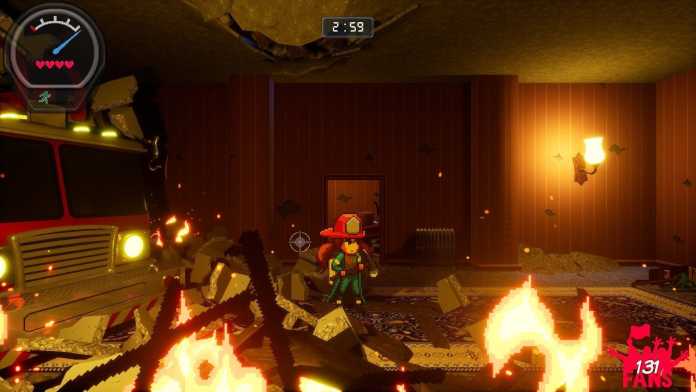
Firegirl: Hack ‘n Splash Rescue is a procedurally generated 2D platformer where you play as a fire fighting and hose-slinging piece of pixel art. With a tight timer and a randomly generated building to explore, you’ll need to hose down the fire and rescue the inhabitants before the blaze engulfs the building and all hope of your steak even approaching being cooked rare is lost. Those hoping for a hack and slash adventure featuring Firegirl, a lesser-known superhero and outlaw who was bitten by a radioactive fire are going to be bitterly disappointed as the titular Firegirl is so named as a cutesy descriptor for a female firefighter and the use of Hack ‘n Splash is a cutesy play on Firegirl having a hose.

The first thing that struck me about Firegirl: Hack ‘n Splash Rescue is the design of the game. A lot of games live and die by their lighting engine. Take Fallout 4 and Fallout 76 – essentially identical games in their design and textures, except Fallout 76 has much better lighting so blows Fallout 4 out of the park (as long as you don’t look closely at anything for too long). In a game like Firegirl, where 99% of the frames of the game involve some flames, it’s great to see that the lighting is up to scratch. With the fire generating lovely flickering lighting effects, casting deep shadows and bathing the whole environment in gorgeous dark oranges and reds, the game looks the part. 

The design is paired nicely with a slight narrative wackiness. You’re not fighting fires as such, you’re fighting anthropomorphised fire monsters instead. When you rescue people, they immediately abandon their promising careers in medicine, engineering and the like and offer their services to your fire department. As soon as you put out a single fire, you’re paraded in front of the mayor for a medal. All of this comes together to make the game feel distinctive and toy box-ey, taking the game-ifiable parts of firefighting into the game and abandoning the harrowing and consequence-laden part that heroic real-life firefighters have to deal with every day. This makes your inevitable failure to rescue a civilian, save the building or even leave the blaze with your life feel like less of a weight on your mortal soul.

Unfortunately, that’s where the nice things I have to say about the game start to dry up, like the remains of a civilian you failed to save from the inferno. Firstly, the controls. You have your standard running and jumping controls – an axe attack on the right mouse button for smashing through doors and destroying debris and a hose on the left mouse button that you control with the mouse pointer to extinguish fires and destroy fire monsters. The hose can also be used for an Iron Man-style boost jump, which is entirely required for vertical traversal. When moving vertically you can also look up and down to work out if anything is in your way before you do a boost jump or drop down to a lower level. The real issue here is how finicky the boost controls are when you’re using them in conjunction with looking up and down. I only have two hands, so holding left click, moving the mouse, holding the jump button and left/right for directions PLUS holding a button to see where you’re going is just not feasible. You can have a quick look before you commit to a jump but, in general, you have to jump blindly into the inferno thanks to the controls and, nine times out of ten, that puts you in a fiery-bad-time. To make things worse, you have a limited tank of water so, if you do crash and burn thanks to the awkward controls, you’ve probably emptied your tank and are doomed to burn in place without the ability to try again. There are water refill pickups dotted around the map, but you can still end up stuck in a hole unable to progress because their location is randomly generated.

That leads me onto the next thing that doesn’t quite gel – the procedurally generated-ness of the levels. Every single level is built up from pre-produced modular pieces which are sewn together procedurally with what appears like very little limitation on what permutations are allowed. This makes everything looks the same so it’s incredibly easy to get lost and means you have no idea where you’re supposed to be going. Am I going left or right here? Should I use my limited water to boost up to a higher level or continue to my left? Have I been here before? I’ve definitely been in an identical corridor before but was it this one or another example of this corridor being used in the procedural generation? This system makes the game incredibly confusing and frustrating. You never have any idea if you’re making any progress which makes you feel disengaged with the whole game and begs the question: What’s the point?

The final nail in the coffin is very much that, a very minor thing in itself but an issue that rubbed me up the wrong way, sealing the fate of this review. To quit the game you have to go to the main menu. When you go to the main menu it shows you the several-second-long opening logos first. If you mash skip to get through those, the skip button is the same as the select button so you select the first option, ‘New Game’ as soon as you get to the menu (which you can’t back out of once you’ve pressed it) and you have to start the whole process again – quitting, skipping and finally pressing the quit button when you finally get to the main menu unmolested. I was having a pretty miserable time with the game for the reasons discussed above, so this barrier to exiting the game dialled my frustration up from around an 8 to a full 10/10.

All in all, Firegirl: Hack ‘n Splash Rescue feels like a bit of a mess. Awkward controls, confusing levels and some antagonistic design come together in a game about as fun and engaging as actually being on fire. As ever, a pretty game doesn’t make a good game and, as gorgeous as the lighting looks, it’s a pretty veneer on an otherwise unappealing mound of gameplay mechanics. With some more development: tightening of the controls, limitation on the procedural generation, a map and some balancing on size of the water tanks, there could be something quite fun and charming on offer. But, as it is, it’s difficult to recommend Firegirl: Hack n’ Splash Rescue.

Review: Trophy

There is a clear divide between the love of modern and dated games. You either adore the pixelated graphics, simple controls, and silly stories. Or you don’t! I love retro gaming and I admire the simple concepts, frustrating controls, and rage-inducing moments. Therefore, Trophy caught my eye thanks to its nostalgia-fuelled moments and sense of “just one more go”.

Developed by Gradual Games and published by 8-Bit Legit, this is a tough and addictive retro platform title. Originally developed for use with an NES cartridge, it now expands its appeal on the Xbox One. It captures everything that made the genre and era fantastic, and I loved the trip down memory lane.

Where it begins.

Trophy has a ridiculous plot.

80s and 90s gaming revolved around bizarre plots and interesting characters. Luckily, Trophy follows suit as very little makes sense. You control the amusingly named Dr Jared Sword. He and Dr Xela Quine befriend the inhabitants of the planet Gearus 9, and Sword returns to Earth to demonstrate his findings. One of the sentient beings called Beeper accompanies him to Earth to prove that robots and mankind can live in harmony.

The plan would have been perfect if it wasn’t for Quine. Sadly, isolation drives the doctor mad, and he genetically modifies the remaining robots. With a deadly army at his disposal, he declares himself Lord Q and plans to take over the known universe! Fortunately, though, not all is lost and only one being can stand in his way. Sword and Beeper use the secret technology of Gearus 9 as they merge to create a robotic being known as Trophy.

As I said, it makes no sense, but let those concerns wash over you. If you can accept the nonsensical story, you’ll love the challenging gameplay and the simple concepts. Effectively, you must move through each stage aiming to survive, while killing every creature in sight. You have limited lives and health, but you must still get to the finish line. You face nine levels and nine gargantuan bosses. Each has strengths and weaknesses, and you must exploit them in order to be successful. Alongside the level ending nightmares, you’ll face an array of creatures and traps that must be destroyed or avoided.

This robot never rusts.

Well-trodden but excellent execution.

Trophy doesn’t tread any new ground and this may frustrate some players. Me, however, I adored its nod to a much-loved era and its challenging ways. Though the levels are small, your enemies predictable, and the bosses can be manipulated, it will still test you throughout. This is a game that is as much about dated aesthetics as it is memorising each stage. You are required to remember every foe you face and the correct path to take. You will need oodles of skill and a healthy dose of luck if you wish to be successful.

Running around while avoiding every enemy is one thing, but killing everything in sight was my go-to option. Fortunately, Trophy is armed with a triple-shot laser, and this deadly tool will decimate your enemies while making you look badass. Blasting your foes while swimming through water, avoiding spikes, climbing ladders, and more was enthralling. However, one false move and you’ll die. Unfortunately, there is no room for error and the brutality of NES gaming is evident in every element.

If you are fortunate, you can collect extra lives or health boosts as your enemies falter. Unfortunately, though, the chances of receiving these bonus items are slim, and this makes the action harder still. If you die, and you will, you will restart at the last checkpoint. Furthermore, if you are unlucky enough to run out of lives, the level is over and you must start again. It is infuriating and you’ll be tempted to swear, rage-quit, or smash your controller.

Trophy is brilliantly dated.

If you’ve played an NES or Master System, you’ll remember the artistic slowdown and pixelated imagery. Trophy has captured this perfectly as the gameplay occasionally stutters to a near stop. Subsequently, this was frustrating at first, but this quickly turned to enjoyment as you begin to love the authentic retro experience. Moreover, thanks to its side-scrolling design, pixelated imagery, and garish tones, this will teleport you back to the 80s immediately.

Nothing screams early console gaming more than synth wave music. Luckily, Trophy has a brilliant blend of hard-hitting and calmer tunes for you to enjoy, and each stage has a unique soundtrack. I loved the variety on offer and the complementary sound effects! The shrill noises and rudimentary sounds are familiar, but they work brilliantly within the genre. It, unfortunately, doesn’t break the mould, but the audio is excellent and it was easy to forgive the lack of originality.

Who would create an evil robot spider?

Easy to play, tough to master.

Retro games lack complexity, and Trophy is no different. You must focus on shooting and navigating each level, and therefore, it is easy to play. However, you’ll be lulled into a false sense of security as it’s tough to master. You must remember every detail while trying to avoid projectiles, traps, and enemies. It’s easier said than done, as the controls are a little clumsy. The protagonist can only shoot horizontally, and this makes tackling some enemies much harder. These limitations test your ability, make you angry, and transport you back to the 80s.

Limited to only nine levels, you may wonder if it’s good value for money. If it wasn’t for the difficult nature of the gameplay, then it would be over extremely quickly. However, the action is wonderfully padded thanks to the brutal bosses and tricky monsters. Furthermore, you must memorise the traps, paths, and creatures on every level. It’ll test your reactions, patience, and memory, and rage-quitting and failure are guaranteed.

Trophy is brilliantly retro. 

Trophy will undoubtedly divide its audience, as its retro gameplay won’t appeal to all. Yet, if you are an older gamer, or simply love old-school titles, you must play this! It reeks of nostalgia, has excellent pixelated graphics, and the synth music is awesome. Then there are the era-accurate controls, brutal bosses, and great level designs. I adored it and I recommend you to buy it here! Can you stop the mad doctor in his tracks? Nine levels and gargantuan bosses stand between you and victory, so best of luck. 

Review: A Monster’s Expedition

0

Do you wish there was a game that could reduce and calm your anxiety? Possibly one that isn’t only relaxing to play, but a little bit puzzling as well? Then, check out A Monster’s Expedition which is both, relaxing while still being an adventure and puzzle game, worthy of playing!

From The Start

When you begin for the first time and many times afterward, all you feel is how the game calms and provides this relaxation that no other puzzling game which I’ve ever come upon could do! The tune makes one’s cluttered and overworked mind easily transitions to a slightly sedative state. No need to say the words om or if it’s aum to feel unity or oneness with everything. Also, you don’t even need to be in a special space or room to feel so clear of mind and stress when you begin just playing this game.

A Monster’s Expedition is the most unique and original game, which also provides such great sound of waves in the background and includes beautiful and realistic graphics. Each of these just works together to build such a tranquilizing and peaceful place for the player. Unless you need loud sounds, violence, and tons of things going on, well then this isn’t that game for you. However, if you can take on the white noise effect with plenty of puzzles to challenge your mind in a mind-boggling, but practical way, this may be a winning choice!

Oh yes, it does help if you love adventure-style puzzle games, as it is a blend of the two. It’s a game that requires a little more planning to get you on your way, but don’t worry you won’t need to use too much brainpower to get through the different parts of this entire worldly adventure. In addition to the surroundings and the sounds in this game, which I’d like to admit that even without the music playing in the background, it can still be quite relaxing. The graphics and way we move within the game, of our character, the monster is great! We are dark and a black-colored creature, which makes it easy to never get lost and stand out quite well within this game.

Our main goal is to continue the expedition, figuring out the many puzzles from one island to the next, making them connect. All by working with what nature-style objects may be around us. It may seem quite simple to comprehend and yet putting it all together can make it puzzling at the same time. Even if this is a puzzle game, there is no need to fear a countdown timer or one that continues to go up, ticking away as you play. It’s so much more about the liberty to take as long or as go as fast as you like. Makes it perfect for all age groups, everything mentioned above. Additionally, there are no horrific graphics to visualize or sound effects to worry about. It’s a pleasant environment for everyone to enjoy and may I add a charming one too!

I do have one negative comment, nothing too harsh. It’s the background sound or music that plays repeatedly. It’s nothing too big to wreck one’s thoughts about the game or how the game plays. The problem I came upon is actually what occurs in the settings of the game. I know right in the front, menu portion. It’s nothing really to do with the music alone but the settings.

When you try to change the volume from loudest to the lowest, well it’s possible. Just the only difference is that it’s not a big difference. Okay, it does turn the sound off and on, but nothing with the music, and you’re given 3 options to adjust. The only one that really matters is the ambiance volume. Something new that no other game has in an audio control setting, as a choice. Well, none that I’ve played yet, till this game.

So when deciding the only sound that matters is the middle, ambiance volume. The higher it is the louder the sound, the lower it is the lower the sound. No matter if the music volume is off or on, it’s playing pretty much the same with every setting you decide to move the others to. I only know this is cause I had all the others turned to all different settings, while even the music and sound volume can be on zero or no music at all and the ambiance is all that matters. So my question, ping-ponging in my mind, is to why include those two others if it doesn’t change anything?

Lets Get Back To The Game:

It really doesn’t seem as if there is much to work hard on understanding. When you play the game, it’s basically moving the monster, which is our character with the controller’s arrow keys and the game’s left analog button if you want to move a bit more smoothly. I’ve played this game on the Nintendo Switch Lite and I’m sure it would be the same when played on the regular console as well.

Additionally, there are a few other buttons one can use on the controller. These buttons are located on the right side that helps you choose to undo, restart or look around the world we are stationed at, as well as the many different islands to come up next. On the other hand, skip those buttons altogether and you can use your finger to touch the screen and make the monster head towards the tree or object and location you want it to go.

Simple and straightforward right? Well, this is a bit of what you need to do to play the game. The objective of the game, the puzzling aspect is what will help you find these humorous and monster views on humanity as well as help you continue the expedition. The puzzle portion is again not too hard to comprehend, just by pushing objects to make one island connect to the next is all it takes.

Regardless of the puzzles, you must accomplish, the game does have a feature I find quite brilliant. It’s all very interactive to the touch on the objects. You can even make the monster, we the player sit down and enjoy taking it easy, relaxing without moving forward if you don’t want to. Another way to enjoy the calming sounds in the background and scenery as well!

Don’t Get Stumped, Just Undo or Restart!

When you have a chance to plan which way a tree trunk should be moved. That could be either on its side to be rolled or pushed from the top and bottom, moving up and down. By the way, yes this monster is strong and can break trees and move the trunks with ease! Anywho, you can make sure to position it correctly to get it to connect to the other side. The only thing, the monster doesn’t jump so don’t expect a floating log that is not a direct walk from one island to the next is considered correct.

This is where restart or undo can come in handy, even if you need to go back a few steps. However, restart is a better method to clear the section and start it back to the beginning. The way I mention it to be easy, well it is easy to many, but don’t be fooled it does get harder and harder to accomplish. The more you move on through the adventure, the more you discover new territory that needs a bit more work to get you further.

It does appear to become a bit mind-boggling, but with any good puzzle game, it’s a must! However, if you’re playing the game through it’s a little bit of an adjustment than just super fast, but there are those simple push-and-go islands where it doesn’t require much brainpower. However, even with some leisure, it’s best to have the game pick up and make it difficult. So I do find that the many things you need to do and work out a good plan to accomplish are going to present themselves.

Nevertheless, using undo or reset really puts you back to that feeling to not worry, you are able to begin again and not take any cost from you, lose points or waste time doing so. It’s all a calming and game that just allows you to restart as much as you like or undo the same way!

Final Thoughts

I feel there is nothing better than a game that puts one’s anxiety on the back burner and makes you feel free from all of the stress going on in the world. This is such an easy game to understand and works with so many different controlling formats. Either touching the screen or using the controller, it’s all perfect and even the game is straightforward.

The music could be strange, as it doesn’t make any sense or much of any adjustment. You really just need to focus on the ambiance. Other than that, the graphics and sound that do play are soothing and easy on the eyes. There is one last thing, a game portable like this can be an excellent way to escape to a more interesting location and feel happier, by just playing or listening to the sounds in this game!

Review: Way Down

I’ve played a fair few games adapted from films over the years, they tend to be as good as film adaptations of games for the most part, i.e not good. Some I can be a tad more biased over others because I’ve enjoyed the film/series, the PC X-Files game I enjoyed but as a game it wasn’t great. the Die Hard game on PS1 all those years a go is a nostalgic classic but I’d say my favourite is probably the PC Bladerunner game, which hopefully is being remastered sooner rather than later. Way Down is actually the film adaptation of the movie titled The Vault released in 2021.

Way Down follows the story of The Vault pretty closely throughout without adding anything new to the concept. Walter’s team of treasure hunters discovered some sunken Spanish treasure, unfortunately the Spanish government don’t fancy sharing the proceeds. This obviously doesn’t sit well with Walter so they employ a brilliant young engineer called Thom when they realise a great opportunity is about to present itself. During the 2010 World Cup, Spain have reached the final, all Spanish eyes are on their Spanish counterparts attempts to bring the trophy home. With such a distraction it gives Walter’s team a great chance to get their hands on the treasure which is buried deep under a Spanish bank.

Way Down’s initial story comes across quite well and engrossing, however it is let down badly by the gameplay lack of getting to know the characters. As already stated Thom is an engineer who obviously is there for all the engineering tasks, Walter & Simon are your tech guys who do hacking roles whilst Lorraine seems to act as the person who investigates buildings the team are interested in. Beyond knowing the roles of each member there is no real backstory and no character is looked at in any real detail which is a real shame.

Way Down is almost played like a series of stages interspersed with mini games. Mini games involve hacking whilst the rest of Way Down is slowly walking to areas of interest. Way Down is a very slow game which is fine where stealth is involved but it’s just too slow and you’ll find yourself losing momentum over and over again. The last area when all the team together is just as boring as the previous elements as well which is just frustrating. The Lorraine elements have a little variety to them as you’re able to converse with characters and choose different answers but it’s only a minor positive.

Graphically Way Down is pretty poor, none of the environments you slowly plod through are particularly present whilst the characters models themselves are fairly forgettable. The start of Way Down actually sets an interesting scene but when you get into it, there just isn’t that much interesting to look at or interact with. Audio is fine, there’s nothing that particularly stands out nor is there anything negative to report on it. There is probably 5-8 hours worth of gameplay but it’s really not worth it.

Way Down starts in an interesting way and with the film plot supporting it there was some hope this would be engrossing bank heist game, unfortunately that’s not the case. There’s really not much to recommend with Way Down because there are just too many elements which let it down whether it’s the slow uninvolving gameplay or the way it looks.

Review: Procession to Calvary

Melting Pot of Madness

What do you get when you mix the aesthetic of renaissance paintings, the sounds of classical music, surrealist dark humour, the vibe of Monty Python, and optional murder and/or mayhem? 

Well for one you get a guaranteed great time. Perhaps more importantly though, you get The Procession to Calvary. A solid entry into the point and click genre.

Please Sir, May I Kill Some More?

You are thrust into the shoes of Bellona, some people may be familiar with her as the Roman Goddess of War. Or maybe you know her from the painting by Rembrandt which the character seems to be directly lifted from. Quite a fitting choice of protagonist, as the game opens with her on a killing spree as part of a holy war. Not long after this montage though, she’s interrupted by a holy man telling her the North has won the war against Heavenly Peter. Unfortunately for her this means she may no longer kill with reckless abandon. 

It comes as no surprise to anyone that she’s not very impressed. In the mere seconds we’ve been following her it’s been made clear that murder is her one true passion in life. And now she’s been told that’s not allowed anymore. As luck would have it though, the Immortal John (the leader of the new regime) has one more reluctant task for her. Although Heavenly Peter was defeated, he is still alive in the South. And that’s one murder that the new benevolent leader could turn a blind eye to. 

Journey to the South

So off you go to a boatman, who will take you to a lugger, that could take you to a brig, which could take you to a full-rigged pinnace, that just might be able to take you to the South. Easy. But of course it isn’t. First the boatman needs his oars back, which he gave to a man lacking a pair of crutches. And thus you have your first puzzle. Find the man, and figure out a way to get his walking aid.

Puzzles are the backbone of gameplay, you’ll be faced with a number of problems and obstacles that will test your wits and push your ingenuity to it’s limits. At least that’s what it did with my ingenuity, humble as it is. The puzzles range from straightforward, such as the aforementioned oar-crutch conundrum. To complex head-scratchers such as finding three pieces of jewellery across the map in order to bribe your way to an audience with Heavenly Peter (Harder than it sounds, I promise).

The Sword is Mightier Than the Puzzle

Something I appreciated was that these puzzles didn’t have to be completed in the set and scripted way. For example, getting the oars could be completed by simply convincing the man to hand them over. The way one might assume they should go about getting them. However, you’re playing as Bellona. Why ask nicely when you have a perfectly good sword at your hip? You have the option of meeting obstacles with violence and getting your way in the worst way possible. Although following this path, may have some unforeseen consequences.

Puzzles will definitely present you with a good challenge, but they’re never impossibly difficult. That being said, there were times when I was well and truly stumped. I found myself on two occasions stuck to the point I had to come back the next day with fresh eyes. And even then I needed a bit of time to fiddle with every interactive object before I finally put the pieces together for that “Aha!” moment. These moments were never really the game’s fault, but my own. The hints were there, but somehow flew over my head. Those moments though, when everything clicked into place was so satisfying I couldn’t even be mad at myself for long.

A Lively One Isn’t It?

This is a game with a lot of character and a very clear idea of what it wants to be. The Monty Python influence is apparent from the get go. From the humour wrought with irony, wit, and the breaking of the fourth wall to the gorgeous visuals that are quite literally paintings come to life. This made it more than a pleasure to play through. I couldn’t wait to meet more people that I could talk to, slap, swindle, or be swindled by. Every single NPC had so much personality, and even when they didn’t speak, they added to the personality of the world itself.

Your journey is humorous and light hearted, even when your objective is murder and the world is filled with people having terrible days. Like a field you come across filled with people being crucified. Dreadful I know, and yet the game remains darkly funny throughout. It can also have rare moments of sincerity. Such as a composer you meet who has reached a low point. Figuring his life’s work and music has no value to society due to the fact that only the rich can enjoy his works. His music doesn’t bring the joy that a wedding band might, or the peace a lullaby provides.

Sights and Sounds of a Painted World

In terms of music, what might one expect from a game, that’s a renaissance painting, that’s a game? Classical music! You have songs from household names like Bach, Vivaldi, and Beethoven. As well as a couple of songs I’d never heard of but almost instantly added to a brand new classical playlist such as Wagner’s Siegfried. These tracks were of course a perfect fit for the aesthetic and time period. However, Procession to Calvary took things a step further and had music actually be played by NPCs in game. You’ll see a group of people playing brass instruments as you enter an area, or a jester going absolutely crazy on a flute. I loved that touch more than I expected.

I’ve used the word painting a good couple of times by now. But for good reason. Just take one look at any still image from this game and it makes it abundantly clear. But it’s not just the look and style of renaissance art. There are literal portraits and other paintings brought to life in this game. The most obvious example being “The Girl with a Pearl earring” by Vermeer as an NPC you interact with as part of your objectives. 

Many paintings from this period are rightly hailed as masterpieces, therefore a game with that visual style is bound to look great. And it definitely does. What makes it more unique however, is in the movement of objects and people. They move in a sort of marionette fashion. With elbows, shoulders and knees as points of leverage for motion. This creates a really goofy look in the movement that suits the tone of the game perfectly. Especially in Bellona’s running animation, which is just ridiculous. 

Short and Sweet

It’s not the most lengthy game. A quick thinker could probably get through it in around two hours. Yet it took me over three times as long. Thankfully, we’ve already established that I’m not always the sharpest tool in the shed when it comes to this genre. 

Overall Procession to Calvary is an easy game to recommend. It’s got a lot of style. A lot of personality. It looks great, has a solid soundtrack, and allows you to be an absolute monster if you’d like.

Review: Chorus

I love the escapism of video games! It allows me to forget about the real world while taking on tasks that are otherwise unobtainable. One genre that piques my interest is science fiction, and in particular, space shooters. Therefore, when Chorus was announced, I was genuinely excited. Thanks to its fast-paced action, beautiful aesthetics, and lore infused plot, I couldn’t help but start salivating.

Developed by Fishlabs and published by Deep Silver, this is a Good Vs Evil open-world Sci-Fi title. You’ll spend much of your time blasting through space while completing side quests and seeking revenge. It’s a game that sounds fantastic, is wonderfully acted, and looks great on the surface. However, as you get into it, you see niggling issues that taint the polish ever so slightly.

Chorus has religious undertones. 

Every great story has an element of David Vs Goliath. No one vies for the favourite and everyone secretly wants the underdog to win. Fortunately, Chorus uses this theory beautifully in its lore infused and religious plot. The Space-cult known as the Circle is a power-hungry entity that stops at nothing to get what they want. People matter not, and war crimes and atrocities are committed repeatedly. The only thing to stand in their way is the rebels. This hardy yet under-resourced group has heart and desire, but that isn’t enough to stop the bloodshed. No, they need a fearless hero to help their cause, and this is where Nara steps in.

She was once a key weapon in the Space-cult’s ghastly plans. Her cold and calculating ways allowed her to commit evil acts without issue. Yet, even heartless beasts have a breaking point and when Nara snapped, she knew she had to help the rebels. Assisted by ungodly powers, a sentient ship, and abilities known as rites, you must take on side quests and the main story. Along the way, you’ll find new areas of space to explore, interesting puzzles to solve, and ball-breaking bosses to overcome.

BOOOOOM!

An eye-opening internal monologue. 

Nara feels guilt and regrets as she has spent her life completing heinous tasks. Yet, listening to her guilt-ridden dialogue is a little depressing. Furthermore, if you combine this with the lore heavy plot, you have a considerably overwhelming experience on your hands. Fortunately, though, the freedom to explore the vast environments and the array of quests on offer reduce the pain. Furthermore, the introduction of Nara’s sentinel ship Forsaken helps further still. The special bond between the two strengthens as you progress and I loved how it added a human touch to a cold world. 

Outwardly, Nara offers a friendly or hostile persona. However, her inner monologue highlights her true thoughts in any situation. It was intriguing to see how each moment developed and how the relationships formed. It was a clever idea from the developers that helped to build rapport in a subtle way. 

Dogfighting at its best. 

Blending a vast open-world with intricate space combat is no mean feat. Many Sci-Fi games have tried and failed to get the mixture just right. The normal gripes of chasing fast ships while continually spinning on the spot are both annoying and nauseating. Fortunately, however, Chorus has got this element balanced perfectly. With a combination of excellent controls, interesting locations, and amazing free-flowing mechanics, dogfighting has never been so good.

You can upgrade your ship to improve weaponry, shields, and add mods. Alongside this, your rite abilities allow you to strafe, teleport, temporarily disable your foes, and more. It was truly wonderful to dodge lasers while unleashing hell upon your enemies. Tackling space pirates or simply blasting through space was an enthralling experience. I never tired of unlocking new areas or destroying capital ships.

These hulking machines are laced with turrets and are tricky to destroy. Sadly, you can’t fly in all guns blazing. Instead, you must be tactically savvy. You must destroy key areas before venturing inside to finish it off. Subsequently, it can be a little frustrating when you can’t find the key components required to complete the task. However, with a little patience, you’ll enjoy the challenge that these behemoths present.

Don’t mess with Nara!

Nara looks incredible, but Chorus is lacking elsewhere.

I was amazed by the attention to detail and the animation of Nara in the cinematic. The developers have invested an incredible amount of time and effort. Therefore, it was disappointing that this didn’t continue in every element. The NPCs are faceless and comprise limited models. Sadly, this continues with the vehicles. You’ll witness the same ships repeatedly, and this annoyed me.

Though there are shortcomings, I found the exploration to be truly enthralling. With a vast world to explore and brilliant environments to discover it was excellent. I was amazed by the variety of space debris, planets, anomalies, and more. It was wonderful to take on numerous side quests while searching the interesting landscapes.

The brilliant story was enhanced beautifully by Nara’s fantastic narration. Both her forceful and blunt dialogue are complemented by her inner thoughts. This was supported further by the phenomenal sound effects and great music. Its blend of soft and high energy music and thumping noises are wonderfully futuristic.

Step carefully.

Excellent controls.

A space combat title with poor controls is unforgivable. Fortunately, though, Chorus is fantastic to play. Its free-flowing and accurate setup allows you to play with ease. It was thoroughly enjoyable to combine the rite abilities with the traditional space combat mechanics. Therefore, fans of this genre will adore Fishlabs’ approach and eye for detail. Moreover, the action is supported by a clean UI that makes selecting weapons a cinch. Furthermore, the waypoints are clearly displayed, and this makes exploration much easier.

I love open-world titles but find the likes of Assassins Creed or Far Cry overwhelming. With masses of collectables and a ridiculously large quest list, there is almost too much to do. Fortunately, though, Chorus gets the balance just right! With a nice variety of side quests to polish your combat skills and an interesting story to experience, you’ll want to keep playing. You’ll easily invest around 20+ hours to get through the story, and a large achievement list will test you along the way.

Chorus is a fantastic space combat game. 

Chorus is a game that does most things right! Yes, there are shortcomings that impact the final polish, but many elements paper over those cracks. Much of the gameplay is phenomenal and the protagonist and story are genuinely interesting to experience. It’s a fantastic example of the genre and I recommend you to buy it here! Revenge is all-consuming and you must stop at nothing to stop the evil Space-cult. 

Review: Terminator: Resistance Annihilation Line

It’s weird to me that nobody has managed to make something of the Terminator, after the second movie. It’s a very interesting franchise, visually and narratively, build on some simple but very effective ideas. There’s time travel, there are post-apocalyptic backdrops and killer robots. It should be enough and it should be relatively easy to capitalize on the success the franchise had at its onset. It should be relatively easy, then, to create another piece of media that is at least decent. However, after the first two movies, nobody seems to be able to understand what makes this franchise special. Or, maybe, some creators do understand but lack the expertise or the means to succeed.

In this latter mentioned category falls the game Terminator: Resistance. A budget title that was released on January 7 2020, it was rough around the edges and old fashioned in many design aspects, but showed a love for the franchise and nailed the overall atmosphere.

Now, there’s an enhanced version for the PlayStation 5 that released on April 2021, that irons out some of the problems. With loading times that are significantly shorter and some boosts on performance, the enhanced edition is the best one for sure, even if it doesn’t address all the nuisances. The updated edition included a new mode too, a roguelike-like one that had us fighting for the “other side”, for the robots. It was short, cool, but plagued by the same annoyances more or less.

After the updated version, we have some new content in the form of a 4-hour long DLC called Annihilation Line that’s more of the same, mostly. If you enjoyed the main game, chances are you will like the new addition too. If not, it will not win you over.

This is a new story that takes place around the middle of the main plot of Resistance, branching in a new path with some new characters and happenings. It’s not a great story, but it’s decent standard fare to be used as background for a simple game. You can play without really caring about the plot; bad robots do bad things, good human survivors fight them, you go to save some hostages. That’s the gist of it. Oh, if you are familiar with the franchise, you will hear some name-dropping too. Bad enemy T-800 are doing bad things, good human survivors are led by Kyle Reese to save hostages. There is a fair amount of fan service here and it’s mostly enjoyable.

The developers’ love for the franchise is more evident by the overall audiovisual presentation. The sounds are reminiscent of the ones we heard in the movies, the music too and it’s also very good and atmospheric, the visual design of the post-apocalyptic places is spot on. It’s a shame then, that the characters are totally bland and forgettable. Everyone is interchangeable here, the dialogue is wooden and boring and there are some meaningless dialogue choices too.

Continuing on the meaningless trend, this is still a game that doesn’t know what it wants to be. There are many light RPG elements that serve absolutely no purpose, like crafting, leveling up, lockpicking, hacking etc. In the main game, it was still unnecessary. Here, though, those systems feel like extra burden for what is otherwise a standard shooter set on some decent open ended levels. The shorter time is to the game’s advantage for sure, making for a tighter experience this time around, but the many added systems are unneeded baggage. Also, the gunplay, even though it’s better now, it still can’t compare to other shooters and feels a bit left behind.

There are some improvements to be found, thankfully. The enemy robots are a bit more efficient, can aim better and are harder to destroy -as boring as their types still are. This way, the harrowing robots feel somewhat harrowing indeed, aided further by the better looking metal textures of the enhanced edition. The combat is slightly harder, the pacing is better, but the rest doesn’t make a good impression. The worst offender is still the mission design, which is really boring and uninspired. Also, some visual glitches are present, with robot heads turning frantically and walls turning invisible for no reason. The textures are a bit muddy, the character models wooden and the animations leave a lot to be desired. The game is in better shape, compared to the one we saw at its launch, but is by no means a triple A game, or even a double A one.

It’s simple, really: if you are a fan of the Terminator franchise and especially if you enjoyed -even a little- the game Terminator: Resistance, and if you know what to expect, you will enjoy the DLC. It’s not bad, it’s just a bit uninteresting and generic, but can be saved by its love for the source material and the way it expresses it. If you don’t care for the Terminator series, there’s nothing for you here. For better or worse, Terminator: Resistance is the best Terminator game, and its DLC is just more of it.

Review: Cosmic Express

0

Do you love the originality in games, including the design and music? How about puzzles that get tricky as you move on, but you’re still able to try so many different ways to complete it? Maybe it’s time to lay down those train tracks and try out Cosmic Express!

Honestly, what this game really does is that it brings so many fun enclosed puzzling environments to play through. Each being a bit trickier than the last, and still a whole bunch of fun! Especially, because it’s a bit of a free to do as you please type of game. There is no exact one right way to win, but a whole bunch of possible ways. Then again, it also depends on the level’s design. If there is less activity or obstacles on each puzzle, then there are many more available paths to build a route from the entry to the exit.

Positive Reasons to Love The Game

A few well-known features that caught my attention right away would have to be the beautiful environmental graphics. It’s fully a space-styled-themed game, but I always get this feeling that there is a slight feeling of winter or some type of snow-related mix as well. Possibly could be from the passing holiday feeling or just that it’s the actual season of winter in the real world. Add those two feelings and the addition of this game’s graphical appearance, the background in the music, and even the colors associated with each level, it is hard not to feel a bit chilled and like you’re in the icy, depths of space. I guess that makes sense, space being cold and all.

On top of the sound in the background. The music gives you a calming and relaxing feeling. There isn’t much to the tune playing, just enough to give you that space-chilling theme of the game and yet plenty of room to keep a clear mind to figure out the puzzles in front of you. Actually, that is something one can be thankful for, nothing distracting or irritating while you play including the sound effects.

Additionally, the levels are big and a bit like an open space. Clear enough to see and not be distracted by the extra worldly environmental graphics or objects you need to work with while playing the game. Plus playing on such a smaller Nintendo Switch screen, the game is still clear enough and so easy to see everything, making it just superb! All is very easy to detect and makes it fun as a puzzling portable game!

Let me add one more positive note about the game! It’s very easy to understand right from the beginning. Gratefully, this is something I like most about the game, which is that anyone in many age groups can pick up and play. The buttons, which are mapped out on the side of the game levels, each one you play makes it very simple for no one to forget what does what.

My First and Closing Thoughts

At first, Cosmic Express felt like a winter wonderland, enclosed in a bubble. However, I realized it was a space-style, puzzle game. Nothing wrong with that, it’s actually ended up being very fun and what I love most, tricky!

I almost felt it would be too easy, but it really isn’t. The first level was a piece of cake, and I guess I got that feeling I’d beat the game in less than an hour or at least get through so many worlds or stages in no time. However, it actually is a bit difficult as you move on. Even if the first level sets you up on what you can expect and how to play. That little taste of the game isn’t really how easy it will be as you move on, just so much more to learn and to do!

You really have to start thinking and using a bit of planning before letting the train run in this game. Thankfully, the tracks you would lay down can be erased and repositioned a few different times or restarted from the beginning. As the goal is to get the train from one side to the next, but also to get the alien-like creatures to their expected locations and it’s not only just one set but a few of them in each level.

Lastly, I must conclude by saying that this game is quite fun! It’s a challenging, yet a game that I can see spending hours trying to figure out and not that it’s hard to understand or too much to learn to actually play it. Just that it’s got a bit of a challenge that comes in each puzzle, making it a strategy puzzle game and perfect for those who want to beat boredom and spend time using their noggings a bit more than usual!

Review: Castle on the Coast

My video review with footage captured on my Xbox Series X, enjoy!

Feuding friends and terrible arguments are nothing new when emotions are raw. Sometimes all it takes is a sympathetic ear and a calm soul to solve the situation. However, when that doesn’t work, a bit of crazy action usually resolves the matter. Castle on the Coast captures this idea in its eclectic and silly world.

Developed by Big Heart Productions and published by Klabater, this is a 3D arcade adventure title. It focuses on collectables, unusual landscapes, and emotive subjects. You’ll explore some weird and whacky areas, meet some interesting characters, and gather unusual items.

Castle on the Coast is a slow-burner. 

As the game opens, you’ll wonder what you’ve let yourself in for. The clunky imagery, lacklustre controls, and weird story all seem dated and unattractive. However, if you can battle past this, you experience a heart-warming tale and some truly interesting environments. 

You control George, a mute giraffe who loves to help others. He stumbles across the Castle on the Coast and discovers a group of hapless orphans. These abandoned kids are “minded” by a pair of warring magicians who are no older than they are. Aleandra and Vendrick have lost their magical parents, who saved the world from a rampaging dragon. Subsequently, they take out their anger on those closest to them. Therefore, this uncomfortable story touches upon loss, conflict, and loving your enemies.

Aleandra loves fire.

Retro vibes.

The PS One and original Xbox were renowned for their platforming adventure titles. Castle on the Coast is distinctly reminiscent of this era thanks to its aesthetics, controls, and cooky storyline. This was fantastic if you craved a little nostalgia combined with a new and unusual plot. However, it may be off-putting for anyone that wants depth and finesse.

The story revolves around the magical castle and its secret portals. These colourful gateways connect a forest, ocean, skate park, and more to the central library. Here the orphans reside, waiting to access the tower that houses their wizard masters. By collecting magical orbs and keystones, you unlock the gates that connect the world.

En route, you also find purple orbs that unlock costumes for George. He can be a knight, a wizard, a child, some boxes, and more. Unsurprisingly, most of the gameplay is nonsensical and you must accept the madness that unfolds.

Its strange but inoffensive ways make it a perfect family game. Helped further still by its couch co-op option, this is a chilled title that can be enjoyed by young and old alike. 

Avoid the frogs.

Castle on the Coast is graphically lacklustre. 

I don’t need great graphics to enjoy a game, however, Castle on the Coast is distinctly lacklustre. Its chunky, clunky finish is dated and sadly leaves a lot to be desired. Furthermore, its style went out in the 90s and it’s poorly polished. Moreover, there are endless problems as George clips the scenery repeatedly and collides with invisible barriers. It’s frustrating as hell as it detracts from the other great elements. Graphical fidelity aside, you’ll enjoy a colourful cartoon world that combines fantasy images with a surreal dreamscape. The bizarre nature of each area can be disorientating, but once you understand the navigation system, you’ll enjoy what’s on offer.

The audio combines tedious soundbites with wonderfully folksy tunes. It was a strange mix, but it brilliantly delivered the emotion while also annoying you. The NPCs repeat the same limited lines and the sound effects are bizarre, yet the music is fantastic. Fortunately, the well thought out soundtrack prevents this from becoming a tedious and painful mess. 

A snowman in a library, why not?

Drifting movement. 

I despise rough and badly implemented controls and sadly, Castle on the Coast is cumbersome. The movement is sluggish and lacks accuracy, and this causes endless problems. You’ll struggle to navigate platforms, fall into pits, and die repeatedly. Furthermore, there are abilities you don’t use and this causes you confusion. Fortunately, though, everything is just about serviceable, but it could have been much better! If the developers had simplified things while tightening the controls, then the game would have been much better.

The core concept is simple, and each area lacks challenge! Yet, the introduction of co-op action, various costumes, and collectables increase longevity. A speed run option adds to the replay value alongside the large achievement list. Subsequently, it offers reasonable value for money and a reason to keep playing.

Castle on the Coast could have been great. 

It’s always frustrating when a game falls short. This is especially true when many of its elements are fantastic. Castle on the Coast has a strange but touching story that’ll resonate with many. Its levels are interesting to explore and the collectables are hard to find. I also loved its music and the blend of characters you encounter. Sadly, though, the graphics and controls are lacking and the sound effects are tedious. I loved the ability to play co-op and its cooky ways. Therefore, I enjoyed it despite its shortcomings and recommend you to buy it here! Will George do the right thing or are the kids destined to fight eternally? Gather the collectables, explore the world, and make new friends.