Review: Ruined King: A League of Legends Story

Before we get into the Ruined King, let us discuss how we got here.

For over 10 years, Riot Games had exclusively focused their developmental efforts on creating and maintaining League of Legends. This paid off massively for them as League rose to unfathomably heights, and still remains today as the most concurrently played title worldwide.

However, on League’s 10th anniversary, Riot announced that they were aiming to expand their catalogue, and were going to put the S back into Riot Games. They began with the launch of the competitive FPS Valorant, and followed up shortly thereafter with the digital collectible card game, Legends of Runeterra. They also branched out of the gaming space late last year, when they partnered with Netflix to release the hit animated series, Arcane.

In the midst of this, they also created the publishing company ‘Riot Forge’, allowing them to outsource their IPs, and collaborate with various indie studios. This is what led developers Airship Syndicate into creating the ‘Ruined King: A League of Legends Story’, and it is that which we will be discussing today.

Story

The Ruined King is an isometric, turn based RPG, set within the fictional world of Runeterra. The story revolves around a mismatched group of heroes on their journey to stop the sinister Viego, and the apocalyptic curse known as the Harrowing.

The playable characters, which consist of Ahri, Braum, Captain Fortune, Illoai, Pyke and Yasuo, are the true backbone of the narrative. They are all situated in the port city of Bilgewater for their own reasons, but it is the looming danger of the Harrowing which brings them together as a team. You find out more about their motives and backgrounds as you progress through the story, and the game does a stellar job of blending it seamlessly into the main plot.

None of this would be possible however without the all-star cast of voice actors, the likes of which include Laura Bailey and Liam O’Brien. They perfectly capture the dynamic of what it is like to be in a roleplaying party, and it seems as though the dialogue is often trying to mimic that of a D&D session. In the end, it was their performances that created a deeper level of immersion for me, and in turn, is what made me truly care about the outcome of the story.

You might ask, “will I still enjoy this game if I haven’t played League of Legends before?” While I do believe you might get more mileage out of this if you’re already a fan, the answer to that question is still a resounding yes! Airship Syndicate have done an incredible job to accommodate any new players that are venturing out into this universe for the first time.

Art

The art direction is similar to the one used in League of Legends, but leans a bit heavier into the graphic novel stylization. This ends up working to the games favour, as characters personalities shine through in the forefront, while backgrounds still remain vibrant and lively. Combat sequences were another visual treat for me, though admittedly, the animations did get a little repetitive after a while. Thankfully, Airship Syndicate have provided players with a way to increase the combat speed, so once combat exhaustion does set in, you can turn that on to make things a bit more manageable.

There are only two regions in the game to explore, those being Bilgewater and the Shadow Isles. Other regions like Ionia and Freljord are referenced, but you sadly never get the chance to sail out and see them. I personally never felt tiresome of the locales I was exploring, so this didn’t really have an effect on the game for me.

Gameplay

Exploration

Traversing the game is all fairly standard and straight forward. Speak to NPCs to pick up quests, buy and sell items from vendors, and so on. There are puzzles to solve out in the wild as well, and these help to break up the standard gameplay loop.

Additionally, there are couple of side events you can partake in. The first of which is the bounty board, which rewards you for tracking down and defeating powerful enemies, and the other is a fishing mini-game. While the latter was fairly relaxing, it lacked any real substance to keep me entertained for prolonged periods.

Battle Mechanic

The combat in this game uses a system called ‘Lane Initiative’, which, for all intents and purposes, is an innovation to the combat timelines seen in the likes of the Trails series. For those that don’t know, combat timelines provide you with information on when everyone will be making their next move, thus, allowing you to make more tactical decisions.

The combat timeline in the Ruined King is referred to as the Initiative Bar, and it is split up into three separate lanes called ‘Speed’, ‘Balance’ and ‘Power’. Using an ability in the ‘Speed’ lane will make that action preform faster, but as a trade-off, it will be slightly weaker. ‘Power’ will make your action take longer to execute, though it will pack more of a punch when it does. Lastly, the ‘Balance’ lane acts normally, and has no changes in speed, or ability potency. You’ll also have to deal with regional effects which apply varying buffs and debuffs.

While the Lane Initiative system does a nice job of improving upon an otherwise stale design, it unfortunately made the game a bit too easy for me. The lack of any really challenge made combat sequences rather boring, and this even while playing it on its hardest difficulty.

That’s not to say that the Lane Initiative system doesn’t have potential though. If Airship Syndicate are going to do a sequel, I hope they build upon the foundations they’ve made here, and create a more robust system with additional features.

Customization

Of course, no RPG is complete without character customization options, and the Ruined King has a fair amount of depth when it comes to this. For starters, each ability comes with its own mini skill tree, so you can modify the way that they work to suit your needs. Additionally, entire characters can be spec’d into specific avenues, so if you want to change your healer into more of a damage dealer, there is options to do that.

There is also a plethora of gear to find within the world, which come with different properties and affixes. You can also enchant the gear to give them additional benefits and traits, or, to mix up the way that they work entirely.

Audio

On the audio side there really isn’t too much to say. The arrangements made for the soundtrack are perfectly suitable for what they need to do, and the sound effects are crisp matching that of their visual counterpart.

Final Thoughts

The Ruined King is varied enough that it kept me entertained throughout the majority of my playthrough, but combat fatigue eventually left me feeling a little exhausted by the end of it. While the story is fairly simplistic, the charming characters, mixed with the sublime art style, made it a fun jaunt overall. If you are a fan of League of Legends and turn-based RPGs, then this is the game for you. Otherwise, I’d recommend waiting until this goes on sale before picking it up for yourself.

Review: Lumote: The Mastermote Chronicles

0

Do you have what it takes to help return the ocean’s bioverse back to normal? If you think you have the time to solve some challenging puzzles while guiding our little hero in this game, Lumote to the end of each location safely, then you should give this game a go!

Lumote: The Mastermote Chronicles is a fully illuminated 3D-style platformer that is not only an adventure game that needs you to find the exit, without getting harmed. Instead, it’s a puzzle game, which requires you to lead Lumote to the end after figuring out the correct way to do so. Each level is designed as towers in the sea, but the problem is mainly the puzzles you’ll face, as some may be a bit more tedious than others.

By the way, each of the beautiful levels glows so brightly from its design, and as Lumote takes a step, bounces, leaps, or in any other way interacts with the objects and ground, he also makes the tower-style levels light up. Many of the wonderful abilities Lumote possesses will be taught through the first portion of the game. As he can do so much without speaking and just using his unique creature-style body to interact with the other bioluminescent creatures and objects. Plus, there are many collectible items to be discovered and they are hidden around each part of the level, another side goal to enjoy while playing.

Oh yes, Lumote may be cute, including his adorable appearance and noises, as much as how beautiful the levels appear. However, cute doesn’t mean easy! This game will have a variety of hard to easy puzzling levels and some may be fast to solve as others may take some time. So if you feel you have the time and want to use your logical knowledge to figure out each level, then let Lumote brighten up your day!

Graphics and Sound

The game supplies a variety of luminescing colors, which works with the entire sea theme of the game. I loved the bright and lit-up levels design on these high towering platforms. It was really an excellent idea for the ocean bioverse design. Each towering platform has a squared-out design, simple and safe for moving around on, but the only issue is that it’s not safe if you miss the ledge. The edges aren’t blocked so you will fall fatally if you end up not getting on the ground fully. Nevertheless, it’s just what the game should include making it a bit more challenging than just about going easily through the levels without the chance to mess up.

The character’s design and the other bright creatures, really add a bit of friendly and welcoming love to the game. Making it perfect for anyone to play. No gore or fear in this ocean-style game, just tons of cute and adorable gameplay. Additionally, the movements were very normal to a platform game or one that you’d get when playing as a human. There is no flowing or swimming, even if it’s based in the sea. If you want to go left, right, jump or do anything else, it’s all controlled very easily with the remote and isn’t anything spectacular or different because of the game’s theme or character.

Possibly the way to interact with items may be unusual, but there isn’t something too pronounced that will stick out as much. One pleasure is that there are no worries of restrictions to move or get to leap higher; double jump in this game. Plus, the music that plays in the background is a perfect water-based game sound. It really complements the game quite nicely, adding this lovely tune to the underwater theme. So are the cute sounds of Lumote as he moves and interacts with items. Some sound human-like and others more of just cute noise.

Final Thoughts

Lumote: The Mastermote Chronicles is such a luminous adventure and puzzling game. It’s absolutely full of levels to enjoy, with plenty of tricky obstacles to figure out. Some may go super fast, while others require a few learned skills and some logical thinking to figure out. I honestly love the difficult level of the game, it’s not too hard or too easy, but just one of those games that require more thinking than simply using weapons to defeat an enemy.

I did find a few features to be absolutely great, and it’s not including just the eye-catching character and level design. The game has a really easy-to-use and sensitive camera rotation, allowing a view from above, below, left, or even right. There is no blocking of the visible portions of the game. Another one is that I also enjoyed that Lumote can double jump. Many games don’t have this and I’m so used to it after playing others. It allows me to reach the height I want or just fulfill that need to click the button twice. Lastly, the level is in one single location, not a bunch of loading time is required.

However, there is one issue that I’ve encountered in the game when you mess up, sometimes it could be an issue or it could be still repairable. You have to plan right and restart that section, which is great that it saves each time you complete a portion or you’ll have to start it all over. Sometimes, I wished if there were no moves it would warn you that no further moves were available and you will need to be restarted. Just think it would be easier, but it’s just a small thing and my own opinion.

Lastly, this game is very nicely designed and the puzzles are challenging, requiring sometimes a few mistakes till you get them right. However, I love the use of logic when it comes to solving puzzles than playing a game to defeat enemies. Additionally, the sea-like background music, 3D graphics, and cute characters all play a great part in the game and it all just works! So if it’s solving puzzles under the sea where it’s lit up with plenty of bright-neon style lights and this cute bioluminescence style creature, well this is a fun game to wrap one’s mind around and be absolutely entertained with the lights.

Review: Trek to Yomi

The path to righteousness can be complex and full of heartache. You are often left with many difficult decisions, and those that you love may get left behind. However, the rewards usually outweigh the negatives even if your soul disagrees. This is the idea behind Trek to Yomi. It is a dark and sombre game that captures the brilliance of Japanese culture.

Developed by Flying Wild Hog and published by Devolver Digital, this is a fighting action-adventure title. It has a phenomenal cinematic that creates a moody and mystical atmosphere. Furthermore, it combines realistic elements of Asian life with bizarre and often unnerving surreal moments. On top of this, it has a fantastic story, interesting characters, many skills to unlock and collectables to find.

Trek to Yomi tells a classic story.

I have always admired Japanese culture and the “Way of the Samurai”. Therefore, whenever a game depicts this theme at its core, I jump right in. Luckily, Trek to Yomi blends realism and surrealism beautifully. Even when the game goes into a dreamlike state, it doesn’t leave its roots behind. Consequently, the story and the gameplay flow nicely, especially when you have no idea of what’s happening.

The plot revolves around a young Samurai called Hiroki. His master is dying, and he promises to protect the village and the people he loves. Sadly, this vow is tested when his once peaceful village is attacked. Caught off guard, and desperate for victory, Hiroki is led astray. This error costs him and the villagers dearly, and he must battle invading forces and brutal overlords if he is to right the wrongs.

Trek to Yomi looks amazing.
Slay your foe.

A short game.

Set over 6 chapters, Trek to Yomi can only be considered a short title. Now, you may want more bang for your buck, but worry not! Luckily, this is available as part of the Game Pass subscription. Consequently, you have nothing to lose by trying this visual masterpiece. Yes, I’m jumping in early on with my love of the graphics, but I can’t help it. Trek to Yomi is simply stunning to look at. With monochromatic visuals and authentic landscapes, it is easy to admire what unfolds. Yet, just because it is beautiful, doesn’t make it a phenomenal game. Sadly, there are many shortcomings that hold back its potential.

First, the rigid linear focus makes the world feel small and claustrophobic. This isn’t usually a bad thing, but the environment is so inviting (in a macabre way) that I was disappointed that I couldn’t explore it. Second, the combat is awfully lacklustre. There are an array of warriors to tackle and weaponry to use. What’s more, you unlock plenty of combo attacks, blocks, and equipment to balance the books. However, repetitive and dull encounters make this element a bit of a damp squib. Third, there are too many save points. Shrines heal you while saving your progress. This happens so regularly that there is next to no risk in any given situation. Consequently, death has no meaning and your loss is minimal, so you go balls to the wall every time.

This was particularly poor in a game set around discipline, skill, and combat. I wanted to slice off limbs, time my blows perfectly, and dodge my enemy’s advances. Instead, I hacked away like a maniac and rarely did this approach fail me. There is, of course, a stamina bar to consider as well as tougher opponents, but both rarely held you back. If the developers had tightened this up, the game would have been much better.

Trek to Yomi is sombre and full of death and destruction.
Avoid the arrows that rain down on you.

Trek to Yomi was interesting to explore.

Though much of the core gameplay disappointed me, the level design did not. I’ve already gushed about my love of the visuals, but each chapter’s sprawling landscapes were just as good. With limited exploration options, it could have been a mundane and lifeless experience. However, leaping across buildings while killing your foes with barrels or other objects was fascinating. Furthermore, searching for stamina and health boosts, new attacks, or collectables was excellent. Secrets were hidden in plain sight, and finding every one of them wasn’t easy.

Alongside the captivating environment was the amazing audio. The persistent sound of terror and loss was haunting as you explore your surroundings. A torturous and sombre atmosphere is created thanks to the harrowing noises and horrific images. Dilapidated villages are matched with the roar and crackle of the fire and the shrieks of mourning villagers. It is hard to say that I loved this brutal experience, but I can’t help but admire what I saw. Moreover, you are immersed in the action thanks to the use of subtitles and authentic Japanese dialogue. You may despise the use of subtitles, but it was the perfect accompaniment to add to the realism.

A sombre but beautiful world.
Such a beautiful world to look at.

The controls could have been better.

I’m not the biggest fan of multi-button combo attacks. I find them to be overly complex, usually poorly thought out and tough to execute. Unfortunately, most of this is true of Trek to Yomi as you try to remember a long list of unique commands. With finishing moves, heavy attacks, light attacks, blocks, and ranged weaponry, there was an awful lot to master. Annoyingly, no matter how many moves I was given, I stuck to what worked. Luckily, however, the fundamentals worked well and were responsive. This meant that you could pick it up and play without worrying about massive combos or complex moves.

With only 6 hours of gameplay, this is a short but stunning game. Sadly, if you are not a completionist, you won’t get the most out of it. However, if you love to search every nook and cranny, you’ll enjoy exploring each chapter fully. Subsequently, finding every collectable isn’t easy and many of the secrets can be overlooked. Therefore, if you are a completionist, you’ll have your work cut out for you.

Trek to Yomi could have been better. 

Many Game Pass subscribers will love the cinematic experience and story-rich gameplay. However, Trek to Yomi could have been much better. With overly complicated controls, poor combat, and strict linear progression, it is too restrictive and frustrating. I loved the immersive atmosphere and the deep lore, but there are better Samurai games on the market. All things considered, this is worth trying and can be purchased here! Will you keep your vow or will you let yourself and your people down?

Review: Moon Knight Episode 6

Spoiler Free Review Moon Knight Episode 6

Although this is a spoiler-free review of Moon Knight Episode 6 all images used have been taken from the episode.

Moon Knight Episode 6 picks up right where the previous one ended and shows us the fallout of that fatal incident. What takes place is a race-against-time to save the world, and perhaps on a more personal level for the players to save themselves too. May Calamawy shows us that anyone can be a hero and, as we’ve seen all along, she is a force to be reckoned with. The character of Layla is fantastic and the development she gets in this episode is a ‘leaping-off-the-sofa’ cheer moment. Moon Knight deserves more episodes just so we can see more of Layla being awesome.

Ethan Hawke’s villainous Harrow is hell-bent on releasing the ancient Egyptian goddess Ammit to fuel his cult’s goals of exacting judgment. They’re targeting the souls of people who may not have even committed the crimes yet. Harrow has more depth than this, we really see the inner workings of his troubled mind and the nuanced performance is chilling.

It may come as no surprise that Oscar Isaac shone once more as the title hero. Playing multiple people sharing a scene is never easy, but he does it perfectly. He also brings his own flair to pre-existing comic book characters. We also get to see Moon Knight in action for a large part of the episode. It certainly feels more ‘superhero show’ when he dons the suit, but it also feels like so much more.

Moon Knight Episode 6 is a solid conclusion to the series. The stories are rounded out nicely, with room to expand into another series or movie if needed. It doesn’t feel incomplete. While a shame if we never saw any more Moon Knight, I’d be satisfied with this series as the MCU representation of one of my favourite comic book characters. The episode was nicely paced without rushing the conclusion as these things can often do. The action sequences were awesome, with wonderful shots displaying the fighting sequences well with the backdrop of impressive CGI action. Overall, this episode is as strong as the rest of the series and a satisfying watch.

Make sure to watch the mid-credits scene!

Thoughts on the series

Moon Knight Episode 6 concludes this Disney+ masterpiece in a wonderful way. It was slated for the longest time as a limited series, but I hope they change their minds. Moon Knight deserves more episodes. Simply, it’s the best series to have appeared in the MCU Disney+ line-up. It’s full of action, has deep lore, blends comedy with heartfelt topics wonderfully, and best of all? Addresses mental health in a way that most shows shy away from. Every character is brilliantly developed, and Oscar Isaac is superb in the title role. If there’s one series you choose to watch, make it Moon Knight.

Review: Dragon Saddle Melee

1

Dragon Saddle Melee is a classic 2D arcade action game developed and published by Main Tank Software. The premise is simple, you get to ride around in a dragon and fight enemies in an arcade multiplayer setting. While its simplicity causes the game to get stale after a while, the mechanics are quite fun and easy to pick up.

Gameplay

The main mechanic of the game is riding your dragon better than other players and reacting to the environmental challenges that change with each round. The controls are simple and easy to learn.  

There are power-ups for the players to pick up, there is enough variety to keep the core gameplay interesting. The power-ups allow players who can masterfully make use of them to score easy points or make a comeback from a desperate situation. While they do provide the player with a leg up, they aren’t too powerful as to cause players to dominate the game by just using powerups.

The arena is simple and not visually distracting. It fits the overall vibe of the game just fine. However, I do believe having more than just one arena would have elevated the gameplay and prevented every match from feeling the same after a while.

Challenges and the goals change in each round, the game wouldn’t be as much fun without this feature. The rounds change often enough to keep the players engaged. One big improvement for the round system would probably be shuffling the different types of rounds, instead of always going in the same order. However, the rounds changing in the same order every match allows players to strategize and plan. While I believe the shuffle system would work better, this is not too big of a problem within the overall gameplay.

Players can choose to either play against bots or other players. The AI for the bots is not too bad but it doesn’t offer anything to write home about. From what I’ve experienced there’s no real way to invite friends to the same lobby or join a specific lobby which is a big minus for a game in this genre.

Technical Side

The animations and overall movement of the dragon is quite responsive, which alleviates possible frustration in a game where a small mistake can cost you a life. There is partial controller support which means you can use a controller to control your dragon and use items, but you can’t use it to navigate within the in-game options menu. I haven’t experienced any bugs while playing or had any frame rate problems or crashes. The system requirements for the game are quite modest and most PC’s will be able to run it smoothly.

Graphics and Audio

The graphics do a good job of capturing the retro arcade feel, the details of the dragon and the animations are also quite good. There is only one background for the whole game which is a minus, having multiple backgrounds would have added a lot to the “feeling” of variety.

The music is fitting for the gameplay and the genre. The sound effects are nothing special but they get the job done.

Conclusion

Dragon Saddle Melee doesn’t offer its players a lot of variety or many different mechanics, however the existing gameplay is quite polished and feels good to play. I had a lot of fun just bouncing around the arena with my dragon and on top of other dragons. Its price is quite cheap, it would make a good choice for a game to relax with after a tiring day.

Review: Wildcat Gun Machine

I love a game that has a deep story, interesting characters, and an emotive core. However, occasionally I enjoy mindless violence! Wildcat Gun Machine focuses on the latter option because of its lack of plot. Moreover, it chucks you in at the deep end with hard-hitting action.

Developed by Chunkybox Games and published by Daedalic Entertainment, this is a bullet hell dungeon crawler. Designed in the same vein as Hades, but without the finesse, this title isn’t as groundbreaking as its rivals. However, don’t let this put you off, as you’ll have plenty of fun and frustration en route. 

Wildcat Gun Machine rinses and repeats. 

Normally, I’m not a fan of repetitive gameplay. The constant rehash of ideas and mechanics becomes tiresome beyond belief. Yet, in Wildcat Gun Machine I didn’t mind its rinse and repeat nature. Luckily, the developers added enough of a twist to the actions that I never got bored. However, massive fans of the genre may become frustrated by the lack of evolution and depth.

As mentioned, there is no story to talk about. Therefore, you are left to your own devices and imagination as you explore each room. This isn’t an issue, but I would have liked some meat on the bone. The gameplay is broken down into chapters that comprise multiple areas, many locked doors, and gigantic robotic bosses. There are oodles of traps, plenty of guns, loads of upgrades, and cute kitties. Consequently, the blend of elements leads to a confusing experience that supports the bullet-hell approach.

So many weapons and upgrades to pick from.
Choices, choices!

Keys, guns, and death.

I’m conscious that Wildcat Gun Machine could be considered a puzzle title. However, this “tag” is so loose that it’s almost irrelevant. Yes, you have to explore the labyrinthine world to find keys to progress, but this is the extent of that element. Subsequently, it felt more adventure/Metroidvania than anything else. The multicoloured keys send you on a predetermined route, which makes the game distinctly linear. Now, this is fine, but I would have liked a heavier focus on Metroidvania. It would have been fascinating to combine maze-like gameplay with the brutality of each arena.

This brutality is countered wonderfully by a large array of weapons and upgrades. As you explore, you will find bigger and better guns and skeletons to loot. The new weapons balance out the difficulty and give you a unique strategic approach. Whether it’s a high-powered rifle, machine gun, or grenade launcher, they all have pros and cons. Alongside this, you have unlockable perks such as dashing, grenades, and more. You are also blessed with a special ability that turns you into a killing machine. 

As mentioned, you must loot skeletons to upgrade your character. This is supported further as you kill each enemy you face. You’ll gather bones that can be spent on new pistols, and increased abilities. These are game-changers and are essential as you progress. If you fail to maximise your hero, you will die! Death is absolutely guaranteed, but it isn’t too frustrating. Unlike rogue-lite/like games, you don’t lose your progress or anything you’ve gathered. 

Use the checkpoints to stay alive.
Use the checkpoints to renew your kitties.

Wildcat Gun Machine looks surprisingly good. 

I expected Wildcat Gun Machine to be your standard pixelated indie title. Instead, it’s a vivid and well-polished cartoon affair. Consequently, it is a treat for the eyes and a pleasant change from the norm. Alongside the striking imagery, I adored the variety of monsters, the unique backdrops, the gargantuan bosses, and the interesting stage design. With many of the core elements reused throughout, I thoroughly expected the graphics to follow suit. Luckily, however, they didn’t, and this makes it stand out from its peers. 

The action is fast and hectic and so is the audio. The aggressive hard-hitting tunes combine brilliantly with the silly, sci-fi sound effects. Therefore, you experience loud and uncomfortable audio that matches the theme and genre. However, it is not perfect! Many of the noises sound similar and I would have liked more variety. What’s more, it would have been interesting to have soundbites for each foe you faced. Sadly, this wasn’t to be, and this was an oversight. 

Wildcat Gun Machine is filled with evil monsters.
Make sure you avoid those bullets.

Simple dual analogue controls. 

When all hell is breaking out around you, you need the controls to be simple. Luckily, the easy to master dual analogue approach makes it a cinch. Furthermore, the well-designed UI complements the control layout. Each ability, item, and new weapon are straightforward to use and this was fantastic. Consequently, this is an excellent game for veterans and newcomers alike. 

With many mysterious elements and loads of weapons to unlock, this has both longevity and replay value. It would be easy to lose hours in each chapter, and certain areas are tougher than others. Subsequently, completing this is no mean feat. 

Wildcat Gun Machine needed direction. 

Though I’m comfortable with a free-flowing game, I still enjoy some guidance. Consequently, Wildcat Gun Machine needed more focus and direction. Yes, the action is linear, but I’d have liked to know why everything was occurring. Though these complaints don’t take away from the game’s brilliance, they would have made it so much better. Yet, all things considered, I still recommend you buy it here! Scour each level, grab the skeletons, upgrade your character, and kick some ass. 

Review: Ghost on The Shore

1

 Ghost on the shore is a game that will stick with players for quite some time after they watch the credits roll. Developed by Like Charlie and published by Application Systems Heidelberg, the story behind it is one of sadness and sorrow but has cute little moments to help make the journey a little easier on the heart. Pairing the simple art style with the subtle and peaceful music helps make this game a wonderful experience from start to finish, even if it does take a some time to get started. Do you want to know more about Riley’s journey as she tries to find out the mystery of the islands? Well grab a life jacket and hop on board as we set sail for the Rogue islands in Ghost on the shore.

Story

The game starts off with Riley navigating a small ship through a terrible storm as she sets off on a personal journey to see what the world has to offer. As things start to take a turn for the worse, a voice chips in and begins to walk our protagonist through some helpful steps in order to make it safely to her destination. This catches Riley off guard and she begins to struggle with the idea of having someone supporting her who isn’t physically there.

Once she manages to steer the ship to a dock, Riley finds herself on an island that looks like it has seen some better days in the past. Buildings lay wasting away by a tattered dock with no signs of anyone else on the Island as. As Riley adventures through the Island and uncovers its mysteries, the voice of Josh is there to help shed some light on things as they peer into the lives of those who were here before. The relationship between the two of them is tense at first but as the hours pass, players can make decisions that will help shape their relationship. These dialog options aren’t just for flavor text though and can have an impact on the ending that players will see by the time their adventure comes to an end.

Gameplay

Ghost on the Shore is a first-person adventure game that puts players in the shoes of a woman named Riley who is also accompanied by Josh, the mysterious voice in her head who seems to know a little bit about the island that she is on. The game has some accessibility options that should be an industry standard but sadly are not, with the ability to turn Head bob on or off being the major one that stood out. The game also supports multiple languages and even has subtitles that players can adjust the size of to help with visibility. This is something that I genuinely appreciated since I was sitting a little further from my desk due to the game featuring controller support. Ghost on the shore supports both Xbox and PlayStation controllers and it was nice to be able to plug and play without any hiccups or spending extra time in the options menu.

As players travel across the island, they will find a multitude of items to interact with. Most objects can be turned around and examining them will often lead to either Riley talking to herself about an observation or a conversation between Riley and Josh about the residents on the island. Riley will occasionally take notes in her journal as well as draw sketches of the things that she has seen along the way. Players can look at these notes to help get a little more information and revisit any letters or tapes that they have picked up throughout the game.

One of the best aspects of the game is how the relationship between both Riley and Josh continues to develop and unfold. Players are given dialog options throughout the game and Ghost on the shore does a really good job of utilizing these choices to help expand on the characters. Riley can try to convince herself that the voice isn’t there, or she can fully embrace the situation by talking to him during their journey. Sometimes there will be moments where the two get real snarky with one another and players can get the feeling that the pair is starting to get a little more comfortable with each others presence. These dialog choices will have an impact on their relationship and can even impact the ending that the players see which will provide a reason to come back once the initial playthrough is finished.

Final Thoughts

Ghost on the shore is a slower paced adventure that is sure to capture the hearts of those looking for a bit of mystery. The story is captivating and the ability to interact with different objects to get an understanding of the different lives that used to inhabit the island really helps bring the player along. The mystery of who Josh is and his connection with Riley is sure to have players glued to their screens. If you are a fan of story heavy games with a sense of mystery, Ghost on the shore is definitely worth your time.

Review: Nintendo Switch Sports

On my brother’s 10th birthday, he wanted only one thing. I was too young to know what a console was; I had no idea what Nintendo was if I’m honest – so the concept of a Nintendo Wii was pretty irrelevant to me. Nonetheless, he was ecstatic as we got to the toy shop, and he got the gift he’d been after for months. So we set up the white box in our living room and chose two games – one of which being Wii Sports. 

I’m sure you know how revolutionary this game and the Wii were when released. Implementing motion control for a household console and having controllers that didn’t leave wires draping over the carpet and savage tripping hazards for any blissfully unaware family member was a cultural reset for anything gaming. 

I fell in love. 

My brother and I played Wii sports almost religiously – and obviously, he was way better than me due to being older and having experience with video games beforehand. But Wii sports was something I could grasp and enjoy even after crying about losing at bowling for the sixth time in a row. 

Many gamers are in the same boat when thinking about Wii Sports. It’s fondly referenced in conversation and is always a laugh when pulled out at a party. This is because it was revolutionary when it was released. But you can’t kid yourself into believing that the Wii isn’t outdated. 

That’s not to say it isn’t still one of Nintendo’s best co-op games ever to be released. I still love it, and I will always be thankful for all the memories of getting up on a Saturday morning with my brother and watching him master the arts of a smash serve. Or fondly remember my Dad’s thorough coaching on flicking your wrist at the end of a bowl to get a strike.  All of it feeds into how I became such a fan of video games, and they’re wholesome memories I probably share similarly with everyone who played them growing up. 

So when Nintendo Switch Sports was announced in February 2022, it felt like my brother’s 10th birthday again. I watched the direct with bated breath, feeling like I’d walked into that big toy shop, but now I knew what gaming was. 

Nintendo Switch Sports is now available via the Nintendo e-Shop.

How times have changed

I think many gamers were skeptical when we watched the trailer for this game. It’s been anticipated by such a vast audience since the Nintendo Switch was released, so it needed to be done right. With Wii sports holding such a firm place in our hearts, the release of something new that might replace that will need to be top tier even to be considered. We were after something just like the original game’s experience, but it needed to highlight everything positive about the Nintendo Switch and its capabilities. I don’t think any of us knew what we wanted, but we just knew we did. 

It’s not you; it’s Mii.

The first thing that stood out to me was the difference in art style. Wii Sports allowed players to use their Miis rather than automatically generated characters, but Nintendo Switch Sports shakes things up. Sure, you can still use your Mii if that’s more your style. But Switch Sports is equipt with character creation as soon as you begin the game. Rather than the 2D appearance of Mii’s, there’s a more rounded and modern approach to characters called “sportsmates.” You can completely personalize your sportsmate to be the best representation of you, then give them a nickname and a title, and you’re good to go. 

I love Mii’s. Any fan of Nintendo probably does. They’re hilarious and iconic to the brand – and there’s nothing like the joy of coming across a Mii created under the image of an obscure character. Which you definitely will. I played a volleyball match against a Monty Mole Mii, and yes – it was just as terrifying as you can imagine. But the Switch Sports character creation shows how times have changed and is a gentle reminder that this game is not just a copy of Wii Sports from the moment you start. The new characters are wide-eyed and eager to play – and incredibly expressive during tense matches, which I found particularly charming. 

An incentive to exercise 

As you progress through the game, you unlock more options to continue to customize your character. So rather than being limited to customizing your character once and never looking at it again, you continue to unlock hairstyles or outfits, or equipment as you earn more points from competing online. THIS is where my competitive side began to come out. 

Unlockable rewards come as a set of three cards, each card hosting a handful of prizes and offering a complete outfit upon completion. To unlock a single award, you need to earn one hundred points. To earn points, you need to play games, and the more success you have, the more points you get (you probably know where this is headed now), so I rinsed through this game. 

As a somewhat perfectionist, I needed every reward and, in turn, every outfit, but that meant hours of gameplay. I have never felt this eager to engage in any sort of exercise. Suddenly a match of badminton was a life or death deal. Bowling turned into a battle royale, and volleyball became a test of skill unmatched by anything I do in my day-to-day life. It has been hilarious. 

An internet sensation

You can enter matches online with two players for tennis, volleyball, and bowling. I’ll preface now, you may end up in several backhanded remarks if said partner hits a ball that you claim would go out of the court, or they miss a spike in volleyball and hand a point to your competition. But if you fight through this tension, you are welcomed into a world of competitive team gaming that I haven’t found so fun in a while. These online games are the only way to unlock the points for cosmetics and rewards, so they will probably be the thing you spend the most time on. 

Unlike Wii Sports, you can compete as a team against another random player and put your skills to the test. I adore this feature, and I think Switch Sports would be incredibly repetitive and boring without it. It’s what I found pulls the game together to make it a unique and refreshing experience for literally everyone involved. Of course, you never know who you’ll be paired with, and since ranked matches can’t be played in a team, you never know how hard your skills will be tested. 

There’s no voice and no text chat either, so the only way you can communicate with the opposite team is by four stickers of characters showing different emotions. By default, you are given feelings of joy, applause, crying, and a thumbs up. But, if played correctly, you can pull out the competitive nature of any player. In Rocket League, when you miss a shot or are responsible for your team’s own goal, everyone spams you with ‘Nice Shot!’ It sends that guilt and anger and the need to prove yourself in the next match racing through your body? 

Spamming the applaud sticker every time the opposing player does something similar is the Nintendo Switch Sports equivalent. 

It was moments like this where I felt like sitting back and cracking my knuckles, ready to show the court who’s boss (even though I probably lost the match, which is why I got shamed in this way in the first place.) Don’t get me wrong; I’m a very competitive person in every game I play. But Nintendo Switch Sports is another level. I have no shame in saying it, but I put so much energy into the matches I pulled a muscle on my first day of playing. Did that put me out of business for the next day? NO! Should I have taken this as a sign to chill out and take it easy on the game? ABSOLUTELY NOT. 

I adore how competitively people react in this game. Suddenly it’s not just a party game; it’s a trial to see if you’re Olympic-level worthy. Online play was one of the best things Nintendo could’ve added to encourage player interaction, and when I say they’ve done it right. I mean it. 

Ready, set, match

Enough about what it feels like to play the game; let’s focus on what makes it so desirable to play and how things have changed since we all picked up Wii Sports. 

Nintendo Switch Sports features old classics any player of Wii Sports will remember and introduces several new games. Football, chambara, volleyball, and badminton are all new additions. Of course, there’s still Tennis and bowling, but if you grew up playing these two and need something new – Switch Sports has you covered. 

Sword swinging and shuttle sending

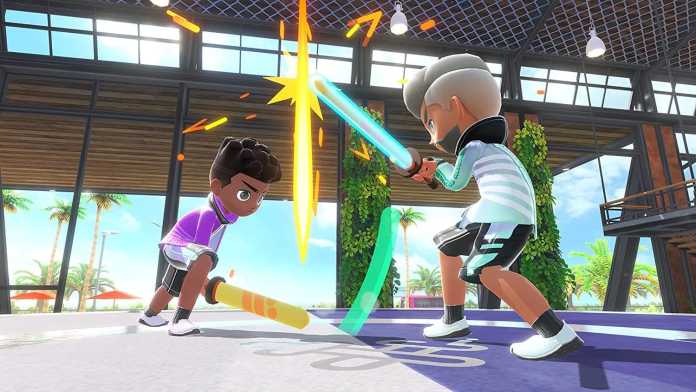
Chambara and badminton are single-player games, so it’s just you and your competition fighting it out. These can be played online or locally, and both are equally fun. One of my main concerns with badminton was that it might play the same as tennis since it follows the same concept of hitting the thing over the net and hoping your player misses a shot or hits it out of the court upon return. 

But it’s far from being a carbon copy. Sure, it follows the same mechanics, but the Switch has utilized its rumble physics to make badminton feel lighter than tennis. The use of buttons on a single controller can also have you running around the court and making your competition lunge for a skillfully placed drop shot. 

As for chambara, this game is not easy in the slightest. It relies heavily on you reading the next move of your competition, which is something I learned I was pretty poor at very quickly. There is a tiny gameplay window, so it’s got your hair standing on edge from the minute a match begins. Once you get into the rhythm of expecting your competition’s next move, you’ll be a chambara champion. I’m currently playing ranked, and the match is ridiculously good. What rank I’m playing at is classified information to protect my pride before you think about asking. 

Let’s get ready to rumble.

I cannot emphasize how fantastic the game feels in terms of rumble. Tennis feels heavy, badminton is light, and you know when you’ve been hit in chambara. Of course, you need to hit the shuttlecock with some real beans if you want to make sure it goes over the net (hence why I pulled a muscle, I was swinging my arm so hard it hurt.) But in tennis, a light tap could result in an unexpected point. You can also judge how hard to send a shot by changing how hard you swing, which I think Wii Sports missed entirely. 

Directional swinging is also pretty integral. It’s the best way to throw the competition off and go for gold in volleyball.  I didn’t pick this up until a few days into playing, and suddenly I felt way more successful. The hints the game gives you during loading screens are pretty helpful; who would’ve thought? 

It’s easy to say Nintendo Switch Sports makes the most of motion control and other tracking features the Nintendo Switch is capable of. But, as I mentioned, the Wii was pretty revolutionary for its time. The Switch honors many of these features while making them more up-to-date and appropriate for modern gameplay – encouraging that feeling of childlike glee again. 

Spike and Score

Going back to team games, volleyball and football are two more new additions for this release. Football is split into teams of four players and has a Rocket League feel about it. Frankly, it may just have a football feel. It’s never been a game I played or watched growing up, so I can’t speak from any experience in that sense. 

For this game, you need both joy-cons. You can play two players, but you’ll need a pair of controllers. If you have Ring Fit, you can use the leg strap to play for a more immersive experience. (And more strenuous as it involves jogging on the spot – blegh.) But holding both controllers works just as well. Football is an exhilarating chase with seven other players trying to score a goal. Except, your characters can hilariously dive halfway across a pitch to steal a ball. 

These games require a few more buttons and swings to remember than a game like tennis. But it pays off once you get to grips with the controls. Volleyball is by far my favorite sport. It requires slightly more skill in terms of timing and remembering the pattern of setting up for a spike. Once you’ve got into your groove and you’re paired with some decent competition, these matches can be pretty intense. 

I appreciate a challenge, and volleyball requires a lot of gambling your competition moves like chambara. However, getting a perfect run of actions and a spike leading to the destruction of your partner is another refreshing sense of pride Nintendo Switch Sports offers the average joe. (Meaning me. I am the average joe in question, and I like winning.)

Final thoughts

My time with Nintendo Switch Sports has been one of the most fun experiences I have had with a co-op game. And frankly, the most fun I’ve had with anything sport-related ever. I adored Wii Sports, but Switch Sports has given us the breath of fresh air we needed. It has everything good about Wii Sports while adding its twist and charm to a new title. 

If you are hunting for a new party game to whip out to get everyone excited and involved, I cannot emphasize how much I recommend this game. It’s so fun without needing a heavy story and tense gaming to enjoy. Plus, I’m sure it’ll make some memories you can reflect on in the future as Wii Sports did. How can it not?


Oh, by the way. The slide-on straps are vital if you want to have a TV by the end of your playthrough. Joycon controllers are surprisingly slidey if you’re throwing your arms around. Of course, maybe that’s just me.

See you on the pitch!

Review: GXT 391 Thian

Picking the wrong headset can be disastrous for your gaming setup. This can be made worse if you have a limited budget and multiple devices to connect to. Consequently, you must consider how they sound, ease of connectivity, and build quality. There are also many other factors to weigh up as you think about your next purchase. I rarely look at entry-level headphones, so, therefore, I was intrigued when I was asked to review the GXT 391 Thian headset.

I’ve recently looked at the Turtle Beach Stealth 600 Gen MAX headphones and I loved them. Subsequently, I was concerned that the GXT 391 Thian headset wouldn’t compare. Fortunately, I was pleasantly surprised as this multi-use peripheral is user-friendly, robust, lightweight, and has some decent audio quality. It has a flexible microphone, well-placed buttons, and it is made from recycled materials.

The GXT 391 Thian headset allows for wireless PC and PlayStation gaming.
Enjoy wireless PC and PlayStation gaming.

What’s in the box of the GXT 391 Thian headset?

  • The lightweight packaging is flimsy and uninspiring. Consequently, it was unfortunately damaged in transit. Luckily, though, the contents survived the posting ordeal. Furthermore, it has an insipid design because of its cooler colour palette that looks cheap and bland. However, it is emblazoned with useful information and the company logo. A massive positive from Trust Gaming is the fully recyclable packaging.
  • The GXT 391 Thian headset. This lightweight accessory has a basic but robust appearance. It can be used wirelessly or plugged in with a dual 3.5mm audio cable. The earcups are adjustable and have a cool and comfortable leatherette finish. Alongside this, there are well-placed on-ear controls that are simple to use.
  • USB C Charging cable. This cable allows for up to 13 hours of wireless gaming. The short rubberised cable is hard wearing and works from any USB A port.
  • USB wireless dongle. A compact and sturdy device that is automatically connected to your accessory. Turn on your headphones, plug in the dongle and listen to your heart’s content. 
  • 1.2m audio cable. A nylon braided cable that allows you to connect to any device with a 3.5mm audio port.
  • User manual. This simple guide depicts your setup with straightforward images.

Technical aspects. 

Earcup typeOver-ear
Frequency range20-20,000 Hz
Driver size40mm
ControlsVolume
Mute microphone
Power
ConnectorWireless via USB dongle
3.5mm aux for wired connection
Wireless range10m
PlaytimeUp to 13 hours
Dimension160*190*75mm
Weight200g

No one wants to spend hours of their spare time setting up their gear. Luckily, the GXT 391 Thian works straight out of the box. Plug in the USB dongle or the audio cable and your headphones will work. Alongside this, the basic connections allow you to swap between devices with ease. Furthermore, the 5.8 GHz Wireless setup ensures fast and lag-free connectivity.

The rechargeable battery lasts up to 13 hours. Now, for serious gamers, this will be a little short. However, for casual players or those playing wired, this matters not. A clear and helpful LED indicates the charging status, and this prevents you from running out of juice.

With easily accessible controls, you can mute your mic, adjust the sound and toggle power. What’s more, the 40mm drivers deliver a wide range of tones and some decent bass. Consequently, the headphones add to the immersion of big triple-A games or movies you may watch. Furthermore, the bass isn’t too heavy on your ears. I have experienced headphones that leave your head buzzing. Fortunately, the GXT 391 Thian’s are more subtle. They rely on the 40mm drivers to deliver a crisp and comfortable sound.

The Wireless connection is not only lag-free, but it works perfectly on PC and PlayStation. This gives the headset a premium feel at an affordable price. However, for Xbox or mobile gamers, the wired approach is just as good. Both options have their pros and cons, and the lengthy audio cable ensures that you are still free to move about.

An excellent headset for PC and console gaming.
He looks happy with his headset.

Are the GXT 391 Thian headphones worth it?

With a vast array of headsets on the market, it can be tough to choose. Luckily, I think these affordable and straightforward headphones will appeal to many. Now, I found them a little understated for my liking and I prefer something more substantial. Consequently, they were lighter than I’d liked and the earcups were too small. What’s more, a bit of glitz and glam to the livery is never a bad thing. Sadly, the black design is just too simple and potentially a little dull.

However, looks and weight aside, there’s lots to like about this accessory. First, making your product from 85% recycled material is a winner in anyone’s book. Then to combine this with a robust and stylish look is just incredible. This is then enhanced further because of the user-friendly approach, excellent sound quality, a multi-use options. Subsequently, this is a great entry-level product and excellent for younger or casual gamers. Though it didn’t tick every box, I think Trust Gaming has delivered a solid and dependable peripheral that won’t break the bank. If you are in the market for an affordable headset, I recommend you buy it here!

Summary.

This jack of all trades won’t compete with high-end headsets. Its understated looks, lightweight approach, and noticeable cheaper packaging highlight its key demographic and its shortcomings. Yet, if you want a multi-use accessory that ticks many boxes without being OTT, then this would be money well invested.

(More information on Trust Gaming can be found here!) 

Review: Postal 4: No Regerts

Postal is Back

Postal 4: No Regerts really tested me. Not because it was challenging, mind you. It never left me scratching my head trying to solve puzzles that would give the riddler a run for his money. Nor were my hands left with drenched palms from intense firefights. What this game really tested was my patience.

Postal is a series known for being intentionally offensive and vulgar. Irreverent humour and violence are its main draws. Anyone who is familiar with the franchise, especially Postal 2, is probably pretty familiar with the postal dude and his morally corrupt antics. But while the second entry was a relatively fun descent into destruction and debauchery, this latest entry is desperately lacking in fun. Its tone and sense of humour came across as trying a little too hard to be raunchy or edgy. I’ll admit I exhaled out of my nose with some force a few times. However, for the most part I was as straight-faced as I’d be washing the dishes. 

When we join the postal Dude and his ever-faithful companion Champ, they’ve just had their trailer home stolen. Along with it, all their possessions and money. Luckily, a city shines in the distance, beckoning them toward a chance to find their mobile home, or at the very least make some cash. The Arizona border town of Edensin is rife with opportunities. And the postal dude is seemingly up for just about anything.

Anything For a Dollar

This is Postal 4’s main objective in a nutshell. Make money however you can, and man does it take you down some weird paths. From catapulting people south of the border wall, to getting high on noxious fumes and turning into a cat looking for a mate. You’ll become a prison guard for an afternoon, and end up massacring most of the population. Or getting people to sign a petition in support of bidets at gunpoint. 

Your adventures get pretty wild and wacky, but on the other hand, the campaign is fairly straightforward. The story takes place over one business week. Each day from Monday to Friday you’re given a list of tasks from a range of weird side characters. At first, you look for some honest work, however, you find anything but that. 

Everything you do is messed up in one way or another. Such as catching stray animals and chucking them into chutes and compartments of a van for undisclosed but definitely shady reasons. Whatever the task, it usually ends up with someone or something dying. The few exceptions to this are mind-numbingly tedious. Like a job that has you search for illegally parked cars so you can give them a ticket. I was genuinely surprised at how banal this task was compared to the crimes against humanity I’d committed already.

Shoot First, Think Much Later

Whether the job was unclogging pipes, or getting into shootouts I couldn’t help but feel like most of it was just busywork. Too much of the main campaign feels like it would be an optional side quest in any other open-world game; give or take a couple of ethically questionable actions. I can count on one hand how many times I actually enjoyed a task. By the end, it felt almost like the devs created an open-world playground, realised the player needed things to do, and ran down a list of generic missions to complete. 

All of this made me realise Postal 4 lacks a cohesive feel. It’s all just stuck together with the glue of the postal dude needing to take any dirty job under the sun for a crumb of currency. You’re just going from one point to the next occasionally shooting something until the day is done.

However, that leads me to one thing I more or less enjoyed. Shooting things. It’s not to the quality of any major shooter or open-world title that includes guns. It’s an aim and spray that just about gets the job done. Although, in a world filled with pretty uninspired jobs and activities it really makes you appreciate being able to enjoy at least one aspect of gameplay. Edensin is packed to the rafters with guns and ammo, and you won’t go very far before you’ve got an arsenal under your bathrobe. This includes pulling out your johnson to urinate on your enemies, should you wish.

Along with an abundance of weapons, also comes a wealth of consumables around town. Such as unaccompanied slices of pizza on outdoor sofas, and health (read: crack) pipes that you can inhale for a boost of health. But be warned, soon you’ll need another hit, or you’ll get hit with a blow to your HP leaving you questioning whether it was really worth it. There are energy drinks that allow you to dual wield guns, and catnip that can be eaten in order to slow down time while aiming down the sights of a sniper rifle. There are some pretty absurd items that can be enjoyed in a variety of ways to spice up gameplay or give you an edge in a fight.

What a Terrible Place to Live

The relationship between the consumables and combat allows for a little more depth when getting into fights, and with all of these useful items spread out in the world. There’s at least some reward and incentive for exploring Edensin. Unfortunately, actually getting around is another headache. You could go on foot, but the size of the map and distances between objectives means a slow march while your brain turns off and your eyes glaze over. Another way is the vehicle. And I’m sad to say that the previous sentence wasn’t a concord error. Your options include a single kind of vehicle. A mobility scooter

There are all kinds of cars parked everywhere in town, but you’ll rarely see any in use. Everyone who isn’t walking will be using these scooters, including you. Combining the fact that the map is fairly large and these scooters are fairly slow, makes getting around tiresome. Add into that combo a lack of a radio or any kind of music and you’ve got a silent ride that can only be spiced up with the odd hit-and-run. Licensing may not be cheap, but there’s a fair amount of music as you make your way through the campaign. I’d have liked an option to hear some while driving. Maybe even a couple of royalty-free tracks at least. They don’t even need to be good at this point. 

Edensin isn’t exactly easy on the eyes. Full of browns, greys, and greens, the environments are pretty drab. Even if it is somewhat of a desert town. While top-notch graphics aren’t a necessity, a decent art style is and Postal 4 is more than a little unappealing to look at, from the town to the townspeople. At least the aesthetic kind of matches the game’s overall tone. 

The missions can be tedious, the world is uninspired, exploration is painful, and the jokes barely ever land. At least it’s got some fun chaos and gunplay to enjoy. Postal 4 is hardly a game I can recommend if you aren’t already a huge fan of the series with some low expectations. Honestly, you may just be better off going back to Postal 2.

Review: Phantom Breaker – Omnia

It’s rare to come across a 2D fighter that doesn’t require a deep dive into its mechanics to get to grips with it, but Phantom Breaker: Omnia is out to question whether that’s really necessary, as it pairs exciting gameplay with highly approachable mechanics.

Originally released in 2011 as Phantom Breaker, and receiving an update in 2013 as Phantom Breaker: Extra, the 2D fighter has now seen further updates in Omnia. Using Extra as its base, additions include two new characters and new story as well as a remixed soundtrack, a new fighting style and balance adjustments. 

Discarding complicated combo inputs, Omnia sets the game up perfectly for a novice to the genre and allows you to fight however you please. If you like to button-mash – square, triangle, and circle each has 3-4 combos you can tap and string together. If you like to hit-and-run or spam energy attacks from afar, that’s also possible with strong and special moves that at the very most require three buttons to be pressed in unison. 

This may not sound particularly impressive, but this is just one aspect of the fighting system and there are plenty of tension-building gameplay mechanics that can turn the tables in a fight at any given moment. I’d go as far to say as I had some of the most exciting battles that I’ve had in a 2D fighter in a long time due to tight battles and great match-ups between different types of characters (short-range/ long-range etc).

The story won’t be winning any awards, but it suits the purposes of the game.

That was until I realized that the game has an auto-blocking system. Funnily enough, I was hours in before I even noticed it as I’m so used to blocking with the opposite directional button (and was doing it manually). Sadly, like a permanent cheat code that you can’t turn off, it unbalances the battle system and at worst makes all other strategies and mechanics pointless.

By itself, the auto block is not too bad, but when combined with a dodge (which is done by heading towards the enemy exactly as they attack), it’s like a dagger to any tension the game could create. In theory, this double-pronged inclusion makes sense, as timing a split-second dodge is difficult when holding down block to then dodge (i.e. flicking the directional button left to right or visa versa), but it in actuality having the auto block not only makes dodging very easy, it also allows you to sit on your hands while you wait for the enemy to finish their attack and it removes you from the intensity of the action when you are backed into a corner. 

Clashing boosts your gauges and while not particularly photogenic in a screenshot, looks great in real-time.

You could argue that you don’t need to use it, but ignoring it when you know the option is there is like walking to the shops when you have the option to teleport there instead – no one in their right mind takes the harder option. As such, I really think it should have been a setting you could turn off, rather than enforced accessibility. 

Other than that, everything else works like a charm with the mayhem starting as soon as the ball drops. 

But it isn’t just quick gameplay that aids the experience. The in-battle animation, for example, is aided by added visual effects to moves and characters during battles which make the action seem even faster. When characters attack at the same time (which is called ‘clashing’) the camera zooms in and shakes and attacks are often blurred and accentuated with colorful highlights. This, added to a blood-pumping soundtrack, never fails in its attempt to stir up the player and whip up a frenzied battle.  

Despite the game’s accessibility being great in most areas, it ironically is lacking any helpful interactive options in the training mode, leaving you with pages of text to decipher instead.

After clashing multiple times a tension gauge activates and for a short period of time boosts the effectiveness of your attacks while giving you a full energy bar (called a ‘burst gauge). If used strategically you can fill your burst gauge to 200% and unleash your super move to do some serious damage. The burst gauge can also be used for an overdrive (which speeds up your character while slowing the enemy) and an emergency shield.

All these powerful attacking options mean that the battles are often high-speed affairs that – in addition to the varying effective distance of each character’s attacks – really make each fight feel different, assuming of course that you aren’t just relying on the auto-blocking and dodging system. There are also 3 fighting styles for each character (focused on speed, power, or a mix of both) for those that want an even more specific experience, although I mostly chose the speedier option to add to the insanity on the screen.  

Replay value is offered in spades with the 2 story modes (from Onmia itself and Extra) with voiced visual novel sections and a fantasy anime story for 15 characters, while there are 22 characters that are available for the arcade, endless battle, time attack and score attack modes.  

No doubt to the chagrin of many though, the online multiplayer mode lacks rollback netcode, leaving your experience to the mercy of your opponent’s internet speed and, unfortunately, due to a lack of available players at the time of writing I was unable to fully test how robust the current online code is. 

One of the most approachable and enjoyable 2D fighters I’ve ever played, Phantom Breaker: Omnia has the potential to be great, but nullifies the effectiveness of its battle mechanics by trying to be too accessible, which ultimately restricts the best action to the multiplayer modes. 

Review: Bugsnax

0

Time to gear up for an awesome adventure through Snaxtooth Island, filled with delicious-looking bugs that are more than appealing, but tasty too! BugSnax is a captivating 3D-styled island adventure game, full of mysteries and new discoveries waiting to be revealed. The main goal is to discover the whereabouts of Elizabert Megafig. As we do so, we’ll find ourselves making friends with the other islanders as they are scattered all around, each providing separate tasks for us to complete. So with a little bit of free-roaming through the island of Snaxtooth, we’ll be searching for Elizabert and filling our friend’s bellies with Bugsnax.

The best part about the game Bugsnax, is that it’s not just a cute title but exactly what these bugs represent. Many of the tasks we need to fulfill in the game are to catch these delicious bugs, which look like cute food-shaped insects. So no worries, cause these bugs are all delectable and not at all gross! Especially as they come in the form of something fruity, savory, meaty, crunchy, salty, and even cinnamon sweet. There are a bunch of other flavorful bugs and each still does resemble the same appearance and movements of a real bug. So with about 100 species on the island, there are many to catch and so many to taste.

Graphics and Sound

I am impressed with the realistic 3D graphics, it really makes the game so much more appealing, and when looking at food like bugs; Bugsnax, it is hard not to wish you could capture them so you can take a bite! The colors of the sweetly designed characters are well-detailed to appear like real food. Capturing the textures and exact appearance of strawberries, cinnamon buns, sandwiches, pineapples, ribs, and other food shapes. This is also true about the game’s environmental design. Including, the night sky, plants, rocks, logs, buildings, flowers, and so many other objects and background scenes, they all appear so real.

Also, the camera scanning and photo-taking portion add a fun feature to the game. Like being a real explorer searching for new things and in this case new bugs to snack on. Plus, you can take as many photos as you like, from any viewpoint you’d like. Every control to use the camera is very easy, and the shots are simply clear that they look good each time. Plus explanations of each character after scanning and photo-taking are clearly explained.

Furthermore, It’s quite interesting to see how these fuzzy characters change when you feed them. It almost really makes sense, the food you eat is what you’ll look like. In this game that really appears to be true! The more food you feed each fuzzy character, the more similar to the food they ate, Bugsnax will appear on their body. It is strange, but something you’d not find in any other game.

Unfortunately, there is one issue I felt about the graphics that made the game not as great as it probably could be. To be exact, with the many actions that each character can make or do, they don’t seem too close to reality. Just a few examples would be the way they eat and interact with their surroundings. Not to say that it doesn’t present a clear picture of the food being eaten or that they are coming in contact with the objects, but it appears like it just either vanishes or nothing quite moves to show the reaction of things performing together. Regardless, I still feel that the game is still very nicely done, and beautifully appealing to the eyes.

For the sound effects, they are very cute and sound just as they should. From the water being walked through, bushes being shaken, and plenty of other things like the bugs roaming the island. Additionally, the voices are a bit interesting, like Pokemon catching these bugs and the sounds they make, relating to the food they represent. The main fuzzy characters also have this unique and strange attitude with their own personalities. No matter, it’s all a bit humorous and additionally adorable to the entire game. So to be honest, everything about the game’s music, sound effects, and beautifully bright graphics all scream out that this game is friendly and welcome for anyone to play.

Final Thoughts

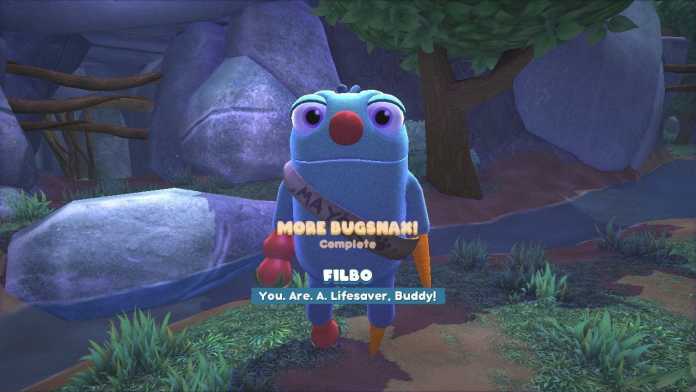
Before playing this game, I honestly had no idea what to expect. Yet, after playing through, discovering the mysterious food-style bugs, decorating my characters, and touring the island, I found the game fully adorable and entertaining. The puzzles are really the tasks being requested by our new island friends, like Flibo the mayor, Wambus the farmer, Beffica the gossip, and many more.

Plus, the Bugsnax on the island doesn’t make you feel squeamish as they are more tasteful like real food than scary like real bugs. I think that is the main reason I love the game is just that! It doesn’t repulse me or make me want to rethink the food I love to eat. Bugsnax in general is cute and is one-of-a-kind, which I found myself enjoying! The game is fully engaging, fun to roam while fulfilling tasks, and provides plenty of interesting discoveries as the story unravels.

Lastly, I did find myself sitting back and playing this for a while, till I was able to solve the mystery of the missing Elizabert Megafig. It’s humorous, cute, and fully entertaining with many things one can do. I don’t feel that the game gets too redundant, even after a few hours of playing. The joy of finding something new that flys, crawls, and just looks appetizing is as exciting as discovering a new Pokemon, but instead of battling you get to eat them. So if it’s cute, fun, and a puzzling type of adventure game you’d love to try, then you might just want to play Bugsnax.

Review: Trust Gaming GXT 834 Callaz

Love it or loathe it, RGB lighting is here to stay. If you are a fan, there is no doubt that your setup is bright and garish. However, if you are one of the few gamers who hate such a grand show, you won’t know what all the fuss is about. I’m in the love it camp, so when the Trust Gaming GXT 834 Callaz mechanical keyboard landed on my desk, I immediately unwrapped it.

I have recently reviewed the ROCCAT Vulcan TKL Pro keyboard, and I adored it. So, therefore, how would this inexpensive and simpler accessory stand up to its upmarket peers? In short, it does pretty well! Yes, it doesn’t have a fancy name or a big price tag, but it performs well, looks stylish, and can be customised to your liking.

You won't lose your way in the dark thanks to the vivid RGB lighting.
Bright and vivid RGB display.

What’s in the box of the Trust Gaming GXT 834 Callaz mechanical keyboard?

  • The packaging is lightweight and simple in design. It is about 95% recyclable and unfortunately didn’t fare so well in transit. However, the accessory and paperwork were intact. With some key points and the company logo on display, the packaging is as you’d expect.
  • The Trust Gaming GXT 834 Callaz mechanical keyboard. This TKL or Tenkeyless keyboard is compact and well built. It has an attached USB 2.0 cable to connect to a PC or Laptop and has a nice weight. There are supporting legs at the rear and this, alongside the high-profile keys, makes it comfortable and easy to use.
  • A straightforward user manual. A well-designed manual explains the fundamentals. You will learn how to change the light pattern, increase or decrease the brightness and speed, and understand the shortcut functionality. Thankfully, this user guide gets you up and running in no time at all.

Technical aspects.

Key technologyMechanical
Width367 mm
Weight652 g
Keyboard layoutQWERTY
Switch brandOutemu
Switch typeLinear
Lifetime of keys50 million
Manufacturer warranty2 years
Response time8 ms
Travel distance4 mm
Connection typeWired
BluetoothNo

Gaming keyboards are all about their responsive nature and comfortable layout. Luckily, this one has both thanks to its small travel distance and compact design. This smaller than normal keyboard allows for a greater mouse movement and a natural position for both hands. What’s more, as it is a mechanical peripheral, it has that delightfully noisy clicking sound that we all enjoy.

Alongside these key elements, we all like a stylish accessory that is built to last. Fortunately, the metal top plate offers a premium finish while making the Trust Gaming GXT 834 Callaz mechanical keyboard more robust. Furthermore, there is a massive 50 million keypress guarantee and a 2-year manufacturer’s warranty.

RGB accessories are all about the lights and the patterns. With 6 different colours and 20 unique programs, you will find the style that matches your personality. Alongside this, there are adjustable speeds and the ability to reduce or increase the brightness. What’s more, if you fancy a break from the multicolour display, you can simply switch off the lights and continue to use the keyboard as normal.

With convenience and time a priority for many players, it is nice to see the inclusion of media buttons. With 12 shortcuts options included, and a well-placed function button, you’ll adjust your setup on the fly with little effort.

The Trust Gaming GXT 834 Callaz Mechanical keyboard is compact and stylish.
A compact and comfortable design.

Is the Trust Gaming GXT 834 Callaz mechanical keyboard worth it?

I’m a firm believer in you get what you pay for. Therefore, at less than £50, you may be a little dubious. Luckily, for the most part, this is an exceptional entry-level peripheral. With a premium metal finish, high profile keys, vivid lights, and multiple programs to select, this gives you a lot of bang for your buck.

However, this doesn’t mean it is perfect because it isn’t. Annoyingly, it can be slow to boot up and you have to watch it run through its load cycle every time. Now, this may seem a small thing, but if you want to load into your boot menu, this can be problematic. Furthermore, the backlit style can make reading the keys a difficult task. Therefore, if you are unfamiliar with touch typing, you may unwittingly make mistakes as you chat or game. Fortunately, with the adjustable brightness, this problem can be eradicated with some fine tweaking.

Other than these small issues, I found this to be a good, user-friendly gaming keyboard that is excellent for an entry-level gamer. Yes, there are better examples out there, but they will cost you an awful lot more. If you are in the market for a bright and stylish accessory that won’t break the bank, then look no further!

Summary.

The Trust Gaming GXT 834 Callaz mechanical keyboard is an inexpensive addition to any gaming setup. What’s more, it is robust, looks fantastic, and has an excellent keystroke guarantee and manufacturer warranty. Its compact design is comfortable and makes the smallest of desks look massive. Sadly, it doesn’t compete with the big brands, but this shouldn’t detract from its brilliance. It is a fantastic budget peripheral that will look amazing next to that bright gaming rig.

(More information on Trust Gaming can be found here!)

The Movies Games and Tech silver award.

Review: Sumire (iOS version)

We reviewed Sumire last year on the Switch, and now it’s available on iOS.

Here’s what we said for the Switch version which still stands for the iOS version (original Switch review by Krissy):

Sumire is a charming narrative adventure where a young Japanese girl sets out on an adventure to change her miserable fate and fulfill her wish of seeing her grandmother’s spirit.

Gameplay:

Sumire is about a disillusioned young girl who spends her days cooped up inside, in fear of the outside world now that her grandmother is no longer in it. On top of this, her father has left home, and her best friend has deserted her. But one day, a magical flower appears and promises her that she can change her fate. But the magical flower only has one day and one life to help her have a perfect day and make her wish come true.

The gameplay is pretty simple; you make choices that affect your karma and determine the outcome of the story. Despite there being a good and bad ending, the game doesn’t force what’s good or bad on you but shows you that your actions have consequences regardless of what decisions you make. And no matter what path you decide to take, Sumire comes to terms with the decisions she’s made at the end of the day.

At the beginning of the game, Sumire jots down a to-do list in her notebook of the things she wants to achieve in hopes of having a perfect day. While it may not sound like much, there are also small quests and even fleshed-out mini-games that you can enjoy along the way.

The most prominent features of Sumire are the art and the music. In fact, the music is not only relaxing but also very memorable. In addition, the overall design of the game feels like a Japanese watercolor painting that blends nicely with the music. While there are some depressing moments, the overall style of the game is quite wholesome.

On the other hand, for a narrative-focused game, I was a bit disappointed in the writing. It felt stiff, and the character dialogue was a bit monotonous. For games where the gameplay is primarily dependent on the story, I think the writing should be meticulous. That’s not to say that the writing ruined the game, but I think Sumire could have been more impactful if the writing was better.

Conclusion:

All in all, Sumire was truly a fun short adventure that I thoroughly enjoyed. With that being said, as a narrative-focused game, if the writing were better, it could have easily been a 10/10 game for me. Despite this shortcoming, I still highly recommend this charming indie game.

Entertainment: 8/10

Replay value: 7/10

Graphics: 10/10

Sound: 9/10

Kid Friendly: Yes