Review: Neurodeck

Neurodeck is a game with a great premise. It is a journey into the protagonist’s psyche through high stakes battles against their deepest fears. And when I say high stakes I mean it. 

Failure is not the end

There is no retry or continuing right where you took your defeat. Once it’s over it is exactly that. Over. You’ll have to build your deck from scratch in each campaign. But that’s exactly what makes it a good deck builder.

Taking a defeat in Neurodeck may feel as such on your first run. But soon you realise that with every failure you become more powerful. You may have lost what you thought was a star studded deck, but every run yields more of a chance for that perfect selection of tools. There is an answer to every situation, and it takes time to fully understand what a scenario might need from you. One phobia may inflict debuffs on you, which requires the spiritual beliefs card to clear debuffs and inflict damage to the phobia for every debuff lost. Another phobia might stack wrath upon itself, boosting its offensive capability. This situation might call for a little anarchy to wipe their buff and offer them a 10HP loss for their trouble. 

I was really grateful for the fact that there isn’t some ultra steep learning curve, where I might have needed an almanac just to figure out what was going on. Failure is part of the game, and reinforcing each loss with a tangible sense of understanding as to my shortcomings was great. One could even attribute that logic to life. We might falter and fall, but there is always the chance to try again, in whatever way works. And that next try might be the one that brings success. Especially when we learn from past mistakes. 

Face your fears

There are 14 phobias to fight in Neurodeck from agoraphobia to phasmophobia, even masculinity. Battling against them for the first time means you have no idea of their capabilities. You have to face them and beat them to learn what they are and what their weaknesses might be, which comes in clutch when you inevitably fight them again down the line. 

This is a great way of introducing them and teaching the player what they are up against. It also proved to be a great way of learning more about the many existing phobias, some of which I was familiar with but never had a name for.

They’re well designed and animated for the most part with some unsettling sounds and sights from many, especially tokophobia, the fear of pregnancy and childbirth. I was drawn to the dark and shadowy figures that these phobias presented. They all brought with them a sense of dread in their designs and movements.

The cards at your disposal

There is a wide array of cards that you have the chance to collect throughout each run of the campaign. And each fits within the framework of mental health. Many cards are in the forms of coping mechanisms, events in life, and real world objects that have carried over into this neural realm such as comfort food and journaling. There is also a christmas day card which grants sanity (HP) and adds two present cards to your deck. This present card has the ability to inflict damage to the phobia, while shuffling another present card into your deck. This card has the added benefit of not using an action point, making it wildly useful.

Each card has their purpose. None felt wasted or pointless, and there was some nice synergy between cards that could make for a powerful deck. Getting your hands on these cards is nice and simple, and there are a good amount of ways to go about it. Defeating a phobia gives you a choice of four cards. But between each battle, you choose between destinations like the kitchen which grants buffs, the bedroom where sleep adds cards or taking surveys to gain traits. Some of these locations may also hold excerpts from the protagonist’s life detailing experiences, memories and dreams that have gained a foothold in their mind.

The surveys grant passive traits like extra sanity when drawing a card, or sanity and stamina whenever a card is discarded. They ask scenario based questions that would categorize you as one of two things, which yield one of two cards. Having only two answers per question was a bit limiting and there were a good couple of instances where neither answer would be accurate for me, but I would resign myself to picking the closest answer. Of course you could outright ignore accuracy in responses just to get the trait you want.

Far from perfect

There were a couple of hiccups and bugs throughout my time with it. Most were UI issues, such as the settings icon being blocked by the scrollbar at times. There was also a problem with text blocking the trait explanation within the traits menu. 

The biggest problem for me came from the remove a card option. The ability to remove a card isn’t readily available. It’s one of the destinations you visit between battles. Clicking on the arrow to cycle between cards just removes the current selection. There’s not even an “are you sure” in case of a mistake. You click an arrow to choose the card you want to get rid of and boom, the wrong one is gone. I’ve tried this multiple times, but each instance is the same. At this point I just avoid removing cards, but it would be so useful. Especially if you want to increase the chances of drawing a useful card in an oversaturated deck.


Neurodeck is an enticing deck building game that I found myself looking forward to consistently. With oodles of replayability, different sets of challenges in starting stats and cards, and mental trials there is a lot of content to enjoy.

Review: Pang Adventures

Pang adventures sees two brothers on a quest around the world, with levels taking place in locations such as Bora Bora and Death Valley.

The brothers goal is a simple one: to save humankind from an Alien Invasion – one ball pop at a time. 

The series is based on a collection of arcade games from the 90s, and this new addition does a great job of delivering a faithful and enjoyable title, with a modest game length extended by a reasonable level of challenge.

A good challenge:

The basic premise is simple: you need to pop falling alien bubble / ball things(who am I to say, really), within a strict time limit. Each level features this same initial premise, but with additional layers added regularly that test both your wit and reactions. 

Initially, the gameplay seemed pretty unremarkable. 

However, very quickly, I found myself having to think; and consider how to best approach the level so that I could hit my target within the time limit, as well as avoid getting hit with any bubble’s. There were times where I genuinely thought: “This is literally Dark Souls, but in bubble form”. 

This may have been a slight exaggeration. However, similar to Dark Souls, I felt the same kind of euphoric feelings when finally surpassing my first real roadblock: the Bora Bora boss. This game is incredibly rewarding and things did get very tense; very quickly. Some of the levels I found really quite challenging; forcing me to tactically plan out my approach. 

For a game that is about popping bubbles, there is actually a fair amount of thinking involved… at least for me!

The bubbles themselves all behave in different ways, and this is something you need to consider when tackling a level. A larger bubble moves relatively slowly, and can be much easier to evade, than say, multiple fast moving smaller bubbles. If you’re not careful, it is easy to be quickly overwhelmed in a bubble minefield; which might sound quite pleasant. It is not.

These considerations and challenges are so important, as without them, this game wouldn’t have much in the way of longevity.  

There are three modes that players can take on; the tour mode, which is essentially the game’s story mode(which is perhaps a bit generous, as there really isn’t much in the way of a story here).  This is the mode you will likely spend the most time with.

Score attack, a more authentic arcaded style mode unlocked after completing tour mode, that restricts you to three lives and no continues. 

And Panic mode, a survival mode, which again restricts you to three lives, as you try to reach level 99. This mode in particular does have a certain addictive quality; I found myself yearning for ‘one last run’ to level 99. Alas, I was unsuccessful. 

Each mode allows for online co-op, which encourages an added level of synergy between players; to see who can take down the most balls! Trust me, it is actually really fun.

Appealing visuals:

Pang Adventures art style definitely helped keep me engaged. The games colourful and detailed visuals bring a lot of life to the experience; especially when facing off against the games’ various Alien bosses. 

Coupled with some fun sound design, Pang adventures digital palette feels inspired and distinct. From the Icy Arctic tundras, to the tropics of Bora Bora, the game’s backdrops are diverse and intentionally juxtapose with the constant threats you’re facing. 

But… is it worth it?

The regular edition of the game runs at a modest £8.99, which I would say is a reasonable price for what you’re getting. But, the game’s longevity is heavily contingent on whether or not you wish to play competitively – that being trying to accrue the highest possible scores, on the various modes. The story mode is pretty short, and this is certainly not a game that you would play for any sort of narrative reason.

However, if you do enjoy the core gameplay loop, which becomes increasingly more thoughtful as the game progresses, then I would say this game is worth your time. The game can be genuinely challenging, and the feeling of finally overcoming a level – through a combination of strategy and fast reflexes – really is quite satisfying.

Pang Adventures successfully focuses on the niche it is trying to fill; putting faith into its core gameplay, to provide a fun and visually engaging experience for players of all ages. If you’re looking to delve into nostalgic waters, or are just up for a challenge that may – or may not be comparable to Dark Souls(allegedly), this might not be a bad addition to your collection. 

Review: Beast Quest

When books get converted into a; TV series, film or gaming franchise it’s a gamble. In theory, it should be a raving success with ample money behind it, a massive fan base, and as many plots and well-designed characters as you can shake a stick at. Beast Quest is a much-loved book series aimed at young adults. It follows the tales of a young Knight called Tom and his female friend Elenna. The pair attempt to bring peace and order to the world of Avantia.

Developed by Torus Games and published by Maximum Games, this cartoon RPG adventure has been out for 3 years and has failed to make a good impression on its audience. Will I see it any different to my peers, or can I find a diamond in the rough?

A colourful Fable-Esque themed world jumps out at you the moment you load in. You are chucked straight into the action with a cut scene that attempts to bridge the novel with its newfound home on the console. This quickly rolls into a brief yet in-depth tutorial that teaches you the fundamentals. You are told why you have been chosen, and what mission you must undertake to save the world. It’s all straightforward and familiar, like any of the hundreds of RPGs I’ve played. This wasn’t an issue, however, as many have this inherent fault and originality is scarce these days.

Ah, such a pretty birdy.

A tale of one Wizard and four Beasts!

The story revolves around a deluded and evil Wizard who wishes to destroy the world by controlling four beasts of different elemental powers. Fate dictates that a young man who is true of heart will step up and save the world. Unsurprisingly, that is you, Tom the young, unheard of Knight. You must venture across 5 realms; a volcano, forest, icy plains, mountains and a grassy plateau. Each has a unique look and comes with its challenges and monsters to battle.

As you succeed in each fight, you will earn AP. This is spent on improving your character and your skills. The main attributes are; speed, health, power and defence. Alongside this, you will unlock; new attacks, better ways to block, and more. Like the story, this is nothing new, and it won’t amaze you with any surprise elements. Equipment will be found or purchased to further improve stats. I liked the cosmetic changes with each main garment or weapon choice, but was disappointed that the smaller trinkets didn’t appear. It’s as if the small details didn’t matter, but in an RPG they help to define your personality.

To follow on from this, the game sets itself up as a tactical RPG with battles that require; patience, skill and observation. In reality, it’s an arduous hack ‘n’ slash event that suffers from a serious case of Deja Vu. The developers attempted to mix things up with your Beast Quest companions’ special attacks. Sadly, this added very little other than to end a battle early, but that at least eliminated the tedium of each event (every cloud and all that.)

Maybe the main bosses and side quests will be its saviour?

When a game centres all its attention around its 4 beasts and an evil Wizard, you are right to expect some epic fights. Don’t get your hopes up! Repetition is the tonic that Torus Games rely upon. Sadly, this isn’t the cure for what ails this title. Well, surely its shining light is the many side quests you undertake? It is if you like; collecting flowers, wolf skins, pieces of paper and many other (*sarcastic tone*)dangerous tasks” like these, then you’ll be in your element. But seriously, everyone knows that the secondary missions are a mere distraction, unfortunately these are so weak in design that it’s a painful experience taking them on.

A wooden shield against flames, I don’t fancy my chances.

With such an excellent foundation found in the Beast Quest books, I was shocked by how badly wrong the developers got this. It’s mediocrity at its best! If you had never seen an RPG in your life, you may be fooled into thinking this was a good example, but you are more likely to be put off the genre for Eternity. It sadly lacks any redeeming features, and I have yet to cover; the wooden acting, terrible script, dreadful sound bites and dated graphics.

Amateur dramatics has less ham than this. 

A three-year-old game shouldn’t; look, feel, and behave like it was made for an early generation console. Yet, somehow, this is exactly what happened with its odd 3D presentation and terrible cinematic. There are clear influences of; Fable, Zelda and Monkey Hero. The three combined should make an awesome looking game, however, it’s a mess. Bad animation haunts this throughout, and the enemies slide towards you slowly. The landscape is blocky and bland to look at, and quickly blurs into one easy to forget image. The lip-sync of the cutscenes is off and easily distracts you from what is being said. It’s one plus side is its use of colour works well with the fantasy setting. The bright and vivid tones set against the earthy landscape made the characters stand out.

Moving swiftly on to the audio. Cheesy, horribly acted and memorable for all the wrong reasons. The script is dreadful and is full of failed humour and a wooden delivery. Every time the action stopped, and it cuts to one of these scenes, my heart sank. If it wasn’t so badly presented, I’m sure the intended jokes would have amused me, but it failed miserably. On the plus side, I enjoyed the music. The folksy tunes had a classic RPG feel to them, and the beat and tone matched the situation you found yourself in. This was the best element of the game. Sadly, it had little competition to gain this accolade.

It then comes crashing down to its usual standard when you listen to the sound bites. Tom says some of the most ridiculous things I’ve heard in a game. Each time he spoke it added nothing to the gameplay and made me shake my head with disbelief.

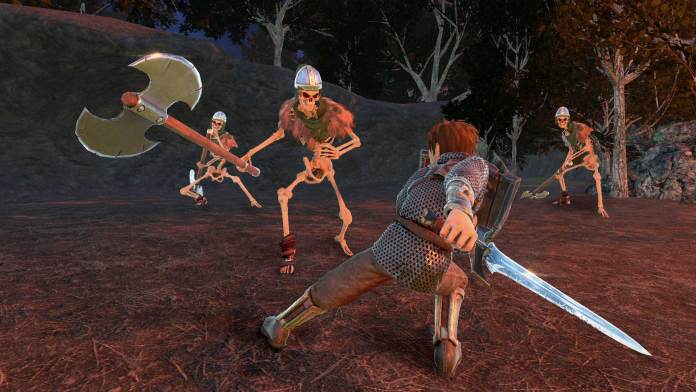
These skeletons could do with a hearty meal.

It handles worse than a shopping trolley.

There is nothing worse than a game that has potential, only to be let down by terrible controls. Unfortunately, Beast Quest is one of those games. Slow response times, terrible dodge mechanics, a weird movement system and a jump that allows you to unintentionally levitate. It’s a mess from start to finish. I found it ironic that its tutorial was one of the easiest I’ve ever come across, but it confuses itself with poorly executed commands and awful optimisation. 

The developers have sold this as an adventure game with a sprawling world that will suck you in with exciting action and its many quests. In reality, it couldn’t be further from the truth. The linear gameplay restricts you to where you have no freedom to explore. Repetitive elements, treasure chests that have predictable loot, and battles that will send you to sleep. If you can stomach it, you’ll endure around 5 hours of gameplay to save the world and get to the end credits. 

A disappointment from the off. 

It always pains me to be so brutal about a game, but when one has no redeeming qualities, and misses the mark on all points, then it wouldn’t be fair to recommend it. Beast Quest had so many opportunities to get the game to a reasonable standard, but it tried and failed repeatedly. If you want an RPG adventure title then look elsewhere, the market has plenty that are leaps and bounds ahead of this. If you want to buy it, you can here! Tom must learn to be a Knight and save humanity and the land of Avantia from the evil Wizard. 

Review: Ori and the Will of the Wisps

If I had to describe this game in a single word, it would be “Masterpiece”. Ori and the Will of the Wisps is genuinely one of the better platformers out there and probably one of the best games I’ve ever played. The sequel to 2015’s Ori and the Blind Forest, the game takes place within an enchanting fairytale-like world that’s bound to dazzle your eyes. Coupled with fantastic artwork, a superb storyline and probably one of the best game soundtracks ever to date, Ori and the Will of the Wisps is nothing short of magnificent.

Ori and the Will of the Wisps is set after the events of Ori and the Blind forest. You control a lovable spirit guardian named Ori and set out into a luscious world where you face challenging foes and dangerous territories while meeting new friends along the way. You begin the game with no abilities and no means of battling the many monsters that lie in wait within the dense Nibel Forest.

Meet allies along the way that help you along your journey

As you proceed through the game, you must explore every nook and cranny throughout the map to discover new abilities and weapons which allow you to proceed along with the story. Nowadays, most RPGs give you the exact instructions to a mission or even give detailed routes to reach your destination. In my opinion, it muddies the gameplay and makes things too easy for the player. Ori does this differently, though, as you’re expected to wander and find clues as to where you’re supposed to go next. The maps are detailed but don’t tell you exactly where to go, making the game pretty challenging to play. Some might find this annoying, but I think this gives the game its identity as the feeling of euphoria you get when you finally solve each map is extremely rewarding. You could say it feels as great as finally solving an extremely challenging math question, but that’s just my take on it.

The game isn’t just that simple in terms of mechanics. You obtain many skills, which tend to build upon one another, allowing you to perform more intricate types of movements. Some puzzles require real big brain maneuvers that you have to discover for yourself. It does add to the depth of the game, making it super fun and super rewarding. Combat is quite repetitive, though, and gets a little stale. I usually find myself trying to avoid enemies instead of battling them as it’s just really too much of a hassle. On the other hand, Boss battles are super challenging as you memorize their attack patterns to bring them down. It usually takes a few or more tries, but the game is forgiving in that you can start right back where you died and try again.

Boss battles are challenging, but a whole lot of fun!

The aesthetics of the game are also really detailed. The fantastic artwork, intricately designed terrains, enemies, and characters make the overall experience easy on the eyes. The real MVP of this game, though, is its soundtrack. Gareth Coker, composer of the Ori and the Will of the Wisps soundtrack, did a tremendous job. The BGM does set the tone of the game well and is an integral part of what makes Ori so mesmerizing and enchanting to play.

Amazing artwork!

Ori and the Will of the Wisps is an entire cohesive package where you get great gameplay, a fantastic storyline, superb graphics, and fitting soundtracks to go along. Having played the game on the switch, I feel it would be a great addition to your collection of switch games. The controls are simple and feel intuitive to play. The graphics also aren’t too bad and provides a fully immersive experience on the go. All in all, moon studios did yet another fantastic job with this game, and I have no qualms with calling it a masterpiece.

Review: Hunting Simulator 2

I’ve played many different games that take place in many different genres but the one genre i’m not particularly experienced with is the hunting genre. I think the closest i’ve come to hunting are the various side missions you come across in a game like Final Fantasy XV, but it’s less about hunting and more about fighting in those games. It’ll be interesting to see how much hunting you can do in Hunting Simulator 2.

Hunting Simulator 2 starts off in a surprising manner as you find yourself in a log cabin which is home to many of the things you would expect a hunter would have. The walls are adorned with animal trophies, whilst there are weapons dotted around. You begin your adventure of sorts by leaving your cabin and start using your hunting instincts to find you next trophy. The log cabin you soon find is where each hunt begins and ends. You begin your hunting adventures off with a small sum of cash which you use to buy weaponry and licenses, just like you’d have to buy guns, bullets and licenses if you were going on a real-life hunting trip. The better you hunt the better the trophies you acquire which in turn means you end up with more money to buy a better arsenal.

There are 6 locations to do your hunting within and those locations are broken up into smaller areas. Those areas include Czechia Marshlands and Harghita County which are in Europe, Roosevelt Forest and Pawnee Meadows in Colorado and the Chihuahuan Desert and Bandera Region in Texas. There are around 33 animal species to hunt but you must make sure you have the necessary licenses to hunt those animals. Luckily Hunting Simulator 2 will warn you about a lack of licenses when you get an animals in your crosshairs, but if you still choose to proceed then you might end up getting fined. The firearms are also important, only certain weapons can be used on certain animals. There are a variety of licensed firearms whose brands you will recognise like Winchester. You can also acquire a pet in Hunting Simulator 2 which will help you track and retrieve various prey.

Hunting Simulator 2 is a very slow game to move around in and that’s part of the whole process. Running around will make the animals aware of you and they will runaway, so you need to sneak around the gorgeous landscapes. One issue is there doesn’t seem to be a gradual scale to your speed, you either walk very slowly or run very quickly, there is no fast walk or casual jog to get around. The slow pace allows you to appreciate the various environmental and animal sounds dotted throughout the ambient scenes. You will at times spend up to an hour tracking some animals down, in some cases you’ll need to wound the animal several times before you can capture your “trophy”. Luckily Hunting Simulator 2 doesn’t expect you to cut, skin or drag your catch back to your cabin, that would have been a much more grisly experience.

With the lack of any direction or story, sometimes Hunting Simulator 2 doesn’t quite involve you as much as it could. For example, entering competitions with fellow hunters or having something to work up to would have made Hunting Simulator 2 a better experience. There are a few fast travel points located in Hunting Simulator 2, unfortunately you need to find them to use them. Considering the amount of travelling you are doing in Hunting Simulator 2, having these fast travel points more visible would have definitely spend up the process.

Hunting Simulator 2 is exactly what it says it is, it’s a simulator about hunting. The relaxing set up and ambient nature makes the Hunting Simulator 2 experience an enjoyable one. Thankfully you don’t get drawn into the more bloody elements of actual hunting but Hunting Simulator 2 does give you the opportunity to hone your hunting skills. If you are looking for something a bit different, which takes things slowly but still makes it enjoyable then Hunting Simulator 2 will give you some entertainment.

Review: Thomas Was Alone

Thomas Was Alone is a delightful platform puzzle game which follows the story of a handful of shapes. At first, you will probably question how a game full of colourful squares and rectangles could be so enjoyable, which I’ll admit to doing also. But upon being introduced to each character and personality, you find yourself falling in love with each of them. 

More than meets the eye

This game takes the roots of a platformer and presents it in it’s finest form. Although you expect to have seen it all before, it revisits the simplicity of what makes a platform game good. It is built upon the purest elements, and with no intense challenge it is easy to cruise through and embed yourself in the story. Each new shape you encounter has a story. You learn quickly what everyone is capable of, and also how to utilise working as a team to progress. There are ten stages to the story and each level involves different obstacles in order to challenge your puzzle solving skills. 

Notable narrative

A charming narrative accompanies all 100 levels, emphasising the emotional story behind each square. This narrative is what will keep you engaged for the whole game, otherwise it would feel extremely bland. Without it, Thomas Was Alone would definitely struggle to stand out. I’d definitely argue that the narrative is the most important part of this game. Despite a lot of thought going into level design, and how engaged you are kept when you need to use each shape to get from one point to the next, the concept is still simple. I’d recommend this game for just the narrative. I didn’t know what to expect upon playing for the first time, but I didn’t expect to feel so attached to everyone by the end. You learn to love every shape and their quirks and Danny Wallace’s narration really helps bring these little guys to life. 

Beautiful soundtrack

The sound design of the game is also particularly notable. Alongside an emotive story, several pieces of music played throughout the levels help tug on your heartstrings. Tiny elements of each piece of music make it seem as though the blocks are communicating with one another. It’s honestly just so wholesome. The soundtrack is memorable and it really helps you focus and crave progression when stuck on a hard level. Once again it attaches you as a player to the different blocks and it all comes together to produce such a wonderful feeling. When you get your characters to safety, and feel them going through levels, you definitely feel an indescribable pride. 

Final thoughts

As a whole, this game may look pretty basic upon first glance. But once picking it up, you will definitely spend hours trying to get all your new pals to safety. I fell in love with this game far harder than I expected to. I’ve played many platform games in my life, but this one stands out as one of the best for sure. Puzzles are fun and don’t repeat themselves, and everything seems oddly charming. Even down to the ominous black cloud which is never really explained. If you want to lose yourself amongst a handful of shapes for a few hours, I’d highly recommend this game. 

Review: Rogue Company

Shooting games have come on leaps and bounds recently. First-person, third-person neither matter as the quality has improved vastly. Yet a massive leap in performance sees a surge in mediocre games. The market becomes awash with developers trying to get their piece of the pie. Thus, it’s challenging for a gamer to find decent titles from the mundane. Triple-A games are always a safe bet, but they rarely move away from their reliable and much-loved formula, so when I was offered Rogue Company I was intrigued.

Developed by First Watch Games and published by Hi Rez Studios, this free-to-play third-person shooter aims to offer a unique experience in a much loved, yet congested market place. You may scream at the thought of another free-to-play product sneaking its way into the game store, I normally do as microtransactions are the Devil’s work. However, this genre lends itself to the culture well and in this case, at least, the extra items are mainly cosmetic so offer no in-game advantage. 

COD and Apex Legends

When your closest rivals are; COD Warzone and Apex Legends, you’re going to have to do something special to stand out. I think they’ve done exactly that! This 4V4 shooter prides itself on its no nonsense, simple approach that allows gamers to crack on and play immediately. Having played a fair amount of shooters in the past, I instantly noted how accessible everything was. Player stats, character selection, game choice and the store were all available at the click of a button. It was refreshing that everything was so easy to find. 

Unlike COD, Rogue Company doesn’t rely on a class system. You must select between 1 of 17 agents known as rogues. Each has a unique loadout and plays a specific role in each fight you compete in. There is no right or wrong when it comes to your selection, it’s just gameplay style and character preference. Each has its own progress tree known as “Mastery” the more you use them, the more XP they earn, and the quicker they progress. It’s brilliantly straightforward and matches the simplicity of the UI.

If they can’t see you, they can’t kill you.

It’s all about the game modes. 

Ease of access, detailed stats and great character choices are all good, but they mean nothing without great game modes. Luckily, Rogue Company has a small, yet fantastic match-list waiting to be explored. At the time of playing there were 3 categories and 4 game modes; Limited time games, Verses and Ranked. Countdown, Demolition, Strikeout and Extraction. 

Limited time and Verses. 

This is where you’ll spend all your early gaming time. A wide range of player ability can be seen at this level, and all game modes are open to play. Each follows a classic shooter approach; Demolition is Search and Destroy, Strikeout is Team Death Match, Extraction is domination and Countdown is all about holding a bomb. 

Ranked Mode. 

This is where the big boys and girls play. With an entry restriction of level 30, this isn’t for noobs. A different mode is added to this at regular intervals, and this allows you to test yourself against the best global players. 

Some new Mechanics, some old! 

What I loved about this was the requirement to communicate clearly with your 3 teammates. Great comms make a difference, and teamwork was the winning element. With only 12 lives available per run, failure to speak ruins your chances greatly. Everyone loves being the all-action hero, but a slower approach is required. Lives can be saved by reviving downed teammates and this is as important as shooting the opposition.

Kill or be killed.

For older gamers, or fans of Esports, you’ll recognise a key mechanism from Counter Strike, and that’s your ability to alter your loadout between games. Money is earned per round for; assists, kills, objectives and the win. Money buys; perks, primary weapons, gadgets, grenades and upgrades. This was a superb way to make each character unique with a reward for succeeding in each match. There could be an argument that this benefits the better player, but everyone is awarded some form of cash, so new equipment isn’t unobtainable at the start of each round. 

It wouldn’t be free-to-play if there wasn’t an in-game currency. “Rogue Bucks” allow you to boost ranks, gain cosmetics and kit out your character with garish skins. It’s mostly cosmetic so doesn’t impact the gameplay, and anything that can be purchased with “Rogue Bucks” can be brought with Reputation Points. These are earned through natural progression, but items take a little longer to unlock. There is also a battle pass to keep the hardcore fans interested. 

It runs like a dream. 

I’ve not played this on anything apart from the Series X, but boy does it run great. Its transition from menu to menu is slick, loading times are nominal, and it plays better than many triple-A titles. But it doesn’t stop there! The graphics are great, character models are brilliantly designed and move fantastically, and each map looks interesting and contains many details. Talking of details, no area was missed by the keen eye of the developers. The weapons look great and the walk-in cinematic look amazing. In short, it’s a free game with a premium presentation. 

This quality flows through the audio with an amazing soundtrack that creates a high-tempo and aggressive atmosphere. The music is great, but what I want is ear-piercing shots and thumping bangs, and this is exactly what I got. The sound effects range from; the delicate pattering of feet to skull shaking explosions. It’s awesome and sucks you right into the action.

Meet the rogues.

 Tutorials and addictions. 

If you’ve played any shooting game in the last 5 years, you’ll feel at ease with this. However, if you need to brush up on your skills, a full tutorial that lasts around 10 minutes walks you through all the fundamentals. This is also available for each game mode alongside a gun range and a private lobby. All bases have been covered, and this easy to control shooter is easy to pick up and a joy to play. 

Rogue Company is like Pringles! “Once you pop, you can’t stop!” It’s addictive as hell, and the phrase “just one more go” will be muttered repeatedly. Like every shooter ever released, the replay valve is based on your friendship group and your love of the game. If you have a good team, you’ll play this for hours. Chuck in the battle pass, character progression, cosmetics and the ranked matches, and you’ll find plenty to keep you busy. 

A pleasant surprise.

I genuinely didn’t know what to expect when I loaded into another free-to-play game. I had my concerns it would be clunky, look ugly and would force me to spend real money. Gladly, none of these things happened, and it was one of the best experiences I’ve had with this genre for a long time. I recommend you download a copy here as you have nothing to lose! Rogue Company is a slick, well designed third-person shooter. It’s brilliance puts a lot of its peers to shame! You should grab your rogue and join the fight……. Now!

Review: Those Who Remain

There are three types of people when it comes to horror video games. The type that will put on a good pair of headphones, turn all of the lights out, and relish in the psychological terror felt at every turn. The type that will play the game with all of the lights on to make sure that no one sneaks up and murders them. Lastly, there is the type that will not play horror games under any circumstances.

If you fall in either of the first two categories, Camel 101’s Those Who Remain will pique your terror-seeking interests. But is it a game worth playing?

Are you Afraid of the Dark?

When I was first offered Those Who Remain, the title sounded like a not-so-subtle nod to Last of Us. In practice, however, this game shares a lot more similarities with Remedy Entertainment’s Alan Wake – an absolute favorite game of mine and Hideo Kojima’s playable teaser, PT. There are also some nods to David Lynch’s Twin Peaks and even a sprinkle of everyone’s favorite Netflix series, Stranger Things.

On the surface, this sounds like an incredible combination. However, Those Who Remain is not able to live up to its promise.

The protagonist, Edward, is an apologetic man intent on heading to a dingy motel to break things off with the woman with whom he’s been cheating on his wife. Things quickly go sideways when Edward’s car is stolen and he is forced to travel by foot to the nearby town of Dormont. 

Edward learns he must stay in the light to survive, as there are ghastly figures awaiting him in the dark. How does our hero survive? In the simplest terms, by turning on light switches. Spoiler alert: Edward doesn’t think to just carry a flashlight with him.

Paging Agent Cooper

The set pieces in Those Who Remain, while creepy, have a very disjointed feeling to them. Every chapter takes place in a distinct location. The motel, a house in a corn field, a diner, a library – they’re all supposedly in the same town but you’d never think it. There is no way to travel between these places. Edward is seemingly placed in these locations as the game progresses.

The Stranger Things’ Upside Down-esque world that Edward enters at certain points are a highlight. These are used to reach areas Edward cannot reach in the real world. He can move heavy objects or reach light switches in this spiritual realm that change their place in the physical realm as well.

I ask myself the same question every morning.

Much like the aforementioned PT, the game is seen entirely from a first-person view. The game directs your attention to one side, only to have the room change behind you. The most memorable instance being a bathroom wall turning into a jail cell engulfed in the fiery flames of Hell.

Dancing in the Dark

There is no actual challenge to this game. Yes, there are puzzles to be solved, but they all boil down to the same formula. Hover your cursor over an object and press A. Trial and error is all you need to beat this game.

The controls present the most frustration in the game. Those Who Remain was certainly built with PC players in mind. An Xbox controller just does not give the preciseness needed to swiftly target a tiny light switch to escape death.

I found myself growing increasingly aggravated every time Edward died because I could not creep him just enough around the corner to turn a light on. 

On second thought, I’ll wait until morning to use the bathroom.

These downsides could be overlooked if the story, characters, or even locations were engrossing. Instead, there is a very rudimentary plot that never builds towards anything gratifying and a complete lack of character development.

For example, along his light-switching way, Edward meets a shadowy figure that tells him he needs to decide whether other characters, not yet introduced, deserve to die. The life or death decisions are made after gathering evidence such as a note written by the “offender’s” teacher or a criminal complaint written by the police chief.

If there was any character development before I had to make these choices for Edward, this would have elevated the intensity of the game. Instead, I made my decisions based on my own personal philosophies without regard for the characters themselves. There seemed to be no right or wrong answer as far as the game was concerned. Or was there?

Imperfect Dark

According to the developer, there are three different endings depending on how you decide the fates of our subjects. I played through the game twice and made totally opposite decisions in both playthroughs, but still ended up with the same ending. It is entirely possible that there is a certain combination of decisions that need to be made to achieve a different ending, but there is absolutely no indication in the game to say what you “should” do.

The team behind Those Who Remain clearly have a love for psychological horror. While I believe they have a good starting point, this entry may be better left in the dark.

Review: Jet Kave Adventure

As opening gambits go, a caveman with a jetpack from outer space is a pretty solid tagline. So it is in Jet Kave Adventure, where you play the titular Kave as he explores his prehistoric world – which also has dinosaurs, by the way – in search of an alien who crash-landed near his village. It is from said alien that he acquires his mysterious jetpack, giving him a small boost to his jumping abilities and inexplicably allowing him to bust through sheer rock walls face first without encountering major head trauma. With Kave, players will have to navigate 2D platforming sequences, fighting dinosaurs and dodging environmental hazards, in the hopes of catching up to the extra-terrestrial visitor before they can trigger a volcanic eruption that would destroy Kave’s home.

At first glance, most players are going to notice that Jet Kave Adventure isn’t particularly original, in terms of both its design and its mechanics. Platforming is one of the oldest video game genres around and the general principle hasn’t really changed since the original Donkey Kong in 1981, but while this might seem like stagnation, there’s one very good reason for it: they’re really fun to play.

In that regard, Jet Kave Adventure nails it. The controls, while a little hard to get used to on PC and clearly better suited for a controller, are responsive and accurate, and the levels are both challenging and varied enough to keep the game engaging. In keeping with the style of the genre, gameplay is kept relatively simple, with clear, silent tutorials presented whenever a new mechanic is introduced. While it’s undoubtedly not going to be for everyone, if you have enjoyed other 2D platformers, then you are almost guaranteed to get something out of this experience.

Even without being revolutionary, the developers of Jet Kave Adventure have put in a substantial effort to make their game stand out, with particular attention to detail being paid to the variety of content. Alongside the standard platforming expected of this type of game, Jet Kave Adventure features chase sequences, boss battles, and gliding and flying sections, amongst others, and the range of content on offer helps to keep the game engaging long after you might expect it to wear out its welcome.

Extending its longevity further still is the inclusion of challenges and collectibles. These are available in each level and task players with completing the course within a set time, collecting certain items, or making it to the end without taking any damage. To help players with these challenges, Jet Kave Adventure features an upgrade tree of sorts, in the form of purchasable items that expand your inventory, your health bar, or your jetpack fuel. While the main game never strictly requires players to obtain such upgrades, they can certainly offer a helping hand once the difficulty starts to ramp up.

Setting aside the mechanics themselves, this game does have one truly standout feature: Jet Kave Adventure is beautiful. Each of the levels has its own location and environment and it’s clear throughout that a huge amount of effort has gone into making the game feel vibrant and alive, with spectacular results. The developers have crafted a series of stunning backdrops that make Kave’s world a genuine joy to explore and coupled with the cartoony art style used to craft player and enemy models, the game’s visuals are one of its greatest achievements.

Jet Kave Adventure is not perfect, of course. For one, the game is surprisingly short, made up of just 36 levels, each of which only takes a handful of minutes at most. This is somewhat mitigated by the inclusion of challenges and collectibles, but it does mean that players will be able to see everything the game has to offer within a few hours.

The most frustrating flaw to me was the music. As with other games in the genre, Jet Kave Adventure features a simple backing tune that plays over menus and at times during gameplay itself, which I initially enjoyed as an effort has clearly been made to make it fit with the prehistoric setting. However, after spending some time navigating the ‘world map’ menu in search of challenges and upgrades, it quickly becomes apparent that the main theme’s loop is extremely short and as a result, it starts to grate on your nerves very quickly. This isn’t a critical failing by any stretch, but if you’re trying to aim for 100% completion, you’re likely going to want to nudge that volume slider down.

Overall, Jet Kave Adventure isn’t going to surprise you, but that doesn’t mean it isn’t good for a few hours of fun. If you like 2D platformers, or just want to look at some really impressive prehistoric environments for a nice lockdown-friendly change, you could certainly do worse than this.

Review: Kingdoms of Amalur Re-Reckoning

Kingdoms of Amalur Reckoning was always a fantastic open-world fantasy RPG. Kingdoms of Amalur Re-Reckoning builds upon the game in an excellent remaster. With tons of new content and updated graphical capabilities, that makes Kingdoms of Amalur Re-Reckoning one of the very best open-world RPG’s.

A Stunning Remaster

The Kingdoms of Amalur Re-Reckoning is absolutely stunning; from the lush forests to the craggiest mountains, the game is breathtaking on the new consoles, especially next-gen. I played the game on Xbox Series S, and the game blew me away on next-gen systems. Having played the original Kingdoms of Amalur Reckoning on the Xbox 360, the differences in graphical fidelity stood out.

The open-world game looks breathtaking and shows off the excellent art style Kingdom’s of Amalur is known for. Surprisingly, Kingdoms of Amalur Re-Reckoning also uses the quick resume functionality, harnessing the next-gen consoles’ power. Kingdoms of Amalur Re-Reckoning uses this quick resume functionality to launch you back into a previous save immediately. Regardless if you have switched games in the meantime. The use of the feature surprised me but greatly improved the pacing of the game. It allowed me to jump back into the game almost instantly. But that’s not to say the pacing of the game was initially bad; it was not.

Kingdoms of Amalur Re-Reckoning has excellent pacing and perhaps has one of the best pacings within the open-world RPG genre. From completing a story mission to completing several side missions, each task is well-paced with quick and rewarding completion—the story missions and DLC, like before, offer considerable depth and lore to the Amalur universe.

Fast Paced Combat

A Universe Steeped in Lore

Likewise, the side missions are also full of folklore and depth, fleshing out the world. They are also exciting and engaging, making you feel like a monster-slaying adventurer discovering new secrets and lands previously undiscovered. A personal favourite was an expedition to the teeth of Nagros as part of the games DLC, a land once forgotten by the creatures of Amalur. What went from a casual outing quickly turned into a monster-slaying story involving ancient gods. Kingdoms of Amalur Re-Reckoning’s missions are standouts from a storying telling perspective but are also rewarding.

The game rewards the player for their effort in a fun and challenging way. Like its remastered counterpart, the game offers multiple difficulty levels. It throws you straight into the action. You can complete side missions and explore the world without even having to tackle much of the main story. Allowing you to gain great loot whenever you choose too. Thus, the game opens up the world of Amalur for you to explore at your leisure. Ultimately, this makes the game stand out, making the whole experience fun but challenging due to having limited restrictions.

Furthermore, much like its predecessor, Kingdoms of Amalur Re-Reckoning has superb gameplay. From combat to exploring the many towns and villages, everything feels fluid and natural. The action itself is exceptional, just like its remastered predecessor with classic RPG combat mechanics, skill trees and class types. Likewise, the addition of quick-time events, when you activate your unique ability, is, as before, brilliant. Making you feel like a monster-slaying machine. Thus, from a gameplay perspective, Kingdoms of Amalur Re-Reckoning is one of the best open-world RPG’s out there.

Furthermore, Kingdoms of Amalur Re-Reckoning is chock full of content, from the expansive story and DLC to the several hours of extra content the game provides as part of this remaster, Kingdoms of Amalur Re-Reckoning has considerable replayability. From a content standpoint alone, the game is more than worth picking up.

Stunning gameplay

Annoying Dialogue and Poor HUD

Now it is worth mentioning on a more negative note. The mini-map still isn’t that great. Although I eventually found my way to my points of interest, the mini-map is unclear and should have been improved. I often found it difficult to successfully locate a specific store due to the mini-maps lack of clarity. Likewise, I also found issues with the games dialogue choices and rather annoying repetition of dialogue from NPC’s. Although an issue amongst many open-world RPG’s, it would have been nice if this remaster could have improved the NPC’s dialogue or perhaps stopped the constant repetition. Nevertheless, these are small nitpicks for an otherwise outstanding game.

Verdict

Overall, Kingdoms of Amalur Re-Reckoning is an excellent remaster of an already great open-world RPG. The game takes everything we love about the previous remastered game, making it look fresh with updated graphics and extra content to create an outstanding remaster. If you are a Kingdoms of Amalur Reckoning fan or a fan of open-world RPG’s, pick up this game.

Review: Capcom Arcade Stadium

With most of the world currently in lockdown, Capcom Arcade Stadium (CAS) might just be the closest any of us can get to a real-life arcade. Re-releasing classic arcade games from 1984-2001, CAS offers players a taste of times-gone-by with over 30 games at your disposal. From beat em’ ups like ‘Captain Commando’, to vertical scroller-shooters like ‘Giga Wing’, there certainly is a little something for everyone in CAS. However, considering how much of this collection is only available as paid DLC, just how does CAS compare to its competitors in the emulation market? Also, although centred around the re-release of decades-old games, what does this collection bring new to the table? However, most importantly, will this help alleviate the global phenomena of lockdown-boredom? Well, slot in another quarter and press continue to find out.

Probably the most notable thing you will notice when looking to purchase CAS is its pricing. Despite being advertised as a free-to-play game, the reality is that you’ll have to dish out more than a few quarters to get the full experience. By downloading CAS, you’ll be gifted ‘1943: The Battle of Midway’, which is a nice gesture, however the remaining 31 games must be purchased separately. These are neatly bundled into collections based on their decade of release, each setting you back £11.99. Alternatively you can purchase the entire collection for £29.99. One on hand, although this does offer players the opportunity to only purchase collections featuring the games they specifically want (therefore saving money), on the other, you may have to pay double just to get that one-extra game that happened to be released 3 years later. Furthermore, £29.99 for a collection of re-released games? To put that into perspective, many modern AAA games fall to prices lower than this only one year after release, which you’ll easily get just as much enjoyment out of. Nevertheless, whether you feel that the value of these games matches its price is up to you, as some have a much greater interest in retro arcade games compared to others. Just a word of caution though, unless you do, it is unlikely you will feel like you have gotten your money’s worth here.

Anyway, I’m sure you’re far more interested in the game itself, not Capcom’s pricing strategies. CAS essentially takes place in a virtual 3D arcade, where you play each game on its own dedicated machine. This was quite different to what I was expecting, but in truth, I felt this was a great design choice. It offers little outside of giving the game a unique aesthetic, but playing each game on a secondary, virtual arcade screen, and being able to look around outside of the machine whilst playing was a nice touch. As an owner of a SNES Mini, CAS definitely felt like it had taken a step further in this regard. Switching between games is smooth and sleek, with the option to create favourite lists, search by genre, and more. Considering this was the only area where the developers were actually given creative freedom, I applaud them on a job well done.

In regards to the games themselves, I obviously won’t go into detail on every single one, as most likely if you are interested in CAS you have already played many of these games before. However, that’s not to say there is nothing worth mentioning here. For the most part, each game plays just as you would expect. At least, I imagine… I’m too young to have played the originals. You are given a range of settings for each game, giving you the option to change the difficulty, adjust the game speed, as well as save/load your progress. To be honest, this is very similar to almost every game/console released in the emulation market, so again, there is little in way of surprise here. Similarly, the ability to ‘rewind’ your game is nothing new, albeit a handy little feature. For the most part then, CAS is very much a familiar experience to those who have already played emulated games.

So, aside from the games themselves, what does CAS offer that is different? Well, this can be found in the way of online leader-boards and challenge modes. For every game, different challenges are presented to the player, in the form of score challenges, time challenges and even ‘special’ challenges. This was something I found surprisingly fun, even if they felt a bit lacklustre. Being set (reasonably) difficult milestones to reach is great motivation to keep playing, and winning bragging rights by having your name plastered atop various leader-boards is certainly an incentive for many. However, this is really the extent of the online functionality offered in CAS. Yes, the satisfaction of placing 8th on the weekly leader-board of your favourite game is good, but the motivation to do the exact same next week isn’t quite the same. This is only compounded by the notable lack of reward for such achievements – virtual player points and a medal isn’t enough for most. Subsequently, CAS will almost certainly need more long-term support and updates to appease its player-base.

There’s just one last thing I wanted to mention… the performance of the games. You might be a bit confused – surely an arcade game from 1986 would play just fine on a modern games console, right? Well, in reality, that’s not always the case. A few of the games I played suffered from fairly significant frame-rate issues, especially when the screen was crowded with countless enemies, bullets, lasers, etc. I would like to give some benefit of the doubt, as yes, the chaotic nature of some of these games does lend itself to some performance issues, and yes, I did notice this only on a handful of games. But really, it’s quite disappointing that almost any issues are present considering the age of the titles. Especially when you consider CAS is entirely based on re-released games, with little in the way of new content, one would expect ensuring smooth performance across the board would be a priority during development. This may well be a consequence of playing on the Switch though, and so it will be interesting to see whether these problems persist when released on other platforms. Nevertheless, for those looking to pick up the Switch version, this is definitely something to be aware of.

All in all, I found CAS to be a fun, fast-paced and action-packed game, albeit one of little long-term interest. If you can get past the pricing, I’m certain most players will have a blast playing the collection of classic games, even if you are unfamiliar with them. I for one became quickly hooked on ‘Giga Wing’, despite having never played it before. There is something in the way of online multiplayer, however, much like the game as a whole, it is unlikely this will keep you going for very long. As a result, although regular arcade-goers might find CAS to be a great opportunity to pick up and play their favourite retro games on the fly, I don’t expect many casual gamers to see much value in their purchase after a week or two of playing.

5 Good Life Lessons to Take from Gaming

0
Pixabay CC0 License

You may or may not have noticed, but gaming is an extremely popular form of entertainment these days – one that virtually everyone under the age of 40 engages in, at least occasionally.

Obviously, there are a bunch of reasons why gaming is such a runaway success – including the fact that it’s really fun, it offers an immersive way of engaging with deep and powerful storylines, it allows friends to enjoy competitive activities without being together in the same physical space, and more.

But gaming isn’t just fun because of bright colours, explosions, and interesting fictional settings. Part of the reason it’s so engaging is because it can put us into certain states of mind that we all, more or less, associate with a sense of thriving.

So, here are a few good life lessons you can take from gaming, so that your everyday existence can become more exciting, interesting, and fun as a result.

Be willing to think outside the box

In many games, and especially in puzzle games, whether in the form of an online escape room or a horror game that is based around escaping from a Gothic castle, the only real way to progress and to make it to the end is to get comfortable with thinking outside the box.

It is specifically because puzzle games demand that we think outside the box that they can be so frustrating on the one hand, and so satisfying on the other hand. Because, in other words, we need to engage with tricky situations, invest energy, and move past those obstacles.

Then, after the inevitable setbacks – when we do succeed – victory feels all the more sweet as a result.

In life, it’s often very useful to think outside the box both with regards to figuring certain things out in your personal life, getting your professional life on track, and any number of other things. And it’s often really satisfying, as well, to overcome the bigger obstacles you might have been facing in everyday life, because you were able to successfully do a bit of creative thinking outside the box.

Focus on pursuing things that you find meaningful and exciting

Almost by definition, no successful game has you spending a lot of time working on things that you find really dull, uninteresting, and meaningless.

Contrary to this, we all tend to take it as a given that our real everyday lives will inevitably require a bunch of grinding away at tasks that we really don’t like, and ultimately find deeply unfulfilling. And it’s certainly true that most people likely aren’t going to enjoy doing the dishes.

Keep in mind, though, that it’s always possible to make changes in your life so that you are spending more and more time focusing on pursuing things that you actually find genuinely meaningful and exciting, and less and less time working on things that you find hollow and soul-destroying.

If you keep moving in the right direction for long enough, you may even be able to escape the mindless drudgery altogether, and to have your life structured around meaningful, engaging, and exciting activities, pastimes, and avenues.

In either case, there’s no reason to give up on an exciting and meaningful life, without a fight.

Treat your life as a great story that’s busy unfolding

In addition to fun and engaging gameplay mechanics, the leading reason for the success of many of the most highly acclaimed games of all time – such as The Witcher 3, for example – is the fact that these games often have deeply compelling stories and narrative elements.

As human beings, we all view the world in terms of stories and narratives, in a wide variety of different ways. We think about the meanings of events, the development of relationships, the directions we want to head in, and the influence of fate, rather than just calculating everything in a strictly rational sense and “crunching numbers.”

Cormac McCarthy once said that “each man is the bard of his own existence,” and there’s no reason why you shouldn’t think of yourself as the hero or heroine of your own great and unfolding life story.

Instead of getting swept along by the currents of life, or trying to calculate everything in purely rationalistic terms, start thinking of your life as a great story, and pay attention to how you want to write the chapter you’re currently living through.

If you begin approaching things in this way, you will likely find that your life becomes a lot more magical and exciting, overnight.

Take the time to recognise and enjoy the beauty that’s already present in your life (and add some more whenever you can)

For a huge number of games today, cutting-edge graphics and breathtaking visual elements are a key selling point that many gamers find really important and engaging.

If you’ve played a game like Assassin’s Creed Valhalla or Red Dead Redemption 2, you’ve probably spent a decent amount of time just sitting in one place and savouring a great landscape, or the attention to detail that was put into the animations of the different characters.

Translate that lesson to your real, everyday life. Instead of always being distracted, take the time to pause periodically and actually notice and enjoy the beauty that’s already present in your life.

Savour the taste of your first sip of morning coffee. Get lost in the majesty of the sunrise or sunset. And, wherever and whenever you can, add some extra elements of beauty to your life as well.

Stay in motion, don’t let yourself stagnate

In every good game, there are things to do, and staying in one place and stagnating is never on the cards. At least not for long.

In real life, many of us end up giving in to passivity and becoming stagnant, from time to time.

But if you are sitting in one place and doing nothing (as opposed to just pausing regularly to savour the moment and relax for a time), you are missing out on a lot of the excitement and adventure of life.

Take this lesson from gaming: stay in motion.

Review: Untitled Goose Game

0

Something I, as a game reviewer, constantly have to balance are my cynicism and optimism. Going into every game I aim to have an open mind, but the human side of me often will influence things. The trick is to not let the negatives overwhelm the experience, while also not letting the positives completely negate any criticism I might have. To assist in doing this I give myself a buffer between putting the game down, and writing my review. Normally this is a few days’ time, but I spent a week between writing this, and last playing Untitled Goose Game

Many of you already know what this title is. Released as early as September 2019, Untitled Goose Game is a self proclaimed “slapstick-stealth-sandbox” genre game also available on PC, Switch, and PS4. It was the Xbox One version that I reviewed, and this was my first time ever playing it. I had heard of it before starting it up, having seen the memes, but never had the urge to play it. 

I want to right off the bat say something positive about the game, so let me tell you about the artistic direction. Visually I find the use of cel-shaded graphics in any game a plus, as this choice always helps to keep it from aging into a blocky, optic nightmare. Untitled Goose Game combines them with a strong color scheme that distinguishes objects in a very pleasing way. 

However despite the success of those choices, the selection icon is a miss for me. Object interaction is context sensitive, so it’s hard to tell at a glance what is manipulatable and what’s just set dressing. Also in terms of art direction, the audio is something that is just there. I would actually call it a negative because while the background music is unmemorable, I felt that muting the game weakened the overall experience. 

The honking noise the goose makes is actually a positive though, despite it being extremely annoying. It’s supposed to be obnoxious because that’s what your character is, a horrible goose. The game description for Untitled Goose Game is very meta and humorous, mentioning that you have “a dedicated honk button (!!!)”. The description downplays it as this button is actually extremely important to the gameplay. 

This brings me to the controls and here’s where I start bringing the mood down. I hate them. The actual layout is simple and minimalistic, giving you only a few seemingly important actions. One of which is spreading your wings, a button I personally believe to be useless. These are all fine, but drags things down is the way you move the goose. It has a weight problem, giving it lasting momentum that makes walking feel unresponsive. In open spaces this isn’t so much a problem, but it becomes one when trying to maneuver yourself into an item’s context sensitive range, or when humans chase you away. 

Here we lead into another massive issue I had; the townsfolk. Ironically the game’s description page again provides a perfect quote, “you hate them”. These human beings are the main reason why I find the game insufferable. Each area features a list of tasks to complete, all of which involve the aforementioned humans. Untitled Goose Game proclaims itself to be a “slapstick-stealth-sandbox”, but I would argue it’s more of a puzzle game. 

Having to work against these people is extremely difficult, and navigating with and around them was unfun. To solve some of the puzzles you need to do things like distracting the citizens to lure them away from areas or objects. Problem is they’re fickle, jumping from displaced items in a way only the lord of chaos knows. This caused massive anxiety in me when trying to collect items for my tasks. Early in the game, one of the assignments is to gather items for a picnic. The gardener would ignore my created distractions and instantly start erasing all my progress, causing me high levels of anger and sorrow. 

There are so many problems with these villagers that I could go on and on. From the way they run faster than you so it’s pointless to try and escape them when they see you. From the way they cause the goose to flail uncontrollably when they touch it, making you wait a solid 10 seconds to recover and do anything. From the delay in them resetting their positions and forcing you to wait and fall into boredom just to get another attempt at solving a puzzle. They are absolutely terrible and I despise them. 

I hate that I couldn’t find the same joy as many have, but in my frustration I think I have found the answer as to why; the lack of a proper tutorial. Quick spoiler about one of the chores, involving making a boy wear the wrong glasses. I learned from looking online that you could untie his shoes, causing him to bend over to re-tie them and allowing you to scare him. This causes his glasses to fall off and be replaced. I questioned why I would even think of that. 

It was inquiring about this that made me realize the game never put me in the mindset to naturally come up with this plan. Tutorials are often thought of as hand holding moments, like throwing up button prompts to walk out of a starting area. I think back to She Remembered Caterpillars and how it was able to use visuals and gameplay to prepare me for the challenges ahead. If Untitled Goose Game had a tutorial that used gameplay examples to teach me what to expect, I think I could have found the game much less aggravating. 

When I worked at Blockbuster when I was younger, I realized an important fact about personal tastes. No matter the quality of a given media, there will always be someone who loves it, and someone who hates it. There is no unanimously praised or loathed form of entertainment. If you need proof of that, here I am talking down about a game that many would say they really enjoyed. Many of my friends told me I was going to be happy playing Untitled Goose Game, and the fact I’m writing so negatively brings me no joy. 

At the end of the day I don’t recommend Untitled Goose Game. Between clunky controls and the lack of context or information I rage quit on 3 separate attempts to progress. I only made it to the third area by consulting an online guide. I asked myself, If I’m only progressing because of continuous help, why am I even playing? I desperately tried to have fun, tried to get into the proper mindset, and failed. I had anxiety breakdowns and felt enraged to unhealthy levels. 

That said, I would suggest that you evaluate yourself if you’re thinking about picking up this game. There are definitely many people who have found enjoyment in it, and you might well be one of them. But know that it’s possible that you, like me, might be massively let down by Untitled Goose Game. I hate having to say this, but “HONK” this game

Review: Shady Part of Me

No matter how alone you are in this world, you will always have someone with you. You can attempt to hide from them, but they are always attached to you. Your shadow has been forever by your side, experiencing the highs and lows of your life. Douze Dixiemes explores this premise in its light manipulating puzzle game Shady Part of Me (SPoM).

Published by Focus Home Interactive, this melancholy title has you controlling a lonely girl whose existence is dominated by the continued feelings of isolation and despair. A recluse child whose fear of the light has kept her in the dark. Her only companion in her “prison” is her silhouette, her shady pal enables her to journey to places otherwise off-limits. Alongside this solitary friend is a person known as “the other”. This controlling being is the authority figure in her life and offers no contact or warmth.

A familiar mechanic. 

Light manipulation is nothing new, many puzzle games of late have used it to great success. Projection First Light is one such title and one I’ve recently reviewedSPoM plays with the use of shadow alongside visual perception. What once appeared flat, turns into a climbing frame along another plain. Paths are forged through unseen layers and moving torches and boxes alter both the fore and the background.

Silence is golden!

It was a familiar and comfortable place to be, with a gentle learning curve. Her phobia of the light forced you into analysing the situation and thinking about how to venture through the shadow. Her shady partner loves the light and isn’t simply a passenger in this puzzle game. She can pull levers and change objects in the other realm. Each child works together to reach an illuminated circle. Both characters’ progress is delicately balanced, but not complicated.

A story veiled in mystery. 

Other than the opening cinematic that explains the main game premise, very little is uncovered. The world in which the girls live, changes in how it looks, and the atmosphere it creates. You never know if it’s simply a nightmare or something more sinister. “The other” takes many forms and tricks the mind into thinking it’s all a dream. No matter the reason for being there, the aim is clear! The two friends must work together to escape their fate.

Even though the story is kept a mystery, how the gameplay unfolds is a delightful experience. It never bothered me that I never pieced together every part, and that its conclusion wasn’t entirely fulfilling. The journey from beginning to end was a sombre awakening with some brilliantly designed puzzles chucked in.

A library full of questions, but no answers.

A monochromatic delight. 

When you are playing with light and dark, the world is going to be monochromatic by nature. The beautiful use of silhouettes and hidden imagery strengthened the dreamlike nature of this title. And a gothic art style powered through helping to enhance the melancholy and depressing tones set by the odd story. Each of the 4 chapters that you experience has a unique look and progressively deepens the insane and confusing nature of the storyline.

The power of words is an under-used commodity, but not in SPoM. Phrases and emotive tags are splashed across the world, giving hints and meaning to the actions that you are undertaking. It’s a clever approach from the developers, though it wasn’t always necessary.

The artistry wouldn’t have been as successful if it wasn’t for the wonderful audio. The mournful yet airy soundtrack keeps you going along this confusing and unnerving path. Its quiet and gentle tones patter away in the background, never overpowering the action or the storyline. It supports every other element with a strong yet subtle platform.

Allow your shadow to do all the work.

Easy to play and odd collectables. 

Whenever I play these perception manipulating titles, I get concerned that it’ll be a complicated mess. From the off, it’s clear that it’s going to be a pleasure to play. A simple tutorial offers advice covering all aspects of the game. A small amount of trial and error ensures you master everything within the first 5 minutes.

So with simple puzzles, and a short gameplay length, approximately 1 evening, you may think it lacks depth and replay value. You needn’t worry as the gameplay and story offer enough to keep you interested, and bizarre origami birds act as collectables to keep you coming back for more. These odd birds add a layer of gameplay that strangely does nothing to clear up the main story. I cracked a wry smile when it simply added another layer of mystery to this strange story.

A beautiful and touching story that’s worth a look. 

The gaming world is getting better and better with delivering touching tales and emotive plots. Shady Part of Me is a prime example of an interesting mechanic mixed with an excellent story. You may be disappointed, confused, or annoyed with the outcome. Don’t let it tarnish the journey you have taken. With a distinct art style, sombre music, and well-delivered pace, I can’t help but recommend you try this. Buy a copy here! Darkness and light must come together to help you escape your personal prison. Grab your shadow and solve the problems you face!