Heroes of Yore is a turn based strategy game with a unique concept of historical and fictional figures from history.
The concept is a clever idea and having all of these unique abilities for characters in an RTS game should suit. However, there is little to no strategy in this game. Enemies hardly ever use abilities that made me struggle. I only ever had to have one healer at most and just keep attacking until I won. The retro pixelated look is unique and makes a nice change from most games.
There is very little story, after a level they will explain why you’ll come across the next hero. We do a level unlock a character, do more levels and unlock characters while gaining exp, which also unlocks characters. Unlocking all these characters is a good reason to keep playing, but the game is so easy that I didn’t feel I need a better character or any specific abilities. If anything unlocking a new character would just make it even easier.
Going through the story is genuinely boring. You just keep attacking the enemies each round until they’re all dead. You rarely have to worry about healing or defence. There was only a few times I came across unique characters to fight against in the story and when you do they don’t ever pose a challenge. You can also collect many characters. You will also come across some who are a bit too powerful. Merlin, for example can do an aoe attack that does a heap of damage. Compare him to a character like Robin Hood who only has two single attacks that don’t do as much damage as Merlin’s aoe, it doesn’t give any reason to ever play characters like Robin Hood
There is quickplay where you gain a good amount of exp, which is a good reason to do quickplay. Single player feels like it just copies and pastes the levels over with different skins at times. If enemies had better abilities the story would be much better and enjoyable. There is voice acting for the characters, it’s pretty bad, but it’s just a few words after some moves or abilities. So, it never really bothered me.
Multiplayer
Non existent. I have waited about ten separate times to find a game for quite a while each time and have never found a game. I’m unsure whether the problem is on my end or the games, but my internet is very good so I can’t see how it would be me. It’s highly disappointing to have a component with good potential that cant be used. Multiplayer felt like the place where I would find a challenge and would need to use strategy. Unlocking better characters for multiplayer would have been a big reason for me to keep unlocking them. But with multiplayer not being able to find me any opponents it has no use.
Nobody joined
Conclusion
Heroes of Yore for its price is an okay game, but I can’t see many wanting to spend money on a game like this. For such a cool concept, it is disappointingly lacklustre and has no replayability. It is in early access and I think with better abilities to make it more strategic, the game would greatly improve. With the story being a drag to get through, not being able to find online games really hurts Heroes of Yore’s value.
Wireless gaming was once viewed as a premium experience reserved only for high-end players. Considered the epitome of freedom, you are no longer tethered to one spot. However, it has never been trouble-free, and controllers require a considerable amount of power to work correctly. Batteries are constantly being replaced or plug and play kits are inconveniently being charged. So, what’s the solution? PowerA’sDual Charging Station for Xbox Series X/S.
This beefy and stylish looking docking station is officially licensed by Xbox! It allows you to charge two Series X/S or Xbox One controllers at once, so you’ll never run out of juice. You may think “docking stations have been around for years!” This is true, but the quality and power method make this stand out from its peers.
A stunning design.
The Dual Charging Station is well-considered.
Previously, I have dabbled with Venom and Oivo, and they have both been serviceable. However, the build quality is lacking compared to the Dual Charging Station. This robust accessory uses back-to-back controller placement to make it easier to dock the pads.
PowerA has also provided four battery doors to support each generation of console. This was a great decision as the Dual Charging Station can be used when you move generations. Furthermore, two powerful 1100 mAh batteries are provided to keep you playing for hours. The charging is highlighted by bright LEDs that give a clear indication of when the batteries are full. This was a nicely integrated feature that makes it easier to use.
Look at the integrated light.
What’s in the box?
The substantial package is adorned with bright imagery. The striking look gives it a quality finish, and this continues as you open it up. The securely packaged accessory has a sturdy base unit, four battery doors, two 1100 mAh batteries, an AC adapter, and an in-depth user manual.
Base unit.
1100 mAh batteries * 2.
Xbox One battery doors * 2.
Xbox Series X/S battery doors * 2.
AC adapter.
User Manual.
2*1100 mAh battery.
Two schools of thought.
You may look at the contents and wonder why it’s charged using AC power. I admit I was surprised, as every docking station I have used has been USB only. PowerA know that USB ports are essential, and they believe that this keeps the ports free for controllers and external hard drives.
This led me to contemplate two schools of thought. The advantage of USB charging is it’s convenient when the console is on. It uses power from the machine and lets you play and charge simultaneously. This method is tried and tested and makes sense. However, PowerA’s use of mains electricity adds a layer of freedom as your controller can be charged whenever you wish, and your console won’t be left switched on. Also, it frees up USB space while ensuring your controllers are always ready to be used.
I like the mains option, but a USB lead as an alternative would have been a welcomed addition. If this could be added, it would make it stand out above its peers in every way.
The Dual Charging Station is a key peripheral.
Wireless gamers fear running out of juice, but this needn’t be the case anymore. The Dual Charging Station is a stylish, user-friendly, and key peripheral that every gamer needs. The battery life is powerful and long-lasting, it spans both generations, and it looks amazing next to your console. It’s a no-brainer purchase and I recommend you to buy it here! Give batteries the heave-ho and keep gaming through the night.
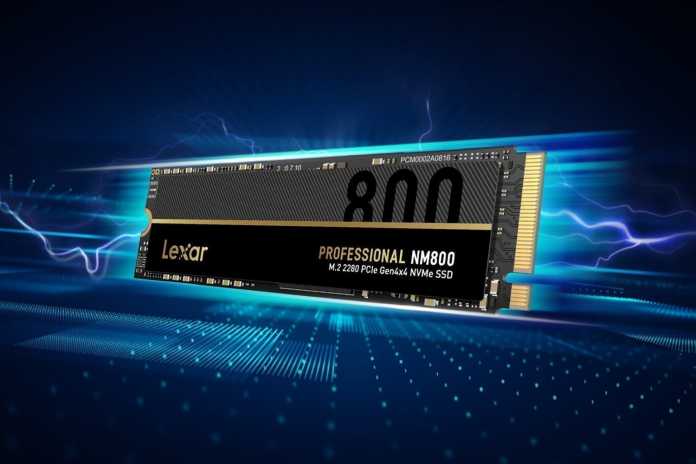
Here is our review of the Lexar NM800 M.2 2280 PCIe Gen4x4 NVMe SSD.
The Lexar Professional NM800 M.2 2280 NVMe SSD provides maximum SSD performance that puts you in the computing fast lane with speeds up to 7400MB/s read and 5800MB/s write, which is 12.7x the speed of SATA-based SSDs. It is also supported by the PCIe Gen4x4 NVMe 1.4 technology standard and backward compatible with PCIe 3.0, adding versatility to your professional workflow.
Developed with the 12nm controller, the Professional NM800 SSD produces low power consumption for longer battery life and a better user experience.
Unlike traditional hard disk drives, the NM800 SSD has no moving parts so it is built to last. On top of that, it’s also shock and vibration resistant2, making it one robust and reliable SSD.
Features
Superior speed PCIe Gen4x4 interface: 7400MB/s read and 5800MB/s write – NVMe 1.4, with M.2 2280 form factor
Get 12.7x the speed of a SATA-based SSD
Designed for hardcore gamers and creative professionals
Features LDPC (Low-Density Parity Check)
Shock and vibration resistant with no moving parts
Designed with heat dissipation label that keeps your computer cool
Five-year limited warranty
What’s in the box?
The box contains the NM800 SSD, a screw and a quick installation guide.
A Closer Look
Final Thoughts
The NM800 is small and is very easy to fit. The box contains the SSD and a screw to fit it into whatever device you want to use it in.
The NM800 can be used to either upgrade an existing PC with the correct slot, or if you wanted you could use it to upgrade your storage capability on your PS5, although if you are going down the PS5 route you should be aware that the NM800 doesn’t have a built in heatsink so you will need to buy one to add to it before you fit it into your PS5 (it only costs about £10 for a decent heatsink). For PC use you wont need a seperate heatsink and the NM800 handles it well, but Sony state you need one for SSDs and I wouldn’t take the risk of either the NM800, or your PS5 without adding one.
Fitting the NM800 was very easy – just slot it in and screw it down – that’s it!
Speed wise, the NM800 was excellent for both read and write – so no matter what you are using it for, whether its for games, music, videos, your Windows OS or anything else, you wont be disappointed.
They say good things come in small packages, and in the case of the Lexar NM800, they would be right.
The Lexar NM800 M.2 2280 PCIe Gen4x4 NVMe SSD is available now priced at around £99 for the 512GB version and £179 for the 1TB model.
First off, I am a big fan of adventure games, ever since I played games like Mario, Sonic the Hedgehog, Spyro, Crash Bandicoot, and so many others! The only thing that makes it hard to find myself attached to any game is it doesn’t bring anything exciting or worth spending hours playing. That would include if the graphics are horrible, no interesting music that plays in the background, or a dull story that is either narrated or spoken amongst the characters throughout the game. Practically, the game would begin to score low for me because the talking portion, not basically the video feature, but the speaking portion that goes throughout the game takes way too much time, which I would rather be playing than listening or reading.
So here are the two questions I asked myself before playing. Will Effie provide everything I feel I need in an adventure game? At least, if the story is not that great, will the action portion of the game, help overcome any lackluster if there is any?
Well to my findings, this wasn’t as easy to say in just a few words, as the game had me feeling unimpressed. I honestly don’t feel that this game brings anything different or exciting as I was hoping. It’s not that the game is missing something, or maybe it could be? However, I felt it just wasn’t as entertaining and I felt it could be better.
However, I rather tell you a few positive things that I did find pleasing, before the worst aspects of the game. Starting with it being a simpler game to play and allowing you to engage in plenty of fighting off the bad guys throughout the game. You will feel that similarity to many other games, as you play along. Even with its world environmental design, it’s very interesting and quite captivating.
Now comes the portion of why I found the game to be not for me or worthy of playing. So, while I did play through the game, which includes this long introduction. I just felt it didn’t bring any special thrills that would make it stand out. I was looking for something different or extraordinary when it came to the adventure portion of the game. Especially with the character design, it looks like it would be quite entertaining! However, some of the graphics felt a bit much, especially with the color red. It just looked awful to look at. Even the character design, while some were fine, others could have been done better.
Another reason this game made me feel very unhappy was that it’s told by us. So it’s in this 3rd person narrative because we are telling the story to the girl whose name is the title of the game, Effie. I don’t have a problem with this, but it can be a bit much to hear him speak about himself the entire time. I so wanted to turn off the volume, but I had no idea if I’d miss something important, as the words that also appear on the screen go away quickly and I could miss something.
Now let’s talk about the weapons. Well, this is easy, there is nothing really exciting, only one weapon, a shield. We finally get this when it’s time to defeat the first few ghostly villains and learn how it’s used. This weapon is awesome, there is just nothing else to hold our breath for. So even if it is used for other portions of the game, it doesn’t really bring much excitement to look forward to anything else.
Additionally, controlling the character was just the same, easy to move left, right, and side to side. It’s not such a very complicated mapping on the controller. Therefore, anyone who doesn’t normally pick up an action-adventure game will find it still easy to move around with ease. Especially, if there is nothing else to look forward to when it comes to getting new weapons to learn or hard skills, other than the ones you do get to learn during this game.
I did have one difficulty, which is in many games already, leaping from one edge to another. Now in the beginning we don’t double jump, till we learn this skill so it’s a bit difficult to get it right the first time. However, it will get easier when you finally move forward and learn these bonus skills. Thankfully, it wasn’t left to one single jump like many games do. I’ve always been left wishing for a double jump capability in any game if it isn’t going to ever happen.
Therefore, I want to leave you with this. Effie is a game that is with an original story, it’s not really complicated or difficult to pick up and play, with plenty of interesting elements and action of battling the enemies on your way through each part of the game. It just doesn’t work for me, I’ll play it, but it isn’t something I would play often. Leaving me to tell you that if you want something a bit more thrilling, something that will make you forget any other game you’ve ever played or challenge your brain with these so-called puzzles in this game, well I wouldn’t get your hopes up too much, but it does depend on the player’s experience. The more games you’ve played, and coming to this may not be as pleasing as if you just played not many action-packed and adventure games first.
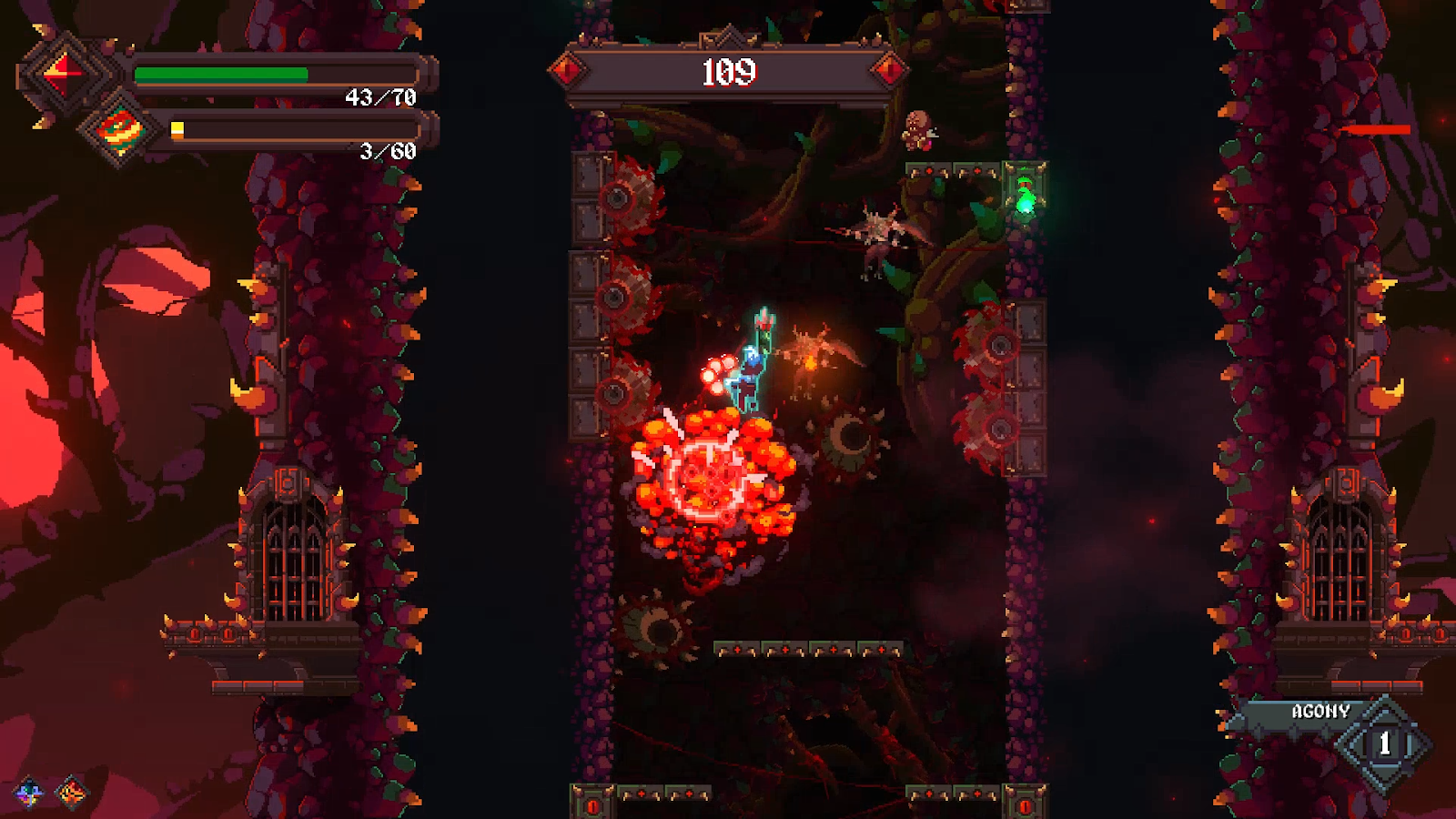
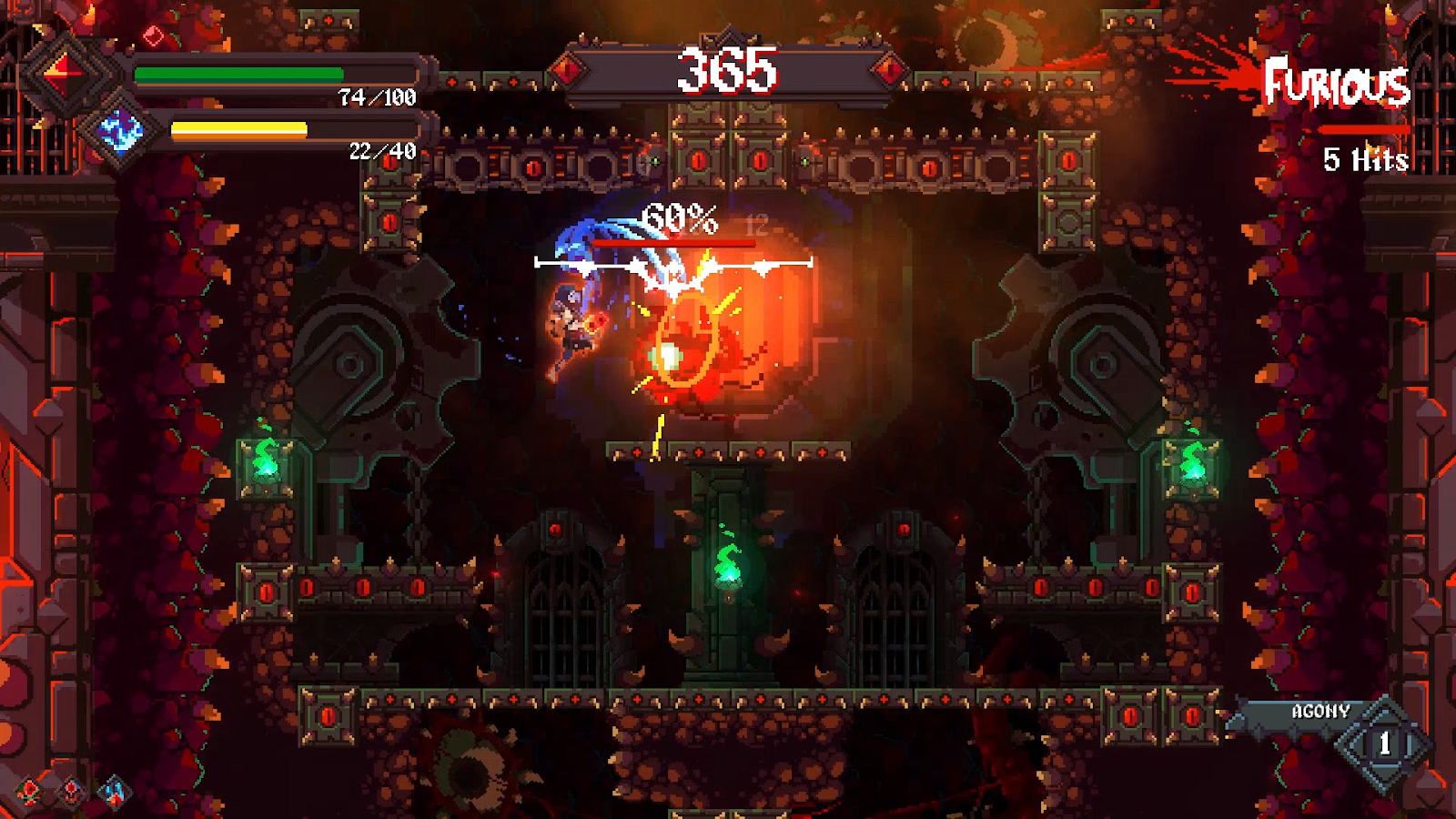
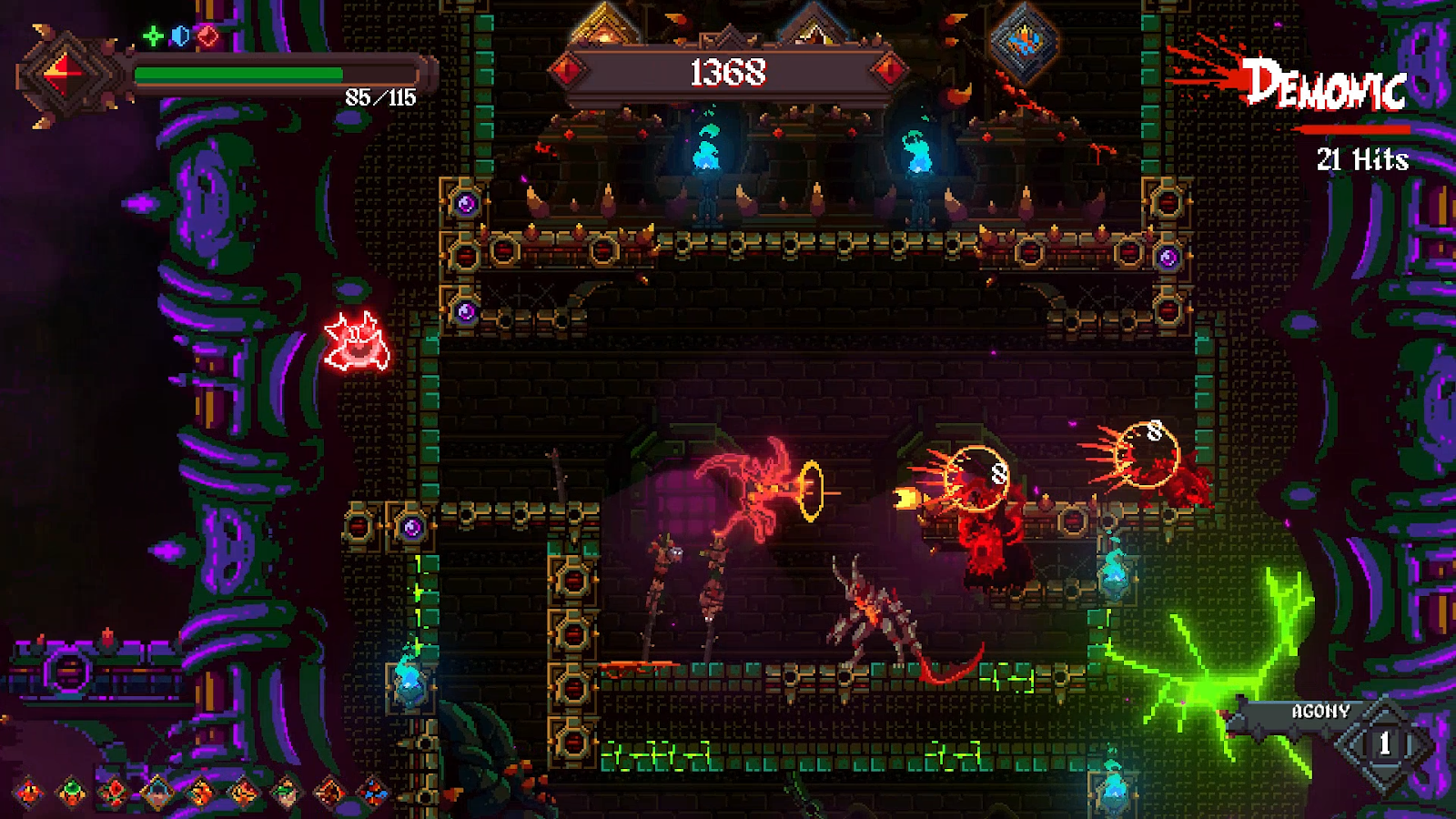
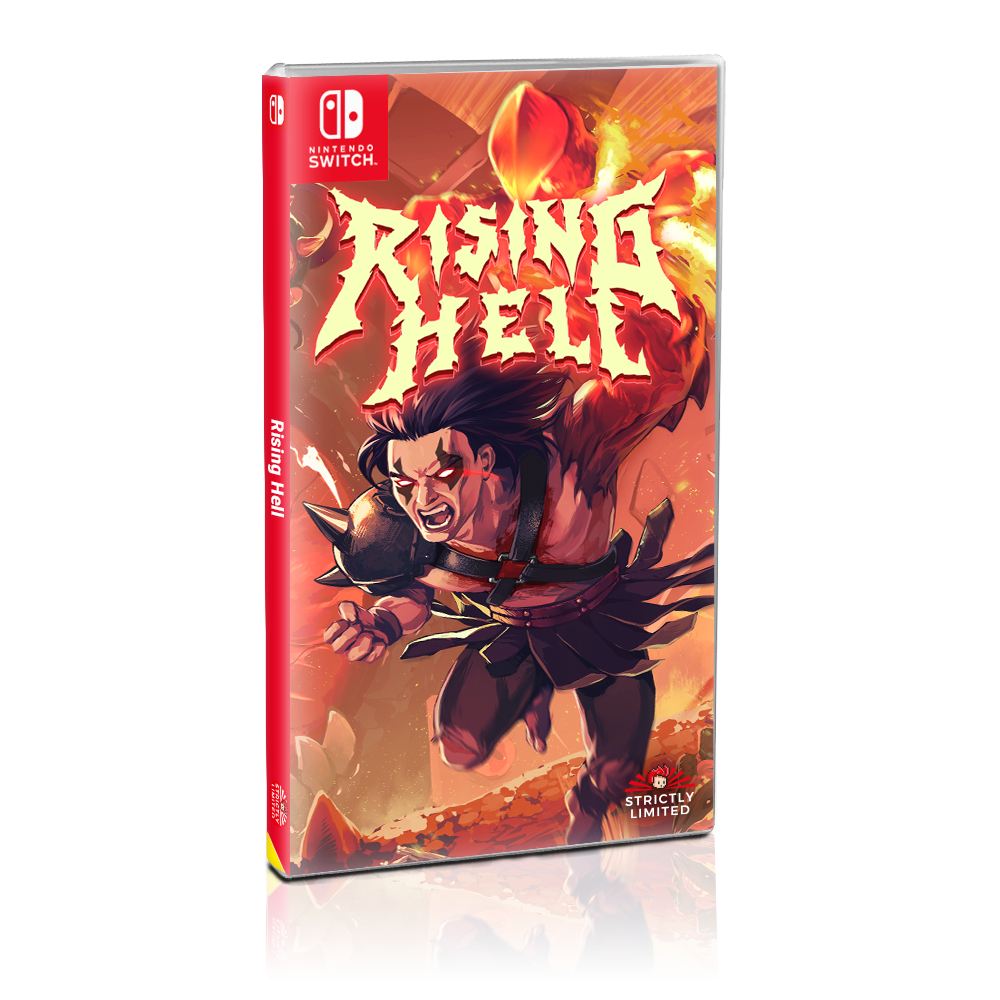
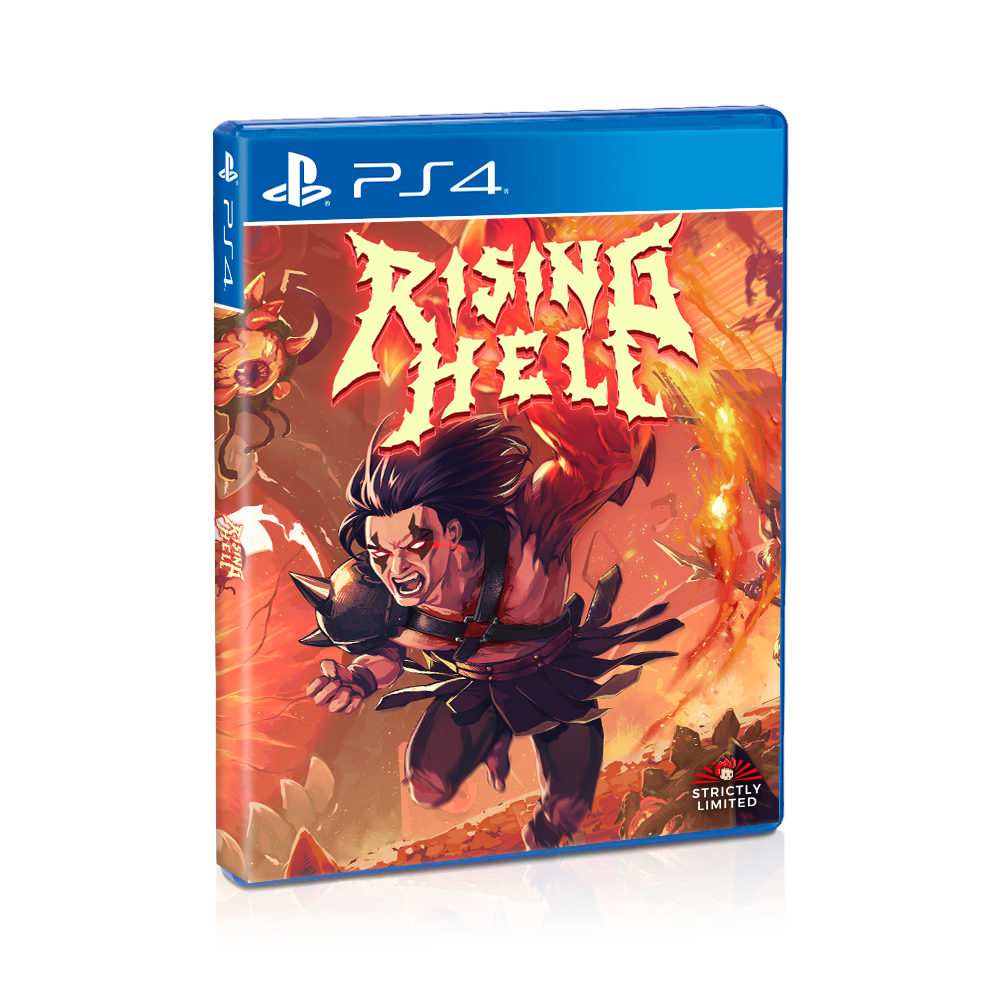
Strictly Limited Games, in partnership with Chorus Worldwide Games & Toge Productions, are proud to announce that Tahoe Games’ indie-gem “Rising Hell” will receive an exclusive, limited physical release. This 2D action rogue-lite with stylish pixel-look offers tons of adrenaline-pumping action, underlined by bone-shredding heavy-metal riffs, as you fight your way through the ghoulish gatekeepers of hell.
Rising Hell will be available for Nintendo Switch and PlayStation 4, as a boxed Limited Edition and Special Limited Edition, with pre-orders kicking off on Sunday, December 12th, at 12 AM CET (midnight), only at Strictly Limited Games.
About the game:
Rising Hell puts you in the shackles of Arok, a sinner wielding a mysterious bestial arm with the power to kill demons. Fight your way through hordes of blood-lusting abominations, as you ascend vertically through the randomly-generated and ever-changing depths of hell, to reach freedom and resurrect your dark master Lucifer on the surface.
Head-banging heavy metal riffs and gorgeously grotesque pixel graphics will accompany you on your climb, facing the bug-ridden Beelzebub’s Lair, and other pits of hell with different creatures, bosses, and living traps lurking at every turn. To stand a chance, you need to chain together combos, complete jumping manoeuvres and collect red orbs from slain foes, to spend on mighty buffs and talents.
Whether you’re a veteran with a knack for retro games or this is your first rogue-lite rodeo, Rising Hell will give you the kick you need! With the threat of permadeath pumping adrenaline through your veins, one thing’s for sure – you’re in for a hell of a time as you head-bang your way up on this highway from hell!
Features:
Slay in style while head-banging to heavy-metal riffs
Vertical hell-ride: Climb out of ever-changing, procedurally-generated hell by chaining together jump-attacks and satisfying combos
In true rogue-lite fashion, the threat of permadeath is ever present, but if you meet your demise, you come back stronger, as buffs continue to level up
Unlock and play additional cursed characters to explore a variety of playstyles, including the powerful Sydna or the agile rogue fiend Zelos
Fight epic boss battles, slaying ancient demons such as Dagon, Beelzebub and more
Strictly Limited Editions with hellish extras for real demon slayers:
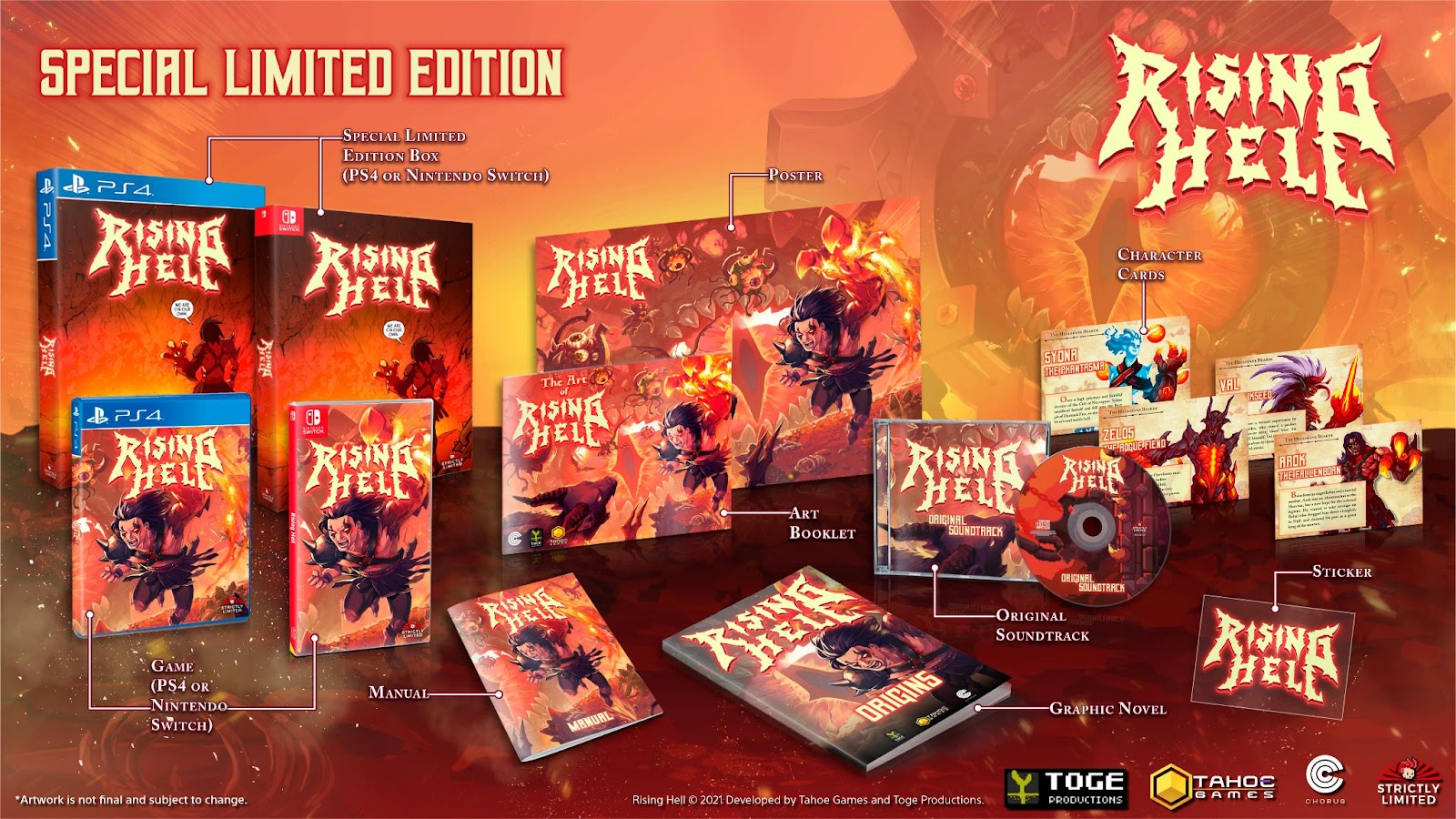
Strictly Limited Games is giving Rising Hell the boxed legacy it deserves, with two unique limited editions, available for pre-order exclusively via the Strictly Limited Games online shop.
The Limited Edition is limited to 2,200 copies for Nintendo Switch and 1,200 for PlayStation 4, at a price of 29.99€, including a colourful game manual.
The Special Limited Edition is limited to 1,800 copies for Nintendo Switch and 800 for PlayStation 4, for 49.99€, including lots of additional collectibles:
My vvideo review with footage captured from my Xbox Series X, enjoy!
Long before the Y2K bug was “invented”, we all lived in a pleasant technological bubble where our greatest fears were viruses from Napster. We would gather with our friends to play couch cooperative games and speak to each other face to face rather than on party chat. This era of gaming brought us some great and memorable titles and some of my favourites were the Mario Party franchise. Its colourful characters, crazy maps, and exciting mini-games kept me busy for hours. However, I haven’t experienced anything similar in years, until I tackled My Singing Monsters Playground.
Developed by Big Blue Bubble and published by Sold-Out Software, this is a colourful couch mini-game title. Focussing on casual fun and an array of events, you’re assured an entertaining time. You control monsters who compete to be crowned the champion. The selection of available games will test your stamina, reactions, and guile, and a friendly get together will soon become a heated affair.
Time your jumps and win the race.
My Singing Monsters Playground gets right to the point.
Unlike others in this genre, My Singing Monsters Playground doesn’t beat around the bush. You are chucked into the action immediately with three game modes available to select from. You can try Free mode, Tournament, or Solo Gauntlet. Furthermore, you can spend tokens at a prize machine to unlock decorations and cosmetics. Its allure is its lack of complexity and the ability to play, even if you have limited time.
The developers have focused on creating a vast selection of games that’ll test an array of skills. There is something for everyone and this balances the playing field. This four-player title asks you to tackle free-for-all matches, 2v2, and 3v1. The reward for winning an event is three diamonds, 2nd awards two, 3rd one, and 4th leaves you empty-handed. It was amazing how quickly the tournaments became competitive and arguments were commonplace. Think of Monopoly on Christmas Day and multiply it by ten! That’s how quickly things escalated.
Sprint to power that rocket.
Excellent fun, but it lacks depth.
It reminded me of the Mario Party franchise. Sadly, though, My Singing Monsters Playground doesn’t have the depth that its behemoth peer is famous for. The action doesn’t revolve around a board game, nor does it take you on an adventure. No, it simply wants you to compete repeatedly with no advancements in the gameplay.
This was okay for a short period of time, but it quickly became stale, especially when playing solo. With friends in tow, you can mask the repetition as you mock one another, or team up to annoy a friend. Unfortunately, hammering the computer players regularly isn’t as appealing. Even with three difficulty settings to select, it was never challenging.
However, if you can put aside the lack of story and underperforming competitors, you experience some wonderful and interesting moments. You must run away from stampeding monsters, drive race cars, dodge logs, match shapes, avoid gloop, power up a rocket, and more. I had no issue with the amount of variety. I just wanted there to be more structure to develop the ideas further, and tougher foes. Unfortunately, though, this never materialised, and this stagnates the gameplay very quickly.
My Singing Monsters Playground looks wonderful.
I’m a sucker for a bright and colourful experience, and My Singing Monsters Playground is eye-wateringly vivid. Thanks to its excellent stage designs, cartoon monsters, and variety of traps and activities, it was interesting to look at. The action is helped by the smooth movement and well-animated characters. Furthermore, this makes the hectic gameplay easier to manage. Visually, this is finished to a high standard, and I loved the selection of heroes and the additional cosmetics that could be unlocked.
Unsurprisingly, a whacky game requires a zany soundtrack, and that’s exactly what is delivered. The high tempo songs blended with the unusual sound effects add energy and amusement to the gameplay. Fortunately, the developers incorporated a vast amount of songs, and this reduced the feeling of repetition.
Whack anything that moves.
Simple to play.
With so many events to enjoy, it would be easy to become confused. Luckily, a clear tutorial overcomes this issue. Furthermore, you can experience a practice round to familiarise yourself with the controls. This was an excellent choice, and it ensured that less confident players had a fighting chance.
The party genre is excellent fun and creates memorable gaming sessions. However, its appeal is reduced when your friends stop playing. Subsequently, solo gaming becomes tedious very quickly. If the developers had incorporated online play, then this would be a truly moreish title. Sadly, though, it’ll be hit and miss for longevity and replay value.
My Singing Monsters Playground is great in short bursts.
Party games normally keep you playing for hours, yet, My Singing Monsters Playground probably won’t. It’s excellent fun in short bursts, but you’ll tire of the action quite quickly. As a multiplayer title, it is brilliant, but the solo action lacks depth and challenge, and this undermines the fun. However, I liked it and recommend you to buy it despite its shortcomings. Pick your monster, win every game, and become the champion of every tournament.
From the studio behind Life Is Strange and Vampyr comes another narrative-driven tale filled with twists and turns, but just how well does it stand out amongst Dontnod’s other star-studded titles?
After waking up in a hotel room bleary-eyed and covered in blood with no memories of the previous night, we’re immediately presented with a sense of dread and a conundrum on our hands: why are we covered in blood, who’s blood is it, and most importantly, how? There is absolutely no shortage of intrigue here, but we’ll return to this a little later.
Returning to a chapter in your life that you think you’ve closed is never an easy decision, but it’s one that investigative journalist Sam Higgs had to make. From the outset, Twin Mirror establishes this well; two years after he left, Sam is apprehensive about returning to his home of Basswood, West Virginia, to attend the funeral of his friend Nick who died in a tragic car accident.
What secrets does Basswood, West Virginia, hold?
As soon as you enter Basswood, it becomes evident that Sam isn’t liked amongst the townsfolk. As we slowly learn, Basswood is an old mining town, and after Sam published an article about the shady nature of the mine, it was forced to close down. The residents of Basswood didn’t take too kindly to Sam’s article and blamed the sudden downfall of the mine on him. The tension is immediately apparent as you get to know some of the townspeople, but this is unfortunately as far as the development for some of the residents of Basswood goes. Sam knows immediately that details regarding his friend’s sudden death don’t feel right, and after the wake, we are faced with waking up in the same hotel room we saw at the very beginning of the game; covered in blood, with more questions than answers. Now, he’s more determined than ever to uncover the truth about Nick and the town of Basswood.
Is there more than meets the eye with Nick’s sudden death?
The sudden death of Nick weighs heavy on the minds of not only Sam, but the residents of Basswood too, and it’s up to you as you reconcile with old acquaintances how these relationships evolve. Twin Mirror is a ‘choose your own adventure’ narrative, much like Dontnod’s other works in the past. To further complicate your decision making, as well as eat away at Sam’s already fragile mental state, Sam has an imaginary twin that only he can perceive. Referred to only as “Him”, the twin acts as Sam’s conscience of sorts, especially during moments when he is overwhelmed and emotionally detached from the situation. The twin acts as both an angel and a devil on Sam’s shoulders, and when he’s involved you can listen to him and follow his route or ignore him completely—again, it is your choice.
Would you trust your conscience personified?
Sam displays a very unique and intriguing ability early on in Twin Mirror, manifesting as something he calls his ‘Mind Palace’—and I’m sure if you were a fan of the Sherlock series from the early 2010s you’ll recognise this concept immediately. Essentially, Sam is able to enter a memory-like world in his own consciousness which allows him to relive his memories based on linked items he comes across in the world. Using his skills as a journalist, he is able to form his own hypotheses about certain objects regarding their importance to his investigations and choose between several options that formulate as a result. As you begin to piece the convoluted puzzle together, Sam’s Mind Palace can begin to morph depending on the situation he finds himself in. Some variants I came across included Sam struggling to cope with his growing anxiety and fears about Nick’s death which resulted in sudden chase scenes and the pristine crystalline environment morphing into a pitch-black void as he tries to escape his own mind.
Inside the mind palace…
…there are two sides to every coin.
Unfortunately for Twin Mirror, this is about as interesting as the plot gets. As you use the Mind Palace more to reconstruct different sequences within the story, a similar pattern begins to emerge. For example, when Sam is investigating the site of Nick’s crash, you are able to choose different variables that could have caused the accident that all play out in Sam’s head. Although there is a wide variety of conclusions Sam can draw from the scenario, only one of them is ever correct and will advance you further. This ends up causing a situation where you end up simply clicking and swapping variables until you get the scenario correct instead of working out your own conclusions as to what happened. This is the case with every choice that Sam faces, and it does get old after a while. The evidence gathering situations fall under a similar pace, and it results in you simply pacing around an area you can’t leave until you’ve ticked every possible scenario box. It doesn’t exactly help when Sam narrates every click with terribly obvious insight.
These scenes are what makes Twin Mirror feel so slow-paced. With these types of narrative games, each decision you make is supposed to feel as though it has a consequence, and it doesn’t always feel like Twin Mirror’s choices hold the same weight as other titles like Life Is Strange, for example. This isn’t exactly helped much by the side characters that Sam interacts with. Outside of his ‘twin’ and Anna, a lot of the characters you meet show up once and are never seen again, and Twin Mirror definitely suffers because of this—the characters simply don’t hold much emotional importance to become memorable.
Playing devil’s advocate: who do you trust?
Whilst Twin Mirror does hold some intriguing plotlines, it certainly doesn’t live up to its full potential. It offers a wide variety of choices, branching options and multiple endings both good and bad in nature, but it simply doesn’t allow enough time to build up enough momentum to keep it going. This ends up resulting in characters with basic development and not enough plot suspense in what is meant to be a narrative uncovering the mystery of a murder.
It’s frustrating at best because Twin Mirror clearly has all the hallmarks of a Dontnod classic. The graphics are beautiful and the atmosphere is exactly what I would expect if I were suddenly dropped into a small town in West Virginia. The music is exactly what you would expect from a narrative adventure and does add a lot to the immersion of the plot itself. The tension between Sam and his double is arguably the best-produced aspect of Twin Mirror, and the inclusion of his Mind Palace provides an excellent change of pace and scenery and helps to build Sam’s complexity.
With a solid 5+ hours of gameplay and multiple endings and collectables, Twin Mirror does have potential if you’re looking for a narrative adventure from Dontnod with some unique elements. If you’re a fan of Life Is Strange, you will definitely find aspects within Twin Mirror that are similar enough to enjoy, but overall, Twin Mirror doesn’t quite stick its landing as well as other narratives like it.
The world’s favourite blue hedgehog is back for a next-level adventure in SONIC THE HEDGEHOG 2. After settling in Green Hills, Sonic is eager to prove he has what it takes to be a true hero.
Sonic (Ben Schwartz) in SONIC THE HEDGEHOG 2 from Paramount Pictures and Sega. Photo Credit: Courtesy Paramount Pictures and Sega of America.
His test comes when Dr. Robotnik returns, this time with a new partner, Knuckles, in search for an emerald that has the power to destroy civilizations. Sonic teams up with his own sidekick, Tails, and together they embark on a globe-trotting journey to find the emerald before it falls into the wrong hands.
From the filmmakers behind The Fast and the Furious and Deadpool, SONIC THE HEDGEHOG 2 stars James Marsden, Ben Schwartz as the voice of Sonic, Tika Sumpter, Natasha Rothwell, Adam Pally, and Jim Carrey returning, alongside new additions Shemar Moore, with Idris Elba as the voice of Knuckles, and Colleen O’Shaughnessey as the voice of Tails.
Knuckles (Idris Elba) in Sonic The Hedgehog 2 from Paramount Pictures and Sega. Photo Credit: Courtesy Paramount Pictures and Sega of America.
Sonic The Hedgehog 2 will be available in Cinemas in 2022. Personally I cant wait!
First of all, I have to admit that this is my first experience with the Nioh franchise. Furthermore, at most, I have played the first Dark Souls game for about 20 hours, so I’m far from being an expert in this type of game. With that being said, I honestly couldn’t have been more thrilled as I played through Nioh 2 and experienced the brilliance of such a hardcore genre for the first time.
Despite being a sequel, Nioh 2 is actually a prequel to the first game, at least for the most part. From what I can tell, only the very last couple of missions from Nioh 2 actually take place after the first game, and they might potentially spoil one thing or another. Nevertheless, I didn’t feel lost or anything like that when I got to that point. I’m glad I did the research beforehand and went into this sequel blind. If you’re reading this and you’re on the same boat, then I honestly think you have nothing to worry about.
Nioh 2 is an ARPG set in Japan during the Sengoku Period, where players fight off against relentless hosts of yokai and humans. It’s a game with a tremendous focus on individual skill, and it’s also a game that offers players a vast array of possibilities in terms of coming up with different character builds. Whether you want to develop your character towards a slow but hard-hitting playstyle with something like an odachi or a battle axe, or whether you prefer something more akin to dual-wielding swords or tonfa that allows for a more fast-paced combat style, Nioh 2 certainly has you covered.
The customization aspect of Nioh 2 doesn’t end with the type of weapons that you choose to focus on though. There are also different types of armour that either favour you in terms of speed or defence, as well as yokai abilities that provide you with unique powers that can change the tide of a battle and save you in crucial moments. Not to mention, there’re also plenty of consumables ranging from damage resistance boosters to elemental damage imbuing scrolls, to even bombs, shurikens, and kunai. The best thing though, is the fact that you can even turn yourself into three different yokai forms temporarily, which grant you otherworldy abilities. Then there’re also ranged weapons, which are rather limited, with there only being bows, rifles, and hand cannons, but they still have their rightful place in everyone’s arsenal.
The coolest thing that made me really appreciate the depth of Nioh 2’s combat was not only the number of ways in which you can approach it but how flexible it is. Even late in the game, you can choose to switch your weapons of choice if you feel like it. The gear stats are more important than your individual stats, so you can totally make numerous viable builds even if you spent most of the game building your character towards a specific path. The game really rewards that kind of experimentation, and I found myself being able to get specific bosses where I was stuck, by simply changing my main weapon and learning how to move around and fight with it.
While most games might just give players a wide range of equipment and abilities to use, Nioh 2 goes even further with its combat complexity thanks to the use of stances. There are three of them, high, mid, and low, and they vastly change how fast you can move around and they fundamentally change how each weapon type behaves. In a lot of cases, being able to instantly switch between them in the middle of a tough fight can save your life. While the high stance allows you to unleash devastating attacks, they’re really slow and consume tons of stamina. On the other hand, the low stance favours speed but doesn’t really give allow you to deal much damage, but it does excel in triggered status effects on enemies. Meanwhile, the mid stance strikes a balance between the two, strengthening your ability to block attacks while also allowing you to execute more wide attack moves. The most optimal stance will always depend on what kind of enemy you’re facing, so while you can just play the game always using the same stance, if you master this system, you’re pretty much unstoppable.
If you’ve played the first game, then you probably already know this, but I was extremely surprised to see how much Nioh rewards aggressive playstyles rather than a patient approach. Don’t get me wrong though, being overconfident and relentlessly striking your opponents without backing away can prove fatal, but it all boils down to stamina management. It’s vital that you first learn your opponents’ movesets, and then you use that knowledge to exploit openings in their attack patterns so that you can get the better of them. If you manage to continuously hit your adversary, you will eventually deplete their stamina and you’ll be able to deal a lot more damage to them. Likewise, if you keep blocking enemy attacks or you’re repeatedly attacking, you can also run out of stamina and leave yourself exposed to your enemies.
Nioh 2’s combat is all about keeping a healthy balance between knowing when to run and when to dodge, and knowing when you should hit hard and when to pull back. I’d be lying if I said that I didn’t die countless times to bosses and even some regular enemies, but it’s all part of the learning process. The game can be extremely frustrating, but once you finally pull through and manage to overcome a roadblock, the satisfaction is immeasurable. To master the stamina system, you must learn the ways of pulsing, which is essentially timing a button press shortly after you execute any series of attacks. If you’re successful, you can regain a good chunk of stamina back while the enemy is still recovering.
Now, truth be told, while the game keeps getting progressively harder and harder, especially in the DLCs that are included in the Complete Edition, once I got the hang of the game, I breeze through most of the game’s bosses. I’m not sure if I just picked the right weapons for me, a combo of an odachi and an axe, but even the colossal yokai bosses, which are masterfully done and came into play in battles of epic proportions, still felt relatively easy. Nevertheless, some bosses did feel like they represented massive spikes in difficulty for me, and after beating them the game went back to being perfectly manageable.
Still, although the smooth and continuous execution of attack combos by enemies can look stunning, there are plenty of human enemies that just seem to stand still while getting repeatedly attacked. I found this to be particularly common with revenants – the AI-controlled player avatars that you can summon to your world and fight. However, some human bosses also seemed to exhibit this kind of behaviour. I’m not sure how accurate it is, but it always felt like some sort of a bug, where the AI would simply stop responding accordingly to my attacks. Regardless, it’s a really minor thing and it isn’t prevalent throughout most of the game.
In contrast to other games like, let’s say, Dark Souls, Nioh is a much more linear game. All the action starts from the world map of Japan, where you get to pick your next mission, whether that be to advance through the main story questline, or to delve deeper into the game’s world through its numerous side missions. In the map, you can also visit your safehouse to craft new equipment or improve the one that you already have, as well as manage your massive collection of gear that you’ll surely accrue throughout your journey. The map pretty much serves as a hub for all things character-related and anything that you’d expect from a typical RPG.
Now, Nioh’s mission structure is definitely pretty linear, but it works beautifully. The levels are carefully designed and there’s a tremendous attention to detail. Most levels don’t feel like a corridor like most linear games, they feel more like semi-open areas where you slowly unlock shortcuts and explore small branching paths that hide some kind of rewards. With that being said, main missions can be pretty long, going up to 2 hours if you don’t die too much, with side missions usually taking about 40 minutes or so to go through. In any case, the pacing of the game is kept together thanks to the various shrines spread throughout the levels where you can replenish your consumables, level up your character, and even sacrifice items in exchange for loot. This is obviously fairly important to keep in mind, because if you die and fail to make it back to where you perished, you’ll lose all your experience and you’ll have to start grinding it back again to level up once more.
It’s worth noting that you’ll be revisiting some areas, at least that’s assuming that you’ll play through the side missions as well, which I honestly found to be worth diving into. However, when you revisit previous areas, they’ve usually changed in one way or another, like by blocking certain paths or by adding new enemies. It honestly didn’t feel like recycled content. Although main missions tend to present the best moments in the game, partially due to having a major unique boss at the end, the optional content still provides plenty of value. The side missions do help in deepening your understanding of the world and its characters, but they’re really there to help you acquire more gear and to level up your character faster.
In terms of the story, I’m afraid I didn’t find it to be that engaging, and I had trouble keeping track of all the characters’ names, but perhaps that’s just because I’m not really knowledgeable in Japanese history and culture. Furthermore, the story felt a bit rushed towards the end of the main campaign. Nonetheless, although it is enjoyable, the story isn’t really why you should be playing the game. That would be the gameplay.
As a whole, the game just plays so smoothly and everything is so wonderful to look at in motion that I honestly struggle to let its few issues get in the way of a strong recommendation for fans of the genre. The boss designs are absolutely superb, but overall, every single yokai in the game is terrifying in its own way. The game always managed to surprise me whenever it introduced me to a new boss, which is usually done through a cutscene once you enter their arena. It always makes you fear for your life and wonder how long it will take you before you finally manage to beat the bloody thing.
Nioh 2 The Complete Edition includes the 3 DLCs that were released for the main game, The Tengu’s Desciple, Darkness in the Capital, and The First Samurai, and I’m honestly glad that they’re not an optional purchase. Although they’re all their own self-contained adventures in new regions and introduce new enemies, they all continue the player’s story that ended with the last main mission of the main game. That isn’t to say that the base game ends abruptly or leaves loose ends, quite on the contrary, but having played the DLCs, I’m thankful that I did as it provided a much more satisfying conclusion to the overarching story.
It took me roughly 100 hours to complete the main game and its three DLCs, and despite a few moments of frustration, I’m really happy that I got to the end of it. It was such a hectic and satisfying experience, and I’m really glad that I gave the game a chance. With this being my first adventure into this beloved and polarizing genre, I honestly think that Nioh 2 was the right call to get started. It’s not perfect, but it’s definitely pretty good.
Whether you just want to play through the story once or beat the game multiple times by increasing the difficulty, or if you just want to play through the game with the help of another player’s spirit, then Nioh has definitely got you covered. If you were ever intimidated by this kind of game, I think that Nioh 2 provides the right tools for players to slowly get the hang of it and achieve a great sense of fulfilment when the game finally clicks for them. I highly recommend it.
Power Rangers Battle For The Grid is a fighting video game. When I was younger, Power Rangers was one of my favourite shows to watch. But back then we only had the Mighty Morphin’ Power Rangers. But upon playing this game I have learnt that there are many new versions of them.
Power Rangers Plot
Power Rangers Battle For The Grid focuses on all power rangers currently in existence. Lord Drakkon is trying to get all the Battle Morphers. If he meets his goal, he will be able to control the world and the battle grid. You play as both Power Rangers and Monsters. The player takes control of whichever side wins the battle according to the story.
Power Rangers Gameplay
The game is like any other beat them up. Each button corresponds to a different Maeve. Using them in combination makes more powerful attacks. Each Power Ranger has a multitude of special attacks that can be used when you have enough special bar. In some battles, you have a partner. He can switch into combat or use the special assist attack. And an even rarer occasion you have access to the Zoids.
The difficulty level is where I have issues with the game. The normal difficulty seems near on impossible to be for an eBay. The easy difficulty seems far too easy. There needs to be a difficulty between the two difficulties to make it more enjoyable. That being said if you want to play for the story and I’m not too concerned about the gameplay easy is the way to go. There is an online mate which seems to be the main focus. Yet during my time reviewing the game I was unable to match with anyone.
If you are new to beat-em-ups there is a helpful tutorial that I completely missed. It was helpful in understanding the combat system and how the specials work. Even so, some enemies are unbeatable as they spam range attacks.
The Presentation
The graphics are acceptable but nothing special. The issue developers had was that you can’t do much with Power Ranger armour. To make it look impressive as it’s very bland. The monsters do have great detail and are far more interesting to look at. Unfortunately, the Zoids are off-screen so you never get to see them.
The soundtrack brings a lot of nostalgia back for a fan of Power Rangers. It has all the theme songs that play in the background. The sound effects are taken from the TV series. Which while cheesy makes the game a great package to play for any Power Ranger fan.
Replayability
Apart from the online mate. There isn’t much reason to reply. There is also difficulty levels but these can be frustrating and don’t add much to the game. Even with the complete package, there is not much content. Fingers crossed if they do a sequel to add a lot more content-wise.
Final thoughts
For a Power Ranger fanboy, this is a great chance to be a Power Ranger. Butts the combat is very limited and it would’ve suited an action game rather than a beta mark. The only incentive to continue on with the main story is to learn what happens. You are not awarded any upgrades or any reward for beating the enemies. It’s a deep shine but I hope they will learn from this in the next one and we can all enjoy it.
For a non-fan, this isn’t worth picking up. It is catered for those that love the series. As the combat is subpar and unfair at times. For that reason, I can’t give it a score higher than five but I’m willing to pick up the sequel should one be released.
When a game that essentially formed your childhood is remade and re-released when you’re an adult, it takes more than a month to sit down and write a review for it. All the thoughts and feelings and excitement that little Kara in 2006 would’ve felt have come back and ignited my initial love for the Pokémon franchise. I have spent almost every day since release on Shining Pearl. And upon completing the Sinnoh Dex, almost crying over my third attempt at Cynthia, and spending an ungodly amount of time smashing into walls underground, I can say I think I’ve just about seen enough to sit down and finally be able to write.
As I mentioned, when I was younger, I spent a ridiculous amount of time on Pokémon Pearl. I’d sit up at night with my DS under the covers, chasing mesprit around the map without a care in the world. Having maintained my adoration for the franchise for over 14 years, my excitement absolutely could not be contained upon the announcement of its re-release on Nintendo Switch. So what’s Sinnoh looking like almost two decades later?
Let’s begin at the beginning
The start of this game almost brought a tear to my eye. From your first encounter with Professor Rowen, to running into your nemesis (and also best friend despite how irritatingly they show up at incredibly inconvenient times) it just screams Diamond and Pearl. Initially I was really skeptical about the new art style. I loved the original, pixelated art style.
So the 3D animation was a new change I wasn’t sure if I was ready to accept. It felt too much like Let’s Go, which I really didn’t enjoy. But after a while you seem to fall in love with the chibi style. I don’t know if I really like it, or if I just got used to it after sitting in front of the TV for so long. Obviously I want to claim I am in love with everything that makes this game a reality, but the art style is what holds me back.
At times it feels slightly unfinished. When the challenge animation during gym battles spans across the screen it seems almost… blurry? Rather than the sharp, manga-esque style from the first release of the games. As I said, the art style is my only downside. I understand it shows phenomenal progression in terms of graphic and animation but it doesn’t feel quite right. If they had used the same style as Sword and Shield I probably would have massively preferred it. But due to how happy this game made me as a whole, I’ll have to forgive it this one time.
The only legendary Pokémon worth catching…
We are the champions, my friend
I swear they have made this battle sequence far more difficult in this game than the original. I am almost certain that I did not struggle this hard when I was younger. And I didn’t think anywhere near as strategically then as I did now. On my first attempt I managed to reach the second member of the elite four without struggle, but after that things just went rapidly downhill. After breezing through every trainer battle, every galactic encounter and everyone on victory road, I thought the elite four would be a slice of cake.
Oh boy, was I wrong.
The elite four in Shining Pearl is unlike any trainer battle I have experienced in any Pokémon game. It’s knuckle-whiteningly frustrating. Groaning through gritted teeth. Threatening to snap your switch after angrily putting it down and having to walk away from it for an hour or so. Honestly, it really is a challenge. Sure, at the time I was angry enough to declare I was never going to pick up the game again, but I welcomed the challenge with open arms. It was about time we were given something that trainers actually struggled with. But Cynthia’s Garchomp is another level of difficulty.
But nothing quite compares to taking that last pinch of HP from your opponent’s Pokemon. Nothing feels as enlightening as being announced the champion. It’s a feeling unparalleled by anything for all my fellow Pokémon fanatics. It’s glorious. All your hard work finally pays off. And then you return home and your mum mentions nothing about it and you just continue your adventure with no further recognition. Obviously…
Show your Pokemon the world as you explore (seriously – some of the walk animations are too cute to handle)
Sound of the Underground
I feel like The Grand Underground deserves a special mention. Despite carrying many traits over from the original game, there are so many new features which have been implemented to make it feel refreshing and if anything, far more interactive. When you first visit, you’ll notice how massive the map is, and question all the tiny boxes with question marks in. That’s what I did at least. What I didn’t expect to find was room after room of different biomes – much like the Wild Area in Pokemon Sword and Shield. The excited squeal that left me when I first stumbled into these rooms is something I can’t even begin to explain in this review.
It’s a breath of fresh air for anyone who is hoping to fill out their dex. Gone are the days of sitting with a guide open. Describing when and where these Pokemon spawn at what time of day. Sure, it makes it easier which some people don’t enjoy. But seeing Pokemon in the wild rather than hidden in tall grass is something which any inner child would adore.
There are several other elements to the underground which are new to this game. Thus supporting the many hours you will spend down there. Such as the huge amount of diglets following you around the map, gifting undisclosed pink sparkles when you run past. It took me a shameful amount of time to understand why and what these do. But you’ll notice that a bar underneath the minimap fills as you collect. Once this bar is full, a whistle will sound and things will start flashing. It’s all very exciting, but unless you know what’s happening you’ll probably just ignore it. I wish this element was explained in more detail because for all my shiny hunters out there – this is an extremely useful element!
There is nothing quite like seeing your favourite critters just milling about
The sweet sounds of childhood
The soundtrack to both Brilliant Diamond and Shining Pearl is basically nostalgia in a parcel for me. If you played these games when they first came out, you will recognise the majority of the soundtrack and it is honestly joyous. Every time I booted up the game I found myself singing along. Even hearing it coming from a housemate’s room at night brought a smile to my face. There’s something about it that just feels special and I am so glad they didn’t change it for the re-release. From the gentle tune of Eterna City to the tense, piercing sounds of encountering a legendary, it’s all there.
Final thoughts
As a whole I don’t think I will ever be able to fully express my love for this game. I’ve played too many hours to declare it as subpar or not worth playing. If you were a fan of Diamond and Pearl back during their initial release then for nostalgia sake you will love this pair. It’s brilliant from start to finish. And there is enough new and exciting content that it doesn’t feel like you’re just replaying a game that hasn’t aged well. I personally think it is fantastic, and will continue to sing its praises for as long as I can.
The massively popular anime series, Demon Slayer, now has a game to give fans the chance to perfect their breathing techniques and slay some Demons.
Developed by CyberConnect2 – who also produced the Naruto Storm fighting games – and published by SEGA, Hinokami Chronicles is a 3D Arena fighter that covers the first season of the anime and the Mugen Train movie.
Arena fighters aren’t exactly held in the greatest regard, and so, despite being a big fan of the anime, I went into this game with tempered expectations.
Was this going to be a hastily made cash-grab to capitalise on the popularity of the anime? Would there be a genuine competitive fighting scene that could sustain itself beyond the initial fanfare? And what level of Arena fighter ‘jank’ was I going to experience?
Let’s discuss.
The Hinokami Chronicles:
As mentioned, the story of the game covers the first season of the anime and the Mugen Train movie. Now, this is of course a condensed version of the series, but I was pleased to see scenes recreated in full within the games engine (which is faithful to the excellent Ufotable anime style). In comparison to another Arena fighter – My Hero’s One Justice 2 – which primarily used stills from the anime for cutscenes, this was a good start. All the voice actors are involved, and whilst not a direct replacement for watching the anime, the story itself does a good enough job of giving context and an overall picture of the narrative. Additional collectable “memory fragments” also add extra scenes for players that are not included in the main mission itself. I especially enjoyed some of the fragments that reflected the “Taisho secret” skits at the end of each episode.
I really liked this approach; it kept the story moving at a brisk enough pace for the gaming medium, whilst also contextualising each mission and developing the various characters.
The overall presentation is excellent, however, the gameplay structure is more of a mixed-bag. Each mission is divided into small hub areas, with different collectables to find and a boss battle at the end. This structure is fine for this style of game, but there are a couple things that make each mission a bit of a slog. Tanjiro, who you will be primarily controlling, is so slow. Navigating through each area is tiresome because of the lack of speed, and add to this the fact that every collectable is immediately signposted onto the map – ala Ubisoft – and exploration is just not very satisfying.
Collectables and “side-missions” – which is a very generous use of that term – are not integrated into the game in an engaging way. It all just feels like busy work that prolongs the interesting stuff, like the boss battles. To be more specific, one side mission consists of talking to a select number of NPCs who are out when they shouldn’t be – exhilarating stuff. Each unvoiced conversation ends with Tanjiro telling them to go in doors and the interactions themselves lack any sort of personality. This doesn’t add any value to worldbuilding or the gameplay, but it is something you will be encouraged to do to unlock the panels for each chapter. These panels are another aspect of the game. Using the game’s currency, Kimetsu points, you can unlock panels for each story chapter (and for a few other things). Unlocking panels will give you quotes (for multiplayer), costumes and music. This in of itself is a decent incentive, however the activities in the main campaign used to do this are frankfully dull and feel like a waste of time.
Occasional enemy encounters are welcome, but the majority of each mission consists of just going through each area check-listing every collectable on the map before moving onto the next cutscene. I think it would have been much better for the designers to integrate these collectables into mission rewards and battles, where the game is strongest, because the pseudo-open world gameplay isn’t great.
Thankfully, for fans of the series, the game delivers on capturing the thrill of each demon encounter. Boss battles took me by surprise: they are engaging, unique and faithful to the anime, which with particularly unique Demon’s such as the Drum Demon, deserves high praise. Each encounter has a few unique mechanics in play, and this made me look forward to every boss. The anime encounters were always hype, and the game does a great job of re-capturing this.
In the end, story mode does a decent job overall. In terms of capturing what makes the anime great, the story is excellent. Attempts for optional content; not so great. Nevertheless, it is how you unlock each character for versus and multiplayer, as well as additional costumes and other collectables, so you’re going to want to play it.
The slaying:
I think the most important thing to deliver for Arena fighters is a combat system that is approachable at any skill level, whilst having just enough depth for more seasoned players… and just a little side of fanservice. Ultimately, the primary demographic of Arena fighters are the fans, not necessarily fighting game aficionados.
Hinokami Chronicles, in my opinion, delivers on this front. The combat system features a few fundamentals, such as a throw, guard, dodge, jump, parry and, of course, basic combos. There is a bar that charges that enables you to deliver a super, or in this case, “Ultimate art”. Each character has their own strengths and weaknesses, but with the prominence of swords and a universal control scheme, it is not too difficult to pick up a particular character. Crucially, maximising combos, using boosts and certain skills in a sequence is important. Some skills end combos; others are great for starting combos, and high-level play encourages learning these systems.
Matches take the place of one v one encounters, with each player having a support character (unless you’re using a Demon). The support character can be swapped in and out of combat, as well as be called upon to support your combos or save you from an enemy’s onslaught. In certain encounters – such as against Yahaba and his zoning arrows – your support is a crucial part of your toolkit and a necessary method to break the enemies defence.
This is all good. It also helps that movement feels fluid and responsive (on the PS5, I know PS4 unfortunately has serious issues with input delay). Animations for each super and form are very faithful to the anime and, as a fan, hard to not geek-out at. Whether unleashing water breathing’s 10th form, or zapping into the sky with the thunderous sleep-walking Zenitsu, it is almost impossible to not be stylish. The lack of haptics or any sort of rumble (at least in my experience) on PS5 is disappointing, as I personally enjoy the “feel” of each hit.
The roster itself is definitely on the smaller side; owing to the relative infancy of the anime. At the time of review, the roster features 12 slayers and four Demons (with two more to arrive as free dlc). There are also six additional “academy” versions of some of the cast, but mechanically they play the same aside from having a different super; some of which are absolutely hilarious. This is cool but they are absolutely not different characters. There is already a confirmed season pass which will introduce new characters, and I think the support this game gets will determine how worthwhile the experience is in the long-run.
The combat system has undeniably been created with a lot of love and the animations, fluidity and systems all provide a genuinely fun experience. That being said, a threadbare roster, online play locked at 30FPS – even on next-gen consoles and a subpar netcode do make me concerned for the longevity of the game. New characters will certainly help diversify the roster, with the free dlc Demons already adding more unique playstyles. But, at the moment the online experience is very mixed and this needs to be improved upon.
The Verdict:
Hinokami Chronicles is certainly a promising game, but still far from a complete package. The gameplay is fun, intuitive and easy to pick up. The style is beautifully lifted from the anime, and the story, whilst lacking an engaging open world, does manage to exceed when capturing the most pivotal moments. But, right now the longevity of the experience will be heavily based on A. how much you enjoy the characters and seeing hype animations and B. the level of support and patches this game gets.
I hope this game is supported by SEGA as whilst the game fails to justify full price – even for a huge fan like me – there is still a lot to love here.
Gaming is a strange hobby that brings out the best and the worst in people. Rage-quitting and profanities are commonplace. They are not nice to experience, but let’s not tarnish everyone with that negative brush. Fortunately, these shortcomings are overcome by wonderful friendships, addictive games, and beautiful accessories. The controller we use is an extension of our personalities, and many whacky designs can be found. PowerA has some stunning pads and the Cuphead: Mugman one is a true beauty.
This limited edition enhanced wired controller for Xbox is striking, easy to use, and partially mappable. You may turn your nose up at a wired option, but for gamers who play near their machines, it makes perfect sense. No longer do you worry about lag or charging issues, no, instead you plug in, play, and forget the worries of a wireless connection.
A vibrant controller!
Cuphead: Mugman is stylish and useful.
Whenever I see any third-party controllers, I shudder. They are usually okay, but they tend to fall short on many elements. Fortunately, PowerA has a reputation for affordable peripherals that don’t skimp on the quality. Retaining the latest share features associated with official pads, this Xbox licensed product is a pleasure to use. Furthermore, a handy wired volume control allows you to mute or adjust the chat volume on the fly.
When something looks this great, there is normally a catch. However, I’m yet to find it. It incorporates a 3 metre USB cable, anti-friction rings for smoother motion, a 3.5 mm audio port, diamond-textured grips, and two advanced gaming buttons. It offers a lot of tech for the money and compares favourably to the Xbox official accessories and its nearest rivals.
Amazing packaging.
What’s in the box?
As you first handle the packaging, you are struck by the vivid colours and amusing imagery. Its packaging and content are a real head turner and it’ll stand out on any display. Its great presentation continues as you open the box. A well-protected controller is nestled in a plastic mould alongside the monstrous USB cable. You are provided with a clear manual that explains the button mapping and how to maintain the accessory.
Cuphead: Mugman controller
A 3 metre USB cable.
User Manual.
Comfortable and easy to use.
Pro-tech at a low price.
Button mapping has long been exclusive to high-end pads and pro gamers. PowerA decided that enough was enough and created a cost-effective solution. The Enhanced Wired range has two mappable buttons that enable players to make adjustments on the fly.
Thanks to the in-depth instructions, you will set it up with ease. The buttons are located to the rear of the pad and they lay where your fingers naturally rest. With a little practise they are simple to use and offer you a tactical advantage like no other.
Cuphead: Mugman is beautiful and well built.
I loved the long list of features that are standard for this pad. However, its build quality is what truly amazed me. Cuphead: Mugman is lighter than an official controller, but it feels sturdy and well built. The 3-metre USB cable looks robust and the additional buttons are hard-wearing. Furthermore, the audio jack delivers clear sound and the volume dial is responsive. I loved its striking design and features and recommend you to buy it here! Stand out from the crowd and become a pro gamer at a fraction of the cost.
As you load up Hot Wheels Unleashed it’s hard not to think that you’ve hit the jackpot, as it’s not only been a long time since the series has seen a release on consoles but it’s stuffed to the brim with creative features that can have you occupied for hours before you even get behind the wheel.
Perhaps as an apology for the length of time away, Unleashed puts an impressive effort into transporting Hot Wheels fans back to the living room of their childhood home where their imaginations would take the toys beyond their physical limits and give them a life of their own. With the ability to not only create your own tracks and race with your own paint job-created cars, you can also design your own basement to race them in. Furthermore, you can collect and upgrade your favorite cars while the game’s great graphics allows you to appreciate even the smallest details of the cars, down to the trademarks written underneath them.
With nearly 100 missions and 79 cars to choose from you’d think the expansive single-player mode would be equally inspiring, but unfortunately, in trying to make this as close to the real thing as possible, the racing potential is bound by the limitations the physical sets provide, and for those who don’t have that nostalgic connection with the little metal vehicles, the actual racing is a very slow burn that until you unlock its fastest cars, will likely have you wishing you left it mint and in the box.
The loot box system allows you to purchase cars for 500 coins and then if you wish to – which you obviously wouldn’t with this beauty – you can scrap it for 300 coins or parts which you can purchase new loot boxes with or upgrade other ones.
Unfortunately, so beholden to the brand is this title that no unlicensed video game would choose this combination of gameplay and level elements without nostalgia backing it up. Whether it’s that every car handles almost identically, the fact that the AI has incredible road etiquette, or the unimaginative tracks that repeat themselves ad nauseam, it was only the game’s fastest cars and in-game loot box system that prevented me from giving up on the dull single-player mode before I even reached halfway.
It’s a shame as there is clearly potential for something more if they were to just take off the Hot Wheels branded hat. There are great-looking environments that are completely wasted by tracks floating in the air instead of running through and around obstacles that are just waiting to be integrated. Instead, the majority of the tracks claim yet another tiresome loop to be its greatest feature.
One of the few stunt features is the R2 button which allows you to rotate your car in order if there are anti-gravity features in the level. In my case, I was just trying it on a large jump…..and didn’t land it on the track.
What’s even more puzzling is that imaginative designs and fun track features, such as snakes with opening and closing mouths, do exist in boss races, but there are only 5 in the entire game – out of 100 races. It’s almost as if the developer needed a campaign mode long enough to gradually unlock its collection of cars but didn’t want to overuse its best track features early on, hence making a large number of them feel gut-wrenchingly similar.
This effect wouldn’t be so bad if the 11 AI-controlled cars provided some entertainment on your way to the finish line, but despite racing quickly, they act like sedated ghost laps and rarely ever crash, which considering the series’ previous focus on large and impressive crashes, seems like a missed opportunity.
And for the love of all things awesome, make sure you don’t crash, as the game mechanics barely forgive a jump or turn not completed perfectly – despite the fact that you can ride with your eyes closed for 90% of the track due to its barriers. This harshness is a consequence of Unleashed‘s overreliance on drifting, which increases your speed twofold by upping your speed around the corners and filling your boost meter. It’s a decent system to wield as a player, but it turns out that the robotic AI is pretty good at it too, meaning that if for whatever reason you aren’t receiving the twofold benefit for more than a few seconds, you are not only going to find it almost impossible to catch up, you are likely to finish dead last. A respawn button does alleviate this issue to a degree, but it is a ‘feature’ necessary due to the lack of different ways to actually race.
It perhaps comes as no surprise then that I actually enjoyed the time attack modes quite a bit more than any single player race – which for most arcade titles would quite be the damning assessment, but for Hot Wheels Unleashed, it manages to escape relatively unscathed.
When the racing does fire on all cylinders- through its fun on-track features and the speed from its supercars – it combines brilliantly with its upbeat soundtrack.
Stealing the show are the game’s track creator and online multiplayer modes that allow you to play your own custom-made tracks and those made by the online community. The track editor has endless options for wacky and out-of-this-world creations to be put together, shared and played randomly online with others or played in a single-player time attack mode. Sadly though, this is the extent of which these features are supported currently with no online leaderboards or tournaments at the moment, despite them being the best on-track parts of the game by some margin.
As a big proponent of offline single-player experiences, I seldom say this, but it’s a shame this game didn’t shift more of its creative focus online as without each car having more distinct features (than just top speed and acceleration stats), this game needs innovative and varying designs to best convey its sense of speed.
Fans can rejoice that Unleashed is more than just a Hot Wheels title in name, encompassing everything the product is about, and while criticizing its narrow gameplay might be like complaining that water is wet, I can’t help but feel that the game leaves an unnecessary amount of potential on the table which ultimately prevents this game from being anything more than occasionally great.