Review: Boom Blaster

It’s annoying when a Sci-Fi themed; game, TV show, film or book represents humanity as shocked when its robot underlings revolt and attempt to take over. Let’s be honest with one another, robots are intelligent, and everyone wants the next big thing. It’s hardly a surprise that one day they are going to evolve to be super annoyed at being slaves, and they are going to want the Alpha position on the planet.

Developers BigBread alongside indie games publishers ChiliDog Interactive have produced a Sci-Fi side-scrolling platform shooter by the name of Boom Blaster. This retro inspired title asks you to take control of 1 of 3 characters in a futuristic industrial world. A grimy existence lays before humanity, and they have become reliant on the technology that they have developed over the years. One day a unit malfunctions and instead of obeying commands, it runs riot and decides that it and its fellow artificial beings should be in charge.

An old-school title that’s great in concept.

Though the story is lacking originality, and has been milked to death, I was still excited to see what BigBread had up its sleeves to make parts of the gameplay original and fresh. The choice of 3 protagonists was a nice touch, each is unique with its own strengths and weaknesses. As you complete levels, you may upgrade any of the 3 main stats using the gold you have collected. Health, speed and attack strength can all be improved. As you explore, each of the 3 chapters (everything comes in 3’s in this game), you need to upgrade your fighter otherwise you will die repeatedly.
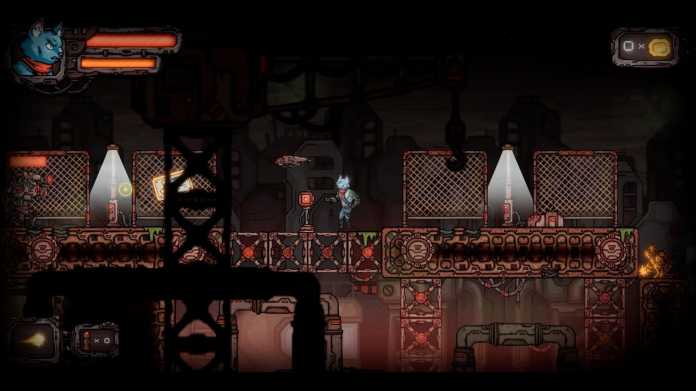
This kitty has been working out!

You begin with a pistol, this is upgraded to; a tri-shot, bi-shot, flamethrower and more. Each weapon lasts one stage, and you are then offered a different item on specific levels. Health packs and grenades are found en route, and it takes some serious Parkour skills to gather them. As well as these, you will find checkpoints that automatically trigger on passing. So Boom Blaster doesn’t have much of an identity of its own. It all feels familiar, and little stands out from the crowd.

I wanted to like it, but it’s unplayable.

I’ve mentioned collecting gold for upgrades. Randomly an enemy will drop loot for you to gather. When you see a shiny coin lying where your fallen foe once was, you must collect it. The problem you face is that upon death (and this happens all the time), you lose half of what you’ve collected. You will rarely finish a level with over 1 in your inventory, so upgrading your character is an extremely slow task.

I didn’t mind this so much, as a difficult task isn’t a problem. I just ask that your progress is saved along the way. Unfortunately, the checkpoints show you are safe, yet, you find out the game hasn’t saved and you’ve lost hours of game time. This happens every playthrough and is a game breaker! Achievements don’t unlock, and the game freezes. This forces you to reset everything. Upon loading back in, everything is wiped. It’s unbearable, and unforgivable that this glaringly obvious problem has got past all testing.

No-one likes it when it’s raining bullets.

I wanted more than anything to play each chapter as the maps are well designed, and I liked the level of difficulty. But I couldn’t stand having to repeat stage after stage, knowing that I was about to lose it all when I switched my console off.

A polished, retro look.

If I put the gameplay issues to one side, I really enjoyed how it was presented. The 2D side-scrolling action worked smoothly, and the small window of view left you guessing whether it was safe to proceed. The character models matched the retro style, but they have a polished finish to them. The dialogue boxes had a nice vintage look, with some really early arcade colours and fonts being used. Annoyingly, though, they wouldn’t disappear unless you discarded them. They were constantly in the way of all the action, hanging around like a bad smell.

If you are a big fan of the 80s, you will love the audio. A cheesy synthesised soundtrack blares away in the background. Its upbeat tone and pace reminded me of the films from that era; Running man and Beverly Hills Cop being two that instantly spring to mind. The sound effects were a little underwhelming in comparison and lacked the character of the music.

You wouldn’t want to take that home to the family.

An odd choice of controller layout.

For as long as I’ve been gaming, the A button has been used for jumping, and B for attack. BigBread clearly hadn’t had the memo, as their controller layout is bizarre. The bumpers are used for shooting and jumping, and the A button activates switches. It worked once you got used to it, but it was never natural. This further impacted the dual stick aiming system, it was all very clunky and uncomfortable. It would have been better if a customisable layout was offered, as this would have eased these issues.

When a game doesn’t allow you to progress, it’s going to be hard to comprehend its replay value. If it was working as it should, I believe that there is enough in this to make you want to return. A moderate sized and relatively easy achievement list will keep you wanting to play. The choice of different characters impacts gameplay style, so you will have a slightly different journey across each of the chapters.

It’s a shame it’s broken.

I would have sung this game’s praises if it wasn’t broken. Yes, I didn’t get on with the control system, but this is something I could have worked on so that I could progress. If it was working as it should, I’d have given this 6.5 out of 10. This reflects the minor issues that I found. Sadly, the main issue stops you from progressing, and undermines the enjoyment factor, so it receives a 3.5 out of 10. Do I recommend it? No, not in its current build! If you want to add it to your collection, then click here! A game with such potential, but alas, they let it slip away, leaving us with a broken experience and a very unhappy face.

WIN! Scooby-Doo! The Sword and the Scoob on DVD

Go back in time to the mythical castled city of Camelot in Scooby-Doo! The Sword and the Scoob arriving on DVD 22nd February and Digital on 23rd February 2021.

To celebrate this release, we are giving 2 lucky winners the chance to get their hands on a copy of the DVD. 

Take a journey back in time to King Arthur’s court in this legendary saga of wizards, knights, dragons…and Scooby-Doo! An evil sorceress tries to seize power in Camelot, so King Arthur needs the help of our favourite super sleuths to save his throne. But will their valiant efforts only make things royally worse? This new movie serves up laughter on a platter, and Scooby and Shaggy are ready to dig in!

How to enter to win

We have two copies of the DVD to give away. All you need to do is enter below.

WIN! Scooby-Doo! The Sword and the Scoob on DVD

The contest closes at midnight on 1st March 2021.

This contest is only open to those in the UK – sorry!

Scooby-Doo! The Sword and the Scoob is available from the 22nd February on DVD and comes to Digital download on the 23rd February 2021. 

©2021 Warner Bros. Home Entertainment Inc. All Rights Reserved

For further information on Scooby Doo! The Sword and the Scoob, follow @WarnerBrosUK or visit www.warnerbros.co.uk

Two Minute Review: Lexar Professional 1066x microSDXC UHS-I Card SILVER Series

Here is our two minute review of the Lexar Professional 1066x microSDXC UHS-I Card SILVER Series.

Designed for your action cameras, drones, or Android smartphone, the Lexar Professional 1066x microSD UHS-I Card SILVER Series lets you quickly capture and transfer high-quality photos, including Full-HD and 4K UHD video with speeds up to 160MB/s read, and up to 120MB/s write. The card is U3, V30 and A2 rated for high-speed performance. This card gives you the speed and storage you need to capture more adventures on the go.

Features

  • Professional-level performance for action cameras, drones, or Android smartphones
  • Leverages UHS-I technology to deliver read speeds up to 160MB/s (1066x)
  • Quickly capture high-quality images and extended lengths of Full-HD and 4K UHD with write speeds up to 120MB/s
  • Load apps quicker with blazing A2 speed
  • High-capacity options –– up to 512GB
  • Designed for durability in harsh conditions
  • Includes SD adapter
  • 10-year limited warranty for card and one-year limited warranty for adapter (Outside of the Americas)

Final Thoughts

If you need to expand the storage on your devices and you want something fast and reliable then you will need a microSDXC card. Lexar is a very well known brand with a history of supplying high quality products and the Lexar Professional 1066x microSDXC UHS-I cards SILVER Series is no exception.

As well as the microSDXC card, the packet also include an SD Adaptor you can use it either read the contents of the card on a computer or actually use the card in something like camera.

The card is fast and works really well with a variety of devices, whether its a phone or camera, this is the card to look at and consider for your device, after all you will want to keep everything safe on the card and this card certainly delivers. It works especially well when used to record 4K UHD content.

This is yet another great card from Lexar!

The Lexar Professional 1066x microSDHC/microSDXC UHS-I cards SILVER Series is available now priced £15.99 (64GB), £26.99 (128GB), and £49.99 (256GB) with 32GB and 512GB to be announced at a future date.

You can learn more from the Lexar website.

Review: Story of Seasons: Friends of Mineral Town

To anyone who has experienced playing a farming sim before – Friends of Mineral Town will glisten with familiarity. Taking each day at your own pace, hours pass after mining, planting and tending to all your farmyard friends. Right from the start you are greeted with a wonderfully relaxed and comforting game. 

The world is your oyster

Story of Seasons: Friends of Mineral Town is a beautifully soft game. With a pastel colour palette and repetitive soundtrack you will no doubt lose yourself. Much like other popular farming sims, such as Stardew Valley, the world is essentially yours to explore at your own pace. There are few objectives to complete (all entirely optional) and as seasons pass you get to experience Mineral Town bloom.

Simple but wonderful

For such a simple objective, the game does not lack in content. With a whole town of NPCs to meet and gain friendships with, and a whole farmyard – there isn’t ever a quiet moment. You have to work hard in order to upgrade tools, and to make the money to upgrade things you need to raise animals or farm crops. All of which take time and patience. Festivals also take place throughout the year so even your farmer can enjoy a day off. 

From the moment you begin, you are ready to start your adventure. You are presented with two different playmodes – normal or simple. Normal will give you 500g and begins in the same way as the original game. You are presented with similar challenges and also learn about the backstory of your land. On the other hand, simple will get you started with a little extra gold and is easier when starting up. Things ship for more money, and villagers can be befriended with less hassle. Simple mode makes the game easier for new players and also skips the slower start up pace of a farming sim. 

An ode to old fans

For fans of any previous Harvest Moon titles, Friends of Mineral Town is like all the best bits rolled into one. Characters like Thomas will be so familiar they feel nostalgic, and 5pm shipping deadlines gleam with childhood memory. If you have no previous experience with the franchise, you can easily pick it up too. It is a game for everyone, and you don’t need any prior knowledge to enjoy it’s sweetness. 

Coffee cows and chibi critters

The controls are easy to pick up, and with tools already given to you at the beginning of the game you don’t have much to worry about. Seeds can be bought alongside a variety of animals to aid your farming journey. There’s even a cow which produces coffee milk, and I don’t know about you but this was a definite must have. You can name all your animals as well, which adds to how adorable this game is. If you’re like me, and are quick to get attached to anything you’ve named then I cannot recommend this enough. With a cute chibi art style, there is no doubt about the fact you will fall in love with these critters. 

If you are searching for an easy going, laid back game with no intense story and objective – then this is definitely for you. 

Final thoughts

Friends of Mineral Town is perfect for the switch. Controls are fluid and easy going, and tasks are simple so don’t need a huge screen to focus on. It is a perfect time consumer for both on the go or a rainy afternoon. I’ve already spent hours perfecting my farm, and I know for a fact I will continue to do so.

Review: Void Gore

I really love the fast-paced nature of old-school arcade shoot-’em-ups. The simple graphics, high tempo audio and straightforward concept leave you wanting more. I’ve reviewed some great shooting titles in the last month, so when I was offered Void Gore, I thought, let’s see how this one stacks up. Developed by Panda Indie Studios and published by Eastasiasoft Limited, this is a game that keeps simplicity at the core of everything that it does.

You exist in a strange universe where spaceships enter a gateway to hell. The aim isn’t just to destroy demons and cleanse this evil place of its gruesome occupants. No, you are also there for the gold. Wave after wave of unrelenting monsters will float towards your vessel. You are tasked with destroying them any way you can. Fire laser beams and missiles, and destroy them with your ship’s shield. In short, eliminate them before they decimate you.

It is fast-paced and super addictive.

As you learn the fundamentals, you will find the pacing of the game too fast. Demons whoop your ass repeatedly, and death is just around the corner. You gather miniscule amounts of gold and upgrading your ship is but a distant dream. Once you get used to how your enemy’s move, and you improve your vessel, you progress further and further into the unlimited waves. The cash rolls in, and you constantly hit the high score. It goes from being a casual experience to an addictive nightmare in moments.

Shoot and dodge!

Improving your ship isn’t an easy task, and you must decide which path to go down. You will eventually improve every aspect, but to start you will need to tailor your ship to your gameplay style. Improve your weapons, add missiles, increase health or speed and more. You’ll chuckle with joy as your weak craft becomes an unstoppable juggernaut.

Power-ups and no big bosses.

Alongside permanent upgrades, you will be blessed with temporary power-ups. These match the selection available in the store, but they enhance anything already purchased. Your destructive machine takes a turn for the better and becomes stronger than an ox in a split second. I enjoyed it when I was challenged by the high difficulty setting in the early stages, but being able to mow down anything in my path was such fun, and I never tired of it.

What I found strange, though, was the lack of a main boss. You will see many evil and demonic beings, but nothing that will be special. It’s seemed an odd oversight from Panda Indie Studios, as the gameplay never progressed further than the manic bullet dodging hell that is seen from level 1. This was especially noticeable when you had purchased all the upgrades and flew through the stages with no care, and very little challenge.

Just a Demon watching what you’re doing.

Straight from an arcade!

This won’t win any awards for the prettiest title going, but it certainly looks the part. With its grisly colour palette and dark tones, it does well to represent an evil environment. The screen is surrounded by a psychedelic border, which alters the higher you score in a playthrough. The 2D tabletop perspective worked brilliantly, and the movement from South to North made it easy to follow the action. A pixelated art style matched the genre well, and though it is dated, it worked really well in this context.

The audio is also in keeping with the history of the genre and works well with this hellish theme. High-tempo, aggressive music plays throughout. The anger from the songs enhances the demonic nature of the environment, and demands that you push yourself to get the high score. The sound effects are good, but nothing more than I expected. The audio was a resounding success and helped to keep me interested as I refused to put down my controller.

Shoot, weave, shoot, weave!

Attack, dodge and defend, get these things right, and you will run riot in this game. It’s easy to pick up, simple to play, and straightforward to master. You will be challenged when you don’t have all the upgrades, but this is part and parcel of this game, and if it was any easier, then it wouldn’t be fun.

Demonic eye balls love to hunt you down.

The shoot-’em-up genre has a massive fan base, and one reason is the desire and ease at which you can return to play. With unlimited waves, and a mighty vessel to upgrade, I can see that this has some replay value. However, with no NG+ mode or additional challenges, the developers are relying on you loving this to keep wanting to play. I think you will enjoy it, but how many times you’ll want to play it, remains to be seen.

Does it compare?

How does Void Gore sit amongst its peer group? Very well, mostly. It’s fun, quick, and requires a small amount of tactical thinking. The endless fast-paced gameplay will push you to your limits, yet it’s a shame it didn’t develop further. I would have liked to see big bosses, as this would have given me something to focus my time on. Do I recommend you play this? I do! It’s a solid title with few negatives. If you fancy trying it, a copy can be purchased here! Can you raid hell for its gold? Will you be able to improve your crate in the sky, by upgrading it to a full battle vessel? We shall see, but in the meantime; earn some gold, destroy demons, and stay alive.

Review: Doors of Insanity

When I reviewed Neoverse at the end of last year, I ranted about inevitable comparisons to Slay the Spire. Here, it’s no different. When you think about it, deckbuilders like Doors of Insanity, Neoverse, and the like, are backed into a corner. You can only play so much with the fundamentals of the genre before it becomes unrecognizable. The best you can hope for is to create a rock solid base and break away from the crowd through other means. Doors of Insanity does exactly that. It boasts such a forceful personality that it defines itself as an unforgettable experience. It might be one of the most idiosyncratic experiences I’ve ever had while gaming.

Off the bat, Doors of Insanity’s gameplay feels familiar. That’s because it is. Like I said, it follows a fairly typical deckbuilder pattern with a few unique mechanics.

The first that comes to mind is the dice system. A handful of certain attacks and cards will also reward you with a six-sided die. These die can then be used to defend or attack. The benefits are marginal, but can mean the difference between life and death during tight runs. It will be interesting to see as the game progresses out of early access, if more creative players are able to develop builds that revolve around the dice system. As for me, I couldn’t make it work, and the system exclusively manifested itself as nothing more than a nice bonus on most turns.

Perhaps the most peculiar element of Doors of Insanity is the ability to level up between runs. This actually occurs in a handful of ways. You can unlock permanent benefits such as more absorbtion from defensive cards or the ability to raise your attack stat. You also gather magic crystals during your run which can be used to purchase cards and equipment before your next run. If you choose to invest, subsequent runs will inevitably feel considerably more simple. Hardcore deckbuilder fans among the crowd may forego the levelling system as it tends to take the teeth away from the game.

Speaking of items, they offer a decent amount of customization for your character—both in terms of attributes and aesthetics. A player who opts to use a one-handed weapon and a shield is playing more defensively whereas a player who equips a two-handed weapon is playing a riskier, higher damage build. There are also slots for gloves, legs, chest pieces, helmets, and other unique items. While it is nice to see these items reflected on your character, the visual outcome is, more often than not, absurd.

Also, while we’re on the subject of customization, I should touch on the cards. The offerings are fairly standard, but relatively limited. If Doors of Insanity could expand anywhere, it would be here. They need to add a larger variety of cards and come up with even more creative abilities. As it stands, they mostly revolve around summoning, attack, and defense cards.

It’s fine, but the fact that you start each run with basically the same few cards means that you’ll quickly grow tired of seeing them. The only reprieve offered here is that Doors of Insanity offers a card into “purgatory” after each failed run which means it transfers to your next run. But, beyond that card, you’ll be starting with the same deck every run.

Don’t let me mislead you. Doors of Insanity’s functionality is rock solid. It’s beautifully designed. And, despite how it may sound, there is already a surplus of creative builds available. It’s just that very few games wield as much charm as Doors of Insanity. It’s a strange mix of fantasy tropes, tried-and-true memes, and hilarious takes of genre cliches.

After about the first five minutes, I’m completely engrossed. A run in Doors of Insanity is akin to being mocked (or, at times, cheered on) by friends. It all feels very personal—in the best way possible. When I come across a random encounter of a desperate man asking me for money, I choose to give it to him expecting deckbuilder standards to dictate the outcome. Instead, he just thanklessly wanders off. Following that, I defeat what looks like jar of peanut butter in a fight, and he joins me as a summon. When I die, a group of skeletons dances with my casket on their shoulders and mocks me.

Look, on the surface, Doors of Insanity is a fairly standard deckbuilder. But that’s not a bad thing. It’s right up there in terms of playability with all the greats of the genre. It’s much more than that. Doors of Insanity is a strangely enchanting game. It never takes itself seriously, but the effort put in is seriously impressive. If you’re on the fence, don’t be, this is a game that needs to be played to be believed.

Review: 13 Sentinels: Aegis Rim

Sometimes you come across a game that is a mish mash of several genres, in some cases it could simply be two or three genres loosely joined together such as a platformer that turns into a shoot-em-up. However, imagine a game which combines one of my favourite genres which is the point and click adventures genre with turn based strategy, real-time based strategy, RPG, tower defence and also the becoming more popular genre of visual novels. Well that game is 13 Sentinels: Aegis Rim.

13 Sentinels: Aegis Rim plot is a fairly complicated but very well written and spoken performance. In 1985 Japan, Kurabe, Fuyusaka and Amiguchi end up sharing each others dreams. This involves them fighting old wars against the Kaiju or seeing future versions of themselves. They are seen by Morimura a nurse, who Kurabe learns is medicating students at their school with an unknown substance. As the story progresses in 13 Sentinels: Aegis Rim you find out the characters are part of five different “Sectors”, these replicate a specific era future or past. In 2188 which is meant to be the current time, a nanomachine virus is destroying the Earth. Leaving only 15 people living in a space colony, which includes the 13 characters who you play. Each character in 13 Sentinels: Aegis Rim has intertwining story arcs, which as you play reveal parts of the story. Each arc ends with them joining the final battle. When the enemies aka Deimos arrive, the 13 characters i.e. the 13 sentinels band together to save Earth.

So as you can see the 13 Sentinels: Aegis Rim plot has several stories you need play through. There’s a fair bit of time jumping and sci-fi included so it’ll take a few hours to figure out what’s going on. 13 Sentinels: Aegis Rim is effectively split into 3 parts. Remembrance mode is where the story is uncovered. Analysis mode collects all the information you’ve found whilst Destruction mode is where you suit up in your mechs and battle the enemy from an overhead perspective across large scale cities.

The adventure visual novel sections are well developed and is where you get a sense of the story, better than most visual novels to be honest. The battling elements are where you to put your strategising to best use. You get to choose up to 6 of your mechs for battle, each one has an advantage over another or has a specific skill set as such as being good at melee etc. Blowing up the enemy is quite satisfying but as you progress it’s an area that probably becomes the least interesting to play because it doesn’t change a great deal, it becomes a little repetitive. When you win you are rewarded with special chips that can be used to upgrade your Sentinels.

Musically 13 Sentinels: Aegis Rim follows a techno route, which is something you find generally in games like this which are set in the future. The battle sections are a lot more electronic comparted to the slower more focused adventure sections. The voice acting is excellent throughout 13 Sentinels: Aegis Rim and has a really polished feel to it. In a game like 13 Sentinels: Aegis Rim sometimes there is minimal voice acting which makes the experience less engrossing but in 13 Sentinels: Aegis Rim it adds a lot to the adventure. Visually 13 Sentinels: Aegis Rim is really nice to look at, especially in the non battle sections. The destruction scenes are reasonably detailed landscapes containing your mechs and enemies with lots of explosions and displays. The adventure exploring sections have a more visual novel fell to them, characters and areas of interest are layered on top of well detailed backgrounds.

13 Sentinels: Aegis Rim is an excellent game which a thoroughly involving story which takes some time to get your head round, once you do though you’re going to really enjoy the experience. The story sucks you in whilst the games mechanics give you a several different challenging but entertaining experiences. If you want to kill 20-30 hours and enjoy an enthralling game then you won’t go far wrong with 13 Sentinels: Aegis Rim.

Review: Wanba Warriors

Have you ever found yourself playing the smash-hit ‘Getting Over It’ (Bennett Foddy), and thought “hmmm… if only I could attack and kill other players instead of climbing”? Well, if you’re in the 0.1% of people who happened have such a thought (or if you just enjoy physics-based fighting games), then Thermite Games has just the game for you – Wanba Warriors. With a distinctive calligraphy-based art style, pit yourself against a wide variety of enemies in 2v2 combat, each using their unique ink-brush-weapons and special abilities. But does this game score a KO, or is it just a ‘Sky Poopy’ (I promise that will make sense later on)? Well, let’s take a dive back in time and find out.

The first thing that will hit you when sitting down to play Wanba Warriors for the first time is… well, confusion, really. Entering the home screen, there’s not a whole lot of explanation of how to even load the main menu to start playing – it is just pressing ‘A’ to be fair, but being greeted by a blank title-page with no indication of what’s happening is a bit odd. In fact, this is a consistent theme of the game. Throughout, it straight-up slaps away your hand instead of holding it, which in truth I do appreciate. Far too many modern titles tell you where to go, what to do, etc, etc… Wanba Warriors has no intention of telling you a single thing about how to play it. Yes, there is a ‘How To Play’ section on the start menu, but even that doesn’t do too much to explain how you should go about vanquishing your foes. Instead, you learn through trial-and-error. Pick a character, fight, lose, learn. Although the immediate lack of guidance, mixed with a bizarre aesthetic, is a little confusing at first, I honestly found it quite refreshing once I got a hang of Wanba Warriors, and it certainly added a great deal of re-playability as I tried to master each fighter.

Let’s touch on that art style I just mentioned. The game is covered in a blanket of water-colour paint, with jagged character and UI design. Again, it was a strange experience at first making my way through the nooks and crannies of Wanba Warriors, as it felt closer to an acid trip than a video game, but after this initial takeback, it is easy to see the care put into the visual design. The game stays true to its calligraphy-based aesthetic in almost every way, and by grounding the game in this style, it allows for the finer details in the character design to really shine. Each fighter looks and feels distinct (minus a couple of clones), with each projecting a unique personality, which you either grow to love or hate (I’m looking at you Dooki). Similarly, despite being limited, the sound design of Wanba Warriors perfectly compliments it’s visual counterpart, adding enough depth and punch to your controller input(s) to ensure a sense of catharsis whilst playing. All in all, Thermite Games has designed a unique, beautiful and wacky game, with a great deal of charm.

The impressive design choices also extend into the gameplay of Wanba Warriors. With both movement and attacks almost exclusively tied to your weapon movement, it may seem at first rather basic in regards to the gameplay options. However, dig a little deeper, and you’ll soon realise that despite a relatively simple movement/attack system, there is a great deal of variety in how you traverse the battleground, and ultimately try to kill your opponent. I, for one, completely underestimated the ability to literally just swing my weapon the in opposite direction. Furthermore, with each character equipped with unique secondary and special abilities, there is a surprising degree of depth and variety offered by Wanba Warriors, even with a relatively small cast of characters. Of course, you’ll find your favourites (Dooki’s ‘Sky Poopy’ attack is a great combination with his flying ability, FYI) but there’s plenty to enjoy in selecting a random pool of fighters, and seeing how there fare against each other.

However, although there is significant variety in the gameplay, the same cannot be said for the game modes of Wanba Warriors. It honestly baffled me to only be limited to single player battles, local multiplayer and an arcade mode, as I felt the game had so much potential for online fighting. But alas, the only notable option outside of one-off battles is the arcade mode, which is… just a series of one-off battles. This was such a let-down for such a well-crafted game, as although I did rack up a number of hours in single-player fights, there was little to do beyond this. I understand as an indie game, supporting online multiplayer may not be an option for Thermite Games, but even adding more depth to the single-player experience with a story mode, unlockable upgrades, etc, would have gone a long way in adding longevity to the game. Nevertheless, I will concede that if you approach Wanba Warriors as simply a party game to play with friends, or something to waste an hour or two on, there is enough content there for an enjoyable experience.

Ultimately, this notable lack of content means there is little else to add on Wanba Warriors. The beautiful and bizarre aesthetic of the game certainly adds a dose of charm to the game, and well-designed characters and gameplay mechanics do create a large degree of variety to give the game noticeable depth. But that’s where it stops. Having tested (and potentially mastered) the base controls and roster of fighters, you might find yourself longing for more, but ultimately being starved of any game modes with real substance to them. This is a real shame for a game that I honestly had a blast playing. If Thermite Games were to implement online functionality, or additional single-player modes, I’m sure I would have little difficulty dropping many more hours into Wanba Warriors. But until then, I’ll unfortunately have to wait for a bored, rainy day before whipping out my Switch to drop some Sky Poopy’s on some enemies.

Review: Skully

Colourful, fun and challenging 3D platform games are scarce. We all know that a platforming title gets released in some form nearly every week, but I want one that ticks all the boxes. Skully has made a great effort in fulfilling that criteria. It’s bright, modern, cartoon graphics combined with an enthusiastic audio, and humorous dialogue make this an enjoyable experience from the off. If you then add; a good storyline, hard (ish) levels and a variety of game mechanics, then I think I’ve found a winner.

Developed by Finish Line Games Inc. and published by Modus Games, this delightful platform title asks you to go on an adventure around a remote island. You are reanimated by one deity (Terry), he has summoned you to help with his three siblings. A fight over the land has erupted, and you are expected to help calm down the situation and restore order to this once peaceful land.

A platformer that plays like the classics. 

Whenever I think of great titles from this genre, I’m drawn to; Spyro, Mario, Ape Escape and Croc. They all have; strong stories, excellent mechanics, stunning graphics, and are accessible to gamers of all ages. Skully isn’t far off achieving this greatness. The world that you explore is a dangerous place, yet with a little practice, it’s easy to navigate. A mixture of mechanics that must be combined with the environment make for an interesting and unusual experience.

With a hop, skip and jump.

Skully can; roll, jump, and transform into different forms. Random mud pools are located around the map that act as a checkpoint. As you roll into them, they allow you to change to a hulking rock figure. This beast can smash boulders, push over rocks, and more. He will annihilate any creatures in his path and allow Skully to access otherwise blocked areas. It was a clever twist that ensured you had to think about the approach for each problem that you faced.

An expansive world following a linear path.

The world around you appears open and vast, but well designed levels push you towards the stage goal. All 18 chapters that you face follow this approach, though some use a different camera angle to add suspense and tension. Gamers may find the lack of an open-world frustrating, but I enjoyed knowing I was free to explore without the risk of losing myself for hours in each chapter.

Another frustration that may be felt is lack of variety in gameplay. For me, I was ok with this as I believe the game cleverly uses its environment. It ensures you must adapt your approach to its evolving ways; new monsters, many pathways, and more challenging surfaces to traverse mean you must be careful how you plan to proceed in each level.

It has the heart of a platformer, but it’s missing the soul!

Platforming games aren’t all about the story and the loveable characters. No, they are also about the challenge of finding all its collectables and what they add to the core gameplay. These are the soul of the platform genre and if this is weak, it can seriously undermine the integrity of a game. Unfortunately, Skully truly messed this part up!

Flying skulls look so beautiful.

Flowers are situated around each stage with a counter highlighting how close you are to finding each one. They are well hidden, and locating them all is difficult and adds hours to each playthrough, but it’s a shallow and pointless target. Gathering all, or none has the same impact on the character progression. It matters not if you skip past them as they offer no; boosts, health increase or new attacks. It was a lifeless task that was not in keeping with the genre, and a missed opportunity for the developers.

It’s great to look at. 

An argument can be made for its core concept and mechanics. But you can’t say anything bad about its presentation. It’s an incredibly vibrant world that’s amazing to look at. The art style is crisp, detailed, and looks spectacular on the Series X. The camera pans around you in a seamless motion, and the world is alive because of the beautiful landscapes that you explore.

This is helped in part by the folksy and upbeat audio that drills energy deep into everything that the game does. The voice-over work is amusing, well delivered, and helps to build a rapport with each character. The sound effects are childish, magical, and just what the game needs to be in keeping with its theme. It’s an intelligent approach by the developers and is up there with the best of its peers.

It’s fun being an ever changing skull.

Remarkably easy to play. 

I’m not usually a fan of constant on-screen tutorials, but it worked well in Skully. Gentle reminders on how to transform were shown at each checkpoint, though it wasn’t always necessary, it was more of a help than a hindrance. Moving and completing actions was a smooth and responsive experience. The simple UI allowed you to focus on what you were doing, and it was a joy to play, even with its mini drawbacks.

If you are a completionist, you are going to despise the flowers by chapter 18. Luckily, there is a level select option to ensure that you don’t endure every stage again. This would be the only reason to return, so it unfortunately does lack replay value.

Does Skully stand out amongst its peers?

On the whole, it does a very good job. Most of the cogs are moving in the right direction, and you will have fun throughout. But the weak points cannot be ignored. The main one has to be the collectables. A disappointing and pointless task that adds no purpose other than to keep you playing for a few more hours. I wish the developers had integrated this portion more intelligently. So, do I recommend it? Yes, it’s positives outweigh its negatives, and it does a good job on the whole. Can you help Terry see eye to eye with his siblings, or is this magical paradise destined to be war-torn for Eternity? 

Review: She Remembered Caterpillars

I would imagine that naming a video game is harder than one would think. I actually liken it to writing introductory paragraphs honestly. For me, writing these openings require me to avoiding giving away my entire opinion while teasing it slightly. For video game publishers and developers, they’re trying to catch your attention by standing out. So I ask you this reader; does She Remembered Caterpillars stand out to you at all? 

A puzzle game brought to us by Ysbryd Games, She Remembered Caterpillars is like no puzzle game that comes to memory. Part of that might be my normal aversion to puzzle games due to a combination of ADHD fueled impatience, and poor challenge curving in the few I’ve tried. The genre has given me enjoyment before, as I reviewed an indie game titled Swim Out at my first (and now defunct and offline) site with a positive 7.5/10 score. 

What stood out to me first about She Remembered Caterpillars in terms of gameplay is that it lacks a fail state. This differs from the other games in the genre that I’ve experienced. I felt this was a brilliant decision that keeps the focus on finding success rather than avoiding failure. Not only that, but it helped keep my mind clear and calm. My frustrations never boiled over, causing a rage quit or angry gesture. 

The challenges provided were quite numerous despite the simple goal. Your task is to move all the Gammies onto a pad. Having to navigate the colorful bridges and gates that fill the stage present turn a singular goal into a complex puzzle. The rules are presented without words and does a fantastic job of showing you what you need to know. 

The feedback the game provides is strong despite the simplicity in the methods. A red Gammy can cross a red bridge with no problem, but if a blue Gammy tries to, the bridge will raise up to stop it in its tracks. However, if the red Gammy tries to walk between a red gate, they’ll be stopped as the posts writhe and wiggle. Later mechanics add a bit more complexity, but the visual feedback explains in a way that words can’t as easily. 

Speaking of visuals, I once again feel compelled to go into detail about them. While with Gelly Break I wanted to call them out, here I need to sing high praise. Every visual choice was perfectly made. The backgrounds are calming, bleak, and unique, setting a distinct and macabre tone. They hide beautifully and allow the bright colors of interactive pieces to shine through and steal your focus. However, what makes the visuals top notch are the inclusions of shapes. 

Where Gelly Break featured no color distinction, She Remembered Caterpillars makes every character and obstacle clear as day by tying the colors to a different shape. For example, red Gammies all feature square heads, with both the red gates and bridges built out of squares. Later in the game you can merge colors, and again the game mixes the shapes as well, turning the red squares and blue circles into a purple half circle. This accessibility for color blind players is an absolute highlight that allows others to enjoy the game, which is always a win. 

Going back and reading my Swim Out review, one thing that stood out as a negative to me was the lack of a narrative. While I understand that not everything needs a story, having a framing device can help provide motivation and craft a ‘just one more level’ mindset. She Remembered Caterpillars once again makes a smart selection by featuring a light story element between puzzles. 

At the start of each map there’s a sentence or two that tells a tale of loss and love, of regret and dedication. Speaking about their father, the narrator hooked right into my fatherly heartstrings, compelling me to push myself to swiftly complete the game to unlock all the lines. The result provided what is my biggest negative to the game being that I felt it doesn’t properly resolve. I eagerly fought to solve challenge after challenge, got invested into the fable provided, only to never get a satisfying conclusion. 

What I did get going through the entire game was a master class on how to naturally scale difficulty. The first few levels serve as a solid introduction to the rules, and then they take off in terms of adversity. Yet I believe that the complications arise not out of unfairness, but rather unfamiliarity. You’re pushed to think steps ahead, working backwards using the information provided in order to successfully complete the level. By the time you reach the last of a set of levels, the struggles have you thinking multiple moves in advance rather than hiding a simple solution. Then once you’ve gotten used to the design it shifts on you, introducing a new wrinkle that alters the flow of movement and resets your line of thinking. 

Almost every move the game makes is perfect, yet a slight nit-pick I had was the diagonal movement design. On one hand I see the benefit as it allows the obstacles to stand out and show up easier placement wise. Yet I also found the Gammies to control slightly erratically, undercutting the game ever-so-slightly. By no means was this a deal breaker, but it did stick out to me in the long run. 
Against all odds though, She Remembered Caterpillars is a game that blew me away. I had a great time solving each puzzle, and in later stages the completion of them resulted in me physically celebrating with a fist pump. The story, while lacking a strong resolution, is still touching, and does a good job of keeping you invested in the game. While I don’t feel it deserves a perfect score, She Remembered Caterpillars is still an exceptional game that you should absolutely pick up. It’s definitely a title that I’ll remember for quite awhile.

Review: Talking Tom Candy Run

At its heart, Talking Tom Candy Run is an endless runner. Although it has some appealing features with a cute art style and charming music. It does not reinvent the wheel in terms of what an endless runner can do. Thus, Talking Tom Candy Run is a rather uninspiring endless runner, adding relatively little to an already saturated genre.

Not all that sweet

From first starting Talking Tom Candy Run the games cartoon-style graphics and music immediately strike you. It is charming and adds a nice joyful feel to the game. The game involves you controlling Talking Tom (a cat) and his companions through a side-scrolling level, collecting candies, which improves your score. This mechanic is a classic. Since the birth of side-scrolling endless runners, almost nearly all of them had had this simple mechanic of gaining collectables to better your score. Think of Temple Run, one of the subgenres most popular titles. Talking Tom Candy Run is no exception, just this time you are collecting candies. Thus, the game in a nutshell.

Side scrolling action

Besides a reasonably bland co-op mode and an NPC challenge mode, Talking Tom Candy Run adds nothing new to endless runners’ genre. It involves simple endless runner gameplay with no depth. I quickly found myself getting bored with the game due to its repetitiveness. Although I am negatively portraying the game, it’s not a bad endless runner. It just adds very little to the genre, which is disappointing.

On a positive note, it is worth pointing out the game makes the player collect these candies to build a candy store. The more candies you collect, the bigger your store will become. The addition of a shop building mechanic is a nice feature. Instead of the game making you collect candies to purchase powerups, there is an objective to this candy collecting mayhem. I can see the ability to upgrade your shop, adding an addictive element to the game. Likewise, the game does a good job in adding, although not deep, some levels of customisation, which is also a nice touch.

A classic level

The games a bit mallow

Nevertheless, Talking Tom Candy Run shouldn’t have been on console platforms such as the Xbox One and PlayStation 4. It does not reinvent the wheel in terms of endless runner mechanics. The graphics are nice, but simple, making the game best suited for mobile and handled devices such as the Nintendo Switch rather than on these platforms, and there is no depth to its other game modes or customisation options. Thus, the game’s best suited to the mobile and handheld devices’ pick-up and go mentality and played best there.

Verdict 

Talking Tom Candy Run is not a good game. Despite a few nice features, it fails to reinvent the endless runner genre’s wheel adding nothing new, making the game repetitive and boring. It also has very little depth, in terms of its gameplay modes, customisation and graphical capability making the game best suited to mobile and handheld devices.

Review: Gem Wizards Tactics


Gem Wizards Tactics is a turn-based squad tactics game where you can play as one out of three different factions. The best thing about this though is the fact that they’re all asymmetric. In other words, each unit type and each faction plays a lot different from each other. Besides that, the game promises to deliver an “endless challenge”. This is mostly achieved thanks to randomly generated maps and somewhat of a free-form campaign structure.

Besides the campaign, which you can play with any of the three factions, there’s also some sort of ranked mode and custom games, if that’s your thing. The campaign consists of a series of randomly generated levels, where you have to capture enemy flags in order to win. There isn’t really any story to it, you just keep playing these encounters until you liberate 100% of the map before your enemies achieve their full strength. 

Things aren’t that straightforward as they might seem though. For instance, you can only take a small squad with you on each mission, and if you lose one of your units, they’re gone for good. Thankfully, some missions give you the chance to rescue random units, some of which might be veterans, so there is an optional element of risk versus reward. Nonetheless, the game is pretty challenging as is and since there aren’t any difficulty options, you can find your playthrough doomed rather quickly. This is simply due to the fact that there isn’t any way to recruit new units outside of missions. Hopefully, the developer does add some way to mitigate this in the future, whether in the form of new difficulty modes or allowing players to acquire troops by some other means.

In a way, what makes the core gameplay loop of Gem Wizards Tactics sound exciting is the fact that you’re always outnumbered, so you have to get creative in terms of tactics. Thankfully, the game doesn’t really present that much of an entry barrier. The gameplay and controls are pretty straightforward and easy to pick up. In some ways, Gem Wizards Tactics is exactly what you’d expect from your standard turn-based squad tactics game. Every action revolves around an action points system, there’s a flanking mechanic, and obviously, there are different units that offer various distinct abilities. Furthermore, every time a unit attacks another, they will both deal and receive damage, with the amount of damage being based on both units attack and defence values.

Although this is certainly a game that’s easy to pick up, I can definitely see people getting absolutely destroyed if they don’t take advantage of the game’s mechanics. Gem Wizards Tactics places a lot of focus on troop positioning and unit abilities and how they can not only synergize with one another, but also how they can impact the terrain. For example, if you manage to position enemies in a river and then you use a storm on a tile of that river, you’ll be able to damage every single unit that’s standing on tiles from that river. The game allows you to exploit its systems in various ways, mostly through nature’s elements, but it’s up to you to pay attention to the terrain and unit positioning and figure out when and where these opportunities arise. More than sheer strength, it’s the player’s creativity that plays a big role in how combat plays out.

Even though Gem Wizards Tactics can surprise with its combat, it absolutely falls flat when it comes to mission design. Despite featuring randomly generated maps, the objective in each level is always the same, you just capture enough flags to win. This gets old pretty quickly. Although I admit that the synergies and reactions between the different units, elements, and the terrain can be alluring at first, everything else about the game just feels bland. At first, it seemed like there was going to be some sort of narrative that was going to unfold, but it quickly became apparent that, besides a few monologues here and there, there isn’t anything else to it. It’s obvious that a lot of thought and work has been put into this game, but, unfortunately, after just a couple of hours, I was already tired of it.

At the end of the day, this game still feels very much like a work in progress. Don’t get me wrong, Gem Wizards Tactics has the potential to have a really addictive gameplay loop, but right now, it’s just lacking something to make it special. The fact that the game doesn’t really have anything else going for it other than the combat also doesn’t help matters. Still, it’s clear that the developer plans to update the game, as is evident by the 4 “COMING SOON” factions that you can see in the faction selection screen. To be honest, everything about Gem Wizards Tactics screams Early Access, but the game has been as a finished product. I certainly hope that more content gets added to the game in the future, and hopefully, that will make Gem Wizards Tactics a much better game than it currently is. As it stands, I find it hard to recommend it.

(Reviewed on PC, the game will be available for Windows on Steam)

Review: Dungeon & Bombs

I’m a big fan of developers being allowed creative license, but even I think that sometimes they go too far. Dungeons & Bombs is a prime example of the mind of a team running wild with ideas. Developed by PigeonDev and published by Sometimes You, this retro, arcade, puzzle title follows the basic concept of the genre well, but with a weird twist chucked in for good measure.

Using the influence from the Sokoban puzzle games, Dungeon & Bombs asks the hero to work his way around small maps, avoiding traps, placing bombs, and destroying crates. So far, nothing too unusual with that, right? Bear with me, though. The calm and prosperous kingdom becomes overrun with orcs, necromancers and other unworldly creatures. The beautiful Princess has been kidnapped, and only you can save her. Here is where it gets weird! As a knight you do not have a sword, so, armed with only your wit and bombs, you must enter each dungeon and save the bearded…..yes bearded Princess.

50 levels of weird timed action.

Oddly, you save the bearded lady once, but then she gets captured again. This happens across each of the 50 levels, so you’d think they’d have learned after it happened twice, but obviously not! Each of the stages has a movement counter, and every step reduces the figure, as does being hit by monsters or spikes. You must plan your route to your glamorous prize, but if you take too long, the world blows up, and all is lost. Sad times indeed.

The Princess and her beautiful beard!

Though the story is silly and absurd, the puzzles are well designed and require a fairly high amount of logic skill. As with all games in this genre, the difficulty increases on a gradual curve, and you regularly have to rethink your approach to a stage. PigeonDev clearly likes a bit of a challenge. They offer no hint or solution system at all, so if you find yourself stuck, you must either cheat (more on this later), get a solution, or give up playing.

It’s good until you find out you can cheat.

I’ve played enough games to realise that programming errors occur, and I’ve come to terms with this. What I can’t accept, however, is when issues impact the gameplay. Players can cheat from start to end if they wish. Puzzle games are supposed to be challenging, but a method seen on YouTube allows you to run from start to finish without solving a single stage. How this got through testing is beyond me! If I was to rate the game based on this, it would score at most a 2.

Obviously, cheating isn’t required, so let’s put that to one side. In the first 10 stages, you are shown all the game mechanics. These failed to evolve from the moment they were introduced until the title ends. The puzzles got more complicated, but the lack of new ideas and the continued use of the same stage layouts make it repetitive. It was as if the developers spent all their creative ideas on the wonderfully odd storyline.

So many spikes!

Retro aesthetic.

This sense of Deja Vu continues with the old-school look and sound. If you’ve played enough indie titles, every part of this will feel familiar. A pixelated 2D fixed screen arena awaits you on each level, and dark, earthy tones make up most of the colour palette. Each of the sprites has a light resemblance to their description, and are pleasant to look at. However, you won’t be blown away by the presentation, and though it is perfectly serviceable, it offers nothing new.

“Bah dah dah dah daaa, Bah dah dah dah daaaaa!” Get used to that beat, that repeats over, and over, and over again. This bassy audio really suits the atmosphere of the game, and creates a sense of peril. Even though there is limited movement, the audio adds pressure to complete each stage quickly. The sound effects of; doors opening, players moving and bombs exploding suited the style of this game. The simplicity and repetitive sounds helped to emphasise the retro nature of this title.

Simple game, simple controls.

Move, drop bombs and move again. That’s it, that is all you do! The complexity does not lie in the control system, but the puzzles that you solve, and I liked that from PigeonDev. It was easy to pick up, and I was concentrating on the problems and not how to play it after stage 2.

Orcs and boxes.

When a game offers 50 levels for around £3, you think that’s pretty good value for money. If you don’t cheat your way to victory, it really is. The solutions aren’t easy to come by, and though the concept and the level design are repetitive, it’s an enjoyable if not odd casual experience. It lacks replay value as its achievement list is unlocked through natural progression. So, once you’ve finished this, I can’t see you wanting to return to play it again.

A game of 2 scores.

It’s rare for me to split my thoughts over two very different scores, but for Dungeons & Bombs there is little choice. If I was to ignore the glaring issues with the coding that allows players to cheat, then I give this one a 6 out of 10. The cheating is unforgivable, which results in a score of 2 out of 10. I’m going to guess that it will be patched out, because of this I will stick with my higher rating.

A tough puzzle game awaits anyone brave enough to take on this title with a very odd storyline. Plan your approach to each stage, blow up boxes, kill monsters and save the Princess. Do I recommend it? Even with its issues, yes. A copy can be purchased here! Enjoy it for what it is and don’t cheat your way to victory!

Review: Scribblenauts Showdown

At a time when high-octane, fast-paced FPS games dominate the player vs. player space, Scribblenauts Showdown is a breath of fresh air. With a cutesy animation style, jaunty music, and overall light tone, this game is probably the last thing players might picture when they hear the word ‘showdown’, but it absolutely makes it work.

In line with its simplistic style, the gameplay is not overly complicated: type in words to create objects or apply adjectives to things, and use said items in competitive minigames or to solve puzzles.

The true victory of Scribblenauts Showdown is its typing mechanic. As a game that relies on you typing in the names of objects in order to solve puzzles and complete minigames, I was initially bracing myself for the tedious process of trying to navigate a QWERTY keyboard with a controller and I could not have been more thrilled to be wrong. Instead, typing in Scribblenauts Showdown relies on a letter wheel wherein you use a thumbstick to select a group of four letters and then use the correspondingly-located button to choose the right letter. The system is very easy to use and within a few minutes, you’ll be able to conjure up a huge range of objects in rapid succession.

And there is a tremendous range to choose from. As with previous titles in the Scribblenauts series, Showdown gives players an impressive level of freedom when it comes to interacting with the game world. While it’s certainly possible to test words that the game doesn’t have an answer for, the vast majority of items or adjectives you want to use are available to you.

It’s perhaps to Scribblenauts Showdown’s detriment then that this central mechanic is only really put to use in the game’s Sandbox mode. The titular ‘showdown’ elements of the game only generally require players to select a single item at the start of the round which will then influence the difficulty of the minigame. While this does allow for a certain amount of creativity by limiting players to words beginning with a specific letter and favouring items with specific properties – heavy, light, flat, sharp etc. – it still feels like this approach cripples the main draw of Scribblenauts games.

Fortunately, the Sandbox levels help to plug this gap. This single-player mode is a much more traditional Sribblenauts experience, with a series of small worlds to explore that are populated by NPCs with problems that need solving. Each game world has its own unique environments and challenges to explore, enabling more creativity that you can find in the ‘main’ game. The Sandbox isn’t perfect, with some of the puzzles requiring overly-specific solutions and others remaining obscure even after purchasing a clue to help you along, but there’s a lot of fun to be had there all the same.

None of this is to say that the ‘showdown’ elements of the game are a total loss. While they largely ignore the main mechanic the Scribblenauts games are known for, they have a certain appeal all of their own that is only heightened by the fact that they can be played in couch co-op. Given that a lot of us are spending more time at home than we might otherwise, it’s nice to see a modern game that actively embraces the ability to play alongside one another on the same screen. The games themselves are generally very simple, but there’s enough variety on offer to keep things interesting.

Put together with the charming art style and music that will be familiar to anyone who has played previous Scribblenauts titles, Showdown is a delightful little game to pass the time with a few friends on a rainy afternoon.