Review: Terraformers

As far as we know, Mars is not home to any life, but what if that were to change? In Terraformers, you can get a glimpse into what that might look like. Terraformers, developed by Asteroid Lab and published by both Golbinz Publishing and IndieArk, is a turn-based strategy game in which you are tasked with the survival of a human colony on Mars. While you might have some trouble doing so thanks to the poor tutorials, there is a lot to enjoy about this title. From the challenging yet fair difficulty, engaging gameplay and beautiful presentation this game is an enjoyable experience.

The Red Planet Awaits

As stated earlier, you are tasked with the survival of a human colony. To survive on such a rough planet, you will need to explore, expand and terraform the planet to the needs of the colony. All of this is done via turn-based gameplay. At the start of a new game, you will select a path. These paths determine the victory conditions for your survival. These conditions include but are not limited to reaching a certain amount of sustainable resources, terraforming the planet a certain amount, or populating enough areas on Mars. Upon choosing a path to walk, the game will begin by having the player choose a leader. Every leader has different skills, each providing different benefits. A leader only has one chance at being elected. Once this whole process is complete, the game will officially start.

A leader in the making

As shown, it takes a long time to start playing the game. Even after all of that, the start of a new game is slow due to the limited resources at your disposal. Because of this, I didn’t enjoy the game at first. However, the player will eventually build their way up to a more self-sustaining system. Building trade routes between Mars and Earth, creating mines for resources and so much more. Going from a city with few resources to a planet with plenty of oceans and forests is very satisfying. While the start of a new game can be slow, building up the planet makes it worth it. After achieving the victory conditions, the player has the option of starting a new game or continuing with their current game in a free-play mode. After clearing a game, your level will increase; giving you more options in future playthroughs.

Building Support

In this title, you have a lot to manage. But how do you spend your resources? Why gather resources in the first place? Well, Resources can be used to build cities, fund projects, and create trading routes. These actions will increase the resources gained and the support level. Every few turns you will receive a continuous decrease in support. If the support level reaches zero or lower, it’s game over. Some actions may cause negative support level gain, however they may be necessary for gaining more resources for future support level gain. This risk and reward system is very interesting and can lead to a very difficult time surviving on Mars, especially with the chance of random events, like earthquakes, occurring. When all the mechanics are at play, it can be quite challenging, which makes it all the more enjoyable.

A city? In a Crater!

The Sounds and Looks of Mars

Terraformers looks and sounds incredible. Every detail from the menus to the amazing illustrations and even the soundtrack adds to the incredible presentation of this game. As soon as you see the title screen, you can tell you are in for a treat with the amazing artwork on display. These pieces are also used to display scenarios you encounter while exploring Mars. The menus are easy and simple to navigate while being fun and satisfying to use which is very important for a game with so many menus. While all this is good, the soundtrack is the highlight of the presentation in Terraformers.

The sound design is jaw-droppingly amazing, featuring a full orchestral soundtrack. This soundtrack made me feel emotional and it made the experience all the better. The best part about the soundtrack is how it reacts to what you do. For example, if you start growing plant life, it will play a  jungle-esque beat, or when you complete the objective and win, it will play a triumphant melody. Listening to this soundtrack is truly a treat for the ears.

Terraformers, Space at its Finest

While Terraformers has its faults like the unclear tutorials that don’t explain the mechanics of the game very well, it is overall still a very fun game. This is thanks to the fantastic presentation, the many unlockable options and difficulty options leading to a very replayable game, and the challenging yet enjoyable gameplay. I strongly recommend giving this game a go. While it has a slow start, I encourage you to push through its grueling start to find a fantastic game with a lot of depth and an emotional soundtrack.

Sakeworld Review

What Is Sakeworld?

From Sakeworld’s official Twitter: “Sake is a clothing brand created by Jack Phoenix. Sakeworld is a side-scrolling beat ’em up game inspired by Jack’s artwork”.

One of the problems with this concept is that Jack’s artwork is fundamentally, unequivocally awful. This was immediately evident once I had seen the game’s splash screen; however, horrible art does not a horrible experience make (just look at most Adult Swim shows), so I figured I’d give it the benefit of the doubt. My initial optimism failed to take into account that for every low-budget masterwork that the terrible art of Adult Swim provides (think 12oz Mouse), we get about a thousand soulless, craven, hideous cash-ins (think The Nutshack).

This is a Nutshack-type game.


The Main Problem

Sakeworld is a a beat-em-up wherein you play as either D Savage, Chief Keef, Trippi Redd, Rucci, or Yung Bans. This distinction is almost purely cosmetic as, aside from ONE special move per character, they all have the exact same set of moves.

Speaking of moves, let’s explore that for a second. Beat-em-ups (especially modern beat-em-ups) are deceptively difficult to make well as there’s a litany of considerations to be made as to how to distinguish the characters from one another through their moves, frame data, looks, attributes, and combo-strings. Sakeworld seeks to circumvent that problem by having a total of 3 (technically 4) moves: a punch, an uppercut (which sometimes comes out when a punch is thrown anyway despite there being no combo strings), a kick, and a special kick which has a cooldown. Not even a grab, which puts this gameplay firmly in the 80s alongside any number of NES games which were swept into the great dustbin of gaming history.

As well as all of that, while Sakeworld has a rank and combo system, there is no combo counter, nor is there any way to actually string together moves; because of this, I found myself burning through levels which were doling out A and S ranks like candy. The only challenge here comes from either wrestling with the awful controls on higher difficulties, or losing due to sheer boredom.


How’s It Look And How’s It Sound?

Sakeworld (surprisingly) has a number of original songs for it’s soundtrack, as well as a jukebox on the main menu wherein you can listen to the entire soundtrack at your leisure. This is a surprisingly competent feature to include here and, while the overwhelming majority of the soundtrack is terrible to me as, aside from Shakewell and the occasional Fat Nick track, this ad-lib heavy, post-glam era pseudo-mumble rap isn’t really my kind of music, but it is here if you want it, so that’s gotta count for something.

Though the game has a decent amount of visual variety, as the backdrops of each level are at least distinct, it all completely collapses under the weight of how awful the gameplay is. To it’s credit though, the game also has a boss rush mode. This mode is incredibly tedious and just has you fighting every boss in a row, in the tutorial area no less, but it does at least exist.

Should You Buy It?

Ultimately, Sakeworld is a pristine example of how quickly and lazily an Android game can be ported to Playstation; however, it should be noted that while this game is undoubtedly terrible, it AT LEAST does not have a platinum, so it is at least better than the mountains of ‘2-minute platinum’ shovelware that is seemingly dumped on the Playstation store every time you open it.

This game is impossible to recommend, but it’s not a 0, the aforementioned ‘2-minute platinum’ games are the only games that are worthy of a zero in my eyes, as they have nothing to offer anybody. But then of course we circle back around to the question of who this game is actually for, and I have no idea. As I see it, it is a game bereft of any charm, full-to-bursting with incompetent design, and absolutely hideous to look at, BUT it is only 12 dollars. I suppose the choice then is whether you would rather spend 12 dollars on this, or a comparable amount of money on an actual good or great beat-em-up. This game isn’t a 0, but with all of it’s problems, and with so many better alternatives, there’s no way it’s any better than a 2.

Review: Mayhem in Single Valley

Mayhem in Single Valley is a tongue-in-cheek affair that is riddled with zombies, puzzles, and amusing characters. What’s more, the young hero must overcome a serious case of bad luck if he is to fulfil his potential in this fun pixelated adventure title.

Developed by Fluxscopic Ltd. and published by TinyBuild, this is an action-adventure title. What’s more, there are some glorious puzzles to solve, masses of zombie creatures to run away from, and some cruel bosses to defeat. Furthermore, you’ll learn that though the creatures are sick, they still have feelings. As such, you must find out their likes and dislikes as you try to quash this zombie invasion. However, this isn’t going to be easy as the hero is weak as piss and the zombies are fast, furious, and not as cute as they should be. 

Mayhem in Single Valley will make you chuckle. 

Jack is a young lad that has little to no luck. Subsequently, he is always getting into trouble no matter how hard he tries. However, his latest whoopsy dwarves anything from his past as he awakens to find the world is crumbling. Moreover, the number of survivors is limited, and those that are alive are a bit nuts, to say the least.

Single Valley was once a quiet but happy town. However, under its serene surface lies cruel secrets and many mysteries. Yet, only a few inhabitants are aware of the strange goings on, and Jack is, frankly, blissfully unaware. Unsurprisingly, his world is turned upside down when a zombie apocalypse appears before his face. But this cheeky lad doesn’t let that stop him as he undertakes a mind-blowing quest to save the town and get home in time for tea.

A plane full of clones is about to crash.
What will happen to those clones?

A brilliantly constructed plot. 

Where Mayhem in Single Valley excels is its brilliant plot and wonderful drip-fed mechanics. As the game evolves, you are given new abilities, items, and information to help you to understand your surroundings. Furthermore, each unique location flows nicely and you never feel out of your depth or confused. This was even more impressive as the cryptic puzzles require you to think outside of the box. However, once you get your head around the developer’s mindset, you adjust your way of thinking and this helps immensely. 

Unlike other zombie games, Jack isn’t armed for combat. Instead, he has a catapult, a selection of unusual ammo, and a special homebrew that helps to cure the plague. Yet, with an array of creatures attacking you, you must understand what foods they like if you wish to cure them all. Squirrels, rabbits, humans, dogs, bears, monkeys, and more stand in your way. Furthermore, you must combine grubs, apples, beetles, bananas, and so forth with the cure if you are to save each creature.

Using your catapult will enable you to distract each animal as you make your way across the town. However, at times, you must move furniture, save clones of yourself, and upgrade your equipment to progress. What’s more, you’ll locate key items to unlock doors, complete tasks, and appease ghostly apparitions. On top of this, you must unravel cryptic clues, use UV lights to find hidden messages, and leap across chasms with an umbrella. All the while, you will be being chased by zombies and a mysterious figure throughout. 

Jack stands on top of a fire truck while a rhino charges and zombies gather.
We have a minor zombie problem to deal with.

Tight spaces and boss fights. 

Another great element of Mayhem in Single Valley is the claustrophobic and hard-to-navigate world. Now, some of you may think that sounds awful. Yet, it wasn’t. With an army of zombies chasing you and limited room to move, it made the action dramatic and stressful. This was then made worse when you had to flip switches, shoo rats, or barricade doors. Moreover, don’t get me started about the angry lion and the strange secret areas hidden beneath the surface. 

These elements were great, and they each played a part in the boss battles as well. These relatively simple affairs were fun, interesting, and easy once you worked out the solution. However, until you figured out what to do, you’ll run around like a headless chicken. Yes, that was a little annoying, but you were afforded a wry smile once the eureka moment struck. Consequently, though the battles weren’t the hardest I’ve come across, they were still rewarding. 

Mayhem in Single Valley is a pixelated dream. 

I’m sure everyone is fed up with the word pixelated. Yet, I still love this approach when it is executed correctly. Mayhem in Single Valley gets its presentation just right as the blend of colours, interesting character models, and varied locations keep things fresh. What’s more, the animation is smooth, and I rarely encountered any visual issues. 

I loved what I was looking at, but the audio was better still. By finding cassette tapes, you may change the style of music. This was incredible, as each original song added drama at the right times. Whether it was a daunting song as you crept through a cave, or an upbeat track as you avoided swirling tornadoes, it never got boring. Alongside this, I enjoyed the silly but effective sound effects.

Jack uses his umbrella to float over gaps.
I’m on top of the world.

Great controls but awful inventory management. 

The control system was mostly a raving success. However, the inventory management screen was a slow and tiring mess. If you wish to access your items, you must scroll through several other screens. Alongside this, if you want to combine food with any liquid, it was a clumsy affair. Yet, once you got used to these minor issues, it mattered not. As such, it doesn’t undermine the gameplay, nor does it prevent you from enjoying the experience. 

Someone needs to tell the developers to ease off the collectables. Accordingly, Mayhem in Single Valley is jam-packed with weird items to collect, clones to rescue, cassette tapes to locate, and other bits to find. Thankfully, you can ignore most of these elements, but the clones reward you with rolls of tape. This everyday commodity is essential, as it is used to upgrade Jack’s skills, his backpack, and his catapult. Subsequently, finding every clone is essential if you want the best chance of surviving.

Mayhem in Single Valley is a great indie title. 

I’ve played some great indie games recently. Luckily, I can say that Mayhem in Single Valley is up there with the best of a great bunch. Thanks to its witty writing, interesting characters, unique environments, and intriguing puzzles, this will keep you busy while entertaining you. Unfortunately, though, the inventory screen was clumsy, and you’ll die repeatedly. Yet, these are minor problems when you consider all the plus points. Accordingly, I loved it and I recommend that you buy it here! Are you strong and brave enough to stop the zombie apocalypse? Solve every puzzle, cure the infected, and take down the shadowy figure once and for all. 

Review: Astronite

Astronite is one of those games that’ll make you scream and scream and scream! Consequently, this maddening 1bit Metroidvania title will infuriate you to the point of despair. However, this also makes it moreish as hell, and I struggled to put down this brutal platformer. Alongside this, it is a game that is full of secrets, upgrades, tough bosses, and a surprisingly big map. As such, this straightforward-looking game will push you to your limits while surprising you regularly.

Developed by DUME Games Studio and published by JanduSoft, this is a 1bit Metroidvania platformer. What’s more, it has plenty of puzzles and loads of combat, and there is an interesting upgrade system to master. Additionally, there are plenty of zones to explore as well as familiar Metroidvania mechanics to endure. Accordingly, you’ll traverse the enormous map looking for different paths as new powers, abilities, and skills become available.

The hero traverses a wooden bridge over a bank of spikes.
Which way should I go?

Astronite tells a damning tale.

Your home planet used to be lush and peaceful, that was, until “they” arrived. These invasive beasts destroyed your home and killed your people. As such, you must seek revenge and remove these evil creatures from your planet. However, this is easier said than done, as giant bosses and evil overlords stand between you and success.

Though the story was damning, the action was harder still! This brutal Metroidvania title does very little hand-holding and offers almost no guidance throughout. As such, you are free to explore at will and die repeatedly. The action focuses on the hero and his endeavours. Throughout his journey, he must collect a valuable resource called Sphirti. This sought-after element is traded for upgrades and is used to power each teleporter. Consequently, it is essential if you wish to progress.

However, the developers enhance the masochistic nature of this title by wiping your Sphirti collection every time you die. Luckily, though, if you can get back to your grave without dying, you can collect everything you have lost. Yet, this isn’t easy and the cruel nature of this game wipes your progress in relentless fashion as you die over and over again.

Use the teleporters to travel great distances.
It is teleporting time.

Typical spaceman gear.

As a spaceman, you expect to have certain resources at your disposal. As a minimum, there should be a weapon, a jetpack, and a way to move quickly. Unfortunately, though, the evil overlord who leads the invasion snatches each of these items from you. Consequently, your journey is hindered until you find each boss that protects each element.

This was a “fun” way to enforce the fundamental Metroidvania tropes. However, this is enhanced further, as upgrades and different items can be purchased separately. You can use your Sphirti to increase your health, buy a map, reduce the cost of teleportation, increase firepower, and so forth. On top of this, the more you explore, the more likely you are to find upgrades in the wild. Subsequently, determined explorers are rewarded for their efforts as a more powerful hero will mow down each brutal boss in a heartbeat.

Alongside these ideas are some excellent secret locations. The Echo Doors hide challenges that only the strongest and bravest can witness. Accordingly, this already tough game offers an extra layer of difficulty to anyone that is stupid enough to try their luck.

Astronite may be dated, but it looks great.

The use of a monochromatic colour palette and a simple art style may not be for everyone. Yet, I loved how Astronite looks. The use of lighting and shade creates depth in each of the incredible areas. Furthermore, the excellent sprites and simple labelling ensure that you can identify land and water, or solid or crumbling platforms. Though the visuals may be rudimentary, they work perfectly for this genre and I adored its stripped-back simplicity and the excellent stage design.

The original audio was equally good. ZeeWave Sound has created a brilliant synth soundtrack that is futuristic, energetic, and full of fun. Alongside this, the basic sound effects complemented the music.

A boss in a giant drill stands between you and your ability to dash.
I hate this drill guy! Just give me back my dash ability.

Responsive controls.

When a game is as infuriating as Astronite, the controls must be spot on. Thankfully, the responsive inputs ensure that you have a fighting chance. With spikes to leap over, chasms to jump, saw blades to avoid, and a never-ending army of creatures to kill, the simple control layout was a blessing. Additionally, you must also master your jetpack and the ability to dash, swim, and shoot. Subsequently, there is a lot to focus on if you wish to complete your mission.

This genre is tough but also rewarding. Moreover, it has plenty of replay value and longevity if you can withstand the cruel mechanics. Fortunately/unfortunately, Astronite goes one step further with its secret areas and its incredibly harsh bosses. Furthermore, the lack of hand-holding or guidance will test your patience and your will to live.

Astronite is cruel but undeniably good.

I normally give Metroidvania games a wide birth. Why? Well, I usually find the back-and-forth and cruel mechanics to be unfulfilling and far too tough. Now, Astronite is guilty of these things as well, but I adored the story, the fantastic presentation, and the rewarding nature of each boss encounter. Furthermore, the drip-fed mechanics and excellent stage design were wonderful as well. Accordingly, though it kicked my ass, I loved what I saw. As such, I recommend that you buy it here! Can you destroy the plague of invaders that have ruined your planet? Search for your gear, find every secret, and fulfil your destiny to become a hero. 

Review: Caverns of Mars: Recharged

The 80s are famous for many great things. One such claim to fame is the incredible range of arcade games that thrived in this era. Consequently, modern developers still take inspiration from these addictive, simple, and fun experiences. However, Atari has taken it one step further with their Recharged series. This excellent endeavour revisits some of the best titles from the decade while giving them a modern polish. As such, the latest game to be looked at is Caverns of Mars: Recharged.

Developed by SneakyBox and published by Atari, this is a vertical-scrolling shooter. What’s more, it is full of challenges, is undeniably tough, but its fast-paced and hectic approach is wonderfully moreish. This 1981 staple was much-loved by its fan base and I fully expect this modern take to be equally loved. With neon hues, claustrophobic caverns, and cruel enemies, you’ll have to think fast and react faster if you wish to be successful.

Avoid your foes and blow up the mines.
Shoot your foes and destroy those mines.

Caverns of Mars: Recharged ups the ante.

In the original, players were treated to limited locations and a small range of weapons. Roll on 40+ years, and the core gameplay has been given an overhaul. Subsequently, the developers have added more levels to explore and a wider range of weapons to master. Furthermore, there is now a leaderboard to top, plenty of challenging missions to overcome, and an arcade mode to push you to your limit. Alongside this, you can play it solo or multiplayer and this enhances the fun factor further still.

Caverns of Mars: Recharged doesn’t have a story, but that is ok. Instead, you must fly your spaceship vertically through a maze of caverns to a central location. En route, you will have to destroy enemy vessels, blow up mines, avoid traps, and annihilate the scenery. Moreover, you are free to pick up weapon upgrades and you must collect energy containers if you wish to survive. Unfortunately, your ship has a limited power supply, and unless you top it up regularly, it’ll blow up and your run will be ended.

Avoid the skull or blast your way through it.
Ohhhh so spooky.

Same idea with a modern bite.

What I loved about this game is the familiar edge to its action. Accordingly, if you are a fan of the original, you won’t be aggrieved by the incorporation of modern ideas. Yet, it is these new elements that make it so moreish. In the arcade mode, there are modifiers that can alter the course of each run. Additionally, the randomness of each level will keep you guessing and the range of weapons ensures that you can try plenty of different tactics.

Alongside this, the main mode has a vast selection of missions that are tough to complete but rewarding to play. As your ship flies through each narrow path, you must think fast and plan your route. By shooting your guns, your ship stops, and this allows you time to think. However, if you wait too long, your energy levels will be depleted, and it is game over. Consequently, you must balance patience and speed perfectly if you are to overcome each stage.

Caverns of Mars: Recharged looks fantastic.

The Recharged series hasn’t disappointed me yet. Thankfully, Caverns of Mars: Recharged hasn’t bucked this trend! With stunning visuals and a vivid colour palette, it is a treat to the eyes. Furthermore, the simple but effective animations are smooth and daunting. The explosions are wonderfully OTT, and being chased by an enemy ship is horrific. Yet, this is nothing when you are hurtling through a narrow corridor. Accordingly, the developers have done an amazing job of creating a suspenseful title with limited assets and a simple idea.

This wouldn’t be a Recharged game if it didn’t have an amazing soundtrack. The loud and high-energy music is perfect for the madness that unfolds on screen. Moreover, the weapons and traps all sound incredible. With futuristic pings, booming explosions, and indescribable noises, the sound effects are uncomfortably brilliant.

Can you complete you mission and destroy the reactor?
Boom!!!!

Brilliant controls.

Arcade gaming may be tough, but the controls are usually straightforward. Luckily, Caverns of Mars: Recharged is easy to understand and quick to pick up. What’s more, the simple UI and easy-to-navigate menus help to push you straight into the action. Though there isn’t a tutorial, the concept is so basic that a little trial and error is enough for you to nail the fundamentals.

Like the other games in the franchise, this one is moreish as hell. Subsequently, it has both replay value and longevity. On top of this, the inclusion of a multiplayer option and a leaderboard keeps you coming back for more. Furthermore, the arcade mode is tough to put down as it can be enjoyed casually between other titles.

Caverns of Mars: Recharged is another amazing addition to the series.

Whenever Atari announces a Recharged game, I can’t wait to get my hands on it. Rarely do they disappoint, and Caverns of Mars: Recharged was another amazing addition to the series. With striking visuals, incredible audio, and addictive action, this is a brilliant casual title. However, if I was to be critical, the challenges needed to be tougher to test veteran players. Yet, this is a minor complaint and I recommend that you buy it here! Can you make it through each level? Choose your path, destroy your foes, and keep your energy levels topped up.

Review: DREDGE

My experience with DREDGE can be neatly encapsulated by describing a single moment. I was sailing around behind the town of Greater Marrow, catching flounders, and enjoying the calm sea and nice air. Then my hook caught and pulled up a flounder that was little more than a lump of mutated flesh. A Cyclopean Flounder, its head a pulsating mass. Suddenly, the water didn’t feel so calm; the air didn’t feel so nice. Something is wrong here.

This is DREDGE‘s greatest strength. Its core loop will fool you into thinking you’re playing a nice, relaxing life simulator. Catch some fish, upgrade your gear, enjoy the sights. Then you’ll hook something up or the sun will go down and you’ll realise things aren’t so nice. There’s eldritch in my life simulator.

Dredge - Scenery

Hook, Line and Ew

DREDGE starts with a fisherman taking an angling job in the town of Greater Marrow. His illustrious new career begins with him crashing into some jagged rocks. Starting as we mean to go on. Thankfully, we’re rescued and handed a new ship, with the instructions to haul in enough fish to pay off the debt. A sweet deal, frankly, because DREDGE‘s scenery is gorgeous. There’s a painted feel to the graphics that makes sailing into the deep blue a continuously enjoyable experience. Paired with the gentle music, the sight of leaping dolphins and the ambient sounds, it’s easy to get into a relaxing groove.

The main gameplay loop helps with this as well. You catch fish, at various depths, then haul them back to the nearest fishmonger to get your gold. Once you’ve paid off your debt, you’re free to spend the cash on upgrading your boat. Different fish require different rods or nets, so the more money you pour into your boat, the more you can get from fish. Space in the hold is limited, so you’ll naturally navigate to the pricier fish. This, and the main story quest, encourages exploration of the surrounding islands. It felt quite organic. Most islands I visited because I’d exhausted the pools of nearby fish and materials, rather than strictly following my quest log.

But, lest we forget, we can never fully relax. Mutated fish start popping up early on and catching a fish with a set of bloody, human teeth isn’t something you forget in a hurry. What’s more, when the sun goes down the veil is lifted completely. Trust me on this: upgrade the boat’s lights. The darkness makes us panic, causing us to see shapes in the fog. I dismissed this at first, thinking it a figment of a panicked mind, until I blasted my horn and it echoed back out of the fog. I watched as a shadow of my ship came towards me, only for it to morph into a giant angler fish and disable my engines. My hubris ended with me limping back home, praying to whatever God oversees small fishermen.

Dredge - Fishing

Sinking Deeper

DREDGE isn’t scary exactly, but seeks to get under the skin. It certainly burrowed under mine. Though it wouldn’t have worked if DREDGE wasn’t so well-rounded. Controlling the ship feels smooth, ensuring that every hull breach was my own stupid fault. The different mechanics all link together well too. Bigger upgrades take up more cargo space, meaning less room for fish, so choices come with a trade off. I don’t normally like inventory systems that force you to manage space, but DREDGE handles it well. Every fish has a slightly different shape, turning each voyage into a game of stinky Tetris.

That being said, there are a few mechanics that could’ve pushed the envelope a bit more. The first is crucial: the fishing itself. Fishing has a lot of potential when it comes to creepiness. A small hook descending down into the black, otherworldy ocean where anything could grab hold. I was a little disappointed when I drove over a fishing spot and was greeted with a simple quick time event. It may be a compromise due to the sheer amount of fishing involved, but it feels like it’s missing a trick. Hooking a deformed monstrosity would be a lot spookier if we could see it squelching towards our hook.

The second is the questing. Throughout the ocean there are many individuals, all in need of a fisherman. Before I gripe, I will say that I like the writing. Each character feels distinct and they deliver the requisite ominous dialogue well. There were even hints towards the endings layered in the dialogue, which reflected decent writing, even if the endings didn’t quite cash that cheque. Yet every quest we get is a simple fetch quest. Even the main story is just an elongated one of these. Given the tools on our boat (like the horn), I’d hoped for a little more diversification. At one point, I was talking to a soldier about how his comrades had been massacred by beasts lurking in the mangrove swamps, only for him to promptly send me off to catch a catfish.

Dredge - People

Quite A Catch

Marrying together fishing simulator and Lovecraftian nightmare is a difficult task but DREDGE pairs the two well. The day is spent gathering fish, cash and materials but the mutants make it so you can’t fully relax. The night is a panicked drive through tumultuous water, but the nice graphics and variety of night-time fish means it never gets old. The gameplay loop is the thread that keeps it all together. Admittedly, this may lead to something of a niche audience. It’s aiming for players who enjoy life simulators and then the subset of those that enjoy eldritch abominations.

Thankfully, I fall squarely into this niche and as a result I thoroughly enjoyed my time with DREDGE. Every time I stop playing, I itch to get back into it, just to see what variety of monstrous fish will be dragged up next. I’m impressed that this is Black Salt Games’ debut title. DREDGE is a wonderfully well-rounded game that hooked me straight away. While there are a few areas that could’ve benefitted from some envelope-pushing, DREDGE is a perfect marriage between relaxing fishing and skin-crawling nightmares.

(DREDGE Steam Page)

Boost your sessions with these top mobile gaming accessories 

0

Mobile gaming certainly has its limitations. Whether it’s due to poor battery power or inadequate controls, not all smartphones provide a solid gaming experience. Thankfully, a number of tried and tested accessories elevated mobile gaming’s offering and enabled smartphone users to enjoy playing games on their portable handheld devices in the best way possible. 

There are some excellent options out there 

Innovation has resulted in some truly remarkable products in this particular space. Now, in 2023, whether you’re playing an augmented reality masterpiece like Pokemon Go or you’re exploring the array of products at a real money online casino, such as themed slots like Warrior Conquest and table-based classics like poker, an extensive selection of accessories can be purchased to enhance certain mobile gaming releases.

The Skullcandy Indy earbuds offer top-sound quality 

Outside noise can hamper a gamer’s chances on a particular level. To end any outside disruptions, purchasing the Skullcandy Indy earbuds is recommended. They bring clear in-game sounds to gamers, they offer no latency, they’re capable of blocking out most outside noise, they’re incredibly comfortable to wear, and one charge will provide up to 16 hours of non-stop gaming. They even boast sweat, water and dust resistance features, too. 

The Charmast power bank is a beast 

One of the common annoyances associated with mobile gaming is the shoddy batteries many smartphones possess. No matter the title, gaming can drain a phone’s battery alarmingly quickly, resulting your gaming session being cut off too quickly. To combat this painful issue, consider buying a power bank like this one from Charmast, a device that houses a 10,000mAh battery that will charge your phone up with ease. It’s palm-sized, too. 

The Razer Kishi is one of the best controllers around 

Particularly popular with dedicated mobile gamers, the Razer Kishi is one of the best game controllers on the market right now and it’s entirely understandable as to why once you manage to get your hands on one. Lightweight and comfortable to grip, this favoured controller is easy to sync up to any android phone with a central USB-C port. Then, from there, it runs off your smartphone’s battery without needing a charge. Compact in size and easy to carry around, the Razer Kishi doesn’t offer any input lag, as well as being able to support pass-through charging. 

The Otterbox clip is a great alternative 

If controllers, such as the aforementioned Razer Kishi, don’t tickle your fancy, and you simply can’t warm to mobile controllers in general, then a mobile gaming clip is probably the answer. Otterbox has gained a glowing reputation for producing sturdy clips that allow gamers to convert their smartphone devices into a portable console. This handy clip holds a phone securely in place, too. 

Other top mobile gaming accessories include the Stratus Duo, Razer Hammerhead gaming earbuds, the Samsung 128GB Evo Select microSD, and MagicFiber Microfiber cleaning cloths. 

If you’re keen to step your game up and make the most of your mobile gaming sessions, then take a look at some of the accessories mobile gamers are turning to, and find one which fits you.

Review: Trophy

0

If you are looking for a pixelated arcade-action game that reminds you of the 1980s but was published in 2023? Well then you must try this new game, Trophy! As you play the hero, Trophy, a metal-style-looking robot whose goal is to help bring peace back to the planet Gearus 9. Of course, this isn’t going to be a simple task! There are plenty of enemies, large bosses, and obstacles that will cause difficulty every step of the way, but with Trophy’s weapons and upgrades, there is going to be no stopping you!

Traveling Back In Time To The 8-Bit Era

From the very start, the game had me moved by the brilliant graphics and music, which just brought me back to the time of playing the NES or even the classic Gameboy. It was so simple back then to play a game, no strange 3D worlds to roam, just a one-way path from start to finish. The design is way easier to comprehend and look at, removing the pain of getting headaches or vertigo and providing just simple entertaining action, the way I like it!

I couldn’t find it easy to put the game down because each of the levels was not as easy to accomplish and had me spending some time trying to figure out the right way to get past each section. As the game is made up of one world with a boss level to play. So when I get playing, and I’m sure many may feel this way or not, I just can’t stop till I can complete the world or level I’m replaying over and over. What really intrigues me about this game is that it really reminds me of the classic action platformer games of the 8-bit era. It’s also just as equally difficult and requires time to think of a way to proceed.

Thankfully, there are passwords to save your spot if you happen to use all the lives you are given at the start or acquire while playing. The similarity is exactly like playing an old classic game, with a short lifespan you have to play. Even though I’m not a fan of limited gameplay because the lives are short, at least the passwords help make the game feel a bit easier to know you won’t worry about ever passing a portion of the game and can continue where you left off. Of course, have a piece of paper nearby so you can remember to write them down.

Another feature I love about this game is that you really don’t have to worry about accessing a different level in the game. There are 9, but the game allows you access to the 8 levels to play in any order. No worries if you can’t win one level right away, just move to another and go back to the other later. It’s pretty nice and changes the gameplay up, so you don’t have to keep failing over the same area until you want to go back to it.

Now for some negative features in the game, this includes the bosses, smaller enemies in the levels, and the level’s design. For me, when playing the bosses and the smaller enemies in the level made it feel impossible sometimes to win the game because of the way they were programmed. The speed of most moving objects and enemies, plus the location of the platforms to jump onto next don’t make a perfectly easy combination to get through. Especially, with the limited screen space and design of the area you are entering, they have a higher chance of destroying you.

Plus, add in a few glitches, where enemies tend to vanish on the screen, which can be difficult to watch out for because their attacks could also make it harder. Additionally, I do have one more negative feeling towards the game, when I’m trying to squat down, Trophy doesn’t squat! He can only stand, so to get the smaller enemies that are lower to the ground, well it’s a bit difficult to do, including bending down to avoid missiles and other things coming our way. Sadly, there is no way to get around this and it also makes the game difficult to win.

Final Thoughts

Trophy has been fun to play and try to beat even with a few issues I came upon. I would love to see a few changes occur, but the game is totally relatable to a classic 8-bit style game, transporting me back to the 1980s. I honestly can say that how the game is designed, may feel slightly like a beta game, but I guess that can totally add to the challenge effect and why it’s considered homebrewed. So there are indeed plenty of obstacles that will keep the player trying to figure out how to move forward.

Review: ACEFAST 20,000mAh Power Bank

Every mobile piece of tech that you own demands to be charged! Now, this isn’t a problem when you are at home, but what happens if you are out for the day? Consequently, when this happens, it can be tough to keep your phone, watch, or earbuds charged. Furthermore, if you love to camp, then staying on top of your devices is harder still. Thankfully, the tech industry reacted to this problem by creating power banks. As such, these wonderful devices are not new, but the technology has evolved an awful lot. Accordingly, today I am looking at the ACEFAST 20,000mAh Power Bank.

This incredible but simple accessory is an absolute game-changer if you need to charge your tech on the move. Moreover, it looks phenomenal with its array of colours and an easy-to-read LED screen. Alongside this, it is extremely safe to use as it protects against short circuit issues, over-voltage, and overcharge problems. What’s more, it has a fast charge facility and can charge multiple devices at once. Subsequently, it is the ideal companion on days out and trips with the family.

What’s in the box of the ACEFAST 20,000mAh Power Bank?

  • The main packaging is colourful, interesting, and professional. With key selling points and some striking images, it begs to be opened. Furthermore, 90% of the box can be recycled, and this is a step in the right direction.
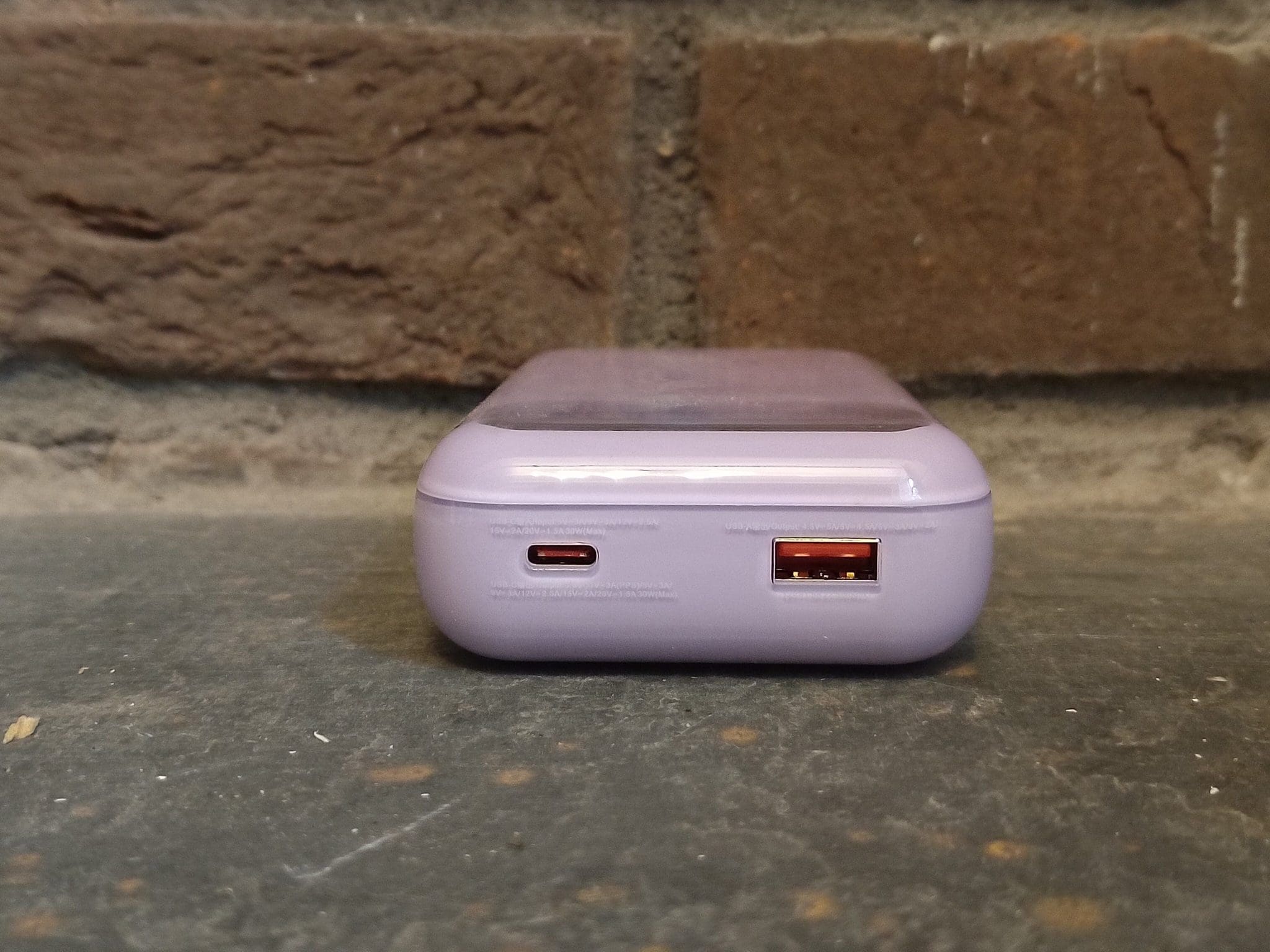
  • The ACEFAST 20,000mAh Power Bank is a weighty beast. Yet, it doesn’t feel cumbersome, and it isn’t obnoxiously big either. I choose the lilac version and it is pleasant to the eye. At the top, there is a USB-C port and a USB-A port. To the side, a push button activates the LED screen. Finally, there is a wonderful transparent window that houses the LED screen while showing the innards of the Power Bank.
  • A small USB-C to USB-C cable is included. This colour-matched cable allows you to charge any USB-C device or you can charge the Power Bank if you have a suitable GAN or wall charger.
  • A simple user manual. Understand the fundamentals thanks to this easy-to-read guide.

Technical aspects.

I think it’s fair to say that a Power Bank doesn’t get the juices flowing. However, the ACEFAST 20,000mAh Power Bank is pretty damn impressive. The compact design doesn’t compromise its power delivery or charging capacity. Additionally, the 2 charging ports allow you to simultaneously fast-charge 2 unique devices, which is incredible. With a 30W in and out rating, you are able to almost half the time it takes to charge your goods compared to its peers. This may seem like a minor thing, but when time is money, you want your phone, watch, or earphones charged as quickly as possible.

Alongside the fast-charge facility, you’ll note that this device is compatible with most mobile phones, sports watches, and earbuds or earphones. Subsequently, this makes this great device more appealing. The USB-C port supports – For Apple 2.4A / for Samsung 5V-2A / for DCP / for QC3.0 / QC4+ / for AFC / for FCP / for SCP / for PD2.0 / PD3.0. While the USB-A port supports – For Apple 2.4A / for Samsung 5V-2A / for DCP / for QC3.0 / for AFC / for FCP / for SCP.

On top of this, the ACEFAST 20,000mAh Power Bank is reassuringly safe to use and is certified to aviation standards. Accordingly, you can take this on holiday with you without worrying about it being confiscated. ACEFAST has designed this to be protected from a range of issues. As such, you needn’t worry about overcharging, a short circuit, overcurrent, and other vital concerns. This means that you can confidently use this on your expensive tech and know that you have no concerns.

Build quality.

When something is being chucked in your bag and thrown around the place, you need it to be hard-wearing and robust. Thankfully, this device ticks these boxes. On top of this, the smooth and hardened case is great to look at and feels nice to hold. What’s more, you can choose from 4 striking colours to add some personality to your setup.

What was particularly great was the transparent window with the LED display. I loved being able to see the internal components even if it adds little to the usability. However, the display was a great move, as many of its peers use a more refined method. The screen is complemented by some well-placed lights that highlight when it is on charge and when it is low on power. Consequently, it is easy to identify what is happening and when you need to charge the bank itself.

Is the ACEFAST 20,000mAh Power Bank worth it?

There are so many positive elements to this simple but effective tool. The massive power capacity ensures that you can repeatedly fast-charge multiple devices before the juice runs out. Moreover, when it does run out, the 30W input helps to get you up and running in no time at all. On top of this, the dual charge facility makes this versatile and more user-friendly. Then you must consider the excellent display, the fantastic design, and the robust case. Additionally, it is unbelievably safe to use and is certified for aviation. Consequently, this is a phenomenal device and I recommend that you buy it here!

(More information on ACEFAST can be found here!)

Review: Zebra Oasis Shoes

0

Here is our review of the Zebra Oasis Shoes.

Zebra Oasis (ZO) is a premium lifestyle brand dedicated to sustainability. Their focus is on creating high-quality footwear, apparel, and other textile products with a low environmental impact.

Their first shoes feature a unique detachable design using eco-friendly materials such as hemp. Their goal is to provide an exceptional wearing experience while minimising our impact on the environment and working towards 100% recyclability, biodegradability, and carbon neutrality.

Features

  • 100% Truly Recyclable: Just pull out the patented R-ring(‘R’ stands for ‘Reboot’) inside the shoe to separate the parts completely for recycling.
  • Recycled-CO₂-injected sole: Our 100% recyclable TPU foam utilizes innovative gas-assisted technology, eliminating the need for harmful chemicals in the foaming process and reducing existing CO₂.
  • World’s 1st Self-Adapting Hemp Flynit Upper: Perfectly fit for every foot. Blister-free. Breathable & Durable, inherently environmentally sustainable.
  • No Dye & Machine-washable: No extra pollution and emission during the process.
  • Foldable & Lightweight: Perfect travel options. Just step and go.
  • Versitile Design for All-day Wear including traveling, hiking, office work, etc.

A Closer Look

Wearing the Shoes

Final Thoughts

What makes these shoes truly unique is that they are 100% recyclable – just pull on the R-ring pull in the shoe and it all comes apart, and they are also made in a 100% sustainable way. The shoe sole is recyclable and the upper part is biodegradable.

The shoes can be easily cleaned in a washing machine and they can be folded up to make the easy to carry if you are travelling.

The shoes themselves are extremely comfortable and don’t need any breaking-in period. ZO shoes feature a lightweight and high-performing TPU sole and a durable, breathable hemp mesh upper that are so soft for any types of feet. These materials and design make ZO shoes suitable for all-day wear, including activities like traveling, hiking, and office work.

If you are looking for an extremely comfortable, sustainable and recyclable pair of shoes then you will definitely want to check out Zebra Oasis.

You can learn more from the Zebra Oasis website.

Review: Returnal

Roguelikes tend to exist in a space where a story may help or hinder the gameplay. The frustration of starting a run over after a minor mistake can be a huge blemish on an experience and has the potential to end a player’s time with the game without seeing the full story. While I have not always been a fan of the genre, it has started to grow on me over these past few years with titles like Hades and Dead Cells being a big component in my experience with roguelikes. When Retrunal originally came out on the PS5, I missed out on it due to a plethora of other titles keeping me occupied but with its release on PC, it was time to change that. 

Story


Selene, our protagonist, is just as in the dark as we are once the game starts. After a rough crash on the planet Astropos, She embarks on a journey to piece together the puzzle that she’s been thrown into. During her adventure, Selene comes across statues and data fragments that hint at some strange occurrences with time on the planet. She soon comes to the understanding that each time she dies, the loop starts over once more with her emerging from her wrecked ship. This is a wonderful way to incorporate the looping gameplay that Returnal offers us. 

During the journey, there are a multitude of alien documents that helps shed some light on the situation. Selene, and the player, will often be thrown into situations where she has to explore her past memories. The change of perspective in these segments does a wonderful job of cranking up the creepiness of the planet since we will be exploring things such as her home from a first person perspective. Since this story takes place on a different planet, there is something chilling about seeing her house out of place and in the middle of unknown territory. 

Gameplay

Returnal is a roguelike that pulls from Housemarque’s experience of putting players in tough situations while maintaining their space on the screen. Their previous games put players in hectic battles where it was important to recognize enemy patterns and Returnal is no different. As you progress through the different chambers and environments on Astropos, enemies will bombard you with varying attack patterns and movements. For example, there are big dog-like enemies that will shoot out a basic line of orbs that are easy to dodge but a harder variant has a move that will rush the Selene. Thankfully she is equipped with a suite that allows her to dash and sprint at high speeds in order to avoid these obstacles. Pairing these dangerous enemies with an even dangerous environment can make for stressful encounters and a simple miscalculation can result in a run ending in frustration. While enemy designs may start to repeat themselves later on, their behavior can be drastically different from their other forms so gameplay doesn’t get too stale as you open up new areas. 

Spread throughout the planet are upgrades to Selene’s weapons as well as parasites that are able to provide different effects that may help, and sometimes hinder, your progress. The first couple of hours will involve a lot of alien and made up sci-fi verbiage being thrown at you but once everything starts to click, the game opens up a lot more. I found myself scanning the ground in the midst of a hectic encounter in hopes to find another little parasite that may give me the edge I need to finish the fight. As you take out enemies, there is an adrenaline system that builds up as you take out more enemies and these stacks disappear once you are hit, which means you are rewarded for playing effectively. 

There are also a ton of chests and items to pick up that are “Malignant” which means that there is a risk for picking these things up. This means that Selene can get stuck with a debuff that will make progressing much harder until certain requirements have been met. Pairing this with the Parasites means that players are always running the risk of making the game harder for themselves. This really forces you to be aware of what you are picking up and thinking about the risk of picking up another item. One wrong move can send you back to the ship with a run ended early or it can boost you just enough to get through the next encounter. 

Selene is equipped with a simple pistol in the beginning but as she explores the world, there is a chance she will find a new weapon that may behave differently than the one currently equipped. With 10 different types of weapons, it was alway a pleasant surprise to find one of my favorites in the middle of a tough run. Each weapon type also has a chance to have a different type of gun trait that may make shots more accurate or may inflict different status effects. All of this on top of some guns with alternate fire modes means that your arsenal may not always be the same in between runs. This approach keeps you on the edge of the seat in hopes of finding the right weapon to take on the next wave of enemies. 

Final Thoughts

Overall, I am pleased to see Housemarque’s work make it over to the PC. Both PS5 and Xbox controllers felt comfortable to play with without any hiccups and the game even makes use of the PS5’s adaptive triggers. Although I didn’t have any hiccups with my experience, I might make it a point to say that I was playing at 1080p at medium settings and did not try to play at a higher resolution or settings since I did not want that to impact my experience. Returnal is an interesting game and for those who want a roguelike that keeps the story hidden behind a challenging gameplay loop, this is a wonderful place to start. Astropos is full of mystery and danger but with enough runs, any player has the ability to master the tight combat offered up here. 

Review: Big Ambitions

We’ve all imagined what it would be like to start from nothing and build a business empire; well, wonder no more as Big Ambitions lets you do just that. With a bit of help from family (played out in the tutorial), you can go from nothing to something in a very ambitious life/business simulator.

Starting from Nothing

If you’re a fan of life simulators, then Big Ambitions may be of interest. You control the central character trying to make it New York City. From property to business, this game covers it all in an impressive depth.

As the character, you have some basic needs to keep up with – energy and hunger. These are taken care of by ensuring you send your character to eat and sleep. Also, make sure to buy groceries! This isn’t as in-depth as The SIMS, but it’s not really the game’s focus. There also doesn’t seem to be any penalty for letting it drop to nothing, save for a passing out animation and waking up in the hospital. It would have been nice if this had a penalty, like a charge for treatment, for example, and that groceries can go bad, so you have to build that lifestyle routine into the gameplay. This would add an extra level of immersion. As your character, you can also buy and rent property to live in – from a basic apartment to townhouses and penthouses. Naturally, you can furnish it how you like.

Where this game excelled and astonished me, though, was in how detailed the business simulator part of it is. Starting with a small business (in this case, retail), you can rent the store, design, and furnish it, buy stock, hire and fire staff and run the establishment. The goal, of course, is to make lots of money in the process. Initially, this involves driving all over town, grabbing what you need, but as you progress, you get access to importing goods, logistics and warehousing, and corporate headquarters. What do you do with all that money? Well, investment is a good idea. There doesn’t seem to be an end to the game, as with most simulation-type titles.

The game places you in a 3D world based on Manhattan, and you can navigate it freely. Not all buildings are accessible, but you can, for example, go into stores and pick up what you need for your apartment or business. You can then load it into your car, drive there, unload it and use a grid-based point-and-click system to place items. It’s a blend of playstyles, but it works well. In addition, there are a lot of UI screens to give you more information and let you manage your growing empire.

Devil in the Detail

There is a basic character creator, but don’t expect The SIMs’ level of customisation. Mostly, it serves the job, as the avatar isn’t the focus here. It is nice to be able to approximate yourself, however. In the game, you have several UI screens to help manage things. This includes a phone for arranging employment agencies to find candidates, a map with markers for different services, a general business analytics and control tab, and broader market news and feeds, allowing investments and a more profound understanding when working out what business to run. It’s all a little overwhelming, to begin with, but the tutorial is fantastic at walking you through what’s what.

I was impressed with the level of detail here. After you’ve hired a bunch of people, you can even go as far as to set their working hours and days to align with the hours you decided your business should be open for. Want a 24/7 fast food restaurant? You can. Want a gift shop that is only open on weekends? Also, possible. From coffee shops, law firms, design agencies, supermarkets and more. There are so many businesses to create.

You can also design a basic logo for your business which is a nice touch, and select the font of the store sign out front. I wasn’t expecting quite this level of detail from a business simulator, but wow, you could spend hours upon hours creating the perfect store before you’ve even started trading! Not to mention how all the items are customisable too.

Indeed, some Big Ambitions

If you have any big ambitions to start a business empire, or if you just like tycoon/simulation games, then Big Ambitions is for you. It’s an excellent simulator from Hovgaard Games and one I can see myself enjoying regularly. I hope they continue to improve things like object placement and maybe even introduce a penalty for not taking care of yourself. The sky is the limit as a PC game, and I can’t wait to see what they add!

Review: Karcher RCV 3 Robot Vacuum Cleaner

Here is our review of the Karcher RCV 3 Robot Vacuum Cleaner.

The smart RCV 3 comes with precise LiDAR navigation and convenient app control to fully customise your cleaning routine. The machine also has a wiping function for hard surfaces.

More time for the enjoyable things in life: the smart RCV 3 Robot Vacuum Cleaner takes over the floor cleaning. The RCV 3 robot systematically and independently cleans your hard floors and low-pile carpets. Dry dirt is reliably transported into the built-in waste container by the rotating brush, the side brush for the edges, and the fan. Where needed, the RCV 3 doesn’t just vacuum, but can also damp mop your hard floors. As the battery capacity decreases, the RCV 3 can regularly charge itself and, after the work is done, it always returns to the charging station. Via the app, the device will automatically create a map of the rooms by detecting the surroundings using built-in LiDAR navigation. Individual cleaning parameters can be set for every room – simply select which rooms should be vacuumed, mopped or not cleaned. Additional sensors prevent the device from falling and you can use a preset individual schedule or press a button on the device to start your cleaning. Voice output of the device will provide the most important information and status.

Specifications

What’s in the box?

The box contains the RCV 3 robot vacuum cleaner, manual and quick start guide, charging station and cable, 2 brushes, two dust containers and 2 wiping clothes.

A Closer Look

Using the RCV 3

Before you can start using the RCV 3 you need to install the Karcher Home Robots App. The app walks you through everything you need to do to add your robot to the app and set it up. From there you can control everything.

Final Thoughts

The RCV 3 comes very well packaged with each component carefully wrapped. You can follow the instructions in the quick start guide to get it all ready to be configured.

Setting up the RCV 3 using the app was actually really simple – just follow the steps and within a few minutes the RCV 3 is added and ready to be used.

The RCV 3, when fully charged, can clean for up to 120 minutes on a single charge. It will automatically return to the charging station when needed. Once the charging has completed the RCV 3 will continue on its cleaning mission.

Using LiDAR the RCV 3 scans the room and then cleans it step-by-step. It creates a map of the room so that it knows where all the normal obstacles are such as chairs, tables and so on. It uses collision sensors to detect and avoid obstacles and fall sensors to details steps and stairs so that it doesn’t accidentally fall down them. During the testing the RCV 3 got very close to the top of the stairs and I was a little concerned it was going to go down them but it didn’t (and I breathed a sigh of relief).

I was also concerned how it might be with moving obstacles (in my case 3 cats) – but it worked very well. I’m not sure the cats were overly impressed though! They haven’t tried to sit on it yet, but I imagine that’s just a matter of time!

The RCV 3 is fairly flat which enables it to go under furniture and clean – again I was concerned it might get stuck under the sofa but it actually worked really well.

There are different cleaning modes that can be selected – dry cleaning, wet cleaning and combination cleaning depending on the type of surface you want to clean. You can swap out various accessories as well.

There are also suction power options – quiet, standard, medium and turbo. And if you using the wet cleaning or combination cleaning modes you can choose water quantity – low, medium and high. The best thing to do it test out each of these to figure out what the best combination works for your environment.

The RCV 3 works really well wether you are using it on carpet, hard floors or a combination of both. The dust containers actually hold a lot more that you think they will and are very easy to empty and carry on going. The cloths are washable as well so they can be reused when they get too dirty.

I was always a little sceptical about robot vacuum cleaners but after putting the RCV 3 though it’s paces I’m a believer! This is a must have addition to any home!

The Karcher RCV 3 Robot Vacuum Cleaner is available now priced around £349.99.

You can learn more from the Karcher website.

Review: Steel Defier

Steel Defier is one of those indie games that is bound to be overlooked. However, I urge you to reconsider. With straightforward gameplay, a short playtime, and easy-to-understand mechanics, it’s a wonderfully casual experience. Yet, its cruelty and labyrinthine world make the action more challenging than you’d expect. Consequently, it’s a deceptive title that’ll have you hooked in no time at all.

Developed by Viridino Studios and published by Ratalaika Games, this is an action survival title. What’s more, it is reminiscent of Disc Room as each arena is full of traps, danger, and almost guaranteed death. Furthermore, the random nature of each obstacle and the use of special abilities keep you on your toes. As such, it is tough to plan your approach, as the action is constantly shifting.

Steel Defier is a harsh game. 

Technology is supposed to advance mankind’s existence. Yet, if you’ve watched as much sci-fi as I have, you’ll know that it’s a bit of a myth. Unfortunately, artificial intelligence goes haywire, and it normally turns on its makers. When this happens, the aftermath isn’t a pretty sight. Moreover, blood, guts, and limbs are normally what remain.

Steel Defier paints a grim picture of this reality. You are a lone survivor on board a transport vessel. Dressed suspiciously in an orange jumpsuit, you must escape your prison cell and explore up to 40 small arenas. Regretfully, the defence system has malfunctioned and everyone else has been slaughtered. Accordingly, you must evade the AI traps as you carve your way to the exit.

The sweeping trap is a constant risk.
Damn the sweeping trap.

Deadly robots but no weapons. 

If I was being chased by deadly robots, I’d want a weapon to fight back. However, in Steel Defier, this isn’t an option. Instead, you must rely on your reactions and agility to succeed. Additionally, you’ll collect an array of special abilities such as dashing, slowing time, a magnetic field, and more. Impressively, each of these skills makes the action easier, and this helps you to overcome each robotic foe.

The aim of the game is simple. Each arena has a pressure plate that must be activated. Once this happens, the traps start to move. At first, the action is slow and the robots are easy to understand. However, things quickly heat up as more robots are added to the mix, and the gameplay becomes more hectic. To escape each arena, you must find and collect 15 key cards. Once one is picked up, another spawns in a random location. As such, you’ll have to dash, leap, and dodge your foes while collecting each key.

This idea was wonderfully stripped-back but perfectly executed. You’ll focus your attention on each key whilst using your peripheral vision to avoid each incoming robot. Consequently, it soon turns into a hectic nightmare as spinning blades, splitting boxes, and a sweeping beam bear down on you. Additionally, the slightest touch is enough to kill you and ruin your progress. Thankfully, though, if this happens, you merely lose that arena’s progress and nothing more.

The prisoner avoids the pointy traps.
Keep away from the pointy blocks.

Steel Defier is a low poly affair.

Indie developers love a dated aesthetic. As such, Steel Defier uses a low poly art style and repetitive assets to push its agenda. Now, this may seem like a complaint, but it isn’t. Accordingly, I adored the basic visuals, the contrasting colour palettes, and the easy-to-identify character models. Additionally, the claustrophobic nature of the labyrinthine world was uncomfortable and difficult to navigate. As such, this added to the challenge, and that was fine by me. 

Originality and gaming don’t always go hand-in-hand. However, with an original Synthwave soundtrack, Steel Defier hopes to impress its audience. I loved the 80s-era futuristic approach and the upbeat flow of every song. Alongside this, the brutal sound effects and shrill sirens add to the drama! Subsequently, if being chased by deadly robots didn’t worry you, the relentless sounds and ominous noises will get your heart racing instead.

The prisoner escapes a spinning blade.
Avoid the spinning blades.

Excellent controls. 

With so much going on, this game could have been a horrible mess. Thankfully, though, the responsive controls and simple layout make it a pleasure to play. On top of this, the fundamentals are well explained whenever you gain a new ability. Accordingly, it is easy to pick up, simple to master, and great fun to play. 

Where Steel Defier falls short, however, is its longevity and replay value. Disappointingly, you’ll complete each level and unlock every achievement in under an hour. Consequently, this is over long before you want it to be. Luckily, though, there is a survival mode, but this lacks depth and a leaderboard. As such, it fails to grab you and this impacts the replay value further still.

These issues could have easily been resolved if more content was added. Alternatively, if an NG+ mode was incorporated, a hardcore mode was added, extra robots were included, or additional chapters to the game were created, this would vastly improve things.

Steel Defier could have been the next Vampire Survivors.

Steel Defier is so good that it could have been the next Vampire Survivors. However, it’s far too short, and it lacks the required depth to reach this level. Consequently, this was disappointing, as I desperately want to score it an 8/10 or above. Yet, this wouldn’t be right, as no matter how much I loved it, it left me wanting. 

I adored the art style, the original soundtrack, and the excellent controls. Moreover, the simple concept was great and easy to understand. But I cannot ignore the fact that it isn’t long enough. Hopefully, the developers are still working on this project and more DLC will become available. If this happens, this will be a big hit for many gamers. Despite its painfully short playtime, I still recommend that you buy it here! Can you escape your prison cell? Avoid the robots, collect the keys, learn new skills, and make it to the landing bay in one piece.