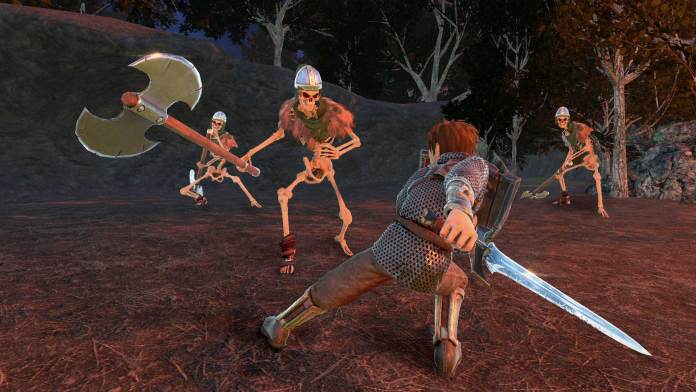
Review: Swords of Gargantua

The backbone of any good VR game is the overall feel of immersion. If the game can successfully create this feeling, in many cases, it’s considered a success. Swords of Gargantua is one of the few cases that creates the immersion, but is then failed by the remaining factors that didn’t receive the same amount of polish.

Where it Comes so Close

Within the first few moments of the game play starting, SoG feels almost overwhelming. Game play tips and guidance is given slowly over the first few levels, and even then it comes as a slow drip. Much of it you are required to learn for yourself. Luckily the combat is explained up front and you are given some time to acquaint yourself with the expectations. I can honestly say I loved the feel of the combat. The weapons felt like they had weight and did the appropriate amount of damage. Tracking of the headset and motion controllers was spot on so parrying and blocking felt incredibly accurate. For me, this was the highlight. Not once did I die and have anyone other than myself to blame. Except for the controls, but I’ll get to that in a minute.

There are a variety of weapons and each feels fantastic. Swords, shields, nunchuks, and many other weapons are at your disposal. Beware, they do degrade over time and just when you need this the most they will shatter leaving you almost defenseless. I say almost for one reason in particular. You can carry several weapons at one time, which was an excellent design choice. One weapon, or shield, can be carried in each hand, one on your non-dominant hip, and there are two throwing knives/daggers on each shoulder. So, for example, if you’re in the middle of a fight and your main weapon or shield shatters, you can replace that empty hand with the main weapon attached to your hip, dual wielding to your heart’s delight. If your next weapon breaks, you can grab one of the knives from your shoulder to carry on. Blocking an enemy strike with your main weapon and using your free hand to remove the knife from your shoulder, the slipping that between your targets ribs is a glorious feeling that is hard to beat.

There is multiplayer mode that is also a good time. You and several friends can team up against the evil hordes that never seem to run out. This function works well, and I would consider it much more enjoyable that the single player portion. Having the ability to flank enemies, revive each other, and plan attacks adds a new dimension to the game play that was much needed.

Where it Falls so Far

Even though the combat feels excellent, there are certain aspects that don’t mesh with the overall tone. Mainly, it’s the aspect that going for head shots don’t make any difference. Striking the enemy on the head will do the same amount as striking their arm. There are combination moves, but they involve hitting randomly generated target areas on the enemies they glow at the appropriate time. Since these areas are entirely random, they can sometimes appear far out of reach, effectively eliminating any chance of completing the combination.

In many other fighting games the way to solve this issue is to maneuver around the enemy in order to get a better vantage. In this case, the controls on the PSVR make that virtually impossible. To move in any direction you have to use the four buttons on the face of each motion controller. Up/down, left/right, and pivoting left and right all require a different button press. This is, by far, the most detrimental issue with SoG. I do understand why it’s like that, the PlayStation motion controllers can’t hold a candle to any other motion/VR controller and lack any type of decent navigational thumb stick. So I don’t see this as much of a choice as a lack of options. In any event, fluid motion is nonexistent and the game suffers greatly for it.

The only other area of suffering I came across was the environments. There is a small diversity of arenas that rotate between each level, but each amounts to roughly the same concept. The color pallet, for the most part, remains drab and repetitive. Any levels that look like they may be in a forested area are completely green with only slightly different shades scattered around. Any that look like an old stone temple are a light beige. The floor of each arena is a different story. Normally this wouldn’t jump out at me, but in this case it was impossible to overlook. The best example can be found in the forested areas. The terrain of these levels looks exactly like and N64 title would. My first thought was the “grassy” areas from Ocarina of Time and Goldeneye. It’s possibly some of the worst environment texturing I’ve seen in a decade.

Where it Lands

Overall the game is an excellent alpha or early access. The core game play for SoG tries so hard to get out and shine, but unfortunately it’s buried beneath several issues that can’t be ignored. If you can overlook these issues, you will have a blast with this game, especially if you have the convenience of using the motion controls of the Oculus. If you’re on the PSVR like me, you may be better off spending the $30.00 on something more refined.

Review: Leisure Suit Larry – Wet Dreams Dry Twice

About an hour into Leisure Suit Larry – Wet Dreams Dry Twice, I realized something. I’ve actually played this series before. It’s been over two decades since I last booted up a Leisure Suit Larry game, and now I’m actually old enough to understand them. Unfortunately, even though I understand it now, I’m still not sure I get it. The game plays, as it always has, as a classic point-and-click adventure game with lovably nonsensical puzzles and quirky interactions. For fans of the series, the game’s plot will be a direct continuation from the previous game, Wet Dreams Don’t Dry, but Wet Dreams Dry Twice can easily be enjoyed as a standalone title.

After escaping an arranged marriage, the titular Larry finds himself shipwrecked on a resort island that is an amalgamation of all tropical destinations—it’s vaguely Hawaii, vaguely Mexico, and vaguely everything all at once. The story springboards from there, and Larry finds himself haplessly roped into all sorts of characters’ problems. Your first mission? Earn the resort a five star review on the famous website Gulp (an obvious pun on Yelp).

The game is so jam-packed with sexual innuendo that it is barely worth mentioning. Nearly every interaction holds a double entendre, and all the backgrounds are jam packed with smutty goodness. Sadly, this is sort of where Wet Dreams Dry Twice starts to lose me. It’s relentless. Sure, the occasional witty joke lands, but for the most part, it starts to feel like a slog. The game is as much a survival game where you battle against terrible puns as it is a point-and-click. For the right audience, this game could be a laugh riot, but on my playthrough I find it missing time and time again. I end up clicking my way through most of the dialogue.

Apart from the onslaught of sexual puns, Wet Dreams Dry Twice is actually fairly enticing. The story is intriguing enough to keep me interested, and I find myself wanting to keep going to figure out how it all will end. But this is no easy task. I distinctly remember how difficult these point-and-click games were as a kid, and twenty years later it’s no different. There’s no two ways around it: Wet Dreams Dry Twice is hard. I wouldn’t be surprised if most players were checking guides fairly regularly. I certainly was.

The puzzles are both inventive and exceedingly strange. Your first puzzle is to fix a guitar with an old electrical wire, but the solutions get increasingly odd. At one point, to trick a stubborn environmentalist into leaving their post, I combine a lewd rubber ducky and a plastic six-pack ring to lure out a rooster. I throw said rooster into a vat of oil, call the environmentalist, and, voilà, problem solved. If your mind can figure out those sorts of puzzles easily, then congratulations, you’re quicker on your feet than I am. Again, for someone dipping their toe into point-and-click like myself, these puzzles are frustratingly difficult. But, for the inveterate player, these might be perfectly crafted.

The charm in Wet Dreams Dry Twice stems from the little details. The game is replete with a myriad of pop culture callouts. In only a couple of hours, I’ve encountered references to Blade Runner, Austin Powers: Gold Member, and even Finding Nemo. There’s also several on-the-nose nods to our current society. Larry finds himself constantly on the outside of societal norms. He’s constantly confused about the proper way to navigate everyday life in the modern era. He, like the Leisure Suit Larry series, is a relic of the 1980s marooned in the 21st century.

You’ll also encounter all the classic stereotypes of our time. You’ve got the ludicrously picky critic who is weaponizing their reputation on a review platform, the rave obsessed backpacker, and the tried-and-true aloof hipster. It’s all fine, but it feels like it’s been done a million times before. It’s not exactly unfunny, but it certainly isn’t fresh.

Wet Dreams Dry Twice is an odd experience. It oscillates between totally enjoyable and completely tedious. I am either enjoying the challenge of a certain puzzle or flocking to the safety of a guide to get me through. Like most games, I can imagine a perfect audience for Wet Dreams Dry Twice, but to me it feels dated—and not in an intentional manner. Sure, loyal fans might be thankful that CrazyBunch has stayed true to their roots, but newcomers will find a game that feels too deeply couched in a bygone era. I haven’t played a point-and-click in over two decades, and yet the genre feels completely unchanged. Is that a good thing? Possibly to long standing fans of the genre. But to most, it’s all going to feel a bit stale.

Famous Movies that Became Arcade Games

Today’s most knowledgeable video game and movie aficionados are likely already aware that there are dozens of movies out there based on the plots — or in some cases, the lack thereof — of video games that date as far back as the late 1970s. While some of these movies have turned out to be highly entertaining and a genuine pleasure to watch with all manner of special effects, decent acting, and all-around great casting and costume design, others haven’t exactly lived up to these kinds of high standards. 

If you are a true gamer, you’re probably already familiar with most of the titles on this list. Here, we’ve ranked some of the greats from our genuine favorites to our favorite less-than-phenomenal but still entertaining classics from a time when special effects weren’t… so special.

Super Mario Bros. 

This screen gem featuring arguably the most well-known video game characters of all time, Mario and Luigi, hit the big screen in 1993. Starring fan favorites like John Leguizamo, Dennis Hopper, Bob Hoskins, Fiona Shaw, Samantha Mathis, and Fisher Stevens, this movie was at once strange and entertaining for viewers of all ages. 

Though older fans with the benefit of knowing Dennis Hopper from other roles like the antagonist in Blue Velvet might not agree the casting was exactly on-point for a younger audience, the feature enjoyed some acclaim at the time, and for those who still consider themselves diehard fans of the Mario Bros. franchise, it absolutely deserves a watch.

Sonic the Hedgehog 

As the newest movie on this list, Sonic the Hedgehog hit screens of all sizes in 2020. This animated adventure offers up plenty of good fun and lighthearted humor while still bringing that edge that all gamers love in their video game-themed films. Featuring the likes of Jim Carrey and plenty of James Mardsen, Sonic the Hedgehog, the movie has everything from an absurd plotline to thrills and spills sure to please moviegoers of all ages. 

It’s hilarious, entertaining, and yes, it even looks as good as the video game itself, thanks to incredible recent updates to CGI technology. And to top it all off, at the end of the day, Sonic the Hedgehog — the movie — is really just a fun tale about the lasting bonds of authentic friendship.

Mortal Kombat  

Just as with the video game of the same name, the Mortal Kombat movie brings us a mixed bag of would-be heroes and heroines all poised to battle to the death — all in an effort to save the entire planet. What’s not to love already

Mortal Kombat was not the very first video game-based movie, but given that it came out in 1995, it isn’t that far off! If you are among those who gathered around this arcade game at your local pizza shack or bowling alley, Mortal Kombat, the movie, is a must-see — if you haven’t yet. Likewise, for those too young to remember the days of pizza-grease-laden arcade game buttons and joysticks, this one is a cult classic any gamer can get on board with from the jump. Enjoy your favorite Mortal Kombat characters, including Sub-Zero, Goro, and Scorpion, come alive as they take on the evils of, well, everything, in this 90s standard.

Doom

Originally airing in theatres in 2005, Doom is a video game-turned-movie with many great assets in its corner, not the least of which is some of the best casting any movie of this kind has ever seen. With leading stars Karl Urban and Dwayne “The Rock” Johnson, Doom immediately promises to deliver. Add to this that Doom features The Rock for the first time in his career — outside of the wrestling ring — playing a downright dirty villain, and you’ve got yourself a gamer’s movie delight in the making. 

While some still try to suggest that this early 2000s classic just doesn’t deliver, we happen to believe it really does. From offering up first-person shooter mode for the gamers in the audience to bringing lovers of great acting the likes of Rosamund Pike, Doom steals the screen by sticking to its video game plot while still offering tons of fun for those who may not necessarily know the ins and outs of the video game itself.

The Best May Be Yet to Come 

While it is certainly true that some of today’s absolute best arcade and video games have not yet been turned into movies, give it time! And, while you wait, consider trying your hand at some of the latest and greatest video and arcade games there are, right at your local Main Event location! 

With everything from the classic arcade games you (or your parents!) grew up on to some of the most authentic virtual reality experiences and everything in between, Main Event truly does have something for every kind of gamer. 

With an entire arcade hall loaded with interactive games galore, you’re sure to find something you’ll love. From The New Ghostbusters to fan favorites like Candy Crush Saga, and even a giant Connect Four, and multiplayer games like NBA Basketball, Main Event truly offers something for every lover of video and arcade games of every age — or should we say genre!

Review: Nexomon: Extinction

Prepare for trouble! Make it double! Nexomon: Extinction, a monster-capturing and battling adventure burst onto the console scene in 2020 to try to take the genre in a new direction and challenge a juggernaut to a duel.

So let’s address the Pokemon-shaped elephant in the room. There are some very obvious similarities with this title and the Pokemon games, not only in its monsters but also in its camera angles and battle system. Nexomon: Extinction, a sequel to Nexomon, takes those aspects and aims to differentiate itself with a more complex offering than its wildly popular counterpart with cute visuals, a suggestively apocalyptic story and humorous characters to appeal to a larger demographic, one including children and adults. 

No pressure….

Your customizable character steps out of an orphanage to become a tamer within a guild set on reclaiming a world terrorized by tyrants, huge monster Nexomon, despite realizing they are way out of their depth. Working their way up through the guild’s ranks, you learn that the world isn’t simply black and white, with allies and enemies with similar motivations shifting alliances as the plot thickens. The game’s insistence in showing you that your actions are likely immoral combined with its amusing characters and presentation make for an enjoyable experience.

As your character doesn’t speak, your companion – a highly memorable cat – does all the talking for you. Hardly unique for the RPG genre, this feline makes up for it by sarcastically shooting down enemy retorts with as much ease as complaining about the ‘lack of effort’ the developer has put into the game and is just one example of a unique cast of characters full of charm and personality that exist in the story’s dark tone and setting.

The legend known as Coco.

Contrasting with said tones are the game’s effective visuals that combine clean and vibrant environments with silky smooth monster-fighting animation making it the best showcase of the Unity engine’s capabilities that I’ve ever seen. The cutscene stills, character avatars and chibi-characters further add to a great visual presentation while the soundtrack is the catalyst that brings everything together, the jet fuel that gives each area character, while each section of the story is boosted by tracks that convey the scene’s importance and emotional weight perfectly, giving the feeling of a truly epic adventure. The upbeat and high tempo Egyptian and Japanese-inspired tracks for their corresponding maps, in particular, are highly addictive and are constantly on loop on my Youtube playlist.

Atmosphere conveyed with color and design

Despite my playthrough of the main story only lasting 17 hours, it’s quite impressive how much content the developer VEWO Interactive included. It actually would have been shorter if it weren’t for me getting stuck for embarrassingly long periods in the game’s puzzle sections. The large cast of entertaining and exaggerated characters entice with just enough backstory without feeling overwhelming and provide context to a story with depth and heart. It’s executed so well that you’ll wish the game was longer.

Every single NPC has something to say and that conversation changes throughout the story, referring to your most recent actions in the region. This is also true with other tamers who you can challenge again after a period of time, which is where the majority of your experience will be gained, giving a real sense of a malleable and living world. In addition, there is a great mixture of things to do, with a large list of side quests, even extensive ones that start immediately after the main story game has been completed, extending the game’s life considerably. So enjoyable is it to just explore this world, and the desire to learn more about it, that completing side quests feels as rewarding as the main story.

This fella wants a fight…

The battle system differs little to others in the genre but does include a system of cores – or buffs – assignable to your monsters. Working as percentage increases to your stats, they can be created with materials that you mine throughout the game and are essential to aid your progress. Ironically though, they are actually too useful, removing much of the challenge from the battles.

The extremely helpful cores.

Despite having the standard amount of 6 Nexomon in my team, I managed to defeat 95% of all the main story enemies with one character, even with elemental differences, and only used the others to occasionally heal and revive it. Another disappointing aspect with the battle system is that aside from the high-level Nexomon in the story, there is a complete lack of interaction with and information about most of the 300+ basic level beasts, which makes them feel entirely separate from the story and a necessity only for the gameplay mechanic. The Shin Megami Tensei series, while far darker in tone to Nexomon: Extinction, allows the player to communicate with its demons, linking them to the story and its world excellently and I can’t help feeling that Nexomon: Extinction could have benefited greatly from a similar approach during battles, whether that’s through general conversation or negotiations. Even the trading function currently in the game could have included Nexomon and would have been a welcome addition.

Masquiti, in his 1st of 3 forms, destroyed all in his path, but wasn’t once acknowledged by the player. Poor Masquiti.

Rather than feeling like a rip-off, Nexomon: Extinction is a great little title that pushes the genre in a story-driven direction while also providing the freedom and addictive gameplay that it’s known for. With a custom-mode on the horizon that’ll allow players to completely change the parameters of the game in New Game+ capacity, it will address any issues with the game’s difficulty and adds yet further value to an already feature-rich game.

As such, this is an easy recommendation for fans of the genre and with a focus on humour and storytelling, it also comes recommended for those wanting to test the monster-infested waters for the first time.

Review: Pathfinder Kingmaker

Tabletop gaming isn’t everyone’s cup of tea. A fun and hardcore genre that requires a mixture of dedication, imagination and a great group of friends. A successful session is as much down to the game mechanics as it is the Dungeon Master. When I was told that a game had made it through a Kickstarter campaign and was based around the fundamentals of the 4th edition of D&D, I was dubious.

Pathfinder: Kingmaker is an isometric Role Playing Game that has; morality, a great story and companionship at the heart of everything it does. Developed by Owlcat Games and published by Deep Silver, this massive RPG will have you losing hours of your life to its; plot, lore and finer details. 

Another success for Kickstarter. 

Successfully backed in 2017, Pathfinder: Kingmaker had a great following and plenty of interest before it was released. Combining two separate gaming methods; turn-based and real-time strategy, the action can be played as quickly, or as slowly as you wish. The game utilises a wide range of difficulty settings from; custom and story, to the nigh on impossible hardest level. This range has opened the developers up for a barrage of criticism because of the unbalanced nature of the gameplay. In true modern gaming fashion, patches and hotfixes have been rolled out to address the list of issues. Some have been resolved, but others remain an ongoing concern.

The basic premise of this tale is simple to follow. A band of misfit adventurers is brought together to claim the disputed region known as the Stolen Lands. The successful team will bring calm and order to this area, and one will be given the title of Baron. *Spoiler*, it’s you who have this honour!

When you and your band of misfits stare into the abyss and only hellish fire looks back!

The story doesn’t reflect the whole picture. 

The plot only presents a portion of the heart and soul of this title. It’s also a game that allows you to influence people’s moral compass. You must balance your decision making with the needs of your lands and your team of companions. Dialogue choices and your alignment, builds bonds or create rifts in friendships. It’s a fine balancing act, and one that you will fall foul of multiple times. 

Like all great RPGs, Pathfinder: Kingmaker allows you the freedom to explore the world around you. A 2D map gives you the ability to discover; sprawling dungeons, settlements and towns, random encounters with monsters and a varied and interesting landscape. The vast and meaty world is controlled by the main game mechanic, a virtual d20 (a 20 sided dice). This D&D inspired concept adds a layer of risk and uncertainty, and keeps the gameplay true to its roots.

Micromanaging your world. 

Other than the aforementioned adventuring, you must also manage your barony and people. This portion was unusual for an RPG, and though not as labour intensive as a simulation title, it still contained a lot of details. Your decisions directly influence your reputation. Create trade deals and honour them, and people will view you as honest and just. Rescind or pillage and you fall into the evil and chaotic bracket. 

You may build establishments to make money and instruct your team of companions to follow orders and complete tasks. It’s gloriously detailed and is as time-consuming or hands-off as you like.

Man Vs Beast, there can only be one victor.

Sound concept, but tough to pick up. 

The entire concept is solid and puts this in good standing with most of its peers. It’s glaring fault, however, is its complexity and assumption that players will have D&D experience. Fortunately, I do, yet even I struggled with many of the fundamentals. Tutelage is provided throughout, but these wordy documents can be tough to swallow.

This is where a real Dungeon Master beats a virtual computer one every time. No-one wants their hand held throughout, but a gentle nudge can be the difference between joy and frustration. As you progress, it becomes second nature. However, the learning curve is steep, and I fear this will put off many would-be players.

Influences of Pillars of Eternity and Baldur’s Gate. 

If you also had a misspent youth spending hours on end playing Baldur’s Gate, then you will slip into this with ease. The developers have borrowed much of the control system to make up the core of the gameplay. The concept of pausing the action mid-battle, resting, spells and more will not come as a surprise. It’s like riding a bike and it’ll all come back to you naturally. 

The story is told through a combination of dialogue and the plot unravelling on the pages of a dusty old tome. Clear links can be seen between this and Pillars of Eternity, though I believe the latter delivers the story in a much stronger and smoother way. I enjoyed the D&D style choices which aid or hinder the party. This, for me, was the closest element to the tabletop game.

Close quarter combat isn’t the only option available. Blast them away with spells and arrows.

 Old-school influences with a modern polish. 

The isometric viewpoint and dark, grainy graphics gave this an old-school feel. The earthy tones and low lighting create a sinister and ominous atmosphere that rarely dissipates. The text style and character models are retro in look and reminded me of early console and 90s PC titles. Though the viewing angle allows a clear line of sight, it can be a challenge to keep on top of all the action. I experienced several bugs while playing, and this is an issue that Owlcat Games are actively working on.

The audio follows suit with a music style that is synonymous with the early RPG genre. Minor toned, folksy music plays throughout. This represents both the emotion and the environment perfectly. The sound effects work well, but lacks originality, and the voice-over is delivered to a good standard. The characters come across as likeable or hated, and the delivery of their lines is anything but wooden. 

You need to give it time. 

If you are unfamiliar with D&D rules and methodology, then you will find this a handful to play. But with time and patience will soon be a pro who will compete at a high standard. With more written text than a library, be prepared for a tough yet justified learning curve. 

Just like this review, Pathfinder: Kingmaker is; long, wordy, and full of detail. Over 100 hours of gameplay awaits anyone that gets hooked. With a wide range of dialogue choices, moral alignments, and a realm to run, there is plenty of replay value. At £39.99 normally and £19.99 for a limited time, it’s great value for money.

Is the effort worth it?

There is no denying it, this is a tough nut to crack. But with effort comes reward! For all its intricacies and quirks, you’ll find yourself with a fantastically challenging experience. It does enough to compare it fondly to it its peer group, but its list of bugs and high difficulty keeps it from excelling. Do I recommend it? I do! If you wish to try this massive RPG for yourself, then buy it here! Choose your path, influence your people, and explore the world. 100+ hours of gameplay await you in this D&D inspired title. 

Review: Olija

Let me make something very clear. Olija is a blast to play. At first glance it’s a simple 2D action adventure title, but beneath that veil lies a surprisingly fun and gripping game. With exceptional music and some great depth to combat, this is one to look out for.

In a marriage of Asian and Sailor’s legends, Olija tells the tale of Lord Faraday’s journey across the isles of Terraphage. You and your crew, have been lost at sea. You awaken alone in this strange land and set out to restore your crew, and find a way back home. 

Getting Around

Combat and exploration are at Olija’s core, both being a big draw for the title. Olija makes use of metroidvania style exploration. Maps have slightly interconnected pathways, requiring you to do some light backtracking to find collectables, ingredients, and items necessary to progress the story. However, none of the maps are sprawling labyrinths that hold secrets in every crevice. This makes it an accessible metroidvania style adventure, for those unaccustomed to or against that style of exploration and traversal. Though, it may leave those wishing for some deeper exploration, a little underwhelmed.

Harpoons Aren’t Just For Fishing

Olija’s Combat has some surprising depth to it. There is a relatively wide selection of weapons to use from a musket, to your magical harpoon. I will say, however that not every weapon at your disposal felt absolutely necessary; for instance I hardly used the crossbow or musket. In fact I only remember two instances, one of which was out of necessity. Ranged weapons just never trumped the satisfaction that came with close quarters fights. 

The magical harpoon you wield is the bread and butter of both the title’s combat and exploration. It allows you to teleport when thrown at certain items. This makes for some interesting platforming that becomes flashier as the story progresses and you become comfortable with the mechanic. It’s always a heap of fun to zip around teleporting all over the place. You can also throw the harpoon at enemies teleporting to them while dealing damage at the same time. This allows you to cover distance and get straight into the fight. 

The harpoon mechanic makes for some gorgeous fights, at the very least in terms of visual appeal. It lends itself well to the more frenetic encounters, especially the boss battles. These fights were definitely the highlights of gameplay, creating some memorable moments when going toe to toe with Olija’s big-bads. Each battle comes with some variety in how to handle them. You might find yourself losing the first couple rounds, but none of the bosses ever felt insurmountable. In my opinion they held just the right amount of challenge.

Nice Hat

Skeleton Crew Studios, the developer of Olija, managed to fit some very light crafting into this game. Ingredients can be found throughout the world, which enable you to craft hats. The headgear here grants certain abilities to its user, such as an immunity to poison damage while dealing some yourself. This is part of what incentivises you to go out and explore in the first place. Combining basic moves with the harpoon’s teleportation, and hat abilities make for some deliciously flashy plays. This results in an extremely satisfying gameplay loop and keeps it fresh throughout the campaign.

Your Eyes & Ears Will Thank You

Olija is a title inspired by the artstyle of the 16-bit era, and makes great use of this for their world design. The game has a dark beauty one cannot help but appreciate. Alongside this macabre aesthetic, are also moments of serenity, supported immensely by its soundtrack.

The star of the show has to be the music. I was constantly grinning from ear to ear at the music of Olija. The sheer variety and fusion of genres were a pleasure for the ears. Certain songs contain elements of instruments like the Quena flute and Shamisen. Throughout the campaign there are notes of flamenco, traditional Japanese music, and the type of percussion and synthesizers one would hear in lo-fi beats. A few tracks even include the saxophone, which just goes to show the great selection of audio on display. Honestly the music is the best part of Olija to me. I look forward to the original soundtrack becoming available so I can enjoy it all over again.  

Can I Have Some More?

The only bad thing I have to say about Olija is that it’s tragically short. The whole thing can be completed in around 4 hours. By that point, I know I wasn’t ready to say goodbye yet. What pains me even more is the lack of incentive to start a new campaign. This will lead to many players moving on after finishing Olija. I know I’ll be back to play it again in a couple of months, but I’m already hungry for more. That being said, I’m looking forward to the next project to come out of Skeleton Crew Studios. 

I don’t think anyone will regret their admittedly limited time with Olija, it’s a joyride from start to finish. An all around great title with some excellent combat, exploration, and phenomenal music. 

Review: Habroxia 2

Shoot ’em-ups have been a go to genre for me since I started gaming. The hellishly difficult chapters, the variety in enemies and bosses, and the absurd storylines have always been a draw. I love how modern gaming has pushed to realism, and open world freedom, yet I still crave that hit of arcade action. Earlier this month, I was fortunate enough to play and review Habroxia. I loved every moment, and the review can be read here! When I was advised that Habroxia 2 was due to be released in February, I hounded the publishers and developers for a review code. 

With the promise that the second one would use the first as its foundation, but bump it up a gear, made me very excited. Developed by Lillymo Games and published by Eastasiasoft Limited, this classic shoot-’em-up title will have you scrambling around desperately trying to survive as you battle your way to victory.

New foes, but classic gameplay.

An attack has been made on free space, a squad of scout ships has been sent to investigate the area and one fails to return. The pilot’s talented daughter Sabrina must use her skills to avenge her dad’s disappearance. Armed with a basic vessel, she has to overcome many obstacles, enemies and bosses on her search for the truth. 

The foes that you will face are like nothing you’ve seen before, but yet the gameplay is as old-school as it comes.

This side-scrolling, 2D shooter will have fans of retro games drooling in delight. A pixelated approach reeks of the arcade titles of old, and its smooth but hectic approach lull you into a false sense of security. You will address each stage differently depending on your weapons and game style. All out attack can be advantageous but a lack of planning can be the undoing of the best Shmup gamers.

Whatever route you take, none will bring back your father.

Habroxia was great, but 2 is a different beast.

I adored every element of Habroxia and didn’t expect it to be beaten, yet here we are. Habroxia 2 is like the first, but on steroids. Everything is bigger, stronger, better and more polished. Every element has been tweaked and refined; the gameplay is much more in-depth, upgrades are more advanced, enemies more intelligent, and the level designs are ingenious. This is exactly how a modern day Shoot-’em-up should be; fun, exciting, addictive and challenging.

Each level diverges due to the non-linear storyline. You have 2 portions; “1a and 1b, 2a and 2b” This adds a ridiculous amount of gameplay. Alongside this, each stage has its own mini objectives; Enemy bounties, boss bounties, and an astronaut to save. When you combine this with the hectic gameplay, it’s a brilliant if not headache inducing experience.

Same old credit system, but more to spend it on.

Destroying the landscape, annihilating enemies and defeating bosses awards you with well earned credits. These must be spent on upgrading your spaceship. Improve your; health, armour, boost, shooting range and power, movement and more. You are free to select which works for you, but ultimately you need all of them to progress. No matter the amount of credits you earn, you never have enough. You must replay most levels to increase your strength, and once your vessel is mighty enough, you will mow through your foes like a hot knife through butter.

Dodge and weave, dodge and weave!

My main gripe with Habroxia was the simplicity of the bosses, and it’s painful for me to report that not much has changed on this front. Most can be easily kited and defeating them is a matter of course than a test of your skill. I found it harder arriving at their lair than shooting them from space. It’s disappointing that the developers failed to enhance this element like they had all the others. This doesn’t mean that the boss fights are poor or lack enjoyment. No, they simply failed to challenge me like the rest of the game.

A stunning modern take on a classic genre.

Whenever I see shmup’s being brought to market, I fear the developers will rip the soul out of the genre. Lillymo Games didn’t do this, they kept to the tried and tested formula and polished it for modern gamers. Every graphical layer is fantastic. The simple pixelated models of the aliens and your ship, the variety in the bullets fired from different weapons, and the choices of landscapes were a joy to observe. The dark tones created a sinister atmosphere which opposed the bright colour palette used for our heroine’s ship. Even with many bullets flying and explosions happening, the action never slowed, nor were there any issues.

This theme continued with the exceptional audio. A delightful chiptune soundtrack accompanies everything that you do. This upbeat music inspires you to dodge and shoot your way to victory. The crass and synthesised sound effects scream retro arcade title. Every part of the sound and visual package worked in perfect harmony, helping to create a modern nostalgia filled classic.

Know your foe’s weakness and then exploit it.

Lightning quick reflexes, but simple to play.

Hectic and fast-paced gameplay ensures that only the one with the quickest reflexes will be the champion gamer. This may frustrate some players, but practice makes perfect. Each level runs on a loop, meaning that you can learn your enemy’s movements and plan the best approach. A twin-stick method has been utilised to increase accuracy, and it’s a vast improvement on the standard approach previously taken. Though the gameplay may defeat you, learning the fundamentals won’t, and the control system is a joy to get to grips with.

Because of its non-linear approach, multiple level goals, many bosses and the NG+ mode, you will play this for hours. Habroxia 2 is a shmup that oozes replay value and charm. Its simple approach and user-friendly interface gets you hooked. You’ll lose hours by saying “just one more try!” A large yet simple achievement list will be unlocked through natural progression, and completionists will have fun trying to get their 100% status.

Habroxia 2 is the new champion.

There have been some classic Shoot-’em-up games published, and Habroxia 2 is up there as one of the best. Every element works, with its classic graphics, thumping audio, simple controls and excessive replay value. This will keep you playing for hours. A stunning example of a Shmup that will have you screaming with rage and crying for joy! Every developer should look at this as the blueprint of what makes the genre great. I absolutely recommend this, so buy your copy here! Can Sabrina avenge her father’s disappearance? Jump in your ship, upgrade its equipment, and destroy every alien you see.

Review: Ninja Legends

This was my first time playing a PSVR game like this, one that was based it’s value solely on the device’s tracking and motion controllers. I was a bit skeptic when it was first loading up, but within the tutorial my concerns were both put to rest and validated. The game itself plays a lot like Fruit Ninja. You stay stationary, only able to rotate by turning your head, and targets are thrown in your face until you destroy them. The main difference here being that you are now expected to block attacks that are coming at you from almost 360 degrees. Oh, and of course, your targets are evil ninjas that you can now chop into several tiny pieces. Yes, it’s as fun as it sounds.

The Good

The overall game play loop is incredibly fun and addictive. It essentially breaks down into this: Complete one level, fight a boss, unlock a new weapon, onto the next level. Each level takes only a few minutes to beat, but I don’t recall ever actually being bored with it’s repetitive nature. Playing in a group seemed to be the best way to play. Verbally yelling out our own personal scoring of each other’s ninja skills, worked way better than the online scoreboard that was provided.

The combat itself is glorious for this type of game. Several ninjas rush you at once so it’s up to you to keep track of everyone around you, deflecting their strikes as efficiently as possible. Enemies flank quickly and can get behind you if you’re not paying attention. Luckily, time slows down giving you time to parry each attack. Most of the time, these attacks come in the form of enemy blades, but once in a while a ninja star will come flying at you. Blocking the star in just the right way sends it right back to the thrower.

The rag doll body effects, as well as the dismemberment, are fantastic. Nailing a successful strike will sometimes reward you with legs or arms flying in every direction, portions of heads flying off, and even the upper torso going vertical after a quick spray of blood. One of my favorites was slicing the enemies in half, from head to groin, and then watching each half crumple to the ground into two separate piles. The enemy designs are a little too polygonal for my taste, but overall it wasn’t hard to overlook.

For the most part the environments are pleasant to look at. Most are stereotypical of any ninja or samurai movie that’s ever been made, but that’s not necessarily a bad thing. The colors are exceptionally vibrant, increasingly so in the mission entitled “Ambush at Dawn”. The sunrise bathing everything in shades of red can’t be beat.

The Bad

Ninja Legends does have it’s fair share of problems. The main one being the inconsistent tracking. Normally I wouldn’t attribute this to the game, however I can honestly say I’ve never had motion tracking that was this hit or miss. This goes for the motion controllers and for the VR headset itself. I changed my room layout and lighting several times, but nothing seemed to correct it. Even during the opening tutorial I ran into an issue that persisted the entire game, a notice appeared so close to my face I had to sit down, then lean back to be able to look down far enough to find the “next” button. Several times my in game height would alternate from being average to a 10 foot tall giant.

I did run into several enemy AI glitches that were rather frustrating. Some would run around in circles in an attempt to dodge my projectile attacks, and they would get stuck in their pattern, endlessly running in circles until I restarted the mission. This wasn’t an every few minutes issue, but it persisted several times over my first session of a few hours.

If you’re not a fan of arcade style games, this will probably get a little repetitive for you. Now while I will say that I didn’t find myself getting tired of it, I can definitely see where this could become a problem. The overall weak AI doesn’t help as enemies just charge in your general direction over and over again throughout each level, so the only variety you will see is the environments and a few different types of enemies.

The Verdict

Ninja Legends is a good time that almost anyone can enjoy. How long before it gets repetitive is the more important question. Repetition is not always a bad thing, however for $25.00 I would’ve hoped for a little more, especially with the inconsistent tracking that is the backbone for VR games relying on motion controllers.

Review: Transformers Battlegrounds

For many gamers, the phrase “Robots in disguise” will fill them with giddy delight. If you are in your late 30s to 40s, you will be reminded on the vivid and distinct animation series. Those who are younger will probably know of the Transformers because of the many blockbuster films that have been released. The franchise spans many ventures, and computer games were to be expected. So when I was asked to review one, it didn’t shock me, but what did was the chosen genre.

Transformers Battlegrounds from developers Coatsink and publishers Outright Games is a strategic turn-based title aimed at entry level players, and a younger audience. An odd choice of genre you make think, but because of its theme and its simplified approach, it’s a great way to cut your teeth on an otherwise challenging genre.

Yes, as it’s all about the Allspark.

As with all things Transformers, it’s a standard affair. Optimus Prime and the Autobots are tasked with protecting both Earth and the Allspark. You a lowly human must command this band of space robots, laying down orders from a bird’s-eye perspective, constantly battling the DecepticonsMegatron will stop at nothing to get his shiny claws on the Allspark’s power, so you must battle wave after wave of his minions. You will visit various locations; Central city to Cyberton, each with its unique layout and structures that must be used to gain the upper hand.

Grimlock loves to toast anything in sight.

As you can see, it’s a classic turn-based strategy game down to the nth degree. What makes this stand out as a much more straightforward game, than say Xcom, is the ease at which success is achieved. I’ve played this genre for as long as I can remember, but I’m still no expert. However, with Transformers Battlegrounds I had to place little to no thought into planning to win a stage. The Autobots are over-powered compared with many of the Decepticon cannon fodder. Shots are guaranteed to hit for both parties, so standing out in the open is not an issue.

Simplicity makes it fun, but too easy.

Steamrolling your way through every level is an enjoyable way to spend a few hours. However, the lack of challenge, even in the hardest difficulty setting, soon gets old. Luckily, the chirpy nature of each of the characters, and their upbeat outlook on life makes this game what it is. You soon lose yourself in a delightfully colourful world that is reminiscent of the early 80s cartoon series. The story ebbs and flows nicely, if not a bit predictably, from area to area. Like most 80s cartoons, the dialogue is laced with morality and hidden messages. It was a delightful trip down memory lane.

Does it matter that there is little challenge when you get a fair amount of gameplay? I guess not, but for the experienced gamer in the genre you will certainly find this a walk in the park. Coatsink tries to ease this issue by adding an Arcade mode alongside the main story. From this tab you can take on another player or the computer in a wide range of scenarios, with up to 6 to choose from; Capture the flag, Decepticon grudge match, Energon capture, last stand, destruction and cube. Each has a different aim and set of rules. Though it doesn’t add depth to the story, it’s a welcome distraction and fun to compete in.

The simple UI makes completing each task a piece of cake.

Fewer tactical choices.

As you progress, you will encounter a variety of different Autobots. Each has a unique set of skills, and an oddly elaborate tale to why they are living on Earth. As missions are completed, each of these newly discovered robots joins the arsenal of characters to select. If you are successful in your task (you will be, trust me), you will earn a minimum of 1000 Spark points. More can be gained if you increase the game difficulty. These are spent on new attacks for each class of character, and can be swapped in and out depending on the objectives and selected team.

With limited action points to use, close quarters and long range attacks, and minimal challenge from the AI, you will make fewer tactical choices. Most missions comprise 2 to 5 minute stints where you sprint from A to B killing the odd Decepticon. Once you arrive at the pivotal moment in each act, you will face a boss battle. These fights usually last around 10 minutes, treating you to a small challenge, and introducing new powerful Decepticons that must be overcome. This is Transformers Battlegrounds in a nutshell, low of genre originality, but laced with nostalgia, and a great cast of characters.

It’s a colourful and loud affair!

Everything about this game is bright, vivid, and in your face. The developers have done well to replicate the colour palette and tone of each of the characters from the original series. The maps that you explore are small, yet contain a vast amount of detail. Each of the models is well designed and move around the map smoothly. The variations in attacks are interesting to look at, and the explosions of cars and other objects are both over the top and spectacular. Its visual presentation doesn’t lead the pack, but is on par with several of the genre’s well loved titles.

The audio is going to be the catch point for most players. You’ll either adore it, or you will want to cut your ears off half way through. The chirpy ramblings of each of the Autobots brought the gameplay to life for me, but after a while it grinds you down. I kept with it as I’ve always been a fan, but I could see why it would become tedious quickly. Every action is met with an over the top response, and no matter how dire the situation is, someone always sees the positives. This cheery disposition will make you shout out, “No, enough, is enough! Not every cloud has a silver lining.” 

Using a battered car as a form of defence is not the smartest idea.

It’s easy to pick up and play.

Early game tutorials are not needed, as nearly every part of this game is self explanatory. An easy to work UI helps explain everything, and a lack of submenus ensures you don’t get lost. A well laid out grid highlights the limitations of movement, and how many action points spent. After the opening level, you will have mastered the basics and be well on your way to becoming an amazing commander for the Autobots.

The addition of the arcade mode prevents this from being a one playthough only game. The ability to play with another human ensures that a tactical approach must be taken. The 6 games were interesting to experience and didn’t take long to play through, so they can be played casually. The achievement list will stretch you, and every difficulty completed to gain 100% status. At £34.99 it may appear quite pricey, yet it’s not bad value if you are a lover of the theme, and appreciate how much time can be wasted on the Arcade mode.

Is it worth your time and effort?

If you a veteran of this genre and not a big fan of Transformers, then you are not likely to get the best out of this. But if you are the polar opposite, or you want a fun strategy game, then this isn’t a bad shout. Its nod to the cartoon series, tongue-in-cheek dialogue, and colourful settings make it an enjoyable title to experience. Its major downside is how simple it is to get through each level, even at later stages. Do I recommend it? I do just heed my warnings about how easy it is. If this review has piqued your interest, and you want a copy for yourself, it can be purchased here! Can you command the Autobots to protect the Earth and keep the Allspark safe? 

Review: Dustoff Z

3… 2… 1… Dustoff!!!

Invictus Games takes you on a helicopter ride as humanity holds on to what is left after a zombie takeover. Zombies are everywhere, so keep your eyes open and your foot on the gas. Choose your preferred riflemen to accompany you in attempt to rescue displaced survivors and defeat huge bosses. Dustoff Z has a ton of personality for such a simple game and the extra features will give you plenty to come back to.

Gameplay

Be careful when dropping low to grab pickups. The zombies can jump and cling to the helicopter.

Dustoff Z has very simple intentions. Pick your helicopter, choose your team, and begin your next adventure. Missions typically last only a couple of minutes to complete, so you can play the game in short bursts or hunker down for a while. I took a few breaks during my playthrough since some levels can get pretty tough almost out of no where. After a hard rescue, the following mission can easily and oftentimes scale the difficulty right back down. The lack of consistency in the game’s difficulty will create stopping points for some players. Upon completing a mission, you’ll see the familiar 3-star rating screen, most commonly used in mobile games or titles such as Overcooked. The easy controls and menu interface really illustrate the game’s potential to be a mobile port.

Controls

Use the left analog stick to fly and steer the ship in a 2.5D environment. Hold the right trigger to fire your gunners’ weapons. And that’s pretty much it. There’s an auto aim function so you won’t need to worry about using a second stick to aim. What this means is that you can’t decide which zombies to shoot at first when they approach. You will have to rely on the auto aim to hopefully pick off the closest ones to the helicopter. The ability to turn auto aim on/off would have been nice for veteran players. However, it’s a simple game and the focus is on the helicopter flying.

Visuals and Audio

Intro Graphic

Dustoff Z uses cell-shaded 3D graphics with bright colors. For a post-apocalyptic zombie shooter, the game looks quite nice. The graphics convince you that there is hope for the survivors. The title has a teen rating for zombie violence and tobacco use, but I believe that this game is great for younger players. The blood is green or can be turned off and the tempo is upbeat. I’d rather my little one play this rather than anything M-rated. The graphics are paired with a Rock n’ Roll soundtrack. It’s such a breath of fresh air to hear guitars, drums, and other fidelity instruments that sound less synthetic and artificial. Dustoff Z’s music is reminiscent of how Borderlands uses banjos and slide guitars to help paint it’s space-redneck picture.

Customization

Spend collected coins to hire and upgrade your gunners. Choose from sniper rifles, rocket launchers, and machine guns.

There is surprisingly a good amount to choose from here to assemble the optimal chopper team to your liking. As you level up, more gunners become available to purchase. You may also spend coins on gunner and vehicle upgrades, such as accuracy. Load up an armor-heavy chopper with rocket launchers and explosives. Or focus on speed and maneuverability while raining bullets on zombie hoards with your automatic rifles. Preferably, I think having all gunners and vehicles available from the start would have been a more polished feature. The player could then choose what to invest in from the get-go in preparation for the schizophrenic difficulty spikes. Leveling up to unlock extras, but still needing to purchase them afterwards, is a bit redundant.

Bottom Line

Dustoff Z is one of the friendliest zombie games you can play. The unstable difficulty is the only issue here, but it’s nothing to speak to the manager about. If you like helicopter controls, play this game. If not, then there are certainly other budget titles you can check out. Dustoff Z is easy to pick up with solid replay value, and is light-hearted fun we can all benefit from.

Review: Lunch A Palooza

Multiplayer party games have really shined during the COVID-19 pandemic. From the viral sensation Fall Guys to indie hit- Phasmophobia and Among Us, these games have been a fantastic way to hang out with friends at a distance and also enjoy some quality gaming time “together.”

Lunch A Palooza from Seashell Studios is a 2-4 player fighting game that aspires to grab your attention like the aforementioned games, but this game is best served as a quick appetizer before moving on to something more filling.

Setting the table

The premise behind Lunch A Palooza is simple: you want to be the last food standing in a five lives fight to the end. 

Lunch A Palooza offers four different game modes. Main Course: the free-for-all variant, Side Dish: 2v2 or 3v1 team-based battles, King of the Cloche: a King of the Hill mode, and Royal Buffet: appear as a random character every time you respawn.

There are four unique foods to choose from: a hamburger, an ear of corn, a meatball, and a bundt cake molded blob of Jell-O. These characters all have their own way of attacking. The hamburger banzai drops on top of its opponents, the ear of corn spins itself into a frenzy and creates a close-range popcorn explosion, the meatball spins itself like a Sonic spin dash, and the Jell-O has a mid-range cube attack – the most effective attack and the favorite of mine.

There are three arenas from which to choose, and all of them deliver their own quirks. Four new characters (pizza, sushi, doughnut, and ice cream) can be unlocked, as well as three additional arenas, when predetermined milestones are achieved.

Pizza Party?

When I first saw Lunch A Palooza, I thought the game could be a nice complement to my favorite party game: Gang Beasts. What makes wacky physics-based games like Gang Beasts, Octo-Dad and Goat Simulator so much fun is that the controls are incredibly responsive. While Lunch A Palooza appears to emulate Gang Beasts on the surface, there is no pizza underneath the toppings.

Disappointment quickly set in when I realized there is no option for online play to be found. Outside of forced social distancing pandemic times, this may not exactly be a deal-breaker, but when I can’t gather with people, opting to play an offline multiplayer-focused game is a tough hill to climb.

Bubblegum covered Jell-O, anyone?

Gameplay

I figured as long as the AI is competent that the game could provide some single-player excitement. I hopped into my first match as a hamburger. It was clear after about 30 seconds that Lunch A Palooza is severely undercooked.

In Lunch A Palooza, there is one button designated for attack: a quick button press causes a weak attack, a longer hold on the button enables a strong attack. Attacking feels like a crap shoot. There is no rhyme or reason to attack strength in practical use. The button either registers immediately, or there is a noticeable delay. The game needs pinpoint controls when a match lasts anywhere between 30 seconds and 3 minutes.

The button that is supposed to grab your opponent never worked. A speed-reading class would be needed to keep up with the hint screens before matches start up.

There are power-ups like aluminum foil that acts as a shield against attacks and power-downs like a rotten fish head that scrambles your controls. These items randomly drop in the field of play, but none of them have much of an impact.

The amount of times that a character is eliminated within five seconds of spawning is aggravating. I would just go back to online dating if I wanted to get rejected that quickly with no reason.

There is no health bar, only an indicator of the number of lives remaining, and to test a theory of mine, I was able to win a match by hiding in a corner and letting the CPU eliminate all other characters on the table. It felt like a kid winning his hurdles race because all of the other competitors ran in the wrong direction.

The battle for Italian food supremacy.

Multiplayer

I recruited my girlfriend to play a few rounds of Lunch A Palooza with me, as the game is meant primarily to be played in couch co-op. I did not want to unfairly judge a multiplayer game for a poor single-player experience.

The poor control issues are only compounded when everyone playing has the same issues.

It took three matches before she decided she had enough. When I asked her what she did not like, she told me there was nothing that she did like.

We started off by trying the King of the Cloche game mode. This mode has characters chasing a piece of cake around the table and vying to hold the position long enough. Right off the bat it was evident that the mode wouldn’t have much staying power. The first person to the cake only needed to do a quick attack to blow the opponent off the table. The few matches we did of this mode lasted about 45 seconds each.

The most enjoyable part of playing multiplayer was a weird glitch that happened in the middle of a Royal Buffet match that gave us a good laugh. My character was knocked off the table to lose a life. When I respawned, my girlfriend controlled her own character as well as mine. I was locked out of the game for the remaining time and watched her fight herself. Both characters moved in the same direction and could not get any closer together as they danced around the table. 

Oddly enough, she still lost the match.

When the best part of a game is a glitch, work needs to be done.

Level Design

One part of the meal that deserves to have its praises sung are the levels themselves. From an Italian restaurant to an 80’s pizza parlor/arcade to an airplane, these stages are varied and aesthetically pleasing.

In Pixel Pizza Paradise, the matches take place on top of an air hockey table. This changes into a foosball or a pool table if you place a quarter into the corresponding slot. 

In Fright Flight Deluxe, the wrestling happens on top of tray tables and airplane seats. This plane is going through the worst case of turbulence that I’ve seen since the movie Alive.

Every level has its quirks and disembodied objects trying to knock the food onto the floor.

If the same amount of work went into the gameplay as it did into the character and level design, Lunch A Palooza would be a much more enjoyable game.

The Final Course

The idea for the game is an absolutely great one, but it needs to be much more polished. The character models and their accompanying backstories are funny, but there is no depth beyond that.

The music, while quickly repetitive, is fun, fast-paced, and frenetic. It sets the table for a frantic time.

If Seashell Studios goes back to the kitchen to rework their controls to provide a tighter experience, I would think about taking another bite. 

This is a game that I would only recommend for very young children that cannot grasp the concept of gameplay.

Review: Oddworld: New ‘n’ Tasty

0

In Oddworld: New ‘n’ Tasty you play as Abe, a former meat factory slave, as you try to survive and rescue your species from becoming tasty treats! 

Oddworld: New ‘n’ Tasty is a fun, silly, and quirky game with a dark twist. It’s a full remake of the 1997 PlayStation classic Oddworld: Abe’s Oddysee. Originally it was released in 2014; however, the Nintendo Switch port was released October 27, 2020. While this game isn’t particularly “new” it’s still tasty!

Gameplay:

Abe was just your average Mudokon floor-waxer working at RuptureFarms until one day he overhears plans for a new tasty treat that would save RuptureFarm’s failing business. Little did he know he was the main ingredient! Abe decides to flee his awful fate and sets off on a mysterious adventure. But just escaping isn’t enough – Abe has to save his fellow Mudokons, and in doing so he might just be able to save his life.

In this 2.5D cinematic platformer, you play as Abe as you try to solve complex puzzles in order to survive. Abe has the ability to possess and control specific enemies which can quickly give you the advantage and help you get past many obstacles. “Gamespeak” is a unique feature of the game which allows Abe to communicate and command other Mudokons in order to save them. There are two game endings that are based on how many Mudokons Abe can save – so be careful you don’t kill your pals or they’ll remember you in the afterlife!

The controls are a bit wonky and can take some time to get used to; if you don’t master them, they can potentially cost Abe his life. With that being said, a lot of this game is trial and error, so don’t be afraid to make a few mistakes! There are also a fair number of hints and guides to help Abe on his journey.

New ‘n’ Tasty has three game modes, each offering a decent challenge, while hard-mode is based on the original Oddworld game. It’s mainly single-player, but it also offers a co-op mode where you can share with a friend. This game is simple enough for a casual gamer to pick up yet still challenging enough for our veteran gamers.

New ‘n’ Tasty is not only fun, silly, and quirky, but it also has an eerie dark feeling to it. Even with gruesome blood-soaked deaths and an unsettling environment, the characters are quite lovable; I particularly loved the snarky dialogue, silly interactions, and crude humor. The game’s unique contrast between dark and humorous is what makes it so charming. 

Pros:

  • No matter what difficulty setting you choose this game still offers a fun challenging experience.
  • There’s a Quick-save option – which is honestly a lifesaver. You can utilize this feature so you don’t have to go back to the checkpoint every time you die.
  • New ‘n’ Tasty is available on many different platforms such as PlayStation 4, Xbox One, iOS, Android, Steam, etc. So if you don’t have a Switch you can still pick it up for a different platform.

Cons:

  • The font used for hints and the captions are very thin and a bit hard to read.
  • The controls can feel a little wonky, and they’re easy to forget if you put the game down for a few days.
  • There are many changes and new additions to this version, so old-time fans of the series may not enjoy it as much. With that said, it’s an easy way for newer fans to get introduced to a classic series.

Conclusion:

This game was a highly entertaining experience; if you like platformers or strategy puzzle games I highly recommend you pick up this tasty treat!

Entertainment: 9/10

Replay value: 5/10

Graphics: 8/10

Sound: 7/10

Kid Friendly: Yes (Teen rating)

Platform:Nintendo Switch
Developer:Oddworld Inhabitants
Publisher:Oddworld Inhabitants
Released:October 27, 2020 (Nintendo Switch)
MSRP:$29.99
ESRB:Teen

Review: Metamorphosis

Metamorphosis is, to be frank, an oddly intriguing but creepy game. Now I want to start by saying if you don’t like bugs or insects with many appendages. This game is NOT for you. Trust me; it’s not. The game starts you off as a human and quickly turns you into a bug. Searching for answers as to why you’ve turned into a creature of some peoples nightmares. Something for someone whos not phased by bugs made me feel incredibly uncomfortable. You not only look like a bug but feel like one too. From the scattering sound effects of your spindly bug legs hitting the Oakwood floor of your apartment. To the visual and voice-over work that puts you right in the bug-like perspective. The game successfully makes you feel like a bug, to the game’s credit and the developers.

This game won’t bug you

Metamorphosis combines the bug-like feel with easy to pick up and surprisingly innovative game mechanics. One mechanic includes you using sticky substances such as ink to climb otherwise untraversable surfaces. Such as the edge of a bookcase. The game shines in this regard. The game makes you feel and play like a bug, through great mechanics and even excellent easy to pick up controls. As a result, the game does not fail to make the player feel like a minuscule insect.

Your insect kingdom

Metamorphosis also stands out in terms of puzzle mechanics. Offering a considerable challenge, having the player figure out various puzzles to traverse through most of the game. The game provides hints of these and makes them enjoyable and progresses the story in a well-paced way. Furthermore, combined with a creepy but engaging soundtrack, all of this makes the game even more engaging.

A game bee-yond comprehension

Now, all of this comes with a large dose of creepiness. Honestly, I would be lying if I said the game wasn’t incredibly creepy. It is bizarre and plays on your psychology, but this is not a bad thing. It only adds to what the developers want us the players to feel. Nevertheless, Metamorphosis does have flaws. Although the graphics look good, the animation of characters and NPC’s is poor. The animation, especially during dialogue sequences, lets the game down. Dialogue is also an issue, with rather odd dialogue between characters that adds very little to the game. Coming across as unnecessary and honestly dull. Although seemingly a minor issue, it did limit my enjoyment of the game. Nevertheless, Metamorphosis is still a good game, but the flaws do standout.

Verdict

In the end, Metamorphosis is a good game despite issues with NPC animation and dialogue. Although intentionally creepy and psychologically thrilling, which some may be off-put by especially if they despise insects of any kind. Metamorphosis offers excellent gameplay, controls, graphics and music that makes you feel like a bug. For good or bad, depending on your perspective. Nevertheless, the game objectively achieves what it sets out to do with fantastic gameplay, musical and graphical elements. For this, it deserves credit.

Review: Tiny Racer

The racer isn’t all that’s tiny.

There’s a commonly seen phenomenon in video games journalism where reviews never give a score lower than six. This leaves review scores in a mathematically unusual position. Rather than showing a game’s percentage ‘goodness’, with 5 being a perfectly average game, the score makes any game look good at a glance, with the mapping realistically reflecting 10 being perfect, 6 being bad and anything less than 6 being atrocious to a level that merits exceptional treatment. Now would be a good time to refer to the score I’ve given Tiny Racer.

On first impressions, there’s nothing to complain about. Tiny Racer is an arcade racing game, inspired by the likes of Micro Machines, Re-Volt and Mario Kart. It has a heavy emphasis on physics-based action and a cute cartoony aesthetic, complete with comic book style 3D “Pow”, “Wham” and “Thump” pop-ups whenever there’s a collision. Unfortunately, though, the chasm between the Tiny Racer’s first impression and the gameplay itself is so yawning that it could accommodate every unwanted copy of The Da Vinci Code ever bought, or something less voluminous, like the sun.

I don’t entirely understand Tiny Racer. Arcade racers are fun because they’re not fair. They have items which allow you to cheat massively and rubber banding so strong that a slingshot in their universe would be regarded as a weapon of mass destruction. This leaves you in a position where anyone can play and expect to do reasonably well, having a lot of friendship-ruining fun along the way. It’s the reason why Mario Kart is one of the most popular party games ever made.

Tiny Racer’s arcade gimmick (and the only thing that separates it from a pure racer) is its extreme physics. There are no items, pick-ups, boosters or anything else you’d expect from a standard arcade racer. However, rather than that gimmick being balancing and fun, allowing players the choice between taking a risky manoeuvrer and potentially suffering the wrath of the physics or taking a longer route that’s less perilous, the physics are insane, unpredictable and, frankly, really irritating. You’ll go flying off cliffs, crashing into walls and other vehicles and sometimes just flip over with no rhyme or reason to why any of it is happening.

What’s worse is how unoptimised the physics have been for the AI. They don’t seem able to deal with it at all. They’ll crash constantly, taking you with them. I played a race where one car was driving in circles over the start line for the entire race, still there every time I finished a lap. When you respawn after falling off the track (again), you spawn above the track and are dropped back into the action. However, when another car falls in the same place at the same time (which happens all the time, again, the AI can’t deal with the physics engine) you’ll both spawn in the same place, which the physics is woefully unequipped to deal with so it just sends you both pinging off, at incredible speeds, to opposite ends of the map.

Other glitches I encountered include: choosing to play as the muscle car but spawning in as a van, broken multiplayer controls when using two joycons and more misplaced invisible walls than that time I worked as a glazier for Loki the Trickster God. The game also has very few tracks, only three modes and nothing else to encourage replayability. It didn’t take much more than an hour to ‘complete’ the game and experienced everything it had to offer, including all the glitches listed above.

One last nit-picking comment: Why is it called Tiny Racer? The game clearly wants to conjure images of Micro Machines and Toybox Turbos, but those games have Micro/Toybox in the name because they play with scale. You’re racing tiny cars around tracks built to a real-world scale, looping around all the junk stored away in the attic or a kitchen midway through making a Sunday roast. Tiny Racer is entirely to scale, the cars are on the same scale as the tracks and the backgrounds. There is nothing tiny about anything. Having ‘Tiny’ in the name makes about as much sense as the career and popularity of any given Kardashian.

Somewhere deep down in the development brief for Tiny Racer there is a glimmer of a good idea, but, unfortunately, a good idea on its own does not make a good game. A poor physics engine, uninspired gameplay and glitches up the wazoo make Tiny Racer difficult to redeem. If you want an arcade racer to play with friends, Tiny Racer is several continents away from being in a position to compete for Mario Kart’s throne.