Review: Can’t Drive This

Would you trust your friend to stop you from falling to your death? Can they build a road quicker than you can drive? If the answer to these questions is yes, then you have the perfect partner to take part in Can’t Drive This

Developed and published by Pixel Maniacs, this single-player and multiplayer building/driving game will have you screaming at, and laughing with your friends, or rage quitting. With both local and online play, the scope to get the most out of this comedy laced game is pretty high.

So what’s it all about?

Have you seen the film Speed? Where Sandra Bullock is on a bus and it can’t drop below 50mph. If the bus slows down, the bomb that has been planted onboard detonates! That’s kinda what happens in Can’t Drive This, except there is no Sandra Bullock, the speed element isn’t as rigid and it’s a monster truck, not a bus (ok, so it’s nothing like Speed). Here I am reviewing yet another monster truck game, at least it’s not a racing title this time, like Monster Truck Championship and Monster Jam Steel Titans 2.

Everyone loves capture the egg.

Anyway, I digress. Can’t Drive This asks you to play; solo, co-op or with up to 3 other players. The latter mode is a party game of Capture the Egg (flag). Co-op allows two modes: Game of Drones and Vardage. Solo events are called Lone Ranger. Each of the options is delightfully simple and oddly addictive.

Capture the Egg.

A local game mode where two teams must race around, building a route and stealing the egg from their opponent’s base. It’s fast-paced, aggressive, and is guaranteed to create arguments. Teamwork is a must, as is clear communication. This wasn’t just about the egg, no this was about the tactical approach it takes to get the prized asset.

Game of Drones.

A small arena has two holo’s to collect. Placed in random locations, you must work with your partner to build a route, locate their position and collect them as quickly as possible. Success ensures you progress to the next level, failure will tally up your score and you will have to try again. Sounds easy, right? It is until you realise a drone is randomly dropping EMP’s on your newly laid path. If you get hit, you need to be revived. If this doesn’t happen, it’s game over.

Vardage and Lone Ranger.

These are the same, except one is co-op and the other solo. A timed event where you will set your route, grab your holo and race to the next platform. Collecting the holo gives you more time, and the further you get, the higher the score.

The burning ring of fire.

A simple concept, but deceptively difficult.

Can’t Drive This has such a simple concept that a child could attempt it. The only issue if they did, is they are guaranteed to fail. Pixel Maniacs have developed this, so no game is the same. You do not know what building blocks will be allocated, and these have a massive impact on how easy your course is to navigate. You will be given simple curves and straight tracks to lay, but then a curveball is chucked into the mix. A ramp, high speed boost section, water trap, foggy area, ring of fire and so on. Your run can be ended with a bit of bad luck, or you can somehow land an epic jump and miss out on large sections of the map.

It was brilliantly infuriating and stupidly addictive. You die for the nth time and chuck your controller down, just to scream, “I want one more try!” You die again, bite your lip with rage and hit restart. Its simplicity makes it work so well, yet I wish it had more content and more game modes.

Basic 3D models and a bird’s-eye perspective.

The combination of two perspectives may confuse and annoy some gamers, but I liked how easily the action flitted from bird’s-eye to third-person. The basic imagery and cool colours made this very easy to look at. The simplicity is in line with the indie theme and is more than adequate for a game of this quality. The cinematic used in the tutorial was reminiscent of a 40s movie, with large in your face icons, and a grainy finish. I liked the whacky presentation, and it went hand in hand with the loud and funny acting.

The comedy flows through every inch of the voice-over work and all the tutorial videos. It’s always a bit of a gamble when you try to add humour, but I think the developers got the balance about right. The childish theme carries on with upbeat music and loud sound effects. The truck has a nice engine roar, and explosions had a good depth. Overall it’s at a standard which I expect, and there were no unpleasant surprises.

Leaping to a fiery death is never good.

The gameplay is tough, but playing it isn’t.

The straightforward and clear message from the tutorial makes this very easy to pick up. The driving action is smooth and responsive, as is the building mode. Rotating each piece is completed with the bumper buttons, and the only stress comes from the ticking of the clock. Gamers of all skill sets will enjoy this, though real progress will only be made by those that are both lucky and skilful.

I enjoyed my time with this, but worry about its longevity. When a game relies heavily on a multiplayer option, you need a good bunch of friends who want to play it regularly to keep things going. If the developers looked to add more solo modes, custom options for track pieces, or different vehicles, I think this would help the lone player want to return. A tough achievement list requires every mode to be played thoroughly, so if you wish to gain the 100% status, you’re going to have to keep playing for some time.

I liked it, but it lacks depth.

Can’t Drive This is a fun little title that can be enjoyed casually. It’s easy to pick up, but tough to progress. The multiplayer modes are good just as long as you have friends who wish to keep playing. With a lack of solo modes and not as many custom options as I’d like, this somewhat lacks depth. Even with these drawbacks, I recommend it and you can buy it here! An enjoyable solo and multiplayer game where a calm head and great communication help you to the highest score possible. 

Review: The Outer Worlds – Murder on Eridanos DLC

It feels like a very long time since The Outer Worlds became one of my top games of 2019 and I was very eager to get more to experience with the two planned DLC drops that would add to the story but playing through “Peril on Gorgon” in 2020 left me very disappointed with an experience that was very much the opposite of how I felt completing the main storyline in DLC that felt like an extended side quest than a full expansion as I had hoped. Now here we are in 2021 and the final chapter of The Outer Worlds is being told with the last Story DLC ‘Murder on Eridanos’ and whilst the trailer had full on 1940’s Noir vibes to it, I still had my concerns and sadly, those concerns were right.

My main issue with this DLC and ‘Peril on Gorgon’ is that due to the nature of how the main game ends, the only way to play the new DLC is to return to a save game before the big finale to the story which means reverting to a lower character level with perhaps different weapons and skills to what you had when you completed the game. There is also the time between playing this new DLC and the last one and honestly forgetting a lot about how my character plays both in abilities and builds so was a little jarring picking the game back up again.

For this DLC it is recommended you have a level 30 character, which if you have completed the main story and the last DLC you should be and being able to just continue from the point you left ‘Peril on Gorgon’ is a lot better than rewinding your experience to before you completed the game. That requirement gave me hope that this DLC would have some challenging combat which was lacking in the previous DLC and the chance to pick up some new weapons is also good but only if you have yet to finish the main game or play to replay the ending after finishing this DLC.

This DLC unlocks the final planet on the map, Eridanos and you, the player, are called upon to become an “Inspector” and given the task of investigating the murder of the most well-known celebrity in the Eridanos colony, Halcyon Helen. With little to go on and arriving at Eridanos with everyone being a possible suspect, you must find clues, pull on threads and see if you can find out who and why she was murdered. The trailer was fantastic and I would have loved to have played this entire story in a black and white style detective style but like much of this DLC, I was to be sadly let down.

Eridanos is perhaps the most visually delicious location of all the worlds in the game so far, a true paradise consisting of floating islands connected by light bridges. It really is a beautiful environment to be in which is handy because this ten hour or so story chapter will have you walking/running or fast travelling back and forth a lot around Eridanos and I am not kidding, there is a lot of walking to various mission way points which after an hour can get very tedious indeed. Enemies are mostly what you would have encountered before so none of them will actually prove any threat to you or your companions throughout, perhaps why the recommending Character level is so high at 30 just to make sure any combat is simply brushed away so you can focus back on the murder mystery.

A Murder Mystery is exactly what this DLC is and no sooner as you arrive on Eridanos then you begin meeting characters who all have a stake in the success of the Colony which has been deeply impacted by the death of Halcyon Helen. Ploughing through the many dialogue trees you will have with characters; more suspects and locations will then be revealed giving you more people to talk to and investigate. So much of this DLC is just this, talking to people and reading dialogue responses and reading messages and emails on computer terminals in order to piece together what happened and who might be responsible. Talking to a character will lead you to investigate their alibi or relationship with Helen and I actually did enjoy the writing and voice acting performances for the varied characters you meet during this DLC.

The problem for me is the pacing of this ten-hour adventure and even if you give allowance for the fact that this is just a murder mystery adventure, it just needed something more than simply talk to this person, be told to do something/go somewhere/bring this to me to keep the excitement alive. Even as you progress on a quest you will end up being asked to do a short side quest for someone else on Eridanos that never feels like it was worth doing or connected to what you need to do in order to solve the crime. Just being at level 30 or higher makes the combat rather dull and boring if you have built your character up at that point which is disappointing considering this is the last DLC for The Outer Worlds, it just fails too really…. “Go big”.

The story is fun but there is so much emptiness around doing the main storyline besides doing a lot of talking and a lot of reading. Like Peril on Gorgon, this is more DLC that would probably work better if you the player, are actually playing this before knowing the ending to the main game because other than levelling up a few levels, my own character never really benefitted from this little side excursion. I never found armour or weapons higher or better than what I had when I started the DLC and that was why the first DLC fell flat. If I was to start a new game and character than this would be great to do say midway in the original campaign playthrough, but having to rewind to use an earlier version of my character that really benefits in no additional way from playing the DLC nor do the ending(s) to the main story change as a result of having both or one of the DLC stories to complete just left it a flat experience and it certainly at no time feels like the send off content The Outer Worlds deserves.

Which is ultimately why neither DLC really reached the same fun and enjoyment of the main game. Murder on Eridanos feels like a side quest than an expansion with the character level requirement quite frankly far too high to make anything here a challenge for the player, it is really just something else to do. Even the fact that the detective work revolves around using a special device called the Discrepancy Amplifier but this only serves to do all the investigative work for you. When you are near a clue it will warn you then bringing up the Discrepancy Amplifier will make it scan, analyse and then tell you what this clue means which makes it less of a murder mystery for you to solve than a murder mystery tour until the point you feel like you want to accuse someone of the murder.

For me, this is a very disappointing farewell to one of the best RPG’s in recent years and neither DLC managed to reach the same level of fun as the main game and because of how the ending to the main story is so complete, having to go back to a point before you finished the game to for the DLC’s is a little bland. This just never feels like the Final DLC the game or fans hoped for or the original playing experience needed.

Superstar Acts Join Guild Esports’ First Online Gaming Festival

0

Guild Esports, the global esports organisation co-owned by David Beckham, is proud to announce an elite line-up to join its first Super Stream Sunday – taking place on the 28th March, 5-10PM GMT on Twitch & YouTube. Super Stream Sunday is Guild’s first online gaming festival – where headline names will compete alongside its roster of professional gamers and content creators.

Topping the lineup is Tom Grennan & Conor Maynard. Tom is fresh off the back of a first number one album, two singles in the UK top-40, and a string of sellout shows announced across the UK. Conor is a world-renowned performer, most recently seeing rapid success on YouTube and being granted a Diamond play button for 10 million subscribers. 

The big question is – can they handle the heat of competitive gaming?

Self-confessed FIFA fanatic Tom will not only be testing his skills alongside the best in the business in Guild’s professional athlete Niklas Raseck, but he’ll also be competing with prince of grime Yizzy. Yizzy continued his rapid rise to fame last year with his aptly titled track ‘Grime’ with the critically acclaimed JME, and also made a track for Guild to mark the launch of its first lifestyle apparel line.

Meanwhile Conor will be battling it out for Rocket League bragging rights alongside leading streamers and entertainers Randolph & Nathan Dawe. Rapper Randolph is known for his passion for all things gaming, while Nathan most recently collaborated with Little Mix on the smash hit ‘No Time For Tears’.

They’re joined by the multi-talented Talia Mar, who will take part in the variety gaming segment of the show. An established singer, YouTuber & content creator, and rising streamer, few have seen the range of successes that Talia has. Alongside her will be rapper and cultural icon Big Zuu, who has recently taken his talents outside of the studio and into the kitchen with his first book launch and the hugely popular TV program ‘Big Zuu’s Big Eats’.

Hosting the variety session will be Guild’s very own Gee Nelly, leading streamer and content creator and founder of the Nelly Nation. Gee is best known for her variety gaming streams and interaction with her loyal followers. Also taking part in the session will be a host of other creators, including Harrie, SnowMixy & Niki Nihachu. Niki’s success in the scene has seen her gather nearly 1.5 million followers on Twitch. 

Meeting them there will be leading entertainer and streamer Harry Pinero. Harry will have to keep up with Guild’s recently crowned #1 EU Fortnite Team as he tests his shooting aim in the Fortnite section.

The stream will be broken into hour long segments, each with a different host and guests.

Yizzy commented, “No one is doing things like Guild at the moment. They recognise how culture crosses over and comes together – from gaming, to music, to entertainment. I’m looking forward to testing my gaming skills against some of the best players in esports, and linking up with other talented performers”.

With something for everyone, Super Stream Sunday is an event you won’t want to miss! Come and drop in from 5pm GMT on March 28th at twitch.tv/guildesports

#WeAreGuild

Review: One Escape

We all know that nothing could go wrong when three criminal animals attempt to rob a high-profile bank. Somehow all hell breaks loose, and the police are called. Cooped up in a jail cell for the rest of your life just won’t do, so it’s time to break free from these walls, it’s time for One Escape.

Developed by BUG-Studio and published by Ratalaika Games, this retro 2D side-scrolling platform game follows all the clichéd classic mechanics. You control each of these thieving animals as they attempt to escape from the confines of the prison. Ironically, you never control all of them simultaneously, so this should have been called Three Escape, not One Escape!

One Escape is filled with nostalgia.

There is one thing I particularly love about indie gaming, and that is the twangs of nostalgia that run through each one. This is no different as every element screams old-school and will have you gripping the controller from start to finish. There are no shock moves from BUG-Studio, and they follow the traditional recipe to the letter. This makes for a familiar, albeit well-travelled gaming experience.

Stay away from the light.

The three criminals are; Dook, Gor, and Hog. A duck, gorilla, and hog, who appear to have been working out as their beach bods are on point! Their plan to rob the bank went horribly wrong, and once they get incarcerated, they are on their own. Each of them has 20 unique levels to play through (quick maths: 20*3=60). 60 levels of increasingly more challenging stages unfold before your eyes.

The fundamentals stay the same for each animal, though Gor and Hog have a special power; Gor can climb cracked walls, and Hog can smash walls and push boxes. The aim of each stage is simple; leap platforms, unlock doors, avoid guards and escape.

One Escape seems simple, but is it?

On paper, One Escape sounds simple. Yet, it has a minor Metroidvania twist. Key cards must be collected before returning to unlock doors, where switches are flipped off and then back on to progress in different directions. All of this before you consider that being caught by a guard resets that level.

Gorillas and lasers don’t mix.

It’s all about planning, patience, and stealth. This is no clearer than when CCTV is introduced. If you get caught in the line of sight, alarm bells will start ringing and all hell breaks loose. Hide in the dark or be captured, I know which I’d rather happen, but sometimes it’s out of your control.

You must further account for; electric cables that will shock you, and pulsing and permanent laser beams that burn. It’s at this point you realise that this prison means business, and they don’t want you breaking out.

Pixelated, gritty and great to look at.

Though each of the stages appears similar, they all have a unique design. It would be harsh of me to criticise BUG-Studio for their lack of creative flair, after all, how glamorous can a jail be? They allowed their creativity to flow with the character design and the several traps you’ll encounter. The game contains a reasonable amount of detail, but is limited because of its retro nature. It’s nice to look at and has a generous mix of both vibrant and earthy tones to help pique your interest.

The visuals were on a par with what I expected, but the same can’t be said for the audio. A quiet and tense soundtrack plays out in a minor tone. This adds a suspenseful atmosphere to the proceedings. It gives depth and meaning to your sneaking around in the dark, and I enjoyed it. What was also great was when you got spotted by a camera. The music would stop and sirens will blare out. Adrenaline pumps and you desperately start searching for somewhere to hide. The mixture of the two is fantastic.

Just keep pushing those boxes.

Classic platform style.

Like most platform games, this one is easy to pick up. Jumping, double jumps, wall climbing, activating switches and more. None of it a challenge, but your timing and accuracy must be thought out. Failure to complete any task will probably result in death or capture, and loss of progress. Don’t say you haven’t been warned!

With this risk of failure looming over your head, you’ll be retrying stages repeatedly. There are 30 wads of cash to find and 60 levels to complete, so there is a lot to make you want to return. Its core concept is repetitive, but this is overcome with the level design and different character skill sets. An easy achievement list will take you less than an hour to complete, with the game taking 4 hours to finish. At £4 this proves to be good value for money.

Is One Escape worth your time?

If you love retro games, platformers, or a casual challenge, then you’ll adore One Escape. There are enough levels to keep you busy, and ample challenge to maintain your focus. This is one old-school title that should be added to your library, so buy a copy here! Can you break out of prison? Jump, smash and climb each stage, eventually you’ll make it to the great outdoors. 

BIPED (Nintendo Switch) Review – UPDATED

Also available on PC, PS4, Xbox One

INTRO

So, The reason this took so long to write was because of a few things that I’ll address during the review itself, but the main reason as of now was figuring out how best to put down how I felt about this game without crossing into AVGN levels of profane territory.

So, let’s discuss BIPED. This is a unique game by NEXT Studio that features bipedal robots with just two legs that double as arms to grab stuff and open chests. Cool concept aside, is this game good? Let’s find out!

STORY

So the story goes as such. The beacons responsible for ensure safe travel across the galaxy. A Biped with Blue eyes named Aku and one with Pink Eyes named Sila (In Co-Op mode) are sent to a apocalyptic-like Earth devoid of human life to reactivate the 7 beacons and restore order to the planet and wider galaxy, while some corrupted Bipeds try to stop our heroic Biped starting in Rainy Ruins. That’s about as far as I got before rage-quitting for reasons I’ll elaborate on shortly.

In the end, order is inevitably restored, and they head off to restore light to other lost planets.

Simple, and yet effective. That’s about the only thing I can use to describe the story.

GAMEPLAY

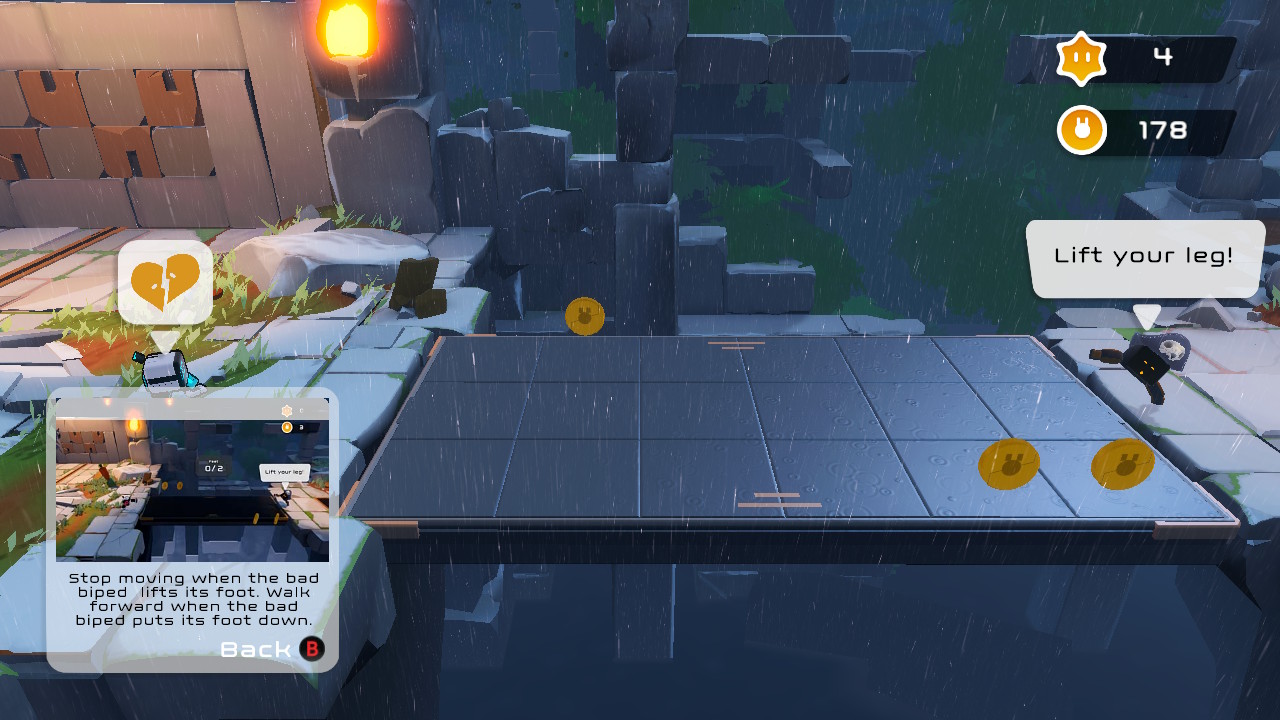
In the ending portion of Rainy Ruins in Single-player mode, an evil BIPED will make this section tear your hair in frustration!

Now, if you were expecting this game to utilize the ABXY buttons like every other game out there, you’re in for a rude as heck awakening. This game is controlled purely via the control sticks.

You know how difficult it is to get this control scheme in particular to work aside from Super Monkey Ball?! I mean HOLY HECK. Instead of holding the joystick(s) forward like in the previously-mentioned Super Monkey Ball games – In which even Banana Blitz had that right – you ROTATE the control sticks in alternating circles to move and walk the Biped. Eventually, surfaces you can slide on are introduced as soon as the tutorial finishes. Isn’t that fantastic /s Oh, you can also collect coins and stars to unlock cosmetics and extra stuff.

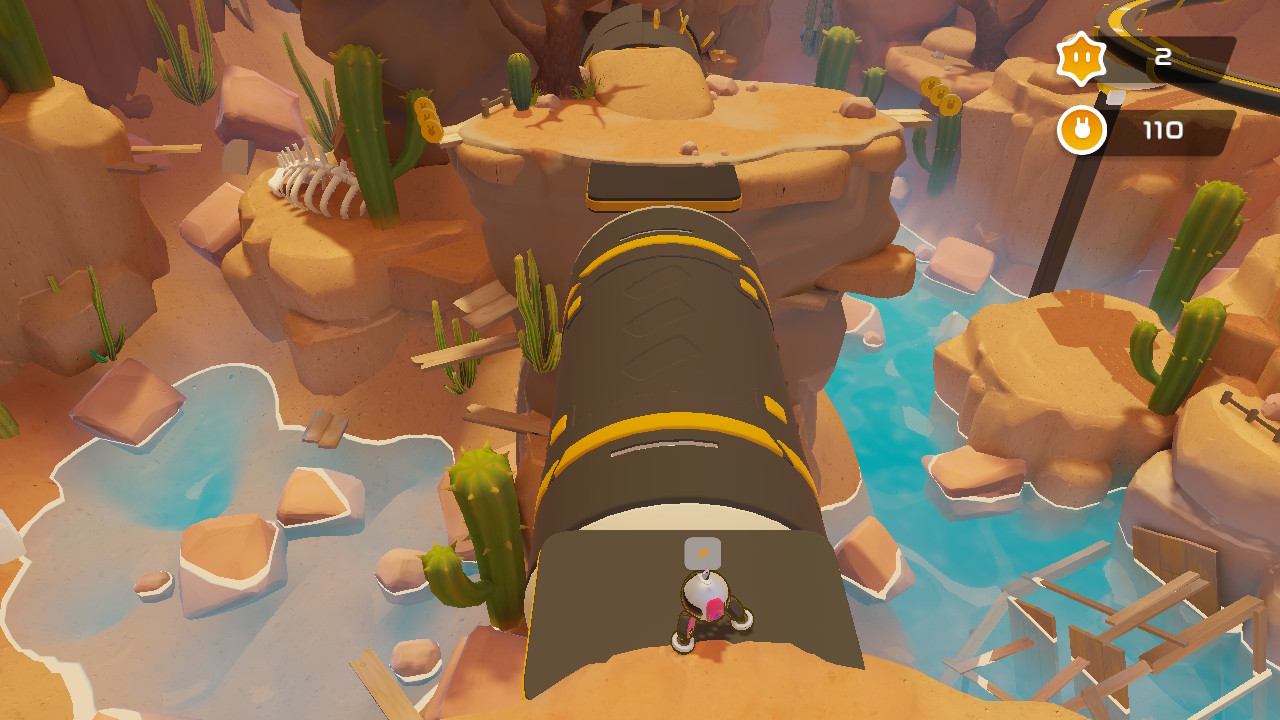
Dense Forest and Cactus Valley are nothing special. They serve to introduce you to the Sliding mechanic. You execute this maneuver by holding down the joysticks in the direction you want to slide/skate in. They’re alright levels Rainy Ruins, on the other hand. . .

The image above that starts this section is where I lost all my sanity and rage-quit. The end of Rainy Ruins in single-player has you deal with an evil Biped trying to stop you from rescuing a trapped Biped. The goal is make sure there’s two feet on there at all times, otherwise the platform will shrink in on itself and disappear, sending your Biped into the abyss. Sound simple enough, right?

Here’s the issue: The evil Biped on the side you need to get to is telling you to put your leg down and then lift it up at various intervals. Simple enough?! Well, the trick is to do the opposite of what it does at the exact same time – not a second sooner or later, or the platform room you have to work with will shrink and eventually disappear. Fail enough times on that, and a B button prompt will appear to back you out of the tip to get you through this segment, and every time you fall, that tip annoyingly reappears.

I spent 2-3 days trying to get past Rainy Ruins, but eventually lost my patience and rage-quit. Not having anyone nearby that’s into this sort of game is also frustrating for me.

And even when you get a partner to play along, it’s through the two Joycon controllers with the switch in Tabletop mode. I feel a wi-fi option would help alleviate the frustration to an extent, but there’s always the sequel for that, I guess.

Also, contrary to what Nintendo Life said in their review, there’s no ability play the levels in any order. There’s a set order in which the levels need to be played.

CONCLUSION

I will give the game trying to be unique in terms of cute visuals and control mechanics. I wanted to really enjoy this. I really did. However, if stuff like Rainy Ruins’ end segment are to be found further in the game, then I recommend skipping this unless you know or live with someone who is as good as you are at video games.

Review: Chess Knights: Viking Lands

Games of strategy and logic have been widely played for centuries. One of these games that is known the world over is Chess! Chess has been testing players’ minds since the 6th century, and is renowned as being easy to pick up, but a lifetime’s work to master. Across the years, many new variants have arisen, some have been popular, some more niche. Yet, each has remained faithful to the basic principles, and if you understand one, then you will understand them all. Chess Knights: Viking Lands is a strategy title that uses a few key pieces from the game and asks you to take part in many puzzles.

Developed by Minimol Games and published by QUByte Interactive, this strategic puzzle game will have you scratching your head searching for the answer to many challenging puzzles. Set in a medieval world, you control knights, who must move from one safe zone to another. Your only task is to rescue other chess pieces who are imprisoned by your enemy. This is the main and only premise of this title, and though the key mechanics revolve around the principles of certain game pieces, this should be considered a strategy puzzle title rather than a game of chess.

Chess Knights: Viking Lands is deceptively challenging.

I have taken part in many games of chess over the years and have played for at least 2 decades. Yet, I still have plenty to learn about the finer points to make me a better player. When you play Chess Knights: Viking Lands, you soon realise that you needn’t have any knowledge of the great board game. A simple tutorial explains how the 3 main pieces move, and what you need to do to be successful. Once you feel comfortable with the task at hand, you are chucked straight into the first of 4 worlds. Each of these lands has a variation of a theme to keep things looking interesting, but the same core mechanics apply, albeit in a much more difficult and complex way.

The game becomes increasingly challenging at an alarming rate! The map changes in size, making it much harder to plot a path to victory. Your army of knights alters from a lone fighter to a vast team of sacrificial lambs. The same applies to your enemy’s force; knights, bishops and queens make up the opposing players. You must contemplate which of your team must be sacrificed, and which of the opposition must be removed. As long as you win the stage, losing each of your pieces will not be in vain.

Brrrrrrr, even chess pieces feel the cold.

Once you have removed all the unnecessary foes, you must rescue each imprisoned piece and return them back to your starting point. This return journey is as thwarted with danger as the original trip, and you can’t let your guard down. The stage is complete once you have rescued each prisoner, or you lose all your pieces. If the latter happens, then you must restart the level and redo all your hard work.

Mistakes are costly!

If you have played the board game, you know mistakes are costly and can ultimately cause you to lose. This Sword of Damocles hangs above your head throughout each level. An error will cost you your progress, so planning and patience are a must if you wish to be successful.

Minimol Games aren’t entirely cold hearted, and they have allowed for an undo option to be used throughout. But this has its restrictions. You may only revert one turn, so if you have wandered down a dead end, and gone too far, then there is no going back. Also, if your last piece is captured, that’s it! You cannot return to undo your mistake, and its level over. This choice of the developers was both brilliant and infuriating. I cursed both them and my stupidity countless times. Yet, if you could revert many moves, the challenge would have been watered-down, and the gameplay would have become pointless and bland quickly.

Alongside the main story, a mode called “The Lost Ones” can be selected. This additional section allows you to visit 3 extra levels per world. Each one follows the same principles, but the puzzle difficulty is ramped up vastly. These 3 stages will be enough to push you over the edge, and I lost many hours, and much of my sanity attempting to complete as many as I could.

Sacrifice is the name of the game.

Chess Knights: Viking Lands is easy on the eyes.

I’ll be honest, I didn’t have high expectations for how this game would look. An indie title that has chess at its heart doesn’t require a triple A presentation. I was pleasantly surprised as I played, as the standard was better than expected. Each world had a distinct look, with a wide range of colours and textures being implemented. The game pieces have a nice level of detail, and the grid-like maps are easy to navigate with a good use of camera rotation, zoom and panning.

The overall visual aesthetics were good until you get to the movement of your own army, and this is where it unravels quickly. A small red arrow rotates around your selected knight, and the locations that it can move are shown with a red circle. This process was cumbersome, hard to control, and led to mistakes repeatedly. It was hard to work out which way the arrow would rotate, and I found I would move to the wrong location, causing me to be captured by the enemy. If you slowed down your approach, this problem was reduced, but when a game is as slow-paced as this one, it was painful, making the process slower still.

Try not to scream!

You may think that this issue would infuriate you to the point of screaming, I admit I was close. Luckily, though, most of your annoyance fades away when you listen to the calming soundtrack that plays throughout. The soft and mellow music helps to set a serene atmosphere that matches the pace of the action. The audio wasn’t anything more than I expected. It won’t go down as a classic, but it works well with both this theme and genre.

Ignore the beautiful sunrise, you have pieces to save.

It doesn’t work well with a controller.

I can imagine that Chess Knights: Viking Lands works perfectly on its desired platform, the PC. Sadly on console it doesn’t handle as well. The aforementioned issue with moving your game pieces haunts you on every level. No matter how much you move the camera, or try to work around the problem, it never goes away. The only solution is to play at a snail’s pace, however this becomes tedious quickly. A simple solution would have been that each move was shown on the board at all times, and you select which works for you. This would have removed this problem, improving the game no end.

As with most puzzle games, the desire to return is low once you’ve completed it. Even with the addition of “The Lost Ones” mode, there is no getting away from the lack of redeeming features to make you want to play again. Luckily, the high difficulty setting ensures that your first playthough is challenging enough to make this worth your while. Achievements are earned as you progress naturally, but completionists will need a logical mind to earn the 100% status. At around £3 it won’t break the bank and is good value for money.

Is it worth it?

A chess game is always going to be a hard sell to anyone that isn’t an avid fan. But I think that Chess Knights: Viking Lands has enough about it to attract additional players. The difficulty is high enough that lovers of the puzzle genre should get hooked on each of the 4 worlds. Yes, it has its issues, and I simply detest the control setup, but I can’t help but recommend you buy it here! A title that can be played casually between bigger games, and one that will challenge you throughout. Can you control your army of knights and rescue each imprisoned chess piece? Take your time, work out your strategy and defeat the enemy forces.

Review: Outbuddies DX

Outbuddies DX promises to be a classic metroidvania experience including a varied open world, environmental puzzles, multiple ways of movement and interesting boss battles. It manages to deliver all the core metroidvania elements very well with some clear references to the classic Metroid games. The story focuses on an explorer who following a shipwreck gets stuck in a complex system of underwater caverns and ruins of an old city. Using a futuristic underwater suit, a robot sidekick and various gadgets found along the way you have to find your way out while uncovering secrets of a lost civilization.

True to the genre the basic gameplay consists of the player having to navigate through various areas in a 2D platformer fashion while overcoming enemies, environmental hazards and puzzles. The world is broken up into five different biomes each consisting of many small, interconnected areas of varying sizes. Each of the biomes features a unique aesthetic, different enemy types, hazards and each has a boss to defeat.

The player starts off the game with the ability to run, jump, dodge roll, wall jump, crawl as well as swim underwater and soon after unlocks a projectile weapon and an ability to plant bombs with many more combat and exploration oriented upgrades to come. The player is also always accompanied by a floating robot called Buddy which can be controlled and used to safely scout the surroundings, scan the area for secrets, hack the enemies and use telekinesis on movable props.

The platforming gameplay is very solid and easy to control without requiring major finger gymnastics. Platforms have generous collision boxes that let the character climb up an edge if the feet almost reach the surface which made it rare for me to fail a jump that I thought was manageable. The combat meshes well with the platforming allowing for dispatching enemies in various ways and from various angles right from the start and more different options can be unlocked over time.

One low point of the gameplay for me was controlling Buddy to find secrets. With his scanning ability you can find walls that are breakable with bombs and which most of the time hide useful upgrades. The scanning requires to stop moving, switch to Buddy and slowly move along every wall in the area as the breakable walls look just like the regular ones. Having to do this very often hurt the game’s pacing and made it drag a bit. I think this could be fixed by having Buddy passively scan walls as it is passing them while following me around and mark them on the map when they were found. Alternatively they could be slightly hinted at in the environment making finding them easier.

The game has a retro art style reminiscent of NES and SNES games. It does very well at conveying creepy, mysterious and unknown using colours and shapes. Ingame environments range from dark, wet caverns through coral formations and ancient structures to earth’s core. The colour palettes for various areas consist mostly of purple, navy-blue, blue-green and magenta which usually aren’t  bright but saturated which contrasts well against very dark, desaturated backgrounds.

Generally the visuals work great for creating an atmosphere and for gameplay with enemies, hazards and interactable objects communicated well. The HUD is also easy to read and menus easy to navigate. However some visuals can be problematic. Some of the enemies can blend in with some environments leading to unexpected damage or deaths. Another thing I found problematic was the map screen with some of the markings counterintuitively indicating locations where I already picked up a power up or an item leading me to backtrack a long way for nothing several times early in the game.

The audio side is very good like the visuals and compliments them perfectly. The background music adds to the mysterious atmosphere without being intrusive and I never got tired of any track. In addition the music swells up with harder sounds when the player is in danger reflecting the character’s state of mind. In terms of sound effects the game also does well at communicating everything without going against the game’s atmosphere by being too arcadey and silly and without clashing with the retro aesthetic by being too gritty and realistic.

During my time with the game I didn’t find any major issues. I tried to play the game in co-op mode several times and tried many things but could never get it to work as my joy-cons would always go back to default single controller mode. Also the controls while not hard to learn can’t be changed and I found some bindings occasionally awkward.

In conclusion the game is very good. It is a great representation of the metroidvania genre which goes back to the roots, has an intriguing, dark, underwater exploration theme and a lot of polish. It has it’s problems but those are overshadowed by a lot of good game design, art and sound ultimately creating a fun and satisfying experience.

Review: Blue Fire

0

Blue Fire is a beautiful 3D platformer that feels like a mashup of Hollow Knight and The Legend of Zelda, with its own unique flavor.

From stellar graphics to a charming soundtrack, this gem is a perfect example of an Indie game that can shine just as bright as any AAA. 

Gameplay:

You play a mysterious hooded swordsman as you explore the dark world of Penumbra. This action-adventure game takes you through many worlds as you complete numerous quests, battle enemies, and collect rare items.

The 3D platforming in Blue Fire proves to be challenging but never madly frustrating. For the most part, jumping and dashing can seem daunting at first; however, after getting new upgrades you’ll start to feel like you’ve really mastered the controls. Even if you die from missing a jump, you can easily pinpoint your mistake and advance on your next try – that’s just how precise this game is. As for the combat system, it felt really fluid and fast-paced. On the other hand, I will say the combat system did feel a bit lackluster, especially with the awkward camera.

The design and graphics are beautiful, and I loved all the environments. Even as you backtrack through each world there were a lot of areas to explore after you upgrade. And on top of the game’s pretty aesthetic, I’d say the soundtrack was notably one of the most spectacular parts of the game.

As charming and fun as this game is, sadly there’s not much to be said about the plot, and the characters are forgettable. To be honest, I was more interested in the side quests instead of the main story. With that being said, I don’t think the dull story takes away from the game, but it’s definitely something that could have made this game unforgettable.

Clocking in about 20 hours of gameplay there’s definitely a lot to explore and many items to collect. In addition, there are many challenging platforming levels in the lost land called the Void. Customization and upgrades play a big role in Blue Fire which are much needed in order to successfully complete the game.

While the gameplay does start to feel repetitive later on, I’d say it isn’t that bad and felt more like I was going through the motions. Even so, there were moments where I felt like the game mechanics could have been better. For example, I got excited thinking one of the side quests was a race with the NPC, and I felt eager to try my hand at dashing across the lava. However, it was simply the same formula as the other side quests. I felt like many missed opportunities like this could have really taken this game to the next level. It may seem like I’m nitpicking, but with such a beautiful gem I feel like it was missing a few elements that could have easily made it one of my favorite games.

Pros:

  • It features a stunning original soundtrack.
  • It has a lovely dark aesthetic and beautiful graphics.
  • A fun challenging platformer with fluid fast-paced controls.

Cons:

  • There was no map so I would easily get lost – but maybe that was just me.
  • The story and characters were dull.
  • The camera was pretty awkward; for a platformer, I feel like it could have been better.

Conclusion:

In summary, Blue Fire was beautifully charming and one of the best Indie games I’ve played in a while. I highly recommend you add this gem to your gaming list this year!

Entertainment: 8/10

Replay value: 6/10

Graphics: 8/10

Sound: 9/10

Kid Friendly: Yes

Platform:Nintendo Switch
Developer:ROBI Studios
Publisher:Graffiti Games
Released:February 04, 2021
MSRP:$19.99
ESRB:Everyone 10+

Review: Bob Help Them

Bob Help Them is a timed resource management game, where your goal is to help all the NPC’s in your village with simple chores. 

Produced by Brazilian game studio Gagonfe, Bob Help Them is the latest edition to the increasingly overwhelming catalogue of resource management games. The question is, how does it stand out from the rest? 

From chopping trees as a dutiful pixelated lumberjack, to catching fish, the tasks that you will undertake are simple and relaxing. The challenge to be found here, comes with the addition of a time-limit, and a star scoring system based on how quickly you complete each level.

It is clear that the developers have structured the game in such a way, as to entice players to catch the proverbial ‘one more level system’ – with the short levels and simple objectives being conducive for such an approach. Add to this, a relatively relaxing aesthetic, and you can see what the developers were aiming towards.

Thoroughly unremarkable:

The problem is that Bob Help Them doesn’t offer anything particularly unique, within a genre that is dominated by huge titles in Stardew Valley and Animal Crossing. The simple gameplay is fun for what it is, but unless you’re someone who wants to play every simulator, there isn’t anything particularly unique here; that hasn’t been done better somewhere else.

There just isn’t anything at all remarkable about this game. For me personally, if you’re going to elect for a more simplistic gameplay loop, then there really should be some other draw to the game. Here, the graphical style is fine; the music is good, but there is just nothing that makes the game feel memorable. It would be great if, across the games 35 levels, you had the opportunity to learn more about the 6 regular NPC’s, for example. 

Well, at least you can Pet dogs!

The game also has an issue with balancing; some late-game missions are astonishingly simple, and feel like they may have been misplaced. Whilst it can be fun to revise your approach to tasks, to ensure you get three stars, the achievement itself feels completely inconsequential beyond an initial dopamine hit.

A relaxing, timer-based game?

Okay, so the previous section was pretty critical of the game. However, I also want to talk about an aspect of the game that does show some promise.

The idea of a game being both relaxing and timer-based sounds damn-near paradoxical to me. Personally, I don’t enjoy time-limits in games. They always succeed in raising anxiety, and causing me to rush through a level without taking in all there is to experience.

So, having a timer slapped on the screen – like in Bob Help Them – sounds like my worst nightmare. Strangely, I never felt any such anxiety throughout my time with Bob Help Them. As a matter of fact, I was pretty chilled out. This is a success.

You see, the time-limit is simply a way of giving the game a modicum of challenge; without it, there is no challenge. The stress of such a limit, is off-set by the calming music and low-stakes of your tasks. The world isn’t going to end. This NPC isn’t going to die if you don’t give them their 40 mangoes on time. One of your tasks is to pet dogs! That is like – the most – relaxing thing.

Bob Help Them genuinely succeeds in being a very relaxing timer-based resource management game(wow, that was a mouthful). Whilst I didn’t find the game particularly engrossing or unique, it certainly offered fun in small doses. I think there is some potential here.

Should you buy it?

Bob Help Them succeeds in offering a relatively stress-free gaming experience, with simple tasks and varying time-limits offering a regular sense of accomplishment. Beyond that, the game doesn’t have much more to offer. There are better options out there.

The village and characters general lack of personality is disappointing, and the inconsistency of the games challenge offers little to draw the player back. The game is fine in small doses, but honestly, it isn’t anything you can’t find elsewhere in the genre. 

Review: Disgaea 4 Complete+

Disgaea 4 Complete+ is an excellent addition to the Disgaea franchise. Disgaea 4 Complete+ takes everything we love about the original Disgaea 4: A Promise Forgotten and ports the game over to current hardware with added content. As with its predecessors, Disgaea 4 Complete+ looks excellent, providing stylish 2D graphics all in a cartoon style package. The game offers a friendly art style looking relatively fresh on current generation consoles. Despite the Chibi art style, better suited to handheld devices. Although the original Disgaea 4: A Promise Forgotten came out in 2011. It still holds its own and has aged well due to its art style and graphical fidelity.

Staying true to originality

Likewise, much like its predecessor, the game keeps its charming adventurous soundtrack, providing a lovely backdrop behind all of the intense turn-based action gameplay. The soundtrack has a nice variety and provides the perfect intensity to accompany the games, battle sequences and overworld. Disgaea 4 Complete+ battles systems also offer the ideal level of turn-based RPG gameplay. The gameplay takes traditional turn-based battle systems present in previous games and stays original to them. 

A Story Scene

The battles provide real challenge and strategy with various abilities and attacks for your characters to use. Each character has different abilities and can be used in conjunction with one another. Some of my favourite moments in the game was creating combination attacks between my various characters. Thus, the turn-based battle mechanics within the game provide a deep level of strategy. But are at face value relatively simple. The combination of deep-rooted strategy combined with relatively easy-to-pick-up and straightforward battle mechanics makes battle sequences a joy to play.

Likewise, Disgaea 4 Complete+ also has enjoyable but specific customisation options. Allowing you to upgrade and choose from a range of different abilities and skills. Similarly, the game has a considerable amount of content. Including extra content from Disgaea 4: A promise revisited on PlayStation Vita. Therefore, offering significant replayability. Thus, like its predecessors, Disgaea 4 Complete+ is a fun strategic but simple turn-based RPG. That is enjoyable to play with a ton of great customisation and content.

Battle gameplay

Frustrating dialogue

On the other hand, I did find the dialogue within the game, particularly long and unnecessary. Much like Disgaea 4: A Promise Forgotten, this game’s dialogue sections are painfully lengthy between characters and makes the gameplay somewhat disjointed. Similarly, the game’s humour also doesn’t hit home with the same running joke about Sardines granting the main character power being rather annoying after the first couple of attempted jokes. Although I appreciate the game trying to add in humour, it doesn’t work most times and takes away from the game’s enjoyment and pacing. Nevertheless, the game’s pacing is generally good and is only let down by the game’s dialogue. 

Verdict 

Overall, Disgaea 4 Complete+ is an excellent port of the original Disgaea 4: A Promise Forgotten. It brings over the classic simple but strategic RPG turn-based gameplay we loved about the original and brings new life to the game on current consoles. However, the game still keeps the same bugbears from the original Disgaea 4.

Review: Space Otter Charlie

When people think of animals in space, I’m sure their first thoughts go to Laika the dog, or Albert II, the first space primate. I doubt very much that anyone would consider the possibility of an otter making it to space. Well, now you must as Charlie the once “normal” otter gets his chance to put on a space suit and take a trip to the stars. Space Otter Charlie is a colourful, comedy laced puzzle game that will have you laughing, screaming and coming back for more.

Developed by Wayward Distractions and published by The Quantum Astrophysicists Guild, this outer world puzzle game takes you on a trip across the galaxy. Charlie the hero and his crew attempt to work out where the humans have gone, and why they were left behind. A title of relatively low difficulty, it can be enjoyed by gamers of all skill sets, and is aimed towards a family-friendly audience.

Space Otter Charlie will test you and keep you smiling.

Space Otter Charlie is a single-player game at its core, but Wayward Distractions added in a local multiplayer mode to keep friends and family happy. It’s a nice addition, and acts as a welcome distraction from the challenges of lone space travel. Both modes use the same core principles, and are easy to pick up, with the focus being aimed towards fun rather than a Dark Souls style difficulty. Charlie the cute Otternaut must venture deep into space, visiting a mixture of; labs, space stations and other random locations. Each stage is compact and has a limited number of objectives to complete, making it simple to play casually and when you have limited time.

The story begins with all humans abandoning the Earth, the planet they once called home is ruined and is slowly cooking itself dry. Humanity has left untold amounts of creatures behind, and at first they enjoyed their new found freedom, but then the heat got too much for them. They were sweating their fur off and something had to be done. Luckily for the remaining creatures, the otters understand astrophysics, and advanced engineering (not absurd in the slightest). After many failed attempts, the scientists launch a rocket with 3 brave otters inside. One of them is Charlie, and thus his adventure begins.

Super otter!

A simple premise with in-depth gameplay.

The brilliance of Space Otter Charlie is its simple approach. The main concept is well explained from the off, and once you play the first level, you know what to expect for the rest of the game. This doesn’t mean that it’s bland, or a walk in the park. No, it simply sets out what you need to do, and builds from there. Charlie wears a set of magnetic space boots, these allow him to land and stick to surfaces. His task then is to leap from location to location by hitting walls and platforms, or by floating around using his jetpack. He’s armed with a laser weapon at first, and then further guns are added to his arsenal. Many upgrades to his equipment are found en route, and new blueprints for different tech can be found in the many levels you search.

This evolving gameplay ensures that the game has real depth to it and prevents it from feeling too repetitive. The choice of weapons at your disposal allows you to choose how you wish to take on each of the stages. You can go face to face with your foes, shooting them with lasers and missiles. Alternatively, you can use a beam that bounces off surfaces and sneakily take down your enemy from afar. As well as the space creatures you find, you must overcome traps, power switches and unlock doors.

These additional elements of the map feel very traditional in their design. Gamers who are well versed in this genre will feel instantly at home with these mechanics. I enjoyed the level of difficulty that accompanied these traps as they required a small amount of planning to progress. The balance of challenge was well thought out, and will keep veteran players interested from start to finish.

Space Otter Charlie is all about the collectables.

Though the key focus is the puzzle element, collectables form a massive part of the gameplay from the off. A large variety of resources can be found on your journey; energy, metal parts, crystals, fabrics and more. This excludes the mission objective items such as; the stage map, fuel, matter-crystals and more. Each object forms components that must be used to improve or make your equipment. You must decide whether to increase your; shield, jetpack fuel or weapons. You are also free to improve the suit that you are wearing, after all, who wants a boring space suit when you can have; a pink glittery outfit, a shark costume, and more.

What are you looking at? Never seen an otter in a shark costume?

Though Charlie is looking for a new home, he must also rescue as many friends as he can from Earth. This is where the energy come into play. The more you collect, the more animals you can beam to your ship. They add little to the gameplay, but I enjoyed the challenge of collecting as much energy as I could. After all, space is lonely! What’s the point in finding a new home if you don’t have friends to share it with?

Bright, colourful and beautifully designed.

I love it when a developer spends loads of time and effort into making its game look great. Wayward Distractions have created a beautiful game to look at. Each stage looks similar, but they all have distinct character models and traps to overcome. Each is well designed, easy to navigate and fun to explore. The enemies are unique and all have a nice extraterrestrial appearance. This combined with the amusing and well presented cutscenes made the gameplay flow nicely from level to level.

The Sci-Fi portion of the game is exposed in the metallic and futuristic audio. The classic and almost clichéd approach worked brilliantly alongside the rest of the gameplay. The airy music accompanies everything that you do and takes a back seat compared to the other elements. The softness of the music is overpowered by the volume and crass nature of the sound effects. Crashes from explosions, the shrill screech of lasers being fired, and the whoosh of the jetpack being powered all play a key part in telling the story.

Bless those scientific otters.

Physics based games can challenge!

Family-friendly and physics based games rarely go together. There are a few exceptions, but mostly they are a tricky beast to handle and can frustrate from start to finish. Space Otter Charlie stands out as an easy game to control. The in-depth tutorial explains everything that you need to know. Though the difficulty increases during the latter stages, you have had enough time to master the controls that the higher challenge is welcome and doesn’t cause any issues. It works perfectly with a gaming pad, and I experienced no input lag or mapping issues. The developers have done well to create a straightforward approach for this fun-filled game.

With many collectables to find, such as; the aforementioned resources and otter based fun facts. There is plenty to make you keep returning to play. Stages contain secret areas that are hard to find, and the moderate achievement list will keep you busy for some time. Chuck in the local multiplayer option that contains 2 game modes, and you have many reasons to keep playing. It’ll take around 5 hours to complete, which is unfortunately short, but at £10 it still proves to be good value for money.

Is this journey to space worth it?

Space Otter Charlie is a title that gets under your skin. Once you play, you will want to keep going until you’ve explored every station and rescued each of his friends. With witty otter based puns, excellent audio and well designed visuals, this is a game that will make you smile from ear to ear. It’s family-friendly approach is a bonus, and I recommend you buy it here! Mankind has ruined the Earth for themselves and for every living being. We can run away and find another planet, but the fate of those left behind lies on the shoulders of one heroic otter. Can you find the animals a new place to live? Will you survive the many bizarre ordeals you’ll face? Grab your space suit, jump in your rocket and let the adventure begin.

Review: Story of Seasons: Pioneers of Olive Town

Story of Seasons: Pioneers of Olive Town is yet another release in the series to pick up where other farming simulators have left off. After playing Friends of Mineral Town a few weeks ago, this next installment is clear to show some extreme developments in the franchise. For those who have reached New Horizons burnout and played through Stardew one too many times now, this game might be for you. With such wholesomeness readily available on yet another farming adventure, Pioneers of Olive Town inherits all the best bits. Seasons pass and you continue to farm crops and raise animals, and get to know the townsfolk. It’s all comfortable and something you’ve experienced before. Even down to the inheritance of your farmland. 

The grind never stops

You are given a large section of map to work on from the moment you arrive, but tasks have to be completed in chunks. As per usual, you need to upgrade your tools in order to face the larger challenges. You can access so much from the get go, including the mine to harvest ore in order to upgrade but progress still feels slow. Stamina depletes slightly slower than it originally did in the Story of Seasons game so more can be achieved per day. Despite this being a definite plus for the game, it is still annoying. When you start out, you want to be able to progress quickly to get the farm going which seems impossible. It feels a bit like you spend more time worrying about stamina than you do actually achieving anything. 

Character development

The character creator you are given at the beginning of a game is a first for the franchise. You are able to fully customise your character, including selecting a voice from a wide variety. Rather than having to choose between a standard male or female pre-built character you are open to present yourself as whatever you’d like. The characters already within the game are a little boring though. In the first season, and during your first interactions, they seem excellent. There are many new faces to greet and you have a good time doing so. But as the days pass, they become static and repeat the same things. Interactions are few and far between and you will more than likely lose interest in speaking to others. When there’s an event on, townsfolk will fixate on speaking about that and only that. Even after the event has finished. It feels lacklustre and could definitely use some work. Especially as you are intended to find a love interest in the comfort of Olive Town. 

Makers on makers on makers

Additionally, the game does become a little repetitive regarding construction. You need to build a whole army of makers in order to progress. Even though your farm seems extremely spacious when you begin, it quickly clogs up with these eyesores. It seems so tedious and becomes very frustrating in a short space of time. Each maker produces one product, so you spend a lot of time hanging about the farm and just waiting. If you think you can get round this, I can reassure you now that it is inevitable. You will end up with a whole field of these. 

Final thoughts

The game recycles a lot of content already featured in the franchise. Although the new character customisation and photo mode is refreshing, it doesn’t seem like enough to tie us over. Despite the art style and location being different, the game as a whole remains the same. It’s enjoyable, sure. But to fans of the franchise it’s a little disappointing since we have all definitely experienced it beforehand.

Review: Windfolk – Sky is Just the Beginning

Innovation in the gaming industry often comes in incremental steps with new titles taking elements from their successful peers before adding their own distinct flavor. Windfolk: Sky is just the beginning, an action-adventure game developed by Spanish Indie developer Fractal Fall, is no different with a formula that looks like ‘Flying X Fortnite‘.

The game’s opening attempts to separate itself from the expectations its borrowed Fortnite-inspired aesthetic creates, introducing its flight system via a tutorial and has you wondering, if just for a second, whether you’ve stumbled upon a hidden gem.  

Well, its not quite a gem. More like an oasis of inconsistency.

As Esen, a soldier in the rebel force, you battle an evil alliance who wishes to take over the world with destructive weapons made from trydian, a priceless natural resource that the world’s population uses for energy, while also taking revenge on the enemy who kidnapped you.

As a huge fan of games with the ability to fly, the idea of jetting off in a beautiful cartoon graphics-infused adventure in the sky is very appealing. Doing this well is easier said than done, however, with many games failing to convey a proper sense of speed and thrill of sailing through the air, but Windfolk succeeds in both with fast, smooth and intuitive movements. Unfortunately, this initial excitement proved to be short-lived, as the second part of the gameplay – the shooting action – changes the experience entirely and feels like a developer stretching beyond their capabilities.

These gunplay scenes restrict the size of the battlefield and populate it with poorly animated enemies with minimal sound effects and feedback during battle, making it feel like you are at a police target range with paper targets moving side to side. The enemies have a lock-on feature that you need to dodge, but with 2 of your 3 available weapons having an overly generous ‘homing’ ability, maneuvering mid-air feels relatively static and is highly unsatisfying. So large is the contrast in quality to the flight gameplay and the effect on the overall experience that you’ll wonder if the gunplay’s inclusion was even necessary. 

If I were to shoot at this very moment, it would be a headshot….

Like a parent being disappointed in their child for not achieving the potential that they know he/she is capable of, this monotonous and below-average element is impossible to ignore not only due to the quality of the product elsewhere but because the majority of the action consists of it. It truly gives you the impression that the game’s great concept became victim to a looming deadline and was rushed out the door. 

The story mode, for example, is fully voiced and has some nice interactions between characters overlayed on top of the action, but its cutscenes barely justify their inclusion with minimal animation and camera movement. Bugs that include preventing half a level of enemies and a boss from landing any damage whatsoever (ironically this is done intentionally later on) as well as trophies activating for unrelated activities also furthers this theory.

Escorting cargo ships and taking out others is a nice break from shooting the mindless enemies that dance around like puppets

Even the flight system doesn’t escape this shoddy submission with a time-trial course mode that incomprehensibly changes the boost button mechanism for no good reason, making the quick and easy maneuvering awkward and imprecise, and in one motion ruining one of the game’s best features.

An extra mode offers you the chance to replay the challenges included in the story and is presumably meant to add longevity to the title, but their existing issues make neither particularly appetizing. A free roam mode for collectibles would have focused more on the game’s greatest strength, but the only way to enjoy that currently is while gritting your teeth through the action sequences of the 3-4 hour campaign mode.

Windfolk is an ambitious title that unfortunately buckles under its inconsistent gameplay, and leaves it in a rather precarious position. Its formula is far from irredeemable with a story, visuals, and flight physics a good foundation for future projects, but will this inconsistent offering provide enough of a windfall for its developer to potentially develop a sequel? While I hope that Windfolk: Sky is just the beginning truly is the start of something more, I, unfortunately, can’t bring myself to recommend this pie in the sky title to anyone other than fellow flight game fans and PlayStation trophy hunters – if they can trigger the achievements that is.


Review: Die With Glory

Valhalla, the dream resting place of the world’s bravest warriors. You have served your country, fought with all your heart, and died in glorious combat. You have now earned the right to enter the hallowed grounds and stand next to your fallen brothers. Imagine if you were so good at combat that death never came for you! Wars pass, and blood is spilt, but none of it is yours. This would frustrate, right? This is the reality for the hero and undefeated warrior Sigurd in Die With Glory.

Developed by Veslo Games and published by ChiliDog Interactive, this beautifully presented story-driven puzzle game takes you on many adventures. You must interact with everyone you come across, hoping that somehow one of them will offer you a glorious death and a way into Valhalla. This is easier said than done, and the slightest of mistakes sees you resurrected to the land of the living.

Die With Glory is a game of tall tales.

We’ve all got that friend who can tell epic tales. He can entertain a whole room with his unbelievable antics. Yet, his stories are always flawed, and soon the lies come to the fore. Your friend is exposed for the half-truths he is spinning, but you don’t mind as you were amused for 5 minutes. This is the main concept behind Die With Glory. You flit from story to story, telling different versions of what you believe to be true. If you stray away from your narrative, you are mocked and you must right this wrong.

Is it getting hot in here?

It’s a simple premise, but boy is it enjoyable. The beautiful settings for each part of Sigurd’s story help to transport you into his world. Each person he interacts with is; witty, rude, sarcastic or just ignorant. The humour runs through every scene, and you will chuckle with joy as each tall tale is recounted. 5 chapters of his life must be looked at, each set in a bold medieval land. There are at least two versions of each event, and as the plot evolves the puzzles get increasingly elaborate.

It’s a wonderful way to ramp up the challenge in the puzzles while gently breaking you into the game. The difficulty is relatively low throughout and is open to most audiences. Younger gamers will need help though, as some logic-based puzzles require forward-thinking.

The perfect death isn’t easy to find!

You may think “just die already, it can’t be that difficult!” I agree, death is just around the corner, but the perfect warrior’s death is not! Die With Glory asks you to complete 3 tasks to unlock the gates of Valhalla. Sadly, this is easier said than done. You must; find the right weapon, encounter the correct foe, and die at their hands. Unfortunately, Sigurd is a mighty warrior who has a habit of decimating his foes. You must think logically, and outside of the box to get to your resting place.

Where better than a tavern to tell a tall tale?

Each story plays out repetitively. There are slight variations in how it is told, and your approach must be altered to account for the key differences. For example; one story will have the red Knight surviving a deadly trap, the other he will face his demise. If you stray off the path, you must start from the incorrect moment. This, however, never got boring. The amusing dialogue and length of each chapter ensured that boredom never entered the equation. Each portion was balanced perfectly and kept you wanting more. Credit has to be given to Veslo Games for their clever writing style.

Die With Glory is beautiful to look at.

A distinct cartoon style has been utilised throughout. The colourful and bright landscapes offer many unusual destinations. You will visit; a lava-filled dragon lair, mushroom forest, an airship, jungle and a keep. Each looks unique and helps to convey the ridiculous tale you are exploring. The characters you interact with are well designed and amusing to look at. Though its approach was crisp and clean, it still had an air of old-school gaming. I loved how it was presented, and it was very easy on the eye.

However, what was odd was the delicate audio that accompanied the action. The music changed tempo, beat and style to match the story, yet it played softly in the background. It was strange that it didn’t take a more pivotal role, as I expected a louder and more intense soundtrack. The comedy continues with the use of childish and amusing sound effects. The over the top noises emphasise each strange death you are involved with. Overall, the audio was a success, even if my expectations were wildly incorrect.

Everyone has a floating skull, right?

The controls were the bane of my life.

Die With Glory has been ported from PC, and it shows. You can move around with ease, but interacting with objects was a pain. Circles appear on the screen to denote an action to be taken. A hand shows an object to collect, and arrows indicate places to go. The issues occur when over one choice is on screen. The highlighted orb flits between the two and you constantly select the wrong option. This wouldn’t be so bad, except you can’t cancel the action. This is prevalent in the boat scene. You can climb the mast to the crow’s nest. If you do this by accident, and you will, you must clamber up, just to climb back down (ARGGGHHHHH). It was infuriating as hell! The developers should have input a cancel action button, after all the button layout is so sparse it could have been done easily.

As with all great films, the writers leave it open for a sequel. This is usually done in a suggestive way, such as the hero has unfinished business. Die With Glory wasn’t so discreet. Upon finishing the 5 levels, you wander to the end of the tavern. Here you are told of the next chapter that is coming. I know not; its release date, price or if it’s a DLC, but I want it now. I completed this in one 3 to 4-hour sitting, obtaining all achievements, and I have to say I loved every minute. Sadly though, I won’t return to play it again as it lacks replay value.

Will you die with glory?

Sigurd has many opportunities to die, but will any of them bathe him in glory? I won’t answer this for you as I don’t wish to spoil it. What I can say is you will be treated to a beautiful art style, nice sound effects and some excellent amusing dialogue. As a puzzle game, it isn’t the most challenging among its peers, but its simplicity allows you to enjoy every aspect. For this reason, I recommend you buy it here! Death is a complicated affair, especially when you are a master warrior. Valhalla’s Gates will remain shut to those that lack honour. Can you plan your perfect death? Can you Die With Glory?