Amazon, which started out as a basic online bookshop in 1994, is now one of the biggest technology companies in the entire world. One of the most dominant fields that amazon operates in is cloud computing. Amazon Web Services are a group of cloud computing products that have a wide-reaching impact. Amazon Web Services have a whopping 32% of the market share in cloud computing – more than the shares of its two main competitors combines. So what exactly are Amazon Web Services, and why are they so successful?
A Wide Range of Compatible Applications
Amazon Web Services are not merely restricted to cloud storage. Instead, AWS is more of a complete cloud computing service. This means that applications of all sorts can be used without being stored on local servers by clients. This web-based application compatibility opens up the possibility for organizations to pick the exact applications they want without committing to long subscription or licensing plans.
A Space for Innovation
Amazon Web Services are useful for developers and innovators looking to push the boundaries of what can be achieved on the cloud. In the past, companies used to have huge computing budgets if they wanted to acquire hardware powerful enough to innovate with. With Amazon Web Services, innovators are only limited by their internet connection. Machine learning is one of the areas that has been catalyzed by practical and adaptive cloud computing. Developers and scientists can utilize lots of applications for the construction of machine learning code. Although the options are opening up for developers to explore these realms, some training is required in order to get the most out of AWS. Completing an AWS machine learning certification path with an experienced set of developers can be very useful if you want to start creating intelligent applications and code using AWS.
Doing Away With Local Servers
All computer networks rely, to some degree, on communications with a server or series of servers. Local servers owned and operated by the organization that uses them are an extremely large expense. They are costly, of limited size, and take a great deal of money to maintain correctly. Amazon Web Services and other cloud computing providers essentially negate the need for local servers. Every computing function that a company might need can be hosted remotely on cloud servers – cutting out lots of expense.
Pay-As-You-Go
Amazon Web Services are charged for in a rather novel way. Instead of buying into a contracted plan, clients pay for services as they use them. This does require some careful budgeting to stay on top of and means that organizations can scale up and down their cloud budgets on the fly. It cuts down on wasted funds spent on unused applications and empty storage space. In theory, a company using AWS can only pay for the storage and software that they are using at the time. Other cloud computing companies are following on from Amazon’s lead and offering pay-as-you-go services.
Human beings are a social bunch who form friendship groups that last a lifetime. Yet, we choose to settle down with one or more partners, sharing our most intimate details while becoming dependent on each other. We are also an irrational species that fear countless things. I think we can all agree that dying is scary, but how about dying alone? Surely, no one wants that! (Wow, how to bring down the mood already.) Later Daters explores this idea, allowing you to experience friendship, love, and mischief as a representative of the older generation.
Developed and published by Bloom Digital Media, this is a colourful and quirky visual novel. It’s set in a vibrant and thriving old people’s home with the acronym ye OLDE! (Oceanview Living Domicile for the Elderly!) You build relationships both positive and negative with the surrounding residents, making new friends and possibly more. How you wish to live out your final days is up to you. Do you wish to be the outgoing, happy granny/grandad, or are you a cantankerous old fart who hates everyone, and is destined to be alone?
Where the tale begins.
Later Daters explores some deep subjects.
Later Daters is a relatively short visual novel that spans seven chapters. During your time as the protagonist, you’ll build bonds with everyone you meet. With a choice of three dialogue options, you’ll be positive, neutral, or negative in your conversations. Though the selections were basic, it was nice to influence those around you. The story sets out to prove that life doesn’t end after you turn sixty-five. If these oldies are anything to go by, the older you get, the more promiscuous you can be.
Though the script wasn’t a masterpiece, it was an enjoyable read from beginning to end. I particularly liked how friendships influenced conversations and the different activities that occurred. The residents are an eclectic mix of ex rockers, hippies, criminals, nosey busybodies, and so forth. This random combination of people makes for an amusing read and who you choose to be with depends on your interactions.
You set the scene, but it doesn’t alter the story.
I enjoyed the freedom to create my character and their backstory. It made me feel that I had influenced part of the plot, making the outcome personal to my choices. Disappointingly, this was a mere illusion! The freedom to choose who you fall for, and how you interact with them counteracts the opening creativity. Ultimately no matter your character’s background, you get the same options, regardless. It was strange that one of Later Daters key concepts stifled its creativity.
This was clear from the gender-neutral responses that form the spine of many conversations. It was weird that the lead characters referred to each other as they or them instead of gender-specific phrases. This gave the impression that many characters were gender-neutral which isn’t an issue, but you decide on both gender and sexuality from the off. It screamed “lazy” writing and I wish the developers had scripted specific responses. The nondescript answers undermine any emotional connection, giving a cold and heartless end product.
Don’t mess with the dodgy looking chap.
Emotionally misdirected but enjoyable interactions, nonetheless.
I may have found the lack of direction uncomfortable, but I enjoyed the interactions, nonetheless. Many of the characters have interesting backstories and probing each one for further information developed well rounded three-dimensional characters. You’ll fall for the charms, smarm, and comical elements of their personalities. How this was tied in with the everyday activities that occurred in ye OLDE was ingenious and helped the story flow at a comfortable pace.
The topics that are covered are considered taboo by many. It was refreshing that the developers matter-of-factly delivered these touchy subjects, allowing the individual personalities to influence the approach. Discussions about sexuality, death, loss, love, illness and more are covered. How you choose to respond will build or destroy any bonds you’ve formed. I liked this element of the visual novel and Later Daters presented this side of its script tastefully.
Later Daters has a wholesome appeal and hand-drawn imagery.
The aforementioned neutrality of the responses was at odds with the games overall wholesome appeal. With pastel tones and beautiful backdrops, Later Daters is nice to look at. The hand-drawn portraits stood out against the varied backdrops, forcing you to focus on the minor facial changes. Like most games in the genre, movement is shown by the characters simply disappearing from the scene and emotion is conveyed with different still images. It’s a basic approach, but it works extremely well.
The audio takes on a similar style by keeping things simple with some classic 30s and later era music. The old-school vibes matched the retirement theme and there was a blend of touching songs and upbeat rock tunes. It was nice to listen to the odd combination as it matched the eclectic personalities you encounter. The sound effects focussed on atmospheric noises and animal sounds. This created a realistic setting that added depth to the story.
A statement we should all live by.
With many relationships to choose from, this has plenty of replay value.
Reading a book shouldn’t be difficult. It’s a relaxing time where you can take it at your pace. Fortunately, Later Daters takes this approach. With a simple control setup and well-paced gameplay, you’ll enjoy absorbing the plot while consuming some snacks.
Unlike many Visual Novels, this one has a considerable amount of replay value. With many characters to woo or upset, you can relive this tale and alter your experience countless times. The overall plot will not change, but you’ll enjoy the different interactions and how each friendship blooms. There is a large achievement list that requires multiple playthroughs to complete, so completionists have their work cut out for them.
Later Daters is a wonderful tale of retirement and taboo subjects.
The idea that old age is boring and lacks sexual chemistry has been debunked in Later Daters. The pensioners are full of life, love, and stories. The taboo subjects are covered tastefully, and the plot flows at a nice pace with a consistent style. I was frustrated by the neutral tone of the dialogue, as it was at odds with many elements of the gameplay. However, it’s a fascinating tale with many twists and turns and I recommend you to buy it here! Retirement isn’t just beige clothes and liquidated food, it’s more than that! Moving to the home isn’t the end, no, it’s the start of a new chapter in your life, so grab it with both hands.
The Longing is an indie point and click game developed by Studio Seufz. Originally released for Windows and Mac, The Longing finally made its way to Nintendo Switch in April 2021. The Longing follows real-world time, and you are presented with a 400 day countdown. Making it one of the slowest games to ever exist. But I couldn’t title it as the most boring at all. Everything takes a lifetime to complete, it’s frustrating yet comical and so incredibly charming in it’s own twisted way.
What are you waiting for?
You are a creature created by the King, of which he kindly refers to as Shade. When everything falls apart and the King becomes weak, it is your role to maintain his safety whilst he rests. But the King’s slumber isn’t exactly what you’d expect. He declares he must rest for 400 days, and on the final one you are to wake him and everything will return to normal. But The Longing doesn’t have an in-game countdown like you’d imagine it to. It follows real world time, so the long 400 day countdown begins.
This countdown however doesn’t exclusively operate when the game is open and running. The countdown continues in the background even when your device is completely idle. But what fun is there in a review if you haven’t actually played the game? Of course, you can just change the time on your Switch to immediately see the end of The Longing, but there’s no fun in that. You have to put yourself through the worst to really see the beauty in such a game.
Slow and steady doesn’t win the race
With over a year to wait, you can imagine The Longing is one of the slowest moving games to ever exist. And it is. Not only do you have to essentially sit and wait for 400 days, but your character moves at a pace unbearable to watch. It’s agonising, but that’s all part of the fun. There are cave systems to ‘explore’ and staircases to spend what feels like hours climbing. Not only that, but your Shade has it’s own home too.
Scarcely decorated, you spend most of your time milling about your little home. There’s not a whole lot to do in there either (unsurprisingly). Your Shade can litter the walls with artistic interpretations of a multitude of things. But if you decide to spend most of your time drawing, make sure you’re going through the cave to pick up bits of coal to restock your stationary. Shade always has something to say about his art as well. The small glimmer of joy it brings him is what keeps you drawing even when you feel like you want to snap your switch over your knee. But that might just be me projecting my own experience.
A real page turner
You’re also given an old armchair, where you can sit and read or just sit and stare into the void. Obviously I tried all available options and sat staring at my screen when I selected sit and stare. Reading is quite an interesting element to the game though. You have a bookshelf with a few titles to choose from, all literary classics. But these are actual books. Like, hundreds of pages long. Which you can just sit and read with Shade. I didn’t realise this until I was about three pages into Moby Dick and then realised I was just reading a whole novel when I was supposed to be finding the point in this game.
So there isn’t a whole lot you can actually do whilst waiting. But you feel almost compelled to since you were given the job to protect the kingdom whilst the King is resting. No matter how hard you try though, there just isn’t enough to do. Which I suppose is what Studio Seufz were after when they set out to create this frustrating ‘walking simulator’. It seems impossible to actually care about getting to the end of The Longing, but because you spend so long waiting you can’t help feeling like you have to. As real world days pass, you’ll find yourself checking to see how many days left to wait, and if anything around you has changed. Things occasionally happen after you’ve been playing for a while, but you have to really test your own will to continue.
Patience is a virtue
Visually The Longing is stunning. The art style is twisted and dark. Caves are massive, the staircases seem never ending, and the detailing on such minor things is what leaves you wanting to explore things you’ve seen one hundred times already. Shade is tiny in comparison to The King, and especially the world you spawn in. Hence why everything takes so long. It runs smoothly, but how hard can that be for a 400 day waiting game.
The Longing is also accompanied by a haunting soundtrack. It’s also very slow to mirror the pace of the game as a whole. But it’s definitely been thought about in extreme detail and that is quite clear. In the King’s chambers you can hear him breathing deeply (which I didn’t expect and when wearing headphones this was a bit of a shock to the system). Shade doesn’t speak, but his text boxes are quite amusing. He appears as very self aware, and also very lethargic. He’s aware there isn’t a whole lot to achieve, but he doesn’t shy away from cracking a joke from time to time.
Final thoughts
The Longing is simply a test of patience. Which in a way feels sort of rewarding. Since day to day life is so busy and bustling, having nothing to do and just waiting around feels oddly comforting. Especially following numerous lockdowns during the COVID pandemic. Gaming tends to focus on the fast paced action packed nature of life, so The Longing really throws a spanner in the works here. It’s long, and boring, but you definitely find comfort in your character and not expecting anything to happen each time you log in. I think the reason I can’t say this is the worst game ever is because of how much I resonate with Shade. It’s familiar in a really sad way, and I think Studio Suefz knew this would be the case with most players.
Wars aren’t all about who has the biggest army or the best equipment, though this obviously helps. Most battles are won off the back of well thought out tactics and using the landscape to your advantage. Gallic Wars: Battle Simulator allows you the opportunity to become a Gaul general to overthrow the Roman empire.
Developed by MadGamesmith and published by Ultimate Games, this is a rogue-like tactical simulation game. This fast-paced title asks you to control a small army of Gauls who must use wit, traps, magic, and the environment to overcome the Roman Legions.
Which way will your campaign go?
Gallic Wars: Battle Simulator is difficult and confusing.
I have no problem when a game is challenging, but Gallic Wars: Battle Simulator is something else! The simple stage design and clear battle information should give way to a clear and easy-to-understand concept, sadly it does not! A poor tutorial leaves you with more questions than answers and you are left scratching your head not knowing what to do. With plenty of trial and error and many failed stages, you’ll finally grasp the fundamentals of this ever-changing game.
The game campaign is separated by tiered battles and during each layer, you are issued a set of troops. Whether these troops live or die matters not. Once they are used, you never see them again. You must judge the difficulty of every fight from the limited information given. You set your troops, plan your approach, and hope your tactics are correct.
It’s all-out warfare.
Winning is bittersweet.
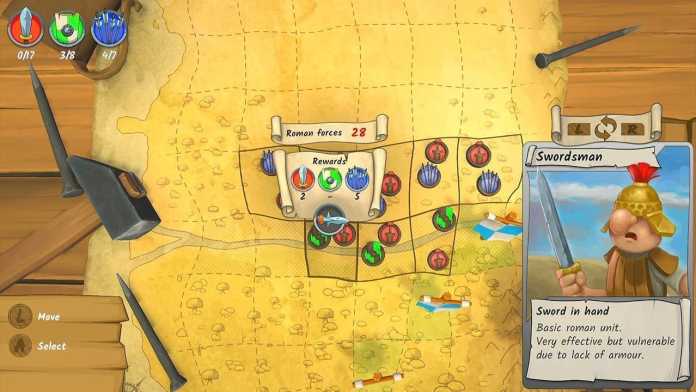
Victory earns you extra troops, magic, or traps. Failure is humiliating and hinders your next battle. The unfair challenge and my biggest gripe come from the imbalance in the tactics. As you start a level, you place your troops in a green box. You know where the enemy will be placed because of a red box. You create a plan, set your troops off, and realise that the opposing force is in a different area altogether. Your approach is wrong and you fail miserably. It’s impossible to plan, as you don’t know what the enemy is doing. It’s unfair because they know exactly what you will do, and this gives them an advantage.
Death and failure are guaranteed, as are frustration and rage. I’m rarely disappointed by games, but Gallic Wars: Battle Simulator is disappointing! Conceptually its sound and its unusual take on the genre should be applauded. However, its execution is so poorly balanced that it’s devoid of entertainment and feels unfairly chaotic throughout.
I desperately wanted to enjoy it, but attempting to get through the campaign was like walking through quicksand. There is a lot of effort and you can see the finish line, but you never get there and death is all but certain.
Gallic Wars: Battle Simulator is basic to look at and lacks detail.
Gallic Wars: Battle Simulator’ issues stem from the lack of visual details. The simplicity of its graphics makes it tough to know what to do and how to use the environment to your benefit. It’s not unfair to say I’ve seen better quality mobile phone games that are also more in-depth. On a large screen, the images are so washed out that you struggle to identify units and your tactical choices. I did however like the use of vibrant colours and the Asterix and Obelix style art used for the still images. They are high quality and I wish this had been the standard throughout.
The audio was also so, so. The music had a hearty feel and was full of oomph and drama and the sound effects were loud and replicated the battlefield brilliantly. Sadly, though, the acting was dry and lifeless and attempted to drive humour into the bland gameplay. For me, at least, it failed. It wasn’t the worst audio I’ve heard; I was simply left uninspired.
Use the bridge to stem the flow.
The weak tutorial undermines the control setup.
Tutorials should fill you with hope and confidence that you’ll overcome whatever the game throws at you. The tutorial in Gallic Wars: Battle Simulator successfully muddies the water and leaves you confused. You’ll hammer the buttons aimlessly trying to set traps, change troops, or activate magic. It was frustrating and makes a tough game an awful lot harder.
If this was simple to play and had a clearer concept, it would be super addictive. Controlling a Gaul is an interesting idea, especially when you have lots of tools at your disposal. In its current build, you’ll be turned off, and turn off quickly. It has few redeeming features that’ll make you keep playing.
Gallic Wars: Battle Simulator: an unfulfilling game that has plenty of potential.
Being negative about games is never nice, but Gallic Wars: Battle Simulator is an unfulfilling mess. With a wonderful concept and unique take on the genre it had such potential, it’s a shame it failed to fulfil it. With confusing gameplay, unbalanced tactics, and nondescript graphics this isn’t a game I’m willing to recommend. If, however, you want to try it, you can here! The Gauls wish to overthrow the Romans one battle at a time. Are you the man to assist them, or will you give it a miss?
Repetition is the name of the game. Well, the name of the game is Roguebook, but repetition is a big part of the experience. Prepare yourself to try and fail, and then try again only to fail again. This process shouldn’t discourage you from trudging on though. You’re supposed to lose. Only a great mind or near impossible RNG could hope to get you a win on your first run.
Welcome to the Roguebook
You’re trapped in the Roguebook, the name of the book you’re imprisoned in, as well as the game you’re playing. A handful of heroes all find themselves captive within the Roguebook’s pages. The only hope for escape is to overcome the challenges and hordes of enemies residing in the book of lore. Which there is no shortage of. Even when you’ve beaten the game for the first time, you’re far from done. That’s if you want to see and do it all.
Roguebook is a roguelike (Hence the name, I’d imagine) deckbuilder where your death means something. Not just by way of your death being permanent between runs, but also through its role in progression. Failure is a part of Roguebook’s gameplay loop. It’s expected of you to take a good couple L’s if you want to get anywhere. That’s because with every death you gain an advantage for the next run.
The roster of characters level up at the end of every trip into the book, provided you’ve selected them for your party of two. As they level up they gain cards which are permanently added to their inventory. Such as Seifer’s Absorb Soul card which when dealing the killing blow to an enemy, will replenish some HP. As the group levels up they gain access to more powerful gems that you can either buy with gold, or find in gem stones by chance out in the field. Either way, you’ve got to get out there. Fight and explore till you come back with something to show for it.
Ink and Blood
Roguebook is interesting in the way that it requires you to explore the world, or more accurately, the book. The only way to move around is to fill in the blanks so to speak. The world has empty squares that are inaccessible to you until you reveal them with the tools essential for filling in the pages of books. Paintbrushes and ink. The only way to step on a block and traverse the tome is to make use of these tools. And the only way to get your mitts on some ink and paint is to fight. Every normal battle has a chance to drop a type of ink or paintbrush effect. Whether it reveals three or four spaces in a straight line, or allows you to pinpoint or expand a brush’s area of effect. Elite battles, however, always drop paintbrushes, giving you a fitting reward for the increased risk and challenge.
Now of course you’re not shoehorned into this explore and fight loop. You could make a beeline for any given chapter’s boss battles and use your default number of paintbrushes to dodge the fights leading up to them. However, it’s always in your best interest to slowly reveal the world and the secrets it holds. So unless you’re going out of your way for a challenge, the game works best as a journey to find everything.
Paintbrushes and ink are your best friends. Without them you’ll be going nowhere fast. And without the ability to explore the environments, you’ll be missing out on a lot. Like new cards, relics, gems, gold and health canisters. Through your travels you’ll also be picking up pages of the roguebook itself, called embellishments. Though, I couldn’t really wrap my head around how you’re in the book, walking across it’s pages while picking up it’s pages. Anyway, these pages you collect act as attribute points for a skill tree. Spending these points grant permanent buffs, and increase the chances of finding useful items in game, such as health canisters. Everything you collect in your many runs will be vital if you wish to have any hope of becoming powerful enough to escape the Roguebook. You’ll need every advantage you can muster.
Once Upon a Time
However, Roguebook is not just filled with relics that grant heroes advantages, and gems which you slot into cards for extra benefits like, reducing its cost to play. It’s also brimming with stories ripped right out of the roguebook. These are small narratives in the form of scrolls, which pose dilemmas to you. One story, for example, might have you choose between sharing a drink with an ogre at a feast or gorging yourself with food. The former has an equal chance of a bad or good outcome, as do many nights of drinking. The latter however, increases your max health, but you draw one less card every turn during your next battle.
These narratives do not always have a pleasant option though, some come with all risk and no reward. This leaves you with the choice of whether or not to interact with the scroll at all. You could potentially gain an invaluable gem, or end up in an unexpected fight for your life.
In terms of story though, its a little paper thin. You get a short cut scene before you start, hyping up the roguebook. A little bit of basic dialogue about where you are and that you need to escape. However between that and the little slices of story found in the narrative scrolls, it didn’t feel like enough. At least not enough to get me engage in any kind of plot.
Each run is procedurally generated. So while you might see familiar cards, gems and narrative scrolls. When and where you find them are different for each expedition. However, at times it can feel like you’re at the mercy of RNG and in those cases the generation did feel a little questionable. Some runs there might be a health canister drought, and others will see lackluster relics strewn all across the field. Therefore in the early stages it becomes a lot harder to achieve victory on your own merits. While the key word in RNG is random, the runs where nothing went my way, lost some of the balance I felt should be present in every playthrough.
Read ’em and Weep
The battles in Roguebook are unsurprisingly where the game is at its best. The wonderfully large number of cards (around 200) across the four playable characters make it so that each and every playthrough has a different array of options available to you. Even when those presented to you, aren’t your first choice, they still give you a fair shot at success. I can’t think of any instances where cards felt completely useless. Everything gave you a leg up. Everything had a purpose and every hero had a range of cards suited to them and their play style. Be it Seifer’s rage-based offensive capabilities, or Aurora’s buffs and frog ally cards.
However, on the downside, I felt that there could have been more synergy between heroes and their cards. Outside of Aurora’s buffs to increase the power of her allies there was very little interplay between cards. The best of the bunch, and my favourite hero was Seifer. When on the receiving end of damage, he goes into a rage, revealing a secondary effect for his cards. Most of the cards available did one of four things for the most part. Inflict damage, block damage, summon allies, and add power to yourself/reduce an enemies power. There are exceptions to the rule like inflicting bleeding damage or ensuring the next hit is critical. But a little some more variation in what unique cards did, or how heroes could play off of one another would have been highly appreciated.
So Much to Do, So Little Time
This title is generous in its variation of layout, number of gems/relics and the cards you add to your arsenal. However, it’s even more generous with post-game content. New game plus is where you’ll be spending most of your time. Once you’ve beaten Roguebook for the first time, you find that there are modifiers that add a little extra challenge. When you stack that modifiers increasing the levels of your new game, they present a considerable challenge. There are 20 levels of epilogue to enjoy that add challenges. Such as one that removes any clear path to a boss, forcing mindful exploration, lest you strand yourself in the book’s pages. You can combine these modifiers in a number of ways, allowing your to curate your own personal Roguebook hell.
The repetition of exploring, fighting and dying sum up Roguebook fairly well. Yet, it never felt aggressively repetitive. I always felt a sense of progress between each dive into the book. The procedurally generated world, and plentiful new game plus, held enough variation that I could confidently say I enjoyed every dip into the book of lore known as the Roguebook. It’s not perfect, but it’s definitely worth it.
Life has a way of throwing out some negative experiences, but from these dark times, light and beauty can be found. No matter how strong you are, friends can be the crutch that prevents you from falling deeper. What would you do if your new friends also hit hard times? Would you be dragged down with them, or would you be the rock they desperately need? Bai Qu: Hundreds of Melodies explores this idea with its bittersweet plot and real to life imagery.
Developed by Magenta Factory and published by Ratalaika Games, this is a touching visual novel about love and friendship. A story that is supported by over one hundred CG images, Bai Qu: Hundreds of Melodies is fantastic to look at. It contains a long plot of around ten hours that has multiple endings to give the reader the impression that they are influencing the story.
It’s time to get uncomfortably close.
Bai Qu: Hundreds of Melodies is a well-paced and touching story.
The story is told through the eyes of Wei Qiuwu. He is a Chinese college student who spends his summer visiting his father in the hospital. During his trip, he befriends another patient called Li Jiayun. She catches his imagination because of her love and talent for music. The plot takes you on a journey around the vibrant city of Nanjing. Here the pair are joined by many eccentric characters. The story soon takes a turn for the worse as Li Jiayun’s health deteriorates, and Wei Quiwu becomes the crutch for his father and his newfound friend.
Bai Qu: Hundreds of Melodies explores its ideas in a slow-paced and relaxing manner. The relationships between the characters have real depth. This allows you to understand the bonds that are forming while enjoying the well-structured story. You’ll experience a range of emotions as it evolves and you may be conflicted about the over-sexualised images. This tale of love, loss, and friendship is oddly juxtaposed with smutty pictures of tight tops, enormous breasts, and sneaky underwear shots. It wasn’t offensive, and in some scenes, it would be suitable, but to have it thrust in your face repeatedly was a step too far.
The summer has taken a weird turn.
Limited dialogue choices and poorly translated words.
I’m no visual novel aficionado, but I have played enough to know the normal structure. It, therefore, stood out as odd that this one contained limited dialogue choices. There are multiple endings to experience, but I can’t see how the plot will alter too much when your influence is reduced to a handful of options. I like when you have the chance to change the direction of the story as it gives you a sense of ownership over the plot. However, this visual novel feels like a traditional book from beginning to end. This is great if you want a relaxing and laid back experience, but for gamers who want a bit more buy-in, it appears cold and standoffish.
I also instantly highlighted many poor grammar choices and incorrect uses of words from the opening scene. Now, this wasn’t an issue as I could read between the lines, but when a game relies solely on its text to sell its ideas, it should have been proofread at least one more time. The poor turns of phrase also impact the emotional attachment to the lead characters. It was clear what the intent was in all chapters, but the badly translated text was occasionally cold and gave the protagonists a lack of depth.
Bai Qu: Hundreds of Melodies has a fantastic style.
Now, I may not like the constant sexual images, but I love the CG art that is used throughout. These crisp images add realism and work perfectly with the plot. The touching narrative is enhanced by the true to life surroundings. In my experience, it’s rare for a visual novel to present such detail. With clear influences of Anime and Manga, the female characters have larger-than-life assets that will appeal to many players. Animation is shown through small changes in facial expressions and images fading in and out of the shot. It’s basic but works well alongside the constant flow of text.
The audio adds a wholesome atmosphere to this touching tale. There are moments of drama and suspense and these are reflected nicely with a sudden change in tempo and mood. The soundtrack acts as a nice distraction from the lengthy and in-depth story.
Limited choices = a simple control setup.
Is this real or a dream?
Grab a drink, get comfy, and put your controller on your lap. Set the pace, select auto, and watch the text unfold before your eyes. With limited dialogue choices, the use of a controller is kept to a minimum. You may as well sit back, relax, and take in everything that Bai Qu: Hundreds of Melodies offers.
With its multiple endings and many CG images to see, this has some replay value. There is the option to skip text that has been consumed, so you needn’t waste your time unnecessarily. The story captures your imagination, so reading it again isn’t a chore. You’ll need to play it several times to unlock all twelve achievements. I suggest setting aside around twenty hours to finish this off.
Bai Qu: Hundreds of Melodies is a wonderful tale of friendship and sorrow.
The well-written plot will resonate with most gamers, even if the translation is off. The beautiful imagery, matching audio, and slow pace, allow you to relax and enjoy its many twists and turns. The skimpy outfits were a step too far and weren’t necessary, though I’m sure many players will appreciate the “artistry”. I enjoyed my time with it and recommend you to buy it here! Sit back, relax, and soak up the wonderful images and touching plot.
Do you ever wish you could redo the big decisions made in your life, even just out of curiosity? Let’s be honest – not even Doc from Back to the Future screaming at us at the top of his lungs not to mess with the past would stop us.
Thankfully, Armature Studio is here to help with Where the Heart Leads, a butterfly effect story adventure that allows us to explore this fantasy situation throughout our protagonist’s life with each choice affecting narrative paths, characters and even the design of the levels.
I adore the artstyle even down to the animation of entering a building and the camera view of the building interiors.
You are in control of Whit, our protagonist, who falls down a huge sinkhole on a fateful night and soon starts to relive his life infront of you, with the game asking you to navigate the difficult and formative decisions that shaped his life. He is a down-to-earth, run-of-the-mill guy without a particular calling in life – the perfect candidate for some sweeping changes.
Fans of narrative games will notice influences from Life is Strange and Everyone’s Gone to the Rapture, for its gameplay and character interaction respectively, but these are not just ‘borrowed’ features from similar genre-games, quite the opposite, in fact, they feel improved upon and better implemented than in the aforementioned critically acclaimed games.
With a melancholic soundtrack and beautiful cartoon visuals setting the mood, Where the Heart Leads combines a mundane country setting with the surreal context of Whit’s situation and feels much like a dream-like state, shifting around the environments in a manner where you can’t quite be sure if its real-life or imaginary.
When I said I wanted a bath, I didn’t mean literally.
What is immediately obvious though is how grounded and relatable it is, grabbing your attention and never relenting. Sure, you are living someone else’s life, but the sheer number of moral choices available start to echo your own personality, and the issues that come up – the pressure to be the best father possible to your children or child to your parents and how to navigate fractures in your family – all hit the same emotional chords as they do in real life. At times uplifting and others heart-breaking Where the Heart Leads provides a tremendous interactive human drama on a scale rarely seen in video games.
These guys don’t forget the decisions you made earlier in your lives. The length of time this game spans – Whit’s entire life – is a first for me and is really quite epic.
A lot of what makes it feel different is not in its breadth of choice, but is due to its pacing. Normally, an atmospheric story-game with minimal gameplay draws out its most atmospheric sections for greater emotional effect, but can on occasion, slow down the proceedings to a crawl and adversely affect the experience. Where the Heart Leads, on the other hand, manages to foster its emotional sentiment while maintaining its pace, allowing you to while away the hours without becoming bored.
Secrets man, who needs them?
Furthermore, the game does a great job building the characters and narrative naturally. This isn’t just a ‘Yes’ and ‘No’ game of twenty questions, the sense of realism and the developer’s quoted amount of ‘thousands’ of decisions make it feel like a life that could have gone in any direction, not just the one subscribed by the developer. I attempted to maintain a healthy equilibrium of happy wife, kids and family by sacrificing all personal opportunities to further theirs, and was so satisfying when Whit reminisced about one of my successful decisions as I felt like I had actually helped someone dear to me achieve something rather important. Funnily enough, I may have ended up being too willing to let others expand their horizons with characters making mistakes that I could have informed them better on with better advice. But like in life it’s only natural to cheer on your family regardless of the consequences.
All it takes is a couple of different decisions and the direction of the town and/or people can be completely changed, as well as your experience of it as access to certain areas are tied to these decisions.
Almost every major component of this picture – the tree, the traffic lights, the shop sign in the background – is made by you and your brother and you can change how it looks. But remember, there’s a whole town of people you need to please with this art…..
Take one example where Sege, Whit’s eccentric and perpetually poor artist brother miraculously has two options to sell some of his artworks. One option would give him more cash but would also see him disheartened as the works are dismantled in front of him, and the other displays them across town, potentially to the chagrin (or pleasure) of residents. Then Sege needs to find himself a place to live. Does he move into the loft apartment downtown with ample space for his art while potentially bankrupting Whit and family who need to cover part of the rent or does he continue to live cordoned off from society in a trailer on Whit’s wife’s spare land?
It’s quite hard to describe how epic it felt to be the maker of this heartfelt emotional rollercoaster, with each of these decisions feeling grounded but also very meaningful due to the connection you feel with the characters.
Call the publisher ’cause we’ve run out of superlatives! This stunning story sets a new standard for choice-based adventures with incredible depth both in the number of lateral branching choices, but also in its realistic storytelling and characters. There are some areas that could have been improved or added, such as voice-acting, but as they fall on the side of ‘would have been nice’ rather than ‘necessary’ it’s hard not to call this an almost perfect game, one that has made an indelible impression on me and one that I won’t be putting down for quite some time.
Kowloon High-School Chronicle is a mad grab-bag of a game. Half Tomb Raider and half Japanese high school simulator lovingly joined together with all of the precision and grace of Jeremy Clarkson with a chainsaw and prit-stick.
You play as Kuro Habaki, a member of a treasure hunting society bent on recovering lost artefacts from an ancient advanced civilization (think proto-space suits and that skull from the Indiana Jones film we don’t talk about). By day you’ll be talking your way through high school drama, avoiding the pitfalls of being the new kid in class and building relationships with your classmates. By night you’ll be working for your society, exploring the ruins below the school with the classmates you can convince to come along, hunting for treasure, solving puzzles and fighting the creatures who protect it.
The tomb raiding sections are honestly superb, it feels like a cross between James Bond and Indiana Jones. It’s a fairly standard dungeon crawler, where you navigate through a linear series of chambers to get to your objective. To pass through a room you’ll need to solve a puzzle written on a giant stone tablet. These are relatively simple but written a little cryptically, so you feel smart when you solve the puzzle but don’t have an awful lot of difficulty in doing so – like you’re bowling with the barriers up but the barriers are invisible and the bowling ball is made of knowledge. The puzzles are along the lines of ‘When the row of nether gods face south from the sunrise, an island to the heaven surfaces’ – meaning you need to face a set of Anubis statues away from an image of the sun to raise a platform to allow you to cross some water.
Intermixed with the puzzle-solving is some tasty RPG turn-based combat. After all, these tombs aren’t undefended. Creatures have made the labyrinthine chambers their home and the ancient civilisations left mechanisms to defend their treasures. You have a series of starter weapons that you aim manually like a first-person shooter: a knife, a gun and grenades, all managed stamina bar that determines how much you can use each of them within a turn. The enemy has a similar system on their turn. Then it’s a simple matter of killing the enemy before they kill you – easy. Or, when the enemy happens to be a nightmare scorpion (regular readers may know I have a significant phobia), it’s time to dock the Switch and play through squinted eyes from another room – less easy.
The other part of the game is less superb. And, much like Sakura Wars, another Japanese game I reviewed for this site which is a mix of RPG action with relationship building and talking, the balance of those two sections is skewed significantly towards the talking, meaning that the fun tomb raiding and RPG fighting in Kowloon High-School Chronicle is the minor part of the game, and you have to sit through a lot of high school nonsense to get to it. I accept this is a strange criticism for a game that promises to be a high school simulator in its title, but I was excited to have my expectations subverted in the opening tomb raiding section, only for the game to whip the rug out from under me and revert rapidly to type.
Through this section you’ll be chatting with other high-school students, mostly women as it’s one of those games where you build ‘relationships’ with the characters with which you interact. The main way of influencing the game in these sections is through dialogue options where you choose one of nine different emotions you wish to convey in your response. I find this system quite awkward for two reasons, firstly the word for the emotion is written in a cryptic and difficult to read font, meaning the first few choices I made I had no idea what I was doing or what the symbols were showing, and secondly because the emotion word doesn’t give a lot of information about what you’re going to say, meaning you’re mostly working with guesswork. It’s much like the dialogue choices in Fallout 4 that drew a lot of criticism. I didn’t see much reason to not choose ‘Joy’ every time and maintain a positive and friendly attitude with everyone.
On top of that, there are a few quality of life issues. The movement controls are different from every other game you’ve played: left and right turn you 90 degrees, back turns you 180 degrees and forward moves you forward – so you have to spin to the direction you want to go and then go forward. It’s not inherently awful but takes some getting used to.
The other thing is the HANT system, which is basically the Pip-Boy from Fallout. It announces useful information about combat: when your turn is over, what you have selected, that sort of thing. Except it’s in Japanese by default, with no subtitles when the rest of the game is in English. So a random Japanese lady is yelling at you when you’re already in a high-pressure combat situation. At least until you go and change it to English in the menus. The HANT also launches a little tutorial piece of text whenever you find something new in the game, for example, the first time you have to jump. This takes control away from you and takes a least 10 seconds to navigate itself through the menu to give you the tutorial. This gets frustrating after a few times, especially as you can’t skip it and it’s giving you unnecessary and obvious information. It’s like the game desperately doesn’t want you to experiment or work anything out for yourself.
Kowloon High-School Chronicle lost me with its title, won me with its opening action sequence and lost me again with its high school simulating. If you like a high school sim, Kowloon High-School Chronicle might be the perfect game for you, with the simulation broken up with some brilliant RPG puzzle and combat sections, all driven by a genuinely interesting premise. However, if, like me, you’re not a fan of the genre, Kowloon High-School Chronicle is unlikely to win you over and may feel disappointing when there are some generally fun nuggets of gameplay buried in with all the rest.
As we grow, the illusion of magic and fantasy fades. What we once believed becomes a dream and the sensibilities of adult life take over. But for those people who dare to dream, their lives can be fulfilled with true happiness. The sights that they see and the feelings they experience are out of this world and unimaginable. Beasts of Maravilla Island captures this perfectly with its touching but short story.
Developed by Banana Bird Studios and published by Whitethorn Games, this is a 3D adventure game with a magical twist. You’ll experience a surreal and heartwarming story as you explore the unchartered mythical island of Maravilla.
This is where your journey starts.
Beasts of Maravilla Island leaves you feeling warm and cosy.
I rarely connect with a game emotionally, but Beasts of Maravilla Island left me feeling warm and cosy. The touching story has you controlling a young wildlife photographer who wants to walk in her late grandfather’s shoes. Armed with his journal, camera, and love of animals, she returns to the island of Maravilla, believing it to be nothing more than a dream.
She quickly discovers that this secret land is full of mystery and wonderment. To fulfil her grandfather’s wishes, she must capture images of the animals that live in this place. By doing this, she will prove to the world that this wonderful island exists.
Seeing the world through the lens of a camera.
The world you explore combines part open-world, part linear approach in order to progress the story. The freedom to explore is limited by natural obstacles. The areas that are open to you must be looked at through the lens of your camera. Here you capture the images to fill the empty pages of your journal. Take selfies, close-ups, or environmental shots. Whatever your subject and whichever you decide to keep is entirely your choice. The linear structure revolves around the behaviour of the main creature for each of the three sections; monkeys, otterdiles, and a Griffin must be snapped for prosperity.
Taking photos isn’t challenging, but finding the mysterious creatures can be tricky. You must complete basic puzzles by manipulating light and sound to create new paths and to force creatures to move. Only by doing this can you hope to fill the journal and complete your grandfather’s wishes. The puzzles will not push you, so don’t come into this expecting a tough time. No, instead they add a fun layer that enhances the exploration element.
An island spirit is ever-present, leaving you to interpret why it haunts your journey. Is it simply keeping the island safe from a strange visitor? Or is it the animal spirit of your grandfather protecting you and observing your adventure? However you interpret it, it’s nice to see and adds magic to the gameplay.
Observe the romantic monkey gestures.
Beasts of Maravilla Island has a cartoon aesthetic that ages it.
I loved exploring the world created in Beasts of Maravilla Island. The neon and bright colours, unusual creatures, and vivid environments make it wonderful to look at. However, its cartoon aesthetic dates its presentation. The blocky images and occasionally rough textures detract from an otherwise polished finish. Some minor glitches require the game to be reset, but I’m hopeful these will be patched out.
The colourful images and surreal creatures are supported by a great soundtrack. Wholesome and magical music accompanies you as you explore each chapter. The environmental sounds have a realistic tone that brings the jungle landscape to life. I admire how the developers enhanced the dreamy theme with airy and light sound effects that added to the fantasy story.
Have you ever seen a neon frog?
Simplicity at its best!
With its clean UI and labelled controls, Beasts of Maravilla Island is simplicity personified. The well laid out and basic control mapping is mastered in minutes, meaning there is no need for a tutorial. I loved its straightforward approach as it allows you to snap photos immediately.
The one area that is sadly lacking is replay value. Once you’ve completed the story and taken the photos, there is little else to do. The small achievement list is easy to complete, but beware as its currently bugged! A playthrough can be as short as two hours, but if you take your time and capture every creature perfectly, you could lose yourself for hours.
Beasts of Maravilla Island is a wonderfully relaxing game.
With its simple puzzles and basic controls, Beasts of MaravillaIsland is accessible to all. It tells a touching story that has to be seen to be believed. I loved it and recommend you to buy it here! Can you fulfil your grandfather’s wishes? Visit the island, capture the photos, and let the world know what you have seen.
Zack 2: Celestine’s Map is a game that features a world full of magic, secrets and supernatural creatures. You play as one of three different characters; Zack, Meggy and Amice, as you traverse through the lands to save your brother from the evil wizard Celestine. Sounds like an interesting plot, doesn’t it? Well, that was my thoughts exactly until I booted the game to find out how messy, incomplete, and terrible this game was.
Zack 2: Celestine’s Map was hands down the worst game I’ve ever played. Everything from its user interface to gameplay was just a pain to manoeuvre through. Firstly, let’s talk about the interface. Everything looked so messy. This huge banner at the top blocked HP bars and what I presumed to be the MP bar at the upper left-hand corner. It just kept popping out from time to time as I pressed buttons on my keyboard. The map just looks plain ugly and so does the weapon wheel at the lower right-hand corner. The fonts used in the game also look really ugly and out of place. It just feels so aesthetically disastrous.
The gameplay is also so bad right from the get-go. Everything feels so clunky and just torturous to play. The character you control seems to be in a running motion but has a move speed of what I presume to simulate the movement of a snail. He literally runs as fast as he walks. It wouldn’t be far fetched to say that even my grandmother could run faster than this dude. Opening chests in this game also really feel more like breaking boxes instead. To open chests, you have to hit them with your sickle. They then crack open as if you’re breaking a wooden crate. Really, it just feels so wrong to be breaking chests with your sickle. It feels as if the game developers were didn’t give a crap about the intricacies of their game at all. The main character is even as tall as a tree as if he was a titan from the Attack on Titan series. Everything about this game just makes me feel uneasy.
Just a horrible experience overall
This game was so bad, I couldn’t even last 1 hour of playtime. First impressions are usually extremely important in the gaming industry today. With thousands of games in the market, first impressions are usually what hooks a player to a game and determines if they decide to continue playing or request for a refund. Zack 2: Celestine’s Map doesn’t just butcher its first moments but has a crappy gameplay to boot as well. At a price of around 10 USD, I’d rather get a value meal or two at MacDonald’s than play this game. Really and truly disappointing.