Review: Diner Bros Inc

Ready to add more to your couch gaming nights with friends and family of all gaming experience levels? JAYFL Games may have another addition to your Saturday night library. Drawing inspiration from the WarioWare formula, Diner Bros Inc is a minigame adrenaline rush. The blood will get pumping and the swear words will fly out unintentionally as you try to keep up your pace. While it’s pleasant to see a different genre being replicated, sudden difficulty spikes and untied ideas may keep this from being a Steam standout.

Random Assortment

Diner Bros Inc, as previously mentioned follows a familiar formula to some niche players. You trudge through a gauntlet of easy-to-learn minigames and try to get through them all. Only a finite amount of mistakes are allowed, in this case 3, and at certain points the tempo will increase. After playing through roughly 10 randomized challenges, completed in ten seconds or less, the player will go through them again. This time in a different order and with a faster speed and less time to finish. Falling short of completing the challenge may be enough to convince the player to try again. The games aren’t too hard to learn, so correcting mistakes isn’t a difficult task. That is until time becomes a factor..

Shoot ’em all before time runs out!

Diner Bros Inc has quite a variety of minigames to learn and complete. You may be herding a bunch of cheep into a circle for one game. Then immediately after you’ll be in a kitchen clicking on the appropriate ingredients for a custom cheeseburger order. After that, you’ll be a character in a karate gi kicking at a car until it breaks before the timer ends. It’s easy to note the videogame, and pop culture references in this mini games. However, nothing really helps to tie them all together thematically. It’s like looking into a giant unorganized Lego box. Some of the games are quite fun, but many are either uninspired, or lacking intuition. Also the tempo increase mechanic allows for unwieldy difficulty spikes, which may create stopping points.

Jovial Company

You are accompanied by jovial drawn cartoon characters that congratulate your progress, or cry in your defeat. This is the games attempt to create timbre, or identity, but it just doesn’t work. The childish cheers and “uh-ohs” don’t really work in regards to helping make this game more kid-friendly. It’s just kind of creepy. Of course there has to be a way to tie all of these already noncomplimentary minigames together, but the cartoon aesthetic just doesn’t do it for me. It almost does the opposite by not allowing the randomness of the games to admit that they have little relations to each other.

Inspirational Inquiry

It’s hard to dictate whether players will want to keep playing after some time, or simply lose interest. An easily seen scenario is where someone blasts through all the minigames, then shelves this one away in immediate search for a new challenge. It may also be possible that players may find the small games challenging enough and fun for a reflex workout. It may depend entirely upon the player individually, rather than reading reviews and not seeing for oneself.

Basic fruit matching game

We seem to be at an era of videogames, where the reviving old niche titles is still in full swing. It’s like a deviation from the retro revival that is ongoing still. But the question is whether developers are genuinely invested into their ideas, or simply looking for something new enough they can churn out for some quick sales. I’m led to believe that this may be the latter case for Diner Bros Inc, especially since JAYFL Games already has had success with Diner Bros.

Bottom Line

Despite some flaws, the first few plays of Diner Bros Inc were enjoyable and engaging. Though there isn’t much to tie the nonregulated aesthetics of each individual minigame together, there is still some fun to be had. A console release would definitely make this title more accessible. Most PC gamers don’t have many couch multiplayer titles in their library. Diner Bros Inc is a relatively average title. The weird title characters just add an element of awkwardness to the overall experience that I could do without in all honesty.

Review: Hermitage: Strange Case Files

Hermitage: Strange Case Files is a mystery-solving visual novel with a sinister gothic twist. You play as Store Manager, a character whose name is an excellent microcosm for the level of delicate mysteriousness and balance in the rest of the game. Store is the owner of a bookshop who, for horror-writing-based reasons, has never been seen outside of its premises. With the help of a range of kooky characters, Mr Manager will get involved with a horrifying grab-bag of paranormal cases, getting to the bottom of which will change the storyline of the game forever.

To solve the mysteries facing Store Manager you’ll need to collect leads – the sort of leads that help you collect evidence, not the sort of leads that help you collect dogs which would be a significantly cuter game and an instant 10/10 from me. You can do this through dialogue, TV news, forums and all the other sorts of things you can do without leaving a bookshop. God forbid the developers put themselves out by designing a new location in the game. Once you’ve scoured the bookshop for evidence, you’ll need to tie it all together in a tight bow, proving your assumptions by associating the narrative you’ve developed with the clues you’ve collected to put together a cast-iron case.

Hermitage: Strange Case Files is pitched as being narratively similar to the weird tales of H. P. Lovecraft, an excellent psychological horror writer and famously terrible person. The trailers also give strong Phoenix Wright: Ace Attorney vibes, drawing similarities to the quintessential investigative adventure game. As you can probably tell by my descriptions of the above, I adore the works of Lovecraft and Wright, so a combination thereof dramatically piqued my interest. Unfortunately, I was left a little disappointed by the final product.

I think the crux of my disappointment is no fault of the developers but instead a key part of Lovecraftian horror – you cannot investigate it. The beauty of a Lovecraftian happening is that it is so incomprehensible, so horrific, so far removed from any human experience that the very suggestion of seeing it or experiencing it is enough to shatter the psyche or the observer, rendering them as a babbling, terrified mess. It’s like giving a human a glimpse of 4-dimensional existence or that scene in The Good Place where Chidi sees the time knife but rather than being played for laughs, the knife has got tentacles and is already penetrating your soul. If you break that down to something that’s just ‘kinda scary’, to a level so tame you can have a quirky bookshop owner called Store Manager investigating it with no real repercussions, it loses so much of its essence and charm. It’s not Lovecraft anymore. It’s just bad horror.

The other side of the coin, the investigation and Phoenix Wright-ness doesn’t earn the game any points back either. The game is slow, and I mean SLOW. It takes its visual novel-ness seriously. We’re talking tens of minutes of dialogue to read before you’re allowed to interact with the game and when you’ve finally battled through that, the interaction will lead you to tens of minutes more dialogue. The dialogue itself is fairly engaging and gothic, with some strong theming. But there’s so little gameplay it’s nightmarish to stay engaged. Even when the dialogue breaks to give you some response options, they’re often not genuine choices, you have to select all of them eventually, you’re just choosing the order in which you want to read the sections.

If you want to read a vaguely Lovecraft-esque novel where you can occasionally make a decision then Hermitage: Strange Case Files might be for you. However, if you want an involved investigative game to channel your inner Sherlock Holmes, or a compellingly creepy narrative about Old Ones and the terrifying other worlds overlapping our own then there are undoubtedly better options out there.

Review: Tormented Souls

With Halloween fast approaching, it’s time to prepare for the cold weather, trick or treat, and an unhealthy level of scary moments. With horror spanning many platforms, your scary experience can come in many forms. Yet, I love to lose myself in a great video game. Tormented Souls is the latest title to test my nerve and this old-school inspired affair will send shivers down your spine.

Developed by Dual Effect and Abstract Digital and published by PQube, this is a classic horror game set in a cliched but brilliant location. Whenever you get your hands on a scary title, you want to feel on edge throughout. Fortunately, Tormented Souls will scare you senseless and you’ll need a change of underwear before you finish each playthrough.

Tormented Souls wears its influences on its sleeve.

Proudly highlighting your influences is not a bad thing, especially when they have cult status. Tormented Souls is so proud of its inspiration that it openly wear them on its sleeve. Every element of this wonderful horror puzzle title can be linked to the genre-leading games of the PS1. Resident Evil, Alone in the Dark, and Silent Hill can be seen in the puzzles, the creepy rooms, and the horrific foes you face.

You may worry that this will simply be a ripoff of these much-loved games. Believe me, its unique storyline and blend of mechanics makes Tormented Souls an excellent addition to the genre in its own right and I loved its spine-tingling ways.

Stay away from the shadows.

A cliched story, but who cares!

Normally, I want a thorough story that isn’t tired or cliched. However, I wasn’t so bothered by its generic “spooky” storyline because many of the other elements were fantastic. I forgave its dated plot and focussed on the many jump scares and challenging puzzles I experienced.

You control Caroline Walker, a young woman who is haunted by the image of twin girls. The game opens with her receiving an envelope containing a postcard adorned with a photo of the twins. From here, her life sadly takes a turn for the worse. Unable to get them out of her mind, Caroline goes to the hospital located in an abandoned mansion to search for the answers to her many questions. This is a big mistake and the start of the many horrors she is about to witness. Entering this hellish building has dire consequences, but once she starts this journey, Caroline can’t turn back until her questions are answered.

I warned you, this is a classic creepy game.

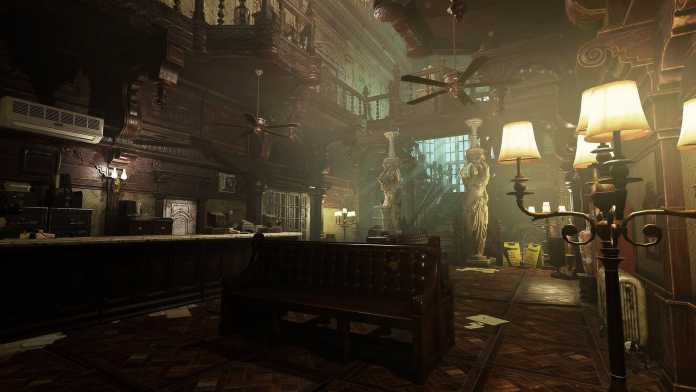
The labyrinthine mansion, limited hints, puzzles to solve, and items to combine, will have retro gamers champing at the bit. Its classic setting is spooky as hell and is only made worse when you step into the shadows. A creature lurks in the dark and is desperate for you to step closer, but fortunately, a handy Zippo lighter keeps them at bay and illuminates the way.

If the creepy shadows and claustrophobic rooms don’t make you soil yourself, maybe the horrific monsters you face will. Being chased by experimental creatures with only a nail gun to defend yourself is no laughing matter. You must decide whether to run or fight! If you win, you can breathe a sigh of relief, but if you die, it’s game over. The survival elements are brutally unfair and losing your progress is guaranteed, so you must be wise in how you take on each encounter.

Would you dare to eat here?

Puzzles and limited save points.

Being scared senseless is part and parcel of this horror genre. In Tormented Souls, it accompanies everything, but it isn’t the main concept. The developers want you to focus on exploration, puzzles, and the survival elements. The latter is key as save points are limited, and you must find a tape player and a reel of tape to record your progress. Though I hated losing everything, I loved how it kept you on edge, knowing that one mistake would cost you everything.

Exploration and solving each puzzle went hand in hand. The solution to many problems wasn’t simply found in the room or surrounding areas. This forces you to push further into the mansion and remember each task and their locations. This becomes increasingly difficult when monsters are chasing you and fresh puzzles are introduced. The logic-based problems were extremely rewarding to solve, as there were many Eureka moments.

What was equally glorious was how dark and twisted the story becomes the further you progress. The water becomes muddier and the reasonings behind the twisted tale doesn’t become clear for some time. This may annoy some players, but I loved the mysterious albeit weird ways that combined beautifully with the risk of losing it all.

Tormented Souls incorporates brilliantly dated aesthetics.

In the correct setting, wooden acting can work perfectly well. When a game is trying to deliver a retro aesthetic, this almost laughable approach is acceptable. I loved the poorly timed delivery and the lack of emotion as this enhanced the action, giving it a cold and heartless tone. When this was combined with the classic horror soundtrack of sharp noises, extended silences, and distant footsteps, you are thoroughly creeped out throughout.

The brilliant audio supports the polished PS1 graphics. This old-school style may be wasted on a top-end PC or next-gen consoles, but I loved it and the look it achieved. The use of greyer tones and smaller spaces enhances the claustrophobic feeling that surrounds every aspect of the gameplay. I appreciate the older style won’t appeal to all, but I think it works brilliantly and is a nod to the market-leading games of the past.

Such a creepy, yet fascinating place.

I wanted it to be more responsive.

When a game expects you to act quickly to avoid enemies, you want the controls to be super responsive. Sadly, Tormented Souls hasn’t read the memo! Its occasionally clunky controls will leave you desperately floundering around while avoiding your foes. I’m perhaps exaggerating slightly, but I wanted the controls to be more responsive. However, there were moments where I had to spam the action button to ensure anything happened and subsequently, this made it frustrating and less immersive.

No matter how many times you experience the same horrific moments, it never gets old. I relived numerous scenes just to jump at the same point repeatedly. This was great, as I worried it wouldn’t have the same impact the second time around. Yet, it’s scary as hell every time you play it and this was great for its longevity. This is supported further still by its large achievement list that requires multiple playthroughs to complete.

Tormented Souls is a classic horror game that shouldn’t be overlooked.

Revisiting tried and tested mechanics can be tricky to get right. Gamers complain about the lack of originality, or the developers just get it wrong. Fortunately, though, Tormented Souls has the blend just right and its nod to much-loved games is mixed beautifully with its unique approach to the genre. I loved it and it shouldn’t be overlooked, so I recommend you to buy it here! Can you solve the mystery surrounding the twins? Stay calm, avoid the monsters, and solve every puzzle in this wonderfully old-school horror title.

Review: SNK vs Capcom: The Match of the Millennium

Fighting games have been around for close to five decades now and, inevitably, their long history means that a lot of gamers will have their own retro favourites. It’s in today’s modern trend of restoring these old games for a healthy dose of nostalgia that we’ve been given SNK vs. Capcom: The Match of the Millennium. Originally released back in 1999 for the Neo Geo Pocket Colour, the game was ported to the Nintendo Switch back in February and reached PC in late September.

If you’re wondering if this is a game worth your time then really the only question you need to ask is if you like old fighting games. If you do, then this is a firm ten out of ten and well worth a look. If you don’t then there is nothing here that you’re going to find appealing. SNK vs. Capcom: The Match of the Millennium is a tremendously faithful port of the original before it, right down to the emulator-style set-up the developers have produced. This means that you’re not really going to find anything new and innovative, but there’s nostalgia aplenty for any long-time fan of the SNK vs. Capcom series.

The game is broken up into a number of sections for players to explore. First and foremost, you have the Tourney, which acts as the story mode. Players choose their character from a wide range of SNK and Capcom fighters and then are immediately launched into a series of battles, interwoven with snippets of story cutscenes. By winning fights, players can progress through the – admittedly paper-thin – storyline to be crowned champion.

Outside of the story, there is a range of alternate modes to explore too. If you’re struggling in the Tourney, then the Sparring mode gives you the opportunity to have one-off fights against an AI-controlled opponent to brush up on your skills. Similarly, if you have a friend who wants to get involved, then the Vs. Mode opens up the possibility of local multiplayer. Considering the age of the game it’s based on, this mode works surprisingly well, although mapping the controls for two devices smoothly across a single keyboard can get a bit muddled.

Surprisingly, there is also a mode that offers content besides fighting. In the Olympics game mode, players can unlock extra content through minigames that include a rhythm-based dancing game and a timing-based platformer. As is to be expected from a game over twenty years old, none of the minigames are particularly complicated or even well-developed, but they are a pleasing change of pace from the rest of the game.

Backing up the solid range of gameplay are the title’s retro graphics and soundtrack. As with the gameplay, these features have been mimicked perfectly from their original counterparts and they are delightfully familiar to anyone who has played the old games. The developers have also helped to soften the limitations of the graphics by containing all the gameplay within the frame of the emulator, meaning they haven’t had to try to stretch decades-old graphics from an obsolete handheld device to modern, high-definition PC screens. The result is a wonderfully cohesive game style that really supports the rest of the title.

On the more negative side of things, there are two main hurdles players are going to be immediately faced with when they first start playing. Fortunately, both are eminently fixable.

The first is that the controls when you first load in aren’t particularly intuitive. For instance, the directional joystick is mapped to the arrow keys on your keyboard instead of the more traditional WASD set-up. However, this issue is entirely resolved by a very simple system that allows you to remap all the emulator’s controls to suit the player at will. It’s slightly strange that the default load out is so divorced from standard PC controls, but ultimately it’s such a minor problem that it barely ranks as a consideration.

The second hurdle is perhaps less of a problem and more of a design carry-over from an older style of gaming. As is traditional for fighting games, each character has their own moves that players can work to perfect. In and of itself, this is great; it gives the game a surprising amount of runtime given the limited content and there’s a level of challenge involved in mastering each player that can be incredibly rewarding.

However, in deference to letting players figure out these moves for themselves, there is no type of in-game tutorial whatsoever. If you’re someone who’s unfamiliar with fighting games, I can imagine that your first introduction to the game is going to be less trial-and-error, and more just key spamming until something happens. For example, the game features special moves for each character, unique attacks that deal a lot of damage that can only be used when their energy bar is filled. SNK vs. Capcom never tells the player this; unless you’re already familiar with this trend in the genre, you wouldn’t know that it was a game mechanic unless you checked the (blessedly included) manual via the overlay menu.

In 1999 it was perfectly common to have to read a manual before playing a game. As a result, developers didn’t need to include any prompts to do so in the game itself and could instead use their valuable disc space for actual content. In 2021, however, digging through a menu to find an instruction booklet probably isn’t going to be anyone’s first port of call to understand what all the different things on their screen mean. It’s not a game breaking issue, but the developers of the port could have given new players a little more signposting to make their introduction to the game a bit smoother.

All in all, these really are incredibly minor problems that most players are going to breeze past entirely. Setting them aside, SNK vs Capcom: The Match of the Millennium is a very faithful port of a fondly remembered 90s title. There’s a lot here to enjoy and if you’re looking for a bit of nostalgia, then definitely give it a go.

Review: Nuclear Blaze

0

Fire! Fire! There’s so much fire. Welcome to Nuclear Blast, a Metroidvania pixel-perfect fire fighting game. Nuclear Blaze is available on Steam. It originally started as a 48hr project for Ludum Dare. After positive reception, the developer, Deepnightgames, decided to make a complete title. It was originally aimed at the creator’s son. But it became too difficult.

Nuclear Blaze Premise

Nuclear Blaze: Helicopter Ride

You begin as a firefighter on the way to a fire in a helicopter. You soon find a factory that doesn’t appear on a map. It appears abandoned and on constant fire. You have a tank of water that you can use to put out with your portable hose. But as you delve deeper and deeper you begin to learn a terrifying secret. This warehouse is harboring a being that creates fire.

Nuclear Blaze Gameplay

Nuclear Blaze: On the Way to the facility

In each level, you put out fires to unlock the fire door to the next level. This sounds boring on paper, but it is executed well. The fire spreads quickly if you don’t put them out. You will find if you take too long, more fires appear. Fire isn’t your only obstacle, there are fire wasps. These are difficult to handle and may kill you many times. However, you feel a sense of accomplishment when you beat them.

As you complete levels you earn upgrades, like Metroid. Such as a bigger water tank and new skills. None of the upgrades become useless and are used in future levels. This drove me to push on, imagining what the next upgrade would be.

My only complaint is that the game felt too short. I made it to the end in only a few hours, even when taking into consideration my many deaths. I would happily welcome some DLC or a sequel

Nuclear Blaze Difficulty

Raging Blaze: Kitty

This game is far from easy. Since the fires spring up so quickly if you’re not careful, you’ll be killed. The checkpoint system is very frustrating, in most levels if you die you go right back to the beginning. Which if you had already been struggling is infuriating. There were certainly times I got close to closing the game and taking a break.

One welcome feature, because the developer made this title originally for his 3-year-old son, is a Kid Mode. This makes it impossible to die and auto-lock on as well as other assistance. Instead of the aim being to get to the end of the level it is to find the cats. I think this is a great inclusion and will be trying it when my little one is old enough.

Replayability

That doesn't look safe

Apart from trying to get to the end of the level, there are collectibles in the form of cats! Once you find a cat, you then must deliver it to the exit. I found them pretty easily at the beginning, but by the end, I forgot about them. I may go back and play it again to get the remaining cats to see what it unlocks.

Nuclear Blaze Presentation

Nuclear Blaze: What's behind door number 1?

Pixel art is the style of this fun title and it really works well. Especially with the 2D side-scrolling gameplay. Each area feels different from the previous one and was very easy on the eye. There are a few Easter Eggs as well, which really stand out from the pixel art backdrop.

The audio was definitely up to the task. It was powerful and helped me feel the urgency of putting out the fires. I have the theme playing now and it is motivating. There were not many tracks, so it would have been nice with a bit more variety. There is one instance that I remember where the music changes which was the final area. This set up the atmosphere perfectly. Maybe in a potential sequel, there would be more areas that would call for more music

Final Thoughts

This title came out of nowhere for me. I had never heard of it, but I had heard of Dead Cells. It held my attention far longer than I expected. I got so invested in it that I lost track of time. Even though it was a short game. I will also be going back to it when my son is old enough to play games and enjoy the kid’s mode. So Nuclear Blaze receives a 9 out of 10. With so few negatives it is worth playing even if it is only for a short amount of time.

Review: Antonball Deluxe

Antonball Deluxe from developer Summitsphere is a classic arcade experience. If you remember and liked Atari’s 1976 title ‘Breakout,’ you’ll be pleased to discover this modern take on the game. Because who can’t enjoy some ball shooting arcade action from time to time.  

Gameplay

That famous title, Breakout, has you shooting a ball at bricks while preventing said ball from falling back past you. Antonball changes the formula to a 2D platformer, where the player is in control of a character who is used to hit a ball and prevent it from escaping. The stage is complete once all bricks are destroyed. This gameplay loop itself is simple enough, you’ll be jumping around attempting to direct a ball into the ever decreasing wall of bricks, without the ball eluding you through the gap behind you. While the stages are varied the gameplay can get repetitive. There are power ups which you can get such as a gun to shoot bricks with, which can help if you are struggling. The DLC ‘Better Than Nothing,’ adds an extra level of challenge with an invisible character, and several new stages.

Presentation

Booting up the game and entering the title screen gave me the feeling of being at an arcade, being excited to try out the games. So when it comes to the theme, the developers did a good job. The art style of the game is simple and clean which makes it easy to tell the background apart from the interactable platforms and objects. After five stages you enter a new area. I started in boiler sewers, but quickly found myself having a grand time in jam jungle. The music in the background helps set the tempo and gives the game a very energetic feel to it.

It features two different game modes, as well as two multiplayer modes. The standard game mode is that classic breakout variant. It’s available in single player and multiplayer with up to four people. There is also ‘punchball,’ which involves delivering ball related justice to various creatures by throwing a ball at them then running into them to destroy them. Lastly, there is a pong style vs mode to play online. This level of variety in a game like this is nice, though it still remains lacking in content despite this. 

Controls

In a game like this, having smooth controls is critical, as you need precision in order to succeed. Sadly, the controls on PC are clunky at best. Fortunately I was able to rebind them which alleviated the issue, though navigating the menu remains awkward. This game would clearly benefit from the use of a controller. Better yet, a classic arcade stick would be perfect. It is available on Nintendo switch which is likely the better platform to try this game on. 

You might like Antonball Deluxe if you’re looking for a quick bite sized arcade experience to pick up and play for a short time. Something to do to take a quick break from work or study. If you’re looking for something to sink your teeth into and master, look elsewhere. Clunky controls and lack of content for the price hold this game back, despite the enjoyable arcade gameplay.

Review: Empires of the Undergrowth

The animal kingdom is a fascinating place. No matter their position in the food chain, they are all fighting to survive. Instincts are all that keep these creatures alive, yet some have the intelligence to give themselves a head start. Empires of the Undergrowth reflects the hectic nature of our surrounding world as you battle for survival.

Developed and published by Slug Disco Studios, this is a real-time strategy title. The action plays out across two distinct modes of city-building and standalone missions. You must control an ant colony that will dig, hunt, and expand its nest deep underground. The concept is brutal, intriguing, and will make you look at the animal kingdom in a whole new light.

Empires of the Undergrowth is remarkably easy to play. 

I’ve played RTS titles for as long as I can remember and my initial concern is always the learning curve. However, fortunately, Empires of the Undergrowth is remarkably easy to play and simple to pick up. The game opens on your ant colony within its Formicarium. This is the central hub where you’ll keep returning to expand your home and to open further missions. From here, you can build the nest of your dreams, upgrade your forces, and unlock further ants. You’ll need to play each combat mission repeatedly as this gifts you resources to complete any improvements.

You open with the choice of two missions that have set objectives. As you complete gateway tasks, further missions become available. Each has a difficulty setting and a further challenge mode once you’ve completed them. After you ticked off every task and you’ve achieved victory, you must choose your prize! Do you pick more territory tiles, food, or Royal jelly? This sounds straightforward, but believe me, it isn’t. Depending on how you are expanding your colony will influence your decision.

Supply the Queen and the colony survives.

Resources make the world go round! 

Territory tiles allow you to dig out tunnels and create chambers. Here you can build food stores, nests, and more. You must plan your design thoroughly, otherwise, this will create weaknesses and will slow your ant army down. Mistakes will happen, and a methodical mind is needed to ensure you don’t waste these limited supplies.

Food is essential for your eggs to hatch and your army to keep respawning. You must have an ample supply, otherwise, a raid on your colony could be devastating. In the Formicarium, the food lies on the surface and workers must venture from the safety of the nest to gather it. Players must use quiet moments to fill their stores, as you don’t want to be collecting supplies when you are under attack.

Finally, Royal jelly, the nutritious link between upgrading and buying new troops. This rare resource is essential to improving the capabilities of all your creatures. Without it, you’ll struggle to reach the latter stages and your troops will be weak. You can improve speed, health, attack, defence, and more. It was fantastic to see how much the upgrades improved your army and the different tactical advantages they gave you. 

Fighting overground reduces the risk to your colony.

Empires of the Undergrowth is all about planning. 

If you are a fan of this genre, you’ll know that the gameplay is all about planning. Unsurprisingly, Empires of the Undergrowth is no different. You must use each of your troops to complete specific tasks while achieving victory. I loved burrowing through the soil to ambush my foes with an army of aggressive warrior ants. It was thoroughly enjoyable watching my swarm of insects dissecting the bodies and returning them to the Queen. The animal kingdom is bloody brutal and the fascinating warfare has been captured perfectly during every mission.

The array of tasks on offer help to keep the gameplay fresh throughout. The inclusion of a challenge mode added a hectic curveball that split your focus and adjusted your approach. This was an excellent way to add longevity and gave the gameplay a hardcore element that veteran gamers will yearn for. These harder missions reward you with greater resources and are essential to expanding your colony.

It’s reminiscent of classic RTS games.

Using a top-down perspective is nothing new in the RTS genre, and Empires of the Undergrowth is reminiscent of many classic titles. Its basic camera angles and limited zoom function give you an excellent viewpoint to watch each battle unfold. I equally liked how key areas were highlighted in the fog of war. The use of exclamation marks demonstrated danger and question marks, resource sources. This simplistic mechanic made planning much easier and I applaud the developers for their user-friendly approach. 

The UI is simple and clean-cut and this allows you to focus on the task at hand. Thanks to its uncluttered appearance, you can enjoy the detail of each character model. Moreover, the developers have invested a lot of time into the realism and each animal is lifelike and excellent to look at. Their movement through the corridors and the horrendous combat was smooth and wonderful to be observed.

The drama of each battle is brilliantly complemented by the hard-hitting audio. The aggressive soundtrack is full of energy and matches the danger of each situation. The music was supported by a crunching mixture of sound effects that bring the fighting to life. You’ll hear creatures crunching as each ant army rips through the other. Further still, a brilliant use of narration warns you of intruders, danger, and more as the game progresses. The aesthetics drag you into this dark subterranean world and you’ll fall for its brutal charms from the opening mission.

Protect the Queen no matter the cost.

Clever mechanics make it easy to control. 

With an array of ants to breed and choose from, this could have been a messy experience. Fortunately, the developers countered this with some clever mechanics. You can group any type of creature into different categories and these units move by following a pheromone trail. If any enemies approach, the ants automatically attack. This made controlling your army much easier. However, you had to ensure your weaker units were held back. Moreover, there is no ability to split the same type of ant into separate groups. This sadly made it harder to attack multiple fronts and reduced the tactical choices available.

Though tactical choices were limited, I still loved every moment. I happily played the same mission repeatedly, and I will keep playing them. Expanding my colony was moreish and the gateway missions are tough and demand a well-designed nest. The developers have done brilliantly with the unique abilities and the number of ants you can introduce to your colony. Splitting the action into two distinct areas was an excellent choice and one that is sure to extend longevity. There are additional modes you can undertake if you tire of the main story, and there are also extra missions that test your tactical approach. Thanks to these options, there is ample replay value and this will keep you playing for hours.

Empires of the Undergrowth is the perfect blend of educational material and RTS.

Usually anything labelled educational turns me off. Fortunately, however, Empires of the Undergrowth gets its balance just right. I adored learning about each type of ant and the tasks they undertake. I also liked the introduction of predators and how each scenario was realistic and challenging. The developers have done a wonderful job with this real-time strategy game and I loved their multilayered approach. It’s an excellent title and I recommend you to buy it here! Complete each mission to get every resource you require, then plan and build the colony of your dreams. 

Review: Out of Line

Out of Line made me question the power of visuals within video games. The puzzle-platformer, developed by Nerd Monkeys, immediately hooked me with its hand-drawn art style, reeling me in with each stunning environment I came across. While its artistic merit kept me playing, this strength doesn’t do enough to suppress the simplicity of its gameplay loop. This tradeoff makes for an uneven game that never entirely amounts to its true potential, opting instead to distract the player with the elements it excels in.

It doesn’t take long to come to terms with how Out of Line’s gameplay works. You play as San, solving environmental puzzles using a spear, the tool which most of the gameplay revolves around. This tool has a variety of uses, which kept me engaged and intrigued as I developed an understanding of its mechanics. Whether it’s for platforming use, flipping levers, grinding gears to a halt, or a variety of other benefits, I never found it to be unresponsive in puzzle-solving. While it’s clear the puzzle design revolved around the spear, I found it frustrating the game never introduced more items to my puzzle-solving tool kit. I’m the first to appreciate simplicity in a game’s mechanics, but the spear grew stale even within the game’s short run-time.

Instead, new mechanics appeared as additions to the environment. Consumable spears that disappeared after a certain amount of time were among the most prominent inclusions, changing the gameplay loop drastically. By using multiple spears in a puzzle, I had to rethink my strategies, giving my brain a new challenge in mechanics. It was a welcome change of pace amongst a consciously simple game. Other introductions weren’t as memorable, such as bugs you had to lead around or pipes you had to adjust. These felt much more like tired puzzle game tropes I had seen elsewhere, never reflecting the authenticity or tangibility presented by the spear. Other attempts at breaking the mold are present, such as the game’s collectible blue cubes. However, the game’s linearity contradicts collectibles, which I usually found just by following the game’s primary path. The controls found more success in preventing me from progressing than the puzzles did at times. Putting simplicity over everything prevented me from having the necessary command to progress. Being unable to reset consumable spears meant waiting long periods for them when it could be bound to a button. While it is a minor detail, I found it frustrating during my puzzle-solving nonetheless.

The game drives you forward with a story told exclusively through visuals and music. While this has proven to work in concept by similar games such as Limbo, it ultimately came off as frustrating and unclear here. The narrative is entirely free of voice acting or text, resulting in a story that’s no more than a vague string of events. These events have a pulse, displaying signs of heart and emotion, but without necessary continuity or explanation, it only amounts to small moments within this journey that glimmer. Creative characters become companions to your character throughout the game. Still, they lack the emotional connection I found myself anticipating. With such beautiful visuals and an excellent atmosphere, it’s frustrating that the narrative never capitalizes on its potential. When the camera pulls out, and you’re presented with a beautiful environment, complimented by great music, it becomes clear that the visuals are genuinely the game’s purpose. The game flaunts its ability to awe, and it truly deserves to.

Out of Line’s belief in simplicity gives rise to both its best and worst qualities. The game’s easy difficulty and linear trajectory make gameplay a breeze, offering the art direction center stage. Lasting at around three hours, it can gently settle as a fun and functional adventure, one that will show its irritating flaws the more you think about it. Just don’t be surprised when its beautiful world begs you to wonder what could’ve been if the rest of the game had done its art style justice.

Review: A Tale of Synapse

A Tale of Synapse running on my Nintendo Switch OLED

Help Sci and Néro to get out of a world where logic, mathematics and puzzles will be your allies in a 2D platform game with a unique aesthetic.

– Nintendo

I would like to start off by saying that I’m not usually someone that likes to play indie/puzzle games. I have always been someone that likes to chase the thrill of the AAA blockbuster title with non stop action and a well fleshed out multiplayer mode. That’s not to say that indie games aren’t impressive, this has just been a personal preference of mine. As you can imagine, with this is mind, I was a bit comprehensive about diving into A Tale of Synapse.

Let me start off with what impressed me most about the experience that I had, within my time reviewing the game. As soon as I jumped into A Tale of Synapse I was met with a beautiful, unique and vibrant art style, it was almost dreamlike and it immediately draws you in. It’s almost refreshing to see when all you are used to playing is realistic games that all start to blend in and feel bland. It’s been a while since I have picked up a new game and actually taken the time to look deeply into the art style and have a sense of appreciation for the work and imagination that has gone into it. The pastel colours, abstract shapes and cartoon style characters really stand out as the highlight of this game.

A tale of Synapse has a beautiful art style

Another way that the game makes you feel engrossed is with the soundtrack. Few games these days are capable of making an all original soundtrack that truly matches the environment. A Tale of Synapse manages to capture the moment perfectly with its all original and almost eery/dreamlike soundtrack.

An all original soundtrack

Multiplayer is present and does work extremely well. With one player controlling Sci and the other controlling Nero, it really adds another dimension to the experience. One player is able to move blocks and shapes to help with puzzles and traversing the environment and the players can communicate and use teamwork to use this to their advantage. Having multiple people makes the experience more fun as you work together to solve complex maths problems.

However I must express that my experience was not without its issues. One of the main issues I faced was the camera zoom/positioning. Because of the complex art style, when the camera is fully zoomed out (which is most of the time) the environment can seem very cluttered and it can even be difficult to make out certain details. Some may find it easier to play in docked mode to make use of a bigger display, however in some circumstances the resolution can be lost playing in docked mode so may contribute to this issue. There are certain points in the game when you are exploring tight areas and the camera will zoom much closer and In my opinion it is much more appealing and I wish there was an option for players to adopt this camera position at all times as it does the art style much more justice.

Far out camera positioning causes a bit of cluttering

As a main focus of the game, puzzles can be very unusual in the fact that sometimes they can be too easy and other times they can be far too difficult. As a player I enjoy a good head scratcher moment, it enables the player to engage more with the game and encourage problem solving. When a puzzle is too easy this can disengage the player. Equally when a puzzle is too tricky this can also disengage the player. There were several moments in the time that I played that I didn’t feel there was enough explanation and there were times where I even tried to find guides for some of the challenges. Admittedly this probably just highlights my terrible mental maths skills however I do feel that it’s the games duty to make all players welcome and this roadblock cut off my immersion and even became frustrating at times. Ultimately it halted my progression until I was finally able to find the answer to the puzzle.

Combat is present in A Tale of Synapse, however it almost seems without reason and doesn’t seem to offer anything to the experience. There are different enemy types with a unique look to them, blending them extremely well with the beautiful art style. These enemies however, can seem more of a hindrance than a good addition to the experience. The main focus of the game is quite clearly the platforming and the puzzles and the enemies feel like more of an afterthought.

Combat feels out of place

In summary A Tale of Synapse is a beautifully vibrant, platform puzzle game, that really nails the atmosphere with its art direction and soundtrack. Sadly it is let down by its odd camera positioning and combat that feels out of place.

Review: Ooops! 2

The world is ending and flood water is rising, so what are you going to do? Will you try to find high ground, or will you jump in a large wooden ark and hope for the best? The latter option is surely the right choice, even though starvation is a very real risk. Ooops! 2 allows you to experience this exact problem, and you soon discover how dangerous life on the sea can be.

Developed by Independent Arts and published by Wild River, this is a colourful solo action game. Following in the footsteps of Overcooked, this is a hectic title. You control an array of fantasy creatures known as Nestrians. These fluffy cute animals are kind, caring, and love their food. Their obsession with cooking is the key concept behind this game. Subsequently, you must create plenty of tasty meals for thousands of hungry critters.

I also don’t believe how similar it is to Overcooked.

Ooops! 2 is oddly very similar to Overcooked

In a genre that focuses on hectic action and food-related tasks, the originality is going to be particularly low. However, even I didn’t expect the gameplay to be so similar to Overcooked. Ooops! 2 uses a unique aesthetic, and this is one of the few things that set it apart from its cooking rival. I was shocked that so many mechanics were almost identical! Moreover, I wonder if this was a nod to a great game or simply a lack of new ideas.

The action revolves around the preparation of food and delivering it to the “pass” ASAP. New recipes are drip-fed and new cooking methods are added. You’ll make salads, pizzas, smoothies, stews, and more across the three chapters. You are tasked with cleaning plates, avoiding obstacles, and preventing critters from stealing your resources. Like others in the genre, its gameplay is hectic, stressful, but rewarding. It’ll make you swear, scream, and laugh as you push yourself to achieve three stars on every level.

Cooking next to a volcano isn’t advisable.

It’s full of comical moments, but it lacks one key ingredient!

It’s clear I’m not impressed with its similarities to Overcooked, however, this does guarantee a fun game. The well-polished and familiar mechanics allow you to jump straight in with little fuss. The three chapters all comprise interesting stage designs and the learning curve is well-balanced. Alongside this, the developers punctuated the action with hilarious cutscenes that progress the story nicely. Here you meet each of the protagonists who are lively, colourful, and full of charm. I loved their cute ways and how they interacted with one another.

What makes this genre particularly strong is its family orientated action. Couch co-op has long been a core concept, but Ooops! 2 has ignored this fantastic element. Its desire to concentrate on a solo mode is absolutely wrong! Its blurb even highlights its “family-based” action, yet this isn’t the case. If a four-player co-op mode was incorporated, then, yes, this would be accurate. However, a single-player title is not family-focused. This was a massive oversight and is one key ingredient that is desperately needed.

Ooops! 2 doesn’t miss the mark aesthetically.

Though Ooops! 2 is sadly lacking in key areas, graphically it’s superb. Its cinematic wouldn’t be out of place in a Disney or Pixar film. The brilliantly finished imagery and vibrant colours are a thing of beauty, and I adored the world that has been created. The developers have also been clever in their design of each stage. They match each chapter’s setting perfectly and subsequently I never tired of exploring new levels. 

The excitement and energy surrounding each stage are enhanced by the playful soundtrack. This loud high energy audio makes you smile even when everything goes wrong. The constant tunes are accompanied by an array of shrill sound effects. These realistic noises match every action you undertake and are a welcome addition. 

One of the many delicious recipes.

Familiar controls that falter under pressure. 

If you know this genre, you’ll pick this up with ease. The simple controller layout is a joy to master and the game benefits because of this. However, the responsiveness is reduced considerably when the action is hectic. You’ll struggle to select the correct items and errors regularly happen. Therefore, you’ll experience some unnecessary frustration and this impacts the enjoyment factor.

Thanks to its thirty-plus stages and new recipes to cook, getting the maximum score will be tough. Yet, it sorely misses the multiplayer mode, and this reduces its longevity drastically. The developers could have mixed things up with each character you unlock. Unique skills could have been introduced, but this opportunity was sadly missed.

Ooops! 2 is enjoyable but sadly lacking.

Though I wasn’t impressed with the lack of originality, I still enjoyed playing this from start to finish. Its colourful aesthetic and comical cutscenes are great to look at and break up the action perfectly. However, I can’t forgive the lack of cooperative action and this ensures that Ooops! 2 is sadly lacking. I liked it and recommend you to buy it here! just be aware of its shortcomings. Can you prevent the animals from starving? Explore the three chapters and quickly serve your customers. 

Here is my review with footage captured from my Xbox Series X, enjoy!

Review: Grotto

A character named “Ouuuch” gives a speech full of wisdom. “If you speak the word ‘blue’, three people that hear it may think of three totally different things. One will think ‘sky’, the other ‘sea’ and the third one will get sad, just because”, Ouuuch tells me in the dark, wet cave that is my home. In Grotto, I am the Soothsayer, the Startamer, the one that seeks meaning in the night sky and spreads the word to the people, affecting their destiny. It is a position of immense power and great responsibility, as I’ve come to know in the 4-or-so hours that it takes to finish Grotto.

You see, everyday a different anthropomorphic animal comes to my cave to seek counsel. One is called “Ouuuch”, another is “The One I Love”. They are talking about their everyday, mundane problems but also of some more important matters that have to do with the power struggles in their community. During these everyday talks I get to influence their thinking, to decide who among them will rise to power and who will end up banished, exiled or even dead. I can be a wise leader, affectionate and understanding, or just move every person as they were my little pawns.

This is the setup of Grotto, an indie game made by Brainwash Gang, the studio that brought us the excellent The Longest Road on Earth -the two games share only the anthropomorphic animal designs, and even those are wildly different in each case. The gameplay is extremely simple, annoyingly so sometimes. You just wake up in your cave, walk (playing in a first-person perspective) to the next “room”, and find a person to speak to (they do the talking, you mostly just listen). Then, when they ask you to make a decision, you go back to the previous room, the one you woke up in, and you look up at the sky through a hole in the ceiling. You see the stars, and you have to connect them using your mouse or analog stick, to form constellations that represent vague concepts. Then, you go back to the person seeking your wisdom and you give them your chosen star, this way “replying” to their question. What? It sounds weird, you say? Well, you’re damn right it is!

What follows is some excellent dialogue, genuinely strange and weirdly effective. Let me give you some examples. “Will I die?” asks the snake-like person. “Rabbit” is the answer they get, by my choosing of the “rabbit” constellation. “So, I’ll live!” replies the reptile. “Will I find the heart of the mountain?” I am asked by an ox-like creature. I show them the “Hedgehog” constellation. “So, what you mean is I’ll get hurt when I reach the heart of the mountain? But that means I will indeed find it!”

People tend to interpret my answers the way that they want to, even if I’d expect an entirely different response. You don’t actually get to see the fruits of your advice-giving; you just listen to the people’s tales, and you have to imagine a whole world outside your little cave, one that is shaped in part by your influence. The story that takes form is surprisingly well-written and really engaging, so you get immersed quickly and you start caring about the interesting and impeccably designed characters you meet each day. So, you will actually want to help them and you’ll try to give them sound advice, but words limit your capacity to do so. It’s a very potent exploration of communication through language and the barriers that arise when you don’t speak the same one with the ones you converse with. You will want to help them and you will know exactly how to do it, but you’ll be unable to because you can only communicate through abstract, vague concepts, left to everyone’s interpretation. It is a wild concept, incredibly interesting and efficient in its implementation.

The gameplay leaves a lot to be desired, some of the mechanics do not work as intended and are a bit clunky, but the core of the experience shines bright. You’ll talk to dead people (or, as the game likes to call them, “Those That Are No More”), you will reclaim the meaning of words, you will give meaning to shapeless concepts, you will converse with fire and you will make some interesting choices -albeit with not-so-real consequences. A crab can mean “weapon”, ice will be “white” and you will see words shifting in front of you, altering the way others perceive them, but also how they perceive you. It’s a tale that is likely to stick with you after it ends, and one that is accentuated by smart visual design that gives off a mystical, magical feeling, along with the excellent, really fitting soundtrack.

“Songs, traditions and rituals are things that cannot be seen, but they give meaning to other things” you’ll be informed by the village -or “The Place We Live In”- bard-like creature, dressed in sheep-like attire and wearing creepy masks. Grotto talks about words, and does so in a really unique way, excellent in its writing, really atmospheric and incredibly interesting. If you can look past the simplistic gameplay and some not fully realized mechanics, and if you find the core concept alluring, play Grotto. You’ll struggle to find another game like this one.

Join the World Premiere of Stargate A.I. and Cast Reunion

Premium Sci-Fi magazine and podcast platform The Companion will host the Virtual Premiere and Q&A of Stargate A.I. on the 6th of November 2021.

Stargate SG-1, Atlantis and Universe Co-Creator Brad Wright and premium Sci-Fi platform The Companion is bringing together a world-class AI and original cast members from Stargate SG-1 and Stargate Atlantis for an innovative table read. Alongside Wright, the event will be co-hosted by veteran actor and Stargate superfan Marc Evan Johnson (The Good Place, Brooklyn Nine-Nine). 

Although the visionary showrunner Brad Wright is co-producing the project, every line of dialogue and every single stage direction the cast will be performing has been written by cutting edge artificial intelligence, created by Google’s AI Lead, Laurence Moroney.

While artificial intelligence has written scripts before, Moroney has taken a new approach for the project by creating a cluster of multiple models, with each model dedicated to accurately reflecting one character only. Each model has millions of inputs on the character’s dialogue and actions, which affects how the models speak, react and interact with one another as Stargate characters – resulting in both authentic and quirky scenarios! 

Fans of the beloved series can watch as the characters come to life once again in this world exclusive premiere: 

  • Michael Shanks returns as Daniel Jackson
  • Amanda Tapping returns as Samantha Carter
  • David Hewlett returns as Rodney McKay
  • Jewel Staite returns as Jennifer Keller

Brad Wright and Marc Evan Jackson will co-host the event with Laurence Moroney adding technical commentary alongside the cast read through. 

Sign up HERE for The Companion today for a free trial to join this exclusive premiere event on November 6th at 2pm PT/9pm GMT, and get access to hundreds of Stargate & Sci-Fi feature articles, podcasts, and event videos.

Find out more on the project here.

Review: Samudra

My Fears

As a child the ocean scared me, and if I’m being honest there’s still a bit of residual fear as an adult. I’d go to the beach with friends or family and just feel intimidated at how endless it all looked. What was under the surface that I couldn’t see? What monstrous sea creatures called the dark and crushing depths of the sea their home?

I remember once, I went about thigh deep into the water, when something slimy brushed up against my leg. Immediately I panicked and bolted for the safety of the sand. I didn’t care that it might have just been a harmless bit of seaweed. That moment ruined the sea for me. The fact that something unknown had touched me was all the justification I needed that the ocean was meant to be feared.

Under The Sea

So it was pretty impactful when Samudra’s opening scene was basically my nightmare. Trip, the protagonist, is sinking to the bottom of the sea. As you fall deeper into the abyss, you begin to notice your surroundings. Bottles, cups, masks, gloves, wardrobes, washing machines, and broken TV’s. The contents of multiple junkyards are exactly what we see on our way down to the ocean floor. And unfortunately this pollution is not limited to this opening scene. The floor itself and most of the landscape we explore is littered with this waste. It’s bleak, and what makes it all the more upsetting is that it’s rooted in reality. 

Trip is one of the helmet-wearing survivors of a world that’s been decimated by climate change. Resources and animals are scarce. And the only place left to find resources to survive and possibly to exploit is the ocean. Trip is, for some unknown reason, sinking down into its depths. From the ocean floor he sets off on a journey back to the surface. Along the way he encounters huge sea creatures, some friendly and some eager to take a bite out of him. Trip explores giant factories meant for consuming every resource the ocean has to offer. He navigates through crashed planes, ancient temples, and sunken cities and every bit of it adds to the sad story of this world without even seeing much of the surface.

The visual storytelling is simple but effective. Although Samudra isn’t a particularly lengthy game, Trip goes on one hell of an adventure. I think it comes down to the variety of locations. The scale of the ocean that I had feared as a child is brought to life beautifully in Samudra. Especially in moments when the camera pulls back from Trip to reveal the monumental backgrounds. He ends up being this little speck making its way across a post-apocalyptic ocean.

Child’s Play

Trip’s journey across this ocean is interrupted quite often by environmental puzzles. These make up the bulk of the gameplay so to speak. There are a variety of things that will end up halting your progress. From natural blockages to more synthetic obstacles. As you progress puzzles are accompanied by other dangerous sea creatures or helmet and business suit wearing humans. While this does elevate the challenge, the puzzles in Samudra are hardly challenging. In fact most times it comes down to memory games, timing, or picking optimal routes to flip switches in factory puzzles. 

While I may have personally preferred some more challenge. The puzzles are designed really well in terms of pacing. Things always move at a reasonable pace and you’ll hardly every be bogged down in one place for too long. It helps that level design synergizes with the puzzles to create simple but fun environmental puzzles. 

It’s a Beautiful, Ugly World

Samudra is gorgeous, every frame may as well be a wallpaper at worst and a painting at best. Even when the screen is filled with more rubbish than ocean, I can’t help but appreciate the artwork. The sheer amount of pollution and ruin was bewildering. It does a brilliant job of illustrating just how bad things are down in the depths of the sea. As well as how scary the leviathans that occasionally stalk you can be. Some of these monsters were simultaneously beautiful and terrifying.

The visuals were also really helped by the unintrusive UI. Mid game, the most that you will end up seeing are button prompts and images replacing dialogue. Speech bubbles will pop up above characters’ heads filled with a warm yellow/orange neon. These communicate or indicate that a button ought to be pressed pretty soon.

To accompany the visuals we’re treated to some pretty solid music, along with some wildly soothing ambient ocean noises. You know, that calming muffled underwater sound. This underwater ambience is always audible under the soundtrack that often consists of piano and beats. A lovely combination. The beats often take on a more industrial feel when in the human-made factories. You’ll be hearing this soundtrack quite often. However, one of the recurring side characters is an octopus that strums their guitar whenever you come across them. With each visit they also seem to add another instrument to their collection. Between the one-octopus band, and the story’s own climactic musical pieces, the selection of music is relatively diverse. 

I’m Afraid It’s Good

The entirety of Trip’s journey are my fears realised. Being cast down to the bottom of the sea. Preyed upon and chased down by a number of huge sea creatures, and what was basically a post-apocalyptic world to boot. And yet, Samudra was still a really enjoyable experience that was, if nothing else, a treat for the eyes. Plus partial proceeds go to the Indonesian environmental activist circle. So supporting the game means supporting the cause of environmentalism.

Review: War Mongrels

0

I never heard of War Mongrels before, but it was an awesome game to review. War Mongrels is a real-time strategy title. It is available on Sony PlayStation 4 and 5, Xbox One, Xbox Series X and S, and Windows PC. You play the role of Manford. A German soldier who refused to shoot innocent civilians. As punishment, he is sent to a Penal Squad. On the way, his transporter is hit with artillery. What follows is Manford escaping with another deserter hoping to get away from war.

War Mongrels’ Setting

in the beginning there were War Mongrels
Transporter Down!

War Mongrels is set in the Eastern Front during the year 1944. Near the end of World War II. This is unique as few games focus on a German deserter. Since the two main characters are both deserters. it is easier for the player to empathize with the characters.

Manford doesn’t hesitate to help a guerilla group on turning the tables against the Nazis. Like most military armies, the Nazis do not treat deserters well. But civilians are treated even worse. It’s a great eye-opener on what it was like to be a soldier in the Nazi army. Especially when they are forced to slaughter innocent civilians.

War Mongrels’ Gameplay

War Mongrels: Climbing phase
Sneaky

Unlike most real-time strategy games, you are not building bases and units. You have limited personnel and resources. You have an option to be either sneaky or loud. Unless you have difficulty on easy, the loud route will almost always get you killed. Yet if you have taken out most of the enemy on the level, there’s no reason you can’t finish the rest off in a gunfight.

The Party

Each character has a set of skills that can be used to make your life easier. Manford has a pocket watch that can be thrown to distract enemies. If he loses the watch, he can whistle to distract enemies. He is an expert at hand-to-hand combat, which makes his attacks quieter. He is the most useful party member in the early game since you will try to stay hidden. One character is very strong and can push large objects which can fall onto enemy soldiers. But, remember that while you’re focused on one character, the others are vulnerable. If any of your party gets spotted, every soldier on the map chases you down. Your party is useless at open warfare. Even in combat mode, they won’t be able to fend them off.

The Difficulty

A quick tip for those that have experience in other RTS games. Go into the settings and change the controls to RTS. Otherwise, you will be fighting with the controls. Remember that the left mouse button controls the actions. While the right mouse button handles selection. I was having a hard time adjusting and it would be helpful if this option had been shown during the tutorial.

It does feel unfair at times, but there are tools that are available to the player to make it easier. If you hold the left mouse button down on an area on the map, it will reveal who can see that point at that moment. This is useful when you plan to throw a distraction or move to that point. It’s easy to forget, but it saved my skin many times.

Game over for me happened often. Even so, the game reloads the previous save in an instant. Yet I did find the manual reload buggy as it didn’t load the save I chose only the most recent one. This was after the day one patch. This meant I couldn’t reload to an easier point where I had more resources. There were a few other bugs, where enemy NPCs are stuck on a loop of spotting a distraction and not moving. But this was few and far between.

War Mongrels’ Presentation

War Mongrels scary cutscene
Creepy cutscenes

The graphics of the game are beautiful. Especially when you take into account the isometric viewpoint. The GUI is easy to use and clear. It also isn’t too small that it takes up needed space on the screen while being readable. The menus are fine as they are nothing special but they get the job done.

My favorite feature of War Mongrels is the cutscenes between chapters. The style of them is beautiful to watch and adds to the plot. I preferred this to if they had done in-game cutscenes. I wish more titles did this style so that the story can be told in the best visual way.

The soundtrack is fit for purpose. When you are playing, all the information you are taking in is visual. It would have been nice if they could have used fog of war to make you rely on the sound. The music sits in the background and doesn’t distract from the action which is exactly what you want. The music changes depending on what is happening on screen. I began to hate the music when I got spotted, which makes you fear it.

Verdict

Omit I had a blast with this title. I couldn’t wait to play more. It was on my mind throughout my day and wanted to watch the story unfold. Even though dying can get frustrating, I learned something new from each death. It is tough, but other similar titles like Desperados and Commandos are harder. For that reason, this title gets a solid 8 out of 10.