Review: Dariusburst Another Chronicle EX+

Amid intense competition to capitalize on the incredible demand in the arcades in the 80s, developers had to boil video games down to their purest form, creating addictive and fast-paced gameplay loops with seemingly achievable goals kept out of reach with tough difficulty levels.

It’s for this very reason that games like 1986-made Darius have changed very little since – formula-wise they simply don’t have to, as they are already perfect pickup-and-play titles. 

This hardly does wonders for its sales though, and because releasing the same title on every console for the last 30+ years is Nintendo’s job, after one remix and two re-releases following the original PSP version, Dariusburst, itself the 7th installment of the Darius series, you might wish they made some larger changes, even if EX+ does have some bite to back up its bark. 

Avoiding obstacles, picking up power-ups and shooting everything in sight is obviously the name of the game here, but there are certain characteristics that have followed the recent Darius entries that differentiate from others in the genre.

Everything is so small, my poor eyes can barely see it all.

Firstly, large mecha sea creature bosses feature at the end of each stage (of each Original mode) which branch out to a total of three different stages offering to end humanity’s subjugation, and secondly, the atmosphere is one of an oppressive space opera with drab visuals and ethereal tracks teasing foreboding events, giving the game quite a distinctive feel. 

So consistent is the difficulty and atmosphere across the stages though that it’s actually quite hard to tell whether you are in the first or last stage of the playthrough. Unfortunately, this is also true across each of the game’s four modes. Original and Original EX is effectively the same mode split in two covering 6 different difficulty levels, while Chronicle and Event modes, the latter of which contains arcade-only released missions, are basically just individual missions. 

So while EX+ does not lack content, nor does it suffer from any debilitating bugs or issues, it does suffer from leaving any lasting impression. I prefer my shoot em’ ups vertical-scrolling, with big colorful explosions and exaggerated sound effects, much like AngerForce: Reloaded, but EX+ is understated and underwhelming in comparison.

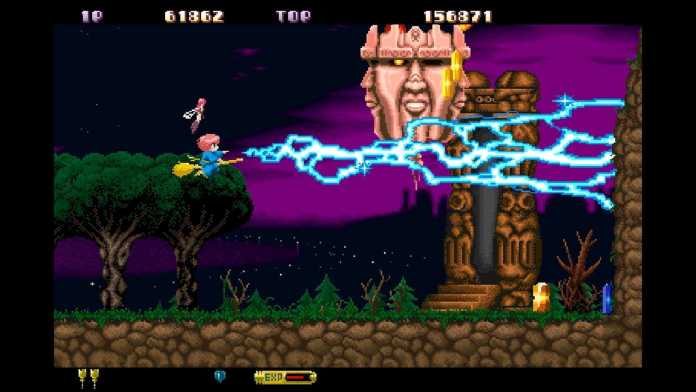
The boss is a bit of a beast….literally.

Different to other Darius games is the inclusion of the Burst weapon, which allows your laser weapon to be rotated (in some cases) and moved to engulf enemy fire and protect yourself during your battles.

Elsewhere, the game’s chosen resolution keeps large black bars above and below the action (originally used for stretching the video over 2 or 3 screens in the arcade) and does the game no favors as it’s unable to show any real detail and the backgrounds are almost always dark and soulless.

The audio, as mentioned previously, gives it a feeling of scale and suffering, but it doesn’t build drama the way that I hoped it might. Funnily enough, Nier Automata, which has clearly been heavily influenced by games like Dariusburst, has its own side-scrolling and vertical-scrolling shoot ’em up sections, but the game’s dark story justifies its surreal soundtrack and creates an incredible oppressive energy that imbues the entire experience. Perhaps comparing it to an Open World game is unfair, but Ex+, with its shrunken screen and miniature-sized, well.. everything, fails to match the tone of the soundtrack until the bosses arrive. 

Mind your wallet before purchasing this one.

As I simultaneously dodge and carve a path to progress through the carpet of enemies, I found myself wondering when the addictive quality of those 80s games would appear – something that would have me itching for one more retry – but it never materialized. Infinite lives, another of the game’s features, is likely to blame for this as it removes any tension from your playthroughs. Never once did I feel worried about returning to the beginning of the stage following a mistake.

My experience would certainly give me pause for thought on whether to buy this title, but muddying the waters further for newcomers is the sheer number of Darius alternatives on offer with Dariusburst Chronicle Saviours (an enhanced port of Dariusburst Another Chronicle) containing a mode with 186 Stages and a large amount of DLC from other shooter franchise series’, Darius Cozmic Collection Console Edition with 8 past console releases, Darius Cozmic Collection Arcade Edition – 6 past arcade games and Darius Cozmic Revelation (though currently only on sale in JP), includes both G-Darius HD and Dariusburst Another Chronicle EX+.

Putting aside this title’s lack of ingenuity and the superior alternatives for a second, and you have yourself an action-packed content-filled game that fans of side-scrolling shoot em’ ups are bound to enjoy, it’s just hard to recommend given the fact that it’s seemingly here to just make up the numbers.

Review: MouseBot: Escape from CatLab

History is littered with tales of good vs evil and classic rivalries. These stories define us and the brutal and sometimes silly outcomes stick in our minds. We all remember The North vs The South, Coke vs Pepsi, Burger King vs McDonald’s and so on. MouseBot: Escape from CatLab tells a story of the age-old rivalry between cat and mouse.

Developed and published by Vector Unit, this is a fast-paced racing puzzle game with a hint of humour. The gameplay revolves around a robotic mouse who must avoid traps while collecting lumps of cheese. It’s all very clichéd, but it’s oddly addictive. With many objectives to focus on and challenging time trials to complete, you’ll be kept busy for hours.

MouseBot: Escape from CatLab is simple, hectic, and moreish.

MouseBot: Escape from CatLab is a basic arcade puzzle game. Spanning eighty-eight levels, you’ll focus on the same goals during each stage. You’re asked to collect lumps of cheese, a heart icon, stay alive, and finish under the set time. Trying to achieve each of these goals in one run-through is impossible and this forces you to play it repeatedly.

You’ll be driven insane by the fine details and small movements you must use to be successful. You must then consider the traps that lay in wait for you during each stage. As you progress through the levels, the obstacles become more elaborate. The race from A to B becomes hectic and increasingly dangerous. You’ll avoid the classic baited traps, rollers, circular saws, mines, and more. The traps quickly combine to make it a headache to traverse each stage, let alone trying to complete each objective.

Racing through nuclear waste is risky.

Crazy cats and drip-fed mechanics.

MouseBot: Escape from CatLab doesn’t contain a complex plot, and this isn’t a bad thing. I’d have hated to be focusing on an intricate storyline while avoiding near-certain death. You’ll enjoy what little story there is as you slowly unravel the evil cat’s plans. The robotic mouse is a thorn in the cat kingpins side and he cares not what method he uses to stop you.

It’s not all doom and gloom for the mouse protagonist, however. Anything the cats can do, the mouse can do better! As new obstacles are introduced, additional mechanics appear. The robotic rodent quickly becomes a leaping, strafing, and dodging beast. Combining the new elements was a challenge, but it was a joy to experiment even when you die repeatedly.

The challenge in this title doesn’t come from complex mechanics or an in-depth overarching story. No, it’s the constant demand for perfection and memory recall that’ll test you throughout.

Leap the lasers.

MouseBot: Escape from CatLab looks great and has a fantastic polished finish.

When I first installed this I didn’t have high expectations. I thought it would be another top-down title with basic and rough imagery. I couldn’t have been more wrong! The wonderful 3D world and excellent character model were great to look at. The traps move smoothly and everything flows as you’d expect. With a fantastically polished finish, every element pops. With vivid colours, sharp lines, and contrasting tones, this is a treat for the eyes.

The stage design was great, but each world was sadly repetitive. Luckily, however, the developers created some amusing cutscenes that broke up the action. It was a pleasant break from the hectic pace, and each one made me chuckle. 

The audio was a bit more run of the mill and this disappointed me. A synthesised soundtrack wasn’t particularly special, and the sound effects were lacking. In a world full of danger everything felt flat and I wanted more oomph. The circular saw blades were particularly poor and reminded me of a cheap hair dryer being used. The audio isn’t terrible and won’t put you off, I just expected much more.

Customisation time.

Practice makes perfect. 

When speed and precision are two key concepts, you know it’s going to be difficult to master. This is all about the fine details and mistakes matter. The adage: Practice makes perfect is relevant and you’ll get sucked into this crazy perfectionists world. This was helped by the excellent explanations when new mechanics were added, ensuring that understanding the basics wasn’t an issue. Using them correctly, however, is no mean feat. 

The addictive nature of the gameplay caught me by surprise! I expected a fun little game, but the challenges, hidden Easter eggs and mountains of cheese to collect made me come back for more. Combined with the tough achievement list, arcade mode upon completion, and cosmetic options, MouseBot: Escape from CatLab contains plenty of replay value. 

MouseBot: Escape from CatLab is simple, repetitive, but worthy of your time. 

Vector Unit was risking their game becoming tiresome when they repeatedly used the same objectives. Fortunately, I never tired of attempting each goal. The addition of new traps and the desire to speedrun each level overcame this obstacle. I enjoyed my time with it and recommend you to buy it here! Can you rekindle this age-old rivalry and uncover the evil cat’s plans?

Here is a video review for the above article with in game footage, I hope you enjoy!

Review: Get Packed

Corporations taking over the world is nothing new. When they see a good deal to be had, they step over everyone and everything to make a profit. Get Packed uses this heart-wrenching plot as you pick up the pieces left behind by a monstrous conglomerate.

Developed by Moonshine Studios and Coatsink and published by the latter, this is a solo and multiplayer physics-based title. Like its peers Moving Out and Overcooked, Get Packed focuses on teamwork and fast-paced action. With many challenges to overcome and bizarre levels to work through, there is a lot for everyone to enjoy.

Who needs gravity when packing boxes?

Get Packed is strange but hilarious.

The plot in Get Packed plays second fiddle to the wonderful gameplay that unfolds before your eyes. The bizarre story is hilarious from the first moment and takes you on a journey of twists and turns. A greedy salt mining company takes over your town, Ditchlington. Every resident, including yourself, is evicted, and this is where you form a genius idea. You take control of a group known as Last Ditch Removals, your intentions are good yet you profit from people’s misery. As every house is emptied, the work dries up and the removal team must think of whacky ways to make a living.

I won’t ruin the later stages of the game for you, but you’ll love every moment. The excellent level design and challenges keep you thinking throughout. You aim to complete as many tasks as possible while raking in the money. Each episode is ranked up to three stars and the amount of cash you earn is the deciding factor. You receive a bonus if you can complete certain objectives, and keeping the damage to a minimum is a must. It’s hectic, will drive you insane, but it’s ridiculously moreish and excellent with friends.

A simple concept that is agonisingly tough.

Racing through the game and opening up every chapter isn’t too difficult. Where the challenge arises is when you aim to complete each objective and get the three stars. Perfectionists will love the rewarding feeling, but will also get frustrated. Many minor elements work against you to make the gameplay agonisingly tough.

Guards, prisoners, and wrecking balls will send you flying. Cars, lorries, and trucks will run you over and smash every item you hold! If you then chuck in the ridiculous physics-based mechanics, there is potential for disaster. Your perfect plans will continually be thwarted by the surrounding environment and you’ll have to adjust to each unique stage.

Each location has special items that must be loaded into your tiny removal vehicle. You can flatpack each object or chuck them in the back as quickly as possible. You choose to pack whatever you wish, but grabbing each highlighted item earns you a cash bonus. This is essential to be awarded the highest score and is foolish to overlook.

Creep around the museum and don’t get caught!

Teamwork and co-op action make this a must-play title.

Get Packed is great as a solo venture but as a co-op game, it truly excels. This can be played locally or online with friends. The madness that ensues is crazy and you’ll shout, scream, and holler at each other as everything goes wrong. Yet, no matter how heated the situation gets, you’ll chuckle as you fall down stairs, blow yourself up, or leap through windows.

Communication and teamwork are key to success and playing with random gamers can be difficult. You must work like a well-oiled machine and staying silent only adds more obstacles. There are few games where I look to avoid strangers, but Get Packed is one of those titles, sadly.

Not only can you play the campaign mode together, but you can also battle it out across a range of multiplayer games. The core concept remains the same, but you must go head to head to be crowned champion. This was excellent fun and was a welcome distraction from the stresses of loading up the moving vehicle.

Get Packed has a great cartoon aesthetic and whimsical audio.

I love a game that uses cartoon graphics and comic book cutscenes. The hilarious story is told through some lovely still images that highlight your plight and silly choices. The isometric viewpoint gives you a clear understanding of the surrounding area, but it’s challenging to see the whole map. When time is of the essence, it’s annoying when you cannot see where key objects are positioned. This causes you to run around like a headless chicken and ensures more unnecessary arguments with your teammates.

The bright colours and brilliantly detailed levels were great to explore and look at. The developers have made the most of each stage and have cut no corners in ensuring a unique experience every time. The gameplay is extremely smooth, and I had no issues even when the action got a little heated.

Before I started playing, I knew what to expect from the audio… I wasn’t left disappointed. The fun and whimsical soundtrack were complemented nicely by the narration of the story. The crashes and bangs of furniture breaking were great, and I loved the noises the NPCs made as fights broke out. The sound effects support the gameplay perfectly and though it was a little OTT, it was very enjoyable to listen to.

Can you move an alien spaceship?

The physics-based mechanics make the controls feel sloppy. 

If you’ve played any physics-based game, you’ll know how loose the controls can feel. Your character rarely reacts to your command and this can be disconcerting. Get Packed suffers from this and getting used to it takes a strong mindset and plenty of patience. Playing with others enhances this annoyance, especially if you both grab the same item in error. However, once you are familiar with the control system, it’s great to play and you’ll love its difficulty curve.

The genre screams replay value and this title is no different. It’s addictive, fun, and challenging in equal measures. With a large and tough achievement list, many objectives during each stage and three stars to be awarded per level, you’ll return for more. There are also hidden trophies to find, and each character has custom options so you can make the removal person of your dreams.

Get Packed is up there with the best multiplayer games.

With so many great games in this category, Get Packed has its work cut out to stand apart from the crowd. It’s up there as one of the best multiplayer games from the genre and won’t disappoint gamers who give it a go. I loved it and recommend you to buy it here! When life gives you lemons, make lemonade! Be an optimist and don’t let “the man” bring you down. Run your business, clear the houses and get rich at the same time! 

Review: HighFleet

I only became aware of HighFleet’s existence very recently, thanks to the reappearance of MicroProse. However, I’ve actually played the developer’s previous game, Hammerfight, which was released back in 2009, and was probably one of the first indie games to hit Steam. They are very different games, but they do have some similarities, particularly the developer’s love for weighty aerial combat.

So, what exactly is HighFleet? HighFleet is a pretty unique game that combines a great deal of strategic planning with aerial combat. Still, I think that you could actually compare a lot of aspects of the game with something like the Silent Hunter series. 

HighFleet takes place during a crucial and desperate conflict between the Romani Empire and a group of rebelling noble Houses that have declared independence. It all happens in what seems to be an alternate timeline, where Humanity tried to reach for the stars, but that only brought doom to everyone. Now, everybody has to live in a desolate deserted world. As for the player, you play as the commander of a fleet of the Romani Empire, and you represent the last hope for the Empire’s survival. 

Although trailers for the game seem to focus on the aerial combat, HighFleet is much more than that. When you’re not flying a ship and fighting against a couple of enemies, you’re leading your entire fleet across the desert in a last-ditch effort to save your beloved Empire. It’s no easy task.

There’s a very specific set of games whose UI is an intrinsic part of how the game looks and plays. HighFleet is one of such cases, with the diegetic interface being seamlessly implemented. From the command center of your fleet aboard your vessel, you plan and draw your flight path across the map. Here, not only you can find nearby towns where you can resupply and acquire new ships, but you’re also able to intercept enemy strike groups that are actively hunting you down. 

As the commander, you have to keep an eye out on your radar and various other electronic instruments that allow you to detect nearby ships. Most often than not, you’ll be able to intercept enemy messages by tuning your instruments to the right frequency. This not only allows you to predict enemy movements, but it also allows you to hijack transports and sell them for money. However, the enemy will eventually start to use coded messages and you’ll have to find a way to decipher them.

I like to think of the strategic layer of HighFleet as a game of cat and mouse. This is because you’re constantly being hunted and you have to learn how to avoid the enemy whenever you can. Sure, you’re mounting an offensive against the enemy capital, but that doesn’t mean that you always have to pick a fight, you must be strategic about it. If you have your radar always on, the enemy will easily detect you and alert the rest of their fleet. If that happens, you can expect to see enemy strike groups closing in on your position, and they’ll most likely keep sending cruise missiles your way in an attempt to quickly wipe you out.

This is where HighFleet can really shine, as it presents the player with the tools to take on threats in a multitude of ways. Let’s say that you’re able to pinpoint the approximate location of an enemy strike group. In this situation, you can either take them head-on by sending your ships to face them, you can send tactical missiles their way in the hopes that they actually hit their target, send an aircraft carrier to intercept the enemy, or you can actually trick them in order to slip by undetected. 

Since the enemy is pretty good at detecting you if you have a radar on, you can exploit that by building a custom ship with one and then use it to lure the enemy away, thus allowing your main fleet to proceed unharmed and undetected. Still, you always have to keep an eye out for fuel, ship’s morale and fatigue. If you’re not careful, you might find yourself stunlocked when trying to repair and refuel while enemy squadrons are closing in on your position, leaving you no way to safely escape. It’s easy to let your guard down and pay the price for it.

Even though settlements are the closest thing to a safe haven in HighFleet, they can be quite tricky. Sure, they are the major places where you can repair your ships, refuel them,  retrofit them (there’s also a ship editor in the main menu), acquire specialized ammunition, and even recruit allies to your cause, but they also pose a threat. Not only they’re always defended, but the enemy is also constantly patrolling the routes between each town. Furthermore, if you spend too long docked, someone might just alert the enemy to your presence. If you think you can just lift off and leave, then you’re wrong, as refuelling and repairing take a lot of time, sometimes days, so you have to plan carefully. It might be worth it to leave your ships unrepaired if the enemy is closing in on you and you have enough fuel to make it to a safe harbour.

Just like the strategic layer, the combat element of HighFleet is also pretty robust. At first glance, it might look like a regular 2D side-scroller where you’re just flying around and shooting enemies down, but there’s more to it than that. Each encounter tends to be pretty short, and you can only control a ship at a time, even if you’re facing multiple enemy ships, which I have to admit is somewhat odd at first. If you lose a ship, or if you choose to retreat to avoid losing it, you’ll immediately go right back into combat with the next ship from your lineup.

In combat, movement is key, as you must use your thrusters to move around and avoid enemy gunfire. It’s important to keep track of enemy fire and anticipate its trajectory. Likewise, you must also lead your shots to make sure that they hit their target. By moving carefully and positioning yourself properly, you can even use enemy ships as meat shields and trick enemy missiles into hitting their own allies. Combat can be difficult at first, but it’s pretty satisfying once you start to hit your shots and witness your enemy go up in flames. In that sense, the combat feels extremely rewarding once you get the hang of it.

Even though I think that the core experience of HighFleet can be pretty compelling, unfortunately, the game isn’t without its issues. For starters, the tutorial, which also serves as a prologue to the campaign, leaves a lot of things unexplained. I’m not only referring to game mechanics here, but also to the overall strategy that’s required to play the campaign reasonably well. It’s only by continuously playing the game, or reading guides and the forums, that you’ll come to realize some of the game’s intricacies.

Additionally, for a game where your mouse is a vital part of the gameplay, it’s also pretty odd that the mouse behaves pretty erratically. I’m pretty sure that the game has a ridiculous amount of mouse acceleration, for whatever reason. It’s really annoying and gets in the way of the gameplay, particularly when you’re aiming during combat. Although I managed to get used to it, there are still times where it can mess your aim during combat. On top of that, the combat can also be complicated due to the fact that the direction that your weapons are facing are represented by these really small arrows that orbit around your ship. When there are a lot of explosions, or when your ship is on fire and smoking, it can be pretty hard to spot these arrows and know where you’re actually pointing.

In any case, it can’t be denied that HighFleet looks absolutely beautiful. The game has a very distinct and striking look, the inside of your main ship, the flaming thrusters, and the numerous projectiles flying during combat, all these things culminate in a wondrous visual spectacle. Likewise, sound design is also on point. Even the weakest weapons sound exceptionally powerful. Each shot fired sounds menacing and daunting, and ultimately, each combat engagement sounds like a loud thunderstorm of gunfire. It’s a joy to listen to. Still, while the game certainly looks stunning, sometimes, the number of visual effects on the screen during some fights can be disorientating.

Despite my complaints, I want to stress that, under the hood, there is a brilliant game here. However, the game isn’t the most approachable, and so it may rub some people in the wrong way. The systems needed to succeed are in the game, but initially, it might feel like there is little room for error, it might seem like things are hopeless and that the game is almost impossible to beat. 

I have to admit, I found the game to be overwhelming during my first hours with it. Still, I’m glad that I pushed through and learned its inner workings. It’s so worth it. Nonetheless, I also feel that I should emphasize that, if you saw clips of the combat and that’s all you’re interested in, then you might end up frustrated due to how heavily that part of the game relies on how well you perform on the strategic layer. I also feel like the standard ship designs aren’t the best. I think you’re encouraged to play around with the editor and come up with your own designs that better suit your playstyle.

With that said, it’s not like you can just slap a bunch of weapons on a ship and call it a day. Parts add weight to each ship, weapons require ammunition autoloaders, ships need crew quarters and fuel tanks, and armour is obviously always a nice addition, despite the extra weight. There’s a balance to be struck on each ship that you build. It’s crucial to have various ships with different purposes, as it’s pretty much impossible to have a ship type that excels in everything.

In any case, there’s no denying that HighFleet is a niche and time-consuming game. This isn’t something that you can pick up and quickly learn how everything works, or what the most optimal strategies are. This fact alone will certainly make some people cross off HighFleet from their list, but it will also surely please many others. Nevertheless, if you can push through its faults, HighFleet is one hell of a game that I thoroughly recommend checking out.

Review: Apple Slash

Everyone dreams of a peaceful life, a beautiful house, and serenity. However, this rarely happens, especially when your land is invaded by monsters! What would you do if this happened to your homeland? Would you sit back and allow it to happen, or would you fight back? Apple Slash is an old-school monochromatic game that tests your ability to defend your home.

Developed by Agelvik and published by Ratalaika Games, this is a retro 8-Bit action-adventure title. You are a mighty apple knight who wields a god-like sword! Your murky swamp may be considered foul by some, but to you, it’s home. When mysterious blob-like creatures invade your land, you grab your weapon and slash away.

Can you unlock the secret door?

Apple Slash is a quick and simple adventure.

Like many games from a bygone era, Apple Slash is a quick and simple adventure. I admit I flew through this in well under an hour. Strangely, I wasn’t disappointed with the short gameplay, instead, I was left frustrated as I desperately wanted more. This has plenty of potential with some unique combat mechanics, fun and adorable NPCs, and interesting monsters. Sadly, however, its short tale will leave you feeling cheated.

The combat’s hack ‘n slash nature is moreish, and I loved how the monsters repeatedly spawned back in. You’ll take on acid-spitting frogs, tiny blobs, and monstrous creatures. As you flail your weapon madly, you’ll decimate each of your foes. This was fantastic fun and never got old. Yet, you’ll beg for it to move on from its simple foundations. Each battle follows the same pattern and you’ll wonder why the developers failed to capitalise on their creation.

Fun puzzles and interesting abilities!

The key concept of new abilities opening up previously locked areas was fantastic. I loved how exploration and secrets rewarded you with new abilities. Most revolve around stronger and more bizarre attack methods. These can be combined to kill wave after wave of monsters or to hack down bushes and vines. You’ll also learn how to create magical bridges to reach previously inaccessible places. I liked how this helped to connect the paths in the swamp, but it made a tiny world just that bit smaller. It was a shame, as it made a semi open-world feel very restrictive.

The developers cleverly sneaked in some fun yet basic puzzles. The combination of switches and new paths were nothing new, but it was constructed accessibly. Each puzzle funnelled the gameplay to the one massive blob that acts as the end game boss. This was great, but came far too quickly, even though there were plenty of humorous moments along the way.

The boss tests your ability to combine each skill while avoiding his minions and blows. Once you learn his simple attack pattern, you’ll annihilate him with ease. I wish Agelvik made this fight much tougher while combining many of the brilliant exploration elements that make this game really enjoyable.

Find and destroy all the eggs

Apple Slash has nice indie graphics and surreal sounds.

The mainly monochromatic colour palette and simple imagery were lovely to look at. With a dank world to explore and contrasting tones, it was easy to navigate around the small maze-like environment. The Gameboy-style perspective emphasised the retro approach and the limited view helped to make the swamp feel larger. The gameplay ran smoothly and even when there were large numbers of enemies there were no problems.

The strange nature of Apple Slash is reflected in the surreal soundtrack. The airy and mystical music was supported by loud and OTT sound effects. The swoosh of your blade as you sliced through monsters was ridiculous but brilliant. Sadly, there is no acting for the weird conversations and this is the only element I would have liked to be different. If acting was added it would have made the humorous interactions funnier still.

Hack through the vines to create a new path.

The awkward controls quickly become second nature.

I was surprised by how awkward the straightforward controls were to master. Selecting abilities and aiming with the analogue sticks was fiddly, to begin with. Yet, after a small amount of practice, it quickly became second nature. Once you get to grips with the control system, you’ll note it’s a pleasure to play. Until that point, it’s frustrating and will leave you feeling annoyed.

Another area this short title is lacking is replay value. Comprising around one hour of gameplay and no reason to return, this won’t push you to keep playing. However, this makes it a completionist’s dream, as the small achievement list is unlocked with ease. As previously stated, I loved what I experienced. I simply wanted much more. I wish the developer created more lands to explore as this would have made Apple Slash much more interesting.

Apple Slash is enjoyable but it could have been fantastic.

Apple Slash is a great, short indie title that I thoroughly enjoyed, yet it fails to reach its potential. With so much going for it, it could have been fantastic. I recommend you buy it here, but be aware it’s extremely short. Learn some new abilities for your god-like sword and remove the monsters from your beloved swamp. 

Enjoy the review with some in-game footage.

Review: Song of Farca

Song of Farca is a morally grey detective game where you play as private investigator Isabella Song as she takes on a weird and wonderful range of cases that might not be as disparate as first appears. Being under house arrest for a crime she absolutely committed won’t stop Izy as she hacks into the technological infrastructure of the near-future city, using the internet, cameras, drones and her friendly AI companion Maurice to collect evidence and build a case against the nefarious wrong-uns who plague the city. With nemeses as wily as those Izy is locking horns with, evidence alone won’t be enough so it’ll be up to your keen wits and detective skills to draw conclusions from the data you find and use it to turn the tide of interrogations against those who deserve it. Not easy when it can sometimes feel like the whole city is against you.

Much like Q from the Bond films, Izy does most of her damage on her laptop, sitting in her pyjamas before her first cup of Earl Grey. And this is where the game starts us off, with Izy sat in her apartment (pictured along the top third of the screen) waiting for a call to come into her computer, (the screen of which takes up the remaining two-thirds of the screen). Here the game introduces you to a minor mechanic that shows how much thought and effort has been put into the development process: You can’t use the computer or interact with anything until Izy is sat at her computer. You can’t even move the cursor. This immediately focuses your attention where it’s meant to be, on Izy, and prevents you from getting distracted on the computer playing minesweeper or writing 80085 on the calculator, whilst also adding a sense of realism. It’s such a tiny touch that only comes up a couple of times throughout the game but it shows how solidly the game is put together and reminds you there’s a ‘real’ character that you’re embodying here, not just a conduit for you to interact with your fancy Minority Report-style laptop.

But, enough on how you *don’t* interact with Song of Farca, time to talk about how you do. The first of the two key phases of the game is the evidence-gathering phase. Here you are trying to untangle the complex web of a criminal conspiracy through every means available from your computer. Your client gives you the basic outline of the case, including what happened, where it happened and an idea of the key players. You can start by doing some basic internet research on the suspects. When you click the ‘do research’ button the game will bring up a couple of important articles with the key information highlighted, which you can click on to add to the case file. The key information is always quite self-contained so I love that you don’t have to read the full articles if you don’t want to. Attention span? What attention span? The game also tells you how much important information there is to find so you don’t waste time trawling for clues that aren’t there.

Once you’ve got a good foothold in the case, it’s time to switch gears and go and do some spying. But of course, you’re under house arrest so you’ll be doing all of that virtually (what is it, 2020?). You’re given a floorplan of the area you’re going to investigate and the location of one camera to get you started. When you hack the camera, any technology within its cone of vision is available to be hacked, allowing you to daisy chain to more and more cameras, revealing an increasing percentage of the map. You can also hack drones and other moving platforms with cameras to expand this range and routers give you access to a camera you cannot see. Your goal is generally to hack your way to a tablet or computer with some juicy evidence in its memory banks. But, you can’t hack these devices when people are nearby so you’ll need to hack distraction devices around the area to draw them away. This hacking mechanic is simple but absolutely brilliant. It’s a self-contained little puzzle that’s really satisfying to solve – for two minutes you feel like a real spy-come-private investigator.

The evidence you gather in the section might be documents, photos or videos – all of which will add to your case file, expanding your knowledge of the case. As ever, the game will tell you how many things there are to find so you’re not fruitlessly searching an area once you have everything. There are a range of puzzles to solve involving the evidence you’ve collected. For example, if the evidence is a video there is a zoom and enhance cliché mini-game where, for three different frames of the video, you need to select from three options what the zoom and enhance might be seeing. The game tells you how many of the three you have correct but not which ones so you’ll need to employ some trial and error to find the correct three images and complete the video.

Once you’ve got all of your evidence together it’s time to ask some scary people some difficult questions. The conversation will go ahead like an interrogation, with you asking the questions and showing your evidence when they deny anything – think of a cross between Phoenix Wright and LA Noire. However, evidence isn’t the only thing you can present to get your suspects to confess. You can also make deductions from all the other information you’ve gathered through your investigation. You’ll need to link two statements together in your Sherlock Holmes-style mind-palace to form a true deduction. For example, if you know that your suspect studied schematics for a device and that the device was frequency hacked, you can link those facts to deduce that they worked out how to frequency hack the device from the schematics (okay, Liz isn’t exactly Poirot but it’s a start). After enough evidence is thrown at a suspect you’ll either be able to tell they didn’t do it and have some new leads for your investigation or they’ll confess and you’ve solved the case.

All of the cases you’ll face in Song of Farca are tied together by the organised crime in the city’s underbelly and the morally bankrupt corporations in their ivory towers. Through the game, you’ll be taken on a narrative journey where you question who’s good, who’s bad and where you sit on that sliding scale, considering the dubious means by which you undertake your pursuit of justice. An absolute sea of grey morality awaits you in Song of Farca.

Song of Farca is an exceptional game. It has great mechanics that draw you into Izy’s world, a thought-provoking narrative and attention to detail up the wazoo. All of this is tied together by a gorgeous cyber-punkey/neon art style that fit the game beautifully. I had a brilliant time with Song of Farca and would really recommend it. If you want to feel like a detective in a high tech future, I’m not sure there’s anything better.

Review: Super Magbot

Super Magbot is a challenging 2D platformer with one hell of a gimmick: no jumping. 

Yes, you heard that right.

The exclusion of such a foundational feature for the platforming genre is an audacious move – to say the least. It is like imagining a shooter without any guns!

Thankfully, the absence of the jump button comes with an interesting trade-off. To navigate the world of ‘Magnetia’, Magbot – our games hero – utilises both positive and negative magnetic properties (denoted by the colours blue and red) to navigate through the very challenging platforming levels. 

This design choice underpins the game’s core formula, and it is undeniably a gamble from the developers.

I guess the question is: does Super Magbot manage to successfully innovate within the platforming genre?

Play to your strengths:

The story of Super Magbot is a simple one, acting as largely background filler to provide a hook to get you from point a to point b.

Your system is under threat. There is a big bad villain. Only you, Magbot, can save the day.

Nothing particularly complex here – but the story – and simple macguffin of collecting all the fragments to save your home planet, MagTek, works because of the emphasis placed on the game’s fundamentals.

Super Magbot plays to its strengths: tough platforming, married with a progressive rise in difficulty – that peaks at brutally hard – provided the hook that kept me going ‘just one more run’ throughout my playthrough. 

The simple visual design also supplements the experience: the colour scheme often corresponds nicely with each element. Furthermore, the design also acts as a helpful indicator for gameplay, such as ice meaning a more slippery surface. 

Audiowise, the music was fairly forgettable. Nothing distractingly bad, but at the same time, nothing all too memorable. 

A progressive, fair, challenge:

I am by no means a platforming aficionado, however even I can recognise the difficulty curve. 

The initial difficulty emanates from the movement system; with the left thumbstick functioning as your run button, and the right being your aim. Coupled with the triggers – which let you choose whether to use positive or negative – there is a high level of precision to basic movement. 

Then you factor in how you need to approach each magnetic force. Movements have different properties, such as sliding or jumping. Initially, this felt quite awkward, and I died – a  lot. But, after enough runs, the magic of muscle memory kicked in and I found myself intuitively navigating through levels. 

Incredibly satisfying (I still died a lot).

To Magbots credit, the control system itself remains simple throughout the game. Creativity comes from new interactable items that can be found as you progress levels. These items all lend themselves largely to navigation, which is important in helping you keep up with the game’s breakneck pace.

As you progress, levels become decidedly more hostile: the floor becomes lava; unforgiving blades and spikes necessitate quick-thinking and reflexes, which adds to both thrill and despair. Thankfully, unlimited lives and super-fast respawning encourages the player to keep going back. 

(Many) Trials and errors:

Super Magbot offers an impressive amount of levels. Because of the forgiving respawn system, I felt encouraged to experiment with each level. When combined with the environmental challenges; different items to use and collect, each level became a playground for me to express my creativity.

On a slightly less positive note, sometimes the game attempts to use two screens or more in the levels can be seriously frustrating. Because of the game’s frenetic pace, the one screen approach is damn near essential in trying to progress.

As an overall package, Super Magbot offers a new approach to the platforming genre: one that is initially quite difficult, but through progressive challenge and a simple control scheme, quickly becomes instinctive.

The game’s nature is fast, frantic and ultimately forgiving, which encourages the player to be creative when approaching each level.

Overall, a really fun experience and addition to the platforming genre. If you’re unsure, there is a free demo on the E-shop.

Review : Cris Tales

In my last review, I recommended you cast aside rational thinking to judge a book by its cover. For Cris Tales, a beautiful storybook-like RPG with a time travel mechanic, however, you might want to forget that bit of advice.

With an action-packed trailer with exploding colors and animation, you’d expect Cris Tales to be just that – an action game. Not only does this description miss the mark by quite a margin, but it highlights its least interesting elements.

As an unwitting time-traveling prodigy that discovers her powers at the start of the story, it’s up to Crisbell to fulfill her prophecy and save the world. In a very Disney-like manner, she pairs up with a talking animal, approaches bad guys in castles and makes friends on her journey to end the war ravaging the world around them. Her powers are a fun little time travel mechanic that has different features for each part of the gameplay.

In the towns, you can see its past, present and future by simply walking through it giving it a layered quality not possible in most games. It’s the best interactive part of this art piece and allows a unique approach to world-building allowing you to resolve issues and complete quests in the present from a combination of the past and future. It’s a brilliant mechanic and one that I wish was expanded further with more residents and areas.

Like three camera lenses looking at three different time periods – The left side is the past, the middle the present and the right is the future

I’m sure you’ve realized this already, but this Unity-developed game is quite the stunner with a clean and simple art style and smooth animation that you can’t help being blown away by as you walk around the beautiful towns dotted around the world. What this unfortunately did for me, was produce unreasonably high expectations, only for them to slowly sink into a malaise of mediocrity, as I realized that everything else on offer was simply average in comparison.

The visuals, worthy of their own cartoon network show, are supplanted by frequent loading screens, unsatisfying battles and voice-acting so awful I felt compelled to mute it. The Unity engine is likely both thank and blame for at least the first issue as it produces that specific look at the expense of engine resources extending the loading times.

Each town is full of interesting residents looking for change from the elite ruling class

The action takes place in the form of rather standard turn-based battles but allows you to use Crisbell’s abilities which can send enemies to the past and future changing their age and strength on one hand and gives you an opportunity to infect and affect them on another. Sending enemies to the past and poisoning them, for example, before returning them to the present magnifies your attacks.

The biggest downside to the battle system though is not the disappointingly standard animation in the battles, nor the singular audio track or even the overall affair being rather bland, but it’s the fact that they appear out of nowhere far too frequently through random encounters and there is no way to avoid them.

It’s so frustrating to have the screen turn white for no obvious reason with no sound effects and no warning only for it then cut to a loading screen as if you are moving into a new area. After this happens a few times, of course, you know full well that even after you beat the bog-standard battle in front of you, another is sure to come and there’s nothing you can do about it. 

Invoking the future crystal would send the enemies on the right into a future version of this field and potentially change the outcome of the battle in the good guys favour

Another interesting mechanic facilitated by Crisbell’s ability is a situation where you are forced to make a decision between helping one of two parties in the town with the decisions having their own consequences and further affecting the town. This is also true for the number of side quests that you do within each location – the more you do, the more it changes – and this fosters and brings to the fore the personality of each areas’ characters.

Despite everything pointing to Cris Tales being for a Saturday morning cartoon audience the Teen-age rating and some awkward dialogue make this choice confusing, like the presumably intentional but completely out of place moment where one of the characters calls another a ‘pr*ck’ and seems as appropriate as Winnie the Pooh whipping out a machine gun and mowing down a honey thief in a spray of sweet-scented death.

Cris Tales is undoubtedly special, but how special is in the eye of the beholder. In my opinion, the RPG battle system spoils the sky-high potential afforded by its presentation and central mechanic. I mean, why would you even bother fighting when you could just manipulate time? Furthermore, it may have been better to expand the great town-based consequence-forming gameplay loop to something more similar to the tremendous system used in Where the Heart Leads.

Overall then, if you bear the unnecessary grinding of Cris Tales, there’s potentially something special waiting for you. I, on the other hand, will be jumping into a Delorean to see if the developer makes an improved sequel. Until we meet again…

Review: The Great Ace Attorney Chronicles

The Great Ace Attorney Chronicles is the latest or arguable earliest instalment of the Ace Attorney series of games acting almost as a prequel. Made up of two games The Great Ace Attorney: Adventures and The Great Ace Attorney 2: Resolve that were released a while back in Japan they’ve finally received the western treatment and make their debut in the UK.

You play as Ryūnosuke Naruhodō who is supposed to be an ancestor of Phoenix Wright, yes the very same Phoenix Wright. The Great Ace Attorney Chronicles is set in the Japanese version of the Victorian period known as the Japanese Meiji period. At the beginning you are thrown onto the legal stage and have to defend yourself. The plot of The Great Ace Attorney Chronicles double adventure has you following Ryūnosuke Naruhodō, a young Japanese lawyer who has made his way from Meiji period Japan to Queen Victoria’s England to learn about the British legal system, which at that point is telling the world it is the greatest legal system on the planet. Luckily he is not along and has his legal assistant Susato Mikotoba help him attempt to defend those in need of legal help in several courtroom battles.

Although The Great Ace Attorney Chronicles explains Ryūnosuke is Phoenix Wright’s very old ancestor, there really isn’t much connecting these two games with the previous editions. The British environment gives a different taste to both the kind of cases and how they are dealt with, so even if you’re an experienced ace attorney, The Great Ace Attorney Chronicles does offer something a little different. There are several colourful characters in The Great Ace Attorney Chronicles who you will interact with many times, these include Baron van Dieks otherwise known as the ‘Grim Reaper of the Old Bailey’, Scotland Yard Officer Tobias Gregson and Herlock Sholmes who you may have guessed is based on Sherlock Holmes.

Compared to previous games The Great Ace Attorney Chronicles tries to change things up. Herlock Sholmes can go off sometimes so you need to help him keep his focus via a series of mini games, they’re more like deduction mini games but they are somewhat different to the usual evidence gathering you would normally do as Phoenix Wright. The courtroom antics have also changed, no longer just a judge to contend with you must convince a jury of your peers. Multi witness testimonies are also part of The Great Ace Attorney Chronicles, you think you would need to keep an eye on how other witnesses react to another witnesses answer but it’s pretty blatant to see.

The Great Ace Attorney Chronicles has an autoplay mode, so if that is selected then it will just automatically run until a decision is required similar to your standard visual novel set up. You can also choose to play Story Mode which will allow you to skip the many puzzles and decision making processes, if you play it this way then The Great Ace Attorney Chronicles doesn’t really play like a game but a televised court room drama. The Great Ace Attorney Chronicles does lack what previous games have had and that’s the issue of defending friends and family, in The Great Ace Attorney Chronicles it’s less involving because there are a fair few characters you won’t be particularly bothered about. The Great Ace Attorney Chronicles isn’t a particular difficult game to get through, you’ll be on the receiving end of many a hint.

Graphically The Great Ace Attorney Chronicles is great to look at. The cinematics as you accuse or have to prove your point are really slick. Objections are met with crescendos of orchestral music and there are plenty of slow plans to various characters as more information comes to light. Musically The Great Ace Attorney Chronicles is just as good as it’s graphics. The music gets louder just as big reveals are made and the whole musical accompaniment works well in The Great Ace Attorney Chronicles. There’s roughly 40-50 hours worth of gaming depending on how quickly you crack the cases. Games like this are bit of a slow burner but once you’ve got past the first hour or so you’ll get fully engaged.

The Great Ace Attorney Chronicles is an excellent and clever prequel to the Phoenix Wright series. The insight into the British legal system and changed dynamics makes The Great Ace Attorney Chronicles are noticeably different experience to it’s previous incarnations. Whilst The Great Ace Attorney Chronicles may lack that personal touch there are so many interesting and fun things to do. If you’ve enjoyed the Phoenix Wright series in the past then The Great Ace Attorney Chronicles is a worthy entry worth several hours of your legal time.

Review: The Legend of Zelda: Skyward Sword

I have adored The Legend of Zelda since I recieved my first DS Lite and played Spirit Tracks. Since then, Link and I have accompanied one another on uncountable adventures around Hyrule. We’ve defeated Ganon hundreds of times, we’ve found more Koroks than I like to admit, and I can confidently say that we have smashed more pots than I like to admit. When looking for an adventure that will always welcome me with warm arms, The Legend of Zelda is always there for me. When Skyward Sword was released in 2011 for the Nintendo Wii – I obviously sprung into action as fast as I could. Similarly when it was announced to be re-imagined for Nintendo Switch, the little girl inside me nearly burst out to celebrate.

A time before twilight

To anyone who is new to the franchise, or anyone who is as baffled by the Zelda timeline as me, Skyward Sword takes place as the first installment of the timeline. We are transported back to a time before we really knew our hero and heroine, no matter how many Legend and Zelda games you have played. Trying to go into Skyward Sword with fresh eyes ten years later was something I thought would be impossible – but as soon as the game is booted up and I heard the Great Fairy Fountain, I felt like a kid again. Nintendo manifest something magical when it comes to transporting their players back to a childlike state of mind, and that is definitely something I adore most about the company.

My first experience with Skyward Sword was watching my brother play on the Wii. As you can imagine, two competitive siblings meant I never really got to have a go. So being able to pick it up now and experience it both again yet for the first time is honestly magical. There is so much substance to an installment in the Legend of Zelda timeline. For a franchise built up with so many games you’d expect at least one of them to seem repetitive or boring, but as a lifelong fanatic I can assure you that this just isn’t the case. Skyward Sword is a masterpiece in terms of the original release and the re-imagined version.

It’s dangerous to go alone

It wouldn’t be an installment to the franchise if you didn’t have a (somewhat annoying) companion for your adventure. From Navi, to ghost zelda, to phantoms, The Legend of Zelda really does provide it all. Within Skyward Sword you are accompanied by Fi, a spirit embedded within your sword. I found Fi rather amusing as she still continues the traits of a Zelda companion. Interrupting you when you’ve already found your way just to let you know you’re on the right track. Stopping you mid battle to let you know that there’s an 89% chance you might be in danger. As frustrating as this is, it just adds to the foundations of a Zelda game.

Link’s usual antagonist isn’t what you’d expect in Skyward Sword either. We are used to the brute force and ominous energy of Ganon, but luckily for our mute hero he is no where to be seen in this game. Instead we are given a breath of fresh air, Giriham. A perfect combination of sassy and challenging, we feel as if we have to take him head on just to knock him from his pedestal. Skyward Sword, although the first installment of the timeline, is a new experience for all Zelda fans. Even if you have played the original when it was first released. If like me you haven’t touched it in 10 years – maybe sit down to revisit Skyloft and remind yourself of the world before twilight fell.

A timeless classic

As anyone would do when their favorite game is re-released on a modern console, I assumed that it wouldn’t be as breathtaking as it was when I was younger. Nintendo have a positive track record when it comes to revisiting old classics, even with the NES Online arcade, it still feels authentic yet looks the part. Skyward Sword is definitely a supporting example for this.

Rather than keeping the blocky, outdated graphics of the original version, they have been polished and buffed to suit the Nintendo Switch. Essentially, it’s like playing the original Wii version with Nintendo Switch graphics. Everything is smooth and colourful, and as I keep mentioning it feels like playing it again for the very first time.

Even controls are kept the same. If you decide to play Skyward Sword with joycons rather than a controller, motion control settings are still in place. Even if you do play the majority of the game with a controller, I really recommend relying on motion controls for at least one hour. There’s something so fulfilling about flailing your controller around in combat, yet doing an impressive impression of swatting a fly in real life. Nintendo are so wonderfully capable of bringing childhood joy to life in exhausted adults, in every way imaginable.

Challenge after challenge

There’s something about Skyward Sword which feels far more challenging than other, more recent Zelda games. Games like Breath of the Wild require more technical skill, Skyward Sword really focuses on the puzzle aspects. Whilst combat is still challenging, puzzles are far more intense. There were several occasions where I felt genuinely frustrated at the game. But it is all part of the Zelda experience. You spend hours in one temple, half the time on one puzzle, and then realise the key was something as simple as spinning your sword in a circle. With puzzle based games like this, the only skill level comes in combat. So puzzles are significantly difficult throughout. Once again this transported me back to my younger self, watching my brother in amazement as he knew exactly what to do. I, ten years later, definitely remained as baffled.

Final thoughts

If you are looking to revisit the wonderful world of Skyloft, then I cannot reccomend this game enough. Even for first time players, this is a wonderful experience for all. The Legend of Zelda is the gift that keeps on giving. And no matter how old, young, or new to the franchise you are – you simply will not regret playing this.

Review: Death’s Door

As one door shuts, another one opens is a favourite saying from the optimist in your life. It means no matter what happens and no matter how bad things seem, there is always the chance to move forward. What would you do if this wasn’t the case? If you failed at your last opportunity and this prevented you from moving forward! This is the concept behind Death’s Door, a game about sombre scenes and melancholy situations.

Developed by Acid Nerve and published by Devolver Digital, this is a puzzle adventure title with a deathly twist. Using Zelda-like exploration and maze-like dungeons, you’ll lose yourself in this expansive world. You control a fledgling crow who epitomises the symbol of death. He wanders around a grey land devoid of human life, collecting souls to power the doors between realms.

Death’s door!

Death’s Door is a touching tale of failure and redemption.

You work for the Reaping Commission and your only task is to collect the souls of your vanquished foes. If you haven’t been assigned a job, you are immortal. However, the moment you walk through a door to complete a task, the ticking clock of life starts moving. The only way to stop it is to collect the giant soul that controls that realm. If you fail, or the soul escapes, your door remains open and death ebbs ever closer. 

Sadly, this predicament forms the backbone of Death’s Door. While completing a simple job, a giant and aged crow steals your prized possession. You are now trapped in limbo and transported to a strange world that contains the oppressive titular door. This enormous locked barrier requires the fledgling crow to undertake three challenging adventures. You’ll adore the in-depth levels and constant back and forth as new abilities unlock new areas. Like Zelda, you’re forced to remember inaccessible locations to return to them when the time is right.

I loved the unveiling of these secret areas and though it had the potential to make the game tiresome, it rarely did. Using your newfound abilities made the gameplay refreshing and introducing mini-bosses adds a layer of complexity to the combat mechanics.

A complex story told with simple but effective mechanics.

The core concept will resonate with most gamers because of its simplicity. The wonderfully dark and charming story muddies the waters, but the murkiness is worth it for the fantastic experience. The game simply asks you to use arrows, magic and swords in each combat encounter. As you progress, they become gradually more challenging and tactical nuance is required to better your foes. Your limited health will be put to the test and a small supply of plants can stop you from dying. This was ingenious, as this extra layer made you gamble on the moment to use your seeds or to power on, regardless.

On top of the fighting were the puzzles that relied on switches, fire, and explosions. Though there was little offered that can’t be found in other titles, the blend of abilities and the use of environmental obstacles was fantastic. During the main chapters, you’ll unlock fire, bombs, and a hook. These tools are key to solving each problem and uncovering the aforementioned secret locations. You’ll enjoy unlocking each skill and discovering how much it expands the already vast world.

Don’t upset the giant frog.

Big bosses and souls well spent.

The Reaping Commission is desperate to have the souls to power their doors. But, they are generous to the crows that work hard collecting them. You’ll upgrade four stats that help to balance the monsters increased strengths in the latter stages. The fledgling quickly transforms into a super bird who is strong, nimble and full of vitality.

Magic and health boosts are also hidden around the grey oppressive world. These shrines contain pieces that must be collected to receive a much-needed boost. You’ll see the hidden locations positioned behind “impossible” to find paths. Only when you have all the abilities unlocked will you be able to gain access to them all. Until this moment you’ll make a mental note, vowing to return at a later date.

As well as increasing your stats to defeat the normal monsters, you’ll need to be as strong as possible to overcome each enormous boss. These pains in the arse beasts test your patience and gaming ability. You’re likely to face your untimely demise and this will feel unfair. Yet, you’ll keep coming back until you learn the best way to take them down for good. Destroying all three will unlock Death’s door, and from here you’ll continue to put your nightmare to bed.

Death’s Door makes the most of every environment.

Some games look fantastic, have awesome stories, and have interesting characters. Yet, they fail to make the most of their incredible environments. Fortunately, Death’s Door utilises its 3D space perfectly. You quickly adjust to life in this bizarre world, scanning the horizon for hidden paths on all plains. You’ll soak up the charming and dark imagery as the striking lines and grey palette enhance the melancholy tale.

The graphics are supported fantastically by the eerie piano music. The haunting soundtrack adds to the sense of despair, leaving you in little doubt that death is just around the corner. With excellent but predictable sound effects, you’ll love the constant blanket of noise. 

The developers have complimented their wonderful story and environments with excellent imagery and audio. This is a fantastic example of an indie title finished to a high standard.

Find the horn and bring music back to the village.

Drip-fed skills and a simple UI.

Death’s Door does a great job of ensuring every aspect is easy to understand. A well laid out UI helps you quickly identify the required skill, and a basic approach to combat and using items make any situation simple to manage. Flitting between abilities is smooth and the only concern is when you run out of magic or ammo. Even this issue is simply resolved with a swing of your sword, so the developers have made this as user friendly as possible.

There are plenty of reasons to keep returning with shiny things to collect and ample hidden locations to find. Once you defeat the final boss, you’ll come back for more as you slowly tick off the mental list of secret places. You’ll invest around fifteen hours to complete it and you’ll thoroughly explore every corner of this odd world. Achievement hunters will need a keen eye for detail and a logical mind. Getting the 100% status is challenging and won’t be for every player.

Death’s Door is spectacular from start to finish.

Death’s Door is captivating from start to finish. This is a high-end indie title with its fantastic graphics, excellent and melancholy audio, and brilliant yet weird storyline. A mix of complex and straightforward mechanics will test veteran and new gamers to the genre. I adored it and recommend you to buy it here! Death is ebbing closer and your only escape is through Death’s door! 

Review: Very Very Valet

Do you thrive in fast-paced work environments? Do you love the comradery of the service industry? Are you an Overcooked veteran? Then this may be the next best title of the couch co-op party game genre. Very Very Valet takes all of the elements that work in this particular style of game, and simply changes the job. Toyful LLC and Nighthawk Interactive bring an easy to learn, yet rage-inducing personal parking experience to life. This title, much like the others of the same realm, is best played with others, so be sure to have your friends over when you boot this one up.

Those Cars Ain’t Gonna Park Themselves

Upon opening the game, the player will be greeted with very familiar sounding flute and string music. It’s heard in places such as It’s Always Sunny in Philadelphia. This is a clear indication that the melodic and optimistic city tunes are used in juxtaposition with the frenetic gameplay. Hearing the elegant sounds just adds insult to injury when you fail. Select your character model, and color, and get to work! The first couple of levels serve as a nice introduction, and a sick awakening if you’re masochistic enough to play these games alone like I did for a lot of the time.

Off to a great start with angry people on the first level.

Play as the valet parking team for restaurants, clubs, bowling alleys, and more creative environments later on. Customers line up and hop out of the car for you to park, and return after some time for you to bring the car back. If a customer is waiting too long at either of the two points, then a frustration meter will fill up. If it reaches max capacity, you will get an X, thus docking one of the three stars from your level rating (yes it’s one of those three star games). Three X’s and you guessed it, failure!

Things will quickly escalate as you progress in the game. More street traffic is introduced, along with teleports, and other hazards on the road in urban settings. Seeing how the world gets more creative, and challenging is half of the fun when playing games of this genre. There’s enough to motivate the player to see what is next, which is a good incentive to keep trying. Now does this reinvent the party co-op genre? Not, not at all. However, since the formula is basically there at this point, there’s not much need to deviate from the norm.

Engine and Paint Job

Controls usually make or break a title such as Very Very Valet. While Overcooked is also a challenging playthrough, the controls never feel too stiff or loose. For the most part, all mistakes justly fall on the player as a result. In this case, there are a few different driving options to use, but they all feel kind of awkward. This is less of a knock to the button layout options, and more to the car physics. There are times where driving feels a bit too loose to break and turn. This makes some of the special levels, where you drive and knock down a series of bowling pins, a bit frustrating. With more players, the issue becomes less about perfect precision and execution, and more about not getting in each other’s way.

The presentation is nice. The graphics are clean and cartoony, and the humor is not juvenile at all. Positively, this game can be appropriate for family night, or a gathering of inebriated friends in the college dorm. There’s not much to complain about the interface either. It’s easy to navigate around and figure things out as it should be.

Choose Your Highlights

What may be Very Very Valet’s best incorporated idea is the choice of specific highlights from each level to choose to save and watch later. Some random clips will appear, for the player(s) to vote on, to save for each level. This adds a little extra fun and competition to a co-op game by creating a small popularity contest. And for single player, it’s fun to choose the silliest real and raise eyebrows to your friends about how you actually made it as far as you did solo.

Bottom Line

While not much has been reinvented, the best elements of the couch co-op party genre are represented here. Very Very Valet is a slick and easy to learn title that’s good for all ages. The minor inconveniences are nothing to write home about at all. I still view the Overcooked series as the best of the genre, but I would much rather play this game than Tools Up! or Moving Out.

Review: Labyrinth City: Pierre the Maze Detective

0

Labyrinth City: Pierre the Maze Detective is an interactive puzzle game reminiscent of Where’s Waldo and the I Spy books.

Adapted from the children’s book series Pierre The Maze Detective, this whimsical game is available on Steam and Nintendo Switch.

Gameplay:

In Labyrinth City: Pierre the Maze Detective, you are tasked with the challenge to find the perpetrator who has stolen the Museum’s precious maze stone! The criminal is non-other than Mr. X, and he’s turned everything into a maze! Play as Pierre as you put your detective skills to the test as you traverse through many colorful mazes to track down the notorious Mr. X!

The gameplay is pretty simple. You control Pierre with the directional buttons and use the action button to interact with the environment and characters. The mazes aren’t made of simple walls but feature many obstacles, from traffic jams to little pups chilling on the street. Many of the interactions are silly animations and conversations, which gives the player time for exploration. Making your way through the maze, you can also find collectibles and treasures.

One of the most charming points about this game is the art design. The hand-drawn art style and paperlike animations make it feel just like a picture book! It’s so bright and inviting you can’t help to want to explore and see what will happen next! For a children’s game, I think the art style is perfectly fitting and eye-catching.

However, for a puzzle game, I really wished Labyrinth City was a bit more challenging. While I don’t think every game needs to be challenging to be fun, I do feel that this game was a bit too guided – even for kids. Also, unlike its unique levels, the gameplay felt too repetitive to the point of losing interest in the game. If there were more elements to the gameplay and the mazes, I really think it would take this game to the next level.

Pros:

  • Simple controls
  • Absolutely charming design that really feels like a picture book

Cons:

  • Lacks challenge
  • Gameplay is repetitive

Conclusion:

Labyrinth City: Pierre the Maze Detective is a really relaxing game that’s perfect to play with the little ones before bedtime – especially if they are fans of the series. If you’re looking for a more challenging puzzle game for yourself, I’d say that’s the only area where the game misses the mark. But if you’re looking for some relaxing wholesome fun, I totally recommend getting lost in this cute maze.

Entertainment: 5/10

Replay value: 4/10

Graphics: 10/10

Sound: 6/10

Kid Friendly: Yes

Platform:Steam
Developer:Darjeeling
Publisher:Pixmain
Released:June 22, 2021
MSRP:$11.99
ESRB:Everyone

Review: Trigger Witch

For some of us, life has no plan! We do not know what we are doing from one day to the next, and we love the random nature of our life choices. Other people, however, have their lives planned out for them by their parents. The school they will attend, the friends they associate with, and the career they will undertake. Having limited choices must be frustrating, but having everything selected for you allows you to excel in your field. You channel all of your energy into achieving your goal and if it goes well, you’ll be seen as the leader in that role. Trigger Witch uses this idea to form its old-school 16-bit inspired title.

Developed by Rainbite and published by Eastasiasoft Limited, this is a colourful and magical pixelated adventure title. With a SNES and Mega Drive aesthetic, this will tweak the nostalgia strings of retro gaming fans. Set in an open world, you are free to explore to your heart’s content while taking on many missions in this cute fantasy tale.

You control Colette, a young witch who graduated from “The Stock” to become a fully-fledged member of “The Clip”. She prefers firepower over magic spells and uses her trusty pistol and other weapons she acquires. Her graduation ceremony is ruined after a mysterious man invades her realm and her life is turned upside-down. She is the heroine in this tale and must use everything she has learned to stop this mysterious stranger before it’s too late.

Brrrrrrrrrrrr don’t freeze in the ice dungeon.

Trigger Witch uses the best mechanics from old-school games.

Many indie games come with the strapline “Inspired by retro games”. Some do well to capture the essence of that classic gaming era, but many fail and the gameplay feels hollow. Trigger Witch has taken the best mechanics and style out of many early console games to create a genuinely interesting retro title.

With many weird and wonderful characters to interact with, vast dungeons to explore, and a simple but enthralling story to work through, this captures your interest from the off. It’s a twin-stick shooter that requires quick reactions and accuracy. It will test new players to the genre but it’ll be a walk in the park for veteran gamers. Trigger Witch has an array of weapons to choose from and your arsenal increases as you find them on your journey. These basic guns can be improved with old parts that are found in chests and gems that you collect from killing monsters. The simple weapons quickly go from being pea shooters to overpowered cannons in no time at all. Arming yourself with these ridiculous tools was fantastic and you’ll be chuckling as you mow down every monster you encounter.

Something seems off about this king.

Well laid out dungeons, evil monster, and couch co-op.

An old-school adventure game wouldn’t be complete without fantastic dungeons to explore. Luckily, Trigger Witch has this covered. These labyrinthine areas are full of twists and turns and puzzles that require logical thinking, and quick shooting. You must destroy every enemy you encounter or unlock doors by hitting switches. This concept is simple and gradually increases in difficulty the further you progress. It’s sadly a little repetitive, but I never tired of the action. The monsters became more aggressive with different methods of attack, so rushing in all guns blazing isn’t always the winning solution. You must study their weaknesses, use the surrounding environment to your advantage, and clear each dungeon of monsters.

As well as the brilliant dungeons, you’ll encounter massive bosses that want to destroy you. Whether the battle takes place in a tiny arena or while riding a broom, the aim is the same. You’ll dodge their attacks, select the right weapons, and chip away at their health. The bosses offer little in the way of a challenge, but I liked the grand setting and the build-up to the fight. The battles were easy, but they were nicely intertwined with the story, so each one felt relevant and necessary.

I enjoyed many aspects of Trigger Witch, but my favourite had to be the “drop-in” multiplayer gameplay. A second player can join the action by simply connecting a controller. This was fantastic and captured the retro gaming scene perfectly. If the second gamer stopped playing it matters not, as their character leaves the world and you carry on, regardless. This seamless layer was excellent and made it much more accessible than many of its peers.

Trigger Witch captures SNES imagery perfectly.

Pixelated gaming is all the rage and I’m one gamer that loves it. Trigger Witch stands out against recent indie titles because of its vivid colours and accurate retro aesthetics. The viewpoint is reminiscent of old-school RPGs, and the cute but deadly monsters are fantastic to look at. The game uses simple imagery to create a magical world that is fun to explore and easy on the eye. I enjoyed the varied landscapes and the different enemies associated with each area. The changes sometimes were subtle, but they offered enough variety to keep things interesting.

The dynamic soundtrack and shrill sound effects were great to listen to. The deafening boom of the weapons and the twang of magic spells added to the fantasy theme. I liked how different areas had their own music and the tone and pace changed to reflect the mood. The basic audio delivers enough variety to prevent boredom and helps to create an exciting and magical adventure.

Ready…..Aim…….Fire!!!!!!

Shooting is easy when you have a laser sight. 

I’ve written about enough twin-stick shooters for people to know I suck at them. Yet, I found Trigger Witch easy to play. Is this because I’m improving at this genre? No! With a permanent laser sight for aiming, no one will miss the target. I really liked this approach, and it made the fast-paced action much more bearable. Alongside this user-friendly idea was the well-designed controller set-up that made learning the basics a walk in the park. Players from any skill set can master this in minutes, which made the multiplayer option even more appealing.

Though the game allows you to explore its open world freely, the story follows a mainly linear structure. This sadly impacts the replay value as the plot doesn’t change when you return for a second playthrough. If you are a completionist, you’ll find reasons to return as the achievement list needs patience and an eye for detail to unlock them all. 

Trigger Witch is captivating, brutal, and exactly what you want from a retro game.

Trigger Witch has many interesting layers that make it a wonderful retro experience. Its story is simple but captivating and its combat mechanics are brutal. Some elements are repetitive, yet its mix of characters and interesting dungeons ensure you’ll want to keep playing. I enjoyed my magical experience and recommend you to buy it here! Grab your gun, defeat the bosses, and hunt down the mysterious stranger.