Review: Quantum Replica

The future is painted as a picture of success and harmony, where mankind has put aside its differences and works for the greater good. In reality, we will probably get more of the same as we experience now; greed, the desire for power, and war, plenty of war. Quantum Replica tells a dark story of an oppressive cyberpunk future that captures all these depressing images in its Totalitarian vision.

Developed by On3D Studios and published by PQube, this is a futuristic stealth tactical adventure title. You must use cunning, patience, and special powers to work your way through a city defended by heartless mercenaries. With an “us vs them” attitude, the power-hungry government will stop at nothing to quash an uprising. This top-down adventure title borrows elements from many much-loved games. It has a familiar feel and will keep you entertained even if it is a little rough around the edges.

Try and stay in the shadows.

Quantum Replica offers a depressing look into our future selves. 

Set in the year 2084, you control a young man called Alpha. He is a vigilante who has no recollection of his past, but he has a desire and drive to destroy the government known as “The Syndicate”. This faceless entity will eradicate any threat that stands in its way and uses its technology and mercenary army to kill anyone that stands up to them.

The future seems a pleasant place and one that I can’t wait to see! The grim landscape shows a clear divide between the wealthy and the poor. In this futuristic vision, the little man has no hope of bettering themselves. Their only hope is Alpha and the team that bellow orders over the radio. Using stealth, and mind-bending skills, he must avoid being detected while hacking his way through a highly protected data mainframe.

The mechanics are well thought out, but lack finesse.

With a heavy dose of Metal Gear Solid stealth mechanics, Quantum Replica demands that you stay hidden in the shadows. Being spotted is a big mistake as it’s almost guaranteeing death. If you wander into your enemy’s cone of vision, an alarm will sound and all hell breaks loose. Your silhouette is etched in red where you were spotted and every mercenary in the vicinity will descend upon you. You’ll have to run and pray that you dodge the ensuing projectiles. I thought this game of cat and mouse was brilliant until I realised that the guards have tunnel vision! If you walk just outside their area of detection, they ignore you! I know there have to be limitations to their observational skills, but not seeing someone just in your peripheral view was just silly.

This lack of finesse doesn’t ruin the game, it simple taints what is otherwise a difficult tactical experience. As the game progresses the security steps up and you must use alleyways, rooftops and tunnels to avoid detection. Yet, stealth isn’t always possible, and this is when you must use EMP grenades, bottles, and non-lethal or lethal ammo to create a path. How you choose to tackle any situation is up to you, but if you make too much noise, you’ll have to deal with the consequences.

A poisonous cloud is a new low.

Quantum Replica adds new skills and bosses to keep things fresh.

Alpha’s memory loss is inconvenient as he cannot remember his training. As the game progresses, his training kicks in and he unlocks an array of new skills. Dashing and time manipulation give you the edge against the grunts and the bosses you encounter. The dash ability lets you sprint across crumbling platforms and dodge enemy attacks. Time manipulation slows the world down to a crawl and gives you the chance to adjust your tactics. Both are lifesavers but also quickly drain your blue power bar. This replenishes slowly, so the use of your abilities must be thought through.

“The Syndicate” holds the keys to the city’s technology. Cameras and computers must be hacked to give Alpha the edge. The mini-game of matching the image or code to three options was genuinely interesting. Though it was never truly challenging, it made you feel you had to work to crack the system.

The end of level bosses are nothing unusual and can be defeated with a quick game of find the weakness. You’ll spend your time exploiting their shortcomings to knock down their health, before moving onto the next stage. Where the game excels is the classic Good vs Evil against the Mad Bomber. The constant on/off fighting and evading his arsenal of weapons keeps you on edge during every encounter.

Old-school graphics with a dark and oppressive edge. 

You won’t be in awe of what is delivered in Quantum Replica. The old-school graphics have been seen many times before, yet I liked the overall presentation. Using dark tones and vivid neon colours gives this cyberpunk inspired world an oppressive edge. The limitation of the enemy’s view was clear to see, allowing you to plan your approach. The levels appear large but claustrophobic as you work your way past obstacles and through tight spaces. Though little of it was original, it was well constructed and enjoyable to explore.

The audio enhanced the futuristic vibes with its metallic and cold finish. The stark barking of orders from the mercenaries was at odds with the warmth from the narrator. This emphasised the theme of Good vs Evil and sold The Syndicate as the heartless monsters they are. The soundtracks heavy tones complete the package and rubber stamps the depressing Totalitarian cyberpunk future.

Work your way through the narrow streets.

A clean and clear UI makes it simple to play. 

I’m not always a fan of controller layouts overlaying the display, but in Quantum Replica it works exceptionally well. The simple images show the mapping while keeping the display clutter-free. The obvious power bar allows you to use your abilities with confidence, giving you the freedom to enjoy your new skills. With responsive controls and clear indications where objects and bullets would travel, it was easy to pick up and play.

With its semi-linear narrative, I found an additional playthrough offered little extra. Most of the replay value came from the challenging levels and the desire to unlock all the achievements. If you are a completionist, you’ll need two goes at it as you’ll need to use both passive and aggressive tactics.

Quantum Replica offers few surprises, but it’s a challenging and enjoyable experience. 

When a game borrows heavily from other titles it’s bound to struggle to define its style. Quantum Replica lacks a sense of originality, but its core concept and many elements are well put together to make it an enjoyable experience. I liked battling the oppressive regime and recommend you buy it here! Alpha is the key to a brighter future. Can he unlock his memory and take down The Syndicate? 

Monkey Shoulder Launches Cards for Hilarity

0

After a year of lockdown restrictions and, let’s be honest, not much opportunity to have a good old knees-up, Monkey Shoulder has released a spirit lifting multi-player game, Cards For Hilarity, to inject some much-needed laughter back into 2021.  

Cards For Hilarity pokes fun at adulthood’s most mundane and tedious tasks (including our recent bugbears which we only discovered we loathed during lockdown), helping us all to see the funny side of life after what has felt like twelve months of house arrest. Whether that’s spending far too much on takeout even though you’ve just done a weekly food shop, forking out a small fortune on lockdown loungewear or just the everyday struggle of getting out of bed (because hey, we all want a duvet day every once in a while, right?), Monkey Shoulder wants to bring us all together to have a laugh about what a spectacle the last twelve months have been.  

Developed with board game specialists The Dice Guys, who created a pretty spectacular bespoke game for The Rock, the UK based company went viral in 2020 after the most recent addition to their portfolio, Lockdownopoly, turned into a global sensation. 

A top-notch game for enjoying either at home or at your local bar with mates, Cards For Hilarity is split into two – Spirit cards and Mixer cards – where players will need to select their funniest card combinations to fill in the blanks. The player with the most outrageous or outlandish combo per round is crowned champion. Add in a couple of Monkey Shoulder cocktails along the way because after all, life is more fun when you mix it up a little and see the Monkey side. 

Available to purchase from www.thediceguys.co.uk/cardsforhilarity for £25, all profits of the game will go to Drinks Trust and The Ben to help support the hospitality sector get back on its feet. 

For people whose mates can’t pop round for an evening of Cards For Hilarity, a digital and interactive version of the game is also available to play for free, from www.monkeyshoulder.com/cardsforhilarity. Access couldn’t be simpler – either on a phone or desktop to help bring the party to everyone, even if you’re on the other side of the world. 

Joe Petch, Global Brand Ambassador at Monkey Shoulder, comments: “2020 was potentially the least fun year in living memory, so we thought we would help bring back the laughs with Monkey Shoulder’s brand new game Cards For Hilarity. We’re really proud to continue supporting the hospitality industry with all profits going to people who have had a particularly tough time.” 

Review: Batbarian: Testament of the Primordials

The idea of fighting for your life when stuck in a deep, dark chasm is terrifying. With beasts aplenty to keep you busy and the constant fear of losing your life, this isn’t an experience for the faint of heart. Batbarian: Testament of the Primordials use this as its main concept, but luckily the protagonist is accompanied by his illuminated bat friend.

Developed by Unspeakable Pixels and published by DANGEN Entertainment, this is a 2D adventure platformer. Using a pixelated style and taking influence from Metroidvania games, this is one adventure that’ll keep you busy as you explore the labyrinthine world. With a heavy dose of humour and an array of enemies and bosses to defeat, this will make you laugh and challenge you from beginning to end.

From the frying pan and into the fire.

Batbarian uses its old-school influences to create an addictive yet simple game.

You control a barbarian who has unfortunately been thrown into an abyss filled with monsters and traps. This large maze-like chasm comprises many areas that offer unique challenges and enemies to overcome. If he was thrown into this alone, it would have been terrible. But luckily his trusty bat friend Pip joins him on his journey. Pip is no ordinary bat, though, as he glows in the dark. This simple idea forms a key component of Batbarian’s core mechanics. Pip is the key to solving many puzzles.

The aim of the game is straightforward; move through the maze of rooms, solve the problems, defeat the monsters, and find the exit. Yet, you’ll quickly realise that things aren’t as easy as they seem. Like most Metroidvania games you’ll quickly become disorientated because of the sheer volume of rooms you have to explore. This is then compounded because special powers are needed to reach certain areas. There is plenty of back and forth which may sound tiresome, but I never got bored with it. Your new skills added depth and made revisiting old areas fresh and enjoyable.

Make new friends, find the secrets, and spend big at the mushroom shop.

Now, you may think it unfair that there is a constant flow of new bosses, but only our hero and his bat. Worry not! As you venture deeper into the abyss, you’ll encounter heroes that wish to join your party. They add new skills, offer tips, open locked areas, and add extra layers of humour to an already hilarious plot. However, I wouldn’t advise getting too attached as they die or abandon you. Typical bunch of fickle A-holes, eh?

Alongside your new friends, you must look for new paths that expand the map, gather hidden collectables, or find secret areas. You’ll gain potions to increase attack, defence, or awareness. Chests hide gems and treasure to fill your coffers. You’ll also find sections of the map to help you navigate the labyrinth. The hidden zones aren’t easy to find and you’ll need to smash blocks, walk through fake walls, and rely on luck to find them all.

Collecting the coins allows you to buy new equipment and ammo at the mushroom shop. Coins are dropped when enemies are killed, alongside XP. The shops are dotted around the map and every visit offers a unique upgrade. Whereas levelling up allows you to improve your hero with a fruit machine style mini-game. Improve three stats and give yourself a chance in the later stages.

Light the way with your bat.

Massive bosses, sneaky monsters, and light-based puzzles.

A Metroidvania game has to have a layer of difficulty to its gameplay. Whether it’s losing yourself in its vast world or challenging foes, it’s supposed to be tough. Batbarian does just that with its array of tough enemies and massive bosses. Your foes require a tactical approach and you may need Pip to knock them on their back or use rocks to drop them from the sky. Whatever is required, you’ll have to work it out quickly, otherwise, they’ll eat you alive.

The bosses like their minions vary in shape and size. However, they are all huge and require time to work out their weaknesses. Death is a certainty, so don’t allow it to frustrate you. Dust yourself off, learn from your mistakes, and dive straight back in.

What I truly adored were the deceptively simple puzzles. Pip’s light can charge crystals that open doors, remove platforms, or retract spike traps. It was basic but ingenious and added a logical layer that makes it stand out from its peers.

Batbarian is an old-school game with a retro look!

Batbarian doesn’t shy away from its old-school roots and I loved it for it. The simple side-scrolling 2D movement was complemented by the basic pixel art. The sprites have a glorious low detail look that screams early console gaming. The use of darker tones works well with the theme, but it should have used some contrasting tones for the platforms as they were difficult to spot. Other than that, I enjoyed its look and the game ran smoothly with no issues to report. 

The developers have produced a wonderfully atmospheric title through the use of sound. The fantastic dramatic soundtrack adds a sombre and desperate feel to the game. The selection of songs reflects the situation and when danger was present, the audio changed accordingly. Every boss battle looked great, but the winner had to be the music! The aggressive songs set the scene, getting the adrenaline pumping while demanding you keep playing. There is no spoken dialogue, just text and this was the correct decision. Voice over work wouldn’t have suited the retro style and it would have been overkill.

He’s got his eye on you.

Easy controls and a clean UI, what more could you ask for?

When a game is all about precision, the controls can be complicated. Fortunately, Batbarian is remarkably easy to play. With its clean UI and basic tutorial for new mechanics, you quickly master the control layout. It’s responsive and well thought out and this makes it a pleasure to play.

With hundreds of rooms to explore, many secrets to discover, friends to find, and bosses to overcome, you’ll be playing for hours. The dark cavern is massive and exploring every inch requires a hero with patience, skill, and a cool head. One taste of the action will have you hooked and its tough achievement list makes it a challenge to complete.

Batbarian is a wonderful Metroidvania title.

Metroidvania titles attract a certain calibre of gamers. Most are hardcore enthusiasts who love an extreme challenge. Batbarian will push you and punish you, but it’s more accessible than its peers. Its comedy laced dialogue, fresh gameplay, and drip-feeding of mechanics make it moreish and a must-play title. I loved it and recommend you to buy it here! Falling into an abyss isn’t the end. Solve the puzzles, find the secrets, and get out alive. 

Review: Monster Hunter Stories 2 – Wings of Ruin

The Monster Hunter series has been one that has never really been able to grab me as a newcomer to it, in fact my first time trying to get to it’s orbit was Monster Hunter World when it came to Xbox One X and the various multiplayer issues that plagued its first few months soured that initial experience and whilst I enjoyed the combat, I just failed to really feel the want to dive in for more. In researching Monster Hunter however, I did come across Monster Hunter Stories released for the 3DS back in 2016 and having only recently come to own a Switch console myself, I jumped at the chance to pay Monster Hunter Stories 2: Wings of Ruin!

I absolutely wish that this were my first experience in the Monster Hunter Universe as so many things about Monster Hunter Stories 2 just tick all the boxes of some of my favourite gaming systems in JRPGs. From the look of the art style and incredible musical score right down to the story and the combat system, this was everything familiar to me from my love of Final Fantasy. I was able to sink my teeth into this style of playing so much more so than I could with Monster Hunter World even though probably as much of the story and world was new to me. With “Wings of Ruin” being a self-contained story world with only a few elements of MP to it, it did not take me exceedingly long to become enamored with the gameplay and the world of Monster Hunter Stories.

As I am new to Nintendo Switch, and by new, I mean I have only just picked one up in time for this game, the art style of this game struck me immediately both in handheld and then when docked on my TV. The colour and animation style of the game is so striking that I started the game over again just to experience the opening ten minutes to the game. I cannot at this moment think of a better game to really showcase the versatility of the Nintendo Switch as a console to both play on the move as well as docked for the big screen without losing any performance or quality in gameplay, though I admit I am still trying to get used to the Joycon button layout being so used to the PlayStation and Xbox controller schemes.

The combat system is where the power of Wings of Ruins lies for me and as above, felt familiar thanks to my love of JRPGs but with a few twists that enhanced it for me here. The combat is a turn-based system where you can select the attack or skill you wish to use on each turn to hopefully counter the attack of your opponents. What came as a refreshing surprise was in the almost “Rock Paper Scissors” attack type strategy that comes into play and how you must tailor your combat strategy to adapt to the attacking style of your enemy. Power, Technical and Speed attacks are your options and if say your enemy is using a Power attack, you would want to choose a speed attack to counter it, but a technical attack would counter a Speed attack and a Power attack counters a technical attack. Colour coded by red for Power, green for Technical and blue for Speed, it helps to quickly work out which attack you need to choose. Skills can also be used to throw in a special move to the mix but the most fun part of combat for me comes in the form of your monster partner!

That is right, you get to have a monster partner in combat as your character is a Monster Rider and so the monster you choose to ride in the world will also become your partner in combat. Each monster will focus on a particular attack style so again Power, Technical or Speed comes into play, and along side choosing your own attack or skill to use, you can also decide this for your monster allowing for a paired attack of the same style. Build up enough battle points and you can mount your monster for an even more powerful attack. I found trying to work out the best strategy for each of the monster types you encounter in the game to be really rewarding and became such an intuitive part of the battle than from the easiest random encounters when you are out exploring to taking on the big mission-based battles, the combat system never feels tired from early to later in the game.

Monsters play a key role in everything about “Wings of Ruin” as they play a part in the combat, the battles you undertake, sourcing of materials to forge new weapons and armour but first you need to capture and raise your “monstie” partner and this is done by finding and, stealing monster eggs from nests found in monster dens you can explore. Each egg can then be hatched and whichever monster you get can be added to your monster party with the lead monster being the one you ride in the world. Each will also have a special ability in the world to enable you to reach different parts such as jumping long distance or climbing vines. Every victory in a fight will earn XP for all monsters in your party though eggs can be held back at your various camps and duplicate monsters can be released so not to take up space.

The most interesting factor with monsters comes in how you can share “genes” between monsters to genetically improve another, with nine slots you can boost or give them attributes to enhance them so giving them abilities they may not naturally have as a monster type. The variations you can play around with is a superb way to tailor a part of monsters for any battle situation and it is extremely easy to understand which is a trait that other crafting systems also use. Forging armour for example was a rathe tedious aspect for me in Monster Hunter World where you had to craft each individual part of an amour set but here you simply find the materials needed to craft the entire set with extra materials allowed to be added to improve or add new qualities to it. This speeds up the process of forging and upgrading your armour and weapons at the blacksmiths found in the various camps you visit but also allows you to focus on a particular monster type to hunt down in the world to gather the resources needed for that next upgrade or new weapon and armour set.

The story itself is rich and for someone like me who still feels very much like a newcomer to the series, very quickly explains the world and setting in a way that enabled me to connect to my created character and feel part of this universe. Your character is the descendant of a famous Rider named Red, and you meet and form a partnership with Navirou who a quite different Feyline is who is capable of not only talking but also in detecting and judging the eggs you find to hatch into monsters. Something is wrong in the world with various Rathalos monsters suddenly vanishing and because of their disappearance, has caused a change in behaviour in other monsters in the world and it is up to you to find out why, what and how it has all happened. I really appreciated the pacing of the story which starts off with big set pieces from the opening to the many tutorials to the games many elements which eases you into the game but has a nice slow pacing to allow you to go put what you have learned into practice before the story takes the next big narrative step. How that pacing would feel to someone who does know this world however is going to be rather subjective but for me, as someone trying very much to get absorbed into the world, the story thanks to the incredible voice acting of the cast along side the art style and musical score just won me over completely.

Monster Hunter Stories 2: Wings of Ruin is a fantastic title for fans of the series but especially or someone like me who is a newcomer to the franchise. It never made me feel out of my depth and its very strengths were recognizable to me allowing me to engage with it on a much deeper level than I experienced with the big Monster Hunter World game. For this to be my first Switch review and first big game of its type on my new Switch console, it not only made me fall for the game in a big way but also gave me a nice connection to my new console. This is the type of Monster Hunter game I could see myself investing even more time in for the future and a great game to take on the move with me this summer.

Review: Mind Maze

With all the modern gadgets and gizmos you’d think we’d never find life tiresome. Entertainment has never been easier to get our hands on and everything is just within grasp. Yet, we are all guilty of allowing ourselves to get bored! When this happens, we turn to tried and tested simple games. Hangman, noughts and crosses, and basic board games all fill the void. I’m sure you’ve experienced the tactical masterpiece known as dots and boxes. If you have, you’ll know how addictive it can be. Mind Maze uses this basic concept to create a fun and competitive strategic title.

Developed and published by Sometimes You, this puzzle strategy game offers a short sharp mind wracking experience. Designed with a futuristic edge, this modern take on a much-loved paper-based game will keep you playing for hours as long as you have a good group of friends. 

Take no prisoners and dominate each match.

A lack of game modes holds Mind Maze back.

Mind Maze has the potential to be played casually when you are tired of other genres. Sadly, however, its lack of game modes and the AI’s bizarre logic prevent it from excelling. There is a main campaign that is split across two chapters and local multiplayer to challenge friends and computer players. Both modes rely heavily on the same mechanics and this stifles the entertainment factor early doors. Playing against AI is unpredictable and fast-paced. It has an air of imbalance because the computer is aware of every available move without thinking.

The game pushes the idea that forcing your opponents into errors is a key tactical approach, and I agree. However, it’s nearly impossible to trick the computer opposition and when you back them in a corner, they react in illogical ways. The aim of the game is to place down walls between dots eventually forming a box. You gain a point for every one you complete and the winner is the person with the highest score. So, therefore it’s obvious that giving away the lowest boxes is what you need to achieve victory. Strangely, the AI doesn’t care and places their walls to give away the maximum amount of squares, when they could easily have offered a minimum return.

This lack of logical prowess impacts the game’s core concept and if there is no tactical element, then there is no point in playing. Luckily, however, local multiplayer retains this focus and makes for an enjoyable and challenging experience. Obviously, this relies heavily on having friends who wish to play the game on your couch. If you have seven like-minded mates, then you’ll have an enjoyable time.

Select your level and create your plan.

The level design attempts to freshen up the action.

Where Mind Maze excels is its wide array of levels that are on offer. The selection of shapes and sizes enable you to take a different tactical viewpoint. The smaller more compact stages lean towards an aggressive style, whereas the larger expansive grids require you to contemplate the long game. This was an element that I thoroughly enjoyed, though the bigger stages emphasised the imbalance in AI insight. Your turn could take minutes of planning, you’d place your wall and within seconds the computer has seen a move and it would be your turn again. It was pretty soul destroying as you always felt like you’re on the back foot.

Where this is lacking is the inability to use power-ups, or any tools to shift tactics quickly. It would have been interesting and refreshing to have a level shook up with the ability to place more than one wall, or walls crumbling after several turns. This would have added layers to what is otherwise a steady experience that plateaus early on. Dots and Boxes isn’t an advanced game, but Sometimes You had the chance to place a fresh stamp on this family favourite. What they’ve presented is true to the original game, but I’m greedy and I wanted more.

Mind Maze had a clean simple look with futuristic Tron touches.

Not only did Mind Maze stay true to the core concept, but it maintained a simple look as well. The uniformed approach of grey cells coloured by neon walls and balls made it easy to look at. The contrasting colours and clean lines gave this a futuristic look similar to the film Tron. The top-down viewpoint and basic UI allow you to concentrate on the action unfolding before you. I appreciated the glowing hue that shows the last-placed wall, as following every computer move can be difficult. This was especially prevalent on the larger maps and this ensured you could plan accordingly. 

The audio followed suit with a synth style and upbeat tone. The dated but suitable soundtrack was pleasant to listen to as you while away the hours. Where this was lacking was a layer of excitement! When I captured squares or was victorious, I wanted there to be fireworks or a rapturous round of applause. Sadly, you get nothing, which made your success feel hollow and pointless. 

So many boxes and so much colour.

A basic game shouldn’t have clunky controls. 

When a game is this straightforward, I don’t expect there to be any issues with the controls. Unfortunately, they are clunky and lead to unforced errors. Moving around each map is performed with the analogue stick, you’ll want to select a grid, but inexplicably it won’t let you. You’ll keep wiggling the stick until you get where you want to be, which made this frustrating to play and it’s something I didn’t expect to encounter. As the game relies heavily on this movement mechanic, it should have been perfect, yet sadly it wasn’t. 

As a multiplayer experience with friends Mind Maze is great. It captures the competitive edge and is truly moreish. You’ll scream at each other with rage and want to play repeatedly to be crowned the victor. Playing against the computer doesn’t hold the same allure, mainly because of their imbalance and strange tactical choices. If you have friends who like this genre, you’ll find plenty of replay value. If not, it’s fun as a casual experience but don’t expect to play it for hours on end. 

Mind Maze is fun and challenging but is lacking in key parts. 

Mind Maze at a base level is exactly what I expected, challenging, fun, and addictive with friends. I was disappointed, however, that it failed to develop past the basic concept. There was so much potential to create a unique game that it was a shame the opportunity was missed. I enjoyed it in short bursts and lost hours playing local multiplayer. It’s for these reasons I recommend you buy it here! It’s a casual puzzle experience that stays true to the original paper-based game. Place your walls, capture the squares, and become the dots and boxes champion. 

Review: Green Hell

The world is full of dangerous and inhospitable places. You can visit boiling deserts, cold icy tundras, or climb to the highest peak on Earth. No matter which place you visit you must be prepared, otherwise, death is guaranteed. What springs to mind when I say the words Amazonian jungle? Beautiful fauna, stunning rare animals, or isolated tribes? Whatever image pops up first, you must remember the Amazon is a deadly place to live, especially when you have no supplies and no way of contacting the outside world. Green Hell transports you to this stunning but dangerous landscape and asks you to survive its many pitfalls.

Developed and published by Creepy Jar, this is a brutally challenging survival game that will make you explode with rage. The semi-linear storyline compliments the open world that you explore. The hot and humid jungle closes in on you as you venture further into its murky depths and you will lose your way and become disorientated in this never-ending green prison.

So beautiful but so dangerous!

Green Hell takes no prisoners.

Survival games are supposed to test you to the limits. They make you think about many elements of your character’s wellbeing and the surrounding environment. However, when you throw in a storyline that must be followed to progress, you have an awful lot to think about to ensure you survive. Green Hell asks you to juggle many factors while you explore your new home. You must hunt for resources, kill animals, search for clues, find food and water, and build a shelter. Some basics are explained in your handy notebook, but much of the advanced technology requires trial and error.

This wouldn’t be so bad if the game wasn’t unfairly harsh, but Green Hell takes no prisoners! Everything in the jungle wants to kill you, scratch you, cut you, or maim you. Wild animals will attack if you try to kill them, ants bite you causing rashes and infections, leeches suck your blood, and the water is full of parasites. Your head will spin as you try to find the most basic of items to get from one day to the next. Yet, the horrific gameplay is oddly addictive and you’ll keep returning for more punishment. The more experienced you are, the easier it becomes, but it never gets to a point where it’s a walk in the park and this makes it so moreish.

A story of deceit, love and loss.

You take the role of Doctor Jake Higgins, an anthropologist who discovered a lost tribe called the Yabahuaca. He travels with his wife Mia who is a world-class interpreter and it is her job to form bonds with the tribes people. Their second visit to the Amazon doesn’t go as planned, as Mia wakes Jake using the radio. She is screaming for his help and Jake runs to where the tribe lives. He is chased away, where he barely escapes with his life! He awakens on the jungle floor with Mia, asking for him on the radio, and then he passes out again. Upon waking Jake is alone in the Amazon with no food, supplies or contact with the outside world. He must find out what has happened to Mia and survive his arduous time alone in this hostile environment.

From this point, you are free to play the game as you wish. You can build a wonderfully absurd shelter to live out your days or run around like a loon, just waiting to get killed. If you play the game as intended you’ll find clues that piece together the events that form the spine of this story. As the pieces of the jigsaw fall into place you realise why you were chased by the Yabahuaca. Tackling the story mode is a worthwhile and fulfilling experience, though it is not for the faint of heart. Finding all the clues is no easy task and you will have to plan correctly and take your time if you wish to survive.

It’s all in your mind.

We all despise the idea of becoming unwell, dirty or injured, but in Green Hell, it affects you more than this! If you do not manage your stats correctly, your sanity will be impacted. The jungle is a dangerous place at the best of times, but to allow your mind to play tricks on you is not wise. You must eat, sleep, and look after yourself, if you don’t you are very unlikely to survive.

Maintaining your stats is as simple as looking at your new fancy watch. Fortunately, Mia gifted you a top of the range timepiece that monitors your vital statistics and doubles as a compass. It’s almost like she knew you’d become stranded in a deadly jungle. 

The guide that’ll save your life.

Green Hell offers more than the single-player mode.

Many survival games are aimed at solo players, who will spend their time formulating plans while creating shelters to increase their chances for as long as possible. Green Hell has taken a different route and allows up to four players to work together to survive this brutal experience. You can share the load, or master skills to progress your mini tribe. The online play adds a sense of community and makes resource gathering feel less of a grind, but it reduces the fear factor as you laugh and joke your way through the action.

If the brutality of the story wasn’t enough for you, Creepy Jar made it a bit tougher by offering a challenge mode. This condensed version of the main story asks you to; fight the tribes, create certain items, gather resources, or survive for as long as possible. It maintains the core concept of the game, but there is no chance to take a breather. The full-on style is all or nothing which led to some frustrating moments that weren’t as rewarding as the story experience.

To ensure that the gameplay remains balanced to your skill level, the developers created several difficulty settings. These alter whether the game hates you a little or an awful lot! With four levels to choose from, you will find the right setting to match your desired style. You also have the option for a “creative” mode that allows you to focus solely on surviving and building a shelter rather than searching for the clues and progressing the story.

So much death, but what a beautiful place to die in.

Death surrounds you in this beautiful looking game. The expansive jungle is incredible to look at, with its stunning mixture of fauna and wildlife to take in. The rich colours create real depth and the world has to be admired from the bug-ridden ground to the tops of the trees. The use of light and shade is wonderful, and the textures of the landscape are great to look at and add a realistic layer. With a high level of detail, and a massive open world to explore, you will not be bored by what you see, no matter how many hours you put into it.

The soundtrack and ambient sounds are wonderful to listen to. The gameplay is mostly accompanied by the noise of crunching leaves, birds singing, and animals hissing and crying. You will be kept on edge throughout and nighttime will fill you with dread. Playing this with headphones is a must as you will become lost in the engrossing audio. The acting in the cutscenes and the conversations between Jake and Mia are fantastic to listen to, and it’s performed to a high standard.

The first of man cuts.

The controls are fiddly.

Green Hell was first released as a PC title in 2019. This port to console shows some elements work better with Mouse and Keyboard as the controls can be fiddly. The cursor is slow to move across the screen, and crafting items can be time-consuming. Other tasks such as inspecting your body and using your watch to check stats worked particularly well with a controller. Overall it has been ported successfully and the controls are smooth and responsive. The small niggles you’ll encounter are quickly overcome the more you play it.

The survival genre is renowned for its addictive titles. Green Hell is no exception as you’ll lose hours of your life trying to survive your jungle experience. The addition of extra game modes and multiplayer action only increased the replay value. A challenging achievement list requires a lot of patience and dedication to gain the 100% status.

Green Hell is horrible, brutal, but one hell of a survival game.

Playing Green Hell will push you to your limits. It isn’t so much a game, but a baptism of fire. Veterans of the genre will struggle because of its tough learning curve and harsh nature. I loved it even though it made me want to scream and survival fans will equally adore it. I recommend you buy a copy here! Hostile environments are bad enough, but being lost without supplies is a recipe for disaster. Can you live off the land and piece together the story, or will the jungle finish you? 

What Exactly Are Amazon Web Services?

22

Amazon, which started out as a basic online bookshop in 1994, is now one of the biggest technology companies in the entire world. One of the most dominant fields that amazon operates in is cloud computing. Amazon Web Services are a group of cloud computing products that have a wide-reaching impact. Amazon Web Services have a whopping 32% of the market share in cloud computing – more than the shares of its two main competitors combines. So what exactly are Amazon Web Services, and why are they so successful? 

A Wide Range of Compatible Applications

Amazon Web Services are not merely restricted to cloud storage. Instead, AWS is more of a complete cloud computing service. This means that applications of all sorts can be used without being stored on local servers by clients. This web-based application compatibility opens up the possibility for organizations to pick the exact applications they want without committing to long subscription or licensing plans. 

A Space for Innovation

Amazon Web Services are useful for developers and innovators looking to push the boundaries of what can be achieved on the cloud. In the past, companies used to have huge computing budgets if they wanted to acquire hardware powerful enough to innovate with. With Amazon Web Services, innovators are only limited by their internet connection. Machine learning is one of the areas that has been catalyzed by practical and adaptive cloud computing. Developers and scientists can utilize lots of applications for the construction of machine learning code. Although the options are opening up for developers to explore these realms, some training is required in order to get the most out of AWS. Completing an AWS machine learning certification path with an experienced set of developers can be very useful if you want to start creating intelligent applications and code using AWS. 

Doing Away With Local Servers

All computer networks rely, to some degree, on communications with a server or series of servers. Local servers owned and operated by the organization that uses them are an extremely large expense. They are costly, of limited size, and take a great deal of money to maintain correctly. Amazon Web Services and other cloud computing providers essentially negate the need for local servers. Every computing function that a company might need can be hosted remotely on cloud servers – cutting out lots of expense. 

Pay-As-You-Go

Amazon Web Services are charged for in a rather novel way. Instead of buying into a contracted plan, clients pay for services as they use them. This does require some careful budgeting to stay on top of and means that organizations can scale up and down their cloud budgets on the fly. It cuts down on wasted funds spent on unused applications and empty storage space. In theory, a company using AWS can only pay for the storage and software that they are using at the time. Other cloud computing companies are following on from Amazon’s lead and offering pay-as-you-go services. 

Review: Later Daters

Human beings are a social bunch who form friendship groups that last a lifetime. Yet, we choose to settle down with one or more partners, sharing our most intimate details while becoming dependent on each other. We are also an irrational species that fear countless things. I think we can all agree that dying is scary, but how about dying alone? Surely, no one wants that! (Wow, how to bring down the mood already.) Later Daters explores this idea, allowing you to experience friendship, love, and mischief as a representative of the older generation.

Developed and published by Bloom Digital Media, this is a colourful and quirky visual novel. It’s set in a vibrant and thriving old people’s home with the acronym ye OLDE! (Oceanview Living Domicile for the Elderly!) You build relationships both positive and negative with the surrounding residents, making new friends and possibly more. How you wish to live out your final days is up to you. Do you wish to be the outgoing, happy granny/grandad, or are you a cantankerous old fart who hates everyone, and is destined to be alone?

Where the tale begins.

Later Daters explores some deep subjects.

Later Daters is a relatively short visual novel that spans seven chapters. During your time as the protagonist, you’ll build bonds with everyone you meet. With a choice of three dialogue options, you’ll be positive, neutral, or negative in your conversations. Though the selections were basic, it was nice to influence those around you. The story sets out to prove that life doesn’t end after you turn sixty-five. If these oldies are anything to go by, the older you get, the more promiscuous you can be.

Though the script wasn’t a masterpiece, it was an enjoyable read from beginning to end. I particularly liked how friendships influenced conversations and the different activities that occurred. The residents are an eclectic mix of ex rockers, hippies, criminals, nosey busybodies, and so forth. This random combination of people makes for an amusing read and who you choose to be with depends on your interactions.

You set the scene, but it doesn’t alter the story.

I enjoyed the freedom to create my character and their backstory. It made me feel that I had influenced part of the plot, making the outcome personal to my choices. Disappointingly, this was a mere illusion! The freedom to choose who you fall for, and how you interact with them counteracts the opening creativity. Ultimately no matter your character’s background, you get the same options, regardless. It was strange that one of Later Daters key concepts stifled its creativity.

This was clear from the gender-neutral responses that form the spine of many conversations. It was weird that the lead characters referred to each other as they or them instead of gender-specific phrases. This gave the impression that many characters were gender-neutral which isn’t an issue, but you decide on both gender and sexuality from the off. It screamed “lazy” writing and I wish the developers had scripted specific responses. The nondescript answers undermine any emotional connection, giving a cold and heartless end product.

Don’t mess with the dodgy looking chap.

Emotionally misdirected but enjoyable interactions, nonetheless.

I may have found the lack of direction uncomfortable, but I enjoyed the interactions, nonetheless. Many of the characters have interesting backstories and probing each one for further information developed well rounded three-dimensional characters. You’ll fall for the charms, smarm, and comical elements of their personalities. How this was tied in with the everyday activities that occurred in ye OLDE was ingenious and helped the story flow at a comfortable pace.

The topics that are covered are considered taboo by many. It was refreshing that the developers matter-of-factly delivered these touchy subjects, allowing the individual personalities to influence the approach. Discussions about sexuality, death, loss, love, illness and more are covered. How you choose to respond will build or destroy any bonds you’ve formed. I liked this element of the visual novel and Later Daters presented this side of its script tastefully.

Later Daters has a wholesome appeal and hand-drawn imagery.

The aforementioned neutrality of the responses was at odds with the games overall wholesome appeal. With pastel tones and beautiful backdrops, Later Daters is nice to look at. The hand-drawn portraits stood out against the varied backdrops, forcing you to focus on the minor facial changes. Like most games in the genre, movement is shown by the characters simply disappearing from the scene and emotion is conveyed with different still images. It’s a basic approach, but it works extremely well.

The audio takes on a similar style by keeping things simple with some classic 30s and later era music. The old-school vibes matched the retirement theme and there was a blend of touching songs and upbeat rock tunes. It was nice to listen to the odd combination as it matched the eclectic personalities you encounter. The sound effects focussed on atmospheric noises and animal sounds. This created a realistic setting that added depth to the story.

A statement we should all live by.

With many relationships to choose from, this has plenty of replay value.

Reading a book shouldn’t be difficult. It’s a relaxing time where you can take it at your pace. Fortunately, Later Daters takes this approach. With a simple control setup and well-paced gameplay, you’ll enjoy absorbing the plot while consuming some snacks.

Unlike many Visual Novels, this one has a considerable amount of replay value. With many characters to woo or upset, you can relive this tale and alter your experience countless times. The overall plot will not change, but you’ll enjoy the different interactions and how each friendship blooms. There is a large achievement list that requires multiple playthroughs to complete, so completionists have their work cut out for them.

Later Daters is a wonderful tale of retirement and taboo subjects.

The idea that old age is boring and lacks sexual chemistry has been debunked in Later Daters. The pensioners are full of life, love, and stories. The taboo subjects are covered tastefully, and the plot flows at a nice pace with a consistent style. I was frustrated by the neutral tone of the dialogue, as it was at odds with many elements of the gameplay. However, it’s a fascinating tale with many twists and turns and I recommend you to buy it here! Retirement isn’t just beige clothes and liquidated food, it’s more than that! Moving to the home isn’t the end, no, it’s the start of a new chapter in your life, so grab it with both hands. 

Review: The Longing

The Longing is an indie point and click game developed by Studio Seufz. Originally released for Windows and Mac, The Longing finally made its way to Nintendo Switch in April 2021. The Longing follows real-world time, and you are presented with a 400 day countdown. Making it one of the slowest games to ever exist. But I couldn’t title it as the most boring at all. Everything takes a lifetime to complete, it’s frustrating yet comical and so incredibly charming in it’s own twisted way. 

What are you waiting for?

You are a creature created by the King, of which he kindly refers to as Shade. When everything falls apart and the King becomes weak, it is your role to maintain his safety whilst he rests. But the King’s slumber isn’t exactly what you’d expect. He declares he must rest for 400 days, and on the final one you are to wake him and everything will return to normal. But The Longing doesn’t have an in-game countdown like you’d imagine it to. It follows real world time, so the long 400 day countdown begins. 

This countdown however doesn’t exclusively operate when the game is open and running. The countdown continues in the background even when your device is completely idle. But what fun is there in a review if you haven’t actually played the game? Of course, you can just change the time on your Switch to immediately see the end of The Longing, but there’s no fun in that. You have to put yourself through the worst to really see the beauty in such a game. 

Slow and steady doesn’t win the race

With over a year to wait, you can imagine The Longing is one of the slowest moving games to ever exist. And it is. Not only do you have to essentially sit and wait for 400 days, but your character moves at a pace unbearable to watch. It’s agonising, but that’s all part of the fun. There are cave systems to ‘explore’ and staircases to spend what feels like hours climbing. Not only that, but your Shade has it’s own home too. 

Scarcely decorated, you spend most of your time milling about your little home. There’s not a whole lot to do in there either (unsurprisingly). Your Shade can litter the walls with artistic interpretations of a multitude of things. But if you decide to spend most of your time drawing, make sure you’re going through the cave to pick up bits of coal to restock your stationary. Shade always has something to say about his art as well. The small glimmer of joy it brings him is what keeps you drawing even when you feel like you want to snap your switch over your knee. But that might just be me projecting my own experience. 

A real page turner

You’re also given an old armchair, where you can sit and read or just sit and stare into the void. Obviously I tried all available options and sat staring at my screen when I selected sit and stare. Reading is quite an interesting element to the game though. You have a bookshelf with a few titles to choose from, all literary classics. But these are actual books. Like, hundreds of pages long. Which you can just sit and read with Shade. I didn’t realise this until I was about three pages into Moby Dick and then realised I was just reading a whole novel when I was supposed to be finding the point in this game. 

So there isn’t a whole lot you can actually do whilst waiting. But you feel almost compelled to since you were given the job to protect the kingdom whilst the King is resting. No matter how hard you try though, there just isn’t enough to do. Which I suppose is what Studio Seufz were after when they set out to create this frustrating ‘walking simulator’. It seems impossible to actually care about getting to the end of The Longing, but because you spend so long waiting you can’t help feeling like you have to. As real world days pass, you’ll find yourself checking to see how many days left to wait, and if anything around you has changed. Things occasionally happen after you’ve been playing for a while, but you have to really test your own will to continue.

Patience is a virtue

Visually The Longing is stunning. The art style is twisted and dark. Caves are massive, the staircases seem never ending, and the detailing on such minor things is what leaves you wanting to explore things you’ve seen one hundred times already. Shade is tiny in comparison to The King, and especially the world you spawn in. Hence why everything takes so long. It runs smoothly, but how hard can that be for a 400 day waiting game. 

The Longing is also accompanied by a haunting soundtrack. It’s also very slow to mirror the pace of the game as a whole. But it’s definitely been thought about in extreme detail and that is quite clear. In the King’s chambers you can hear him breathing deeply (which I didn’t expect and when wearing headphones this was a bit of a shock to the system). Shade doesn’t speak, but his text boxes are quite amusing. He appears as very self aware, and also very lethargic. He’s aware there isn’t a whole lot to achieve, but he doesn’t shy away from cracking a joke from time to time. 

Final thoughts

The Longing is simply a test of patience. Which in a way feels sort of rewarding. Since day to day life is so busy and bustling, having nothing to do and just waiting around feels oddly comforting. Especially following numerous lockdowns during the COVID pandemic. Gaming tends to focus on the fast paced action packed nature of life, so The Longing really throws a spanner in the works here. It’s long, and boring, but you definitely find comfort in your character and not expecting anything to happen each time you log in. I think the reason I can’t say this is the worst game ever is because of how much I resonate with Shade. It’s familiar in a really sad way, and I think Studio Suefz knew this would be the case with most players.

Review: Gallic Wars: Battle Simulator

Wars aren’t all about who has the biggest army or the best equipment, though this obviously helps. Most battles are won off the back of well thought out tactics and using the landscape to your advantage. Gallic Wars: Battle Simulator allows you the opportunity to become a Gaul general to overthrow the Roman empire.

Developed by MadGamesmith and published by Ultimate Games, this is a rogue-like tactical simulation game. This fast-paced title asks you to control a small army of Gauls who must use wit, traps, magic, and the environment to overcome the Roman Legions.

Which way will your campaign go?

Gallic Wars: Battle Simulator is difficult and confusing.

I have no problem when a game is challenging, but Gallic Wars: Battle Simulator is something else! The simple stage design and clear battle information should give way to a clear and easy-to-understand concept, sadly it does not! A poor tutorial leaves you with more questions than answers and you are left scratching your head not knowing what to do. With plenty of trial and error and many failed stages, you’ll finally grasp the fundamentals of this ever-changing game.

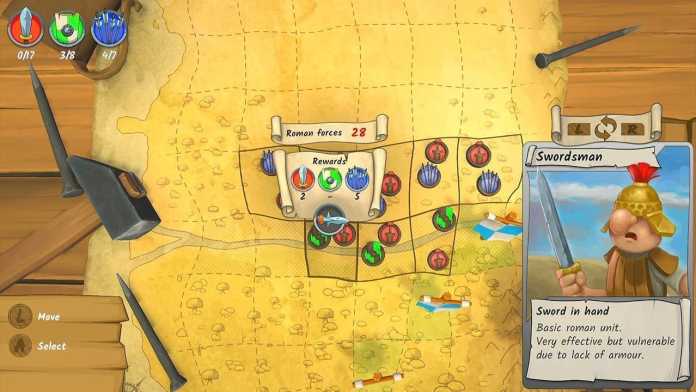
The game campaign is separated by tiered battles and during each layer, you are issued a set of troops. Whether these troops live or die matters not. Once they are used, you never see them again. You must judge the difficulty of every fight from the limited information given. You set your troops, plan your approach, and hope your tactics are correct.

It’s all-out warfare.

Winning is bittersweet.

Victory earns you extra troops, magic, or traps. Failure is humiliating and hinders your next battle. The unfair challenge and my biggest gripe come from the imbalance in the tactics. As you start a level, you place your troops in a green box. You know where the enemy will be placed because of a red box. You create a plan, set your troops off, and realise that the opposing force is in a different area altogether. Your approach is wrong and you fail miserably. It’s impossible to plan, as you don’t know what the enemy is doing. It’s unfair because they know exactly what you will do, and this gives them an advantage.

Death and failure are guaranteed, as are frustration and rage. I’m rarely disappointed by games, but Gallic Wars: Battle Simulator is disappointing! Conceptually its sound and its unusual take on the genre should be applauded. However, its execution is so poorly balanced that it’s devoid of entertainment and feels unfairly chaotic throughout.

I desperately wanted to enjoy it, but attempting to get through the campaign was like walking through quicksand. There is a lot of effort and you can see the finish line, but you never get there and death is all but certain.

Gallic Wars: Battle Simulator is basic to look at and lacks detail.

Gallic Wars: Battle Simulator’ issues stem from the lack of visual details. The simplicity of its graphics makes it tough to know what to do and how to use the environment to your benefit. It’s not unfair to say I’ve seen better quality mobile phone games that are also more in-depth. On a large screen, the images are so washed out that you struggle to identify units and your tactical choices. I did however like the use of vibrant colours and the Asterix and Obelix style art used for the still images. They are high quality and I wish this had been the standard throughout.

The audio was also so, so. The music had a hearty feel and was full of oomph and drama and the sound effects were loud and replicated the battlefield brilliantly. Sadly, though, the acting was dry and lifeless and attempted to drive humour into the bland gameplay. For me, at least, it failed. It wasn’t the worst audio I’ve heard; I was simply left uninspired.

Use the bridge to stem the flow.

The weak tutorial undermines the control setup.

Tutorials should fill you with hope and confidence that you’ll overcome whatever the game throws at you. The tutorial in Gallic Wars: Battle Simulator successfully muddies the water and leaves you confused. You’ll hammer the buttons aimlessly trying to set traps, change troops, or activate magic. It was frustrating and makes a tough game an awful lot harder.

If this was simple to play and had a clearer concept, it would be super addictive. Controlling a Gaul is an interesting idea, especially when you have lots of tools at your disposal. In its current build, you’ll be turned off, and turn off quickly. It has few redeeming features that’ll make you keep playing.

Gallic Wars: Battle Simulator: an unfulfilling game that has plenty of potential.

Being negative about games is never nice, but Gallic Wars: Battle Simulator is an unfulfilling mess. With a wonderful concept and unique take on the genre it had such potential, it’s a shame it failed to fulfil it. With confusing gameplay, unbalanced tactics, and nondescript graphics this isn’t a game I’m willing to recommend. If, however, you want to try it, you can here! The Gauls wish to overthrow the Romans one battle at a time. Are you the man to assist them, or will you give it a miss? 

Review: Roguebook

Repetition is the name of the game. Well, the name of the game is Roguebook, but repetition is a big part of the experience. Prepare yourself to try and fail, and then try again only to fail again. This process shouldn’t discourage you from trudging on though. You’re supposed to lose. Only a great mind or near impossible RNG could hope to get you a win on your first run. 

Welcome to the Roguebook

You’re trapped in the Roguebook, the name of the book you’re imprisoned in, as well as the game you’re playing. A handful of heroes all find themselves captive within the Roguebook’s pages. The only hope for escape is to overcome the challenges and hordes of enemies residing in the book of lore. Which there is no shortage of. Even when you’ve beaten the game for the first time, you’re far from done. That’s if you want to see and do it all. 

Roguebook is a roguelike (Hence the name, I’d imagine) deckbuilder where your death means something. Not just by way of your death being permanent between runs, but also through its role in progression. Failure is a part of Roguebook’s gameplay loop. It’s expected of you to take a good couple L’s if you want to get anywhere. That’s because with every death you gain an advantage for the next run. 

The roster of characters level up at the end of every trip into the book, provided you’ve selected them for your party of two. As they level up they gain cards which are permanently added to their inventory. Such as Seifer’s Absorb Soul card which when dealing the killing blow to an enemy, will replenish some HP. As the group levels up they gain access to more powerful gems that you can either buy with gold, or find in gem stones by chance out in the field. Either way, you’ve got to get out there. Fight and explore till you come back with something to show for it. 

Ink and Blood

Roguebook is interesting in the way that it requires you to explore the world, or more accurately, the book. The only way to move around is to fill in the blanks so to speak. The world has empty squares that are inaccessible to you until you reveal them with the tools essential for filling in the pages of books. Paintbrushes and ink. The only way to step on a block and traverse the tome is to make use of these tools. And the only way to get your mitts on some ink and paint is to fight. Every normal battle has a chance to drop a type of ink or paintbrush effect. Whether it reveals three or four spaces in a straight line, or allows you to pinpoint or expand a brush’s area of effect. Elite battles, however, always drop paintbrushes, giving you a fitting reward for the increased risk and challenge. 

Now of course you’re not shoehorned into this explore and fight loop. You could make a beeline for any given chapter’s boss battles and use your default number of paintbrushes to dodge the fights leading up to them. However, it’s always in your best interest to slowly reveal the world and the secrets it holds. So unless you’re going out of your way for a challenge, the game works best as a journey to find everything. 

Paintbrushes and ink are your best friends. Without them you’ll be going nowhere fast. And without the ability to explore the environments, you’ll be missing out on a lot. Like new cards, relics, gems, gold and health canisters. Through your travels you’ll also be picking up pages of the roguebook itself, called embellishments. Though, I couldn’t really wrap my head around how you’re in the book, walking across it’s pages while picking up it’s pages. Anyway, these pages you collect act as attribute points for a skill tree. Spending these points grant permanent buffs, and increase the chances of finding useful items in game, such as health canisters. Everything you collect in your many runs will be vital if you wish to have any hope of becoming powerful enough to escape the Roguebook. You’ll need every advantage you can muster. 

Once Upon a Time

However, Roguebook is not just filled with relics that grant heroes advantages, and gems which you slot into cards for extra benefits like, reducing its cost to play. It’s also brimming with stories ripped right out of the roguebook. These are small narratives in the form of scrolls, which pose dilemmas to you. One story, for example, might have you choose between sharing a drink with an ogre at a feast or gorging yourself with food. The former has an equal chance of a bad or good outcome, as do many nights of drinking. The latter however, increases your max health, but you draw one less card every turn during your next battle. 

These narratives do not always have a pleasant option though, some come with all risk and no reward. This leaves you with the choice of whether or not to interact with the scroll at all. You could potentially gain an invaluable gem, or end up in an unexpected fight for your life. 

In terms of story though, its a little paper thin. You get a short cut scene before you start, hyping up the roguebook. A little bit of basic dialogue about where you are and that you need to escape. However between that and the little slices of story found in the narrative scrolls, it didn’t feel like enough. At least not enough to get me engage in any kind of plot.

Each run is procedurally generated. So while you might see familiar cards, gems and narrative scrolls. When and where you find them are different for each expedition. However, at times it can feel like you’re at the mercy of RNG and in those cases the generation did feel a little questionable. Some runs there might be a health canister drought, and others will see lackluster relics strewn all across the field. Therefore in the early stages it becomes a lot harder to achieve victory on your own merits. While the key word in RNG is random, the runs where nothing went my way, lost some of the balance I felt should be present in every playthrough. 

Read ’em and Weep

The battles in Roguebook are unsurprisingly where the game is at its best. The wonderfully large number of cards (around 200) across the four playable characters make it so that each and every playthrough has a different array of options available to you. Even when those presented to you, aren’t your first choice, they still give you a fair shot at success. I can’t think of any instances where cards felt completely useless. Everything gave you a leg up. Everything had a purpose and every hero had a range of cards suited to them and their play style. Be it Seifer’s rage-based offensive capabilities, or Aurora’s buffs and frog ally cards.

However, on the downside, I felt that there could have been more synergy between heroes and their cards. Outside of Aurora’s buffs to increase the power of her allies there was very little interplay between cards. The best of the bunch, and my favourite hero was Seifer. When on the receiving end of damage, he goes into a rage, revealing a secondary effect for his cards. Most of the cards available did one of four things for the most part. Inflict damage, block damage, summon allies, and add power to yourself/reduce an enemies power. There are exceptions to the rule like inflicting bleeding damage or ensuring the next hit is critical. But a little some more variation in what unique cards did, or how heroes could play off of one another would have been highly appreciated.

So Much to Do, So Little Time

This title is generous in its variation of layout, number of gems/relics and the cards you add to your arsenal. However, it’s even more generous with post-game content. New game plus is where you’ll be spending most of your time. Once you’ve beaten Roguebook for the first time, you find that there are modifiers that add a little extra challenge. When you stack that modifiers increasing the levels of your new game, they present a considerable challenge. There are 20 levels of epilogue to enjoy that add challenges. Such as one that removes any clear path to a boss, forcing mindful exploration, lest you strand yourself in the book’s pages. You can combine these modifiers in a number of ways, allowing your to curate your own personal Roguebook hell.


The repetition of exploring, fighting and dying sum up Roguebook fairly well. Yet, it never felt aggressively repetitive. I always felt a sense of progress between each dive into the book. The procedurally generated world, and plentiful new game plus, held enough variation that I could confidently say I enjoyed every dip into the book of lore known as the Roguebook. It’s not perfect, but it’s definitely worth it.

Review: Bai Qu: Hundreds of Melodies

Life has a way of throwing out some negative experiences, but from these dark times, light and beauty can be found. No matter how strong you are, friends can be the crutch that prevents you from falling deeper. What would you do if your new friends also hit hard times? Would you be dragged down with them, or would you be the rock they desperately need? Bai Qu: Hundreds of Melodies explores this idea with its bittersweet plot and real to life imagery.

Developed by Magenta Factory and published by Ratalaika Games, this is a touching visual novel about love and friendship. A story that is supported by over one hundred CG images, Bai Qu: Hundreds of Melodies is fantastic to look at. It contains a long plot of around ten hours that has multiple endings to give the reader the impression that they are influencing the story.

It’s time to get uncomfortably close.

Bai Qu: Hundreds of Melodies is a well-paced and touching story.

The story is told through the eyes of Wei Qiuwu. He is a Chinese college student who spends his summer visiting his father in the hospital. During his trip, he befriends another patient called Li Jiayun. She catches his imagination because of her love and talent for music. The plot takes you on a journey around the vibrant city of Nanjing. Here the pair are joined by many eccentric characters. The story soon takes a turn for the worse as Li Jiayun’s health deteriorates, and Wei Quiwu becomes the crutch for his father and his newfound friend.

Bai Qu: Hundreds of Melodies explores its ideas in a slow-paced and relaxing manner. The relationships between the characters have real depth. This allows you to understand the bonds that are forming while enjoying the well-structured story. You’ll experience a range of emotions as it evolves and you may be conflicted about the over-sexualised images. This tale of love, loss, and friendship is oddly juxtaposed with smutty pictures of tight tops, enormous breasts, and sneaky underwear shots. It wasn’t offensive, and in some scenes, it would be suitable, but to have it thrust in your face repeatedly was a step too far.

The summer has taken a weird turn.

Limited dialogue choices and poorly translated words.

I’m no visual novel aficionado, but I have played enough to know the normal structure. It, therefore, stood out as odd that this one contained limited dialogue choices. There are multiple endings to experience, but I can’t see how the plot will alter too much when your influence is reduced to a handful of options. I like when you have the chance to change the direction of the story as it gives you a sense of ownership over the plot. However, this visual novel feels like a traditional book from beginning to end. This is great if you want a relaxing and laid back experience, but for gamers who want a bit more buy-in, it appears cold and standoffish.

I also instantly highlighted many poor grammar choices and incorrect uses of words from the opening scene. Now, this wasn’t an issue as I could read between the lines, but when a game relies solely on its text to sell its ideas, it should have been proofread at least one more time. The poor turns of phrase also impact the emotional attachment to the lead characters. It was clear what the intent was in all chapters, but the badly translated text was occasionally cold and gave the protagonists a lack of depth.

Bai Qu: Hundreds of Melodies has a fantastic style.

Now, I may not like the constant sexual images, but I love the CG art that is used throughout. These crisp images add realism and work perfectly with the plot. The touching narrative is enhanced by the true to life surroundings. In my experience, it’s rare for a visual novel to present such detail. With clear influences of Anime and Manga, the female characters have larger-than-life assets that will appeal to many players. Animation is shown through small changes in facial expressions and images fading in and out of the shot. It’s basic but works well alongside the constant flow of text.

The audio adds a wholesome atmosphere to this touching tale. There are moments of drama and suspense and these are reflected nicely with a sudden change in tempo and mood. The soundtrack acts as a nice distraction from the lengthy and in-depth story.

Limited choices = a simple control setup.

Is this real or a dream?

Grab a drink, get comfy, and put your controller on your lap. Set the pace, select auto, and watch the text unfold before your eyes. With limited dialogue choices, the use of a controller is kept to a minimum. You may as well sit back, relax, and take in everything that Bai Qu: Hundreds of Melodies offers. 

With its multiple endings and many CG images to see, this has some replay value. There is the option to skip text that has been consumed, so you needn’t waste your time unnecessarily. The story captures your imagination, so reading it again isn’t a chore. You’ll need to play it several times to unlock all twelve achievements. I suggest setting aside around twenty hours to finish this off.

Bai Qu: Hundreds of Melodies is a wonderful tale of friendship and sorrow.

The well-written plot will resonate with most gamers, even if the translation is off. The beautiful imagery, matching audio, and slow pace, allow you to relax and enjoy its many twists and turns. The skimpy outfits were a step too far and weren’t necessary, though I’m sure many players will appreciate the “artistry”. I enjoyed my time with it and recommend you to buy it here! Sit back, relax, and soak up the wonderful images and touching plot. 

Review: Where the Heart Leads

Do you ever wish you could redo the big decisions made in your life, even just out of curiosity? Let’s be honest – not even Doc from Back to the Future screaming at us at the top of his lungs not to mess with the past would stop us.  

Thankfully, Armature Studio is here to help with Where the Heart Leads, a butterfly effect story adventure that allows us to explore this fantasy situation throughout our protagonist’s life with each choice affecting narrative paths, characters and even the design of the levels.

I adore the artstyle even down to the animation of entering a building and the camera view of the building interiors.

You are in control of Whit, our protagonist, who falls down a huge sinkhole on a fateful night and soon starts to relive his life infront of you, with the game asking you to navigate the difficult and formative decisions that shaped his life. He is a down-to-earth, run-of-the-mill guy without a particular calling in life – the perfect candidate for some sweeping changes.

Fans of narrative games will notice influences from Life is Strange and Everyone’s Gone to the Rapture, for its gameplay and character interaction respectively, but these are not just ‘borrowed’ features from similar genre-games, quite the opposite, in fact, they feel improved upon and better implemented than in the aforementioned critically acclaimed games.

With a melancholic soundtrack and beautiful cartoon visuals setting the mood, Where the Heart Leads combines a mundane country setting with the surreal context of Whit’s situation and feels much like a dream-like state, shifting around the environments in a manner where you can’t quite be sure if its real-life or imaginary.

When I said I wanted a bath, I didn’t mean literally.

What is immediately obvious though is how grounded and relatable it is, grabbing your attention and never relenting. Sure, you are living someone else’s life, but the sheer number of moral choices available start to echo your own personality, and the issues that come up – the pressure to be the best father possible to your children or child to your parents and how to navigate fractures in your family – all hit the same emotional chords as they do in real life. At times uplifting and others heart-breaking Where the Heart Leads provides a tremendous interactive human drama on a scale rarely seen in video games.

These guys don’t forget the decisions you made earlier in your lives. The length of time this game spans – Whit’s entire life – is a first for me and is really quite epic.

A lot of what makes it feel different is not in its breadth of choice, but is due to its pacing. Normally, an atmospheric story-game with minimal gameplay draws out its most atmospheric sections for greater emotional effect, but can on occasion, slow down the proceedings to a crawl and adversely affect the experience. Where the Heart Leads, on the other hand, manages to foster its emotional sentiment while maintaining its pace, allowing you to while away the hours without becoming bored. 

Secrets man, who needs them?

Furthermore, the game does a great job building the characters and narrative naturally. This isn’t just a ‘Yes’ and ‘No’ game of twenty questions, the sense of realism and the developer’s quoted amount of ‘thousands’ of decisions make it feel like a life that could have gone in any direction, not just the one subscribed by the developer. I attempted to maintain a healthy equilibrium of happy wife, kids and family by sacrificing all personal opportunities to further theirs, and was so satisfying when Whit reminisced about one of my successful decisions as I felt like I had actually helped someone dear to me achieve something rather important. Funnily enough, I may have ended up being too willing to let others expand their horizons with characters making mistakes that I could have informed them better on with better advice. But like in life it’s only natural to cheer on your family regardless of the consequences.

All it takes is a couple of different decisions and the direction of the town and/or people can be completely changed, as well as your experience of it as access to certain areas are tied to these decisions.

Almost every major component of this picture – the tree, the traffic lights, the shop sign in the background – is made by you and your brother and you can change how it looks. But remember, there’s a whole town of people you need to please with this art…..

Take one example where Sege, Whit’s eccentric and perpetually poor artist brother miraculously has two options to sell some of his artworks. One option would give him more cash but would also see him disheartened as the works are dismantled in front of him, and the other displays them across town, potentially to the chagrin (or pleasure) of residents. Then Sege needs to find himself a place to live. Does he move into the loft apartment downtown with ample space for his art while potentially bankrupting Whit and family who need to cover part of the rent or does he continue to live cordoned off from society in a trailer on Whit’s wife’s spare land?

It’s quite hard to describe how epic it felt to be the maker of this heartfelt emotional rollercoaster, with each of these decisions feeling grounded but also very meaningful due to the connection you feel with the characters. 

Call the publisher ’cause we’ve run out of superlatives! This stunning story sets a new standard for choice-based adventures with incredible depth both in the number of lateral branching choices, but also in its realistic storytelling and characters. There are some areas that could have been improved or added, such as voice-acting, but as they fall on the side of ‘would have been nice’ rather than ‘necessary’ it’s hard not to call this an almost perfect game, one that has made an indelible impression on me and one that I won’t be putting down for quite some time. 

Review: Kowloon High-School Chronicle

Kowloon High-School Chronicle is a mad grab-bag of a game. Half Tomb Raider and half Japanese high school simulator lovingly joined together with all of the precision and grace of Jeremy Clarkson with a chainsaw and prit-stick.

You play as Kuro Habaki, a member of a treasure hunting society bent on recovering lost artefacts from an ancient advanced civilization (think proto-space suits and that skull from the Indiana Jones film we don’t talk about). By day you’ll be talking your way through high school drama, avoiding the pitfalls of being the new kid in class and building relationships with your classmates. By night you’ll be working for your society, exploring the ruins below the school with the classmates you can convince to come along, hunting for treasure, solving puzzles and fighting the creatures who protect it.

The tomb raiding sections are honestly superb, it feels like a cross between James Bond and Indiana Jones. It’s a fairly standard dungeon crawler, where you navigate through a linear series of chambers to get to your objective. To pass through a room you’ll need to solve a puzzle written on a giant stone tablet. These are relatively simple but written a little cryptically, so you feel smart when you solve the puzzle but don’t have an awful lot of difficulty in doing so – like you’re bowling with the barriers up but the barriers are invisible and the bowling ball is made of knowledge. The puzzles are along the lines of ‘When the row of nether gods face south from the sunrise, an island to the heaven surfaces’ – meaning you need to face a set of Anubis statues away from an image of the sun to raise a platform to allow you to cross some water.

Intermixed with the puzzle-solving is some tasty RPG turn-based combat. After all, these tombs aren’t undefended. Creatures have made the labyrinthine chambers their home and the ancient civilisations left mechanisms to defend their treasures. You have a series of starter weapons that you aim manually like a first-person shooter: a knife, a gun and grenades, all managed stamina bar that determines how much you can use each of them within a turn. The enemy has a similar system on their turn. Then it’s a simple matter of killing the enemy before they kill you – easy. Or, when the enemy happens to be a nightmare scorpion (regular readers may know I have a significant phobia), it’s time to dock the Switch and play through squinted eyes from another room – less easy.

The other part of the game is less superb. And, much like Sakura Wars, another Japanese game I reviewed for this site which is a mix of RPG action with relationship building and talking, the balance of those two sections is skewed significantly towards the talking, meaning that the fun tomb raiding and RPG fighting in Kowloon High-School Chronicle is the minor part of the game, and you have to sit through a lot of high school nonsense to get to it. I accept this is a strange criticism for a game that promises to be a high school simulator in its title, but I was excited to have my expectations subverted in the opening tomb raiding section, only for the game to whip the rug out from under me and revert rapidly to type.

Through this section you’ll be chatting with other high-school students, mostly women as it’s one of those games where you build ‘relationships’ with the characters with which you interact. The main way of influencing the game in these sections is through dialogue options where you choose one of nine different emotions you wish to convey in your response. I find this system quite awkward for two reasons, firstly the word for the emotion is written in a cryptic and difficult to read font, meaning the first few choices I made I had no idea what I was doing or what the symbols were showing, and secondly because the emotion word doesn’t give a lot of information about what you’re going to say, meaning you’re mostly working with guesswork. It’s much like the dialogue choices in Fallout 4 that drew a lot of criticism. I didn’t see much reason to not choose ‘Joy’ every time and maintain a positive and friendly attitude with everyone.

On top of that, there are a few quality of life issues. The movement controls are different from every other game you’ve played: left and right turn you 90 degrees, back turns you 180 degrees and forward moves you forward – so you have to spin to the direction you want to go and then go forward. It’s not inherently awful but takes some getting used to.

The other thing is the HANT system, which is basically the Pip-Boy from Fallout. It announces useful information about combat: when your turn is over, what you have selected, that sort of thing. Except it’s in Japanese by default, with no subtitles when the rest of the game is in English. So a random Japanese lady is yelling at you when you’re already in a high-pressure combat situation. At least until you go and change it to English in the menus. The HANT also launches a little tutorial piece of text whenever you find something new in the game, for example, the first time you have to jump. This takes control away from you and takes a least 10 seconds to navigate itself through the menu to give you the tutorial. This gets frustrating after a few times, especially as you can’t skip it and it’s giving you unnecessary and obvious information. It’s like the game desperately doesn’t want you to experiment or work anything out for yourself.

Kowloon High-School Chronicle lost me with its title, won me with its opening action sequence and lost me again with its high school simulating. If you like a high school sim, Kowloon High-School Chronicle might be the perfect game for you, with the simulation broken up with some brilliant RPG puzzle and combat sections, all driven by a genuinely interesting premise. However, if, like me, you’re not a fan of the genre, Kowloon High-School Chronicle is unlikely to win you over and may feel disappointing when there are some generally fun nuggets of gameplay buried in with all the rest.