A really strange, but unique experience to say the least. Described as a rejection or sociopath sim, which it certainly lives up to.
We play as Nicole, a girl with clear issues as she has moved home for the seventh time due to her mothers many divorces along with her fathers suicide, which she often jokes about. We land at a new high school where Nicole has begun to notice her looks have improved, thus people’s interest in her has increased. Nicole doesn’t care for the attention. In particular, attention from men and doesn’t want to be a pushover.
The humor is quite dark and crude, so if you’re easily offended this game is not for you. I’m not though and I found the game to be pretty funny at times. It’s well aware of typical high school stereotypes and mocks them. There’s lots of cursing, but for teenagers I suppose that’s normal. The dialogue would sometimes shift to something realistic then to something outlandish. For such a strange story it makes sense however.
The game is fully voices and well voiced at that. Nicole’s tone is always well preformed and the characters such as the generic nerd and bully are voiced in a satirical manner, which was funny since it’s so self aware.
The choices you make have huge effects even ones such as not going to class can change your ending. Speaking of there’s multiple endings and some drastically different from others. I would even say some would be controversial to those easily triggered. Nonetheless having all these endings makes replayabilty enjoyable. My first playthrough took around half an hour, but even with different endings the game is rather short.
One great feature was to be able to make a different choice at different points in the menu and play it from there. Rather than having to go through everything again from the start, which was a welcomed feature. It saves at multiple points automatically for you, so no need to go through tedious amounts of dialogue you already know.
I wouldn’t say the story is memorable, but the endings are undeniably memorable. The choices were limited, yet they had impactful effects on the story and dialogue. None of the characters were that likeable, still I didn’t dislike them. Nicole felt realistic even though her personality wouldn’t be a common one. The good voice acting really carried the games dialogue and in hand the funny dialogue at times carried the story.
Class of ’09 giving the player a moral dilemma.
This is a very niche game and it is definitely one you’ll enjoy or wont be able to stand. The games humor bodes well most of the time and it was worth replaying to see different dialogue and endings. Class of ’09 feels like a huge satirical piece on romantic simulation games and even stereotypes in general. The price of €12.50 is perhaps a bit much for such a short game with only dialogue. Although, I definitely won’t forget Class of ’09 anytime soon.
Take a look at this game, Loop Hero, and you’ll probably dismiss it as “another one of those retro-loving indies”. Yes, Loop Hero looks like a SNES game. Indeed, its graphics are pixelated and too simple; you are a small hero that looks like… something, a skeleton maybe, build on basic animations and zero details. Another dungeon crawler, another roguelite, by the looks of it. Well, dungeon crawler and roguelite are terms that are needed to describe Loop Hero, but they are by no means enough.
You see, this little game punches far aboive than you’d except and works far better than it should be allowed to. It’s a weird experiment, a strange mix of genres and mechanics, a combination that sounds too niche to be fun, or even to exist. It’s a part rogulite, a bit RPG, it utilizes loot, turn-based combat and even cards, it has a story and can eliminate your free time -and you’ll love it.
The only entry point is that you must be tempted by this description. If rogue-card-RPG sounds even a little enticing, chances are this will be one of your favorite recently released games. If it sounds like trouble, well, better stay away. Loop Hero is, after all, very strange.
First things first: yes, this weird mix has an actual story and surprisingly it isn’t just filler material. This is a genuinely well-written plot, engaging, full of character and personality. The dialogues are the star of the show, charming, funny, interesting fun but also somber. Moreover, the story does a great job making the roguelite elements feel plausible. In Loop Hero’s world, everything has disappeared. There is no color, mountains don’t exist, rivers, forests, land and sea are all absent; the world is now a black void. Nobody can even remember how it used to be, everyone has forgotten. So, it falls upon you, the hero, the one who can actually remember the previous state of the world, to reconstruct it.
This premise is expertly designed and creates the canvas on which the game builds its story, lore and gameplay. Yes, the gameplay is also built on the black, empty void. If you watch a trailer or a gameplay video, you’ll see that the little ghostly knight walks in a circle, with empty nothingness all around them. Here lies the core concept: Loop Hero doesn’t give you control. You don’t control the hero’s movement, you don’t control the way they fight. The hero walks, in a circle, looping again and again, and you help them remember by placing memories to form a place. Memories are cards, of course, and there are strict rules to follow. You can place a mountain here, a river next to it, a village down further and some spider-monster nests near a road.
This way, you actually form the terrain on which you walk but also the difficulty, all at once, because everything you meet as you traverse the loop is placed by you. Terrain cards can give you boosts, raise your max health for example, and there are some secret combinations to discover that invite a lot of experimentation. Why would you make the game more difficult, then, if it’s entirely your choice (and also affected by a bit of luck, for sure, as your deck of cards behaves like, well, a deck of cards -you build it, but it’s handed to you in random card order), what’s stopping from just chilling in the black void?
You have to try and find balance, creating a world full of buffs and boons for your hero, but also filled with dangers, traps and enemies. You need to place cards on the world, because, if you want to face the boss and end the stage, you have to fill a bar that’s filled, yes, by placing cards. It’s a matter of balance, of choice, of finding the right moment to raise the stakes, when you’re well equipped to face the harder foes. Enemies give you loot, after all, so you can get better weapons to destroy what’s coming and, mind you, Loop Hero’s combat is hard. Every loop you complete raises the enemy level, so you can’t just take it slow either. It’s a perfectly balanced system, incredibly fun and addictive, well-designed and constantly surprising.
Interesting on its own, the gameplay system gets even more fascinating because of its choice-based difficulty. Loop Hero couldn’t be an easy game; its influences certainly lie on the difficult side. Although, instead of making you face hard challenges and intimidating foes at set or procedural stages, it mixes things up by having you call the shots, shaping the landscape and level of difficulty as you go. It is a good, original idea that fits this particular genre(s), and it’s made with care and attention.
Some problems do arise if you play for a long time -it takes around 30 hours to finish a playthrough- because it does get repetitive and some skills take too long to unlock. Also, the PC version is the better choice to play this game, even if the Switch port tries its best. The lack of a mouse can be felt and if you’re playing on docked mode you’ll encounter some frustrations, as the touch controls are by far the most convenient scheme. Even on handheld, though, you’ll see that the UI is not perfectly implemented to take into account the smaller screen. However, any way you decide to play, you’ll find that Loop Hero is a beautiful experience that takes advantage of its pixelated SNES graphics and throws in some great music too, to create a singular, atmospheric loop that’s as fun as it is memorable.
No problem is enough to detract from all the things Loop Hero gets right, thankfully. It’s full of ideas, excellent in their implementation and unusual in their concept. It merges different genres successfully and will rule your every thought for some days. The enthusiasm can wane over time, the narrative is a bit sparse, but this is a delightful game, full of heart and character, bursting with originality and excellent mechanics. If Loop Hero sounds even a little fascinating to you, just go for it and you won’t regret it.
When a product has been available for nearly six years and still it’s being worked upon, it makes me excited. If you then add in a simple concept and exciting and amusing theme, it should be a winner. Well, this is the basic background for Who’s Your Daddy?! a ridiculous conceptual title that has captured the interest of the gaming community.
It has been developed and published by Evil Tortilla Games and was Kickstarted with a $1500 backing. It is a Game Preview multiplayer parody simulation title similar to DEEEER Simulatoror Goat Simulator. In its current build, it has many locked areas, and it’s missing some key elements. However, this doesn’t stop you from playing, and there is some enjoyment to be had.
Who’s Your Daddy?! is absurd.
Who’s Your Daddy?! stands out from its peers because it lacks a story. Its core gameplay revolves around online or couch co-op multiplayer action. This idea is wonderful in theory, but in reality, it can quickly become tiresome. Luckily, though, its absurd set-up helps to alleviate the monotony while adding a sick but amusing twist.
The action spans four game modes; 1v1, 4v4, Daddy’s Nightmare, or custom rules. Whichever you choose, you get a short match that follows a similar pattern. You must pick team Daddy or team Baby, and then all hell breaks loose. The Dads must care for their babies as they pick up deadly items and try to kill themselves. The babies, however, must escape their father’s attention and cause as much mischief as possible. Whatever happens, you are guaranteed to giggle as things rarely go to plan.
Who’ll blink first?
Conceptually great, but lacking balance.
The idea behind Who’s Your Daddy?! is equally brilliant and ridiculous. Snatching items from your toddler while forcing food down their throat is both rewarding and sinister. Likewise, it’s bloody amusing to pour petrol everywhere and burn down the house as a baby. Furthermore, it was excellent fun to evade capture by sneaking through crawl spaces or consuming potions of invisibility.
However, much of the enjoyment is tarnished by some very noticeable issues. Sadly, each taints the game’s balance, and this makes it infuriating to play.
The first noticeable complaint lies within the 4v4 lobby. The description implies balanced sides, yet every game I played had me as a daddy taking on 7 babies. Aside from the constant laughter as 7 rugrats crawled around ruining my life, it was impossible to win. When you have no fighting chance, there is zero enjoyment to be had.
The second problem is that most of the map is locked. Now, I know this is still in development, but the playable area simply isn’t big enough. Furthermore, what has been created unfairly favours the baby. Nearly everything is deadly, and there isn’t enough to counter it. In short, team Daddy will always struggle.
Finally, the action is confusing. Now, I enjoy a nonsensical title, but there is little structure to define how you win. Free for all action is all well and good, but I want goals. Going forward, the developers should structure each match to define the winning criteria. In its current build, I believe its longevity will be adversely affected.
If only it was always this clean.
Who’s Your Daddy?! isn’t groundbreaking.
I’ve covered many of these simulation titles and all of them look similar. Where Who’s Your Daddy?! stands out is its differing perspectives. It was great to compare the world through the eyes of each team. As a baby, everything is larger than life and this was a great move. Whereas, the adult has full scope to plan and move objects out of reach. This element of the game was well delivered while retaining a colourful and cartoon approach.
The mischievous nature of the gameplay is enhanced by the naughty soundtrack. The blend of baby noises and catastrophic booms will make you chuckle. If you then add in the sounds of machinery as well as the playful splashing of kids enjoying the swimming pool, you have a bizarre and eclectic blend. Fortunately, this was another layer that works brilliantly and it can only improve as the game expands.
Not the safest option.
The controls are lacking.
Much of the action relies on a floppy physics-based style and this will frustrate some players. I didn’t mind this, as it has little bearing on the gameplay. My problems, however, lie somewhere else. As the dad, you are tasked with loving and protecting your child. Yet, you can’t pick them up, other than to feed them. Moreover, you can’t prevent them from leaving a room, nor can you put them back in their crib. The developers need to alter this to even up the playing field. Other than these issues, the controls are well mapped and are responsive.
Four game modes is a good return from an inexpensive title. Though they are conceptually similar, they are unique enough to add to the longevity and replay value. This will improve further still as the game expands and more elements are added. Sadly, its current build is limited and this forces you to play casually rather than for hours.
Who’s Your Daddy?! needs a lot of work.
I appreciate that bringing a game to market is a long and arduous task. Furthermore, I also understand it’s easy for me to highlight the shortcomings. Yet, Who’s Your Daddy?! has lots going for it, it just needs a few tweaks. If the developers can get the balance right and expand the action, this will be an enjoyable title. The graphics are good; the sound adds to the fun, and the concept is ridiculous. It has a bright future and you can experience it here! Being a parent is tough enough, but these babies don’t care! Can you protect them, or will they get their own way?
Summary.
Who’s Your Daddy?! is a conceptually amusing title that’s held back by its imbalance. The developers have some minor elements to focus on to make this reach its potential. Its graphics are as expected, but I loved the combination of each perspective. Furthermore, its audio is fun and lighthearted while having a mischievous twist. If a defined goal is added to the action, and Team Daddy is given better powers, the gameplay will be improved vastly.
(Reviewed on the Xbox Series X. Also available on PC, Mac and PlayStation.)
Now, I love a challenge as much as the next gamer, in fact, maybe a little more. Call me sadomasochistic, but I don’t care! With challenge comes reward, and I like to think my effort makes a difference. However, Battle Brothers pushed me beyond my comfort zone. It’s a title that keeps taking, and taking, and taking! Yet, I couldn’t put it down!
Developed by Overhype Studios and published by Overhype Studios and Ukiyo Publishing Limited, this is a tactical RPG that’ll break you. It opens with a warning about its difficulty, yet I stupidly thought I was better. I ignored this message and jumped right on in, and this was the first of many mistakes. Annoyingly, Battle Brothers is brutally hard, but oh so moreish, and subsequently, you can’t walk away. Due to a lack of hand-holding, you will experience an awful lot of trial and error, and you’ll fail more than you’ll succeed. Yet, this matters not as you dust yourself down, and try again.
Battle Brothers is a balancing act of finances and violence.
Going to war with your band of brothers is an honourable thing. You have each other’s backs and will stop at nothing to get the job done. This is the core concept behind Battle Brothers. It’s a medieval tactical RPG that blends business simulation with all-out warfare. The story opens with bloodshed and the loss of your commander. Consequently, you must step up and take control of your mercenary army, and the fate of this group is now in your hands. With limited resources and a small team, you must build a reputation while becoming wealthy.
Sounds simple, right? Wrong! Everything that could go wrong will go wrong. Contracts will be failed, men will die, and you’ll run out of cash almost instantly. Yet, if you can overcome these obstacles, you may be able to build a renowned group of heroes that every town and village can rely upon. Set in a vast Germanic world, you must march from village to town to complete contracts, trade wares, and hire fighters. You must decide the path you wish to take and decide whether you wish to be honourable, or profitable, or hopefully both.
A battlefield strewn with bodies.
The world is your oyster.
The developers have allowed you to decide your own path. You hire who you wish, or more likely, who you can afford. You’ll equip them as you like, and pick your perks, formations, and missions to undertake. These planned moments lull you into a false sense of security, as luck plays a massive part in this tactical title.
You may set up your army for one type of fight but accidentally stumble into something completely different. Your team may be armed with bows, but these are ineffective against shields. You could pick smaller and quicker weapons, but these will cause little damage. Or finally, you could go in with maces and be slow and cumbersome. It’s best to plan for all eventualities, but even this isn’t always possible.
Money makes the world go round, and you never have enough of it. Luckily, you are free to explore the kingdom as you see fit. You can work with small hamlets to pick up tiny contracts and build a fine reputation, or you can trade and help noble houses to get a name for yourself. Whatever you pick, the world is your oyster and, as long as you have money and food, you can explore to your heart’s content.
The world map is enormous.
Distinctive layers.
The gameplay is split into three distinct layers; the world map and settlements, party management, and finally, the battlefield. These entities take some getting used to, but once you understand the finer points, they are easy to navigate.
The world map and settlements.
This is where you spend much of your time. This wonderful 2D map is covered by a fog of war. The further you explore, the more secrets you discover, and each playthrough is unique thanks to the map seeding system. You’ll discover hidden tombs, creepy graveyards, and dilapidated buildings that house criminals. Fortunately, the world is full of surprises and will keep you focused throughout.
The settlement screen comprises an array of shops, taverns, and men willing to join you. Here you can pick up contracts, kit out your crew, or improve morale by getting drunk in the alehouse. These boltholes offer a welcome break from the unrelenting action as well as adding some structure to the gameplay.
Party management.
This was one of the most in-depth elements that define your chances of success. Here you can set formations, choose equipment, level up your warriors and select perks. I loved everything on offer, however; it was let down by its fiddly nature. Sadly, there is no way to compare weapon stats and everything feels drawn out. The developers needed to tidy this section up while making it more user friendly.
Battlefield.
Blood is spilt, soldiers killed, and brothers die in this wonderful 2D turn-based arena. You must utilise the environment to your advantage as you challenge unrelenting waves of warriors, the undead, and peasants. It’s an exciting game of chess that can fall apart in moments.
Can you distance your archers from your foes? If you can’t, they will get battered as they flee the Zone of Control. This one hex movement trap prevents friends and foes from escaping one another. It’s another example of the brutality of Battle Brothers, and another rule you must remember as you tackle each contract.
A confusing Ui with plenty going on.
Battle Brothers has a Monty Python-esque appearance.
Unsurprisingly, this brutal title is gruesome to look at! Skulls are cracked, limbs decapitated, and blood spilt as each war is fought. Yet, there is a distinct Monty Python-esque appearance in the character models. Your icon hops across the world as you travel between cities. Furthermore, each of them has a unique look on the battlefield. This eye for detail was fantastic and added some colour and fun to an otherwise miserable blend of earthy tones and broken bones.
With so much death and disaster, you may worry that the audio is overbearing and sombre. However, worry not as the folksy soundtrack adds to the medieval and Germanic theme. I loved how the music transported you to the era while adding a lighthearted edge. Furthermore, the realistic sound effects add energy to each scene. Whether it was the horses neighing or the clash of weapons, each moment was wonderful to experience.
The User Interface needs work.
With so much going on, there was always likely to be issues. Sadly, this was seen in the overly complex UI. Thanks to its cumbersome ways, it taints the action. The poor controls don’t detract from the amazing gameplay, but they make it considerably harder to master. Unfortunately, this is further compounded by the lack of a tutorial! You’ll have to put aside hours to learn the fundamentals while preparing to fail repeatedly. Consequently, a harder game is much harder still.
No matter how tough it is to play, you won’t be able to put it down. Battle Brothers is an addictive title that gets better the more time you invest. It oozes replay value while demanding you adjust your tactics and approach. Luckily, the action never becomes tiresome, and this is helped further by the map seeding system and the large array of quests. Completionists will have to invest many hours as the achievement list is enormous.
Battle Brothers is an exceptional turn-based title.
I’ve experienced many strategy titles and turn-based games, yet Battle Brothers stands out. It’s unbelievably difficult while being super rewarding. Moreover, no playthrough is ever the same, and this keeps you playing. I loved its brutality and theme and recommend you to buy it here! Will you be able to run your company of mercenaries, or is death all but guaranteed? Hire troops, buy the best equipment, and become a hero.
Trash Sailors is one of those games with a really brave name. It’s the sort of name that REQUIRES the game to be at least good. If it isn’t, the jokes, remarks and headlines available to smarmy game journalists like myself will write themselves. Take Quantum Break, a game that was ambitious, star-studded and (eventually) quite fun. Alas, it launched hideously broken and had “Break” in the name so every gaming news outlet could knock off at 2pm after bashing out the ‘hilarious’ articles on that turn of events. So let’s see how easy my job is today and whether Trash Sailors is, well, trash.
Trash Sailors pitches itself as a sailing ‘simulator’ for the most generous definition of the world simulator that I’ve seen since Surgeon Simulator called a heart transplant successful if the new heart was tossed in the general vicinity of an empty chest cavity. The aim of the game is to sail your ship from the start of a course to the end without sinking – gaining points for avoiding damage, completing the course quickly and collecting trash.
Various posts around a small rickety raft can be manned by yourself and up to 3 friends through online co-op or, if you don’t have any friends, 1 AI-controlled robot. Everything on the boat requires trash to function so you’ll need people fishing trash out of the water, compacting it into usable materials, fixing the raft with those materials and putting them into the engine as fuel. You’ll also need someone steering and people prepared for various events, such as fixing the lights, fighting creatures and fishing maps out of the water. Having a series of posts that all have different functions that need to be performed with significant time pressure feels a lot like Sea of Thieves. With 4 competent people, you can go for a leisurely sail with the craft handling like a well-oiled machine, prepared for anything the world can throw at you. With 1 incompetent person, you can handle the craft about as well as that time Chris Hemsworth crashed the USS Kelvin into the Narada while piloting it solo in Star Trek (2009).
The main thing going for Trash Sailors is its appearance. I mean, look at the screenshots dotted around this page, it’s like the Mona Lisa had a baby with the Scream. I mean the art style of those pieces, the actual progeny of that union would be horrifying beyond compare, like a melting eyebrow-less witch-queen. All the art for the game is hand-drawn by some very talented people and every iota of time and effort spent is visible on the screen. Everything is so consistent that it’s like an artist’s sketchbook has come to life with almost visible pencil strokes and blending so smooth that it must have been achieved by a layer of Clearasil being applied after the initial design.
Unfortunately, the gameplay sometimes makes me wonder if the fantastic drawings that make up the game’s assets should have been left in the sketchbook. For full disclosure, I have only played the game in the single-player mode with the AI assistant and I fully accept that isn’t the optimum way of playing it. You would have a lot more fun in multiplayer, but the game ships with a single-player mode so that’s what I’m reviewing.
As a single-player game, there is just a bit too much going on to keep track of. If you leave the raft without any steering you WILL crash into something so you always need to be steering. This can either be done by manually steering by yourself and leaving the robot to the other duties (like randomly fishing out trash) and then running off the wheel during a clear bit of water to compact that trash and deal with other problems. This is what I did. Alternatively, you can put the robot on steering and do everything else yourself. However, when the robot is on steering duty it doesn’t actually steer, it just allows you to steer remotely while doing other tasks which, for me personally is a bit too much to think about. It’s chaos. And I don’t mean fun Overcooked style “chaos but everything is ostensibly fine”. I mean a “there is literally no way of doing this well” sort of chaos.
As a multiplayer game, I’m sure there is a lot to recommend Trash Sailors to the same cohort of gamers that enjoy some Sea of Thieves (although, I do think it might be a bit too easy with 4 people doing what is essentially 4 jobs). But, as a single-player game there is not a lot to recommend it. Absolutely beautiful but chaotic, difficult and almost unfair, I didn’t have a lot of fun with Trash Sailors beyond the first few levels. To make an easy play on words, Trash Sailors is far from trash but you might want to sail on by this particular ‘simulator’ as a solo player.
You find yourself in a monastery surrounded by crosses and tombs. It doesn’t take long for you to spot your first prey. You chase your next victim, but they manage to paralyse you using a cross. But they didn’t move quick enough, you hit them with a follow-up attack and they die…well sort of. They do come back. Rinse and repeat until you lose. This is A Way to be Dead.
A Way To Be Dead is a multiplayer horror arena game. It was developed and published Crania Games. They have two other games to their name: Beyond Extinct and Roots of Insanity…There is definitely a horror theme to their creations. Both of their previous games have received mostly positive reviews. So how does A Way To Be Dead fair?
Before getting into the review, the game is still in Early Access Game. So what I played may have changed and I hope it does as it has limitless potential on how it can be improved.
How Does A Way to be Dead Play?
There are two areas you can play in, one is a hospital and the other is a monastery. Both are very dark areas so there are very few cues at the hospital level that you are in a hospital. Once the area has been selected you are presented with either playing as the killer, as a victim or playing with the AI. If you play as a killer you host the lobby and if you play as a victim you connect to a killer’s lobby.
If you play as a killer you have to protect either graves or stones from the victims. Each killer has a unique ability to transform into a stronger version once the ability is charged up after killing victims. The monastery killer equips a large scythe while the hospital’s killer transforms into a four-legged monster. If a victim secures a key they can then escape the area. Should they escape its game over. But honestly, it’s game over as the killer doesn’t move fast enough to intercept the victims. This makes everything you’ve done worthless and really put me off playing any more of the game. Especially after killing the victims multiple times.
This makes everyhing you’ve done worthless
If you play as a victim, you have to avoid the killer and either destroy rocks/coffins or plant bones into graves. Once you’ve done this task enough you receive a key. You now have two exits to make your way to. You are also not alone, as there is up to 3 other victims who will be either helping each other or focusing on their own escape. This could be a great time for the victims to coordinate their attack. But currently, there is no reason to as escaping is so easy.
A Way To Be Dead’s Issues
The main issue is the escaping mechanic. This is an area that needs to be improved. Such as whoever has the key movement speed is reduced and is highlighted to the killer throughout the escape. That way it provides more technical fun for both sides.
There is a levelling up system, but they only upgrade stats by 1%. In its current state it doesn’t feel completed and can bring a lot to the game if it is fleshed out.
A Way To Be Dead Presentation
The detail on the victims is very low, but the models for the killers is highly detailed. This isn’t an issue, since the victims are supposed to seem like generic victims from a horror film. I honestly can’t remember the audio quality, it worked well with the game.
My only concern with the presentation is that it is far too dark. For the killer, this isn’t an issue as they can use a special view that highlights all key objects such as victims and the objects you need to protect. And for a horror game it isn’t particular scary.
A Way To Be Dead’s Final Thoughts
Since this is an early access game it is rather unfair to do a full review. Should the game be updated with new features I’ll update this review. But in the meantime, it doesn’t feel very fun. And I feel no reason to play it again. For this reason I’m giving A Way to be Dead a 3. But that will go up if the updates improve the game.
Whenever I picture a sci-fi game, I instantly jump to the thoughts of aliens, spaceships, and other unimaginable things. I rarely think of a Quantum Leap style title, and this was why Transient: Extended Edition took me by surprise. With its spattering of random images, futuristic approach, and bizarre story, it has a distinct Lovecraftian and Cyberpunk air about it.
Developed by Stormling Studios and published by Iceberg interactive, this is an adventure title that comprises many genres. You’ll experience an array of mini-games as well as exploring many realities. Furthermore, the action demands an eye for detail as well as a logical mind.
That’s a little ominous.
Transient explores some interesting avenues.
Transient is instantly recognisable as a title that likes to mix things up while taking risks. Normally, I would applaud this approach. However, the developers may be guilty of trying too much at once. Subsequently, every element is interesting to experience, but they rarely go as far as you’d hope, and everything feels underdone.
The story is probably the strongest piece of the jigsaw, even though it’s extremely far-fetched. Set in the not so distant future, in an enclosed citadel called Domed City Providence. Humans have enhanced themselves with robotic parts and here is where the Cyberpunk theme is most prevalent. You control Randolph Carter, a member of a hacker-for-hire group called ODIN. They accidentally stumble across the terrifying truth that potentially will be the end of mankind and Randolph’s sanity.
The truth has never been so odd.
Much of the action revolves around the protagonist piecing together clues through an array of realities. He must enter virtual worlds, explores the here and now, and utilities an ability called PHI to discover secrets. Each realm he enters provides you with information and clues to solve riddles and puzzles. You must hack computers, scour for documents, and read every article to progress the story.
The gameplay relies heavily on a series of puzzles to unlock doors, find hidden items, and access secret files. The fun and logic-based problems will not challenge a methodically minded player. However, this combined with the unusual environments and selection of mini-games offers enough diversity to keep you going.
The chair where the magic happens.
Here is where my problem lies.
My aforementioned complaint about underdone mechanics is where my issues lie. Transient doesn’t appear to know what game it wants to be. It flits from detective drama to problem solver, and then from adventure game to futuristic zombie experience.
Yes, it does each of these layers well, but it fails to explore each thoroughly. Consequently, I wanted much more! The puzzles were interesting, but they were rudimentary at best. Moreover, the riddles required little thought process, and most answers were available in the documents you find. Fortunately, the best moments were when the adventure went hand in hand with the story. It was genuinely intriguing to watch the plot unfold, and the many twists and turns will take you by surprise.
Transient: Beautifully futuristic, but with dated aesthetics.
Transient was originally released in 2020 and wasn’t considered a high-end title. Roll on 2 years, and sadly it looks dated. The character models are serviceable, but they won’t wow you. Furthermore, the textures are rough, and little imagery appears unique or original. Yet, this doesn’t mean it’s horrible to look at, because it isn’t. It is wonderfully futuristic and many of the areas are interesting to explore with plenty of variety. The developers have done a great job of creating a captivating world, unfortunately, though it simply falls short of modern standards.
The graphics may not have met my expectations, yet the audio did. The brilliantly atmospheric sounds transport you to the future while sucking you into this grim existence. This is then complemented further thanks to the excellent, albeit occasionally “hammy” acting. The combination of overbearing characters and a gruff protagonist was great, as it added many dynamics to the storyline.
This world is full of quirky moments.
The blend of genres was easy to manage.
Transient has an awful lot going on and at times it is overwhelming. However, this was more to do with the amount of information rather than the blend of genres. Thankfully, the game seamlessly transfers from one play style to another, and this was fascinating to experience. Moreover, its excellent UI and simple menu system help to alleviate some of the overwhelming feelings.
Alongside the story, Transient excels in both its replay value and its longevity. Thanks to its interpretive plot, every playthrough can have a different meaning. Furthermore, there are collectables to find, a tough achievement list to crack, and the need for a speedrun if you are a completionist.
Transient has its fingers in many pies.
I adore Stormling Studios ambitions, and they very nearly got everything right. Sadly, though, it’s a case of many fingers in many pies. Transient’s potential is plain to see, but its gamble hasn’t paid off. It’s a good game, but it could have been so much more! I liked it despite its shortcomings and I recommend you to buy it here! Can you unravel the truth, or is it too late?
Reminiscing and longing are fundamental human emotions that we all tend to have, whether we like to admit it or not. It is a part of what makes us so vulnerable, so when a game can tap into these emotions successfully, it can produce a narrative that becomes very hard to forget.
OPUS: Echo of Starsongtells the story of an old nobleman by the name of Jun, who reminisces of his younger days in the Thousand Peeks galaxy. In his youth, Jun explored asteroids called lumen caves, which held a fittingly named valuable resource called lumen. After one particularly unsuccessful expedition where Jun had exploded some caves that belonged to the similarly noble East Ocean, he was exiled from his family and nobility. In an attempt to restore his family name and status, Jun joined forces with his guardian Kay, a young woman Eda and her pilot Remi to discover the secrets that the Thousand Peeks galaxy held.
Jun’s fate is in your hands
OPUS: EoS is a mashup of a visual novel, a two-dimensional side-scroller and a puzzle game all in one. Stylistically, OPUS: EoS is beautifully crafted and unique. The 2D elements of the visual novel and side-scroller often morph as you play into a 3D environment that compliments the drama and the plot magnificently. These morphs tend to occur during high-suspense moments and the art style itself lends itself well into these moments. It sports an anime-like style for the 2D character art and sprites during conversations and these morph into 3D low-poly character models during area exploration and action scenes. The combination of both 2D and 3D elements made both the characters and world of OPUS: EoS simply come to life in the best way possible.
The art for the backgrounds and environments in Thousand Peeks is simply stunning. Whilst the style itself doesn’t lend itself to realism, the world of OPUS: EoS still manages to create atmospheres that feel realistic. The lumen caves for example, whilst they are all different in capacity and under control by several groups and corporations in the galaxy, the caves themselves are presented in a way that feels isolating and closed-off from the outside galaxy. They’re lonely and suffocating; dull grey and black walls and machinery only illuminated by the rich aqua colour of the magical lumen embedded in the walls. The caves themselves are reminiscent of the galaxy outside: lonely, suffocating and full of secrets, especially if you are in the shoes of Jun or Eda.
The characters themselves are very likeable throughout the story. As you learn more about the pasts of Jun, Eda and the others, the more they begin to feel like real people with real concerns and motives—and it’s very easy to sympathise and form a connection with the main cast because of their rich backstories and hidden lore. Each character clearly has a purpose, and none are subject to stereotypical box-checking agendas. An overarching theme that I loved as a result of the bond between the main cast was the found-family aspect. Eda, Jun, Kay and Remi are all brought together by the desire to find purpose in their world—and the way that their concerns and fears of abandonment and the feeling of being useless in a situation are incredibly well written and struck deep chords with me personally as I played.
Eda and Jun’s first encounter
In addition to the lore of the characters, the world-building and development of the Thousand Peeks galaxy and the surrounding lumen caves and civilisations is wonderfully brimming with detail. As the story is being told from the perspective of Jun’s older self, each location you visit and “memory” item you obtain has valuable pieces of information and smaller details about his journey as well as his developing friendships with Eda and Remi. They can be easily missed if you tend to rush through areas without fully exploring, however so it pays to keep an eye on the walls as you pass through each location for interactable content.
Find and collect pieces of Jun’s past that shed light on the universe around him
Perhaps the most important aspect of OPUS: EoS is the music. The plot has a firm connection to sound and music, with lumen itself being powered by song and the abilities of Eda. The music is simply magnificent and ranges from more mellow pieces that you could imagine space may sound like to some more sinister and lively pieces depending on your situation. Music plays a key part in both the story and gameplay mechanics, and it’s clear that each piece was conceived with purpose and consideration into the plot. There are various puzzles that require the use of music, but one that stands out uses Jun’s sceptre to align markings on gates using the frequency and volume of Eda’s songs. Sometimes you’ll need more than one song to get through the gate which requires some exploration, but overall, the puzzles themselves are not extremely challenging.
The exploration mechanic is fairly simple. Using the galaxy chart, you can choose which areas to travel to and explore. However, you will need to keep a keen eye on your ship’s fuel and armour. If you fail to plan your fuel usage you could end up stranded in space with limited resources, which isn’t ideal. You can replenish your fuel using exploration kits that you can find in abandoned locations on the map, or they are purchasable from shops. As you travel, you may also encounter some random events that you can either run from or take on—these can range from assisting random ships to stopping pirates from hijacking ships for a reward. These choices employ dialogue checks and RNG dice rolls, so it really is down to you to gamble on your resources or not.
The more you explore, the more locations you’ll discover
Whilst this is the third title in the OPUS series, you can fully enjoy OPUS: Echo of Starsong without having any prior knowledge of the series or world that the games take place in. Without spoiling too much, OPUS: EoS is an incredibly well-made and emotional journey. You can very easily reach over 10 hours of gameplay simply due to how detailed and gripping Jun and Eda’s stories become. One of my only criticisms is that the first chapter and some of the second can feel a little stiff as you learn about the universe.
For me, OPUS: Echo of Starsong had everything I could possibly want in a game. Rich storylines, interesting characters that genuinely have purpose and have their own motives, wonderful world-building and simply magnificent music. In fact, OPUS: Echo of Starsong holds a very rare accolade of being one of the very few games that have brought me to tears by the end—in a completely good way of course. OPUS: Echo of Starsong taps into your emotions with ease and utilises them exceptionally well to create a story that is not only beautiful but equally as heart-wrenching. OPUS: Echo of Starsong is a phenomenal tale that you simply must experience.
As we age, our memory is not as good as it once was. We become forgetful and our decision making can be dubious at best. However, we don’t let this stop us and it merely becomes a bit of an inconvenience. This everyday occurrence is the core premise of Wytchwood and can be seen throughout its whimsical story.
Developed and published by Alientrap, this is a crafting adventure title. It’s a game that perfectly balances exploration, interesting characters, and a never-ending to-do list. You must complete quests, appease strange beasts, and venture deep into a fairy tale fantasy world.
Wytchwood will make you smile.
The thought of endless back and forth combined with inane tasks normally fills me with dread. Yet, this is the core premise of Wytchwood and I was left smiling throughout. I don’t know if it was the colourful world, exuberant characters, or mad quests that worked, but I didn’t care. I was invested from the opening gambit and I allowed its absurdities to take me on an insane journey.
You control the old witch of the woods who awakens to discover her mind is a tad hazy. Matters are made worse when she is accosted by a talking goat. Surprisingly, the story somehow gets weirder from this point! You are told of a contract you have struck with this hooved demon. To fulfil it, you must capture 12 souls and this will awaken the sleeping beauty under your house. Once the contract is complete, the goat will disappear and your memory and the many mysteries will become clearer.
This area is depressing!
Layers upon layers of quests and crafting.
The world revolves around your house in the woods. This central hub allows you to access portals from across the world. Sadly, though, the gateways remain locked until certain tasks have been completed. This linear approach may be frustrating for some, but it stops you from getting ahead of yourself and I appreciated it.
You may think you like the idea of an open-world adventure. But too much freedom in Wytchwood is an overwhelming and confusing thing. Because of its layers of tasks and the sheer magnitude of crafting options, you can quickly become swamped down. Luckily, however, the aforementioned linear style keeps this under control, mostly.
While undertaking her main quest, the witch must help untold amounts of people and creatures. She must utilise tools that she begs, borrows, and steals to obtain much-needed resources. These, in turn, are used to craft magic spells, potions, and protective charms. There is a monstrous list of items and craftable objects, and this adds to the challenge of the game. Yet, the difficulty doesn’t end there as resources are area-specific and this ensures plenty of back and forth during every task.
What is hiding in the dark?
Leave no stone unturned.
In a title that is obsessed with crafting, you must thoroughly search every location. The witch is like Mary Poppins and she can carry an endless amount of weight. This was fantastic, as you could store as many ingredients as you could find. However, danger lies around every corner and death undermines your progress.
I didn’t expect a little old lady to be battle-ready, so, unsurprisingly, this frail witch is low on health. Subsequently, she gets her ass handed to her repeatedly. If you die, and you will, you respawn at your hovel but you lose much of your inventory. This was an annoying but essential mechanic that demanded a tactical mind while ensuring the gameplay wasn’t too easy. Losing your stuff was a setback, so using the chests in each area was essential.
Wytchwood is a beautiful game to play.
Utilising an isometric viewpoint, Wytchwood’s action is easy to follow. The game takes in a vast amount of locations, from swamps, mountains, graveyards, fields, and more. Each captures the fantasy theme perfectly, and they all look wonderful and unique. I loved the fairy tale imagery, the large spaces, and the use of visual novel style still pictures. The combination of different approaches helped to break up the adventuring element and gave the gameplay some rigid structure.
The whimsical atmosphere continues with the fun, yet bizarre, audio. There is a distinct folksy soundtrack that plays throughout and this is wonderfully complemented by the strange and magical sound effects. I found it easy to lose myself in the fairy tale charm and was easily swept along for the ride. Though I loved everything I heard, I was left a little disappointed by a lack of narration. I didn’t expect there to be a fully acted story, but to receive nothing was slightly underwhelming.
Not all areas are as beautiful as this one.
Lots going on, but easy to handle.
Wythchwood asks you to juggle many elements at once and this could have been confusing. Fortunately, however, a brilliantly thought out UI enables you to manage your resources while tackling the endless list of tasks. Alongside this, you’ll experience an array of simple commands that are easy to understand. Furthermore, thanks to the clear instructions, you’ll rapidly master the fundamentals.
It’s true that the story plays out linearly, but you are free to select which tasks to complete first. Consequently, you feel in command of how the story plays out, and this adds to the replay value and longevity. Alongside this, you may craft as much as you like while trying to tackle the large achievement list.
Wytchwood is a whimsical must-play title.
On paper, I should have disliked much of what was on offer. Constantly walking back and forth is normally tiresome, yet, in Wytchwood, it’s fascinating and enjoyable. The brilliant blend of craftables, characters, and areas makes this a moreish and unforgettable title. Its brilliance took me by surprise and this was a gem I’m glad to have discovered. Unsurprisingly, I loved it and you must buy it here! Can you solve the mystery of the sleeping maiden? Hunt down the souls, banish the goat and get your memory back.
Here we take a look at the Marvel Ultimate Spider-Man 3D Deco Light from Lost Universe.
This incredible Marvel Spider-Man Hand Wall 3D Deco Light has your friendly neighbourhood Spider-Man punching through the wall to light up your room.
Complete with a cracked effect sticker, this wall light depicts Spider-Man’s hand firing cool to the touch, fibre-optic web from his wrist to illuminate your room.
The Spider-Man Hand Wall Light is easy to install and comes with full instructions.
It’s powered by three AA batteries (not included) and measures approximately 22cm x 15cm x 5cm.
An ideal additional to any Spidey fan’s bedroom, this Spider-Man Hand 3D Light will make your wall brighter than a teenage science wiz!
For the ultimate wall décor, why not pair this with a matching Spider-Man mask wall light?
The light is very easy to fit to the wall and use within a few minutes and will bring joy to any young Spidey fan.
Do you have some room in your busy day to play a creepy and kooky game? Possibly one that includes a character lineup of a familiar cartoon cast? You’d probably know them better by their actual names which are Wednesday, Pugsley, Gomez, and Morticia Addams.
Well if you are looking for a fun and entertaining game that is full of action, adventure and even includes teamwork, you should try the Addams Family Mansion Mayhem. It’s a great resemblance to the cartoon version and most recent Addams Family movies. By the way, I hope you have all your fingers available because snapping the theme song would be lovely, but it is a bit hard while holding a controller to play the game.
What To Expect
Addams Family Mansion Mayhem is entertaining whether played alone or with a bunch of others, up to 4 can play. Furthermore, the game allows the player or players to choose to be any one of the four family members from the movie. Each choice of character can be chosen freely, no matter the number of players. Every character may appear different, as they are one of the four family member characters. However, no one has a better or a more powerful ability than the others.
Now for the game, there is one main goal, to save the house while discovering relics and solving puzzles to reveal some interesting facts about the family. Plus, this game is packed with so many different levels to play through. Each location can actually fit every player as they are quite large and spacious. Honestly, it looks like we got zapped by a shrink-ray machine and now we are smaller than the items we would use daily. It’s quite a unique view, no way to control the point-of-view, at least everyone can see where they are in the game with that much of a distant view.
This will be the same view while playing the mini-games option where you’ll play against friends or family members. It’s unique, but so is the Addams Family so a perfect fit! Of course, the strange and kooky design of the game continues throughout the many differently themed levels, which are super action-packed and adventurous. Fighting our way through and completing objectives per level. In addition to the game’s design and play, the music and sound effects perfectly fit the game, bringing that complete reminder that this is the Addams Family game.
The Good and The Bad
There are a few things about the game that I found to be a bit lacking. To start, the game after playing through the first few levels, felt more to be a fast game that doesn’t complicate or challenge the player too much. The levels are large and spacious as mentioned before, but they also aren’t hiding much that can’t be discovered easily. Not to say this is going to be the result for each player. Depending on who’s playing and if they play games very often, well that could determine fast and easy or long and hard it might be to play.
Additionally, with the many character option and the additional friend playing, you can easily gain more help and work together to find the way to obtain each level’s objective and complete the game a bit sooner. Nevertheless, I don’t feel that this game is meant to be that hard because it is for kids from 10 and older. So it could be simple for this reason, but I still feel that some 10year olds will want a bit more challenging levels or more to the game than what is given.
The second problem which stood out to me is that its view is way too far from the character. Gratefully, we can see everything in the levels, even the round light that surrounds the character, and can make it easy to know where we are located at all times. On the other hand, I wish we could have a bit of a closer view, maybe if just in the single-player mode. Don’t get me wrong, I am glad that the cameras can rotate and move automatically, so the player can just move with the character facing the right way each time. I just wish we can get a bit closer to the action.
This may be just a slightly negative feeling I have because the view is still great for a multiplayer view, with so many in the game at once. However, I think it could be zoomed in a little bit more when a single player is playing. Plus, the ability to see the scenes in the background just can be somewhat strange on a few levels. To also mention it’s not the place we move upon, that’s fine. It’s the surroundings or background location which is odd and maybe makes no sense if this is what the house appears inside to look like? I would think more of a realistic background than a mystical tan and white swirl design as one example. I feel that this could use improvement to fit the levels a bit more.
There is one last thing, maybe not very negative, but a personal wish about the music at the beginning of the game. I honestly wish the game had during the start-up; start menu the Addams Family theme song to play. I so wanted to snap my fingers and sing along. It’s something I’ve always loved hearing and listening to during the movies and it would be great to hear when the game started. It would really make me feel joy and bring excitement when starting to play the game each time.
Now, let us talk about the better features that made the game hard to stop playing. Especially during a snowstorm. First I want to start off with the variety of characters and their unique abilities. Just having a choice of characters that can provide some additional features of their own and abilities is quite interesting. You don’t get stuck with the same character, but instead a variety of characters unique to each other.
Another is that the level design is very interesting, and as I mentioned love the large view for a multiplayer option, seeing everyone and space to move around the level. Also, I do like that it’s simple for everyone to play without getting lost where to go next or feeling pressured to move quickly. Since there is no timed level in the game, but there are in the minigames. However, in the regular levels, there is no pressure to accomplish each level super quickly in a short amount of time. It’s very straightforward with some special areas to find special bonuses and discover mysteries. Some are quite puzzling, but as always makes for a bit more fun!
Also, the levels are filled with their own objectives to complete. Making it a bit more fun to play. So it’s not just the player or players fighting their way to the end. It’s more like the players trying to complete goals while finishing the levels. Oh, and the little mysteries of the Addams Family are while loading at the end or before the game. You will learn a little more about the characters and the house when you finish or start a game. It’s a few facts that come freely while playing. That also is kind of fun about the entire game!
In addition to the gameplay, I do love that the controller’s buttons are well taught at the beginning of the game. However, if you don’t even know the buttons, without playing level one. Well, you can easily figure out how to move the character, even if you forget! As it’s quite simple to pick up a controller, no matter if you start from the middle of the game or if you are just playing one level to help someone. It’s just that simple, perfect for everyone who wants to pick up the controller to play at any time!
One last positive feature that stood out to me, which is the multiplayer option. Playing a separate game option of different party-style minigames. This is something where you are free to jump and bump all over each other to win. The battle to win in these mini-games can be competitive and fun. A great way to break the boredom and play through some fun entertaining mini action games as a family or with friends.
I always love that ability to battle it out together and enjoy playing through games where you can see who has what it takes to win! It also is a great idea to play during a family or friends game night. Especially for my family, which we are all about games, and when it’s a video game we can play together more often by battling it out and seeing who will come out on top, as the winner!
Final Thoughts
This is such a wonderful game that really is great for kids and adults. It is so much fun to play with a group of people, friends or family and even by one’s self. Nevertheless, you can do so much with the many options to play. For example, the multiplayer choice gives you an option to play separate games to compete with 2-4 others. While, the single-mode is a game on its own, where others can join if they like.
In addition, with many other characters than one hero to be, you can play as any of the Addams and see what they can do and the unique ability they bring to the game. Play as one character throughout, play again as another. Same with the battling of minigames, try each character, and so on. It’s a game that isn’t difficult, just a bit easy but still quite entertaining and perfect for those who like to play a simpler, but fun game that can be fully -completed!
Four line of dialogue and just over six minutes of screen time in the original Star Wars trilogy, and for Forty Years, the character of Boba Fett has captured the imaginations of Star Wars fans across the decades. I certainly grew up fascinated by this mysterious Bounty Hunter and loved seeing his origin story fleshed out in the prequel trilogy not to mention jumping and shouting at my TV when the character was brought back from the dead seemingly in the Mandalorian show, absolutely blew my Star Wars Fanboy heart. So, when it was announced that following the finale to the Mandalorian, that he was getting his very own Disney Plus TV series, well I was happy as a Jawa finding a Droid without an owner.
I chose to wait for the second episode to air as well before putting my thoughts down as the first episode was shorter than I had expected but filled with so much awesome that I wanted to ground that excitement to see if the story telling of the first episode would carry into the second but obviously, we must start with how is began and I really liked the opening to this series:
Episode One – Boba Fett holds Court
Since his appearance in the Mandalorian, the first question I hoped this series would answer would be to explain for the first time since Return of the Jedi in 1983 that was left unanswered, how did Boba escape from the belly of the Sarlacc! To explain this mystery, the show has chosen to go with a very interesting way of telling the story, one which for anyone who has watched Arrow will recognize right away and it just works so brilliantly for The Book of Boba Fett.
What we have is two stories being told in one series, first we have the “modern day” story of how Boba Fett with Fennec Shand, played brilliantly by the also returning Ming-Na Wen, seizing control of Jabb the Hut’s empire but then we also have the flashback story of how Boba escaped the Sarlacc stomach and what happened to him before the events of The Mandalorian. This first episode opens with Boba inside a Bacta Tank, used for healing injuries such as the one we see Luke put inside during The Empire Strikes Back. Whilst inside the tank, Boba dreams of how he escaped the Sarlacc pit by using the breathing oxygen of a Storm Trooper, also a victim of the Sarlacc Pit, to refill his own oxygen before punching a whole in the guts of the Sarlacc and using his flame thrower to burn his way out to then push his way up through the sand to surface on the desert of Tatooine. We then see him fall unconscious from the effort before Jawa’s happen upon his body, thinking him dead they strip him of his armour leaving the body which is then found by a tribe of Sand People who take him prisoner.
Now all of that happens in just the opening eight minutes of the episode, successfully answering how did Boba survive and escape and not only is it a fantastic opening to his own series but immediately explains to the audience who would have been asking. I must give credit to Temuera Morrison who has completely brought the character of Boba to life after originally playing Jango Fett in the Prequel trilogy, just the very fact they chose and were able to bring him back as this character so many years later is just sublime as is his performance and it was a clever decision to also have Boba remove his helmet for a lot of the dialogue scenes as a juxtaposition to how in The Mandalorian which works best when the helmet is kept on for the character.
The clever way in which we get to see the events that lead to Boba appearing in the Mandalorian first before switching back to the present time in the story with Boba trying to assert his dominance to rule his new crime organization which also shows us the Code that Boba sticks to. He wants to rule his empire with respect and not fear, he chooses to walk the streets rather than being carried like a King unliked the previous heads of the organization. For someone as feared as Boba Fett, it is very interesting to see this idealistic approach which shows perhaps a more mature version of the character, perhaps shaped by the experiences we are also getting to see in the flashback scenes. This is helped so much by the character of Fennec, who serves as not only Boba’s number 2 but also his counsel and protector, who will follow Boba’s instructions but not afraid to raise concerns about possible threats to his new rule and it is very clear, that Boba’s position as leader is not absolute at this point. An attempt on Boba’s life during his walking around the people gives the chance to remind the audience just how lethal Fennec is as well but also a tease that Boba is still not back to full health as the battle leaves him requiring his Bacta Healing Tank whilst protected by his two Gamorrean guards.
This opening episode though short, gave a brilliant look at the criminal underworld of Tatooine in a time where new adventures and stories can be told in the Star Wars Universe. I am intrigued to see how Boba and Fennec try to establish their rule but a little more excited to see the flashback scenes, with the episode leaving us seeing how Boba saved the child of the Sand People leaders who hold him captive, earning their respect by the end of 38-minute episode. We had great action, some comedy, and a lot of world building with fantastic cast performance. Visually stunning and showing once again that Disney + Star Wars TV shows are the best Star Wars experience fans can have right now, it is fair to say it is both fun and frustrating to experience classic episodic weekly television and I am hoping for a lot of the seeds that were sown in Chapter One of this series to continue into Chapter 2.
Chapter 2 – Boba Fett faces new Challenges on Tatooine
It really feels like I have been waiting since last year (apologies for New Year’s joke) since watching the first episode, such is the joy of traditional episodic TV. I was very pleased to see that Chapter 2 has a long run time that the first with a good extra ten minutes to tell its story and I was hoping to see more flashback story and present-day story telling as we see the rise of Boba Fett continue.
We return to the present day with Boba trying to get information from the captured Assassin who tried to kill him, though he refuses to talk but Fennec uses Jabba’s old Rancor trick to rather quickly change the assassin’s mind who happily confesses that it was the Mayor, whose representative had refused to bring tribute to Boba unlike others, had hired the Assassins to take out Boba. I loved this scene a lot with its cheeky nod to something fans will instantly recognize as well as a lovely reminder that once again, it is the former throne of Jabba the Hut that Boba has now claimed as his own.
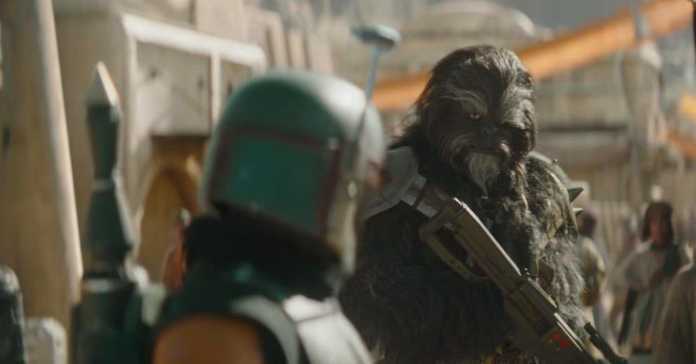
This episode also cements the fact that Boba’s rule is not set in stone yet and not only is the Mayor not accepting or respecting his claim to the throne and title as Daimyo, but now we see some very powerful players also arriving to claim the territory in The Twins, part of the Hutt family and cousins of Jabba, who believe that they have a right to claim the territory of Jabba. This whole scene, played out on the streets of Mos Espa is a chance for Boba to stand firm to state his right to rule with the Hutts retreating to no doubt try another day but not before introducing us to a new character in what I could only describe as the Brock Lesnar of Wookies, who Boba identifies as a Gladiator from the Death Pits of Duur. This opening twenty minutes is all about power posturing and letting the audience meet the different players in the game in a mini ‘Game of Thrones’ style political drama with different powers all claiming the right to take over Jabba’s old empire.
The one element to this series that I am really enjoying is the focus on the flashback story, told when Boba goes back into his Bacta healing tank and has “dreams”. We see Boba now being trained in how to use the Tusken battle staff, something we saw him use when we first see him in The Mandalorian. A good portion of this second episode is dedicated to this flashback stories and I am so pleased because for me, this is the more interesting story than the present day story arc because not only do we get to see how Boba came to be where he was when we see him in The Mandalorian which then leads to him claiming the title and power of Daimyo but we also get to see and learn as much about the Tusken Raiders as we do about Boba.
There is an almost Māori element to the Tusken tribe that has captured Boba, the respect that he shows them and they in turn are showing him respect since his helped rescue the leader’s youngling. Seeing Boba learning their fighting technique, something only valued Warriors in their tribe would be taught. This is a great look at Boba as a character once again, the training sequences show his patience and willingness to endure to improve and become a better fighter but his respect for these Tuskens when all we think of Boba is a relentless and merciless Bounty Hunter is a tremendous contrast to see.
That side of Boba is not lost however, and when a mysterious Train speeding across the sand suddenly open fire on the tribe killing their creatures and members. After helping them to burn their dead according to their tradition, Boba becomes the Fett we know as he spies a Speeder Bike gang and requests the tribe leader allows him to take one of their Rifles and his practice staff and we see Boba walking across the desert to the bar the gang are in and he makes short work of them, beating them roundly before having a drink at the bar, then stealing their speeder bikes as he has come up with a plan to stop the Train from attacking the tribe once and for all.
Even without his Mandalorian armour, Boba Fett is a vicious and deadly fighter but the softness when he interacts with the Tuskens adds such a new dynamic to a character, we know so very little about, even from his time in The Mandalorian series. There is a lovely fun element as Boba tries to teach the Tusken warriors how to ride the speeder bikes to execute his plan of attacking and hijacking the train in one of the best action sequences I have seen yet in a Disney + Star Wars series. The visual effects are incredible with a blend of CGI and physical stunts making the whole sequence feel more like a old west train heist…just with laser pistols.
Temuera Morrison physical performance is simply outstanding here with it being as impactful as his delivery of dialogue, he just has such a presence on screen that even when the story jumps back to the present day and he is in his full armour, we know the man underneath it, we know that under the stillness and quietness Boba may show those who would threaten him, he is still a deadly warrior capable of clearing an entire room on his own should he choose to. The flashback story is only helping to grow this legend of Boba Fett with so many layers that in just two episodes, has already grown in my eyes and no doubt other fans. There is no real indication of how far in the past the flashback scenes are but by the end of this episode, Boba is rewarded for his help by being dressed in the traditional clothing of the Tusken and taken through the ritual resulting in him being shown how to craft his own weapon, both of which is how we see Boba in the Mandalorian before he reclaims his armour.
So far, The Book of Boba Fett is just outstanding Star Wars storytelling, which is no surprise seeing how once again the team of Jon Favreau and Dave Filoni are once again leading this show. The quality of these Star Wars shows is still putting to shame the last trilogy of films making Disney + the best source of Star Wars content just as it is with MARVEL right now.
The wait for next week’s episode will be worth it, but the first two episodes have certainly set the tone and I for one cannot wait to see where this story goes.
Ubisoft announced that its Ubisoft+ subscription service will be coming to Xbox in the future. Originally launched for PC, the service allows access to more than 100 Ubisoft titles at a single monthly cost, with games and DLC available on launch day, and monthly rewards including cosmetics, boosters, in-game items, and more. But that’s not all — Ubisoft also announced that Rainbow Six Extraction will be a day one addition for Xbox Game Pass and PC Game Pass members, allowing them to play on Xbox consoles and PC right from the game’s launch on January 20. Rainbow Six Siege, already available as part of Xbox Game Pass, will be available to Xbox Game Pass Ultimate and PC Game Pass members the same day, giving PC players the chance to squad-up for even more Rainbow Six action with their friends.
Chris Early, Ubisoft’s Senior Vice President of Strategic Partnerships and Business Development said: “By making Rainbow Six Extraction available to Xbox Game Pass and PC Game Pass members on the day and date of its launch via Xbox Game Pass, we’re demonstrating that we believe in the value and choice that game subscriptions offer to players. Rainbow Six Extraction for Xbox Game Pass and PC Game Pass members is just the beginning. Ultimately, we will offer the Ubisoft+ subscription service to Xbox owners so that they can enjoy the full extent of our Ubisoft+ game library, including new releases, on their consoles.”
Sarah Bond, Corporate Vice President, Game Creator Experience and Ecosystem at Xbox added: “With Rainbow Six Extraction, Xbox Game Pass and PC Game Pass members are getting another blockbuster added to their library on the same day the title launches, and because Rainbow Six Siege will be on both Xbox Game Pass and PC Game Pass as well, the Rainbow Six community and fans of tactical shooters will have plenty to look forward to playing together, no matter where they play.”
Rainbow Six Extraction launches on January 20 and will be available on Xbox Game Pass and for PC Game Pass members when it releases. Rainbow Six Siege is already available on Xbox Game Pass and will be available to PC Game Pass and Xbox Game Pass Ultimate members on the same day. For more news on Rainbow Six Siege, the launch of Ubisoft+ on Xbox, and Ubisoft’s other games and services, stay tuned to the Ubisoft News hub.
The phrase “virtual services” gets bandied about a lot these days, but that doesn’t make it any less confusing. We sort of think we know what it means, but we’re not quite sure. It pops up in so many different places, it’s hard to pin it down to a precise definition.
Virtual services are a relatively recent technology. They’re something that the business community introduced to the world in various forms over the last twenty years. Today you can get virtual assistants, virtual address for mail boxes, and even virtual offices.
Virtual suggests “not quite real,” though, which is a rub for some people. When they buy a virtual service, they want to know that they’re getting something worth their money in return.
What Are Virtual Services?
A virtual service is another name for tech-enabled service that another agency performs instead of you doing it yourself in-house. The technological underpinnings can be simple – as is the case with virtual assistants who just use a phone – or more complicated. Ultimately, virtual services encompass anyone that provides businesses with services through some sort of technical means, but is not a part of that business.
The concept is actually quite sophisticated. Companies that adopt it get multiple benefits, each of which is specific to the firm itself.
Why Businesses Use Virtual Services
There are all sorts of reasons why companies might opt for virtual services. They offer a host of benefits that are simply inaccessible in-house.
Perhaps the most obvious is that they help to improve customer service. In many cases, the primary person or “key man” in the business isn’t available to operate the telephone or respond to email. Instead of just allowing communication to go unanswered, virtual services step in and fill the gap. When a customer or client calls, they pick up the phone and then, essentially, do their masters’ bidding, carrying out conversations according to their instructions. They can do things like schedule appointments, quote prices, and forward complaints. In fact, because real human beings do this job, they’re able to do most receptionist-type tasks.
Businesses also use virtual services to enhance their services. For instance, some brands can’t afford swanky offices downtown. For that reason, they often use virtual mailboxes. These give them mailing addresses that appear to indicate that they have a prime location when, in fact, they’re in cheap offices out of town. The virtual mail house then sorts their mail and either forwards it in the post or emails it.
Some brands need virtual services for the flexibility that they offer. Firms that hire an in-house marketing team as full-time employees can’t just stop paying them on the spot with no explanation. Employees’ rights, union action and the law all weigh against them.
For that reason, they will often just outsource these services, only paying for what they need in chunks. For example, a smoothie brand might ask a marketing company to do their web design and SEO.
Then there’s the time issue: the sheer amount of work that goes into the most basic (and mundane business tasks). Firms spend much of their week simply carrying out routine operations, without focusing on meeting customers’ needs or innovating at all.
Virtual services are tools that time-stressed companies can leverage to free themselves from some of the drudgery. For instance, recruitment companies can reduce the pain and hassle associated with finding people to work for them. Influencer outreach firms can cut down on the search costs associated with finding a suitable partner to work with on social media, and so on.
Lastly, virtual tech is often a money-saver. It’s far cheaper to buy services a la carte and then get them delivered over the cloud or via the telephone than to employ directly.
Perhaps the best example of this is in the area of IT support. If you want to employ a team of IT professionals to take care of your network, it’ll set you back hundreds of thousands of dollars per year. However, just getting an agency to do it might cost you $10,000 per year, and sometimes less.
Virtual services are an innovative new technology because they involve new methods of organization for producing goods and services. As such, they are becoming more important. Businesses are starting to see how they can help them in their daily operations. Of course, they’re not a panacea. You can’t outsource every task your firm performs. But you can certainly reduce a lot of the effort associated with running a business and being successful.