Get ready to hit that respawn button and dive deep! Developed and Published by WarpedCore Studios, Aqua Lungers brings back that often forgotten couch multiplayer experience. You can have as many as four players in this surprisingly humorous split-screen title. With deaths aplenty, funny visuals, and a banger of a soundtrack, this may be the game to let you enjoy a laugh with your roommates for an afternoon. Aqua Lungers has a very familiar control layout and recognizable game mechanics, so any player can literally “dive in!”
Better swim out of there fast after filling up.
Dive After Dive
Aqua Lungers, introduces no new controls or stratagems. You have your standard move, attack, jump, and change weapon controls utilized in 2D platformers for decades. Swim to the sunken treasure ships, fill up with gold, and slowly make your way back to shore. But ye be warned! Swarms of mean-mugging aquatic creatures are ready to defend their stash. Attacking omnidirectional foes one at a time is what you will be doing the most in the unfriendly waters. No one-hit deaths here, but having a few hit points to spare won’t save you from eventually turning into giblets.
You will really feel the weight of the gold held against you as you attempt to resurface with man-eating piranhas seeking revenge after you slayed their comrades. The extra slowdown after filling up, paired with the ease of dropping your stash, create a sense of urgency best shared with another to ridicule you for your struggles. You’ll definitely want to experience Aqua Lungers in multiplayer mode. The single player, while no different than the multiplayer, is for sure missing the same spark. It’s not as fun when you’re racing against yourself. You’ll also lose your motivation if you reach a roadblock and can’t get over the hump without accompaniment.
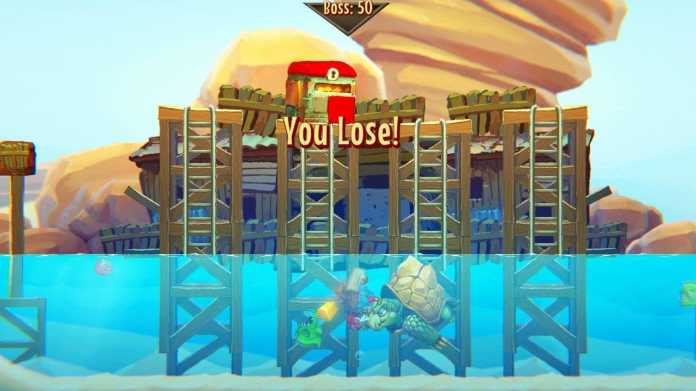
You will see this screen a lot.
Big Budget Battle Themes and Silly Walk Cycles
The cut-and-paste look rears it’s head once again. I know I’m a little biased, since I prefer pixels and sprites. However, I’m led to believe that this is a more cost efficient method, in terms of animation, for smaller budget games. The divers look so cute with their large feet. It’s adorable and also disheartening watching them walk around so eagerly, only to be ingested by a giant pink shark within moments of touching the water. This really brought me back to the flash animation era of the 2000s. I envision myself in middle school computer class playing something similar to Aqua Lungers on websites such as Newgrounds or Miniclip, then minimizing my window as the teacher walks by.
I laughed out loud upon playing the first level and hearing the intensely orchestrated score. Real instruments are back, and the music is heroic and triumphant. Strings, woodwinds, brass backings, literally anything you would hear from a Peter Jackson film, make their presence heard in this title. When you die and die, over and over, the music keeps its headstrong tone, making you feel even more of a fool for doing your diver a disservice by being bad.
Aqua Lungers is best played with a friend, or two, or three!
Bottom Line
Aqua Lungers is definitely a niche title. Difficulty aside, the game is entertaining enough and designed to be experienced in real social circumstances for players looking to find the pleasure in pain. And for those few, it’ll do just the trick.
No matter how much of a hardcore gamer you are, there is always room for a silly arcade shooter in your life. This genre has been around for decades, evolving successfully to the style that we see today. Twin-stick shooters are big news for the indie market, and more recently we’ve seen some brilliant titles such as Enter the Gungeon and Neon Chrome. Older players will remember the brutally gory experience of Smash TV, and this is where I believe UltraGoodness 2 took its main inspiration from.
Developed by Rasul Mono and published by Ratalaika Games, this gory, fast-paced shooter will test your reactions and patience. You must plan your approach as you are expected to defeat wave after wave of evil creatures. Power-ups, diamonds and health must be collected on each stage, and these will help you upgrade your sidekick, defeat enemies in one hit, and survive for as long as possible.
What’s it about?
A once peaceful kingdom is now at risk of being overrun by evil forces. The only thing that will stop that from happening is the King and his trusty furry sidekick. You will face 30 levels of sheer hell. Bullets fly across the screen from the guns of demon bats. Fiery balls of fury will scorch you, and mushrooms will kill themselves to take you with them. You are armed with 5 hearts and a laser gun. You must use your wits and skill to avoid being struck, and wipe out everything in sight.
Bunny’s gonna get it!
It’s such a simple concept, but the madness is great fun. You run around each stage like Rambo on acid; throwing bombs, using your apocalypse powers, shooting enemies, and dodging projectiles like a King possessed. You quickly realise that more haste and less speed are needed to be successful, and you plan how to approach each stage. There is no randomly generated algorithm here, so each level is exactly the same every time. You learn each monster’s hiding place, and you react to them before they’ve seen you. For anyone looking on, it makes you look like a pro, but they don’t know that you’ve died 100 times already.
Though the main concept is shooting, shooting and more shooting, the game has a trick up its sleeve. Time manipulation enables you to slow everything down. Simply stop moving and the world around you slows to a crawl. It was an element easily forgotten, but it was a brilliant tactical tool that enabled you to eliminate your foes.
It’s more than just a cat.
Collecting diamonds appears to be a pointless task at first, but then you realise you can upgrade your cat. Your floating ally has his own weapon, and depending on how generous you are with the cash, you can; use missiles, rapid fire, a burning laser, and many more. It becomes clear early on that victory relies on the power of your cat, so getting him up to speed with the correct accessories is a must.
This isn’t a vacation!
The difficulty for a Ratalaika Games published title is quite high for once. Though on paper it looks easy to play, the limited lives combined with the number of monsters and their increasing firepower make this a tough nut to crack. The difficulty curve starts at a moderate level and slowly creeps up. I screamed the phrase “You *choice word* turd!” Many, many times. It’s a hilarious, frustrating affair that will bring the worst out in you.
Polished retro action.
As with most twin-stick shooters, the action takes place from a bird’s-eye perspective. You have a limited field of view, and unfortunately your enemies usually see you before you see them. The level’s are simple in design and lend themselves towards a basic art style. Vibrant colours stand out against the dark, earthy backgrounds that make up the opening portion of the game. The second and third chapters use a lighter background, but the same ominous atmosphere represents the plight that the Kingdom is facing. There was always plenty of movement on the screen, yet there were never any issues in how it played out. It was a smooth, enjoyable experience throughout.
When a game wants you to blow the head off of everything, you know the audio is going to be high tempo, and aggressive as hell. UltraGoodness 2 didn’t disappoint. A loud drum and bass soundtrack blares out alongside the action. Thuds of your bullets smashing into your opponent’s head sound on top of the music, as does the noise of their bodies exploding. It’s gory, over the top, and absolutely splendid. After playing this, you’ll need some time in a quiet room to allow your senses to clarify the in your face approach that Rasul Mono has taken.
I thought that hell would never freeze over.
Easy to play and easy to lose time.
I’ve reviewed countless twin-stick shooters, and I normally moan about how rubbish I am with the controls. Finally, a game where I felt comfortable with everything that the developers offered. You experience simple controls that are responsive and easy to learn. Your ally is controlled by the computer, so you need only focus on what you are doing to survive.
Whenever I’m offered a Ratalaika Games title, I’m assured that the achievement list will be short and easy to unlock, and the game is usually quick to play. That wasn’t the case with this game! Yes, it was simple enough to get the 1000 Gamerscore, but a full completion will take some time. Death is guaranteed, as is screaming and frustration. The 30 levels look easy on paper, yet looks can be deceiving. You must set aside hours of your life to get through every stage, and potentially a new controller.
Will Evil win?
Having your Kingdom overrun is not fun for anyone! Luckily, a well armed king and his cat sidekick can take down anything that crosses their path. A well designed twin-stick shooter that has perfectly balanced difficulty with progression. You must unlock weapons for your cat and choose the correct one for each level so that you can be victorious. Do I recommend it? Yes, I do! You can buy your copy here! Grab your cat and gun, get mad and get revenge. Stop the Evil from taking over your realm, after all you are the King!
When a game tries to use multiple approaches to form its core concept, it’s brave or stupid. Using this method can not only confuse your player base, but can also water down your ideas, making them weak and badly designed. Tears of Avia from developers CooCooSqueaky and publishers PQube Limited is one of those titles that has taken the gamble and tried to create an adventure game with a twist. It’s a strategy RPG that relies heavily on the turn-based attack method.
Set in the beautiful and rugged world of Estera, you must choose your hero, the “Seeker” of this tale. Gifted with an ancient power that allows only the blessed to see a jewelled treasure known as a “Tear”, you begin a journey fraught with danger and excitement. You must gather a band of warriors, wizards and priests to take on the many monsters that you will face. The demon Vylenkine desires power, and to control humanity, but he can only do this once he has found all the “Tears” that are scattered across the land. Once they are collected, a powerful magic seal will be broken, and evil will rise to rule over the world. Only you and your team can prevent him from fulfilling his evil plan.
A pretty standard story.
Once you brush away the dramatic elements of the story in hand, you soon realise that there is very little that makes it stand out against its peers. A demon who wants to rule the world, magic seals that need to be broken, and a team of random heroes thrust together to stop the apocalypse from arriving. It’s a 3 for 3; heard it, done it, got the tee-shirt. This doesn’t mean that it’s badly written or not enjoyable, but CooCooSqueaky had to make this stand out from the crowd.
Burn baby burn!
They mashed together several genres to create a sort of super hybrid. A SRPG turn-based Asian inspired adventure game (wow, that’s a mouthful). So did their gamble pay off? Was it too confusing to get to grips with and does it get boring quickly? In short, yes, no, no. It’s not a bad title at all, but it doesn’t really excel either. Having stretched their resources thinly, I was always left wanting a little more detail and complexity in nearly every layer of gameplay. But the merging of the genres was well executed, and will be of interest for most RPG fans.
What works?
Asian RPGs influence many of the game mechanics. Text dialogue translates the original acting, this allows you to hear the tone and flow as the developers intended. This goes deeper still with some fantastic Manga and Anime inspired character models and battle animations. This adds flair and colour to what is otherwise a rather depressing and dark landscape of war-torn buildings and cities. The team selection and inventory was also well designed. You choose to select which 4 additional fighters you wish to take into battle with you. This freedom allowed you total control over the tactics you wished to use, and your own gameplay style.
The levelling up and character progression impressed me. XP is awarded after fights, and can be spent on one of 3 branches of a skill tree. Whatever you choose allows an attack or defence option in fights and can help to turn battles in your favour. Alongside this, you may purchase upgrades for each individual skill. This allows you to concentrate on the parts of each hero that work with your approach and make the strongest team possible. It gave me a real sense of ownership over how the game was flowing, and I really enjoyed this micromanagement element.
Take some time out from the constant fighting.
Clunky, clunky, clunky.
Did anyone mention that this is clunky? Walking animations appear like they belong on a Sega Saturn, battles are slow and arduous, and though I liked the fight animations, the Anime/Manga ones took forever to complete. Large maps become the bane of your life as walking from one end to the other takes an eternity. The camera angle is terrible, and navigating any of the cities is a monotonous task. Unfortunately, for all the good elements, there are plenty that brings this crashing back down to earth. With so much going for it, the desperate attempts of pleasing many people came back to bite the developers in the posterior. Too many cooks spoil the broth, or in this case, spoil the detail in the gameplay. None of these things that have been mentioned ruin the game, it just makes you sigh as you plod along.
A vast world and replayable battles.
Though the story isn’t the most original penned script you’ll ever read, it sits in the background supporting the main concept, the battles. A large 2D world slowly opens up to allow you to choose each fight that you have already faced. Each one has a 3 star rating that must be achieved through set objectives. At the beginning these are unobtainable, and shouldn’t be considered. You may think “That’s pointless!” I thought that until I realised that it’s created for challenge and replay value.
It’s a clever way to ensure that players will continue playing through as their characters level up, purchase better equipment, and become a stronger unit. I really applaud CooCooSqueaky for this approach. It was almost laughable when you returned to the earlier fights, mowing through your opponents.
4 against 2, I like those odds.
It’s a mixed bag presentation.
This colourful and detailed RPG will have you loving its landscapes and environments, but loathing its chunky character models. The battle areas are well designed and offer a tactical challenge. The animation for the attacks is well thought out, but I can’t get over how poorly you move through any of the cities. This is further compounded with a badly optimised camera, and difficult to navigate locations. Places of interest are highlighted with a white orb, but these are hard to see, making it a mess to look at. It’s a shame the quality of the backdrop couldn’t have been replicated across much of the rest of the game.
Alongside the brilliantly integrated acting, a classic RPG style soundtrack plays out. The high energy music with a magical medieval tone sets the scene nicely. The sound effects from the team moving and attacking were nice, and each had their own repertoire of sounds. Though it wasn’t mind blowing, it did well to support the action, and created character traits for each of the warriors.
The controls were lacking.
It’s sad when a good game is let down by unintuitive controls. Unfortunately, this is the case in Tears of Avia. At every point it feels like you are battling an invisible force. Nothing runs smoothly, and you are constantly willing for it to work with you, not against you. It’s all serviceable, and the game is playable, it’s simply not as user friendly as it should have been.
The bigger they are, the harder they fall.
Alongside the delightful choice of replayable battles, a challenging achievement list will draw you back in to keep playing. The in-depth skill tree, and the combination of teammates means that each playthrough never needs to be the same. The developers spent a lot of time ensuring that its fans would want to keep playing, lets hope that its shortcomings don’t put them off.
Many positives, many negatives.
This was one of those games that left me confused with how I felt about it. I loved so many of its key ideas that I wanted to keep playing, but I was constantly battling its negatives. It’s not the best title in this category, but it’s also not the worst by a long way. At only £16.99 you get a lot of value for money, as long as you can forgive its mistakes. If you want a copy, it can be purchased here! Do I recommend it, I actually do! The positives just about outweigh its downsides, and most of them are cosmetic, so they can be ignored. If you play this, you must save the world of Estera from a power hungry demon. Can you gather your team and collect all the “Tears” before Vylenkine does?
A recurring theme in recent Indie releases is style over substance. ENDER LILIES bucks the trend by expertly marrying playability and graphical excellence. The game is both a visual feast and a consistent joy to play. Though done in a familiar Metroidvania style, ENDER LILIES manages to bring a unique spin to the genre with its atmospheric focus and dark yet innocent style.
It goes without saying that the team behind animating ENDER LILIES is good at their job. Seriously, within the first few minutes, you can tell you’re experiencing a serious accomplishment. From the stunning lighting to the life-like movements of your character, Lily, everything is picture perfect. Normally I’m not one to heap so much praise on the graphical side of a game, but when the experience leans so heavily on atmosphere, you have to get it right. Here, they’ve done exactly that.
But, ENDER LILIES is much more than a visual achievement. It’s equipped with gameplay to match. In typical Metroidvania style, you’ll progress with the items and power-ups that you earn. Binary Haze Interactive has done an excellent job of balancing the difficulty of their game. It’s hard, but not unbeatable. The items (called “relics”) grant minimal bonuses and offer only a marginally easier experience in boss fights. I struggled to find many of these during my playthrough, but my lack of relics hardly hampered my progress. The rewards earned from the aforementioned boss fights, unique abilities, are far more coveted, as they offer a genuine upgrade that will help you progress.
For me, the weakest point of ENDER LILIES is the normal enemies. There is a marked lack of diversity in the mobs you encounter and their abilities leave much to be desired. They all seem to operate on some variation of a tracking shot whether it be arrows, missiles, or orbs. Or, they charge a powerful melee attack. Whatever the case may be, the enemies quickly begin to feel predictable and, by extension, rather impotent. It gets to the point where you can pattern most enemies on your first encounter. You simply have to jump over the tracking missile and dodge away from the charged attack.
While the encounters feel slightly monotonous, the addictingly smooth gameplay is more than enough to make up for it. The platforming is tight, and there are well designed areas of the map where the jumps are very difficult but totally possible. They’ve also done an outstanding job of integrating your abilities into your progression. You cannot move past an area of the map without first attaining abilities from the boss fight.
Having said that, the map design is linear without being restrictive. There is plenty of backtracking to be done, and multiple ways you can approach a playthrough of ENDER LILIES. It should also be said that you can backtrack at any point to grind for experience (and probably should). This helps to dismantle the railroaded impression of the game since you will undoubtedly spend time clearing earlier stages in order to bolster your stats. As mentioned earlier, there are also a number of spots that are inaccessible without abilities earned from future bosses, so once you’ve obtained those skills, it will be worth your while to backtrack and pick up rewards.
Beyond the obvious visual wins, ENDER LILIES boasts a great soundtrack. It’s relatively unassertive, but adds perfectly to the atmosphere. In fact, a distinct lack of sound characterizes the experience. You can hear your character’s footsteps echoing. Your guardian’s slashes ring off the cathedral walls. It all lends a very isolating, lonely feeling to the game.
As it is, ENDER LILIES is an expertly crafted but clearly early access game. Sure, it lacks a bit of depth, but the content that is there is encouraging. They’ve already managed to build a ridiculously forceful atmosphere and solid underlying mechanics. It’s polished well beyond most early release titles, but still lacks the depth of a full release. Now, the only task left is to add content. If Binary Haze can spice up their enemies a little more, and expand the game by a couple of hours, they’ll have a truly remarkable achievement on their hands.
I love a good mind training exercise, so when I have the chance to combine it with a computer game, I jump at it with little thought (oh, the irony). Previously I have played, completed and reviewed Active Neurons 1 and 2. When I was offered Active Neurons 3 – Wonders of the World, I couldn’t refuse. A delightfully calm, puzzling experience that tests both your logic and spatial awareness. It’s exactly what I needed to break away from the sports and first-person games that monopolise my time.
Developed and published by Sometimes You, this addition to the trilogy follows on from the previous two titles, but can be played separately as it doesn’t affect the action. The premise is straightforward, but the execution is anything but. You control a glowing white square. It aims to navigate a map of obstacles and traps to reach an illuminated white circle. As the game progresses, you must overcome additional hurdles to be successful. The challenges become more convoluted and the difficulty ramps up pretty quickly.
A simple idea, brilliantly executed.
When you strip this back to the bare bones, there is very little to this title. 14 chapters comprising 10 stages, stand between you and completion. When you are successful, you are rewarded with an image and information regarding a Wonder of the World. It’s not much of a prize for all your hard work, but it is interesting to see when each famous landmark was discovered/made, and what they look like.
So many Wonders, and so many levels.
As you start a new episode of 10 stages, a new gaming element is introduced. Teleportation, sticky nodes, cloning, traps, moveable blocks and more. Any combination can be used to form a puzzle, and you must work out a solution even when the goalposts are constantly moving. It was maddening, and made it hard work, but boy was it a fantastic challenge.
Stuck, or want to cheat? It’s only a button away.
When a puzzle game offers solutions up like confetti, it doesn’t sit right with me. This issue is historical across the franchise and somewhat cheapens the game. A helping hand is not an issue, but players can solve puzzles without penalty. A few hints should be available per chapter. This would ensure gamers would press the “cheat” button only when necessary.
Don’t allow this to tarnish your opinion of the game. It’s frustratingly difficult and will push you to your limits. Many of the solutions are ingenious, and when you stumble across the answer there is an overwhelming sense of achievement.
One of the many Wonders of the World.
Simple to look at.
Lining up against the previous instalments shows little change. The fixed screen top-down perspective uses mainly monochromatic tones and simple shapes to define the playing area. An uncomplicated UI keeps the screen from being cluttered, and all the special elements have a unique shape or colour to make them stand out. The simplicity works with this, and anything more would have been an overkill.
The calm and classical musical score works brilliantly in this setting. Soft notes play out behind the scenes, creating a relaxing ambience. It’s like when you are on hold on the phone and they are trying to settle your nerves and ensure you’re patient. The sound effects are at odds with the music, and are jarring, almost robotic. However, they are not overbearing and strike the right balance in terms of style and volume.
Sliding is the name of the game.
When the puzzles are complex and more mechanics are added regularly, you don’t want an unusable control setup. Active Neurons 3 has kept it straightforward, and all you must do is slide. Move around, push blocks, activate switches and dodging traps are all achieved by sliding. If only the puzzles were this easy, you’d be in for a pain-free ride.
A simple view, but a complex puzzle.
What each of these games has lacked is a replay value. Once you’ve completed each of the 14 chapters, you discover that there is little to draw you back in. The achievement list unlocks through natural progression. Completion is all but guaranteed, especially with the free use of the solution button. Timing each stage or a movement counter would have added a competitive edge and would have made you play again.
Same old gameplay, just as brilliant.
You may think “3 games with identical concepts, that must be boring!” It was a possibility, but fortunately, the repetitive approach worked well. Challenging problems, and an interesting blend of puzzle-solving mechanics keep your brain ticking over. The casual and relaxing gameplay is a welcome break from the hectic nature of sports and first-person titles. Do I recommend it? Absolutely! And a copy can be purchased here! Sit back, relax, and use your mind and not a gun or boot to be victorious.
The RPG genre has long been dominated by some of the biggest names in the industry; Zelda and Final Fantasy are to name but a few. The complexity of the character base and the mixture of puzzles and battles keeps its fans wanting more. When I was offered World to the West, I was intrigued to see how it would compare to these much-loved titles.
Developed by Rain Games and published by Soedesco, this colourful RPG adventure has you exploring a linear world filled with; monsters, gold and puzzles. You control a team of 4 unlikely heroes, each has their skills and all of them must work together to uncover the mysteries that this medieval world has to offer.
A follow up to Teslagrad.
World to the West is the standalone follow up to the indie hit Teslagrad. Fans of this side-scrolling game will find a new open-world experience that follows a linear storyline. Your 4 heroes do not know that they must work together on their journey to finding a priceless treasure deep to the west of the country. A mystical force brings the team together. They soon discover their heads adorning a totem pole that acts as; a fast travel portal, a checkpoint, and where you swap usable characters.
Just keep running, just keep running!
Though the story follows a set path, you have the freedom to explore anywhere that you can access. Locked doors, moveable platforms, soft ground and more will prevent you from progressing. When you find your path is blocked, you must change to a suitable teammate, or try another route. This skill-based path element was reminiscent of many of the puzzles found in Zelda: A Link to the Past. It was a fantastic twist that makes you think about many aspects of the problem at hand. It was also interesting that you’d be allowed to travel so far before the game forced you to go back. Most times, it was 1 step forward and 2 steps back. It was frustrating, especially as there was no way to track your progress.
It’s fun, but slow going.
The well-written dialogue, weird combination of teammates, and clever puzzles make this a really fun game to play. It’s Lost Viking style puzzle solutions will make you break out a wry smile as the obvious answers suddenly smack you in the face. However, what jumped out to me was the slow-going gameplay. Nothing felt rushed, and progress seemed drawn out. This wasn’t helped by the fact that you had to change characters and then complete the same journey again. It wasn’t so much a fellowship of would-be heroes, but a more unruly gathering.
Another welcome twist to the gameplay was the simplicity of the combat, and that your enemies are more than disposable assets. Fighting is a piece of cake, and this includes any of the main bosses. It takes no time to assess the way to win a fight, so you get to focus more time on the puzzles. I particularly enjoyed the hypnotism mechanic, where mind control allowed you to turn your foes into pawns in your own game of chess. This added another layer to the puzzle conundrum and helps you to keep searching for a solution.
Take some time and enjoy the festivities.
For an older game, it looks great.
Originally released in 2017, World to the West has aged well. The cartoon style, bright colours and interesting landscapes mean that there is plenty to look at. The character models weren’t as detailed as I’d like, but you rarely see them up close because of the bird’s-eye perspective. A lack of camera rotation bothered me more than it should have, and I constantly felt like I was missing out on hidden paths or objects. Like the detailing, it was a minor thing, but it would have been a good feature to have.
The audio is as expected. A punchy soundtrack adds both energy and atmosphere to the proceedings. It was obvious to me that Rain Games are invested in retro and old-school games as all the song have a classic RPG vibe. The sound effects are good, but didn’t stand out. Maybe it was all too familiar for my liking.
4 different approaches, each as easy as the last.
Four different characters means four unique gameplay styles. I was worried that it would confuse and be tedious, but it wasn’t. Tutorial pop-ups help to advise of any new mechanics, and everything else is common sense. It’s a joy to play and allows you to focus on solving the many puzzles.
Time to lose yourself in that beautiful view.
Because you are free to roam the world, you will stumble into the hidden artefacts by chance. These forgotten relics form the collectable portion of the game and add an incredible amount of replay value, if you like that sort of thing. The achievement list is brutally intertwined with the need to find them all, so completionists are in for a tough time.
An old game, but is it worth it?
I enjoyed my time venturing through the different areas, and solving the many puzzles, but I didn’t like the slow gameplay. The constant swapping of characters and walking the same path was too tedious for me. This already has a large fan base, and I can only see it getting stronger because of its unique mechanics. Unfortunately, I won’t be jumping on that bandwagon. Do I recommend it? If you like slow puzzle games with an adventure twist, then yes. If you’re tempted, buy a copy here! Can your team of 4 strangers work together to unearth the treasure in the west? They must, otherwise failure is guaranteed and fate is wrong.
Captain Sabertooth and the Magic Diamond is a classic platformer. Varying in dimension, the game is definitely enjoyable for some time. Although, as quests increase in difficulty both adults and children alike will struggle. Embedded with puzzles and mini-games, you never find yourself doing the same task repeatedly. With the assistance of a chirpy parrot, you’ll slowly find your way through the map digging up treasure and defeating enemies until you finish.
Aesthetic appeal
Captain Sabertooth looks fantastic. Bright colors and soft graphics appeal to the younger target audience and remind the older of games like Crash Bandicoot or Donkey Kong Country: Tropical Freeze. It can be stated that the content however does not match up. The concept is simple and definitely something all gamers have heard before. Find a magic diamond that grants the holder it’s wish. Since I’m not familiar with the franchise already, I don’t have the same attachment to the characters that some players might experience. Titled as a game to be ‘fun for all the family’, there are definitely flaws in this.
‘Family friendly?’
The first half is frustratingly easy. Which is great for the kids who will pick this up. But anyone with a vague idea of how platform games work will breeze through. You are assisted by a parrot throughout, who chimes in occasionally to tell you how to work out a task you might’ve already completed. At first this is charming, it plays into the pirate theme very nicely and is occasionally helpful whilst you get to grip with controls. After the dialogue has repeated several times, you’ll begin to feel quite frustrated at it and end up muting it. Or at least that’s what I ended up doing.
The next half of the game seems to morph into a very challenging series of wall jumps, slingshots and moving platforms. Don’t get too comfortable in how easy the first half is, since this transition will be extremely jarring. Even I found parts challenging and had to replay them time and time again, so I question if kids would feel similarly upon attempt. The challenges fluctuate a lot – which I definitely would’ve found frustrating as a youngster.
Frustrating character narration
Each character is narrated, and it seems this narration is the only thing that separates the two playable characters you choose from at the start. Despite dialogue being a key factor in the story, your playable character constantly repeats a handful of phrases throughout play. Once again, this starts as charming, but a few hours in this completely shatters any train of thought. Also for a child-friendly game, the protagonist stated “take that, you miserable creature!” every time an innocent enemy was killed… Questionable right? For a bright, soft game, this seems a bit on the nose. Sure the enemies are animated unlike actual creatures but they don’t really do anything. I ended up jumping over most of them out of guilt and the wish to progress to the next area.
Almost useless map
The map is pretty difficult to navigate too. You can’t zoom in, and the whole thing is marked with a small key to guide you through what means what. I ended up ignoring the map since it wasn’t any help when I needed to know where to go. Areas look great, but they’re hard to navigate. Paths are well hidden and I spent more time than I like to admit running around the same area. Getting stuck in the same area with the same few notes of soundtrack also led to muting.
Final thoughts
As a whole, I can see why this game is appealing. But with sticky controls and extreme repetition it’s not something I see myself picking up in the future. I don’t even think I’d recommend it to a younger audience since the challenge fluctuates too much and it’s not something you’d play enough to see the credits roll. I’d just leave it if I were you, unless you have a hidden love for the Captain Sabertooth franchise.
Spider-man Miles Morales launched as one of the headline PS5 titles. The initial trailer showed off the game’s next-generation graphics; Miles’s venom-powered moveset; and of course, some more of that sweet Insomniac web swinging.
Following on from the commercial success that was Spider-man PS4, expectations were set fairly high for Miles Morales’s big debut. The question is: was it able to deliver? And – on an even more important note – would we have to go around chasing Howard’s damn pigeons again?
Not a sequel:
–
Insomniac were fairly clear that Spider-man Miles Morales isn’t a direct sequel to Spiderman PS4. And now having played it myself, this is evident.
The game doesn’t follow up on the threads from Peter’s story in the first game; with a largely brand-new cast and distinct tone, this truly feels like Miles’s game. Between the Hip-hop esque track; significantly lighter story(for the most part); and distinct changes made, Insomniac have delivered a great spin-off title. But, do not mistake this for a full-fledge sequel; you will be disappointed.
Miles Morales is not a very long video game. It’s pricing at £49.99 is a point of contention for me.
I managed to finish the game at 99% completion, and this took me about 16 hours. Whether this level of content is an issue for you or not, the fact is this game is about half the length of Spiderman 2018.
Personally, I think that the story could have used a couple more hours. There were a couple characters and a couple twists that I don’t think received enough build-up to properly capture the impact that Insomniac was going for.
On the other hand, I was pleased that Miles Morales managed to change the gameplay formula just enough for it to not feel like a rehash of the previous game. Spiderman PS4’s ‘Arkham style’ combat was one of the game’s big highlights for me back in 2018. Here, with Miles Morales, Insomniac has built upon the system they had in place; adding a few new additions that distinguish Miles and Peter’s playstyles. Unlike Peter, Miles only has a limited amount of gadgets at his disposal throughout the game. However, his arsenal is certainly not lacking, as Miles has the ability to charge up ‘venom’ attacks that pack a real punch. All of these attacks add a new flavour to the gameplay, and are well integrated into the combo flow. You can lift enemies into the air; slam the ground with all your might; and, provide a ‘big-ole punch to the face of New York’s resident villains.
For my 16 hour playthrough, combat never ceased to entertain, with the boss fights being particularly excellent(more so than the first game). I played on the second hardest difficulty and most of the time felt reasonably challenged. To offer one small criticism, I did find the game lacking when it came to normal moves. Most of the base moveset that Peter had is re-used here, with admittedly some new animations for Miles, but it would have been nice to see a couple more unique combos(because the ones they do have are awesome).
A good story elevated by great side content:
–
Spider-man Miles Morales is a focused, personal tale that acts as a very satisfying introduction to Miles as a full-fledged superhero. The game wastes little time thrusting you straight into the action; with a thrilling chase culminating in a tutorial boss fight against Rhino. Shortly thereafter, Peter leaves for a trip with MJ to Europe, and in his absence, it is time for Miles to shine.
As I mentioned, the narrative here is incredibly focused, and centred around Miles and those closest to him. This framing does a great job of allowing Miles to differentiate himself from Peter; his attitude; the adversities he faces; and all of his fantastic relationships successfully help to create an enjoyable – albeit short – story.
Without going into too much detail, the story focuses on Miles’s local neighborhood of Harlem; with the conflict between two adversary groups in Roxxon and The Underground driving the narrative forward. Unfortunately neither group is particularly well developed, and whilst the Tinkerer: the leader of The Underground, is quite an interesting character, Roxxon’s Elon Musk wannabe Simon Krieger is a lazy, typical evil rich dude. I would have appreciated a few more shades of grey here; like we had in the previous game with Oscorp and Martin Li.
Having said that, Miles’s relationships with all of the central characters are very well developed throughout the narrative and side missions. Ganke – his sidekick and bestfriend – is an enjoyable addition, who regularly chimes in with different teenage musings as you swing around New York. Miles’s mum, Rio Morales, is also an interesting character who’s campaigning in Harlem puts her into some interesting situations – to say the least. There are a few other characters whose relationship’s with Miles are thoughtfully developed, including one of the central antagonists, but I think it is best you see it yourself.
So, the main story is quite good. But, if you were to just blitz through the main story there would be a few developments and character arcs that may seem to have little build-up. This is where the side content comes in.
Unlike in the previous game, the side content here is supplementary to the main narrative. You would be doing yourself a great disservice by not engaging with the side content, in my opinion.
I was pleasantly surprised by how well the side-missions developed a number of Miles’s key relationships from the main story. Miles’s relationship with a number of residents from Harlem is almost exclusively developed through a select few side-missions. This is good. I like this a lot.
Importantly, none of the side-missions feel like filler; they all serve at a minimum, the central service of developing Miles further. Yes, you do at one point have to catch some pigeons, but again this mission serves to develop Miles’s relationship with Peter. This is just one example.
In some games, such as the Yakuza series, side-missions offer a fun breakaway from the intensity of the main narrative. In Miles Morales, they are essential in my opinion to seeing the full story. Insomniac have smartly separated them from the core-missions, for those who just wish to play the main story, but that doesn’t mean that they are not incredibly important to the narrative.
Using the PS5’s potential:
–
Two seconds. Two full seconds is all it took for Miles Morales to go from the games menu, to the introductory cutscene. Within 2 seconds, I was immersed in the game world; as the palms of my hands were graced with the motions of the New York subway. Insomniac’s immediate – and clever use of the PS5’s DualSense ‘haptic feedback’ feature set the precedent for what would be a thoroughly next-gen experience.
Soon enough I was swinging around New York, with the motion of each webswing being gracefully captured by haptic feedback. ‘This is incredible’ – was an assertion I would regularly regurgitate like a swooned lover, throughout my time with Miles Morales – or should I say: as Miles Morales. Every venom-fuelled punch, luchador esque kick and door being jockeyed-into, is captured by Insomniac’s regular, and immersive use of this new feature. Such use of the PS5’s technology goes a long way into making Miles Morales an incredibly immersive experience. Okay, I think I’ve said Immersive enough now.
Furthermore, upon starting the game for the first time, the player is presented with two key performance options: performance mode, which prioritises a steady 60 frames per second, or fidelity mode, with enhanced ray tracing and graphical resolution. Personally, I spent the majority of the game in performance mode; web-swinging at 60fps is quite frankly, incredible. Again, both options offer players two great options that both reinforce this next-gen experience I keep gushing about. But seriously, this game looks great.
Between the absurdly fast loading times, impressive graphical fidelity, and mostly consistent performance -the game crashed twice during my playthrough, but otherwise was a complete breeze – Miles Morales truly sets the bar for what is to come.
The experience is further enhanced by a good story, even better side content, and solid combat – that does Miles justice as a great hero in his own right. At £49 the price is on the steeper side for the volume of the game’s content, but if you have the chance, this game is still a must play. I still can’t get over how amazing the haptic feedback is.
Few games are almost as old as video games themself, but Space Invaders is one of them. This leaves me asking the obvious question, do we need more? Well, Space Invaders Forever attempts to answer that question with a collection of three games that all offer something different from the original formula to varied rates of success. Included in Forever are Space Invaders Extreme, Space Invaders Gigmax 4SE, and Arkanoid vs. Space Invaders.
The first and really only game worth playing in this collection is 2008’s Space invaders extreme. Extreme does as much as it can to keep the classic space invaders’ gameplay fresh. During each stage, you will get game-changing power-ups and enter unique bonus rooms for extra score or powerups to prevent the gameplay from getting stale. There’s also a more diverse and innovative range of enemies than classic space invaders here that adds a bit more strategy than just mindless shooting. But where extreme really excels is with its trance-like presentation similar to the likes of Rez or Tetris Effect. Your actions sync to the amazing soundtrack and flash visuals entrance you more than a Space Invaders title has any right to.
Second in the collection is Space Invaders Gigamax 4SE offering a multiplayer experience with a large playing area, and… well, that’s about it. There’s nothing special about this version of the game other than the multiplayer, but with the plethora of local multiplayer games out on the market at the moment, it’s hardly worth playing for the five minutes of novelty fun you might be able to get before switching to something more enjoyable.
Finally, we have Arkanoid vs. Space Invaders, and if that title sounds familiar to you, it might be because this is the highly popular mobile game that was released in 2017. It’s a crossover between Arkanoid and Space invaders and mixes the gameplay from both franchises perfectly, creating an experience that makes it satisfying to clear levels due to the added skill reflecting the pellets requires. However, this game cannot be played in docked mode on the switch, and you have to play using touch controls with the button held vertically. This personally made it basically unplayable for me having to undock the switch, take off the joy-cons, and use the touch screen felt like such an unnecessary task when I could play on my phone. I’m not sure why they decided to go with the game for the collection and not something that would be better suited to the system. It’s also strange how this title is treated as a separate game on the switch menu, unlike the other two, which are under one app.
Overall, Space Invaders Forever seems lacking in any real thought, while extreme is a delightful trance trip. Gigamax 4SE offers so little, and Arkanoid vs. Space Invaders is a frustrating addition to the collection that feels like a complete afterthought that they threw in to try and justify a very hefty price tag. No extras are included in the collection, which is also a shame and adds to how bare-bones the experience is.
Whenever I see a retro puzzle RPG game released, I always look at the gameplay footage. There is something about this genre that takes me back to my childhood. Though I don’t buy them all, I’m always interested to see what has been created. Glittering Sword is an old-school adventure game inspired by classic titles. Developers HugePixel wanted it to stand out so they implemented a Sokoban-style puzzle element to add a challenging layer to their creation. Published by ChiliDog Interactive, this short title will overpower you with its nostalgia filled gameplay and aesthetics.
The story begins like all great adventure titles, with the hero spending time with his one true love. Disaster strikes when an evil wizard swoops in and takes his love away. Your journey begins in a simple woodland area where you must learn the fundamentals before moving on to more complex scenarios. The pixelated protagonist can sprint and slash his way out of danger. He must avoid being hit too many times as death wipes that stage’s progress, and you must work through all the action again.
A short but jam-packed story.
5 chapters of puzzle based fun stand between you and that horrendous sorcerer. Each level has its own main boss, and these are found once you’ve solved many puzzles. Each of the chapters is broken down into segments that are represented by a set map joined only by a locked gateway. Once all the tasks in that area are complete, the gate unlocks, and you are free to progress. The key to moving on can be as simple as wiping out all the enemies, or collecting pink diamonds to de-active the magical wall that blocks your exit. Either way, it’s good, simple fun that reeks of old-school charm.
Circular saws and spikes galore.
The enemies that you face and the puzzles that you must overcome gradually get more difficult. You must flip switches, avoid spikes, dodge arrows, and trip floor plates. In the latter stages, you are forced to think quickly. Magical beings causes stalagmites to rise from the ground, causing you to be injured. No matter how good you are at this game, death is all but certain, and you will learn from your errors and try again. You will study your foes’ movements, and create a plan. It’s not heavy on the tactics, but it pushed me enough to keep me interested.
Potions and death!
Chests are dotted around the world that allow you to upgrade the hero. To unlock them, you must risk your life and solve yet more puzzles. Opening them is worth the effort, and if you get injured, you simply use the health potions available to top yourself back up. But if you die, it’s not the end of the world. I lost count of the times I lost my life to a bat, bee or werewolf. I just swore a bit and started again. You lose no items, just a small amount of progress, so death is a small price to pay.
The simple nature of this title makes it great fun. You start off ploughing through the stages, laughing at the difficulty level and believing that you’ll complete it with ease. But then the complexity ramps up, and you realise you have to think in order to succeed. You have no potions, and the spiders keep leaping at you from the bushes. You calmly make a plan and get to work ensuring that you execute it perfectly. These straightforward chunks of retro gaming are fantastic and make you want to play this short title in one sitting.
There is a reason people are scared of spiders, and this is it.
Classic look, and old-school audio.
The fixed screen bird’s-eye perspective allows you to see all the action with ease. The bright colours and garish tones will remind you of games from the SNES and MegaDrive era. The wonderfully crafted models contain enough details to identify what they are, and each of the stages is well designed. Every one of the 5 chapters has a different look, and new enemies are added the further you progress. The large bosses looked great, and though they weren’t challenging, they made me smile with their distinct retro look, attack and movement.
The audio is equally well designed and is influenced by early gaming titles. A hearty and wholesome synthesised soundtrack plays alongside everything that you do. It varies from; a jovial light-hearted sound, to sombre tracks and aggressive high tempo music. I enjoyed how well it was constructed, and how it altered the atmosphere in the game. The sound effects worked brilliantly, and will make you chuckle, especially when you slay innocent sheep. The differences in the audio were subtle, but it kept the action fresh.
As simple to play as any early adventure title.
One of the main draws of Glittering Sword has to be how easy it is to play. You learn all the controls within the first screen of the game, and from there it’s plain sailing. You will hack and dodge your way out of most situations, and if all else fails, you can use magic and potions to recover. My only gripe with the movement is that it’s set as if using a d-pad. The hero doesn’t hit at an angle, so you can swing away and miss an enemy stood right in front of you. It was a minor thing, but damn was it annoying.
Gold, diamonds and portals.
Because of the short gameplay and easy achievements, there is little to inspire you to keep playing. No NG+ mode was an unfortunate oversight. Its inclusion would have added a lot of replay value. A speedrun option would have also tested a player’s skill. But this matters not, as I completed the game and unlocked all the achievements in just over 3 hours. At only £4.19 to buy, you get great value for money.
A wonderful nod to the past.
HugePixel clearly has an affinity with all things old-school. Their love for the retro titles shines through in this modern game, and I loved it. Every element filled me with nostalgia, and they got the balance of difficulty just right. Though it’s only a short game, it won’t take up much room in your library and can be played casually. Do I recommend it? Absolutely! And you can buy a copy here! Can you help the hero solve the puzzles and defeat everything in his path? Find that wizard and get your one true love back.
The longest-running Japanese RPG series you’ve never heard of, The Legend of Heroes began a new arc of its subset Trails series in 2013, starting with The Legend of Heroes: Trails of Cold Steel on PS3, which developer Nihon Falcom subsequently ported worldwide to the PS4 in 2019. A school-based life simulation JRPG, Trails of Cold Steel follows Rean Schwarzer and the whole of Class VII as they join Thors, a prestigious military academy, and has you live out their lives starting from the beginning of their first school year.
I hope you enjoyed your time at school as Trails of Cold Steel is going to take you right back, flood you with lore, test you in an exam and then place your results on a board with all the other students. Isn’t immersion wonderful?
Nightmarish…
The school is the perfect insular setting to allow the story to focus on Class VII’s relationships and plays out a lot like a season of anime episodes, with the game’s visuals, lengthy conversations and a slow-burn slice of life theme very much aiding that experience. You learn about your diverse classmates’ lives in great detail, visiting their largely eEropean-styled hometowns and families on your field trips that allow the characters to learn about the huge divisions and inequality in society.
It’s a slow and incredibly meticulous ride that becomes ever more engrossing, adding layer upon layer to its story with each passing chapter. Your days are divided into mornings and afternoons and give you plenty of ways to use your time however you wish, whether that’s completing the main or side missions, building social bonds or taking part in other activities such as cooking, fishing or playing cards; there is a tremendous selection of things on offer to keep the player amused.
A great little card game by the name of Blade that you can play on your train journeys with your classmates. The variety of activities used to immerse you in their daily lives is impressive.
The social bonding events, which share a similarity to the Persona series, vary from going shopping with classmates to listening to them play music and have the dual effect of unlocking battle abilities between the two characters and building a rapport with them. While the events don’t affect the main story as a whole, your choices do affect certain scenes in the game adding a nice customizable touch to the experience. Unfortunately, the number of possible events is more numerous than the number you can choose each day which forces those who wish to experience them all to replay the game through New Game+.
It isn’t just the school-based characters that are given the time to develop, however, as the game’s forays into the outer world provide a world-building that few games are able to match, with nations given a history, maps and political parties. There are countless influential groups attempting to change the world at large, with the game providing a weight to their importance and brilliantly hanging the unease of potential conflict over the story’s head while contrasting it with Class VII’s safe and comforting school environment.
Well….mostly comfortable….
Dungeon-crawling, synonymous with the genre, is basic and accessible allowing you to lower the difficulty of the battles after each lost encounter. The turn-based combat system builds upon the system used in the series’ previous games and requires that you fight opponents in a small area, where you can manoeuvre yourself into strategic advantages as well as working separately to attack opponents. The addition of group actions in both attack and defence as well as the ability to initiate special moves at any time, add interesting tactical elements that can decimate opponents with effective timing and planning.
The clean and effective battle interface is easy to understand and works well. The orange lights underneath my character avatars tell me I have two characters with special moves ready to be deployed. Huzzah!
Despite the game’s duration providing a great platform for its storytelling and world-building, it’s too long, forcing themes to repeat unnecessarily. As a result, Rean and his group of rather serious classmates are constantly re-evaluating their lives in the coming of age story, giving ‘inspirational’ speeches with eye-rolling frequency and leaving nothing inferred. This in addition to the story waiting until its final hours to figuratively blow off the academy doors, suggests the 60-hour text-heavy title is trying too hard to set up the series’ story arc. Having said that, the ending did have me at the edge of my seat and I’m very intrigued to see how the story progresses in the sequels.
One of the few laughable jokes made in the game. The rest of the humor tends to fall either side of awkward or inappropriate.
Unfortunately, while Trails of Cold Steel‘s remaster does receive some improvements – in resolution, frame rate, dual audio and further voice acting – it’s the right solution to the wrong problem and does very little to prevent the already basic assets, animation and NPC mechanics from feeling woefully outdated. Low-quality textures affect the small and sparsely-filled maps, robotic character models interact poorly with the environment, and towns with ‘huge bustling crowds’ equate to 5 very similar looking NPCs walking around in circles. Another addition is a Turbo Mode which gives you the ability to speed up the remaster’s cutscenes and slow pacing. It also acts as a ‘run’ button, but somehow manages to animate your character nauseatingly fast and can’t be adjusted.
The offending ‘bustling’ town. Ouch.
Trails of Cold Steel‘s remaster might just be the best version of the game, but the developer’s barely passable effort makes it hard to recommend as a repeat purchase, with the Japanese audio being the only worthwhile addition. For anime and JRPG fans who haven’t ventured onto Class VII’s campus, it’s an easy recommendation with its excellently crafted world likely to inspire many to embark on the 4-game journey. While its niche appeal might deter a wider audience, those who do give it a shot are unlikely to come away disappointed, despite its rough edges.
Rean is slightly upset by the score, but understands the conundrum that remasters put game reviewers in.
If I was to mention the word Wipeout, you will either fondly remember the fast and furious spaceship racing franchise, or the popular TV program. For this review I am of course referring to the game, and my, what a brilliant spectacle it was. I was never very good at it, but I enjoyed zooming around the different tracks, attempting to better my last run, and hoping to finish on the podium. When I was offered Antigraviator, I was intrigued to see how it would compare to its nearest rival.
Developed by Cybernetic Walrus and published by Iceberg Interactive, this spaceship racing game follows Wipeout’s model almost identically, but somehow misses the mark on nearly every point. The concept behind this title is simple; race several tournaments, place as high as you can, win credits, and upgrade your vessel. As your vehicle improves, you have a greater chance of winning the more difficult tournaments, and you will win extra prize money. Alongside the career mode, you are given the chance to enter quick races and compete online. It’s a very standard fare, and won’t wow you from the off.
I’ve seen it all before.
There is an issue with spaceship racing games, and that is the difficulty in making it original. Boosts, power-ups and traps have all been done to death, yet they are all sitting front and centre in Antigraviator. It’s hard to criticise Cybernetic Walrus for using such a tried and tested formula, but if you’ve played Wipeout, you won’t find anything new here. Just because the material is old, doesn’t mean that it isn’t well implemented, because it is.
Nothing better than looping the loop.
The races are mind-blowingly fast, and it takes some time to adjust to the speed. Boost pads are located around each track, and you must use your memory to ensure that you find them as you complete lap after lap. The power-ups are collected and you will fight the opposition to gather them all. Once you have enough, you can sprint for a short period, helping to close the gap, or extend your lead. The traps, though, are a bit of a mystery! A robotic voice screams “trap ready” repeatedly until you send it on its way, your ship will glow different colours, and a message will ring out saying it was successful. What was successful, and how it affected someone is a mystery, but it stops the robot speaking, and that’s a great thing.
Plenty of race types and custom options.
Though the mechanics may be old hat, the developers mixed things up nicely with their race types. 6 are available to take part in; Single race, Pure, Training, Deathrace, Hybrid, and Countdown. Each gives you a different task to achieve, and all follow the same basic principles. Depending on which tournament you enter, you will be given a variety of these to attempt across any of the many tracks that are available. I really enjoyed this part of the game, and it felt like the developers placed a lot of thoughts into ensuring that the race types were varied.
Alongside the many racing options were the ship customisation and equipment upgrades. If you are successful, you earn the accolade of winning a tournament, and plenty of credits. The money can buy a new ship, or to alter the; wings, trans, or plating. Each different part has its own statistics, so you must purchase and fit the bits that best suit your driving style. Once you have your racer sorted, you can customise every part how you wish. I loved this section; decals, colour, and logos, it was all there to select. Unfortunately, your ship goes too fast to see it during a race, but it’s cool to look at in the hangar.
The settings are a thing of beauty!
Online mode, what online mode?
Antigraviator is advertised as a single and multiplayer title, allowing you to enjoy this with friends and strangers from around the globe. Unfortunately, I could never enjoy it with friends, or strangers, as the servers are dead as a dodo. I waited for 30 minutes to join a game. No luck, not even a sniff. So if you wish to play this, it’s very much a standalone game with an unused multiplayer option. If you are fortunate enough to have lots of friends who have the game, you can create a private lobby, or you can go to a ranked match. If you go down this route, don’t expect to be joined by too many random players, though.
Everything is a blur, but it still looks great.
As you whip past posts and buildings, it all blurs into a hazy mess. But oddly enough, it still looks great. Your ship shines in the neon, cyberpunk futuristic setting like a beacon of light on a dark night. The tracks are brilliantly laid out with the power-ups poking from the ground clear for everyone to see. The action flows seamlessly with no juddering or stalling, and though it could make you feel motion sick, its buttery smooth finish allows you to play this for hours on end if you so wished. The many explosions of traps being set off, and ships blowing up, were a visual treat.
The audio however, cut through my brain with its high beats and aggressive tones. A mixture of dance music and drum and bass plays on loop as you circle each circuit. Now I don’t like this genre of music at the best of times, but to hear it blaring down my headphones during hours of gaming can only be described as agonising. If I put aside my hatred of the music choice, it suits the style and theme of the game perfectly. The adrenaline pumping tracks keep you on the edge of your seat, ensuring you stay focused. The sound effects matched what was happening on the screen, and the deafening bangs and crunching noises made you wince as vessels flew off the track, never to race again.
Three in a row can only mean a crash is imminent.
The controls are simple, only your reactions will let you down.
A basic tutorial is offered from the main menu, but you won’t need it. Helpful tips flit up between races, and everything else is learned through trial and error. The accurate analogue control allows you to soar through the skies with little difficulty. Traps are aimed automatically, and your only issues will be your own reactions. You will crash into walls, and the oppositions traps, but you dust yourself off and try again. It really is a straightforward affair, and this is one of its biggest selling points.
From its main selling point, to its lowest ebb, is a lack of desire to return to play. The gameplay feels repetitive and done to death. What you experience from race number 1 doesn’t alter at all. Yes, your ship gets stronger and faster, but so does the opposition. The lack of online play has impacted this title massively, and it’s a shame because I think it would have been a fun multiplayer experience. The multiple races do enough to keep you interested for the short time you try this, and a large and unforgiving achievement list will keep you playing if you want the 100% completion accolade.
How does it compare to Wipeout?
Antigraviator is an ok title, but it’s no where near the greatness of Wipeout. A lack of originality and no online community has killed this before it got going. The custom options for your ride are fantastic, as is the smoothness of the graphics. But I couldn’t get over the deja vu feeling that appeared during every race. Do I recommend it? If you love racing games, yes, but if not give this one a miss. If you fancy buying your own copy, you can do so here! Can you pilot your vessel and win all the fast-paced races? Avoid traps, dodge your opposition, and boost your way to victory.
Here is our review of the HyperX Cloud Buds Wireless Headphones.
The HyperX Cloud Buds are the perfect travel companion for those that live life on the go. These Bluetooth® earbuds are great for listening to music, streaming your favorite media, or playing some casual games to pass the time. The lightweight flexible neckband features an in-line mic and multi-function button so you can answer calls, control tracks, and activate digital assistants with ease. Three ear tip sizes are included so you can get the perfect fit for all day comfort.
Features
Bluetooth wireless connection
Long-lasting battery life
Premium HyperX sound
Signature HyperX comfort
In-line mic and audio controls
What’s in the box?
The box contains the Cloud Buds, extra ear tips, quick start guide, charging cable and carry case.
A Closer Look
Final Thoughts
The HyperX Cloud Buds are small and lightweight. They are on a neckband which, when you are wearing, doesn’t feel like you are wearing it or gets in the way of whatever you are doing.
There is a small carry case included in the box so when you have finished using them you can safely put them away.
Pairing the buds with a device is very quick and easy to do.
The sound quality is very good – the Cloud Buds support both aptX and aptX HD but strangely don’t support AAC, although for a lot of people this won’t cause any issues.
The controls for the buds are attached to the neckband – there is volume control and also a control for either skipping tracks or answering and ending phone calls.
There are some different sized earbud tips in the box so that you can get the correct size for your ears. The earbud tips are slightly angled to give them a better fit, so for some people it might take a little getting used to wearing them, but even for long periods they are quite comfortable.
Battery life is good – you can get about 10 hours out of a full charge.
So if you are in the market for a good quality set of earbuds at a reasonable price, then you will want to take a look, and listen at the HyperX Cloud Buds.
The HyperX Cloud Buds Wireless Headphones are available now priced around £55.
The Rogue-lite genre isn’t everyone’s cup of tea. The constant feeling of grinding, and the inevitable pain of repetitive death is enough to stop the fun. Yet for its fan base, this brutal gameplay drives them to succeed, and they won’t hear a bad word said about their beloved games. I sit on the fence; I used to hate everything that it stood for, but as I’ve reviewed several games my hatred has dissipated, and I find myself open to trying them out. UnderMine is a tongue in cheek Rogue-lite title that has you controlling a conveyor belt of peasants on a journey beneath the surface.
Developed by Thorium and published by Fandom, this delightfully pixelated adventure game will have you exploring the mines beneath the city. The wizard in charge sends you on a quest to find the city’s blacksmith and discover the source of the earthquakes. It’s a dangerous trip that will guarantee death, yet the wizard cares not. He dismisses your concerns and sends you on your way with only a journal to protect you.
Rogue-lites core concepts make them repetitive.
It’s true that no matter how much you love these games, you know that the core concept is repetitive. Luckily, UnderMine has tried to alleviate this by adding some key temporary and permanent mechanics. Character and weapon upgrades can be found during any trip to the underworld. Unfortunately, these time restricted items will disappear once you reach the surface. These boosts will give you a taste of how powerful you can be, and they adjust how you approach each playthrough. To add to this, you will also visit demons for curses/blessings and encounter stores hidden in the depths. These little twists add enough to the gameplay to keep it feeling fresh, and to make it stand out from its peers.
One Pickaxe against a giant millipede, I fancy my chances!
The permanent additions are the real winners, and not only do they make you; stronger, faster, healthier and more, they give you a focus for each run. The upgrades can only be implemented by the blacksmith in the city. So oddly, death is an aim when you want to improve your character. These improvements make exploring the catacombs much easier, yet because of the random nature of each playthrough, you can never guarantee that you’ll progress any further. Each of these enhancements cost gold, and this is one of the few items that return to the surface with you. A percentage is lost upon awakening, so you will exhale a mighty sigh when you lose all your items.
Familiar weapons and bosses.
I only faced a handful of bosses in my time with this, yet they were all weirdly familiar. This makes me confident enough to state that none of them will surprise you with their style or approach. Boulders will be chucked at you, foes will roll in your direction, and projectiles will bounce off their armour. You may feel that this is unoriginal and dull, but there can only be a few enemy types in this style of game. You must make the most out of the tools at your disposal; throwing your pick, shooting arrows and slicing at the air, all to mine gold and destroy monsters. It was straightforward and helped to keep the gameplay fast-paced and hectic.
As well as killing anything that crosses your path, you are expected to; gather relics, obtain blueprints for crafting, release prisoners, mine for gold, and collect food and potions. Each visit to the underworld is unique, and though death was irritating, its part and parcel of this genre. The well balanced gameplay combined; dungeon crawling, fighting, and treasure hunting. I was amused by the use of a new peasant, each time you died, and this matched the wizard’s attitude that every adventurer is expendable. It was a great bit of dark humour that occasionally popped up in other conversations with NPCs.
The mysterious track to nowhere.
It looks like it was made for Nintendo.
The vivid colours and detailed character models look like they belong to a classic Nintendo franchise. The dungeon layouts match the aspirations of many of the early Zelda games, and each monster wouldn’t be amiss in any retro RPG. The bird’s-eye perspective allowed for a great view of the action, and the mini map lets you see where you have been, and what is ahead. The clean cut UI ensures you can concentrate on all the dungeon crawling gameplay. Using earthy tones worked well with the theme, and its nice pixelated style gave it a retro ambience.
The audio did well to support the concept without being overbearing. Minor tones and simple tunes flutter in the background, and they do little to set the pace, but help to create a troubled atmosphere. The sound effects were more obvious, though. The clink of your pick on stone, the thud of foes being felled by your weapon, and the scream of your peasant as you fall to the next level were all great. Fantastic graphics and audio make this stand out from its many peers.
Easy to play with lots of replay value.
The fast-paced nature of the gameplay may put some gamers off, but it really shouldn’t. No matter how far you get on your journey, or how many items you collect, it’s really easy to play. A straightforward controller setup allows you to learn the mechanics in a matter of minutes. My only complaint was a sense of lag between button presses and a response in the game. It doesn’t ruin it, but I was conscious of it at all times.
The dungeon shop will be a welcome break from the killing.
With its randomly generated maps, upgradable items, and a wide range of monsters, you’ll find plenty to do. The enjoyment of making it further each time you enter the mine outweighed the sense of loss when you died. A large achievement list, and long main story will keep you going for some time. You will need to set aside between 15 and 20 hours to complete the main quests. A further 100 hours will be required to complete it. For a game that is available as part of the Gamepass subscription, this proves great value for money.
Slowly being converted to rogue-likes.
If all rogue-like titles were like UnderMine, I would be an avid fan. Yes, it still has all the annoyances associated with the genre, but these are forgotten because of the light-hearted gameplay. The RPG elements with the upgradable equipment, the variety of enemies, and the curses and blessings make each playthrough different. Lovers of this genre, will either already have this, or have considered trying it. If you normally give these a miss, I recommend giving this a go. If you don’t have Gamepass, you can buy a copy here! Can you solve the mystery behind the earthquakes beneath the city? Grab your pick and venture into the deep. If you die, don’t worry as there are peasants lining up to take your place.