While driving is an experience that many people enjoy and do every day, it’s also very dangerous and many people are caught in accidents every day. Not every accident results in serious injuries, but serious damage can be done regardless, and it will have an effect on the people involved in an accident.
If you ever are in an accident, you know that there is a car crash lawyer just waiting to take your call so that you can get compensated for the losses that you have suffered. The thing is, you need to be as safe a driver as possible so that when you are on the road you are not the danger. This way, you could just concentrate on ensuring that everybody else doesn’t get in your way.
One of the major problems with driving on the road is that everyone has to be aware of what’s going on around them. Even if you’re the most cautious driver on the road, you have to be able to trust all of the other drivers around you. Others can be unpredictable, and that’s what makes driving so dangerous.
If you’ve been in an accident, it can be hard to tell who is at fault, especially if the accident was serious. Everything happens so fast, and recounting the events can be difficult and unclear, so it’s best to put something in place to help you with that. Usually, if there are authorities involved, camera footage from the area around will be used as evidence, but there won’t always be cameras around. Having a dashcam installed into your car can be perfect for proving your role in an accident, and can save you from unnecessary charges and costs.
Was it your fault?
If you’re found to be at fault for the accident, going forward can prove difficult. There are going to be a number of consequences for the driving that caused the accident, and many people will have to either deal with higher insurance or find a new insurer. Many after finding themselves responsible for causing an accident will look for “cheap sr22 insurance near me”, which is going to be your best bet for getting insured. Dealing with a car accident can be difficult enough as it is, and you’ll want to make sure you’re prepared going forward.
Preventative measures
There are a lot of things you can do to help prevent such an accident from happening, and you should if you’re a cautious driver. There are many additional safety features you can have put onto your car to help make sure you’re at less risk of colliding with another vehicle.
Blindspot mirrors are a cheap and easy to install safety measure and help you get a little extra vision behind your car. Your blind spot can hide more than you think, and being able to expose even a little of it can be a great help. You could even have a rearview camera installed to help you keep an eye on the road behind you, perfect for when you’re backing out of tight spaces and cannot see clearly behind you.
Many drivers who have been in accidents on the road struggle with confidence while driving afterward. It’s difficult to move past, and you should make sure that you never have to deal with it. Being cautious of other drivers on the road is important at all times, as even if they are in the wrong, being involved in an accident that they have caused will still affect you.
In such situations, many users of the interpollawfirm.com platform turn to their already verified lawyers for help.
Unto the End is a gorgeous take on a combat game based on an adventure style platformer. Players are left to their own devices when taking on the journey, and each decision must be carefully chosen. Your adventure is told through all your actions, so make sure you are deciding carefully.
Unto the End is by no stretch of the imagination an easy game. You are challenged and pushed back endlessly by the game, be it in combat or casual exploration. Hours of frustration poured into this game before I even fathomed finding my way home. I am not someone shy of a challenge, but this game seems to be critically unfair. As the player, you follow a strict set of combat restrictions. You hit high or low, and block in a routine way. The monsters you face however, do not follow these rules.
Even if you land a perfect hit which is expected to knock a monster back, they can hit you twice as hard almost immediately. The combat, although designed to be challenging, is outrageously so. Each move you do feels heavy and there seems to be a lag, so before you realise it your health has been pummeled out.
Clunky combat
Although the first introduction seems intriguing and exciting. Your swings are heavy to match your weapon, and for a small amount of time it feels right. But eventually this novelty wears off and as you progress the inconsistencies of this game come forward. These attacks are followed by a hefty amount of lag, and blocking is slow. But letting your guard down is almost immediate. The changes in speed for your character’s actions is agonising and no matter how long you sit and play for, you’ll never quite learn how to fight effectively. Half the time you heavily rely on the chance to land a hit that might end an encounter.
No time to die/heal/anything
Even when mob encounters finish, you are affected long after. Fighting exhausts you, and if you don’t fight effectively enough, you’ll bleed out and eventually die. Having to face everything again. There is obviously a stamina system in place, but nothing during gameplay to give you any indication of how exhausted you’re getting. Although this game has a lot of potential, there seems to be a large amount of inconsistencies and annoyances. The time between finishing a fight, having to heal, and encountering another mob, also means pretty much instant death. There is an extreme lack of middle ground to help the player out.
There is little to no tutorial at the beginning of the game, but players are able to revisit a fighting mode to learn combat. Even this, although helpful at the time, doesn’t help as you progress. Even if a mob hits low, and you block low, occasional damage is caused to your character. Some mobs produce unblockable moves which once again leaves you on your last legs. For a game centred around it’s combat, you’d think there would be more of an understanding on how combat actually works.
Aesthetically empty
Visually, the game is beautiful. You explore several landscapes which follow a minimalist design and mimic an origami style almost. To say it’s not visually pleasing, would be a total lie. Occasionally though, it just seems empty. There are a lot of block colours and spaces left blank throughout gameplay. On more than one occasion I stopped to question if I was being too harsh on minimalism, but it just appears as lazy.
Final thoughts
As a whole, Unto the End isn’t a game I plan on picking up again. Although at first it’s exciting and you plunge into an adventure completely unknowing, it just feels unfinished. It has potential, for sure, but it’s not one I’d recommend to anyone looking for the next exhilarating title.
When a game uses a surreal landscape to base its whole premise, it has a clean canvas on which to work. The developers have free rein to do what they want, and their only limitations are their imaginations. RiME uses this dreamlike state at its core, creating a world that’s mystical, beautiful and devoid of any logic. It is a disconcerting place if you desire structure and meaning, but it’s wonderful if you are happy to go with the flow.
Developed by Tequila Works and published by Grey Box, this is a puzzle-platform adventure game that will leave you scratching your head. Set in a magical world, you are free to explore as you wish. Little guidance aids you on your journey, and you can play as quickly or a slowly as you like. It’s a title that lacks monsters or any real danger, and its confusing ways will be a turnoff for anyone who doesn’t like a “flowery” experience.
Don’t look down!
RiME is eye opening, but it lacks urgency or direction.
I’m not a gamer who needs his hands held while playing. I don’t mind searching around for clues and backtracking to find missing items. But even I found that my patience was tested while reviewing RiME. This surreal title expects you to go from point A to Z with zero help. There is no text to guide you, cinematics reveals no clues, and puzzles are stumbled upon as you aimlessly wander around.
The lack of direction wouldn’t be so bad if you knew why you were taking a journey. No information tells you about your character or the limited constants you encounter. I struggled to connect with any moment of the game, even though the audio and the world around me were begging for me to fall for their charms.
I spent much of my time inwardly focussed, trying to fathom out where to go. And I never took the time to enjoy my surroundings. This was truly a shame, as when you look up and take a moment, you get to see a wonderfully abstract environment that supports the weirdness of the theme.
One island, four environments, a fox, and a mysterious hooded figure.
Sure, waking up on a random island with no idea what’s happening would be a little disorientating. How about adding in four different environments, a magical fox, and a mysterious hooded figure in red! These are but some ingredients that help to muddy the water further in RiME. The fox and the person in red are key components in this tale, but yet you have no connection with them throughout.
There is no sense of sorrow, love, or desire to catch them. It was odd to play a game that lacked an emotional element, especially when its audio oozed such charm. The developers grabbed their surreal world and ran with a lack of focus or rules. It was bizarre that no constraints were placed upon you, and I think the developers went too far with their dreamlike approach.
It is time to pet the magical fox.
Simple puzzles, and a lack of dialogue.
Much of the gameplay revolves around simple puzzles that offer little to no challenge. Shapes must be placed in such a way to form a structure, pressure plates need to be used correctly, or light manipulated to find a solution. None of it was revolutionary, and little will pique your interest. Even with the low difficulty level, sometimes I was stuck. I didn’t know if I had missed something, was in the wrong place, or I had not found the correct solution. And you guessed it, RiME never told me either way. Usually, the solution was staring you in the face, or hidden in the environment waiting to be discovered. These moments will test your resolve, but not your logical thinking.
A lack of dialogue is a key factor that you must overcome if you are taking this on. The protagonist instead prefers to communicate with singing and other sounds. Using this method of communication you will activate switches, stoke flames, and reveal hidden pathways. The joys of living in a dream world, I guess. This unique mechanic created some interesting challenges, and though it was odd to get used to, it worked well with this type of game.
RiME looks and sounds great.
I wish the rest of RiME was as well designed as its graphics and sound. Tequila Works created a beautiful land to explore; a tropical island, scorched desert, a dilapidated city and a foreboding abyss, its variety was truly breathtaking. The horrendous journey from the sunny archipelago to the miserable cesspit was wonderful. A mixture of colour and tone helped to make each stand out from the other, and the third-person perspective allowed you to make the most of the surrounding scenery.
The music was a thing of beauty. Flipping from soft and calm airy sounds to aggressive overbearing tunes that made you feel oppressed and concerned. The audio traversed an array of emotions, and though you did not know where the game was going, you had an enjoyable soundtrack to lose yourself in.
Just keep climbing.
The game required finesse, and this wasn’t always granted.
Many of the puzzles involved manipulation. Whether you were playing with shadows, moving a camera to form a shape, or using pressure plates, finesse was required. Sadly, it was painfully clumsy and the lack of accuracy was frustrating. Other than this issue, you won’t struggle to learn how to play RiME. No combat, as much time as you need, and the freedom to explore as you like, make this easy to play.
Like most adventure games, this one has plenty of collectables to search for and gather. Hidden in the most obscure locations, it’ll take patience and a pig-headed attitude to grab them all. Completionists have a challenging achievement list to unlock, and though the base game is short, the extras add some much-needed longevity.
RiME doesn’t live up to its peers.
There are some great titles in this genre, and RiME has attempted something unusual to make itself stand out. Sadly, it misses the mark on many points and it doesn’t quite reach the quality of its peers. I believe there are better puzzle-platform adventure games, so I don’t recommend this one. If you want to try it, buy it here! A surreal world and abstract concept cause confusion and a lack of emotional connection. Unfortunately, it went one step too far with its weirdness.
No one enjoys being lost, a feeling of helplessness and that desire to get back home can be overwhelming. Imagine if this happened to you, but you were being chased by a mysterious floating robot! How would you feel, and what would you do? Rift Racoon tells this sorrowful story with its pixelated retro aesthetic.
Developed by Marcos Game Dev and Ratalaika Games and published by Eastasiasoft Limited. Rift Racoon is a classic precision platform game where jumping, climbing, and teleportation are key skills you need to be successful.
Rift Racoon takes a simple approach.
It was refreshing to have a game that jumped into its main concept with little window dressing. You are thrown straight into the action, getting to grips with the fundamentals, and failing your tasks repeatedly. With an option of two difficulties, you can either select normal which is instakill, or casual which allows for two strikes before you die. In all honesty normal was tough, but casual dumbed down the experience too much.
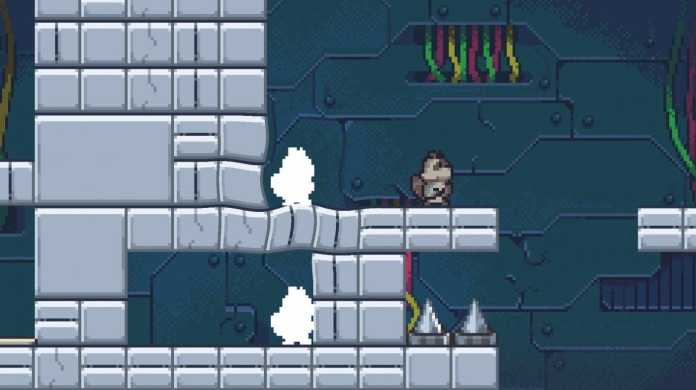
You control Tucker, he’s a lost racoon who has a curious ability. Not only can he leap large gaps, and use his sharp claws to climb, he can also teleport through walls. Yes, you read that right, a teleporting racoon! You face fifty handcrafted levels that vary in design and difficulty. You must avoid spikes, climb mountainous walls, and teleport through objects. Sounds simple? Think again, this is a beastly precision platformer where death is one small error away.
So many spikes.
Short stages and leaps of faith.
I adore a casual gaming experience. A quick blast on a title between jobs, or something to enjoy after you put the kids to bed. Rift Racoon offers this in abundance. If you are accurate and trust your instincts, you’ll fly through the levels. This doesn’t mean it’s easy. No, the short stages allow you to memorise the layout, and a generous amount of checkpoints help you continue from where you left off.
Not only will you have to have trust in your abilities, you’ll be making many leaps of faith. Falling from high platforms to lower areas is a key element in this precision platformer. This was quite disconcerting, and though I died repeatedly, it was rewarding when it all came together.
Alongside your death-defying leaps, you’ll have to teleport into tight spaces. This aspect was troublesome, and failure was all but guaranteed. The developers weren’t lying when they insisted that accuracy was key. If you are just millimetres off, Tucker gets stuck, and unsurprisingly dies. It’s harsh, but that’s what you get for messing with the laws of physics.
Time to teleport.
Rift Racoon is a retro game with an old-school aesthetic.
I know pixelated and dated graphics aren’t to everyone’s liking, but I like them. My Series X eats them for breakfast, but I love the simplicity, and the nostalgic feeling it produces. The handcrafted levels are great to look at, with many new assets used as the game moves on. There is a nice variety in backdrops, and though the colours are garish and in your face, they weren’t OTT. The sprites are basic but offer enough detail to be inoffensive. The traps, platforms and other obstacles all stand out from one another, helping you to negotiate each stage.
Old-school arcade games are renowned for their brash, synth sound and upbeat tempo. Rift Racoon ticks these boxes with its retro style. Alongside the fast-paced music, you are also treated to calmer and more mellow sounds. It was a pleasant mixture of songs that added some interesting variety to the gameplay. Jumping and teleporting was met with shrill sound effects, and these were a little harsh on the ears. But the discomfort was worth it as the audio creates that much-loved arcade experience.
Just keep leaping.
Tight controls, but missing key elements.
If you are coining your game as a precision platformer, you better have the controls on point. Fortunately, not only are they responsive and accurate, they are easy to pick up. This doesn’t reduce the difficulty of the task at hand. No, it simply makes it more enjoyable to play. Only a few buttons are used across the fifty levels, making this a great entry-level platform game.
I want to say that this has loads of replay value, but sadly I can’t. It keeps you coming back whilst you complete each of the stages, but once you’ve finished it, there is little reason to return. There are gems to collect, but these add nothing to the gameplay. Also, the achievements are unlocked very early on and offer little difficulty to gain them. If the developers had selected a full collectable list and made these relevant to the gameplay, it would have added an interesting layer to the action. Another consideration would have been a speed run option. This would have tested the best players to push themselves and would have added a competitive edge. It would be nice to see the latter added to increase longevity.
Rift Racoon does exactly what it needs to.
Nothing about Rift Racoon shocked me, and its description matches the action perfectly. It’s a casual gaming experience that tests your patience and short term memory. You must have quick reactions and be able to time your actions perfectly. A generous amount of checkpoints ensure that even the toughest of stages are achievable with a little practice. I enjoyed my time with it and recommend you buy it here! Can you help Tucker find his way home and avoid the strange stalking robot? Leap, climb and teleport your way to victory.
Fate of Kai takes you on a boy’s journey to earn his freedom. The boy in question, Kai, finds himself shackled to a mysterious chest. His only clue lies on the shackles that bind him to his portable prison, the image of a castle.
Once Upon a Time
Fate of Kai, is a short interactive comic that’s presented to you in the form of a magical book. Something that reminds me a lot of the opening scene of Shrek. It’s a short little caper filled with mystery, faceless people, strange creatures, and unlikely allies. Its world is intriguing and the artwork, which is hand drawn, looks fantastic. There’s a lovely use of colour and personality which, coupled with its dynamic soundtrack really come together to bring about a memorable experience.
The most memorable part of Fate of Kai, however, are its puzzles. Here it’s not just a matter of manipulating your own actions to overcome obstacles. Kai is somehow able to change the thoughts and actions of those around him, both in the present and the past. This is where Fate of Kai really hooked me.
Time is Relative
Without spoiling too much let me try to paint a picture for you. Kai comes across a broken bridge. You turn to the next page of the book and you’re greeted with a couple of dark pages explaining that Kai couldn’t find a way across and gave up. Now that could be the end, but if you go back a couple panels, you find a symbol that allows you to view events of the past. That alone caught my interest, who doesn’t love a look-see into the past?
You find out, a pair of travelers caused an accident which damaged the bridge. By going back to their past actions and altering them just a bit, you can make sure that accident never happens. Giving Kai the chance to cross it safely.
Now that’s far from the only instance you manipulate the past, to fix the present. That mechanic also mixes in with Kai’s actions in the present, but also with his manipulations of other people’s thoughts and actions, as we saw above.
Fate of Kai encourages you to backtrack, interact and play around with the space-time continuum willy-nilly and it’s a great mechanic. I love games that allow me to manipulate time as part of the gameplay and Fate of Kai does a great job of implementing it.
However, it did leave me with one nagging question. What does Kai’s manipulation of time and people say about free will in this world?
Leave Them Wanting More
Unfortunately time is also the problem I have with Fate of Kai. Not the manipulation of it, but how much of it we spend in Kai’s world. While his road is long and arduous. For the player it’s about an afternoon’s fun, If even that.
The game is criminally short. So short, that not long after completing it the first time around. I could go back in for a second session and still have some daylight left. It’s a shame really, because I did enjoy my time with it. Even on that second go.
Don’t hesitate to go for that second run as well. It gives you the chance to enjoy the story’s nuances and artwork without being bogged down by unfamiliar puzzles and questions of free will.
Dreams are supposed to be everyone’s safe space. A place where your imagination can run wild, and your mind makes sense of the day’s activities. You should go to sleep knowing that you’ll wake safely. Imagine if this couldn’t be guaranteed, and you gambled with your life every night. Oniria Crimes uses this fearful idea in its futuristic world laced with grit and crime.
Developed by cKolmos Game Studios and published by Badland Publishing. This detective point and click game is loaded with lore and uses visual novel elements to sell its story. A neon washed metropolis is presented using voxel graphics. This boxy style alongside an in-depth story transports you to this seedy setting. What should be a peaceful paradise is ruined by some rogue criminals.
Oniria Crimes should be great, but bugs let it down.
Set in the year 2060, humans and other species have decided that dreams should be entertainment. They create a place known as Oniria, the Land of Dreams. Here every being co-exists in their dream state. The idea was sold to the people as a peaceful escape, and a way to enjoy the surreal world of their minds. Sadly, humans are their own worst enemy, and they quickly ruin it by breaking the rules and committing heinous crimes.
The Rounders crime unit was created. They enter Oniria and solve the many mysteries that arise. You follow two cops from this department; Detective Santos and Inspector Torres. Between them they must; investigate six crime scenes, piece together the information, and compile a file of evidence. This is then used to accuse one of the three suspects.
In theory, this is a sound concept. However, in reality, it’s a buggy mess that undoes all its hard work by crashing, freezing, and corrupting save data. No matter how much you try to avoid the bugs, they jump out of nowhere and ruin everything. It’s an infuriating error from the developers and is especially annoying, as I can see the potential that Oniria Crimes presents.
So, what do we know?
Its detail and depth is its pièce de résistance, and its downfall.
Ironically, the best part of this is also one of its major downfalls. In a dreamlike world, the laws of normality and physics matter not. Every object you encounter is alive and can be interacted with. These items blather on constantly and reveal the much-needed clues to solve each crime. The issue I had with these non-stop talking objects was deciphering relevant information from the unnecessary chatter. Picking out the clues amongst the quagmire of drivel was a challenging task. Fortunately, a handy notebook recorded the relevant facts for you to peruse at your leisure. Yet even this proved problematic.
Random information that appeared to have little bearing on the investigation would appear against a suspect. It was a constant battle to identify what was relevant, and what wasn’t. Yet, once you have scoured the scene, and gathered all the clues, you had to decide who was guilty. You read through your information, come to your conclusions, and make your accusations. Right or wrong, progress never stopped, and you simply moved onto your next task. This sped up the gameplay but gave everything a hollow feel.
It was a shame that a game that was full of character, and lore felt so unrewarding at key moments. I was desperate for it to make me work the scene again, to come up with the right answers. But it insisted you move to the next crime.
Such a needy Rubik’s cube.
Oniria Crimes isn’t just about murder.
Yes, Oniria Crimes is a detective story, but you are given some welcome respite from this thankless task with a selection of puzzles. Each case has a unique challenge for you to solve. Trying them is a welcome distraction and takes your mind off the constant bugs and information dumps that you must sift through.
Every investigation score is based on correct accusations, gathering information, and your ability to solve puzzles. Your ranking has no bearing on the game as previously mentioned. Aiming for perfection is about personal pride and again the developers let themselves down. What’s the point in being perfect if it’s met with the same response as a failure. It undermined what was otherwise a fantastically deep concept.
A dark and seedy world.
Even though I battled with the never-ending issues, and had to reset the game repeatedly, I couldn’t help but admire the world that was created. A hazy neon hue helped to create a dark and seedy atmosphere. The voxel graphics provided enough detail to allow you to easily examine each location, and the text is easy to read. A well-designed UI makes navigating the clues and the surrounding world an easy task. I adored the visual style and wish the rest of the gameplay had performed at this level.
The 80s style synth music enhanced the sinister atmosphere. This classic cop film audio added tension to what was otherwise a very slow affair. A lack of futuristic sound effects was another oversight from the developers. In a surreal world they could have added anything they wanted, but yet they relied on their musical score to carry the load. The soundtrack was good, but it fell short of what I hoped for.
Leave no stone unturned.
An unsuccessful port from PC.
Point and click games always perform better on PC, mainly because of the use of a mouse and keyboard. Sadly, Oniria Crimes has had a terrible port from PC to console. Alongside its glitches and bugs, it’s a slow and cumbersome beast to control. The cursor slowly floats across the screen, frustrating you in the process. And there is no sense of finesse because of the lack of accuracy. It’s just about serviceable, but anything that requires a delicate touch will annoy you and is difficult to overcome.
With plenty of stories to devour, many amusing objects to interact with, and perfect scores to aim for, this has replay value. However, it’s difficult to overcome the many problems you face, and it will put off even the most hardcore of gamers. No one has the accolade of the 100% status on Xbox, and I envisage that being the case for a long time.
Oniria Crimes lets itself down.
When a game has this much promise, a fantastic world, and a great soundtrack, you’d think everyone would rave about it. Unfortunately, the game-breaking bugs ruin it. If there were no issues, this would be an easy 7 out of 10. However, in its current state, it’s bang average. I can’t recommend it, but you can buy a copy here if you are intrigued! Six crime scenes, plenty of witnesses, and two detectives. Finding the criminal should be a piece of cake, right?
If you ever questioned what a Yakuza/ Ace Attorney crossover might look like, Judgement may just be the answer – that leaves you with a whole lot more questions.
Brought to you by Ryu Ga Gotoku studio, most known for the brutal and eccentric Yakuza series, Judgement is a spin-off title that shares both some similarities – as well as some very noticeable differences – with the beloved mainline franchise.
Does Judgement do enough to carve out its own unique identity within the wide Yakuza tapestry? Let’s find out.
A grounded crime drama(yes, seriously):
–
For anyone who has played even one Yakuza game, you will know that the idea of Kamurocho taking centre stage for a more grounded, realistic episode, sounds downright ridiculous. The Yakuza series is brilliant. It excels in many areas. Great combat; unique and compelling characters; along with an entertaining, densely packed open-world provide the formula to this series increasing popularity and undeniable success.
A cohesive, coherent and grounded story, though? Aside from the absolutely brilliant prequel in Yakuza 0, such traits are rarely found in a Yakuza script. Judgement, however, proves to be the exception.
The game follows former lawyer, Takayuki Yagami, who now works as a freelance detective in the fictional Tokyo district of Kamurocho. Unsurprisingly, given the nature of Yagami’s work and the infamous setting, he soon finds himself on the trail of an elusive serial killer.
Yagami is a complex character, written with far more nuance than most video game protagonists, let alone in the Yakuza series. His ‘modest’ apartment, lackadaisical attitude and questionable Yakuza connections are often contrasted with his past as a lawyer. The dichotomy between Yagami’s past and present is intriguing, and without spoiling anything, the game does a great job of hinting at future plot points.
The supporting cast of characters is also written with the same level of care and sophistication. Small-time Yakuza clan captain, Kyohei Hamura, makes for a compelling antagonist; whose intentions are not quite as straightforward as your typical villain. Kaito, Yagami’s best friend and partner, is such a loveable character who would fit in any Yakuza game. And Issei Hoshino, the young, idealistic defense attorney acts as a great counterweight to the jaded Yagami.
I am leaving out so many other great characters, intentionally. The cast across the board is excellent; the way they interact with one another, as well as the story, is just delightful.
In true Yakuza fashion, there are a few big twists, but they mostly feel like earned, rewarding revelations(no, not those revelations). This is because the story is so well thought-out, and the many mysteries that this game presents all lead to satisfying conclusions. The unravelling of who is behind the killings is the obvious highlight, but I also enjoyed finding out more about each of the characters – especially Yagami – and the many subplots that drive them.
From a narrative point of view, Judgement is simply outstanding. Whilst the game shares the same universe as Yakuza, the story is welcoming to newcomers and series vets alike. The characters are loveable, hateable, relatable and the writing regularly retains such a high standard.
Of course, this isn’t a picture novel. This wouldn’t be a good video game review if I didn’t actually speak about the gameplay.
So, beyond the fantastic story and excellent cast of characters, does Judgement do enough to keep players interested for the 50+ hours of content available?
Kung-fu, drones and dating:
–
… no, this is definitely not my ideal Friday night.
If the story in Judgement does its best to distance itself from the outlandish scripts of Yakuza past, then the gameplay exists to remind the player that this is still very much a ‘Yakuza’ title.
As mentioned, Kamurocho once again takes centre stage; providing a familiar fun-fair of minigames and odd quests, with a couple of new attractions along the way.
You can still visit the arcade, play various different card games and endure the challenging baseball minigame(that someone still seems to like at SEGA). There are also two new minigames exclusive to Judgement.
Paradise VR – a dice and cube game where Yagami moves across a virtual world – provides an opportunity for some tough fights, a variety of rewards and some mild frustration. I’ll admit, it is a fairly sizable minigame, but I found the novelty did not last long. Especially frustrating was the fact that a number of key combat upgrades were locked behind this minigame.
The second new addition is the Drone racing league, where, you guessed it, you race drones as you look to ascend the league ranks. I enjoyed customising my drone and the races were fun enough. Not my favourite Yakuza minigame, but a solid addition.
Oh, you can also play pinball(it is ok).
Combat is unsurprisingly a highlight. Building upon the Dragon engine system started in Yakuza 6, Judgement’s combat is especially stylish, with Yagami’s ability to jump off walls and perform various Kung-Fu like strikes a far cry from the raw power based moveset iconic to series lead, Kazuma Kiryu.
Yagami has two combat styles: Crane and Tiger. Crane is a far-reaching, elegant style focused on fighting multiple groups of enemies. Tiger, on the other hand, is a heavier, less flashy, more punchy style, that is better for 1v1 encounters. Each style has their own unique ‘heat moves’ – a staple of the Yakuza series, and as the game progresses, you can unlock both passive upgrades , new moves and heat actions for each style.
Unfortunately, the Crane style feels incredibly underdeveloped, so much so, that I found myself using Tiger style for the majority of fights. It is just better. It was almost like the developers knew this, as nearly all of the significant combat upgrades are centred around the Tiger style. This is disappointing, as whilst the core combat system is very good, there is a lack of depth that is exacerbated across the 50+ hour playthrough.
An aspect I really enjoyed about Judgement was the new ‘friendship’ system. Through completing different side missions, as well as other openworld activities, Yagami will begin to form friendships with the different, ever-so eccentric residents of Kamurocho. Not only does this system add even greater importance to the already solid side missions, but it also offers very unique gameplay incentives.
For example, certain friends will provide situational support in combat(depending on where you’re fighting on the map), with frequently hilarious results.
The side missions themselves are full of the usual Yakuza mix of weird, wacky and surprisingly poignant tales that add a distinct sense of character to the open world. I especially enjoyed missions that would encourage Yagami to use his detective or legal skills. One particular side quest involving an eaten cake was both hilarious and intriguing. There is also a dating element to the game, but it is relatively simple.
I do wish that the ‘detective’ elements of the gameplay were more engaging. The investigating of crime scenes is serviceable, but tailing missions are just as bad as they have ever been. And sadly, there are quite a few of them.
That being said, as an overall package Judgement offers enough gameplay variety to keep the player engaged throughout the 50+ hour play through. Whilst some ideas are half-baked and poorly implemented, highlights such as the excellent side ‘cases’, friendship system and solid combat do enough to keep the gameplay experience regularly entertaining.
Is it worth it?
… Yes. No superfluous conclusion needed here.
Judgement offers a gripping, well-written story, supported by a fantastic cast of characters, and plenty of gameplay variety. Not to mention, it acts as a great entry point into the weird, wonderful world of Yakuza.
The sea is full of stories of tragedy! Human error, catastrophic failure, and bad luck all play a part in these sad tales. The Kursk disaster is one incident where an unfortunate accident took the life of 118 naval personnel. The 12th of August 2000 marks the date where fear and panic washed over the crew of this ill-fated vessel. Kursk the video game aims to replicate the emotion that was experienced and takes you on a virtual tour of a submarine that was destined for failure.
Developed by Storm Trident and published by Forever Entertainment S.A. It’s a simulation spy title that takes you on a journey across the last days of the lost crew. With highly detailed surroundings and atmospheric audio, it transports you to this underwater tomb, while aiming to highlight the known faults that caused the disaster.
One of the many distractions.
Kursk’s setting is factual, but its story is pure fiction.
I was worried when I received my code for Kursk. It concerned me that the developers would fail to be tasteful when its game’s subject was so tragic! Fortunately, Storm Trident overcame any concerns by penning a fictional spy story that allows us to explore the events that lead up to the catastrophic situation.
You assume the role of an American spy who has been sent to infiltrate the K-141 KURSK submarine. Your task is to befriend the crew, retrieve top-secret information hidden on board, and find the revolutionary Shkval supercavitating torpedoes. As your mission unfolds, you will witness the dramatic end to the well-reported tale and will experience the blend of fiction and non-fiction as the game concludes.
The story starts with the protagonist locked in his room. An explosion rips through the vessel, and sirens wail. The ship falls into darkness, and a red emergency light helps you to see. With the help of a fellow sailor, you soon break free, and then the game flashes back to before the incident. A hotel room, an unknown female Russian colleague taking a shower, and a top-secret mission briefing. This truly is a James Bond-style opening. Armed with little information, a PDA, many random attachments, and a sense of pride for your country, you begin your mission.
Sneak around, take pictures, complete tasks, and don’t get caught!
For all the emotional connections, Kursk is technically a walking spy simulator. Playing out linearly, your main aim is to follow the orders of the officer in command. He will send you on many, and I mean many quests that involve fetching documents, speaking to individuals, and ensuring that parts of the vessel work. Each of these components links back to the cause of the disaster and have relevance to the theme of the game. The tasks themselves aren’t entirely interesting and offer little to no challenge. Accepting each quest takes you on a trip around each deck of the sub, you “interact” with the crew, and find distractions en route.
I say “interact”, because most of the people either ignore you or are devoid of interesting conversation. It was a shame, as I would have liked to be more connected with the crew knowing their inevitable fate. The distractions gave me a good insight into how time was spent under the water. Lounging around smoking in the messroom, playing arcade games, sleeping, or challenging to see who was the fittest. Each element brought the environment to life and took focus away from the claustrophobic corridors that you had to traipse through.
When disaster strikes.
The crew on the Kursk never suspected a thing!
Life as a spy should excite and be challenging. Your brain is full of vital information, and you cannot get caught. Luckily, no matter how bad you are at this top-secret malarkey, you rarely mess up. You keep prying into the revolutionary torpedoes hidden onboard, but no one cares. You ask a bunch of dodgy questions, and not one eyebrow is raised. It was strange indeed. In fact, the only time you were caught was when you were using your PDA for “spy” business.
Fortunately, you see the world through the eyes of the spy, and you never find out where he hides his PDA and additional tools. Wherever they were stashed, they never raised an alarm. I could only conclude that this man either has one big cavity or a large satchel. Either way, it’s used to pick locks, take photos, hack computers, and track your objectives. Once you get to grips with each process, it lacks any depth, and I was left wanting much more of a challenge. There was a sense of tension as you went about your business, as crew members completing their rounds could catch you in the act, and that signalled game over.
Nicely detailed, but clunky animation.
I loved the styling of the submarine and the noughties vibe. The instruments, room layout, uniform, and landscape were all well designed. Walking through the ship was eerie, as you know it’s fate, but it was equally fascinating. It’s not the highest quality game with its finish, but it looks great nonetheless. Where it lets itself down is in every animation that was implemented. Robotic movement, drifting and slow panning as you climb ladders. The airlocks took an age to pass through, and more. It was equally frustrating that the game hung as you transitioned from one section to another. It broke up the gameplay and severely hampered the immersive nature.
The graphics were a mixed bag, but the audio was almost perfect. This had to be the best element of the game by a country mile. The creaking of the sub under pressure. Metallic footsteps ringing out, the shuffle of feet on the ladders and steps, and so forth. When the game comes full circle back to the explosion, the sounds and feeling of panic are torturous. You will lose your composure and you’ll run around trying to escape the flames and the devastation.
Yes sir!
Simple controls, but lacking some key options.
It’s hard not to praise a game when its control system is simple to pick up. But Kursk has some basic options that are sadly lacking. The sub is a confusing, claustrophobic maze that’s tough to navigate. Yet, there is no map to assist you. The man has a PDA that can hack computers and pick locks, but it can’t draw a simple map for you. This flows into my second issue. If you are given an image of a place to visit or an item to gather, there is no way to look at it again. You must remember each detail or start again! Both problems were infuriating, and a big oversight from the developers.
You are given the freedom of the whole vessel to explore. Within its many decks, you will find collectables, letters, and other objects. All these items can be ignored, but completionists will have to search for them all if they are to get their 100% status. This alongside the many side quests adds a considerable amount of replay value. The story won’t draw you back in once you have finished it, but the other elements increase its longevity.
Kursk is tasteful, but lacking in some departments.
For all its shortcomings, Kursk is a tasteful depiction of the events that lead up to the submarine tragedy. Its unrelated fictional story allows you full access to the ship while piecing together the mystery that shrouds this accident. Graphically it should have done better, and its lack of a map and item recall was a big oversight. Fortunately, it’s saved from sinking with its wonderful audio, and stunningly detailed depiction of the K-141 KURSK. On the whole, I enjoyed it and recommend you buy it here! Experience a tragic moment in Soviet history and remember the 118 personnel who sadly lost their lives.
Balancing Monkey Games invites you to take a break from the day-to-day, and whatever hardships that may bring, for some relaxing world-building amusement. Referred to as Peeps, these human-like inhabitants come forth from the planet’s crust after a previous war leaves it in shambles. From the ground up, it’s time to build a new world and leave for another. Explore new islands, construct communities and thriving ecosystems, and chill out to a beautifully orchestrated soundtrack. Before We Leavelets you control the pace and keep the stress down on this hexagonal shaped experience. For those looking for a break from Demon-slaying and online trash talk, this may be the right fix.
“Peep” Into A New Society
Players new to the genre, will find an elaborate tutorial that takes it’s time introducing and explaining what to do. Start with simple roads and houses. It’s so calming to watch more and more Peeps emerge from the central hub and find things to do as more roles become available. Though the player may feel like the game is on autopilot at first, that feeling isn’t here to stay.
The world is so neat and cute.
Eventually it will be time to learn how to research new building constructs, and resource farming methods. You’ll then be preparing shipping routes and interplanetary space travel. Though it may take a couple of hours to finish the first planet, the tutorial never feels like a slog. This is in-part due to the clean and nonintrusive interface that Before We Leave utilizes. It’s easy to navigate around to learn and explore.
There really aren’t that many issues to deal with, aside from resource management and infrastructure problems. There is no war, or politics, or famine, or any sense of impending doom when resources are low and and/or not being distributed responsibly. You will, however face the infamous “all buildings must face a road” ordeal that many players and reviewers of the genre are all so quick to point out. A pro-tip is to really focus on where your roads are going first and build the city around it. It’s like comparing London to New York City. You will also need to focus on the travel distance for your peeps to carry resources to and from, as well as other logistics. These issues are manageable and have no lasting outcomes, aside from halting production.
Wait, How Do I Do That Again?
As your habitat expands, new roles, materials, and buildings become available. Farm research points to be able to unlock them.
While Before We Leave may give the sense of the game playing itself, there may be a point where the player will start to feel the training wheels being taken off. You will start to realize that more and more minor fixes and research becomes necessary to progress. Once the iron smelting plants, wool fabricators, and school systems are required, the small logistical problems can stack up. It can then become tedious to go back and diagnose what to do. Thankfully, there are online walkthrough videos and forum posts to save the day for literally any game. After such an in-depth learning experience it’s easy to forget some of the tips and necessities learned in the early game. This, of course, can be a completely subjective issue. Other players may easily have no problems planning out and retaining everything, so there’s nothing game-breaking to report.
Sit Back And Relax
What immediately draws attention is the opening theme upon a first boot-up. The music is heartfelt, exciting at times, and overall melancholic throughout. So many stringed instruments and pipes draw a medieval village and contemporary countryside vibe. When playing games with a lot of patience or grinding involved, the soundtrack becomes important to help keep the player immersed. And Before We Leave does just that.
Take your ship to freely discover new islands on the planet.
Chill out and listen to the tunes as you watch your Peeps work hard together with the tools they created. Imagine a utopian society as such existing today. You may even look up the OST online to study or read to at the end of the day if you’re too tired for a game (I listened to the OST while writing this review).
Bottom Line
Games that are information and infrastructurally heavy may be intimidating, but Before We Leave provides a safe space to learn and make mistakes. It’s a nice little title for those wanting to get into the simulation realm and escape. With some of the best music of it’s genre, players will find comfort in the adorable aesthetics with little major problems to encounter down the road.
What The Dub?! is a fantastic laugh out loud party game full of hilarity and fun. The game adds its unique take on the party game genre producing a game that stands out amongst its peers but may lack substance in the long run.
In’dub’itable fun
At its core, What The Dub?! is simply a voice-over exercise, you a player of What The Dub?!, is shown a particular video sequence from an old school film or show and asked what the characters say next, the player with the best answer wins and thus, wins the game. That is it. The gameplay and concept behind the game are simple, but that is what makes it so great. There are not several different complex mechanics you need to learn to play the game, much like other party games but instead a straightforward premise and concept that is genuinely hilarious. Thus, the game is easy to pick up for gamers and non-gamers alike and is the perfect party game. Dubbing the various video clips is an excellent concept entertaining all age demographics, making this game something special.
There are many videos to dub over, and each of them gives an early 20th-century vibe that makes dubbing particularly amusing. You can play the game solo, but the magic happens when playing multiplayer. The seriousness of the clips, combined with guessing and finding out your teammate’s comical dub, makes the game a blast to play, being funny from start to finish.
In Game Footage
Brilliant Gameplay but Limited Replayability
What The Dub?! also has a great vibe with energetic old school game show music with a great voice over, making you feel like you are on a game show from a bygone era. All of this compliments the funny but straightforward design and concept of the game, only adding to its appeal. However, although the game is simple and does an excellent job, it might not have enough meat on the bone at times.
Although the gameplay is impressive, there needs to be more of it. There is only one primary game mode: the simple dub mode spread out across single and multiplayer. The core concept of gameplay is a standout and could be incorporated into other game modes that may add to the game’s longevity through variety. Thus, at the moment, What The Dub?! doesn’t have much replayability. The game is likely to become relatively dry after several attempts. That’s not to say the gameplay is not good. It is outstanding. It is just too much of any good thing is too much. Constant repetition of this game mode may make the game boring in the long run.
Multiplayer Fun
Verdict
Overall, What The Dub?! is a standout out party game. At its core, it is a simple party game that wholly succeeds in everything it sets out to do. The fundamental dubbing concept behind the game is witty and makes the game hilarious and a standout in the genre. Nevertheless, there needs to be more of it, spread out across many game modes. At the moment, the game lacks replayability which will hamper it in the long run.
select
review(Total War: Rome Remastered) – review(ROME: Total War) as Review: Total War: Rome Remastered
from Movies Games and Tech
Reviewing a remaster is interesting. Do I review the game as a whole, hitting all the key points that a review of the original game would’ve hit and regurgitating a lot of material that fans of that game already know? Or do I only talk about what’s new – what’s been changed between the original and the remaster? After some deliberation, I’ve decided to do the latter, so this isn’t much of a review of ROME: Total War – look elsewhere for that. This is going to be what happens when you subtract a review of Total War: Rome Remastered from a review of ROME: Total War. A review of ‘Remastered’ in essence.
So what are the key points that Total War: Rome Remastered has improved? Well, it’s prettier now. It’s got nicer textures, new models and it works in 4K. The UI is more user-friendly and transparent (as in understandable not see-through – that would be a lot less user-friendly) and there a few new features, such as the ability to play as any faction from the start, a tutorial (which we’ll get on to later) and an array of new heat-maps and reporting.
But that’s about it. If you’ve played the original game then your experience with Total War: Rome Remastered will be very much the same as your time with it. If you haven’t played the original then there isn’t an awful lot to recommend this version as a jumping-on point. In the last 17 years the strategy genre has moved on and there have been a hell of a lot of Total War games to bridge the gap. As well-loved as ROME: Total War deservedly is nowadays, I suspect a significant portion of that is nostalgia and the game can be seen by outsiders as a relic of a bygone age.
The remaster really leant into this nostalgia. It’s for the people who loved the original game and want to play it again as a modern release. Which is fine – it’s great for them but it doesn’t seem to have targeted a wider appeal to the rest of the gaming community. Feral Interactive have done enough to call it a remaster but they have not done much more. It’s the equivalent of defrosting a month’s old stew and popping it in the microwave. Yes, it’s technically dinner but nobody is as happy to see it as a freshly made meal, or defrosting a pasta sauce and eating it with freshly cooked pasta and garlic bread (which I think are respectively: making a new game and doing a comprehensive remaster like Oddworld: New n Tasty in this metaphor that has got well out of hand).
Arguably, the main garlic bread added by Total War: Rome Remastered is the tutorial, which honestly rubbed me up the wrong way. It’s a nice-to-have, for sure, but in the same vein of the remaster being strongly focused on appealing to the existing player base – I don’t think it was intended to be used that much and that intention shows. The tutorial takes you through one turn of the game. There is a lady in the top left of the screen with a robotic customer service voice from what sounds like a text to speech engine (apologies to the voice actor if there was one in the loop). She talks you through the background of why you’re doing what you’re doing but an awful lot of the tutorial is her saying “Now read the instructions in the top right of the screen” or, most egregiously “Spend some time on this screen and mouse over all of the buttons to get the tooltip of what they do”. It just feels like a lazily tagged on feature that was done in an afternoon so they can write on the steam page that the remaster has added a tutorial.
And looping back to the first thing the remastered changed – after all of that remastering to make the game prettier, I’m not sure the visual aspects of the game are particularly remarkable. By 2004 standards? Sure. But in 2021 they look about how I’d expect a game from 2004 to look thanks to my rose-tinted glasses – ugly and outdated. It’s another example of the remaster doing the bare minimum to be a remaster. Yes, it runs in 4K. Yes, it has new textures. But it still looks old. With a remaster of such a well-loved game, I’d expect more. I’d expect it to look new. Much like the gold standard of remasters, Oddworld: New n Tasty, which rebuilt the game from the ground up to look and play indistinguishably from a modern release.
Feral Interactive knew exactly what they wanted to do when they set about the remaster of ROME: Total War and that is exactly what they’ve done. I can’t fault them for that and from that perspective, you could call Total War: Rome Remastered a 10/10 game. If you loved ROME: Total War, you’re the person the game was remastered for and you’re probably going to love it (and in all honesty, you’ve probably already bought it). If not, if you somehow managed to let ROME: Total War pass you by, then you’re probably going to let this pass you by as well.
Human beings and war are as inevitable as day turning into night. Two factors usually cause conflict; religion and money. When either or both are involved, people lose their minds and do silly and unforgivable things. Infestor uses conflict at its core and shows that no good comes from war.
Developed by Woblyware Oy and published by Ratalaika Games, this is a classic indie puzzle platform title. You control a green alien-like blob who assumes the role of any human it encounters. Use this special power to navigate the seventy levels, overcoming obstacles and avoiding death en route.
Best to avoid the spikes.
Infestor does its job well and offers some surprises.
Whenever I play a retro platform game, I know I’ll have to solve puzzles, double jump to new heights, and avoid a range of traps. I also expect enemies to block my path and try to kill me. Infestor offers all this at its core, and more! The green blob uses the strength of each human it possesses; shoving crates, becoming agile, carrying a gun, opening locked doors, and using a jet pack.
Each of these independent skills is great, but you must work out which human to use first to progress. This is where the puzzle element shines. Study the layout, pick the correct victim, and set about trying to complete the level.
So, where did the green blob come from? The two human factions on colony 31-5B share resources, and this created tensions. A war broke out and one side created a biological weapon. The green blob results from this land squabble and sadly every human he touches dies!
The story is absurd, but it’s as simple as the gameplay.
When a game coins its style as a puzzle-platformer, you believe there will be an element of difficulty. Infestor does little to challenge you in any way across its seventy levels. The small maps and linear approach give away the solution with no logical thinking required. Yes, there was some trial and error and exploration required, but this hardly tests your resolve.
For me, the joy and difficulty were locked behind the timing and precision aspects. Avoiding giant presses that squash you, or leaping from multiple surfaces. It required patience, a good memory, and a fair amount of accuracy.
If you’re a veteran of the genre or someone who wants a tough platform game, you won’t get that playing Infestor. Instead, you’ll have a gentle experience of killing innocent humans as you make your way through each level.
Shoot ’em when their back is turned.
An old-school game gets an old-school style.
This 2D pixelated retro classic has a simple but clean-cut image. Vivid colours, varied sprites and basic level designs ensure that it’s interesting to look at, yet not overwhelming. Sadly, the levels lacked a unique look. Each stage could have easily been mistaken for another and I was desperate for the developers to mix up the background, but it never materialised.
The audio is equally old-school, thanks to the 80s inspired synth soundtrack that blares out. I loved how the electronic sound with its upbeat tempo accompanied everything you did. A basic 8-bit sound effect library accompanied each action and it was glorious. Shrill noises when you jumped and gutless thuds of your weapons firing, it represents retro gaming in a nutshell.
Its look and sound epitomise arcade gaming, and Infestor wouldn’t look out of place at an amusement arcade. If you have a soft spot for retro gaming, this will tick many boxes and will be right up your street.
Poor human, just another body for the pile.
Not as responsive as I’d like.
When you play a platform game, you need its controls to be spot on. This is especially true when one of the key mechanics is precision. Sadly, Infestor lacked the responsive element required. It’s serviceable, mostly, but will leave you frustrated when actions aren’t acknowledged. This leads to death, failure of levels, and exasperated huffs. It doesn’t prevent you from playing, it simply taints the experience a little.
Like most Ratalaika Games titles, this one is an easy 1000 Gamerscore. Completion takes around an hour, and all the levels are finished in only three hours. Sadly, this impacts the replay value. With no NG+ mode, there is little reason to return. Luckily, the first playthrough is enjoyable enough to make it worth your time.
Infestor has some interesting ideas but its lack of challenge lets it down!
With an absurd story, simple concept, and unique mechanics, Infestor has some interesting ideas. It’s fun, colourful, and will test your approach. Unfortunately, however, it won’t be difficult enough for most and should have incorporated a harder mode.
I enjoyed my time with it and I think it’s fun when played casually. I recommend it, so buy it here! War is a terrible thing, it only brings; blood, sweat, tears, and a green blob.
Actors or thespians as they are otherwise known are adored the world over. Admired for their talent, looks, and style, but for most, it wasn’t an easy path into the spotlight. Rejected repeatedly and having to do whatever it takes to get noticed is tough. Talent not Included unusually tells this tale.
Developed by Frima Studio and published by Frima Original, this is a medieval platform game with a quirky approach. Set in a mock theatre, you play the part of three desperate actors who will do whatever they can to get their lucky break and fulfil their ambitions.
Leap the lasers.
Talent not Included has a simple yet clever concept.
Challenging platform games are two a penny, and it is hard for gamers to sift through the mountain of titles at their disposal. With 2D side-scrolling adventures to 3D immersive, open-world journeys, little has been missed out. Talent not Included hasn’t followed the crowd, instead, it uses a fixed screen view and a simple but clever key concept. A central cylinder with multiple moving parts rotates at the end of each section. When this happens, it creates a new portion of the level. It’s a unique and wonderful twist to the genre that keeps you on your toes and takes you on a journey even though you stay in the same working space.
The game is split into three acts, one for each character. Each comprises fifteen stages and three boss fights. Once all acts are complete, you must face the main boss, the villain of this bizarre performance. Set in the world of Notthatmuchfurther the three actors must dress as a knight, rogue, and mage. Each has a unique set of skills and must face an array of traps and monsters to get to the goal.
A unique approach, but familiar mechanics.
Its core concept is unique and I can’t recall other games taking a similar approach. But its mechanics and objectives follow a familiar pattern. As mentioned, each actor has a unique set of skills; spinning dash attacks, rolling through spikes, or floating in bubbles and shooting magic. Yet, every other move comes straight out of the platforming rulebook 101. Double jumps, wall climbing, dashing, and more. If you are a fan of the genre, this will feel wonderfully familiar even in its strange setting.
The objectives for each stage are also standard fare. Each level requires you to score the highest amount of points available. You do this by killing enemies, collecting hearts, and gathering sweets. If you avoid getting hit, you’ll build a multiplier of up to 5X the base amount. As the score is tallied up, you aim for three stars which are represented by a golden mask. Two stars are silver, and for completing the stage you are awarded a wooden mask.
Burning bullets, what could go wrong?
A gentle learning curve and predictable bosses.
Talent not Included has a gentle learning curve and its difficulty follows suit. Opening with basic tasks such as; leaping a chasm, jumping spikes, and killing simple enemies, fools you into a false sense of security. This soon ramps up, however; Dodging fire laden bullets, tackling robotic hellhounds, moving platforms, killer wizards, and more. The gloves quickly come off, and what starts as a fun-filled platforming experience soon turns into your worst nightmare.
Each hero has a boss to face; an angry mage, a gigantic bull, and a fiery knight. They’ve taken a disliking to the actors and want to rip their heads off ASAP. Fortunately, they are the most predictable foes you’re likely to encounter. At first, you may struggle against them, but once you know their pattern of attack, it doesn’t change and killing them offers little challenge. The hardest part of this game is overcoming the obstacle to face them.
Talent not Included is a colourful and whimsical treat.
The world of the theatre is over the top, in your face, and very fancy. Talent not Included incorporates all these elements in its brightly coloured, extravagant cartoon world. With a healthy mix of sparse scenes and busy landscapes, it doesn’t overpower you with its imagery. Well designed sprites and smooth performance make this a pleasure to play even when you die repeatedly.
The theatrical elements continued with the whimsical and medieval-themed audio. The lighthearted soundtrack matched the shenanigans that unfolded on the screen, and the theme equally well. The sound effects were good, mostly, but the character noises were annoying and could have been toned down. Overall for an older title, it aged well, and its presentation stands up against the high end modern indie games.
Dodge the traps and collect the sweets.
Accessible to all, though tough to master.
I love when a game makes it easy to play and is accessible to all. This inclusive approach piques your interest from the first level and allows gamers of all skill sets to enjoy the action. Tutorial hints are issued as new mechanics are added, ensuring you know what you are doing throughout. Yet, even with this hand-holding, it’s tough to master! Precision and timing are a must if you are to be successful in the latter stages.
This increase in difficulty ensures that there is plenty of replay value. You’ll constantly die, lose your score multiplier, and miss out on the maximum three masks. Cursing your luck, you’ll reset the action and retry the stage. This addictive and frustrating gameplay begs you to return to play it. Completionists will need to be perfect to gain 100% status, as all masks must be earned to claim you have defeated it. Best of luck with that!
Talent not Included is addictive and deceptively simple.
I admit I was hooked on Talent not Included from level two. Its deceptively simple approach got to me, and I kept muttering “just one more try”. Its addictive gameplay should come with a warning, and the hours melt away as you lose yourself in the medieval theatrical world. It’s a game that has aged well, and I recommend you buy your copy here! Three actors, one theatre, and many monsters. I guess now’s the time to shout “Break a leg!”
When I think of rampaging arcade driving games, the first thing that springs to mind is Crazy Taxi. With its fast-paced, adrenaline-boosting action occurring at every turn, it keeps you on the edge of your seat. Objective after objective is thrown in your path, and the only aim is to score as many points as possible. When I saw Snakeybus and realised its core concept was similar, I thought this should be fun.
Developed by Stovetop, LLC, and Stage Clear Studios and published by Digerati, Snakeybus is a casual arcade indie game with a twist. Drive around different levels, collect the passengers at the bus stop (naturally, you are a bus, after all), and drop them off. As you run through each drop-off zone, your bus extends in length, and so the madness begins.
Think 1997 and Nokia’sSnake, that’s Snakeybus’s core concept.
If you are old enough, you will remember the glory days of Snake on the Nokia 6110. Moving your pixelated snake around a tiny green screen…. amazing! Snakeybus takes this idea and expands it to create a fuller experience. Unlike the guaranteed death in Snake when you touch your body, in this, colliding with yourself is nothing more than a slight inconvenience.
The main aim is simple, keep on moving! This is it, no bells and whistles, all you must do is drive. But that is easier said than done when your constant twists and turns trap you within your elongated bus body. The serene and slow-paced action soon turns into a nightmare as you lose space, can’t find gaps, and crash at every turn. The moment you can’t move is game over, so you dust yourself off and begin again.
Avoid the snaking bus.
Lots of maps, several game modes, and torturous monotony.
The developers were kind enough to offer four game modes, lots of vehicles, and many maps. The game modes are as follows; Classic, Time Race, Aerial, and Endless. You’d think that with four gameplay options available, there would be minimal repetition….. wrong! Except for Endless, the others follow the same pattern with minor differences in the action. Endless has no goal, and the lack of focus and challenge bored me within five minutes.
The vehicles and maps are unlocked by earning points as you play. It offers little in the way of a challenge as the highest-priced item is 16,000 points. On average, you’ll earn 2,000 points a game, so you’ll have everything unlocked within an hour. The lack of difficulty made it mind-numbingly painful and eliminated any slither of enjoyment.
There was a speck of light at the end of the tunnel, however! The level selection added a much-needed boost to what was otherwise bland and tedious. A variety of locations are at your disposal once you unlock them, that is. Each has unique obstacles and adds an element of interest as you first “explore” them. You’ll drive through; Paris, a dorm, a museum, and more. You must dodge cars, leap jumps, avoid buildings, and so forth. Sadly, you’ll tire of this as well, and only completionists and reviewers will endure it to get the 100% status.
Take a first person look at the chaos.
Snakeybus soon becomes a bore.
No matter who you are or what you do, one person in your life bores you to tears. Usually, it’s at work. They enter the break room, and the place empties! Sadly, you are not quick enough, and you are left listening to their tales of buses, trains, and other inane drivel. (Disclaimer; fans of buses and trains replace those words with football, cars, or whatever you find boring).
What I’m trying to say in my last paragraph is that I’d rather spend an afternoon listening to my boring colleague than attempt another hour of Snakeybus! Its gameplay disappointed me and became tiresome quickly. It’s always a shame when a potentially good game misses the mark so badly.
Dated graphics and glitches galore.
Now, I know indie developers don’t have the budget of the bigger studios, and I give leniency towards the smaller guys to balance things up. But even I have a limit on what I accept. Modern games should aspire to perform to a good standard. Disappointingly, this is full of glitches and bugs that ruin the already lacklustre gameplay. The vehicles liveries shimmer and change colour. You fall through the map and collide with invisible entities. Frankly, it’s not good enough. If you combine this with its subpar PS2 graphics, it’s honestly not a modern-era standard. Graphics don’t make a game, but when you have little else going for you, they should be optimised to a higher level.
One redeeming quality from this title was its well-designed audio. With crunching sound effects each time you crashed and collided, and amusing sounds of people cheering as you picked them up, it worked well with the theme. The music choice was strange, however. It has a calm tone and was contradictory to the action. Strangely, it somehow worked and was enjoyable to listen to as the madness ensued.
Bendy buses have nothing on this beast.
Serviceable controls and easy achievements.
Another plus point was the ease to pick up the controls. A well explained controller layout describes the button mapping, ensuring no tutorial is necessary. The controls weren’t as responsive as I’d liked, but this led to some amusing scenes as the bus jumped miles in the air or crashed into a ravine. It added a comical element to the gameplay, and though it may frustrate some people, it made me chuckle repeatedly.
Unfortunately, Snakeybus wasn’t for me, and I won’t be returning to play it. It lacks challenge and doesn’t combine the best elements of either Crazy Taxi or Snake. Some parts were fun (for the first hour), but it was lacking finesse and the polish I come to expect from a modern title. The easy achievement list will be completed in under two hours, making it a completionist’s dream. For £10, it doesn’t prove to be value for money, even if you get a couple more hours out of it than I did. If the developers had added multiplayer or additional modes that had a different focus, then maybe it would be worth investing your time into.
Snakeybus wasn’t for me.
I hate being tough on games, as I strongly believe that what doesn’t work for me will work for someone else. I was left bored and disappointed with Snakeybus and wanted it to step up to the next level, but it never did. With all the gameplay revolving around the same mechanics, and little variety offered, it soon became tedious and tiresome. I don’t recommend it, but if you want a copy, click here! It was a nice attempt to blend a retro classic with a modern arcade title, but it sadly missed the mark by a country mile. A few redeeming qualities will interest some gamers, but for me, it’s a title I won’t consider playing again.