Review: Alchemic Cutie

Your gaming library is loaded with hectic and fast-paced titles, and that’s fantastic. You can join friends on a battlefield or race strangers across the globe. However, occasionally you want something a little more relaxed and slower-paced. You don’t want blood to fly, or people to lose their limbs. No, all you desire is a calm and cute environment. Alchemic Cutie delivers this and much more in its vivid yet laid back gameplay.

Developed by Sebastien Vakerics and Thomas Cashman and published by PM Studios, this is an adventure RPG. Set on a colourful and whimsical island, this slow-paced title demands you explore and care for your jelly farm. Fans of Stardew Valley and Harvest Moon will adore the style and premise. Subsequently, this has the opportunity to become a time sink and a cult favourite.

Alchemic Cutie breaks no new ground.

Thanks to its strong influences, Alchemic Cutie has the chance to be an excellent title. Sadly, however, it relies heavily on the key concepts from Stardew Valley and this stunts its creative flow. Moreover, every task has a deja vu feeling to it and this, unfortunately, doesn’t break new ground. This, however, doesn’t mean it should be overlooked. No, I was merely hoping for a slight twist in the action.

So, it’s not that original, but I’m not willing to write it off because of that. The story revolves around a delicious little island called Wimba. This beautiful tropical paradise hides secrets in plain sight and hosts a few residents. Subsequently, it houses an array of shops and restaurants, but most importantly, it’s the home to an impressive collection of wild jellies. These gelatinous beasts are the key to progressing the story and they are cute as hell.

You control the protagonist who is newly qualified in the alchemic arts. This skill is essential when it comes to taming jellies and exploring the island. Luckily, using these powers is extremely straightforward! All you must do is aim your cursor and click, and your only restriction is a generous stamina bar. You’ll capture jellies to send to your farm, harvest fauna, and cut down grasses. Completing these tasks will drop essential items and gems that can be spent in any of the shops or restaurants.

Time to spend your cash.

Loads of quests, but very little guidance. 

One thing that Alchemic Cutie isn’t lacking is quests and objects to collect. I would normally be screaming about how great this is however, I can’t! Annoyingly, a lack of guidance leaves you confused and stabbing around in the dark. This is further compounded by the exploration elements. This should be phenomenal, yet I couldn’t comprehend how to progress.

Wimba’s secrets are locked behind shrines that require crystallised jelly relics to open them. Your tamed jellies need care and attention to survive, and a mixture of happiness and overfeeding forces them to end their lives and turn into a statue. Bizarre, I know, but let’s go with the flow. It sounds simple to manage, yet I rarely succeeded. Failure wouldn’t normally bother me, yet, without the relics, you can’t progress the story. So, unfortunately, I experienced a mundane cycle of jelly farming, side quests, and resource gathering, only to fail again.

The vicious cycle of minor tasks and failure are Alchemic Cutie’s Achilles heel. What should make it an enjoyable and in-depth game full of lore and interesting twists and turns undermines it. If the developers had been more forthcoming with a tutorial, then this cloud of confusion would have been lifted. Subsequently, players are left disappointed and frustrated by the lack of guidance. 

What secrets does this jelly hide?

Alchemic Cutie is very similar to Stardew Valley.

Alchemic Cutie unashamedly wears its influences on its sleeve. Its uncanny resemblance to Stardew Valley was a little too close for comfort. However, I have no issue with it per se, it simply reduced the originality. Other than that, it was nice to look at with the standard vivid colours and pixelated imagery. Wimba island has a nice variety of regions to explore and the bird’s-eye perspective made it easier to see all the action. You won’t be wowed by its style, but equally, it won’t disappoint you. 

The same can be said for the cutesy and lighthearted audio. The upbeat tunes help to break up the monotony of each day, but they offer nothing new. Both the audio and graphics were serviceable, but I wanted them to deliver so much more. 

Winter has hit the island.

A well-constructed UI. 

There is plenty of content to contend with, so a well-constructed UI was essential. Luckily, the developers hid the menu system behind a clever notebook. Your journal covers every aspect of the gameplay and provides you with jelly information, a map of the island, and so forth. This was an excellent move, as I’d have been turned off by anything more complex. This is also supported by responsive controls and an easy to learn button layout. Therefore, if you can get to grips with the fundamentals, you’ll experience an easy to handle title. 

The action may not be as clear as I’d liked, but it’s moreish and demands you keep playing. Caring for your jellies takes time, resources, and an eye for detail. Completing quests and unlocking the secrets is easier said than done and you’ll lose hours to finishing these tasks. Moreover, a thorough achievement list will require dedication if you wish to get them all.

Alchemic Cutie is good, but it’s sadly lacking in key areas. 

I enjoyed what Alchemic Cutie offered, but it was sadly lacking in key areas. Its lack of explanation damages its potential and I think this will put many gamers off. I liked it despite its shortcomings and recommend you to buy it here! Can you unlock the secrets of Wimba Island? Tame some jellies, complete the quests, and help the residents. 

Review: Monster Train First Class

0

Card games can be fun, especially if you’re using them to defeat an enemy or another group of players, can even be a friend! Monster Train First Class is just as it sounds, monsters on a train. You as the player are given a variety of cards to pull from the deck and play against the other enemies that are attacking.

The game starts off very easy, perfect for one to get a hang of how to play the game. If you happen to be a first-time player of any card game such as ones that require you to build a strategy to fight the other teams or enemies, this game will be a perfect one to try out! The entire card game is easy to learn, with a high chance of winning right on the first battle! That is even if you never played a card game like this or didn’t have much of an idea how to play.

It honestly isn’t too difficult to play, but this is true for the first few rounds. So even if you make a mistake it’s very easy to get back on track and defeat the enemies attacking you. When I first tried, I might have come close while playing to being defeated. However, to my surprise, I still was able to win the game and this is going in a bit uncertain what I needed to do. Plus, it only took a few minutes to play the first round.

Oh yes, there is no need to worry about concentrating as much when it comes to playing the right card. True again for the first few rounds, but as you move on, it’s time to get thinking and focusing on what you’ll need or what to have ready for a winning attack. No matter where you’re at in this game, you’ll be granted access to know about each of the cards you are about to play. Everyone is very well explained, and it’s easy to understand what the card will do to the enemies or your own team created from the cards played.

Additionally, with the small number of cards to look through on each turn, you can decide which to play and how many you can play till you have to end your turn. Each time a card is played it’s put in another pile, the discard pile. For those starting out, a tip I can suggest about the cards is if one is said to cause damage when used on the enemy, that is a card one must play first or sometime during your turn. Especially, if you have others in your hand, it’s best to play these when you can and on the enemies that have the least amount to go to be destroyed. Always aiming for the same player will reduce the hits they can give you as it will reduce the number of enemies on one side, faster.

To be honest, when I started playing for the first time, I didn’t really understand the cards. I learned by playing that there are plenty of unique cards, with different abilities to use in the game. So it took time to understand, and yet can be difficult for anyone to understand a few that really don’t tell you much or if you need to recall what a card can do.

Thankfully, there is a button you can push on the console to make the details of what the card is meant to do, appear right in front of you. Instead of just using the card on an enemy, to heal, and provide a protective team of monsters on your side, you can easily reveal what the card or cards will do for you once played. Plus, when you do finally play the card if it’s attacking the enemy, or adding a new member to defend you, these actions happen right away!

Like many games, even those that are RPG-style, when you battle in those games just as you are doing in this game, but with cards. You can see the special effect, attack/hit, or anything else you choose to occur right away. No waiting or having to plan each attack before it takes place on the screen. Additionally, this goes the same for the opposite side, if you’re using an attack card it could cause the attack granted on any member of that team you are trying to aim for.

While talking about the cards, there is a limit of cards one can play on their turn. After you finally played enough cards that your points will allow you to. You will then have to end your turn. This is where the enemies you are fighting will begin to play and try to defeat you and any of the monster-style team members you have placed on the screen.

The background scene design where you are battling is that of the title of the game. The battles take place on a moving train. So as you’re trying to defeat the enemies boarding the train, it will appear as if it’s moving in the background. It doesn’t add or do anything to cause you to feel rushed, as it’s just the scene not to be a distraction or cause another obstacle for you to work through. Plus, being a game that uses the word Hell a bunch of times, it’s clear that its theme revolves around a devilishly dark and monstrous or Hellish-style game. This must be why it’s a game that features horned and devilish-style monsters with fire-style attacks.

The other thing to understand about this game, which is a big part of the game. You will have to be aware of the fire that’s lit on the top level of the train. This is what decides if you’ll win or lose. Now I at first was scared because the boss, the last to arrive on the train, got up there quite quickly and so did many other enemies that I had to defeat. However, I didn’t realize that the fire I’m trying to keep protected is very much a weapon too. Since the cards I did play weren’t as powerful, especially to defeat many of these enemies arriving on the train.

Being still the first time playing, I did notice, how my cards weren’t as powerful as the fire I have to keep from being destroyed on the top floor of the train. It is one powerful fighter! The best part is that the fire on that floor doesn’t require any buttons or activation to set it off. It will begin attacking freely on its own and can take the most points from the enemy aiming for it. Instantly defeating them!

A few times when I was playing, I honestly felt GAME OVER was going to occur, but it didn’t! That blazing fire I’m protecting is way more powerful than the cards I can play. I found that to be a bit strange but I guess it’s a blessing I won’t be ending the game so soon.

Nevertheless, the major part of winning this game is trying to protect the fire from being destroyed, that is if they can really destroy it. Another relatable design to fit the theme of the underworld and these devilish monsters battling. Additionally, since I haven’t yet mentioned it, but the music is also quite fitting with the scenery, theme, and characters. Everything seems to play right together.

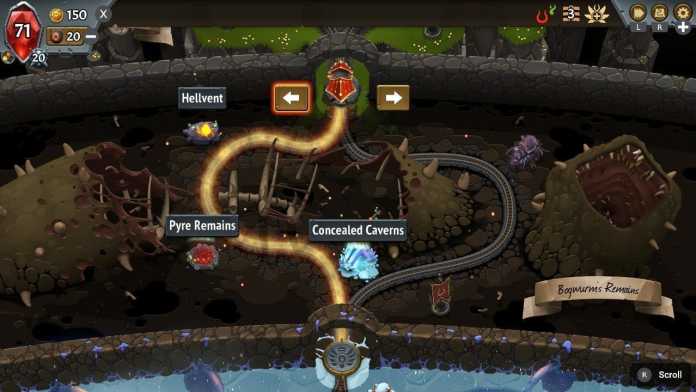
Another thing about the game is that the train can take different paths as you view the map. This is something you’ll notice at the end of each battle. It’s also able to be seen on a map, a route you can travel before entering another battle. There is either a choice of moving to the left or right as you go down the tracks. While it doesn’t make much of a difference, but there is a reason to know which side you’d like to travel on.

They all have a few different merchants and places to purchase or sell items, as well as upgrade a few too! Two of these buildings for example that you can visit are called PyreRemains and Merchant of Magic. These markets do different things and knowing which side you want to travel, as there are other locations to visit can aid in the cards you’ll play and how much more equipped you’ll be in the next battle.

Other than all I’ve mentioned, this game is basically the same throughout. You practically can get a routine going and keep moving down the tracks on the map as you fight your way to win! As mentioned before, it’s not too hard to understand or difficult to play. Everything is explained clearly as you play, and there are even a few additional features that help you speed through the opposite sides’ battle time and get you to yours quicker.

Lastly, this game provides plenty of battles, multiplayer challenges, and plenty of shops to visit for items to buy or upgrades to help aid you in this card-style battle. Plus, like many card games, it takes a bit of planning to make sure you use the right card at the time of the battle, leaving room to use those for the next attacks and invaders boarding the train. So it just can be a perfect strategy card game for beginners who never have played anything like this before and wants to move on towards the more challenging battles that require one to be a bit clever to win the round, as they do get challenging!

Review: Call of Duty Vanguard

We are in a very interesting time for the FPS genre as for the first time in years, especially on consoles, we have all the big hitters releasing with CoD Vanguard and Battlefield 2042 both having releases just a week apart and then the return of HALO with Infinite in early December. The intriguing part is that each franchise is daring to do something different but also similar. In terms of CoD Vanguard, the series has headed back to where it began with a World War setting rather than Modern or Future warfare. The question is whether Vanguard can return CoD to its former glory which the other franchises are also trying to do. The answer is simply, not quite.

It really is that simple an answer as CoD Vanguard does exactly what you expect a CoD game to do and, in some ways, the “no need to fix what is not broken” has become the mantra almost for each release with only the popularity of Warzone, the free to play Battle Royale, changing the way in which releases of Call of Duty now interact together. I came to Vanguard hoping for something different as Battlefield took a short break to reinvent itself and HALO Infinite is back to try and reclaim the crown of FPS king, something it has not been able to really achieve since 343 Industries took over from Bungie. Call of Duty on the other hand has almost been unchallenged in recent years and therefore has not had a reason to try to do anything new outside of Warzone.

The campaign, which used to be a big part of a CoD release is very much scaled back in Vanguard but as always is my first mode to play. Disappointingly, the campaign only runs for 5hrs, it is very short and quite frankly a play once and forgettable experience despite the story being quite novel. In the early days of CoD, the WW setting would have players replaying big set pieces of historical moments of the wars, most commonly the D-Day landings on Normandy. Vanguard however focuses very much on the final days of WW2 and sees the formation of a “Special Forces” team, sent on a mission to capture documents on a Nazi war project known as Phoenix. Each member of the team has a unique skill and history but are brought together for the first time in the opening mission or prologue to the campaign.

As to be expected, the campaign relies on gameplay that leads to a big set piece whilst cutscenes tell the narrative of the story so cased by the opening which sees the team on board a train, working their way through taking down numerous Nazi soldiers to reach the depot where the documents are held, but it ends with the team’s capture that leads to the interrogation of each member. The result is that the player will then experience an almost origin story to explain why that character is part of this unique team up as the story of the end of WW2 unfolds. I really like this angle as we experience the end of the war from the viewpoint of the Nazi’s, even using the reaction to learning of the suicide of Hitler to see how the Nazi leadership deal with that and the impending loss to the allied forces.

Where the campaign does fall flat is in the imbalance of the tone of the story at times which can range from very personal stories of the characters and how they came to be a part of the war and this team to over-the-top set pieces that imply this six-person team could have single handedly wiped out the Nazi forces if conveniently placed ammo crates were stashed every 20 meters. The narrative does showcase the brutality of the Nazi regime, even looking at the racist element to it with some very straight to the point moments and even suggesting Hitler was inspired by Madison Grant and early American racism. It can be uncomfortable to see such themes used but then when it comes to Nazism, there really is no way to do it and not water it down to a degree and Vanguard at least tries to keep that part of the narrative on track. Though only around the five-hour mark, it was a satisfying ending to the story but as the very long credits rolled, nothing about it made me want to revisit or replay it and I am unlikely to return to the story campaign at all, but it was nice to know the story of some of the operators players will then get to use in the MP.

The MP of Vanguard truly is the break and butter of this game and will be the Multiplayer and this is where I have dropped a lot of hours in the last week since Vanguard released and I am happy to say I have really enjoyed my time with this so far despite some server issues. Across the 16 maps, the usual MP match types return with Team Deathmatch, Domination, Search and Destroy, Free for All, Kill Confirmed along with new mode Patrol. The variety that Vanguard brings to these modes is the ability to have a traditional smaller Team Vs Team experience or you can opt in for much larger big team battles of 24 Vs 24. In Cold War I used the filter to actually trim down the modes I wanted to play over the ones I did not enjoy but so far in this first week since release I have dived into any mode possible, including the Duo Team of Champions Hill, which sees teams of 2 taking on other teams to become the last team standing, which is a mode I was not very impressed with in the PS5 beta but now actually enjoying it a little more.

The Armory is also a nice touch, allowing players to truly customize their weapons and loadouts as you would in Warzone with the ability to build a weapon pretty much to your own gameplay taste with components that can boost aspects of the gun but also some that might have a negative impact to finetune it how you want. This also brings a big weapon grind and when the vast number of weapons available to be unlocked and then grinded through to unlock the various component types to customize it, you could really lose yourself in that grind, not to mention the natural grind for all the gun camos to unlock as well. This might be a factor that the hardcore CoD MP fan will relish but for me, I found I gravitated towards a gun in each class and worked on it to try and find the build I was happy with but can see it will take a very long time if there is a desire to have every gun in every class ready to go.

Gameplay is fast, with quick deaths and quick respawns to keep the kinetic energy high whilst playing. I am not a big fan of forced crossplay but so far on Xbox Series X I have not felt too disadvantaged against PC players with M&K and have really enjoyed going into big matches and doing quite well. The speed of the action can be thrilling but also frustrating as the quick respawns can be helpful and a hinderance and too many times the player or players I have just taken out will instantly respawn behind me to get their revenge. Many maps have pure camping spots and whilst I have no real issue with strategic “zone defending”, when I have opted to have full game chat audio on, the reaction to it from others can be funny and shocking. Some server issues have plagued the launch sadly, which is now common and especially in recent days the “Server Snapshot Error” problem has been a pain so hoping in the weeks and months to come these issues can be ironed out.

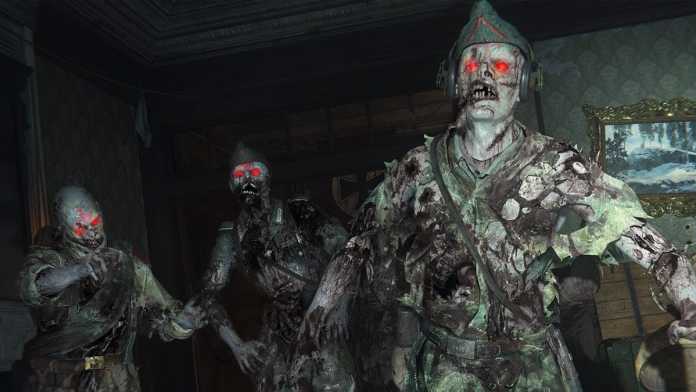
The most forgettable mode for me in Vanguard is easily the Zombies mode, which in previous games I have dabbled in but mostly ignored unless friends wanted to play it and here it is even more lackluster for me. To players who do enjoy the Zombies mode than this will probably be quite disappointing. Played on the map called The Beginning or Der Anfang, teams will travel through one of seven portals to complete an objective mission such as harvesting crystals, defending a moving relic or trying to survive an attack. Compared to previous Zombie modes, this feels very disjointed and very much cobbled together from other games to have it included even if there really is not connection to the rest of the game other than it being a good place to level up guns to be used in the MP. Much like the campaign, this mode feels like an aside to the MP, something to have because players expect it to be there but for now, just a week after release, it fails to other anything to make it the reason you fired up Vanguard to play in the first place. But it is there as something to do, which is better than not having it, it just fails to offer the same gameplay fun as MP.

Vanguard is an interesting enter to the series, it tries to tap into where Call of Duty started by having a World War setting but it fails to do anything to really stand out. You can even launch the more recent COD games from it if you own and play them which is a strange move if you want new players to play Vanguard by offering them other CoD Games to play. Of course, there will be the interactivity with Warzone as weapons and the new map will encourage and feature more Vanguard in the free to play mode and come December 2nd, the battle pass will fully unlock so fans can collect all the items they are currently unlocking with MP play.

Visually Vanguard does make great use of the new gen console power in terms of loading times and how great it looks and sounds on Xbox Series X and the Series S, with a sensible installation size, for now at least but Vanguard is exactly what you would expect from a Call of Duty game but it is very much more of the same, a short story campaign that you can play once and never feel the need to return to, a MP based on massive weapon grind to get the best out of it but is still fun but not amazing to play and a Zombie mode that wouldn’t have been missed if it was not included but because it is, it provides something else to do until you get bored and return to the MP.

The problem with Call of Duty sticking to this tired formula is that its rivals in Battlefield 2042 and HALO Infinite are now back and both are looking to do what they do best but better, and Vanguard is Call of Duty doing the Call of Duty you already know which may not be enough to satisfy more than just the CoD Faithful.

Review: Gynoug

Shmups are a go-to genre when you want a quick fix. The brutally fast-paced action and guarantee of death are offset by the rewarding and addictive gameplay. The 90s was a great decade for console shooters and Sega and Nintendo battled it out for the best game of the era. In 1991, Gynoug was released on the Sega Mega Drive to mixed reviews. More recently, Japan exclusively had access via the Wii virtual store, and today it has been re-released on modern consoles.

Developed by Masaya and published by Ratalaika Games, this is a classic shoot-’em-up title. Set in an undefined era between modern-day and the Middle ages, this is a battle of good versus evil. It comprises six stages that demand you must collect power-ups, defeat minions, and slay bosses. Its challenging gameplay and deceptively simple approach make it an irresistible game that you can’t put down.

Dodge the projectiles.

Gynoug hasn’t changed a bit.

Like the recent re-release of Gleylancer, Gynoug hasn’t changed a bit! In an era of remastered or reimagined games, I expected there to be a modern polish. However, both developer and publisher resisted the urge and fans can enjoy every grainy image on their modern machines.

You control the angel Wor who must stand up for the survival of his entire tribe. He uses his powers of good to confront Iccus and prevent the spread of the evil spirit. How’s that for a grand story? Amazing, I know, but don’t get carried away by its grandiose appearance. Sadly, the plot has little relevance to the action and merely helps to set a theme and the scenery.

Though the lack of a story was disappointing, it does set up a brilliant fantasy world full of revolting creatures. Demonic beings unleash bullets and projectiles at an alarming rate! You must down your foes while dodging everything that is thrown your way. It’s hectic, challenging, and can be downright unfair. You’ll die repeatedly, lose your progress, and complain about the difficulty. Yet, you’ll pick up the controller, again and again, to try to better your score and to get one stage further.

Blow that statue to pieces.

Power-ups, bosses, and cheats. 

A shoot-’em-up would be nothing without its power-ups and gargantuan bosses. Fortunately, Gynoug has it all! With an array of weaponry to pick up and spells to cast, your foes won’t know what’s hit them. However, unlike traditional shumps, Gynoug makes you work for your all-powerful upgrades. You must pick up red and blue orbs to add strength to your weapons and spells. When you die, you lose an orb from each colour and, subsequently, you become weaker. It’s a bit unfair, but what are you going to do?

Having the most powerful weapons and spells is essential when facing each enormous boss. These hulking demonic beings fire an array of projectiles at you. Therefore, you must dodge, weave, and shoot to defeat them and stay alive.

If you are old enough to remember the original Sega Mega Drive, you’ll know the enjoyment of unlocking cheats to level the playing field. This version has gone one step further by allowing you to cheat freely. Purists will hate this option, but I loved how reckless I could be and how much easier it was to play.

Gynoug is gothic, dark, and disgustingly great. 

I adored the gothic charm that oozes from every one of Gynoug’s pores. The demonic imagery blended with Greek mythology was amazing to look at. The dark and grainy style worked perfectly with the theme and I enjoyed the minor tweaks on every stage. The side-scrolling perspective is brilliantly old-school and I couldn’t help but fall for its charms. 

If you’re a fan of shrill synth music and crass sound effects, then look no further. The loud and obnoxious audio is brilliantly retro and screams “look at me”. Moreover, this in your face soundtrack fills the action with energy that prevents it from becoming tiresome or boring. 

It doesn’t get much weirder.

A poorly explained UI and controller layout. 

There is much to love about this classic title, but how the controller layout has been executed is not one! There is zero explanation regarding power-ups or the button layout. No tutorial is provided, and this leaves you guessing what to do. However, once you understand what’s required of you, you’ll find it easy to play.

Shoot-’em-ups are a moreish genre that demands to be played. You’ll sink hours into this without knowing it, as practice is required to best your foes. Moreover, completionists will need to play every level and score over one million points if they wish to finish this hellish title.

Gynoug is a brilliantly old-school title. 

There may be some gamers who wanted this to receive a modern polish, but I think it’s unnecessary. Its brilliantly old-school approach works wonders on new consoles and I loved its simplicity and dated look. I died a lot, needed to cheat, but thoroughly enjoyed it and recommend you to buy it here! Grab your power-ups, use your spells, and stop the evil from spreading.

My video review with footage captured from my Xbox Series X, enjoy!

Review: Midnight Protocol

Back in my senior year of high school, my English teacher called me up after class and showed me an assignment that I’d recently turned in. She said that my paper was well-written, but unfortunately, it had nothing to do with the prompt that I’d been assigned. She said that this left her feeling conflicted, because although the work I produced was high quality, how was she supposed to grade it when I didn’t follow the instructions that I’d been given?

This is similar to how I feel about Midnight Protocol. The game is awesome and delivers such a unique experience, but it’s so vastly different from what people expect from a typical video game, that I’m honestly unsure about my feelings for the title.  

In Midnight Protocol you play as a master hacker who’s recently been freed from prison and is looking to get revenge on those who wronged you. You do this the only way you know how, by using your leet hacker skills to delve into the seedy underbelly of the digital world and track down a mysterious hacker known as Kraken. 

In most games, hacking takes the form of a brief mini-game, and it’s usually illustrated by either shooting something, reaching the end of the stage in a set amount of time, or even just a quick time event. But in Midnight Protocol, you’re breaking into computer networks and using keyboard commands like /forward1, /trojan, and /sldown4 to accomplish your goals.  

Just like an old computer, no mouse is needed for this experience.

(typing /help shows you a list of commands, this is incredibly helpful)

All commands in the game are done exclusively through your keyboard (the game even tells you at the very beginning to not freak out because there’s no mouse cursor), and as someone who hasn’t taken a computer class in quite a long time, I was initially drowning in all the information I needed to know to even move my character forward one space.

The story is told via emails between you and other characters.

(The story is told via emails between you and other characters.. 

However, my time with this game ended up being incredibly positive, because even though it took me a while to understand what the heck was going on, once you do get the hang of things, there’s an incredible amount of depth. And as I became more experienced, my fingers were zipping across the keyboard, inputting commands like I was a master hacker from one of those cheesy 90s movies. Make no mistake, I was still awful, but hey, at least I felt cool. 

Midnight Protocol is entirely turn-based, and mercifully this means that I can spend however long I need to look up commands and plot out my moves accordingly. You want to be smart when you play because the further you go into the game, the more it expects from you, and you need to constantly stay on your toes. At the start of the game, you can move your character from node to node without any real trouble, but as the difficulty ramps up, you start encountering obstacles like firewalls, ICE programs, and viruses, and you start being hunted down by enemy A.I. which will actively pursue you during missions. 

If you’re a masochist, this game can be played in real-time.

Each mission has different kinds of security measures you’ll have to deal with (some levels have lots of firewalls, some are on a strict timer, etc.), and you’re given something called a deck to help handle each new problem. In layman’s terms, you’re able to buy new abilities and power-ups on the black market, and you can choose up to five abilities to place into your deck before each mission. Certain missions can have very specific ways to beat them, so if you’re having trouble, you can change out programs to find a more effective deck, and it’s also just fun swapping out programs and learning what they do and how they work. 

For example, the jackhammer card allows you to break through firewalls faster, the leech makes it easier to drain money from bank accounts, and the cloak is great if you’re terrible at the game and need a few extra turns to get stuff done (this was my favorite ability). Decks add a ton of variety to the game, and it allows you to tackle the same level in radically different ways which can add a lot of replay value.. 

Midnight Protocol feels like it’s designed for a very certain type of person. If you play games to relax after a long day of school or work, this is not for you. But if you enjoy the cerebral challenge and the feeling of mastering a game’s systems and mechanics, then you’ll have a great time with this title. Midnight Protocol expects a ton from the player, but those who put in the time to master the systems will be handsomely rewarded and will have an experience that is radically unlike anything else on the market.

Review: Neptunia x SENRAN KAGURA: Ninja Wars

When two gaming franchises come together in a collaborative effort it doesn’t always work out as planned. For every game that fits like a glove in Professor Layton vs. Phoenix Wright: Ace Attorney, there’s another where the narrative seems like a collection of one-way conversations taking place in separate universes – like in Project X Zone.

Neptunia x SENRAN KAGURA: Ninja Wars, two very niche franchises that are well-known for featuring light-hearted humor, bouncing body parts and hot spring scenes jump onto the scene with more of the same, but this time with an action RPG twist. 

Using the Neptunia universe as its platform NxSK takes its parody and pokes at the gaming industry – along with the ninja goddess concept – and places Asuka and co. (from the Senran Kagura series) into the equation as a rival countries’ group of ninjas who have a long history of fighting with The Purple princess and friends, basically, just for laughs. 

It perhaps shouldn’t come as much of a shock then that the character development focuses more on commenting on the characters’ current physical development and expanding on the few adjectives listed in their loading screen bios rather than any decent gags or overarching plot. You could argue that this a pitfall of trying to introduce two franchises worth of characters in a short period or perhaps or its simply showing their skin-deep character depth. 

There are lots of self-referential comments from protagonist Neptune, which confuses all the other characters.

While that isn’t necessarily a bad thing – at least in the eyes of fans – what does get my goat is how this is presented, in a visual novel animated so off-puttingly that I wanted to skip the story altogether after only a few chapters. The character designs and voice acting are decent enough, but the animation is supremely lazy, with the occasional blink and robotically animated mouths that continue to move at the same speed and pattern, even when characters pause between sentences. Considering how smoothly animated characters are in co-developer Compile Hearts’s previous Neptunia games such Neptunia Virtual Stars released just one year prior, it’s really disappointing. 

Sneaking in like a well-endowed ninja with a copy of Jekyll and Hyde in their back pocket though, the fighting gameplay comes to the rescue and is addictive enough to grab and keep your attention for the length of the story. Lots of cool artistic accents like small camera lifts and tilts are welcome details in smooth attacks that flow well into another and, to a degree, share a resemblance with Samurai Warriors 5‘s visual presentation, with its almost cell-shaded anime characters and a traditional Japanese instrument-filled soundtrack keeping the tempo moving.

With 10 ninja/samurai characters all with different weapons and skillsets, there are lots of satisfying ways to attack the few enemies that the game offers, but much like the story, there isn’t much depth beyond that, with few unlockables for both weapons and abilities.

This ninja cat is essentially an athletic Wolverine, which a few of the characters are like, which is obviously freakin’ awesome.

In terms of the attack-based interface, cues are taken from the FFVII remake with melee attacks assigned to the ‘square’ button and ‘L1’ and ‘R1’ shortcut menus for special moves and temporary status effect boosts respectively. One of the great things about bringing up these menus, similar to FFVII remake, is that the scene goes into ultra slow-mo which allows you to appreciate the beautiful slashing accents and kickass moves afforded to you.

Unfortunately, this hack and slack/RPG fusion has its issues in that NxSK omits the key features that make those specific aspects work so well in the prior-mentioned games. Without large maps, a decent enemy count and multiple controllable allies on the field at the same time, the fighting mechanics’ potential is restricted, like a beast forever waiting to be unleashed. Jekyll makes a further appearance in an unadjustable and overly easy difficulty level that renders the game’s item, gem and equipment systems almost completely redundant – assuming you aren’t just running at the enemy in straight lines. 

In a way, it’s almost more disappointing that the fighting mechanics exists as a singular pillar of quality (on an island of mediocrity) rather than the overall game being entirely average, as I would love to be let loose with these fighting mechanics in a more fully fleshed out context – either through an expanded single-player mode with maps rather than dungeons, or even a co-op multiplayer.

Those who do enjoy what story is given to them will likely enjoy the remaining features of the game which includes, amongst others, a mission mode full of one-off dungeons and a ‘Peaches and Cream Meditation’ mode where one of the thinly-dressed cast of female ninjas balance on a peach, controlled by rotating the PS4 controller. No, that’s not a typo, and failure to keep your bearings on said fruit will have you fall into an ‘interesting’ position on the ground. It’s not particularly graphic, which may upset those who prefer the two series’ forays into adult rating content, but it does a good job of showing who this game is tailored towards.

Look at that peach….

In attempting to mix, match and accentuate the two franchises, NxSK results in a short and forgettable filler episode, with neither of the two’s best aspects able to shine through particularly well. It should be said that it’s not without redeeming features, as both fanbases will find replay value in the enjoyable action gameplay, but it’s far from likely to command a casual’s attention as a standalone attraction.

REVIEW: Formula Retro Racing

0

Formula Retro Racing is one of the simplest racing games to enjoy when you need some reason to hit the gas and go as fast as you’d like! In addition to being a simple racing game, the controls for the vehicle are not as complicated either. Making it a perfect game for players who aren’t searching for something that is all about the details or design of the game. It’s also a game that is free from mechanic job knowledge. So you don’t need to know anything complicated about the vehicle’s parts or be required to learn how to repair or fuel your racing vehicle.

It’s practically a game that’s dedicated to just racing, putting that foot on the pedal, and going as fast as you like. Of course, using some reason, you will still need to avoid turns as this can cause damage to your vehicle. As well, it’s best to avoid other racers, which also may damage your vehicle badly, but maybe you could be lucky enough and it will just wreck the other racers’ vehicles!

Once playing, you’ll notice the choice of vehicles. There are many different colors, which are not limited to just five, but plenty. Many are a simple one-color design, with that similar style in vehicle design. On the other hand, there are a few with different patterns to choose from. Nothing too spectacular, just like having a choice of a simple racing stripe added to the design.

When choosing a track, which starts with the simplest, going to the most challenging styles. You’ll notice that it’s not too complicated as well as the scenery around each course. The racing tracks are all designed a little differently. From being as easy as you’ll be going in a simple circle, without too many turns or it could be challenging where the track could take you all over, like a rollercoaster. Nevertheless, these tracks aren’t very distracting from the race. Not even the background will cause you to lose concentration, as it’s just such a simple designed layout throughout this game.

For the music, the soundtrack that plays is like a very arcade, retro-style fun! It brings the game together and makes for that perfect retro appeal! Nothing but a great way to motivate the player and push them to win.

Oh yes, before I forget. Even for those players that want to play a fast game any time of the day. You can count on this racing game to allow you to have a fast pace game that won’t take too long to play and be exciting! Since there are plenty of simple race tracks that you can choose from. However, if you have more time to play, there are a few difficult ones, which are longer. Either way, each will give you something to fill in that gap of free time you may have.

I do want to point out one other thing I like about this game. I find myself enjoying the low poly graphics. This is something that makes this a better game choice for many players and myself included. I suffer from vertigo and going around in circles, having too many high graphic designs or lights flashing can be difficult to look at. So to play a racing game that doesn’t have any of this, but still brings that arcade racing fun, well that is a winner right there! I don’t have to worry about controlling the camera to make sure I can always keep my vehicle in view. I don’t need to worry about the pain of having my vehicle spin and heading in the wrong direction. So I’m grateful that this isn’t that type of game! It’s one reason I highly love playing it.

Additionally, there is one other strange reason why I like this game. Maybe it will sound a bit odd, but on the other hand, I do have to come clean and tell you something a bit awful on my part, but maybe I’m not alone? I do enjoy crashing and bashing into other vehicles. No, this isn’t what you need to do in the game or written as a part of what you have to do to succeed. Instead, I just enjoy doing it as much as possible. Even if I’m not the greatest racer, I like to play like a ram and crash into other vehicles while trying to move ahead of the other players. I guess I just really enjoy playing bumper cars when going fast in any racing game.

However, this could be a positive thing, where if you hit them just right, they may blow up. Allowing you a chance to get ahead of them or it might just cause a little damage to your vehicle. I know it may sound odd, but after any stressful day, this just might give you a slight satisfying feeling from destroying other racers. Okay, I’m glad I came clean and actually I guess you can say I am a big fan of a little bumper car-style action. Especially, if it’s just for fun.

Lastly, this game is an excellent retro, low poly-style racing game. It’s got plenty of exciting racing courses, plenty of challenging modes, and vehicles to choose to ride. If simple and just plain racing is what you crave, this is the game you have to try!

Review: BARRICADEZ ReVisited

BARRICADEZ ReVisited is a Switch port of a PC game that honestly should have been so much better. Let’s talk about why. BARRICADEZ ReVisited by FlyPenguin Inc. is a scrolling-based mix of tower defence and survival. You play as an invincible robot tasked with protecting a baby in a cradle; this baby happens to be the last hope of humanity. Set against a wasteland dystopian backdrop where every night monsters come with one aim – kill the child.

BARRICADEZ ReVisited - Survivng the monsters

Gameplay Modes

BARRICADEZ ReVisited has four modes. Story Mode, Challenges, Practice and Red Moon Rush. It is advisable you check out the Practice Mode before trying anything else. This is the only place you learn the controls and how to play the game. It is unfortunately the controls that lower the score of an otherwise wonderful little game. I honestly recommend the PC version over the Switch port. This is because the controls are designed with a mouse in mind (and occasionally even references pressing the escape key). This makes for very cumbersome gameplay when trying to move a ‘mouse cursor’ with a joystick. The touchscreen is also totally unused. You do eventually get to grips with it and its limitations, but it certainly reduces the enjoyability factor of gameplay. The Practice Mode is well thought out. It starts basic by introducing you to movement and progresses through the more advanced features such as crafting and upgrading.

Challenges, once unlocked, offer a fun ‘quick game’ mode alternative to the main story. There are six in total. Ranging from only defending the baby using certain traps to surviving for days against vast numbers of monsters. These challenges are fun, but also serve as a useful learning curve for the main game.

BARRICADEZ ReVisited - Building defences

The Story Mode is a slight misnomer. There is no real story to speak of save for the background to the game. As a protector robot you must protect the last hope of humanity from hordes of monsters that attack each night. The story is a nice setting for an intriguing mix of tower defence and survival. You have it all available in this mode. You’re challenged to last 56 nights by going underground to gather resources and craft items which can eventually be upgraded. With these resources you can build a wide variety of structures, traps, and weapons to defend the baby each night. During the day you can repair these items, collect and reposition them and of course build more. It’s a lot of fun, working out patterns for the crawler monster types to never get anywhere; placing the best traps and devices to kill the ones that will cause damage as you wait until morning. There’s a good variety of traps from basic spikes through to platforms that will catapult monsters into carefully placed firepits, swinging axes, flamethrowers, and arrow shooters. Similarly, there’s a nice variety of monster types so that each night never feels the same.

Finally, Red Moon Rush is then the game’s equivalent of ‘hard mode’. In the main Story Mode, you get what I consider a ‘boss’ coming every seven nights. As each week progresses, these get harder and harder. In Red Moon Rush you only get the ‘boss levels’. I’d leave this mode alone until you’re comfortable with the crafting and building system.

UI

I mentioned earlier that my main gripe with this game is the controls on Switch and unfortunately this is most prevalent in building and crafting. The UI is clearly designed for a PC and there’s a lot of ‘clicking’ involved to cycle through tabs. It’s cumbersome at best and at worst it’s repeatedly pressing the wrong control or moving the joystick and ending up in a totally different menu system. This is a real shame because when you can get it to work it is actually a great feature. As you expand your arsenal you can build and engineer new things, combining items and ensuring your weapons remain stocked. It is fully fleshed out as well, there are no half-measures here.

BARRICADEZ ReVisited - Gathering Resources

Crafting in BARRICADEZ ReVisited

The gathering and crafting side of BARRICADEZ ReVisited often feels like the primary focus, without it you cannot build anything to protect the baby from the monsters. For me, it was the more cathartic part of the game. Set against a wonderful score the plucky little robot heads down into the caves to gather materials. All the usual suspects appear; wood, stone, sand, iron, copper, and many, many more. As well as these you can find chests that contain pre-made defences and traps. There are special blocks, presumably derelict buildings from the now wasteland Earth, which contain a random selection of an even wider range of resources. It was difficult to work out some of the crafting recipes as there is no clear guide. It became frustrating when I had an overwhelming amount of one resource and absolutely none of the other I needed to build a trap. This is more of a me problem but on numerous playthroughs this was the case. I wonder if either a) the algorithm behind resource drops needs tweaking for such low-level items or b) it isn’t as low-level as the items list makes it out to be in which case that needs altering to make it clearer.

BARRICADEZ ReVisited Review Conclusion

Overall, BARRICADEZ ReVisited is a fun tower defence game with a truly fantastic survival/crafting element built in. The graphics are just fine, and the music is a joy. The variety of gameplay is great, the variety of monsters is even better. Time control helps you manage your building and every seven days you get a more challenging boss to overcome. Similarly, as you progress things get harder overall keeping the game fresh and challenging. However, don’t play this game on Nintendo Switch. The controls are terrible for a console that has a touchscreen and joysticks and it ruins what is otherwise a solid game of this genre.

Review: Source of Madness

Source of Madness is a strange and intriguing game. Would you like to walk through a world of eldritch horrors, odd creatures and ominous areas. What’s more, all of this, the textures, enemy behaviors, is all controlled by neural network AI. It’s certainly a unique concept for it’s genre, but is it something worth playing? Let’s find out. 

Note that this is an early access review, and as such may not be representative of the final product.

Gameplay

The game is a roguelite, so the basic gameplay loop is as follows. You spawn by choosing one of three characters, then you purchase upgrades using blood you’ve acquired in past runs. These can be new classes, upgrades to existing classes, health flasks etc. Next you leave the main hub and progress out into the world. It’s a side scroller, so you head out and fight enemies and battle your way into the next zone, fighting a boss at the end of the zone. 

The game has been compared to dark souls and diablo, and it’s not hard to see why. The creepy atmosphere of a grim dark fantasy world. The tough and strange enemies. Even the text when you enter a new zone matches dark souls. You have two ring slots, which give you your spells, on left and right click. Being in early access the content is not fully fleshed out yet, with only the first act fully completed. Combat can feel a little too floaty and odd at times. Escaping combat and moving around the map can feel a little janky at times.

Presentation

This is the strongest area for Source of Madness. From the music, the creepy monsters and the strange levels, this game is oozing with thematic horror. It really makes the game shine. Plus, its textures are apparently AI controlled, however that works, which is definitely an interesting feature. I did find my eyes getting strained after around an hour or so of play. I think it’s because of the way everything blends together. Otherwise, the presentation is spot on.

Design

Firstly, the sound design is perfect. Hearing the distant screech of monsters, among other ominous sounds, really adds to the theme. The feel and look of your spells as you cast them is satisfying. The procedurally generated areas remain varied and interesting enough to encourage further playthroughs. The UI is intuitive and works well. All of this provides a great experience, though it is not without its faults.

Your spells awkwardly collide with your enemies in a way which doesn’t feel impactful. At times it is hard to tell what is an enemy, and what is a corpse or just an obstacle in your way. It’s hard to tell if your getting hit sometimes. I would swear I took a hit then check my life bar and see that I didn’t, and vice versa. Finally, while the game is visually varied, the difference between spells doesn’t seem fully fleshed out yet.

Overall, Source of Madness is promising title, held back by a few design choices. It’s perfect for those looking for a good hit of Lovecraftian horror. It’s certainty a title to keep an eye on as it’s development cycle continues. A promising early access title.

Two Minute Review : Twelve South Forte for iPhone with MagSafe

Here is our Two Minute Review of the Twelve South Forte for iPhone with MagSafe.

Forté for iPhone is a modern wireless charging stand made exclusively for iPhone 12 and the Apple MagSafe Charger. Snap your MagSafe Charger into Forté and you instantly have a clever way to dock your iPhone 12 while it wirelessly charges at a speedy 15 Watts. It magnetically holds your phone vertically or horizontally for hands-free use. As a bonus, the platform tilts up to 70-degrees to create the perfect viewing angle or charging pedestal for your AirPods. When it’s time to travel, your MagSafe charger easily pops out to go. 

What’s in the Box?

The box contains the stand and arm, a screw and a hex key.

A Closer Look

Final Thoughts

The Forte feels reassuringly heavy in your hand – not that it will be in your hand, it will be on your desk or other flat surface!

Putting the Forte together was very simple – slot the arm into the base plate, use the supplied screw and hex key to secure it in place, then attach your existing Apple MagSafe Charger and that’s it! You can now place your iPhone securely on the stand and use it for whatever purpose you need – and it works either vertically or horizontally.

This is a really great addition to your desk, you’ll probably wonder how you got by without one!

The Twelve South Forte for iPhone with MagSafe is available now priced around £39.99.

You can learn more from the Twelve South website.

Review: Epic Chef

Cooking is a pastime that consumes many people. However, no matter how much you love it, you always have the freedom to walk away. Would you adore this culinary hobby if it demanded your full attention? Epic Chef tells the tale of one kingdom’s obsession with food, and the adventures that go with it.

Developed by Infinigon and published by Team17, this is a food-obsessed and relaxing RPG adventure. At first glance, this colourful cartoon title could easily be mistaken for many others. Yet, once you strip back the layers, you’ll enjoy a bizarre magic fuelled journey that has a razor-sharp wit. It’s one of those games that’ll surprise you with its depth of character and whimsical ways.

Epic Chef is hilarious and charming.

Team17 rarely let me down, so I knew this would be serviceable. But what I could never guess was how much I’d love it. My sides were hurting from the witty dialogue and inappropriate comments that are made throughout. You can’t help but smile at the stupidity of the jokes and this ensures the main quests are always lighthearted. Its core concept is charming and you’ll never tire of experimenting with food or harvesting your own goods.

The gameplay focuses on a central story with a strong quest line, side missions, farming, and exploration. There are some RPG elements as well as customised clothing and the challenge of becoming the number one chef.

The would-be Epic Chef is a dutiful but immature lad called Zest. He has spent his life savings on a haunted and dilapidated mansion that scares the residents of Ambrosia. With no way out, Zest makes the most of the bizarre opportunity while planning how to become the best chef around.

Where it all began.

Its simple and relaxing approach will have you hooked.

I was so grateful that Epic Chef is packed with content and quests, but is simple to play. At first glance, you’ll raise an eyebrow as you attempt to fathom out the vocabulary. However, this quickly fades as you realise how straightforward it is. Subsequently, you won’t want to put it down! I adored bundling ingredients together while trying to create a phenomenal dish. The challenge of combining the right items and timing the bake to perfection was an excellent experience.

No matter what you try to do in Epic Chef, it all revolves around the food mechanics. You will gather plants, grow crops, and buy ingredients for any dish. Every item belongs to a category, such as land, sea, fruit, and so forth. Mixing different groups enhances or detracts from the final product, and you must be wise to get the best out of every meal. If you time the bake just right and blend the correct items, you’ll combine both aroma and synergy that leads to an irresistible dish.

What will you serve up?

Cooking competitions and helping the locals.

Understanding the cooking mechanic is key, as progress is dependent on you winning multiple cooking competitions. The fun and often silly events will test your ability while offering fantastic rewards. You can slum it in the underground cook-offs, or make it official and work through the culinary leagues. Unsurprisingly, the further you go, the harder it gets! You’ll need to use sauces, rare ingredients, and level up your character. Moreover, this was a wonderful way to add depth as you discovered the unique ways to blend each ingredient.

You won’t tire of cooking for people, but if you want a break, you can help the locals. Most of the tasks incorporate food or magic and these bizarre quests were easy to complete and fun to take part in. The longer you play, the larger the world becomes, and once out of reach zones, open up and you get to explore some strange areas. Furthermore, your rundown mansion is lacking the necessary equipment to become an Epic Chef. Therefore, you must unlock blueprints, gather resources, and build the machines and structures to be a success.

Epic Chef transports you to its crazy world.

It’s hard not to lose yourself in the absurdly colourful Epic Chef world. The combination of cartoon graphics and vivid colours reminded me of Summer in Mara. The fantasy theme has been brilliantly incorporated into the “normal” paradise setting with thorny bushes, magical hovels, and creepy creatures. I loved exploring new areas as they were unlocked and the variety in landscapes kept things interesting throughout.

The whimsical nature of the action is captured in both the written dialogue and the audio. This belly laughter-inducing element was the highlight of this title, and I could listen to the music and read the immature lines repeatedly. It was brilliantly lighthearted, undoubtedly childish, but it cements every other layer together perfectly.

Who will win the cook-off?

A time sink.

Like most games in this genre, Epic Chef is a time sink! One hour turns into two, three, and before you know it, you should be in bed. It’s gloriously effortless and keeps you playing without trying. Whether you’re attempting to collect more outfits or unlocking the large list of achievements, you won’t put it down.

The story and mechanics are wonderful, but they are supported brilliantly by the excellent controller setup. With a choice of keyboard and mouse or gamepad, the developers have taken a well thought out and inclusive approach. I used the latter option and found the controls to be both responsive and easy to understand.

Epic Chef is a must-have title.

I knew little about Epic Chef before I started, but I’m glad I played it. It’s a game that captivated me from the off and my love for it grew exponentially. It’s a fantastic relaxing RPG adventure that puts its peers to shame! With so much going on, you won’t tire of its amusing and lighthearted ways. Unsurprisingly, I adored it and I recommend you to play it here! The culinary business is a tricky place to master! Can you gather the right ingredients, create the perfect dish, and become the Epic Chef?

Review: Aquarium Designer

Have you ever been in a pet shop and thought to yourself, hey, those fish look super cool and easy to keep…only then when you look into aquariums and fish keeping you discover just how much work is required? Yeah, me too. Fear not though, the developers over at Sigur Studio have come to the rescue with their delightful sandbox Aquarium Designer to satiate all of your fish-keeping desires.

Aquarium Designer by all means isn’t your typical sandbox simulator game, and it shouldn’t be treated as such. If you go in expecting hyperrealism and, you will find yourself disappointed, irrespective of the fun facts you find on the fish descriptions.

I wouldn’t call myself an expert in any case regarding fish, but growing up my dad kept an array of exotic parrotfish and angelfish, so I was excited to see just what Aquarium Designer had to offer in the way of exotic breeds and realism. 

It didn’t disappoint.

You can choose between two game modes; a campaign and a creative mode. Both modes are fun and offer their own unique gameplay, but they are still currently lacking in some areas.

The campaign will see you taking emails from customers as well as your in-game uncle, picking out the right vegetation, heaters, filters, substrates and of course fish to complete the customer’s desired aquarium. 

Uncle Joe wanted a simple tank to kick things off

It really is just a lot of slow-paced relaxed clicking and dragging, but it is rewarding nonetheless. 

Each campaign contract is “graded” out of 1000 points, which then helps you to level up. With every level unlocked, new fish species, plants, rocks and other fun accessories for your tanks become available. The closer to the contract you complete your aquarium, the more points you’ll earn and the faster you’ll level up.

Seems like Uncle Joe was pleased with his tank

You can even return to your completed contract tanks later down the line to tweak your designs to fully max out your points.

It took around 2 hours of playtime to casually complete the campaign mode as well as reach level 10 and pick up any achievements along the way. The quirky emails from your uncle and the fun facts that come through along with your commissions are a fun little addition that definitely kept up my enthusiasm.

Moving onto the creative mode, this is where things get interesting. You can choose between a casual sandbox mode or a realistic mode here.

The casual is exactly as it is described—you are given free rein over a tank of your choosing, you don’t need to worry about water pH, temperature regulation nor do you need to keep an eye on your fish at all times. Here, you are the design master, and you can swap between any of your own tanks to tweak at any time. 

The realistic mode has all of the benefits of casual, only with the added difficulty factor of pH balancing, temperature and water checks as well as monitoring your fish and plants to keep them alive—all of this happens when the game isn’t active too, to make the challenge a little harder like in real life. 

These modes are arguably Aquarium Designer’s magnum opus. With complete creative freedom, you’re given a blank slate to build your dream tank without the pressure of your uncle’s emails or worrying about whether your design is up to the customer’s standard. 

Add in the relaxing lo-fi background music and the easy to navigate menus and we’re onto a winner. 

Aquarium Designer is without a doubt a relaxing game to sit down for a few hours and let your creativity out, but it isn’t without its small flaws and opportunities.

As you inevitably unlock more fish species, you’ll begin to notice patterns in their behaviours. They all act the same. From your usually more solitary betta fish to your schooling tetras, each fish species is unique and this isn’t always reflected in Aquarium Designer. Don’t get me wrong, it’s realistic enough to keep the immersion, (aside from the odd time one of your fish will clip through a rock) but differentiating behaviours would be an excellent addition to an already fun simulator. 

With more content already confirmed by the developers, it’s only a matter of time before brand new features, fish and interactions are added.

Aquarium Designer definitely has the scope for a bright future, but as it stands, it is an enjoyable designer sandbox that you should definitely give a chance, whether you are a novice or a pro with aquascaping and fish-keeping.

Review: Super Monkey Ball Banana Mania

0

Time to go bananas with this fun and adorable game, Super Monkey Ball Banana Mania! It’s an entirely entertaining game, no matter the game one may choose from at the very start. There are six monkeys to choose from at the very beginning. Each is designed so cutely and adds to the fun of this game! I can honestly say no matter the time of day as there will always be time for some bright, cheerful monkeys and a bunch of banana collecting fun!

When one starts the game, there will be a variety of options. Each allows you to play the game a little bit differently or add on some wonderfully new styles to your monkey team. The first option would be to start the game alone, as a single-player game. You would be playing the main game, where you go through many different challenges on your very own and play the story straight through. On the other hand, if you have some others who want to play, there is always the party game option. This is where you can enjoy playing with four extra players and see who comes out on top. I always felt that a game alone is fun, but with others, it’s even better!

Oh yes, it doesn’t just stop there! Maybe by chance, you aren’t with friends or family and still want to be challenged by others, well there is the option to play against others from all over the world. Another feature I’ve always loved in games because there is someone out there that will push you a bit harder to be the best! This game never keeps you from challenging yourself or many others, that is for sure.

In addition to the ability to play in any game mode, you would like. There is also what I find enjoyable within a game, the ability to customize your character. This is available once you earn points to purchase some new editions for each character or whom you want to dress up. Yet, this can be done with each amount of reward earned from the levels you were playing through. Keep every character designed and looking the way you want them to. It’s another great way to show off your personal preference while in games with others and just for your enjoyment. Plus, the purchases don’t just stop at what you can add to your monkeys, but also the ability to purchase other Sega game characters, such as Sonic and Tails.

Even with all the purchases, you can buy, the game just starts you off with six cute monkeys. These cartoon characters are named AiAi, MeeMee, GonGon, Baby, YanYan, and Doctor. These characters are already available to play, and you don’t need to worry about buying them. In addition to the option of character choice, there is one positive note worth mentioning. You need not worry about which character you should be, as they are possessing the same capabilities while playing the game. So no one character is stronger or powerful than the next. This makes for fair gameplay, no more fighting over who you want as it’s the skills you possess that make for who will come out as the winner in the end.

From my first experience, I couldn’t stop playing! Once I turned the game, started right into the story mode. I was hooked on the cute sounds which makes me think of Pokémon characters or even that of a game called Bust-a-Move. I kept thinking to myself, will Pikachu be appearing on-screen too? Nevertheless, I still adored the cute sounds and music in the background, very upbeat and competitive but not overly annoying to cause a loss of concentration.

The game’s main objective is to get to the goal, but of course, the less time used the better. Yet, there is also that thing about bananas, like in this game’s title, Banana Mania. This is where you can rack up some more points by collecting these bananas through each stage.

The first world’s stage was quite simple as in many games, always are. However, it does start to get a bit trickier and difficult to accomplish. You best believe that each level will have you focusing and working to move around the obstacles and collect everything without fail. It can be a simple as aiming towards the goal and ending the stage or going above and beyond to collect every banana as possible. Don’t worry, it isn’t set in stone how you play or how fast you are! Having fun is all you need to achieve from this game.

Talking about the levels, well there are so many to roll around. Many can be tricky while others not so much. It varies and even mentions on top if it’s simple or difficult. Plus, with a view of the world-mapped design when choosing the next stage, you can get an idea of what to expect. Also, for some simple stages, many of those bananas are located in tricky places. Making them be a bit complicated to grab. You might find yourself heading to the goal and skipping them entirely or if you are spontaneous and want to take on this challenge, no matter how many times you play the stage. I must applaud you for doing so!

One thing I did want to point out since I spoke much about the stages and their difficulty is how these appear. Each of the stages you enter is floating in the air. Yes, up in the air, attached to nothing. So at any chance, you rotate too quickly or go too fast, which might mean a big FALL OUT, or in other words GAME OVER! However, to win the game you need to rotate and move perfectly inside the level. Pay attention to the curves coming up, the pace you are moving at, and pay attention to what is going on with the unique stage obstacles you may face.

There was an issue I did have with the game. No, it’s nothing too horrible, and of course, it’s my own opinion. However, watching the replays, either winning at the goal or falling out of the stage is still quite entertaining, but sometimes it can be a bit redundant after a while. Especially if you are doing it every time you start the game. I felt that even for a short stage or just a mistake made in the same area, the action replay can be a bit much.

At least there is a solution! Just with one push of the button, you can quickly bypass the replay. I just wish that in the settings, there was an option to turn this action replay off. It would even be nice to just turn it off completely or set it up that one may keep the winning goals replayed, but not the epic fails. Again, this is just my opinion, but it doesn’t reflect everyone’s feelings. So don’t let that scare you, it still is quite a fun and lively game.

Lastly, I want to mention that this is a great game to keep one’s mind occupied as there are many levels to roll through, many challenging stages, and much fun for everyone to monkey ball-around in! Friends, family members, and everyone all over the world can enjoy this game together. It’s nothing less than brilliant!

Review: Ghosts and Apples

Ghosts And Apples is a frantic action-puzzler with mighty ghosts, combining action, strategy, reasoning, and memory. You must accumulate golden apples and gems to buy the keys of every room within the mysterious house to escape. To achieve your goal, you must catch devious ghosts and swoosh them at stacks of other ghosts to clear the screen!

Worthplaying.com

Gameplay

On its face the gameplay in Ghosts and Apples looks unique but if you were to strip it back to its core it would just be another colour match game with core elements similar to the likes of candy crush and many many others. Games like this are very popular on the mobile scene due to its ‘pick up and play’ style and addictive gameplay. Ghosts and Apples takes this winning formula, tweaks it a little bit and puts a nice hand drawn art style over the top.

Players must use strategy and memory in this hectic puzzle game to accumulate apples and gems which can be used to buy keys. The player must then use these keys to unlock rooms in a mysterious house in an attempt to escape.

The player is tasked with catching ghosts and placing them at either side of the screen in stacks. Matching these ghosts by colour will reward the player with more points and the end goal is to clear the screen and catch a certain amount of ghosts to proceed.

There are over 150 different levels to play, all with similar goals. After playing around 10 levels I noticed that the speed in which the ghosts appear becomes much quicker, causing the player to make quicker decisions and this truly becomes a test of strategy and memory. I did notice that beyond this speed increase the gameplay itself didn’t deviate too much in the time that I played and some players may even find the gameplay slightly repetitive.

Visuals

Just like many other indie games on the market, Ghosts and Apples has a very unique and imaginative art style. As soon as you boot up the game you can tell that a lot of heart went in to hand drawing most of the elements and personally I think this is very inviting and fun and makes a nice change from the usual drawn out realistic generated scenery that is present in most games.

Although a lot of the game has been designed with ‘dark and gloomy’ in mind there are instances were there are some great colour pops, especially in regards to the ghosts. 

One thing I will say is that the main playable character does sometimes give me the creeps!

Replay Value

Ghosts and Apples has 150 unique levels to play all with increasing speeds and difficulty. The gameplay within the first portion of levels doesn’t differentiate much though, meaning eventual repetitiveness.

In terms of replay value, players can technically play the same levels again and in some instances achieve a higher score but otherwise I personally do not see much need to replay the game after all 150 levels have been completed.

Verdict

Ghosts and Apples has many of the same core elements as many popular and addictive mobile games. This formula has been used for many years and luckily Ghosts and Apples has managed to put enough of a spin on that formula to still stand out amongst the crowd. Addictive gameplay and great visuals make for a great experience however some players may not like the repetitive nature of these types of games. This game is still a must play for anyone that wants something addictive to pick up and play.

Update: After speaking with a member of the team who worked on the game they have pointed out that there are further gameplay elements and another character later on in the game

(All subjects touched upon in this review are based on my experiences in the small portion of the game that I was able to play in my review time)