Here is our Two Minute Review of the Kikkerland Felt iBed Storage.
Keep cozy in bed, everything you need is within reach! The Felt iBed Storage is a convenient bedside or couchside companion that conveniently organizes pens, papers, notebooks, cords, and anything you need for work or entertainment for easy access wherever you are! The compartment is big enough for travel and work needs, and the lid can be used as a surface for laptops, tablets, notebooks – even snacking! A great travel tool or at home organizer, keep all your work or play together with the convenient Felt iBed Storage.
Kikkerland’s Felt iBed Storage is a simple, easy organization solution. It features a storage compartment covered in dark grey felt and a removable wood lid to make it an all-in-one work or play station.
Keep everything you need for work, play or travel neatly organized and easy to access. The Kikkerland Felt iBed Storage is great for travel, work at home, or a convenient all-in-one storage and work/play station. Keep pens, paper, notebooks, cords, electronics and more safe, organized and easy to reach. Great for keeping kids entertained on long trips, as a travel workspace or a handy bed and couch companion so your gotta-haves are easy to grab!
A Closer Look
Final Thoughts
The box is very lightweight and can easily sit on your lap without it feeling heavy or uncomfortable. You can also sit it on the floor or on a desk just as easily.
The lid is easy to remove in order to store whatever you need in there – cables, charger, headphones, a snack perhaps?
Your tablet will fit perfectly into the groove on the top holding it in a great position for using. You can then use the rest of the tray for a keyboard (if you want to type), or for anything else you need.
The Kikkerland Felt iBed Storage is a great addition and makes using your tablet more comfortable, and keeps everything together in one easy to access place.
The Kikkerland Felt iBed Storage is available now priced around £40.
Fighting games attract three breeds of players. First, there are the button mashers. This group is unpredictable and they know it. Second, is the casual gamer, a rare breed who likes to relive that arcade experience. Finally, there are the pros! These guys/girls practice until their fingers bleed and know every combo attack going. Phantom Breaker: Omnia is an Anime beat ’em up that is great for newcomers and veterans alike.
Developed and published by Rocket Panda Games, this is a 2D fighting game. It utilises Manga imagery and subsequently, it’s sexy, stylish, and a little weird. It’s the perfect title for every breed of player as it’s quick, user-friendly, and easy to understand.
Phantom Breaker: Omnia isn’t new.
Residents of Japan will scoff at our fascination with this new fighting title. Why you might wonder? Because it was released around 11 years ago exclusively for a Japanese audience. However, it is new to us, and I’m excited to see what is on offer. In short, it’s a straightforward, fast-paced 2D fighter that blends Dead or Alive with Street Fighter. Consequently, you get a striking title that has many strong stories and some bizarre characters.
The action spans multiple game modes, with the story element being the strongest and most important. To bulk the gameplay out, the developers added a tutorial mode, couch competitive and online competitive options. So far, so good. As you load in, you get the clichéd Asian imagery as well as some mystical nonsense to set the scene. Sadly, it’s very dated, but it works well with the theme.
The solo mode allows you to select from 20 unique fighters who all have a story to tell. This eclectic blend of warriors each has a dream that they are willing to die for. Subsequently, they will fight whoever stands in their way. This forms the basis of the single-player mode and is fascinating to experience. The excellent writing and layers of lore build rapport with each character and make it hard to put down.
Story mode will keep you busy.
A great game for casual players.
I’ve always enjoyed the fighting genre, yet I never excel at it. Fundamentally, I understand what I need to do, but a lack of practice always stands in my way. Luckily, though, Phantom Breaker: Omnia is different. Its easy-to-understand mechanics make it perfect for casual players. Consequently, with little effort, you can challenge global players and stand a chance of winning. However, there still are moments of finesse, therefore hardcore fans will find something to get their teeth into.
Most characters have three combat modes to pick from. There is quick, hard, and Omnia. The quick mode favours jabs and lighter moves. It is perfect for button-mashing gamers and is tough to handle. The hard option is great for methodical players who like to combine combinations and hefty punches. Omnia, on the other hand, is new to this version of the game. It combines elements of the previous approaches and offers a Jack of all trades style.
Depending on the character you select, each of these styles will offer unique tactical advantages. Accordingly, if you select a light, fast, and long reached fighter, you’ll want the quick set-up. On the flip side, if your warrior is hefty and a bit of a brute, the hard mode is probably the right choice. However, you must select what works for you, and I loved the freedom you are afforded.
Use the giant hand to slap her.
The AI is good, but fighting humans is better.
Competing against AI is always going to feel robotic. Furthermore, there is always the belief that the result is somehow rigged. Don’t get me wrong, I loved the balance of the difficulty and the challenge of the story mode. Yet, I love battling like-minded individuals and both the online and couch competitive modes were great.
Fortunately, there is an active online community that lacks toxicity. I fully expected to be abused, screamed at, or told to “get guud”. Thankfully, this never happened as it’s an instant turn off. Now, I’m not saying that trolls don’t play this game, but luckily, I never crossed their bridges.
Phantom Breaker: Omnia looks old.
I’m not a massive Anime/Manga fan. It’s not because I don’t appreciate the artistry or the vivid colours. No, I just don’t like the over-sexualised imagery. However, the fighting genre just about gets away with flashing a little more flesh. Subsequently, the grotesquely toned men and big-boobed women don’t look out of place. Phantom Breaker: Omnia has this and more in its 2D fantasy Asian world. Moreover, there is a bizarre blend of backdrops to enjoy and some strange characters to observe. What’s more, the action is smooth, error-free, and great to look at. Sadly, though, it doesn’t have a modern finish. Therefore, it isn’t as striking as I’d expect, as it looks dated. Fortunately, this doesn’t impact the gameplay, I just wanted more.
As expected, the audio is loud, in your face, and a little OTT. The high-energy tunes follow every battle, and this was great. The electro-Asian music adds aggression to each encounter, and was what I hoped for. On top of this, there are some nice soundbites and crazy sound effects. Consequently, you’ll enjoy the crashing of fists and some unusual noises. However, I wasn’t surprised by what I heard, but it was enjoyable and well-considered, nonetheless.
Which of the 20 characters will you pick?
Simple control set-up.
I love how easy Phantom Breaker: Omnia is to play. With a basic layout, simple fundamentals, and awesome combos, you’ll be battling in no time. Yet, things are complicated slightly because of the three combat approaches and the different character styles. Now, this didn’t make it difficult to play. Instead, it adds a layer of depth that is great for hardcore fans. Alongside this, the buttons are extremely responsive and this is perfect to contend with the hectic action.
All fighting games are addictive, but does Phantom Breaker: Omnia have longevity and replay value? In short, yes! Each story has multiple battles that can be cut short. Moreover, the online and couch competitive modes will keep you coming back for more. On top of this, there is a hefty achievement list and an array of combo attacks to learn. Subsequently, it’ll keep you busy for hours.
Phantom Breaker: Omnia is a wonderful fighting game.
This is a saturated marketplace, yet Phantom Breaker: Omnia stands out. Its blend of stories and strange characters is wonderful to see. Though it isn’t as polished as I’d like, it was still well presented and ran smoothly. Furthermore, the audio is great and the controls are responsive and easy to master. All things considered, I enjoyed it and I recommend you to buy it here! Can you fight for what you desire? Choose your warrior, pick a style, and battle for victory.
Welcome to the end of the universe! The Last Sunshine: Rekindled is a challenging shoot ‘em up/bullet-hell rouge-lite in which you embody the last surviving stars as they drive back the ceaseless darkness that has brought about the end.
Something that’s always messed with me is the denouement of the cosmos. The knowledge that, although the universe feels infinite, it is finite, and will one day come to an end is a bit unnerving. How can something as monumental as the known universe share mortality in common with me? This title is set at that point; when the universe goes through a theory known as heat death.
As the universe expands indefinitely; matter gets further and further apart. Eventually, this constant diffusion makes celestial reproduction impossible. The cycle of dead star matter making up the kindling for new ones to form ends. As the stars die out, the universe gets colder, more isolated, and desolate. A slow fade into darkness.
It’s a genuinely depressing theory and thought. However, The Last Sunshine: Rekindled gives you a chance to refuse that outcome. It personifies the darkness and places you in control of a selection of stars that live on at the end. You can push back the darkness, defeating its acolytes, while collecting starlight scattered throughout the cosmos.
I loved the idea, as it makes heat death less of an inescapable outcome, and more of a fight for survival. And a chance for life to continue. Your enemies have names and display their desperate aggression as they try and snuff out the last bit of light. They’re tangible threats that can be fought and beaten.
Rage Against the Dying of the Light
In this bullet-hell and shoot ‘em up hybrid you start off as Sol; a star which I’m sure many are familiar with. I’m not sure how it lived till the end of the universe and even then still hasn’t become a red giant, but I’ll suspend my disbelief. More stars are unlocked as you play and collect remnants, and each one has its speciality. Such as Vega, a blue main-sequence star that has an affinity for shields. Or Titan, a slow-moving giant, that comes with a lot more HP.
Alongside their character traits, they also have unique abilities and firing styles that differentiate them. Each star begins with a variety of skills, four of which are equipped. One utility skill, such as a burst of speed. One high damage attack that uses up mana points that cannot be changed, for example, Sol’s AOE attack. And finally, you’ve got your two most vital default skills that can be used as much as you’d like. These include basic attacks such as a continuous stream of projectiles and a burst of bullets that do great damage at short range.
These last two skills, however, can be swapped out for more powerful options as you collect them from chests, and other hiding spots. One of my favourites was Titan’s ability to spew a cloud of poisonous gas, which was perfect for the tank of a star. It could get in, absolutely wreck everything near it and leave to regenerate its HP.
RNG is the deciding factor when it comes to which offensive attacks you pick up as you make your way through the areas. In some runs it can be painfully withholding, and in others, you’ll struggle to choose which two you love more. There’s a solid number of skills to choose from between each star. This makes for well-needed variety, in a game where visually, and in gameplay, it can be a little samey.
Highs & Lows
This is a challenging title in which you need to balance aggression and evasion. Some enemies will actively try to make your life as difficult as possible. Like the generator which will not only shoot projectiles, but also spawn little dudes that chase you down a lot quicker than you’d expect. The gameplay is executed well for the most part. Especially in the unforgiving boss fights, requiring focus and at times a little strategy, aside from the usual dodging and shooting. These encounters are the highlight of gameplay, dancing around huge projectiles, while trying to get in close to do some proper damage. However, outside of these big and exciting fights, things eventually got a little stale.
Being a rogue-lite means you’ll be making multiple runs. While the layout, and which abilities you collect do change; the gameplay does not. You can vary things such as which star you use, but for an effective run, you’ll undoubtedly choose a favourite. Of course, this doesn’t exactly help the repetitive feeling in its gameplay. The challenge helps, but I felt that when you tend to make multiple expeditions in the same areas, fighting the same kinds of enemies loses its novelty fast. More enemy variety within each area would have made a big difference. Advancing to a new area does at least shake things up, but die in that second area and you’ll be back where you started facing the same old scrubs.
The Last Sunshine: Rekindled allows some progression between runs. You level up your stars as you play with them; increasing their power, HP, and mana. Throughout your playthroughs, you’ll also collect cores which are used for more permanent upgrades. These cores are also used to unlock new stars once you’ve collected the required remnants. However, something I unexpectedly appreciated was the passive upgrades. These upgrades influenced things like base HP, shield ratings, damage output, and movement speed. This meant you could take a slow-moving tank like Titan and pump movement speed and HP regen to create the darkness’ worst nightmare. The fact that these upgrades weren’t permanent meant that experimentation was not only viable but encouraged.
I appreciated the backgrounds of the battlegrounds at first. It’s a post-apocalyptic universe with fading dust clouds and galaxies off in the distance. But again, the lack of variety poked its head out. The areas had alternative passages and nooks, but essentially sported the same design. As you can imagine, this gets old, and after a while, you stop paying attention to the background completely. There are some changes as you move to a new area. But the art style still didn’t do anything particularly noteworthy, which was a bit disappointing.
One important thing I should mention is a bit of a stuttering issue I had at times. Whenever a boss fight first popped off and there were a lot of things moving about between their attacks, and my own skills. There would be a second of freezing, this was quite a consistent issue. It never impacted my gameplay too much and was always once-off in the encounter, but it happened each time I fought a boss. While not a dealbreaker, it was a recurring problem worth mentioning.
The Verdict
I may have had my issues with repetitive gameplay, and lacklustre art style. However, the high points of the fast-paced and intense boss fights, as well as the variety in each star’s moveset and build helped balance things out considerably. It’s a flawed, but enjoyable bullet-hell title, that can provide some fun for those with a love for the genre. However, I couldn’t necessarily say it hit home with me.
NO PLOT DETAILS ARE DISCUSSED IN THIS POST, BUT THE IMAGES ARE TAKEN FROM MOON KNIGHT EPISODE 2
A new week and a new episode of Marvel’s Moon Knight premiered on Disney+. Moon Knight Episode 2 picks up right after the first one (Spoiler free first episode review here) and continues the story almost seamlessly. I understand the business logic in a weekly release, but in the modern world of binge watching and continuous narrative arcs I can’t help but think all these series would be better watched in one block. I’ve thought this about every MCU Disney+ series so far. I wouldn’t blame you if you wanted to wait for the six-episode event to end, but beware – spoilers plague the internet. Thankfully, not in this review!
The runtime is just over five minutes more than episode one, however, some of that is taken up by a ‘here’s what happened last time’ montage. With the weekly wait for each episode, this is sadly needed. The episode packs a lot in once again, new character introductions, action sequences, character development and more. It didn’t feel too much, and it certainly never felt off in terms of Moon Knight Episode 2’s pacing.
Much like in episode one we are following, for the most part, the perspective of Steven (Isaac) as he tries to come to grips with what he believes is a mental breakdown. Without going into too much plot detail Isaac has really nailed this role. The anger, the anguish, the defeatist attitude is all spot on. The English accent is still a little ropey but as an Englishman I’m nit-picking. Isaac also does a fantastic job acting against himself when Steven talks to Marc and visa versa. This isn’t easy to accomplish without it looking ‘hammy’ and I am genuinely drawn into how this dichotomy of personality is conveyed.
Dissociative Identity Disorder is still very stigmatised and badly portrayed. I do feel that the writers have done a good job avoiding some of these more harmful stereotypes. It was reassuring to find out the series used a specialist consultant. Isaac specifically wanted the series to also be a character study. We as the audience experience the events unfold through the eyes of otherwise oblivious and innocent Steven. This character study is accomplished, hands down.
Moon Knight Episode 2 goes further. We learn a lot more about Ethan Hawkes character as well as meet Layla properly for the first time. The episode serves as a staging ground for the more ‘Indiana Jones’ style action-adventure set to come. We learn more about the ‘great plot’ and we also start to see some of the origin behind Moon Knight’s power. For me, a comic book fan of the character first, it’s nice to see them hint at the less-than-perfect nature of this character.
The action sequences are beautifully shot. We get treated to more suited-up Moon Knight which is great to see properly. The suit design is gorgeous, it stays true to the comics but also adds some MCU flair. In addition, we get a nod to another version of the titular hero. The show continues to blend comedy well, but there is an overall tone of darkness to the series so far. It’s very much the midway point between the MCU and say the dark grittiness of the Netflix Marvel content. The directors also dabbed their toes in the world of horror. With sequences showing the Egyptian god Khonshu being shot specifically to entice the audience into fear and shock.
Also, make sure you look out for the QR Code during the episode. As in Episode 1 there is a free comic available!
Overall, Moon Knight Episode 2 builds on last week’s premiere and takes the show forward without feeling like a filler. If the show continues this strongly it might just be the best Disney+ addition to the MCU.
There are few franchises or TV series that span generations and platforms. However, Star Wars is one such franchise. Accordingly, it is critically acclaimed and much-loved. Even so, it still suffers the odd faux par. Here’s looking at you Jar Jar Binks. LEGO Star Wars: The SkyWalker Saga is the latest in a long list of LEGO games and another take on the Star Wars franchise. Yet, unlike its predecessors, this is pretty much the perfect accompaniment to the franchise.
Developed by TT Games and published by Warner Bros. Interactive Entertainment, this is an action-adventure platformer. Alongside these elements, you have puzzling moments, lashings of lightsaber combat, and oodles of collectables to find. Furthermore, there are characters from every faction, unique vehicles, racing, and mind-boggling open-world sections. In short, it blows every other Star Wars game out of the water.
LEGO Star Wars: The SkyWalker Saga is hilarious.
Now, I admit I’m no Star Wars aficionado. But, luckily, you don’t have to be to enjoy the game. Yes, I may have missed some of the more subtle jokes, but on the whole, I was able to keep up. Consequently, TT Games has done a phenomenal job of appealing to the hardcore fans without alienating the rest of us.
The gameplay spans each of the 9 films, but sadly makes no room for Rogue One, Solo, or the Mandalorian. However, there is a nod to the latter spin-off thanks to a playable character. Other than this, the action focuses on each of the 9 key films.
The story opens with Episode 1, The Phantom Menace and plays out from there. Each chapter comprises 5 levels and in total there are a whopping 45 stages to explore. Alongside this, there are massive open-world sections that must be searched. These are expanded further thanks to the side quests, characters, Kyber blocks, and studs. Subsequently, you’ll lose hours to each episode of this spectacular franchise.
Guess who decided to make an appearance!
Familiar LEGO concepts.
If you’ve ever played a LEGO game, you’ll know exactly what to expect. There are millions of studs to collect, upgradable characters, new costumes, theme-related shenanigans, and masses of tongue-in-cheek humour. It was obvious that TT Games loves working on this franchise. Their infectious passion for Star Wars can be seen in every element. Yet, it was most apparent in the cinematic. The cutscenes will make you chuckle even when you struggle to keep up with the plot. I adored the wicked sense of humour and the immaturity of much of the action.
Though many of the core mechanics are unchanged, LEGO Star Wars: The SkyWalker Saga is much improved from its predecessors. Thanks to its shift from the tiny Mos Eisley Cantina central hub, gamers now experience a larger and more fluid world. Consequently, these gargantuan areas offer over 700 puzzles to solve and a whopping 140 side missions to complete. Therefore, once you’ve finished every episode, you’ve still got plenty to do.
It’s not perfect!
Becoming a Jedi is the dream of many, and according to the UK census, it’s their religion as well. Being a Jedi isn’t for the weak-willed or faint of heart. Yet, LEGO Star Wars: The SkyWalker Saga never felt like that! The combat rarely captured the magic and awe-inspiring power and this was disappointing.
On top of the slightly uninspiring combat were a plethora of loading issues. My time with the game was haunted by crashes, hanging screens, and awful loading times. It may simply be teething issues, but I found it frustrating nonetheless. Accordingly, if these are known issues, I hope the developers patch these sooner rather than later.
The gameplay is full of famous and much-loved scenes.
LEGO Star Wars: The SkyWalker Saga is impressive to look at.
My opening thoughts after numerous crashes were how impressive LEGO Star Wars: The SkyWalker Saga looked. Consequently, I couldn’t believe how far this franchise has come in such a short period. This was helped in part by the incredible cinematic. However, the phenomenal level design, accurate characters, and vivid colours bring this to life.
Exploring each of the 20+ planets never became tiresome! The accuracy of the poignant moments in each episode was eerie. Furthermore, the developers did a great job of seamlessly connecting the plot. Yet, the best part of each world was the aforementioned open-world sections. Any fan will jump at the ability to explore each unique environment while interacting with each zany and unusual character.
The whimsical cutscenes would be nothing without the brilliance and almost accurate character acting. The delivery of lines and hilarious jokes will have you chuckling immediately. Moreover, it brilliantly drove the plot forward without being overbearing. What’s more, I loved that you didn’t have to be a Star Wars superfan to enjoy the jokes. With many slapstick moments, it’ll make you laugh throughout regardless of your fanboy/girl status.
As well as the great acting, there are some awesome familiar songs and wonderful sound effects. Both elements capture the Sci-Fi theme and add drama and energy to the action.
Remember, violence is never the answer!
Clearly defined controls.
What I love about LEGO games are the phenomenal tutorials and user-friendly approach. Subsequently, they are easy to pick up, simple to master, are great to experience with younger players. On top of this, the buttons are responsive and the layout is well-defined. In short, you’ll be chortling and having fun almost immediately.
I’ve pretty much covered every aspect of replay value, but let’s look at it again. 9 episodes to visit, 20+ planets to explore, vast open-world sections, 45 levels in total, over 700 puzzles, 140 side missions, 135 level challenges, and finally 380 characters to collect. There are also vehicles to find, character upgrades, and Kyber bricks to locate. Moreover, there is a multiplayer option to enhance the fun. With so much to do, this oozes replay value and is worth every penny.
LEGO Star Wars: The SkyWalker Saga is outstanding.
Though LEGO fans will enjoy a familiar core concept, many mechanics have been improved for this title. Consequently, LEGO Star Wars: The SkyWalker Saga is outstanding. Yes, I had my issues with it, but on the whole, I was blown away. TT Games have developed an incredible must-have game. Therefore, I recommend you to buy it here! Will you find every collectable while enjoying the full Star Wars experience? Pick your character, smash up the scenery, and discover the secrets.
Friendships are a fickle thing. One day you are the best of mates, the next you are enemies. When this happens, what are you going to do? Will you try to build bridges and rekindle what is lost, or will you stand your ground and fight for what’s right? You must consider these questions and more in Battle Kid: Fortress of Peril.
Developed by Sivak Games and published by 8-Bit Legit, this is a retro-inspired platform title. Set in a wonderfully absurd futuristic world, you’ll enjoy a strange pixelated story. It captures the magic of platforming titles while testing your patience, skills, and ability to stay calm. Subsequently, it’ll make you swear, rage quit, and vow never to play it again.
Battle Kid: Fortress of Peril is a tale of betrayal.
Two lifelong friends aspire to reach the pinnacle of their careers. They both want to be fighters, but one is seen as the golden boy. However, his success has only come about because of deception and underhanded ways. Subsequently, he is banished from the programme and his reputation is now tarnished. Fortunately for Timmy, though, this change in circumstances allows him to flourish. Free from his friend’s shadow, he can become the hero he is destined to be.
Though the story is hard-hitting and dramatic, it is as old as the hills. Furthermore, its familiar ways work perfectly with the Sci-Fi-inspired action. The gameplay revolves around an enormous fortress that is filled with aliens, traps, and massive bosses. Accordingly, you are forced to fight everything you encounter while avoiding every trap you face. Consequently, it isn’t unique, but it’s challenging, moreish, and brilliantly old-school.
This is where it all begins.
Instadeath, upgrades, and tricky routes.
Like many retro NES games, Battle Kid: Fortress of Peril is unforgiving. You’ll experience instadeath and tricky routes that must be traversed. Furthermore, there are Metroidvania elements to add to the challenge. What’s more, there are five difficulty settings, blocked paths, and upgradable abilities to help you progress. Consequently, it is confusing, tough, and undeniably addictive.
Though death is assured, you have unlimited continues at the last checkpoint you activated. This was great as you will die a lot! There are spikes, aliens that shoot projectiles, moving platforms, and more to contend with. On top of this, not every path is inaccessible until you obtain special abilities or keys. This was a nightmare that lures you down countless dead ends. However, it was a classic Metroidvania mechanic that increases the challenge.
As you progress, some brutal bosses must be slain. Each of these overlords has strengths and weaknesses. Yet, by using trial and error, you’ll defeat them one by one. As you overcome these heinous monsters, you’ll find one of three special powers. These increase your abilities and allow you to explore the labyrinthine world more thoroughly.
Time to overcome hundreds of spikes.
Battle Kid: Fortress of Peril is an old-school classic.
As I said, the plot and mechanics lack originality, but they are fantastic nonetheless. This familiar style extends to the aesthetics as Battle Kid: Fortress of Peril retains its NES looks and sounds. The action plays out in a defined space. Subsequently, the bordered imagery is wonderfully old-school and works well on larger monitors and TVs. The simple sprites, bright colours, and basic backdrops were great to look at. What’s more, it was easy to identify the obstacles, and this was a small mercy.
The imagery is great for fans of nostalgia, but the audio is even better! The ear-piercing 8-Bit music is uncomfortable, shrill, and dated, but it’s also fantastic. The developers have incorporated unique songs into each special area, and this adds drama. Alongside the music are some excellent but basic sound effects. Sadly, these simple noises won’t wow you, but they work well with the theme, regardless.
So many weird creatures.
Back to basics.
A remake of an NES game was never going to be complex! Therefore, the basic controls are easy to master. However, it would have been great if a tutorial was included. With no explanation of what to do, there is some unnecessary trial and error. Apart from this, the controls are responsive and well laid out.
Thanks to the Metroidvania elements, Battle Kid: Fortress of Peril has some longevity. Yet, once you complete it, there are no reasons to return. Yes, you can increase the difficulty, but I would have preferred a speedrun or an NG+ option.
Battle Kid: Fortress of Peril will test you.
This classic NES title is fun, colourful, and deceptively tough. Consequently, it will test you and punish your mistakes. I loved how raw the gameplay was, and the absurd and silly plot. Battle Kid: Fortress of Peril is a perfect title for retro fans and a great port for modern consoles. I adored it and I recommend you to buy it here! The world needs a hero and only you are available. Put on your experimental suit, battle weird aliens, and better the dangerous fortress.
Have you ever wished you could descend right down a rabbit hole, similar to the one in Alice in Wonderland, just to arrive at a unique and bizarre world filled with puzzles to solve? Well then, Catie in Meowmeowland is something quite similar and filled with numerous amounts of puzzles to figure out, while providing one difference, plenty of cats.
As you embark on this adventure through this strange world, your main goal is to help solve challenging puzzles as you visit different locations of the game. It may at first seem a bit odd, but honestly, the game provides plenty of awkward and amusing things to encounter and figure out. All with the simple controls of a point and click, leading you to a new location to help others and finally leading you to the final goal of helping Catie find her way home.
How Was The Game?
At first, the game appeared like a fantasy world filled with cats. To be honest, I always adored cats, and it just made me find the game a bit more pleasing to see a world filled with them. Even in all their mysteriously different shapes and designed styles, as well as many other characters. Plus, the main character named Catie is a perfect match for this game, as her name includes the word cat.
Now for the graphics, they are stunning and mesmerizing! As for the characters, each is a bit odd, and yet like the movie Alice in Wonderland, it sort of feels similar to the strange style of each as well as the background scenes. The music is also very well fitted for the game. I couldn’t find anything wrong with the nice art design of the entire game while I played.
One thing I loved most is that there are plenty of puzzles to solve. Each requires a little bit of thinking and some planning when deciding what to do to solve the problem or puzzle in that location. It’s all simply done with the point and click method, similar to playing it on a computer with a mouse pointer. Nevertheless, I can for the most part say that the game isn’t too simple, and easy to know what to do or where to go first. There are a few challenging sections, but after a few tries, it becomes simple to recall what needs to be done to move on.
Regardless, I think for the most part the gameplay is quite interesting and a type of puzzle game I do adore. It’s very much like a find and discover on your own how to complete the location you enter. There are a few areas that are confusing and come with slight hints, but sometimes it takes a little bit of figuring out on one’s own. The many different objects that need help to work or get you to the next location all depend on searching around. I played something similar on the PC like this game, a bit different still but with the same way to figure out the puzzle. No matter, this game is quite amusing and when completed a great way to feel that something was achieved. It may be short in total, but the game itself is still quite fun and entertaining for the brain as well as the eyes.
Final Conclusion
I would like to say that Catie in Meowmeowland is an interesting game, something original. The game is an amusing, slightly hilarious, and extremely imaginative game. Also, perfect for those who love everything about cats. The music that plays in the background works well with the puzzling attributes and the strange atmosphere of the game. Plus, the unique and different sections that Catie visits are well designed, graphicly, and full of colors. Leaving me to say that this game is worthy of trying and even fun to play. So do you have what it takes to help others and get Catie home?
Being able to drive fast cars recklessly is beyond many of us. Accordingly, it’s understandable that petrolheads and adrenaline junkies lean towards arcade racers. This genre has been around for years, and the latest, yet retro title to hit the market is Slipstream.
Developed by Ansdor Games and published by Blitworks, this is an old-school arcade racing title. It follows in the footsteps of the Outrun franchise and is heavily influenced by Sega. Consequently, it is filled with 80s and early 90s vibes, is distinctly old-school, and is rough around the edges.
Drift through the neon-infused city.
Slipstream is loaded with modes.
The story of Slipstream is nonexistent. Subsequently, your attention is held by the captivating action and the many modes you undertake. The lack of a plot did disappoint me, as I love how ridiculous 80s-inspired stories are. Yet, in the long run, it matters not as you quickly fall for its charms!
The multitude of modes that are available effectively demands the same thing. Race hard, overtake your rivals, and complete each leg of the race. However, it isn’t as simple as it seems, and the smallest of mistakes will undermine your progress. If you fail, and you will, it’s game over! Now, this may seem disappointing, but it’s not such a big deal. Luckily, each race is quick and you can easily jump straight back into the action.
The gameplay demands that you drive from point A to B as quickly as possible. If you fail to beat the timer, you’ll lose. Therefore, speed is of the essence. As you drive along, you’ll overtake NPCs and rival racers. However, depending on which mode you select, this is either essential or just part of the fun. During each event, you must drift every corner like a demented boy racer. By doing this, you’ll increase your speed while looking badass. Yet, extra speed increases the likelihood that you’ll crash. When this happens, you can rewind the action by up to five seconds. This is an essential tool that rectifies mistakes while keeping you in the lead.
Take on your friends in couch multiplayer action.
Solo racing or play with friends.
The original arcade racers were phenomenal, but they lacked multiplayer action. Luckily, Slipstream hasn’t made the same mistake. Subsequently, you can enjoy the hectic and fast-paced action alone or with three friends. This additional content adds to the longevity while making it exceptionally competitive. Besides, it was fantastic challenging your friends as the AI isn’t tough enough.
The gameplay is split across an array of modes. You’ll experience single races, grand tours, cup events, battle royale, and a cannonball race. Every one of them is filled with rivals, unique landscapes, and twisty tracks. Sadly, though, there is a distinct lack of challenge and this undermines the action. Other than crashing, there is little chance that you won’t win every event. Annoyingly, the computer puts up no fight and victory is all but assured.
Fortunately, nonetheless, the cup events and the cannonball races offer some unique rules. Moreover, you can also improve your car and at least this adds depth to a very shallow arcade affair. I wish the developers had consistently delivered this sort of detail, but unfortunately, it wasn’t to be.
Slipstream is gloriously old-school.
Ansdor Games has brilliantly captured the late 80s early 90s aesthetics. With boxy imagery, vivid colours, and basic animation, this is distinctly old-school in its approach. What’s more, the landscapes are wonderfully varied from icy tundra to neon-lit cities. Consequently, there is a nice blend of open spaces and claustrophobic tracks. These ensure the gameplay stays fresh while adding a minor layer of difficulty.
Where this excels is its synth music. The audio captures the era perfectly and is a wonderful accompaniment to the fast racing. The banging tunes are complemented by the screech of your tires and the relentless bangs as you crash for the nth time. Subsequently, it was gloriously loud, obnoxious, and unbelievably retro.
The ice will help you drift.
Simple controls.
Drifting is a key aspect, and yet the developers allowed this to be automated! This strange move makes an already easy game much simpler. Alongside this, the steering is accurate and the rewind option is straightforward to execute. Sadly, this basic approach will disappoint adept gamers. However, it’s great for newcomers and younger players.
The single-player mode has limited appeal, and this impacts its longevity. Once you complete every task, which will take around three to four hours, there is little else to do. Thankfully, the excellent couch multiplayer mode will ensure you’ll return. Therefore, there is some replay value to be had from this retro racer.
Slipstream is fun but lacks depth and difficulty.
Arcade racers are all about the fun and the challenge. Subsequently, Slipstream ticks some of those boxes. It’s undeniably enjoyable, and playing with friends is excellent. However, it lacks depth and won’t challenge you. I wish every mode was as deep and fulfilling as the battle royale or cannonball race. Sadly, they weren’t, and this was a shame. All things considered, it’s fun and therefore I recommend you to buy it here! Will you beat your rivals and win every race? Choose your ride and drift your way to victory.
ININ Games, in partnership with Survios and under licence from TAITO Corporation are delighted to announce the upcoming boxed retail release of Puzzle Bobble 3D: Vacation Odyssey. This new entry in the classic Japanese action, puzzle-game franchise brings bubble-popping puzzle fun to the third dimension for the first time and can optionally even be experienced in virtual reality via PlayStation VR (PSVR). The game is coming for PlayStation 4 (PS4) and PlayStation5 (PS5), marking ININ Games’ first release on the 9th generation of consoles, and will be available for pre-order at select retailers soon. Eager fans can already look forward to the imminent pre-order start for the Limited Edition and Collector’s Edition which contain additional collectible items. These editions will only be available at Strictly Limited Games and their partnered fan store Gamesrocket. Pre-orders kick off on Thursday, April 7th.
About the Game
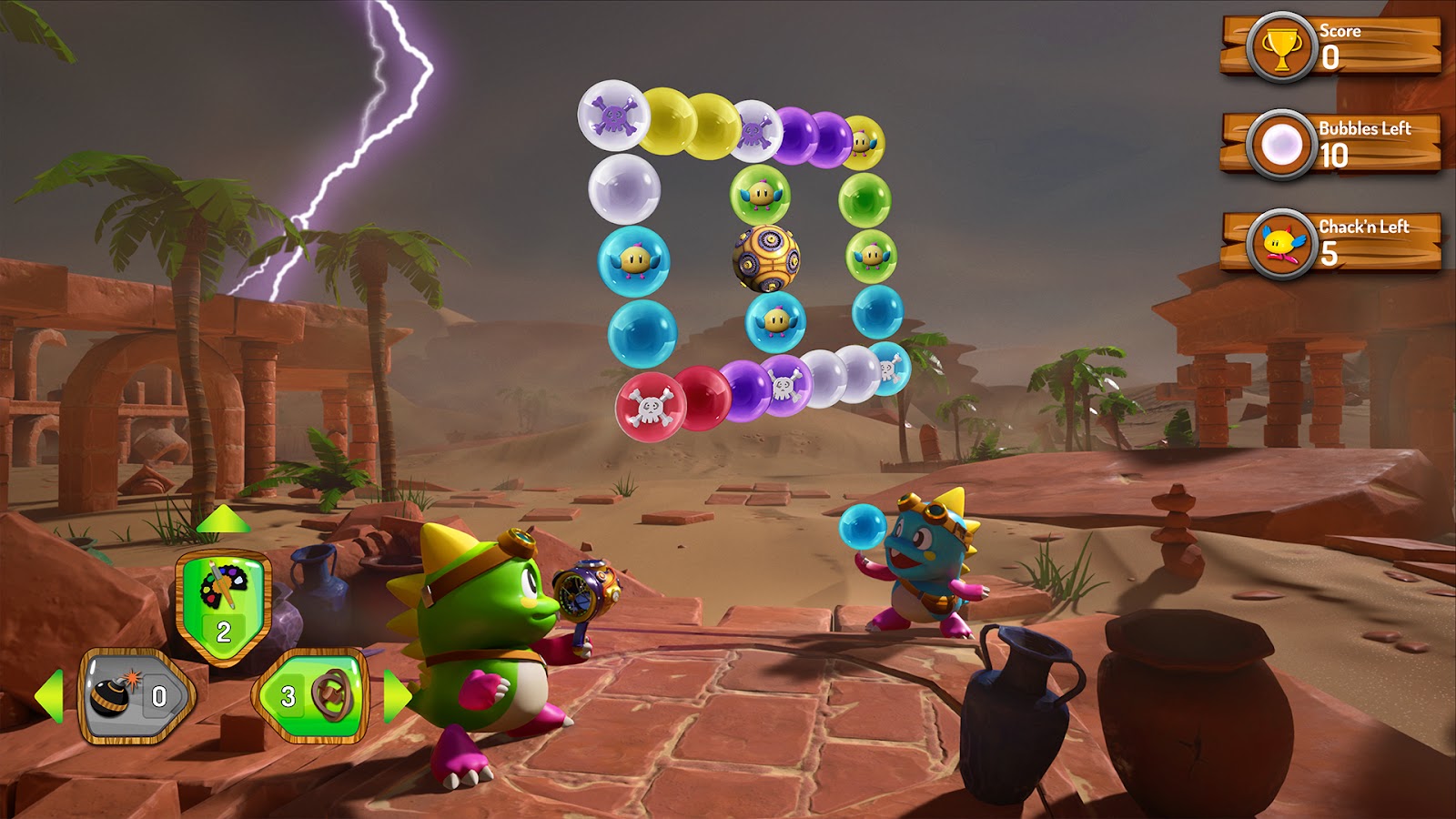
Bubble dragon brothers Bub and Bob are in for a surprise when their island vacation takes an unexpected turn for an epic, bubble-popping adventure in Puzzle Bobble 3D: Vacation Odyssey. Explore lush tropical islands, peaceful lakesides and even the pyramids while solving 100 new puzzles in Puzzle Bobble’s first-ever 3D and optional VR experience, the next evolution of the classic Japanese action, puzzle-game franchise! This game is positively bursting with its cheerful design, adorable characters, and timeless, fun gameplay for fans of the series and newcomers alike.
Features:
100 New Puzzles: Brand new 3D puzzles with special bubbles, fun power-ups and items add more depth and physics for a mind-bending challenge
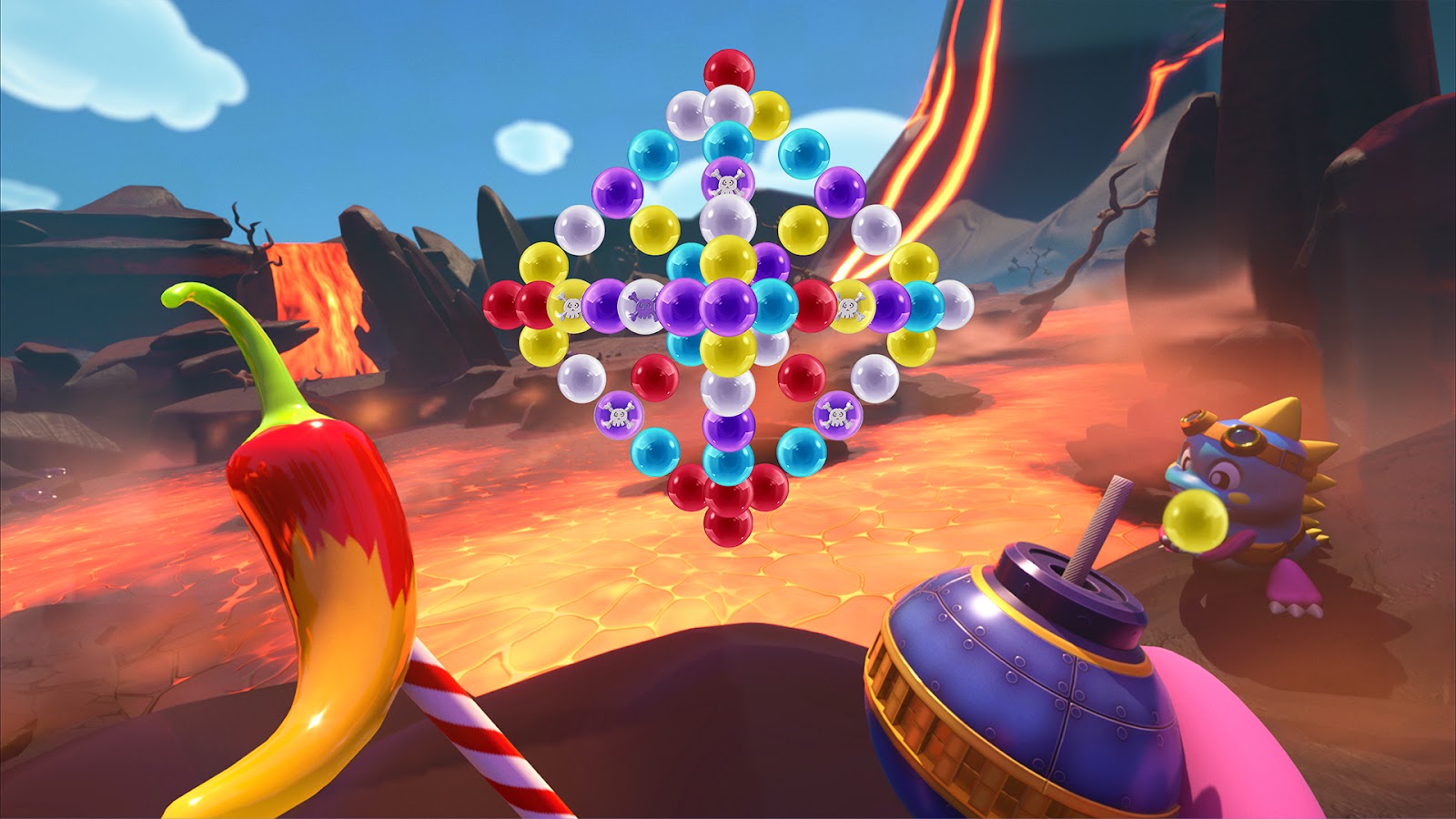
Full PSVR Support [optional]: Virtual reality transforms players into a bubble-popping dragon with a first-person perspective, and even physicalized interactions when paired with PlayStation Move controllers. You can switch seamlessly between playing on TV and VR.
3 Distinct Puzzle Modes: Master the 100 progressively difficult puzzles in Story Mode, kick back and pop endless puzzles in Infinite Mode, or hop into online 1v1 Duel Mode, which supports matches across PS4, PS5 and PSVR.
Easy to Pick-Up-&-Play but Challenging to Master: Simple controls and intuitive game mechanics introduces puzzle popping in a fun, non-intimidating way
Fantastic tunes: Includes an all-new score by Zuntata, the composers for the original series!
Strictly Limited Games and Gamesrocket are giving Puzzle Bobble 3D: Vacation Odyssey a much deserved special limited release, exclusively via the Strictly Limited Games Partner Store and via the Gamesrocket store.
The Limited Edition is limited to 2,000 individually numbered copies for PS4 and 1,500 copies for PS5, at a price of 29.99€/ $34.99, including a unique cover artwork and a colourful game manual.
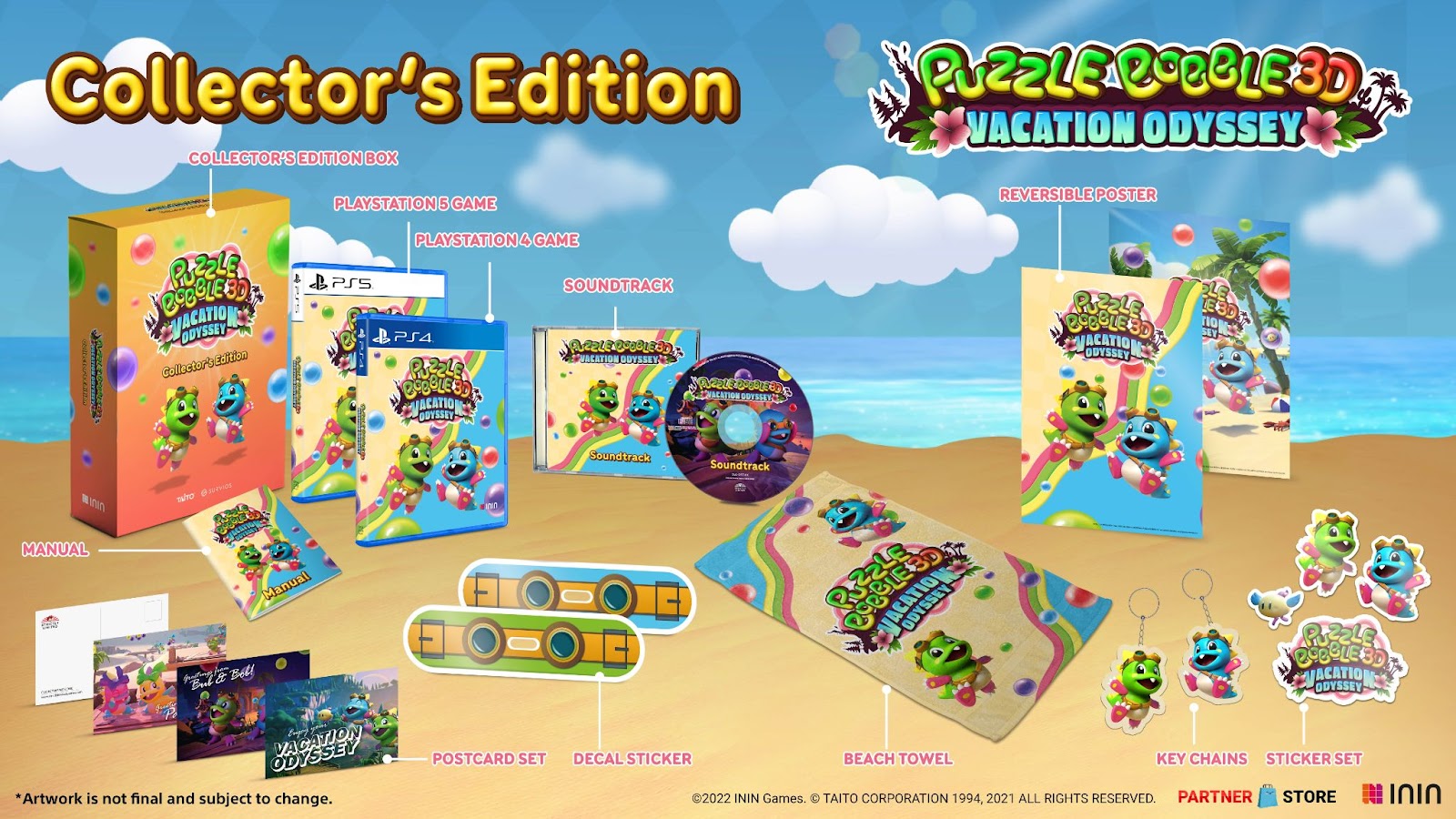
The Collector’s Edition is limited to 1,200 copies for PS4 and 800 for PS5. It costs 59.99€/ $64.99 and includes awesome additional collectibles:
Special Collector’s Edition Box
Colourful Game Manual
Original Soundtrack
Vacation Odyssey Beach Towel
Bub and Bob Acrylic Keychains
Double-Sided Poster (A2)
4 Die Cut Stickers
3 Vacation Postcards
Bub and Bob Goggle Decal Stickers (VR Headset Compatible)
Both editions will be available for pre-order on Thursday, April 7th, at 4PM CEST and shipping is expected for Q3 2022.
Shoot-’em-ups are as popular today as they always have been. I’m not sure if it’s the retro style, simple approach, or hectic action that attracts us all. Whatever it is, you are guaranteed an addictive and hard-hitting experience. The latest title in a long list of games within this genre is Z-Warp. It has every element you’ve come to expect and will take you on a trip down memory lane.
Developed by Panda Indie Studio and Eastasiasoft Limited and published by the latter, this is a vertical shoot-’em-up. It embodies everything that makes the genre fantastic, and I adored its pixelated style, sharp sounds, and mind-boggling action. Furthermore, it is simple to pick up but almost impossible to put down.
The first boss will test you!
Z-Warp has a classic 80s-inspired story.
The story of Z-Warp plays second fiddle to the hefty action that unfolds. However, it is glorious and absurd. Moreover, it epitomises 80s gaming and you’ll adore its outrageous ways. The year is 21XX, and the Z-Division has been developing top-secret space exploration technology. Sadly, though, the experiment has gone wrong. After a successful warp into the far reaches of space, there is radio silence. Earth waits with bated breath and suddenly, a message comes through. Worryingly, it is a call for help and only a hero can save the day. Subsequently, a new pilot must be selected, and that is you. Your mission is to explore deep space and find the black box. By doing this, mankind will understand what went wrong and learn from its mistakes.
As I said, it’s absurd but wonderfully ridiculous at the same time. Once you understand the central story, you a flung into action. Consequently, you may pick between two game modes, story and endless. Both are equally challenging, hectic, and follow the same principles. Effectively, whatever you choose, you’ll scream and cry as you die for the nth time.
Oh Snappy, go easy on me, please.
High scores, enormous bosses, and heavy weaponry.
As expected, Z-Warp has straightforward goals and is easy to understand. Therefore, the aim of both modes is to destroy every foe and obtain the highest score possible. Sounds simple, right? Wrong! Everything wants to kill you, as space is a dangerous and hostile place. Moreover, every stage is loaded with aliens that shoot you while having Kamikaze tendencies. On top of this, the end level bosses are just brutal. Subsequently, they are gargantuan terrors that emit bombs, and lasers, and are killing machines.
If you somehow survive a level, you must dust yourself off and start again. Furthermore, each stage you undertake has unique problems that must be overcome. Whether it’s spiked walls, aliens that block your way, or more, the solution stares you in the face. So, the enemies are tough, but you are tougher, still. Thankfully, you are armed with a laser cannon, machine gun, bombs, and an all-powerful instant kill. However, these aren’t always enough and you must rely on your ship’s shield. Fortunately, this does recharge, but you’ll need time and luck to keep it powered.
Z-Warp is beautifully dated.
Like its peers, Z-Warp is wonderfully dated. Its garish colours, simple sprites, and easy to follow vertical scrolling perspective are beautifully retro. Furthermore, the environments are varied, and this keeps things interesting. Alongside this, I loved how the action plays out in a small confined space. The white-bordered gaming area was reminiscent of a Gameboy, and this adds to the nostalgia.
This genre is renowned for its heavy soundtracks and loud sound effects. Luckily, Z-Warp is no different. Consequently, the music screams at you as you unleash hell upon your opponents. What’s more, the noise gets louder and more unbearable as you unload your arsenal of weapons. Now, this may seem horrific, but it is not. It’s wonderfully OTT and enhances the madness that unfolds.
It’s killer weapon time.
Where’s the explanation?
Being thrust into the action isn’t a bad thing, but a small tutorial wouldn’t go a miss. Disappointingly, Z-Warp fails to explain any of the fundamentals. Therefore, there is a fair amount of trial and error before you master it. Fortunately, though, the stages are tiny, so the disappointment is short-lived.
If you love the genre, you’ll play this until the cows come home. It’s undeniably addictive, and I loved trying to top the leaderboard. What’s more, the two modes keep you playing for hours. Alongside this, longevity is increased thanks to its tough achievement list. You’ll have to better many bosses if you wish to complete the game. All I can say is, best of luck.
Z-Warp is old-school gaming personified.
Thanks to its simple approach, challenging gameplay, and garish aesthetics, this is as retro as it comes. In fact, Z-Warp is old-school gaming personified. I adored its brutality, moreish ways, and heavy audio. Consequently, I recommend that you buy it here! Can you venture into deep space and complete your mission? Jump in your ship, destroy your foes, and attempt to survive.
Either I haven’t been paying too much attention to the usual gaming media buzz or Core Keeper really has come out of nowhere. I first heard about it during Steam’s Next Festival back in February, but it was only after it arrived on Steam’s Early Access that it really grabbed my attention. It’s the new survival indie hit that has been sitting on Steam’s top sellers for a while now, so if you fancy that sort of game, then you might want to keep this one on your radar.
Since games such as DayZ, Minecraft, and Terraria have popularized the sandbox survival genre, there have been numerous games that have attempted to find their place in this market. However, very few have succeeded. While some obviously lack any kind of inspiration or unique selling point, there are a select few who seem to have hit the nail right on the head. Despite the fact that the current version of Core Keeper is a very early one, and one that will undoubtedly change a lot as the game gets closer to its final release, I’m pretty confident when I say that the future is bright for this game.
While a lot of games seem to pour a lot of resources into making something really unique, something that nobody has ever seen before, sometimes they end up failing in providing an enjoyable gameplay experience. Sure, it might not be perfect, but for an Early Access title, Core Keeper sure feels great to play already. The Swedish team over at Pugstorm really seem to have struck gold.
It might not be groundbreaking in any meaningful way, but Core Keeper’s gameplay is a satisfying one that will, hopefully, only get better with time. For me, exploration is always a key aspect of this type of game. If I don’t feel motivated to go out and explore a game’s world, then that game has already lost me. Luckily, Core Keeper is quite compelling in this aspect, at least initially, when everything still feels and looks mysterious in the eyes of a new player.
As you step into Core Keeper’s world for the first time, there’s barely anything other than darkness all around you. A faint blue glow emanates from a nearby stone, one that’s intricately shaped and that looks exactly like the one that teleported you here, wherever here is. Whether you’re alone with seven other people, it doesn’t matter, you’re stuck underground.
The chamber where you start is completely enclosed, and so you find yourself forced to dig your way out into a series of small cave networks. There is no compass to guide you, and your map only shows what you’ve explored so far. However, you can spot tiny glints of light in the dark and you hurriedly make your way towards them. That’s how you often find ore or other things that have been randomly placed in your world. Core Keeper is a sandbox game, but these small hints really make it feel like the game is pointing you in a specific direction. Personally, I appreciate that.
I think that the genius thing about Core Keeper’s exploration is how mining is directly tied to exploration, and as a direct result, so is resource gathering. In Core Keeper, resource gathering and exploration are beautifully married together. Because the whole game takes place underground, you need to dig and mine walls in order to explore, and so you’re doing two things at once. I really think it’s quite a brilliant execution, even though it might not sound the most exciting.
There sure is a lot of mining to be done, but I quickly realized that this only made the discovery of ancient ruins and other landmarks all the more exciting. With that being said, mining is extremely satisfying, not only due to the sound that your pickaxe makes with every blow, but also due to the fact that you can see each block starting to crack as you hit it repeatedly. Another rather funny detail is the fact that walls wobble when you hit them, it’s almost like they’re made out of jelly. I think it’s quite funny, but I honestly stopped paying attention to it after a few minutes.
Thankfully, Core Keeper has streamlined a lot of the menial work that’s still present in a lot of survival games. For instance, torches can be crafted with just wood, you don’t need coal. Likewise, all you need to smelt ores is a furnace, there’s no need for fuel. I’m sure some people will be put off by that, but I think it just improves the gameplay flow a lot since it saves players time that can be spent doing more interesting things in the game.
Unfortunately, the combat has got to be Core Keeper’s weakest aspect. There’s just not much to it. Sure, you can get better weapons and armour to fight its various enemies and bosses, but combat just revolves around an attack and run loop. If you’re using melee, all you have to do is charge at the enemy when there’s an opening, attack, and then run from the enemy’s attack range. Rinse and repeat. It’s about as basic as it could be, but to be honest, I’m not sure how the developers could improve it without having to create an entirely new combat system from scratch.
Regardless, whether this will be detrimental to your gameplay experience as a whole will depend on what you’re really looking to get out of Core Keeper. If you’re looking for the whole package when it comes to a sandbox survival game, then you’ll probably be somewhat disappointed. However, if what you’re interested in is just a cosy and charming little survival game with the usual activities like fishing, farming, and tons of mining, then I’m pretty sure that you’ll have a jolly time with it.
After ten long years of waiting, the Rune Factory franchise has been reignited for Nintendo Switch. The release of Rune Factory 5 has been long awaited by hundreds of fans ready to dive into dungeon crawling. With farming sims currently taking the internet by storm, Rune Factory 5 has been released outside of Japan at the perfect time.
If you’re searching for a sweet, simple pastime, then let’s explore what Rune Factory 5 has to offer.
After awakening in the midst of an unknown land, you are diagnosed with amnesia. Your protagonist will struggle to remember who they are and how they arrived in the location. Obviously after some lengthy introductions, it’s your job to uncover these truths. You’re quickly taken in by a team called SEED, and taken on a tour of where you’ll stay for the next length of time. Several characters are also introduced, which may seem overwhelming to begin with, but throughout the title you’ll learn more about them. Making them far more memorable than your first interactions.
A stylish set of hello’s
Rune Factory 5 walks you through a lengthy tutorial to help you get to grips. At the beginning of the game, things feel quite slow in terms of pace. But as any good farming based simulator goes, this is the best way to get to grips with your homeland. You don’t learn Pelican Town off by heart during your first interaction in Stardew Valley, nor Mineral Town in Story of Seasons. Plus in Rune Factory, there are a huge number of people to meet. Starting off by walking around the town to introduce yourself is necessary.
However despite its stylish animated introduction sequence, the map itself feels a little empty. There are several large spaces with no selling point across the map and rather than bulking it out with uninhabited buildings or natural beauty, textures are flat. Which goes for the majority of the map. It just feels like it’s lacking a lot of promised detail. There is a mechanic which allows you to sacrifice a few frame rates for a higher quality look, but even then it doesn’t feel much different.
It appears that the majority of art perfection has gone into character design, which can be said for the majority of previously released Rune Factory titles. Specifically, dialogue portraits retain a certain level of detail which the core game misses. The same can be said for the frequent animated cutscenes which mirror the intense opening number of RF5. They certainly look the part, and are beneficial for players looking to get their romance on. Several cutscenes will also follow the romancing of certain characters so be sure to check the map to see where these are. They can’t be skipped though, so maybe take this as a break to get some snacks.
Farming & becoming familiar
As mentioned already, farming plays a huge part in what makes Rune Factory enjoyable. It’s praised for its farming factor, but upon completing the tutorial, it’s pretty similar to any other encounters you’ll have with farming in an RPG game. You already have access to money making through shipping items, and you’re told when to grow certain crops. Also, you’ll learn the frustrations of tool upgrade for what feels like the hundredth time, so those pesky boulders will have to stay for a little while longer.
Once you get to grips with the map you’ll notice just how much Rune Factory 5 has to offer. Even hours into the title, dungeons and areas of a map start to appear which you may have originally missed. Disregarding a few graphical errors, the game does have an extremely rich storyline and is far from lacking in content. It’s a shame that there are several elements of gameplay which cause input delay, which results in a pretty poor approach to combat.
Input delays and a skills for days
Combat is one of Rune Factories unique selling points. Unlike its competitors like anything from Story of Seasons, there’s a lot of combat involved in leveling. It’s not integral to having a good time with the title, and players are able to pick it up when and if they please, but it isn’t exactly worth picking up either. If you’re playing this title in handheld via Nintendo Switch, you’ll probably have a more beneficial time in combat. But if you play the console docked, then prepare yourself for several instances of button delay which will cause frustrating mishaps. It’s a shame, as some of the enemy design in this game is truly beautiful. But if there’s one thing to put you off engaging in combat, it’s lag.
Alongside leveling through combat, Rune Factory 5 has an extremely overwhelming skill set. There are almost too many skills to master. And far too many different crafting tables to memorize in order to pursue them. They’re scattered throughout your hometown to make sure you’ve always got easy access to them. Eventually you can place them in your own home. But for the beginning of the game, try and learn as much as you can. As you progress, you’ll eventually lose the ability to use base weapons and need to upgrade. But in order to do so you’ll need to understand how to do that. It’s all explained simply to you during the course of the game, but it’s worth spending some time mastering when you can.
A soundtrack to swoon over
If there’s one extremely notable feature to Rune Factory, it would be it’s charming soundtrack. Every adventurer needs a score to explore alongside. And this game certainly delivers. Several areas are accompanied by a set of wonderful tunes. They aren’t repetitive and in-your-face either, so you can quite happily go about your day without really noticing it. I thoroughly enjoyed the soundtrack. So much so I’ve had it on in the background when going about my own real life tasks.
Final thoughts
As a whole, I struggle to say that Rune Factory 5 was worth the 10 year wait. You’d expect such a sought after title would show some development since it’s previous title in 2012, but I can’t say this game delivers. There are definitely elements which are thoroughly enjoyable. The more time you put into the title, the more fun you’ll have. If you’re bored of every other farming sim and release from Rising Star, maybe this game could suit what you’re looking for. But if you’re searching for something a little more groundbreaking then you may want to keep looking.
Writing with a pen on paper is a way of life for many people. However, in this eco-friendly & technology-focused world, using oodles of paper is frowned upon. So, what is the answer? Do you use your phone to create a draft, or will you stick to your PC & laptop? Either way, this is likely to stifle your creative flow. So, what is the solution? ReMarkable 2, that’s what!
This beautifully slim writing tablet gives you the freedom to express your views while maintaining the feel of a pen on paper. It’s wonderfully advanced, offers a distraction-free experience, and is like nothing else I’ve tried before. Furthermore, it is stylish, lightweight, and has a battery life that puts the DuracellBunny to shame. Moreover, from the moment I saw it, I knew it would be special. However, I just didn’t realise how special it would be.
What’s in the box?
As a reviewer, I was fortunate that the company behind ReMarkable 2 allowed me to test each product on offer. As such, I will highlight everything I received. Just be aware that many of the items are optional extras, and this is shown when you purchase your writing tablet.
Every object comes delivered in a crisp, striking, sturdy, and simple package. Furthermore, the goods are quality sealed, so you know everything is brand new. What’s more, there is an emphasis on recycling as all the packaging is paper or cardboard.
The ReMarkable 2 tablet comes pre-charged, but I recommend plugging it in before getting started. It is well-packaged and has a traditional but expensive look.
The USB C cable is made of a rubberised material and is of higher quality than most you receive with other pieces of technology. Moreover, it is long enough to be convenient and durable enough to survive multiple trips in your bag.
A straightforward and easy-to-understand user manual. This quick access guide explains the fundamentals of getting started. However, most of the start-up information is found on the tablet.
Simple but effective packaging. The ReMarkable 2 tablet. The complete package. A closer look.
The Accessories.
The basic Folio case. This grey textile protective cover is a fantastic way to protect your device when out and about. What’s more, it has a handy pocket to store your marker pen.
The Leather Book Folio case. The next step up from the basic model comes in three colours. I was sent the brown leather case that enhances its book-like feel and the traditional look. It is also magnetised and secures the tablet with ease. I adored this premium finish, as it complements the style whilst also being functional.
Standard marker. This grey writing tool is magnetised and a great way to make the most out of your tablet. It has a specialised nib and is pressure and tilt sensitive.
Marker Plus. This is the premium option that is a must-have for keen hobbyists and professional writers. It comes in a distinct black colour, uses the same pressure and tilt sensitive technology as the standard marker, and is also magnetised. However, where it differs is the built-in eraser for ease of use. Simply flip the pen over and undo any mistakes you make.
Spare Nibs. Both markers come with spare nibs to ensure you maintain the best quality writing instruments. They are simple to change and long-lasting. Consequently, there are no concerns that you will need to replace these often.
The Leather Folio Book case in its simple packaging. The professional looking Leather Book Folio case. Simple packaging for the Folio textile case. The ReMarkable 2 tablet sits comfortably within the Folio case. The ReMarkable 2 in the Leather Book Folio. Each of the marker pens side by side. The marker in grey. The marker plus in black.
ReMarkable 2: It’s more than just a writing tablet.
Whenever I’ve discussed ReMarkable 2 with friends and family, they universally don’t understand the concept. Many of them believe that an iPad, Samsung Tablet, or even a mobile phone can deliver the same quality. However, they are wrong! Yes, the aforementioned products offer a version of the technology, while giving reasonable results, yet they are a million miles from what ReMarkable 2 delivers.
Not only is it a phenomenal note-taking device, but it allows you to work with templates, compose letters and documents, and much more. Subsequently, you can transcribe handwriting to email, make notes on PDFs, and demonstrate your work to a live audience. Therefore, it offers an array of solutions rarely seen in one package. On top of this, it has an exceptional battery life, can be carried in a small bag, and is the thinnest tablet on the market.
Alongside its stylish looks, massive 3000 mAh battery, and multi-faceted approach, it’s also unbelievably stable. Thanks to its purposefully designed Linux-based operating system, it doesn’t complicate matters. Therefore, crashes and errors are few and far between. In fact, my device never faltered once. This was particularly impressive as I allowed my young children to draw, scribble, and write to their heart’s content. Consequently, what I found was that it never stuttered, not even once, and that is mighty impressive.
Excuse my terrible handwriting.
Don’t let technology distract you.
Technology is a wonderful thing, but let’s be honest, it is distracting. Emails pinging left, right, and centre or the Internet, just begging to be searched. Whatever it is, it will stifle your creativity. Luckily, though, ReMarkable 2 is different. It doesn’t have apps, browsers, or games. There are no distractions and it is bliss. Therefore, when you sit down and write, nothing will stand in your way.
This return to my writing roots was magical and something I’ve yearned for for years. However, I worried that the blend of technology and traditional elements would be cold and callous. Yet, I was wrong. The team behind the tablet wants this to be as authentic as possible, and this was achieved through the final aesthetics.
Unlike its peers, ReMarkable 2 doesn’t rely on a sharp and bright back-lit screen. No, instead it incorporates something called a CANVAS display. This second-generation technology gives the impression of a paper-like surface without harsh lighting. As a result, it’s much easier on the eye and can be used in strong sunlight.
Alongside the beautifully subtle display is a feeling of friction and resistance similar to writing on paper. What’s more, you hear the familiar scratching of your pen as words form. This was the piece de resistance and something that surprised me. Here I was writing on a tablet, yet it captures everything I love about being an old-school journalist.
Technical Specifications.
Size and weight
187 x 246 x 4.7 mm Approximately 403.5 g (.88 lb)
Processor
1.2 GHz dual core ARM
Storage and RAM
1 GB LPDDR3 SDRAM 8 GB internal storage
Second-generation CANVAS display
10.3” monochrome digital paper display (no colors) 1872 x 1404 resolution (226 DPI) Partially powered by E Ink Carta technology Multi-point capacitive touch
Marker
No charging, setup, or pairing required Special high-friction pen tip Tilt detection 4096 levels of pressure sensitivity
Connectivity
Wi-Fi 2.4GHz and 5GHz USB-C Accessory port
Battery
Rechargeable (Li-ion) battery USB-C charging 3000 mAh
Operating system
Codex — A purposely designed Linux-based operating system for low-latency digital paper displays
Document support
PDF and ePUB
Other
Menu language: English only Note and file syncing between reMarkable tablet and reMarkable apps for MacOS, Windows 10, iOS, and Android
Are there any negatives?
As a piece of technology, I can’t fault the ReMarkable 2. It is a phenomenal writing tool that can be used as an eReader as well as an amazing business tool. Subsequently, it has many uses that make it stand out from its peers. Furthermore, it is easy to set up, undeniably simple to master, and delivers on what it promises.
However, there is one small drawback: Sadly, the accessibility to every feature is locked behind a subscription service called Connect. This monthly renewable option allows users to transcribe written words to text, perform the tablet to screen elements, and more. Sadly, many may see this as an unnecessary expense, but I didn’t. This premium subscription service offers unrivalled benefits that none of its peers can touch. What’s more, there are regular updates that ensure the device is running optimally.
The ReMarkable 2 tablet with its fabric Folio case.
Is ReMarkable 2 worth it?
I was blown away by everything I experienced with my ReMarkable 2 tablet. From the simple but stunning packaging to the secure, reliable, and easy to understand operating system, this was a winner. Alongside this, the transcribing from handwriting to typed word was unlike anything I’ve experienced. The accuracy is just phenomenal, and this amazed me. Yes, it takes a little getting used to, and it highlights any lazy habits you have picked up. However, once you understand your flaws and its quirks, it’s incredible.
On top of this, the Marker Pens are responsive, wonderfully comfortable, and considerably weighty. They feel fantastic to hold and pick up every detail you make. What’s more, you are free to select from an array of digital tools. Whether it is a ballpoint pen, highlighter, pencil, calligraphy pen, or more, there is a vast choice. Furthermore, you can alter the colour, thickness, and so forth. This was a simple thing that ensures every element is user-friendly.
Everything considered, I was thoroughly impressed with what I saw. This tablet oozes quality and style from every pore and is worth every penny. It is fair to say there are always challengers to the throne, but ReMarkable 2 can’t be touched. I loved everything about it and I recommend you to buy it here! Don’t let technology shackle your thoughts. Return to a simpler way of writing and experience what it means to combine technology with good old fashioned paper.
Summary.
Finding a device that is as fantastic as ReMarkable 2 is rare. Subsequently, this exceptional tablet is quality personified and a must-have item. I adored everything it offered, even if it showed up my writing faults. Cut out the noise and distraction and allow yourself time to think.
(More information on ReMarkable 2 can be found here!)
Moon Knight is finally here! The much-anticipated next instalment of the Disney+ MCU series arrived on the 30 March 2022 with Moon Knight Episode 1. In the comics, Marc Spector (a mercenary) is left for dead and given powers from the Egyptian god Khonshu; he isn’t a god himself. Khonshu by the way is cool – he’s a god from Ancient Egypt who represented the moon. His name means “traveller”.
In Marvel Comics Khonshu is on a one-god war against evil. Marc Spector is given powers to become ‘the fist of Khonshu’ aka Moon Knight. Supernatural strength, heightened reflexes and endurance are part and parcel of this character’s powers, getting stronger depending on the phase of the moon. It will be interesting to see how closely the new series sticks to this origin. I am almost certain we’ll see the granting of the powers in a flashback sequence.
The series begins with Steven (Oscar Isaac), a museum worker at The British Museum in London going about his life. We learn quickly that he suffers with mental health problems as (as we saw in the trailer) he keeps himself chained to his bed and door taped up at night. If you know the comics, you know that Moon Knight’s alter ego also has dissociative identity disorder. Isaac plays this role brilliantly. He can achieve the subtle nuances of a man fighting an inner conflict – a mix of fear and sadness and in places, total confusion. While the British accent is a little hammy it’s certainly better than what us Brits usually suffer through in Hollywood productions where non-English actors attempt a ‘cockney/London’ accent.
The overall tone of Moon Knight Episode 1 is very much an introduction. We are introduced to the world of Moon Knight through the eyes of a character who knows as little as we do. That’s refreshing as we as an audience aren’t made to feel bad for not necessarily having read the comics. There is plenty of heart, interesting character study, light comedy and action sequences that will undoubtedly remind you of franchises like Indiana Jones.
In addition to Isaac, we also meet the character being played by Ethan Hawke. Another great portrayal of an interesting character. The series starts with an introduction to him over the main character. Hawke plays a cult leader exceptionally well, really grasping the double-edged sword of charisma and malice perfectly. His character is an interesting retelling of a known Moon Knight comic villain and I’m looking forward to seeing how this spin will work long term. Marvel is known from departing from comic book origins to give us something contemporary and fresh and Moon Knight is certainly no exception.
Visually, the show is a treat and Mohamed Diab has sympathetically introduced Ancient Egyptian mysticism into the MCU. Diab also gives us what promises to be a wonderful character study with Issac’s character. There is one scene in a London restaurant that is partuclarly moving. When most would have probably cut it out to keep pace Diab didn’t. For that I’m thankful.
Moon Knight Episode 1 also has a great soundtrack, which compliments the tone perfectly. What the series has to offer going forward will be exciting to find out.
Overall, Moon Knight is off to a fantastic start. It’s great to see a lessor known Marvel character being given a chance to shine. Isaac is honestly the perfect casting and I’m anticipating a strong series from the whole team and cast.