Review: Heidelberg 1693

Heidelberg 1693 is a cruel game that twists the narrative of 17th-century Bavaria. With silent movie-inspired cinematic and a tough fantasy story to swallow, this is a grim endeavour that is challenging to complete. Furthermore, you’ll enjoy multiple endings, classic platforming mechanics, and an array of zombies and creepy monsters to hunt and kill. Consequently, this isn’t for the faint of heart, and even hardcore gamers will be tested throughout.

Developed by Andrade Games and published by RED ART GAMES, this is a 2D action title. What’s more, there are minor tactical nuances, a selection of sub-weapons to use, and buckets of blood and gore to endure. In short, it is a disgusting game that’ll make you weep. However, its cruel nature and overpowered bosses ensure that it is rewarding and enjoyable as well. Additionally, its aesthetics are reminiscent of a bygone console era. Accordingly, retro gamers will enjoy the simple side-scrolling approach and the rudimentary, albeit nasty graphics.
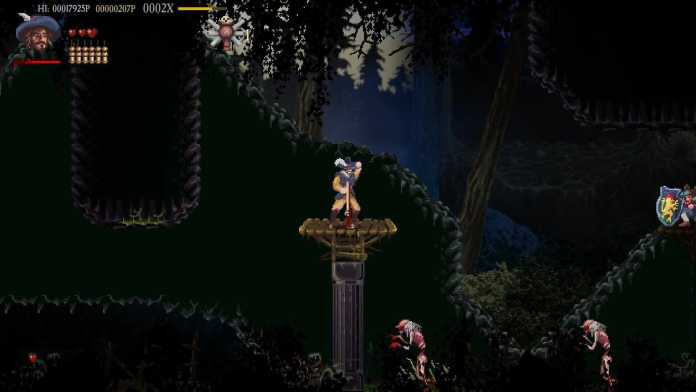
The hero stands upon a pillar and reloads his musket.
Stay up high and stay safe.

Heidelberg 1693 tells a harrowing tale.

You control one of King Louis XIV’s famous musketeers. This battle-hardened warrior is sent on a mission to rid 17th-century Germany of its zombie infestation. En route, you will encounter many historical characters from the era as you try to save the day. However, with branching storylines and tough moments, completing your goal is easier said than done.

Armed with a sword and your powerful musket, you must destroy an increasingly challenging wave of enemies. As you progress, you’ll encounter locked doors, traps, and portals to another dimension. If you activate these swirling gateways to hell, you’ll unleash more demonic beings that must be destroyed. However, with careful planning and an eye for detail, you can avoid unnecessary conflict and live to fight another day.

Use your sword and stab your opponents in Heidelberg 1693.
En garde.

Carve your path and select your weapon.

What makes Heidelberg 1693 so great is the tactical elements of the gameplay. Consequently, how you wish to deal with your enemies is entirely your choice! You can run in like a headless chicken while flailing your sword like a madman, or you can stand back, take your time, and unleash your powerful musket. However, with limited ammo and a slow reload time, you must be careful how you use your gun.

Alongside this, you will find sub-weapons that can turn the tide of each battle in your favour. Furthermore, you’ll find ways to replenish your health as well as additional ammo for your rifle. As such, you must be flexible in your approach and change your plan according to the enemies you face. On top of this, there are spikes and traps to avoid, as well as demonic beings to destroy. Accordingly, it is a hectic mess that is tough but rewarding to play.

As with most adventure games, you must face plenty of angry bosses en route. Heidelberg 1693 has some of the toughest overlords that I’ve encountered. As such, learning their weaknesses and strengths was a challenge. Luckily, however, the developers were generous with their checkpoints, so death and failure weren’t as harsh as they could have been.

Heidelberg 1693 is dank and grim.

I adored the hectic and challenging gameplay, but the visuals were better still. With excellent stage design and unique backdrops, I never tired of what I saw. Additionally, the grim and sombre colour palette matched the daunting nature of the gameplay. Furthermore, the excellent animation and fantastic sprites added to the variety. Though the basic design and simplicity fail to utilise the power of modern machines, I adored the retro style and the uncomfortable levels of gore.

The excellent gameplay was complemented by some amazing cinematic. Inspired by silent-era films, the drama oozes from each tough cutscene. Furthermore, the story evolves nicely, and you are introduced to a range of historical characters at the same time. Though the cinematic was equally grim and cruel, it was a nice break away from the harsh and relentless gameplay.

The brutality was enhanced by the cruel sound effects and dramatic music. With booming rifles, squelching limbs, and screams of pain, it is bone-chillingly horrific. Thankfully, though, the music drowns out much of the ear-splitting noises. However, during sombre and melancholy moments, you’ll have to endure the chilling nature of the sound effects.

The hero is being chased by a zombie.
Remain vigilant at all times.

Tricky controls.

Heidelberg 1693 is a thoroughly enjoyable, albeit macabre, title. However, the controls should have been much better. As such, shooting your musket wasn’t as easy as it should have been and this enhances the difficulty. The developers could have made the aiming mechanic much more user-friendly. Yet, they used the wrong analogue stick, and this makes it fiddly. Consequently, the controls aren’t as intuitive as they could have been, and this was frustrating.

With these issues to one side, you’ll enjoy plenty of replay value and longevity. Thanks to the difficult bosses and multiple endings, you are kept busy for hours. Luckily, though, the generous checkpoints ensure that failure isn’t so bad and with some practice, you’ll nail each gargantuan boss in turn.

Heidelberg 1693 is gloriously disgusting.

This is a bloodbath of a game! As such, with claret spurting all over the place, you can’t avoid how gloriously disgusting it is. Furthermore, the challenging combat and excellent stage design enhance the enjoyment factor and how moreish it is. Yes, the controls should have been better, but this isn’t a massive issue. Accordingly, despite this minor setback, I recommend that you buy it here! Can you slay every zombie you face? Grab your musket and sword and defeat anything that stands in your way.

Review: Remnant: From the Ashes

I’ll preface this by saying that soulslikes are not my cup of tea in any way shape or form. So much so in fact, my bio at the bottom of this article (if you make it that far) states my predilection for easier difficulty modes in all things (mostly video games because, well, you know). So being asked to review Remnant: From the Ashes was never going to be something I was fully comfortable/capable of. So now that I’ve fully put you off listening to my opinion, here is my review of Remnant: From the Ashes.

This review was conducted on Nintendo Switch as Remnant was recently ported to the console. So bear in mind that any critique may be unique to this particular edition of the game. Or not, who’s to say?

Remnant: From the Ashes was first released way back in pre-Covid times (remember those?), in the year 2019, a more innocent time. Developed by Gunfire Games and published by Gearbox Publishing, it is a third-person action RPG taking its inspiration from FromSoftware’s Dark Souls games, but adding in the quirk of being able to shoot anything that goes bump in the dark, with a gun no less.

By now, gamers will be familiar with the soulslike genre, take the standard formula RPG, make it gruellingly tough, slap some lore over the top and you’re golden. Whilst that is likely an oversimplification, it isn’t far from the truth, especially in the case of Remnant: From the Ashes. The plot has you pitted against a somewhat botanical foe known only as ‘The Root’, which honestly just gave me Groot vibes, minus the affable nature as these trees are decidedly more likely to murder you just for existing. 

However, the story is not what you’re likely here for with Remnant: From the Ashes as it goes from story beat to story beat without ever truly innovating on a tired apocalyptic survival genre. Luckily for fans of soulslikes, the combat is mechanically tight, responsive, and suitably frantic enough to keep the game afloat by itself. You are tasked with systemically clearing a series of dungeons each inhabited by a variety of horrifying arboreal foes. As you advance through the procedurally created levels, you will collect loot and resources needed to upgrade your gear, a vital component of Remnant: From the Ashes

Fail to prepare, prepare to fail has never felt so apt. 

When you’re not fighting Treebeard’s disfigured cousins, you’re bouncing from crystal to crystal, Remnant’s version of the Dark Souls campfires. These take on a glowing red hue in opposition to the rest of the world which is a dull grey. It is custom at this point for post-apocalyptic worlds to be miserable however, I can’t help but feel that this trope is somewhat played out by now. Beyond my personal feelings, it does make picking out any details in the world exceptionally tricky, especially whilst playing in handheld mode. The experience does improve whilst docked but this was just the first of several issues, I had with Remnant: From the Ashes’ Switch port. 

First is the map, in handheld, this is tiny, almost worthless. I yearned for the days of mounting a magnifying glass to my GameBoy Colour whilst journeying through this strange, new world. Zooming in on it within the menus does little to alleviate this issue, making traversal less enjoyable which is always a bummer in any video game. 

Possibly the most frustrating, however, is the laborious loading times. Loading up the game can take anywhere between 30 seconds and a minute. Now this may be my ancient console, but I get the feeling that even the slightly more powerful OLED would struggle here. Whether this is a fault of the game, or the system is hard to say, but unfortunately, it is a common problem with Switch ports. Nintendo, release a new console soon, please. Cheers.  

Despite some issues visually, the core gameplay of Remnant: From the Ashes seems to have held up well in its trip cross-platform. Gunplay is excellent and the feel of quickly dispatching several horrors in a row with your choice of weapon is very satisfying. Class-wise, you have the choice of close, mid-range or long-range specialities. Each has unique weapons and skills associated with it, allowing for a variety of playstyles which serves the other aspect of Remnant that it leans heavily on.

Remnant: From the Ashes feels tailored to the co-op experience. Whilst the game is perfectly playable solo, certain locations and enemies feel built to be tackled in tandem with ‘friends’, a foreign concept to us nerds, I know. You can choose to play with actual acquaintances or play the matchmaking lottery and team up with an equally lonely soul (an exercise in frustration let me tell you). This will make the game slightly more difficult, scaling to the number of players, but dividing the attention of enemies makes things so much easier. As a soulslike hater, this was a godsend.

All in all, it feels difficult to recommend Remnant: From the Ashes as a Nintendo Switch title. If you like soulslikes, guns, trees, and grey things: maybe play this on any other console.

Chances are, it’s a pretty good game there. But here, it’s not a great experience. 

Review: Ravenbound

I must confess upfront that I’ve never quite gotten along with Soulslike games. Years of Excel spreadsheets and apple cider have dulled my reflexes enough that I can’t quite keep up with them. Yet I do adore Roguelikes/lites and at the end of the day, both are about punching a brick wall until it eventually breaks. So when Ravenbound promised to marry the two, I was quite interested. It’s a pairing that has some promise.

Unfortunately, Ravenbound didn’t stop there. It kept chucking things into the pot, throwing in an open world and card-based gameplay into the mix, stopping it all from cooking down properly. It’s ambitious, there’s no doubt about that, but Ravenbound struggles to blend it all and feels shallow as a result. After all, keep mixing paints together and all you’re going to be left with is gray.

Ravenbound - Raven Form

A Flock of Genres

Let’s strap Ravenbound to the vivisection table and start examining its parts, beginning with that open world. Ravenbound‘s world of Avalt is on its last legs. Back in its heyday, it had six protectors but after one of them stabbed the others in the back, it fell into ruin. To bring it back to life, its former protectors create a spirit in the form of a raven to inhabit vessels and hit a lot of things with swords. As stories go, it’s fairly interesting yet poorly told. So much is in plain, unvoiced text dumps, either vomited by NPCs or contained in giant stones. Ravenbound does far too much telling and not enough showing.

Still, its explorable world shows a bit more promise. It looks great for one and is littered with the remnants of old buildings being reclaimed by nature. Flying over the landscape and moving from glorious sunshine to driving rain felt great. For the first few runs, I’d slow my speed a bit and just watch the hills roll by. We’re a raven, remember, so we can fly. It’s actually a nice travel method. Transforming into an armoured warrior miles in the air and crashing down onto the heads of unsuspecting bandits never got old.

There is an issue with the open world though and it’s one that permeates all of Ravenbound: it’s ultimately shallow. You won’t find many interesting things there, outside of set combat zones that are scattered around the countryside. These fights show up as icons, so you zoom your feathered form down to them, fight, then immediatly take to the air again. Except you can only transform at set points on the map, so every fight was followed by trudging back to a raven point so I could get to the next one. Rather undermines the open world concept, unfortunately.

Ravenbound - Troll Combat

Dealing Out The Pain

Let’s examine the combat next. It’s standard soulslike affair. We have a light attack, heavy attack, block and dodge. Survival depends largely on your reflexes and reading enemy patterns. Its functional, if unexciting, but helped somewhat by the enemy variety. You have bandits, of course, but also trolls, strange floating women and giant, aggressive trees. That said, the combat works best against small handfuls of melee creatures because the camera enjoys getting in close. It does make the difficulty a bit all over the place, as the worst enemies will just fire stuff at you from off screen, doing massive damage. Given the RNG of the roguelite element, this can lead to some frustrating deaths.

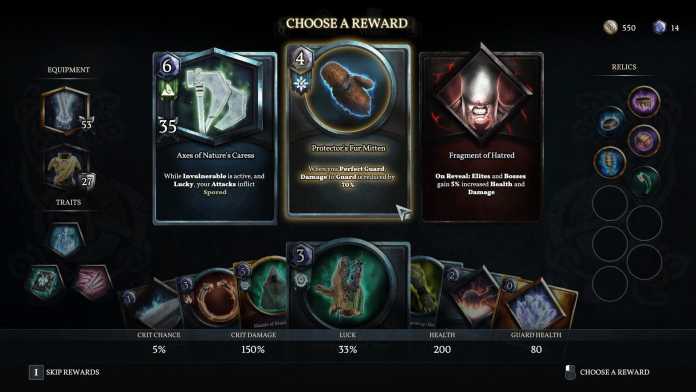
Paired with this is the card system, which I actually liked. When you open a chest, or gather enough ‘fragments’ from corpses, you’ll get presented with a handful of cards. This includes new armour, weapons or buffs. You then need to hunt out enough mana to use them. While they don’t change up more than numbers (as weapon styles are locked in when you choose a character), it introduces a nice risk-reward system. Taking too many cards will cause ‘hatred’, which powers up the bosses. You can gamble on a good bit of gear but if your luck sucks then you’re going to be fighting an incredibly angry boss with a feather duster.

These boss fights are the points where all the systems get the closest to melding. It’s a 1-on-1 fight with a giant boss, who’s carrying a weapon twice your length. While I was a bit disappointed that every boss is an identical looking suit of armour, the 1v1 focus forces some tension into the combat. There are no healing items, bar one single card, so mistiming a dodge or block feels genuinely painful. Scraping by these fights by the skin of my teeth was one of my highlights with Ravenbound. Some feel a little unfair, like the lad with a giant axe, but it’s not too bad.

Ravenbound - Card System

Ravenlite

You’ll note I’ve been conspicuously avoiding talking about the Roguelite element and that’s because of one simple reason: I don’t really care for it. See, roguelites by definition require playing the same thing over and over. To make that work, the game needs enjoyable moment-to-moment gameplay and Ravenbound doesn’t have that. Before each boss there is precisely one simple sidequest and a requirement to convert a set number of fragments. Then it’s a 1v1 and repeat for the next boss. The only thing that changes are the cards, which is just a glorified roll of the dice at the end of the day.

I pushed through enough to kill all the bosses except the final one. Then Ravenbound told me I had to kill three previous bosses in a row but changed up nothing. It was side quest, fragments, boss, repeat. The varying difficult of the enemies meant I tended to fight the same types over and over. Dying on the third boss brought new levels of frustration because I knew I’d have to do the same damn thing over again. The scales fell from my eyes as I realised I’d just been going through a simple loop for the past three hours. In the end, I just kind of gave up.

My final word is this: I admire Ravenbound a lot more than I actually like it. It’s trying to merge together a host of different elements, which is by no means an easy task. When asked to describe it, I’d probably do that sideways, waggling hand motion. It’s not bad but not particularly good either. Its nice ideas are balanced out by the shallowness of the experience. If you want to see a game juggle far too many balls then give Ravenbound a look but I struggle to recommend it otherwise.

(Ravenbound‘s Steam Page)

Review: Trust Tytan 2.1 Speaker Set

There are so many fantastic audio devices available for gaming that it can be hard to select the right one. Do you exclusively use headphones to improve your experience, or do you go loud and proud with a speaker setup? Whatever you decide, you want crisp tones, an excellent bass, and something that looks amazing. I think this is where the Trust Tytan 2.1 Speaker Set comes into play. This affordable speaker system is compact, powerful, and easy to use. Furthermore, it doesn’t have garish RGB lighting and, as a consequence; it is nicely understated.

Alongside the excellent design quality, you get a straightforward setup, robust speakers, and a fantastic subwoofer. What’s more, there is an inline remote control and only a limited number of cables to worry about. Subsequently, the finished setup looks professional and clean. On top of this, there is a power saving feature as well as a 2-year manufacturer warranty.

What’s in the box of the Trust Tytan 2.1 Speaker Set?

  • The large box is adorned with key images and information. Moreover, it is sturdy and the contents are protected thanks to the polystyrene shells. However, this does impact the ability to recycle, and that was disappointing. Furthermore, to make matters worse, every item is protected by a plastic bag and film. This was unnecessary, as there are plenty of environmentally friendly alternatives that could have been used.
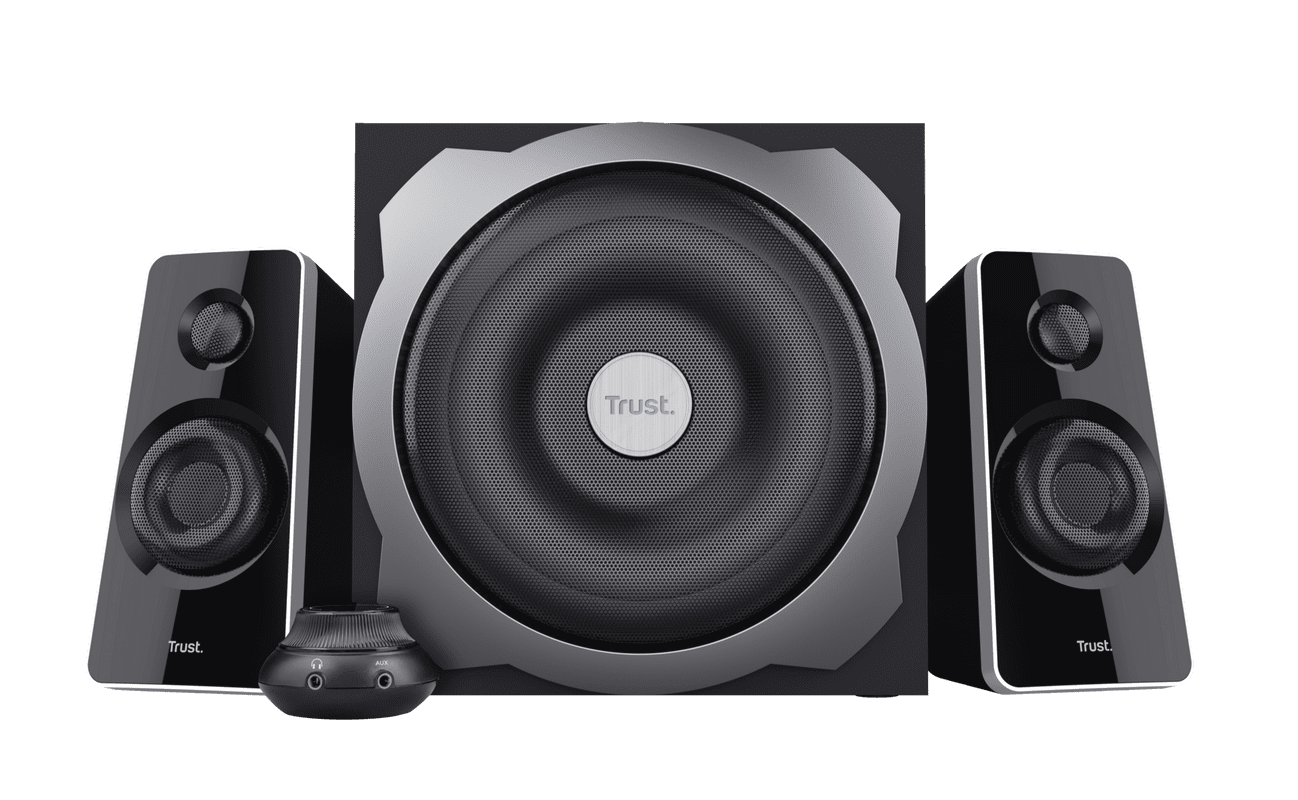
  • The Speaker Set comprises a sizeable subwoofer and 2 satellite speakers. Each of the speakers has a colour-coded jack that matches the output port on the subwoofer. Accordingly, setting up the speakers was an easy task. To the side of the subwoofer are a power switch, a power save switch, 2 input and 2 output female jack ports, and a volume and bass control knob.
  • An inline wired controller allows you to adjust the volume with ease. Furthermore, there are 3.5mm jack ports for headphones and a microphone. This small device has a tactile base, and the knob is easy to adjust.
  • I was provided with a European power cable, as such, I used an alternative UK cable to power the device. However, adapters can be purchased if you don’t wish to buy a new cable.
  • A simple user guide highlights the technical specification of this speaker set.

Technical aspects.

GeneralType of Speaker 2.1
FeaturesPower Saving
Weight4900g
ControllerRemote wired
ControlsPower saving button, Volume, Bass
ConnectivityWired
BluetoothNo
InputPower source – Wall socket

The Trust Tytan 2.1 Speaker Set offers rich forward-facing sound. Accordingly, unlike more expensive speakers or high-end headphones, you cannot get 3D audio or surround sound. However, for the price, this wasn’t a feature I expected to receive. Instead, the power output peak of 120 W and the 3×150 mm driver units deliver a warm and welcomed range of tones and bass. Furthermore, the combined 10 W output for each satellite speaker and 40 W for the subwoofer create a limited but immersive experience.

Each of the satellite speakers is sizeable, but not oppressive. The simple glossy black finish delivers an understated but clean edge to your gaming setup. Furthermore, each speaker has 1 inbuilt cable that is easy to route into the large and heavy subwoofer. This understandably cumbersome unit offers some hefty bass without blowing your head off. Moreover, the simple input and output option, control knobs, and switches make it a straightforward device to set up.

If I was to find a fault, it is that the switches should have been more accessible. Subsequently, if you push your subwoofer under your desk, you’ll have to move it if you wish to adjust the settings or change the power save mode. Thankfully, though, the inline control unit enables you to adjust your volume with ease. Yet, if you wish to alter the bass, this must still be done from the side-facing control knob.

Is the Trust Tytan 2.1 Speaker Set worth it?

The Trust Tytan 2.1 Speaker Set will not break the bank. Available for around £80, you get a lot of bang for your buck. Furthermore, the excellent build quality, refined style, and balanced audio make this a desirable audio device. However, where they excel is their plug-and-play approach, the clean wiring system, and the inline control knob. Moreover, the ability to add headphones and a microphone to the remote was a stroke of genius.

If you are looking for an immersive surround sound system with all the bells and whistles, then this won’t be for you. But if you want a more straightforward setup with rich and direct audio and a clean professional finish, then this ticks those boxes. Alongside this, this speaker set is perfect for those gamers who have a high-end set of headphones but want a down-to-earth speaker system. Accordingly, if that is you, then I recommend that you buy them here!

(More information on Trust can be found here!)

Review: Vengeful Guardian Moonrider

Vengeful Guardian Moonrider, as you can probably tell from its badass, polysyllabic nonsense name, doesn’t particularly care about story. ‘Good samurai robot go kill bad samurai robots’. That’s the extent of it, which is fine. These types of games don’t need compelling stories, just compelling gameplay loops.

I find there are typically two kinds of retro revival games: ones which seek to revive the general atmosphere or difficulty of those games without directly copying them (Cuphead or Katana Zero), and those which seek to tap the gaming ‘oldheads’ on the shoulder and say “remember this?” while spitting out gameplay and environmental references like nobody’s watching (Bloodstained or Shovel Knight).

Moonrider is definitely in that latter group. It’s not like there’s anything wrong with either style, but they can be screwed up in uniquely different ways. Games like Moonrider can be screwed up if gameplay and design philosophy references are used without taking into account that they may not work alongside all of the other stuff you’ve decided to throw in. And, while still a good game, Moonrider absolutely falls into this trap.


The Style and Sound

Before talking about the gameplay, it’s important to note how wonderful the game’s pixel art can look. In recreating the feel of these sorts of games, often the visuals come up the rear as looking relatively lazy, but Moonrider is beautiful to look at.

The music, while not terribly memorable I thought, is at least in keeping with the 16-bit, 1980s faux-futuristic, ‘everything’s gone to hell so let’s kick ass’ vibe.

Each main stage has between one and three mini-bosses/ mini encounters, as well as a final boss. One detail I really found myself loving was that, before engaging in the actual fight with the stage’s boss, each one would speak in a bit-crushed, nigh inscrutable Japanese voice, presumably saying something injurious about how quickly I’m going to get my ass kicked.

The Stages

Though this initially appears to be a linear, Ninja Gaiden-esque game with a set number of stages and a definitive difficulty curve, it’s actually much more like Mega Man.

After beating the tutorial, you are booted to the stage select screen from where you can then select any of the 6 available stages. As per Mega Man tradition, there are a number of stages which can be beaten in any order that, once beaten, unlock the final stage.

The tutorial takes place in a fairly typical bionics lab, and so I was initially expecting for the first 2/3 levels to be in and around here, but the game has a knack for variety and ensures that every stage feel fairly different. From the rushing wind of leaping across airships, to the concomitant misery of yet another water level, there’s certainly a lot to experience.

The issue with this, as well as the stages being so short, is that it’s very easy to pinpoint the levels, or portions of levels which to you seem boring or poorly designed. For me, it was any time the game had some sections which ground the pace to a halt and forced me to either move with the screen, ride on a lift, ride on a motorcycle, or trudge through water.

There is one stage which is free of all of these problems, a forest stage. In this level, you have to constantly remain moving and on your toes in order to survive. This seems like the epitome of what the game is, but it’s a design which is almost never used again. Every few minutes the game stops you in your tracks and forces you through yet another tedious section.

In every stage there are either 1 or 2 collectibles. These are equippable power up chips which can give you anything from recharging MP to a double jump. These are often placed on opposite sides of branching paths or in tiny alcoves which you need to wall jump up to. There’s nothing wrong with these items as they stand, but once you collect them, there’s absolutely no reason for you to ever look for them again. On subsequent runs, this lack of exploration really highlights how short many of these stages actually are when they aren’t railroading you into a needlessly slow section.


The Gameplay

Moonrider is an action platformer, and it has all of the movement options you would expect therein. You have your standard slash, a run which is activated by either holding a button or double tapping a direction, a running slash which does much more damage than a regular slash but has significant startup to compensate, a wall jump, a dive kick, and an ‘unlockable’ double jump.

All the bones of the game are right, but I do have several issues. For one, the wall jump seems antithetical to the rest of your moveset. You are supposed to be a relentless warrior who is tearing through these levels, but the wall jump feels needlessly slow. This is one of those things that’s very difficult to explain, but it essentially just feels as though you have all the mobility in the world, until you have to touch a wall.

As well as this, the dash is mapped to both a dedicated button as well as a double tap input. The only reason dash/ run was ever mapped to double tap was because older arcade cabinets and controllers just didn’t have enough buttons, but now we evidently have more than we can even use, so why force me to work around the looming specter of an accidental dash when it’s already mapped to a button?

The combat is fine, which is to be expected, as none of the regular enemies are there to pose much of a threat, they are only meant to be threatening in conjunction with the platforming. This is the mill of attrition you have to survive before you reach every boss. All of this is fine.

My main problem with the gameplay comes from the aforementioned problem of unlockable chips. So many sections in this game are made with the express purpose of hiding these upgrades and once found, there’s no reason to explore these sections again. This is all fine, but the problem is that the game has a ranking system.

In every level you get graded from E to S, with the main factor seemingly being speed. I’m not always a fiend for S ranks, but I’ll get them if I can, and these S ranks are entirely superfluous. These rankings indicate that the entire game is built on speed (as getting hit doesn’t reduce your score significantly), but this is something which is ruined by the overwhelming number of slow sections.

On your 1st playthrough you’ll probably just be trying to survive, through you may still explore a little. Then, on your 2nd run of a level you’ll be looking for the upgrades. Finally, on your 3rd run and onward, you’ll be chasing S ranks. This is forced replayability, which is not replayability at all. Why weren’t upgrades just tied to rankings like this: first one unlocked at A rank, second unlocked at S rank. There is no tangible reason to chase these rankings, and many sections of most levels aren’t even built with speed in mind anyway, so I can’t imagine many would chase these for fun if trophies and achievements weren’t tied to them.


Conclusion

Moonrider feels like a nostalgic mish-mash of different ideas, with little care taken as to how each new idea will affect the whole.

This game is very fun on a first playthrough, and fairly dull on any subsequent ones. The game is not open enough to appeal to exploratory players who want to find its secrets, and the game is nowhere near tight enough to appeal to old school arcade players or rank chasers.

There’s almost certainly a plurality of people who fall into the middle somewhere and they’ll almost definitely love the game, but for me, it’s just a fairly good retro platformer; a game-type which I’m quickly becoming tired of.

How Web3 Technology Is Making Our World a Better Place

0

If you’re here, I’m guessing you’ve heard something about web 3 technology and want to learn more about it. It’s incredible how quickly the world is changing. From not having the internet to having nearly everything connected to it. This article will go into detail about what it is and the influence it will have on the globe. However, to fully comprehend what it is, we must go back in time to grasp its beginnings.

What is Web 3 technology?

For us to completely understand what it is, let us first dive into what is web 1 and Web 2 technology.

Web 1 technology was developed as the initial iteration of the Internet in the 1970s. There was a client-server architecture, which means that a computer processes, stores, and communicates data to the end user, who is now the client. It is also closely related to HTTP, or Hyper Text Transfer Protocol.

Web 2 technology, on the other hand, was developed in 2004 and became widespread in 2005 as a result of Google’s introduction of Gmail. Google, Facebook, Wikipedia, and YouTube all employ this technique. It enables people to communicate, produce, and share material. The best aspect of it was the development of social media platforms, which practically all of us utilize.

The definition of Web 3 technology

Web 3 technology is the wave of the future. It employs a decentralized architecture in which the development of websites and apps is not controlled and stored by a single business. This means that no one can access your data unless you permit them. To provide people more control over their data and content, Web 3 technology employs decentralized blockchain technology. This means that you cannot be spied on or hacked with this technology. Because of the additional capabilities that will be available in modern Web3 technologies in crypto gambling, this technology is being widely adopted by gambling companies.

Reasons why Web 3 technology is important

We are at the start of a new era that has the potential to disrupt and innovate nearly every industry on the globe. We will never shop, sell, share, or consume in the same manner again. Banks, industries, and even nations will exist in a new blockchain-driven world where everything is based on web 3 technology. If you are in an industry or business that has not yet been disrupted, it will be shortly. Here are some of the reasons why this technology is important.

1. It has greater security than ever before.

As you may know, Web 3 technology is based on decentralized blockchain technology. This means that no one can access or share your information. It is the safest technology ever created.

2. Decentralization by Web 3 technology.

Decentralization in Web 3 indicates that the apps are not created around a certain person or company. This data is held across billions of computers, which means that no one can share it unless the owner wants it shared.

3. It is built on blockchain technology.

Blockchain is a distributed ledger of transactions that is shared by many computers. Rather than a single central database, information is dispersed across many different users or computers, making it much more difficult to hack or breach or hack into it.

4. It gives people greater control over their data.

The current web hosting system is a monopoly that puts all of the power in the hands of a few companies. Web 3 decentralizes this process and allows individuals to control their data instead of having it owned by an entity other than themselves.

5. It has an open source and is accessible to everybody on the planet.

The internet was designed to be a place for people to share knowledge, but it has evolved into a place where firms can control what you see and how you interact with others. This technology provides us with an opportunity to reclaim control over our digital lives by ensuring that the software that manages our data is open source. This means that anyone may examine the code underlying any piece of software and ensure that it does what it claims it does without having to rely on anyone else to do the correct thing.

6. It has an identity layer 

This is the feature that allows users to control their identity and ensure that it is not being used without their permission or knowledge.

The impact of Web 3 technology

Web 3 is the next technological breakthrough. This technology has the same impact on our lives that the internet did when it was first introduced. We can now interact with individuals worldwide, shop online, produce and share material, and do so much more in such a short amount of time. 

We can indeed do so much more with this technology, which is where web 3 comes into play. This decentralized network provides us with greater transparency, security, and control. Creators are now able to sell their material through peer-to-peer marketing rather than a platform, allowing them more control.

Professionals see workforce decentralization, which means increased selling of skill sets through the decentralized system.

This technology also influences businesses in terms of increased brand awareness and customer security while interacting with their services.

Conclusion

The world is entering unknown territory as more individuals discover how Web3 can revolutionize the way we do business. People all across the world are starting to see how Web3 technology will improve their lives in novel and entertaining ways. There are numerous characteristics of this technology that make it intriguing, but it all comes down to a decision. People desire options, and Web3 technology allows them to do so.

Review: Contraband Police

0

Contraband Police is a new simulation game from Crazy Rocks that pushes the boundaries of its genre. You are the new commander of an outpost tasked with watching the border and inspecting the documents of anyone attempting to enter the fictional Eastern European nation of Acaristan in 1981.

The gameplay loop will be immediately familiar to anyone who has played Papers, Please; you must examine an ever-growing pile of legal documents searching for any inconsistencies or expirations. Is the name on your ID Sokolov, but the name on your passport is Sokolev? Denied, go away! Did that driver shave his beard without updating his photo? Sorry buddy, get that fixed and try again.

Can I see your Passport, License, Cargo Manifest, and the receipts from your last three shopping trips, please?

The first twist to the gameplay is the titular contraband; the player will receive several clues about different smugglers that will attempt to trick you and sneak their dastardly goods in, ranging from a few packs of cigarettes to truly prodigious amounts of weaponry or cocaine. The player must find where the goods are hidden and dismantle those sections of the car before the contraband bursts out like candy a villainous pinata to for the player to collect, store, and deliver to the local police station while you drive the smuggler to a local quarry to serve out their sentence.

I had expected this to be the core gameplay loop: check papers, search vehicles for contraband, and do deliveries.  

And then they gave me a gun.

I am going to inspect so many tires with this bad boy.

This is where Crazy Rocks’ vision begins to truly deviate from their inspiration. Occasionally during an inspection your outpost will be attacked by bands of rebels, and the game quickly shifts from a dry simulation game into a first-person shooter. The gunplay itself is serviceable, but nothing to write home about. Each enemy has a small icon marking their position and only take a few shots to defeat, but there are often a large amount of them.

In response, the game adds another small innovation by offering a reasonably extensive suite of upgrades to help the player weather these assaults; more personnel, superior weaponry, and different vehicles that can themselves be upgraded. And you will want those vehicles, since some of those runners you’ll be chasing can drive pretty quickly.

This is the true gameplay loop: a balance between routine, ever-growing clerical work and short bursts of action, and it serves reasonably well. There are numerous optional activities that the player can engage in such as hunting for collectibles hidden across the map or diving into another gunfight, but these are pretty infrequent. Periodically, the game will ask the player to handle a local matter that gives some insight into the people living near your outpost and give a brief glimpse into the wider political struggle.

The game does have a couple issues; the first and most obvious being the frequent attacks you’ll endure simply driving about the map while doing your business. It’s fun to fight the bandits off the first few times, but the sheer frequency of attacks quickly made it a chore, and most players will likely either drive through the ambushes or, like me, simply turn off the roadside attacks in the options menu.

Contraband Police does have a few bugs; one persistent one I encountered sent me clipping under the map before teleporting my character a short distance away, but it did once send me halfway across the map.

Ultimately, Crazy Rocks makes a valiant attempt at evolving the formula but doesn’t quite stick the landing. If you want another game in the same vein as Papers, Please but with a little extra spice and an additional dimension then this is the absolutely game for you.

Review: Trust GXT 619 THORNE soundbar

Getting the right sound balance isn’t easy! Some systems are too loud, tinny, or simply have too much bass. Consequently, this can ruin the experience and undermine any game or movie you are enjoying. So, what is the solution? A soundbar can add depth to any existing setup with little effort. As such, this is an affordable way to overcome issues. The Trust GXT 619 THORNE soundbar delivers a healthy dose of tones and bass and it looks great as well.

With a handsome RGB display and a matt finish in black, it will complement most entertainment areas. Furthermore, it isn’t obnoxiously big, and it is easy to use. Subsequently, this is the perfect accompaniment for your TV or gaming setup. What’s more, it does not need to be plugged into a power supply as the USB cable powers the device. This was great, as it enhances its versatility and its usability.

What’s in the box of the Trust GXT 619 THORNE soundbar?

  • The packaging is simple but attractive. With basic images and key selling points, it has a basic but professional look. Furthermore, it is 100% recyclable and sturdy. Therefore, the contents are well protected when in transit.
  • This compact and well-designed speaker weighs only 700g! Moreover, the built-in USB and aux cable ensures that it can be used with a plethora of compatible devices. What’s more, the 40mm drivers and up to 12 W of power output offer a rich sound quality.
  • A simple user manual highlights the basic technical aspects of this speaker.

Technical aspects.

The Trust GXT 619 THORNE soundbar isn’t as advanced as some of its peers. Accordingly, with easy-to-understand controls, limited features, and no Bluetooth functionality, you may be put off. Yet, I urge you to reconsider. Why? Well, this is an excellent entry-level device that won’t break the bank, is simple to set up, and it performs admirably. What’s more, the fantastic RGB lights have 5 unique modes to choose from. Using the touch-sensitive switch, you can flit between modes, or turn the lights off altogether. As such, it looks perfect with other RGB items. What’s more, it isn’t garish or OTT and it doesn’t look out of place under your TV or monitor.

This speaker has 2 40 mm drivers to deliver a healthy range of tones and a nice quality bass. Additionally, the built-in volume control helps to prevent distorted sound and is easy to use. Alongside this, I loved the plug-and-play approach and which makes it appealing to technophobes and those who wish for a straightforward device.

Though I loved its rudimentary style and no-nonsense approach, a lack of Bluetooth or TWS was a little disappointing. However, I can’t complain too much as the Trust GXT 619 THORNE soundbar isn’t aimed at a premium audience. Yet, its finish and RGB lights look fantastic whilst giving it a high-end aesthetic.

A simple black case protects the Trust GXT 619 THORNE soundbar.

Usability and sound quality.

The lack of features may be a sticking point for some, but the usability and sound quality overcome many of these shortcomings. I experimented with my console, TV, mobile phone, and laptop. During each of these tests, the speaker was simple to set up and sounded fantastic. On top of this, the light display was mesmerising and altering the pattern was simple to achieve.

By plugging the device into any USB port, USB plug adapter, or power bank, you can switch it on instantly. This versatile powering method ensures that the soundbar can be used with ease across many situations. For example, in a pinch, it could be used as a portable speaker at a party or when you are down the beach. Now, I’m not saying that’s its primary use, but it would work nevertheless. Where this device excels is when watching a film or playing a game. The excellent sound quality is immersive and doesn’t crackle or pop like some of its peers. What’s more, the cables are flexible, long, and simple to work with. As such, OCD users will maintain their clean cable management system.

The Trust GXT 619 THORNE soundbar has an incredible RGB finish.

Is the Trust GXT 619 THORNE soundbar worth it?

I can comfortably recommend the Trust GXT 619 THORNE soundbar despite the highlighted shortcomings. Yes, a lack of high-end features does sour the experience slightly, but the price point reflects this fact. What’s more, this speaker performs so well that I soon forgot about these issues. On top of this, once it is set up, you have nothing to worry about. Accordingly, its rudimentary approach and comfortable range of tones and bass were more than adequate. Alongside this, the build quality was fantastic, the RGB lights were vivid and easy to control, and the size and weight were not overwhelming. Therefore, I loved it and I recommend that you buy it here!

(More information on Trust can be found here!)

The Trust GXT 619 THORNE soundbar has been awarded the Movies Games and Tech Gold Award.

How To Start Trading: Step By Step Beginner’s Guide

0

Image by Freepik

Introduction 

Online trading of stocks, shares, and currencies is one of the most promising investments, and it does not require any age bar. What you need is to gain thorough knowledge and input on the trade, and then you can start with your trading. Millions of people are trading online to achieve success in the long term. 

If you want to invest in online trading, this can be your moment. Gone are days of banking entirely on the brokers. With the arrival of the mobile revolution, online trading and its picture attained a thorough change. This article focuses primarily on online trading and a step-by-step guide to trade. 

Steps To Start Online Trading

Online trading, be it stocks, shares, digital currency, or foreign currency, follow its own guidelines. But the undermining philosophy is the same- doing it smoothly, quickly, and easily. Here we discuss a step-by-step beginner’s guide to online trading. Let’s start with forex trading first. 

1. Learn About Forex 

The first thing you need to learn in forex trading is the basics. You have to be up and getting into the depth of things. Specialized knowledge and commitment can be your first step to forex trading.

2. Setting Up A Brokerage Account 

Forex, Crypto, or stocks- you must open a brokerage account. For this to happen, you must search the internet for brokerage services. 

Do your research and select the brokerage. You can bank on forex trading Argentina. They are experienced enough and can help you with the tools to facilitate currency exchanges.

3. Strategies 

Strategies are a significant aspect of forex trading. Having a possible strategy can enable you to predict the time market movement. A strategy will help you set the broad guidelines and the road map for trading. 

4. Always Be On Top Of Your Numbers

Most trading software provides a daily accounting of the value of trade. You must ensure you do not have the pending positions to fill. So you have to work consistently on the positions at the end of the day. You must always see that you have sufficient balances for future trades.

Who Trades Currencies?

This is a general question, and it can be common for anyone who is new to this trade. There is no bar for trading stocks; age does not matter here. What you need to focus on is gaining experience. 

Generally, the banks, like commercial and centralized banks, do it in their client’s favor. Apart from the banks, the investment managers and the hedge funds also engage themselves in trading forex. 

The forex market is the biggest (around 6.6 Trillion daily investment). This makes it one of the best options for trading. Hence, you need to understand its importance and invest in it. Forex trading is brimmed with opportunities for all kinds of investors, big or small. 

Around 180 currencies are working globally, and the major currencies include USD, UK pounds, Japanese Yen, and others. This is a huge incentive for trading. 

Step-By-Step Process Of Stock Trading For Beginners

According to Statista, the market capitalization of the domestic companies listed on the stock exchanges globally is 105.07 Trillion US dollars. This is the value as of June 2022. 

Therefore you can understand the expanse of the stock trading markets globally. Millions of people are trading stocks today based on the size or scale of investment. So if you too want to begin your stock trading journey, follow a simple guide to it. So let’s start the discussion here. 

1. Open A Demat Account

First, you need to enter the share market to open a demat account. It can help you with your investment. Another term associated with the demat account is the brokerage account. The account works like a bank account where you can hold the money to use for trading. The securities you buy are maintained electronically in the Demat account. 

2. Understand The Stock Quotes 

The price of the stocks moves based on the fundamentals, technical analysis, and so on. You can strengthen your stock market knowledge by gaining knowledge on different aspects. They help you figure out the right prices to enter a trade. 

3. Fundamentals And Technical Knowledge Of Stocks

The fundamental and technical knowledge of the stocks and their analysis can help you plan your trading. The entire study evaluates the security by measuring the value. If you must strengthen your fundamentals, consider the dynamics, including assets, liabilities, earnings, and liabilities. Therefore you have to consider the fundamentals. 

6. Learning To Stop The Losses

Volatility is an implicit characteristic of share markets. Beginners need to learn how to prevent themselves from heavy losses. What you can focus on is creating stock loss princes. This way, you can minimize the loss. 

7. Ask An Expert 

The stock markets are highly volatile. You can fall from the summit of success to the nadir of breakdown. Taking advice from an expert can help beginners make the right trading decisions for you. 

Ask experts on the different aspects of trading stocks. An experienced broker can help you out. They can help you understand your limitations and make you aware of the strategies you can take to handle things. Therefore try your best to stop losses that may completely damage your investments.

8. Play Safe With Safer Stocks

You are a beginner and can not afford to take risks right from the beginning. You need to understand the basics and start playing with the safer stocks. With safer options, the chances of profiteering can be low, but the growth will be stable. Therefore what you need is to gain confidence. Share market investments have their risks and uncertainty.

Bringing The Discussion To A Close 

Online trading is the future; therefore, you must focus on learning through research. Do not haste and jump into trading. Do not suffer from the fear of missing out. You need to find the right channels and, of course, the right broker to help you with your investment. 

The Software Used to Develop Sophisticated Games

0

Video game development software is some of the most advanced tech out there. When you consider what goes into making a game and how it looks at the end, you will quickly realize that you need incredibly powerful and comprehensive tools to create the finished product. 

If you haven’t looked into it yourself, here are some of the most popular programs game studios and designers use to create the AAA titles we know and love. 

Photo by Siednji Leon on Unsplash

Unity

If you look at the multitude of online games to play and AAA titles that top the gaming charts, many of them are built in Unity. The program is a cross-platform development suite that enables you to make games for PC, console, mobile and virtual reality. 

Unity has become the go-to development platform for many designers and studios due to being incredibly easy to use. It offers both 2D and 3D models and environments, and it is easy to learn for beginners and designers who haven’t used it before. Not to mention, Unity is constantly at the forefront of new technology, meaning that the platform is simply often the best option. 

Unreal Engine

Another staple in game development is Unreal Engine. While many will use either Unreal or Unity, the former has proven to be exceptional when it comes to creating most types of games, most notably titles such as PUBG, Gears of War, Fable and Fortnite. 

Unreal also offers 3D designing, and many believe it to be easier to use and learn compared with Unity. However, Unreal doesn’t have the same versatility as Unity, as many choose the latter if they want their game to be played across multiple platforms. 

Construct

While Unreal may be more well-known, Construct is arguably the second-biggest design platform behind Unity. What is interesting about Construct is that it is a program created and geared toward non-programmers. 

It facilitates easy and quick design, development and creation of 2D games and assets and can be used to create said assets that are then exported or used as the platform on which an entire game is built. 

Photo by Sean Do on Unsplash

Adobe Photoshop

When it comes to creating sprites, backgrounds, textures and other 2D images and assets, many studios look no further than Adobe Photoshop. This legendary piece of software has all the tools you need to create almost any 2D asset you may need. 

Another benefit of Photoshop is that it is fairly easy to learn and changes can be made very quickly and efficiently if needed. 

Maya

Maya is another very popular and common 3D asset creator. While Maya is used extensively across the film sector, it is the second-most used 3D asset tool behind Blender. However, since Blender is so much easier to use, its market share is limited. 

Maya has extensive features that can be used for the simplest or most complicated 3D design and animation. It is also built on Python, and since the language is so popular, Maya is, therefore, popular amongst those with coding and programming experience. 

Aseprite

If you are developing a game that uses pixel art, such as Stardew Valley, then a program like Aseprite is for you. You can create pixel sprites, textures, images and animations, all within the same program. 

Aseprite is also hosted on GitHub, which is an open-source programming platform that allows contributions from outside programmers. This means that Aseprite is constantly evolving, with new features being added all the time. 

GIMP

For smaller studios or independent developers, the cost of many of these programs will add up incredibly quickly; therefore, using a few free options is always great. GIMP is one of those free options, as it is an open-source image editing and manipulation studio. 

While GIMP doesn’t have the same polish as something like Adobe Photoshop or the same animation features as Aseprite, it is the perfect program to not only learn image editing but also to get a lot of quality work done for free. 

Blender

Blender is the platform used by multiple studios and designers for creating 3D animations and assets. The open-source software is free to use and has an absolute plethora of tools available for you to use. 

You can use Blender to create animated films, visual effects, motion graphics, virtual reality assets, texturing, rastering, fluid and smoke simulation, particle simulation, soft body simulation and so much more. 

Photo by Sebastian Svenson on Unsplash

Audacity

Open-source and free is still the order of the day when it comes to digital audio workstations or DAWs. Audacity is the one used the most across studios and developers and has been a favorite since it was released all the way back in 2000. 

The list of tools and features Audacity has is almost endless, but in short, it enables you to create, edit, splice and reimagine almost any sound. It can be used to create environment sounds, edit voices or simply perfect the crunching sound of a character walking on a dirt road.

What Is Cloud Storage?

The Internet has permeated every aspect of our existence. This means individuals and companies handle a lot of data that must be stored safely. This is where cloud storage comes in handy. You may ask, what is cloud storage? Cloud storage is a method of cloud computing that makes it possible to store files and data on the Internet via a cloud computing provider that you can retrieve through a private or public network connection. You can also backup the data from anywhere, anytime you go online.

The Importance Of Using Cloud Storage

With cloud storage, you don’t have to invest in expensive infrastructure to store your data. Instead, the provider will safely store, maintain and control the storage network, infrastructure, and servers to ensure you can access the data of infinite volume and with flexible capacity.

Cloud storage will help you enjoy longevity, scalability, and agility and access your data anytime and anywhere. Cloud storage is easy to scale and cost-effective. It relieves you of having to maintain storage area networks (SANs), replace damaged devices, and incur the cost of making, repairing, and running a vast internal infrastructure network, among other issues.

Who Should Use Cloud Storage?

Cloud storage is essential to individuals as well as companies. As an individual, it is not unthinkable to find that you have accumulated documents, work files, research for a book or thesis, and photos that you value a lot, and you have run out of space in your gadgets and hardware to store them.

When you load your computer with too much stuff, its performance might be negatively affected and even damaged. So, cloud computing can be a useful alternative storage for you.

Businesses also greatly benefit from this technology, mainly because they can scale and only pay for the capacity they are using.

Factors To Consider When Using Cloud Storage

It would help to look for various factors for a cloud service storage provider.

File And Data Management

You might have your unique and complex storage management structure and the system as a business. Even though it’s easy to move your files to a cloud, it might be challenging to duplicate your folder arrangement or structure in the storage system. However, it is not all doom and gloom since some cloud service providers, such as Google Cloud Platform and Amazon Web Service, provide clients with various methods to arrange their files online.

Security And Privacy

In this day and age of the Internet, security, and privacy have become major concerns for most companies. Luckily, many cloud storage services have security features that enable you to protect your data from getting into the hands of unauthorized people. The most common security features are multifactor identification when logging in and file encryption.

Backup Services

Cloud storage solutions offer clients backup services that ensure you can recover data if they lose it for any reason. It is possible to make changes to files and have the cloud update the backed-up data to the latest version. Types of cloud backup include real-time backup, incremental backup, cloud sync, and full backup.

Wrapping Up

With the above information, you will no longer be asking the question; What is cloud storage? Cloud storage is a beneficial service that individuals and businesses utilize to store data safely. The best thing about it is that you can store unlimited data, access it from anywhere and recover your data in case you lose it.  

Review: RunBean Galactic

RunBean Galactic is one of those titles that shouldn’t be as fun or addictive as it is. However, this simple idea has you hooked from the off. Like the now-unavailable Flappy Birds, this title isn’t complicated or graphically impressive. No, its basic approach and just one more try nature will amuse you and drive you insane in equal measure.

Developed by Khud0 and Eastasiasoft Limited and published by the latter, this is an action platformer. However, those labels should be taken with a pinch of salt as you effectively dodge a plethora of obstacles. Consequently, this never-ending running title demands fast reactions, excellent peripheral vision, and the ability to be flexible.

Level 12 is manageable.
It starts so well.

RunBean Galactic has no story!

Why the “hero” is stranded on this lonely planet is anyone’s guess, but the lack of story has zero impact on proceedings. Instead, you may enjoy the looming danger, the mountains of obstacles, and the minor tactical elements that you face. Furthermore, there are several heroes at your disposal as you try to survive for as long as possible.

You control a cute creature that is abandoned on a lush planet. However, you don’t get to explore this strange place. No, you must circumnavigate it while avoiding spikes, traps, and locked doors. As you progress, your score increases and it only stops whenever you die. Moreover, there is a day/night cycle to add a layer of difficulty to the action.

Nighttime has stuck at level 52.
Nighttime is daunting and oppressive.

It is all about the score.

Like Flappy Bird, the idea of RunBean Galactic is to survive as long as you can while achieving the highest score possible. Now, this may seem like an easy task, but things soon hot up and the gameplay becomes consistently tougher. As day turns to night, the rotation of the planet appears to change. Subsequently, you must react faster as the traps are closer together. This was wonderfully brutal as it tests your memory, your reactions, and your ability to scan the whole planet. What’s more, it makes the action rewarding, especially when you beat your high score.

The core concept is unbelievably simple. As such, you must jump red spikes, roll under yellow-toothed traps, or leap over locked doors. Furthermore, you may collect stars to increase your score, leap to gather keys to unlock padlocks or blow up stuff with a bomb. On top of this, there is a pillar to turn you around as well. Each of these obstacles spawns randomly and can appear right before your eyes. Consequently, you are kept on your toes and must think fast if you wish to succeed.

RunBean Galactic is bright but understated.

With such a simple concept, I wasn’t surprised that the visuals were so basic. However, I was taken aback by the vivid colours and the excellent character models. Alongside this, I enjoyed the animation and the shift in style between daytime and nighttime. What’s more, each trap is easy to identify, and this helps make the gameplay a little easier.

Like the visuals, the audio was stripped-back as well. The upbeat and funky soundtrack plays on a loop. Accordingly, this made the action even more repetitive. Yet, this wasn’t so bad as each round is short and the casual action is enjoyable and moreish.

Level 119 and things look to have calmed down.
Leap those spikes.

Simple controls but minor flaws.

You cannot stop your character from running, nor can you choose their direction. No, instead, you must allow the gaming gods to decide your path. As such, all you focus on is jumping and rolling. Therefore, as long as you pick the right option and time it correctly, you’ll survive. However, though the controls are straightforward, moving from the rolling animation to jumping is sluggish. As a consequence, you will dive into red spikes repeatedly and this will kill you. Moreover, this will also make you scream with rage and want to smash anything within reach (you have been warned!).

RunBean Galactic has no story, no goals, and no depth, but it is addictive as hell. It is so moreish that I want it on my phone, Steam Deck, and any other portable device. Alongside this, there is a competitive edge, as there is a leaderboard to track your progress. Yet, there could have been many more elements incorporated to enhance the experience. I would have loved to see unique planets with their dangers, more traps, and daily or weekly quests. Furthermore, each character should have had a set of skills to mix things up. However, this didn’t happen, and this was disappointing.

RunBean Galactic is a great casual game.

Though this won’t set the world alight, it is a great casual game, nonetheless. Its rudimentary approach, vivid colours, and easy-to-understand mechanics make it an enjoyable experience. On top of this, it is stupidly addictive and tough to put down. Accordingly, I loved it and I recommend that you buy it here! Run, run, and keep running. Leap, roll, and avoid every obstacle as you stay alive for as long as possible.

Tower.bet Responsible Gaming Guide: How Do I Know It’s Time to Stop Playing?

0

Recently we decided to do a little research on various gambling platforms. Among the modern resources there are many crypto casino games, but the best were in Tower.bet. This platform strives to provide a reliable gaming environment for all its users. They let us know that gambling can be a fun and exciting form of entertainment. 

But, we would like to point out for you that it is important to recognize the signs of problem gambling. And to take appropriate action! If anything, we are there to help you with helpful information. We’re gonna give you some tips. You will define how to determine when it’s time to stop gambling and seek help if necessary.

The first and most important step is to admit to yourself that gambling can be a problem. There is no need to ignore such calls. It is important to set limits for yourself and stick to them. This means setting a budget for how much you are willing to spend on gambling and not exceeding it. It’s also important to set a time limit, for how long you will gamble bitcoin dice games and to stick to that as well.

Another sign that it may be time to stop playing is when you start to feel anxious or stressed when you are not gambling. This can be a sign of addiction. It’s important to seek help if you feel like you can’t control your urge to gamble. This can include talking to a counselor or therapist who specializes in problem gambling, attending a support group, or seeking treatment at a specialized gambling addiction center.

If you find that you are spending more money than you can afford – it’s definitely your time to take a break. Seriously, you don’t want to go bankrupt, right? This could mean taking a break from Gambling altogether. Or simply taking a break for a certain period of time. Remember that: Gambling is meant to be a form of entertainment. It’s not a way to make money, for sure. If you are gambling with money that you can’t afford – it’s time to stop.

Let’s consider that you are neglecting other important areas of your life. Work, school, or relationships, for the sake of gambling. It is another sign that it is time to quit. It can be a sign of addiction, and it is important to seek help if you feel you cannot control your gambling cravings.

Tower.bet provides tools and resources to help players make informed decisions about their Gambling. These include setting deposit limits, setting time limits, and self-exclusion options. Players, can also reach out to customer support if they have any questions or concerns about their Gambling Habits.

Final thoughts

Gambling can be a fun and exciting form of entertainment, it’s important to recognize the signs of problem gambling and take appropriate action. If you feel like you can’t control your urge to gamble, it’s important to seek help from a professional. Tower.bet is committed to providing a safe and responsible gaming environment for all its users, and we encourage our players to gamble responsibly.

Classic Games that Stand the Test of Time

0

Pretty much everyone (within a certain age range) has fond childhood memories of playing video games growing up. From the imagery to the sound effects, the nostalgia factor has just as much to do with these games’ popularity as their actual quality. Of all the video games that have been introduced over the years, just a few of them have kept their appeal. The games mentioned below are just as iconic as those played in the real world, like chess or checkers. In fact, you can even play games like Four in a Row online – thanks to sites like Foony, they’ve evolved to reach even wider audiences. 

Tetris

Who hasn’t heard about Tetris? Even non-gamers have heard of it, as this game has made its way into pop culture all over the world. Originally from Russia, this block puzzler is simple enough to be accessible to anyone, yet complex enough to keep you occupied for hours. Even more impressive, Tetris has inspired numerous remakes that have tried (and failed) to improve on the original formula. This game is somehow so simple, yet so perfect. No matter how hard game developers tried, they’ve never been able to produce something that could top the original 1984 version. 

As of March 2023, Tetris even has its own movie, made with big-name stars and quite an impressive budget. As it turns out, the game’s origin story is just as engrossing as the game itself. You can learn more about that on your own, though; suffice it to say that the more you learn about Tetris, the more you’ll love it!

Street Fighter II

The original Street Fighter may have fallen by the wayside, but Street Fighter II lives on as one of the early iconic fighter games of the 90s. It was a titan of its genre, and (just like so many other games) was followed by numerous spin-offs. Mortal Kombat was another early competitor for the title of “best fighter game”, but Street Fighter II is arguably the winner. Not only was it released before Mortal Kombat, but it also had more influence on the next decade’s worth of games released in this genre.

Compared to the first iteration of this game, Street Fighter II had more colorful characters that had unique abilities and were brilliantly designed. It was also the first game of its type to introduce the combo system, a mechanic that later became integral to fighter games. Regardless of what decade you’re living in, Street Fighter II offers some of gaming’s greatest experiences ever.

Half-Life 2

This timeless classic gave us Gordon Freeman, the voiceless protagonist who’s every bit as iconic as Sonic, Mario, and other well-known figures. The physics-based first-person shooter game is a must for anyone who calls themselves a gamer; it’s practically a rite of passage at this point. What makes this game such a classic? It’s mainly due to its advanced physics-based mechanics, as well as its innovative game engine. This engine has provided the framework for countless games thanks to its strength and versatility. Even at 17 years old, Half-Life 2 still feels just as fresh as it did the day it was released.

Doom

No discussion of classic video games is complete without mentioning Doom. This first-person shooter has gotten a new lease on life thanks to a revival of the series, but the original version still holds the soul of the game. It’s a bit like the Star Wars franchise – nothing will ever be as good as the originals. There’s plenty to be said for the newer versions, but the original Doom titles have a simplicity that makes them easily portable to any platform. The controls are easy to handle, letting players enjoy fast-paced action throughout the entire game. The graphics may be a bit janky, but they still have a certain charm and artistic style that keeps them from feeling dated.

The Legend of Zelda: Ocarina of Time

One of Nintendo’s staples over the years, the Legend of Zelda series has been thriving since its inception. Its fifth and most iconic installment was released in 1998, called Ocarina of Time. Even now, more than two decades later, it’s known as one of the series’ best releases. It has amazing playability, with an action-adventure-fantasy vibe that easily captures the imagination for hours at a time. The game has even been enjoying a renaissance of sorts over the past several years; core elements like rewards and quest items are randomized in order of appearance, making an entirely new experience for even the most seasoned Zelda fans.

Halo

The later installments of this game may have faltered, but the original 2001 Halo has stood the test of time. This sci-fi shooter was absolutely ground-breaking when it was released, and fans are still flocking to the early games for both fun and nostalgia. It’s possible to play glossier remasters, but die-hard aficionados can use the original graphics setting for a blast from the past. Halo’s early campaigns can still be considered masterpieces, proving that this multiplayer game can hold its own against all comers.

Mario 64

From Mario’s mustachio to the iconic magic mushrooms, Mario 64 has influenced not only the gaming world, but the imagery of pop culture as well. Even people who have never played the game recognize many of the references. The game mechanics of the initial Super Mario Bros. was unprecedented for its time, cementing its place in video game history. From the appealing visuals to the enjoyable adventures, it’s no wonder that this game is still so popular. These days, it’s often played by gamers who are livestreaming “speedruns”, in which they try to beat the game as fast as possible.

The takeaway

Most older games simply can’t compare to their newer counterparts – the graphics are too clunky, the controls are frustrating, or there’s some other fatal flaw. With these games there’s no such problem. No matter what you compare them to, they’ll always hold their places as timeless classics.