Review: Drift21

Drift21 fills a very specific hole in the gaming market. Drift21 is a driving simulator with an emphasis on drifting specifically, and fully customizable vehicles currently in early access. That’s it! That’s the whole game. While this isn’t necessarily a bad thing, it certainly cuts down the number of people this game can actually appeal too. This is very much an experience for racing fans, and even at that the emphasis on drifting may push the average racing fan away. Drift21’s main content is for fans of in-depth drift mechanics, and car enthusiasts as gameplay is split between drifting levels, and a main garage area in which you can customize your car and purchase new parts. Trying to appeal to a niche audience helps give Drift21 a sense of identity and purpose, but is that enough to make a compelling game?

            Overall, the drifting aspect is enjoyable for what it is. At first, I was worried playing on controller was going to ruin the experience, but the control scheme feels nice which is really all you can ask for at the end of the day in drifting game. Although other modes are available, such as a newly added multiplayer mode, time trial is definitely the mode that suits Drift21 the best. There is a decent selection of courses to chose from, however some require upgrades to be made to the car in the garage. The drifting feels good and the course selection is adequate, but that’s about all there is to say about it. As someone who is not a huge fan of racing games, let alone one focusing just on drifting, I was becoming uninterested with the repetitive gameplay. An average video game fan could probably get at maximum five hours of enjoyment out of Drift21, but by that point I would find it surprising anyone who aren’t there for the gameplay could keep going. Racing for a high score on each stage is enjoyable, but even that becomes repetitive quickly.

            The other big aspect of the game is the garage. Sadly, this part is not my cup of tea. Every single part in the car is not only fully customizable, but mandatory upon purchasing a new vehicle. I am not a car person, so I was pretty lost. Although tutorials were available to make installing the car parts easier, text boxes can only help so much. The garage is probably very enjoyable for car fans, but that’s the issue once again. The extremely in-depth car system is only able to appeal to so many people. Once I hit a point where I had no idea what I needed to put in my car, and the game was telling me I required certain parts to continue I started to question why I was even playing in the first place as someone who doesn’t care much for the car medium. Also, the sensitivity in the garage is ridiculous! Some of the hitboxes to add parts into the car are extremely small. I had to switch to mouse and keyboard just to put in some of the car’s smaller parts. Perhaps car fans will have a good time with this section of the game, but it’s certainly not for me.

            There is very little to say about Drift21. Sure the graphics are nice, and the sound design is good, but neither of those are important unless you’re a fan of the gameplay. If you are not a fan of drifting, and car maintenance then there is no reason to purchase this game. Although I am definitely more likely to recommend this game to a of drifting or car maintenance, I sadly am not even sure about that. It’s hard to tell what the drifting aficionado what think of Drift21’s mechanics. The games $25 price tag may be too high based on the amount of content actually provided, of course all of that is subject to change as this game is still in early access. Overall, if you like drifting and cars, this may be your game, but be ready because that’s all this game is. As far as everyone else goes, I see very little reason to pick up this game especially at its price tag considering the vast number of other games at a similar price of higher quality.

Persona 5 Strikers Out Now!

0

Strike back with the Phantom Thieves! Persona® 5 Strikers is available now for PlayStation 4, Nintendo Switch and Steam.

As the Phantom Thieves investigate a series of strange cases occurring across Japan, they discover another realm where innocent people are being jailed and forced to forfeit their hearts’ desires by the whims of its ruler. In typical Phantom Thieves style, they’re going to use everything they’ve got to liberate the imprisoned, return their hearts, and strike back against the corruption in their most explosive fight yet!

Persona 5 Strikerstakes players on an epic road trip with the Phantom Thieves, where they strike back against the corruption overwhelming cities across Japan. A summer vacation with close friends takes a sudden turn as a distorted reality emerges; reveal the truth and redeem the hearts of those imprisoned at the centre of the crisis!   

New story and sights – Persona 5 Strikers features a deep story campaign and thrilling combat that makes for a true Persona experience. Visit 6 different cities across Japan, cook tantalizing regional recipes, and lend a helping hand to those in need; then fight against the Shadows to uncover the source of the corruption within the Metaverse dungeons. Jump into the story whether you are a newcomer to the series or a longtime fan! 

Fight with Style – Attack enemies in the hybrid battle system that fuses explosive action-combat with pause-and-plan sequences to decide your next strategic move. Gain an advantage over your enemies by ambushing them, striking their elemental weaknesses to knock them down, and deal the finishing blow with an All-Out Attack! 

Harness the Phantom Thieves’ full strength – All Phantom Thieves are fully playable, so utilize each character’s specific skills and summon their Personas for smooth, elegant combat! Strengthen their skills and abilities and fight with your own style. Each character has their own unique suite of wide-ranging, flashy spells and magic to clear out big hordes. Have you ever wanted to fight as a giant cat bus? Well, look no further. Persona 5 Strikers is purrfect for you. 

More information about the game can be found on the official site: www.atlus.com/p5s

PlayStation’s ‘Play at Home’ Returning for 2021

0

There is just no denying how much the last 12 months have sucked on a global level for just about everyone and Sony are about to continue something they began in 2020 when all this mess started with their ‘Play at Home’ promotion. Last year, PlayStation gave for free both Journey and the Uncharted: Nathan Drake Collection to everyone with a PSN account to give them something to play at home and today, they have announced it is coming back.

The official PlayStation Blog has the following statement:

“Hello again! The past 12 months haven’t been easy. And I think we’re all hopeful that we may be starting to see some flickers of light at the end of this long COVID-19 tunnel thanks to the tireless work of the medical community and people around the world.

In these historic times, the team at PlayStation wanted to thank the community by giving something back. These days, we could all use something to look forward to and another reason to stay safely socially distanced, so we are happy to be able to offer a free selection of great games and some entertainment offers.

Last April, we launched the Play At Home initiative, offering up two incredible PlayStation games for free: Uncharted: The Nathan Drake Collection and Journey. I like to think they helped make the year just a little bit easier.

This year, we wanted to go further. So we’ve designed a series of free games and entertainment offers for our PlayStation community to make the next few months a little more fun and enjoyable.

This year’s Play at Home initiative is kicking off in March and extending through June. 

Starting March 1, 2021

  • PlayStation and Insomniac Games will make Ratchet & Clank PS4 available for free download for a limited time through PlayStation Store from March 1 at 8pm PST / March 2 at 4am GMT / 5am CET to March 31, 2021 at 8pm PDT* / April 1 at 4am BST / 5am CEST.
  • Once you redeem the game, it will be yours to keep. This 2016 PS4 action-adventure hit from Insomniac Games revisits the origin stories of these beloved PlayStation heroes and features a great mix of outrageous combat and comedy.

Starting March 25, 2021

  • Our friends at Funimation (a joint venture of Sony Pictures Entertainment and Aniplex of Japan) are kicking in a very special offer: extended access for new subscribers to Funimation or Wakanim in the countries they are available . Funimation is an anime-focused subscription service and Wakanim is  Funimation’s European division. While there will be additional details to follow, this offer is only available to our community who sign up for and download the Funimation (in the United States, Canada, United Kingdom, Ireland, Australia, and New Zealand) or Wakanim apps (in most of Western and Northern Europe) starting on March 25 for a limited time. 

What we outlined today is just the beginning of what’s in store for Play At Home. In the coming weeks, we’ll share more details on free games and entertainment offers dropping for our PlayStation community. 

I think we’ve got a great mix of games and entertainment offers lined up, and I hope this news made your day just a little bit brighter. We consider ourselves privileged to bring you this entertainment, and we are very grateful to be a part of your lives.

Thanks for playing.

This is a fantastic gesture once again from Sony PlayStation and their partners with even more to come for this scheme. It does feel a very long time since this all began and even now as we approach March 2021 and the light at the end of the tunnel looking a little brighter, this is still a very lovely thing to do for PlayStation users.

Sony Confirm PS5 PSVR is On the Way!

0

Probably not a huge surprise for PlayStation fans but today Sony has finally confirmed that the next generation of PSVR for PS5 is being worked on.

Going into more detail on the official PlayStation Blog, we learn more details about what this next generation of PSVR will be with advancements made from lessons learned with PSVR for PS4:

“our next-generation VR system will be coming to PlayStation 5, enabling the ultimate entertainment experience with dramatic leaps in performance and interactivity. Players will feel an even greater sense of presence and become even more immersed in their game worlds once they put on the new headset.

We’re continuing to innovate with our new VR system so that our fans can continue to enjoy the unique experiences that are synonymous with PlayStation. We’re taking what we’ve learned since launching PS VR on PS4 to develop a next-gen VR system that enhances everything from resolution and field of view to tracking and input. It will connect to PS5 with a single cord to simplify setup and improve ease-of-use, while enabling a high-fidelity visual experience.”

Moving away from the wireless experience is quite interesting, perhaps showing a need to use more power via the PS5 console rather than the headset itself. What is no surprise is that the evolution of the next PSVR controller will borrow a lot form the excellent PS5 Duelsense controller:

“One of the innovations we’re excited about is our new VR controller, which will incorporate some of the key features found in the DualSense wireless controller, along with a focus on great ergonomics. That’s just one of the examples of future-proof technology we’re developing to match our vision for a whole new generation of VR games and experiences. 

There’s still a lot of development underway for our new VR system, so it won’t be launching in 2021. But we wanted to provide this early update to our fans, as the development community has started to work on creating new worlds for you to explore in virtual reality. “

For me, PSVR is not something that has ever grabbed my attention enough to purchase it for my own gaming experience, but there is no denying what an incredible feat it was for Sony to not only make VR more affordable for gamers in hardware but in utilising wireless tech to do so. With the pandemic still causing havoc in just providing enough PS5 consoles themselves for fans, the fact the next generation of PSVR for PS5 is still some time away makes sense as well, even though those who adopted it for PS4 and have a PS5 have to use adaptors to continue to use it for now.

Definitely one to watch in the months to come as more news is no doubt released.

Xbox ‘Games with Gold’ for March 2021 Announced

1

Xbox have announced the March 2021 ‘Games with Gold’ offerings and…..well…yeah:

Warface: Breakout
Tight gunplay and strategic team cooperation define this tactical online first-person shooter. Make split-second decisions, use a vast arsenal of weapons, and master the high-stakes PvP experience to become the ultimate mercenary of tomorrow. Elite forces are coming to Warface: Breakout on March 1! A new cosmetic pack adds a new exclusive knife, elite weapon skins, new epic helmets, and more to the game. Join the new event from March 8 to March 22 in the team deathmatch game mode. Improve your progress in the event and get new special rewards!

Vicious Attack Llama Apocalypse
Prepare your thumbs for a frantic top-down, couch co-op, twin-stick shooter like no other. Remotely pilot an endless supply of mechs to fight through the vast llama horde apocalypse. Featuring 1 to 4 player co-op, a massive, changing city to explore, and Xbox Play Anywhere functionality including on your PC, take down the Llamanati and pray that Llamazon blesses you!

Metal Slug 3
Marco and Tarma of the Peregrine Falcon Strike Force are back to take down General Morden’s rebel forces. Run, gun, slice, and camel your way through an onslaught of adversaries, from soldiers to giant enemy crabs. Pilot a wide array of Metal Slug vehicles, shoot a variety of weapons, and cause mass destruction in this legendary run-and-gun shooter.

Port Royale 3
It’s the turbulent 17th Century, and you are a young sea captain whose only goal is to be the most powerful man in the New World. To achieve your goal, either choose to be a trader – developing trade routes to earn fortune, glory, and power; or become an adventurer – plundering, invading, and leading your ships in beautiful 3D naval battles. Set sail on 16 different ships, from versatile frigates to powerful galleons, and build your empire in the Caribbean.

An active subscription to either Xbox LIVE Gold or Xbox Game Pass Ultimate will net you these games in March. For me though this really is another example of the focus being on the great games on offer in Xbox Game Pass Ultimate with ‘Games with Gold’ just being a side thought now, for me this line up is the weakest for quite some time, free is free but definitely the focus is to attract Xbox fans to the vastly superior Xbox Game Pass Ultimate.

Source – Xbox Wire

Review: Curse of the Dead Gods

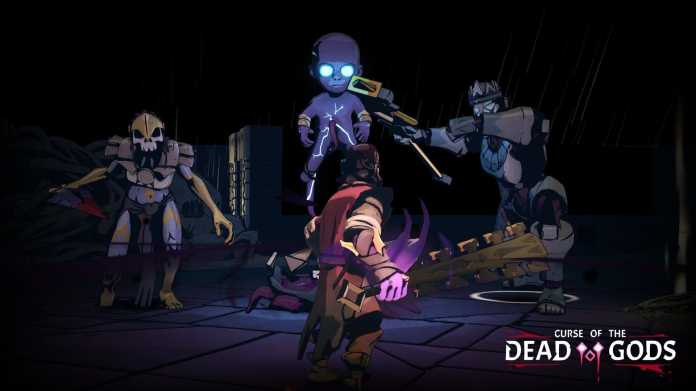
Isometric dungeon-crawling RPG games first came onto my radar when I played Diablo. The constant battling, hunting for treasure and dark, desolate worlds got under my skin. It was a joy to place my hero’s life at risk to get a bit more gold, or a slightly better weapon. I always get excited when a new game that is influenced by Diablo gameplay is unleashed onto the market. When I was offered Curse of the Dead Gods (CotDG), I couldn’t wait to get started.

Developed by Passtech Games and published by Focus Home Interactive, this ungodly dungeon-crawling rogue-like game is influenced by many genres, and is unnervingly addictive. It relies on a simple concept, search through a labyrinth of connected rooms to face a monstrous beast. Your path is random, and each attempt is different. Luck will either be with you, or against you, and the only thing you can trust is your own ability.

A simple concept with in-depth mechanics.

Don’t let the simplicity of the idea fool you. Complex mechanics weigh this title down. Curses, corruption, weapons, stats, collectables and more. Death is easy to come by in this tough, unforgiving world. With rogue-lite elements wiping your progress back to zero, you better “get good” or have the patience of a saint while playing.

The game gravitates around mankind’s greed, and its desire to give up everything for; power, treasure and eternal life. Blinded by this madness, you are led to the cursed temple. It offers untold riches and power beyond your wildest dreams, but at what cost? Traps, explosions, monsters and demonic curses await you!

Once you enter the temple, the only escape is death. A perpetual cycle of death and glory lies in front of you. This is your curse for life and there is no walking away from it.

Offer up blood or gold to the gods!

Light and Darkness.

The basic concept of light and darkness has never been so important! Moving away from the safety of the flame enhances the monster’s strengths. Traps are invisible, and the gameplay ramps up considerably. These minor adjustments are seen in nearly every element. Curses increase certain stats at the cost of others, and blessings increase your corruption levels, cursing you at the same time. Offering items to the gods costs you the object, but temporarily increases your stats. It’s a tactical nightmare, and a constant battle.

Yet, this complexity makes it tick. Choose which weapon suits the fight, juggle between; flame, poison and lightning. Acknowledge the rarity, level and ability of each tool, and consider your attributes; Constitution, Dexterity, or Perception. Attack or defend? Parry and maintain stamina, or hack ‘n slash your way to victory. It’s layer upon layer of minor considerations, but it adds up to make an intriguing and complex dungeon-crawler with many gameplay styles.

The path to victory is random and tough.

A procedurally generated maze of rooms is placed before you. You may only pick one at a time, and you must follow the flow of the arrows. Each area has a prize to be awarded; gold, healing, weapons, attributes and so on. You chose which best suits that adventure and hope the gamble pays off. As you pass through doors, your corruption levels increase. Upon hitting 100, you receive one curse. Five can be given per journey and the final one impacts your survival chances vastly. It is unavoidable and will affect how you attempt each run through.

Does anyone have a fire extinguisher?

You may think, “It’s light on RPG elements!” Upgradable statistics and weapons improvements are part and parcel of this game and are intertwined with the treasure you collect. Crystal skulls and Jade rings allow you to unlock blessing, improve stats, and allow for other improvements. This part is a slow and tough slog, and it takes an awful lot of skill and hard work to make any real progress.

Old-school look.

The table top isometric perspective screams Diablo. A wonderful nod to an amazing franchise, and a great choice that works perfectly. Well designed levels with hidden traps take you by surprise. Using dark and light tones creates a menacing atmosphere that’s both daunting and worrying. The demonic monsters you face will fill you with dread, and their detail models and movement animation is a joy to look at. Visually, this is both spectacular to watch and play.

Passtech Games have continued this brilliance with their use of audio. A “classic” medieval soundtrack plays out alongside the action. It has a familiar tone and beat to it, and it works well. It supports the visual package with definitive changes in pace and tone, emphasising the doomed atmosphere that your character faces.

So many demonic monsters!

In-depth and hard to get to grips with.

Because of the complexity of the many layers, it was understandable that it’s challenging to begin with. Weapon choice, timing, and the combination of blessings and curses impacts the gameplay. A very handy tutorial eases some hardship, but practise and patience are your greatest ally to overcome the early learning curve.

The words; rogue-like and dungeon-crawler are synonymous with replay value. So it’ll come as no surprise that CotDG oozes it. Hours and hours will be lost as you try, yet fail to work your way through each theme of the temple. Take into consideration the multitudes of game approaches, and the challenging achievement list, and you have a title that is amazing value for money.

Being cursed has never been so good.

The message that the downfall of mankind is its own greed wasn’t lost on me. However, I was so engrossed by the gameplay that I allowed this curse to infect me. It’s a glorious game that successfully blends a multitude of genres, and a game I strongly recommend. Buy your copy here, you won’t regret it! Choose your approach, select your weapons, and hope that the gods and luck are on your side.

Review: The King of Fighters 2002 Unlimited Match

The King of Fighters series has seen numerous entries over the years receiving an annual iteration from 1994 to 2010, but not all have been a smashing success – leading to only a single release since then. One that has stood the test of time is The King of Fighters 2002 Unlimited Match, which is back with a vengeance with an all-new online mode. A remake of The King of Fighters 2002, Unlimited Match was originally released on PS2 and X-box in 2009 and was then re-tuned and re-released by developer SNK in 2015 on Windows and then in 2021 on PS4. 

With the largest roster in the series, revised game balance and additional moves, there’s little more a newcomer could ask for here – but what about a KOF fan? Does this offer value or is it an attempt for the once-great franchise to regain relevance with an almost identical re-release?

Look at all those characters!

KOF’s strengths over the more popular 2d fighting series are obvious as soon as you put up your fists. A long list of attacks combined with hypnotically animated and detailed character sprites give each character personality, but the real joy of this title stems from mastering the game’s ‘Max Mode’ system which allows for the blending of combos into one long highly destructive move. With the already impressive list of moves available, this feature adds a depth and replay value that few fighting games can boast as there are so many different ways to use it. Pulling them off within the game’s strict input window represents another aspect KOF games are known for – their difficulty. It needs quite the dedication to become proficient, and although it’s not required to have fun with the title, it might seem unappealing to those accustomed to other more accessible fighters such as Super Smash Bros and Street Fighter.

I’m trying to lighten up, but I’m British and negativity is our thing….

While it’s hard to find any faults with the fighting system per se, one thing I did find disappointing with the visuals is a lack of frames present in the fighting animation, which contrasts greatly with the buttery smooth standing animation. It’s forced to cover too much movement frame to frame, making the fast action feel quite jerky, and leaving potential on the table right from the drop of the hat.   

Granted it was more of a throw, but did you get the reference?

All the standard modes return with 3-on-3 team play, which is a change from previous KOF iterations at release which had a ‘striker’ system similar to the aid characters in the Marvel vs Capcom games; single play, challenge mode, which acts as a tutorial; endless mode and a practice mode. You’re also able to adjust the graphics settings by adding or removing scanlines or making the character sprites smoother.

Aside from the main modes which are almost identical, there are actually fewer extra features compared to the PS2 version, with the gallery and Neogeo modes now missing. Why character profiles or some semblance of a story couldn’t have been added for newcomers is a bit puzzling, especially considering that SNK’s re-releases of KOF 98 and SNK’s Garou: Mark of the Wolves both included numerous additions, but what do I know? What does carry over, however, is the PS2 version’s lackluster overall presentation. Whether it’s the obnoxious main menu, the slightly blurred character selection and quote screens, the irritating narration, or the omission of any real guidance on how to use the Max Mode system correctly, there’s little added value outside of its battle system.  

Joe is one of the easiest characters to pick up with an epic combo linked to the L2 button.

The game’s real selling point though is its online functionality which lets you play opponents from around the world with rollback netcode, cutting edge technology that ensures a stable connection with your opponent regardless of their internet speed. It also has the ability to view replays of your last 10 online battles, which may or may not be something you’ll (*cough* I’ll) ever want to look at.

I wish you luck……

With its upgrades and online functionality, The King of Fighters 2002 Unlimited Match represents the best KOF has to offer on a 2D axis. While it must be said that there are more accomplished 2D fighters available, for those looking for deeper combat and a more involved experience there are few better alternatives.     

Review: Hero-U: Rogue To Redemption

Transolar Games brings back the once-forgotten genre that many gamers never explored. Drawing motifs from Harry Potter, King’s Quest, and Stardew Valley, this point-and-click adventure doesn’t simply knock on the door of relevance, but kicks it wide open. Enroll in Hero University and learn the rules and skills of a rogue, while uncovering secrets within the very walls of the campus. Dialogue choices and time management matter here, for you will be rewarded or penalized for your progress, or lack of. Hero-U is very intricate and engaging experience. Playing on console isn’t a terrible alternative to the PC intended release.

Back To School

Enter Shawn O’Connor. A city slicker who gets in with the wrong crowd with ambitions to rule the streets. After a break-in attempt, he is discovered by a mysterious man that brings him to Hero University, rather than turn him in. Without much of a choice, he obliges and becomes the new kid in class. Fitting in is hard for Shawn. Not only is he mocked for his lack of family accolades and reputation, he also has a lot of caching up to do, due to late enrollment. It’s time to make friends, or try to, and become a Hero! This takes you to the main gameplay of Hero-U.

The painted characters are gorgeous and expressive.

Build Your Routine

Each day begins with your daily class session. You will then have the remaining hours to hone your thievery skills, study theory, or work small jobs. Most things and people you interact with can result in a stat point increase or decrease. This gives the game a huge amount of variety within the day-to-day tasks that may feel monotonous to some. Do you want to become a jack of all trades, or find your niche and master it? As you begin to build a rhythm, some key events will introduce themselves to mix up your routine and advance the plot. The story progression is a little on the slow side, but nothing ever feels too dragged out. Hero-U is much like Stardew Valley in this regard, but smaller in scale and with faster time progression.

Use the cursor to move Shawn, and interact with objects and other people.

Combat

Hero-U’s combat introduces a turn-based function. It gives you time to plan your actions and doesn’t require you to change you playing tempo. This is a nice deviation from the main mechanics of the game. I found myself quite enjoying killing rats in the basement and and cashing them in. Maybe it was due to the fact that there was less “point-and-click” during battles. I will say that while playing the console port, I really felt the absence of the mouse and how it lends itself so well to this particular genre. The enemies can get tough so try not to wake up in the infirmary past your bedtime.

The combat is easy to understand and is a nice break from the text heavy day-to-day.

Dimly Lit Hallways and Witty Banter

Creeping around the dark corridors to the polyphonic tune of a music box really gave me Hogwarts vibes. The world felt pretty realized here, albeit lonely. The Rogue class you are a part of resides in the lower levels of the castle. Seeing students in other programs (Paladin, Wizard, etc.) doesn’t really happen. I understand that programming more characters means more interactive actions to attach, but couldn’t help but feel that the environment felt empty. The music does motivate you to be nosy and explore, though. Maybe more characters walking around would yield distractions. There is a lot for you to do already.

There are plenty of dialogue choices, so you can Shape Shawn to be just like you.

The painted characters that replace cinematics are so well-done. I’ll admit the expressions look awkward and a little silly at first, but I found that the intricate brushstrokes really gave Hero-U its own artistic timbre. The exaggerated faces really add value to the plethora of jokes, quips, and references this title has to offer. It’s easy to recognize the game’s inspiration from the sarcastic tone of the vintage King’s Quest series. The jokes may not always land as smoothly with Hero-U, but I appreciate the attempts along with the nostalgic reflections.

Bottom Line

Hero-U is hopefully the first installment of a new franchise, granted the developers can continue their amazing work. This is one of the better genre revivals within the past couple of years and is well-suited for anyone in search of a curious and witty endeavor. Try to play this point-and-click adventure on PC.

Review: Oddworld: Munch’s Oddysee

0

Abe is back in action, but this time he’s teaming up with Munch as they try and save his race from extinction!

Oddworld: Munch’s Oddysee was originally released for Xbox in 2001 but was recently ported in HD for Nintendo Switch on May 14th, 2020. In this 3D platformer, the odd duo set out on yet another silly adventure packed full of familiar friends, new enemies, and new challenges.

Gameplay:

This time the star of this game is Munch, a Gabbit who gets abducted by scientists who implant a strange device into his skull. On top of this, Munch finds out his entire race has nearly been hunted to extinction by the nasty Glukkons! Using his newly gained abilities, Munch breaks out of the lab, saves a few furry Fuzzles along the way, where he eventually rendezvous with our old pal Abe.

This is the third game in the Oddworld series, and unlike the other two games, Munch’s Oddysee takes a stab at the 3D platformer genre. Despite taking the plunge from 2D to 3D, Munch’s Oddysee feels flat and like a step back compared to the first game in the series, Oddworld: Abe’s Oddysee.

What makes Munch’s Oddysee unique is the player has to switch between Abe and Munch to traverse through their world and solve many puzzles. Munch’s Oddysee follows the same overall formula of the original game since your objective is to save the Mudokons and Fuzzles; depending on how well (or badly) you do will determine if you get a good or bad ending.

Abe has pretty much the same abilities such as possession, but to use this, among other powers, you must collect countless green globs called “spooce”. Another big difference with this game is Abe and his buddies can fight, and some Mudokons are even armed. Munch can zap enemies or he can command his Fuzzle friends to sic ‘em. There are also power-ups and new abilities unique to this game all conveniently placed for our friends. Even though it sounds like Munch’s Oddysee is packed full of action and adventure, I honestly found this game painfully boring and annoyingly tedious.

The controls are pretty awful. There are many commands mapped to the same button which leads to many frustrating mistakes. And then jumping becomes the bane of your existence, and the awkward camera is pretty annoying. While the voices are still charming – the sound effects are also horrible. I think Munch’s hopping sound haunted me in my dreams like poor old Mr. Krabs’ nightmare of the squeaky boots – too bad I can’t eat Munch to stop the squeaking headache that remained.

For every good thing I can say about this game, I have ten more bad things I can complain about. While the HD Switch version of the game runs smoothly and provides crisp graphics, the overall design of the game is severely lacking. The majority of the environments feel empty, the gameplay is repetitive, movements are clunky, and the combat system resembled something out of a bad RPG. Munch’s Oddysee felt nostalgic like most of those bad budget-cut 3D games we played when we were like five.

The first half of the game felt like the longest game tutorial ever; it was so boring I almost forgot video games were supposed to be fun! With that being said, the latter half is a lot better. I’d argue that the game would’ve been better if they took out the majority of the first half before speaking to the Raisin.

Pros:

  • The Quick-save option will forever be my best friend. This is a recurring feature I personally love about this series.
  • This game has a nice mix of the old mixed in with the new.
  • It’s not as dark as the original and feels more kid-friendly. (This may be a con for some.)

Cons:

  • There are no subtitles or captions. With their strange voices and occasional bad audio, I couldn’t fully capture everything they were saying. People who are hard of hearing will miss out on many important points, especially since the gurus guide you throughout the game.
  • I honestly hated the clunky controls; I wish the Switch version at least offered similar mapping to the Oddworld: New ‘n’ Tasty game.
  • It was boring and mundane. In my opinion, watching a clock is more fun than this game.
  • The walking animation sounds were cute for the first few seconds – then it just got annoying.

Conclusion:

I really really wanted to like this game, especially since I really enjoyed Oddworld: New ‘n’ Tasty, which is why I played it to the end. Honestly, I just think this game didn’t age well; I can totally see why old fans like this game as it has a nostalgic flavor, but it may not be as exciting for newer fans of the series. If you do plan to pick it up – grab it while it’s on sale. It is $9.99 in the Nintendo shop until February 25th, 2021.
I wouldn’t say Munch’s Oddysee is completely terrible or the worst game ever as there were a few moments worth playing…But would I recommend it? Probably not.

Entertainment: 3/10

Replay value: 2/10

Graphics: 5/10

Sound: 3/10

Kid Friendly: Yes (Teen rating)

Platform:Nintendo Switch
Developer:Oddworld Inhabitants
Publisher:Oddworld Inhabitants
Released:October 27, 2020 (Nintendo Switch)
MSRP:$29.99
ESRB:Teen

Review: BloodRoots

BloodRoots is an excellent game. The game from developers Paper Cult is a fun and strategic top-down action slasher game that stands out as one of the very best in its genre.

Visibly Stunning

The first thing you will notice when starting BloodRoots is its beautiful art style. The game has a cartoon-like art style taking inspiration from hit titles such as Guacamelee, matching vibrant colours with a sharp cartoon art style to create a visibly stunning game. The games art style varies between missions, offering various backdrops to BloodRoots variety of levels. The combination of levels present in the game is also a standout, although each level is the same old defeat all the enemies to get to the next checkpoint. The level design varies between tasks, offering different camera perspectives and gameplay mechanics. The gameplay mechanics make this game shine.

Fun and Addictive Gameplay

BloodRoots gameplay involves fast-paced top-down slasher gameplay, which is incredibly fun and addictive. The gameplay also involves a one-hit kill mechanic. Meaning it takes one hit to kill the enemy and one hit to kill you. Thus, the gameplay offers a degree of challenge and strategy. I found myself strategically making decisions about to take down a specific enemy with the range of weapons and items I had around me.

In this regard, the variety of weapons available are outstanding. You can pretty much pick up anything and use it as a weapon. I used a roast Chicken to blindside an enemy and a ladder to take out many enemies in one scenario. Finally, alongside Bloodroots brilliant gameplay is its cutscenes which are exceptional, taking that vibrant cartoon-style art style and gameplay to create humorous scenes within the game’s story and cut scenes dedicated to showing off the characters various finisher moves on enemies. BloodRoots also has a great soundtrack mixing wild west vibes with rhythmic beats on top of all of this.

One of the games many levels

Unfortunate Technical Issues

On the flip side, although BloodRoots is excellent, I did have issues with framerate drops and glitches. Entering areas with many enemies saw a significant decline in frame rate. I played BloodRoots on PS4. Although harnessing previous generation tech, the game should not have had such drops in framerate. I did not get the chance to play BloodRoots on Nintendo Switch, but I can imagine the framerate issues would be a problem or even worse on the handheld device. Likewise, I encountered glitches when playing through the game, such as gettings stuck behind various in-game objects and obstacles. Although this was relatively infrequent, the game has technical issues.

Verdict

Overall, BloodRoots is an outstanding game. It combines fun and fast-paced strategic action with a stellar soundtrack, appealing art style and weapon variation that makes this game stand out within its genre. Despite some technical issues, Bloodroots is an excellent top-down action game, one of the very best.

Review: Kinetic Edge

Kinetic Edge is the type of game where what you see is what you get. You will know within the first 30 seconds of playing whether you like it or not. At its core, it’s an enjoyably difficult platformer decked out in a harsh neon glow. It’s simultaneously relaxing and engaging. Kinetic Edge is a perfect sort of game to chill out to, but you’ll need to remain focused at all times to succeed.

The enjoyment in Kinetic Edge revolves closely around the mechanics. Luckily, the controls are intuitive, and by extension, the platforming come across as well-oiled and tightly designed. Some of the levels are absurdly tricky, but it always feels fair. I never got stuck in one spot for too long, and the solution was always more or less obvious. That’s because Kinetic Edge is not so much a puzzle game as a skill-based platformer. You need to be pixel perfect at moments. For me, that was the pleasure of the entire experience. The difficulty was addicting.

Speaking in specifics, you have a few tools at your disposal as you navigate the levels. You can dash, jump, and send a blast out to knock other players off track. Unfortunately, I was never able to find a multiplayer game, so the latter power went unused. There are also a number of game types to try from straightforward racing to golfing to even maneuvering around a maze. As expected, they’re all smoothly done but none of them are particularly enticing alternatives.

We need to talk about the aesthetic. Even if you’re a fan of the futuristic, neon, Tron-inspired look, it gets hard to look at during quick platforming. By about an hour or two, my eyes are on fire. The incessant glow is just too harsh.

There’s an awkward clash at the heart of Kinetic Edge. As I said, it’s both perfectly relaxing but also discordantly aggressive. It would be a nice game to sit back and play for hours, but you’d need corneas of steel to do so. The repetitive but enjoyable nature of the game can lull you into a trance, but you’ll never really get comfortable. SCT needs to decide what they’re going for here. Is this a hardcore race-to-the-finish type game? Or is it a hypnotic time waster? As it stands, it sits in an odd in-between that will fail to satisfy most types of players.

Kinetic Edge is a stripped-down platformer with a nicely balanced difficulty. Sure, the game is an effortless experience, but it’s unclear what atmosphere SCT was trying to achieve. To make matters worse, when the fundamentals are so simplistic, any missteps are hard to ignore. The mechanics are near perfect to what SCT was trying to achieve, but it feels like the bare minimum. It needs a stylistic overhaul to match. I’m not inherently against the cyberpunk approach, but it’s over the top. Without any change, Kinetic Edge will please only a handful of dedicated platformer players but will deter casual fans with its intense look.

Review: Disjunction

Disjunction is a stealth-action game that takes place in a dystopian New York City in the year 2048. The game tells a story about three strangers that find themselves involved in a massive conspiracy right at the centre of New York City. Although it’s not directly touched upon, the whole narrative revolves around the societal struggles of the world after the biggest economic crisis since The Great Depression. It lightly touches on subjects such as transhumanism and the rapid evolution of technology, which leads to mass unemployment with the rise of automation and so on.  Still, I found the actual story within this world to be quite predictable, with no interesting twists or surprises. Luckily, Disjunction’s gameplay does have some redeeming qualities that might make it worth checking out.

At its core, Disjunction is a stealth-action game, but sometimes it does feel like it tries to delve into something that’s a little more focused on the narrative. However, the game doesn’t push that deep in that realm. Despite featuring an interesting backdrop, I felt that the actual main story pales in comparison. All dialogue is text-based, and the game does provide some dialogue choices for players to choose from. Unfortunately, the game isn’t really clear if most of them have any impact on how the story unfolds. 

Disjunction’s playable characters come from different backgrounds, but they share something in common, they’ve all lost something or someone. You’ll get to play as a private investigator, as an ex-military, and as an underground hacker. Each character has their own set of abilities that they can employ to aid them during missions. These abilities range from stun and smoke grenades, a taser, holoprojections to distract enemies, invisibility, amongst a couple of others. With that said, you can’t really choose which character you want to take with you on the next mission, as each character plays out their own story arc independently.

Surprisingly, these character abilities can be used both if you’re playing stealthily or if you’re someone who’s more action-oriented. In spite of that, I feel that the fact that abilities require energy points to be used to be detrimental. The fact that you have a limited energy pool that doesn’t automatically regenerate, just means that you’ll do your best to avoid using any abilities. As a consequence of that, I didn’t really use abilities that much, because I’d always do my best to save them in case I’d find myself in a tough spot. With that said, I do feel like Disjunction stealth is much more robust than its action, particularly because you can hide in the shadows and drag bodies. Also, by sneaking around, you not only move around silently, but you’re also able to visualize your enemy’s vision cone. This works really well with the game’s perspective, as it gives it a more tactical feeling. From my experience, if you just go in guns blazing, you’ll have a lot of trouble staying alive for long. 

Nonetheless, it’s worth pointing out that, currently, there is no way to adjust the difficulty of the game. Given the fact that you can opt for a stealth approach pretty much throughout the entire game, or at least some way to avoid direct confrontation, I wouldn’t really say that this is a difficult game though. If you take it slowly and don’t rush it, if you sneak around and plan how you’ll engage or evade each enemy, the game is pretty accessible, especially since you can easily stun lock enemies by repeatedly hitting them with your melee attack. On the other hand, if you’re the sort of person that prefers to go in guns blazing and dropping bodies left and right, then the game unquestionably is much more challenging.

Now, one of the problems that I have with Disjunction is how it handles saves. There’s only 1 spot in each level where you can save, and they can only be used once. To be honest, I don’t quite understand why this works the way it does, because if it’s to be challenging, then it just feels like an artificial way to make the game more difficult. If anything, it’s just annoying. Ideally, anyone should be able to save any game whenever and wherever they wanted to, without having to be constrained by such game design choices. In any case, for me, this wasn’t that really of an issue apart from the final level, where it actually is quite frustrating since the level is quite big and heavily guarded. However, I can’t shake the feeling that some people might dislike the way the save system works, especially since they’re scarce.

Other than that, one of the weakest points of Disjunction is definitely the lack of mission variety. Every single mission can be boiled down to a single simple loop: go in, gest past enemy patrols, acquire keycards to open doors, get to the objective, and then the mission automatically ends. Furthermore, while each level does tend to look visually different from each other, they still feel and play out exactly the same. All the missions take place in enclosed buildings, and despite the visual differences that I’ve mentioned above, the game could very well take place in a single sky-scrapper for all I know, since you can’t see anything else around you. 

Be that as it may, there are actually upgrade kits in each level, in the form of side-objectives. These can then be used to unlock ability-specific upgrades before each mission. Still, these upgrades aren’t permanent, meaning that you can alternate between them as you see fit without fear of committing to a specific playstyle. Likewise, there are also non-permanent talents that you can purchase with experience points, which you naturally acquire by completing missions, However, unlike upgrades, these are more specific to your character and not their abilities. They include things such as increased attack speed and increased movement speed while sneaking. 

Finally, I’d also like to point out that there also isn’t that much to Disjunction in terms of enemy variety. There are a few enemies that have melee weapons, while others have firearms, but there are also turrets and cameras, as well as 4 different types of robots that populate the levels. There might not be that many of them, but I have to say that they fit the layouts of the levels and the pacing of the game quite well. Therefore, I didn’t find the number of enemy types to be detrimental to the whole experience.

Now, for some reason, the game runs pretty bad if you happen to have a high refresh rate monitor, no matter what hardware you have. Unfortunately for me, even after lowering my refresh rate from 144Hz to 60Hz (which seems to be the only fix for people with these issues), I wasn’t always able to fix this problem and my game still stuttered pretty badly. The frame rate would fluctuate from 40 to 60, which made the camera movement extremely choppy. 

At the end of the day, there really isn’t much that Disjunction does that well, but it also isn’t terrible in any field by any stretch of the imagination. In other words, I can’t necessarily say that I thoroughly enjoyed it, but I also didn’t dislike it. This is one of those polarizing games from what I’ve seen, where some people seem to thoroughly enjoy it, while others, like myself, are indifferent to it. Don’t get me wrong, Disjunction is a decent enough game for what it is, but it doesn’t break any new ground nor does anything exciting or riveting. After the 9 hours that it took me to beat the game, I can safely say that it felt like the game outstayed its welcome. Unless you’re a hardcore fan of stealth games who wants to play every single game out there, you’re probably better off waiting for a sale if you happen to have any interest in it.

Review: The Raven Remastered

Who Done It murders are usually reserved for books, but it’s one of those rare genres that lends itself to whatever platform it appears on. No matter the form it takes, I’m always keen to lose myself in its constant twists and turns, and I love to play the part of the famous detective. The original was released in 2013, and was well received. In 2018 the remastered version The Raven: Remastered swooped in allowing gamers to enjoy a polished version of its gameplay.

Developed by King Art Games and published by THQ Nordic, this point and click, detective game will have you solving the many mysteries that unfold on your journey around the world. I’m going to be very careful as I do not wish to spoil the surprises and twists that you will experience while playing this wonderful Agatha Christie style murder mystery.

A tale well told.

A Who Done It mystery is only as good as its plot, and the characters that it revolves around. Luckily, this one ticks both boxes. A glorious story follows; a legendary detective, a Swiss constable, and a world famous villain. The tale takes twists and turns throughout, allowing you to see the different elements from several viewpoints. This was a fantastic concept as it gave you a fuller picture, and a better understanding of each of the characters’ backgrounds. 

The main protagonist, Swiss officer Zellner, is an avid fan of crime drama, and jumps at the chance to be the lead officer when one unfolds right before his eyes. Detective Legrand thwarts his attempts. He wishes for little to no help and believes he alone can solve the mystery and find the perpetrator. The villain known as the “Raven-heir” is always one step ahead. He mocks the authorities, knowing he won’t be caught.

Zellner loves the life of a detective!

5 years have passed since Legrand shot the “Raven”. The world thought that would be the end of his reign of tyranny. A brutal burglary occurs at the London museum in 1964. A priceless ruby is stolen and a single raven’s feather is left at the scene. Is it someone following in his footsteps, or could he still be alive? Only Zellner and Legrand have the skills to uncover this mystery.

Beautiful landscapes and traditional concepts.

The game flows from place to place with ease; a train (aptly named the Orient Express), a cruise ship, Cairo and an Egyptian museum all await. The detail orientated Zellner must piece together the clues as Legrand focuses on the bigger picture. He sees the smaller issues as futile and cannot see how the dots connect to lead them to their crook. You will talk to the many colourful characters that make up the pieces of this jigsaw puzzle. The conversations are sometimes tedious, long, and feel unnecessary, but they always provide you with information and clues to help you progress.

Talking isn’t the only way to move forward. A point and click detective game is also about inspecting the surrounding area, and utilising the objects you find. This mechanic is used to its fullest as you will experiment with different objects attempting to unlock doors, tricking the characters, and solving problems. This portion of the game is not unlike many others in the genre, and neither stood out, nor disappointed me. The champion element has to be the aforementioned character interactions.

The nervous professor was always on my radar.

Superb delivery, and a delight to look at.

Everything about this game screams classic murder mystery. Zellner with his cliched apparel, and love of drama and murder mystery. The dated and romantic settings for each scene. The brilliant blend of classic characters that combine to create a humorous, touching, and exciting story. You have; an annoying child, a solitary doctor, a nervous and suspicious professor, the handsome and troubled musician, the stubborn famous writer and the member of royalty. Each adds layer upon layer of uncertainty and doubt, and all must be considered a suspect until proven otherwise.

The grainy imagery and dated clothing represent the 60s perfectly. The Raven does a spectacular job of transporting you to this era with its well versed script and accurate scenery. It’s as if King Art Games brought Christie back from the dead and utilised her wonderful vision of the world for us all to explore in this game. 

It’s rare that the voice-over work is delivered to such a high standard. The quality of the acting blew me away. I’d happily sit for hours listening to the well delivered lines from a team of talented performers. If I closed my eyes, I could have been fooled into believing that I was watching a TV series or film. The music is just as good, with the pace and tone changing to represent the emotion of each moment.

Ah, the glory of the steam railway.

He may be chunky, but why must he be so cumbersome.

With such a resounding success from the presentation, there has to be one downside, and that’s the controls. Zellner waddles around like a fat duck next to a lake. His ambling ways were a constant annoyance! You’d crash into furniture, walking around items, and look like you soiled yourself. These were but a few of my highlights. The clunky controls and lethargic UI shows it is best suited to PC. It didn’t break the game, and it was playable. It was simply frustrating.

Solving the mystery is the backbone of this game. But, side stories will distract you. This additional content allows for a considerable amount of replay value. If you want to unveil the cloud of mystery that sounds most of the lesser problems, then you are going to have to be observant, or play it many times.

A remaster that’s worth a revisit.

Remastered titles are big business at the moment, yet they aren’t all worth the effort. The Raven: Remastered is different. A nicely updated look, and quicker loading times make this more accessible than the original. With a fantastic story, excellent acting, great audio, and in keeping imagery, this is a game worth losing yourself in. I recommend you give this a go, and a copy can be purchased here! Can Zellner and Legrand work together to solve the mystery? Buy a copy and become a famous detective.

Review: Lonely Mountains: Downhill

Speedy thing goes in, speedy thing goes splat.

I can’t ride a bike. I never learned and, at this stage of my life, learning to ride one wouldn’t add much to my life experience. This has become a point of great contention among my friend group, one of whom felt strongly enough that their father offered to sponsor me to learn. But now, a few hours into Lonely Mountains: Downhill, I feel a sense of vindication for that disinterest in learning to ride one, because I am now more convinced than ever that bikes are terrifying death machines with only one goal, to take the blood that’s inside your body and transition it to the outside with great ferocity and speed.

Lonely Mountains: Downhill is a mountain biking game where your objective is to take a mad man with a bike and a death wish from the top of a mountain to the bottom, without fulfilling that wish for the sweet release of oblivion. There are four mountains and four trails on each mountain, each adding more rocks, steep slopes and jumps to make that job progressively harder as you progress through the game. The controls are beautifully simplistic, giving you only steering, acceleration, brakes and sprint, which tips the scale on the game to being incredibly skill-based and satisfying to play. When you get the exact sequence of controls right to navigate a tricky bit of a trail, it almost feels like solving a puzzle and weirdly reminds me of the feeling of completing a test chamber in Portal, only without a psychotic AI telling you that you “fly through the air like an eagle…piloting a blimp”, one of my favourite lines in gaming.

That satisfying gameplay is also due to the feeling of the movement in the game. The acceleration as you go down a hill or use the sprint button and you start to lose control feels real. The resistivity of the longer grass holding you back when you stray from the path feels real. The twitchy feeling of braking at great speed and suppressing or leaning into a skid feels real. So much attention to detail has been put into how the game feels and it really shows. The developers nailed a lot of the components of Lonely Mountains: Downhill, but the feeling of motion is the headline that I’d use to recommend the game.

You’re given each trail that you tackle in the game in a free roam format to start with, where you have no time limit or challenges to meet, like the first year at university. You’ll die a lot during this first run because mountain biking is dangerous and mountain bikers are lunatics. But that’s the point of being given a free roam version of the map to start with, so you can familiarise yourself with its intricacies and death traps. There are 5-10 checkpoints per trail so you’ll just pop back to that point every time you die so you can attempt the tricky bit again.

Once you’ve familiarised yourself with the trail it’s time to do it for real. You’re given a selection of challenges such as completing it in a certain time or with fewer than so many crashes. Each of those challenges unlocks something, such as new bikes or skins (insert joke about the cyclist needing new skin because the crashes made all of his come off) or, most importantly, new trails and mountains, meaning you’ll need to complete at least one challenge to progress through the game. These challenges are pretty perfect and balance being difficult without being impossible.

I really like two things the game does to make the challenges a little more forgiving. Firstly, you don’t need to complete all of them in a single run, so you can go for a slow, cautious run to complete the few crashes challenge and then go for a fast, caution-to-the-wind run to beat the trail within the time limit. Secondly, the checkpoint system is tied to the timing when you’re doing a timed run, so if (when) you crash, the time taken between the last checkpoint and that crash is taken from your total, i.e. it only includes the time you took to get between one checkpoint and the next without crashing. This makes the challenges feel doable and means you’re not kept from playing the latter half of the game when the new mountains and trails are locked behind completing them.

Lonely Mountains: Downhill also manages to pack this satisfying gameplay and compelling challenge system into a nicely presented art style. The vibrant colours and polygonal models fit the game perfectly and, despite that style being characteristic of older PS1 and Xbox games, it actually makes the game look fresh and distinct, as well as quite beautiful, with the lovingly rendered gushing streams and autumnal leaves. The word ‘oversaturation’ clearly wasn’t in the vocabulary of whoever chose the colour pallet, leading to the gorgeous presentation of the game we ended up with.

In my mind, Lonely Mountains: Downhill is the perfect Switch game and, a pretty great game regardless of platform. It feels amazing, looks fantastic and is exactly the right level of challenging. The way that you can pick it up for five minutes, have a run through a trail and have a fun time makes it ideally suited to what I think the switch does best, that pick-up-and-play genre of games you can play on a train or while waiting for a bus. Even then, you can sit down with it for a few hours to make some progress through a mountain, tackle a difficult challenge or destroy your high score. Whatever type of gamer you are, Lonely Mountains: Downhill has something for you to sink your teeth into and it’s a strong recommendation from me.