Review: Under the Jolly Roger

Humanity has its own set of rules and ideas of what is right and wrong. Theft, murder, and deceit are frowned upon, yet the romanticism that surrounds piracy still burns strong. People are obsessed with this “free” way of life; sailing the seven seas, plundering, pillaging, and murdering whoever stands in their way. Several games and films have fed off this obsession, and some of the best-loved franchises have blossomed in this dark criminal world. Pirates of the Caribbean, Port Royale, Sid Meier’s Pirates, and Patrician are to name but a few.

I for one sit in the love/obsessed camp with pirate-themed entertainment. I happily admit that I own, and have played all the major games that have been released on both PC and console. When I saw that Under the Jolly Roger was coming to Xbox One, I jumped at the chance to review it and was lucky enough to receive a code. Developed by Lion’s Shade and published by HeroCraft, it is an open-world pirate RPG that is accessible to gamers of all ages and skill sets.

It follows a classic approach.

Like many of the great pirate based games of the past, this one is set in a Caribbean style landscape. You are the Captain of a small vessel, you offer no allegiances, and the only way to guarantee favour is to pay for it with gold. The world is your oyster, and you are free to explore it however you wish. You can live your life in peace, sailing from each port trading with the many merchants or you can become interesting and; fight, plunder, and destroy everything you see.

The deadly life of a pirate.

There is a basic storyline that you may follow if you so wish, but the beauty of this title is the freedom to do whatever your heart desires. Many towns are available that allow you to; purchase goods, sell stolen ships, and undertake missions. Each of these habitats has an affinity to a country, and each time you complete a task for them, the trust builds, and dealing with them then becomes easier. If you do something wrong, your reputation will be harmed, and you will be hunted across the vast oceans. So, think before you act as actions have consequences, and you don’t wish to ruin the small bond of trust that you’ve built up.

The open-world is fantastic.

Unlike its peers, that weigh you down with a constant resource management idealism. Under the Jolly Roger focuses heavily on the action rather than the minor details. Gamers who are used to a complex trading, battle and political system, may find the simplicity a little underwhelming, but for me, I enjoyed the ease at which I could learn the fundamentals. Don’t confuse this straightforward approach with a lower difficulty, because you will be massively underestimating the learning curve you have ahead of you. It’s deceptively easy to pick up, but you will make mistake after mistake, and you will have to restart several times before you can truly progress.

Yet, once you understand the core concepts, you allow yourself to feel free in this gigantic world. You can explore as far as you wish, and many missions will require you to move from your local area to further afield. It gives the impression of going on a journey, and you plan your approach as if that is the case. You ensure that you have the most talented crew members possible, the biggest ship, and the best arsenal. However, this usually isn’t enough. You must balance the morale of the crew with constant repairs, ammunition refills, and keeping your people healthy. It’s like trying to spin 10 plates at once.

The monster from the depth started you on this journey.

Life as a pirate is a balancing game.

This continual juggling act will challenge new players. To take out the big ships, you must improve your vessel’s equipment. Upgrades are expensive and difficult to find, so the early game feels a little unbalanced. Yet, this challenge will inspire you to keep playing. The early stage grind isn’t as bad as you’d think, and the starter quests help to even up the score. You will slowly move from a green horn to a legend of the Sea quicker than you think.

Every element that you think of can be improved from its base standard. Ships can get stronger, faster, and more accurate. Spy glasses assist you with identifying the details of your opponents, and crew members can be levelled up for a massive stat boost. But the most important thing is crew management. A badly placed and unhappy crew will turn the tide of a battle in seconds.

Place your team on any of the decks for a boost in performance. Where you enhance one area, you weaken another, and it’s a challenge to get right. You must also know your crew’s morale, as unhappy sailors perform badly. Your powerhouse ship can quickly become as weak as a kitten when your team is depressed. Sailors will leave their posts and mutiny will occur, so keep battling as this makes a pirate giddy with delight. These multilayered elements ensure you must consider your approach before taking on many of the sea battles that are presented.

A game of three perspectives.

The gameplay is broken down into three distinct concepts; the World map, the open ocean, and third-person exploration and fights. Each has a unique look, and they are mostly successful with their ideas and delivery, but sadly one holds the other two back.

Time to relax and take in your beautiful surroundings.

The World map.

A 2D classic presentation of a sea chart. It starts with the unexplored areas covered by an opaque fog, as you venture into the unknown, cities and forts appear from the gloom. It’s a basic, but well-detailed navigation tool that allows you to complete your tasks with ease. The simple UI is clean and doesn’t complicate the issues. From this screen, you’ll see random fights that you can take part in. Pirate battles, wars, trade routes, fort attacks and more are available.

Sea fights.

An open-world where 3D models of your ships and the opposition appear on screen. You must select which ammo you wish to use and either blow your enemy out of the water or destroy their sails and decimate their crew. You must observe the wind direction, reloading times, your ship’s stats and more to be victorious. If you decide to take the ship for yourself, you will be thrown into a third-person fight upon both vessels.

Crew fights.

Grab your cutlass and pistol, as you will go face to face with another crew. The victor takes all the spoils, and the loser leaves with nothing. In theory, this should be the most enthralling part of the game, yet sadly it’s a dated and clunky experience that is just serviceable. The character models are well designed, the ships look great, but it’s full of glitches and bugs. The animations are slow and cumbersome and you will ghost through solid objects with ease.

Though this area wasn’t as good as it should have been, it shouldn’t detract from what is otherwise a fantastic game. You’ll still have fun competing with enemy crews and exploring different tropical islands. It was just a shame that it wasn’t as polished as the other elements.

Fire and wooden ships never mix.

Sea shanties and booming sound effects.

The audio is as piratey as it comes. Plenty of “Yar me hearties” and drunken roars await you. Jolly sea shanties accompany you across the great oceans. The constant crash of waves on your hull emphasises the pirate theme. The roaring of cannons being fired and the cracking of timber as it exploded on impact were glorious. Lion’s Shade has done a spectacular job with the sound, and it instantly transports you to this dangerous tropical paradise.

Lots to consider, but easy to play.

With so many aspects to consider, you may worry that it’ll be difficult to handle. I was pleasantly surprised at the ease at which I picked this up. A well-designed tutorial guides you through every aspect of the game, yet you’ll still make mistakes. You will have to restart it repeatedly, but once you iron out the errors, you’ll control this like a pro.

I liked the lack of a linear approach. The game allows you the choice of how you wish to progress, who you side with, and what style of gameplay you want to adopt. This design choice increases the desire to return. Alongside its challenging achievement list, and many battles, you’ll find it is brimming with replay value.

It’s not without its faults, but the open water will get under your skin.

This rather thorough review has given you all the ins and outs of a great pirate game. It contains many layers that add up to create a thoroughly rewarding gaming experience. Choose how you wish to spend your time, become renowned on the ocean, and command the most powerful vessel in this tropical world. It compares well against its peers, and I recommend you play it, so buy a copy here! Grab your ship, maintain your crew, and destroy anything in sight. You deserve to become a renowned pirate, and the free world must fear your name!

Review: Atelia Ryza 2

Atelia Ryza 2 is a classic Japanese RPG taking everything you expect from a Japanese RPG and mixing it with superb graphics, music and gameplay. The game doesn’t reinvent the genre but offers enjoyable gameplay and story experience—all with outstanding graphical and musical quality.

Breathtaking Graphics 

When you start Atelia Ryza 2, you will immediately notice how beautiful this game is. The game mixes a 3D world with a fresh colour pallet and graphical fidelity that makes the game stunning. I found myself continually running about the game’s lush environments and in its big cities, astonished by how pretty the 3D models and surrounding area looked. From a graphical standpoint, Atelia Ryza 2 is a masterpiece. The graphics in Atelia Ryza 2 are in a league of their own.

Games such as Legend of Zelda: Breath of the Wild, although they look gorgeous. Pale in comparison to Atelia Ryza 2’s graphics. Although a shame games such as Breath of The Wild have inferior graphics. This game shows the future graphical potential of Japanese RPG’s. I reviewed Atelia Ryza 2 on Playstation 4, and it was still stunning. The eventual new Nintendo console and the current next-gen hardware can push games in the genre to a new level.

Battle Gameplay

The recent announcement of Pokemon Legends and the already announced Breath of the Wild 2 can hopefully offer the same high-quality graphics Atelia Ryza 2 offers. Although Atelia Ryza 2 offers stunning graphics, it is worth noting that it is not an open world. The games separated into areas allowing the game to push its graphical potential. Nevertheless, the game is stunning.

Lengthy and Frustrating Cutscenes 

Aside from Atelia Ryza 2’s great graphics, the game has stellar Japanese voice-over work but lacks an English voice-over. The cutscenes are also painfully long. I found myself watching more of the cutscenes than playing the game. Thus, shorter cutscenes would have improved the game’s pacing, which is relatively slow from the onset of the game.

A Cutscene

Nevertheless, the story is excellent, with a fantastic musical backdrop/soundtrack. The soundtrack is a standout, drawing on classic adventure vibes that make you feel like you are embarking on a life-changing adventure. In this adventure, you will encounter many monsters and enemies along your journey. Battling them is fun but relatively simple. The game takes inspiration from the classic RPG turn-based gameplay mechanics of its predecessors in the genre. Although Atelia Ryza 2 does not reinvent the wheel in terms of battle mechanics, they are fun and enjoyable. Atelia Ryza 2, in this regard, doesn’t try to fix what’s not broken, providing a great gameplay experience.   

Verdict

Overall, Atelia Ryza 2 is an excellent Japanese RPG that doesn’t reinvent the genre but provides an enjoyable story and gameplay experience wrapped up in outstanding graphics and musical score. As a result, Atelia Ryza 2 should be picked up by any Japanese RPG fan. It was an absolute pleasure to play.

Review: For The King: Lost Civilization Adventure Pack

After almost 3 years worth of numerous free content updates, the tabletop-inspired RPG For The King finally receives its first paid DLC, the Lost Civilization Adventure Pack. This expansion not only brings an entirely new campaign, but it also adds two new playable characters (the Gladiator and the Astronomer), as well as gladiator arenas, dual-wielding weapons, and over 90 items and 50 new enemies. The new campaign, Lost Civilization,  will take you to foreign lands to a jungle realm, where you get to unravel the mysteries behind an ancient civilization. Also, it’s worth noting that, if you plan on playing the new adventure online with other people, only one person actually needs to own DLC, which is quite awesome.

First of all, I should clarify that I’m by no means a For The King veteran. I’ve dabbled into the game in the past, but my knowledge about the game isn’t that deep. For The King is the sort of game that I like to play just for the sake of enjoyment, and not to challenge myself and become the best I can possibly be by developing tactics and min-maxing. With that said, as someone who hasn’t revisited the game in a while and hasn’t experienced every single update that it has received, for free, ever since its release in early 2018, I can definitely say that it’s good to be back. The main menu theme still gives me chills, even after all this time.

Jungle Falls

Now, although I have never had any particular issue with the game itself, Lost Civilization is the first time where For The King actually leaves me scratching my head. It’s hard to argue if this Adventure Pack is worth getting or not, not only because it’s really cheap, but also because it seems to be very divisive. This is mostly because the new enemies also get added to the other adventures present in the base game, which honestly can make some of the other campaigns feel quite unbalanced. In case you were wondering, yes, you can actually disable the DLC so that you can play previous campaigns as you’re used to, but doing so also disables all the new items and the Gladiator and the Astronomer. 

To be honest, my only complaint about this DLC is how it can make things quite difficult for less experienced players. I love everything else about it. A new campaign is always welcome, as it brings forth a new story for everyone to enjoy. Likewise, having even more weapons and items is always great, as are new characters. The Gladiator is obviously more geared to physical damage, and it makes use of high initiative to strike first at your enemies. Meanwhile, the Astronomer is an extremely powerful mage that can be a life-saver in certain situations, thanks to their Black Hole ability, which you can probably guess what is used for. With that said, before you can use both characters, you must first unlock them in the Lore Store. 

Despite everything, I wouldn’t say that Lost Civilization is a must-buy, at least not right now. At the moment, the difficulty feels way off when compared to the rest of the game, and adding the DLC also messes up the balancing of the original game thanks to the new enemies. If you happen to still be exploring the game itself and feel like you still have a lot to learn, then you might want to wait a while before checking out this DLC. Now, having said that, if you are among the few that already dominate the base game and just want more For The King, then this might just be what you’re looking for. Lost Civilization might not break new ground, but it’s still a worthwhile addition.

IronOak Games have done a tremendously good job over the last couple of years by continuously supporting and updating their game, and that gives me hope for the future. Still, and I can’t stress this enough, if you just love For The King, and you don’t mind difficult games nor constantly finding yourself in the midst of a challenge, then the Lost Civilization Adventure Pack might just be what you want. Simply put, it’s just more For The King, so if you don’t take issue with the game’s randomness messing you up, even though I’ve felt that some of the new enemies can absolutely make you feel like the game is out to get you, then you probably won’t regret buying this pack. This is one of those cases where it feels like this DLC is more tailored to hardcore fans of the base game, and not to those who just want to experience a casual adventure. There’s nothing wrong with that, just make sure you know what you’re getting into before you decide to pull the trigger. 

Review: Moving Out DLC – Movers in Paradise

I have recently told you all about my love of Moving Out by developers, DEVM Games and SMG Studio, and publisher Team17 Digital LTD. This crazy solo and couch co-op title has you working together as a team of house movers. You must lift boxes and items of all shapes and sizes, aiming to get them to the removal van quickly and safely. Sadly, not everything goes to plan, and you must work around many obstacles to succeed and gain each gold medal.

I will not go into anymore detail about the base game, but if you want to know more, then read my review here! What I’m looking at today is the latest DLC released to enhance this wonderful title. Moving Out – Movers in Paradise was brought to the market by exactly the same team as the original, so it’s fair to assume that this will match up to the high standards already set.

Even tropical islands need a removal crew.

We’ve moved all the furniture from one house to another, spending all our time in a town setting, so what happens now? Work hard, play hard, so it’s time for our well worked team to take a break on a tropical island. Well, not entirely correct, it’s time for them to have a rest after they have moved all the furniture in this beautiful archipelago. New setting, new mechanics, but same glorious gameplay! 

This DLC adds another layer of quality gaming to the brilliantly laid foundations. So what do you get for your money? 23 new levels, 4 new movers to use, and 1 buried treasure to unearth. After all, it wouldn’t be a desert island without any treasure to unearth. Packmore Island is a great backdrop for the madness that ensues, you are guaranteed to; laugh, cry, and scream at loved ones as you desperately try to move suitcases, trunks of gold and more. 

A beautiful place to holiday!

This family friendly game is great to play with gamers of all ages, but be prepared to lose your cool as your well made plans get ruined by the kids’ inability to follow orders. If you then consider the new mechanics; moving platforms, ladders that create new paths and the crabs. This new addition is more challenging than the base game. 

New mechanics will make you cry!

The moving platforms are easy to navigate in theory, but when you have many people trying to jump them while holding furniture, it takes plenty of agility and dexterity. You’ll need patience, great communication skills, and plenty of luck on your side.

The ladders like the moving platforms should be easy to use, but if you misplace them, they can fall into the chasms they span, and you will follow them into the depths, shortly followed by your untimely death. You may think “well place it correctly then!” With time ticking away, and your team screaming at you to move faster, that’s easier said than done. 

Crabs……those annoying pincer wielding crustaceans! They get in your way, move the items you are looking for, and kindly unload your van for you. If it isn’t your children you want to scream at while playing this, it will be the crabs for sure!

These new mechanics add a greater depth of difficulty. It was nice that the developers made the game harder. I dislike when DLC is released that adds little content, and next to no game time. Fortunately, Movers In Paradise has a full achievement list, and will push the most adept players to their limits.

Don’t let those crustacean’s make you crabby!

A similar look, but a calmer audio.

Little has changed with the visual approach from the developers. It’s a case of if it isn’t broke, don’t fix it. The brilliant cartoon style and vivid colours work perfectly with the tropical setting. The new character models look great, and there were no issues with performance even when the action was hectic. I loved the use of warm colours, it made this add on stand out from the cool tones used in the original city.

Movers In Paradise has moved away from the game show music experienced in Moving Out. You are now treated to a delightful Caribbean themed soundtrack that is relaxing, fun, and will bring a smile to your face. It was a little strange that this chilled out style played out as you ran around like a headless chicken. Though it was weird, it worked well with the theme and the mad style of this game.

Easy to play, but you may smash a controller!

You begin your trip to Packmore Island with a straightforward tutorial. This follows the same process as before, but gives you a quick overview of the new mechanics. That is with the exception of the crabs, they are a nasty surprise that comes later. I said in my Moving Out review that 4 and 6-year-olds can play this, I stand by that, but this doesn’t mean they will be much help in your moving team. Many smashed controllers may be the side effect of playing this with the youngest members of your family, so just remember you have been warned!

Geysers and furniture do not mix.

If you keep all your peripherals intact, you’ll get to play through 23 new levels of madness and fun. These stages all use the timed scoring system, so to gain all the gold medals will require many hours and a high level of skill. Add to that the full 1000 Gamerscore achievement list, and you have a lot of reasons to return to play. At £5.99 it proves to be great value for money, and a worthy addition to your couch co-op gaming library.

DLC isn’t always worth it. How about this one?

I have purchased many DLC packs in the past and several have disappointed me. Happily, I can say that I wasn’t let down by Movers In Paradise. Though the concept hasn’t changed a lot, the addition of 3 main game mechanics makes this worth playing. If you love Moving Out, you won’t be disappointed with this, so buy it here! Grab your passport, jump on the boat and help the people of the Packmore island move house.

Review: Moving Out

Couch Co-op games are massive business. The last 18 months have had families locked in their houses with little more to do than; home school, argue, and play games. So why not combine 2 of those things and take part in a guaranteed fight by playing one of the many couch co-op games that are available?

Moving Out by developers; SMG Studio and DEVM Games and publisher Team 17 Digital LTD is a fast-paced and hectic family friendly game about a moving company attempting to complete many jobs. I first discovered this at EGX 2019. We laughed and played it for 1 hour straight as we screamed at each other for failing to move furniture and boxes correctly. From that moment I was champing at the bit to get my hands on a copy. With its release on Gamepass for Xbox and PC, I played it to death, and now I return to it because of its newly released DLC Movers in Paradise.

Fun, frustration, and plenty of fights.

The concept of this is straightforward. Go to your job, move the required items to the van, and go home! If only it were that simple, though. Each job has many hurdles to overcome, with pitfalls around every corner wanting to catch you out. Animals run amuck, chasms will appear, obstacles will block your path and more.

That’s one way to cut the tape from these boxes.

You are a team of workers, and you must join forces to move the objects quickly and safely. Lost or broken furniture is unacceptable, and certain pieces require multiple bodies to move it. It’s a logistical nightmare, and one that will test your patience and communication skills. Alongside your day job, you are expected to complete secret tasks to be awarded medals.

Break windows, move turtles or garden ornaments, chuck boxes and so forth. These additional challenges add an extra layer of difficulty and shouldn’t be taken lightly. To get them all, you are likely to have; lost friends, gotten a divorce, and developed a nervous twitch. Don’t say you haven’t been warned!

It’s exactly what you want from a couch Co-op.

When I look at family friendly games, I still want it to contain a challenging element, and Moving Out has struck that balance brilliantly! With gameplay modifiers that can assist a solo player or a struggling team, to the aforementioned additional challenges, there really is something for everyone.

To add to that, each stage can be approached in manageable chunks. You needn’t worry that your little angels will get bored as rounds can be finished in minutes. You can play as seriously or as casually as your team of movers likes, and this makes it accessible to gamers of all ages and abilities.

Why on earth would you want to move a boulder?

It’s awash with colour.

Like many of its peers; Overcooked 1, 2 and Tools Up, this is a bright cartoon based game that is a treat for the sense. The plasticine style character models with their many skins allow each player the freedom to express which best suits their personality. The level designs are ingenious with many quirky touches, and each has a unique look. I particularly enjoyed the world map. It wasn’t just a method of moving from one mission to the next, no, it held its own secrets and objectives if you looked close enough.

When you play with 4 players, it’s all hands to the pump, and the action gets hectic, items fly everywhere, but the gameplay never stutters or falters. It’s incredibly smooth and though you’ll want to scream with rage, it’s never because of performance issues.

An 80s inspired game show style audio plays out as you desperately try to move all the boxes. The upbeat synthesised pop music gets you and the team ready for some heavy lifting. It was a great choice as its playful tones matched the light-hearted nature of the gameplay. This was then married up with ear splitting crashes and bangs from dropping boxes, breaking furniture and smashing glass. It’s sensory overload, but man did I love it.

Furniture and fire do not mix.

So simple, a child will play it.

Why aim a game at youngsters if you are going to make it hard to master? This must have been considered by the developers, as this is one of the easiest couch co-op games I’ve attempted. If my 4 and 6-year-olds can play it, then anyone can. Just be warned that your patience will be pushed if you try to involve young family members, and you’re likely to scream out loud.

A sign of a great game is that you’ve loved playing it, and you can’t wait to play it again. Moving Out ticks both these boxes and more. With its variety in stage design, difficulty choices, ability to play solo and the multitude of challenges, this one has a lot of replay value. To buy it outright at £19.99 it’s great value for money. If you subscribe to Gamepass, you get to install it for free as part of your subscription.

Moving furniture has never been such fun!

Who’d have thought that furniture removal could be so enjoyable? Yes, there’s a lot of heavy lifting, you’re likely to lose friends, and you may finish with one less child, but you had fun on the way. Moving Out is a simple concept executed brilliantly, and I can’t help but recommend it. Download it on Gamepass or buy it here! Go from job to job with your team of movers. Remove everything without destroying the house, unless of course your secret objectives ask you to! Complete the tasks, gain all the medals, and become the best movers in town.

Review: Radical Rabbit Stew

Why is it that rabbits get the rough end of the stick in nearly every computer game? In Rayman Raving Rabbids they are shown as insane and are constantly battling one another. In my latest review, Radical Rabbit Stew, the poor beasts are the main ingredient for our chef’s menu. 

Developed by Pugstorm and published by Sold Out, this retro puzzle game will tweak nostalgia-filled heartstrings with its simple gameplay and 16-bit aesthetic.

Puzzling has never been so easy.

You control a chef whose only aim in life is to capture every rabbit he finds and cook it in a pot. “How does he do this?” He has a massive spoon and the world around him to hit them on a course of no return. Once every pot is full, the level is over, and you must do it all again on the next stage.

Take down that massive evil Rabbit!

It’s puzzling, but on an easy scale. Failure isn’t a concern, and if you knock a bunny into the nether, you start again and learn from your mistakes. Think of it as a giant “Whack-a-Rabbit”, they keep popping up and you smack them over the head.

Fun, but repetitive.

The initial stages are fun, and until you familiarise yourself with the mechanics, they offer some challenge. New upgraded tools are chucked into the mix to add extra dimensions, and the levels get bigger and more complicated. However, it’s repetitive and becomes dull quickly. Even with introducing boss fights, it never gets off the ground. All the new ideas revolved around the chef’s spoon and didn’t develop any further.

To overcome this, Pugstorm added a level editor and a local multiplayer mode. These acted like a plaster over a decapitated limb. These were nice additions, but they failed to overcome the obvious shortcomings in the main concept.

Born with a silver spoon in your mouth?

The level editor was fun to use, but wasn’t user friendly. No tutorial is offered, and it has a learn as you fail model. Once you get to grips with it, you can design some tough and gruelling levels that will test you to your limits. The multiplayer is on par with the single-player mode, but is reliant on up to 3 additional people wanting to cook up rabbits in a competitive manner Unfortunately, this rarely happens, and neither adds much to this simple game.

16-bit retro inspiration. 

If you’re a fan of the old-school pixel art style, then you will love how this is presented. A colourful, vivid and blurry world awaits you in this simplistic title. The stages all lack finesse, and I was reminded of early SNES and Mega Drive endeavours. Bold colours dominate the landscape, and though each area has its own look, they all had a familiar air to them. The graphics won’t blow you away, but they work with this style and in this context. 

The audio goes hand in hand with the visuals and uses a simple synthesised sound. The music is retro, screechy, and annoying. The sound effects were, however, great. The noises will make you chuckle as you smack your bunnies around the head, or you get chased by them, and they bite you.

Too many cooks spoil the broth.

Swing and a miss. 

Swing, swing, swing! You will swipe and flail away at the rabbits, constantly missing. It was frustrating, a bit of a mess, but something that must be accepted if you wish to play this. Other than timing issues, it’s easy to learn and handle, and players from all age groups and skill levels can play it without issue. 

Because of its repetitive nature, and the lack of development in the multiplayer mode, I wasn’t keen on playing this for too long. Initially, it did enough to keep me focussed, yet it quickly lost its shine. This affects the replay value and will prevent gamers from wanting to return.

A sad result for the bunnies! 

You get cooked in a pot, and no one wants to play with you. It is truly a sad day for rabbits everywhere. The difficulty of the puzzles was lacking, and new elements failed to build on a weak concept. Unfortunately, not much of this piqued my interest past the initial world. Do I recommend this? Not really. If you do like retro puzzle games, you may wish to buy it here! Become the chef and cook every rabbit in sight. It’s not a tough task, as every puzzle is a piece of cake to solve. 

Review: Shakes on a Plane

Is Overcooked getting cooked over?

Shakes on a plane is a co-operative cooking game where you take orders, prepare food and drinks and serve it to the customer in a tight time limit while the environment, chaotic controls and corporealness of other players are all working against you. If that sounds hauntingly familiar, like a popular game whose name rhymes with shmover shmooked, that’s because it’s almost a carbon copy of that very game.

For legal reasons (read: fun reasons) I won’t be referring to That Other Game by name (except in the subtitle because the joke was just too good). But, it’s almost impossible to review Shakes on a Plane without talking about it because they are just so similar. Any comment on the quality of the game has to be taken in reference to The Elephant in the Room because they’re both available on the same platform at the same price. It’s a direct competition for the same market, the likes of which I can’t say I’ve seen before.

The part that Shakes on a Plane nails is the feeling of chaos and any vestige of control gradually slipping through your fingers over the duration of a round until you become a passenger on a road paved in the poor decisions of your younger self. You find yourself running frantically from one end of the plane to the other, trying to will a coffee to brew quickly enough for you to add it to your tray and dash it over to the customer in time for the three-second deadline while bashing your teammates out of the way. The game has duplicated that hectic charm from You Know What almost perfectly.

Unfortunately, that’s where the favourable comparisons to the Game That Shall Not Be Named end. The most jarring disappointment for me is the style of the game. The game has a very generic aesthetic with assets and models that look like they were ripped directly from a Unity asset market, all paired with a very washed out and muted colour pallet. It feels like the game as absolutely no soul, which doesn’t look good when it’s compared to the vibrant cartoony aesthetic of Overson McCooked.

The game also doesn’t tell you enough about how ready your food and drink are to serve. For example, even the worst of the bad fast-food restaurants have worked out that you need to cook a burger before taking it to a customer. However, in Shakes on a Plane, the uncooked burger and cooked burger models just look like ready to eat burgers, with nothing on screen to tell you whether they’re cooked or not. That’s fine when you’re taking a burger directly from the dispenser to the oven to the customer, but the hectic nature of the game means that you rarely have that luxury. A drastically different item for the uncooked and cooked versions of food or an on-screen prompt for where you need to take it next would have been nice (like is done in ‘certain other games’) but Shakes on a Plane omitted that quality of life feature.

One final minor note that doesn’t ruin the gameplay but does give a really bad introduction to the game. In the menus, the button for select/yes/enter/whatever moves around, seemingly at random. During the character selection menu, it moves from A when selecting a slot, to B when selecting a character and Y when selecting an AI character, with the button that was previously ‘Select’ becoming ‘Back’. It’s possibly the worst UI design that I’ve ever seen. It’s obtusely unintuitive and a bold decision to get the player frustrated with the game before they’ve even started playing it.

Overall, Shakes on a Plane is inherently pretty average. It has a great premise with some less than great execution in places. However, that great premise is directly ripped from another game and, as the old saying goes, if you come for the king you better not miss. Shakes on a Plane didn’t exactly miss its swing for the co-op cooking game throne but the strength of the swing was equivalent to an ant swinging a toothpick at a giant. If you’re looking for a chaotic game to play with friends to beat the lockdown blues, there isn’t much to promote Shakes on a Plane over the king: Overcooked.

Review: Thunderflash

We all have our favourite eras. Maybe it was the peak of your youth, or you liked the fashion or music. Whatever your choice is, no-one will alter your thoughts on it no matter how hard they try. For me it was the 80s, and though I was only a young child, I now watch TV programs from that time and get sucked into the terrible costumes, and over the top stories.

Thunderflash from developer SEEP and publisher Ratalaika Games, is an 80s inspired action solo or two player game that lives up to the best films and TV programs that were available during the period. Bright colours, pixelated graphics, painful audio and a barely believable story are all chucked into the mixing pot to produce this all action shooting title.

Cliched story.

An evil villain is planning on taking over the world. Kashmir is being overrun by a criminal organisation known as Bloody Wolf, only two heroes can save the day; Rock and Stan. These muscle bound action men love nothing more than to get strapped up and kill bad guys. Shoot helicopters, cars, boats and anything else that crosses your path. Humanity needs a hero, and you are more than happy to step up.

Oh no, a scary skull faced machine!

Like all old-school titles, this one is simple to play. Choose between several modes; Story, boss battle or survival. Select the number of credits you wish to have and finally pick standard or hardcore. Once you setup your game, you are thrown in at the deep end, with some missiles and a pistol. Wander around each stage, grab power-ups and new weapons, and shoot anything that moves.

The story mode has a loose plot, but allows you the freedom to go along with whatever drama is thrown in your way. Boss battle can only be accessed at the end and lets you test your skills against the enormous machines that you have taken down already. Survival is all about destroying bots, picking up new weapons and staying alive for as long as possible.

Vertical and side-scrolling action.

Like all the great shooters of the past, Thunderflash has used a simple approach to move from point A to B. The action flows around you as you walk past a constantly fluid industrial backdrop. Enemies approach from all directions, and it is your task to take them down one bullet at a time. The gameplay comprises 5 levels, each broken down into further segments. Like its peers, this has you tackling a variety of end stage bosses. Each of them gets bigger and more challenging than the last.

The boss battles are the exception of the scrolling action, and these encounters must be undertaken on a fixed 2D screen. It vastly reduced the difficulty of overcoming these overpowered tyrants. With a small amount of practice you can highlight the weaknesses and then pounce on them like a cat on a mouse. I found the ease at which I overcame these bosses disappointing; I don’t want it to be Dark Souls difficult! But I wanted it to push me more.

Old looking bird.

The difficulty increased considerably during the hardcore setting, mainly affecting the amount of damage incurred per shot. Yet, even this wasn’t much of a challenge. If you wished, you could simply run past every enemy from start to finish, like the A-Team, you needn’t fire one bullet or hurt one person on your way to victory. This somewhat tarnished both the all action approach and the retro gaming style.

Straight from the arcade.

This top-down shooter wouldn’t be out of place in any seaside arcade. The smooth action and CRT imagery screamed retro gaming. It made this stand out from most indie titles who try to replicate this era. The pixelated graphics and over the top sprites were well designed and made for a classic gaming experience. The backdrops altered slightly as you moved through each level. But the lack of details meant that they all blurred into a very samey image. 

I’m sure all the TV directors from the 80s had a memo saying “make the soundtrack LOUD and AGGRESSIVE!” So this is what they all did. SEEP clearly received the same document as the high-tempo music gets you ready for a fight. The sound effects are just as in your face and over the top. The banging of rockets, the hissing of the gas from a flame thrower, and the thud of the bullets from your gun all rattle around your head as you look to complete the stage.

That’s one way to keep warm when floating in the clouds.

Old-school simplicity.

The lack of training may be a worry. Will you get your ass handed to you? Will you die immediately? Fear not though, as you’ll sail through the early stages without issue, and this carries on in every game mode, and against each boss. This reduces further still if you add in a second player, and you begin mowing down all your enemies with ease. If I was to be really picky, the weapons lack accuracy. But this is overcome when moving your hero around.

Played it, done it, got all the achievements! This is the standard response to a Ratalaika Games title, but this one adds a little more to get you coming back. Not all the story is told on completion, and you must finish it in one sitting, to see the entire plot. For players who wish to get full closure, this will add some challenge, and a few more hours of gameplay. The survival mode adds the most replay value, and is fun for a limited time. The high-score element adds a competitive edge, allowing you to challenge friends to beat your total.

Should this have stayed in the 80s?

This doesn’t go down as my favourite indie title that I’ve played recently, but I enjoyed my time with it. I chuckled at; the absurd plot, the badly translated text, and that every character is humongous. It captures the essence of early action games perfectly, and is worth a look at if you want a quick casual game, or you love the genre. Buy a copy here if you want a trip down memory lane! Can two heroes destroy a criminal organisation and save the day? Grab a gun, choose your character, and mow down anything in sight in this fast-paced old-school shooter.

Review: Ancestors Legacy Conqueror’s Edition

Ancestors Legacy Conqueror’s edition is a real-time strategy game that gives you the opportunity to control 4 different groups – Viking, Anglo-Saxon, German or Slav – and plunder, pillage and conquer your way through 30 ‘expansive’ history-inspired missions. Resource management and tactical nous is advertised as king here with missions that mostly consist of capturing bases to claim as your own before moving onto the next one. With a large selection of maps that provide different ways to approach each battle and with each army having its own unique characteristics, the game manages to live up to its expansive billing, despite the lack of control you’ll feel during it.

As someone who is utterly useless at strategy games, I was happy to be reintroduced to its mechanics via the tutorials and the game’s clean and efficient user interface, but soon came to realize that there isn’t a great deal left to impress with repetitive and unrewarding gameplay that gives the player little reason to keep coming back for more.

This is due to the most frequent part of the action being as inflexible as the axe you wield. Confrontations, while starting off small, often form into one large hackathon, but with no effective way to change your position mid-battle, the victor is decided before they even lock swords. The inability to move your units when ‘engaged’ is especially frustrating when they are stacked behind each other, and the only way to disengage their idleness is to force them to retreat halfway back across the map, before being able to call them back – if the units don’t end up in the exact same position that is, as they often decide your commands are a suggestion rather than a requirement. It’s highly cumbersome and puts the success of entire missions down to luck, even in easy mode.

Unsurprisingly, this inflexibility also applies to the enemy AI who will let your units retreat mere meters away to your base during battle and reform your entire army. I, hardly the master of strategic thinking, was defeated more times than I’d willingly admit due to this issue because I didn’t think the enemy AI would provide such an obvious affront of logic. Satisfying victories can certainly be had with a few well-placed archer units or a pincer attack to blindside enemies, but these strategies are soon overwhelmed by the inflexible battling system and a rather high enemy refresh rate.

The developer Destructive Creations ran the gauntlet a little here as their previous title attracted a lot of negative press for excessive violence and shock advertising, and while you can still kill villagers for absolutely no reason, it’s mostly accidental due to its mindless and unintentionally suicidal villager AI.

This theme of poor implementation can be seen throughout, with its decent features squandering all the opportunities its potential affords and ultimately finds itself a spot on the Venn diagram of forgettable gaming experiences. A prime example of this is the action that can be viewed through a shaky close-up camera which shows its well-animated action cinematically, only for a bug to cause fighters to stare fixated offscreen as they are fighting, to swoop in and ruin the illusion.

Perhaps the best compliment I can give the game, albeit backhanded, is that Ancestors’ poor voice-acting and lack of any story-based tension – echoing that of a factual Sunday morning cartoon but with bloody visuals – forced me onto its free battle and multiplayer modes, which are by far the best this game has to offer, with a nice selection of maps and adjustable options that provide replay value to the title.

Ancestors legacy Conqueror’s Edition makes historical accuracy the hill it wants to die on but refuses to build any depth with its narrative, segmenting it into ample missions with minimal context. Its crisp graphics and efficient user interface belies a game with inflexible strategic gameplay mechanisms and poor AI, that ultimately makes this title recommendable only in its accessibility rather than its overall quality.

Review: SNK vs. Capcom Match of The Millennium

Is this game a true match by today’s standards? or does it lose by KO?

INTRO – A SNK Cult Classic Returns to Handheld

SNK vs. Capcom: Match of the Millennium launched in November 1999 for the Neo Geo. It’s a crossover 2D fighter featuring 26 characters from various Capcom and SNK games, including the Art of Fighting, Fatal Fury, King of Fighters, Samurai Shodown, and Street Fighter series. It just recently got ported to the Nintendo Switch. While we wait for news on whether The King of Fighters XV Comes to Switch or not, lets see if this game is a crossover dream come true, or a nightmare that never should’ve came about.

STORY – A evil SNK-Capcom team up from 2 Dimensions

Now, crossovers having stories is nothing new. However, the story for this game is rather light in comparison to modern crossovers like Blazblue Cross Tag Battle. Basically, a tournament is organized by Geese Howard and M. Bison to determin which character(s) will serve as members of their Shadaloo pan-dimensional army. Their efforts are rebuked, Geese and M. Bison are beaten, Evil Ryu/Orochi Iori serves as the final boss, and the rival character of whoever you picked saves you twice over from Vega before the credits roll.

For a Crossover, the story here is rather straightforward. I appreciate that. (Screenshot taken via Nintendo Switch)

The story is simple, and I like it for its’ simplicity. It’s not complicated like Blazblue Cross Tag Battle, or any fighting game for that manner. One clicheI’m surprised they didn’t go with was the whole “Villains team up only to argue and then backstab one another when cornered” cliché. Geese and M Bison instead worked well together and fought well together. With that said, how does the gameplay holdup? Let’s find out.

GAMEPLAY – Two-Button combat returns

Terry vs. the 3 clone Guards. (Screenshot taken via Nintendo Switch)


In this game, you have the 4 directional buttons for moving and jumping, and the A and B Buttons for attacking. jumping up then pressing down and A/B at the same time as you reach the apex of the jump executes your down attack.

You also have a special meter which fills up as you land and take blows throughout your battles.
Speaking of battles, your character’s opposing series rival will save you from Vega in Stage 5 before challenging you to a battle that’ll determine your ending in advance. Winning secures your character’s good ending, and losing secures the bad ending.

In terms of characters, you have 18 at the start, and 8 to unlock. You get get 1-3/4 puzzle pieces at random when you beat the game’s final boss (depending on the outcome of the rival fight in Stage 5).
Repeatedly playing the same mode with different characters over and over is the only option on the switch to unlocking these characters as far as I know, since there doesn’t seem to be a transfer option for points earned in the Olympics mode.

The Olympics mode features characters from other SNK and Capcom properties such as Ghosts ‘N Goblins and Samurai Shodown for example. The soundtrack and graphics are very well down for a Neo Geo game. However, the 1 vs 3 guards fight was easily the hardest in the game for me, regardless of difficulty. It took me 3-4 tries to beat, which is why my first playthrough took me nearly 30 minutes. Also, who goes first in that matchup as well as who’s used is random.

CONCLUSION – A Timeless SNK-Capcom Classic

This game may be short, but the features, hidden characters and supers, Olympics Mode, and adjustable difficulty settings will keep you coming back for more and more. It’s a true, and very timeless, classic gem. It truly lived up to its’ title of Match of the Millennium (heh!)


Review: Kill It With Fire

For many people, the thought of spiders brings them out in a cold sweat. These eight-legged, hairy beasts are the stuff of nightmares. Usually those that suffer with Arachnophobia would turn the opposite way when presented with one of these creatures. Now you can stand your ground and smash them into a million pieces.

Kill Them With Fire is a tongue in cheek first-person action adventure game. It focuses solely on the decimation of every arachnid you face. Developed by Casey Donnellan Games LLC and published by tinyBuild, this amusing fighting game has you running around many levels. You’ll rip apart its contents, and beat the crap out of anything that moves.

Potentially shallow.

Let’s be honest for a moment, it doesn’t sound the most complex or in-depth concept I’ve ever come across. Effectively, it’s; explore, ransack, hunt and destroy, though not necessarily in that order. Though the premise is simple, there is a lot more to it than meets the eye.

Yeah, I think throwing that plant away would be best!

Each stage contains a multitude of objectives and hidden objects. Doors are locked until you the hit the spider killing target, and many of the items are hidden behind the objectives that you must complete. Alongside all of this, you will also obtain new; guns, projectiles, make shift flamethrowers, and several melee weapons. Each allows you a different approach, and some have limited uses. This ensures that some thought process must be applied to how and when you use them. You will also be able to upgrade equipment to increase character attributes and inventory size.

Mindless fun!

Admittedly, it has more going for it than I first expected, yet it still has that undertone of mindless fun, and I loved it for that. Though each level was small and easy to navigate, it was packed with detail. There were plenty of hiding places for spiders and lots of objectives to complete.

Although it has much to do to keep you entertained, it doesn’t offer much in the way of a challenge. At least not if all you wish to do is run through it as quickly as possible. The spiders come in many shapes and forms, but they are more afraid of you, than you are of them (maybe it’s the flamethrower pointed at their head?) The ransacking of each area takes little to no time, so success is all but guaranteed. You will fly through level after level; squishing, shooting and burning everything in sight, and you will laugh like an insane evil genius. It’s childish, inane, but so much fun. 

The checklist of doom.

Last gen graphics.

For all of its enjoyment factor, and there really is a lot, the presentation isn’t one of them. Though it’s not terrible to look at, it doesn’t wow you either. The first-person perspective lacks detail and has few smooth edges. It reminded me of a last generation console game, or low end PC title. It’s perfectly serviceable, but won’t blow you away. The bright colour and tone was gaudy to look at, and the level designs are simple and fail to evolve much past the initial stages. It was a shame that more polish wasn’t applied to this element.

The audio is equally uninspired, with what can only be described as lift music pattering along in the background. I expected a variety of tempo’s and tones to represent the danger that you face from the spiders, and this happened with a sharp piano tune, but I wanted more drama. What I did like, however, was the sound effects for each of the weapons and the screech of the spiders that you faced. Each had a unique sound, so once you familiarised yourself with it, you knew which arachnid you were going up against. 

Clumsy controls.

Having originally been released for PC, it’s obvious to me that the game was optimised for use with mouse and keyboard. Though it’s not terrible to operate, it can be clumsy, jerky and a bit of a pain on the finer details. Shooting your gun lacked finesse, and there was no way to look down the sights. Selecting objects was a challenge because of the accuracy of the cursor, and buttons weren’t as responsive as I’d have liked. You won’t struggle to play it because of this, you’ll just wonder why it hasn’t been tightened up in nearly every aspect.

Put each of your eight legs in the air!

If it wasn’t for the many objectives that you face, you’d argue that this lacks depth and replay value. Thankfully, the challenges that you face will make you replay each level, and you will aim to gather all the weapons and the upgraded equipment. A moderate achievement list adds a reasonable amount of game time, but will probably to be ignored by most players. Only the completionists among us will consider taking this task on.

Silly spider squashing fun!

If you jump onto this thinking that you’ll get a massively deep experience with lots of lore, and a rich story presented on a glorious tapestry, you will be sorely disappointed. It’s a casual, silly and fun first-person fighting game that doesn’t take itself too seriously. You have the freedom to explore, destroy and kill anything in sight, so make the most of it. Do I recommend it? Yes, if you want to have a light-hearted game in your library, then buy it here! Spiders are running wild, grab your weapon of choice, find where they are hiding, and take their lives.

Review: Golf with Your Friends

Golf with Your Friends, Forest course

It’s all about the game (and a disclaimer)

Naturally, I am the furthest thing from a golf fan. With that disclaimer out of the way, I am happy to report that as a gamer, I have played golf video games in the past (and yes, I was always Tiger Woods. Always.). This time, I got to play a quirky one called Golf with Your Friends. Developed by Backlight Interactive and published by Team17, Golf with Your Friends officially made its release across consoles and PC in May 2020.


As Golf with Your Friends is a sports game, the only major plot comes in the form of your journey to being number one on the digital green. From the humble beginnings to getting your initial putts to the betrayal of your friendship when your winning shot gets abruptly stopped by a planted trap, and finally your triumphant victory. Until the next course.

Golf with Your Friends, The Deep course

Gameplay: Shoot your shot

Gameplay may seem like simple golf, right? Wrong. Golf with Your Friends needs you to work for your win. How you play the game is up to you. From the course to difficulty – you choose. There are two ways to play: Online and Offline.

Online vs Offline

With Online you can either host or join a Golf with Your Friends lobby and play against other aspiring golfers – all with the bonus of a safe and socially distanced game. Online will also need you to play a smart and tactful game off-the-course. You can set traps and use rewards you earn during gameplay to create added advantages. You will soon learn how cutthroat this sport can be.
It is important to note that this is not realistic golf and there isn’t a large trophy with lots of zeroes in your bank account when you win, but you can get a Viking hat that your golf ball can wear to your next match. Just saying. Each completed course earns you a reward that you can use to decorate, help you and even give you the advantage over your opponents in your face-offs.

On the flip side of things, we have Offline play. This is a place to play and fail in peace. Without the added threat of a honey trap from an opponent, you can master your shots and avoid the natural humiliation that comes with taking more than 10 shots at a single hole only to forfeit it in the end (it can happen to anyone…). But this doesn’t mean it is any easier to win. Thankfully there is Practice available too. Practice mode is all about the vibes of playing the game – no timer no penalties, no restrictions, just you and the continual improvement of your shots.

Golf with Your Friends, Candyland course

The Course Experience

As of recently, there are 13 courses to play on. My personal favorites were Oasis (and not just because I scored my first Hole in One here), Twilight, and Candyland. Each course is designed to keep its theme running through each hole you will face. From the color schemes to the unique challenges, you will both love and hate each course for your reasons.

Onto the gameplay controls. Golf with Your Friends has simple controls which I appreciated. With the left stick, you can control the force and speed of the shot you take by moving it vertically. You can also control the spin you add to your shot which is very useful in those settings that require a the-Matrix-like-shot. The right stick controls your view and the camera as the hole isn’t always as straightforwardly visible as you might hope. Other buttons can be used depending on your selected game mode. You can choose from 5 available modes: Classic, Dunk, Hockey, Explore, and Party. And if you feel you want a unique mode to play, you have the option of creating a custom mode where you have adjusted the difficulty, timing, gravity, and even the shape of the ball.

Visuals and Issues

The visuals of the game are nice and do add to the charm of the game’s quirkiness across the board. I will give Golf with Your Friends points for that. The background music is also upbeat which is very necessary when you’re on your 14th shot at the same hole (yes, I’m looking at you sir Hole 16 of the Forest course – I WILL be back.)


There were a few technical issues I experienced in the game, however. The game would randomly glitch and cause problems by either obstructing my view or resetting me off the course, making it impossible for me to get back on track and completing the hole. In some instances, I would be forced to forfeit the hole just to overcome the glitch. As frustrating as this was, I still had some good moments with this title.

The verdict: To putt or not to putt?

My biggest takeaway from Golf with Your Friends is my newfound Golf lingo education – a hole in one, Birdie, Eagle, Par, Bogey, and Double Bogey – I finally know what they mean now (please refer back to the disclaimer at the beginning of this review).

At the end of it all, I can confidently say that Golf with Your Friends is a charming golf game that you can enjoy by yourself or with others.

Review: Ghosts ‘N Goblins Resurrection

Is Ghosts ‘N Goblins Resurrection as good as Arthur’s Gold armor, or does it just easily fall apart?

INTRO – My History With Ghosts ‘N Goblins

Before we get into Ghosts ‘N Goblins Resurrection, here’s my history with this series.

I recently have gotten into the Ghosts ‘N Goblins series in 2020. I first got exposed to this series thanks to the Nintendo Switch Online service. I first played the NES Ghosts ‘N Goblins through the NES Switch Online application on the Switch. Super Ghouls ‘N Ghosts and Demon’s Crest – the latter a spinoff of Ghosts ‘N Goblins and a sequel to Gargoyle’s Quest on Game Boy – were next on my list, through the SNES App. The SNES Ghosts ‘N Goblins game was enjoyable – far more so than the NES version. Demon’s Crest, on the other hand, was infuriating to get used to controls-wise, and playing as the Red Arremer known as Firebrand was.. an incredible experience that made up for the difficult controls.

With my personal history lesson on this series out of the way, however, let’s see if the newest installment, Ghosts ‘N Goblins Resurrection, is as good as the rest of the series, or if it falls apart at the slightest touch.

STORY – A retelling of a Ghosts ‘N Goblins classic

The Red Arremer, sometimes confused with Satan and known as Firebrand, awaits you after trying to ambush you by knocking a bell down off a ruined church.

The story of Ghosts ‘N Goblins Resurrection is a reboot. The forces of Hell have invaded a village and Princess Prin Prin is kidnapped. Arthur attempts to rescue her straight away, but is KO’d by the shadowy winged demon (presumed to be a Red Arremer). Arthur, undeterred,suits back up and sets out to rescue both Princess Prin Prin, and the Umbral Bees that fled the Umbral Tree due to the demonic attack. From there, the story is strsightforward.

Before anyone even asks, and this is a HUGE Spoiler, you get a credits roll, enemy highlight reel, and altered Shadow versions of whatever stage 1s and 2s you chose to clear on your first playthrough, so technically, the game can be beaten on your first playthrough with everything unlocked and completed (More on that in the Gameplay section).

It’s a simple, and effective story. The lack of having to play through the game twice for the true ending can be a turn off for hardcore fans of the series, and it probably is, but at least the game gives you the ending after the 1st playthrough for your hard work.

GAMEPLAY – The Classic Formula is Back for a New Generation

Image
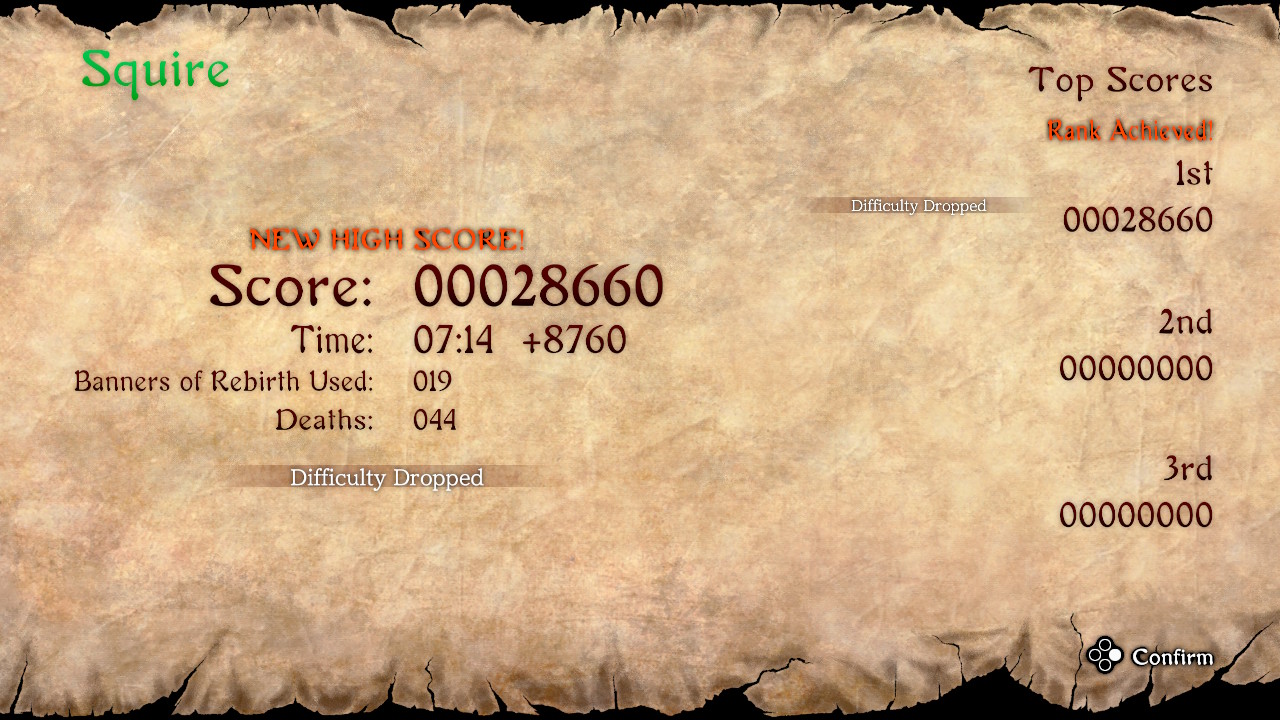
The game will keep track of how many times a Banner of Rebirth was used, and how many deaths you had in a given level. Way to mock us, game!

The gameplay for Ghosts ‘N Goblins Resurrection is PUNISHINGLY hard. If you’re playing on PAGE difficulty – one of four difficulties – you’re probably a newcomer to this series. In that case, I don’t blame you. Immediate resurrection (heh!) upon death is nice prospect. it does take from the challenge this series is known for quite a bit, though.

Squire gives you 4 hits before death and reduces the count of enemies on screen, though Stage 4 is still able to show a lot of enemies at the start if you’re not careful.

Knight difficulty gives you 3 hits to work with, and a familiar, but somewhat merciful, challenge with some checkpoints.

Legend difficulty gives you ONE checkpoint once you reach the boss. Die at ANY POINT beforehand, and it’s back to the beginning of the stage with you, just like the old archaic days of the 1980s.

But wait, there’s 7 stages in this game to complete. You’ll need to complete and memorize all 7 in order to gather all of the Umbral Bees and restore the Umbral Tree to its’ former glory. There are 2 Stage 1s, and 2 Stage 2s.

Also, if you die against a boss or tough section enough times, the game will generally give you hints on how to deal with it, even on the Legend difficulty. Here’s a picture down below.

The game will give you hints on how to beat the bosses, even on the hardest difficulty. What an insult to my pride!

The game, from a graphical standpoint, looks very beautiful, and the soundtrack compliments the gameplay as well. Each theme feels like was remixed from either the NES Ghosts ‘N Goblins or Super Ghouls ‘N Ghosts and sounds so freaking good!

On the subject of Umbral Bees, this game brings back magical abilities, first introduced in Ghouls ‘N Ghosts. As I noticed, a lot of elements got brought back from there into this installment.
From the tower boss rush to Lucifer – I’m sorry, “Loki”, to the Shielder, to the Golden Armor. This game is big love letter to the first two games, and it relishes in it.

I had nearly 200 deaths by the end of my first playthrough on Squire difficulty. I can’t wait to see how much that total goes up on he harder difficulties. . . Speaking of which, if you want to experiment with the difficulties in this game, then die on a higher enough times and it will give you an option to lower the difficulty.

CONCLUSION – Is it GOOD?!

Overall, despite the INFURIATING challenges this game will throw at you, it’s very enjoyable. I actually enjoyed myself playing this. Definitely way more so than the original. I do intend on playing on either Knight or Legend difficulty on a seperate save file, since you can’t change the difficulty mid-game unless you want to lower the challenge mid-level. It was very enjoyable, and I look forward to the next installment in this rebooted series.

NOTE:Ghosts ‘N Goblins Resurrection was provided to Movies Games and Tech by Capcom, and offered to me for review. I accepted.

NOTE: This isn’t my only review for this site. I recommend you read my review on City of Brass if you want a shorter review from me.

Review: Raji: An Ancient Epic

Nodding Heads Games makes their developmental debut with this action-filled and acrobatic adventure. Medieval India has never looked so vibrant and colorful as you climb your way through a simply stunning visual experience. Obtain magical weapons, and learn elemental skills to fight dark manifestations from ancient Hindu Mythology. A once Nintendo Switch exclusive, this title has been ported to PC, thus satiating those who prefer different gaming peripherals. Raji: An Ancient Epic is an adventure worth picking up, even if the core gameplay is a little rough around the edges.

Raji’s Quest

The story revolves around the title character Raji, a circus performer whose brother has been kidnapped. She sets out to save him under close watch and narration of Vishnu and Goddess Druga. They bless her with mighty weapons and magical powers to fight off the demons that took her brother, Golu. The storytelling from above keeps the player company. You definitely feel the Gods’ support and guidance when you see illuminated ledges and beacons pointing you in the right direction. This was a clever way to incorporate hints into the game without breaking the fourth wall. The entities above paired with Raji’s strong resiliency create a feel-good Shonen style story. This is easily what makes Raji: An Ancient Epic stand out amongst it’s indie developed peers. So, how does this title play and feel?

Who Is Playing Who Here?

Stiff controls can make or break a title. In this case it honestly does both. I did enjoy the platforming challenge utilizing the tight controls. Running up walls and timing jumps perfectly with little room for error added a fun challenge. This is reminiscent of Prince of Persia: The Sands of Time. Checkpoints are frequent so you won’t get set back too far. Being able to triple jump down a long corridor, like in Super Mario 64, kept my twitch control urges occupied as I ingested the beautiful architecture and landscapes. I really didn’t find any issue with the control style in terms of movement and acrobatics. This wasn’t the case for the combat.

There are different weapons, move sets, and special attacks that can tailor to your playstyle.

With a fair amount of moves, jumps, and attacks, you would expect to feel relatively free on the battlefield. In reality, some moves lock on to enemies and some do not. This results in Raji changing direction mid combo and looking a bit clueless. When another enemy is firing projectiles at you from afar while you’re stuck figuring out which target to lock on to, you will take damage. And die. Also, good luck running up walls and landing an aerial attack perfectly. A challenge is always welcome and accepted, but the mistakes should fall on the player, rather than the game. I tried switching from mouse and keyboard to a controller, but felt like I had even less control of Raji. This is a classic case of “the game is playing you” rather than the intended vice versa.

A Semi-Immersive Enviromnent

The narration from the gods above paired with the interactable murals in game teach India’s deities and religious history nicely. I was really enticed learning about all of the religious figures and customs taught through statues and puzzles that are a part of Raji’s story. This made enduring the clunky combat, to reach another platforming and explorational segment to advance the plot, worthwhile.

Raji: An Ancient Epic is a linear adventure. You are limited to climbing specific walls and jumping over only the intended gaps. Though the paths are marked properly to avoid confusion, it still felt weird. I couldn’t climb a specific wall, or jump into a certain window simply because the game told me so. Keep in mind only seven people created this title, and deadlines are no joke.

Bottom Line

What Raji: An Ancient Epic’s most notable point to take in is the limited personnel. Of course this debut title has a few cracks in the pavement, given the circumstance, but so was my audition tape to play guitar in a garage rock band. It’s exciting to see India make moves in hopes to secure relevancy in a growing global market. Support the artists here and purchase this game, so we can hopefully experience what Nodding Heads Games can accomplish under a full-scale operation.