Review: Trails and Traces

You’re in trouble, and no-one cares. The police can’t, or won’t, help, and you have nowhere to turn. Who do you call to assist you? A Private Detective that’s who! These specialists make it their business to help you with the most personal of matters. When a family member suddenly disappears with no clue to where they have gone, you are going to need someone with an eye for detail. They won’t stop until all avenues have been exhausted, and they have the answer to your problem. Trails and Traces: The Tomb of Thomas Tew allows you to play the part of a Private Detective. He believes he’s taken on a simple case of a missing person, but he learns there’s more to this than meets the eye. 

Developed by Because Because Games and published by Ratalaika Games, this is an old-school point and click detective game with a supernatural twist. Set in a seedy and grimy city, you will be expected to use your observation skills to gather clues and solve the many problems you encounter. Its simple gameplay and comedy laced one-liners will remind you of the Broken Sword franchise. Its straightforward concept allows you to enjoy the story that unfolds, and focus on the many simple puzzles that prevent you from progressing.

Such beautiful art!

Trails and Traces: The Tomb of Thomas Tew doesn’t reinvent the wheel.

Using a tried and tested method, fans of the genre will feel very comfortable with what is presented. A simple point and click style allows you to focus on many small locations at once. You will need to; look for clues, pick up objects, and combine items to solve the problems in front of you. Talking with the people you encounter helps you to gather information. A good ear and a keen eye will help you move through the puzzles with little issue.

The story revolves around a Private Detective known as James Labbett. He takes on the case of a missing person, but this unexpectedly leads to a new adventure. He must now discover the truth surrounding the pirate Thomas Tew. This historic figure intrigues anyone that reads his mysterious story. Rumours have it, he hid a powerful relic amongst his treasure. Whoever holds this item will be endowed with abilities beyond their wildest dreams. It’s not surprising that this sort of tale attracts some unsavoury characters, so Detective Labbett better be careful as he attempts to solve this case.

The linear approach is frustrating.

Trails and Traces: The Tomb of Thomas Tew insisted on restricting your freedom to explore. This decision was extremely frustrating, as I wanted to venture around the surrounding areas, even if it was an unnecessary waste of time. Because the story focussed solely on the valid locations to move the plot forward, it reduced the difficulty vastly. I would have liked to search each area I saw thoroughly, but the developers prevented you from entering “dead” zones with statements such as “no-one is in there, I don’t need to check it”. That’s fine, but I wanted to see what was hiding behind a closed door, or up those stairs. It made the world feel empty, and a chapter of the story rarely took more than a few minutes to solve.

What I enjoyed was the diversity of the cast, and the many locations you discover. It felt like the plot of an Indiana Jones film, with the core theme being just as insane and unrealistic. You’ll revel in the madness of the world you explore, and the simplicity of the puzzles you solve. This allows you to enjoy the bizarre people you encounter, and their relationships with one another. The story won’t win any awards for its silly ideas, but it was enjoyable for the short time you spend with it.

Being a private detective is dangerous.

Dated graphics and wooden acting.

I didn’t review this expecting triple A graphics or the best audio ever. Yet, even I was surprised by the standard set in Trails and Traces: The Tomb of Thomas Tew. It’s not good, but it’ll make you laugh continuously. I’m not sure this is what the developers wanted, but it’s the result, nonetheless.

A hazy cartoon style is used to depict an earlier era. The pastel colour palette, and retro imagery work well, but give the impression of a lack of polish. It reminded me of an early 90s PC title, that was okay to look at, but nothing more than that. Where it goes downhill drastically is the hilariously bad cutscenes and the animation. The facial details, expressions, and lack of emotion on close ups made me chuckle. If you then chuck in the wooden animation, this is one game that deserves cult status.

Talking about wooden, the acting has to be some of the hammiest, and wooden I’ve ever seen. The attempts at accents and the delivery of lines wouldn’t be amiss in an amateur dramatic society. I particularly enjoyed the quintessential Englishman, but all the characters screamed, look at my stereotypical accent.

The audio and graphical presentation is so bad, that it’s good! Once you recover from laughing, you’ll accept it for what it is, and continue to solve the puzzles in front of you.
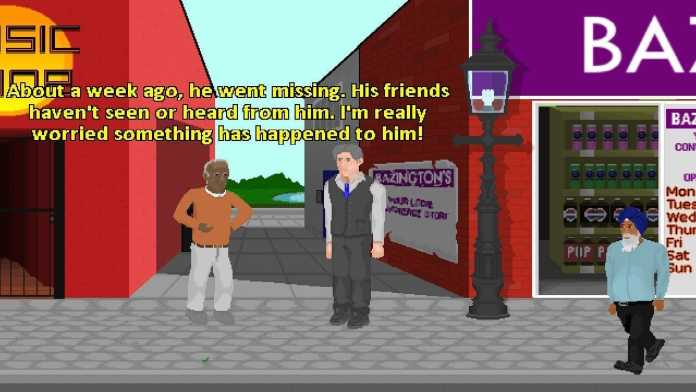
What could have happened to his son?

No tutorial = ???

To say I was confused when I started this, is an understatement. Being chucked into the action with no tutorial confused me no end. Though the controls are simple; hold down a button, and choose between looking at, or selecting an object. With no explanation, it took me some time to work out what was required of me. However, once you know what you are doing, it’s as easy as you’d expect it to be.

I really enjoyed my time with this, but it lacks any replay value. Once the case is solved, that’s game over. The achievement list is small and unlocked through natural progression. This guarantees everyone gets the 100% completion. It will take you around two hours to finish and can be played casually. I would have liked more of a challenge, but what I experienced was fun, and worth playing.

Trails and Traces: The Tomb of Thomas Tew is fun, but lacks depth. 

I really enjoyed many elements of Trails and Traces: The Tomb of Thomas Tew, but it lacked challenge and depth. I wanted it to push me more. Because Because Games missed an opportunity to make a tough puzzle game that stayed true to its old-school roots. Its story was absurd, but enjoyable, and the locations and characters were interesting. It’s just a shame its linear approach reduced its difficulty so much that it was a walk in the park. I recommend it, just be aware it’s short, and lacks challenge. Purchase your copy here! Solve the mystery and see what powers this ancient relic holds. 

Review: Dungeon and Gravestone

Don’t you just hate it when you’re fast asleep and someone wakes you by screaming in your face! You wake up; shocked, in a panic, and with no clue what’s happening. The person who woke you better have a darn good reason. The village you are resting in is about to be eaten by an evil force. Is that good enough? Dungeon and Gravestone allows you to experience this rude awakening and more, as you prepare to slay every monster in sight.

Developed and published by Wonderland Kazakari (WK) this rogue-like dungeon crawler is; cruel, fun, pixelated, and demands a large amount of luck. You’ll explore level after level of ever-changing catacombs. Armed with a sword, shield and magic, you must; loot every chest, collect the gold and kill everything you see.

Dungeon and Gravestone is simple but requires tactical nuance.

Dungeon and Gravestone doesn’t reward you for running around like a headless chicken. No, it punishes the gamers that lack patience and a strategic approach. If you wish to progress to the deepest parts of the dungeon, you must; take your time, kite your enemies, and use your equipment wisely.

Death is a cruel but expected outcome for anyone that enters the monsters’ lair. Sadly, your demise undoes your progress; you’ll lose your loot, and the gold you have stolen. Every five levels you are offered a free ride to the surface. If you take it, you keep your ill-gotten gains. If you gamble and stay below, you risk losing it all! You must ask yourself, is the glory worth the possible heartbreak?

The village you now call home!

It’s a tale of demons.

There is nothing worse than the Demon King of Death trying to devour the place you call home. You are the only hero that is brave enough to challenge his authority. Demon Kings don’t like their plans thwarted, and this one will do its utmost to prevent you from ruining his well thought out mission.

The concept is simple; enter the dungeon repeatedly, return to the surface alive, sell your goods, and improve your equipment. As you progress, magic and better objects will strengthen you. This allows you to delve deeper into the abyss where the loot improves and the monsters become more challenging.

Quests and lots of floors.

Dungeon and Gravestone isn’t just about diving deeper and deeper into the murky depths. No, it’s about quests and defeating bosses as well. The quests are straightforward; select the one you want and hack up the requested number of monsters. These earn you rewards that’ll help push you further on your adventures and give you something to focus on.

Once you get far enough, you’ll face the bosses. It’s fair to say that they are pure hell! Killing each one tests your reactions and your fighting skills. Facing them is not for the ill-prepared or the faint of heart. There are plenty to overcome and you’ll have to be a master to beat them all.

One amusing touch that WK implemented was the ability to write a message for other adventures upon your gravestone. The world that you play in is shared by all players, though you never meet. You can write whatever you wish, and like in Dark Souls, I’m sure trolling messages to “assist” you will become the norm as the game gains popularity.

So many monsters and traps.

Voxel looks and repetitive music.

Its bird’s-eye perspective and retro voxel look gives it a slightly less polished, but similar look to Minecraft Dungeons. A fixed-angle camera allows you to zoom in and out, and you can pan around each stage. It sadly lacks smoothness and finesse. I soon forgot about using it as it made me feel sick. Other than this complaint, I had no issues with the viewpoint. Luckily, moving the image around wasn’t required, so it didn’t impact the gameplay.

I liked the variety in level design and the appearance of the different mobs that you face. The Series X would never struggle to play this, but I enjoyed how smoothly it ran, and the lack of issues I encountered.

I find it disappointing when there is a lack of variety in the soundtrack. It saddens me when I have to listen to the same song repeatedly. Unfortunately, Dungeon and Gravestone is guilty of doing this. Listening to it through headphones was like Japanese water torture. I was left begging for a bigger library of songs. It’s a shame as the sound effects were good, interesting to listen to, and added depth to the action.

What harm can fire do?

Accessible to all and easy to play.

I’ve played a lot of games recently that chuck you straight into the action. You are given no equipment, and no tutorial to ease you into things. Fortunately, one isn’t required as playing this is easy. A well-explained layout can be found in the menu, but it’s pretty self-explanatory. The ease with which this can be picked up and played makes it accessible to all gamers.

When no run is the same, death is guaranteed, and there are lots of floors to visit. You know this has replay value. You’ll face untold amounts of foes, discover secret floors that contain puzzle elements, and have lots of quests to complete. Mix in a difficult achievement list and you’ll agree, there are plenty of reasons to return.

Dungeon and Gravestone is more than just a simple concept.

When a game relies on a simple concept, it can bore you quickly. Fortunately, Dungeon and Gravestone offers much more than just dungeon crawling. With its; minor puzzle content, tactical fights, magical spells, hidden locations, and challenging bosses, you have plenty to get your teeth into. It’s for these reasons I recommend it, so buy it here! Can you prevent the Demon King of Death from devouring your village? Probably not, but if you’re going to die, you may as well die a hero.

Two Minute Review : ZAGG InvisibleShield Glass Elite Privacy + Screen Protector for iPhone 12 Pro Max

Are you looking for a screen protector for your iPhone 12 Pro Max that also provides privacy? If so here is our review of the ZAGG InvisibleShield Glass Elite Privacy + Screen Protector.

“Glass Elite Privacy+ protects your screen from impact and prying eyes. We’ve added a two-way filter to our strongest, most advanced glass screen protection, so you get full-screen privacy when its viewed from the side. And we’ve added ClearPrint, a revolutionary oil-diffusion technology that makes fingerprints virtually invisible.”

Features

  • Extreme Shatter Protection
  • Maximum Scratch Prevention
  • ClearPrint™ Technology
  • Smooth, Silky Feel
  • Anti-microbial treatment protects your screen protector
  • Privacy Filter
  • Reinforced Edges
  • Easy Application

What’s in the box?

The box contains the screen protector and everything you need to prepare your phone and fit it.

Final Thoughts

We all need a screen protector for our phones – whether its because you want to stop it from being scratched, or you just want to keep in clean. ZAGG have been making screen protectors for years and I have used several of them in the past. Sometimes you might need more than just a normal screen protector, you might also need a privacy filter to stop others from seeing what’s on your screen, and that’s where the Elite Privacy + comes into play.

Fitting was very simple, you just follow the few simple instructions and within a few moments the protector is applied and that’s it.

Overall I am very happy with the InvisibleShield Glass Elite Privacy + Screen Protector, and can recommend it if you want to protector your iPhone from dust, scratches and prying eyes.

The ZAGG InvisibleShield Glass Elite Privacy + Screen Protector is available now priced around £29.99.

You can learn more from the ZAGG website.

Evercase VS Console Announced

0

The Evercade retro gaming system is growing with the announcement of the Evercade VS, a new home gaming console from Blaze Entertainment.

Following the successful launch of the Evercade Handheld gaming system in 2020, which became the go-to officially licensed option for many retro game players, the Evercade VS builds on this by bringing the Handheld experience to multiple players.  

Evoking the nostalgia for retro gaming with its physical only game distribution, the Evercade VS goes one step further in allowing people to Play Together. The new console has support for up to four players simultaneously via either the proprietary Evercade VS USB Controller provided in the pack (or available to purchase separately for additional controllers). This follows the same levels of comfort that many praised the Evercade Handheld for, with ergonomically designed controllers that suit all retro games. Evercade games already come with multiplayer support so the existing library with multiplayer capability will be instantly supported.

The Evercade VS will also support numerous third-party USB and wireless controllers, including the Xbox Adaptive controller and 8bitdo wireless controllers.

Evercade itself is a retro gaming ecosystem that delivers fully licensed, curated, collectible game packages via a cartridge with a retro-styled box and manual. The cartridges are currently playable using the Evercade Handheld console, launched in 2020. With the Evercade VS, Blaze is continuing to offer Evercade customers a gaming experience like no other with a catalogue of stone-cold classic titles and Indie gems from over four decades of gaming. Including iconic hits like Double Dragon, Earthworm Jim, Asteroids, River City Ransom, Burger Time, City Connection, and many more.  

The Evercade VS uses the same Cartridge-based game system as the Evercade Handheld, meaning that the existing library of over 260 games across over 20+ cartridges available throughout 2021 will be fully supported* with all future cartridges also supporting both platforms. So those who already have the Evercade Handheld or are invested in the cartridge family can instantly enjoy their games on the Evercade VS, or those new to the system will have an incredibly large back catalogue to choose from.

In addition to this, the Evercade VS will support two cartridges simultaneously. This will allow gamers to have up to 40 games selectable at any one time depending on the number of titles on the cartridge. This will all be displayed on-screen with a new and improved UI with full visual features including screen filters, sorting options, and resolution features allowing for Pixel Perfect representation on screen. The Evercade VS will output at 1080p, making it the highest resolution compact gaming system on the market, and will feature built-in WiFi for easy updates and future online features.  

The games themselves are all tied to the cartridges with top-of-the-line emulation powered by the Evercade VS’s 1.5Ghz quad-core CPU and 512MB DRAM. All cartridges contain save and load states. This means any progress on an Evercade Handheld can be easily resumed on the Evercade VS or visa-versa. Save states will also have a new, full visual area within the new UI to show users exactly where they saved their games.  One of the benefits of the Evercade family is its value and affordability. With prices starting from £89.99/$99.99/€99.99 the Evercade VS allows for a great entry point for those who wish to have an impressive library of official game collections on their televisions at home, and for existing Handheld customers to have a cost-effective and new, enjoyable way to experience their existing collections.

Customers will be able to pre-order the Evercade VS from Friday May 28th, 2021 (with exact pack configurations to be announced the week beforehand) with an estimated release date of early November 2021.

Review: The Skylia Prophecy

While some retro games have aged badly over time, there are still some timeless 16-bit titles that are worth your attention. Such is the size of the enduring audience for these games that many developers have borrowed heavily from them in their own ‘retro-inspired’ titles. These ‘new’ releases are often less interested in making something innovative though and instead focus on exploiting and repackaging nostalgia which, more often than not, results in a poor imitation.

The Skylia Prophecy, a side-scrolling 2D action-adventure developed by indie developer Ezekial Rage, is a prime example of a poor to below-average attempt at ticking the ‘retro’ checkbox. The story is introduced with an opening dissertation and has you battle the undead with the main character Mirenia, as you journey through the world to put an end to the evil you unleashed upon the world. 

As delectable as a mouth full of dry crackers, the gameplay consists of traveling through very similarly designed areas and attacking enemies walking across the screen that actually, often don’t even attack you, let alone block your attacks. The immoral slaying of helpless monsters aside, attacks consist of using what seems like a sword (though the sprite art makes it hard to confirm) and an energy force field of sorts for a defensive attack that is lazily implemented to compensate for a lack of aimed attacks and a separate guard action. Numerous bosses exist with largely the same moves and all follow their own unchanging pattern of behavior each playthrough. Some of the bosses are optional existing only to unlock further moves, but their effect is negligible and are as forgettable as the bosses themselves and the people populating the towns who sing the same tune in every area.

Poor skeleton was just going for a walk…

Unfortunately for The Skylia Prophecy, that’s about it. There are shops in the town areas which allow you to purchase potions (though puzzlingly only one of each) to ease the difficulty of the bosses and also quests that offer money, but the biggest difficulty here will be motivating yourself to continue through the monotony of the game.

Limiting the game to 16-bit standards limits the potential of the visuals somewhat and because of this they are neither impressive nor disappointing, but the sound design is poorly implemented. Whether the recorded voices are unconvincing or the volume levels too high, there is no cohesiveness with the visual presentation and the mood set by the audio, representing a real wasted opportunity to increase the overall presentation and quality of the experience. 

Artificially created difficulty…

The game’s biggest selling point, according to the developer, is its ‘kill the player’ philosophy inspired from the ‘Souls’ games. This difficulty is present in easy mode, with even non-boss enemies being overpowered, resulting in you becoming sick of the ‘game over’ screen until you figure out and memorize their repetitive movements. Personally, this style of game doesn’t appeal to me as it restricts the freedom of the player and interactivity of the game, making the window of opportunity and potential success so small that it’s almost a passive or mathematical experience, with no difference in playthroughs and no satisfaction to be gained from all that failure. Such is the reliance on your interactions with the grim reaper that without them the game’s runtime would last less than an hour and a half.

The best looking enemy isn’t even a boss, or rather – it might be but this character isn’t mentioned or referred to, anywhere. Just like the other bosses.

Traveling through the small number of similarly designed levels while spamming the attack button had me at my wits’ end by the second boss. Frustrated by its difficulty and lack of quality I was procrastinating around my flat for large stretches – much like the enemies walking across the screen with little purpose – simply to avoid playing it.

The Skylia Prophecy might have been inspired by others, but its own offering is less than inspiring, providing rehashed and boring mechanics that would fail in this and the 16-bit era. With its shortfalls unable to be concealed by its harsh gameplay it would take a dedicated retro game fanatic or a purveyor of punishing games to enjoy this, but with far better options available elsewhere it’s hard to recommend even then.

Review: Dull Grey

Is choice an illusion, or do you truly have the freedom to do as you wish? Can you imagine a life where everything is decided for you? What a depressing existence that would be if you had no control over the direction you get to take. Dull Grey tells the story of this problem, and how the people learn to live with it.

Developed by Provodnik Games and published by Sometimes You, this is a depressing and sombre tale of oppression and love. A short Visual Novel set in an industrial Soviet world, its melancholy theme is emphasised by the use of a mainly monochromatic colour scheme and striking imagery.

The surrounding cold wintery mountains that protect your home.

Dull Grey is a sad and touching tale.

Inspired by the worlds of the Strugatsky brothers, and Dostoevsky’s works, Dull Grey is a sad and touching tale that will make you consider your choices. You see life through the eyes of Kir; he is a young man with limited prospects. The government has created a system called the Progress-program. This is their version of “Big Brother” and the robots limit job opportunities. You are assigned a role, and only the strongest willed can break free and find happiness.

To emphasise this theme, a limited amount of dialogue choices is available to you throughout. You will tell your mother, which job you’ll take, and you’ll respond with yes or no. These limitations will frustrate you, but they represent the oppression the protagonist encounters perfectly. On the surface, this is a linear tale that leads you to its heart wrenching conclusion. But, if you take your time to think, and consider your options, you find things aren’t always what they seem. Perhaps there are other paths available to you if you look hard enough.

A slow-paced story.

The story unfolds slowly as every element is repeated. Each section goes full circle back to the question of how Kir sees his future. You may worry that this monotony will bore you. Strangely, it doesn’t, because the story develops even though it appears not to be progressing at all.

You are told of many areas that the characters visit, and the family that they interact with. These bonds add some humanity to what is otherwise an extremely cold and heartless tale. You will experience the people who agree with the system, and those that oppose it. It’s a sinister world where fear and an odd desire to appease overrides your own need for happiness.

Oppressive robots.

Simple art style, but beautifully atmospheric.

What I love about Visual Novels is how easily they convey their meaning through their art style. Some go for OTT sexualised Manga and Anime looks. And others lean towards a simpler approach. Dull Grey has taken the latter choice. The crisp lines, mainly monochromatic palette and silhouetted images sell the theme perfectly. Every scene is told using a still image. Unlike many other Visual Novels, this one doesn’t use simple animation to show each character’s emotions.

I adored the domineering buildings that towered over the landscape, and the robots that engulfed each scene. Every picture told the tale of an oppressive world, and you didn’t have to read the text to understand what this story was trying to say. As great as the imagery is, it would have not been as strong if it wasn’t for the fantastic audio.

Melancholy tunes play gently as the words form on the screen. The touching sounds demonstrate the sad existence that each character must live with. The gentle pace and minor toned songs capture the cold beauty of the world you observe, and enhance the emotion hidden in the text. When you read a book, you wish to be transported to that place, no matter how depressing. The audio and visual elements did just that in the most simple of ways.

What youngster listens to their parents.

The controls won’t surprise you.

If you are a veteran of the Visual Novel world, then you know they are easy to play. Minimal controller action is required to turn each page. This allows you to enjoy a hot beverage and snacks while playing. Dull Grey’s control system won’t surprise you, the left analogue stick and one button are all you need to get from start to finish. This makes it a relaxing experience, and one that you can play with minimal fuss.

As with most books, once you’ve got to the end you’re unlikely to read it again, unless you loved it of course. The beauty with this genre is the addition of a small achievement list to keep you coming back for more. If you are a completionist, you’ll need to complete many playthroughs, and discover some secrets that elude you the first time you read it.

Dull Grey is a short story that needs to be read.

When I first saw Dull Grey advertised, I didn’t know if I’d like it. The story seemed too depressing, and I didn’t know if I was ready for another “Big Brother” is watching type tale. I’m glad that I tried this short story as it is one that makes you richer for the experience. With a wonderful art style, touching audio, and brilliantly written plot, this is a Visual Novel you must read. Buy your copy here! In a dark world controlled by an oppressive government, freedom is considered a dirty word. Your fate has been decided for you, and there is nothing you can do. Or is there?

Review: Antventor

No matter your size, upbringing, or lifestyle, you should be allowed to dream. Just because something has not changed for years, doesn’t mean that it should remain that way. If life is blocking your plans, what would you do? Think of a way to solve that issue, reach for the stars, and make life that bit easier. Antventor explores this idea, allowing you to look at the world through the eyes of an ant.

Developed and published by LoopyMood, this point and click puzzle title takes its inspiration from old-school games and mixes it with a modern twist. Set in a photorealistic micro world, you are an ant whose life is controlled by the desire of the colony. He doesn’t want to work hard; he wants to live smart. He’s happy to pull his weight, but he wants his machines to do the work for him. After all, what’s the use in being an inventor-ant if you don’t use your technology to help.

Antventor is a tale laced with puzzles and comedy.

Antventor takes inspiration for its core concept from some of the great, classic point and click games; Monkey IslandDiscworldDay of the Tentacle and so on. The idea is to collect objects in each of the surrounding rooms, combine them together, and use them in a logical way to solve each puzzle you encounter. Alongside the gathering of items and exploring, you are treated to some wonderfully hilarious and touching moments. The timing of these is perfect as they break up the repetitive gameplay that haunts this genre. 

Florantine (see what they did there) was happy with how his life was going. He gets to sleep late, create new machines, and watch the colony go about its daily business. Until you turned up and broke his machine, that is. With his dreams ruined, and no part to replace the damaged one, you must go on an adventure together to find a suitable replacement.

Your journey takes you outside of the safety of your home, and you will explore the great outdoors. He meets some weird and wonderful creatures while he undertakes his quest. Crows, spiders, and elderly bugs all force you to think outside of the box and use your environment to progress.

Be careful around the guards.

Some solutions are tricky to comprehend.

What I loved about this was its lack of hand-holding. Once the game loads in, you are free to solve each problem as they arise. The only issue I found was that many of the puzzles were ambiguous in their approach, and a solution wasn’t obvious. This wouldn’t normally be an issue, as I love a challenge. But, when you do not know what to do, you simply start guessing by randomly combining objects, or clicking on the screen aimlessly. This removes the puzzle element, making it a game of chance.

LoopyMood attempted to eliminate this with picture clues that can be selected after a short amount of time. This made the game much easier, but it also removed the guessing problem. I think a checklist of tasks would have been a better approach. This would then remove the need for hints, and would allow logical minded gamers to work through the puzzle without guessing their way to a solution.

If you place the puzzle element to one side, Antventor tells a lovely story of hope, friendship, and creativity. The further you explore, the braver Florantine becomes. He must complete tasks that help other insects, while conquering his own fears. Combining random objects, you will; make a spider dance, steal an iPod from a crow, collect water for a sick elderly bug, and more. I adored how it flowed, and though a playthrough is short, it was thoroughly enjoyable from start to finish.

Poor old Florantine.

The photorealistic setting is fantastic.

Mixing cartoon characters with a photorealistic backdrop can be risky. Yet, it worked fantastically! The beautiful landscapes and variety in settings made this a nice game to look at. The crisp and well designed character models have a modern aesthetic, and Florantine displays an array of emotions through well drawn facial expressions. The journey he makes takes you into some weird locations and seeing the world through the eyes of an ant gives you a whole new perspective on things.

Playing this on the Series X I didn’t expect to find any issues. Sadly, there is one section of the game that has a horrendous frame rate drop. The game stutters and slows down to a crawl. It only impacts one tiny part, but it took a lot of the shine off the finished article, and needs to be resolved.

The audio does well to support the woodland area that the ants call home. Birds chirping, the rustle of the wind, and the crunching of leaves all make this a joyful game to listen to. It is mainly devoid of music, but the rare times that it is used are pleasurable, with a style that matches the atmosphere of the area it is in. Comical noises come out of our hero’s mouth. He will mock you for failing to solve a problem, or sigh, because of boredom if you are taking too long. It risks becoming annoying, but it’s a short game, so the risks are minimal.

ARGGGHHHHH!!!!!

It’s easy to play with a controller.

I was shocked at the ease of playing this on console. Point and click games usually lean towards the use of a mouse and keyboard, but accurate and responsive controls make this a pleasure to play. All objects are easy to pick up, and anything that requires interacting with can be seen with a yellow or white orb. The inventory is simple to use, as are combining items. The developers have done a great job at making this a game that can be mastered straightaway.

Planned as a trilogy, this forms part one of the adventure. It can be completed in only one to two hours, and the achievements are unlocked through natural progression. Once you complete your playthrough, there is little reason to return as the challenges all remain the same. It’s fortunate that the first attempt is such fun, and once you finish, you’ll also want to see what part two and three offer.

Antventor does most things right.

For the most part, Antventor is a great example of the genre. It looks fantastic, has a nice natural audio, offers the right balance of challenge, and the story flows at a comfortable pace. However, it has shortcomings; The puzzles are ambiguous, there are frame rate issues, and I wanted it to be longer. I’m hoping that the next instalments rectify some issues, and they increase the length of the gameplay drastically. I loved the game even with its faults, and I recommend you buy it here! You broke Florantine’s machine, so you must help to fix it! Start your adventure, solve the problems, and make some friends en route. 

Clever Online Tricks to Save You IRL Money

A lot of money-saving tricks online are related to online shopping. You save some money and then something gets delivered to your door, or perhaps you even just download or stream something, so you never see a physical object. Getting online can be a great way to save money offline too, though. You can find ways to save money when you go to the grocery store or when you next go to see a movie, whether you make your purchase online or you save money at your destination. Next time you’re looking for some bargains, try these tricks to save money.

Find Online Coupons

Sites like Groupon have been popular for multiple years now. They offer you the chance to find deals on a variety of things, including lots of services and events. You could save money on a hotel stay or a trip to a spa, as well as things like a course to learn something new or an evening out with your family. You can also find lots of online shopping savings, whether you’re looking for new things for your home or you want to get some new jewelry. If you’re buying a deal on a hotel or a personal service, you can take the voucher on your phone or print it out to show it when you arrive.

Image from Pixabay – CC0 License

Use Comparison Sites

Comparison sites allow you to search for deals on various bills and expenses you might have. These days you can find comparison sites for different services; for example, looking for the best internet in my area will help you easily save money on your internet bills. From home insurance to health insurance and even utility companies, you can compare the service in your area and find the best deal to save some money.

Watch Out for In-store Sales and Offers

Not all of the best offers can be found online. Sometimes you have to go into stores if you want to be able to make some awesome savings. But just because the savings are found in stores, it doesn’t mean you can’t learn about them online. One of the best things that you can do is sign up for the newsletters for your favorite stores. When they have special offers or sales available, they’ll email you to let you know. They might even give you a discount that you can use in the store so you can save even more.

Look for Second-hand Purchases

Buying things second-hand is often a great way to save money. And doing it locally can save you even more, helping you avoid the need to pay for postage and packaging. If you can pick up your purchase or get it delivered to you, you can save more. But looking for purchases online can make it a lot easier to find some local bargains. There are all kinds of listing sites and apps that will help you to discover the very best savings opportunities. You can save on everything from furniture to clothes and buy from members of your community.

Get Good Deals on Tickets

If you’re someone who loves to go to live events, getting online could help you to find some great deals on tickets. When you buy tickets in advance, you’re much more likely to save money, even if you’re only going to see a movie. Tickets On Sale is a legit site that can help you to save on sports, theater, and music events. When you get good deals on tickets, you’ve got more money to spend on other things, like your meal before your event, snacks, and drinks, or even a great outfit to wear.

Find Stuff for Free

As well as getting second-hand stuff by looking online, you can even find free things. Sites like Freecycle allow you to seek out things that people don’t want anymore, and that they’re willing to give away for free. A lot of people have stuff that they no longer want or need but that they don’t want to have to throw away or deal with the hassle of selling. They know if they offer it for free, someone will most likely come and take it off their hands. Before you spend money on something, check to see if you can get it free first.

Image from Pixabay – CC0 License

Learn New Skills

The internet can teach you pretty much anything. A lot of people pick up new skills by watching a few YouTube videos showing them how to do something. You can also find plenty of articles and blog posts explaining how to do things in detail. A new skill could save you plenty of money out in the real world, both at home and elsewhere. You can learn how to fix your own car, how to repair and sew clothes, how to do DIY around your home, and much more. All of these things could prevent you from spending too much money on unnecessary things.

Find Cooking Tips

Food is often one of the biggest expenses that any household has, and it’s a necessity so you can’t just cut it out of your budget. Fortunately, the internet can come to your rescue and help you to save money on your groceries. You can discover a huge number of tips, tricks, and recipes that make it easy to spend less on food and drink. Find ideas for how to use up leftovers, plan meals and avoid any food wastage. The right tips will help you to make a smart shopping list before you go to the grocery store and make your food last too.

Look Up Your Local Library

A visit to your local library is a great way to save money, but did you know you can find them online too? Many libraries have online databases that show you which books, movies, and other media that they have in stock. You can also often create an account and reserve something that you can borrow so you can go and collect it. Some libraries offer ebooks and audiobooks that you don’t even need to go in for, and you can even visit your library to borrow things like tools or kitchen supplies so that you don’t have to buy them yourself. Look up your local library online to see what online and offline services they offer.

Going online can help you to find lots of ways to save money offline. Take a look at some of the sites that are built to help you save money.

Review: Mega Party: A Tootuff Adventure

Mega Party: A Tootuff Adventure is a charming series of minigames for you, and potentially a few friends to enjoy. With over 40 levels across three chapters, there is plenty of mayhem to keep you entertained. Causing havoc in the neighbourhood by completing tasks, Tootfuff and friends fill up their stupidity meter. There is more than enough to keep you and your pals entertained for hours. 

In terms of controls, things are simple so anyone can pick them up. Involving a lot of button mashing, I’d argue this game to be fun for all the family. The tasks featured in minigames come in a variety of forms, such as defacing posters or ringing doorbells before running. No matter what you do, your core task is just to disrupt the day to day lives of townsfolk. Tootuff features a small open-world aspect, where you have to interact with NPC’s to progress. In addition to wreaking havoc in the streets you also get to cause chaos in school.

Campaign contradictions

Of course the campaign can be completed solo. But the game features a two player option or even local multiplayer madness. There are two game modes for local multiplayer, Duel of Death and Mega Duels. Both of which support up to four players, and can easily be praised as one of the highlights of this game. Duel of Death is a tournament style selection of minigames, where players compete to become champion. Mega Duels however allows you to select which minigames to compete in. 

Despite the campaign being engaging upon first playthrough, it isn’t necessarily something you would pick up again. You can replay different sections of the story through different game modes, but as a whole it wasn’t that compelling. The story seems lacklustre in terms of narration and story – but there’s enough to keep you busy at first. I’d definitely recommend finding a few friends to play with since that would make it significantly more entertaining. 

Complete customisation

Additionally, there are a lot of opportunities for customisation in Mega Party: A Tootuff Adventure. From the beginning of the game you are able to create your own character, rather than just playing as Tootuff himself. You also have a rival to face off with at regular intervals in the campaign. These all add layers to your experience with Tootuff, all whilst revelling in an abundance amount of toilet humour. To younger kids, these jokes may seem too ‘childish’, but I definitely let out a laugh or two. 

Final thoughts

As a whole, the game isn’t visually outstanding, and there isn’t much to say for it. But as far as local multiplayer comedic games go – this certainly takes the biscuit. It’s not something I’d necessarily pick up on my own, but with friends this easily becomes a hilarious gaming experience. In competitions to see who can be champion of the idiots, there is no shame. It’s enjoyable and accessible for everyone, and for that factor alone I would definitely recommend Mega Party: A Tootuff Adventure.

Review: Beach Buggy Racing 2: Island Adventure

Beach Buggy Racing 2: Island Adventure builds on everything we love about the first Beach Buggy Racing. But, much like the original, it fails to reinvent the wheel within the arcade racing genre. Beach Buggy Racing 2: Island Adventure is what it says on the tin. You race beach buggies across a vast range of courses and modes throughout the game. Beach Buggy Racing 2: Island Adventure, much like the first game, has a great selection of courses and modes. From medieval-themed tracks to time trial modes, the sheer variety adds considerable replayability and variation to an otherwise simple game.

A Classic Arcade Racer

Likewise, the game is fun and addictive to play, offering the fun and fast-paced but silly gameplay we all expect and love from arcade racers. The game has a large variety of powerups and builds upon the first Beach Buggy racing game. The fun and addictive nature of the game combined with the easy to pick up and use controls make the whole buggy racing gameplay experience smooth and fun. The game looks excellent on consoles with a cartoony fresh look.

Despite the praise, Beach Buggy Racing 2: Island Adventure, much like the previous game, sticks to tried and tested formula found in classic arcade racers and does not try anything new.

Classic Racing Fun

Running out of Gas

Notwithstanding the positives of the game, everything listed above is nothing new in the genre. Most arcade racing games nail the gameplay and aesthetical elements of thier games. Beach Buggy Racing 2: Island Adventure is not a bad game but does not add anything new to the already saturated genre. Therefore, it fails to stand out. The game sticks so close to the formula that classic gameplay elements, such as powerups, actually manage to break the game. 

Beach Buggy Racing 2: Island Adventure has far too many powerups. The sheer quantity of powerups often becomes overwhelming, creating chaos rather than fun, with most powerups being heavily overpowered. Similarly, although the game has a charming soundtrack, there is no variety. Each course’s soundtrack felt like a remix of the classic beach buggy track, with no real depth. Despite racing across a volcano or through a medieval world, the soundtrack sounded near-identical. From this perspective, the soundtrack is relatively poor.

Now it might sound like I’m not too fond of this game, but I am. It successfully does everything a good arcade racer should do. However, that is its problem. The game sticks far too close to the proven arcade racing formula tried and tested by classics such as Mario Kart. Adding nothing new to the genre and, in some cases, even overdoing it.

Racing in the desert

Verdict

Overall, Beach Buggy Racing 2: Island Adventure is not a bad game. It is a good arcade racer that offers excellent reliability, graphics and fun and addictive gameplay. But it is the same old same old, and does not add anything new to the genre. Thus, it does not stand out within the genre, and therefore at best, it isn’t very impressive.

Review: Buildings Have Feelings Too!

Have you walked around your town and thought, what happened here? The once thriving area is now desolate, dilapidated, and in need of some tender loving care. The buildings are falling down, and businesses are failing. The beautiful architecture can’t save them, and someone or something has to step in to save the day. Buildings Have Feelings Too! tells the tale of one shop that has had enough. It must salvage what remains of each district and improve the attractiveness of every area it visits.

Developed by Blackstaff Games and published by Merge Games, this is a puzzle, city building, simulation title with a twist. You will visit many districts with one aim; you must improve the environment, build new shops, and help each structure be as “happy” as possible. The core concept appears simple from the offset, but it soon evolves to be a complicated and well thought out affair.

No one wants to be near a stinky chimney.

Buildings Have Feelings Too! is surprisingly challenging.

As you launch into Buildings Have Feelings Too! you’ll feel a little overwhelmed. Chucked in at the deep end, you must work through a well-organised tutorial to teach you the fundamentals. The more you play, the more it appears unplayable and complex. But fear not, these negative feelings soon dissipate as the game mechanics slowly fall into place.

You must visit several regions, completing many tasks that are issued to you by the rundown buildings. Improve houses, choose your industrial site, and feed the masses. Each can be upgraded by fulfilling certain criteria, and it is your responsibility to make the most appealing district possible.

Each property has positive and negative attributes that will impact on its neighbours. Polluting industrial zones have no place being next to residential areas. If you cannot plan correctly, you will not be able to improve the region, and you will not progress the story.

It quickly becomes a cluttered nightmare.

You may think, “this sounds easy, pick your shops, plan where to put them and move on!” That’s exactly what I thought once I got to grips with it. How wrong was I! It quickly becomes a tactical nightmare. You will juggle each of your properties around, desperately trying to increase their appeal to upgrade them to three stars. You run out of room, have the wrong businesses, or don’t have enough bricks to pay for repairs. It’s tough, takes a considerably patient approach, but importantly it’s addictive and fun.

The difficulty doesn’t stop there! A red X of doom hovers above structures that desperately need repairs. If you leave this too long, the building is shut down and you must pay to reinstate it. Alongside this, you will be blessed or cursed with positive and negative effects at random. Depending on your luck, these will aid you or hinder your approach on each stage. This element of chance will not be to every strategy fans liking. But I enjoyed the randomness on it, it kept you on your toes, and made you adjust your plans regularly.

So many options, which will you choose?

A progression tree.

Each type of building has its own progression tree that starts at the basic structure and spurs off as you fulfil its prerequisites. This kept the gameplay flowing at a steady pace and ensured that gamers didn’t get ahead of themselves. I liked how Blackstaff Games drip fed new elements and mechanics as you entered each region. This reduced confusion and helped to keep you focussed on each task as they cropped up. Buildings Have Feelings Too! could have run away with it, but fortunately this approach kept the action reined in, mostly.

What I enjoyed about the free flowing regions and the progression tree, was the ability to return to previous “completed” areas to add new building types. This allowed you to reinvent a district to increase your appeal score and make sure that you maximised the bricks in your inventory. It wasn’t essential to do this, but gamers who are a bit OCD, or those who strive for perfection will love this quirk in the gameplay.

Complex UI, but simple to navigate.

My aforementioned opening concern wasn’t helped by the complex UI and many sub menus you encounter. Luckily, the setup for each is straightforward, and they appear worse than they are. You soon become familiar with each category, and the icons that go with them. It really is a game about allowing yourself to learn its finer points, and not one that you can jump in and be a master within the first five minutes. If you disregard the menu system, what you’ll find is a delightful to look at 2D picture. The buildings are beautifully designed, with hilariously placed arms and legs. The well designed backdrops vary for each district, and the crisp art style makes this lovely to look at.

Buildings Have Feelings Too! has a somewhat bizarre audio. When you read the dialogue between the characters, you realise they are in trouble. Their world is falling apart, and they need a hero to help them change their luck. Yet, when you listen to the upbeat and cheery music, it’ll make you think that they have nothing to fear. Mix this in with the comical noises that the structures shout, and it all appears to be lighthearted and without concern. I liked how it was presented, and I think it works better than a down trodden sombre affair. It just seemed that the two failed to connect and were at odds with each other.

Oh no! The red X of doom!

Clumsy, yet easy-to-use controls.

As the gameplay focuses solely on moving across the horizontal axis, it didn’t surprise me that this was easy to control. Yet, what I found was the analogue stick was clumsy to use. However, when I used the D-pad it allowed for a more accurate and smoother approach. This would certainly be better with a Mouse and Keyboard, though the controller was perfectly serviceable. Flicking through the menus was surprisingly easy, as was selecting upgrades and altering uses. For all its complexities regarding its gameplay, this didn’t leech into its control system, and this allowed you the time to get to grips with its finer points.

With so much back-and-forth action between the regions and a difficult achievement list, this will keep you playing for hours. This is before you consider the challenge that you’ll face from each new district you manage. The constant attack of negative effects, and the impact of building maintenance ensure that you are in for a tough ride. A large progression tree, and plenty of different businesses to select from make this a game that’ll demand you keep playing for a long time.

Buildings Have Feelings Too! is a city management game with a twist!

Don’t come into this expecting a Sim City or Cities: Skylines style game. Buildings Have Feelings Too! is a city management game with a twist! Each of the venues has; aspirations, hopes, and fears. You will need to adjust each neighbourhood to get the most out of it, and this will lead to you changing your approach repeatedly. No region is the same, and you will take a trip from the Victorian Era to the modern day. If you are up for a fun, but challenging management game, I recommend you try this. You can own a copy by clicking here! Can you bring back the life and sparkle to each dilapidated area? Complete the tasks, shuffle the businesses, and make each district as appealing as possible.

Review: Rain on Your Parade

We see them around us every day, from light white wisps, to oppressive dark thunderous entities. Clouds surround us at all times, they bring rain to quench our thirst and shade when the sun is blazing. What I don’t associate clouds with is mischief and trouble making. Rain on your Parade will change your perception towards the clouds forever.

Developed and published by Unbound Creations, this schadenfreude game will have you sniggering from beginning to end. A single-player adventure game that asks you to complete many objectives before you move on to the next level. Fifty stages of madness await you in this cheeky and comical title.

The naughty little cloud loves to rain on your parade.

There have been a string of games recently that ask you to be an obnoxious pest as its sole purpose. The Untitled Goose Game and Donut County are both prime examples, and I loved them for it. When I saw Rain on your Parade, I knew it would be right up my street. After all, who doesn’t want to be a rain cloud causing mischief?

The plot is surprisingly touching. It opens with a grandfather talking to his grandson. He is telling the tale of a naughty rain cloud and tells of all the fun it had. He paints a romantic picture of its antics, and its existence. But the story quickly fades into insignificance as you soon discover that the cardboard cloud is nothing more than an irritating a$*hole.

You never seen a sophisticated cloud before?

It isn’t just about annoying people.

The gameplay starts out in a simple way; soak X amount of people, or destroy a certain object. This escalates to more extreme objectives and multi-layered tasks. The levels then stray away from the task focussed approach and adds in an arcade style high score round. There are also moments where you must avoid detection and steer clear of certain characters. The variety kept the game fresh, and you didn’t know what to expect from one stage to the next.

There is something gloriously sinister about this game. You are floating around looking cute, but all you want to do is ruin people’s days. As the game progresses, the methods of destruction alter. No longer do you rely solely on H20. No, oil, fire, rockets, thunder, snow and more help you fulfil your evil plan.

Simply put, the shenanigans are marvellous, and will make you giggle! Silly dialogue, ironic statements, and making people run around screaming, it’s very immature, but it’s fantastic.

It’s not all rain and fun.

Rain on your Parade isn’t as straightforward as it appears. The latter levels take some planning to be successful. This doesn’t mean the early stages are a walk, or float in the park! You must manage your water supply, select the corrects substances to pour on your victims, and focus on how you achieve each goal. It can become hectic, but it’s mostly silly fun that won’t stretch you too far.

The floating protagonist may be naughty, but he isn’t evil. In this tale that role is reserved for Dr Dryspell! He is your arch nemesis and will do anything within his power to destroy you. Selected stages have you compete against him and his weapons of doom. You must dodge his arsenal of guns and go about your cruel tasks in order to progress. He’ll rue the day he met you, as you successfully thwart each of his plans.

Even dinosaurs had to put up with clouds.

Stylish and simple to look at.

When I saw the trailer I was struck by the vivid colours and the simple art style. Its look reminded me of Donut County, because of its unusual character, loud tones and clever stage setup. I loved the world that Unbound Creations has designed and adore the Paper Mario style used for the rain cloud. It’s a great example of an indie developer sticking to the basics, but still presenting a high-end product.

The audio also does well to keep you interested throughout. It’ll make you laugh as each person screams when soaked, or the explosions go boom as your plan works out. Its jovial nature works with the comical theme and gives the action a slapstick edge.

Both the image and the sound work wonders at enhancing the childish atmosphere that Rain on your Parade thrives off. Each element complements the other and helps to support the mischievous core concept.

Strike!

A child could play it.

What made me smile most about this was my kids played it with ease. They enjoyed watching me play it and laughed a lot. But the moment they were handed the controls, they giggled non stop. It’s a pleasure to play as little skill is required and kids can play it without supervision! It’s a win, win for everyone involved.

It’s not the most complex game I’ve played, yet it has bags of replay value. With secret objectives to discover, a moderate to tough achievement list, and a NG+ mode, there’re loads of reasons to return to play. If you also consider it’s free if you subscribe to Gamepass for both PC and Xbox, or around £12 to buy, it’s great value for money.

Rain on your Parade won’t rain on your parade.

Playing Rain on your Parade will make you chuckle, smile, and be happy to be alive. It’s a casual game where naughtiness is rewarded and chaos the goal. Society wants you to be nice, so allow this to indulge your mischievous side. Don’t miss out, buy your copy here! I recommend you download it now, after all, what harm can a little rain cloud cause?

Review: Dead Dust

The Wild West is a lawless and fearful place. Only the toughest survive, and money and guns do all the talking for you. This gritty landscape has formed the backbone of many films, TV shows, and games. So, it never surprises me when a developer uses it for their project. Dead Dust is a pixelated rogue-like twin-stick shooter that is as addictive as it is frustrating.

Developed by HugePixel and published by ChiliDog Interactive, this 2D retro Western twin-stick shooter will test your reactions, luck, and patience. You must explore many levels, killing each bandit you encounter, and collecting all the loot you find. It follows a simple concept, but its difficulty is anything but easy.

Dead Dust follows a loose story.

You are a bounty hunter named Shlango. You receive a telegram explaining that a highly influential man’s daughter has been kidnapped. Your journey begins, and you are asked to cross the perilous deserts to rescue her and bring her safely home. This is too dangerous a job to be undertaken alone. Luckily, Shlango has a group of trusted friends who will aid him throughout his quest.

This is Dead Dust in a nutshell. The story has little impact on the gameplay and only serves to set the scene. This didn’t bother me too much, as I was more concerned with trying to stay alive. HugePixel has created a game that will test your resolve and will kill you repeatedly. I know this brutal approach isn’t for everyone, but I found it to be oddly addictive. Between the screams of rage, cold stares at my controller, and repeated swear words, I kept returning to play.

Your team of heroes.

Grab the loot and kill everything in sight.

Money makes the world go round, and fortunately, there is no shortage of loot. Barrels can be destroyed, and bandits and Indians drop coins for you to collect. Gather everything you find as you’ll need it to purchase goods from the local barkeep. These conveniently placed taverns sell weapons, first aid, and ammo. If you fail to use them, you reduce your chances of victory greatly. So don’t miss the opportunity when it arises.

Cash isn’t the only item you’ll find lying around. Spears, hatchets, and guns can be picked up and wielded. Each of the melee weapons can be thrown with deadly force, and they are strangely more powerful than any bullet you fire. The overpowered tools were brilliant to use. Find your enemy and chuck it in their direction, if it hits them, they won’t get up! I loved the brutality of it all and spent my time lobbing axes and spears like a hero possessed.

Rogue-like element makes it unfairly difficult. 

Your band of heroes all work independently. There is no pooling of funds, nor do they share weapons. If one dies, then they are out of the adventure for good. Death was a bitter pill to swallow, especially when you had nearly cleared the stage and had bags of loot. You take your last breath, fall to the ground, and all your progress is wiped. You select another hero, spawn randomly, and start your quest again. It’s a Western version of Groundhog Day, but with more bloodshed, and a lot less comedy. 

I cursed the difficulty of the rogue-like genre! It does wonders at teaching you to be patient, but it’s also unfairly harsh. I know the Wild West is supposed to be deadly, but this takes it to a new level. As much as I struggled with the challenge, it worked perfectly with the simplicity of the gameplay. If the developers had taken a different approach, it would have been too easy. The game simply comprises some exploration and lots of killing, so it was refreshing that a minor tactical approach had to be considered.

Loot, blood and a bar.

A warm, pixelated world.

The pixelated approach used in Dead Dust shows clear influences from the 80s arcade era. The bird’s-eye perspective makes it easy to observe the action. But a lack of camera rotation restricts your field of view. I found this to be a poor choice from HugePixel, as it prevents you from looking ahead and creating a plan. However, what I liked was the warm yet vibrant tones, the design of each level, and the pixelated appearance of the sprites. The game lacks a polished finish, but it matters not. It contains enough detail to make objects easily identifiable, and the game was pleasant to look at.

The audio is as gritty as the gameplay. An aggressive original soundtrack screams; danger, excitement and trouble. If you close your eyes, the music is instantly identifiable as associated with the Wild West, and it transports you to this hot dust bowl immediately. The sound effects are equally good. Booming explosions, rasping gunfire, and the twang of melee weapons being thrown. It was glorious to experience.

Neither element is overly complicated, or high-end. But both work fantastically well together to help drive the atmosphere of the story.

The most dangerous train ride ever!

Twin-Stick Shooters are not usually my friend. 

I’m usually very vocal about my dislike of twin-stick shooters, mainly because I’m terrible with the controls. Yet, somehow I found Dead Dust to be extremely easy to play. The aiming was responsive and smooth, using items and picking up objects was straightforward, it made a pleasant change. Also, because of its basic concept, I picked up the fundamentals almost immediately, its high level of accessibility means that this can be attempted by players of all skill sets.

Rogue-like games have a sadomasochistic draw and will keep you playing forever. They enrage you, make you want to quit, but yet, you want just one more try. Every part of this got under my skin, and though I wanted to put it down, I couldn’t. At the time of writing the review, there was no visibility of the achievement list. I’m going to guess that it’ll be a standard affair and will add a layer of replay value for completionists.

Dead Dust brings the Wild West to your living room.

Adventuring into the Wild West is a dangerous job for any man or women, but Dead Dust brings this reality to your living room. Nicely presented and easy to play, this is a title that I recommend you try. A copy can be purchased here! Can you and your team of heroes save the girl? Kill everyone, explore each level, and ride your horses until you bring her home safely. 

Review: 41 Hours: Prologue

Texelworks hypes up their upcoming May 2021 First-Person Shooter (FPS) experience. 41 Hours will take you through an immersive journey including time travel, portals, super-human abilities, and other puzzles. Let’s not forget the ‘realistic guns’ mentioned as well. The release of the first two chapters of their campaign on steam titled 41 Hours: Prologue give players a taste of what’s to come. And a lot is being offered, but is that necessarily a good thing? After my experience, I can say that fixing a few bugs upon user feedback won’t add much polish to this already mess of a title. There are clearly way too many motifs, mechanics, and themes going on here and nothing feels truly fleshed out or finished.

Full Disclosure: There are many FPS references here; I’m a big fan of the genre. Also, 41 Hours borrows a lot from other games.

Let The Countdown Begin…

You play as Ethan, an obsessive scientist that goes on a gun spree to track down and protect the love of his life, accompanied by Clara, a.k.a. Lea. She aids you with her psychic powers to teleport around, explode near enemies, and open worm holes to travel between places. It’s quite handy to have a partner to send out to take care of enemy swarms, though her actions are a little clunky. I did take damage staying in the open moving my cursor to the enemy swarm for her to destroy. While not much plot-wise is explained in the prologue, the game follows a 41 hour countdown, hence the title. But what are we counting down? Why 41? Could we have gotten another hint to draw some extra interest to actually purchase this title?

The gameplay is broken up by comic book cinematics. I normally have no issues with this, since cinemas will show a title’s age more than the gameplay usually. However, the illustrations feel so different from the 3D rendered world you play in. The color is more saturated and cartoonish, compared to the actual game itself. It’s like I’m in two different genres here. Also the dialogue is bland, and the story isn’t explained very well. I predict that the player will skip through these for the most part.

First Person(ality) Shooter

For a protagonist, Ethan seems rather clean and well put together. There’s no toughness to his appearance, nor seriousness in his voice. Maybe I’m biased since this title steers more towards the dramatic realm and I enjoy fast-paced games with one-liners and personality (Duke Nukem, Doom). Upon taking damage, and jumping over rocky terrain, Ethan’s grunts and groans sound weak and almost pathetic. It’s as if the developers wanted Ethan to be a bit relatable as a human, but I’m not sure if it works here. I’m fighting off tons of enemies; I want to feel more so like a badass rather than some average Joe.

Huge World, But Why?

The game has you travel through huge worlds to get to way points. I don’t understand why the maps are so vast. Health and ammo pickups are all near the roads and pathways, so are these extra acres of trees really necessary? And since waypoints highlight your objectives, there is no need to explore any of these copy and pasted forests. You already know where to go. I recently played Ion Fury. It was built on the 20+ year old Build engine. There are secrets to find and cracked walls to blow up, circling the player back to previous areas without causing any backtracking. Exploring immersive environments should reward your curiosity with better weapons or armor pickups. I found little to no reward with 41 Hours: Prologue. The graphics do look good, but that doesn’t help the experience.

Broken Enemy AI

The enemies you fight in the prologue are basic soldiers, and two types of robotic machine gun drones. There really isn’t much of a variety. Sometimes a tiger or bear may jump out and get you, which caused more deaths than you would think. The second you fire your weapon, or the enemy faces your direction, get ready to eat a machine gun sandwich. The invisibility mechanic won’t hide you for long since it stops the moment you pull the trigger, which seems like a missed opportunity for some serious stealth combat. The only thing I could thing to do is hide behind a boulder or house, since the enemies are mainly hit-scan.

After many deaths, I decided to try to flank the enemy hoards off the beaten path from the woods, since there is so much of it. This did not help. Once you break a certain line towards each waypoint, enemies will simply respawn around you no matter your location. The trees even seem to cover the enemies more than you. Now you are taking shots and sifting through trees to find where you’re getting hit from. The game even tells you to stay on the path since that’s where the majority of the health and ammo reside as I said moments ago. So again, what’s the point of this huge level layout? I played 41 Hours: Prologue on the easiest difficulty setting and got my face melted.

The objectives take up so much of your screen real estate.

Audio Miscues

I had to equip the silencer on my guns, solely to mute out obnoxiously loud barrel noises when firing my guns. When you play an FPS, the weapons should have a sense of weight to them. Crunchy sound effects should make it satisfying to pull the trigger, not cause you to turn the volume down. I love using the AWP in Counter Strike or the Flak Cannon in Unreal Tournament for those reasons. The only way to tell if my shots landed, are if a makeshift x appears on screen where you are aiming down your sights like when playing Call of Duty. Also, the drop-tuning rusty guitars in the Game Over music feels ripped straight from Borderlands. There are no Post-Apocalyptical Western themes in this game. The in-game battle music felt over dramatic and corny. I’m a big sound guy, and the overall audio didn’t impress.

Just Pick It Up

Ethan has powers of his own. Like Clara, he can temporarily turn invisible to hide and sneak by, as mentioned previously. The most notable, however, is his telekinesis. There are parts of the game where you must lift and stack up huge objects to access portals, and climb buildings. Half Life introduced this concept of picking interactive objects up back in 1998, and it was still done better then vs. now. This was easily the most infuriating part of my playthrough. You can’t turn objects around, only stack them in the direction they face. Things will never line up properly and your storage box staircase will topple down, wasting your time.

Surely there is an easier way to reach the portal above.

Bottom Line

We are at an age in Video Games where the technology to do what you want with is pretty much there. Whether crafting a massive open world sandbox title or a 2D pixelated platformer, the tools are available. With that in mind, attempting to push the limits visually should not be the driving force of your game. If there are lingering flaws that inhibit the experience, the game will quickly be forgotten when something new comes out later, with better visuals. Borrowing mechanics from other releases to attempt to add variety is not a good cover up when those gimmicks aren’t fleshed out enough. Though nothing is completely broken, there are a lot of issues with 41 Hours: Prologue, and I don’t think the development team will be able to fix much with roughly a month left until it’s already delayed release date.