Review – Ben 10: Power Trip

When I initially installed Ben 10: Power Trip, I will admit to the slight presence of hesitation on my part. Don’t get me wrong, I have no beef with Ben 10 as an animation series, but never having been a huge fan of the series I was anxious if I could enjoy this game. I am pleased to report: I most definitely did!

Let’s go!

Here’s to a (not)relaxing family vacation…

Ben 10: Power Trip is a fun action-adventure game where you hop onto the scooter of protagonist, Ben Tennyson. Set in a European-Esque family vacation, Ben 10: Power Trip wastes no time in establishing the need for Ben 10’s abilities. But, in this quiet part of the world, what or who could want to create inter dimensional trouble? The game very early on reveals that it is none other than Hex – the magic-loving nemesis of Ben. This time, he has managed to acquire powerful crystals that can strip Ben 10 of his alien powers from the onset. Hex falls short of completing his plan, with the other crystals still to be found. This is good news for Ben 10 because he still has a shot at saving the world and all the others that Hex could destroy should he succeed.

By a stroke of luck, Hex drops a mysterious tablet containing clues to what Hex could be up to next. With the help of the amazing Gwen, Ben 10 can attempt catching up to his enemy, hopefully stopping him in time.

Poor Hex, he really just wants to destroy the world without Ben 10 in the way

You’ve got to start somewhere…

The tutorial missions are great to get a hang of controlling Ben 10 and switching between his alien powers when you need them. No lie, I was annoyed on behalf of the homie Ben 10 because I felt the adults got a little too comfortable in letting Ben 10 do their jobs for them (major side-eye was given). But Ben 10 being the spotlight-loving teen he is, it was all fun and games.

You start with Ben 10 and then regain your stolen alien abilities through completing void rift missions. These appear as portals that stick out like a sore thumb. These voids often act as a way out of a seemingly closed-off environment without clear escape. While inside, you get a small introduction to whichever alien is there for you to collect by fighting off minion enemies. The void’s environment design showcases any other unique abilities of the alien – from climbing to torching things and soaring at great speeds. By the time you emerge, you’ll be ready to fight the impending danger headed your way.

A fight scene in Ben 10: Power Trip

Combat with flare (and flames)…

Let’s get into the fights. Combat is relatively simple in Ben 10: Power Trip, with an alternation between heavy and lighter attacks. With each alien equipped with various abilities, these can be used as deemed necessary. Sometimes you’ll require speed over strength, or force over flames. Whichever gets the job done. I enjoyed the combat in Ben 10: Power Trip because I felt the enthusiasm and personality of Ben 10 shine through in each character. I admittedly got cocky like our hero teen, it was inevitable.

As you progress, the fights and enemies get a little faster and a little more challenging (nothing for our boy Ben 10). This is where the level system comes through. When you complete certain missions or portions of them, you get the opportunity to choose your level-up skill. You can select between Damage resistance, Increased damage dealt, or Luck. The first two are obvious, but the Luck skill is not to be underestimated. Besides finding more treasure and loot, you are more likely to land critical “lucky shots” during combat. These shots are life-saving when your health is on a wing and a prayer in the middle of a mini-boss fight. So, I do recommend giving lady luck a shot.

Just Shock Rock taking a leisurely stroll

In Ben 10: Power Trip the boss fights become utterly enjoyable when you have all the aliens at your disposal. Being able to utilize numerous techniques whilst dealing damage to the boss is a ton of fun. Unless you have the unfortunate experience of a glitch in a boss fight, you’ll love it.

It’s Ben 10’s open-world, we’re just living in it…

 Ben 10: Power Trip is the first open-world game for the Ben 10 universe and it does a pretty decent job at it. It is large enough to have sights to see and things to do but compact enough to not get lost on a younger fan playing. Locations can be fast-traveled to once you discover them. There is no open-world game without side missions (how else are you suppose to play the game without endless distractions?). Ben10: Power Trip packs some nice side missions and activities throughout the open world. Some of these cannot be started while you are in the process of completing the main mission. Should you find the side mission way too appealing, you can quit the main mission you are in, but be aware that you will have to restart it when you get back to it.

It’s always a party to shut down with lord decibel

My personal favourite side activity was getting to constantly shut down lord decibel’s “world tour”. When you are not on the main mission, you can find a pair of speakers randomly blasting loud music with the pixel face icon of lord decibel in a portal-like door. When you enter it, you must shut down the party by reaching the stage while avoiding the Hypno-tiles that get you lost in the music and failing the task. There are quite a few scattered around if you look hard enough. Oh, and there are puzzles galore to solve.

A surprise? For me and the homies?

If all this wasn’t enough to convince me, I found out that I get to play split-screen co-op mode by letting Ben 10’s frenemy, Kevin, tag along. But wait, there’s more! Just like Ben 10, you or your partner can also unlock Kevin’s alien powers and play as them all too. I loved this…well, my little brother was obsessed with being able to play too, so this was a well-welcomed bonus.

Ben 10: Power Trip co-op mode with Kevin

The visuals of Ben 10: Power Trip are decent and satisfactory especially for the first attempt at an open-world game like this. I did have moments where I felt like the scenery was lackluster but that’s only because they were technically on a “relaxing holiday”. The void rifts and boss fights made up for this big time. The voice acting was also pretty decent.

Final verdict

Overall, I had a very enjoyable experience playing Ben 10: Power Trip. It was a lot of fun stepping into the shoes of an extroverted and sometimes egotistical human teen with superhero alien capabilities who also gets to kick butt while on vacation. A nicely done game for anyone to enjoy.

Review: Gold Rush: The Game.

The thought of striking gold genuinely makes me excited. Sifting through tonnes of pay dirt to find a large golden nugget makes all the hard work worthwhile. This gold fever has struck many humans across the years, and now gamers can experience this thrill from the comfort of their home. Gold Rush: The Game allows you to explore the Alaskan wilderness, searching for the perfect spot to find your millions.

Developed and published by Code Horizon, this is an ultra-realistic simulation game. Based on the smash-hit Discovery Channel Series, fans can now grab a pan and shovel and find their virtual millions. Originally backed by the Kickstarter program, it has evolved and improved across the years to get a console release we can all enjoy.

Gold Rush: The Game takes the phrase simulation game to the next level.

I have a soft spot for the many virtual reality shows that follow people undertaking dangerous jobs. Fisherman, truck drivers, loggers, gold divers, and others. I admire their levels of expertise and their desire to succeed. It’s also a thrill when you see them hit rock bottom, only to find a way back to the top. Gold Rush: The Game attempts to replicate this with its tough mechanics, and ultra-realistic approach.

Though I enjoy watching these programs, I don’t understand all the finer details. This causes a problem when you learn the fundamentals because of the level of detail that’s been implemented. Every machine you handle has intricate parts that must be purchased, constructed, deconstructed and cleaned. The amount of detail will break some gamers and the opening moments will overwhelm them.

Use technology to make your millionaires.

To get rich, you must get dirty.

There is nothing better than controlling massive pieces of machinery. The tutorial chucks you in at the high end of the operation. Diggers, truck, automated machines, and more are used to explain what must be done. As you are introduced to your parcel of land, the technology is stripped away and you are left facing a rudimentary approach. A shovel, pan, and basic equipment are all you have to make your riches. You realise that you’ll have to get dirty to find your fortune.

Though it is a full-on challenging experience, its slow pace makes it a very relaxing title to play. How quickly you advance through the tech tiers or explore the surrounding town is your choice. You can keep your operation tiny, or expand by hiring workers and attempting to make your millions. I loved the laid back style, but the lack of focus may not be to everyone’s liking.

Being a gold miner isn’t all money and rewards.

Gold Rush: The Game doesn’t make life easy for you. The Alaskan environment isn’t forgiving, nor is the local wildlife! With harsh weather fronts to work through you must work on ways to earn extra cash when the dirt can’t be moved. On top of this, the curious bears love to spoil the party! You will need to have eyes in the back of your head to keep things going.

If it isn’t the weather of bears ruining the operation, it’s the lack of fuel of the continual maintenance. It’s a constant juggling act between spending and earning money. Repairs aren’t simple and like the rest of the game, it’s very hands-on and loaded with detail. All the requirements give you the impression that this has been influenced by many simulation games. Some of you will love the mashup of themes, I, however, found it a bit too much! I wanted to focus my attention on the mining aspect but felt hampered by the constant setbacks.

I love GOLD!!!!!

Gold Rush: The Game has a wonderful sense of community.

Simulation titles have evolved a considerable amount, and it’s no longer just the task that people are interested in. Gamers want meat on the bone, some depth to their virtual existence, and they want to feel like they belong. Gold Rush: The Game has delivered this with a wonderful sense of community. The town at the heart of this rural location is key to your success and you discover you need them more than they need you.

With stores, a blacksmith, a bank, a gas station, and more to visit, you’ll keep returning to town in order to be successful. There is plenty of back and forth and like the high levels of detail and the constant juggling of tasks, this may frustrate some. Personally, I loved it as it added a layer of depth and realism that would have otherwise been missing.

It looks nice, but it has issues!

Sitting back and taking in the wilderness was wonderful. The developers have done a nice job of creating a realistic environment to explore. Earthy tones change to reflect the seasons and the lighting and shadows alter depending on the time of day. Kudos to the team for generating such a realistic-looking title, but, it’s not perfect at all.

Moving around is clumsy and borderline impossible. Minor holes hold you up and you’ll collide with the smallest bit of scenery. The first-person perspective exasperates this problem, sadly. There is no free camera when moving vehicles, making the easiest of tasks an arduous ordeal. These were elements you got used to, but what was unforgivable was the loading between sections. The constant buffering was horrendous and shouldn’t have been present. Seamless exploration is the minimum standard for modern titles, yet this one failed.

Where they didn’t fail was the wonderfully relaxing audio. A calm and serene soundtrack plays along behind everything you do. I loved how it set the scene and mellowed you out. With so much loud machinery dominating the gameplay, anything more aggressive would have been overkill. The deep, grunting sounds of the engines and the constant roar of water were also great to listen to. The audio enhances the realism and was delivered to a high standard.

Shift that pay dirt.

A successful PC port.

It’s rare that I get to say a PC port was a success, but today is that day! Undoubtedly this would still be better with a Mouse and Keyboard, yet the controller worked perfectly well. With a guide available at all times, every task was simple to undertake. You’ll need patience, practice, and finesse to master each piece of machine. This challenge is half the fun and you’ll feel a sense of achievement when you perfect it. The controls were responsive and made a difficult game easier to play.

As with most simulation titles, replay value is determined by your love of the subject. In theory, this has ample content and plenty of scope to keep you going. The moderate achievement list ensures you keep playing, as do the multiple layers of technology you purchase. If you get hooked on this, you’ll lose your life in its addictive ways.

Gold Rush: The Game delivers a lot of content, but is it too much?

Code Horizon has delivered a fantastic simulation title with plenty of content. My concern is it’s potentially too much for the casual player. For fans of the TV series, this will be a thrilling title that gives you a full insight into the life of a miner. For the rest of us, it could overwhelm and cause us to switch off. I enjoyed my time with it and will return to keep digging pay dirt. If you love detailed simulation games, then buy it here! Grab your parcel of land, dig into the dirt, and extract the gold. Mother nature wants you to get rich, don’t disappoint her!

Review: Biomutant

First announced in 2017, Biomutant immediately grabbed my attention by just how high it was trying to reach with the promise of bringing together so many different factors from a whole range of benchmark setting games. Though it has been a long wait since its initial announcement to finally getting released for PC and consoles, I was still very excited to finally get my hands to see if Experient 101 managed to reach the heights they were aiming for. Biomutant tries to do a great many things, but could it pull off the impossible and make it all work?

The first thing that must be said about Biomutant is that by George was Experient 101 ambitious as a developer team. All the time since this game was first announced was a lot of promise about what they hoped to create in terms of an open world adventure game. Ambition and a dream can often be fantastic should they be realised, but overreach on either and you can end up with something that fails to live up to the hope and Biomutant sadly falls into that category with as much to criticise as there is to celebrate. The question remains, is it still a good game?

The answer is a surprising mixed bag with my experience going from loving it to being able to easily pick out the elements and mechanics that should have either been removed or at the least had more time dedicated to their essence in the game. I did get frustrated as much as I was confused with just what experience Biomutant was trying to give me or to let me have but I have hated it, I never felt the team had failed by aiming so high with it and I even made the conscious choice to play the PS4 version on my PS5 despite it only upscaling to 4K with 60FPS instead of the native 4K and 60FPS that the Series X can do from release. There is hope for Biomutant so let me break down what did work and what did not work for me.

The world of Biomutant is most definitely a cautionary tale at a time where Climate Change is very much a real issue on people’s minds. It is a world very much left to die after humanity went and basically messed the planet up even worse than it is right now and did what humans would do…they left on big spaceships called Arks. Since their departure, some wildlife has evolved to become more humanoid and mutations have given some special abilities and powers that the humans might have stuck around for to have. The world is still in danger however with huge monsters threatening to destroy the World Tree and the tribes divided on whether they should let the tree die or try to save it. All in all, the world is still in a right mess just now a crazier mess and well, only one thing can be the deciding factor.

That one thing is you, the player, in the form of the game’s hero which you will customise and create right at the very start, which is also where you start to discover just how many systems you will be dealing with in this game. You begin by choosing your Breed, which determines your starting attributes before choosing a playing class to shape your combat style from ranged with guns to melee weapons of a dual or two handed nature to the incredible ‘Psi-Freak’ which has you starting with the ability to throw electricity from the start. Physical customisation comes in the form of being able to choose the decal of your fur with markings before deciding on the colours. Once chosen these are all locked, the only thing you cannot change or give is a character name and off you go into this new world.

Now the combat system is something I do enjoy about Biomutant even though it is also a point of frustration. If you have a melee build, which is what I prefer and went for, then you will instantly feel at home with basic combos based on the weapon you have equipped with new moves being unlocked with upgrade points acquired when you level your character up. It has the classic dodge and perfect dodge evade system and a parry and counter system and all of which use a stamina bar which is also shared with any abilities you may have equipped and used. It is a system that on paper and early on in the game works quite well right up until the point you realise you are simply doing the same things over and over unless you change your weapon to get different moves but then just recycles the same issues I found to start with. Enemy encounters can be multiple numbers versus you with will comprise of small enemies armed with guns or melee weapons and usually a big enemy or creature to give you a challenge. The issue for me is comes down to how the enemies immediately scale up and slightly over your current level making every fight feel like a slog especially early in the game. Where the crafting system lets you down I feel, is that finding the parts to craft add-ons to your armour or to create a new weapon but especially to upgrade what you are using, is such a pain in the arse until you learnt to start scrapping instead of selling but even then, the lack of finding the materials you need to make improvements over collecting components to make things you then cannot upgrade only to have new weapons feel lacking of any actual improvement.

It was the first example of a multitude of systems trying to complement each other not quite doing so but sadly not the last. The game also takes inspiration from another of other RPG games where player choice is used to define and stir the course of the story but with Biomutant it again fails to really mesh well enough to be impactful on the experience. Those who have played the FABLE series will know that your actions, be they good or evil, will shape the character you become and therefore how others in the world will react to you and Biomutant tries to do the same with a Dark Devil and White Angel characters who tempt you to try and pull towards their side yet, all these choices seem to do is unlock moves based on the number of dark or light points you have acquired by your actions.

Dialogue choices, much like a MASS Effect game, can be good or bad and as you will spend so much of this game talking to an abundance of random and main questline characters. You can be very nice or you can be an A-hole and yet this process happens so many times it almost seems redundant whichever way you do go in a dialogue and a big reason for that is just how much of the dialogue is so confusing or just boring when all they ever do is follow the same formula of “meet random character, listen to a lot of waffle that will or will not make sense, be given a side quest to go get/do something for that random character, go do it and return, end up wondering why you bothered”. This is a criticism many have shared online, and I will come to it again a bit later on because of the surprising thing it means going forward, but in the game this process is mind numbing after a while. Not to mention the sheer amount of side activities the game will let you pick up can be very overwhelming when so much of it has very little reward for doing them.

The Narrator, voiced by the brilliant David Shaw Parker, is a wonderful addition to this world as he or the Automatron robot Cricket you see in the opening cutscene, will step in to translate the character dialogue for you or to explain some story exposition and whilst I did enjoy the performance, there is a limit to when the cuteness of the gibberish spoken the player is forced to sit through all through the game experience. I found myself quickly skipping dialogue to literally just be given the side mission so I could get on with it and that is not a good thing. There is just too much of it where if it had been streamlined down to make conversations short and I do mean the side random stuff you can pick up to do along your journey.

Now reading the above you would rightly expect that I did not enjoy my time playing Biomutant but the opposite is true, I did, as strange as it sounds, I enjoy playing Biomutant. I love how beautiful this post human messing it up world is and despite its many flaws, there is a cracking open world action RPG game waiting to be discovered. What gives me hope for this game is the response from the developers, Experiment 101 who have said they will base update on player feedback and just one week from release, they have already delivered an update that has addressed some crucial feedback such as making dialogue shorted, improving the loot drops as well as bringing some quality of life fixes to the game. This has given me hope that Biomutant will continue to evolve much like the characters you meet and play as in the game. The problem with hit recognition when using guns can be fixed and an improved looting system will help bring the crafting and upgrade systems to a much more usable and enjoyable part of the game. A promised new gen console upgrade for PS5 and Xbox Series X/S will help unlock even more visual potential for the game and its world. This is not a game that is broken but a game that needs to be nurtured and improved because the ambition it was created with ended up with a game that never reached it but with the help of the community playing the game, it most certainly can be refined to be something it can be…special.

This is a game that needs to be given time to have updates improve many of the systems, but you could also take a punt and dive into it and see how it appeals to you. I can see this title dropping into sales very quickly and see it as a contender for Xbox’s Game Pass sooner rather than later. I never grew to hate what didn’t quite work and never lost my admiration for what the team tried to accomplish with it but being overly ambitious without someone perhaps stepping up to reign that enthusiasm in a little means that Biomutant is something that is still “cooking” and is not quite ready even with four years been being announced to being released. It attempts to do everything others have done better but they did it better because they often focused on a few systems and perfecting them than trying to do everything and not quite getting enough of it right.

My time with Biomutant is far from over and I am on board to see where it can go, but this will be a punt for many to jump on board with at this moment, but the first update is promising and in time, with the new gen upgrade, it could really become the special game the developers hoped it would be, it just needed more time in the oven and more taste testing before release.

Review: Iron Harvest: Operation Eagle DLC

Iron Harvest was released on Steam back in September of last year, but it honestly feels like it’s been longer than just a few months since I last played the game. Although the game has continuously been improved through free updates, it did receive a small paid DLC back in December, the Rusviet Revolution. Unfortunately, I haven’t had the chance of checking that out yet, but thankfully, I was able to dig into Operation Eagle, the latest DLC, which is much more ambitious than the previous one. So, what is it all about?

The Operation Eagle DLC brings with it an entirely new single-player campaign, featuring 7 missions with over 25 minutes of fully voice-acted cinematics, and obviously, a whole new faction, Usonia. In case it wasn’t obvious by the name of the DLC, Usonia is essentially the United States of America version of Iron Harvest, or more specifically, the American Union of Usonia. Like every other faction from the original game, Usonia also comes with its own unique units, but, even more important, it brings air units into the game.

Although new units are always nice to have, it’s only Usonia that received unique air units. The rest of the factions just received the most basic ones. However, this is only relevant if you play multiplayer or skirmish. A someone who only cares about the main campaign content, I don’t necessarily mind it, but I understand why others might feel disappointed by this.

In any case, Usonia does feature some interesting units in their army. There’s a mech with machine guns that is effective against infantry, which makes it great for early game and is a cheap way to harass enemy infantry. There’s also the Knox, which is essentially a walking tower with all sorts of weaponry. It’s a mech destroyer, but it can just as easily get rid of infantry. Then, there’s my favourite, this one-of-a-kind stealth artillery tank. This one comes equipped with 3 barrels and they fire in quick succession. It’s a blast (pun intended) to simply sit back and watch these tanks unleash hell from above on enemy troops.

Now, as for the air units, Usonia does have their own set of them, but, other than an air carrier that dispatches autonomous drones to bombard ground targets, they aren’t really interesting. However, they do have quite possibly one of the most badass hero units. The George is a massive airship equipped with various turrets, that also has the ability to activate a medium-range flamethrower barrage. Unfortunately, you only get to use it once in the campaign. Usonia’s two other hero units are Captain Mason and Princess Sita. While the Princess comes with a rifle, she can use her pet bird to track enemy squads, but she can also summon a special squad of cloaked units that excel in melee combat. Meanwhile, the Captain is equipped with power armour that can transform into a turret if the Captain chooses to eject.

In terms of Usonia’s campaign, the story follows Captain William Mason, as he finds himself wrapped in an international conflict over who gets to control Arabia and its oil. Obviously, after Usonia decided to not participate in the Great War between Polania, Saxony and Rusviet, they see the ongoing power struggle in Arabia as an opportunity for Usonia to step forth from its isolationist stance and expand its influence across the world.  

This entire operation takes place throughout 7 missions and, although this might sound like too few for some people, I had a lot of fun with them and thought it was pretty well done. It took me around 7 hours to beat it, with the latter couple of missions taking me over an hour to complete. While some missions are more focused on base-building and defending objectives, others rely more on stealth and avoiding enemy patrols. If you’ve played the campaigns of the base game, you pretty much should expect more of the same, which is great. Overall, there’s a decent amount of mission variety, with map layouts that provide multiple opportunities for players to approach their objectives and eliminate the opposing forces.

Still, the ending did feel rushed, as it didn’t provide any real conclusion to the story. After finishing the campaign, I got the feeling that this won’t be the last that we’ll see of Arabia and Usonia. Nonetheless, I do have another caveat to make about the campaign. If you’re playing the game with native voice-acting turned on, you’ll run into weird situations. For example, in a single conversation, you might have a character speaking English, another that’s speaking Arabic, and a third one that’s speaking German. Without having some sort of translator in these conversations, these dialogues just break my immersion. Nevertheless, it’s just a minor thing to keep in mind, as it doesn’t affect the gameplay in any way.

As was the case with the base game, although it’s far from being perfect, the presentation, the voice acting, the gameplay, the mission design, and the soundtrack do not disappoint. Having played the base game when it originally came out, I still find myself listening to the music from that game up until this day. It’s just that good. I honestly can’t put into words how happy I am due to the fact of Iron Harvest simply being a thing. Not only it brought a wonderful universe into existence, but, more importantly, it’s quite possibly the only beacon of hope for the RTS genre in recent years. Unfortunately, the golden age of real-time strategy games is long gone.

Just like the base game, Operation Eagle might not be ground-breaking or a major milestone in RTS history, but it does have its place. The campaign is solid and, as a faction, Usonia does bring a few interesting units into the field. However, air combat, which is one of the biggest additions to the game, feels extremely underwhelming. Furthermore, skirmish players are left wanting unique air units specific to the original 3 factions. If you enjoyed the base game and just want a new campaign that feels extremely familiar, then you’ll probably have a good time with this DLC. However, if you were expecting air combat to be a huge game-changer, then I’m afraid you’ll be disappointed.

Review: Sturmfront – The Mutant War

Mankind can’t help itself. It can use its most gifted scientists to better the world, establish balance and cure illness. Instead, it uses the individuals to unleash pain, suffering, and wanton destruction. We are our own worst enemy and we always get it wrong. When the inevitable happens we need a hero to step up and pull us back from the brink. Sturmfront – The Mutant War: Ubel Edition explores this theme with its retro pixelated aesthetic.

This is a remake of Andrade Games work and has been developed and published by Red Art Games. This is a twin-stick shooter that is gory, full of violence and is peppered with heavy thrash metal. It’s influenced by late 80s early 90s gaming and it’s brilliantly simple to play. An uncomplicated plot sits in the background allowing you to focus on the arcade action and gratuitous violence.

So many mutants.

Sturmfront – The Mutant War: Ubel Edition transports to a glorious era.

The joy of early console gaming was the lack of complication, but the high level of difficulty. Sturmfront – The Mutant War: Ubel Edition captures both these elements in its gameplay. With several difficulty settings, an array of monsters to slay, and gargantuan bosses to annihilate, this is a retro trip you’ll adore.

The year is 1984 and a great plague has ripped through humanity. With mankind on the brink, and mutants evolving from the aftermath, something has to be done. Dr. Hartmuth Griesgram an eccentric scientist, unleashes his android prototype, the Sturmfront Battle Unit. You are Siegfried von Hammerstein, a semi-organic battle unit who must kill the mutants, purge their nests with fire, and save humanity!

Plenty of stages and weapons to keep you busy.

With no sign of how many hellish levels I was about to face, I went into this blind. I was pleasantly surprised by the number of stages I had to face. It was refreshing to see some interesting labyrinthine designs that kept me on my toes. As the game progresses you are introduced to plenty of weird and wonderful mutants. Some run at you like Kamakazi pilots and others are stationary but spray projectiles for you to dodge. This combined with the ever-spawning mutant nests is a recipe for hectic gameplay.

The lower the difficulty, the slower the action and the fewer monsters you’ll face. This is one game that goes from zero to hero quickly, and the increase in the challenge is certainly noticeable. The harshness is balanced out by introducing power-ups for your machine gun and an array of new guns. Mortars, rocket launches, splitter rifles, plasma cannons, and more await. It was a joy to mow down each horde of enemies with either your main weapon or your flamethrower. Powered by gasoline, your secondary tool fried monsters and their nests alike, but you had to use it sparingly. If you run out of fuel, the mutants keep coming! Plan your attacks and don’t leave yourself exposed to failure.

Shoot the booby boss.

Learn the truth and destroy the bosses.

Other than the opening scene that sets the tone, there is little in the way of a story. Red Art Games overcame this with hidden soul skulls that were found on every level. By touching a skull it would tell you snippets of the war and the truth behind its origins. I loved how this pieced together the plot and added a layer of deep lore to the gameplay. Sadly, though, it wasn’t always easy to read the information as monsters kept attacking you. The developers should have paused the action to allow you to read the brilliant back story.

An arcade game would be lacking if it didn’t have enormous bosses to overcome. There are five to annihilate, each has a special ability and you must work out the pattern of attack. Once you know what it’ll do, it’s easy to defeat them, but the challenge comes from finding the weaknesses.

Awesome 80s arcade look.

I know the pixelated, rough, arcade look isn’t for everyone, but it worked well in Sturmfront – The Mutant War: Ubel Edition. Using a mainly earthy tone, the imagery won’t overpower your senses. The bird’s-eye perspective allows you to plan and have a clear view of the madness that is unfolding. The gameplay never stuttered, even when the screen was overloaded and the action ran smoothly at all times.

The audio is an arcade lovers dream! It’s OTT, loud, and will make you smile throughout. A doomed society needs an aggressive soundtrack and the thrash metal delivers that and then some. Combine this with thumping bullets, ear-piercing explosions, and shrill lasers, and it’s utterly incredible. A booming voice bellows over the action as you run out of ammo, or pick up objects which added to the arcade charm. But, what I loved most was the Arnold Schwarzenegger acting for Siegfried. When you need an all-action hero to save the day, who better than Arnie?

Let the fireworks fly.

Two control methods, both as easy as each other.

I’m not ashamed to say I’m normally terrible at twin-stick shooters. Practice makes perfect and I can at least play them without embarrassing myself now. Luckily, if you take this on, you can be as awful as me and still complete it! With the traditional twin-stick approach, or using the A, B, Y, X buttons use, you are free to select your favourite setup. It was excellent as it made playing much more accessible, though I found the analogue sticks to be more accurate. Everything else was easy to understand and a basic tutorial gets you up and running quickly.

Though there are plenty of stages to take on, this is still a relatively short game. It took me about three hours to complete it on normal mode, and it’ll take around four hours more once you up the difficulty. A moderate achievement list is a challenge to complete as you’ll need to be perfect at the toughest difficulty. The longevity is impacted by the lack of additional modes. If there was a horde or survival option, I’d return for more.

Sturmfront – The Mutant War: Ubel Edition is a brilliant retro title.

If my only complaint is I want more, it shows I enjoyed it, and I’m greedy. Sturmfront – The Mutant War: Ubel Edition is a great retro title that captures the 80s and 90s charm perfectly. Fast-paced and uncomplicated gameplay is matched nicely with snippets of a story and interesting lore. An element of tactical nuance is required during the harder playthrough and the latter stages, making this more than a mindless shooter. I loved my retro trip and recommend you buy it here! Mankind has screwed up, and a hero is needed to bring us back from the brink of extinction. 

Review: Ranch Simulator

Most gamers have had the experience of being burned by a game with “simulator” appended at the end of the title. At this point, the word is less a descriptor of a genre than it is an indicator of a generally poorer quality title. Fortunately, Ranch Simulator appears, at first glance, to be an exception to the rule, but the early access nature of the game means its sitting at a critical juncture where a great deal of more content is necessary.

Right off the bat, Ranch Simulator surprised me with just how well polished it was. The experience opens with unexpectedly deep character customization that rivals titles with far greater backing. Seriously, players can customize nearly everything they’d want to about their character. After the initial loading screen, this attention to detail continues. While there is plenty to critique from Ranch Simulator, there isn’t much to be said against its aesthetic.

I think during the entirety of my play, I encountered only a small handful of visual bugs. An oddly conspicuous one is the character’s arm clipping through the hoodie clothing option, which isn’t the end of the world, but it feels at odds with the otherwise polished nature of the visuals. But, these tiny imperfections are easy to overlook when considering the gorgeous lighting, rendering, and general finish within the game.

Ranch Simulator starts off on a simple enough premise. The player has been left a dilapidated property and has to use a bit of elbow grease to fix it up. During the tutorial, the mechanics feel fairly engaging if a bit shallow. There’s really only a handful of tools and items to use such as an ax, a crowbar, a lawnmower, and the like. You start the game by fueling up your UTV, heading to the store, grabbing a handful of chickens, and setting up a coop for them. This is followed by tearing down and rebuilding the old house on the property.

But that’s it, and it’s also where the problems with Ranch Simulator become apparent. After the tutorial ends, most of the content has been laid out in front of you, and a sense of purposelessness begins to creep in. It’s odd because at some level a simulator game is always going to be relatively purposeless. By their nature, they put players at the steering wheel and in control of their own experience, but a modicum of guidance would be nice. As it stands, the game doesn’t feel like it’s offering you freedom, but instead just leaving you to flounder.

To make matters worse, the world of Ranch Simulator feels completely empty. There’s maybe a total of 3 NPCs, and a smattering of animals throughout the woods, but in general it doesn’t feel lived in. Here, again, the intended experience diverges wildly from the actual experience. Ranch Simulator doesn’t give the relaxing feel of taking a break from busy city life, it instead feels overwhelmingly isolating and borderline depressing. There’s just nothing there.

The fundamental issue in Ranch Simulator is that there is a marked dearth of content, but the content that is available is relatively well done. It’s hard to condemn the game completely because the developer’s efforts shine through the finished content, but even what is finished struggles simply because it stands alone. Sure, the demolishing mechanics function better than expected. Yes, the visual aesthetics are great. I could list about a hundred successes in Ranch Simulator, but I could also list about a hundred features that need to be included.

Ultimately, Ranch Simulator is refreshingly polished for the genre, and it does genuinely feel like the developer’s care about the state of the game, but there’s not enough to keep your average player interested for long. It’s like an immaculately designed and decorated apartment with no furniture at all. Sure, it’s nice to stand there and take it all in for a minute or two, but there’s nowhere to sit.

Dino Rise – T-Rex: Battle of the Giants from Playmobil

0

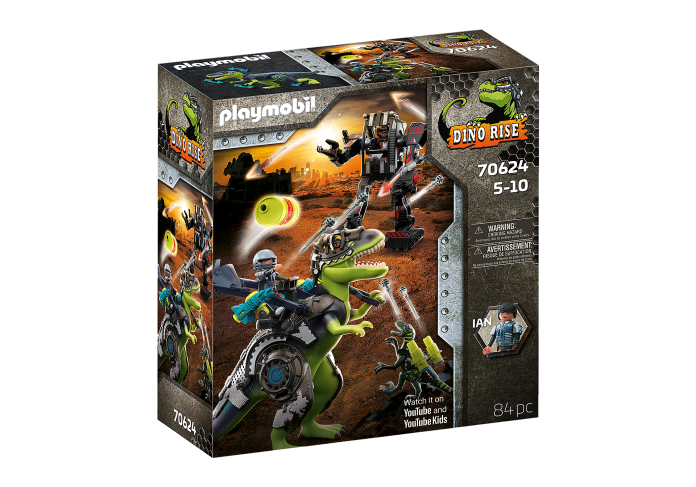
Playmobil have a new range of Dino Rise sets, here we take a look at the T-Rex: Battle of the Giants set (70624).

Equipped with firing cannons, barrel catapult and removable armour. Ian can ride the T-Rex.Attention – the T-Rex is attacking! The T-Rex? Oh no, that’s a hypermodern fighting robot and whoever is controlling it is up to no good.

The robot fighting machine is on destruction course. Who is going to stop it? Suddenly intrepid Ian blocks the machine’s path, and he’s not alone. Ian sits on the back of a real T-Rex with titanium strong protective armour, equipped with cannons and a catapult. Together with the dinosaur and super advanced combat equipment, the two bravely face the machine.

A battle of the giants begins! Get ready for an action-packed dino adventure! Arm yourself with your dino team in ultimate combat gear against the battle robots and save the world.

The set includes the following:

Figures: 1 teenager, 1 villain; Accessories: 1 T-Rex, 1 battle robot, 1 Deinonychus, 6 projectiles blue, 3 projectiles red, 3 energy stones, 1 ton, 2 leg armor, 1 armor with seat, 1 head armor, 1 rocket launcher with armor, 2 helmets, 1 chest armor, 2 arm armor, 1 pair of arm cuffs, 1 change wig.

Recommended for ages 5+, the Dino Rise T-Rex: Battle of the Giants from Playmobil is available now priced around £69.99, and you can learn more from the Playmobil website.

Dino Rise – Pteranodon: Drone Strike from Playmobil

0

Playmobil have a new range of Dino Rise sets, here we take a look at the Pteranodon: Drone Strike set (70628).

The Pteranodon is equipped with scrap parts in the net as projectiles. Kaidan can ride the Pteranodon. Even at lofty heights, the vicious robotic machines are on the move.

A drone makes the airspace unsafe. But that’s no problem for Kaidan and his agile Pteranodon. The pterosaur is at home in the sky. With its projectile net, it can knock out approaching enemies in a flash. Of course, his good friend Kaidan is always with him on his back.

There’s no stopping this clever human-flying dinosaur duo. Attack from the air – repelled!

The set includes the following:

Figures: 1 teenager, 1 villain; Accessories: 1 pteranodon, 1 drone, 1 tripod, 1 remote control, 1 back armor, 1 net, 7 net hooks, 2 projectiles, 2 throwing mines, 2 helmets, 1 headset, 1 chest armor, 1 pair of arm armor, 1 change wig.

Recommended for ages 5+, the Dino Rise Pteranodon: Drone Strike from Playmobil is available now priced around £29.99, and you can learn more from the Playmobil website.

Dino Rise – Spinosaurus: Double Defense Power from Playmobil

0

Playmobil have a new range of Dino Rise sets, here we take a look at the Spinosaurus: Double Defense Power set (70625).

Equipped with firing cannons and removable armour. Samu and Ayla can ride the Spinosaurus.With its razor-sharp teeth, the spinosaurus is one of the largest and most dangerous dinosaurs.

But this Spinosaurus is no ordinary dinosaur, but something very special. Since he was freed from Dino Rock, he and his friends Samu and Ayla have been fighting side by side against the perfidious fighting machines that try to destroy everything.

Thanks to Uncle Rob’s clever fighting equipment, the Spinosaurus also has a special protective armour and firing cannons that make him even more threatening. Will the human-Spinosaurus team with combined power manage to stop the robots from destroying nature?

The set includes the following:

Figures: 2 teenagers; Accessories: 1 spinosaurus, 2 leg armor, 2 back armor, 1 head armor, 2 projectiles gray, 2 projectiles orange, 2 projectile attachments, 1 control seat with tank, 2 interchangeable hairstyles, 2 helmets, 2 chest armor, 1 pair of arm cuffs

Recommended for ages 5+, the Dino Rise Spinosaurus: Double Defense Power from Playmobil is available now priced around £49.99, and you can learn more from the Playmobil website.

Review: ParcSlope for MacBook and iPad

Here is our two minute review of the ParcSlope for MacBook and iPad from Twelve South.

ParcSlope is a dual purpose stand that elevates MacBook screens and angles iPads for more comfort and productivity. With ParcSlope, MacBook users enjoy better ergonomics and increased airflow for a cooler, quieter MacBook. iPad users will love the feel of the 18-degree sketching/typing angle ParcSlope creates. Precision curves, special ridges and built-in cable management make this sleek metal stand a must-have for MacBook and iPad users.    

  • Raises MacBook screen to a more comfortable viewing height
  • Angles iPad for desktop sketching and creative work
  • Increases airflow and cooling around MacBooks
  • Built-in cable management for grab-n-go use

What’s in the box?

The box contains the ParcSlope and some instructions.

A Closer Look

Final Thoughts

Anyone who uses a MacBook or an iPad to do work on, or anything else really, will at some point find it uncomfortable to use, maybe because to the angle of the keyboard, or the environment you are using the devices in.

This is where the ParcSlope comes in. It’s a stand designed to fit either a MacBook or iPad on with a really great angle for keyboard use (its 18 degrees for those of you wanting specifics) and position of the screen for viewing.

The ParcSlope is a one-piece metal stand that is very lightweight and is easy to carry around.

The MacBook fits perfectly on the stand and is held in place, and its very comfortable to use, even for long periods of typing.

The ParcSlope for MacBook and iPad from Twelve South retails for around £50 and is an important addition to your desk set up.

You can learn more from the Twelve South website.

Review: Astro Aqua Kitty

Whenever I picture creatures used in mining situations, my mind jumps to dwarves, rabbits, badgers, or any other subterranean being. It doesn’t conjure up the image of space cats, blasting through rocks and killing enemies. Yet, this is the theme and plot for Astro Aqua Kitty. It’s a fun-filled game with multiple playing options and many foes. Strap yourself in, we’re about to go mining for some gems.

Developed and published by Tikipod Ltd, this is a retro shoot ’em up adventure title with a hint of RPG elements. You must control a pair of heroic mining cats as they delve deep into water-filled asteroids. The sequel to the well-received Astro Kitty UDX, Astro Aqua Kitty builds on these strong foundations. Its latest iteration uses all the well-designed mechanics but blends them into a larger and more open environment for you to explore.

With so many options available, Astro Aqua Kitty plays to your strengths.

I’m not always a fan of games that have plenty of gameplay options. The freedom to customise the game can overwhelm you and can put you off before your adventure begins. Fortunately, this wasn’t the case with Astro Aqua Kitty! Yes, it offers plenty of choices from the start, but none are overpowering, and they definitely won’t confuse you.

You open with the choice of eight cats. Four are pilots and four are engineers. Each of these kitties has unique skills and the challenge lies in picking the right pair for your gameplay style. Alongside this, you are to select your difficulty and whether you wish permadeath to be a feature. The four difficulty settings make this truly accessible.

One of the many missions that lie ahead.

All the kitties want to do is mine for gems.

Mining space gems should be an easy task, but when money and great treasures are involved, it rarely is. With marauding pirates to deal with and an array of monsters to defeat, this is no simple day at the office. Your cat crew must explore eight large labyrinthine stages that culminate with epic boss fights. The traditional approach reeks of classic arcade shoot ’em up titles and I loved that about it. With little in the way of a story, your focus is directed towards the many micro missions you undertake.

Each stage comprises a large number of quests. These involve a variety of tasks; wipe out hosts of enemies, collect crew members, and finding missing objects. Each job ensures you fully explore the surrounding areas and this gives you the chance to earn more gems and gain much-needed XP. As the game progresses the difficulty ramps up considerably. It is essential that you improve your ship and crew quickly. If you fail, you’ll get your arse handed to you.

Upgrades, weapons, and an array of skills.

I loved the level of detail the developers went into for their RPG elements. As XP is earned and gems are mined you are free to improve your pilots and your vessel. There is a plethora of firepower, each with its stats and pros and cons. These weapons have a grading system and the further you go, the more powerful they become. If you are impatient, use your gems and buy new weapons from the shop.

As your kitty pair level up, their ship can be improved and their skills activated. Each level you advance earns you one point that can be spent on either your pilot or engineer. You must decide which upgrade works best for your team and spend them accordingly. Gems can also be exchanged for permanent improvements to your vessel’s health, energy, or shield. I adored this approach as it enhanced the experience and made this more than just another shoot ’em up title.

Float carefully and destroy the monsters.

So many enemies and monstrous bosses.

This wouldn’t be a shoot ’em up titled if there wasn’t an overwhelming number of enemies. Wave after wave of water-loving beasts hide in the cavernous mazes you explore. They hug walls, explode, and continually shoot projectiles at you. It was manic, unpleasant, and blissful hell. This makes this genre great and only the player with the quickest reactions will be victorious.

You can’t have an army of vile creatures without screen-filling bosses, can you? Astro Aqua Kitty has its fill of pesky overlords that want to annihilate you. As the stages wear on, the challenge they pose increases exponentially. You must study their movement, find a weakness, and exploit it.

Astro Aqua Kitty looks great.

So many modern retro-inspired shooters stick with pixelated looks, wearing it as a badge of honour. Astro Aqua Kitty is different. Its up to date style, crisp lines, and vivid colours make it a pleasure to look at. Its large maze-like stages are wonderful to explore, but the vast emptiness takes away from the claustrophobic nature of the original and perhaps dilutes the gameplay. For all its great imagery it suffers from frame rate drops and slowdowns. This only occurred when bosses were defeated! Sadly, it was noticeable as you stuttered to a glorious conclusion.

The audio was great as it added a dynamic quality. The soundtrack was enjoyable to listen to, well-composed, and had plenty of variety. I loved its futuristic and electronic approach and this matched the space theme. The sound effects were as expected but were delivered to a high standard. The whizzing of laser beams and the crunching demise of each enemy was brilliant to listen to.

Pick your crew and prepare to mine.

Shooting enemies and piloting a ship is not a problem for this pro crew.

This is one shoot ’em up that is easy to play. Limited button mapping enables you to master this in minutes. A short tutorial helps with the fundamentals and a gentle learning curve allows you to practice without pressure. The controls are responsive and the layout uses a well thought out design.

With many options to explore and combinations of weapons to use, each playthrough will differ. There is a strong desire to return and try each style and this increases both its replay value and longevity. The choice of difficulties will push the most hardcore of gamers and a strategic mindset is required at the later stages. A moderate achievement list will test completionists, but this doesn’t add much to the overall experience.

Astro Aqua Kitty is a worthy addition to your library.

From its humble origins, this series has grown to an expansive space adventure. This change in direction removes some layers of intimacy and dilutes the gameplay slightly. I enjoyed what was presented, but occasionally I felt lost in the underwater levels. It is great to play and fans of the genre will love it. I recommend you buy a copy here! Choose your team, jump in your ship, and mine some gems. Just try to avoid the monsters that lurk in the dark.

Review: Yooka-Laylee

3D platform games were all the rage in the mid-90s. With many much-loved franchises stemming from this era and many modern series influenced by these games. It never surprises me when titles use these well-established mechanics, but I always worry when a new game comes to market that it won’t live up to my expectations. Yooka-Laylee is heavily inspired by these early console games, so I’m intrigued to see how it’ll compare. Already reviewed in 2017 by Diogo Miguel you can see how his thoughts differ from mine by reading it here!

Developed by Playtonic Games and published by Team17, this is a colourful 3D platform game. It is laced with sarcasm, good old-fashioned wit, fun challenges and many tasks. Using the well-appreciated double protagonist approach, it was clear to see that Yooka-Laylee was influenced by the wonderful title Banjo-Kazooie.

Run lizard run!

Yooka-Laylee has a lot to live up to!

This is one of those genres with die-hard fans who expect everything to be right. Now, I like the genre, but I wouldn’t say I love it, so I’m going to be more forgiving than most. What I expect to find as I delve deep into this colourful, vivid world is plenty of collectables, lots to do, many side quests, and memorable characters. Fortunately, it has all these elements in abundance, so we’re off to a great start.

The story revolves around a crazy evil villain called Capital B and his duck sidekick. They have created a machine that’ll steal the world’s book supply. They want one singular novel known as the “One Book”. Possessing this ancient object will make them become the most powerful beings in the world. As the book is taken, its pages hide in several worlds. You must enter each tome, collecting the pages (pagies) and recovering the book before it’s too late.

Classic mechanics but not enough worlds.

What leapt out at me immediately was the modern take on the classic mechanics. Each of the protagonists brings their personality to the party and they each have abilities that’ll help you progress. The usual; jumping, fighting, and double jumps are utilised. Alongside this, you have bat sonar powers, speed rolling, the power to shoot harvested fruits, and more. The abilities were genuinely interesting and their implementation harked back to the glory days of the genre.

These abilities don’t come for free and a sleazy snake salesman known as Trowzer (yes, he’s a trouser snake. Hilarious, right?) sells you each one for a small number of quills. These feathered pens form the main collectable item and work perfectly with the literature theme. As the new skills are drip-fed, you access more pagies and otherwise locked areas. This, alongside expanding each book, kept you busy throughout your fifteen to twenty hours of gameplay.

Don’t let space stop you.

The gameplay doesn’t quite match its peers.

Even with its many twists and turns, large worlds, and an array of ability, it always felt that Yooka-Laylee was desperately clinging to the past. Yes, it has some interesting moments, such as; the special ability transformations from Dr Puzz an octopus scientist, or the tonics and RPG-style ability modifiers purchased from Vendi the living vending machine. Yet, it felt dated, unoriginal, and uninspiring.

This thought process was confirmed when Banjo-Kazooie inspired game show challenges made repeat appearances. Now, there is nothing wrong with referencing major titles, but to constantly see them in a different franchise held back the creativity. It’s a shame as I desperately wanted this to be original. But its lack of worlds and reliance on other games mechanics held it back considerably.

A 2017 title that has aged badly.

Whenever you think of your favourite game, you always see the best in it. Your rose-tinted view hides the dated aesthetic and the moment you return to play it, you realise it hasn’t aged so well. Unfortunately, Yooka-Laylee has aged badly, and though it is serviceable and has a bright cartoon appearance, it’s rough around the edges. The third-person perspective combined with the juddery camera makes this uncomfortable to observe. The gameplay is also rife with visual glitches and this was a shame as it damaged the end product considerably.

The fun and upbeat audio were to be expected, and I enjoyed the song choices. The lighthearted tunes matched the comical and immature nature of the gameplay. It was surprising that none of the characters had voices, instead, random and annoying sound effects attempted to infer emotion during each cutscene. The sound grated on me throughout and I ended up skipping vital text to avoid listening to the noise. This was a shame, as the text contained the witty banter I loved. This one oversight reduced the enjoyment factor considerably.

Scream if you want to go faster.

Sensitive controls cause many issues.

Half of the challenge in platform games is the intricacies of traversing each level. This fine movement requires accurate controls and a well-designed button layout. This was lacking on both counts and you will be infuriated by the sensitive controls combined with the poor camera angle. Aiming when shooting projectiles was almost impossible, as was lining up jumps. Undoubtedly this poor decision undermined the enjoyment that was had in each of the quests.

Twenty hours of gameplay is a good return for a title in this genre. There are also plenty of side quests, secret arcade games and collectables to be found. So there is an awful lot to keep you playing. A moderately difficult achievement list will make you return repeatedly as will the multiplayer mode. This would have considerable replay value if it wasn’t for the drawbacks to its gameplay.

Yooka-Laylee had such potential, but it’s dated and lacks originality.

Yooka-Laylee had the potential to be a great retro-inspired 3D platforming title, yet it missed the mark. Heavily reliant on other franchise mechanics, it fails to create an identity to make it stand out. Other than its issues I enjoyed playing it, because of its retro style. I felt let down as I guess I just hoped for more. If you love the genre, buy a copy here! I’m on the fence, but its benefits outweigh its negatives, so I recommend it. Can you find the pages and stop Capital B from taking over the world?

Review: Galactic Mining Corp

It’s 7 pm on a Monday evening, you’ve been sent a review code for Galactic Mining Corp and, as you’ve just finished your dinner and don’t have any plans for the evening, you decide it’s time to sit down, put your reviewer hat on, and play the damn game. The next thing you know it’s Thursday morning, you’ve spent 60 hours on the game, you’ve not slept, you’ve not showered, you’ve not eaten and you’re close to dying of thirst. You’ve been fired from your proper job for not showing up two days in a row and your friends and family have called on an international man-hunt because of your disappearance. This is the series of events that genuinely happened to me, for real, in the actual real world and I hope it serves as a serious warning to the addictiveness of Galactic Mining Corp.

I find that when I play a game to review, I make a few judgements early on. Those judgements do develop over my time with the game, but I generally find that my final conclusion doesn’t stray far from the gut instinct decision on my first impression. Maybe I’m just hyper-decisive. However, when it comes to Galactic Mining Corp, my stupid gut couldn’t have been more wrong, because I initially thought that the game was as boring as the pleasantries at the start of your fifth video call of the day. But, after sticking with it for an extra few hours, I can comfortably recommend the game.

Galactic Mining Corp is a rogue-lite, base building, management, mining thing… A wildly irresponsible space entity has left you, a stupid boring human in charge of a Galactic Mining Corp (roll credits). You’ll need to build up your base to keep the company above water, employ a diverse range of aliens to run things and then go mining, which allows you to build your base and hire more people, which allows you to mine more efficiently, and so on… It’s a never-ending cycle in the style of Cookie Clicker which, as any veteran of that particular time-sink will tell you, means the game is as addictive as crack cocaine.

The game introduces itself quite gradually, hence my initial feeling that the game was a bit shallow and dull. However, after not a huge amount of time the game unlocks more and more features to keep you entertained until you’re left with a clear view of a landscape of things you need to do, exactly how many times you need to do them and an idea of how much each of those will make your life easier. I’ll try and give an overview of some of the landmarks in that landscape a bit later on and how they come together to make a complex web of a game in which you are the all-powerful spider.

The core gameplay of Galactic Mining Corp is very simplistic – it’s mining, but not like you know it. You control a drill the hovers mindlessly above an indifferent planet. That planet is made up of blocks, all the way down to the core. When you click, the drill moves towards the mouse pointer and mines everything in its path. Some of the blocks are easier to destroy than others and the harder they are to destroy, the more damage you do to the drill. If the drill loses all of its health you start again from the surface. If you manage to drill all the way down to the core, the planet levels up, making it deeper and more difficult on the next run. I think you can see why I found the game pretty boring in the first instance.

However, tick forward a few hours and I can see that that gameplay is the tip of a titanic-sinking iceberg. I’m not going to go into a huge amount of detail about the additional things you’re able to do but here are a few shaving from the iceberg to cool your tall drink of curiosity:

  • There’s a galaxy map – it costs gold to explore new sectors which have new intergalactic bodies to mine
  • When you get to the core of a planet you can spend those cores on unlockables, such as basic gold generation
  • The blocks you mine are collectable – once you have an amount of a block you can research it to help unlock new rooms
  • Rooms! – They give you upgrades to your drill. mostly multipliers for things like elemental damage (oh, some planets do elemental damage)
  • So much more, like SO much more

Every single step of the core gameplay has additional layers of complexity that progress you forward. Going for a mine unlocks an upgrade which then makes your next mining trip more efficient and that then continues exponentially until you’re auto-generating a literal tonne of gold every few seconds. Every single time you go out mining you want to rush back to base to see what that’s unlocked and then you immediately want to go out and try your new unlock in the field. Addictive is an understatement.

Galactic Mining Corp is one of those games that takes a little bit of perseverance to really hook you but, once it’s got its talons in you, it rewards you with a sweet rush of dopamine every single round. It’s a fantastic game to have on in the background when you’re listening to a podcast or similar and is definitely an addition to my ‘keeping my brain and hands busy for an hour’ game rotation.

Review: The Sinking City

It’s the 1920s, and the world is evolving with technology and new discoveries. Yet, many people are still old-fashioned and like to work traditionally. People have respect for the authorities but are suspicious of private detectives. Too many questions have them on edge, and they’d rather answer with their guns than their words. You get to experience this existence in a grim and dark tale in the world of The Sinking City.

Developed by Frogwares and published by Bigben Interactive, this is a seedy detective game set in a dank world. Inspired by the works of H.P. Lovecraft you experience a typical blend of weird ideas and horror creatures in his Cthulhu Mythos universe. It’s a typical gritty detective drama that firmly sticks with its American writer’s inspiration throughout.

Don’t spend a night in this motel.

The Sinking City tells a tale of new friends and sordid deals.

The Sinking City explores some bizarre and surreal subjects within its 1920s facade. You control a gruff ex-naval diver called Charles Reed. On leaving the forces, he became a private detective. Travelling around America he uses his special powers to solve mysteries, but these abilities have come at a cost. Visions haunt detective Reed and he dreams the same images every night and cannot solve the riddle. This makes him travel to Oakmount, Massachusetts, and this is where the tale begins.

Oakmount is a fictional island on the Eastern Seaboard. A great flood has decimated this once-bustling city, causing carnage and the roads to be partially swamped with water. This disaster brought together two different beings, and the locals hate the Innsmouthers a fishlike people and any newcomers that come to their city. You travel to this wrecked place to meet with Robert Throgmorton a half-man, half-ape being. It is reported that he knows what causes the visions in your head, but your visit hasn’t come at the most convenient of times. Only he can help you, but his knowledge and assistance come at a price. Luckily you have the skills to assist him.

A deeply detailed world full of mystery and jumpscares.

The first thing to strikes you is the level of detail in the surrounding areas. Bustling communities romp around the foggy, eerie streets. An array of buildings and houses form this sprawling metropolis, and the variety is truly breathtaking. You are forced to wander the water lined roads to progress through the many main and side quests you undertake. This was marvellous, to begin with, but as the game wore on it became tedious. So thank goodness for fast travel is all I’m going to say.

As you traverse the grey streets filled with merchants, beggars, and vehicles, you lose yourself in the oppressive atmosphere. You’ll become distracted by the high rising structures to then be scared half to death as monstrous creatures rise from the ground. These jumpscares got me every time, even though I knew they were coming. This was down to the Silent Hill and early Resident Evil elements that have been weaved into the aesthetics. I loved these elements and though it dated the gameplay slightly, it matched the sinister theme and 20s era perfectly.

Don’t allow the insanity to take hold.

Charles Reed: A detective like no other.

The protagonist is no ordinary man, and it wouldn’t be very Lovecraftian if he was. He can understand crime scenes by observing images from the past. He uses his Retrocognition to study items and piece together clues from any crimes he investigates. It was a fantastic way to play with the supernatural and was in keeping with the cosmic thoughts. Yet, like many other clues you are afforded, it’s cryptic in its approach and is extremely confusing to work with.

As you solve each crime, the resulting information is placed in your Mind Palace. Here you work through your findings, connecting the dots and coming up with allegations. Like most of the gameplay, this isn’t a simple yes or no response, instead, your decision impacts whether people live or die, or if you are a good or bad person. It was ingenious, added depth to the story, and made you consider every decision you made.

It was a shame that not all problems were enjoyable to solve. Many of the side quests and the research missions were confusing, with ambiguous cryptic clues to work out. There were many times where I had to guess my way to the answer, as I did not know what was required of me. It was unfortunate as no detective game should require blind guesswork to progress.

One of the many monsters you’ll face.

The Sunken City is disgustingly beautiful. 

No matter the problem solving, drawbacks with the cryptic clues, and other minor indiscretions, the surrounding world is oppressive and beautiful. Its vast and overbearing presence is intimidating and makes you want to explore it further. The variety found in each of the boroughs is fantastic and it ranges from disgusting slums with beggars and burning cars, infestations, and upmarket areas amongst the rubble. The design is truly breathtaking and looks incredible.

This doesn’t mean it’s without fault, as there were some glitches and duplication of NPCs. This was disappointing and took the shine off the final product. I wish the developers had spent some more time adding a range of character models. In its current form, the repetitive nature broke the immersive atmosphere immediately.

If the horrendous beauty of The Sinking City doesn’t capture your imagination, its striking audio and wonderful acting will. The era-specific music was great to hear and instantly transported you to this alternative fantasy horror world. The stunning sound effects helped to fill the void as you traversed vast areas. The screaming of the monsters, the mindless drivel from the NPCs and the environmental noises were all great.

To top it off, though, you are treated to some brilliant acting throughout. Every main character added layers of emotion and drama to the plot and every discussion and cutscene was a pleasure to experience.

Don’t enter the water.

Lethargic and dated combat. 

With the freedom to explore as you like, and many surfaces to climb over, up, and through, it was a good job the control system was simple to understand. Many sub-menus divide up the workload, making it easy to perform the required tasks. Whether you wanted to; make objects in the generous crafting section, scan the map, read through clues, or research in the archives, it was all stored in its own menu. 

It was simple to work through, and the button mapping was straightforward. Yet it was still problematic! Combat was painfully slow and was reminiscent of PlayStation One adventure games. It felt clumsy and underdeveloped and even when Charles was levelled up he was slow and underpowered. I had no expectations that he would become a superhero. It simply felt unrewarding. 

This is one of those detective games where the outcome doesn’t change, but the road to getting there can take many directions. This approach vastly increases the replay value and you’ll return to make alternative choices time and time again. With twenty to thirty hours of gameplay to work through, plenty of quests, and an amazing world to explore, this is great value for money. The moderately sized achievement list is challenging to complete. Those wishing to get them all will have to dedicate time and effort to the cause, increasing their playing time considerably. 

The Sinking City was a pleasant, if not weird, experience. 

I had no prior knowledge of The Sinking City when I started it, and my expectations were low. It’s fair to say I was pleasantly surprised, and I thoroughly enjoyed my time with it, even if it was bloody weird throughout. With a fantastic world to explore, excellent audio, deep and interesting characters, and a strange Lovecraftian inspired tale, this is a must-have game. Yes, it has its problems, but these fade into insignificance when weighed up against the positives. I loved it and recommend you buy it here! Odd visions, an eerie city, and untrusting locals make Oakmount an undesirable but necessary city to visit. Work with Robert Throgmorton, abide by his demands, and unravel the mysterious images in your mind.