James Bond remains one of cinema’s most prized commodities, raking in the money and entertaining the audience. Why doesn’t the world tire of 007?
The Bond Franchise: All Time High and Refuses to Die
James Bond, the super spy created by Ian Fleming, has always been popular. The combination of guns, gadgets and glamour is what makes James Bond so intriguing to audiences. James Bond is the greatest super spy the world has ever known. He’s also one of the most beloved film characters in all of cinema history. The character of Bond is one that has remained popular for over fifty years. The reason for this popularity can be attributed to the fact that each actor who plays Bond does something different with the character while still maintaining certain aspects of his personality.
The Business of Bond
One can also assign 007’s staying power to the way that the business of Bond has been run; even though the release of Bond films have been relatively consistent over the years, it’s never been to the point of oversaturation. The periods between these films has always been long enough to nurture the public’s appetite for more. The Bond films are lavish productions, with costs running into the millions, yet, while they’re distributed by big studios like Sony or Universal, they’re made by Eon productions, which has been described as a ‘mom-and-pop’ operation, and this is because for years, the franchise has been in the hands of the Broccoli family. Either way, owning shares in production companies like the three just mentioned would line the pockets of investors and traders alike.
A franchise that ages like a fine wine
The MCU has been greatly piloted by Kevin Feige, but the rate of at which Marvel films have been churned out has caused many to suffer from superhero fatigue. There can be little doubt that Bond’s steady rate of release combined with the fact that the films almost always deliver an expected degree of quality have allowed the franchise to age like a fine wine. Over the years each actor that has boldly taken on the mantle of 007 has played the character to his strengths, thus defining each tenure as an era. Quite recently audiences had the pleasure of seeing the Daniel Craig era come to end in absolute style with the release of No Time To Die. And while many Bond aficionados will always debate which era or actor is the best, with Sean Connery usually coming up tops, most place Daniel Craig at a close second. Craig’s tenure has been unique; he’s the only actor who had the opportunity to play the character from a hard reboot. This also allowed the producers to depart from the episodic nature of the Bond movies and do something they’d never done before with the character – to give him an arc. The Craig films combined tell an entire story from beginning to end, and if the ending if No Time To Die is anything to go by, it will be interesting to see who will ask for a Vodka Martini next and fill those shoes.
It might be beloved, but it’s also about the money
It’s easy to overlook the fact that the 007 movies are about more than just satisfying fans and movie-going audiences alike; they’re also about money – a whole lot of money! The Craig era alone has generated nearly $3.2 billion and when one takes into account the fact that the revenue from the entire series is $7 billion, it soon becomes apparent that Craig’s era has been a real money spinner. The Bond films outside of their entertainment value have always served as great vessels of advertisements – watch No Time To Die to see how often Bond makes sure that everyone can see it’s a Heineken he’s drinking – with each film providing a slew of product placement opportunities. And let’s not forget the merchandise; toys, video games released across a slew of consoles since 1982 and an official 007 domain where fans can buy everything Bond under the sun. James Bond is important both culturally and as a currency.
The youth of today have a vast array of entertainment options at their fingertips. Whether it’s the Internet, cartoons, or TV shows, there is something for everyone. Growing up in the 80s, I loved cartoons, and fortunately, my children enjoy these classics as well. However, I can’t prevent them from watching modern kids’ programmes. Blaze has recently captured their interest, so when Blaze and the Monster Machines: Axle City Racers was released, I let them have a copy.
Developed by 3D Clouds and published by Outright Games, this is a colourful racing title. Coined as perfect for any age group, I think the developers were a little hopeful. As an adult, this title offers little challenge, and a minuscule amount of content. However, my children loved it and subsequently, I lost my Xbox Series X for many hours.
Blaze and the Monster Machines: Axle City Racers captures the essence of the show.
If you have never watched the show, let me quickly get you up to (blazing) speed. Every story revolves around AJ and his monster machine called Blaze. His team of friendly trucks must complete missions while teaching the audience about maths and science. So, fortunately, it has an educational edge that’s produced in a fun and colourful way. Like all great kids’ programs, it has a villain and in Blaze, the baddie is called Crusher! He has a sidekick and together they cheat their way through life but always fall short. The producers of the show love a good moralistic ending.
Blaze and the Monster Machines: Axle City Racers focuses on high adrenaline racing with the odd smattering of information. The similarities to the TV program are minimal and its faithful elements revolve around the characters and their voices. The lack of depth or connection to the TV series won’t bother younger players, but it irked me considerably.
When a game uses a big name to sell its product, I expect it to try to be an extension of the franchise. Sadly, though, this appears to be cashing in on its popularity.
Use your power-ups to get ahead.
Limited modes.
The game offers three distinct modes to enjoy. Quick Race, Play with Friends, and Adventure. Each has further sub-menus, and except for Play with Friends, must be tackled solo. The gameplay revolves around races of three laps in specific locations. Each has tried to have a unique look and style, but sadly, it all appears the same.
The main mode is Adventure which gave the impression there would be some depth to the gameplay. Unfortunately, this wasn’t the case. The mistitled mode should have been labelled as a tournament because that is all it is! You will take part in three separate events, each comprising three races. You complete the event, move on to the next, and eventually arrive at the finale. The last race mixes things up and you go head to head with Crusher. It offered little in the way of a challenge but was a relief after so much repetition.
The Play with Friends option is where it comes to life, and here I spent most of my time competing with my children. Presented in a split-screen fashion, I loved how well it performed and how smooth the gameplay was. My kids enjoyed the fast racing and the simple approach from 3D Clouds.
Take in the sights as Blaze.
A limited roster of characters, but at least they were unique.
A small roster of characters is available to be picked. You have the chance to select the key protagonists from the series and this was enough for my children. I, however, wanted more options and the ability to customise my truck. If the developers had allowed for customisation, this would have added some depth, which was sadly lacking.
Though the choices were sparse, I have to applaud the developers for their eye for detail. I liked how each machine had a unique skill set and special power. These are charged by collecting spanners that are located on each map. Blaze has his ‘blazing’ speed, Darington drops confetti, Crusher slows you down, and so forth. Charging the power-ups was guaranteed, as the developers were overly generous with the placement of spanners. Again, this worked perfectly for my kids, but it reduced the difficulty further for any adult gamers.
Blaze and the Monster Machines: Axle City Racers looks the part but is dated.
Blaze has a distinct style, and this has been captured in Blaze and the Monster Machines: Axle City Racers. It’s just a shame that it’s pretty dated. The colourful landscape, familiar machines, and twisting racetracks entertained the kids throughout, but for me, I wanted more. There wasn’t enough complexity to any event, and the gameplay was impacted because of this. No matter the difficulty, the computer never challenged you. When you have nothing to look at, except for some dated graphics, it becomes tiresome quite quickly.
Fortunately, the audio wasn’t as drab! The familiar voices and little sound clips bring the gameplay to life. The use of the theme song was a hit with the kids, and it set the scene nicely. The engines are a little lacklustre, but they work in a childish cartoon environment. The constant chatter from each character was enough to fill the room with laughter, so 3D Clouds has got this element right.
This mode is great with kids.
Excellent controls for children.
Continuing with the praise, the controls are exceptional for a younger audience. They are simplicity personified and there is even an option for automated driving. This makes it much easier to play as a family as the computer assists younger players. This was excellent as it levels up the playing field nicely. I admit I was dreading the normal arguments and frustrations as I introduced the family to the first race. However, I was wrong to be concerned, and subsequently, we all had a great time.
The kids were beaming while they were playing, and they were desperate to play again. It’s clear that this has hit the right note with them and the game is aimed at a less skilled and younger market. As an adult, you’ll need limited time and patience to complete it. Therefore, I won’t return to give it another go unless my kids insist on trying to beat me.
Blaze and the Monster Machines: Axle City Racers is perfect for youngsters.
I rarely give out two scores for a game, but Blaze and the Monster Machines: Axle City Racers needs it. As an adult, it’s clearly lacking and underdeveloped. It is unashamedly cashing in on the name, but this, sadly, is nothing new. For this reason, it scores between 4 and 5. Alternatively, my kids adored it! They couldn’t care less about the lack of complexity or character models. They smiled throughout and want to play again, so for that reason, it gets an 8. If you have children this is a must-have and I recommend you to buy it here! Pick your favourite character, win each race, and pick up the coveted Cup.
My video review with footage captured from my Xbox Series X, enjoy!
Building upon the success and maintaining the momentum of the overwhelmingly favoured realme 8 series, today, realme will launch one more best-seller candidate: realme 8i. Since its inception, realme has been carrying out the mission of democratising tech for all, by providing cutting edge technology at an affordable price.
This time, the realme 8i brings the first 120Hz ultra smooth experience with a never before seen affordable price. Equipped with a powerful G96 processor, 120Hz display, and up to 7GB Dynamic RAMwhile also featuring a massive 5000mAh battery with 18W fast charge, realme 8i is poised to be the ultimate smooth superhero.
realme 8i comes with Helio G96’s debut in Europe. The Helio G96 possesses two large A75 cores and 6 small A55 cores, and its main frequency reaches up to 2.05GHz.
The Helio G96 processor is jointly overseen and launched by realme and Mediatek, demonstrating realme’s determination in ensuring quality control and product development. Seven senior engineers were assigned to guide the whole process. Over the course of 106 days, they had technically optimised 3 major performance features, making the realme G96 the only G9 series chip that can power 120Hz displays for updated smooth gaming performance. This is also realme’s first screen in which the brightness can reach as low as 1 nit.
Combined with high-quality performance, the realme 8i also offers the ultimate immersive viewing experience with its 120Hz refresh rate, 6.6inch full screen with a 90.8% screen-to-body ratio, allowing more people to enjoy the ultra-smooth experience together.
Apart from processor and screen display, realme also upgrades the smooth experience with DRE technology, Dynamic RAM Expansion, where 4GB RAM can be upgraded to 7GB RAM (only 4GB+128GB version). The DRE technology is originally derived from computers and is now applied to smartphones for comprehensive uplift in overall smoothness. Not only do apps open faster, but background processes also move faster.
The realme 8i not only delivers a smooth experience but the 5000mAh Battery has also been optimised for ultimate, long-lasting performance that doesn’t affect the day-to-day experience. With just a single charge, this device lets you talk to your friends for 40 hours straight, listen to 1,200 songs or watch 18 movies.
Wales Interactive, acclaimed for its FMV games and narrative-driven stories, has revealed that interactive movie Bloodshore is set to wash up on all platforms starting November 3. Players must battle out in a dystopian battle royale set on a mysterious island location; where influencers, death row inmates and failing celebrities compete for a life-changing cash prize and all the attention they could ever want.
As the world watches on, player decisions dictate the story arc and outcomes — ‘Kiss the girl? Kiss the boy?’ or ‘Kill the girl? Kill the boy?’ — in Bloodshore they can end up being the same thing.
The brand new trailer below shows the life-or-death decisions players will have to make, and with eight hours of FMV footage — the most for any game — each playthrough has winding paths that will affect the narrative and the outcomes of the story.
Bloodshore arrives November 3 for PC, PS4, PS5, Xbox One, Xbox Series S/X, Nintendo Switch, Mac, and iOS, with more details available on the Steam page.
Originally released as a mobile game five years ago, Kickerinho World: a freestyle football-simulator, where your goal is to become the world’s best juggler, now comes to everyone’s favourite portable console.
Featuring over 34 different tricks, Kickerinho sounded like – for me and my gravely uncoordinated comrades – somewhat of a minor power fantasy.
What I wasn’t expecting – masked within the familiar colorful mobile game aesthetic – was such a degree of challenge that Kickerinho has to offer.
The nature of challenge:
Challenge is something that is altogether welcome in gaming. It is relative; where some games offer multiple degrees of difficulty, others – like the Dark Souls series – mostly stick to their ‘intended’ difficulty, where it is up to the player to ‘git gud’.
I am slightly ashamed to admit that during the initial tutorial for Kickerinho the label ‘Dark Souls of juggling a football’ did come in and out of my mind – a few more times than socially acceptable.
Kickerinho isn’t easy. Mastering each skill requires you to carefully utilise the Switch’s trigger buttons. Timing has to be precise, and whilst this did keep me coming back to the game regularly, there were times where it felt like I had timed it perfectly, but the game just wasn’t very responsive. Especially when trying to head the ball.
That being said, it felt great when I did manage to pull off some of the more high-level skills – despite it feeling like more luck than skill.
I appreciate having to learn precise inputs, but I found that during my time with Kickerinho, there was just so much inconsistency in terms of whether I pulled the trick off or not, and this made a sense of progression feel less than tangible.
The game does have customisation options and unlockables that aim to reward taking on the various challenges that Kickerinho offers, which is always a bonus.
That being said, unlocking new maps was a disappointment, as the colourful yet lifeless backdrops do little in the way to shake-up gameplay.
A new platform – was it necessary?
One thing that is immediately apparent is the extent to which Kickerinho World has been designed for mobile. The game excels in short and brief gaming bursts, but during a longer session, the clunky controls and lack of variety hamper the experience.
The absence of annoying add pop-ups trying to lure you to the latest microtransactions is definitely a strength for the Switch port, however, there isn’t anything else here that would make the Switch the more favourable choice. Add in the inconsistent feedback from the control scheme, and what you have is a port that feels subpar to its mobile counterpart.
A lack of gameplay variety, challenge that is induced by the control scheme rather than intelligent game design and just an overall more inferior port makes Kickerinho World a tough one to recommend; even for those like myself who dream of having crazy tekkers. Better lace them boots up and hit the local park instead.
With Christmas not too far away now, we are going to be looking at various things you might want to consider – here we look at the SpyX Micro Gear Set.
The Micro Spy Gear set is perfect for mobile Spy Surveillance!
What’s in the box?
Features a utility belt with 4 micro tools, including a Micro spy light (with an ear clip for hands-free), an Invisible ink pen (decoder light reveals secret messages), a Micro Motion Alarm (beam detects movement or vibration) and a Micro listener (features ear piece).
A Closer Look
Final Thoughts
If your child fancies themselves being the next James Bond (and why not now that Daniel Craig has hung up his Walther PPK) then the SpyX Micro Gear Set could be that first step in the right direction.
In the box you get everything you need to start you off – a micro listener, a micro spy light, a motion alarm and an invisible ink pen.
The pen is great, it can write in invisible ink and the other side of the pen has a light that can read whatever has been written. Unscrew the pen and theres a hidden compartment holding some paper.
The spy light shines a strong red light that can be clipped onto your child’s ear.
The motion alarm can be set – and when it goes off its loud, so no one will be able to sneak up on you.
The micro listener works really well too and all can be attached to the belt using the supplied clips meaning all your gadgets can be carried and easily removed and used when needed. All the gadgets are very lightweight so are easily carried around.
The motion alarm requires 2 AAA batteries that are not supplied so make sure you have some ready to use. The light and pen already have batteries including but you will probably need to replace them quickly, depending on how much they get used. Certainly my trusty assistant wanted to play for hours with all the kit during the review.
If you are looking for something fun for Christmas, then you really should take a look at the SpyX Micro Gear Set as its a lot of fun. SpyX also have other sets that you can buy, so take a look to see what else might be of interest.
Aimed at children aged 6 and above, the SpyX Micro Gear Set is available now priced around £20.
There are classic rivalries the world over and the nature of hunter and prey is a brutal reality for many creatures. However, have you ever considered this concept for inanimate objects? Amuse me for one moment, if you will! Chefs spend their days hacking and slicing food while wielding brutal tools. What would happen if the food suddenly sprung to life? Would it assume the role of prey, knowing its life was over before it began? Or would it fight back and take control? Cheftastic: Buffet Blast explores the latter option with brutal consequences.
Developed and published by Not A Goose, this is an exciting top-down arcade shooter. Created by a small team of four people, I initially got hands-on with this at EGX 2021. It was one of the standout games for me and I loved its concept art style and simple yet moreish approach.
Meet the enemy!
Cheftastic: Buffet Blast keeps things simple yet challenging.
I love it when I can pick up a gamepad and jump into the action and that is exactly what happens in Cheftastic: Buffet Blast. With a little practice and a glance at the controls, I was ready to take on each wave of zombified vegetables that decided to attack me.
The game comprises three unique biomes, seventy different stages, three enemy types, and a range of weapons and traps. The strange story that forms the backbone of the action is odd and has little consequence to the ebb and flow of the action. The Isle of Verdura has been overrun by swarms of mutant vegetables that are hell-bent on killing every chef they meet. You must destroy every enemy you meet while collecting power-ups, lives, and activating traps.
Swarms of enemies, powerful weapons, and a leaderboard.
The never-ending swarms of enemies attack you in unrelenting bursts called waves. As each attack subsides, you must collect cooking utensils and deserts (how very apt) that are strewn across the map. These items adds to your score that is reflected upon the leaderboard. Other than this, there is no incentive to waste your time by collecting it. This was a shame, as I’d like to see the scoring system relate to in-game performance. Maybe a better score could improve your arsenal of weapons or it could be spent on extra lives. This would have added a tactical element that is currently lacking from this fun title.
You start each playthrough with a handy, yet uninspiring rifle. With a little luck, you’ll collect timed power-ups that provide you with new weapons, shields, traps, and extra lives. You’ll collect flamethrowers, rapid-fire, shotguns, bouncing bullets, and more as you attempt to stop each wave. Pepper pots circle your player and form a moving barrier that helps to keep you protected. Traps spawn from the floor, and you must drag your foes to these deadly blades while dodging their projectiles.
The power-ups that’ll help you out.
Aggressive enemies and challenging stage layouts.
Every level is loaded with angry and aggressive foes! You’ll fight carrots, tomatoes, and onions, and each has a unique attack that requires a different approach to take them down. The current roster of enemies is good, but I would like to see more added. A larger pool to fear will force you to consider a new style and will keep the gameplay fresh. I would also like to see bosses implemented. This would create unique events and would further increase the challenge.
Where the developers have excelled is the wonderful stage design. The interesting layouts that vary significantly all offer unique challenges. You must quickly study each stage to ensure you understand the vegetable’s weak points and the areas to avoid. I loved the additional difficulties this added to the action and the vast quantity of maps on offer.
Cheftastic: Buffet Blast is a well-polished indie title.
Considering the size of the team, the end product is extremely well put together. With smooth gameplay, few frame rate issues, and limited problems, this is a well-polished title. Cheftastic: Buffet Blast’s simple style complements the bullet hell, top-down arcade approach. Its fixed-screen perspective is key to ensuring the action doesn’t overwhelm, and this was another great choice by Not a Goose.
A hectic all-out blazing game deserves high energy audio filled with booming sound effects, and this is exactly what you get. Its overpowering audio works beautifully with the theme and genre and I loved its lack of complexity.
Even the cold won’t stop those pesky vegetables!
Responsive controls and partial gamepad support.
There is nothing worse than a fast-paced shooting game that has sluggish controls! Fortunately, this is responsive and well balanced. The sensitivity is well-considered and its button layout is simple to understand and easy to master. Thanks to its partial gamepad support, it’s more inclusive, and this enables more players to pick it up with ease.
In its current build, I was only able to play one mode. Yet, this was enough to get me hooked and to keep me returning for more. I’m hopeful that it will have multiple gameplay options in the future and a full achievement list to add further challenges. A hardcore mode is essential for this to reach its full potential, alongside this I expect to be able to set a plethora of in-game rules. Options to limit lives or weapon choices would be nice, but an increase in difficulty and maybe additional objectives would extend the longevity.
If the developers introduce their planned points system, the game will have much more depth. On full release your score will be used to upgrade equipment and to unlock further levels. This will be a fantastic mechanic that will improve replay value vastly.
Cheftastic: Buffet Blast is simple yet effective.
I was drawn to Cheftastic: Buffet Blast because of its developer’s energy and its simple core concept. I loved how effective its basic premise was and I could easily play it for hours. Yes, I would love to see it evolve to fulfil its potential, but not if it ruins its wonderful gameplay. I loved it and recommend you to wishlist it here! Zombie vegetables must learn their place in life! Grab a weapon, visit the island, and mow those zombies down.
Summary.
Cheftastic: Buffet Blast is an exceptionally fun game in its current build. Its gameplay is interesting, the enemies are challenging, and it has limited issues. However, a few minor tweaks and additional content will enhance it further and will make it stand out against its peers. It’s a jam-packed genre but I’m confident its fun concept will make it a game you’ll want to play.
From the originator of XCOM, Julian Gollop, comes a title to challenge the genre-defining game he was responsible for, a strategy turn-based behemoth appropriately named Phoenix Point: Behemoth Edition. Containing all the DLC and updates from its 2019 PC release, PP (as we shall call it) was unleashed on consoles in October 2021.
Humanity is on the brink of collapse from an alien threat known as the Pandorum and it’s your job as leader of the recently revived peace-keeping force the Phoenix Project to pull the world back from the precipice, form alliances with warring factions, and take the fight to the threat that has laid waste to the world with its virus and mutated army.
How you go about this though is entirely up to you, with tremendous freedom to tackle this threat however you wish.
The remnants of the old world are divided into 3 very different factions – New Jericho, who advocate human supremacy and who wish to return to how it was before the invasion; Synderion – who advocate a lack of a ruling structure and wish for co-existence, and the Disciples of Anu, who worship an alien god and wish for humanity to progress through mutation. These 3 have their own cities known as ‘havens’, their own technology and armies. Rising like a phoenix from the ashes, you need to pick up the pieces of the Phoenix Project, reactivate your long-abandoned bases and amass an army to push the world forward.
Who will you side with to achieve this goal? And how many times will you sacrifice your ideals to see to some semblance of normality? This is grey area where PP thrives and it’s a great compliment to the gameplay, allowing you to feel immersed in the world and sympathize with its inhabitants’ plight.
Gaining the factions’ trust is essential to ally with them and can be had by talking with them, defending them, and even the mandatory (and sometimes unwilling) sabotage of one of the other factions – but war my good friends, in PP, is unavoidable. Once you have built your relationship to certain levels you can gain access to their research, and even their equipment, which you can hugely benefit from as there is a great variety of very effective weapons specific to certain factions. It’s not a permanent agreement mind you, so if you fail to protect them from an attack, or irritate them by talking kindly to other factions and you’ll lose favor and any benefits you previously gained – so you need to flex your democratic muscles wisely.
The great-looking world map that I never got bored of navigating.
The ‘home’ map offers the world (or ‘Geoscape’) as your playground and it allows you to expand your influence from your bases outwards with your aircraft being your tool to explore once you have the ability to scan the area. From your base and the map itself, you can scheme and plot which missions you should follow, where you wish to explore next, and also what to construct and research. The enemy will expand and evolve their influence from their nests, with roaming flying attacks and a virus that spreads a lovely shade of red all over the world.
In terms of the battle gameplay, the characters have upgrades depending on their assigned type and you are able to research and develop more equipment for them throughout the game as you can across more resources, your use of which is key to your success. Overspend your resources of ‘Tech’, ‘Materials’ and ‘Food’ and you put yourself at a huge disadvantage and in a hole that is hard to climb out of.
Launching into missions places you on an isometric grid battlefield with a team of up to 6 members and with the choice of 3 different types (Snipe, Assault, Heavy) as well as vehicles, you have the freedom to attack how you wish. Loadout with a team of snipers where you can perch on top of map’s buildings or equip a team solely with grenade launchers, you can approach the missions in completely different ways each time. After developing research or relationships with the other factions you can also recruit a large variety of different soldiers with very different skills.
The map has every useful indicator under the sun including a useful indicator showing where enemies can be seen from.
The enemies are, in the beginning, equally few in number, but evolve and increase as the game goes on, becoming larger and more dangerous.
You are able to take multiple actions on each turn through the action point system, that might let you maneuver to a good shooting position, shoot and then even return to cover from fire by dipping into your ‘Will points’, assuming your character has that ability, which there is great flexibility in how your attack.
Players familiar with XCOM will be right at home with how PP plays with an overwatch system and action points that you have available each turn, but one aspect that differs is a free aim shooting system, which allows you to go from the standard isometric view to a behind the shoulder and then to a first-person view to shoot at the enemy. If that wasn’t awesome enough, they’ve also added a detailed damage system that allows you to focus on specific limbs causing effects like removing equipment, restricting movement, or adding status effects.
This Arthron is not long for this world.
Permadeath is also very much a threat and combined with a decent customization system, and even a memorial page for fallen soldiers, it should have made for some particularly tense moments when a customized character is on the verge of death, but it, unfortunately, leaves too much of that dramatization down to your imagination with very little dedicated to the loss within the fight itself. Sure, your characters groan with their last breath, and your remaining team members all lose ‘will points’, but there is a big gaping hole where the theatrics should be, lacking recognition between your teammates, no matter how small, to suggest that they care. Paradoxically this actually helps the game create an impersonal and dark atmosphere, one of inevitability and futility where losing entire teams to poor planning and impossible missions is perhaps expected.
You are able to customize the name, appearance, and equipment of your characters. See them perish in battle and they will join the ‘Memorial’ tab.
Unfortunately, the enjoyment of the battle-based gameplay is handcuffed by surprisingly poor performance. It goes without saying that one of the game’s most marketable features should not be its worst-performing, but its free shooting animation freezes both the visuals and audio each and every time you fire a gun. That, all by its lonesome, can be gotten used to (until you see footage online of people playing without it), but what is harder to forgive are the game’s 2-3 minute loading sequences times and the soul-destroying bug that crashes the game every hour or two. It should be said that this is a well-known feature of the Unity game engine, but even by its own standards, this is a little extreme, bringing back memories of Soldier of Fortune‘s 2.5-minute loading screens on the SEGA Dreamcast – oh the nostalgia!
To get the most out of PP right away though you’ll need to do your research – unless you’re happy with wasting a 10+ hour campaign trying to figure it out. I, for example, went hours into the game with only one squad to battle the Pandorum, but the many dormant Phoenix bases and the worldwide mayhem that you need to keep an eagle’s eye on requires at least one other squad. Slow to pick this up, I found the virus and the enemy had reduced the world’s population down to an unrecoverable amount and when I tried to hastily create another team to counteract this, my leveled-up units were spread too thinly across the two teams, and my playthrough ended in a pathetic whimper, unable to defeat any meaningful missions with the few resources I had left.
Impressive is the game’s interface, with the menu and map design suiting the PS4 controller perfectly – which is frankly, nothing short of a miracle for a game with so many options. The visual quality of its assets and audio, though, is contrastingly average and does little to add to the overall experience, clocking in and clocking out at the right times but doing nothing noteworthy during its shift.
The worldwide political dealings and minuscule machinations provide by PP are something I greatly enjoyed. Add the customizable system, depth in both gameplay and story and everything you’d expect from a strategy game is here, it’s just not been actualized in the way you might have hoped.
Phoenix Point: Behemoth Edition offers incredible value with potentially 100s of hours of content and multiple endings, but there is no mistaking that the PS4 is probably not the greatest platform to play it on, with loading times that’ll give you time to do the dishes, clean your clothes and doomscroll twitter with time to spare. Assuming this game can be played without said extended delays and the frequent crashes, though, this is as good a strategy game to lose yourself in as any, and with the constant updates that it receives there’s no telling how good it might get.
The Sega Mega Drive was renowned for its fast-paced shooter titles. Fans of this console were spoilt for choice, and in 1992, Gleylancer was released. It received mixed reviews but was enjoyed for its classic gameplay and difficulty. Roll on nearly thirty years, and Gleylancer has returned to our consoles. With a few tweaks to its settings and in-game options, it’s a faithful recreation of the original affair.
Developed by Masaya and published by Ratalaika Games, this is a no messin side-scrolling shooter. The world of remakes, remasters, and a lack of originality has taken over, so one more classic title to the pile won’t hurt anyone!
Gleylancer comprises old-school Anime cutscenes and a modern polish.
I’m old enough to remember this the first time around, and it was far too difficult for me. So, when I was offered the chance to defeat it as a veteran gamer, I wasn’t going to turn down my chance of revenge. The newest version has retained most of the style, audio, and Anime cutscenes. But, there are improved modes available with accessible features and a focus on modern control systems.
In short, it retains that old-school charm, while not acting or handling like a tired dog! Its modern take on the controls should have made it much easier to play. However, it’s still as challenging as ever, and every spaceship is out to destroy you.
The story revolves around a war between humans and aliens in the year 2025. You are Lucia, a young pilot whose father is the commander of the space fleet. The aliens transport his ship to an unknown area of space and Lucia is understandably heartbroken. Determined to save her father, she steals the latest prototype fighter jet and sets off into space. It’s all very dramatic and clichéd, but I loved its OTT action.
I loved the old-school Anime art.
Simple mechanics and hectic battles.
What makes Gleylancer so moreish and easy to pick up is its simple mechanics and accessible settings. The action focuses on Lucia piloting the spaceship and the two additional weapons she collects. You control the movement of the vessel and the direction of the cannons. Throughout each of the stages, you collect power-ups that change the effectiveness of your guns and alter the difficulty. You start each playthrough with a set amount of lives and if you lose them all, then it’s game over.
You are free to select the position of your additional weapons, the methods in which they move, and if you manually fire your guns. I loved these choices as they allowed you to familiarise yourself with each stage before increasing the difficulty.
You’ll journey across the depths of space and the game comprises 10 unique stages. At the end of each level, you must take down a ridiculously large boss that is usually overpowered and stupidly tough. Alongside this nightmare, you must prepare for an array of enemies, space debris and attacks from all angles. It’s horribly hectic, requires you to stay alert, and will test the best players.
Steal that prototype.
Sounds unfairly difficult, right?
You may be reading this and thinking, “that sounds unfairly difficult!” At times, I winced, screamed out loud, and vowed never to play again. But this is the beauty of old-school shooters. The insane difficulty makes it annoyingly rewarding and you won’t put it down until you are victorious.
To help level out the playing field a little, Masaya implemented three difficulty settings and the ability to slow down or increase the game’s speed. These are classic arcade-style mechanics and they work wonders to help players that are struggling. However, no matter the level of help given, the only way you’ll succeed is if you cheat or practise.
Gleylancer has smooth gameplay, but it’s tough to identify enemies.
The port to the modern console can be challenging, yet, Gleylancer is a success. Its smooth gameplay and modern polish make it enjoyable to play while keeping the old-school charm. The 16-bit imagery will fill retro gamers with nostalgia, and I loved its presentation. Though, sadly, I didn’t like the use of a limited colour palette. Every obstacle, enemy, and item of the scenery looked similar. This made identifying anything at speed almost impossible and, subsequently, it made it much harder.
The graphics weren’t the only thing that tweaked at my heartstrings. No, the synth-wave audio transported me back to my misspent youth. I loved the aggressive soundtrack, the overbearing sound effects, and the simple noises. The shrill sounds and robotic narrative were incredible to listen to, and it was worth playing just for the audio.
Dodge and shoot!
The controls are a vast improvement.
Gleylancer was unable to make too many changes without ruining the original gameplay. However, fortunately, the controls were one area that has been improved. The much smoother and well-rounded aiming ensures you have a better chance of survival. They are also much more responsive and you can now change them on the fly. This helps as the enemies evolve and the bosses become more challenging.
Shooting games are always addictive, and Gleylancer is hard to put down. No matter how tough the action was, I still returned to shoot more enemies! The high score and leaderboards increase the competitive edge and the small but difficult achievement list won’t be easy to complete.
Gleylancer proves that older games still cut it in the modern era.
Some titles are best forgotten, I’m looking at you E.T. the Extra-Terrestrial! Yet, Gleylancer isn’t one of those games. With the community screaming for it to be released, I’m sure this will be gladly received by all who play it. I loved it and recommend you to buy it here! Can you defeat every level and each boss to save your father? Jump in the prototype ship and shoot anything that opposes you.
It’s been a while since I’ve played a game with this much effort put into worldbuilding. Opus: Echo of Starsong is positively oozing with lore, backstory and exposition. It skirts the line of being overwhelming at times, but never crosses that threshold. Instead becoming one of the most fully realised worlds I’ve had the pleasure of engaging with in a long time.
Explore Some More
Usually when I write a review I start with the story. I look at the setting, who our protagonist is, and their motivations. However, with Opus: Echo of Starsong I think that a different approach is necessary. So let’s start with the main component of gameplay in this title. Exploration. You’ll be spending the majority of your time in this game on your ship. You travel from location to location, analysing it before stationing the ship there in order to explore for resources, or interact with the people and areas that move the plot forward.
Getting from one point to the other, of course, requires fuel. Along with armour plating and exploration kits, fuel is a valuable resource that often gets replenished while exploring locations. It makes for a very effective loop and straightforward management of resources. You can also pick up items to sell, or items that an NPC may have requested. Exploring is vital in order to save money on fuel, it also enables you to find the materials needed to upgrade your ship.
Every single location in Opus sports some exposition in the form of a memory belonging to our main protagonist Jun. As you arrive, a bit of text explains the history of the place, or its relevance to the plot or to a character. Whether it’s an abandoned space station destroyed in the United Mining War, an outlaw city, or a shrine dedicated to one of the gods. Many locations also have people to interact with or areas to explore that add flavour to the world. With the places steeped in history, and people either requesting your assistance, or looking to take credits off your hands. Every interaction holds weight, and even when you fail you get something out of it. Such as intel aptly named “tale of failure” that can be sold to merchants.
The sheer scale of the system Opus is set in is really quite impressive. It’s huge, with places to explore littered across the map, and it’s all at your fingertips. You can and probably will progress through the map naturally along with the plot. However, much of it is available to see whenever you’d like. I haven’t felt a sense of satisfaction in exploring a galaxy like this since my first time playing Mass Effect or No Man’s Sky (after its redemption arc).
Meet Our Heroes
Your introduction to Opus’ setting and storyline is through a foreign noble, Jun. It’s actually the perfect entry point, as the star system this game takes place in, Thousand Peaks, is as unfamiliar to him as it is to you. For the most part.
Jun along with his loyal guardian Kai, from the East Ocean system, are on a quest to restore his honour and the glory of their clan. So he sets out on a journey to discover lumen caves. These caves are the source of lumen, a somewhat mystical energy coveted throughout the galaxy. Lumen is the commonality of most plot points, conflicts, histories and motivations. And it’s exactly what brings our main characters together.
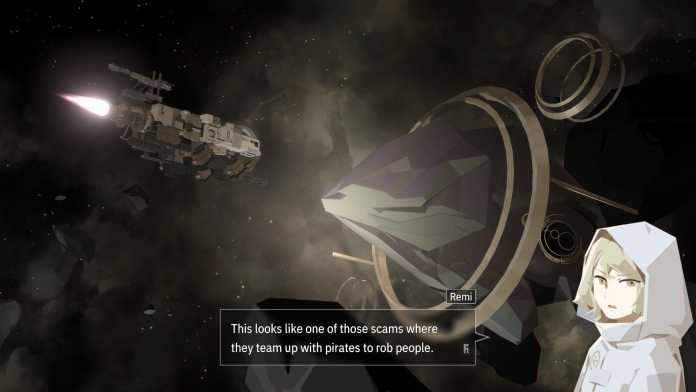
During a particularly disastrous search for lumen caves Jun and Kai cross paths with Remi and Eda, the crew of the Red Chamber ship. After saving each other’s skin in quick succession they join forces, the crew grows, and off they go. I was a fan of the group dynamic, Jun and Eda are drawn to one another, with love on the horizon. Remi and Jun are constantly arguing with one another, while Remi and Eda have their own sadly sweet backstory. I also loved that the story became just as much Eda’s as it was Jun’s.
Now That’s How You Build a World
From this point things really take off, there is a lot of story to digest here. Not just what happens in each main plot point but through the backstory of each character and the history of the star system itself. However, I must give credit to the handling of lore and exposition. It’s segmented into easily digestible bits. Certain locations and moments in the story trigger flashbacks that reveal more about the Red Chamber crew. And the history of Thousand Peaks and its people are told through the exploration of the system.
That being said though, prepare to do a lot of reading. There are no voice lines here so every location description, interaction, flashback and event will need to be read. And I’ll admit that it is a bit much. However, its saving grace is the fact that the writing is really excellent. Most lines of text are a pleasure to read and really do add to the world or character depth.
Exploration and story are deeply intertwined in Opus, you rarely have one without the other. Even to get to each main location, you need to make pit stops. You can’t just travel vast distances without analysing the exact coordinates of your destination. I imagine exiting hyperspeed straight into an asteroid field would be unpleasant. So you end up analysing nearby signals and using those as jumping points in order to get to each key destination. In this way, the world and it’s stories open up naturally as you make your way across the system.
Between these jumping points you’ll find yourself in a wide range of situations. From finessing your way past a military blockade performing inspections; to journalists looking to interview your crew whose reputation is steadily growing. These all just add to that feeling of adventure and exploration with every jump and pitstop.
The Downside
While exploration is the majority of gameplay, it’s not the only aspect. During the main story lumen cave exploration Jun travels on foot. In these caves you record and perform starsongs to open doors which might uncover whether the caves hold enough untapped lumen. These sections, while good for plot and cutscenes, are quite disappointing in their gameplay. The doors are opened by finding the starsong, using it to guide lumen down pipes to the door. At this point you match up lines, extend or shorten as necessary and voilà the door is open. Not the most riveting gameplay.
Gameplay then mostly amounts to walking in a direction and opening some more doors to then walk further. Maybe a climbable ladder or rock wall gets thrown in to spice things up but that’s not really enough. These moments serve to break up the exploration on the ship and progress the story. However, I always just wanted to get back to the Red Chamber as soon as I could. At least it was pretty.
My, Is It Beautiful
The visuals and music of Opus are fantastic. The vast beauty of space is represented wonderfully, and is contrasted quite often with human-made construction and destruction. Bright Nebulae and planets set behind streams of debris from the long gone war that shook the Thousand Peaks, make for some striking sights.
These visuals are accompanied by very often somber piano, and sparingly with some exciting and cinematic music for the tense and more action packed moments. Overall though, you’ll be hearing a lot of ambient sounds and music in your downtime exploring. One thing that I appreciated was the use of your ears when identifying a lumen cave’s starsong or opening doors. As you match the lines of the door or triangulate a starsong, the music intensifies letting you know you’re on the right track.
Opus: Echo of Starsong is more of an experience to me than a traditional game. If you’re looking for a wild ride and some fun gameplay, you may walk away disappointed. However, if a rich and detailed world, or more accurately, star system to explore is something you’re interested in, then you’re for a treat.
When a franchise spans many years, has seventeen games, and several spin-offs, you know it has a fine pedigree. However, what you won’t know is how good the latest title will be and if the developers have gone off on a tangent. The Tales series has been running since 1995, and the latest addition is the beautifully expansive and captivating Tales of Arise.
Developed and published by Bandai Namco, this is a massive action role-playing game. It has captured many fine qualities from its predecessors and has created a story that caught my attention almost immediately.
Tales of Arise covers some hard-hitting topics while transporting you to a bleak fantasy world.
You explore a bleak landscape between the world of Dahna and Rena. The Renans conquered Dahna and subsequently enslaved its population across five realms. They are run by five Lords who compete to become the Renan Sovereign. No-one stands in their way, not even the lives of the Dahnan people. They extract Astral Energy from the surrounding world and the Lord who holds the largest amount is declared the high-ruler.
The oppressive regime causes pockets of resistance to form and the people begin to fight back. One group, known as the Crimson Crows, rescues a cursed Renan called Shionne. Her ‘thorn’ ailment hurts anyone who touches her making her an outcast. As the Crimson Crows rescue her, a masked slave nicknamed ‘Iron Mask’ helps. His bravery doesn’t go unnoticed and the rebels recruit him to assist their cause. This man sadly has no memory of his past and he has no knowledge of his identity. He feels no pain and is the only person who can wield the fire sword produced from Shionne’s Master Core. The two, alongside others, decide to capitalise on the situation and work together to take down the cruel Lords once and for all.
Meet the lead characters.
A cold relationship that thaws.
If you love slow-burning bonds that evolve across a full playthrough, then you’ll adore Tales of Arise. The icy start to the protagonist’s relationship thaws and matures as game-defining events occur. The Tales series is renowned for its captivating plots, and this one is no different. The friendships that form and the secrets that are exposed will keep you interested throughout. I enjoyed how Iron Mask’s identity (Alphen) is unveiled and how his past is a key component in driving the story forward.
You will love how each character’s traits and flaws define the pace and direction of the story. With many players adding to the plot, there was potential for confusion and a lack of direction. However, Bandai Namco cleverly maintained focus upon the two heroes and their reasons for wanting to break the system down.
Combat, Artes and Skill Points.
Tales of Arise has a heavy focus on combat and levelling up. Utilising mechanics first seen in Tales of Grace, this instalment has polished up those already loved elements. Dodging and evading strikes are rewarded with a slow-motion counterattack sequence, and many abilities focus on combos and timing. This smooth gameplay is a noticeable improvement over the rest of the series and was a pleasure to experience. With much of your time spent tackling foes for minimal rewards, you’ll at least enjoy slashing up your enemies.
The already badass combat is helped by Alphen’s expansive range of Artes and Mystic Artes. These special attacks are learned when completing quests and other events. SP or Skill Points can be spent on new Artes from any title that is obtained. This was a wonderful way of making the combo heavy combat more expansive, and I loved how new moves altered your approach. The mystic Artes are your finishing moves that trigger cut scenes for a truly OTT experience. They are a great way to end any battle and a staple within the Tales series. They add to the already polished combat and made it a much more enjoyable spectacle.
Slash your way through every enemy.
It never feels like a waste of time.
I’ve played many RPGs that have felt like a grind! Collecting resources, venturing into the wilderness, or completing side quests simply doesn’t appeal and you ignore a large portion of the game. However, that never happened, and exploring the vast world was always pleasurable. This was helped by the wonderfully challenging big monster battles. These encounters are tough and will test your patience, equipment, and level of skill. Having your arse handed to you is a genuine concern that haunts you throughout. Therefore, mastering the combat mechanics is a must if you want to take down the gargantuan beasts.
These were complemented by the big boss battles that test your teamwork, planning, and guile. The horrendous encounters ramp up the difficulty thanks to their greater skill level and a wider area of attack. You must craft and equip the best gear possible to survive and this loops back perfectly to why you need to explore the world.
Exploration helps to gather resources to vastly improve your chances of survival. It allows you to use the cooking mechanic for buffs, and to craft stronger and better equipment. Hunting larger prey drops rarer items and better weapons, and so every journey feels necessary and I never once complained about my time being wasted.
Tales of Arise is set in a stunning world.
Beauty is in the eye of the Beholder, and I think every element of Tales of Arise is beautiful. No matter the landscape, the finish and quality are phenomenal. The wonderful Anime and Manga inspiration transports you to a surreal world that is part fantasy, part reality. The striking character models and a mixture of vivid colours and pastel tones help to set the scene while enhancing the emotional layers within each scene. The polished combat is helped by the free-flowing camera that assists with the fast-paced nature of each encounter. The expansive nature of the world combined with the hectic gameplay could have been a messy affair, but I experienced no issues or frame rate drops throughout.
The audio is dominated by some incredible songs and a variety of styles. With so many hard-hitting and emotional subjects to cover, the developers needed a varied soundtrack to enhance the range of emotions. Fortunately, the music delivered a dynamic selection of songs that worked perfectly with each scenario. You’ll enjoy some heavy tracks during combat scenes and softer music when moments are emotionally charged. JRPGs are renowned for their loud sound effects and strange noises, and Tales of Arise doesn’t buck this trend.
The world is beautiful but dangerous.
Many combos and commands to work with.
This isn’t the easiest of games to play, but thanks to its thorough tutorial, you soon become comfortable. However, the heavy reliance on combos and timings makes this tough to master. Subsequently, I struggled to keep on top of any new elements and the many core concepts. Fortunately, a range of assist options within your team reduces the difficulty and will help until you become familiar with its finer points.
This massive addition to the franchise is full of replay value. With an enormous world to explore, many quests to undertake, Artes to unlock, and more, you’ll be kept busy. Its large achievement list enhances the replay value further, and completionists will be kept busy trying to finish this off.
Tales of Arise reignites an already great series.
The Tales series is held in high regard, yet Tales of Arise has enhanced its reputation further. It’s a fantastic addition to the series and one that brilliantly polishes some of its much-loved mechanics. If you are looking for a touching and well-polished title with excellent graphics and intelligent audio, then look no further. I adored it and recommend you to buy it here! Uncover the secrets that each protagonist hides, explore the beautiful world, and overcome the five Lords.
It’s officially the spookiest time of the year. Lattes have all transformed into their most pumpkin-spiced variant, lanterns are fully Jack o’ and keeping the doctor away has become a lot more difficult since apples are only available via bobbing. What more fortuitous time therefore to be reviewing Rogue Lords, officially the spookiest game I’ve played this week.
In Rogue Lords, you play as the literal and actual Devil. Ten years ago you were banished by the demon hunters, Van Helsings and priests of the mortal world but, after some time feasting on a buffet of human souls, you have built up enough strength to return to the world of the living and reap your horrifying revenge. But, as you are the evilest and most powerful being to ever exist, it’s below your station to get your hands dirty in squabbles with lesser beings so you call upon your disciples, beings of great power and mythos whose souls you hold in the palm of your hand, to fight your battles for you. The Headless Horseman, Dracula, Bloody Mary and so many more will join your fight and conduct dastardly deeds in your name.
There’s a wide variety of excellent gameplay mechanics available in Rogue Lords for your delectation and delight but the first thing I want to talk about is how absolutely gorgeous the game looks. I’m not convinced that the screenshots smattered around the page will do it justice but the art style is delicious, like salted caramel meeting even more salted caramel. The aesthetic is gothic and comic-book-ey with some beautifully detailed character designs. That aesthetic is paired beautifully with a gothic as heck soundtrack, all melancholy organ sounds (melancholy organ as in synonyms for ‘sad’ and ‘piano’, not a melancholy organ like a lung that’s crying or something). The thing that truly elevates the style of the game is the animations which are buttery smooth, as intricate as a watch mechanism and fantastically stunning in their violence.
There is a lot of game in this game and a lot of systems going on under the hood. You navigate through the world on an overview screen with one of your disciples representing the group as you pass from event to event. This makes what could be a range of disparate happenings feel like a connected narrative. These events can be a really wide range of things, from the obvious combat (which we’ll get onto later) to the interesting social tests – here your disciples can convince/intimidate/threaten mortals into doing their bidding which can have drastic effects on the story. There are a range of social traits that can impact your success in these events and success may reward you with another positive trait and failure may punish you with a negative one. This compounds the system to mean success is more likely to lead to more successes and the same for failure. You can remove negative traits or increase your Diabolical Essence (sort of like your overarching health – if you lose it all you fail) at River Styx events, the Grim Reaper pops up occasionally as an event as a kind of shop and a whole lot else is going on that we don’t have time to go into here.
The event you’ll see most commonly and arguably the main thrust of the game is Combat. Before a round of combat, the enemy will incredibly stupidly reveal their intentions: who they’ll attack and for how much damage. Then you take your horrifying turn to rock these mortal’s whole world. You have five actions per turn to share amongst your disciples. They can use those actions to undertake skills that are generally visceral guttings and other such horror. Once you’ve used a skill you can’t use it again until you’ve recharged, doing which can also have other effects – for Bloody Mary you can place a mirror on a target to duplicate all the damage she deals on that marked target. Similarly, all of your disciples have devastating effects if used correctly. The Headless Horseman should be used as a tank as he can draw damage to himself which builds up Bitterness that can be spent on devastating attacks. This means there are a lot of synergies that can be built between disciples, like pairing the Headless Horseman with someone who works best when defended, generally choosing your disciples carefully to form the evilest of teams.
If all seems lost (or if you just want to have some fun), don’t forget you have the Devil on your side. By entering Devil Mode you can turn the balance of the fight in your favour (cheat). You can spend Diabolic Essence on these cheats which allow you to do all sorts of nonsense, like completely draining an enemy’s health, redirecting attacks or restoring actions. Don’t forget though, Diabolic Essence is effectively your health bar so spending too much can put you in a difficult situation. When a disciple’s health drops to zero you’ll need Diabolic Essence to bring them back to life, or at least un-death, so you’ll be sorry you spent all your ‘life’ on playing ‘Why are you hitting yourself?’ when Dracula has a garlic-seasoned stake through his black heart.
There is so much going on in Rogue Lords with different events coming at you left, right and centre. It’s a deep and complex game with combat mechanics that complement each other unbelievably well and encourage you to really think about how you’re building your team and the skill set of each of your disciples. With some fantastic gameplay dressed up in a beautiful and gothic ball gown of an art style, there’s a lot to love in the diabolic world of Rogue Lords. So off you go, the Devil is waiting and you really, really don’t want to let him down.
With Christmas not too far away now, we are going to be looking at various things you might want to consider – here we look at the Harry Potter Junior Invisibility Cloak from WOW! Stuff.
The Award Winning Harry Potter Invisibility Cloak now in Junior size edition for ages 6 up to adults with a smaller frame size.
The Cloak features movie-accurate detailing with green silk style interior in reference to the movie prop on display at the Warner Bros. Studio Tour London.
The free Wow! Stuff app allows you to recreate iconic scenes from the Harry Potter films or make new ones of your own. View, photograph, or film yourself through the app on your smartphone or tablet and save the images and videos to your camera roll. Your family and friends won’t believe their eyes!
44 inch length ideal for children and smaller adult frame sizes. Movie accurate detailing. Includes a bonus table-top smartphone stand to ensure perfect results every time.
Setting up the app is very quick and easy, just place your device in the stand and follow the instructions. Without wanting to ruin the magic, the app takes a snapshot of the environment before you are standing in it, then when you stand there it records the video and uses the previous snapshot to make you appear invisible. It’s very simple to use and a lot of fun!
You can wear the cloak either with the green on the outside for the purposes of making the video, or with the designs on the outside so that its a proper wizards cloak for any playing you want to do.
The Harry Potter Junior Invisibility Cloak is available now from Amazon priced around £34.99 and is aimed at children 6 years old and up.
Disclaimer: The Harry Potter Junior Invisibility Cloak was sent to us for the purposes of an honest review. All opinions are the opinions of our reviewer.
With Christmas not too far away now, we are going to be looking at various things you might want to consider – here we look at The Gruffalo Interactive Soft Toy from WOW! Stuff.
Snuggle up to this cuddly plush Gruffalo and hear Mouse narrate part of the story by describing the infamous Gruffalo character. Let your child play make believe in the wonderful world of the The Gruffalo created by Julia Donaldson and Axel Scheffler by squeezing The Gruffalo’s Ear, Hand and Knees to hear The Mouse and The Gruffalo speak. Your child can use their imagination to recreate the fabulous Gruffalo stories from the paperback books and films.
Bring the wonderful world of The Gruffalo to life with this beautiful 30cm tall talking soft toy. With 12 sounds and phrases it is the perfect Gruffalo toy for kids who love the book and films.
Squeeze The Gruffalo’s ear, hand, knees and feet to hear Mouse narrate different part of the Gruffalo story. Includes many of the iconic phrases and sounds from the Gruffalo animated movie.
When your child plays the description of the Gruffalo in the right order they unlock The Gruffalo himself! Hear him speak 1 of 9 random phrases, such as “You’ll taste good on a slice of bread!”
Measuring approx. 12″ tall The Gruffalo is a wonderfully soft teddy cuddly toy with press button activation for sounds. Includes bonus content: activity sheet and exclusive poster featuring artwork from Axel Scheffler.
The Julia Donaldson Collection features unique kids toys and gifts inspired by the Julia Donaldson and Axel Scheffler books and films that are authorised and licensed by Magic Light Pictures.
If you are a fan of the Gruffalo, and who isn’t, then this really is the toy for you, sorry, I meant your child. Apart from having your very own plush Gruffalo to play with and cuddle, he also speaks and your child will have hours of fun playing with him. AMAZING!
The Gruffalo Interactive Soft Toy is available now from Amazon priced around £29.99 and is aimed at children 3 years old and up, and even comes supplied with batteries to get you started.