Review: They Always Run

It’s almost entirely sure that if you take a look at this game, They Always Run, you’re going to assume it’s some type of medroidvania experience. You will expect sprawling labyrinths to explore and an ever-growing arsenal of versatile weapons and powers. To a degree, you’d be right. However, They Always Run goes back to linear principles, giving us distinct, finite levels to explore and clear, before going to the next ones. There is no backtracking, and the stages themselves are simpler than what you’d expect to find. Is it a bad thing? No, no it absolutely is not, mainly because of some very good design choices made by the developers.

First of all, our protagonist is really cool. He is a bounty hunter, chasing criminals in space while wearing a badass red cape and a futuristic helmet. Oh, also, he is a mutant of sorts, and so he has a third arm on his back. Can it be used to punch bad guys, you are wondering? Thankfully, punching bad guys is what this third arm is best at, and it’s a blast doing it. The battle system is really slick, based on really interesting animations and a moveset that feels and looks awesome. You can slice your enemies with your trusted swords, yes, swords, plural, because you see, you slice using three swords, one on each hand.

It’s fast, responsive, and the animations change depending on where you’re standing and where your enemy is. For example, if you dodge while standing on empty space, your bounty hunter just rolls on the ground. But, if you dodge in front of a bipedal enemy, you slide between their legs and gain the upper hand, surprising them from behind to break their defense and bypass shields or such measures. Later, you’ll find some pistols, a grappling hook and other gadgets that make fights even cooler and a lot more fun.

There are some more mechanics to discover that add depth to the 5 hour campaign, like the ability to scan enemies to find bounties and then mark them -after you kill them- to earn money, you can one-shot kill enemies by countering their attacks, you’ll fight some exciting bosses and try to save money to buy very useful upgrades, used for fighting and exploring. The systems are neat, well-designed and fun, and give you enough to be satisfied without wanting more -or less. The content is balanced and the skills are unlocked at the right times, with a good sense of pace, so that you are always discovering new things and ways to play. The enemy types could be more varied, but it’s hard to complain a lot when the fighting is so fun.

Also, of course, said gadgets are utilized outside enemy encounters too, in exploration segments that are mostly good, but are brought down by unresponsive jump controls, floaty movement and a camera that zooms in and out for no apparent reason, at times. You’ll take part in some very cool parkour chase scenes that are perfect in theory but end up a bit problematic because of the controls -still, very, very fun. The levels are decently designed, getting the job done without being very memorable. The art, however, is fantastic, giving life to alien planets and beings in watercolour strokes that look amazing and distinct. Additionally, the lighting is utilized efficiently to make the 2D backgrounds and models look like they have volume, like they exist and take up space, while the animation is very fluid. Extra help comes through the soundtrack that is fitting and easy on the ears, but forgettable in the end. All things considered, They Always Run manages to deliver on every front, albeit with some problems here and there -not anything unforgivable, but nonetheless most of its faults are noticeable.

The most surprising aspect of this game, though, is the story. To be frank, the first surprise is that it actually has a plot. Then, you’ll see that it’s not just fluff, not simply filler stuff, but one of the core parts of the experience. They Always Run is a story driven game after all, and its story, whilst just serviceable for the better part, does include some high points. In general, it is indeed a story of unexpected depth and it works well enough, giving you reasons to care about the space adventure and to see it to its end.

Seeing past all the problems that don’t let this game shine as bright as it could, it is easy to recommend They Always Run to genre fans. There’s a lot to love here. Some polish could make it one of this year’s most unexpected and great little gems, but, as it stands, it’s still a fun experience, packing a lot of punch and throwing some cool surprises along the way.

Review: Conway: Disappearance at Dahlia View

Last week I reviewed a mystery-solving detective game that I wasn’t the biggest fan of. Slow exposition and minimal gameplay turned a game that wanted to be Phoenix Wright into something that was more Phoenix Wrong (look, nobody’s happy with that joke, least of all me – let’s move past it). So when I opened my inbox to a code for Conway: Disappearance at Dahlia View, another detective game thriller with a jaded private investigator at the helm, my guard was immediately up for another disappointment. However, it turns out that my caution was unnecessary as Conway: Disappearance at Dahlia View is an absolutely delightful game that hooked me in from the very start.

In Conway: Disappearance at Dahlia View, you play as Conway, a retired private investigator with a career of dubious success considering his gritty noir-style opening monologue mentions that most of his cases are unsolved. On the note of the narration, it is utterly charming, with the voice actor perfectly encapsulating a combination of a polite unassuming British gentleman who’s sorry to bother you with these questions and a fiercely intelligent investigator who will get to the bottom of your darkest secrets. Conway is investigating a disappearance at Dahlia View, no surprises there. Dahlia View is a sleepy corner of the city that, at first glance, is filled with unremarkable residents of upstanding character. However, the disappearance of a young girl, Charlotte May, shines a light on a series of intertwining mysteries embroiling the locals of Dahlia View. Conway will have to get to the bottom of these events to fulfil his promise to the vanished girl’s father and discover her fate. This is complicated by Conway’s daughter, a police officer on the case to whom Conway has promised (in a world where ‘promise’ means ‘to say you’ll do something and promptly not do it’) that he will “leave the police work up to [her]”.

There’s a lot of gameplay on offer right from the start of the game. Conway becomes aware that something is happening outside, so, in true detective/nosey old woman fashion, he takes his camera over to the window to investigate. You control the camera and take photos of anything of interest, mainly suspects and evidence. As you take the photos, Conway narrates what he can see along with the small details he’s already aware of from occupying the world, getting you, the player, up to speed. It’s honestly a masterclass on giving the player information – the narration is in succinct snippets which paint a picture without being distracting so you pick up the information organically without feeling like you’re having a whole pile of exposition dumped on you. These camera sections come up later in the game as well when things are occurring outside of Conway’s flat as a way of playing out people’s actions as developments in the case in a way the player can control and follow.  

Once you’ve had enough of taking photos, it’s time to do some hands-on investigation. These sections feel a little bit like an escape room, so they are completely my jam. There are a lot of items dotted around the room that you can interact with. Notes with information can be photographed for later use but items, such as keys and tools, can be collected into your inventory to help you uncover the secrets of other interactable objects. Once you’ve interacted with everything – using screwdrivers to open vents to find codes to open locks to find keys to get into rooms to finally find a bloody hammer – you’ll have all the evidence you need to make some deductions and take a step along the path towards solving the case. I’ve done a fair amount of escape rooms in my time and, if I were playing through an investigation section of Conway: Disappearance at Dahlia View in real life, I would be very content with that as an escape room experience (or, considering my success rate at escape rooms, I’d be very content with the first 75% of the experience).

Once you’ve gathered your evidence, you can take it to a suspect to interrogate them. In this section, I have no idea what’s going on and it’s one of the very few points of the game where I don’t think it gives you enough information. You ask a suspect a question and they give their testimony on what happened. As they’re doing so, questions will appear at the top of the screen as they occur to Conway of which you can ask one, and only one, after the testimony. This implies that one of the options is the correct question to ask but there is no indication whether you have chosen the correct question and the game simply carries on. I don’t know if this is a case where you can ask any question and it doesn’t matter, as I still left the encounter with, presumably, all the clues I needed but not being sure is a little infuriating

Finally, you can bring together everything you’ve learned on the evidence board. The board poses some questions and you have to link to all of the evidence you’ve collected that proves an answer to the question. This bit feels like a nice culmination to all of the work you’ve been doing in a section and makes you feel like a real detective, pouring through the evidence to discount the irrelevancies and pick out the individual segment of a larger piece of evidence that ties the case together. The story is divided into sections, each of which ends with an evidence board to tie up some of the loose ends and clarify what still needs to be investigated in the next section. These questions are always fascinating and the game has an expert way of wrapping you up in the mystery so you desperately want to find out what’s going on and what secrets the next part of the investigation will uncover.

The final thing I want to talk about that doesn’t fit nicely into another section but requires some attention is the fixed camera. When you’re moving around in the world you have absolutely no camera controls. The camera is fixed, and when you move into another area your view is moved to another fixed camera. This has pros and cons. Pro – the framing of every single shot is utterly gorgeous. Paired with a gorgeous stylised art style, the fixed framing makes every single frame of every single section look like a beauty shot that could be on a poster for the game. Con – the controls are an absolute nightmare. There are two control options. If you’re controlling relative to Conway, you need to invert left and right whenever he’s moving towards the camera which isn’t the nicest thing to get your head around. If you’re controlling relative to the camera, it just doesn’t quite work. Conway is in a wheelchair so forwards and backwards are fine but there is no strafing, all directional control is via rotation. This means you’re never quite sure if you’re asking for a rotation or a movement by pressing a direction button. As the camera is almost always at a diagonal to that movement, it feels almost random which one he’ll do. 

However, despite some slight niggles around controls and dialogue, Conway: Disappearance at Dahlia View is a simply excellent game that I would absolutely recommend you pick up at the first opportunity. With gorgeous graphics, an incredibly compelling story and frankly excellent puzzle-based investigation sections, Conway: Disappearance at Dahlia View is not one to miss and the sheer quality of the game significantly outshines any of its less charming quirks. I’m not sure if I’ve ever played a game as close to perfection without quite reaching the bar as Conway: Disappearance at Dahlia View.

Review: Reminiscence in the Night

Many games are using their platform to explore taboo subjects. These once unspeakable areas are becoming easier to talk about and therefore acceptable to form the backbone of many stories. Reminiscence in the Night is one such title that uses multiple challenging ideas at its core.

Developed by Team SolEtude and published by Ratalaika Games, this is an emotional visual novel. A short but complex tale awaits any player who wishes to take on this touching story. Focusing on “the butterfly effect,” every choice and interaction influences the plot. Moreover, you’ll experience multiple outcomes while unravelling the surrounding mystery.

Reminiscence in the Night is short but in-depth. 

I’ve played an array of visual novels and Reminiscence in the Night is by far the shortest yet. However, this doesn’t mean it’s unworthy of your time. No, its multiple endings and many plot twists are captivating. Its unusual subject matter won’t be a comfortable experience for many, yet I loved how the story evolved.

Set in a tiny house, the protagonist awakens to find she has no memory of what has happened. Desperate to discover who she is and what has happened, she explores her tiny abode. Interacting with the objects around her and communicating with Sofia, her childhood friend, the protagonist, pieces together her past while living through painful memories.

Sofia is always there for you.

Many choices in its minuscule plot.

Though I was left disappointed by the length of each story, the number of choices impressed me. With many objects to interact with, you influence the plot with the smallest of gestures. Will you caress your teddy bear, or will you play a tune on your guitar? Whichever you select will impact your dialogue choice with the few people in your life.

As the story evolves and your memory floods back to you, you will enter a dreamlike world hidden within your mirror. This bizarre look at your personality is twisted and dark and leads to some uneasy moments. Subsequently, the sombre and chilling imagery is reminiscent of a nightmare state.

The source of the protagonist’s sorrow is clarified beautifully when you converse with her mother over the phone. I will not ruin the plot for you, but her nightmarish visions are justified as her haunting past catches up with her.

The mirror allows you to reflect upon what you’ve seen.

Reminiscence in the Night uses sobering imagery. 

Its many touching aspects require a well thought out approach and fortunately, the developers have done just that. Its sobering imagery reflects the challenging nature of the story and I enjoyed how the emotions were emphasised in each scene. With a mainly cool colour palette, the serene atmosphere matched the slow pace of the plot. However, when moments of drama or high tension were called for, vivid tones were implemented. Alongside this, shadowy characters and an oppressive style were incorporated to enhance the nightmarish twist.

The audio was perfectly balanced to support the touching art style. A blend of calm piano songs was punctuated by heavier tunes that put you on edge. With such a short story to experience, it would have been easy to incorporate a minimal approach. Fortunately, however, the developers matched the multiple endings with an array of different songs. Sadly, there is no acting, nor is there a selection of sound effects to enjoy. I would have liked the developers to have explored this avenue, as I believe it would have enhanced the gameplay further. 

The mind can play tricks on you.

A nice point and click approach. 

Strangely, the developers have incorporated a point and click approach to their gameplay. This freedom to select any interactive item on-screen was excellent. I loved searching each room for clues to this strange story and it was rewarding when you progressed the story. Like other visual novels, it’s easy to select between dialogue options and this helps to make sure the gameplay flows nicely. There are also the usual choices to skip text, speed up the game, and so forth. This was excellent, as it prevented the gameplay from becoming stale when revisiting scenes.

You may think that a short game has no longevity. However, in Reminiscence in the Night, this isn’t the case. Thanks to its multiple endings, there is plenty to draw you back in. You’ll experience an array of emotions as you discover secrets surrounding each character. I loved how the story evolved and the pace at which it was delivered.

Reminiscence in the Night will be too harrowing for some. 

A dark and sombre plot isn’t going to appeal to everyone. In fact, I’d say that Reminiscence in the Night will be too harrowing for some. If you can cope with the uncomfortable subject matter, you’ll experience a quick but deep tale. I enjoyed its twists and turns and recommend you to buy it here! Uncover the mystery of your past to discover who you are. 

Review: Growing Up

Ever wanted to go back in time? Growing Up allows you to relive those early years and decide on a new course. Vile Monarch developed Growing Up. They have also created Weedcraft Inc and Oh…Sir! The Insult Simulator. It’s a life simulator where you make decisions on how to progress.

What is Growing Up?

You start as a baby. You choose your parents, gender and name. Or you can leave the parents and gender up to the game to decide. It then opens up with your baby learning new skills and progressing over the years. It takes you all the way up to your 18th birthday, when you leave school. You are then presented with an ending that depends on all the decisions you made in the game. Once the ending is over you start again with a new baby.

Growing Up the Game

After the player has made their character. The player is then shown how to increase your skills using Knowledge points. Then you schedule a time to devote to those skills to learn them. Each skill has a specified time it takes to learn. Once you learn the skill you’ll receive bonuses. In early game, there isn’t any real difficulty and it’s a great way to ease the player into the game flow.

As you progress, the game introduces more mechanics. That you need to take into account when planning your day. You have to balance mental health vs parents’ view of you. If either of these drops to zero it can have massive consequences. I’ve only done it once, but I avoided it as much as I could. If either drops below a certain level, it limits what you can do throughout the day. This is where the difficulty lies. Do you focus on getting a skill at the cost of your mental health? Or do you have fun and disappoint your parents.

The Many Mechanics

Once the player hits a milestone they are then given an exam. The exam consists of a Bejeweled-like puzzle. Instead of colour jewels, there are your attributes. Once you destroy some of a specific attribute, you can then select a skill on the right. This awards the player points which increases his or her rating. At the end of the exam, the player is awarded a grade. Higher than a grade B and the player gets bonuses. Anything less than a B results in disappointed parents.

Another mini-game is the brain map. This is where the player selects attributes to improve. Only a few attribute points are visible at first. But as the player selects nodes, it reveals more attributes. It’s an interesting take on the RPG element. Which gives the player limited control over their character’s attributes. I found it interesting and was one of my favorite mechanics in the game.

Is Growing Up Pretty?

If you have ever played Doki Doki Literature club the art style is very similar. But less Anime and more western style. The characters are rendered in 2D and so are the environments which are beautiful. I played it on PC, which looked brilliant. The creators decided on as few characters as possible so that each could get a unique and memorable look. The characters also change as you progress through the game. Some change their looks while they get older. And they are believable changes.

The music is suited to the game. Each area has different music which suits the atmosphere. Some of the songs do have vocals which is nice to hear in an indie title. The music is pretty relaxed and I would love to have it on in the background when doing other tasks. Since there are no time-limited tasks, it’s a great game to play while doing other tasks. Though it is easy to get lost in the game and the music.

Many Endings

Growing Up has so much replayability available for the player. After each play through the player is awarded an ending scene depending on the actions you take. With so many skills to learn your characters have many endings based on that. There are also many characters to interact with. If you progress their relationship the ending will change. There are plenty of achievements on Steam to work towards. This means the player can focus on a different aspect for each play-through.

Final Verdict

I enjoyed my time with Growing Up. There was a lot to learn and each gameplay mechanic added more as time progressed. On top of that, there was also the replayability aspect which is very high. It is also not the type of game I would play. But I do feel like I want to explore more of these story-driven games since they are relaxing. It’s a great package of a game and would urge anyone who wants a more laid-back version of The Sims to play it. You can even sneak in games while working, but you didn’t hear that from me.

Review: Yoto Player

With Christmas not that far away, we take a look at the Yoto Player.

Yoto Player is a carefully connected speaker – it has the smarts of a connected device, but all the content is safe, since the Yoto Card Store has been built for kids from the ground up.

With Yoto Player, cards are just one way to play. Yoto has a whole ecosystem of features, a lot which you can access for free!

The Yoto App helps get your Player online so it can play cards. Then use it to manage settings on the Player and see and play all your cards. 

A second adult can pair to the same Player, to create a family group.

What’s in the Box?

The box contains the Yoto Player, a Welcome Card, instructions and a charging dock.

A Closer Look

Setting it Up

Setting up the Yoto Player was very easy – it’s all done via the app!

Once it’s all set up it’s ready to be used.

There are various settings that can be controlled from the app, including the cards and content.

Final Thoughts

As mentioned, setting up the Yoto Player was very quick and easy. Download the app to your smartphone, connect up the Yoto Player to power and then follow the steps in the app – simple!

Once you pick a card to listen to you just slide it into the player and it adds it to your collection – you can then use the app as well.

Yoto’s parental app allows you to hold a digital copy of all your physical content cards on your phone, so you’ll never be without your complete Yoto library. Audio can then either be played through a Yoto Player linked to the parental app, with no need to insert your physical content card, or directly from the phone itself.

The app also gives parents the power to manage settings and content behind the scenes. Parents can control daytime and night-time features separately, with the option to change the timings of these to suit your child’s routine. The Yoto Player has a clock face that will show a sun during the day, and a moon during the night, perfect for helping with sleep training!

There is also free daily content on Yoto Radio and Yoto Daily so kids can enjoy a world of safe, fresh and interactive fun, readily available at their fingertips.

The night light function of the Yoto Player can be customised via the app, with a range of colours to choose from, the light can be set to change colour, or turn from off to on between day and night.

The Yoto Player is a great addition to any child’s room – they get to listen to whatever stories and songs they choose and they get to see special images on the side of the player. Each story card is the size of a credit card and has a picture on so that your child can easily identify what story they want to listen to, then only need to slot the card in to start.

Controlling the volume and which chapter is very easy on the player, and can also be done on the app too.

With Christmas coming up this is definitely something to seriously look at as it’s not just a story box! There are so many cards available already with more being released all the time, and you can even record your own for that really personal touch.

The Yoto Player is available now priced around £79.99 and the Yoto Cards start from around £4.99.

You can learn more from the Yoto website.

Disclaimer: The Yoto Player was sent to us for the purposes of an honest review. All opinions are the opinions of our reviewer.

A Closer Look at the Sodastream Spirit

With Christmas not that far away now, you might want to look at the Sodastream Spirit as a possible gift choice for the one you love, or maybe as a present for yourself.

Make ice cold, fresh sparkling water just the way you like in seconds.

Create your own healthy, delicious soft drinks, cocktails and more this party season.

Make a difference this Christmas by minimising the effects of single-use plastic pollution.

You can buy either a Starter Pack (for £99) which includes:

Sparkling water maker

Carbonating cylinder

1L bottle

Free shipping

2 year warranty

Or a Hydration Pack (for £133) which includes:

Sparkling water maker

Carbonating cylinder

1L bottle x2

0.5 litre bottles x2

Soda Press flavours x2

Free shipping

2 year warranty

The Sodastream Spirit comes in 7 different colours and there are lots of different flavours you can add as well, including Pepsi and 7UP!

If you want to relive your youth (if you are my age) or you want to create your own sparkling drinks, then the Sodastream Spirit is just what you are looking for.

You can learn more from the Sodastream website.

Review: myFirst Headphones BC Wireless

With Christmas not that far away, we take a look at the myFirst Headphones BC Wireless.

Unlike traditional headphones, BCW uses bone conduction technology to transmit sound via the cheekbones. This technology leaves ears open to the surrounding sounds. Audio is set to an appropriate volume, ensuring safe levels of listening to the child.

Bone conduction technology allows for music to be transmitted via the cheekbones. Kids can listen to music while remaining alert outside.

Soft rubber contact points on myFirst Headphones BC Wireless provides comfort, even on long usage periods. Perfect for long flights and rides!

What’s in the box?

The box contains the headphones, manual, charging cable and stickers.

A Closer Look

Final Thoughts

The headphones are very lightweight, weighing it at only 26g. They are easy to carry around and when worn they are comfortable (according to my trusty 5 year old assistant).

To charge the headphones, you place one end of the charger into a USB port and the other end allows the headphones to sit on the charging point. Fully charged, which takes around 2 hours, the headphones will last for around 5 hours of playback.

Pairing the headphones with a device was simple and in no time at all they were ready to use. Place on them comfortably on your child (or have them do it themselves) and that’s it.

Sound quality was really good, and there is also a built-in microphone if they want to use it for FaceTime or something else too.

The great thing about these headphones is that they don’t cover your child’s ears so they can still hear any important sounds around them yet still listen to whatever they want to.

The myFirst Headphones BC Wireless is available now priced around £75.00 and comes in either grey or green.

You can learn more from the myFirst website.

Disclaimer: The myFirst Headphones BC Wireless was sent to us for the purposes of an honest review. All opinions are the opinions of our reviewer.

Review: myFirst Sketch Book

With Christmas not that far away, we take a look at the myFirst Sketch Book.

Draw, take notes, doodle, erase, and just a simple click to save your child’s memorable work.

With built-in memory, it can now save your child’s every single masterpiece. Be the first parents to witness their growth with myFirst Sketch Book and together cherish the moments in your child’s drawing world.

Pair with our Sketch Book app, let your child draw with wholehearted by adjusting the font thickness, pens, tip size, and colour that creates a different feel of writing and drawing on this kid’s digital sketch pad. Children can spread their wings and sore up by expanding their knowledge and creativity.

myFirst Sketch Book delivers a seamless experience to transfer your child’s work to your preferred devices by pairing with myFirst Sketch Book app. It will be amazing as your child hand-drawn sketches on this drawing pad with pen will take on a new life via the digital app. Feel proud and share your child’s work to the world!

What’s in the box?

The box contains the Sketch Book, instructions, stylus, charging cable, case and some stickers.

A Closer Look

Final Thoughts

Most children love to draw, whether it’s a detailed picture or just scribbles and writing, and having a tablet that lets them do this simply and easily is a lot of fun.

Using the Sketch Book was simple – just press the power on button and within 2 seconds your child can be using it and drawing.

They can simply press a button when they have finished to either save the image so that it can be transferred to the app or they can press the clear button twice to start again.

Battery life is amazing – when fully charged the tablet lasts around 50 hours and the stylus last around 200 hours. Both are easily charged using the supplied USB charging cable.

The Sketch Book only weighs 335g and is 10″ tall so it’s really easy for small hands to use.

There is even a leather case included in the box to keep the Sketch Book protected when not in use – that was a good idea!

The myFirst Sketch Book is available now priced around £89.99 and comes in either white or black and would make a great Christmas present for the budding artist in your family.

You can learn more from the myFirst website.

Disclaimer: The myFirst Sketch Book was sent to us for the purposes of an honest review. All opinions are the opinions of our reviewer.

Review: Lucid Cycle

If you cannot recall your dreams, you are missing out on a weird and wonderful part of your mind. Your brain pieces together your thoughts in a way that you never thought possible and you experience some bizarre and nonsensical sequences. These journeys are harmless, mostly, as it’s simply your way of understanding the day’s events. Lucid Cycle recreates this dream state but in a more sinister and deeper way.

Developed by Tonguc Bodur and Eastasiasoft Limited and published by the latter, this is a surreal walking simulator. It is based around a day/night cycle and an odd computerised psychiatrist. Therefore, this abstract title will leave you confused, dazed, and feeling that you have little control over the unfolding events.

Complete the picture to understand every vision.

Lucid Cycle captures the dream state perfectly. 

Dreams are as unique as each individual, yet they all have a familiar feeling. There is a sense of weightlessness, a lack of control, and the daunting feeling of falling. Lucid Cycle has captured this perfectly within its episodic gameplay. Though I was confused throughout, I enjoyed the weird journey I was taken on. 

No matter the dream or nightmare you experience, the gameplay always returns to a small apartment. Here you may relax, enjoy playing some games, or speak to a robotic ‘shrink’. This cold and callous object demands you answer its questions while offering a heartless insight into your visions. This was the strangest part of Lucid Cycle as the lack of empathy and warmth gave a calculated and subjective impression of your visions.

Take the portal to your next dream.

Eleven dreams, multiple mechanics, but no idea what was happening. 

The beauty of Lucid Cycle is its reliance on its walking simulator elements. The slow-paced gameplay allows you to enjoy each of the eleven bizarre chapters. You’ll hunt boar, shoot neon cubes, search through fog, avoid balls, and more. How long you wish to spend in each zone is your choice and once a portal opens, you may leave to experience another vision. 

What I loved, however, was the incorporation of other mechanics. The developers have used first-person shooter ideas, there are puzzles to solve, mazes to defeat, and more. The standard walking sim idea is beautifully complemented by these additional elements. This helped to overcome the overwhelming notion that the gameplay was intentionally confusing.

Lucid Cycle is a wonderfully dreamy experience. 

Undoubtedly, Lucid Cycle has captured the brilliance and uneasy essence of the dream state. The blend of obscure locations, bizarre imagery, and helplessness transports you to that dreamy world. The combination of cool and vivid colours with expansive spaces leaves you both uneasy and in awe of your surroundings. I loved exploring the different landscapes, and I enjoyed how the game returned to the apartment between chapters. This clever idea gave closure to each section while allowing you to absorb what you had observed. The familiar environment broke up the surreal nature of the gameplay while giving you a much-needed break from the madness.

The audio is brilliantly composed and enhances each chapter. The combination of dramatic tunes and airy songs creates a varied atmosphere. You’ll experience serene moments that are juxtaposed with aggressive moments of danger. The uncertain nature of each part of the soundtrack adds drama and kept me interested throughout. 

Neon blocks fill the night sky.

A walking sim with no complications. 

Walking sims aren’t renowned for their difficult gameplay and Lucid Cycle is no different. With its simple button layout and minimalistic action, you’ll enjoy each chapter with no fuss. Fortunately, though, when the gameplay demands you shoot your enemy or jump chasms, the instructions are clear and the controls are responsive.

There are plenty of positives to take away from Lucid Cycle, but the replay value isn’t one of them. Yes, you are free to explore each chapter freely, and you can play the mini-games as much as you wish. Sadly, though, this adds little longevity. Unfortunately, the achievement list is completed in one playthrough, so this offers no further incentive. Subsequently, though, the ease at which this is finished does make it a completionist’s dream.

Lucid Cycle is brilliant but it will mess with your mind!

Walking simulators are pretty hit and miss and when you get a poor one, they tarnish the genre. Fortunately, though, Lucid Cycle is fantastic if not a little strange. Its obscure scenarios and a blend of mechanics will leave you confused as it plays with your mind. Its short game time will leave you wanting more and its lack of longevity will leave you frustrated. However, don’t let this put you off! I enjoyed it and I recommend you to buy it here! Dreams are a beautiful but strange place to be. Can you solve the meaning behind your visions or will your journey leave you with more questions?

Review: Carrion (PS4)

There are only so many ways to scare an audience, and as such one could argue that the horror genre is a wheel that cannot be reinvented – that is, until the ‘reverse horror’ came along. Introducing aspects not possible with a traditional horror, this subgenre and also any game where you are the enemy inspires a fantasy-violence that when given the right context, can be both amusing and awful at the same time. Indie title Carrion provides this in spades and is one you won’t want to miss.

Moving around dark 2D Metroidvania-like levels in a reverse horror conceit, you, a Carnage/Venom alien type monster, aim to escape your prison and gorily devour any unfortunate humans who happen to be in your path. Set-up like a horror movie with tense music and screaming women, you are the monster with an insatiable appetite, and it’s glorious.

Unfortunately – or fortunately, depending on how you want to look at it – the underground base you find yourself in is quite intent on keeping you there, with plenty of barriers and doors preventing your exit, so you, as a malleable and disgusting beast, must use your 3 forms (all with their own offensive and defensive abilities) to break through and reach your freedom. The environment requires that you change your form to use a specific ability to destroy or bypass certain barriers, which in turn requires that you either gain health, by consuming the unsuspecting populace, or by shedding some of your biomass. It’s a great way to integrate the environment with all the amusing bloodshed, giving it meaning and decent pacing.

Upgrades are unlocked progressively throughout the game and by the end, you’ll have some very satisfying attacks that can take out entire rooms of people that take to the air with ragdoll physics.

Our little monster looks kinda cute here…..

The joy of using your prehensile limbs though, outstrips all the attacks, allowing you to flip, grab or throw almost everything in sight, whether that’s switches, vending machines, or the resident homo sapiens. It’s even sensitive enough to move the enemies elsewhere in the room if you don’t wish to slam them from floor to ceiling – or to just hold them upside down just for laughs. Another great ability is a limb that connects to a living or dead enemy’s brain and controls them, allowing you to take out enemies with guns, flame throwers and to pilot robots with miniguns – a surprising, but awesome inclusion.

It’s a shame that no importance is placed in sparing the sacks of flesh though, and a mercy rating/kill rating that measured your activities would have been brilliant, but as the gameplay requires that you replenish your health in order to use certain abilities, it perhaps would have been difficult to implement.

Once you get past the barriers and motion-detecting defenses halting your progress, you disappear through manholes in the labyrinth of labs and propagate, slowly taking over the compound and bursting through re-enforced doors. The art and color design does a great job combining with the epic horror movie soundtrack to create an appropriately horrific atmosphere and provides a gleefully tense stage for all the glory about to commence.   

Not so cute here though…..

While minor in the larger scheme of things, Carrion is not the most varied of experiences, with levels that share a very similar structure and enemy types relatively few in number. Armed humans and drones make up the majority, and while they do combine at the end to provide a decent enough challenge, a main boss or two would have been nice to truly put the monster’s abilities to test. There is also a separate human-controlled section of gameplay, but it feels unnecessary and adds very little of anything to the proceedings.  

“Why can’t weeeee be friends? Why can’t weee be friends?”

Latching onto these issues and drawing them into a gaping oblivion of ragged teeth is its refined core gameplay, as Carrion never gets old, with abilities that provide a great number of ways to finish off the enemy. What pushes it over the edge for me though, is its incredible attention to detail that adds to the overall experience. Whether it’s the small hanging lights that can be ripped off the ceiling or the effortlessly smooth and liquid-like movement as your monster moves and grabs onto the environment with its tentacles, it’s a masterclass of interaction and 2D animation and is highly impressive for a development team that largely consisted of two people.

Unfortunately, for those playing the recently released PlayStation version, your experience is likely to be hampered by a final area that crashes every 15 mins. There are save points dotted around each area, but it’s frustrating enough to make you want to put the game down for a few months in order for the developer to fix it. Until then, your desire to purchase this short, but gloriously bloody experience should probably be put on ice, but know that something great is waiting for you once it is fixed.

A Closer Look at the WOW! Jurassic World Pteranodon Dinosaur Flyer

With Christmas not too far away now, we are going to be looking at various things you might want to consider – here we look at the Jurassic World Pteranodon Dinosaur Flyer from WOW! Stuff.

Bring the movies to life with this official Jurassic World Pterandon Flyer! Let your child re-enact epic movie scenes as they switch it on and watch it fly. This officially licensed Jurassic Dinosaur Flyer is perfectly detailed and designed for indoor flying. It features built-in proximity sensors that detect movement beneath from your hands or feet and this causes the Flyer to accelerate upwards! Designed for indoor use only, the Flyer will only work well outdoors if it is flying in total shade or under heavy cloud. This is due to the Infra Red sensors that can get confused in daylight or sunshine. Challenge family or friends to see who can keep the Flyer in the air the longest (note: Battery charge approx. 20 minutes for 5 minute flight time). The Jurassic World Pteranadon Dinosaur Flyer can be adjusted in seconds for flying in small or large rooms! Once activated and airborne the wings flap rapidly producing a spectacular special effect. Holding the body of the Flyer simply press the fob button, wave your hand below it and let go. Lightweight and easy to fly, this Flyer is ideal for beginners and experienced flyers alike.

FLYS INDOORS – The official Jurassic World Pteranodon Flyer lets your child re-enact epic movie scenes! This officially licensed Jurassic Dinosaur Flyer is perfectly detailed and designed for indoor flying!

HAND CONTROLLED – Built-in proximity sensors detect movement beneath from your hands or feet! Wave your hands below it to send your Dinosaur Flyer upwards. Challenge family or friends to see who can keep the Flyer in the air the longest.

FLAPPING WINGS – The Jurassic World Pteranadon Dinosaur Flyer can be adjusted in seconds for flying in small or large rooms! Once activated and airborne the wings flap rapidly producing a spectacular special effect.

EASY TO FLY – Holding the body of the Flyer simply press the on/off fob, wave your hand below and let go. Lightweight and easy to fly. Ideal for beginners and experienced flyers alike. Includes recharging USB and button cell battery in fob.

The Jurassic World Pteranodon Dinosaur Flyer is available now from Amazon priced around £27.99 and is aimed at children 5 years old and up.

Disclaimer: The Jurassic World Pteranodon Dinosaur Flyer was sent to us for the purposes of an honest review. All opinions are the opinions of our reviewer.

Review: Princess.Loot.Pixel.Again

No matter how confident you are, proving yourself worthy in the eyes of your in-laws is a daunting task. Now imagine if your father-in-law to be is the ruler of your country! Suddenly, its mission impossible and you have an immense hill to climb. However, even you couldn’t imagine how badly your proposition would end. An attempted beheading, an Evil Mage, and a King who is kidnapped! This is the crazy plot of Princess.Loot.Pixel.Again, and a story that you’ll relive a thousand times.

Developed by EfimovMax and published by Big Way Games, this is a rogue-lite dynamic platformer. Set in an ever-changing Evil Tower, Princess.Loot.Pixel.Again is a tough action-adventure title. Subsequently, its retro charms will infuriate you from the start as you’ll die repeatedly and lose all your progress.

Extinguish the fiery skulls.

Princess.Loot.Pixel.Again is deceptively simple. 

I’ve played enough of these games to know that I shouldn’t fall for the basic mechanics. However, I always do, and these deceptively simple ideas make it moreish but oh so frustrating. You’ll die more times than you care to think about, but this matters not. You’ll take a deep breath and start the madness over again.

Princess.Loot.Pixel.Again is jam-packed with content and there is an array of characters to pick from, and a plethora of items to find and artefacts to collect. Each playable hero has strengths and weaknesses that support certain play styles. There is a warrior, rogue, mage, archer, and more. You’ll experience magic, speed, close or ranged combat, and so on as you annihilate every enemy. The equipment you find adds to your base attributes and these can make huge differences to your chances of survival. Yet, the artefacts are the key objects to collect. These magic-infused tablets give you a helping hand during each playthrough.

Death surrounds you. 

Simply not being good enough for the King’s daughter shouldn’t be a reason to lose your head. Sadly, though, this is where it all begins. You may think it karma when an Evil Mage swoops in and kidnaps the murder-happy ruler. However, you want to prove you are worthy of the Princess’s love, so you enter the Evil Tower to slay the Evil Mage. Unsurprisingly, this is instantly regrettable as death is guaranteed. 

If you make it past the many twists and turns and overcome the horrific bosses in your path, you’ll witness multiple endings. Depending on the choices you’ve made and how many times you’ve played it, you’ll see many unique finales. This was surprisingly rewarding and made the hard work worthwhile. 

Pick up your artefacts.

Damn you, rogue-lite mechanics. 

Because of its rogue-lite qualities and tough platforming elements, your progress is wiped repeatedly. This horrendous mechanic will make you wince as you start again for the nth time. Yet, it allows you to experiment with each character and different setups. I loved how minor changes had a big impact on how you tried each playthrough. Would you try to rush each level with the rogue, or will you pick off your foes with a bow or magic? Tactically, it’s very clever and you’ll have to think on your feet to be victorious.

Strangely, though, the real kicker surrounding the simplicity of Princess.Loot.Pixel.Again is how easy the monsters are to defeat. Each creature moves in a set way, so planning to kill them is easy, in theory. Sadly, though, it’s never that straightforward, as traps and obstacles always stand in your way. You learn that new items will only get you so far, and victory is determined by studying your foes’ strengths and manipulating their weaknesses.

Princess.Loot.Pixel.Again is dated, but pleasant to look at. 

The side-scrolling perspective and Metroidvania style dungeon crawling were combined brilliantly. This tried and tested approach works spectacularly in this setting and was easy to pick up and play. The dated but smooth imagery doesn’t harness the power of modern machines, but it was nice, nonetheless. Thanks to its mainly dull colour palette, the surrounding world feels oppressive and claustrophobic. Thankfully, there are moments of vivid colour that break up the monotony and keep things interesting.

Death is just around the corner, so it could have been easy to get frustrated. Fortunately, however, the high-adrenaline electronic soundtrack is full of energy. Its fun tunes distract you from the repetitive nature of the gameplay and the basic sound effects are effective throughout. You won’t be wowed by the audio, but its lighthearted energetic style is on par with many of its peers.

Better than a poke in the eye.

A gentle reminder as you begin again. 

The developers have done a great job of making the action extremely accessible. A gentle reminder at the start of each playthrough highlights the controls, and the simple but effective UI makes it easy to use your abilities and inventory. You’ll have the controls mastered in no time, and this allows you to focus on the finer details.

Its core rogue-lite elements make this extremely addictive and frustrating. Players will lose hours of their lives while trying to overcome each obstacle and every enemy they encounter. I never tired of trying to get to the end boss, and every new ending is worthy of your time. Subsequently, Princess.Loot.Pixel.Again is loaded with replay value and is exceptional value for money. 

Princess.Loot.Pixel.Again is annoying, but brilliant at the same time. 

My hatred for rogue-lite/like games has waned, yet I still find them equally annoying and brilliant. Princess.Loot.Pixel.Again will punish you and test your ability to focus on fine details. If you learn your enemy’s traits, you will progress at a nice pace. However, simply relying on upgrades is not enough and will ensure you fail repeatedly. I loved it and hated it and recommend you to buy it here! You’ll scream, quit, and try again as you make your way through the Evil Tower to destroy the Evil Mage. 

Review: No Straight Roads: Encore Edition

0

Sometimes you get a feeling that you are about to play something special. No Straight Roads: Encore edition is available on Windows PC. It is an action-adventure with plenty of variety. Metronomik developed NSR. Which comprises two developers of Final Fantasy XV. Considering how great that game was, NSR has a lot to live up to. And it does it well.

NSR Plot

NSR: Bunkbed Junction!

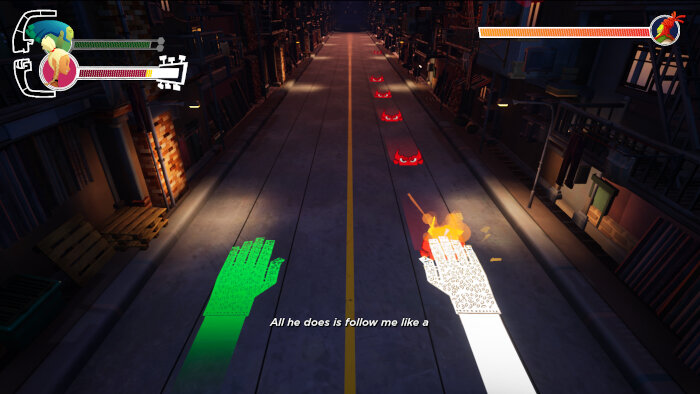
The NSR rule over Vinyl City, they are in control of power. It’s a bit like Monsters Inc, where the music, not screams, power the city. This sounds great until you learn that only one genre of music is welcome: EDM. You play as Bunk Bed Junction, a band composed of Mayday, a female guitarist, and Duke a male drummer. Their goal is to save Vinyl city from the grip of NSR and EDM. By reintroducing the city to Rock, which was present many years before.

NSR Gameplay

NSR: Rap battle

Each area has a boss DJ, which you must beat using the game’s unique battle system. They telegraph their attack moves via the music that is playing. As well as graphical indicators. You can also counter specific attacks if they are pink. Because of this, it makes each encounter exciting and not a drag. In fact most of the time you’re looking forward to the next one.

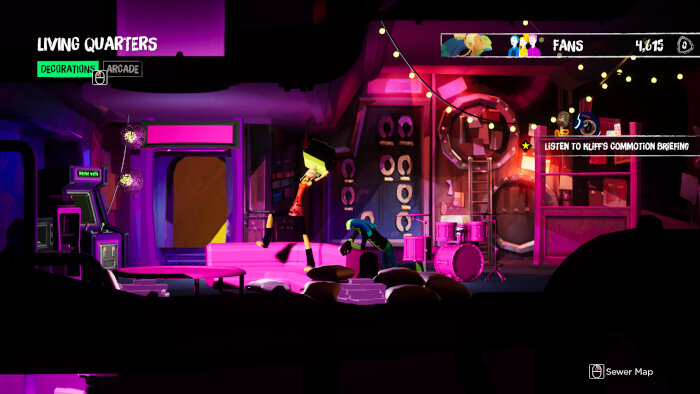
Between boss battles, you will explore the districts. While exploring, you can find stickers. Stickers are then added to the instruments. These stickers improve various stats. There is graffiti on the walls of the districts made by fans. The fan art can decorate your guitar case. There are over 200 designs, and I set my case to random so that it is different every time. It’s a cool collectible and each design is very unique. The only downside is there is no indicator on whether you have collected one before so it is easy to miss one or two.

Between the district and the boss battle, you fight the boss’s minions. Unfortunately, this is where the game falls down. It’s quite a boring part of the game as the enemies telegraph their attacks and you can beat them. The blessing is that these areas are short.

NSR Presentation

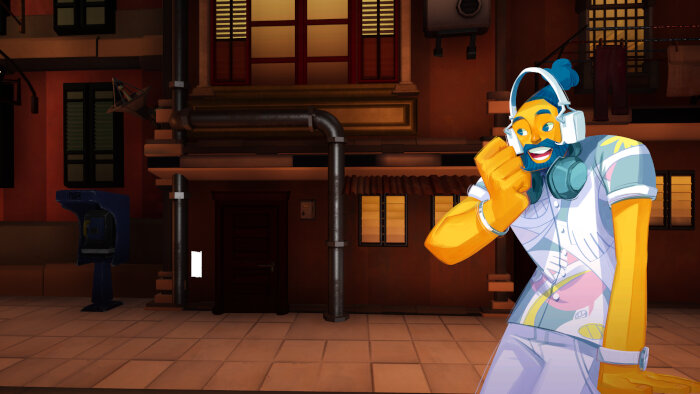
One of the many characters

NSR: Encore edition has a beautiful design. The environments are vibrant and different for every district. The characters are cartoony and have no jagged edges. Due to this style, I don’t see it ever aging. Each character has a crazy design and does reflect their personalities. Even the side characters have unique designs.

NSR’s main focus is music. The music is great and varied. Though the main style is EDM it feels great to listen to. I can see myself listening to the soundtrack for many hours and have added it to my goto playlist. I hope that there will be a sequel soon where there will be more variety of genres. rock vs another genre? The possibilities are endless.

Replayability

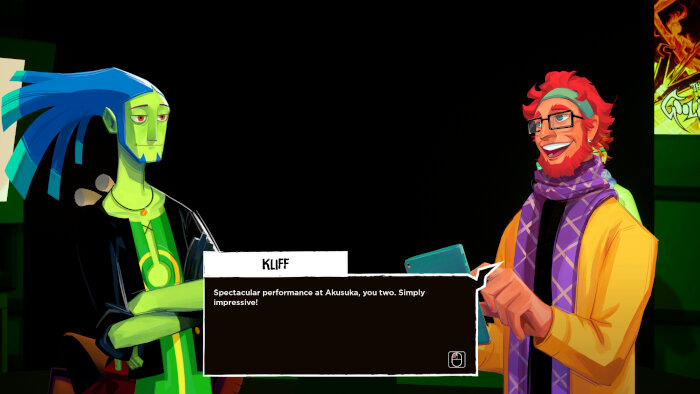
Helpful Kliff

Each boss battle ends with a grade. The higher the grade the more fans you receive. Fans are then used to level up your abilities. This makes it worth backtracking to previous bosses and trying to improve your grade. Once you’ve beaten a boss once, it becomes easier to figure out a strategy to get better grades.

There is also a co-op mode, where you can each play as either Duke or Mayday. I didn’t have much experience playing as a co-op. But I can imagine it would be a blast getting to the end and experiencing the story with another player. This would be a title I would be playing with my son in the future.

Final Verdict

The base

NSR was a blast to play. I couldn’t stop playing and it was very upbeat. It’s a great title to play when you’re having a bad day. The enemies never feel overbearing. The light-hearted music adds to the joyful game. For that and many other reasons, No Straight Roads: Encore Edition gets a well-deserving 9 out of 10. Now if you don’t mind, I’m going to play some more.

A Closer Look at the Eldrador Creatures from Schleich

With Christmas not that far away, we take a look at some of the Eldrador Creatures from Schleich.

There are different creatures and robots to collect and play with. Here are a few we got to look at.

Eldrador Mini Creatures Jungle Robot

The Eldrador Mini Creatures Jungle Robot from Schleich Eldrador Creatures, with his movable arms and exchangeable jungle chainsaw doesn’t do things by halves – he aims for maximum destruction!

But it’s the Jungle Lord, as the leader of the Mini Creatures in the jungle world, who’s really in control. He is made up of crystal and can sit in the robot.

The Eldrador Mini Creatures Jungle Robot is available now priced around £13.99.

Eldrador Mini Creatures Ice Robot

The Eldrador Mini Creatures Ice Robot from Schleich Eldrador Creatures destroys his foes using his movable arms and his exchangeable ice pick – it turns anything and anyone into an icicle.

The robot is controlled by the Ice Lord, leader of the Mini Creatures from the ice world.

He is made of powerful crystal and can be placed in the robot.

The Eldrador Mini Creatures Ice Robot is available now priced around £13.99.

Eldrador Mini Creatures Series 1

Collect the 17 Eldrador Mini Creatures from Schleich Eldrador Creatures!

Each blind bag contains one figurine from the Lava, Ice, Stone or Jungle world.

Stack them into a mighty pyramid or put them in one of the four super strong robots.

If you’re lucky you might receive the golden Mini Hero, the legendary hero of the Mini Creatures!

Each blind bag retails for around £2.99.

You can learn more from the Schleich website.

Disclaimer: The Eldrador Creatures from Schleich were sent to us for the purposes of an honest review. All opinions are the opinions of our reviewer.