The last few years have seen something of a resurgence in games mimicking the platforming titles of old, as both 2D side-scrollers and more elaborate 3D adventures. Super Sami Roll is the latest offering in this arena, presenting players with a series of 3D racing stages to explore.
The game casts you as a tiny dinosaur searching for his kidnapped friend. As far as the story goes, that’s all you’re really going to get; this is not a game seeking to make a huge narrative impact. Instead, the story is set up in a few quick panes of retro artwork, and then players are free to get on with the business of platforming their way through Super Sami Roll’s various levels.
Understandably, given the genre, the game’s primary focus is on movement. Beyond simple directional keys and jumping, players are given access to a short range grapple in the form of Sami’s tongue, and a bounce jump that grants extra height. Combined with the sense of momentum players have to account for when Sami is rolling at high speed, there is a surprising amount of complexity to navigating the game’s levels and perfecting the speed at which you do so.
Each level takes the form of a short time trial, in which players have to get to the end of the track before the time runs out. The races are ranked depending on how much time you have left when you complete the course. Along the way there are coins to collect, which add seconds onto your time limit, and occasional checkpoints to give you a helping hand with the trickier platforming sections. There is also a single raspberry in each level to find. Outside of the races, the coins and raspberries both take the form of currency that can be traded in the game’s shop to alter Sami’s appearance or to buy accessories for him to wear.
These ranks and collectibles are what provide Super Sami Roll with replayability; completionists will want to ensure they find everything on offer, while perfectionists will want to shoot for a perfect S+ ranking on each level.
Backing all of this is a really solid soundtrack, helping to give the game a lot of energy despite the numerous resets players are going to have to sit through on the harder levels. And this game is hard – if you’re not a fan of replaying the same sections over and over again until you get it right then this is definitely not the title for you. Like the original platformers of the 80s and 90s, Super Sami Roll demands near perfection in places or players face the risk of falling or running out of time.
For anybody looking to divert a few hours to a reasonably simple but challenging platformer, then you could certainly do worse than Super Sami Roll.
That being said, this game is far from perfect and there are a couple of issues that can really negatively impact your play time. To start with, the levels can be a little disappointing visually. While the platforms have all been well crafted in terms of jump distance and height, all of them exist as random blocky structures in a strange, featureless void. Effort has certainly gone into making the levels feel distinct, with striking colour palettes and varied enemy types, but the lack of actual world around you can feel incredibly disconnecting. Super Sami Roll doesn’t have the same focus on world design and exploring as, say, Yooka-Laylee, so it’s not a huge issue, but it really contributes to making each level feel very small.
A much more pressing issue is the sudden, unpredictable performance crashes that crop up throughout the game. Random frame drops and sudden increases to camera sensitivity can be tolerable in some games, but Super Sami Roll relies so heavily on rapid, careful movement that the slightest drop in performance almost always necessitates a reset. Reverting to a checkpoint doesn’t take long and they are liberally spread through complicated levels, but having to restart because the game decided not to register your input for a few seconds never feels good.
Compounding this issue is Sami’s sense of momentum. As a concept, this seems like a brilliant idea, making players have to work out what they want to do before they do it instead of relying on reactionary controls when it looks like something isn’t going the way they want. However, there are places where the maps don’t feel entirely like they’ve been built with this sense of forward movement in mind. Sharp turns and narrow walkways do add challenge and that’s likely the point of them, but there are a handful of sections that feel as though they’re difficult more due to level design not meshing well with the controls than through any developer intentions.
Overall, Super Sami Roll is a decent 3D platform racer. There’s not a huge amount of variety in content, but there are enough levels to keep players entertained for some time. The art style is appealing and the music consistently manages to be engaging without being distracting. If you’re looking for a more adventure- or story-based experience then you’re probably better off with something like Yooka-Laylee or Super Mario Odyssey, but if you just want something you can breeze in and out of, then definitely give Super Sami Roll a look.
Midnight Caravan is a visual novel and game of choices. While the overarching plot may be set in stone, you have agency in most of what you do. Your decisions are the deciding factor in the outcome of many encounters. As well as which doors might remain tightly shut, or wide open for you to enter.
Midnight Caravan has you play as a man who has been stripped of everything by a malignant and faceless figure known as Cassini. Years ago, your name and status came to ruin as you were framed for a crime that is never explicitly mentioned. Whatever it was, has forced you to go on the run. And you’ve been on the run for a long time. Long enough that you now find yourself as the master of the Midnight caravan, a traveling home to drinking, gambling, and harlotry to many patrons around Italy.
Make it Glorious
The caravan you run can be whatever you make it. Perhaps it will be a micro-dictatorship with you as its ruthless tyrant. Or you might create a safe haven for any in need of one. A home for outcasts and free thinkers, or a den of criminals and debauchery. You can prioritise the people who depend on you or keep coins at the forefront of your mind at all times.
The choices surrounding the caravan and your day to day life were easily the best part of the choice based gameplay. These choices mould the caravan and can hold all manner of possible benefits and pitfalls to your journey to find the man called Cassini. Some scenarios propose morals and honour and against making some money. Others might be strokes of misfortune that require you to weigh what resources you value more. Whether that be due to necessity or greed.
Whatever choice you make, should never be made lightly. It might affect a resource, add a useful item, or grant you a new trait. Each of these may prove invaluable as you progress through the story. However not every trait is welcome. For example, one of the first choices you make is where to set up the caravan. One option is to choose a secluded cave where you stashed some valuables while on the run. It increases your starting amount of coins. However it’s close vicinity to a malarial swamp means a decrease in health every turn.
However, not every choice has an immediate effect. At times you will encounter a scenario which bears unexpected fruit further down the line. Such as helping a group of beggars who in turn prove highly valuable to your hunt for Cassini. Sometimes what seems like the obvious choice can also lead to your downfall and the dreaded game over screen illustrating the one of three reasons you have failed to uncover the labyrinthian conspiracy surrounding you.
Health, Wealth, and Stealth
The three main reasons are your three vital stats. Your coins, your health and your suspicion level should all be monitored closely. Make the wrong choices and the story ends before you unveil the truth behind who Cassini is, and why they have ruined your life.
So clearly, the choices made through the campaign have far reaching benefits and consequences. They bleed into the main plot-line quite seamlessly. The people you befriend and items you amass can open up new dialogue options that progress the story in a manner most beneficial. The default route may see you lose a segment of health or put a dent into your coin purse. However, the alternate routes that are opened up through your many choices can create beneficial paths that are all reward and no punishment.
Though this does mean, that making the wrong choice way back when, can only send you to failure without fully understanding why. Such as one run where I was locked out of all options and promptly got killed. These moments can feel a tad unfair, and left me a little salty.
Let’s Try That Again
You’ll be replaying Midnight Caravan often if you’re anything like me. I couldn’t just let things go with me dead and the mystery unsolved. So of course, I dove straight back in. Doing so proved highly valuable. While the scenarios that crop up between the main plot are randomised, playing enough times means you’ll get a couple of familiar scenes. Knowing what benefits you can get out of each choice can be extremely useful to ensure a clean run. But it also showed me something I didn’t appreciate as much.
While those side scenarios affect the plot in many ways. The plot itself is really quite linear. Regardless of what choice you make, many times the outcome is the same. Often the only difference is what stat, if any, de- or increased. There were one or two occasions where an ally may be lost to me based on my choice. However, the main story often chugs along just fine without them.
Seeing as this is a visual novel, it’s understandable and acceptable. Yet, I couldn’t help but be disappointed by how linear it could be when I found myself playing through it so often. Especially when choices proved so important in the side stories.
Sights & Sounds
Midnight Caravan’s scenes and characters are illustrated quite well, and definitely add to the atmosphere and setting. It’s a story of intrigue, conspiracy and betrayal and the illustration oozes that fact. My only complaint was the amount of bare breasts littered throughout. Sure, its a caravan with sex workers on staff, but it still felt gratuitous. Every second woman you speak to is topless. Even when you’re having a private conversation where they ask for time off, or seek your help. Seeing as the caravan operates at night, don’t they get cold? A small complaint, but very noticeable.
Midnight Caravan also sports some great classical music to complement it. Strings, woodwinds and brass sections come together for a lovely symphony in its main and game menus. While the piano forms the backbone of the soundtrack when engaged in dialogue and choices. Overall the music fits really well with the kind of story you’re engaged in. And while there’s not a crazy amount of variety between the tracks. There’s enough complexity in each background song that it never felt repetitive. Even in my many playthroughs.
Excuse Me, There’s a Bug in My Game
Unfortunately the game has a few technical issues. I’ll recap the two I experienced. On one of my later playthroughs my suspicion level reached its limit and I was due to fail. But instead of the usual screen explaining why the game was over, it would just crash. This happened every time I tried, regardless of which choice I made.
The other bug was in the end of night recap screen. Here it summarises how much money, fame, health and suspicion you made or lost. If I decided to press the space bar instead of clicking my mouse, it would just add on to those amounts as if another night had passed. Essentially skipping a day each time. I could click this until I gained a certain amount of money. However, I would then not be able to progress the story, trapping me in an endless loop of pressing “continue”. I guess it’s what I get for trying to finesse some extra cash.
I also noticed a couple of grammatical errors here and there, such as using “him” where “he” would make more sense.
Midnight Caravan as a whole is an enjoyable visual novel that interweaves choices into a main plot that remains engaging all the way through. While not a perfect experience, you may just find yourself playing and replaying. It always keeps you coming back with its great dialogue and deep conspiracy.
‘War. War never changes.’ Except sometimes. Sometimes war changes quite significantly. If we take ‘war’ to mean Fallout, the video game franchise that harps on about war never changing, as if it makes the gameplay about slaying mutants in a post-apocalyptic wasteland somehow poetic, then war changes a great deal. Over the years Fallout has gone from an isometric turn-based RPG to a 3D first-person shooter RPG to a 3D multiplayer pile of garbage. But why am I wittering on about Fallout in this review of Dust to the End? Well, partially because Fallout is potentially my favourite video game franchise of all time and I’ll take any opportunity to talk about it, but mostly because Dust to the End gives me significant Fallout 1 and 2 vibes in its theming, art and some of its gameplay. If you love the original flavour of Fallout before ‘War. War changed’ and are upset there hasn’t been a release in that vein over the last two decades then I might have a little gem of a game for you.
Humanity is over. Standard story: boy meets boy, boy dislikes boy, boy wipes boy off the surface of the Earth with enough nukes to destroy life as we know it. It’s the sort of war that nobody wins and everybody loses. The only survivors are those who managed to get to underground vaults before the apocalypse really got going (I’ll be honest, some of the Fallout parallels aren’t subtle). Now, hundreds of years later, you play as a descendant of these survivors, still living in the vault away from the dangers of the irradiated world above. Unfortunately, your cosy existence in this protected corner of the post-apocalyptic wasteland isn’t destined to last and it isn’t long before bandits dressed in rad-as-hell plague doctor masks attack the vault and kill or capture all of your vault-dwelling companions. More through luck than judgement you manage to escape, fleeing into the wasteland with only your wits for company. It turns out that your wits are terrible company and before long you fall unconscious, surely fated to die under the scorching desert sun.
As ‘Dying Under the Scorching Desert Sun Simulator 2021’ would be a short and terrible game, the developers made the wise choice here to intervene and you are rescued by a kindly old man who nurses you back to health. However, this is a ‘you saved my life, I am eternally grateful’ situation and the old man turns out not to be that kindly after all, expecting you to work off your life debt to him by working for his caravan company. This job requires you to travel between settlements, buying supplies in one town for a low price and selling them on in another town for a higher price, repeating the process until you become some kind of post-apocalyptic Jeff Bezos, aka Jeff Bezos after a few more years of Jeff Bezos being Jeff Bezos. Your first goal is to make 5,000 money so you can pay the town’s ‘taxes’ which pay for a big can of giant-bug-repelling bug spray. A settlement will almost certainly perish without the bug spray, so the ‘tax’ is more of a protection racket run by the corporations monopolising the supply. Oh look, it’s Jeffery Bezos again.
Travelling between settlements is the main thrust of the game and is where I really pick up on the Fallout vibes the game is putting down. Much like in Fallout 1 and 2, when you travel between settlements you watch a little version of your character walking across an overview map, with the settlements highlighted, bandits and creatures roaming looking for an easy fight and random events such as supply caches marked. Your character will set off on a beeline towards the settlement you’ve set as your destination but you still have complete control of their movement, meaning you can avoid combat encounters, divert towards dropped supplied or change your destination entirely. As a pro-tip here, you should definitely do those things and not get distracted by eating a casserole, leaving your character to wander. Much like in the real world, you will get eaten by mutated bugs if you get distracted by casserole.
Speaking of food, I believe I’ve mentioned in another review on this site that I normally despise hunger and thirst meters in games. It’s enough of an ordeal monitoring your need for food and water in the real world, without having to take care of a video game character’s needs as well. Therefore, it may surprise you to hear that I love Dust to the End’s survival system, mostly because you don’t need to monitor your needs at all. The game tells you how much food and water you’ll need for a journey before you set off and you just need to make sure you have at least that much in your inventory. Beyond that, it pretty much takes care of itself. I appreciate this hands-off approach to hunger and thirst and it’s one of the few games where I think it makes gameplay sense to have survival needs, as it means you need to balance your inventory between having enough food and water to survive a journey but also carrying as many supplies as possible to sell for a profit at the next town. It’s not just the amount of food and water you carry that’s important – the quality of those items influences your ‘morale’, which impacts your combat effectiveness. So you might want to spend the extra cash and inventory space on better food so you’re not caught with your gun-belt around your ankles when you’re attacked by bandits.
The final element of gameplay is combat – you can avoid fighting enemies to your heart’s content but that won’t help you when a quest needs you to collect bug blood to free some people who may or may not be your kidnapped fellow vault-dwellers (it doesn’t sound like it but it does make sense in context, trust me). The combat is turn-based with some of your stats determining the rate at which you get another turn. This is illustrated by a turn order at the top of your screen. You can always do your basic attack which will do a modest amount of damage to a single enemy. But, what you’ll really want to do is one of your special attacks. Special attacks generally do more damage or have a chance to apply a status effect to the enemy it hits, like ‘stunned’ which forces them to skip their next turn. However, special attacks require AP and your AP is determined by your morale, so if you’ve been eating gristle and bugs for the last week you’ll be stuck doing your basic attack all of the time. The combat isn’t anything particularly special but it’s solidly put together and there’s nothing to complain about – especially when you’ll be avoiding combat as much as you can in an effort to try and stay alive.
If you want a hit of an early Fallout game in a brilliant and non-copyright infringing package since Bethesda have jumped into a lake with the concrete breeze-block of Fallout 76 tied to their ankles, then look no further than Dust to the End. Brimming with a compelling story and memorable characters, Dust to the End is not one to let pass you by. It’s got a clear mechanism for earning money, with one of the best yet most understandable economies in games – certainly more understandable than the real world economy where people starve while billionaires go to space. This mechanic is packaged next to your standard turn-based RPG combat and has a decent system for travelling and avoiding combat thrown in for good measure. Now, if you’ll excuse me, I still have a few kilos of bug blood to harvest because after all – War, war never changes.
Everyone can be good at whatever they try, but few will be blessed with natural talent. When you have those gifts, you must nurture them with practice, training, and listening to your elders. Dodgeball Academia wants us mere mortals to experience the challenges faced by the best in their fields.
Developed by Pocket Trap and published by Humble Games, this is a colourful underdog sports title. Set in the renowned Dodgeball Academia, you must battle your way to the top of the sport. You’ll set out to prove the naysayers wrong as you and your band of rejects take on the best in the sport. The reward for your hard work is to become the champion.
Where it all begins.
Dodgeball Academia is a Manga inspired RPG.
It’s obvious from the dialogue and art style that Pocket Trap has taken inspiration from some much-loved RPGs and modern Anime titles. With the feel-good vibes, constant one-upmanship and the need to be the best, it has a familiar feel. It was great, as you instantly felt comfortable in what is otherwise a strange plot with an array of bizarre and loveable characters.
The campus is filled with stereotypes; the school bullies, weird kids, geeks, those who try too hard, and our protagonist, the newcomer. The teaching staff have their obvious traits and the plot plays out like a children’s high school drama, albeit weirder.
Plenty to do and dramatic battles.
You control Otto who has transferred to Dodgeball Academia from a rundown underachieving school. You desire the dodgeball championship crown and must battle your way to the top. You’ll learn new abilities from your tutors, take on school kids and compete in the main tournament. Your adventures uncover secrets, and you’ll make new friends and rivals as you excel.
The story is fantastic, light-hearted and will keep you interested throughout, with its mixture of characters, battles, and mini-games it keeps the gameplay fresh. With a lot of back-and-forth action across the small campus, this prevented it from becoming tiresome.
The game spans eight episodes that comprise main quests, side quests, items to find, character levelling, and team building. You’ll explore many locations, visit shops, heal yourself in the pharmacy, and try to unlock secret chests. With lots to keep your interest and challenging games of dodgeball, you’ll test your skills, tactical nuance, and newly learnt abilities.
Multi dodgeball.
RPG influences are key to the story progression.
Every battle, side quest, and item you find are key to making progress in Dodgeball Academia. Levelling up your team is essential as the later matches become progressively harder. Every victory rewards each teammate with XP, and this increases; health, attributes, and the strength of your special powers. Permanent upgrades can be obtained by consuming items, but not every character likes the food presented! Pay attention to the finer details or rare items will be wasted. Equipment can also be worn to increase stats and these can be found, won, or purchased along the way.
The influence of early Nintendo RPGs was great to see. The adventure portion reminded me of Harvest Moon and the battles were a cross between Pokémon and Dragon Ball Z. However, even though there were nods to these great gaming franchises, Dodgeball Academia does enough for you to admire it on its merit. With ever-changing battle elements and zany characters, you’ll fall for its strange charms.
Dodgeball Academia has a striking style and a colourful world.
As you jump into Dodgeball Academia, you are met with vivid colours and a distinct art style. The bright world comprises small areas that you’ll explore thoroughly. With many NPCs to interact with and lots of collectables to find, you’ll lose yourself in this eye-catching world. I loved the varied sprites, the different venues and the OTT special powers. The cutscenes and animations were equally fantastic and the game seamlessly moved from scene to scene.
With its clear influences, it was apparent the music would be upbeat and full of energy. The constant noise should have been unbearable, but I loved it. Chuck in the loud and obnoxious sound effects and you have an in your face audio that never quits.
Someone get a fire extinguisher.
Timing is key and lots of buttons to remember.
Each enemy you face on the dodgeball court has a unique blend of attack and defence. You must study their moves, time your blocks, and go on the offensive. You’ll learn power attacks, dodging, jumping, focused attacks, and special abilities. As your team grows, you must use each skill wisely and remember your strengths and weaknesses.
The action can be hectic, with many balls flying around at once, yet with some effort, you’ll master the moves and will enjoy every encounter you face.
The story runs linearly, so you may worry that this impacts the replay value. However, fear not, as the achievement list demands you keep playing to search the whole academy. The final hunt for every item was tedious, but the wonderful characters will keep you amused throughout.
Dodgeball Academia will make you smile and bring out your aggressive side.
Smashing a ball into your cartoon opponent’s face is fantastic. Dodgeball Academia makes you smile as it brings out your aggressive side. With a ten to fifteen hours story and many colourful characters, it’s well worth the investment. Free to play as part of the Gamepass subscription, you have nothing to lose by giving it a whirl. I enjoyed it and recommend you to buy it here! Unleash your special powers and be crowned the champion of the arena.
Racing has been around for years and fans flock to watch the high adrenaline action and to scream for their favourite driver. Rally racing, however, is a relatively new sport, compared to the others. Its supporters flock to the trackside to watch the competitors jump, speed through water traps, and slide around bends. The events are rarely trouble-free, and this is one of the main draws for the crowd. Art of Rally replicates the sport in an old-school fast-paced manner.
Developed and published by Funselektor Labs Inc, this tells a story of the sport’s heyday, while allowing you to compete across several classes of cars. With racing at the heart of everything it does, Art of Rally rarely changes pace and gamers will enjoy the high tempo action of every event they take part in.
Art of Rally demands precision and a connection to each race.
I’ve never excelled at the racing genre, but that doesn’t mean I don’t enjoy it. I lack the finesse required to compete at the top level and I’ve come to terms with that. Fortunately, the developers understand its player base varies in ability and have allowed for a range of difficulty settings to compensate for those that are lacking. You can vary the damage to your vehicle and make your opponents as slow as a Sunday driver, so there was hope for me still.
With many modes to select from and a wide range of countries to visit, I felt spoilt immediately. Each country provides many tracks, and each one has a different surface that affects your driving style. I absolutely adored this attention to detail, and this ensured that the game was always challenging. You’ll race over tarmac, gravel, snow, dirt, and more as you aim to be crowned the champion of the world.
A brief history of the late rally scene.
The game opens with a surreal tutorial where a giant Buddha statue gives you a lecture about the history of the sport. I wasn’t too hopeful after this bizarre start, but I’m glad I kept an open mind as it quickly settled down to be a great driving experience.
You are flung straight into the Free Roam arena where you can do as you please. These large areas are surrounded by trees, rivers, and give you a taste of things to come. Here you are asked to collect five tapes, visit five beauty spots, and you must collect letters to make the word RALLY. Once you have found each letter, the next stage unlocks, and the fun starts over.
Other than the Free Roam section, the rest of the gameplay options are standard fare. Career, Time attack, Custom Rally, and Online Events are all available for selection.
Let’s talk game modes!
Career is where you’ll spend most of your time. Here you will race across different eras, unlocking a range of high performance and unique vehicles, while competing against computer opponents. Each level is generated randomly so you never know which country you’ll visit. The aim is simple; Get from A to B the quickest to be awarded the maximum points. You are given five restarts per race and if you finish first and have restarts left, you’ll unlock new vehicles and unseen liveries.
Time attack allows you to compete with online players to challenge for the number one gamer spot in the world. This will have the community champing at the bit and will be extremely competitive. Custom Rally contains no surprises, and you are free to set up the events of your dreams. Finally, Online Events allow for a daily and weekly competition on set tracks that are posted against other competing players.
It’s enjoyable, challenging, but something was missing.
Thrashing around each track while mastering the finer points of the surface was great fun. It’s truly rewarding once you get to grips with it and you hug the curves like a professional. Trying out the new cars was also a treat and increasing the speed never got boring. The impact of damage on your bodywork and the vehicle’s performance was interesting and was another layer to watch out for. As you increase the difficulty setting and up the damage percentage, the gameplay becomes challenging but fair. However, I couldn’t help but think that something was missing!
I’ve played my fair share of rally games across the years and am used to seeing live time splits for every competitor. Oddly, Art of Rally failed to provide this information. You are also driving every track blind as you are given no map or visibility of what to expect. This made for an exciting drive, but when you are pushing to go as fast as possible, a little heads up and knowledge would have gone a long way. I know it’s a small thing, but I expected to have these tools at my disposal and I believe this was an oversight from the developers.
Art of Rally is a simple game that makes the most of its assets.
So many racing games push the envelope to look fantastic and to be ultra-realistic. Therefore, it was refreshing that Art of Rally used its simplicity to make a fantastic looking and fun to play indie title. Shot from a bird’s-eye perspective, you have a great view of the surrounding world. The track is clearly set out before you, and the pixelated environment blurs as you speed on by. Crowds line the streets during each race and the insane competitors always get a little too close for comfort. The variety of landscapes and weather fronts helps to keep the gameplay interesting and I enjoyed experiencing each one.
The audio is dominated by the sound of the engines, even though there is a fast-paced soundtrack playing throughout. The overpowering sound effects were great, but I would have liked them scaled back a bit to create some balance. I enjoyed the squeals of the tyres and the thuds as you repeatedly crashed into the scenery, but I wasn’t surprised by anything on offer. I would have liked more crowd noises and some commentary to add excitement to each event. This doesn’t mean I was disappointed by the audio. I simply wanted a more rounded and fuller experience.
Pick your car and keep on racing.
The lack of complexity extends to the well-thought-out control setup. The opening tutorial with Buddha allows you the freedom to experiment before being chucked in the deep end. You’ll understand the fundamentals before you have to alter your style for each track, and this made it accessible. The difficulty scale also helped to balance out the field, and I was grateful for the user-friendly approach.
Thanks to the wide range of game modes and Online events, Art of Rally has plenty to keep you playing. You’ll also be sucked into its Free Roam section and the demand to find all the collectables. Lovers of the genre will become addicted to competing for the fastest times and completionists will need to invest lots of hours.
Art of Rally is straightforward racing at its best.
Racing games come thick and fast, so it was nice to play one that concentrated on the key elements. Yes, Art of Rally has its shortcomings, but its gameplay is fun and straightforward. Free to play on Gamepass and a play anywhere title, this is a game that is well worth your time. I enjoyed it and recommend you to buy it here! Do you have what it takes to win every rally? Jump into a car, select your event, and race your heart out.
Here is my video review using in game footage shot on my Xbox Series X.
I have to be honest, when I first saw The Ascent, back in 2020 when it was first revealed, I didn’t think much of it. Visually, it looked stunning, but the gameplay didn’t exactly grab my attention. However, now that I’ve finally had the chance of playing it after all this time, all I can say is that I couldn’t possibly have been more wrong back then.
The Ascent describes itself as an “action-shooter RPG”, but I’d argue that designation doesn’t do it justice. If I had to describe it to someone, I’d say that it’s what you get when you combine the gameplay of an isometric shooter with the progression mechanics and the worldbuilding of an RPG. I guess I could also say that The Ascent is unlike anything else I’ve ever played before in this genre, at least in terms of scope.
It’s worth noting that the game supports online co-op and shared split-screen with up to 4 players, but you can also play the entire game by yourself, which is what I did. I never felt like I was missing out on anything by playing solo, and the game remained decently challenging throughout my entire playthrough. With that said, I’m actually not sure how the game scales as more players jump into a session.
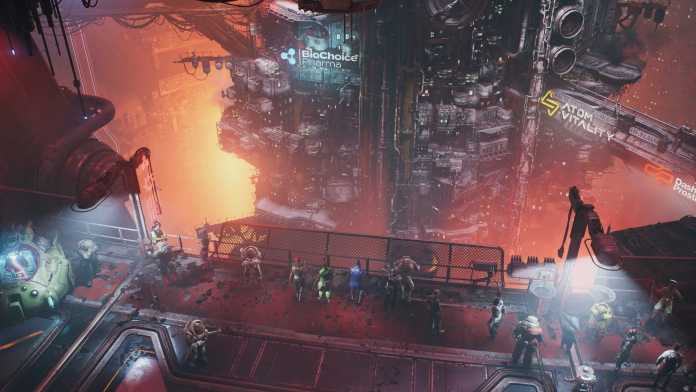
I know that a lot of people quickly get sick of seeing the same theme across various games, but this was never an issue for me. Over the last couple of years, cyberpunk has been making a resurgence, and I’m glad that all the cyberpunk games coming out don’t restrict themselves to a specific genre. In the case of The Ascent, its world is absolutely breathtaking.
I completely adore the way that cyberpunk is displayed here. There’s a huge variety of sceneries, ranging from tight hallways filled with massive pipes and cables that power the vast industries of the arcology, to more open areas where people tend to mingle. The game takes place across multiple layers of the Ascent Group’s arcology, with each of them being divided into multiple districts that, ultimately, make up for a series of interconnected areas.
The world isn’t just populated by enemies, but also by its inhabitants. Most often than not, you’ll see plenty of people running away when shots start flying, and this adds a lot to the game in terms of making it a believable and breathing world. It’s a world of constant skirmishes, not only between major gangs, but also between massive corporations that fight over the dominance of extremely rare AIs and assets.
Obviously, the game’s atmosphere wouldn’t be possible without the game’s graphical fidelity. Whether it’s the massive neon signs that populate the forest of towering habitation modules, or the amazing vistas from above the clouds where the rich spend their entire lifetimes, The Ascent looks absolutely stunning. The game goes far and beyond to make its world feel real. There’s trash literally everywhere across the streets, there are people pondering their miserable lives at every corner, and it all just culminates in an extremely engrossing experience.
Furthermore, thanks to how the game looks, most weapons feel pretty impactful. From bullet trails flying across the screen, to enemies exploding into bits due to the sheer power of your weapons, combat looks absolutely great. Meanwhile, in terms of sound, the game also does a pretty good job. From the punchy sound of each gunshot, to the background noise of the city, everything contributes to the game as a whole. The soundtrack, in particular, is spot on and I found it to always set the perfect mood in the right moment. It’s composed by Pawel Blaszczak, which also worked on the music for Dying Light, the Dead Island games and also the Call of Juarez series, so you might have heard his work before.
Although I could probably spend hours talking about the world of The Ascent, I have to admit that the game’s story didn’t grab me as much, at least not initially. It’s fine for the most part, but I thought that the later missions definitely do a better job in keeping you engaged. Personally, I prefered wandering around the streets of arcology, listening to random street conversations. Nonetheless, the game features a pretty interesting set of characters, each with their personal agendas. The game also has a codex full of lore entries that allow you to learn a ton more about the world. Overall, although I certainly wouldn’t commend the game for its quest design and narrative, I would most definitely praise it for its stellar worldbuilding.
Now, in spite of all that, combat is what constitutes the core experience of The Ascent. In general, it’s pretty intuitive and easy to get into the groove. It’s your typical isometric shooter with numerous abilities, weapons, armour pieces, and upgrades, but it still has a rather distinct flair. I think the most peculiar thing about it is the fact that you can lift your weapon when shooting. This not only allows you to fire accurately from behind cover, but it also allows you to hit larger enemies that tower over their smaller allies. It might sound obvious and simple, but the cover system actually plays a huge role during the vast majority of the game.
Unlike most games where enemies will always be right in front of you, ready to engage, The Ascent makes an effort to create more dynamic encounters. Usually, when you start engaging a group of enemies, you’ll see a bunch of new enemies appear out of nowhere, like coming out from nearby buildings or jumping from flying cars. The thing is, they tend to appear from behind you, so you always have to keep the pressure on the enemy and kill them as fast as possible. It creates this rather forceful game of constantly jumping from cover to cover or circling around a single piece of cover. It forces you to always have something between you and your enemy, so that you can lift your weapon and shoot over it. At least, that’s what happens until you become tanky enough that most enemies can’t even scratch you.
Having said that, the enemy AI is somewhat of a mixed bag. During combat, they behave quite well, constantly looking for cover and trying to flank you while some enemies provide cover fire, but they aren’t the brightest outside of combat. There have been times where I’ve been able to slowly take down enemies one by one by just sitting at the edge of the screen. Despite getting shot, they wouldn’t react in any way, simply because I was too far away and they couldn’t aggro. Likewise, if you attract an enemy’s attention and you just run the opposite way, they’d eventually stop chasing you, even if you still keep shooting them. It’s quite disappointing.
However, what certainly didn’t disappoint was the number of weapons, and types, that you can get your hands on. There are pistols, SMGs, shotguns, rifles, hand cannons, miniguns, rocket launchers, energy weapons, weapons with homing shots, amongst other more exotic weapons. There’s surely something for everybody. Each weapon is also more effective against specific enemy types. For example, energy weapons are better for dealing with synthetic enemies, while ballistic weapons fare much better against humanoids.
Just like with weapons, there are also various armour types with different stat bonuses that allow you to come up with distinct builds. Furthermore, tactical gear like stun grenades and combat robots, as well as active abilities in the form of augmentations, also deepen the game’s customization even further.
Unfortunately, the AI isn’t the only downside of The Ascent. Another complaint that I have is that sometimes the camera angle isn’t the best. There’s no way for you to adjust the camera in any way, so it can happen that you find yourself behind an object on the screen and so you can’t properly see what’s going on. It’s also not uncommon to get shot from outside your field of view. There are also a few sections where the game switches to a side-scrolling perspective, and it’s particularly difficult to aim properly here, but thankfully these are extremely rare.
As far as bugs go, I experienced two, but unfortunately, one of them was quite annoying. When selling duplicate items at one of the various shops, I just wouldn’t receive any money for them. I would have to sell everything one by one. Besides that, the skins that you pick up as random drops from enemies also either disappear when you restart the game, or they just never show up as if you actually picked them up.
Additionally, there are other things that do detract from the overall experience, which hopefully can be addressed in future updates. For instance, there’s no way to filter items by weapon type, damage type or anything like that. Because of that, eventually, inventory management can become a chore. Lastly, although I do love to explore the city and take in the surroundings, I have to admit that, a lot of times, there’s just way too much walking around. There’s a fast travel system in the form of a train system, and there are also paid taxis, but they only take to specific spots, you can’t choose the exact destination. This means that even if you take one of these means of transportation, you’ll still have a bit of walking to do. I personally didn’t mind it too much, but I definitely see how it can bother some people.
The problems that I’ve mentioned aren’t actually game-breaking, they’re just pretty annoying in a worst-case scenario. Now, having said that, the biggest issue that I have with the game is how it handles the waypoint system for quests, and just how the map looks as a whole. The map makes it pretty hard to figure out if something, like a shop vendor or a collectable, is a level above or beneath you. The map screen could definitely use some work, but I guess that it could also be solved by allowing players to place their own waypoint and have the game lead them to it.
On the other hand, one thing that does need to be addressed is the fact that the game’s waypoint system can point you to awkward spots because you haven’t unlocked the areas where the currently selected quest actually takes place. As far as I can tell, this can only happen if you start playing the side-content instead of going for the main quests first. Therefore, it can be avoided, but if you’re like me and like exploring, you might run into quite a few dead ends.
All in all, despite its issues, there’s no denying that the core gameplay of The Ascent is fun and that the game’s world has been masterfully crafted. I went into it expecting just a generic shooter experience, but the game surprised me in terms of the dynamics that each combat encounter can bring to the table. One moment you fire the first shot, ready to deal with all enemies on the screen, but, next thing you know, a group of enemies has just exited a building and is ready to join the fight. This constant back and forth makes you adapt and always be on the lookout for the best spot to hide behind cover. Therefore, the game becomes much more than just run and gun.
Nevertheless, the final boss fight was a disappointment, especially when you consider all the different enemies that you face throughout the game. As far as the ending itself, it felt like it came out of nowhere, it was unexpected, and it left a lot of things hanging. With that being said, I guess that this leaves room for a potential sequel or to expand on the content of the base game.
It took me roughly 22 hours to reach the end of the game, and I completed every side-quest that I found. Therefore, if you just go for the main quest, you can probably finish it in much less time. Still, I think that a lot of the side quests are worthwhile, as they give you more insights into the world of The Ascent and its people. Despite all its issues, I thoroughly enjoyed my time with the game and I highly recommend it if you’re into shooters or just into cyberpunk as a whole.
Fantasy games create some of the weirdest and most beautiful worlds you’ll ever experience. Without the demands of realism and accuracy, the developers are free to do as they wish. I’m always excited whenever I get my hands on anything within this genre, and Blightbound was no different.
Developed by Ronimo Games and published by Devolver Digital, this is a dungeon-crawling rogue-like RPG. Set in a desolate land, you control a trio of heroes who must change the villagers’ fortunes. You’ll crawl many dungeons to save fallen warriors, collect loot, and increase your levels. The world is a dank place and the monsters are worse still. Everything is out to get you, and death is a horrendous punishment. Staying alive is difficult and the only hope is to work together to defeat your foes.
Blightbound contains a classic plot with some fantastic ideas.
Blightbound uses a story that you’ve heard a million times before. However, it has a unique twist, and this makes it a fascinating experience. The story revolves around a hamlet that is surrounded by a fog known as the Blight. The people of this land spent decades fighting a being known as a Shadow Titan. To curse those that stood in his way, he released the Blight to corrupt humans and turn them into disfigured monsters. Your trio of heroes must enter the dungeons, destroy the bosses and rid the world of this foul entity….so, no pressure there then!
Your band comprises a “tank” warrior, a nimble assassin, and a powerful mage. As the game progresses, you unlock more characters in each of these fields, but your group must contain each of these classes. Each hero improves their stats by completing each dungeon and returning to the refuge alive. Here the spoils of war are shared and you may improve any fighter who has increased their level. So, it’s standard RPG mechanics, but with the risk of losing it all. Death in the dungeon returns you to the safety of the hamlet, but you lose everything you have collected. It’s classic rogue-like elements will keep you on your toes and make you scream with rage.
Hack away at the enormous monsters.
An excellent concept thwarted by poor execution and terrible matchmaking.
Blightbound sells itself as a fun and tactical multiplayer experience. It wants you to join friends or strangers online as you venture into each dungeon. Sadly, though, its appalling matchmaking system ensures that this rarely happens. If you have two mates that wish to join you, you’ll have a blast, but other than that, you are restricted to playing with the idiotic AI. Online matchmaking is impacted heavily because of its key concept. Each team must comprise one of each class and if this cannot happen, you won’t match with anyone. The popular class of mage is always taken and gamers rarely want to use the other roles. It was an oversight by the developers and perhaps random characters should have been allocated.
The AI is God awful! They are, however, accurate and useful in battle, but they are lacking in every other department. You are left exposed by their weaknesses repeatedly and issuing commands falls on deaf ears. In a game where death is costly, this will make you scream.
Can a game redeem itself if its USP is fundamentally flawed?
This setback for the developers made me think, “can a game redeem itself if it’s fundamentally flawed?” Usually not, but Blightbound has enough quality components that you’ll still enjoy the core game. With customisation options, many fighters to select, attribute improvements, unique equipment, and a vibrant hamlet, there are lots to mask the shortcomings.
Your time within the labyrinthine dungeons is thoroughly enjoyable, if not a little repetitive. There are unique goals to conquer and an array of monsters and bosses to defeat. Annoyingly, though, it leans on its hack ‘n slash crutch a little too much for my liking. You will, however, enjoy the exploration elements, the gathering of loot, and the destruction of your foes. Also, the sense of achievement upon victory is euphoric. This feeling is experienced rarely during the later stages as you rely on your useless AI colleagues. In short, the end game is extremely difficult, if not impossible, without human input, so get some friends on board.
Teamwork is key to a successful run.
Blightbound has a dark fantasy aesthetic and harrowing audio to set the mood.
My love for this genre stems from the wonderful stories and the fantastic imagery. Blightbound didn’t disappoint me and I was left surprised by the brilliant contrasting colours of the heroes. The vivid armour and striking sprites stood out against a grey and oppressive backdrop. The isometric viewpoint was fantastic and allowed me a clear view of the hectic action before me.
Unfortunately, there were some visual glitches and bugs that impacted the gameplay. Monsters and heroes would clip the scenery and become stuck, forcing you to quit the game and lose progress. This was thoroughly disappointing and tainted an already challenging experience further. Other than these glitches, the game ran smoothly and if the developers can remove the bugs, the game will be a much more rounded and polished product.
The hard-hitting audio was punctuated with comical one-liners, and the heavy and dominating soundtrack was accompanied by fizzing spells and booming blows. The audio plays up to its fantasy theme, and this was one of the magical elements contained within Blightbound. With death just around the corner and the risk of losing everything weighing on your mind, humour was key. I chuckled repeatedly at the most inopportune moments as the banter flowed. It was childish, but I never tired of it.
Images of death haunt you.
A clean UI, but still confusing to play.
I can’t fault Ronimo Games for their well-designed UI, but it didn’t make it any less confusing. With multiple actions per class and various methods to fill each gauge, it took ages to become comfortable with the controls. I loved Blightbound’s enthusiasm and desire to provide multiple methods of attack, but it over-complicated the matter unnecessarily. Once you master your favourite class, you’ll be laughing. Until then, grit your teeth and get on with it.
If the matchmaking issues are resolved, or you have a great group of friends, you’ll spend hours crawling the dungeons. There is plenty of potential for replay value, however, it’s not got there yet. I desperately wanted to move up the ranks and dive into harder quests, sadly I couldn’t. This tainted the experience for me, and I wasn’t willing to invest hours to guarantee failure every time.
Blightbound is too clever for its good.
The core concept within Blightbound is fantastic, but it’s also holding it back. The ideas are clever and work in theory, but unfortunately, gamers are fickle. No one will choose a class they dislike and this prevents players from progressing. Happily, it could be fantastic if there were some minor tweaks made. I liked it and recommend you to buy it here! Just be aware of its shortcomings before you invest. The Blight has thwarted mankind for too long! Enter the dungeon, defeat the monsters, and rid your land of this foul entity.
Enjoy the video review with in game footage shot from my Series X.
It’s rare to find a unique game. I’ve been playing for thirty-plus years and most beg, steal and borrow from one another. However, Bone Marrow shocked me with its unusual and refreshing gameplay.
Developed by Huge Pixel and published by Ratalaika Games, this is an RPG inspired by board game mechanics. Using old-school aesthetics and a simple concept, you’ll fall for its addictive charms once you get your head around the action.
Bone Marrow lets you stumble your way to victory.
Bone Marrow has a unique concept, but its story is as clichéd as they come. Good vs evil, warriors, monsters and the battle for ultimate power. It’s tried and tested and won’t win any awards for originality, but this was forgiven as the gameplay unravels.
The action starts with you selecting your warrior and the level you wish to attempt. There are four and each unlocks as you defeat the main boss. You’ll scream as rogue-lite elements ensure that your progress is wiped upon death (which happens frequently). This is frustrating as you must start over from the beginning of the last unlocked stage. Fortunately, you quickly familiarise yourself with the downfalls and create plans to prevent future failings.
With a limited tutorial, Huge Pixel has left you stabbing around in the dark to work out the fundamentals. This was annoying as the concept is so unusual, but with a little trial and error, you soon understand what is being asked of you.
Time to plan your approach.
Keep on sliding and fighting.
Each world comprises a board made up of many squares. Your character appears as a figurine in the middle and you can slide in four directions. As you move, an object appears, and any items already on the board slide in the character’s direction. As identical items collide, they combine, changing their shape and value to make them more powerful. The objects available are food for health, swords for attack, and shields for defence.
The game runs on a night and day timer and each has set rules. At night time you cannot collect any objects and here you plan to improve the value of the surrounding items. As day time comes, you can collect the goods and battle your foe, who also appears alongside you. However, there is a deadly twist! As you slide and gather items, so do your opponents! You must plan many moves, otherwise, you’ll strengthen your foe and face defeat quickly.
Don’t let the skeleton defeat you.
Levelling up and understanding the stats.
Throughout every stage, you have a clear understanding of your enemies’ strengths and weaknesses. You see their attack, defence, and remaining health. If you have an attack value of fifty, and they have thirty defence and twenty health, you’ll defeat them with one blow. Understanding this basic concept is key to success and once you are comfortable with this mechanic, you’ll have a blast playing Bone Marrow.
Defeating each opponent earns you XP and as you level up, your health stat doubles in value. Maintaining high health is essential to progress, and players can’t be victorious if they concentrate solely on their attack and defence values. I was surprised by how much thought I had to put into such a simple title. Like a game of chess, the small details matter! Every little action influences the outcome and to get the best out of this, you’ll have to play slowly with much consideration.
Bone Marrow uses old-school aesthetics to maintain its simple approach.
Other than the initial confusion surrounding the gameplay, Bone Marrow lacks complexity. The approach is reflected in the simple old-school imagery that has been adopted. The earthy colour palette and 8-Bit graphics give this the look and feel of an Amiga title. The top-down perspective emphasises the board game influences and makes it easy to plan each move. It won’t win any beauty awards but it’s serviceable and matches the theme and genre well.
The audio also takes a low key stance. With sorrowful and daunting tones, it matches the dungeon environment and reflects the storyline of the well-trodden plot. The sound effects are unimaginative and could have been plucked from an early RPG. I wasn’t disappointed, but equally, I wasn’t inspired as the audio faded into the background.
No one fears the lowly rat.
Planning and moving are the name of the game.
When the core concept revolves around sliding in four directions, you know it’s going to be easy to play. Bone Marrow is understandably simple to control, and this is good, as its complexities lie within the tactical gameplay. I understand why Huge Pixel simplified the tutorial, but one to explain the tactical elements would have been welcome.
As you familiarise yourself with the finer points, you realise that the simple gameplay is addictive. No matter the amount of failure I experienced, I kept wanting to play! Once you master it, you can play casually. This makes it a fantastic title to play when short on time or between larger games.
Bone Marrow will sadly be overlooked by many.
Bone Marrow is a title that will sadly be overlooked by many. Its unusual concept and dated appearance will put many off, but it shouldn’t. The gameplay is unique and calls to lovers of board games and logical puzzles. Its simple tactics and requirement for strategical thinking were marvellous and ensured no game was the same. I enjoyed it and recommend you to buy it here! Can you plan for every eventuality and defeat the bosses? Combine objects, slide to attack, and stay one step ahead.
Movies are renowned for having some badass hard-hitting characters that enjoy a brawl; Jason Statham, Sylvester Stallone, and Steven Seagal are, to name but a few. Then there are the classic games that everyone remembers as they grow up; Tetris, Sonic the Hedgehog, World of Warcraft, and so forth. What would happen if we combined the unflinching strength and tenacity of Chuck Norris with the moreish and addictive world of Minecraft? You’d produce Paint the Town Red, that’s what!
Developed and published by South East Games, this is a violent Voxel adventure arena brawler with a hint of rogue-like action. Created by a small two-man team, mainly, I wasn’t expecting a massive amount of gameplay. I was, however, wrong. Set across many locations, and with three game modes to experience, it’s a title that keeps on giving. You’ll lose hours of your life in glorious battle as you slash off limbs, slice faces, and throw weapons at anything and anyone that stands in your way!
What mysteries lie Beneath?
Paint the Town Red is childish, violent, but oh so addictive.
You’ll be chuckling from the first moment as you flit between your options and dive straight in. You’ll select between; Scenarios, Beneath, and Arena modes. Each one follows the same core concept and mechanics, so it’s pretty simple to get to grips with. The exception being Beneath that has a loose story for you to follow and an array of characters to choose from.
I jumped right into the Scenarios section, as I wanted some mindless action. This was a fantastic decision as it’s the perfect opportunity to familiarise yourself with the fundamentals. Here you’ll choose from five maps; a bar, disco, prison, and a day and night version of a pirate island. You can decide between challenge mode or add modifiers to mix up the gameplay. The world is full of enemies and your only task is to be the last man standing. You’ll choose from an array of weapons, a Superhot mode, increased health and strength and more. This was a brilliant choice from the developers and made an addictive game more captivating.
More modes to keep you playing.
As the dust settled from my multiple brawls, I explored what else Paint the Town Red offered. The Arena mode pits you against other NPC fighters in a gladiatorial event. This was hellish, hectic, and gory as hell. You’ll slice off limbs, break bones, and avoid traps. With two separate challenges available and plenty of rounds to experience, you’ll be pushed to your limits as you try to survive.
The main event, however, is Beneath. This odd adventure requires you to explore colourful catacombs and fight zombies and monsters. It was confusing, tough, and it leans on rogue-like mechanics, so be prepared to be enraged. You delve into the depths of a scientific facility looking for the answers to your questions. En route you earn coins, find crystals, unlock doors, and battle unrelenting beasts. A shop is on each floor and here you can buy upgrades and new equipment. This mode is tough as hell and isn’t for the faint of heart! With cryptic clues scattered around, you’ll have to be observant as well as agile.
Get the gladiatorial battle started.
Plenty of content and fun to be found.
To say I was shocked by what I experienced is an understatement. Never in a million years did I expect to get such in-depth action, and Paint the Town Red surprised me throughout. The act of slicing your opponents up with any weapon you found was gruesome but fantastic. If weapons aren’t available, you simply punch them in their square head or kick them in the balls. Watching your enemy falling away injured draws a wry smile. You know it’s wrong, but you’ll beat them while they are down just to make sure they are defeated.
Some may say the depiction of violence is too much, but I think the balance is just right. It certainly wouldn’t be appropriate for a younger audience, but it’s thoroughly enjoyable for adults. Alongside the fighting, there are elements of tactical nuance, especially when tackling Beneath. You’ll pick from an array of classes; Spectre, Vanguard, Warlock, Brawler, and Corrupted. Each has strengths and weaknesses to aid you on your journey and you must decide which suits your play style.
Paint the Town Red has Voxel characters but a smoother, more polished world.
Whenever I hear the phrase “Voxel inspired” I think “here we go again!” Don’t misunderstand me, I love the style, but sadly some developers use it as an excuse to make poorly finished games. Fortunately, Paint the Town Red doesn’t fall into this category and the game has a wonderful polished finish. Though the entire game is constructed using this style, it’s mostly apparent in the characters you interact with. They each have massive heads, square bodies, and interesting looks. Think of Harry Maguire, the English footballer, and you’re halfway there. The variety of environments is just as good as South East Games treats you to many locations. I’ve played this for hours and have yet to explore everything on offer.
The audio was cleverly thought out and spans many styles. Each suits the area you are exploring and adds to the expected atmosphere. In the biker bar or the disco, the NPCs operate the music, so if you attack them, the tunes stop. This was an excellent idea, as your actions had direct consequences for the surrounding environment. You’ll experience haunting and eerie sounds as you explore the depths, and the crowd vies for blood in the arena. The sound effects are loud, blunt, and will make you wince. Smashing a pool cue over someone’s head or battering a person with a chair sounded appalling, and that was great. No matter the weapon, the associated sounds will make you wince. I wonder, is it wrong that I got so much enjoyment from this?
Duh duh…duh duh….duh duh……
Hectic gameplay, but so easy to play.
With so many enemies to avoid, the action is always hectic. Fortunately, the controls are simple to master and this is helped by the well-designed UI. Clearly labelled controls present themselves at the start of each playthrough and a basic radial menu allows you to select any unlocked special powers. You’ll easily dodge and weave thanks to the smooth gameplay and your biggest concern is finding weapons and surviving each stage.
Whenever I tackle an arena brawler, I tire of the action pretty quickly. Fortunately, Paint the Town Red kept me interested throughout. Helped in part by its variety of settings and interesting modes, you’ll want to keep playing. Its moderate achievement list is challenging and completionists must invest a chunk of time to finish it. The story mode is full of surprises and one playthrough isn’t enough to experience them all.
Paint the Town Red offers an expansive experience that must be played.
Must play titles are usually restricted to triple-A-rated games but Paint the Town Red should be in this category. It’s challenging, but fun gameplay will have you wincing and smiling for joy. The addictive nature of each mode will keep you fighting, and its simplicity makes it accessible. I loved every element and recommend you to buy it here! Grab a weapon, start a fight, and watch the carnage unravel.
Here is a video review of the above article. Enjoy some in game footage shot my my Xbox Series X
I do love puzzles, especially in video games where puzzles help you learn and explore the world of that video game which is why I was very interested and intrigued by The Long Gate on Switch, being new to having this console, I was hoping to find that puzzle experience to have on the move. What I did not expect was to find an experience that was so purely focused on challenging the player with true puzzles and I am not sure this is a title for everyone.
The Long Gate is a very curious game to review if I am being honest, it was certainly not the experience I thought I would have with it and it did genuinely and still challenges what I believed were actual good problem solving and puzzle completing skills. It was very clear right from the opening minutes that this was a game that players could not rely on hand holding or any real guidance was going to be provided. In fact, the opening ten minutes were a big sign of things to come and not all of them were positive.
I will begin with the visuals which both on handheld and when docked to my TV really did not look very good, often blurry in this first-person view perspective and it took me by surprise after playing titles such as Link’s Awakening and Monster Hunter Stories 2, and it was very odd indeed. Another thing I am not a fan of is just how dark everything is other than the puzzles, almost like it is trying to create the illusion that you are in a much bigger environment than you are which felt unnecessary and for most of the time made this a very uninviting world to be in.
The puzzles are very well designed but these are puzzles fully designed at times to be challenging requiring precise problem solving skills such as an understand of how logic gates work which I can see for a lot of people could be unrewarding and nothing but frustrating in a world that is not very appealing to be in other than the well designed puzzle sections but with the blurry visuals for me at least, it was more of a chore to progress through than being satisfied in solving a puzzle and eager to move to the next one.
The controls certainly do not help the situation with the joycons feeling very cumbersome when moving and trying to move the view camera and it only gets worse when you try to move objects in a puzzle for you move as well as the object reducing the precision some of the switches in the puzzles require so you can easily make a mistake or lose track of what you need to be doing forcing you to reset and try again. So many little things combine to make The Long Gate a collection of issues that detract away from the very brilliantly done puzzles.
The puzzles are amazing, some so challenging I even whipped out an actual notepad and pen just to do some classic working out, even putting the game down to try and come up with a solution before attempting a troublesome one again. I truly take my hat off to the design of the puzzles that it really is a shame that the “Game” wrapped around them end up being the weakest element to the experience. The lack of any musical score is a huge absence for me and it just screams to have one to accompany the puzzles and the world. Playing the amazing OMNO at the same time which truly is a world with puzzles, with elements that compliment and enhance that experience to then come to The Long Gate which is devoid of so many of those elements but for clever puzzles just made this a disappointing time.
The only people I could recommend this game for are the die-hard puzzle solvers, this is a game that lacks many of the things needed to create a world that invites players into and to keep them enthralled enough to build up the energy needed to take on the many puzzles. As much as it lacks elements it also has elements that simply detract from the experience with messy controls, poor visuals outside the actual puzzles themselves and lacking any soundtrack makes this an often too dark to see and too silent to make it an enjoyable place to spend time in especially as some puzzles can be 20–30-minute solutions.
It was nice to see puzzles using actual physics and true logic gate solutions that you can really appreciate the effort and the design that went into the puzzles but as I said above, the weakness in all the other elements around the puzzles themselves makes this a very hard title to recommend.
Glancing at the title of my next review and thinking that it’s one that critics have called ‘one of the best ever’ is enough to put a spring in anyone’s step, but it turns out that the missing ‘y’ in Spelunky is often what you scream when playing Spelunker HD Deluxe on PS4, a re-release of a PS3 game that remastered the original 1983 Atari title.
Good reader, I’d like to pose you a question – Is it possible to enjoy a game that’s aggressively awful? If your answer is ‘Yes’, please read on. If it happens to be ‘No’, you have my permission to exit this window. Turn around and don’t look back. I’ll hold no grudges.
Spelunker‘s formula is simple enough – scurrying through caves, avoiding pitfalls and falling objects to head deeper and deeper into caves, there are potential game-like systems that could be employed here and – who knows – maybe even some enjoyment to be had. The overwhelmingly large but, however, comes in the form of a complete lack of quality in all areas.
If you edge off the ladder the Spelunker will die mid-air without falling any distance at all. This is also true of any edges. Not joking.
I apologize in advance to the developer of the remake if it wasn’t, but this absolutely has to have been intentional, in an ironic Goat Simulator-esque ‘so bad it’s good’ kind of way, but without the humor. Smartphone game visuals and gameplay tepidly conjure up an image of a Mario and Bob the Builder lovechild while the animation hands him a jerky coffee addiction through an exaggerated movement speed, Bomberman-like, but on separate screens.
Committing gaming’s single biggest sin, Spelunky implements physics so poorly that you believe the game is at fault for your failure, rather than yourself. Dying from a fall from a distance you should easily survive, or dying instantaneously after running off a platform is utterly infuriating. Not only does fly in the face of standard gaming convention – it’s just plain ridiculous. You’d think the developer would use the momentum from your fall to give you the chance to grab onto something, but that would be too easy, right? Add an ‘amusing’ drowning death animation when walking into an enemy and it’s enough to make you turn it off in a fit of rage.
Another catastrophic and horrific death.
Play the game in its original 2D game presentation though, with its NES Mario graphics and 8-bit music and everything starts to make a bit more sense – the visuals look less tacky and the soundtrack doesn’t make you want to rip your ears off. Quite why the developer decided against using modern mechanics for the modern visuals is a bit puzzling, making a complete mess of the mismatch and doing the original a disservice in one fell swoop, but it at least solves that nagging feeling that something is oddly amiss.
Go one step further and involve friends and the reason for playing this torturous game becomes clear – you are supposed to share your pain with other people, locally or online, in mini speedrunning battles.
After this revelation it is, dare I say, possible to enjoy this title in short bursts, but only if you’ve found people to play it with, as any sane individual’s patience will likely soon waver.
It didn’t steamroll me in this instance, but I’ll be honest, I kind of wished it did.
The modes available to you are divided into Adventure, Competition, Championship and Endless Cave NEO, but are all much the same, which bares perhaps the game’s biggest wasted opportunity as being able to cooperate in teams in the same cave (with multiplayer currently only played on separate split screens) could have given this game a bit more longevity.
Spelunky HD Deluxe might just be the novelty spicy pepper of video games, where you trick your friends into playing it and watch them writhe. Enjoyment is not the goal then unless you are a serious Speedrunner and enjoy beating unreasonably bad games. Either way, it’s an experience you won’t forget, for better or for worse…..but probably for worse.
There will not be a single Comic Book fan that has never asked themselves “What If?”…..that moment where you think what if this moment happened another way, what if Superman landed in Russia instead of Kansas USA, what if the Radioactive Spider bit Gwen Stacey and not Peter Parker and so many more iconic moments that created the superhero’s we know and love. Well thanks to MARVEL and Disney Plus, a number of “What If?” questions having been imagined and brought to life in a new animated series that has launched today August 11th 2021 and the first Episode asks the question, “What If?” Peggy Carter took the Super Solider Serum instead of Steve Rogers?
I love the whole concept of the “What If?” question and perhaps one of the first things MARVEL MCU fans might ask themselves is indeed, what if Peggy Carter took the Super Soldier Serum instead of Steve Rogers to become Captain Britain instead of Captain America. This twenty one minute animated episode as seen through the eyes of The Watcher, voiced brilliantly by Jeffrey Wright, shows fans what would happen if a single moment was changed from the original MCU timeline, in this case that moment during “Captain America: The First Avenger” in the room just as Steve Rogers is preparing to undergo the procedure and Captain Carter is asked if she would be more comfortable watching with the other VIP guests but instead of agreeing as Peggy did originally, she chose to stay on the floor of the lab and thus creating a new alternate timeline as not only did Peggy choose to stay, but the Hydra Agent chose to act before the experiment was completed instead of after, blowing the bomb and shooting Steve Rogers who left the Vita Ray pod to try and help. In the scramble and with only moments before the chance to use the serum would be gone forever, it is Peggy that chooses to step inside the pod to take the serum.
The art style is fantastic, even having a classic 40’s feel to the characters and having the familiarity of using recognisable characters and scenes from Cap’s first MCU film also really go a long way to showing just how different events and the MCU would have played out with this change in the timeline. The only complaint and more disappointing element is that only Chris Evans failed to return to voice “Skinny Steve” in this animation, the original cast returned from the film or had their lines reused from the film in this animation. Josh Keaton replaces Evans but also delivers a fantastic performance along side the always excellent Hayley Atwell as Peggy Carter. As the story explores her own battles during that time in our history and the very dismissive and misogynistic attitude to women in the army which mirrors what happens to Steve Rogers who is side-lined and set to perform for troops instead of being used as the Super Soldier he is, Peggy also faced this struggle with leaders who view the entire program as a failure because he became the super solider instead of Steve and her fight to have her worth recognised just as Steve did.
The animation in the combat and battle scenes is exquisite, especially when Captain Carter is fully in her uniform and Shield, now re-imagined with the Union Jack colours of Great Britain and showcased a lot more fighting ability than even Steve Rogers was shown to have in his first live action film. I do not want to spoil all the surprises and twists of this “What If?” story but I really do adore this art style which I do hope will be used for the remaining stories to be told and though the wait for the weekly drop of each episode gives me something to look forward to, as a MARVEL and a MARVEL MCU fan, I really want to just binge all the episodes now.
For those who have watched the LOKI series on Disney Plus and the birth of the full Multiverse in the MCU going into Phase 4, I do hope that at some point Hayley Atwell could well become the true Captain Carter on the big screen. This story alone shows just how deep they are going with this question, it is not just putting a character into a different character’s costume or powers, you really do get a taste of what that MCU Universe would look like with just one simple change taking place. I am very excited to see where this series goes as it continues to ask the question…
The life of a crime fighter can be a lonely existence. Whether you are a superhero or a detective, friends are scarce and trust is a limited commodity. How would you cope if your world got turned upside down? Everything you knew, trusted, and loved was wrenched away from you in a blink of an eye. Crimson Spires explores this with its seedy, romantic, and supernatural plot.
Developed by Woodsy Studios and published by Eastasiasoft Limited, this is a detective visual novel with an adventure romance twist. Set in the backwards mining town of Bataille, you control FBI agent Erika Wright. She has the perfect job; people she loves, nice coworkers, and a pleasant home. This is suddenly taken from her as she becomes trapped by mystical towers that kill anyone if they attempt to leave. People try to escape and lose their lives, leaving Erika as the only law enforcement agent in town. Promoted to the sheriff, she must uphold the law while trying to solve the surrounding mysteries.
Crimson Spires is a gripping drama with some compelling and odd characters.
The drama comprised within Crimson Spires starts immediately. You are thrust into the story as Erika is called to assist a crashed prison wagon carrying August, an alleged serial killer. On arrival, the devastation is obvious, and a standoff begins between law enforcement and August. Out of nowhere, metallic towers rise from the ground, encompassing the town of Bataille, and trapping the residents in their newfound prison. This day becomes known as the Contingency! The townsfolk are split in their beliefs; some think it’s an act of God, and he’s helping to protect them from the Devil. Others think it’s a test and a punishment for past indiscretions. Whatever the cause, it’s your job to solve the mystery and keep the people safe.
This far-fetched story unravels like a visual novel. Crimson Spires demands that you sit up and take note, while reading an awful lot of text. I loved this as the writing is fantastic and the characters are odd and compelling. Sexual tension bounces around every scene and you are repeatedly thrown off the scent with red hearings and conspiring characters.
Choices, choices.
Options, options, options, and supernatural beings.
Dialogue choices and actions that impact the story alter the course of the plot. You are free to influence this tale to romance anyone who you feel will provide valuable information. This was thoroughly enjoyable and allowed my inner detective to get to work. You push through each chapter making sense of all the information. This isn’t easy as new characters are added regularly and their introduction only muddies the water further.
With multiple romance roots, the developers introduced an NG+ mode. This allows gamers to delve deeper into the story once all avenues are exhausted. This was an excellent choice as it gives the plot a definitive ending and closes up any gaping plot holes.
My favourite element was the odd blend of characters and the heavy influences of religion. The “everyday” folk are unfazed by introducing an alleged murder or the rich vampires who appear in charge. This ridiculous basis for the story was absurd, but it made it compelling, dark, and I loved it nonetheless. This is a tale where you let it wash over you and you ignore the sensibilities of real life. If you can do that, you’ll fall for its seedy and mysterious charms from the first chapter.
Don’t fall for his charms.
Crimson Spires is both brilliant and poor in the presentation department.
When a game splits itself across two distinct genres, it always runs a risk. Sadly, Crimson Spires falls foul of this as its visual presentation is both brilliant and poor. The still imagery and character details have a Manga/Anime influence. With the usual OTT reactions to emphasise emotions, it relies heavily on tried and tested mechanics. Where it slips, however, is when the game flips to a first-person adventure. With dated graphics and rough textures, it stands out against the polished finish.
The audio also splits itself into two methods of working, and this was bizarre. During key scenes, it’s acted and this adds atmosphere and depth. Yet, other moments are accompanied only by the eerie and soft music used throughout. I guess the developers wished to emphasise the key moments, but as I played, it made little sense, and only added confusion.
Will you be brave enough?
A typical visual novel with simple controls.
The controls for Crimson Spires are basic and straightforward to master. There are no complexities in how the game handles and you’ll have zero issues with playing it. The gameplay is smooth, and I had no problems during my time in this dark world.
Visual novels rarely have replay value. Their linear plots allow for one playthrough before things become repetitive. This is different thanks to the multiple romance options and the addition of the NG+ mode.
Crimson Spires is an addictive tale that’s just a little absurd.
To get the most out of this, you need to leave your sensibilities at the front door. You’ll enjoy the bizarre plot for what it is and love the mystery as it unfolds. I enjoyed the dark romancing plot and I recommend you to buy it here! Losing your liberties by committing a crime is one thing, but this is something else. Form unexpected partnerships, question your suspects, and romance whoever is useful.
Gardening is one of those pastimes that you either love or hate. The thought of ripping up weeds, cutting down trees, and removing the waste can be daunting. But, there is an enormous amount of people who adore the challenge that yard work brings. They spend hours cutting, preening, and mowing the lawn and then they sit back and admire the fruits of their labour. Lawn Mowing Simulator taps into this market while introducing a business management twist.
Developed by Skyhook Games and published by Curve Digital, this is an addictive gardening game about pristine lawns and balancing the books. You take control of a gardener who starts a fledgling business with only one small mower to their name. You must take on contracts, maintain your equipment, and leave your clients’ lawns in immaculate condition. With a variety of missions to undertake, several game modes, and the chance to expand your empire, this is one sim game that ticks many boxes for a range of gamers.
Lawn Mowing Simulator will take over your life.
I’m a massive fan of simulation games! I love the in-depth qualities that the genre brings and I enjoy the escapism that each role affords me. Lawn Mowing Simulator is no different, and I quickly realised that it was taking over my life. Once you switch the game on, there is no such thing as one short mission. The hours melt away as you take on contract after contract and your business expands. It captures all the fine elements from other simulation games, and cutting each lawn to the exact specifications is oddly satisfying.
My wife rarely understands the enjoyment that I get from the variety of games I play, and this one was met with laughter and disbelief. I have a massive garden that requires “real life” attention, yet I’ve spent hours mowing a virtual lawn. I guess I best get some fresh air and cut the grass for real, but somehow it’s not as desirable or profitable as my virtual endeavours. When I get the call to take care of Mavis’ unkempt front and back garden, I jumped at the opportunity. No one likes a messy bush, and she pays handsomely! As the contracts keep rolling in, you can invest in better equipment, a bigger headquarters, and staff to earn you more money. You quickly corner the lawn mowing market and you’ll love each new mission that arises and the difficulties they bring.
One of the beautiful locations you’ll maintain.
New mowers, hiring staff and maintenance are key.
It’s not until you can afford the improved equipment that you realise how appalling the starter machines are. A small yard takes around 20 minutes of painstaking precision to complete. The tiny blades, miniature collection box, and slow speed are a real hindrance, but this soon becomes a thing of the past. You can select from an array of professional brands, each has a unique cutting method, speed, fuel capacity, and so on. You can purchase additional tools for some, and not every job can be completed with each type. As you expand, you must consider the jobs you wish to undertake and purchase your equipment wisely.
To make your business successful and to maximise your cash flow, you must hire staff to complete additional jobs. To do this, your company must be reputable, you must have spare mowers and a headquarters that is big enough to house them. You’ll be spinning many plates as you try to balance the books and make more money. It’s tough, but it’s very enjoyable and the more successful you are, the more RP you earn and the bigger the jobs you can undertake.
Buying new tools and hiring staff is just the start. If you don’t train your employees correctly or forget to maintain your vehicles, the wheels quickly fall off. Blades lose their edges, engines break, fuel runs low, and grass cuttings must be removed. If you don’t keep on top of the little things, your profit margin is reduced and your reputation takes a bashing. To keep the jobs rolling in, you must have the best staff available and this is achieved in two ways; hire a top-end employee, or train them in an array of skills. Either way, it’s essential and ridiculously expensive. The adage: spend money to make money is key, and your business will flourish under the correct management.
Take your time and watch out for the flowers.
More RP = better jobs and more challenges.
The developers were clever in their approach to the challenge mode. There are three categories to try, but they are locked until you increase your reputation in the career mode. This was fantastic as your progress was rewarded and the challenges offer a well-deserved break away from the demands that the business brings. You will face time trials, limited fuel jobs and more as you take on increasingly harder events. The career RP also enhances the tasks that are offered and a well-respected company has its pick of whatever job is available.
Alongside the career and challenge mode, you can enter a sandbox world that allows you to cut, clean, and work as much as you wish. I wasn’t a fan of this option, however, as I enjoyed the focus and drive that the aforementioned modes offered.
Lawn Mowing Simulator looks great but lacks custom options.
I loved how small details matter in Lawn Mowing Simulator! Unkempt lawns look rich and wild, and then you rock up on your ride-on mower and the grounds quickly become a lush green landscape. With so much grass to cut, it’s easy to miss small patches as you rush to complete each job. Luckily, “pro view” allows you to highlight missed areas. Combining this with the well-designed free camera allows you to navigate the tight gardens and vast fields. I can’t fault the look of the game, but the lack of custom options for your character was disappointing. It doesn’t impact the gameplay, but when you spend so much time looking at your business logo and person, it would have been nice to have more input into their design.
The audio is restricted to mainly the sound of the mower’s engine, the grass being cut, and mother nature. This minimalist approach was fantastic and though the roar of the motor was distracting, it wasn’t overpowering. You could easily hear the birds chirping and cows mooing and enjoy the sounds of the countryside. You are treated to an upbeat soundtrack when flitting through the menu, and this was a welcome distraction from the sound effects. The audio brilliantly combined a rough and hardy industrial edge with the soft, relaxing sounds of nature.
The never-ending job of mowing the grass.
Well-labelled controls make this a pleasure to play.
Any job that involves heavy machinery can be challenging to master, luckily Lawn Mowing Simulator takes it easy on you. With a well-labelled UI and a cleverly mapped controller layout, it’s great to play. You’ll have the basics down in no time and your only concern will be to stay out of the flowerbeds and not crashing into the ornaments.
When a game keeps you playing until the early hours of the morning, you know that it’s stupidly addictive. The career mode is moreish, the challenges will push you, and the sandbox mode gives you freedom. I never thought I’d find cutting grass addictive, but this got me hooked from the first lawn.
Lawn Mowing Simulator will get under your skin.
Every aspect of Lawn Mowing Simulator works in perfect harmony. Learning the fundamentals is easy, managing your business is enjoyable, and completing each contract is addictive. The weak point is the sandbox mode, but this is a personal issue rather than a problem with the gameplay. It’s a title that’ll tick many boxes, and fans of the genre will fall for its charms. I loved it and recommend you to buy it here! Jump on your mower, fulfil the contract criteria, and build the gardening empire of your dreams.