When I first booted up Paper Cut Mansion, I wasn’t sure what to expect. I like a roguelite as much as the next gamer, but the art style was more interesting to me than anything else. Thankfully this game has much more to offer than just an excellent design!
Gameplay
In Paper Cut Mansion, you play a detective sent to investigate the mystery of the titular house. This Roguelite puzzle game presents a variety of challenges to the player. Firstly, if you die – it’s game over, and you must start from the beginning. As you explore the mansion, you’ll be able to search the furniture, which includes detailed inspection to turn items around, and open drawers to find clues or coins. If you’re unlucky, you’ll unleash a ghost and need to run away until it goes or, if you help the exorcist, hang out near him. In this primary dimension, you’ll have many puzzles to solve to progress to new areas or solve quests. This could be from finding the combination to a lock to backtracking to search for a power source. Along the way, you’ll be guided by a radar-like moth, but apart from some general sound cues, there’s really very little assistance in your quest.
This, so far, seems like a run-of-the-mill 2.5D puzzler with some horror themes. What elevates this title is the dimensional aspect and how they all interrelate to progress in the game. One minute, you’re in the puzzle dimension and then next, you need to go to the dimension which can cause environmental damage with a small torch beam to explore. Or maybe you’ll jump into the combat dimension. Whatever it is, the game relies heavily on this back-and-forth to drive the story and experience forward.
As you explore the maze-like mansion, the story unfolds, becoming so much more than a horror-themed puzzler. The story is interesting and worth the frustration of the occasional total restart and endless walking in circles to find a clue to open the next locked door.
The combat feels very ‘arcade’, but it’s a welcome break from exploring the maze and completing puzzle-based or item-based quests. The game also makes a point of explicitly taking you there, which ensures a variety of gameplay.
Audio and Visuals
When you think of papercraft games, you would be forgiven to immediately think about a certain plumber and a particular dinosaur, but Paper Cut Mansion uses it perfectly. It’s a joy to see how the mansion is put together and the papery monsters you must fight. The visuals don’t match the genre, so this feels strange as you explore, adding to the creepiness in some ways but taking away from any genuine scares in others. While the game makes some attempts at jump-scares and uses the soundtrack to create atmosphere, it is less terrifying and more eerie. I feel like more could have been done in that respect, although I will admit I do enjoy the art style in general.
Final thoughts on Paper Cut Mansion
Paper Cut Mansion pleasantly surprises with its horror take on the papercraft art style of more family-friendly platformers. If you’re a fan of puzzle games with a bit of combat thrown in, it’s one I recommend.
Mobile gaming is the future. As network speeds increase, the ability to game on the move is a viable option. Furthermore, Xbox Cloud Gaming, Amazon Luna, and the late Google Stadia are proof that the concept works. However, like always, it is the hardware that holds it back. Massive games require monster mobile phones. Consequently, this gives manufacturers an enormous headache. Do they produce a top-end device that costs a bomb, or do they compromise and focus purely on the gaming aspects? Well, ASUS hasn’t compromised with its latest device. The ASUS ROG Phone 6D Ultimate or ROG Phone 6 Pro is a market leader.
This high-spec beast certainly pushes the boundaries. Yet, it’ll also test your relationship with your bank manager. Available for a whopping £1199.99, it is an eye-watering price tag. But don’t let this put you off. After all, can we really put a price on your gaming experience? Well, yes, apparently it is £1199.99! However, this to one side, let’s look at what you get when you invest in such a monstrously powerful machine.
What’s in the box of the ROG Phone 6 Pro?
The packaging is futuristic, interesting, and unusual. The full cardboard setup ensures its recyclable, and the contents are well protected. Furthermore, it looks stylish and screams to be opened immediately.
The ROG Phone 6 Pro is impressive to the eye. This sizeable device looks sleek and has a futuristic finish. To the rear, there is an offset triple-lens camera and a small display. Alongside this, there are 2 USB-C ports and the normal tactile buttons.
The Aeroactive Cooler 6. This external device clamps to the phone to drive cool air into the phone. Moreover, it has a USB-C port for charging and is easy to equip.
Clip on case. This small plastic case clips to the outside of the phone. If you use it, it adds a layer of protection while removing some of the futuristic details.
USB-C cable and power adapter. For this review, I was sent an American version of the power adapter. Luckily, though, a UK adapter works just as well. If you purchase a UK version, the correct adapter will be included.
Technical aspects.
When I research a gaming phone, I desire three key components: a powerful processor, a massive battery, and a phenomenal screen. Fortunately, the ASUS ROG Phone 6 Pro has these and much more. Why do I desire these components? Well, I want the best gaming experience I can get. Luckily, ASUS delivers a game-changing phone that’ll change the way you play.
AMOLED screens are nothing new. However, a 6.78-inch display that delivers a whopping 165 Hz refresh rate and a 720 Hz touch-sample rate is impressive. These stats combined deliver a seamless gaming experience like no other. Accordingly, FPS titles and racing games look incredible. Furthermore, the HDR 10+ technology pushes deep and rich colours that make every photo and video pop.
A mind-blowing screen is one thing. However, it is only as good as the processor that powers the device. Powered by the MediaTek 9000+, you enjoy an unparalleled performance. This monstrous processor devours anything thrown its way, thanks to its up to 3.2GHz2 clock speed. Consequently, it is hard to put into words how impressive this phone is. No longer do you have loading issues or performance lags. Instead, you enjoy a buttery smooth device that eats any game or program for breakfast.
All that tech, but does it have the staying power?
We’ve all been there. You sit down, relax, and prepare to play your favourite game. However, disaster strikes as the battery runs out of juice! This issue fades away into significance when you use the ROG Phone 6 Pro. With an enormous 6000 mAh battery that can be charged from 0 to 100% in under an hour, you never stop playing. Alongside this, the advanced steady charging facility allows you to control the charging speed. This may seem minor, but this feature ensures that the battery life is extended no matter the phone’s daily intended use.
The battery life is key, but overheating is a major issue as well. Thankfully, this is another problem that has been dealt with admirably. The Aeroactive Cooler 6 drives cool air directly onto the phone. This keeps the core temperature down and optimises performance. Yet, this excellent piece of kit isn’t perfect. The constant fan noise is distracting and the size of the device is a little clumsy. On top of this, it impacts your phone’s microphone and can ruin any recordings you may take. But these are minor setbacks when you consider the enhanced performance.
Style.
The futuristic finish matches ASUS‘ lofty vision for mobile gaming. I adored the clean lines, the mechanical edge, and the rear display. This “gadgety” extra is totally unnecessary, but I didn’t care. With indicators for battery life and other unessential bits, it enhanced the sci-fi look. Yet, when the cooler was attached, it couldn’t be seen, and this was a shame.
The offset camera comprises a triple-lense from Sony. This enables wide-angle shots as well as up to 8k video recordings. On-screen, the images and videos looked terrific. However, I didn’t print off my efforts, so the final product is a little inconclusive. That being said, it is nice that ASUS included such a great camera that didn’t feel like an afterthought.
The size and weight of a phone are divisive. Consequently, what I love, you may hate. Therefore, for what it’s worth, I cherished both the large screen and the meaty weight of this device. Moreover, it delivers a sense of high build quality, whilst being robust and hard-wearing.
Is the ROG Phone 6 Pro worth it?
I could go on for much longer. Yet, I don’t want to dither. But I’m conscious that I haven’t mentioned the incredible DDR5 RAM, the amazing audio, and the phenomenal air trigger controls. These additional elements enhance this phone’s status as a market leader and a true powerhouse. However, does it justify that whopping price point?
The answer? Absolutely! If you love to game on the move and want to stand out from the crowd, look no further. ASUS has delivered another beasty device that will not disappoint you. Accordingly, I recommend that you buy it here!
Like countless other gamers, I absolutely adore high budget AAA epics. However, devoting 30+ hours to completing one can sometimes feel a bit daunting. This is where the beauty of shortform games lie. They allow you to immersive yourself with an entire adventure, without having to make as much of a commitment. Somber, the game which we will be discussing today, is a stellar example of this concept.
Heavily inspired by the likes of LIMBO and the Ori series, Somber is a 2D, puzzle-platform, Metroidvania side-scroller. It was developed by You Will Get There, a small independent studio based out of Stockholm, Sweden. Considering this is their first official release, it’s commendable what they’ve been able to accomplish.
A tale as old as time.
Somber’s narrative pays homage to the Grimm fairy tales of old. It chronicles the journey of a peculiar creature, aptly nicknamed “The Hero”, who, at the behest of the King, has been tasked with stopping the sinister Witch. Being The Hero, they immediately embark on their quest, vowing in the process to “make things right.”
To be completely honest, the overarching premise of Somber isn’t exactly revolutionary. Yes, the concept of good vs evil is a tried and tested classic, and it certainly has its place. However, in many cases, it often comes across as primitive and clichéd. Thankfully, Somber, whilst having its own fair share of tropes, does manage to slightly break out of this categorisation. And it does so by making one very important amendment.
The developers, in a stroke of genius, decided to keep the internal structure of the story open to interpretation. For example, you could take it at face value as ‘the unlikely Hero overcoming the odds.’ Or, like me, you might perceive the entire narrative as a metaphor for anti- industrialisation. Regardless of the drawn conclusion, the speculative nature of this plot was a much-welcomed change of pace.
Shockingly good gameplay.
On the gameplay front, Somber blends tight platforming action, with light puzzle elements. This generally consists of making precise jumps and dashes, all while avoiding obstacles such as spikes, enemies, and disappearing platforms. Some sequences do require a bit more patience than others, but on the whole, they aren’t too challenging. What they are though is satisfying, and, for a lack of a better term, moreish.
Mercifully, the controls, specifically on a gamepad, are both functional and responsive. This means that you don’t have to worry about the game working against you, and can instead solely focus on your execution. If you do happen to fail a jump, you’ll instantly be able to try again thanks to the abundance of checkpoints littered throughout Gloom. Massive double thumbs up for this.
As this is a Metroidvania game, you can expect to explore a semi-open world. I say semi-open as some areas aren’t accessible until you complete the previous ones. Technically, this isn’t necessarily a bad thing, but it’s something to keep in mind if you like free reign exploration.
Variety is the spice of life.
As you progress through Somber, you’ll be granted a plethora of unique abilities to help level the playing field. For instance, Magic Missiles allows you to fire bolts of energy at your enemies, temporarily eliminating them. Whereas skills like Fling and Wall Jump allow you to leap from catapults, and bounce off of walls respectively.
Besides the unlockable abilities, there are also a couple of permeants passive powerups as well. These come in the form of attribute modifiers which either boost your Magic Missile’s damage output, or improve your Wall Jump’s mastery. They are typically hidden in secret areas, which makes it rather easy to unknowingly walk by them. Fortunately, you should be able to remedy any accidental oversights by exploring each corridor on the map.
Altogether, the addition of these upgrades, especially the unique abilities, prevented Somber’s gameplay loop from becoming stale. Best of all though, the manner in which they were incorporated was both diverse, and, most importantly, entertaining.
Melancholy graphics.
For the vast majority of the game, Somber’s varying art mediums complement each other quite well. The foregrounds, which are approached in a blackened silhouette style, mix together effortlessly with the coloured ink backdrops. It’s a striking, yet oddly beautiful direction, that I feel is best described as mesmerising.
On top of this, Somber also features a vibrant and alluring colour palette. Ingeniously, this has been woven directly into the core identity of the game, and is often used to further drive the anti-industrial motions of the narrative. Assuming this was done intentionally, it’s a brilliant representation of visual storytelling by the developers.
The environments themselves are expertly hand drawn, and radiate with the same sort of exuberant energy that you’d find in a Tim Burton movie. For example, one minute you may be absorbing an intricately planned landscape, only to be blindsided with abstract eldritch imagery moments later. This disparity is cool in of itself, but it also turned out to be incredibly useful in navigating the game’s open world.
All in all, I have nothing bad to say about Somber’s in the graphics department. Every detail from the character and background designs, to the VFX and animations, have been integrated phenomenally. If the developers could retain this measure of quality on all of their future releases, then they’d give companies like Neotro Inc a run for their money.
Harmless audio design.
Somber’s OST contains a collection of tracks that are innately simplistic, but nonetheless effective in highlighting the games prevailing themes. It achieves this by intertwining ambient style instrumentation, with spacious and open production values. In a way, it’s fairly reminiscent to Journey, though, admittedly, I didn’t find it nearly as memorable. Still, it is a competently arranged soundtrack, and it adequately achieves its desired goals.
In a similar capacity to the OST, the SFX in Somber are inherently minimalistic. As a result, I don’t have a whole lot to say about the sound design. Simply put, they remained largely innocuous throughout my playthrough, which is exactly what you want for this sort of game.
Conclusion
In summary, Somber is an incredibly short title, but one that successfully delivers an enjoyable experience. The gameplay, which conforms around well-paced platforming action, is both responsive, and surprisingly varied. A similar sentiment spills over onto the narrative, which I found to be rather engaging, though, at times, somewhat clichéd. Musically, the soundtrack is well put together and wholly inoffensive, but doesn’t do anything special to warrant being remembered. However, the same cannot be said about Somber’s artistic prowess, which is smartly woven into the core ideology of the game, and is downright gorgeous to look at. Unfortunately, Somber is currently priced at just under £6 as of writing this. While that isn’t an exuberant amount of money, it feels a little overpriced for how much time you’ll spend with it. As such, I’d recommend waiting until this goes on sale before considering buying a copy of your own.
Shumps have been a go-to genre for generations. Fans love the simple stories, rich colours, and addictive gameplay. However, having played many of these titles, I yearn for something fresh. Thankfully, Wings of Bluestar delivers this with its multifaceted story, multiple endings, and single-player and cooperative action.
Developed by Shinu Real Arts and Eastasiasoft Limited and published by the latter, this is a retro shoot-’em-up. What’s more, it comprises visual novel elements, a fun arcade mode, and a challenging boss battle. On top of this, it can be enjoyed with a friend and has some excellent artwork to devour.
Welcome to bullet hell.
Wings of Bluestar focuses on longevity.
An addictive game is all well and good. Yet, I’m interested in the longevity of the plot and the action. Thankfully, Wings of Bluestar delivers this in spades. With multiple endings, and many plot-altering choices to mull over, no playthrough is the same. Alongside this, you may select from two protagonists with a specialist set of skills. Accordingly, when each of these elements combines, you experience a game that keeps you coming back for more.
You control a pair of pilots who must save mankind. Aya is a hard-working trainee with a heart of gold. Whereas, Zarak is top of his field and his modesty reflects this status. However, both characters know their roles and what they must do to be victorious. Sadly, the peace has been disrupted as remnants of an AI rears their ugly head. By exploring strange locations and destroying an array of enemies, these heroes will rise to the top and save the day. Yet, things are never as easy as they seem! Unsurprisingly, enormous bosses and bloodthirsty machines will stop at nothing to halt their progress. Consequently, they must master their abilities and arm their ships if they wish to fulfil their destiny.
Oi, what do you have there?
Bullet hell and upgrades.
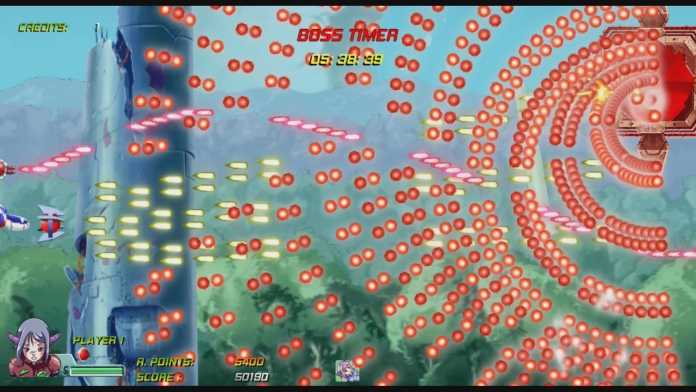
Though many of its peers have fast-paced and hectic action at their core, Wings of Bluestar bumps it up a notch. This bullet hell monster keeps you on your toes as you dodge, weave, and shoot to survive. On top of this, there are collectables to grab, risk stars to gather, and plenty of upgrades to be had. Then you must remember the scoring system that ticks over. Each of these mechanics merges to generate a fun but overwhelming experience. Furthermore, the branching storyline and interesting characters keep you hooked.
Yet, the most important element has to be the ship upgrades. As you destroy each enemy, there is a chance they’ll drop new weapons, power-ups, or a shield. Whatever it is, it’ll improve your chances of survival. Fortunately, though, the developers are pretty generous. Subsequently, you have multiple credits and lives to keep each run going. Moreover, if you fail, you simply start over from the top of that chapter. As such, you never lose too much progress and the gameplay isn’t too frustrating.
Wings of Bluestar is polished to a modern standard.
Wings of Bluestar has a familiar aesthetic. However, the polished finish and vivid colours make it stand out from the crowd. Additionally, the interesting stage design and variety of robotic enemies were great to look at. Alongside this, you’ll adore the masses of projectiles that fill the screen. In short, it’s a messy but well-conceived idea that is pleasant to the eyes. Accordingly, I loved the graphics, but it was the smooth action and lag-free approach that impressed me most of all. With so much going on, it could have performed horribly. Instead, it never stuttered and though it is overwhelming to observe, it never turns your stomach or hurts your eyes.
Graphically, Wings of Bluestar leaps forward. Yet, its audio is distinctly old-school. With a synth style and electronic undertones, it is reminiscent of many great 80s classics. Moreover, the sound effects are shrill and harsh, but well-considered. I adored the booming explosions, the high-pitched lasers, and the high-energy soundtrack. Thankfully, every element worked as it drove the action and story forward.
Unlease hell!
Hit-and-miss controls.
Normally, Shmups are easy to play but tough to master. However, this one is more complicated than its rivals. As such, its control system is hit-and-miss and poorly explained. Furthermore, I discovered a fault with the shooting mechanics that undermined the action. On top of this, it made it much harder to play! Sadly, this impacted the enjoyment factor and was detrimental to the final product. However, when the analogue shooting option worked, it was brilliant. Yet, it annoyingly failed many times.
If you can ignore this issue, you’ll enjoy a moreish and challenging game. What’s more, it can be played with a friend and this adds to the longevity. There is also a range of game modes to unlock as well as a small achievement list to complete. As such, it is excellent for completionists and veterans of the genre.
Wings of Bluestar is amazing when it works perfectly.
Wings of Bluestar does a great job of freshening up this well-trodden genre. Yet, I can’t overlook the controls. Every other element is polished and well thought out. But the control system lets it down. I adored the great story, the manic action, and the tough gameplay. However, it is held back by the fiddly inputs. If the developers were to rectify this, it would be one of the best Shmups of recent times. As it is, it’s amazing when it works, but that wasn’t as often as I’d have liked. Consequently, you may be discouraged, but I recommend it despite its shortcomings! Can you save mankind from an old foe? Grab the upgrades and power-ups, and kill everything in sight.
At EGX 2022, I was lucky enough to play The Last Hero of Nostalgaia and patiently waited for the game to come out. It was hilarious with the most sarcastic narrator a game has ever had, and I’m so glad this game exists. While the game is Nostalgaia – not nostalgia, you’ll undoubtedly be feeling nostalgic as you explore this unique souls-like world.
Gameplay
If you’ve ever played a Souls game, you’ll know what to expect from The Last Hero of Nostalgaia; it feels very similar to most action RPGs. You have items that can be equipped, monsters that can be looted, free movement, fluid combat controls and skill points to spend. However, be prepared to die and repeat sections because this will happen. It will happen a lot. While for some players, this is mildly infuriating (for others, it’s controller-breakingly so!), it’s not so bad.
One of my favourite games to play between deaths was spot the Souls reference. From level designs to bosses to entire scenes, there were subtle (and not-so-subtle) references that any fan of the genre would love. The story is a straightforward concept – the world of Nostalgaia is falling into pixelation, and it doesn’t look like there is a hero that can save the day. That is until an unlikely hero appears. A stick figure. What follows is an exciting, action-packed, comedy-filled love letter to Souls games with familiar bosses and locations blended perfectly into this new and unique world.
Regarding weapons and other gear, The Last Hero of Nostalgaia has more than enough to satisfy every player. Not only that, but there are so many references to other games that it is a genuine joy to find these unique items. One of the unique mechanisms when it comes to gear is ‘remembrance’. You can uncover the lore of the thing you find to unlock additional stats. This is genius, and more games need to adopt this blend of world-building mechanics.
Don’t worry if you prefer magic powers to hacking and slashing; the game has you covered. In the game, it’s called Source (to tie in with the meta-gaming references), and there’s a lot you can do with these abilities.
How Long To Beat pitches the game at taking about 16 hours to complete everything and only 11 hours to complete the main story. While not as long as a true Souls game, The Last Hero of Nostalgaia packs in a lot.
There is a main quest to complete but also numerous side quests from the world’s unique cast of characters. The fantasy world that you can explore is varied, but not without some minor issues referenced below.
Visuals
The art is one of the most wonderful things about The Last Hero of Nostalgaia. What starts out as a wonderful, detailed aesthetic reminiscent of those early Dark Souls games quickly descended into pixel art. These two contrasting art styles make such a visually interesting game to look at and explore. You could have a beautiful vista and the simplest texture on a wall. You never know when something will look 3D or be 2D pixels. It gives the world a fresh feel while playing on the nostalgia of different RPG-Adventure games. The hero, you would expect, should have endless customisations to determine every inch of their appearance. Well, The Last Hero of Nostalgaia even has a tongue-in-cheek twist on this. It gives you all the sliders but literally changes nothing. You’re a stick figure, after all.
As I mentioned earlier, the references to Souls games are strong, which even translates into the visuals. The entire world design feels like it belongs in Souls 1, and even some Bloodborne bosses make it into the game. If you’re a fan of Dark Souls, Bloodborne, or anything close to them, you will love the visuals of The Last Hero of Nostalgaia.
Some minor issues
While the combat is usually brilliant, there are some issues with hit registration in places, but thankfully this was infrequent enough not to register as a major annoyance.
My other minor annoyance is that while the world is spectacular, you can often find yourself taking a somewhat unnecessary shortcut to a place you’ve already been – but with little-to-no value in returning there. In addition, the fast-travel system is limited, meaning you can often find yourself backtracking unnecessarily to get to that one NPC you need to visit with nothing exciting to pass your time. A better thought-out fast travel system would be welcome.
Boss battles are few and far between. This isn’t a Souls game, so don’t expect it to be full of insanely difficult bosses at every turn. What is there, however, is well thought out and unique to each stage of your journey.
Final Thoughts on The Last Hero of Nostalgaia
The Last Hero of Nostalgaia is near-perfect. It is a fun, action RPG with an engaging story and a Soul-like experience. On top of that, you get a unique art style blending 3D and 2D graphics, and finally, there is comedy. I’ve never laughed more than cried when playing something called ‘Souls-like’. To me, the icing on this delicious cake is the references, not only to the various Souls games and Bloodborne but also to other franchises entirely (HALO and Zelda, to name two). It’s a delight; slight annoyances aside from exploration mechanics and missed hits, you will find yourself hitting ‘revive’ a million times as you try and prove that sarcastic narrator wrong!
We have brands that we associate with excellence. For me, EPOS | SENNHEISER is one of the best. In the past, I was fortunate to look at the EPOS GTW 270 hybrid earbuds. Consequently, these phenomenal earbuds reinforced my belief that EPOS | SENNHEISER is a market leader. Therefore, when I was told of their recent flash sale, it piqued my interest.
Gamers and audiophiles can grab some of the greatest tech available at a discounted rate. As such, you can improve your setup without breaking the bank. Without further ado, let’s see what treats are on offer.
The EPOS | SENNHEISER flash sale.
About the GSP 670
The GSP 670 is a premium wireless gaming headset for the demanding gamer. Customise 7.1 surround with the EPOS Gaming Suite and adjust chat and game audio independently. Intelligent battery management preserves battery life and Bluetooth® lets you switch seamlessly between your game and phone.
GSP 670 – from $249 down to $169 (save $80) // £219 down to £149 (save £70)
About the GSP 370.
The GSP 370 wireless gaming headset delivers reliable, lag-free audio with up to 100 hours of play on a single charge. Personalise your game audio through the EPOS Gaming Suite with 7.1 digital surround sound processing. The headset features a microphone with a lift-to-mute flexible boom arm and high-wearing comfort.
GSP 370 – from $149 down to $99 (save $50) // £129 down to £89 (save £40)
About the GAME ZERO.
The GAME ZERO is the classic closed acoustic headset designed for the gamer seeking a competitive edge. Original transducer technology delivers extreme audio clarity for exceptionally detailed realism and positional accuracy. Lightweight, yet robust, the headset folds for convenient portability.
GAME ZERO from $179 down to $99 (save $80) // £159 down to £89 (save £70)
This is a limited-time offer.
The up to 45% off bestselling, award-winning EPOS | SENNHEISER gaming headsets is available for a limited time only at eposaudio.com. This incredible offer runs from the 16th of January until the 29th of January 2023. Subsequently, if you want to grab yourself a bargain, I advise you to be quick. These products get a thumbs-up from the team at Movies Games and Tech. Furthermore, EPOS | SENNHEISER is a brand with a great pedigree and an excellent reputation.
(More information on EPOS | SENNHEISER can be found here!)
In 2022 the video game industry had a good year. The two big companies in the sector, Microsoft with its Xbox X Series and Sony with its veteran PlayStation series, managed to satisfy their eager fans. Also, Nintendo, with the new video games for the Nintendo Switch, showed that it still may par alongside the best in the industry. Undoubtedly 2022 left good video games and raised the bar for 2023.
However, in this coming year, it is expected that the novelties will come in strong in terms of video games. We still do not know all the releases that will be throughout the year, but there are already some hints of the upcoming video game titles scheduled to arrive in the first half of 2023. Before summer, there will be a mini-revolution in the sector because of all these releases, some of these being highly anticipated titles by video game lovers. The unknown factor is whether there will be more surprises after summer or this flash will only last for the first six months of 2023.
The most faithful to their favorite games have already noted the release dates of those games they can’t resist. In 2023 there will be releases for all major gaming platforms: PlayStation, PC, Xbox, and Nintendo. Some will be continuations of the most iconic video game sagas in the world, and other titles will bring fresh new properties and brands to both the triple-A and indie gaming markets.
Which video game releases in 2023 are the most anticipated
One of the most anticipated titles is Fire Emblem Engage, the sequel to the tactical strategy game that was so popular when Fire Emblem: 3 Houses was released. The previous one was released in the summer of 2022, and for this year, it’s time for the upcoming sequel, which promises even more content, characters, and great cinematic work. Nintendo Switch lovers will undoubtedly spend hours enjoying themselves with this exclusive title.
But also, they will have to learn how to properly spare some of their gaming time for the highly anticipated The Legend of Zelda: Tears of the Kingdom. One of the most anticipated games by the fans because Zelda games are consistent hits, and in 2023 this new saga of the story will be available to all. There has not been a new Zelda installment since 2017, so Tears of Kingdom will surely be one of the great video games of 2023.
On the other hand, PlayStation and Xbox users will also have to save up for new video games coming in 2023. For example, the Dead Space remake has already been announced, and it has been promised that it will surprise because it will test the capacity of PS5 and Xbox Series. Also, a spin-off of the Yakuza series will arrive called Like a Dragon: Ishin, a video game reserved for Japan only until 2023.
However, the big smash titles of 2023 for the PS5 and Xbox are Hogwarts Legacy and Resident Evil 4 (Remake). Hogwarts Legacy, the video game set in the Harry Potter universe, was scheduled for release in 2022, but its release was delayed for 2023 due to development issues, making its release one of the most anticipated for fans of the J.K Rowling universe. Just as anticipated will be the remake of the famed Resident Evil 4 title, which will be updated with the latest graphics and gameplay features.
These two games will also be compatible with PC, although the most anticipated PC-exclusive games this 2023 are Starfield and Company of Heroes 3. Just as exclusively, Final Fantasy XVI for PS5 will be released alongside PlayStation VR2 in 2023; a new step forward in virtual reality that will revolutionize how we interact with our gaming systems.
Virtual reality has offered astonishing advances in countless entertainment-related sectors. For instance, some games offer great visual experiences such as casino games. It is true that nowadays, this sector can be easily found online, with plenty more advantages and bonuses than in previous years. Among these benefits is the online casino no deposit bonus. People claim no deposit bonuses because users get extra money which they may use to win real money at online casinos. In addition, there are several bonuses suitable to everyone’s pockets to play gambling classics like Book of Ra.
In essence, 2023 comes loaded: New video games that will get the most out of the latest generation consoles. Thrilling stories, improved graphics and new ways to play and interact with the game world are what 2023 is expected to bring gamers of all types, both console and PC players alike. It remains to be seen what other surprises 2023 has up its sleeves in terms of releases because there are sure to be more and we cannot wait to see them.
Here is our review of the Xplora XGO3 GPS Smartwatch aimed at children.
The Xplora XGO3 smartwatch for kids is a perfect introduction to the digital world and comes with all the key features to be onboarded safely. It provides comfort, fun, and security in everyday life for the whole family. Thanks to mobile connectivity, children can discover the world carefree and communicate with their friends and relatives at any time.
Xplora offers the highest level of data security, making it the most secure product in its category, and has been tested and approved by TÜV. All communication is encrypted. This means there is secure encrypted communication between the kid’s watch, the cloud server, and the parental app. In addition, the Xplora kids smartwatch is not connected to the Internet. The data storage has been carefully designed according to the GDPR regulations. These factors combined make Xplora safe and suitable for children. The Xplora smartwatch is equipped with the technology of a smartphone. However, the features are adapted to the needs of children. Most importantly, unlike ordinary smartphones, the smartwatch has been designed with security measures that protect it from possible hacking or cyberbullying.
All Xplora watches are set up and managed via the Xplora app. This way, parents always have an overview and control. They can enter and add contacts via the app, and only these contacts are visible on the Xplora watch. The child can only communicate with the contacts that have also been stored by the parents. The live location of the watch can be viewed by the parents at any time via the app. All other functions, such as setting an alarm, school mode, or safety zones, are also controlled via the parental app.
Xplora believes that kids should be encouraged to stay active and explore the world around them. Xplora’s reputation as the world’s leading smartwatch for kids has allowed us to be pioneers in this space. Using our revolutionary rewards system, kids receive 1 Xplora Coin for every 1,000 steps they take. Xplora Coins are valid in the unique Goplay platform that features fun games, activities, and exciting campaigns. Working with major film and TV companies such as Paramount, Warner Bros, Universal Pictures, and Netflix, we run regular campaigns on the Goplay platform, encouraging children to be more active. These often include competitions and amazing prizes for topping the leaderboard.
Features
Phone
Messages and Voice Messages
GPS Location Function with SOS and Safety Zones
School Mode
Step Counter, Stopwatch, and Alarm
Camera, Gallery, Emojis
What’s in the box?
The box contains the XGO3 smartwatch, charging cable, instructions and a SIM removal tool.
A Closer Look
Final Thoughts
The XGO3 looks and behaves just like a smartwatch – because thats exactly what it is, just one designed for a child. Its a little chunkier than an adults smartphone but that makes it easier for smaller hands to use.
The XGO3 comes with a sim included in the box – you just have to activate it and then take out a subscription in order to use some of the features of the watch like GPS tracking, with the subscription costing around £7.99 a month, but this does include unlimited calls and data on the watch.
Setting up the XGO3 was fairly simple – just download and install the Xplora app and then follow the onscreen instructions.
The Xplora app is what you as a parent would use in order to track where the watch currently is. The app also controls what the watch can do, when it can do it (there is a School mode that disables certain functionality during the school day), who can be contacted from the watch and so on. It’s worth checking if your childs school will allow them to wear a smartwatch though.
If you child is worried or needs help, there is an SOS button on the watch which sends a message to an emergency contact.
Charging is via the included charger – a full charge should last a day or so, depending on usage.
The screen is clear and easy to read and the watch itself is waterproof so it should protect it if there are any little accidents.
The only calls that can be made or received on the watch are from pre-approved numbers added via the app – that stops them from calling the wrong numbers or receiving unwanted calls.
The Goplay platform encourages children to be active and earn rewards in games – this is a good way to get the child to play! Once they start earning those xcoins they want want to stop!
The camera is 2MP, not the greatest camera around but certainly good enough to use on the watch and enables your child to take pictures and have fun.
The XGO3 makes a great smartwatch for your child!
The XGO3 is available now priced around £139.99 (although at the time of the review it was available at £119.99) and is available in Blue, Black, Green, Orange and Pink. SIM plans start from £6.79 per month.
Undernauts: Labyrinth of Yomi is a dungeon crawler from Aksys Games and Poppy Works. When a dungeon mysteriously appears from the ground, the government send people to investigate. You play a corpo tasked with exploring the depths of this dungeon to find precious, presumably priceless, resources.
Gameplay
After some story cut-scene, you start the game by making your character. There are some basic archetypes to pick from, male, female, grizzled and young – after that, you can edit the name, history, job etc., but none serves many purposes beyond fleshing out the character in your mind. What will make a difference, though, is the background you select. Again, there are different options to pick from, which will impact your character’s starting stats. Finally, you must choose the job – these again have some impact as the jobs are tied to additional abilities and stats. I will say they are a unique list and not your typical, although there are some familiar archetypes here that will feel more familiar. Once you’ve set your starter stats, you’re finally ready to enter the dungeon.
Exploring is typical for a dungeon crawler, with square-by-square movement to explore rooms and complete environmental puzzles to unlock new areas. As you explore, you’ll encounter various monsters that need to be defeated (see the combat section below!) and find treasure that can help you develop. The mini-map is vital for exploration; you need to pay attention to it! It will show the squares you’ve visited, which are very helpful when you want to find your way back to camp. The map also features auto-travel routes, a timesaver when you’re deep in the dungeon and need supplies.
Treasure chests are not all they seem; often, I was surprised by an attack.
The camp has basic crafting, and the team mechanics work relatively well with the ability to boost their skills, increase defence and more for a short duration.
Turn-based Combat
Combat grows your experience, and it’s important with the volume of monster encounters in the dungeon. Being a turn-based system, you can select between defending, attacking, using items and skills, or running away. It felt a little like early Pokémon if that reference helps! You can control your team during combat scenarios, and as you face more difficult enemies, the skill will be needed to work out when to defend, heal or buff another team member for their powerful attacks. Definitely pay attention to the colour marker of the monsters you’re facing, as this will denote whether you should run or stay and fight. Purple means boss, red is normal, green unlocks new areas etc. The number of skulls is also something to consider; the more skulls, the longer the combat chain, which means if you’re not stocked up or your health is low, you might want to avoid these.
When you inevitably win (hopefully!), you’ll be rewarded with experience and sometimes items that might be useful to you. Experience, as you would expect, allows you to level up your skills and stats.
Undernauts: Labyrinth of Yomi is Not Perfect
Undernauts: Labyrinth of Yomi isn’t a perfect game, though. Often, the music had no correlation or even tonality to the environment or actions on the screen, and this disconnect made immersion difficult. Furthermore, the story feels underdeveloped and quite surface levels in places and the dungeon crawler experience, while solid, doesn’t feel new or bring anything exciting to the table. This isn’t a reason necessarily not to play it, but if the budget is tight and you’ve played dungeon crawlers before, then perhaps the money is best placed elsewhere unless you really love this genre.
More often than not, Xbox Game Pass always delivers a regular cadence of high-quality indie games. With games like Vampire Survivors, Cult of the Lamb, etc. gamers have flocked to these smaller gems in the absence of Big Blockbuster exclusives. Rainbow Billy: The Curse of the Leviathan is my most recent obsession thanks to the service. It’s a 2.5d, creature capture adventure-puzzle-platformer, developed by ManaVoid Entertainment and published by Skybound Games.
A World Devoid of Color.
Let’s face it, the world can be a scary place. So many of us struggle with accepting ourselves for who we are, and that is reflected beautifully in Rainbow Billy: The Curse of the Leviathan. At the beginning of the game, our characters’ worlds are full of color. This allows them to be themselves, making them cheerful and loving. But, the Leviathan who is colorless, steals all the color from the world, except Billy’s, and you must go on a magical and fun journey to restore color to the world.
I love games that tell meaningful stories in fun new ways. There’s a lesson in this game that is important for all ages, and it’s presented beautifully.
The starting area in Rainbow Billy: The Curse of the Leviathan
The Friends You Make Along the Way
Restoring color to the world is quite a daunting task, especially alone. Luckily for you, gaining friends in Rainbow Billy: The Curse of The Leviathan is a crucial mechanic. Like the rest of the world, the majority of people have lost their colors, exposing them to all of their insecurities and flaws.
You’ll meet so many endearing characters throughout your play-through, and you’ll learn just how essential friendship is in a dark and cold world. The coolest part of gaining these friends is how developer Manavoid Entertainment incorporates the power of talking into its battle system.
The character “Friend-ship in Rainbow Billy: The Curse of the Leviathan
We All Need Someone to talk to
As you go from island to island on your friend/talking boat aptly named “Friend-ship.” You’ll come across characters who are devoid of color. A battle will initiate once you approach them, and you must talk to them by learning what troubles them. This will reveal their colors to you, which allows you to recolor them with the friends you’ve already made.
The Battle Screen in Rainbow Billy: The Curse of the Leviathan
It was so touching seeing characters talk about their struggles very openly, and helping them to see the good in it. This was simply stellar game design from the developers, and I applaud them for it.
What’s even cooler is once you’ve made these friends they hang out below deck on your boat pal. You can go and visit them whenever you like and even bring them gifts you find in the world. They request said gifts, and by doing this your friends will level up.
Closing
Rainbow Billy: The Curse of the Leviathan is an important game for all ages. Now more than ever, we need to be accepting of everyone, because we’re all human and this game does a stellar job of highlighting that. With a charming world, enchanting characters, and a thoughtful message, you’ll find plenty to enjoy in this game.
Always be yourself, always be kind, and never be afraid to show your true colors.
People play games for all sorts of reasons. For some they’re an entertaining pastime, for others a means of connecting with friends both near and far. And for some, the competitive experience is the key motivator behind why they play.
For those in that latter group, there’s a clear desire to work towards improving your skills in the game you play, irrespective of whether it’s a classic table game, a high octane esport, or something in between.
No matter what game it is, there are several simple steps you can take to meaningfully progress in your quest to improve your gameplay. Below we’re going to take a look at some of these fundamentals.
Learn the Language
Gaining an involved understanding of the terminology in use in the game you play can be a huge help when you’re trying to improve. Often specific language grows up around a game to describe dynamics, rule-sets and strategies that only grow more relevant the better you get.
For example, the card game poker, which is more popular than ever in its online forms, has a wide glossary of niche termsand definitions for all aspects of play. The same even goes for seemingly more simple games, like the popular battle royale Fortnite, which has insider idioms relating to everything from fortress-building methods to descriptors of situational tactics.
In developing a familiarity of the language specific to your chosen game, you not only gain a more specific understanding of its core game mechanics, but an ability to converse with other players about detailed aspects of gameplay.
Do as the Romans Do
The popular saying, “when in Rome, do as the Romans do” relates to following the customs of the place you’re visiting, and whether that’s a physical location or game world, it holds true. One of the most natural ways to improve in playing a game well is to pay attention to the way skilled gamers play, and do your best to emulate their tactics and behaviours.
Often, through mimicking a highly proficient player, you may discover facts of gameplay that would be ordinarily obscured from you. Say, for example, you see that at the beginning of a game on a specific map, high level players all gravitate towards the same location.
In following them, you may discover the underlying rationale for their doing so – perhaps they’re heading to the spawn location of a power weapon, or even an outcrop that gives you a superior line of sight over your opponents.
By taking time to observe those better than you, and think about the motives underlying their behaviours, you will naturally improve. The same goes for rival players – if you get defeated, time and again, in a certain situation, take some time to unpick why. You may discover that you’re exposing a weakness obvious to better players, hence the pattern.
Those Who Can, Teach
In popular psychology and educational theory, there is a phenomenon known as the protégé effect. It demonstrates that an individual tends to learn and integrate information more effectively when they’re tasked with teaching what they know to another.
This is because, in formatting what you know in such a way that it can be taught to another, you must first clarify, to yourself, what your understanding of the given subject is. This can be a powerful tool to employ when trying to get better at a game.
In guiding a new, or less skilled, player, you may find that you learn – or re-learn – things that benefit you in the process. Often we take things for granted, and that can lead us to develop bad habits or simply make-do with an incomplete understanding.
Teaching another, and fielding whatever questions they may have about basic and fundamental components of the game in question, can be an extremely potent way for you yourself to become a better player.
Back in May 2021, we were all dodging Covid and enjoying the latest instalment of Resident Evil. Resident Evil Village blew me away and was given a 9/10 for its efforts. Consequently, when the Winters’ Expansion DLC was announced, I was very excited. This excellent addition focuses on 2 unique game modes. The first sees the return of Mercenaries mode, the second adds a fresh storyline with an unlikely protagonist. As such, it incorporates some mindless arcade fun and a new but familiar adventure experience.
Developed and published by Capcom Co, Ltd. this is a horror adventure title. Furthermore, it is story-rich, and gory, and has a wonderful blend of evil and wicked characters. Alongside this, it retains many much-loved mechanics while delivering some original elements along the way. If you’ve played the base game, you’ll experience many of the excellent locations again. Now, this may seem a bit lazy, but it is not. Instead, the developers have twisted each area to complement the fresh tale and the new protagonists.
Don’t go in there!
Winters’ Expansion: an unlikely protagonist.
Shadows of Rose explores a story 16 years after the original. You control Rosemary Winters, Ethan’s daughter. During the original story, she is but a mere child. However, now, she has some unusual powers. With psychic abilities, Rose is a tough adversary. Furthermore, her twisted experiences within the familiar locations are brutal, haunting, and unbelievably scary. Her DLC runs for around 3-4 hours and comprises 3 key moments. The first and the last are nothing unusual and follow standard Resident Evil tropes. However, the middle section is phenomenal.
During this time, you’ll enjoy some delightful stealth elements. Here, the story truly shines and the horror moments pop. Without spoiling it for you, there are plenty of jump scares, eerie experiences, and a fantastic and fascinating plot. Talking about the story, this 3 or so hour endeavour ties in nicely with the base game. Consequently, fans of the series can devour some interesting lore while closing off a few loose ends.
The first and third sections concentrate on the usual shooting, searching, and minor puzzles. As such, this happens to be the weakest part of the DLC. However, it was still a fantastic experience, so I had zero complaints.
Take out each beast in the fleshed-out Mercenaries mode.
Mercenaries mode is fleshed out.
Where Winters’ Expansion excels is the enhanced Mercenaries mode. Here, you’ll work through new maps and master 3 characters. Chris Redfield is fully loaded and ready to go. Next, you can tackle monsters as Karl Heisenberg. However, some work is required if you wish to use Lady Dimitrescu. In order to play as this vampiric beast, you must “S-rank” any of the available levels. This is no mean feat, so don’t expect to wield ungodly powers immediately.
Thankfully, the additional content makes this excellent mode feel more complete. With an array of weapons to improve and individual character traits to master, it gives you something to get your teeth or fangs into.
Winters’ Expansion changes the perspective.
When playing Shadows of Rose, you’ll explore the world from a third-person perspective. This new viewpoint can also be used if you wish to revisit the main story. Now, this may be a godsend for over-the-shoulder adventure fans, but I wasn’t so keen. For me, this ruined the claustrophobic and eerie atmosphere. Furthermore, it made the combat feel clunky and aiming with each gun wasn’t great. Accordingly, it was disappointing, and I certainly won’t be using it if I replay the main story.
The audio, on the other hand, was amazing! The excellent acting, striking cinematic, and booming weaponry was phenomenal. This wasn’t surprising, as the base game was an audiophile’s dream.
Maybe they should keep their tentacles to themselves.
Darn this new viewpoint.
Mostly, the controls were great. The normal responsive inputs and well-considered layout make it easy to play. Yet, the new viewpoint makes some of the key elements unnecessarily clunky. This was both disappointing and frustrating, and something I wouldn’t expect from the franchise.
Frankly, Shadows of Rose was too short. Though I enjoyed its stealth mechanics and the story, it was over too soon. Thankfully, the Mercenaries option adds plenty of longevity and replay value. Because of its arcade nature and moreish scoring system, you won’t want to put it down. On top of that, who doesn’t want to unlock Lady Dimitrescu and run amuck?
Winters’ Expansion was great but flawed.
Winters’ Expansion does a great job of mixing things up. I adored the stealth mechanics and the Mercenaries mode. However, I wish that the story portion of this DLC was longer. Moreover, the third-person perspective wasn’t needed. If the developers unleash more content, I’d love to see more depth. Yet, I still loved it and I recommend that you buy it here! Will you complete the Mercenaries mode, or will you piece together Rose’s story?
Sequels can evoke some very powerful emotions. When its predecessor is phenomenal, you can’t wait to get stuck in. However, if the original was awful, chances are you’ll scowl at the thought of wasting your time. Sadly, for me, the latter option materialised when I was given Hello Neighbor 2 to play. Why? Well, I hated the first game with a passion. Its clunky controls, surreal plot, and stupidly tough puzzle mechanics enraged me. Consequently, I was apprehensive about investing my life into the sequel.
Developed by Eerie Guest Studios and published by tinyBuild, this is a horror adventure title. What’s more, it has an open world, plenty of stealth mechanics, and some ingenious, albeit hard puzzles to solve. On top of this, the graphics and audio are impressive. Yet, the controls weren’t perfect. There is not enough guidance, and the developers have perhaps bitten off more than they can chew. Subsequently, there is potential, but it is, unfortunately, poorly executed.
Oh no, not again.
Hello Neighbor 2 makes you paranoid.
You are Quentin, an investigative journalist who is sent to discover the truth about Raven Brooks. Children are missing, and no one knows who is to blame. As such, you are hired to break into every house and leave no stone unturned. Unfortunately, Mr Peterson and his chilling cohorts are displeased at seeing you. Accordingly, you must use stealth, cunning, and luck to complete your task and find the culprits.
My disdain for the original isn’t a secret, but I did like its sinister edge. Thankfully, Hello Neighbor 2 retains this idea with its creepy protagonists and first-person perspective. Instead of one creepy individual to focus on, there is a village of eerie folk to investigate. As such, every building is searched, and each person is a suspect. Therefore, you move from house to house, completing an array of mind-bending puzzles while hiding in the shadows. If you can solve every problem, and tick each person off of your list, you may crack your case, and escape this strange, but ominous town.
Someone isn’t happy.
Familiar mechanics.
Much of Hello Neighbor 2 is mechanically similar to its predecessor. Consequently, you must use obscure visual clues to discover each puzzle. Sadly, this can be frustrating even if the eureka moments are rewarding. Furthermore, the lack of hand-holding or guidance will just piss you off. This is especially true when you are being stalked by a kidnapping weirdo. When the pressure is on, and you are hiding in a cupboard, it is particularly annoying.
I hate to admit it, but the problems are so absurd that I turned to a guide to help me progress. I wasn’t proud of this approach, but aimlessly searching for clues was a real turnoff. Moreover, being stuck in the same house for hours on end tests your patience to the limits.
I admired the developers’ focus on evolution. The push from a singular area to an open-world setting must be applauded. However, the familiar quests and the one key puzzle per zone soon became tiresome. Subsequently, the game spreads itself too thin, and it is devoid of rich or deep elements. Instead, you are left with a rinse-and-repeat effort, albeit in some interesting new environments.
Hello Neighbor 2 looks exquisite.
The core elements didn’t strike the right note, but visually, Hello Neighbor 2 looks exquisite. The bold colours, clean lines, and oddly OTT imagery are a treat to the eyes. What’s more, the throwing and movement animation is great, and the first-person perspective enhances the horror elements. On top of this, there are some great surreal moments, and some exciting and unusual locations to explore.
The visuals are expertly supported by audacious audio. The strange music, environmental sounds, and loud sound effects combine perfectly. However, its lack of dialogue or narration undermines the story. Furthermore, the lack of guidance adds to unnecessary confusion.
How will I get that key?
Sloppy controls.
Like its predecessor, Hello Neighbor 2 is painful to control. Consequently, selecting objects, throwing items, or climbing ladders is a pain in the balls. Furthermore, the layout is confusing and poorly explained. As such, the already sky-high levels of confusion turn into an unbearable tsunami of rage and hatred.
If, and that is a big if, you can ignore these shortcomings, there is plenty of longevity and replay value. With some nice Easter eggs and some deep-seated lore, it is fascinating. However, it’ll take a strong stomach and even stronger willpower to explore this game fully.
Hello Neighbor 2 is a marginally better sequel.
It was always going to be a tough task to get me onside, but sadly, the developers have failed. The same issues rear their ugly heads time and time again. Consequently, I was repeatedly frustrated and annoyed throughout. Yes, the graphics, audio, and setting were great, but that wasn’t enough. Even when Hello Neighbor 2 excelled, it wasn’t enough to paper over the cracks. Disappointingly, I cannot recommend that you buy it. However, more information can be found here! Crimes have been committed, and the village is a mess. Can you find the clues to unearth the culprits?
Hack ‘n slash adventure titles are low on my priority list. Why? Well, they are usually repetitive and full of annoying soundbites. However, occasionally, I’m wrong and a game from this genre stops me in my tracks. Soulstice was one such experience that caught me off guard. Without the normal mindless combat and irritating audio, I was pleasantly surprised. Yet, will it do enough to change how I feel about the genre?
Developed by Reply Game Studios and published by Modus Games, this is a fantasy hack ‘n slash title. What’s more, it is story rich and has some phenomenal acting throughout. On top of this, the combat is enthralling, the action is balanced, and it is perfect for newcomers and veterans alike.
Use the hammer to wipe out your foes.
Soulstice is captivating but familiar.
The gaming industry is fickle and gamers the world over complain bitterly about a lack of originality. Mostly, this is a fair viewpoint, but occasionally, I love to see a glimpse of top-end games in other developers’ work. Accordingly, Soulstice had a familiar edge to its visuals and gameplay. Though the action was extremely linear, I was reminded of both Devil May Cry and NieR Replicant. This isn’t a bad thing as both games are phenomenal. However, I don’t believe this has enough about it to be awarded such accolades.
The story focuses on 2 sisters, Briar and Lute. The first is alive but cursed and the second was sacrificed to ensure the pair were reborn as The Chimera. These ungodly beings are destined to share an intertwined existence, but they care not. Instead, they use their new powers to assist The Order and help the sprawling city of Ilden. A tear has appeared above the city and The Order must investigate the cause, battle the wraiths, and rectify the situation. This is where the sisters come into play. By working together, The Chimera will expel these evil forces and save the day.
It’s all about the combat.
With a predominantly hack ‘n slash core, the game unsurprisingly focuses on its combat mechanics. Yet, it still tells an incredible story thanks to the amazing acting and attractive cinematic. The gameplay is split into chapters that comprise pockets of fighting, some basic exploration, and the odd secret to find. The secrets transport you to a challenge arena where you must pit your skills against waves of beasts and creatures. These additional quests can be revisited at any time if you wish to practise or improve your final score.
However, the body of the game concentrates on excellent fighting mechanics. At first, the game gives you a gentle introduction that is particularly underwhelming. Yet, after a few hours, the combat becomes intense, and each of the protagonists expands their vocabulary of attacks and their arsenal of weapons. Lute is an ethereal being and acts in a support role. In doing so, she is the guardian of her living sibling. By increasing her blocking capabilities or the range of her spectral powers, she is a useful ally to call upon.
Use Lute’s powers to kill ghostly beings.
How about Briar?
Briar, on the other hand, is a cold-blooded killer. Armed with a meaty sword, her skill tree focuses solely on her destructive powers. As the game unfolds, she wields a hammer, a bow, and a giant metal fist. The first allows you to clear swarms of enemies in one swift attack. Alternatively, the bow takes down your foes from afar and the glove decimates armour. Each unique weapon is an essential tool to tackle the swarms of beasts that you’ll face.
As the game evolves, you must combine the sister’s powers to be successful. Lute must use her spectral range to allow Briar to kill the ghastly apparitions. Alongside this, her ability to freeze and block attacks is a key combat mechanic. This is then balanced perfectly with the entropy meter. This special gauge ensures that Lute uses her powers sparingly. If the meter maxes out, she vanishes and Briar is left alone and exposed. Consequently, you must balance each of the sisters to overcome each combat encounter.
Soulstice looks amazing.
Whenever a game is a blur of activity, you need it to look great and perform admirably. Thankfully, Soulstice does just that. Its sombre and oppressive colour palette is complemented by the moody dialogue and fascinating plot. What’s more, the combat animation is smooth, OTT, and has a wonderful fantasy edge. Accordingly, it looks amazing and the backdrops are intriguing. My only frustration came whenever I wished to explore the massive sprawling city. Unfortunately, invisible walls and the linear approach prevent you from venturing off the set path.
Alongside the magical visuals were some great audio moments. The plot is delivered perfectly thanks to the phenomenal acting. Furthermore, the aggressive soundtrack is complemented by loud and obnoxious sound effects. In short, it is loud, in your face, but boy, does it work well.
Grab your bow and take down your foes.
The controls are the cherry on top of the cake.
Things get better as you consider the control setup. With plenty of combos to execute and some meaty combat to address, it could have been tough to play. Fortunately, though, the excellent layout, responsive inputs, and thorough tutorials make it a cinch to play. As such, even when the new mechanics are dropped in, you never feel out of your depth.
The developers have done a great job with both longevity and replay value. The aforementioned secret arenas are moreish and challenging. Moreover, each fight is ranked to give each chapter an overriding score. This was an excellent idea as perfectionists will return to get the best result. Alongside this, there is an array of difficulty settings to defeat along the way.
Soulstice is a great game.
Though it isn’t as good as NieR or Devil May Cry, Soulstice is a great game. However, I wasn’t a fan of the strict linear style or the occasionally repetitive action. Yet, the stunning graphics, fantastic audio, and brilliant controls make up for this. Accordingly, I recommend that you buy it here! Can you help The Order and save the day? Work as a team, master your skills, and defeat every monster.