Review: The Wild Eight

I rarely get close to being Liam Neeson from The Grey. More recently, my chance came when the Beast from the East 2 struck the UK. Even so, the closest I came to starving or dying of thirst was when I ran out of Doritos, and my beer supply ran worryingly low. Death was also never an issue, though it was a close-run thing when one of my kids kicked me in the balls. This all changed the moment I installed The Wild Eight. It’s a delightfully dark survival game based around the wintry tundra of the Alaskan plains.

Developed by Fntastic and published by Hypetrain Digital, this survival game has you running across miles of snowy procedurally generated lands. A remarkably accessible game that offers a brutal experience with a relatively gentle learning curve for the genre. Death will certainly happen, but you have a fighting chance of preventing it, even if you are new to the game.

Few stats to manage, but it keeps you thinking. 

Unlike a lot of its peers, The Wild Eight has kept its character survival stats to a bare minimum. This is great if you are new to the genre, or if you simply dislike micromanaging a virtual person’s life. You must focus on; health, food and temperature, and that’s it. And keeping each one topped up is as straightforward as it should be. Suddenly cold? Build a fire, find shelter or chuck some wood in your furnace. Hungry? Go foraging, beat to death a wild animal, or eat the remains of yourself (this happens more often than I care to think about). Low on health? Medikits, bandages or sleep. This is surviving all wrapped up for you!

Surviving is always easy when you have friends.

If only it were that simple. After you come around from your plane crash (original I know), and you’ve escaped the many wolves roaming around (Liam Neeson’s, The Grey *cough cough*), there is plenty for you to do. You will; explore bunkers, search warehouses, follow electrical lines for miles, and more. Each lead to different quests and objectives. It was a great way to progress the story and ensure that you ventured far from the safety of your snowy base.

Wolves and character progression. 

You will want to stay close to home as the army of never-ending wolves hunt you relentlessly. These evil menaces love nothing more than to rip your throat out, leaving your remains strewn across the snowy ground. This is frustrating, annoying, but not the end of the world if you play on the easy setting. Respawn, retrace your steps and collect all your goods. Just make sure Mr Wolf doesn’t kill you again.

One way to ensure these furry hell hounds are less of a problem is to level yourself and all your buildings up. Fntastic balanced this just right. No matter how much you try, you can’t steamroller your way through the skill trees. Items must be collected, hunted or made, it’s slow progress, but it’s rewarding and challenging, just how a survival title should be. 

It may be cold, but the fire and food are always hot.

Improving your buildings leads to new items and environmental boosts. Your basic shelter turns into a warm haven, and your workshop transforms into a place to get top tools and weapons to battle the elements and the wildlife. It’s brilliantly balanced and keeps the action pushing you to the end.

Filled with despair and a small ray of hope. 

It’s incredible when a developer transports you to their creation with some emotive audio and great art style. From the off, you are sucked into this world of despair and sorrow. The vast emptiness and a sense of loss are at odds with the beauty of the surrounding scene. A blanket of untouched pure white snow lies before you. If it wasn’t for the situation you find yourself in, you’d be in awe of your new-found surroundings. 

Playing out from a bird’s-eye perspective, this simple cartoon style title will suck you in with its easy on the eye and no-nonsense approach. The grid-like map is easy to navigate as your field of view is large. Character models are basic but detailed enough, and the use of cold tones emphasise the icy bleak world you now live in. 

The audio complements this perfectly. A sad minor toned audio plays out quietly in the background. It allows the sound effects of the eerie howling wind, the crunch of feet in the snow, and the padding of animal feet to sound over it. Like the graphics, it’s not complicated or triple-A-rated, but its simplicity works brilliantly in this setting and is thoroughly enjoyable, if not a tiny bit depressing.

Berries, mushrooms and a Wildebeest. The joy’s of the great outdoors.

Clumsy controls. 

Unfortunately, Fntastic didn’t get everything right with their port to console. This is noticeable in the clunky and clumsy control system. Though the UI is well designed, and lends itself to easy navigation, you still press the wrong buttons repeatedly. When time is of the essence, and your stats are ticking down, you don’t want to die because of the control setup, but you will, and you do, all the time. Without a doubt, this would handle better on a PC. The UI lends itself to the use of keyboard and mouse over controller, and though it’s serviceable, it’s frustrating.

With several difficulties to choose between, a procedurally generated map, and different approaches being offered to succeed, this oozes replay value. A challenging achievement list ensures that would-be completionists must play through every portion of this to get their 100% status. This is one survival game that will keep you coming back for more. 

More than you’d expect. 

When I first saw this advertised, I was sure that it would be “just” another survival game, but yet it surprised me. With its generous difficulty curve, glorious aesthetics and ample replay value, it will test newbies and veterans of the genre. I enjoyed how the developers dipped their toes into the world of surreal and fantasy alongside their realistic survival mechanics. I won’t spoil it for you, but you will find some joyous and brutal surprises during your time in Alaska. Do I recommend it? Absolutely! It’s a cracking example of a survival game and can be purchased here! Do you have what it takes to venture into the snowy tundra and come out stronger on the other side? Plenty of ice, wolves, and mysteries lie ahead for those who take on The Wild Eight

Two Minute Review: Confetti 88 from Geomag

Playtime can be fun with the Confetti 88 from Geomag, here is our two minute review.

Geomag Classic is an inventive system of simple construction made of 58 mm magnetic rods and steel spheres. A huge number of shapes, geometric figures and models of every kind can be constructed. Geomag stimulates creativity and logical reasoning. The variety of the shapes and their transformations make it possible to create different structures continuously.  

The wonderful Geomag Confetti set is the perfect introduction into the world of construction and creativity.  With 88 pieces you’ll only need a few parts to create some awesome magnetic constructions. Full of vibrant colour the magnetic rods and non-magnetic and safe steel spheres come together to create a hundred of patterns, structures, and shapes.

The set is fun and educational, the inventive system of simple construction is made of 58mm magnetic rods and steel spheres. Stimulating creativity and logical reasoning and featuring all the components of STEM, (acronym for Science, Technology, Engineering and Mathematics), the set is great for the whole family.  

You only need to add imagination to the set and you are well on your way to create a unique masterpiece.  Geomag magnetic kits are the perfect way to express your creativity. There is virtually no limit to the creations that you can make.

Final Thoughts

The Confetti 88 set we were sent was the 88 piece set and there are other sets to choose from (more more or less pieces).

You can create anything your mind (or the mind of your child) can think of, and its a lot of fun to put something together and feel that snap as the magnetic pieces come together. There are examples in the box of shapes and structures you can put together and other suggestions available on the Geomag website.

It’s not only fun to build, but it’s a fun way of teach your child about magnetism – seeing my 4 years old face when the pieces appeared to push away from each other was priceless.

The Confetti 88 set is available now priced around £39 and is aimed at ages 3 and up. There are different sized sets, so have a look and see which one fits you best. This will make a really fun present and you will find yourself wanting to buy more sets just to build bigger and more fun creations.

You can learn more from the Geomag website.

Review: Splashy Cube

Let’s Make a Splash(y)

Do games need to have complex control schemes to provide an entertaining gameplay experience? Definitely not. For every Monster Hunter game that requires you to remember increasingly difficult control schemes, there is an incredibly simplistic game like Galaga that pulls you in with easy to pick up, tightly responsive gameplay. Splashy Cube for Nintendo Switch is a game that certainly falls into the latter category.

Everything about Splashy Cube screams mobile gameplay with its touchscreen control scheme, bite-sized levels, and the barebones UI. The game originally came out on iOS as Splashy Cube: Color Run in 2018. The responsiveness, fast-paced gameplay, and “just one more try” persistence the game cultivates is perfect for the hybrid Switch console.

Just Move Forward

Splashy Cube is also a game with a very simple premise. You play as a cube whose goal is to scoot to the end of procedurally generated labyrinths while collecting same-colored blobs and avoiding obstacles. Buzzsaws, protruding spikes, dead-ends, and pits are all out to get the cube. The challenge navigating these snags is that the stage is constantly plummeting into the abyss and your cube can only move in forward diagonals. This is accomplished by pressing the L/ZL and R/ZR buttons.

Not much to it!

I did not have high expectations of the game upon booting it up for the first time, but I was later proven wrong. The main navigation menu offers a single-player gameplay mode, a modest customization suite to change the look of your cube from around one dozen options that you unlock through gameplay, a national leaderboard, and the ever-present credits. The developer missed a real opportunity by not adding a multiplayer mode to the Switch port of the game. However, if Splashy Cube had included one, it would easily rank in my top multiplayer games on Switch.

Splashy Cube dropped me into the first level without any hand-holding. I was told by the game to press A to start and given the two-button control scheme. But outside of that, I could choose my own adventure, so to speak. Is this cube an Arthurian hero trying to save the prince from a hidden dungeon? Maybe it is a race-cube driver trying to set the record for fastest hotlap. It can be anything that you want.

What Makes a Good Game?

The key to a good game is having the ability to make the player say “one more try” or “one more level.” Splashy Cube overwhelmingly succeeds in this category. I originally set aside 15 minutes to get some first impressions of the game. However, when I looked at my watch, 30 minutes had zipped by.  If you have chores to do or scheduled commitments to keep, beware the vacuum of time this diversion creates. The additional promise of climbing up the leaderboard was my motivation to keep scooting through the levels. After an hour of gameplay, I owned that coveted top score.

Top of the w… leaderboard!

Levels are incredibly compact, ranging anywhere from 10 seconds to a couple minutes at the end. There are no hit points or checkpoints; if I make a mistake, I drop back to the beginning of the level and my high score resets. With zero loading time, if you thought you would have a chance to think about whether or not to take a break, you do not. Just hit A and continue giving those blobs Hell.

Take in the Sights and Sounds

Visually, the game would best be described as taking a minimalist futuristic approach because the colors are vibrant, fun, and clean. Every couple levels your cube and the environments change color, giving you the sense of leveling up and pushing you to keep exploring further. One complaint I could make about the visuals is that with gameplay so dependent on hues there is no option to toggle a colorblind-friendly mode which is a serious disadvantage to a portion of the gaming community.

“Is this cube an Arthurian hero trying to save the prince from a hidden dungeon? Maybe it is a race-cube driver trying to set the record for fastest hotlap.”

The sounds in Splashy Cube match the overall aesthetic perfectly. A cheerful, chiptune-like soundtrack pushed me to keep moving. The sound effects are cartoonish in a good way with satisfying plops when I crush blobs and the iconic cartoon falling out of the sky sound when I make the wrong move into a hole.

Verdict

Above all, at a $4.99 price point, Splashy Cube sets itself up as a great game. Whether playing in short bursts while riding on public transit, looking to kill a few minutes, or even as a new game for chasing those high scores, you’re covered. If you want to try the game out before purchasing and you have an iOS device, download Splashy Cube: Color Run.

Review: Orwell’s Animal Farm

Old MacStalin had a farm, ee-eye ee-eye oh.

Orwell’s Animal Farm, as you can probably tell from the title, is a video game-ized retelling of the classic 1995 film Babe. The game focuses on Babe’s pre-Pig-in-the-City days and brings in a lot of political themes that weren’t present in the original film. It also swaps out a lot of Babe’s characterisation, making him a lot meaner and changing his name to Napoleon, presumably in an attempt to situate the game as another gritty reboot.

I am, of course, being ridiculous.

Orwell’s Animal Farm set itself the ambitious goal of taking a novel about communism and converting it into a choice-driven text-based video game with a branching story and multiple endings. Somehow, despite the mammoth-ness of the undertaking of transforming a century-old linear novel into a game where your choices matter, Orwell’s Animal Farm absolutely smashes it. Just to show off, it also makes it cute, charismatic and captivating as well. It has a thematically appropriate style that reminds me of a children’s storybook and some buttery smooth narration from the wonderful Abubakar Salim of Assassins Creed Origins fame.

The game’s opening is what you’d probably expect from an Animal Farm game. You’re dropped into the Animal Farm barn, with the animals conspiring to free the farm from its human owner, Jones. The animals go ahead and do this with relative ease and very little prompting from the player, begging the question of where the animals’ competency runs away to once you’re left in control of them. The main gameplay picks up straight away after that, leaving you in charge of controlling the animals as they begin running the farm for themselves. It’s sort of like a communist Animal Crossing, in which case the farm’s raccoon has probably been taken to a quiet corner and shot in the back of the head for his capitalist agenda.

The game spends most of its time on an overview screen which shows all of Animal Farm and a selection of its animal inhabitants. Every day you’re given a scenario and the on-screen animals will all have different opinions on how the scenario should be dealt with. It’s up to you to choose which animal’s option to go with, balancing the potential gains and probably consequences. The game shows you what improvements and damage that choice will cause by placing little up and down arrows on the things being effected. These things often include the happiness of the animal itself, the happiness of other animals and some of the different resources you have to balance. These resources include:

Animalism: Don’t trust anything on two legs, don’t drink alcohol, don’t sleep in a bed. The rules the animals set for themselves when they revolted. Break them at your peril.

Supplies: Plough the fields, harvest the crops, don’t starve. Use up all your supplies and you won’t make it through the winter.

Defences: The humans will come back. You better be prepared to fight them off.

Repair: Winter will damage the farm’s buildings. You better repair them if you don’t want your animals to get sick and your supplies to spoil.

Windmill: You’ve had it too easy for too long. The animals want a windmill. You’ll need to use some of the time that you should be managing the other resources to focus on building it.

On top of managing your resources and the happiness and health of your animals, there are several events and achievements you can acquire through your choices in the game. They trigger different story events, such as animals arriving and departing from the farm, your relationships with the humans changing and the prosperity of the farm as a whole being altered. They come thick and fast so you’ll get a whole bunch of them through your first playthrough for that instant hit of dopamine. There are also 8 different endings your choices can lead to, some harrowing (like the one I got) and some, presumably, less harrowing. This branching narrative allows a significant level of replayability to the game as you’ll want to choose different options to see the story beats you missed the first time and how a different ending might unfold. In my mind, that’s a great way to encourage replayability as the game is only a couple of hours long, which is reasonable considering the story being told and the price of the game.

On that subject, there are a few flaws in the game due to its small scale. The same choices come up several times throughout and I’m fairly sure the same story event triggered twice for me during the same playthrough. I don’t think anyone was expecting the levels of choice and branching story that you might from an RPG along the lines of Skyrim, but, after a couple of playthroughs, I can imagine you’d be bored of seeing the same narrative, like tuning into the news on the day 335 of a pandemic.

There also isn’t any kind of tutorial to the game so the exact consequences of your choices aren’t always completely clear. When all the choices increase supplies but decrease the happiness of the animal doing the work, except for the sheep that doesn’t have a negative consequence, why wouldn’t you choose the sheep every time? I suspect I was missing something and those choices tie into the progress of story events behind the scenes but I’m too much of a pedant to let it slide without a mention.

Orwell’s Animal Farm is a great retelling of a classic story. It’s almost a visual novel but the level of interactivity and choice elevates the game well above what it could’ve been with a little less ambition. It’s small scale but the number of options and potential story outcomes give a good amount of replayability and intrigue. Overall, I think the content is perfectly pitched for the price and, whether you’re a fan of the novel or want to experience the story for the first time, it’s definitely worth a couple of hours of your time.

Review: Bartlow’s Dread Machine

Bartlow’s Dread Machine is a great game. From starting the game, I didn’t expect to enjoy it. The game’s mechanics felt off. The mechanics are arcade shooter like, but you don’t have complete movement of your character (a secret agent). It felt unnatural and limited as an arcade shooter—however, the games set in an interesting era of history. The game’s setting pulled me in, and I quickly found myself loving it. Bartlow’s Dread Machine is set in 1930s America, a period of history whereby US president Franklin D Roosevelt attempted to revitalise the US after the great depression. As a secret agent during this period, you embark on a mission to stop an evil plot from taking shape.

An amercianised feel

The game shines in this regard; its setting makes it stand out. The game has an Americanised 1930’s look which is beautiful. The outstanding graphics combined with its early 20th-century pre-war soundtrack puts you in the boots of a secret agent during this particular part of US history. You feel like a secret agent during the period, and it feels great. By great feeling, I mean the gameplay. Although I wasn’t a fan of the gameplay at the start of my playthrough, it grew on me as I continued to work my way through the story. The gameplay is fun and strategic having you the player using various weapons to take down enemies in a classic arcade shooter feel but in early 20th-century America.

A classic level

Outstanding variety and customisation

As you progress through the story, the enemy types vary, making you choose how to take down the enemies to go through the level strategically. Bartlow’s Dread Machine also has considerable variation in level design and uses various camera angles to change gameplay dynamics. This variation makes the game stand out, turning a traditional arcade shooter into a strategy game. One example is the use of the top-down camera angle to position the player in such a way as to be able to take down and see incoming waves of enemies otherwise impossible from a side-on view. Furthermore, Bartlow’s Dread Machine also has considerable customisation with a vast range of weapons and 1930’s clothing to choose from, to give your agent that 1930’s feel. Further adding appeal to the game.

Despite the positives, I found the lack of complete control of your secret agent still very restrictive. Your secret agent can only move up, down, left and right and this restrive movement made boss battles reasonably bland. Likewise, your character’s motion is slow and could have done with more speed to improve the game’s pacing. Thus the pacing of the game is bad, due to restrive and slow movement. Nevertheless, controlling your character in this respect is easy. The game’s controls are easy to pick up and simple, making it an appealing and accessible arcade shooter.

Arcade shooter action

Verdict

Overall, Bartlow’s Dread Machine stands out as an arcade shooter. From the great graphics to the outstanding variety in levels and customisation. Bartlow’s Dread Machine incorporates all of this in a 20th-century feel that not only controls well but makes you feel like an agent of a bygone era. Despite pacing and movement issues, the game stands out amongst its rivals in the arcade shooter genre. It is adding a considerable amount of new to an already saturated genre of games.

Review: Dread Nautical

The idea of a desolate ship floating somewhere on the vast ocean sends a shiver down my spine. The fear of isolation and sorrow must overpower if you were one of a small group of survivors aboard this meandering metal prison. If you then chuck in a sense of Deja vu and monstrous creatures, you have the beginnings of a nightmare. This is Dread Nautical in a nutshell. A Rogue-lite survival strategy game that asks you to search the many decks searching for survivors and resources to live just one more day.

Developed and published by Zen Studios, this suspense filled survival title asks you to explore a ship known as “The Hope”. You control your chosen character, who must leave the safety of the lower lobby to undertake missions in each of the 20 decks of this massive vessel of doom. You must search through furniture for; food, scraps, equipment, and other useful objects. As you explore, survivors will cross your path, and you must try to convince them to join you.

A unique experience.

Unlike other strategy, resource management survival games, this one has an eerie and creepy main concept. Each day ends with you sounding the ship’s horn for help, but doing so causes you to collapse and return to the lower lobby. From here your day begins again just like the last. This perpetual loop of searching, collapsing and searching some more keeps you busy as you desperately look for items that will help you survive.

Hack, hack and hack some more.

The lobby forms the hub of all activity and is your HQ throughout your stay aboard “The Hope”. You can upgrade this area to ensure that you can house more people, repair, upgrade or scrap any weapons you find, and more. Poles, guns, paddles, harpoons, are but a few of the objects used to attack the many ghastly beasts you encounter. You are free to keep, store, scrap or dump anything that you find. Once you discard an item, you can’t get it back once the day ends. This is the joy and the burden of this procedurally generated world. You are constantly shifting your approach and changing your tactics to suit the situation that you find yourself in.

Turn-based battles and convincing others.

Scavenging is but one part of this suspense-filled title, the other key layer is turn-based battles. You move around each level using a grid system. When no enemies are present, you may freely roam with no issue, but if an enemy is nearby, it automatically reverts to a turn-based system where Action Points are the currency of choice. Stealth is a key tool in victory, as is the weapon that you choose. Each has a set amount of uses, and each exhausts Action Points. You must analyse a situation and decide whether the fight is worth the risk. Once your foes are vanquished, they will drop much needed resources, but is it worth losing your weapon or life for one piece of food?

Alongside monsters, you will help or protect survivors who are caught up in this mess. A choice based dialogue will be presented, and depending on your answers, you may encourage them to join you, or you will offend them and they will risk their lives fending for themselves. Not all survivors are useful to you, and an extra body is an extra mouth to feed. You must decide who joins, and who is left by themselves. It’s tough, almost certainly unfair, but survival is key, and solving the mystery of this ship won’t happen if you die.

The perfect setting for a bloody performance.

A cartoon style with creepy undertones.

The artistic style was fantastic to look at, if not a little dated. The cartoon models were basic in design, but colourful and easy on the eye. The cutscenes used for the conversations were weirdly animated with most characters flailing limbs around like they couldn’t control their bodies. It was odd, but made me chuckle repeatedly so I forgave it. The core portion of this title plays out from a 3D isometric viewpoint. This was a clever choice from Zen Studios, as you had a brilliant view of all the action, and it allowed you to take in the vast emptiness of the world that you inhabit.

The audio is a sombre and melancholy affair. The sinister aura wraps itself around every element, and the tone and pace of the music emphasise this brilliantly. Echoed footsteps, the sound of the sea, and silence help to create a sense of foreboding and loss. Though there are no jump scares, and it goes nowhere near the horror genre, you can’t help but be on the edge of your seat throughout.

Easy UI and 3 difficulties.

When I was offered this, I was worried that I’d have to spend hours learning all the finer details, I couldn’t have been more wrong. A simple UI and a well implemented tutorial allows you to understand the fundamentals with ease. Once you get into it, you are left to your own devices, and this could cause confusion as more complex concepts aren’t as well explained. Yet with a small amount of trial and error, you progress easily enough. The well laid out UI is easy to navigate and helps you to power through the opening stages.

Where better to search for food than the ship’s galley?

Like with all procedurally generated games, the replay value is really high. To add to this, Zen Studios used 3 difficulty modes; Normal, Hard and Insane. The latter 2 will challenge experienced players of this genre, so I recommend cutting your teeth on the normal mode to start. A gradual learning curve and forgiving settings will allow you to master the game without wanting to rip out your hair. Add in a nice sized achievement list, and you get an awful lot of game for only £16.74.

Making friends and surviving, no matter what.

Dread Nautical is an interesting title that is unique in its core concept. It doesn’t ham up its sense of foreboding, nor does it hammer you with difficulty in the lowest setting. Its user friendly approach wants you to enjoy everything it has to offer before you move on. Team and resource management are 2 key elements that keep you playing. Who do you save, and who fends for themselves? You have limited food, who eats, and who starves? It’s tough, but as the group leader you must decide! Do I recommend it? Absolutely! A copy can be purchased here! Search, gather, help, fight, and sound that horn. This is your life until you solve the mystery surrounding your presence on the good ship “The Hope”.

Review: Heaven’s Vault

As it happens more often than I’d like, I’m kind of late to the party when it comes to Heaven’s Vault. The developers, inkle Ltd, who were also responsible for the Sorcery! series and 80 Days, released this game back in April of 2019 and it was met with critical acclaim. Now, luckily for me, I’ve just had the chance of playing it, and I’m honestly really glad that I finally did it.  

I’ll just go ahead and say it right away. Heaven’s Vault is quite possibly one of the best and most engaging narrative-driven adventure games that I’ve ever had the pleasure of playing. It’s a well-rounded adventure game with an amazing story and an astonishing puzzle mechanic. Heaven’s Vault is a game about finding ancient artefacts and deciphering the language of an ancient civilization. This is done by slowly building up your vocabulary by translating various inscriptions that you find etched in artefacts and numerous locations that you get the chance of visiting throughout the game. 

Aliya on an ancient ruin

The game takes place in the Nebula, a mysterious place where its inhabitants are able to travel between different moons through some sort of ethereal river network. It’s a world full of intrigue and social struggles that stem from thousands of years worth of knowledge that was lost and clouded by superstition. As the player, you play as Aliya, an archaeologist from the University of Iox, the current seat of power, that seeks to understand the world and what came before. 

At its core, Heaven’s Vault plays very much like your typical point & click adventure game, and you’ll often see yourself going back and forth between certain places if you so desire. A lot of people might associate this kind of games with linearity, in one way or another, but with Heaven’s Vault that isn’t quite the case. If anything, the only thing that’s linear about the game are the locations themselves, as they’re just enclosed areas. Everything else leaves quite a lot of room for replayability. This isn’t so much because you can drastically change how the story plays out but more so because as you spend more time with the game, you’ll get better at translating the ancient inscriptions. What I mean by this is that, a lot of times, you might think that you’ve translated something correctly, and thus you just assume that the inscriptions that you encounter from that point onwards mean something specific. However, you might eventually be able to figure out that you’ve been translating some hieroglyphs incorrectly, and that can totally change how you perceive things. 

Event timeline

There’s a timeline which you can consult to learn more about world events as you find leads about them, as well as your findings and actions. This includes making sure that you got translations right, by comparing different transcripts and trying to make sense of this long lost language. Figuring out the meaning of the ancient inscriptions might be tricky at first, but you’ll slowly build up your vocabulary and expand your knowledge. As this gradual process unfolds, so does the game’s narrative, and this makes for a really compelling mechanic to keep the player’s interest alive. 

The whole translation process starts with the game giving you a few options for each word, and there are various ways to be certain that your translations are actually correct, so you slowly start to make sense of what are initially just random hieroglyphs. Some of the earlier glyphs are easy to figure out, as their shape resembles their meaning, so it’s not like you’re going into the game completely blind. Still, as you progress through the game, the strings of hieroglyphs start to become more complex. Even though you continuously translate the ancient language, the game manages to keep up with the challenge and the intrigue of its puzzles thanks to this increased complexity.

Translating one of many inscriptions

Meanwhile, on the narrative side, the game keeps up the pace by continuously introducing you to new locations and characters. Also, Aliya isn’t alone in her journey, as she’s accompanied by Six (her sixth robot), courtesy of her professor from the University of Iox. As you wander through the world, whether that be through its several points of interest or by sailing the river, it’s Six that keeps you from going insane from boredom. There’s tons of dialogue between the two, and although a lot of it might not serve any actual purpose in aiding your investigations, it certainly adds a lot of flavour to the game world and experience. Without it, the game would certainly feel very bland. With that said, while Heaven’s Vault is unquestionably a text-heavy game, it does have some great moments of voice acting in the form of Aliya’s internal monologues.

It took me around 30 hours to complete my first playthrough, but you can actually keep playing in New Game+ if you want to experience more of the story and approach it differently. With NG+, the game allows you to continue with the words that you’ve already learned, but you’ll have to decipher harder and much longer strings of words. Speaking of which, I found that, although the game’s translation interface worked well for most of my playthrough, it clearly doesn’t work that well once you start to deal with long phrases and lots of possible meanings. There’s plenty of space on the screen which could’ve been better used.

If there’s one thing that I wished that Heaven’s Vault had, that would be the ability to sprint. There’s a lot of walking around, and while the scenery is more often than not immersive, I do wish I could move around faster. Still, I think I understand why the developers have opted to leave such an option out of the game. Although I’m sure that it would’ve been convenient to be able to move around quicker, I also think that this slower approach gives time for players to reflect upon the story and their findings. In a way, this gives Heaven’s Vault a sort of meditative feel, so, I guess that in the end, this is probably for the better. Besides that, the lack of manual saves might also put some people off, as this means that you’re at the mercy of the game’s auto-save system. So, because of that, you can’t go back on any choice that you make, you’ll have to live with the consequences.

Sailing one of the Nebula’s many rivers

Furthermore, I also have another complaint in regards to sailing. As you’re sailing between different locations, you’ll inevitably run into ruins and shipwrecks. These aren’t explorable, but your robot can search them for artefacts that can help you in furthering your translation efforts. Although every time that you sail you happen to chat with your robot, the act of sailing itself gets old pretty quickly, especially when you get into areas with almost no river flow. There is an option that lets your robot take you to your destination, but this obviously not only means that you’ll skip any dialogue that might have happened during your journey, but you will also miss any potential sites along the way.

In any case, Heaven’s Vault contains such a thoughtful and captivating story that kept me hooked right until the very end. With that in mind, after spending roughly 30 hours, I honestly couldn’t force myself to play the game again in NG+. Don’t get me wrong, I really wanted to go through the game and interact differently with its characters, and I also really wanted to try to experience the other endings that the game has to offer. However, just thinking about all the walking and sailing around that I’d have to do all over again was enough to stop me from replaying the game. Instead, I just looked up the different endings and did some reading on the Steam forums, as there are plenty of insightful and thought-provoking discussions in there. 

Heaven’s Vault is one of a kind. It’s one of the most intriguing and captivating narrative-driven video games that I’ve ever had the chance to play. The beauty of Heaven’s Vault is the fact that there isn’t a right or wrong way to play it. Most often than not, you can reach the same place through different means and by interacting with people in distinct ways. The fact that the narrative adapts seamlessly to your choices makes the whole experience feel so much more dynamic. Despite its shortcomings, I’m pretty sure that Heaven’s Vault will be one of those games which I’ll forever remember. It isn’t perfect, but it sure as hell is one of the best gaming experiences that I’ve ever had. If you don’t mind reading, I wholeheartedly recommend to any fans of narrative-driven adventure games.

Review: Aqua Lungers

Submerge Yourself!

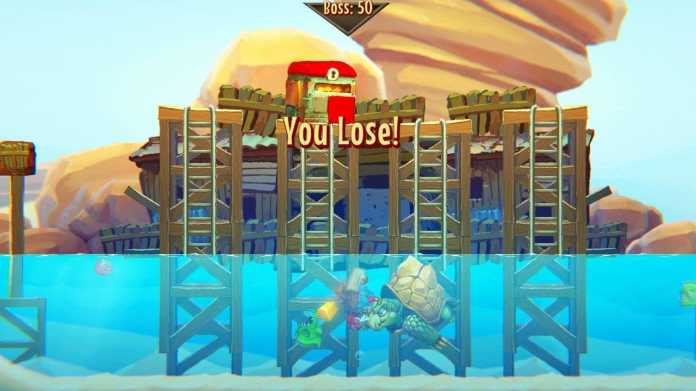
Get ready to hit that respawn button and dive deep! Developed and Published by WarpedCore Studios, Aqua Lungers brings back that often forgotten couch multiplayer experience. You can have as many as four players in this surprisingly humorous split-screen title. With deaths aplenty, funny visuals, and a banger of a soundtrack, this may be the game to let you enjoy a laugh with your roommates for an afternoon. Aqua Lungers has a very familiar control layout and recognizable game mechanics, so any player can literally “dive in!”

Better swim out of there fast after filling up.

Dive After Dive

Aqua Lungers, introduces no new controls or stratagems. You have your standard move, attack, jump, and change weapon controls utilized in 2D platformers for decades. Swim to the sunken treasure ships, fill up with gold, and slowly make your way back to shore. But ye be warned! Swarms of mean-mugging aquatic creatures are ready to defend their stash. Attacking omnidirectional foes one at a time is what you will be doing the most in the unfriendly waters. No one-hit deaths here, but having a few hit points to spare won’t save you from eventually turning into giblets.

You will really feel the weight of the gold held against you as you attempt to resurface with man-eating piranhas seeking revenge after you slayed their comrades. The extra slowdown after filling up, paired with the ease of dropping your stash, create a sense of urgency best shared with another to ridicule you for your struggles. You’ll definitely want to experience Aqua Lungers in multiplayer mode. The single player, while no different than the multiplayer, is for sure missing the same spark. It’s not as fun when you’re racing against yourself. You’ll also lose your motivation if you reach a roadblock and can’t get over the hump without accompaniment.

You will see this screen a lot.

Big Budget Battle Themes and Silly Walk Cycles

The cut-and-paste look rears it’s head once again. I know I’m a little biased, since I prefer pixels and sprites. However, I’m led to believe that this is a more cost efficient method, in terms of animation, for smaller budget games. The divers look so cute with their large feet. It’s adorable and also disheartening watching them walk around so eagerly, only to be ingested by a giant pink shark within moments of touching the water. This really brought me back to the flash animation era of the 2000s. I envision myself in middle school computer class playing something similar to Aqua Lungers on websites such as Newgrounds or Miniclip, then minimizing my window as the teacher walks by.

I laughed out loud upon playing the first level and hearing the intensely orchestrated score. Real instruments are back, and the music is heroic and triumphant. Strings, woodwinds, brass backings, literally anything you would hear from a Peter Jackson film, make their presence heard in this title. When you die and die, over and over, the music keeps its headstrong tone, making you feel even more of a fool for doing your diver a disservice by being bad.

Aqua Lungers is best played with a friend, or two, or three!

Bottom Line

Aqua Lungers is definitely a niche title. Difficulty aside, the game is entertaining enough and designed to be experienced in real social circumstances for players looking to find the pleasure in pain. And for those few, it’ll do just the trick.

Review: UltraGoodness 2

No matter how much of a hardcore gamer you are, there is always room for a silly arcade shooter in your life. This genre has been around for decades, evolving successfully to the style that we see today. Twin-stick shooters are big news for the indie market, and more recently we’ve seen some brilliant titles such as Enter the Gungeon and Neon Chrome. Older players will remember the brutally gory experience of Smash TV, and this is where I believe UltraGoodness 2 took its main inspiration from.

Developed by Rasul Mono and published by Ratalaika Games, this gory, fast-paced shooter will test your reactions and patience. You must plan your approach as you are expected to defeat wave after wave of evil creatures. Power-ups, diamonds and health must be collected on each stage, and these will help you upgrade your sidekick, defeat enemies in one hit, and survive for as long as possible.

What’s it about?

A once peaceful kingdom is now at risk of being overrun by evil forces. The only thing that will stop that from happening is the King and his trusty furry sidekick. You will face 30 levels of sheer hell. Bullets fly across the screen from the guns of demon bats. Fiery balls of fury will scorch you, and mushrooms will kill themselves to take you with them. You are armed with 5 hearts and a laser gun. You must use your wits and skill to avoid being struck, and wipe out everything in sight.

Bunny’s gonna get it!

It’s such a simple concept, but the madness is great fun. You run around each stage like Rambo on acid; throwing bombs, using your apocalypse powers, shooting enemies, and dodging projectiles like a King possessed. You quickly realise that more haste and less speed are needed to be successful, and you plan how to approach each stage. There is no randomly generated algorithm here, so each level is exactly the same every time. You learn each monster’s hiding place, and you react to them before they’ve seen you. For anyone looking on, it makes you look like a pro, but they don’t know that you’ve died 100 times already.

Though the main concept is shooting, shooting and more shooting, the game has a trick up its sleeve. Time manipulation enables you to slow everything down. Simply stop moving and the world around you slows to a crawl. It was an element easily forgotten, but it was a brilliant tactical tool that enabled you to eliminate your foes.

It’s more than just a cat.

Collecting diamonds appears to be a pointless task at first, but then you realise you can upgrade your cat. Your floating ally has his own weapon, and depending on how generous you are with the cash, you can; use missiles, rapid fire, a burning laser, and many more. It becomes clear early on that victory relies on the power of your cat, so getting him up to speed with the correct accessories is a must.

This isn’t a vacation!

The difficulty for a Ratalaika Games published title is quite high for once. Though on paper it looks easy to play, the limited lives combined with the number of monsters and their increasing firepower make this a tough nut to crack. The difficulty curve starts at a moderate level and slowly creeps up. I screamed the phrase “You *choice word* turd!” Many, many times. It’s a hilarious, frustrating affair that will bring the worst out in you.

Polished retro action.

As with most twin-stick shooters, the action takes place from a bird’s-eye perspective. You have a limited field of view, and unfortunately your enemies usually see you before you see them. The level’s are simple in design and lend themselves towards a basic art style. Vibrant colours stand out against the dark, earthy backgrounds that make up the opening portion of the game. The second and third chapters use a lighter background, but the same ominous atmosphere represents the plight that the Kingdom is facing. There was always plenty of movement on the screen, yet there were never any issues in how it played out. It was a smooth, enjoyable experience throughout.

When a game wants you to blow the head off of everything, you know the audio is going to be high tempo, and aggressive as hell. UltraGoodness 2 didn’t disappoint. A loud drum and bass soundtrack blares out alongside the action. Thuds of your bullets smashing into your opponent’s head sound on top of the music, as does the noise of their bodies exploding. It’s gory, over the top, and absolutely splendid. After playing this, you’ll need some time in a quiet room to allow your senses to clarify the in your face approach that Rasul Mono has taken.

I thought that hell would never freeze over.

Easy to play and easy to lose time.

I’ve reviewed countless twin-stick shooters, and I normally moan about how rubbish I am with the controls. Finally, a game where I felt comfortable with everything that the developers offered. You experience simple controls that are responsive and easy to learn. Your ally is controlled by the computer, so you need only focus on what you are doing to survive. 

Whenever I’m offered a Ratalaika Games title, I’m assured that the achievement list will be short and easy to unlock, and the game is usually quick to play. That wasn’t the case with this game! Yes, it was simple enough to get the 1000 Gamerscore, but a full completion will take some time. Death is guaranteed, as is screaming and frustration. The 30 levels look easy on paper, yet looks can be deceiving. You must set aside hours of your life to get through every stage, and potentially a new controller.

Will Evil win?

Having your Kingdom overrun is not fun for anyone! Luckily, a well armed king and his cat sidekick can take down anything that crosses their path. A well designed twin-stick shooter that has perfectly balanced difficulty with progression. You must unlock weapons for your cat and choose the correct one for each level so that you can be victorious. Do I recommend it? Yes, I do! You can buy your copy here! Grab your cat and gun, get mad and get revenge. Stop the Evil from taking over your realm, after all you are the King!

Review: Tears of Avia

When a game tries to use multiple approaches to form its core concept, it’s brave or stupid. Using this method can not only confuse your player base, but can also water down your ideas, making them weak and badly designed. Tears of Avia from developers CooCooSqueaky and publishers PQube Limited is one of those titles that has taken the gamble and tried to create an adventure game with a twist. It’s a strategy RPG that relies heavily on the turn-based attack method.

Set in the beautiful and rugged world of Estera, you must choose your hero, the “Seeker” of this tale. Gifted with an ancient power that allows only the blessed to see a jewelled treasure known as a “Tear”, you begin a journey fraught with danger and excitement. You must gather a band of warriors, wizards and priests to take on the many monsters that you will face. The demon Vylenkine desires power, and to control humanity, but he can only do this once he has found all the “Tears” that are scattered across the land. Once they are collected, a powerful magic seal will be broken, and evil will rise to rule over the world. Only you and your team can prevent him from fulfilling his evil plan.

A pretty standard story.

Once you brush away the dramatic elements of the story in hand, you soon realise that there is very little that makes it stand out against its peers. A demon who wants to rule the world, magic seals that need to be broken, and a team of random heroes thrust together to stop the apocalypse from arriving. It’s a 3 for 3; heard it, done it, got the tee-shirt. This doesn’t mean that it’s badly written or not enjoyable, but CooCooSqueaky had to make this stand out from the crowd.

Burn baby burn!

They mashed together several genres to create a sort of super hybrid. A SRPG turn-based Asian inspired adventure game (wow, that’s a mouthful). So did their gamble pay off? Was it too confusing to get to grips with and does it get boring quickly? In short, yes, no, no. It’s not a bad title at all, but it doesn’t really excel either. Having stretched their resources thinly, I was always left wanting a little more detail and complexity in nearly every layer of gameplay. But the merging of the genres was well executed, and will be of interest for most RPG fans.

What works?

Asian RPGs influence many of the game mechanics. Text dialogue translates the original acting, this allows you to hear the tone and flow as the developers intended. This goes deeper still with some fantastic Manga and Anime inspired character models and battle animations. This adds flair and colour to what is otherwise a rather depressing and dark landscape of war-torn buildings and cities. The team selection and inventory was also well designed. You choose to select which 4 additional fighters you wish to take into battle with you. This freedom allowed you total control over the tactics you wished to use, and your own gameplay style.

The levelling up and character progression impressed me. XP is awarded after fights, and can be spent on one of 3 branches of a skill tree. Whatever you choose allows an attack or defence option in fights and can help to turn battles in your favour. Alongside this, you may purchase upgrades for each individual skill. This allows you to concentrate on the parts of each hero that work with your approach and make the strongest team possible. It gave me a real sense of ownership over how the game was flowing, and I really enjoyed this micromanagement element.

Take some time out from the constant fighting.

Clunky, clunky, clunky.

Did anyone mention that this is clunky? Walking animations appear like they belong on a Sega Saturn, battles are slow and arduous, and though I liked the fight animations, the Anime/Manga ones took forever to complete. Large maps become the bane of your life as walking from one end to the other takes an eternity. The camera angle is terrible, and navigating any of the cities is a monotonous task. Unfortunately, for all the good elements, there are plenty that brings this crashing back down to earth. With so much going for it, the desperate attempts of pleasing many people came back to bite the developers in the posterior. Too many cooks spoil the broth, or in this case, spoil the detail in the gameplay. None of these things that have been mentioned ruin the game, it just makes you sigh as you plod along.

A vast world and replayable battles.

Though the story isn’t the most original penned script you’ll ever read, it sits in the background supporting the main concept, the battles. A large 2D world slowly opens up to allow you to choose each fight that you have already faced. Each one has a 3 star rating that must be achieved through set objectives. At the beginning these are unobtainable, and shouldn’t be considered. You may think “That’s pointless!” I thought that until I realised that it’s created for challenge and replay value.

It’s a clever way to ensure that players will continue playing through as their characters level up, purchase better equipment, and become a stronger unit. I really applaud CooCooSqueaky for this approach. It was almost laughable when you returned to the earlier fights, mowing through your opponents.

4 against 2, I like those odds.

It’s a mixed bag presentation.

This colourful and detailed RPG will have you loving its landscapes and environments, but loathing its chunky character models. The battle areas are well designed and offer a tactical challenge. The animation for the attacks is well thought out, but I can’t get over how poorly you move through any of the cities. This is further compounded with a badly optimised camera, and difficult to navigate locations. Places of interest are highlighted with a white orb, but these are hard to see, making it a mess to look at. It’s a shame the quality of the backdrop couldn’t have been replicated across much of the rest of the game.

Alongside the brilliantly integrated acting, a classic RPG style soundtrack plays out. The high energy music with a magical medieval tone sets the scene nicely. The sound effects from the team moving and attacking were nice, and each had their own repertoire of sounds. Though it wasn’t mind blowing, it did well to support the action, and created character traits for each of the warriors.

The controls were lacking.

It’s sad when a good game is let down by unintuitive controls. Unfortunately, this is the case in Tears of Avia. At every point it feels like you are battling an invisible force. Nothing runs smoothly, and you are constantly willing for it to work with you, not against you. It’s all serviceable, and the game is playable, it’s simply not as user friendly as it should have been.

The bigger they are, the harder they fall.

Alongside the delightful choice of replayable battles, a challenging achievement list will draw you back in to keep playing. The in-depth skill tree, and the combination of teammates means that each playthrough never needs to be the same. The developers spent a lot of time ensuring that its fans would want to keep playing, lets hope that its shortcomings don’t put them off.

Many positives, many negatives.

This was one of those games that left me confused with how I felt about it. I loved so many of its key ideas that I wanted to keep playing, but I was constantly battling its negatives. It’s not the best title in this category, but it’s also not the worst by a long way. At only £16.99 you get a lot of value for money, as long as you can forgive its mistakes. If you want a copy, it can be purchased here! Do I recommend it, I actually do! The positives just about outweigh its downsides, and most of them are cosmetic, so they can be ignored. If you play this, you must save the world of Estera from a power hungry demon. Can you gather your team and collect all the “Tears” before Vylenkine does?

Review: ENDER LILIES

A recurring theme in recent Indie releases is style over substance. ENDER LILIES bucks the trend by expertly marrying playability and graphical excellence. The game is both a visual feast and a consistent joy to play. Though done in a familiar Metroidvania style, ENDER LILIES manages to bring a unique spin to the genre with its atmospheric focus and dark yet innocent style.

It goes without saying that the team behind animating ENDER LILIES is good at their job. Seriously, within the first few minutes, you can tell you’re experiencing a serious accomplishment. From the stunning lighting to the life-like movements of your character, Lily, everything is picture perfect. Normally I’m not one to heap so much praise on the graphical side of a game, but when the experience leans so heavily on atmosphere, you have to get it right. Here, they’ve done exactly that.

But, ENDER LILIES is much more than a visual achievement. It’s equipped with gameplay to match. In typical Metroidvania style, you’ll progress with the items and power-ups that you earn. Binary Haze Interactive has done an excellent job of balancing the difficulty of their game. It’s hard, but not unbeatable. The items (called “relics”) grant minimal bonuses and offer only a marginally easier experience in boss fights. I struggled to find many of these during my playthrough, but my lack of relics hardly hampered my progress. The rewards earned from the aforementioned boss fights, unique abilities, are far more coveted, as they offer a genuine upgrade that will help you progress.

For me, the weakest point of ENDER LILIES is the normal enemies. There is a marked lack of diversity in the mobs you encounter and their abilities leave much to be desired. They all seem to operate on some variation of a tracking shot whether it be arrows, missiles, or orbs. Or, they charge a powerful melee attack. Whatever the case may be, the enemies quickly begin to feel predictable and, by extension, rather impotent. It gets to the point where you can pattern most enemies on your first encounter. You simply have to jump over the tracking missile and dodge away from the charged attack.

While the encounters feel slightly monotonous, the addictingly smooth gameplay is more than enough to make up for it. The platforming is tight, and there are well designed areas of the map where the jumps are very difficult but totally possible. They’ve also done an outstanding job of integrating your abilities into your progression. You cannot move past an area of the map without first attaining abilities from the boss fight.

Having said that, the map design is linear without being restrictive. There is plenty of backtracking to be done, and multiple ways you can approach a playthrough of ENDER LILIES. It should also be said that you can backtrack at any point to grind for experience (and probably should). This helps to dismantle the railroaded impression of the game since you will undoubtedly spend time clearing earlier stages in order to bolster your stats. As mentioned earlier, there are also a number of spots that are inaccessible without abilities earned from future bosses, so once you’ve obtained those skills, it will be worth your while to backtrack and pick up rewards.

Beyond the obvious visual wins, ENDER LILIES boasts a great soundtrack. It’s relatively unassertive, but adds perfectly to the atmosphere. In fact, a distinct lack of sound characterizes the experience. You can hear your character’s footsteps echoing. Your guardian’s slashes ring off the cathedral walls. It all lends a very isolating, lonely feeling to the game.

As it is, ENDER LILIES is an expertly crafted but clearly early access game. Sure, it lacks a bit of depth, but the content that is there is encouraging. They’ve already managed to build a ridiculously forceful atmosphere and solid underlying mechanics. It’s polished well beyond most early release titles, but still lacks the depth of a full release. Now, the only task left is to add content. If Binary Haze can spice up their enemies a little more, and expand the game by a couple of hours, they’ll have a truly remarkable achievement on their hands.

Review: Active Neurons 3 – Wonders of the World

I love a good mind training exercise, so when I have the chance to combine it with a computer game, I jump at it with little thought (oh, the irony). Previously I have played, completed and reviewed Active Neurons 1 and 2. When I was offered Active Neurons 3 – Wonders of the World, I couldn’t refuse. A delightfully calm, puzzling experience that tests both your logic and spatial awareness. It’s exactly what I needed to break away from the sports and first-person games that monopolise my time.

Developed and published by Sometimes You, this addition to the trilogy follows on from the previous two titles, but can be played separately as it doesn’t affect the action. The premise is straightforward, but the execution is anything but. You control a glowing white square. It aims to navigate a map of obstacles and traps to reach an illuminated white circle. As the game progresses, you must overcome additional hurdles to be successful. The challenges become more convoluted and the difficulty ramps up pretty quickly.

A simple idea, brilliantly executed.

When you strip this back to the bare bones, there is very little to this title. 14 chapters comprising 10 stages, stand between you and completion. When you are successful, you are rewarded with an image and information regarding a Wonder of the World. It’s not much of a prize for all your hard work, but it is interesting to see when each famous landmark was discovered/made, and what they look like.

So many Wonders, and so many levels.

As you start a new episode of 10 stages, a new gaming element is introduced. Teleportation, sticky nodes, cloning, traps, moveable blocks and more. Any combination can be used to form a puzzle, and you must work out a solution even when the goalposts are constantly moving. It was maddening, and made it hard work, but boy was it a fantastic challenge.

Stuck, or want to cheat? It’s only a button away.

When a puzzle game offers solutions up like confetti, it doesn’t sit right with me. This issue is historical across the franchise and somewhat cheapens the game. A helping hand is not an issue, but players can solve puzzles without penalty. A few hints should be available per chapter. This would ensure gamers would press the “cheat” button only when necessary.

Don’t allow this to tarnish your opinion of the game. It’s frustratingly difficult and will push you to your limits. Many of the solutions are ingenious, and when you stumble across the answer there is an overwhelming sense of achievement.

One of the many Wonders of the World.

Simple to look at.

Lining up against the previous instalments shows little change. The fixed screen top-down perspective uses mainly monochromatic tones and simple shapes to define the playing area. An uncomplicated UI keeps the screen from being cluttered, and all the special elements have a unique shape or colour to make them stand out. The simplicity works with this, and anything more would have been an overkill.

The calm and classical musical score works brilliantly in this setting. Soft notes play out behind the scenes, creating a relaxing ambience. It’s like when you are on hold on the phone and they are trying to settle your nerves and ensure you’re patient. The sound effects are at odds with the music, and are jarring, almost robotic. However, they are not overbearing and strike the right balance in terms of style and volume.

Sliding is the name of the game.

When the puzzles are complex and more mechanics are added regularly, you don’t want an unusable control setup. Active Neurons 3 has kept it straightforward, and all you must do is slide. Move around, push blocks, activate switches and dodging traps are all achieved by sliding. If only the puzzles were this easy, you’d be in for a pain-free ride.

A simple view, but a complex puzzle.

What each of these games has lacked is a replay value. Once you’ve completed each of the 14 chapters, you discover that there is little to draw you back in. The achievement list unlocks through natural progression. Completion is all but guaranteed, especially with the free use of the solution button. Timing each stage or a movement counter would have added a competitive edge and would have made you play again.

Same old gameplay, just as brilliant.

You may think “3 games with identical concepts, that must be boring!” It was a possibility, but fortunately, the repetitive approach worked well. Challenging problems, and an interesting blend of puzzle-solving mechanics keep your brain ticking over. The casual and relaxing gameplay is a welcome break from the hectic nature of sports and first-person titles. Do I recommend it? Absolutely! And a copy can be purchased here! Sit back, relax, and use your mind and not a gun or boot to be victorious.

Review: World to the West

The RPG genre has long been dominated by some of the biggest names in the industry; Zelda and Final Fantasy are to name but a few. The complexity of the character base and the mixture of puzzles and battles keeps its fans wanting more. When I was offered World to the West, I was intrigued to see how it would compare to these much-loved titles.

Developed by Rain Games and published by Soedesco, this colourful RPG adventure has you exploring a linear world filled with; monsters, gold and puzzles. You control a team of 4 unlikely heroes, each has their skills and all of them must work together to uncover the mysteries that this medieval world has to offer.

A follow up to Teslagrad.

World to the West is the standalone follow up to the indie hit Teslagrad. Fans of this side-scrolling game will find a new open-world experience that follows a linear storyline. Your 4 heroes do not know that they must work together on their journey to finding a priceless treasure deep to the west of the country. A mystical force brings the team together. They soon discover their heads adorning a totem pole that acts as; a fast travel portal, a checkpoint, and where you swap usable characters.

Just keep running, just keep running!

Though the story follows a set path, you have the freedom to explore anywhere that you can access. Locked doors, moveable platforms, soft ground and more will prevent you from progressing. When you find your path is blocked, you must change to a suitable teammate, or try another route. This skill-based path element was reminiscent of many of the puzzles found in Zelda: A Link to the Past. It was a fantastic twist that makes you think about many aspects of the problem at hand. It was also interesting that you’d be allowed to travel so far before the game forced you to go back. Most times, it was 1 step forward and 2 steps back. It was frustrating, especially as there was no way to track your progress.

It’s fun, but slow going.

The well-written dialogue, weird combination of teammates, and clever puzzles make this a really fun game to play. It’s Lost Viking style puzzle solutions will make you break out a wry smile as the obvious answers suddenly smack you in the face. However, what jumped out to me was the slow-going gameplay. Nothing felt rushed, and progress seemed drawn out. This wasn’t helped by the fact that you had to change characters and then complete the same journey again. It wasn’t so much a fellowship of would-be heroes, but a more unruly gathering.

Another welcome twist to the gameplay was the simplicity of the combat, and that your enemies are more than disposable assets. Fighting is a piece of cake, and this includes any of the main bosses. It takes no time to assess the way to win a fight, so you get to focus more time on the puzzles. I particularly enjoyed the hypnotism mechanic, where mind control allowed you to turn your foes into pawns in your own game of chess. This added another layer to the puzzle conundrum and helps you to keep searching for a solution.

Take some time and enjoy the festivities.

For an older game, it looks great.

Originally released in 2017, World to the West has aged well. The cartoon style, bright colours and interesting landscapes mean that there is plenty to look at. The character models weren’t as detailed as I’d like, but you rarely see them up close because of the bird’s-eye perspective. A lack of camera rotation bothered me more than it should have, and I constantly felt like I was missing out on hidden paths or objects. Like the detailing, it was a minor thing, but it would have been a good feature to have.

The audio is as expected. A punchy soundtrack adds both energy and atmosphere to the proceedings. It was obvious to me that Rain Games are invested in retro and old-school games as all the song have a classic RPG vibe. The sound effects are good, but didn’t stand out. Maybe it was all too familiar for my liking.

4 different approaches, each as easy as the last.

Four different characters means four unique gameplay styles. I was worried that it would confuse and be tedious, but it wasn’t. Tutorial pop-ups help to advise of any new mechanics, and everything else is common sense. It’s a joy to play and allows you to focus on solving the many puzzles.

Time to lose yourself in that beautiful view.

Because you are free to roam the world, you will stumble into the hidden artefacts by chance. These forgotten relics form the collectable portion of the game and add an incredible amount of replay value, if you like that sort of thing. The achievement list is brutally intertwined with the need to find them all, so completionists are in for a tough time.

An old game, but is it worth it?

I enjoyed my time venturing through the different areas, and solving the many puzzles, but I didn’t like the slow gameplay. The constant swapping of characters and walking the same path was too tedious for me. This already has a large fan base, and I can only see it getting stronger because of its unique mechanics. Unfortunately, I won’t be jumping on that bandwagon. Do I recommend it? If you like slow puzzle games with an adventure twist, then yes. If you’re tempted, buy a copy here! Can your team of 4 strangers work together to unearth the treasure in the west? They must, otherwise failure is guaranteed and fate is wrong.

Review: Captain Sabertooth and the Magic Diamond

Captain Sabertooth and the Magic Diamond is a classic platformer. Varying in dimension, the game is definitely enjoyable for some time. Although, as quests increase in difficulty both adults and children alike will struggle. Embedded with puzzles and mini-games, you never find yourself doing the same task repeatedly. With the assistance of a chirpy parrot, you’ll slowly find your way through the map digging up treasure and defeating enemies until you finish. 

Aesthetic appeal

Captain Sabertooth looks fantastic. Bright colors and soft graphics appeal to the younger target audience and remind the older of games like Crash Bandicoot or Donkey Kong Country: Tropical Freeze. It can be stated that the content however does not match up. The concept is simple and definitely something all gamers have heard before. Find a magic diamond that grants the holder it’s wish. Since I’m not familiar with the franchise already, I don’t have the same attachment to the characters that some players might experience. Titled as a game to be ‘fun for all the family’, there are definitely flaws in this. 

‘Family friendly?’

The first half is frustratingly easy. Which is great for the kids who will pick this up. But anyone with a vague idea of how platform games work will breeze through. You are assisted by a parrot throughout, who chimes in occasionally to tell you how to work out a task you might’ve already completed. At first this is charming, it plays into the pirate theme very nicely and is occasionally helpful whilst you get to grip with controls. After the dialogue has repeated several times, you’ll begin to feel quite frustrated at it and end up muting it. Or at least that’s what I ended up doing.

The next half of the game seems to morph into a very challenging series of wall jumps, slingshots and moving platforms. Don’t get too comfortable in how easy the first half is, since this transition will be extremely jarring. Even I found parts challenging and had to replay them time and time again, so I question if kids would feel similarly upon attempt. The challenges fluctuate a lot – which I definitely would’ve found frustrating as a youngster. 

Frustrating character narration

Each character is narrated, and it seems this narration is the only thing that separates the two playable characters you choose from at the start. Despite dialogue being a key factor in the story, your playable character constantly repeats a handful of phrases throughout play. Once again, this starts as charming, but a few hours in this completely shatters any train of thought. Also for a child-friendly game, the protagonist stated “take that, you miserable creature!” every time an innocent enemy was killed… Questionable right? For a bright, soft game, this seems a bit on the nose. Sure the enemies are animated unlike actual creatures but they don’t really do anything. I ended up jumping over most of them out of guilt and the wish to progress to the next area. 

Almost useless map

The map is pretty difficult to navigate too. You can’t zoom in, and the whole thing is marked with a small key to guide you through what means what. I ended up ignoring the map since it wasn’t any help when I needed to know where to go. Areas look great, but they’re hard to navigate. Paths are well hidden and I spent more time than I like to admit running around the same area. Getting stuck in the same area with the same few notes of soundtrack also led to muting. 

Final thoughts

As a whole, I can see why this game is appealing. But with sticky controls and extreme repetition it’s not something I see myself picking up in the future. I don’t even think I’d recommend it to a younger audience since the challenge fluctuates too much and it’s not something you’d play enough to see the credits roll. I’d just leave it if I were you, unless you have a hidden love for the Captain Sabertooth franchise.