Review: Fear Effect Sedna

The perks of reviewing games are getting to come across titles you normally wouldn’t have considered under “normal” circumstances. Fear Effect: Sedna is one of those. And this one was definitely a rollercoaster ride of “What the heck?!” “Wait what?!” “No way!” By virtue of my never having played its predecessor released back in 2000, I had no point of reference in the characters’ backstories as well as the game’s style of storytelling. But this did not dampen my experience of Fear Effect Sedna at all.  

Background

For those unaware of the Fear Effect series, it follows a group of mercenaries that earn their keep through completing rather dodgy missions. In the first title, Fear Effect, the characters receive the task of a kidnapping to prevent another kidnapping. Unfortunately, things get way more complicated than they should and with every chapter, events get darker.

Fear Effect: Sedna continues the stories of the mercenaries-for-hire sometime after the events of the previous game. This would be my first introduction to the characters.

Let the game begin…

Beginning with a curious cutscene, a mercenary is given a plane ticket and experiences an unsettling hallucination. The backdrop changes and we meet two badass female mercs who are in Hong Kong – Hana and Rain. The assignment is to retrieve some very valuable cargo in a secure building. And this is where gameplay begins. This mission served as a much-appreciated tutorial for me. Everything from combat, special skills, health, puzzles, and a special feature mode called Tactic. I found this helpful to get the hang of the mechanics of the gameplay. Upon successful completion of the mission, the game really begins. (And don’t let anyone judge you for blowing up a few times while you were trying to figure out the clues to solve the puzzle).

A not-so-simple job offer…

Fear Effect: Sedna takes place after an unknown man appears in Hana and Rain’s apartment offering a well-paying job with a simple-enough mission: infiltrate the Chinese Embassy in Paris and retrieve a statuette. For Hana, this sounds great. Because now she can also get time to find out more about her birthplace – a mystery to her.

Simple as it may sound, reinforcements come needed in the form of Deke, and Glas, other mercs with the experience needed to pull this job off. From traveling the world to Inuit mythology, there’s a lot to process and play through. Fear Effect: Sedna took many unexpected turns in the story and left me feeling like I need to pause for a while to digest how I got here. This was not a bad thing, but understandable as my hands-on experience with the Fear Effect series.

Let’s get into the gameplay.

Gameplay: Skills, tactics, puzzles, and action!

Fear Effect: Sedna plays as an isometric third-person shooter. You can switch between characters at any given time, provided that the characters are available and present in the environment. This was nice as some puzzles required characters in a separate location to solve. In combat, it is useful to have backup by switching to characters to control in order to survive.

With Fear Effect: Sedna, each character possesses unique skillsets, utilized when the relevant ammo is equipped. Hana, for example, has a skill called Bouncing Bullet, which hits multiple enemies with a single shot. Looting ammo boxes will show you any ordinary ammunition you’ve acquired. As well as special skill ammo along with the name of the user of the said special ammunition. Getting to know the different mercenary skills was nice and had a decent learning curve.

Tactics – it’s all in the planning…

There is a mode in Fear Effect: Sedna you can enter when in combat – Tactic. In tactic mode, time is paused to plan out your character’s moves and actions ahead of time. From their path to the shots and even stealth. You can cancel and restart your planning if you’re not satisfied. Once you’re happy with your planning you can accept it and watch it play out. If like me, you completed your tactic planning and had it play only to see enemies you didn’t see before, then you can directly control a character to adapt to the real-time situation. It spared me from a lot of egg on my face a few times.

You can also plan your characters to combine their special skill moves to make for a more powerful attack. I struggled to get the hang of this one, but once I did, boy did I have fun with it (when I had the ammo of course). Health is also an important factor in how you get through Fear Effect: Sedna. Your played character’s health and heart rate is monitored on the top left screen. Keep it in the green. This is where fear comes into play.

Stay Healthy folks…

When your character gets injured, almost dies, or experiences a stressful situation particular to them, their heart rate will spike. An increased level of fear will enable the character to deal more damage, but make them more susceptible to injury as their resilience decreases. In order to reduce fear and heal injuries, you will need a Medikit. These are collectible throughout the different levels. Should you have the need for a Medikit, use it in a secluded and safe location as it takes time to fully kick in. The Medikit can revive other characters who have died – provided that you yourself are still alive long enough to administer it.

I mentioned puzzles earlier on, because there is no escaping them in Fear Effect: Sedna. Many levels will require you to solve some sort of puzzle to progress. Clues come scattered throughout the level. Sometimes you will need to go back to catch what you might have missed earlier on. Not all puzzles need clues to solve, others just need your brain juice a ton of patience. My gamer pride got me through Fear Effect: Sedna’s puzzles – I couldn’t quit because I had to see what was going to happen next.

In terms of gameplay, there were a lot of enjoyable moments in Fear Effect: Sedna. I give it points for that one.

The joys and pains of the game

The visuals were really nice. I enjoyed the graphic novel/comic book art style of the characters and how they translated into the cutscenes. The soundtrack provided the necessary vibes with each level and environment. Fear Effect: Sedna did well with their audio and visuals.

Here is my biggest issue with Fear Effect: Sedna – the voice acting. I struggled to get into the game as much because the voice acting was just not as convincing as I would have liked. I am a sucker for a well-delivered narrative in video games. Yes, this story was not entirely perfect, but it definitely had potential had the acting been matching the plot. In some scenes, in which the characters were in unexpected danger and shock, but I couldn’t get that emotion from the voices. I feel like that really took away from how much better Fear Effect: Sedna could have been.

Final verdict

Overall, I can say that Fear Effect: Sedna is a decent game. With tons of potential, I’ll be keeping my eye out for this series in the future.

Review: Fantasy Friends

0

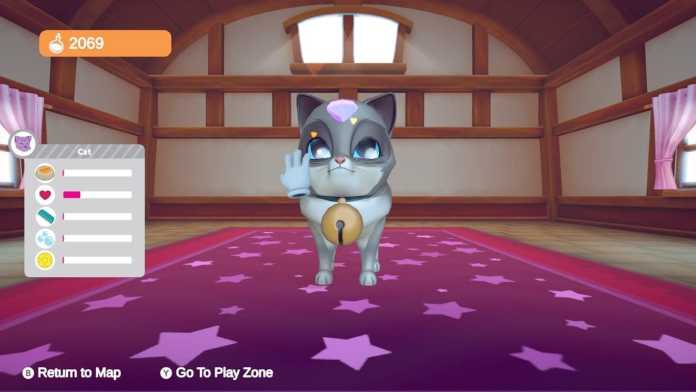
Fantasy Friends is a magical virtual pet game for young children; available for Nintendo Switch, PlayStation 4, and PC.

Gameplay:

Fantasy Friends is your typical virtual pet game that felt like a cheap version of Nintendogs or Talking Tom Cat minus the talking and the fun features. Players have to feed, wash, and play with their furry friends. There are 12 different animals you can collect as well as different skins and accessories. Players can also decorate their forest, though there isn’t really anything else to do in the forest.

The controls are simple and easy enough for very young children. With that being said, I believe the controls would have worked better with touch controls as the player mainly uses the Left Stick to pet, wash, feed, and play with their pet. This game also features mini-games such as throwing a ball or mixing food in a cauldron. However, the mini-games are very dull and not very interactive.

A magical fairy named Aurea guides the player throughout the game. The only problem is Aurea speaks in Animalese like the animals in the Animal Crossing series. It’s very cute, but if this game is aimed at young children, the dialogue should be simplified, or Aurea should have an actual voice to help young children. Also, the font isn’t very kid-friendly either. I would expect the font to be larger and more appealing, like something from the LeapFrog games. 

I think what’s attractive about this game is the bright colors and cute characters. Since it’s eye-catching, it’s something that a little tyke would love to pick up. The only problem is there isn’t enough content in the game to keep them entertained for long, especially not for the price. This feels like a game you’d buy from the App Store for .99 cents, not $30.

Pros:

  • Bright, colorful, and visually attractive.
  • The simple controls are well suited for young children.

Cons:

  • Steep price for the lack of content.
  • Dialogue doesn’t feel geared towards young children.

Conclusion:

If this game were $4.99 or less, I would recommend it as something cute for the little ones, but for $30, it’s not worth it at all. I recommend that parents check out some gameplay online with their children to see if they’re interested before purchasing it. Or wait until it’s more than 75% off.

Entertainment: 3/10

Replay value: 2/10

Graphics: 7/10

Sound: 6/10

Kid Friendly: Yes

Platform:Nintendo Switch
Developer:JUST FOR GAMES
Publisher:JUST FOR GAMES
Released:November 20, 2020
MSRP:$29.99
ESRB:Everyone

Review: Zombie Army 4: Dead War

Zombie Nazis, classic horror movie imagery, 80s synth-heavy music, and a ton of firepower! Rebellion Developments, known for the acclaimed Sniper Elite Series returns with 3rd person zombie shooter that’s just as fun to endure solo as it is with other comrades. Choose a character tailored to your action style, equip and upgrade your weapon loadout, and reenter the World War 2 era with a twist. Instead of Hitler’s defeat, he releases a zombie army that swallows Europe. Join the renegades whom survived the war and are out to put and end to this zombie problem. Utilizing dramatic executions and kill cams, with a large variety of enemies, Zombie Army 4: Dead War is quite flashy and fun, even if the title sounds generic. And most everything is done well here, but there’s one hurdle to address.

A Lot Of Meat On The Bones

The campaign is lengthy. Each chapter can take over an hour to finish solo. So buckle up and get ready to trudge through the trenches. Select from a few different characters that excel in their own niche (i.e. mobility, melee, sniping). With little gameplay interruptions, the action is at a constant. And though the level design is very linear, there is a good sense of flow. I didn’t expect the zombie infested canals of Venice to have such detail while seamlessly pulling the player to the next waypoint without getting lost. There are a few side areas to explore to find weapon upgrades and other extras. But the exploration is like the dialogue in classic horror movies, not the star of the show. I didn’t watch Dawn of the Dead for the Hallmark moments. I’m here to see the protagonists blowing zombies to bits in gruesome ways.

Swarms upon swarms of zombies. Get that trigger finger ready!

Zombie Army 4: Dead War puts the action first and foremost. So much that there are ammo boxes everywhere to replenish your weapons. And if that’s not enough, you can stomp on zombies and ammo will spawn from the exploding giblets. There’s no need to conserve your bullets so you can literally “Spray n’ Pray.” And since the weapon firing is promoted so much here, the gun physics and sound effects lend themselves well to add to the experience. It feels great to zoom in with your rifle and go for those head shots. Taking a shotgun to a small room filled to the brim with zombies is satisfying as well. Adding a synth-wave soundtrack eases up on the chills and focuses mainly on the thrills.

Another Zombie Shooter?

Even though a lot is pulled from other games, this isn’t a deterrent. This game may handle like the Resident Evil remakes, so why consider? Recently I looked at 41 Hours and and took note on how much was borrowed or recycled. That title failed because the inspired nuts and bolts lacked cohesion to the overall experience. With Zombie Army 4, however, the reused themes and ideas from previous works add to the game’s charm very well. It’s not just mechanics, but also the 80s music and retro horror imagery all seem to mesh well. This helps give the title a better sense of identity. Killing Nazis is no new motif in the action genre (looking at you Wolfenstein). But when they’re reincarnated in hoards of brainless zombies in 1940s Milan with a 1980s soundtrack, it’s a unique way to continue to harass the legacy of Hitler himself.

Great introduction scenes for new enemies and bosses.

And if zombies is what you want, than zombies is what you will get. This game will take you through canals, military bases, train stations, and many other European and classic horror movie settings. And there are different zombie types for each chapter, which adds so much variety. Tired of the suicidal bombers that run at you in groups while on fire? Well, soon you’ll find acid spitting zombies that emerge from the rivers and fountains. Enter a military base and find armored enemies that can only take damage from their uncovered areas, which vary from model to model. These zombie types are only from the first few chapters.

The DLC Dilemma

I’ve stated previously how I’m not a huge fan of DLC. In some cases where the main game is free or lower in price, I’m more so okay with it. The problem with Zombie Army 4: Dead War is that the core game is priced at around $50. That’s a lot to pay before considering if you want to invest more into the title. With that in mind, the limited amount of weapons you can cycle through on your playthrough may begin to bore you, especially when there are so many new pistols and shotguns eyeing you on the weapon select screen.

These five downloadable rifles look cool, but why should I have to pay $5 for them, or even $35 for the season pass? The game alone already cost $50.

I think a good compromise would be to have some of the weapons and characters as in-game unlockables, while keeping the extra missions as the primary DLC items. This yields some reward without forcing the player to immediately pull their wallets back out. Users on Steam have even claimed that purchasing the $75 deluxe edition of the title, did not give them everything. For those on a penny pinch, this is a fatal flaw and a stay-away which is rather unfortunate since this is a great game.

Bottom Line

With a title as generic as Zombie Army 4: Dead War, it’s easy to skip past this one. Even looking at screenshots and gameplay footage, there doesn’t seem to be many new features introduced. However, in some circumstances it’s possible to release a polished title without needing to reinvent the wheel. And Rebellion Developments did just that while keeping a sense of identity. This is a quality title with plenty of campaigns, characters, and weapons to come back to, if you’re willing to shell out the extra cash.

Star Renegades Limited Edition Available for Pre-Order

0

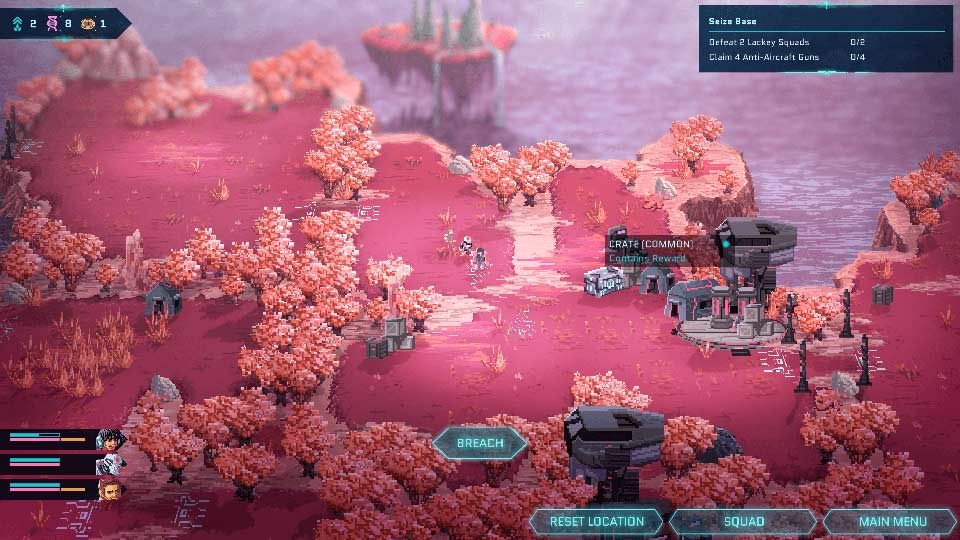
ININ Games together with Raw Fury proudly present a really unique game that calls for players who are not afraid of any challenge! The rogue-lite strategy RPG Star Renegades – created by the masterminds and makers of Halycon 6: Starbase Commander at developer studio Massive Damage – will be coming soon to North America and Europe as physical versions for Nintendo Switch and PlayStation 4! 

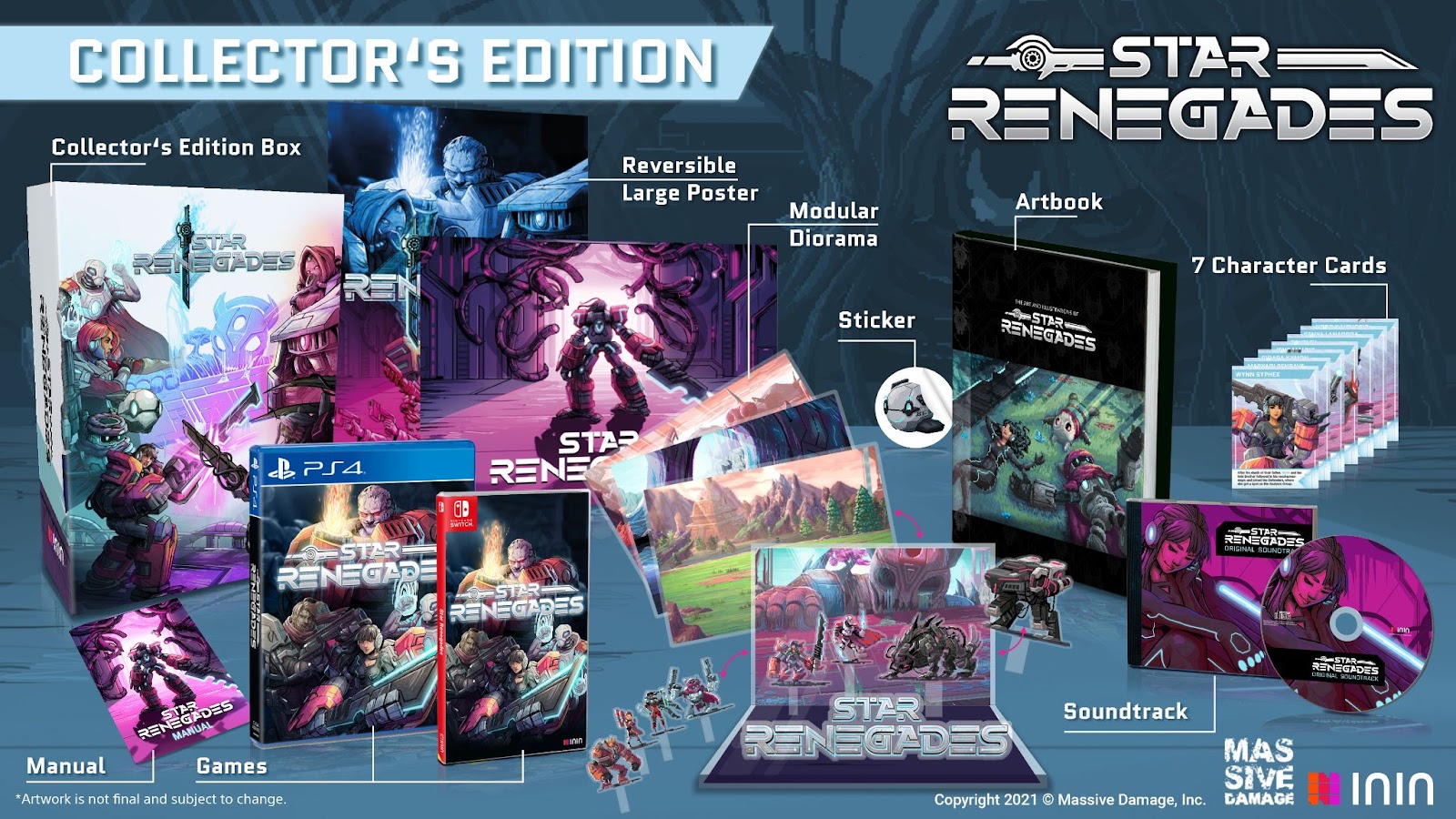
Furthermore, there will be exclusive Limited and Collectors’ Editions for all of the dedicated collectors and passionate Star Renegades fans out there! Both editions will be available for pre-order from April 22nd, 2021, 7pm (CEST) only at theStrictly Limited Games Partner Store. The retail pre-orders will be expected to launch in the next few weeks.

RESIST. RECLAIM. REVIVE. REPEAT. 
Star Renegades puts the player right into an interplanetary rebellion against The Imperium determined to rule the galaxy. In this ongoing fight, a service robot, named J5T-1N came to warn the dimension of imminent extinction. The player leads a ragtag rebel squad that forms to fight against a powerful, evolving, merciless adversary.

The game comes with a fast-paced, tactical, turn-based, timeline battle system that offers a variety of options and strategies to bring the opponents to their knees! The more the game progresses, the stronger the squad becomes. Players can unlock, trade and upgrade the rebels with tons of weapons, loot, and gear. But defeating the enemies will not be a piece of cake! Strategy and experimentation are required to beat the opponents and save the universe! 
These moments of success will reward the player, as well as the beautiful look of the game. 
Star Renegades features a pretty pixel style, the journey through the planets and the varied, challenging battles are accompanied by superior sound design and an awesome synth-wave composition.

  • Fast-paced tactical turn-based timeline battle system
  • Hauntingly beautiful landscapes and ruins
  • Pretty pixel art style
  • Procedurally generated dungeons
  • Unique enemies and bosses
  • Epic synth-wave compositions and excellent sound design 
Screenshot 2


Special Editions in the Strictly Limited Games Partner Store

The Limited Edition Features:

  • Game for Nintendo Switch or PlayStation 4
  • Manual
  • Individually numbered

The Limited Edition is available for €29.99 and limited to 2.500 copies for Nintendo Switch and 1.500 copies for PlayStation 4 worldwide. 

The Collectors Edition Features:
 

  • Game for Nintendo Switch or PlayStation 4
  • Collectors’ Edition Box
  • Manual
  • Modular Diorama
  • Artbook
  • Soundtrack
  • Large Poster
  • Character Cards
  • Sticker
  • Individually numbered

The Collectors’ Edition is available for €49.99 and limited to 2.500 copies for Nintendo Switch and 1.500 copies for PlayStation 4 worldwide. 

Review: Butcher

Can you imagine having to run for your life as a demented cyborg hunts down mankind? No matter what you do, death is all but certain, and fighting back is futile! This dank and grimy future isn’t a world I want to exist in, but if you play Butcher, this is exactly what you’ll encounter.

Developed by Transhuman Design and published by Crunching Koalas, this fast-paced 2D twin-stick shooter will make you wince throughout. A violent blood bath from the very beginning. This isn’t a game for the squeamish. You control the deranged human destroying cyborg, and your only aim is to stay alive, and kill everything that moves.

Butcher is brutal!

I was shocked at the brutality experienced when playing Butcher. Its hardcore levels of violence shock you from the off. Armed with a shotgun and chainsaw to start with, you must shoot, hack and disembody any human that you see. This is the key concept of the game, and the bloodbath gets more extreme as you progress.

Circular saw traps roll behind you, slashing anyone that is unfortunate enough to stray into its path. Hooks are used to hang up your victims, and pools of lava will melt away any evidence. The traps get more gruesome as you work through each of the zones. It quickly strays from a twin-stick shooter, to a freerunning platform agility test.

So much fire and lava.

When “Hard” mode is the easiest setting, you know there is an issue.

With “Tough” games being the in thing, it didn’t surprise me when I saw the level of difficulty. You can select between four options, the lowest being Hard, and the highest, “Impossible” which is not even worth considering. With limited ammo, a small amount of health, and rock hard enemies to kill, this isn’t the easiest game to complete. You must explore five zones, each comprising four levels of hellish gameplay, and you’ll finish with an epic guardian battle.

In theory, it should be a walk in the park, but in reality the game’s difficulty increases gradually the further you get into its plot. Luckily, new weapons are drip fed to you at regular intervals. These quickly become overpowered and a joy to use, but these are countered by ridiculous superhuman’s who fly at you, explode in balls of flames, and launch at you like Kamikaze warriors. It’s hectic, headache inducing, but it is super addictive to play.

Club Fort looks a bit of a hot spot!

Rough pixelated presentation.

Before I got this to review, I did not know what it was about. So when I loaded into it, I was shocked by its appearance. I’m not a gamer who is obsessed with graphics, but this is rough as hell! Looking closer to a game I’d have played on the Master System or NES, it’s ridiculous on a large screened TV. The dark tones and ominous look do wonders at enhancing the murderous theme. Bodies swing from chains, and blood splatters stain the landscape. It’s horrific to observe, painful on the eyes, and won’t win any awards for its style. Yet, I loved it once I became accustomed to it!

An aggressive game needs an angry soundtrack, and Butcher delivers just that. Its drum and bass soundtrack matches the ultra violent scenes that are unfolding on the screen. Its high adrenaline tempo pushes you to take risks, and to increase your pace. You throw caution to the wind, and jump into each area without a care in the world. There are then the thunderous sounds of the shotgun blaring, the chainsaw roaring, and the many other explosions that sound as you continue your murderous spree. The audio did brilliantly to enhance the horrendously dark atmosphere, and I loved it.

Being hit by that will make you sore.

Remarkably easy to control.

When I read the phrases; Twin-stick shooter and fast-paced action, I came out in a cold sweat. My ability to play these types of games is far from its peak, but fortunately, it was remarkably easy to control. An assisted aim allows you easy targeting to take down your foes. Flicking through your list of weapons is responsive, as is the command to jump or fall through platforms. The controls are smooth, and though it was hectic from the first level, it was a joy to play.

A platform game would feel hollow if it didn’t have one form of collectable. Luckily Butcher allows you to collect Skulls (how morbid), thirty five must be searched for across each of the twenty stages. They hide beyond fake walls, along darkened paths, and behind locked doors. You must look high and low to find them, and only the most observant will collect them all.

As well as the skull hunt, you have a speedrun to focus on, and you will die repeatedly! These elements force you to replay most levels, searching for secret paths, and trying to knock off valuable seconds. It’s heartbreaking, infuriating, and annoying, but nothing will stop you from wanting to finish each stage. A brutal achievement list will only be completed by the most foolhardy gamers. I’ve already resigned myself to not completing this, I neither have the skill nor the patience to beat it quickly, or on the toughest setting.

Butcher proves looks can be deceiving.

The moment Butcher loads in, you’ll believe that you’ve time travelled back to the early 90s. Its simplistic design and rough look won’t be to everyone’s liking, but I urge you to not run a mile. You quickly become accustomed to its appearance, and concentrate on moving quickly, and killing everything that moves. You’ll be shocked at the ultra violence, the levels of gore, and the array of weapons. The difficulty will push you, and you’ll scream with anger many times. I recommend you try this, so buy it here! You have one task, murder everyone that stands in your way. Sadly, the humans won’t lie down and take it! Grab your guns, it’s time to go on a killing spree.

Review: Where’s Samantha?

Where’s Samantha? I’ll do you one better. Who’s Samantha? I’ll do you one better. Why’s Samantha?

The platforming market is one of the most saturated markets in gaming. They’re easy to make, easy to theme and difficult to hate. When I made a game in school using the child-friendly programming software Scratch, I made a platformer. Of the 9,038 games on the Nintendo eShop, 1,342 of them are categorised with the tag ‘Platformer’. The situation is similar in the wild-lands of Steam, with 6,003 of the 95,982 games being Platformers. So when a game like Where’s Samantha? comes along with 6,002 competitors on its platform (oh no, I can’t stop saying the word ‘platform’), it’ll need to do something pretty special to stand out from the background noise and be a statistically significant data-point i.e. a good and successful game.

Where’s Samantha is an example of the puzzle flavour of platformer. Motivated by your missing love, Samantha, you’ll puzzle platform your way through a non-copyright infringing wool-like world (that is definitely legally distinct from Yoshi’s Woolly World) to find her. You’ll need to get your craft on and knit your way to success by absorbing excess wool into your delicate square body to transform into bigger and more colourful variants with different weights, speeds and mobility, or split into multiple versions of your original body, all of which would sound like some sort of eldritch nightmare if the theme was less woollen and more…fleshy. You’ll have to choose your form wisely to successfully solve puzzles by interacting with platforms, doors, fans and more.

My main complaint with the game comes in with this size-changing mechanic. There are three controls associated with it, one for splitting a big woollen boy into constituent smaller woollen boys, one for switching control between woollen boys and one for recombining them back into a big woollen boy. These controls are on ctrl, alt and shift and in my several hours with the game I could never remember which one was which and almost always had to try all three until the thing I wanted happened. This could just be me being thick, but I don’t see any intrinsic association between the actions and their buttons. I think most PC gamers have those three buttons filed away as awkward auxiliary controls, apart from where shift is run and ctrl is crouch. The controls are almost certainly more intuitive on a controller where unconscious associations with the face buttons are a bit more general but if you’re playing on a keyboard you might face a lot of trial and error.

Once you’ve got over the slightly fiddly controls, however, Where’s Samantha? is a pretty well put together platformer. The jumping feels a little bit restrictive – even in your smallest form you don’t have a lot of extra height to spare on jumps, but overall there’s not much to complain about. For me, the key to a platformer is the controls not being frustrating. I want to know exactly what to expect when I push a button and, when I push that button, I want exactly that action to be carried out. Where’s Samantha? definitely ticks that box. Other than the couple of things above, I felt zero frustration with the controls.

The puzzling isn’t particularly difficult, it’s almost a case of doing the only thing you’re able to do. I don’t think anybody is expecting to boot up this game and be faced with N++ levels of nightmare platforming, so that’s fine if you ask me (which, when you’re reading a review written by me, you technically are). The game is clearly aimed at children and I think the difficultly of the platforming is pitched pretty perfectly for such an audience.

So, returning to the thesis at the start of this review, does Where’s Samantha? do enough to stand out from a very densely packed crowd, a Where’s Wally? of platformers, if you will? In two words: not really. The game is fine, it’s average, it is to gaming what rice is to food. But it does absolutely nothing original. The size switching mechanic feels like a less combat-focused copy of the same mechanic in Adventures of Pip, another game I reviewed for this site. Is there anything wrong with it? Not especially. But in such a competitive market I don’t think that’s enough. Being average means there are 3,001 platformers on Steam that are better than it, which gives you quite the backlog to get through first.

Review: Brunch Club

Simulation games are a great way to escape the real world. You can become anything you want to be, and with some practise you will be a champion in your field. One theme that I find strangely relaxing is anything related to food. I have played many games where food is the core concept; Cooking Simulator, Cook, Serve, Delicious 3, and Overcooked. Each has a different approach, and I enjoyed my time with them for a variety of reasons. When I was offered Brunch Club I thought, “why not give it a go, I’m sure it’ll be relaxing and fun!” It was certainly fun, but relaxing….. absolutely not!

Developed by Foggy Box Games and published by Yogscast Games, this physics-based food title has a simple premise, but it’ll drive you insane with its difficult controls and challenging tasks. Being a chef would never be an easy job, but Brunch Club takes the proverbial biscuit. Couch co-op games tend to cause arguments, and this one will cause all-out warfare. Be warned, no matter your level of patience, you will want to rage quit or scream almost immediately.

Work together to reach the goal.

Brunch Club makes cooking an upsetting task.

The real kicker with Brunch Club is the way it sets itself up. Each of the stages appears so easy to play, and the tasks all look simple to complete. In reality, however, you’ll have more luck trying to catch a slippery eel. I now know why chefs shout so much, cooking is an upsetting and tough job.

It’s a solo or couch co-op game that wants you to complete the simplest of tasks; butter toast, crack some eggs, griddle steaks, or use utensils. It shouldn’t be an issue, but gravity and some weird controls make everything a challenge.

The levels are quite sparse and nearly every object can help you reach your goal. Food will roll, slap, and slip its way around. Bowls and pans must be used to cook and fry. Tools will cut, mix, and flip anything they go near. You will need to place objects to form ramps and plan how you’ll produce the perfect meal.

Ice cream and blazing heat, what could go wrong?

Play with, or against your friends.

It wouldn’t be a competition if there wasn’t something to aim towards. A leaderboard records your time and compares it to your friend’s best efforts. You can choose to work together to become the best team or fight each other to identify the alpha chef. I bet you’d never thought you’d get competitive over frying an egg, well now’s your chance.

Most of the levels work well in co-op mode. Good communication is key to ensure that you don’t get in each others’ way. If you can work together, you’ll achieve your goals. It’s mindless fun, and on the lowest difficulty offers enough of a challenge to push you to your limits. If you have a death wish, you can make it harder. Doing so will add traps, bombs, and snipers. Foggy Box Games get off on upsetting people, as this pushed me and my family over the edge.

Bright and crisp design.

Before you step into the madness of the cooking world, take some time to admire the graphics. A fun cartoon style combines detailed objects with bright colours to make it an enjoyable game to look at. Each item is instantly recognisable, and this helps when the clock is ticking away. The clean UI and bird’s-eye perspective makes navigating each stage a simple task. Each player is represented by a coloured hue, and though this takes a little getting used to, it was a well throughout approach from the developers. It prevented the screen from becoming cluttered, allowing you to focus on the action.

What wasn’t so pleasant was the chirpy music that buzzed around in the background. The annoying songs soon became tiresome, and I was glad that the music was drowned out by the constant arguments of my family. The sound effects provided some lighthearted relief, with comical noises accompanying many of the actions. It’s fair to say, that the audio isn’t the finest element in Brunch club.

This stage will drive you insane.

Tricky toast and stubborn steaks. 

No matter how much you practice, you’ll find this to be a difficult beast to handle. From explosions that throw the food everywhere, to objects that get stuck, it’ll test your resolve from start to finish. The weird physics-based flapping of each item is almost hypnotic, and after a while, you’ll be able to tame its odd ways. Think of the movement in Humans Fall Flat, and you’ll know how this handles. It’s unpredictable and amusing, but it’ll make you grit your teeth and want to scream.

When a game combines many difficulty levels with timed challenges, you know it’s going to have replay value. The question you must ask yourself is, do you want to go through it all again? If you have any controllers or friends left, then why not treat yourself to another session of; making sandwiches, rolling sushi, or buttering toast. After all, what’s the worst that can happen?

The first rule of Brunch Club is…..

Brunch Club is one of those games that hides away in your library waiting to be played. No one talks about it as they know it’s guaranteed to cause a fight even if you are having fun. Though I found it to be much harder than expected, I enjoyed my time becoming a virtual chef. I’d recommend that you give this a go, so buy it here! Friends become enemies, and your enemies become your friend. Work together, or battle it out to get the high score on the leaderboard. No matter what happens, remember that cooking is supposed to be relaxing! 

Review: Trails and Traces

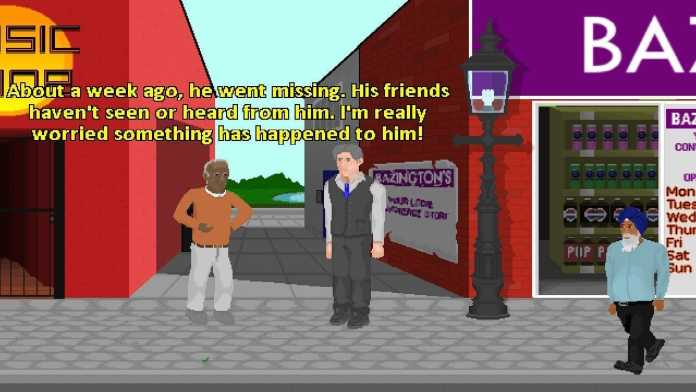
You’re in trouble, and no-one cares. The police can’t, or won’t, help, and you have nowhere to turn. Who do you call to assist you? A Private Detective that’s who! These specialists make it their business to help you with the most personal of matters. When a family member suddenly disappears with no clue to where they have gone, you are going to need someone with an eye for detail. They won’t stop until all avenues have been exhausted, and they have the answer to your problem. Trails and Traces: The Tomb of Thomas Tew allows you to play the part of a Private Detective. He believes he’s taken on a simple case of a missing person, but he learns there’s more to this than meets the eye. 

Developed by Because Because Games and published by Ratalaika Games, this is an old-school point and click detective game with a supernatural twist. Set in a seedy and grimy city, you will be expected to use your observation skills to gather clues and solve the many problems you encounter. Its simple gameplay and comedy laced one-liners will remind you of the Broken Sword franchise. Its straightforward concept allows you to enjoy the story that unfolds, and focus on the many simple puzzles that prevent you from progressing.

Such beautiful art!

Trails and Traces: The Tomb of Thomas Tew doesn’t reinvent the wheel.

Using a tried and tested method, fans of the genre will feel very comfortable with what is presented. A simple point and click style allows you to focus on many small locations at once. You will need to; look for clues, pick up objects, and combine items to solve the problems in front of you. Talking with the people you encounter helps you to gather information. A good ear and a keen eye will help you move through the puzzles with little issue.

The story revolves around a Private Detective known as James Labbett. He takes on the case of a missing person, but this unexpectedly leads to a new adventure. He must now discover the truth surrounding the pirate Thomas Tew. This historic figure intrigues anyone that reads his mysterious story. Rumours have it, he hid a powerful relic amongst his treasure. Whoever holds this item will be endowed with abilities beyond their wildest dreams. It’s not surprising that this sort of tale attracts some unsavoury characters, so Detective Labbett better be careful as he attempts to solve this case.

The linear approach is frustrating.

Trails and Traces: The Tomb of Thomas Tew insisted on restricting your freedom to explore. This decision was extremely frustrating, as I wanted to venture around the surrounding areas, even if it was an unnecessary waste of time. Because the story focussed solely on the valid locations to move the plot forward, it reduced the difficulty vastly. I would have liked to search each area I saw thoroughly, but the developers prevented you from entering “dead” zones with statements such as “no-one is in there, I don’t need to check it”. That’s fine, but I wanted to see what was hiding behind a closed door, or up those stairs. It made the world feel empty, and a chapter of the story rarely took more than a few minutes to solve.

What I enjoyed was the diversity of the cast, and the many locations you discover. It felt like the plot of an Indiana Jones film, with the core theme being just as insane and unrealistic. You’ll revel in the madness of the world you explore, and the simplicity of the puzzles you solve. This allows you to enjoy the bizarre people you encounter, and their relationships with one another. The story won’t win any awards for its silly ideas, but it was enjoyable for the short time you spend with it.

Being a private detective is dangerous.

Dated graphics and wooden acting.

I didn’t review this expecting triple A graphics or the best audio ever. Yet, even I was surprised by the standard set in Trails and Traces: The Tomb of Thomas Tew. It’s not good, but it’ll make you laugh continuously. I’m not sure this is what the developers wanted, but it’s the result, nonetheless.

A hazy cartoon style is used to depict an earlier era. The pastel colour palette, and retro imagery work well, but give the impression of a lack of polish. It reminded me of an early 90s PC title, that was okay to look at, but nothing more than that. Where it goes downhill drastically is the hilariously bad cutscenes and the animation. The facial details, expressions, and lack of emotion on close ups made me chuckle. If you then chuck in the wooden animation, this is one game that deserves cult status.

Talking about wooden, the acting has to be some of the hammiest, and wooden I’ve ever seen. The attempts at accents and the delivery of lines wouldn’t be amiss in an amateur dramatic society. I particularly enjoyed the quintessential Englishman, but all the characters screamed, look at my stereotypical accent.

The audio and graphical presentation is so bad, that it’s good! Once you recover from laughing, you’ll accept it for what it is, and continue to solve the puzzles in front of you.

What could have happened to his son?

No tutorial = ???

To say I was confused when I started this, is an understatement. Being chucked into the action with no tutorial confused me no end. Though the controls are simple; hold down a button, and choose between looking at, or selecting an object. With no explanation, it took me some time to work out what was required of me. However, once you know what you are doing, it’s as easy as you’d expect it to be.

I really enjoyed my time with this, but it lacks any replay value. Once the case is solved, that’s game over. The achievement list is small and unlocked through natural progression. This guarantees everyone gets the 100% completion. It will take you around two hours to finish and can be played casually. I would have liked more of a challenge, but what I experienced was fun, and worth playing.

Trails and Traces: The Tomb of Thomas Tew is fun, but lacks depth. 

I really enjoyed many elements of Trails and Traces: The Tomb of Thomas Tew, but it lacked challenge and depth. I wanted it to push me more. Because Because Games missed an opportunity to make a tough puzzle game that stayed true to its old-school roots. Its story was absurd, but enjoyable, and the locations and characters were interesting. It’s just a shame its linear approach reduced its difficulty so much that it was a walk in the park. I recommend it, just be aware it’s short, and lacks challenge. Purchase your copy here! Solve the mystery and see what powers this ancient relic holds. 

Review: Dungeon and Gravestone

Don’t you just hate it when you’re fast asleep and someone wakes you by screaming in your face! You wake up; shocked, in a panic, and with no clue what’s happening. The person who woke you better have a darn good reason. The village you are resting in is about to be eaten by an evil force. Is that good enough? Dungeon and Gravestone allows you to experience this rude awakening and more, as you prepare to slay every monster in sight.

Developed and published by Wonderland Kazakari (WK) this rogue-like dungeon crawler is; cruel, fun, pixelated, and demands a large amount of luck. You’ll explore level after level of ever-changing catacombs. Armed with a sword, shield and magic, you must; loot every chest, collect the gold and kill everything you see.

Dungeon and Gravestone is simple but requires tactical nuance.

Dungeon and Gravestone doesn’t reward you for running around like a headless chicken. No, it punishes the gamers that lack patience and a strategic approach. If you wish to progress to the deepest parts of the dungeon, you must; take your time, kite your enemies, and use your equipment wisely.

Death is a cruel but expected outcome for anyone that enters the monsters’ lair. Sadly, your demise undoes your progress; you’ll lose your loot, and the gold you have stolen. Every five levels you are offered a free ride to the surface. If you take it, you keep your ill-gotten gains. If you gamble and stay below, you risk losing it all! You must ask yourself, is the glory worth the possible heartbreak?

The village you now call home!

It’s a tale of demons.

There is nothing worse than the Demon King of Death trying to devour the place you call home. You are the only hero that is brave enough to challenge his authority. Demon Kings don’t like their plans thwarted, and this one will do its utmost to prevent you from ruining his well thought out mission.

The concept is simple; enter the dungeon repeatedly, return to the surface alive, sell your goods, and improve your equipment. As you progress, magic and better objects will strengthen you. This allows you to delve deeper into the abyss where the loot improves and the monsters become more challenging.

Quests and lots of floors.

Dungeon and Gravestone isn’t just about diving deeper and deeper into the murky depths. No, it’s about quests and defeating bosses as well. The quests are straightforward; select the one you want and hack up the requested number of monsters. These earn you rewards that’ll help push you further on your adventures and give you something to focus on.

Once you get far enough, you’ll face the bosses. It’s fair to say that they are pure hell! Killing each one tests your reactions and your fighting skills. Facing them is not for the ill-prepared or the faint of heart. There are plenty to overcome and you’ll have to be a master to beat them all.

One amusing touch that WK implemented was the ability to write a message for other adventures upon your gravestone. The world that you play in is shared by all players, though you never meet. You can write whatever you wish, and like in Dark Souls, I’m sure trolling messages to “assist” you will become the norm as the game gains popularity.

So many monsters and traps.

Voxel looks and repetitive music.

Its bird’s-eye perspective and retro voxel look gives it a slightly less polished, but similar look to Minecraft Dungeons. A fixed-angle camera allows you to zoom in and out, and you can pan around each stage. It sadly lacks smoothness and finesse. I soon forgot about using it as it made me feel sick. Other than this complaint, I had no issues with the viewpoint. Luckily, moving the image around wasn’t required, so it didn’t impact the gameplay.

I liked the variety in level design and the appearance of the different mobs that you face. The Series X would never struggle to play this, but I enjoyed how smoothly it ran, and the lack of issues I encountered.

I find it disappointing when there is a lack of variety in the soundtrack. It saddens me when I have to listen to the same song repeatedly. Unfortunately, Dungeon and Gravestone is guilty of doing this. Listening to it through headphones was like Japanese water torture. I was left begging for a bigger library of songs. It’s a shame as the sound effects were good, interesting to listen to, and added depth to the action.

What harm can fire do?

Accessible to all and easy to play.

I’ve played a lot of games recently that chuck you straight into the action. You are given no equipment, and no tutorial to ease you into things. Fortunately, one isn’t required as playing this is easy. A well-explained layout can be found in the menu, but it’s pretty self-explanatory. The ease with which this can be picked up and played makes it accessible to all gamers.

When no run is the same, death is guaranteed, and there are lots of floors to visit. You know this has replay value. You’ll face untold amounts of foes, discover secret floors that contain puzzle elements, and have lots of quests to complete. Mix in a difficult achievement list and you’ll agree, there are plenty of reasons to return.

Dungeon and Gravestone is more than just a simple concept.

When a game relies on a simple concept, it can bore you quickly. Fortunately, Dungeon and Gravestone offers much more than just dungeon crawling. With its; minor puzzle content, tactical fights, magical spells, hidden locations, and challenging bosses, you have plenty to get your teeth into. It’s for these reasons I recommend it, so buy it here! Can you prevent the Demon King of Death from devouring your village? Probably not, but if you’re going to die, you may as well die a hero.

Two Minute Review : ZAGG InvisibleShield Glass Elite Privacy + Screen Protector for iPhone 12 Pro Max

Are you looking for a screen protector for your iPhone 12 Pro Max that also provides privacy? If so here is our review of the ZAGG InvisibleShield Glass Elite Privacy + Screen Protector.

“Glass Elite Privacy+ protects your screen from impact and prying eyes. We’ve added a two-way filter to our strongest, most advanced glass screen protection, so you get full-screen privacy when its viewed from the side. And we’ve added ClearPrint, a revolutionary oil-diffusion technology that makes fingerprints virtually invisible.”

Features

  • Extreme Shatter Protection
  • Maximum Scratch Prevention
  • ClearPrint™ Technology
  • Smooth, Silky Feel
  • Anti-microbial treatment protects your screen protector
  • Privacy Filter
  • Reinforced Edges
  • Easy Application

What’s in the box?

The box contains the screen protector and everything you need to prepare your phone and fit it.

Final Thoughts

We all need a screen protector for our phones – whether its because you want to stop it from being scratched, or you just want to keep in clean. ZAGG have been making screen protectors for years and I have used several of them in the past. Sometimes you might need more than just a normal screen protector, you might also need a privacy filter to stop others from seeing what’s on your screen, and that’s where the Elite Privacy + comes into play.

Fitting was very simple, you just follow the few simple instructions and within a few moments the protector is applied and that’s it.

Overall I am very happy with the InvisibleShield Glass Elite Privacy + Screen Protector, and can recommend it if you want to protector your iPhone from dust, scratches and prying eyes.

The ZAGG InvisibleShield Glass Elite Privacy + Screen Protector is available now priced around £29.99.

You can learn more from the ZAGG website.

Evercase VS Console Announced

0

The Evercade retro gaming system is growing with the announcement of the Evercade VS, a new home gaming console from Blaze Entertainment.

Following the successful launch of the Evercade Handheld gaming system in 2020, which became the go-to officially licensed option for many retro game players, the Evercade VS builds on this by bringing the Handheld experience to multiple players.  

Evoking the nostalgia for retro gaming with its physical only game distribution, the Evercade VS goes one step further in allowing people to Play Together. The new console has support for up to four players simultaneously via either the proprietary Evercade VS USB Controller provided in the pack (or available to purchase separately for additional controllers). This follows the same levels of comfort that many praised the Evercade Handheld for, with ergonomically designed controllers that suit all retro games. Evercade games already come with multiplayer support so the existing library with multiplayer capability will be instantly supported.

The Evercade VS will also support numerous third-party USB and wireless controllers, including the Xbox Adaptive controller and 8bitdo wireless controllers.

Evercade itself is a retro gaming ecosystem that delivers fully licensed, curated, collectible game packages via a cartridge with a retro-styled box and manual. The cartridges are currently playable using the Evercade Handheld console, launched in 2020. With the Evercade VS, Blaze is continuing to offer Evercade customers a gaming experience like no other with a catalogue of stone-cold classic titles and Indie gems from over four decades of gaming. Including iconic hits like Double Dragon, Earthworm Jim, Asteroids, River City Ransom, Burger Time, City Connection, and many more.  

The Evercade VS uses the same Cartridge-based game system as the Evercade Handheld, meaning that the existing library of over 260 games across over 20+ cartridges available throughout 2021 will be fully supported* with all future cartridges also supporting both platforms. So those who already have the Evercade Handheld or are invested in the cartridge family can instantly enjoy their games on the Evercade VS, or those new to the system will have an incredibly large back catalogue to choose from.

In addition to this, the Evercade VS will support two cartridges simultaneously. This will allow gamers to have up to 40 games selectable at any one time depending on the number of titles on the cartridge. This will all be displayed on-screen with a new and improved UI with full visual features including screen filters, sorting options, and resolution features allowing for Pixel Perfect representation on screen. The Evercade VS will output at 1080p, making it the highest resolution compact gaming system on the market, and will feature built-in WiFi for easy updates and future online features.  

The games themselves are all tied to the cartridges with top-of-the-line emulation powered by the Evercade VS’s 1.5Ghz quad-core CPU and 512MB DRAM. All cartridges contain save and load states. This means any progress on an Evercade Handheld can be easily resumed on the Evercade VS or visa-versa. Save states will also have a new, full visual area within the new UI to show users exactly where they saved their games.  One of the benefits of the Evercade family is its value and affordability. With prices starting from £89.99/$99.99/€99.99 the Evercade VS allows for a great entry point for those who wish to have an impressive library of official game collections on their televisions at home, and for existing Handheld customers to have a cost-effective and new, enjoyable way to experience their existing collections.

Customers will be able to pre-order the Evercade VS from Friday May 28th, 2021 (with exact pack configurations to be announced the week beforehand) with an estimated release date of early November 2021.

Review: The Skylia Prophecy

While some retro games have aged badly over time, there are still some timeless 16-bit titles that are worth your attention. Such is the size of the enduring audience for these games that many developers have borrowed heavily from them in their own ‘retro-inspired’ titles. These ‘new’ releases are often less interested in making something innovative though and instead focus on exploiting and repackaging nostalgia which, more often than not, results in a poor imitation.

The Skylia Prophecy, a side-scrolling 2D action-adventure developed by indie developer Ezekial Rage, is a prime example of a poor to below-average attempt at ticking the ‘retro’ checkbox. The story is introduced with an opening dissertation and has you battle the undead with the main character Mirenia, as you journey through the world to put an end to the evil you unleashed upon the world. 

As delectable as a mouth full of dry crackers, the gameplay consists of traveling through very similarly designed areas and attacking enemies walking across the screen that actually, often don’t even attack you, let alone block your attacks. The immoral slaying of helpless monsters aside, attacks consist of using what seems like a sword (though the sprite art makes it hard to confirm) and an energy force field of sorts for a defensive attack that is lazily implemented to compensate for a lack of aimed attacks and a separate guard action. Numerous bosses exist with largely the same moves and all follow their own unchanging pattern of behavior each playthrough. Some of the bosses are optional existing only to unlock further moves, but their effect is negligible and are as forgettable as the bosses themselves and the people populating the towns who sing the same tune in every area.

Poor skeleton was just going for a walk…

Unfortunately for The Skylia Prophecy, that’s about it. There are shops in the town areas which allow you to purchase potions (though puzzlingly only one of each) to ease the difficulty of the bosses and also quests that offer money, but the biggest difficulty here will be motivating yourself to continue through the monotony of the game.

Limiting the game to 16-bit standards limits the potential of the visuals somewhat and because of this they are neither impressive nor disappointing, but the sound design is poorly implemented. Whether the recorded voices are unconvincing or the volume levels too high, there is no cohesiveness with the visual presentation and the mood set by the audio, representing a real wasted opportunity to increase the overall presentation and quality of the experience. 

Artificially created difficulty…

The game’s biggest selling point, according to the developer, is its ‘kill the player’ philosophy inspired from the ‘Souls’ games. This difficulty is present in easy mode, with even non-boss enemies being overpowered, resulting in you becoming sick of the ‘game over’ screen until you figure out and memorize their repetitive movements. Personally, this style of game doesn’t appeal to me as it restricts the freedom of the player and interactivity of the game, making the window of opportunity and potential success so small that it’s almost a passive or mathematical experience, with no difference in playthroughs and no satisfaction to be gained from all that failure. Such is the reliance on your interactions with the grim reaper that without them the game’s runtime would last less than an hour and a half.

The best looking enemy isn’t even a boss, or rather – it might be but this character isn’t mentioned or referred to, anywhere. Just like the other bosses.

Traveling through the small number of similarly designed levels while spamming the attack button had me at my wits’ end by the second boss. Frustrated by its difficulty and lack of quality I was procrastinating around my flat for large stretches – much like the enemies walking across the screen with little purpose – simply to avoid playing it.

The Skylia Prophecy might have been inspired by others, but its own offering is less than inspiring, providing rehashed and boring mechanics that would fail in this and the 16-bit era. With its shortfalls unable to be concealed by its harsh gameplay it would take a dedicated retro game fanatic or a purveyor of punishing games to enjoy this, but with far better options available elsewhere it’s hard to recommend even then.

Review: Dull Grey

Is choice an illusion, or do you truly have the freedom to do as you wish? Can you imagine a life where everything is decided for you? What a depressing existence that would be if you had no control over the direction you get to take. Dull Grey tells the story of this problem, and how the people learn to live with it.

Developed by Provodnik Games and published by Sometimes You, this is a depressing and sombre tale of oppression and love. A short Visual Novel set in an industrial Soviet world, its melancholy theme is emphasised by the use of a mainly monochromatic colour scheme and striking imagery.

The surrounding cold wintery mountains that protect your home.

Dull Grey is a sad and touching tale.

Inspired by the worlds of the Strugatsky brothers, and Dostoevsky’s works, Dull Grey is a sad and touching tale that will make you consider your choices. You see life through the eyes of Kir; he is a young man with limited prospects. The government has created a system called the Progress-program. This is their version of “Big Brother” and the robots limit job opportunities. You are assigned a role, and only the strongest willed can break free and find happiness.

To emphasise this theme, a limited amount of dialogue choices is available to you throughout. You will tell your mother, which job you’ll take, and you’ll respond with yes or no. These limitations will frustrate you, but they represent the oppression the protagonist encounters perfectly. On the surface, this is a linear tale that leads you to its heart wrenching conclusion. But, if you take your time to think, and consider your options, you find things aren’t always what they seem. Perhaps there are other paths available to you if you look hard enough.

A slow-paced story.

The story unfolds slowly as every element is repeated. Each section goes full circle back to the question of how Kir sees his future. You may worry that this monotony will bore you. Strangely, it doesn’t, because the story develops even though it appears not to be progressing at all.

You are told of many areas that the characters visit, and the family that they interact with. These bonds add some humanity to what is otherwise an extremely cold and heartless tale. You will experience the people who agree with the system, and those that oppose it. It’s a sinister world where fear and an odd desire to appease overrides your own need for happiness.

Oppressive robots.

Simple art style, but beautifully atmospheric.

What I love about Visual Novels is how easily they convey their meaning through their art style. Some go for OTT sexualised Manga and Anime looks. And others lean towards a simpler approach. Dull Grey has taken the latter choice. The crisp lines, mainly monochromatic palette and silhouetted images sell the theme perfectly. Every scene is told using a still image. Unlike many other Visual Novels, this one doesn’t use simple animation to show each character’s emotions.

I adored the domineering buildings that towered over the landscape, and the robots that engulfed each scene. Every picture told the tale of an oppressive world, and you didn’t have to read the text to understand what this story was trying to say. As great as the imagery is, it would have not been as strong if it wasn’t for the fantastic audio.

Melancholy tunes play gently as the words form on the screen. The touching sounds demonstrate the sad existence that each character must live with. The gentle pace and minor toned songs capture the cold beauty of the world you observe, and enhance the emotion hidden in the text. When you read a book, you wish to be transported to that place, no matter how depressing. The audio and visual elements did just that in the most simple of ways.

What youngster listens to their parents.

The controls won’t surprise you.

If you are a veteran of the Visual Novel world, then you know they are easy to play. Minimal controller action is required to turn each page. This allows you to enjoy a hot beverage and snacks while playing. Dull Grey’s control system won’t surprise you, the left analogue stick and one button are all you need to get from start to finish. This makes it a relaxing experience, and one that you can play with minimal fuss.

As with most books, once you’ve got to the end you’re unlikely to read it again, unless you loved it of course. The beauty with this genre is the addition of a small achievement list to keep you coming back for more. If you are a completionist, you’ll need to complete many playthroughs, and discover some secrets that elude you the first time you read it.

Dull Grey is a short story that needs to be read.

When I first saw Dull Grey advertised, I didn’t know if I’d like it. The story seemed too depressing, and I didn’t know if I was ready for another “Big Brother” is watching type tale. I’m glad that I tried this short story as it is one that makes you richer for the experience. With a wonderful art style, touching audio, and brilliantly written plot, this is a Visual Novel you must read. Buy your copy here! In a dark world controlled by an oppressive government, freedom is considered a dirty word. Your fate has been decided for you, and there is nothing you can do. Or is there?

Review: Antventor

No matter your size, upbringing, or lifestyle, you should be allowed to dream. Just because something has not changed for years, doesn’t mean that it should remain that way. If life is blocking your plans, what would you do? Think of a way to solve that issue, reach for the stars, and make life that bit easier. Antventor explores this idea, allowing you to look at the world through the eyes of an ant.

Developed and published by LoopyMood, this point and click puzzle title takes its inspiration from old-school games and mixes it with a modern twist. Set in a photorealistic micro world, you are an ant whose life is controlled by the desire of the colony. He doesn’t want to work hard; he wants to live smart. He’s happy to pull his weight, but he wants his machines to do the work for him. After all, what’s the use in being an inventor-ant if you don’t use your technology to help.

Antventor is a tale laced with puzzles and comedy.

Antventor takes inspiration for its core concept from some of the great, classic point and click games; Monkey IslandDiscworldDay of the Tentacle and so on. The idea is to collect objects in each of the surrounding rooms, combine them together, and use them in a logical way to solve each puzzle you encounter. Alongside the gathering of items and exploring, you are treated to some wonderfully hilarious and touching moments. The timing of these is perfect as they break up the repetitive gameplay that haunts this genre. 

Florantine (see what they did there) was happy with how his life was going. He gets to sleep late, create new machines, and watch the colony go about its daily business. Until you turned up and broke his machine, that is. With his dreams ruined, and no part to replace the damaged one, you must go on an adventure together to find a suitable replacement.

Your journey takes you outside of the safety of your home, and you will explore the great outdoors. He meets some weird and wonderful creatures while he undertakes his quest. Crows, spiders, and elderly bugs all force you to think outside of the box and use your environment to progress.

Be careful around the guards.

Some solutions are tricky to comprehend.

What I loved about this was its lack of hand-holding. Once the game loads in, you are free to solve each problem as they arise. The only issue I found was that many of the puzzles were ambiguous in their approach, and a solution wasn’t obvious. This wouldn’t normally be an issue, as I love a challenge. But, when you do not know what to do, you simply start guessing by randomly combining objects, or clicking on the screen aimlessly. This removes the puzzle element, making it a game of chance.

LoopyMood attempted to eliminate this with picture clues that can be selected after a short amount of time. This made the game much easier, but it also removed the guessing problem. I think a checklist of tasks would have been a better approach. This would then remove the need for hints, and would allow logical minded gamers to work through the puzzle without guessing their way to a solution.

If you place the puzzle element to one side, Antventor tells a lovely story of hope, friendship, and creativity. The further you explore, the braver Florantine becomes. He must complete tasks that help other insects, while conquering his own fears. Combining random objects, you will; make a spider dance, steal an iPod from a crow, collect water for a sick elderly bug, and more. I adored how it flowed, and though a playthrough is short, it was thoroughly enjoyable from start to finish.

Poor old Florantine.

The photorealistic setting is fantastic.

Mixing cartoon characters with a photorealistic backdrop can be risky. Yet, it worked fantastically! The beautiful landscapes and variety in settings made this a nice game to look at. The crisp and well designed character models have a modern aesthetic, and Florantine displays an array of emotions through well drawn facial expressions. The journey he makes takes you into some weird locations and seeing the world through the eyes of an ant gives you a whole new perspective on things.

Playing this on the Series X I didn’t expect to find any issues. Sadly, there is one section of the game that has a horrendous frame rate drop. The game stutters and slows down to a crawl. It only impacts one tiny part, but it took a lot of the shine off the finished article, and needs to be resolved.

The audio does well to support the woodland area that the ants call home. Birds chirping, the rustle of the wind, and the crunching of leaves all make this a joyful game to listen to. It is mainly devoid of music, but the rare times that it is used are pleasurable, with a style that matches the atmosphere of the area it is in. Comical noises come out of our hero’s mouth. He will mock you for failing to solve a problem, or sigh, because of boredom if you are taking too long. It risks becoming annoying, but it’s a short game, so the risks are minimal.

ARGGGHHHHH!!!!!

It’s easy to play with a controller.

I was shocked at the ease of playing this on console. Point and click games usually lean towards the use of a mouse and keyboard, but accurate and responsive controls make this a pleasure to play. All objects are easy to pick up, and anything that requires interacting with can be seen with a yellow or white orb. The inventory is simple to use, as are combining items. The developers have done a great job at making this a game that can be mastered straightaway.

Planned as a trilogy, this forms part one of the adventure. It can be completed in only one to two hours, and the achievements are unlocked through natural progression. Once you complete your playthrough, there is little reason to return as the challenges all remain the same. It’s fortunate that the first attempt is such fun, and once you finish, you’ll also want to see what part two and three offer.

Antventor does most things right.

For the most part, Antventor is a great example of the genre. It looks fantastic, has a nice natural audio, offers the right balance of challenge, and the story flows at a comfortable pace. However, it has shortcomings; The puzzles are ambiguous, there are frame rate issues, and I wanted it to be longer. I’m hoping that the next instalments rectify some issues, and they increase the length of the gameplay drastically. I loved the game even with its faults, and I recommend you buy it here! You broke Florantine’s machine, so you must help to fix it! Start your adventure, solve the problems, and make some friends en route.