Here is our review of the new ROCCAT Kone Pro Mouse.
Meet the ROCCAT Kone Pro Lightweight Optical Ergonomic Performance Gaming Mouse with RGB Lighting. Perfected through 14 years of craftmanship, at just 66g the Kone Pro is the most lightweight and advanced gaming mouse we’ve ever made. It utilizes the Titan Switch Optical, AIMO RGB lighting, our 19K DPI Owl-Eye Sensor, PhantomFlex Cable and superior heat-treated PTFE glides.
Specifications
ROCCAT Owl-Eye 19K optical sensor (Based on PAW3370)
Adjustable lift-off distance
50g acceleration
ROCCAT Titan Switch Optical
100 million click life cycle
On-board memory
1.8m flexible cable
Length: 125.6mm
Height: 40mm
Width: 72mm
Weight: 66g
What’s in the box?
The box contains the mouse, a set of spare feet and a quick start guide.
A Closer Look
Final Thoughts
The ROCCAT Kone Pro Mouse feels very comfortable in your hand, and it effortlessly glides along surfaces. The mouse itself only weighs 66 grams so it’s almost like its not even there! The vivid AIMO 16.8 million colour RGB lighting appears when using the mouse buttons.
There are the two main mouse buttons, two sides buttons and a wheel called the Titan Wheel Pro.
The Kone Pro connects to your computer using the attached USB phantom flex cable. This cable is very light weight and it doesn’t get in the way of a good play session!
The Titan Wheel Pro is made of solid aluminium and give you a satisfying click when using it.
The mouse buttons provide a tactile and responsive click and feel comfortable even in the heat of battle. The Titan Switch Optical is faster than any mechanical switch and has twice the durability, giving you the competitive edge game after game.
Bottom line, if you want a smooth, fast, comfortable mouse that will give you a competitive edge when playing games, then you definitely want to take a look at the ROCCAT Kone Pro Mouse.
The ROCCAT Kone Pro Mouse is available now priced around £69.99 in white.
Human beings are considered the most intelligent beings on Earth. We have built vast homes for ourselves, communicate with one another, and openly express our emotions. But are we the only creatures that do this? Do you ever look at the surrounding creatures and think “what are they thinking, or how does the world look to them?” Life of Fly 2 does just that with its observation focussed narrative.
Developed and published by EpiXR Games, this is the sequel to Life of Fly. I reviewed it in January 2021 and thoroughly enjoyed it. I loved its dry narrative and observational dialogue. When I was offered the sequel I jumped at the chance.
The thoughts of a fly.
Life of Fly 2 is mellow, touching, and lacks complexity.
Life of Fly 2 is a delightful break from the norm. The world of fast-paced shooters and sports titles is a million miles from what you experience here! This mellow and slow-paced narrative-driven title allows you to absorb the story while exploring familiar landscapes.
The gameplay revolves around the observations and life experiences of one fly. His stories have a range of subjects, some are funny and poke fun at errors made by humans. Some are touching, sombre tales that describe naivety and loss. You play through thirteen chapters that flow into one another. You revel in the delight of each fly’s discoveries and it’s a genuine pleasurable time listening to each tale.
The game, however, lacks complexity, though this isn’t a complaint. You fly around each stage looking for a glowing orb. As you collect each one, a segment of the story plays. In the right corner, you see a counter that highlights the number of orbs to collect. Once they are all gathered, you will hear the complete story. It was a wonderful way to make you explore your surrounding, but this approach was also problematic.
Wooden delivery and drawn-out narrative.
I loved exploring each chapter. Getting to see each commonplace from a fly’s-eye perspective was an intriguing experience. But the time to travel to each orb makes the dialogue stutter, which affects the flow. The pause between each point makes the stories appear disjointed and confusing, and I’d preferred a continual flow with orbs placed closer together.
The break-in narrative had a weird side effect as it impacted the delivery of each line. Sometimes heartfelt lines were devoid of emotion and almost wooden in their approach. This was a real shame and was a step back from Life of Fly, where the delivery was more consistent.
Explore everyday locations.
The chilled approach may be a turnoff for some.
With a lack of objectives and repetitive gameplay, this voyeuristic game won’t be for everyone. I loved its amusing observations and wasn’t put off by the slow pace. I would have liked some tasks that gave depth to each character, however.
Exploration was a key mechanic, so some hidden collectables relevant to each stage would have added an interesting layer. If you could fly faster during this free play section, this would have added a new dynamic to the gameplay that would have been a welcome addition.
Life of Fly 2 looks great from its fly’s-eye perspective.
The larger-than-life imagery and the fly’s-eye perspective work wonders to sell the games main concept. Each chapter portrays everyday situations in a larger, more dominating fashion. The lighting is sharper and more vivid, making brighter spaces harder to navigate. The blurry view from the fly’s many eyes reduces detail and gives the game a dated look. I enjoyed flying past the OTT objects as a golden glowing insect, the overbearing furniture emphasised the tiny statue of the flying protagonist. You knew what to expect from each scenario. But I was amazed by the variety and level of detail in each stage.
The audio was also great with a well thought out calm soundtrack. The serene music matched the laid back atmosphere and allowed the dialogue to take centre stage. The amusing and touching audio was delivered to a high standard and was only held back by the aforementioned issues. The protagonist flaps around silently. And that was the right choice. The gaps in dialogue are nicely filled with mellow music. When a game focuses on its story and relaxed pace, you need the audio to reflect this. Life of Fly 2 gets the balance just right.
Focus on the white orbs.
Its simplicity affects the replay value.
Life of Fly 2 is such an easy game to play that no tutorial is necessary. Each chapter starts and you flap to each orb using the analogue stick. This is the extent of its control system, making it a piece of cake to pick up and play. Other than inverting the axis and setting the sensitivity you have nothing to worry about.
Sadly, the replay value is impacted because of a lack of collectables and each short stage. The thirteen chapters can be completed in a few hours, and once they are finished, there is little reason to return. The small achievement list is unlocked through natural progression and offers little challenge. Luckily, the dialogue is well written making the first playthrough worthwhile.
Life of Fly 2: a wonderful tale worth experiencing.
You may not want to put down your fast-paced games, but Life Of Fly 2 is worth the sacrifice. With its wonderful stories, excellent environments, and touching audio, this is a relaxing game worthy of your time. I enjoyed it and recommend you to buy it here! Look at the world through the eyes of a fly. Listen to their stories and laugh at their observations. Who’d have thought a fly could be so interesting?
They say that living in a virtual world is thwarted by dangers. Predators, viruses, and more can prey on the weak. What I don’t think they had in mind were endless puzzles filled with traps. This is the idea behind Loopindex, an ingenious puzzle game set in a virtual setting.
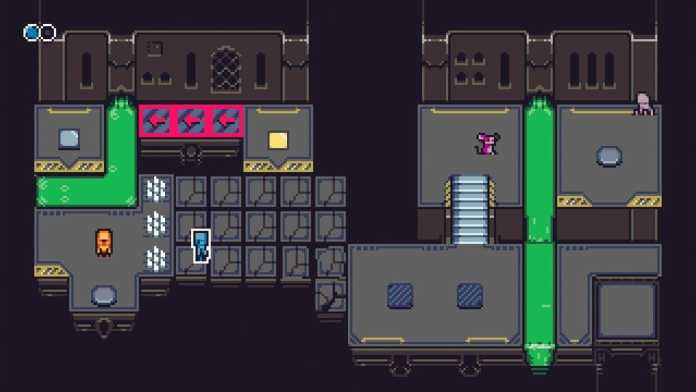
Developed by Somepx and published by Ratalaika Games, this small indie title takes logical thinking and quick reactions. A game that can be played solo or couch co-op with a friend. You must move from stage to stage, solving the problems and escaping using the lift. It appears straightforward in concept, but new mechanics are added regularly that complicate matters and muddy the waters.
Push the frog and see where the arrows take him.
Loopindex tests many abilities.
Most puzzle titles focus their efforts on logic-based challenges. Loopindex does this also but adds extra layers to increase the difficulty. You must use observational skills to avoid traps and plan the correct route. Timing and precision must be practised to overcome obstacles, and you also use Robo pets to trigger switches. None of it will blow your mind, but it makes for a challenging experience with each element combined.
You take control of two robots who exist in a virtual world known as Loopindex. This land comprises 70+ tricky levels, each with unique designs and problems to overcome. You will use each robot to trigger switches in the correct order, kick bombs, or move boxes. If done correctly, spikes will retract into the floor, walls will break, and new paths will be formed. None of the challenges was difficult, it simply took planning and foresight to complete each stage.
Robo pets and bosses.
You and your robot pal aren’t alone in this mysterious place. No, you are joined by Robo pets and enormous bosses. The frogs and mice are controlled in different ways, and learning their quirks is essential to being victorious. The frogs enjoy being pushed around and only leap in a straight line. Any obstacle they hit will stop them, so using the environment or your teammate is essential to manipulating their movement. The mice, however, run away as you approach them. You scare the skittish rodents to force them to sit on pressure plates. This took patience and was the most frustrating element of the whole game.
Everyone loves a boss fight! Proving your worth against monstrous beasts shows how great you are. Loopindex uses its boss battles to piece together each element. You must dodge attacks, kick bombs, trigger pressure plates, and use the pets to overcome the bosses. It was manic, but once you understood what was expected, it wasn’t particularly challenging. It would have been nice to have been tested more, but victory felt rewarding and showed you had mastered every element.
Use that pesky rodent to solve the puzzle.
Loopindex has a classic indie look.
With its fixed screen top-down perspective, it’s easy to study each stage and plan your approach. Using garish colours and pixelated graphics, Loopindex has the standard indie game look and approach. With limited details and basic sprites, its simple style won’t amaze many gamers. Though it wasn’t great to look at, I liked what I saw and importantly its visuals didn’t detract from the core concept of puzzling.
Like the graphics, the audio is also standard fare. With a low key synthesised soundtrack you almost forget it’s playing in the background. This isn’t a bad thing, as its unobtrusive nature allows you to focus on the job at hand.
Neither the audio nor the graphics did anything to surprise me. Both stuck to a tried and tested formula and this produced an OK but safe result. It was enjoyable to play, but it never wowed me.
Can the frog solve the puzzle?
Easy to play solo but better as a team.
How the developers ensured the game could be played solo and co-op was ingenious. Flitting between characters was smooth (as long as you remembered the button), and moving items was a cinch. However, sometimes the controls failed to respond. This caused many issues and usually resorted in the level being reset. Queue many huffs, sighs, and tuts of annoyance. This issue was removed when playing co-op, as you could take your time and focus solely on your task. Solo play was enjoyable, but this excelled as a co-op title.
70+ levels are a lot of bang for your buck, especially when new mechanics are added regularly. Though the puzzles aren’t the toughest compared to their peers, the use of other elements made the gameplay challenging. There is some replay value because of the number of stages, but the simple achievement list won’t draw you back to play again.
Loopindex delivers a pleasant indie experience.
I wasn’t wowed when playing Loopindex, but I thoroughly enjoyed my indie puzzle experience. Combining lots of simple mechanics has created a fun and slightly challenging title. It’s much better with a friend, but still worth the investment if you are a solo gamer. I liked it, so I recommend you to buy it here! Virtual worlds are dangerous, so work together, solve the problems, and get out alive.
Sumire is a charming narrative adventure where a young Japanese girl sets out on an adventure to change her miserable fate and fulfill her wish of seeing her grandmother’s spirit.
Sumire was released on May 27, 2021, for both Nintendo Switch and Steam. The Steam version has a bundle that comes with the original soundtrack and a digital artbook.
Gameplay:
Sumire is about a disillusioned young girl who spends her days cooped up inside, in fear of the outside world now that her grandmother is no longer in it. On top of this, her father has left home, and her best friend has deserted her. But one day, a magical flower appears and promises her that she can change her fate. But the magical flower only has one day and one life to help her have a perfect day and make her wish come true.
The gameplay is pretty simple; you make choices that affect your karma and determine the outcome of the story. Despite there being a good and bad ending, the game doesn’t force what’s good or bad on you but shows you that your actions have consequences regardless of what decisions you make. And no matter what path you decide to take, Sumire comes to terms with the decisions she’s made at the end of the day.
At the beginning of the game, Sumire jots down a to-do list in her notebook of the things she wants to achieve in hopes of having a perfect day. While it may not sound like much, there are also small quests and even fleshed-out mini-games that you can enjoy along the way.
Pros:
Attractive design and relaxing music
Mini-games!
Short, but offers a nice bit of replay value
Cons:
Can’t have more than one save file
Character dialogue and writing could have been better
Can’t play mini-games from the main menu (I really liked them so this was a bummer)
The most prominent features of Sumire are the art and the music. In fact, the music is not only relaxing but also very memorable. In addition, the overall design of the game feels like a Japanese watercolor painting that blends nicely with the music. While there are some depressing moments, the overall style of the game is quite wholesome.
On the other hand, for a narrative-focused game, I was a bit disappointed in the writing. It felt stiff, and the character dialogue was a bit monotonous. For games where the gameplay is primarily dependent on the story, I think the writing should be meticulous. That’s not to say that the writing ruined the game, but I think Sumire could have been more impactful if the writing was better.
Conclusion:
All in all, Sumire was truly a fun short adventure that I thoroughly enjoyed. With that being said, as a narrative-focused game, if the writing were better, it could have easily been a 10/10 game for me. Despite this shortcoming, I still highly recommend this charming indie game.
Ride 3 is a grown-up racing video game. The Ride series has always taken a serious stance when simulating racing, and this game is no different. Unlike other games in the genre, Ride 3 makes racing a serious matter, delivering the most realistic motorbike video game to date.
A Riders Dream
When you first start Ride 3, you will instantly realise the games incredible customisation options, available from the get-go of the game. Ride 3 not only lets you customise your character but also your bike, giving you numerous colour and other cosmetic options. In this regard, the game stands out, making you feel like a motorbike racer with your very own personalised bike. Similarly, the sheer variety of bikes available is impressive; the game has them all from the RS 125 Aprilia to the BMW F800 R. As a result, Ride 3 is a motorbike enthusiasts dream. The hundreds of bikes available are outstanding adding depth and considerable replayability to the game.
As already highlighted, you shouldn’t expect Ride 3 to be a shoot from the hip, quirky racer with powerups and funny looking characters/vehicles. Fun in this game comes from the pure joy of racing and that alone, which comes in several different racing modes, including quick play, time trial and a career mode. All of these modes are excellent, adding variety to the game. The seriousness of Ride 3, devoted to a motorbike fanboy rather than the average racing fan, makes this game stand out.
Graphics That Can’t Catch up
Ride 3 is by and large a near-perfect simulation of competitive motorbike racing. In reality, though, this game is only meant for the most hardcore of biking fans. I quickly found myself getting bored with the game after a few laps of Garda Lake in Italy. However, this isn’t to the detriment of the game. Simply, I’m not Ride 3’s target audience, and that’s not a bad thing. The games built for motorbike racing fans who love the thrill of racing, and it executes that perfectly.
Ride 3, alongside its excellent customisation options and bike variety, has access to many tracks. Such as the Ulster Gp, which further adds to the immersive racing experience. On the other hand, despite the positives of the game, it’s not without its flaws. Ride 3 is an excellent racing simulator but honestly doesn’t look that great. The game looks grainy and lacks the graphical fidelity expected from a game of this nature. Unfortunately, the game’s graphics let it down, making it look lacklustre on current and last generation consoles, despite the game’s graphics taking away from the immersive racing experience. Ride 3 still stands proud as a great racing game simulator.
Verdict
Overall, Ride 3 is a superb motorbike racing simulator. Despite its lacklustre graphics, Ride 3 is an immersive motorbike racing experience. It is built for those who love or want to experience the thrill of nitty-gritty motorbike racing. If you love motorbike racing, pick up this game, it won’t let you down.
Do you like an addictive challenge that slowly grows on you? Are indie games with an old-school vibe your thing? Will I stop asking questions and get on with this? If the answer to all three questions is yes, then you’ll love Arkan: The Dog Adventurer, and I can get on with this review!
Developed by Taverna Game Studio and published by Sometimes You, this is an Arkanoid platform game with a retro twist. You control a dog who is hell-bent on destroying everything and everyone he sees. He is a dog like no other and has special powers and a badass attitude.
So many foes for one dog.
Arkan: The Dog Adventurer is simple but addictive.
Like the great arcade games from the past, Arkan: The Dog Adventurer has a very simple concept. You must control the doggy hero as he throws a ball at the destructible scenery. Like Arkanoid, you must annihilate every block. If you don’t, the scenery will act as a defensive wall for the monsters. Failure to kill them all will prevent you from collecting your stars and progressing.
There are three worlds to visit, each comprising twenty stages. You aim to collect each of the stars, kill the monsters, and survive. This is easier said than done as your enemies become more aggressive and increase in size. You must plan how to eliminate the blocks, aim your throws, and dodge projectiles.
During the early stage, this is relatively easy, but it quickly becomes problematic. You will fall down pits, be struck by bullets, and fail levels. It’s infuriating, annoying, but it adds to the addictive fun and demands you have just one more try.
Arkan: The Dog Adventurer is no ordinary dog, he has special powers.
It wouldn’t be much of a platform game if the hero had no special powers. Luckily, Arkan: The Dog Adventurer is loaded with game-changing skills. He can; jump, double jump, power up his magical ball, and teleport to slow time.
These skills take time to get used to and they add a tactical element to an otherwise simple premise. Worried about facing a barrage of bullets? No problem, teleport out of the way. Are all your foes hidden behind blocks? Don’t worry, leap like a gazelle and take them down. Is the action going too quickly for you? Slow it down and give yourself time.
Dodge those projectiles.
A game of luck, patience, and some skill.
Like Arkanoid, there is some skill needed to be successful. But mostly you’ll need luck on your side and a heavy dose of patience. The ball will bounce around the right-hand side of the screen and there is nothing you can do about it. An invisible force field stops you from entering and you simply must wait for the ball to return to you.
This was pretty tiresome and I wish the developers had used an option to reset the ball. There were moments where you stared blindly at the screen as you became a voyeur in your game. It wasn’t necessary, and it impacted the enjoyment factor.
A classic indie old-school look.
There is very little that’ll surprise you about this. The fixed screen perspective leaves nothing to the imagination. The pixelated graphics are good but lacked originality. I liked what I saw, especially the different backdrops for each world and the unique monsters. However, I would have liked to see something unusual that matches the weird combination of genres.
The audio is similar, and it has a pleasant array of songs to listen to. Each matched the look and help to build the manic atmosphere. It was a shame that it sounds like many retro indie games on the market. I was disappointed as I hoped for more from this bizarre title.
Don’t let the freezing cold stop you.
Practice makes perfect.
When the controls are simple, you’d expect to pick them up quickly. Strangely, I struggled with it to begin with. The timing was a key element and if you get this wrong, you floundered in the air and missed the ball repeatedly. Fear not though, practice makes perfect! Once you nail the finer points, it quickly becomes second nature.
With many stages to complete and lots of stars to collect, this will keep you going. Three difficulty modes are available to make the game harder and this increases the longevity vastly. A small achievement list adds some challenge but can be completed in a few hours. It’s inexpensive so you get a lot of value for your money.
Arkan: The Dog Adventurer is challenging, fun, but plateaus.
This is one bizarre title that I’m glad to have played. Never in a million years did I think this would work, but it does. It’s challenging, fun, and addictive, yet the gameplay plateaus quickly. It keeps you interested throughout, so it’s worth giving it a go. I liked it and recommend you to buy it here! Break the blocks, collect the stars, and kill your foes.
I’m sure you’ve been asked who your favourite superhero is on hundreds of occasions at this point. So who would you respond with? Batman? Superman? Captain America? Well, have you ever thought about what their life was like outside of being so idolised? Do they have a normal life? Do they attend school? What do they do in their spare time? Luckily, DC Super Hero Girls: Teen Power lets you live through all parts of the day to day life of our heroes.
Fun for everyone
DC Super Hero Girls started as a cartoon on Cartoon Network, and due to its extreme popularity, Teen Power was released so fans could live the lives of their favourite heroines. Following the story of SuperGirl, BatGirl and Wonder Woman, you are set with the challenge to explore the fantastic world of Metropolis, meeting more beloved characters along the way. With a cast entirely narrated by the original voice actors, you really get to know each heroine. And before you know it you’re saving the world side by side.
As someone with no prior experience in the franchise, I was skeptical to suit up and start this adventure. I didn’t really know what to expect, but after playing it for just an hour I had gained a whole new appreciation for the franchise. Characters are witty and fun, and you gain such an insight on the world behind saving lives and kicking butt. Rather than following a single narrative and living the life of one character, you take on the lives of all three. You also get to witness the villainous demise of DC characters, like Poison Ivy who I definitely admired growing up. Although this is a great feature, and you never find yourself bored of the cast, I couldn’t help but feel frustrated when the main characters didn’t realise that their high school besties were their counterparts in crime.
More than enough to explore
The storyline is as expected of a superhero game. Fight any crime that comes your way and save the city from potential peril. You’ve heard this a thousand times I’m sure, but it shouldn’t put you off. I’ve been a fan of superheroes much like everyone else, and so I feel like I’ve seen it all. DC SuperHero Girls: Teen Power is not worth sleeping on because of this though. There’s something so refreshing about experiencing something entirely new. Even if that is just living the life of an undercover teenage hero. Going out for ice cream has never felt so exciting, much the same as attending highschool. I felt smug going about daily activities as BatGirl, because no one around you knows. Now I understand why it feels like the biggest secret anyone could ever tell you.
Just because it’s based on a cartoon certainly doesn’t mean that it is easy. I really appreciated that DC SuperHero Girls: Teen Power is a challenging game. You have to work hard and put in the time to progress, much like if you were a superhero. Things don’t come easy, and even with a magical whip or the ability to fly, you still have to work hard. And I definitely did. I spent hours buzzing about Metropolis without even realising. There are hundreds of challenges and quests to complete, so it’s not short of content either.
Final thoughts
If you’re looking for a lighthearted, action packed experience then I cannot recommend this game enough. Even with no prior experience with the wonderful world of Teen Power, this game is an enjoyable and arguably an unforgettable experience.
There are plenty of jobs in the world, each with varying levels of difficulty and skills required. Some are tough, while others are easy. With long hours, back-breaking work, and toiling away in all weather’s, I think we can all agree that farming is a challenging career. So to make this difficult role harder, why not add in some zombies to complicate matters further. Farm for your Life plays with this idea in its colourful and cute world.
Developed and published by Secret Item Games, this is a fun but challenging resource management farming sim. Like many titles in this genre, you must help the local community, build bonds, and become the rock that people turn to. It uses many well-trodden mechanics, but introducing the undead adds an interesting twist.
Runaway from the zombies.
It’s raining zombies!
I’ve played many cute life simulation titles and I particularly enjoy the farming themed games. There is something relaxing about cleaning up a dilapidated farm and making it successful. Farm for your Life plays with this idea in a slightly different way. Instead of you inheriting a farm from a long-lost relative, you are already a resident of this small island. A storm strikes and ruins the infrastructure. The islanders now depend on your crops to survive. What’s worse is the storm awoke a zombie apocalypse. Yes, you read that right, a zombie apocalypse!
It must have been one heck of a storm for it to bring the dead back to life. Fortunately, the slow meandering creatures won’t hurt you, as they don’t crave brains. Instead, they want to destroy your farm! They steal your crops, ruin your cafe, and take your resources. Nighttime falls and they plod on to your land. If you don’t kill them, they run amuck ruining your plans and taking your crops.
Farm for your Life is slow-paced but strangely hectic.
If you’ve ever played one of these games, you’ll know they are a slow-paced relaxing experience. You march around your land planting crops while tending to your livestock. However, Farm for your Life takes it to another level with its strange tower defence model. Alongside your defensive duties, you are also expected to run a cafe to feed the locals. It’s nonstop from the get-go and this makes it stand out from its peers.
The hectic nature of the gameplay keeps you on your toes and forces you to plan. You are constantly juggling between selling items and buying new crops. This was a nightmare and felt unbalanced. The cost of seeds was astronomical and slowed progress to a crawl. It made the game a bit of a grind until you hired the locals to help. This mechanic was a game-changer and prevented it from becoming tiresome. The help of the dreadlock wielding locals allowed you to explore, improve your facilities, and collect resources.
If all else fails, throw the produce at them.
Upgrade your tools to improve your life.
The basic tools you are given are useful but make the easiest of tasks arduous. Digging the soil takes forever, your watering can is useless, and a twig has the strength of a mighty oak. Buying or finding upgraded equipment is a must, and this helps to reduce the grind. Finding these items is linked with opening up new areas and exploring the island.
The land is split into several zones. One has resources that respawn regularly but is filled with zombies. You must dodge them while seeking stone and wood to improve your farm. The rest of the map is opened up by building new bridges and removing obstacles with the improved tools. I liked how your farm stayed productive while allowing you the freedom to explore. The island isn’t massive, but there is enough variety to keep you entertained on your journey.
Farm for your Life is colourful and cutesy.
I love the cartoon graphics that was used. The OTT characters, the vivid colours and the cute creatures give it a wholesome appeal. The world is simple to look at, but there is enough detail to identify each item. The bird’s-eye perspective allows you to have a clear view of the action, though a lack of manual camera movement impedes line of sight. It ran smoothly and looked great, mostly, but I found one minor issue when talking to the volunteers. The text was jumbled, making it hard to read what orders to issue. It didn’t impact the action as it was easy to guess what was written.
Farm for your Life has a cute and upbeat soundtrack to match its graphical approach. The calming influence of the music is at odds with the Zombie invasions and the hectic day-to-day demands. I loved the sound effects of the groaning undead and the tools when you worked the land. There were no surprises from the audio, but it did its job perfectly.
Cows and crops.
Clumsy controls and a lacklustre tutorial.
I hate having to watch gameplay videos to understand what I have to do. Sadly, that’s exactly what happened here. The tutorial is confusing and lacks clarity. You are given quests to show you the fundamentals, but no further information is given. It was frustrating and tainted my opening hour. Luckily, though, once you understand the basics, it is very easy to play.
This has been ported from PC and the controls are clumsy because of it. Using Mouse and Keyboard would have been quick and accurate, whereas the controller isn’t so responsive. It affects the gameplay slightly, but you get used to its quirky ways.
As with all simulation games, this one is jam-packed with replay value. You’ll lose hours of your life gathering resources, purchasing crops and getting new animals. Exploring the island is fun, as are the constant fights with the undead. Though the gameplay doesn’t evolve too much, there is enough there to keep you going. There is a moderately sized achievement list that requires hours of game time. If you are a completionist, gaining all the achievements isn’t easy. So, if a 100% is your goal, you are in this for the long haul.
Farm for your Life is an unusual twist on a much-loved genre.
It was refreshing to review a game that has a unique insight into a tried and tested genre. I liked most aspects and though there were negatives, the developers countered this successfully. Using helpers removes the grind, and the exploration elements break up the monotony. If you love the genre, then you’ll adore this even with its clumsy and quirky controls. I enjoyed my time with it and recommend you to buy it here! A wrecked farm, helpless people, and a zombie apocalypse, what’s the worst that can happen!
Entertainment is supposed to be wholesome and enjoyable for everyone. Yes, there can be laughter at people’s expense, but everyone must get something out of it. Our future selves are depicted as getting a thrill out of killing and maiming one another. Films like; Running Man or The Hunger Games show our lust for blood and murder. Then there is the classic game Smash TV that depicts one man’s attempt to survive a barrage of attacks. The future is a scary and sick place if any of these ideas become reality! Galaxy Champions TV is the latest title to follow this thought process, and you are left vying for your life while entertaining a screaming audience.
Developed by aQuadian Games and published by Silesia Games, this is a top-down, closed arena shooter. It’s a modern take on Smash TV and fans of that title will love the up-to-date aesthetics and fast-paced action. The future is a brutal place and people will do anything to become rich and famous. Surviving the arena is difficult, but if you live, you will be wealthy and adored by your many fans.
Arena battles quickly become hectic.
Galaxy Champions TV is a wonderfully simple concept.
What makes Galaxy Champions TV so great is the simplicity of its core concept. You enter each arena with a machine gun or any weapon you have scavenged. Waves of enemies are released from any of the four doors and you must mow them down to win. This is the game, nothing complex, no in-depth lore, just kill or be killed. It’s easy to understand and bloody marvellous to play.
Bullets fly left, right, and centre and you quickly become overrun by the hordes of enemies you face. Their projectiles zip around the stage, and you must be fast on your feet to survive. You’ll be blessed with new weapons and power-ups to help you. A stopwatch, health boosts, and more can be collected. You must destroy the hovering robots and collect the weapons they drop. These androids are essential to your victory, as the extra firepower will turn the battle in your favour.
Not only are you granted new weapons, but you also have upgrades available at the end of each stage. You may choose from the limited options; upgraded weapons, ricochet bullets, faster movement, increased speed or health, and so on. Your basic warrior quickly becomes a super-powerful menace. However, you soon realise that your jump in strength is minimal as your enemies are also getting stronger. The balance in gameplay is great and at no point does it feel like a walk in the park.
Let the minigun do all the talking.
Monstrous enemies and enormous bosses.
You are expected to survive four worlds, each containing a unique arena and six hectic stages. Once you clear each one, you will face a boss battle. As you slowly work through the levels, you’ll work out tactics that ensure you survive. The arenas are small, open planned, and laced with bombs that will blow up whenever you touch them. They are obvious to see so the danger you’ll trip them is minimal. It was a shame the developers didn’t make more of these hazardous objects and it would have been nice to avoid spikes or falling debris. If there were more traps it would have added extra layers of danger and another tactical element to the crazy gameplay.
With a lack of environmental dangers, you must focus your energy on defeating your angry foes. As the game progresses, you’ll see a growing roster of warriors. Basic grunts, samurai, exploding turtles, hulking beasts, and so forth. It soon becomes a nightmare and you run around in circles like a headless chicken. Once you’ve destroyed each opponent, you are rewarded with a boss battle. Four must be killed to be crowned champion, and each has unique powers and abilities that you must study and avoid. Their methods of attack lack complexity, but it takes times to learn the best way to defeat them. Death is guaranteed, but you’ll come back stronger.
Galaxy Champions TV has a polished old-school look.
Viewed from a top-down perspective this fixed screen arena shooter is easy on the eye. With its polished old-school aesthetic and soft pixelated look, it offers enough for old and new gamers alike. Each arena has a unique colour and style, but they all appear similar. This matters not as the action is hectic and you’ll have little time to admire the landscape. The later levels become a quagmire of bullets and bodies and I was impressed there were no issues.
Though the graphics were given a modern touch, the audio is stuck in the 80s. This is not a bad thing as the upbeat aggressive synth-wave funk works perfectly. The high-energy soundtrack blended with the OTT sound effects was fantastic. I particularly loved the screams from the audience as you moved through the arenas. The audio isn’t complex in its approach but it matches the theme and genre to a tee.
Dash and shoot, dash and shoot!
An easy twin-stick shooter to be played alone or with a friend.
If you follow my reviews you’ll know I’m not the best at twin-stick shooters. Fortunately, Galaxy Champions TV is simple to control. You can dash, move, or shoot, and that is all. aQuadian Games were so confident of its simplicity that no tutorial is offered. The lack of button choices makes this great to play, and I enjoyed jumping straight into the action.
Running around an arena killing people is a timeless endeavour. To ensure you don’t get bored though, there are several difficulty options, couch co-op, and a champion mode. The couch co-op is brilliant fun if not a little stressful. Mowing down enemies with a friend or significant other becomes heated quickly. You get in each other’s way and tactics go out the window, so there is likely to be bloodshed at home and on the screen. The champion mode is as brutal as can be and is reserved for hardcore gamers. One life, one chance, and completing it is bloody hard work. A tough achievement list requires patience, skill, and a lot of luck!
Galaxy Champions TV is gory, fast-paced, and mindless fun.
I loved Smash TV, so I was always going to enjoy this. With plenty of blood, overpowered weapons, upgrades, and power-ups, the gameplay always feels fresh. A well-balanced approach keeps the difficulty in check ensuring you can’t steamroll your way to victory. If you love gratuitous violence, twin-stick shooters, or arcade games, buy this here! It was brilliant and I recommend you try it. Bloodlust and violence are all the rage, and money and fame are what you desire. Jump into the arena, defeat your opponents, and become the champion!
From the moment I first watched the reveal trailer for Scarlet Nexus it captured my curiosity. Having at the time just finished an incredible time playing CODE Vein, I was ready to sink my teeth into another Anime styled action-adventure RPG and Scarlet Nexus certainly ticked all the right boxes. But it has been an agonisingly year long wait to finally get to play it myself, beginning with the early access Xbox Series X demo but then trying it on PlayStation 5. Once I tried out the combat I was hooked and the rest well, Scarlet Nexus blew me away!
Scarlet Nexus is set in a Japan in the far distant future where science has discovered a psionic hormone in the human brain, granting people extra-sensory powers and changed the world. With so many of the population now wielding incredible mental powers, psionics have been scouted for their talents and began being recruited to the Other Suppression Force (OSF), a task force designed to keep humanity safe from the threat of Others, monstrous deranged mutants that began to descend from the sky with a gruesome taste for human brains. These monsters were highly resistant to conventional attack methods and so the OSF was created to use the new Psionic abilities to build a defence against the others.
The story and setting are everything I love about a good Anime story and world but something I also came to like was the quite western sci-fi elements threaded throughout the story. Playing through the game’s dual stories is very rewarding and rather than an anime film, it really feels like I was playing through an episodic anime series because of how it is structured from dramatic cutscenes to gameplay and satisfying combat and boss fights to the causal relationship building with the various characters in the game, something I did not expect but came to really appreciate and took the time to get right but I will come to that a little further on.
Right away I must talk about how incredible the visuals and art style of Scarlet Nexus are and how they help immerse the player in its world so effortlessly. Every trailer I have seen before being able to enjoy the full game just had my eyes wide open. I love the continuity of the cutscenes to the action of the gameplay and combat just leaps out of your TV or monitor and never gets tired of being one of the coolest looking action-adventure games I have played in recent years, something I am truly coming to adore from Bandai Namco games. The vibrance of the colour pallet really comes to life with the 4K and 60FPS performance on the PS5 and just looked astonishing on my TV. The cutscenes are a blend of storyboard with voice over and fully animated scenes making it at times feel like a comic book brought to life.
In the game the smoothness of the 60FPS really shines through as you move through the various locations in the world but more importantly, helps make the combat system in Scarlet Nexus one of the most fluid I have experienced in what in essence is a party-based fighting system. The player can choose to play the story as either Kasane Randall or Yuito Sumeragi and though both characters have the psycho-kinesis ability, each one has their own story narrative which will mix with the other but immediately gives this game instant replayability in order to experience the story of both characters. They have different weapon and fighting styles with Yuito relying on his sword for up close and personal combat whilst Kasane uses her knives for a faster quick attacking style. The combat has the usually melee style of weapon strikes with combo’s you would expect but it is how the psycho-kinesis ability is used that elevates every battle into something special as the ability also allows you to throw objects at enemies as part of combo and it is quite the visual spectacle to see a good sword combo end with the throwing of a nearby box, rubble or even a car, yes a car going smack into the face of one of the Others.
The psycho-kinesis power adds so much to the fighting when you have the freedom to see an object you think will do a good amount of damage, set up the sequence to best make use of it then trigger the power with right trigger and watch the animation in real time as the object flies up, builds up momentum then smashes into the monster. Others come in a variety of types and sizes and the strategy to defeat them determines on their type as some may have an elemental weakness whilst the bigger Others could have armour protecting their weak spot and you will need to work out what it will take to break it. Now, once you have found the weak spot and you have done enough damage you can perform an execution with left trigger and the animations of the executions are thrilling and extremely satisfying when triggered.
Earlier I mentioned how I felt the combat was very squad based and this is because as you progress through the story, other OSF members and friends, will join you as your squad, who you have will be determined by playing as either Yuito or Kasane. One of the more surprising elements to the combat is that your squad members will have their own ability such as Hanabi who has Pyrokinesis and Gemma Garrison with Sclerokinesis. As Squad Leader, you can instruct the members of your squad to share their ability with you for a short time so for Hanabi, she can her ability giving you access to have fire-based attacks whilst Gemma, whose Sclerokinesis ability is defensive, will give you armour stopping you taking damage for the duration of its use. Every time you take their power, it goes on cooldown to show how long you can use it and then how long before you can all on it again. New member will be added depending on what the element the story feels you need such as a new type of Other requiring a certain ability to fight it and the OSF member with it, will be added to your squad. So how you fight now has the added factor of having the capability of using the powers of squad members as well as you own and balancing out which to use on what Other whilst making sure the timing is correct so you will always have access to the right power for the right fight.
The deep and rich combat system is one of the big reasons I loved my time with Scarlet Nexus, the next is the natural element to having a squad of different people, relationships. Maintaining and improving your relationships with your squad mates not only adds more story elements in terms of learning their character histories but also in combat as well as the stronger your ‘bond’ with them, the stronger the sharing of their powers will be, giving you more elements to the fighting and improved use of their shared abilities. This comes from talking with them, giving them the right gift, that they will enjoy and via ‘bond episodes’ where a dialogue exchange will create a chance to have some one-on-one time with them allowing you to learn more about their relationship with your chosen hero and their life story. These all happen via the Hideout, a safe place between the Story Phases, where you can hang out with your squad and take a pause which is why the story feels like an episodic story rather than a full-length animated feature film. The pacing helps the player take stock of the team and to apply much needed skill points via the brain map to enhance your own abilities.
You can also stop to use the shop and save point, something the game is very generous providing in every location you find yourself in during the story, where you can buy health supplies for you and your squad as well as upgrading weapons and booster add-ons. Now whilst I do not want to spoil any of the story, I will advise to always take a look at the “Exchange” area of the shop as this is a very handy way of making sure you always have the best weapon for you and your squad and for buying the Presents to gift the squad with, a hear will show by their thumbnail to show how well that gift will be received, it is all a little Stardew Valley that way.
With an amazing combat system that becomes more and more fun the deeper into the story goes as well as that story being full or surprises and twists all the way through to keep the narrative entertaining, there are just so many elements to Scarlet Nexus to enjoy and there are quite a lot of those factors that all come together. From the visual art style to the incredible soundtrack that accompanies all you do, to the mechanics of managing and building the best squad possible to improve your combat just creates a brilliant experience that has genuinely been one of the most enjoyable of 2021 so far.
The demos released only scratched the surface of what is capable with the fighting mechanics and once you are in the world and meeting some totally unique and wonderful characters in an exciting world with a rich anime story, this is a fantastic game to have at this point of the gaming year. For me personally, this has certainly been worth the year long wait for release and I am still enjoying just listening to the digital soundtrack and planning my 2nd run through the game but this time as Kasane!