Windows 7 Release Candidate Now Available to Download

2

Microsoft announced recently that on the 5th May 2009 they would make the Windows 7 Release Candidate available to the public for download. Well, today is the 5th and it is out there and ready for download. Those of you who have MSDN and TechNet have had a few extra days as it was made available last week.

Win 7 RC Download

Microsoft have made available both the 32bit and 64bit editions of Windows 7 Ultimate for you to play with, but if you were looking for a different version you won’t be able to get it.

I love Windows 7, it is so much better than previous versions of Windows 🙂

Anyway, if you want to download Windows 7 and try it for yourself, click here.

How to Install or Remove the Windows Home Server Connector Software

The Windows Home Server Connector software must be installed on any computer that you want to use to connect to Windows Home Server either to manage your WHS or to have WHS backup that computer.

The Windows Home Server Connector performs the following functions:

• Connects your computer to your Windows Home Server
• Automatically backs up your home computer on a daily basis
• Monitors the health of your home computer
• Enables you to manage your Windows Home Server from your computer

You can install the Windows Home Server Connector on any of the following Windows operating
systems and their variants:

Windows Vista Operating System (minimum requirements)
• Windows Vista Home Basic
• Windows Vista Home Premium
• Windows Vista Business
• Windows Vista Enterprise
• Windows Vista Ultimate

Windows XP Operating System (minimum requirements)
• Windows XP Home with Service Pack 2 (SP2)
• Windows XP Professional with SP2
• Windows XP Media Center Edition 2005 with SP2 and Rollup 2
• Windows XP Media Center Edition 2005 with SP2
• Windows XP Media Center Edition 2004 with SP2
• Windows XP Tablet Edition with SP2

The Windows Home Server Connector will also work on the beta of Windows 7.

Also, if you are running Windows Home Server Power Pack 1 or higher then you can also install the Windows Home Server Connector software on a 64bit version of either Windows Vista or Windows 7, but not Windows XP.

Installing the Windows Home Server Connector

This section shows you how to install the Windows Home Server Connector on each computer.

If you have the Windows Home Server Connector CD available, start
at Step 1 and then skip to Step 9. If you don’t have the Windows Home Server Connector CD
available, you can connect to the Software share on your Windows Home Server, because a
copy of the Windows Home Server Connector software is placed there automatically during
the installation of Windows Home Server. Start at Step 2 to connect to the Software share on
your Windows Home Server and run the Setup program.

It is important to note that there may be a later version of the Windows Home Server Connector software residing on your Windows Home Server, so whenever possible use this rather than any CD you might have.

For this walk-through I am using the Windows Home Server Connector software that was updated as part of the HP MediaSmart Server 2.5 Update, but the steps are the same, or very similar for any version. When installing the Connector software from HP, the MediaSmart Console is also installed.

1. Insert the Windows Home Server Connector CD into the drive. In the AutoPlay dialog
box, shown in Figure 4-1, click the Run setup.exe option. (If you do not see this dialog
box, then locate the CD drive folder manually and double-click Setup.exe.) You may
then also be asked to confirm your permission to run the program, in which case click
Continue. Next, skip to Step 9.

running from CD

2. Click the Start button and then click Network to view all of the available computers
and devices on your home network, as shown below.

browsing the network

3. Double-click the computer that represents your Windows Home Server (ATLANTIS in
the example shown above).

4. Enter the username and password to access your Windows Home Server (if you have already set up a user account and password that matches the one you are using on the current machine you won’t be asked for this), and then click OK to continue.

Don’t forget that the username is “administrator” and the password is the one you created during
the Windows Home Server post-configuration steps.

5. You are presented with all the shared folders that are available on your Windows Home
Server, including Music, Photos, and Videos. Double-click the Software shared folder to continue.

contents of shared folders

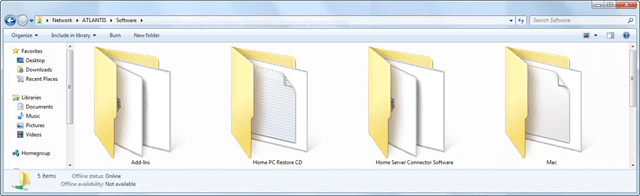
6. You are presented with the contents of the Software shared folder. Double-click the Home Server Connector Software folder to continue.

contents of software folder

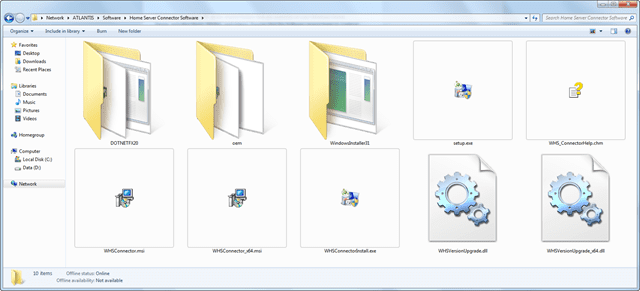
7. You are presented with the contents of the Home Server Connector Software folder. Double-click the Setup icon to start the installation process.

contents of home server connector software folder

8. You may be presented with an Open File – Security Warning dialog box. This dialog box advises you that a file is attempting to run and asks you to confirm that you want to run it. Click the Run button to continue.

9. When you see the Welcome to the Windows Home Server Connector screen click Next to continue.

welcome

10. Read the End-User License Agreement and click the I Accept the Terms of the License Agreement radio button and then click Next to continue. Of course, if you don’t accept the terms, you can’t continue the installation, so what choice do you really have?

licence agreement

11. The installation commences and you can monitor the progress.

monitoring the installation

This completes this part of the installation phase of the Windows Home Server Connector. You next
need to configure it, as described in the following section.

Configuring the Windows Home Server Connector

After the Windows Home Server Connector installation has completed, you will see the Welcome Screen. Click Next to continue.

welcome to whs connector

The wizard automatically tries to locate your Windows Home Server. This process can be
quick or it can take a few minutes—it all depends on your home network.

finding your home server

If for some reason the wizard cannot find your Windows Home Server, you will be given the option of searching again or finding your home server manually.

cannot locate the home server

It is always a good option to try and search again, if it still cannot find it, check that you have all the network cables correctly plugged in and your Windows Home Server is switched on. If you want to try searching manually you can just type in the name of your Windows Home Server.

If you still cannot find it, then consult the troubleshooting documentation or go to the Windows Home Server Forum’s on TechNet for more help.

Assuming the wizard locates your Windows Home Server, you will be asked to enter the password for the administrator account and then click Next. If you have forgotten the password, and you entered a useful hint during installation and configuration of your Windows Home Server, you can click the Password Hint button for a gentle reminder.

enter the WHS admin password

You will then be asked if you want to automatically wake up the computer to back it up if it is in either sleep mode or hibernation mode, or only back it up when it is switched on. Make your choice and click Next to continue.

home computer wake up

The wizard will then join your computer to the Windows Home Server, which means that it is added to the list of computers being monitored  and automatically configure a backup for you, which you can of course change later on. Just click Next to continue when this has completed.

configuring your computer

And that is it – the connector configuration is now complete. Just click Finish and you are done.

configuration complete

You can now launch the Windows Home Server Console and do whatever you need to do.

Removing the Windows Home Server Connector

You may decide that you no longer want to use the Windows Home Server Connector software
on a particular computer.

Removing the Windows Home Server Connector software from your computer doesn’t remove that computer from the list of computers shown in the Console, but you wont be able to backup that computer again, or at least until you reinstall the Windows Home Server Connector again.

You can easily remove the Windows Home Server Connector from a computer by following these simple steps:
1. On the computer you want to remove the Windows Home Server Connector from, click
the Start button and open the Control Panel.

control panel - uninstall

2. Select Uninstall a Program from the Programs group.

3. Highlight the Windows Home Server Connector in the list of programs and click Uninstall.

uninstall WHS connector

4. When prompted, just click Yes to start the uninstall process. You may be asked to confirm your choice again. Just say yes.

are you sure

And that is it, the Windows Home Server Connector software is now removed from your computer.

This Week in the World of Windows Home Server

So this is a new “feature” – rather than post each and every time something happens that isn’t necessarily big news, or someone posts an interesting article on another site, I thought I would just do a weekly round up post, that way if it’s interesting you can go off and read it, and if you are not interested, it’s easy to skip. Anything really big or interesting will continue to get posted straight away.

ws-HmSvr_h_rgb

Obviously the biggest WHS news this week is the announcement that HP are releasing a new HP MediaSmart Server next week called the LX195. The LX195 is a single drive model that comes with an Intel Atom processor and retails in the US for $399. To read the review and in-depth walkthrough we wrote, click here.

Do you have an Apple Mac? Would you like to run the Windows Home Server Console on it? Well the Windows Home Server Team Blog has posted an article on how you can do it. To read the article click here.

Donavon over at HomeServerHacks posted one of his usual excellent articles on how to upgrade your MediaSmart Server – this time how to upgrade the memory on the new HP MediaSmart LX195. Whilst it really is not that difficult, and is nowhere near as fiddly as the previous versions, it nice to have a simple walkthrough with lots of pretty pictures to guide you if you are not sure. To read the article and look at the pictures, click here.

My good friend David over at the HomeServerShow posted an interesting article on how to use Google Analytics with your Windows Home Server so that you can tell who is viewing your WHS Front End. To read the article click here. And whilst you are there, drop David a congratulations email on the arrival of his new son 🙂

And finally, if you are upset that HP haven’t released the HP MediaSmart Server 2.5 Update for the EX470 or EX475 then you can go read how to hack the update and your MSS on MediaSmartServer.net and get it running. To read the article click here. A big word of caution here though folks – this is completely unsupported, may in fact break your MSS, and could also mean that any legitimate updates, such as the forthcoming update to deliver Apple Time Machine and also Amazon S3 support to the EX470 and EX475, may not work. You have been warned! Just ask yourself the simple question – do I really need those add-ins, and if I do, can I get something similar without risking my box?

Adding a new drive to Windows Home Server with the Disk Management Add-In on a Friday night

Starting Blog Picture 

Background

I do not have a lot of time to write tonight so I am going to talk briefly about something cool that Disk Management Add-In can do. I want to show you how you can add a WHS disk and make the Wireframe modification through the Disk Management Add-In. Usually with Windows Home Server you must use the Server Storage tab to add new drives. Read on to find out how you can use the Disk Management Add-In as an alternative to the Server Storage tab.

Adding new drives never gets old to me. I love to back up my Windows Home Server. Seriously.

Equipment Needed

External Hard Drive

One Beer (optional)

One episode of IT Crowd v3

WDC 320GB Passport 

Add-In Description

Windows Home Server Disk Management Add-In was created by Sam Wood at Tentacle software. The Tentacle website is at:

http://www.tentaclesoftware.com/

According to the website it features:

  • Detailed information for each disk in your Windows Home Server
  • Real-time temperature and activity monitoring
  • Capacity indicators for individual disks
  • Customizable disk names
  • Customizable 3D wireframe representation of your server

Download and Installation

You probably already have the Add-In but a full description of the download, installation and my first Disk Management article can be found at:

https://moviesgamesandtech.com/2009/04/19/installing-the-disk-management-add-in-on-windows-home-server-on-a-friday-night/ 

Configuration and Setup

I have an external drive from a previous life that I want to attach to my WHS. I have drives from every stage of my life actually. One of my favorites is a Caviar 1365 from WD that I have from 1995. 365.3 MB in a 3.5” form factor. The cheap video card I just bought has more memory. Boy how things have changed. Anyway I have this drive, a WD 320GB USB drive, and I want to use it for off-site backups. I mention backing up every few articles because I feel it is so important. With WHS backup and the BDBB you can store your WHS backup AND all of your PC images on an external drive and then take that drive away from your network. I rotate two drive to my parents house. Every time I go and see them I take my latest drive and change it with what ever drive I had last left with them. Seriously, for like $120 for both drives I am totally covered with backups.

I digress. Back to adding the drive…

I Made a Boo Boo

Once I attached the drive it showed up immediately with “Attention Required” in the Disk Management Add-In. WTF? I select the drive anyway and click on the “Add” button near the top left.

Disk Management Screen 

You get the choice to add it to the pool or keep it as a backup disk. I choose backup. Come on baby…

Add selected disk 

I click on Next but I get an error message. The error says that the selected disk is not mounted or has no valid partition. Crap. I forgot to initialize the drive and format it before I connected it to the WHS.

When I store a drive from a “previous life” I always write ones and zeros to the drive to prevent data from ever being recovered. The drawback to this process is that it requires initialization prior to being used again. My bad. Sorry WHS and Disk Management.

Add a disk for server backups error 

I have two choices at this point for initialization and formatting. I can use the Advanced Admin Console or I can just disconnect the drive and do a quick format on my desktop PC. I will choose the desktop option and be right back.

Ok, I am back. Drive quick formatted. It was actually faster to use my PC then to use the WHS.

I now see the drive under “Unmanaged Disks”. Very cool. You can see red in the picture below since I disconnected the other drive. I select the new drive and click on “Add”. Let the games begin.

Disk Management Screen 

I have a choice of adding the drive to the pool or as a backup again. I choose backup.

Add selected disk 

I will have WHS format the drive. Why could it have not done it for me?

Add a disk for server backups 

I get to choose a name now. I like names with the drive location, manufacturer and drive size but feel free to name your drive something easy to remember like “ShietBox500”, “SlowAss”, “HotMamaPics” or even “MyLilGBMoFo”.

Name the server backup disk 

Confirm that only you are responsible for what is about to happen.

Confirm disk operation 

You drive is now ready after seeing a quick progress bar. Speaking of a bar it is time for another beer. My beer to screen shot ratio is improving. Is that something to be proud of?

Disk Management Screen 

Now that your drive is added to WHS it is time to update your Wireframe. Once you click on the icon in the upper right that says “Open Settings dialog” the Wireframe Diagram box opens. This is basically the same as clicking on Settings and scrolling down, by the way. If you have a current Wireframe then click on “Edit Current Wireframe”. If you do not have a current Wireframe, then, well, I guess you are done.

Wireframe Diagram 

You should see your current Wireframe. Click on “Add a new drive bay” then check the Advanced Mode check box and click on the little arrow to the right.

Add, Edit or Remove a drive bay 

Mental note: Did you click on the OK button and have to start over? It is “OK” cause I do it all the time! 

The next step is to choose the drive bay type, then click on “External drive bay” and finally click on the arrow again. I hope in future versions of this Add-In that they would change the arrows to “Next” or “Back”.

Drive bay type 

The next step is to choose the drive closest to where you want the new drive. Choose the “Drive bay position” and then use the Movement arrows to move your drive to the right orientation. Speaking of Orientation, did you all see Lost on Wednesday? Is Faraday really dead? If so, will he talk to Miles to save the Losties?

Drive bay position 

Now here is the cool part of the Wireframe. When you click on the drive path you should see the actual path to your drive with the name. I love this part. I am easily impressed. Seriously.

Click the right arrow. Stop trying to click “OK” already.

Drive bay contents 

We are almost done. Do not quit on me now. Only four more screen shots.

You should now see a new green drive and need to name it again. Not sure why you need to use the “Name/text” but if a field is blank I always try and fill it in. I am programmed and have issues I guess. Need a few more beers before I bring those issues up. Click on the right arrow. Stop trying to click “OK” already. Seriously.

Confirmation 

You should now see your new drive in the Wireframe diagram. Congratulations you are the proud owner of a brand new baby Wireframe.

Disk Management Screen 

Now you can finally click “OK” to complete the process. I can see the new drive right where I wanted it.

Disk Management Screen Completed 

I will now click on the Server Storage tab to verify everything is correct. Of course it will be correct but I am programmed to check everything.

Server Storage Screen 

Looks marvellous Lucy.

Conclusion

I like using the Disk Management Add-In to add drives because it helps me remember to update my Wireframe while I am actually in the Add-In. I have had wonderful time using it and it requires very little resources. This is a great Add-In and I hope if you do not have it already that you go and get it. Go get it now. Seriously.

See you next Friday night.

Timothy Daleo

Diskeeper 2009 HomeServer Edition Giveaway Results

diskeeperlogo-thumb 

Last week, I reviewed Diskeeper 2009 HomeServer Edition for Windows Home Server. At the end of the review I said I would giveaway 5 full licences of Diskeeper 2009 HomeServer Edition to our readers, and all you had to do was send me an email with a suggestion.

As usual with our giveaways, we had lots of responses, so thank you 🙂

This time, the lucky winners are:

Robert Hegglov from Sweden

Joseph Nell

Kelly Atkinson from New Zealand

Steve Buffone from OH, USA

G. Bujold from Canada

Congratulations! Your licences will be winging their way to you over the next few days, so check your inboxes.

For those who didn’t win this time, don’t worry, I have plenty of things to giveaway over the coming weeks, so stay tuned to UsingWindowsHomeServer.com for your chance to win!

Critical Update turns out to be Internet Explorer 8 for Windows Home Server

Introduction

Tonight I was greeted by my Home Server announcing that it had a critical update that just *had* to be installed. I wasn’t happy with clicking the Install Updates button in the Home Network Health dialog so I logged into my Home Server via Remote Desktop and had a look for the Windows Update icon to see what it so urgently needed to install.

Critical Update from Microsoft

Turns out it was Internet Explorer 8, not exactly a critical update in my opinion after all I don’t use the internet from my Home Server. Still I can understand why they’d want to force the update onto users, that way installations of IE6 and IE7 would be lowered and critical updates that people haven’t installed would most likely get installed as part of IE8.

Still I’m not exactly happy to install an internet browser on a server appliance, it’s just not something you do from servers. Here’s hoping that the next version of Windows Home Server is like the Core Version of Windows 2008 Server….

Installation

Installation was painless with just a couple of questions (no I don’t want to participate in the gathering of installation ‘metrics’ and yes you SHOULD install updates) and about three minutes later installation is complete and I find that a reboot is required. And I mean required, Windows will prompt you to reboot after the update installs and will continue to do so until you do.

Reboot and then all is well, Network Health upgraded from the Red Critical that not having installed the update gives and all is well once more. I can safety NOT browse the internet from my Home Server, safe in the knowledge that Internet Explorer 8 is installed and protecting me from all the things on the internet that my Home Server NEVER sees…. sarcasm in that last line, NEVER!

Conclusion

I can understand the forcing of the installation but it still doesn’t mean I like being forced to upgrade a component on a server that I believe shouldn’t exist in the first place. But enough of my bitching, then again I’m not the only one. Check out the following links for more information on this update, should you so wish, but remember to install it there *ARE* security updates to core components of your Home Server that will, hopefully, prevent you being exploited and ‘zombified’ in the future:

Microsoft to require opt-in for installing IE8

http://news.cnet.com/8301-13860_3-10218185-56.html

Is IE8 worth installing

Yes

http://www.pcworld.com/article/163902/ie_8_its_security_is_worth_the_download.html

No

http://blogs.computerworld.com/why_you_should_not_install_internet_explorer_8

How to keep IE8 off of your computer

http://blogs.msdn.com/ie/archive/2009/01/06/ie8-blocker-toolkit-available-today.aspx

Update:

As reported by several people as well as the authors own investigation it is correct that this “Critical Update” indeed does break the Advanced Admin Console add-in. Until this issue is resolved it is recommended that you either remove the Advanced Admin Console add-in or do not install the update until this issue is resolved.

If you do choose not to install the update Using Windows Home Server cannot be held responsible for any issues arising from not having the update installed.

In-depth review of the HP MediaSmart Server LX195 Windows Home Server

There have been rumours floating around for the last few weeks about a new HP MediaSmart Server, known as the LX195. Well, these rumours are true. HP today announced the impending release of their next HP MediaSmart Server, and yes, it’s called the LX195, which is a departure from the EX series that are currently available.

The specification of the LX195 is a little different to that of any of the EX series. For a start, you will notice that it is visibly smaller. This is partly because it only contains a single hard drive, and doesn’t have the capability to add additional internal hard drives, but also because there is an external power supply, compared to the built-in power supply on the EX series.

IMG_0164

Also, you will notice that is doesn’t have the sleek shiny black surface that the EX series had, but instead it has a series of ridges which help with the cooling, and the box itself is a dark gray. Below is a picture of the 3 different HP MediaSmart Servers – from left to right, the EX475, the EX487 and now the LX195.

IMG_0169 IMG_0171

SPECIFICATION

The actual specification of the LX195 is as follows:

PROCESSOR Intel Atom 1.6 GHz Processor 230
MEMORY 1GB of DDR2 DRAM
NETWORK SUPPORT Built in 10/100/1000 RJ45 Ethernet
INTERFACES 4 USB 2.0 ports (on the back)
INTERNAL HARD DRIVES 1 SATA 7200 RPM 640 GB drive

So HP have decided for this smaller variant to go with the Intel Atom processor. And yes, there is only room for a single built-in hard drive in the chassis, which is a definite departure from the EX series. However there are 4 USB 2.0 ports on the back of the LX195 which you can use to connect external hard drives to (make sure that the minimum size drive you connect is 100 GB though as anything less is not supported).

IMG_0162

Those of you reading this who know Windows Home Server will immediately realise that with just a single drive you cannot have Folder Duplication enabled. So, the first thing you will want to do is get yourself a decent external hard drive if you want your shared files protected.

UNPACKING AND CONNECTING

The box itself is quite small with everything coming very well packaged inside.

IMG_0149 IMG_0151 IMG_0153

The contents of the box include the LX195 itself, the power cable and power supply (a change to the previous models), an Ethernet cable, some software CDs, a warranty book and the setup poster.

IMG_0157

Plugging it in all shouldn’t take more than a few moments, now it’s time to switch it on and get it working.

INSTALLING AND CONFIGURING

There is not manual as such with the LX195, but when you run the installation CD you are given some online instructions, and you also have the now familiar HP MediaSmart Server Setup Poster to help guide you through what needs to be done.

30-04-2009 10-49-24

The first thing that needs to be done after you have connected up the LX195 to both the power and your home network, and switched it on, is to install the Client software on one of your computers. This performs two functions, the first of which is install the Windows Home Server Connector software on your computer but also to enable you to configure your new Windows Home Server, with details such as the server name and admin password (but more on that in a moment).

After you pop the Software Installation CD in the drive, you then follow the usual steps to install the Windows Home Server Connector software. I won’t walk through all those steps again in this article, but I have included the screenshots for those of you who might be interested. Note the LX195 image on the installer.

30-04-2009 10-48-14 30-04-2009 10-49-06 30-04-2009 10-53-20 30-04-2009 10-53-28 30-04-2009 10-53-38 30-04-2009 10-54-41 30-04-2009 10-55-40 30-04-2009 10-56-27 30-04-2009 10-56-37 30-04-2009 10-57-42

So once you have go to this stage, then its time to configure the Windows Home Server itself. You have to do it via this method because there is no facilities available on the LX195 for you to plug in a mouse, monitor and keyboard.

Again, I won’t bother with going through each and every step, although again I have included the screenshots, but the one interesting thing to point out though which is a change from HP’s other models is that the server name is already entered as HPSERVERLX instead of the usual HPSERVER. You can of course change this if you so wish.

30-04-2009 10-57-50 30-04-2009 10-58-00 30-04-2009 10-59-15 30-04-2009 10-59-24 30-04-2009 11-00-03 30-04-2009 11-00-15 30-04-2009 11-00-24 30-04-2009 11-00-35 30-04-2009 11-02-37 30-04-2009 11-04-07

Once you have completed these steps then you can log in to the Windows Home Server Console as normal.

30-04-2009 11-04-18 30-04-2009 11-04-33

Before you can access the Console though, you are prompted to perform a check to see if there are any HP MediaSmart software updates available.

30-04-2009 11-06-09 30-04-2009 11-06-20

At the time of writing, the version of the software that comes preinstalled, 2.1.1.25860 is the latest version to work on the LX195, so before anyone asks, the 2.5 Update for the EX485 and EX487 is not found and installed for you.

30-04-2009 11-06-28

USING THE LX195

One thing you will notice, or rather you won’t notice is the noise. The LX195 is extremely quiet, in fact it is so quiet you will barely hear it, which cannot really be said about the EX series, although to be fair, the EX series had more hard drives and different power requirements. And the EX series wasn’t really that loud either!

Having a look around the LX195 version of the Windows Home Server Console, you will see the MediaSmart Server tab, with specific additions provided by HP, including an update Welcome screen.

30-04-2009 11-06-38

By clicking on the Server Summary button you can see at a glance the status of your server.

30-04-2009 11-22-33

Those of you familiar with the HP MediaSmart Servers will know that they come with additional software, and the LX195 is no exception.

You basically get the same software you did with the pre 2.5 Updated EX485 and EX487 series, so that is:

HP Photo Publisher which enables you to publish your photos to various online photo sharing sites.

30-04-2009 11-23-10

HP Media Collector which automatically copies and organises media files from any of your computers.

30-04-2009 11-23-17

Features for Mac, which basically includes support to use Apple’s Time Machine to backup files on your Apple Mac to your Windows Home Server and also to access shared folders from your Windows Home Server on your Mac.

30-04-2009 11-23-24

Server for iTunes which enables you to store and publish your iTunes library and playlists on your network.

30-04-2009 11-23-31

HP MediaSmart Server Online Backup which enables you to use an Amazon S3 account to backup your data outside of your home or office. But for this you do need an Amazon S3 account, so it is not free.

30-04-2009 11-23-39

TwonkyMedia is used to stream your digital media on your home network to devices such as an Xbox 360 and also to provide remote streaming.

30-04-2009 11-23-47

All of these additional features can be enabled or disabled depending on your own needs.

Having a look at the Shared Folders tab and the Server Storage tab reminds you that you only have one hard drive out of the box, which means no Folder Duplication, so maybe now is a good time to plug in that external drive you have available?

30-04-2009 11-24-50 30-04-2009 11-24-59

There are also the usual settings tabs for various HP specific options.

30-04-2009 11-25-49 30-04-2009 11-25-55 30-04-2009 11-26-01 30-04-2009 11-26-09 30-04-2009 11-26-15 30-04-2009 11-26-22

The LX195 also comes preinstalled with two add-ins – the TwonkyMedia add-in as mentioned earlier, and also the HP MediaSmart Online Backup add-in, again, as mentioned earlier.

30-04-2009 11-26-40

There is also an add-in available to install that is not installed by default – the McAfee Total Protection Service. So if you want to be protected by Antivirus you can easily install this add-in or use one of your own choosing.

30-04-2009 11-26-47

As the LX195 comes preinstalled with Windows Home Server Power Pack 1, you will need to update to Power Pack 2 before doing much else.

30-04-2009 11-25-20

Just go to the Settings tab, and click on Update Now to retrieve that, and any other updates that are available.

30-04-2009 11-32-56

CONCLUSION

It is very interesting to see a single drive Windows Home Server, mainly because you don’t have the ability to enable Folder Duplication out of the box. However it is very easy to add a USB drive to enable this. I think that more and more people want a cheap, simple solution just to back up their computers and may not want to share their content, in which case a single drive Windows Home Server is just fine.

The price point for the LX195 is $399 which is very good, and obviously is the cheapest of the HP MediaSmart Server series. The next current model up, the EX485 retails at $599 before rebates and other discounts, although you can get it at least $50 less at the time of writing from the HP Store, and possibly cheaper if you search around online. So the question is really is it worth paying that little bit more to get a more internally expandable server, and also one with the new 2.5 Update software for video conversion and support for iPhones? Well that is a question that only you can answer. Do you need those additions, or do you want a cheap and cheerful Windows Home Server?

I have to say I really like the LX195, it’s small, quiet and cheap. It does everything I need to do within the confines of it’s hardware. If I want to do more, then I have the option of buying a bigger Windows Home Server. The only thing I would add though is that I think HP should have shipped it with 2GB of RAM instead of 1GB, but that is easily resolved!

The other point to note is that Acer are currently launching their Acer Aspire easyStore Windows Home Server, that will also retail for $399, but includes double the amount of storage, with the ability to add more internal storage as well. So which will do better? Frankly I think it is a great thing that the price of Windows Home Server’s are coming down and that the choice of hardware is increasing, well done!

The HP MediaSmart Server LX195 Windows Home Server will be released next week (1st week of May) in the US for $399. Once again, no word on a European release so watch this space.

In-depth look at the HP MediaSmart Server 2.5 Update for Windows Home Server

A few weeks ago I posted an article on the then forthcoming HP MediaSmart Server 2.5 Update. Well the update was released last week for all HP MediaSmart Server EX485 and EX487 owners and so I thought it was time to do a more in-depth look at this new update.

Again, unfortunately this update is not available for owners of the HP MediaSmart Server EX470 or EX475 as HP state the hardware requirements for this update are greater than that of the those machines, even if you have updated the memory and processor yourself.

Before we getting into the in-depth look, let’s just have a quick reminder what this update actually includes:

The 2.5 Update brings remote video streaming and automatic video conversion to unprotected content. What this means is that your EX485 or EX487 will be able to automatically convert videos and unprotected DVDs into two different resolutions. These include a high resolution file that you can steam to PCs, Macs and even your Xbox 360 or PS3. The other resolution is aimed at mobile devices, such as the iPhone and iPod Touch. The supported video types are AVI (DivX, Xvid, MJPEG), MOV (MJEG), DVR-MS (MPEG2), MP4 (MPEG4), WMV and unprotected DVD VOB. Unprotected DVD VOB files are automatically stitched together resulting in a smooth stream.

There are also some updates to the mobile streaming user experience, updates to the HP Media Collector, improved configuration for Apple Time Machine and the ability to create public and private albums in the photo viewer.

DOWNLOAD AND INSTALLATION

By the time you read this article it’s a good chance that you have already got the update installed, but in case you haven’t, or you have only just got your EX485 or EX487, here is what you have to do.

First, launch the Windows Home Server Console, click on Settings and then click on HP MediaSmart Server. Then click the HP Update tab. Here you will see the version installed, in this case 2.1.7.24261 which means I don’t currently have the 2.5 update installed.

HP Update - before

Click the Check for updates link and your Windows Home Server will go and check to see if there are any updates available.

hp update - searching

If there is an update available, in this case the MediaSmart Server Update 2.5, ensure it is selected and click Next.

MediaSmart 2.5 Update Available

The update will the be downloaded – be patient though it is over 200MB in size, although if you have a fast connection it will be quicker 🙂

22-04-2009 21-10-21

When the update has finished downloading, it will be launched automatically. 22-04-2009 21-12-17

The installation process will also start automatically.

22-04-2009 21-12-28

Click Next to continue.

22-04-2009 21-12-51

Click Install to continue.

22-04-2009 21-16-29

The installation will take place and won’t take very long, when prompted click Finish. It it also a good idea this point to reboot your Windows Home Server.

22-04-2009 21-21-38

When your click on the MediaSmart tab, you will be presented with the new 2.5 screen, as shown below. We will look at the new features in a moment.

22-04-2009 21-22-37

There is also an update Windows Home Server Connector, which you need to install. Unfortunately this process is not automatic like that of the Windows Home Server Power Pack 2 update, so you will have to perform this on every home computer you have.

Open up the Windows Home Server Software Shared Folder, and then open the Home Server Connector Software folder. Double-click on the Setup.exe file to launch the installation file.

22-04-2009 21-24-35

If you already have a previous version of the Windows Home Server Connector software installed you will be warned that the setup process will uninstall the current version and then reinstall the new version – so click Yes to do start this.

22-04-2009 21-24-54

You will see the installation Wizard appear – click Next to continue.

22-04-2009 21-25-54

Read the licence agreement, click on the I accept…. radio button and then click Next to continue.

22-04-2009 21-26-05

The installation will now take place as usual.

22-04-2009 21-26-30

Remember to do this on each and every one of your client computers.

If you double-click on the HP MediaSmart Server icon on your desktop, you will also see an updated Control Console.

control center

THE NEW FEATURES AND IMPROVEMENTS

There are a few new features and some improvements delivered with the 2.5 Update. So let’s take a look at them.

HP VIDEO CONVERTER

The video converter monitors selected shared folders and attempts to perform video conversion (also known as transcoding) on files with common video file formats.  The video converter also supports DVD file system conversion, for DVD files that are commonly used in camcorders.

The results of the video converter tool are of a single file format: an MPEG-4 video file using an H.264 video codec and AAC stereo audio codec.  Currently, devices supporting this format include

  • Microsoft Xbox 360
  • Sony PlayStation 3
  • Sony PlayStation Portable
  • Apple iPod  (newer iPods with video support)
  • Apple iPhone
  • Microsoft Zune

The Video Converter will not transcode copy protected DVDs or electronic videos with Digital Rights Management Technology built into digital media, such as music and movies.

By default, the HP Video Convertor is switched off. To switch it on, just launch the Windows Home Server Console, click on Settings, then click on HP Video Convertor. Then all you have to do is check the box marked Enable Video Convertor.

18-04-2009 19-04-12

Once you have enabled the HP Video Collector, you can easily select which of the Shared Folders you want to have video files converted from.

23-04-2009 16-09-31

By default, only the Videos folder is selected and also both the Full and Mobile options are selected for you. You can of course easily change this by checking the relevant boxes.

When selecting a shared folder to perform video conversion on, there are two options for the output of the video converter: Full resolution and Mobile resolution.

Full resolution keeps the source video’s screen resolution, and basically just creates an output file with the new format for the provided input.  Video and audio quality should be very similar to the source material for Full resolution videos.  You may notice some differences between the original and Full resolution output, but these differences are minimal in most situations.

One benefit of using the Full resolution output settings is that older video formats like MPEG-2 videos are often much larger in size than the format used by the video converter.  The output of a Full resolution video conversion can be approximately 25% the file size of an original DVD (MPEG-2).   This significant reduction in size can make streaming via 802.11G less problematic (although many factors impact streaming videos wirelessly, results may vary widely).

The Mobile resolution creates a video that is suitable for mobile devices and remote video streaming (the video will be no larger than QVGA: 320w x 240h).  This is to make support of mobile devices easier, and to provide videos suitable for remote media streaming.

Once you have chosen your folders, if you click on the HP Video Converter button on the MediaSmart Server tab, you will be able to see the status of the conversion process.

As you can see from the screenshot below, I have one active, one cancelled and a number of videos pending. Note that each video you want converted will have an MQ (Mobile Quality version) and a HQ (High Quality version) assuming you selected both versions.

23-04-2009 16-13-12

It is important to note that depending on how many videos you want converted, the quality of those videos selected, and the length of the videos, this conversion process can take some time. My advice would be if you are planning on converting a lot of videos, have them running overnight.

You can also see when they are all complete.

23-04-2009 18-28-44

You will also notice a new folder called Converted Videos, this is where all the converted videos are stored – obvious really!

28-04-2009 16-17-53

One last thing on this subject, in order for the streaming to work, and this goes equally for the Photos and Music, as well as the Videos, you must ensure that you have enabled Media Sharing from the Settings area of your Windows Home Server Console.

18-04-2009 19-12-16

HP PHOTO PUBLISHER

The big addition here is the ability to now have both public and private photos albums, meaning that you now have photo albums that only those who you deem worthy can see.

18-04-2009 19-03-12

Whilst this is certainly a useful feature, I am a firm believer in not publishing anything to the Internet that you don’t want people to see in the first place. If you have private photos that you only want a selected few to see, why not give them access to a shared photo folder on your Windows Home Server itself instead of publishing them for all to “possibly” see?

FEATURES FOR MAC

There are a number of improvements to the Mac Backup feature, including the ability to resize the backup disk.

18-04-2009 19-03-22

You need to update the Windows Home Server software on your Mac. To do this, perform the following steps (this assumes you have already got a previous version of the software running – if you don’t just skip the Uninstall step):

Click on your WHS as listed within the Shared area.

2

Open the Software folder.

3

Then open the Mac folder and launch the HP MSS Client.dwg file.

4

As mentioned earlier, if you already have the software installed, you need to uninstall it first, so click on Uninstall HP MediaSmart Server Software.

5

Follow the prompts to remove the software until you see the Uninstall Succeeded message and then click Close.

6 7 8

Now you have to reinstall the software so click on Install HP MediaSmart Server Software.pkg and follow the prompts to perform the installation.

9 10 11 12 13

At the end of the installation the Preferences screen will open and you will need to type in the Server Name and Server Password to reconnection to your Windows Home Server.

14

And that is it, the software is now up to date.

You will also notice a new Control Center which enables you to perform certain functions.

15

You can also launch this Control Center by clicking on the MediaSmart icon.

16

The main new Mac feature as mentioned is the ability to change the size of the Backup Disk.

To do this, click on Preferences in the Control Center, then click on the Backup tab.

17

You will need to click Stop in order to Stop the Backup Disk before you change the size, depending on what is happening at the time, this make take a few moments.

Type in the new Backup Disk Size, in GB and then click the resize button and then click Resize to continue.

20

You will be warned that you cannot cancel or undo the resizing operation, and so remember that all previously stored backup data will be lost. If you are happy, just click Continue.

21

And that is it – the Backup Disk size will be changed and then restarted for you.

22

REMOTE MEDIA STREAMING

When you want to access your media content remotely, you will be presented with a number of options. It is important to note here that you need to have Adobe Flash installed to see the options, but don’t worry if you don’t have it installed, you are given the option to install it.

18-04-2009 19-19-51

If you select the Media Streamer icon you will be taken to the Music area where you can stream your music and search for songs by album, artist, etc. You will also see any cover art and information displayed here as well.

18-04-2009 19-23-03 18-04-2009 19-23-24 18-04-2009 19-23-42 18-04-2009 19-24-00

The Photos button will take you to all of your shared photos, and again you can search for whatever you are looking for by date or in folders.

28-04-2009 16-13-43 28-04-2009 16-14-12 28-04-2009 16-14-32

Lastly you have Videos. You will be presented with a list of available videos.

28-04-2009 16-15-25

You can look in folders and even choose to only display Converted Mobile videos.

28-04-2009 16-15-50 28-04-2009 16-16-00 28-04-2009 16-16-24

If you click the Status button you can see what is currently being converted, or in my case as I am not converting anything at the time of writing, what has been converted. You can even click on a specific file to find out about the conversion.

28-04-2009 16-18-35

iSTREAM

One of the other new features is called iStream and it is an application that works on your iPhone or iPod Touch in order to stream your digital content to those devices. It is not part of the 2.5 Update, but it does require the 2.5 Update to work. For more information on iStream, including a walk-through, click here.

IMG_0005

OTHER FIXES

The following defect fixes and enhancements are included in this update:

Fixed a number of TwonkyMedia server issues, including the case where songs would not play all the way through.

18-04-2009 19-03-58

Improved the HP Media Streamer interface, including adding support for streaming video files, column sort functionality, and new album art views.

Improved Media Collector by displaying progress details, status information, and client connectivity to shared folders.

Improved the HP MediaSmart Server dashboard functionality.

The User’s Guide was updated to match HP MediaSmart Server software changes.

CONCLUSION

This was a very long article on the new update, so if you are still reading, thank you and well done!

Is the update worth having? Yes, very much so, and considering it is free and gives you a lot of additional functionality you really cannot go wrong. Its very simple to set-up, just a few clicks to choose what you want to use and then it just works. In terms of streaming, as long as you have the available bandwidth it works great and it’s certainly nice to see that HP have put a lot of effort into make digital media content even more accessible.

It is very unfortunate that owners of the first generate HP MediaSmart Servers cannot take advantage of this update, but as HP have stated, this is because of the hardware requirements on the update, even though there are a lot of owners who have upgraded both the ram and the processors themselves. Bottom line guys I don’t think that HP will release the software no matter how loud we shout and I think we have to accept that if we want this functionality on our EX470s and EX475s then we will have to look to third parties to release add-ins that could do something similar.

iStream for Windows Home Server

So, for those of you who have been following the recent release of the HP MediaSmart Server 2.5 Update, you will be aware of the application for the iPhone and iPod Touch, called iStream, that enables you to connect to your Windows Home Server and stream your digital content.

This assumes that you have already installed and configured the HP MediaSmart Server 2.5 update and have enabled remote access and media sharing.

INSTALLING iSTREAM

So, if you have an iPhone or iPod Touch (2nd generation, not the 1st generation model), there are two ways you can get the iStream application.

The first is to launch iTunes on your computer, click on the iTunes Store and do a search for MediaSmart. You will then see the HP MediaSmart Server iStream application (as shown in the screenshot below).

app store

Click Get App to start the download and then just connect up and sync your device to install it.

You can also read more about it by clicking on it.

istream itunes app store

The other way to get iStream is to do a search in the App Store directly from your device.

IMG_0003 IMG_0004

CONFIGURING iSTREAM

Once you have installed iStream via whichever method you choose, just select it from wherever it has been placed on your device.

IMG_0007

Then you need to tell it a few details about your server, specifically the server details, the user account name and user account password used to access the shared content.

IMG_0006

For server, you will need to type in the full domain, for example WHATEVER.homeserver.com (where WHATEVER is the name you used when you configured remote access for your Windows Home Server. If you only want to stream internally on your home network you can just type in the name of your Windows Home Server, but remember that outside of your network that just isn’t enough information to connect!

If you connect to more than one Windows Home Server, you can press the History button to see the servers you have already connected to, making it quick and easy to reconnect.

The details you enter will then be verified, and if successful you will see the 3 familiar shared folders – Music, Photos and Videos.

IMG_0024

If you want to change the settings at any time, just press the icon in the bottom left hand corner and then press Open Settings to return to the settings page, or Go Home to return to the 3 folders page.

IMG_0032

If you press the About button on the Settings page you can see information on the iStream application.

IMG_0009

So let’s take a look at each of these in turn and see what you can do.

MUSIC

If you want to listen to your music, just press the Music button. You will then have the choice to display your music by Album, All Tracks, Artist/Album, Folder, Genre/Artist/Album or Playlist.

IMG_0010

So let’s say you want to see all the albums, just press Album to see what you have available.

IMG_0011

Select the album you want to listen to and you will see a list of song titles and information, plus the ability to shuffle them and listen to them in a random order.

IMG_0012

When you have chosen the song you want to listen to it will start playing and you will see information on the song, artist, duration and more.

IMG_0013

If you click on the List Music button on the top right hand corner you will see a view of all the songs on that album.

IMG_0014

One thing you need to remember is that because you are streaming the songs from your Windows Home Server, over the Internet (if you are listening to it outside of your home network) that bandwidth plays a really important part of the process.

I was very happy to see that I was given a warning message and the song would not play because I was on a low speed connection. I would much prefer this than think it will work fine and have the song stopping every few seconds – so well done HP!

IMG_0036

The Playlists menu is interesting as it shows you what you have most played, last played, recently added or even highly rated. This makes it very quick to find something specific that you might want to listen to.

IMG_0015

PHOTOS

If you want to look at your photos, just choose Photos and you will see a menu offering you All Photos, sorted by date, folder and also playlists again.

IMG_0016

Choosing All Photos will list all of your photos in a small thumbnail list with the photo title. As you can see from the screenshot, my photos are not called anything useful so it is difficult to find something specific without scrolling through the whole list.

IMG_0017

This is where the little icon in the bottom right next to Refresh comes in very handy. If you press this the view is replaced by a page of thumbnails, making it much easier to look through and select something.

IMG_0018

To look at a picture, just press one! Depending on your connection speed it may take a moment or two to load.

IMG_0019

Then the picture is displayed for you in all its glory.

IMG_0020

You can then choose to look at photos before or after that particular one, or even press the button on the bottom right to start a slideshow of all your photos.

You can also rotate your device to show the pictures in landscape or portrait mode, which is nice.

You can also view photos by date or folder, and then there is the playlist option, exactly as you had with Music, just with less choices.

IMG_0021 IMG_0022 IMG_0023

You can also look at your photos at the same time you are listening to music, which can make for a nice effect.

VIDEOS

So now that we have looked at streaming your music and your photos, that only leaves your videos.

When you press Videos from the main list, you have the option of All Videos, a specific Folder or Playlists yet again.

IMG_0025

Selecting All Videos takes you to a list of all the available videos. You can just choose which one you want to watch. As you can see, you are offered the “mobile” quality videos by default. It is important to remember that only videos that have been converted by the HQ Video Converter that came with the 2.5 update will be displayed here. This means that only H.264 encoded videos, those in .mov and .mp4 format.

IMG_0026

If you choose the Folder option you can see all of the folders available.

IMG_0028 IMG_0029 IMG_0031

FINAL THOUGHTS

So that was a look at the iStream application. Is it any good? Well simply put, yes. This is a must have add-on if you have an HP MediaSmart EX485 or EX487 Server and an iPhone. Its easy to install, asy to use and is great for showing off with 🙂

Just remember that your streaming experience is reliant on your available bandwidth and your Mobile connection.

Whilst I know that non EX485 and EX487 owners out there are not happy that this update is not available to them, I would imagine it won’t be long before someone releases software and add-ins that do pretty much the same thing. Just hang in there.

Add-In Review : Drive Balancer for Windows Home Server

Introduction

Windows Home Server is a fabulous product, the way it stores your data across multiple hard drives in order to provide resilience and a measure of ‘peace of mind’, unfortunately from time to time checking the distribution of your data across these disks using the Disk Management Add-In you may see that newer hard drives, that you’ve added, are not being made full use of when storing your data.

This is where Drive Balancer comes in, it is Home Server Add-In that is designed to evenly distribute your data across your WHS pooled hard drives regardless of the space or number of drives available. It is not a WHS Add-In in the traditional sense in that it does not integrate into the Windows Home Server console instead it is run from directly on the Home Server in a command prompt window.

Perhaps future releases will result in this being a true Add-In as but the application is fully functional and that’s exactly what it says ‘on the tin’ as is.

First a little background, when I built my Windows Home Server, way back in November 2007, I used three 320 gigabyte hard drives as the storage pool. However since that time and I have added two 750 gigabytes and two 1 TB hard drives too much storage pool.

The image below shows the distribution of data on my Home Server before running Drive Balancer, as you can see most of the data was spread across disks 1, 2 and 3, with some data spread across the disks 4 and 5 but it isn’t the best distribution as Disk’s 1 and 2 are nearing their capacity.

Before Drive Balancer

Installation

Unpacking Drive Balancer to “C:\TEMP” from its distribution zip file (like I said it’s not your typical WHS Add-in) I then connected to my Home Server via Remote Desktop (I could have also used the Advanced Admin Console to get a command prompt connection instead of Remote Desktop) and navigated to the “C:\TEMP” folder where I ran the Drive Balancer executable.

Usage

Drive Balancer asks a couple of questions before it starts and it uses the answers to establish whether it should include the Landing Zone in its work but also how it should distribute or balance the data in the pool.

Now before we proceed any further I’d like to try to put any concerns about what Drive Balancer is doing to rest. When I first saw the Add-in I was concerned that it was modifying data, moving things around and that something COULD go wrong that would result in the loss of data. From my testing and my investigation into how Drive Balancer works I am confident that it doesn’t actually modify your data, instead it creates temporary files and then calls upon the WHS Drive Extender Migrator service to do the actual work moving files around.

Safer with this knowledge that my data SHOULD be safe (remember things CAN go wrong (as with anything in life) and as a result you should heed the warning that running this Add-in is done at your own risk and that neither is the author nor Using Windows Home Server responsible if something goes wrong.) I pressed the ENTER key and let Drive Balancer do its thing.

Rumours that I ran and hid behind a heavy wooden desk at this point in a Pratchett-esque way are unfounded and just not true, I was in fact hiding from my wife who was not happy I had hidden the remote controls for the audio/visual centre so I could prevent her watching Twilight for the millionth bloody time.

Drive Balancer will then just run and it does take some time to run, the drive balancing of my WHS took about four hours to complete but the whole time the HDD Balancer Command Prompt on the server was telling me what was going on, not that I really understood what it was saying but so long as it was doing stuff and the percentages reported were increasing I was happy.

During the run you may see your Network Health change to Yellow/Red as well as the loading on the WHS Pool drives showing all of your disks filling up as the balancing is progressing. There is nothing to worry about this is expected behaviour, towards the end of my drive balancing my WHS showed the following:

During Drive Balancer

And before I took a trip to the do the shopping and hit the local computer stores the Used indicators were slowly increasing.

I returned from my shopping expedition to find that Drive Balancer had completed and I was missing a few hundred dollars as my wife had managed to find my wallet. Drive Balancer was a very polite Home Server Guest and cleaned up after itself by deleting all temporary files/folders it needed/used and checking the Disk Management add-in I was greeted by the following view of my newly balanced Windows Home Server:

After Drive Balancer

As you can see Drive Balancer did a very good job of evening it the data that I have across all of the disks in my WHS Pool. I’m more confident now that should I lose a disk or two that my WHS will cope without loss of data.

Conclusion

Drive Balancer is not your everyday tool or utility, it really needs to be run by a technically competent person and it would be nice in the future if the Author or Microsoft would make this more user-friendly and remove the requirement to connect to the Server to run. That said, Drive Balancer does exactly what it says it does and does a very good job of it.

My shopping trip procured me a couple of Seagate Barracuda 1.5 TB Green SATA-II hard drives and it’ll be an interesting task to add these to my Windows Home Server and then run the Drive Balancer again…. keep an eye out for a review of the hard drive and an update on the Drive Balancing when it occurs.

Drive Balancer, version 1.05, by Beefcake, available to download from here.

Using Windows Home Server to upgrade your client hard drive on a Friday night

Most of us have a laptop that probably came with an 80GB or 120 GB hard drive. It has almost certainly crossed your mind to upgrade the drive when a company like Newegg has 250GB to 500GB laptop drives for $79.99. I know for me, upgrading seems like a pain and I do not want to take the time to mess with it. Please read on to see how WHS can make your hard drive replacement as painless and as fast as possible.

Equipment Needed:

Replacement Hard Drive

Recent WHS backup of the PC

Windows Home Server Restore CD and CD drive

USB Drive (with network drivers, optional)

3 Beers (discretionary but recommended as always)

A recent “Lost” episode

Background

I am going on a short holiday tomorrow to see my sister and taking her 13 year old step-daughter an old Dell GX60 SFF OptiPlex that I have had sitting around the office. Sounds simple enough right? Not quite. It only has an 30GB hard drive. WTF? Her iTunes music alone is probably going to be over 30GB! Why the small drive Uncle Tim? I have never needed more drive space since it was connected to the network and WHS hosts my music and videos. It is a small form-factor so there is no room for a second drive inside the case. What else do you want for free? Oh, you want a monitor, keyboard and mouse too? Crap.

I want to take one of my 500GB IDE drives out of one of my old (and now obsolete?) NAS drives and drop it in the case. The hardware replacement will be easy but what about all of the software? What about the settings, drivers and programs? Service Pack 3 takes about an hour alone to upgrade. No way! I am leaving in the morning and I am running out of time. In addition, the wife is packing the car by herself tonight for the trip tomorrow so I need to do this the fastest way possible!

Dell GX60 with replacement drive

Hard Drive Replacement and Data Transfer Solutions

If I replace the drive I will have four choices for the existing data and programs:

  1. Load Windows and reformat, install programs, files and updates.
  2. Use the File Transfer Wizard (but I have to load Windows on the new drive).
  3. Use the Backup Wizard to transfer (but I still have to load Windows on the new drive to restore from the Backup).
  4. Use the Windows Home Server backup feature and Restore CD.

I’ll take door number four Monty. Viva Windows Home Server!

Backup Verification

Ok, so the GX60 is running and connected to the WHS network. It has been a while since my last backup but we know that WHS only tracks the changes so it should not take that long to run one more backup before I begin. I will start the backup and head to the fridge for a cold one. Where is that damn mini fridge?

Windows Home Server Backup Screen

Mental note: Make some noise and move a few things towards the garage so the wife will know I am helping pack and not cramming to finish this article before we leave.

The backup is done in 8 minutes. Thank you WHS!

Drive Installation

Now that the back up is complete I will power down and replace the drive. You can see that with the GX60 the case is easy to open and the drive replacement is very simple. Your installation will be different of course.

It might look like this:

Inside of a Dell GX60 showing the IDE drive

Or this:

Drive replacement on a Dell Latitude

Make sure if you are using a drive that had prior data on it that you delete ALL of the data and any partitions that may have been on the replacement disk. If you have not done this you can do it when we get to the Disk Manager during the Restore process. We will verify this AGAIN when we get to the Disk Manager during the Restore process. If your replacement drive is new then you should not have any issues.

Mental note: Put the Restore CD in the drive before I power it off so I am ready once I turn back on the PC.

Booting from the Restore CD

I have replaced the drive and am ready to boot up. I have the Restore CD in the computer and I press the power button. Here we go…power on and F12. F12 again. Flippin F12. F12 yet again. Good job with the F12 cause I am at the boot screen. Choose the CD Boot option.

Boot Device Menu Screen

Make sure you know if your PC has over 512 MB of RAM. WHS will ask you before you start the Restore process.

WHS Restore RAM Screen

Let the Restore process begin.

WHS Restore Progress Screen

The Restore Process

Follow the prompts on the screen to start with the actual Restore process. The Restore process is interactive until you actually start to copy data.

WHS Restore Detect Hardware Dialog Box

It is possible that your PC will not find the network or your server once you start this process. This may scare you at first but it is ok. You may be able to click on Continue and go ahead with the process. If it does not let you continue then you will need to have the network driver. I had to install the drivers on my Restore. When WHS asked me for the network driver I went to another computer on my network, looked up the Dell website, downloaded the driver for the GX60 and put it on a USB drive. If you do not have another computer to use during this process you may want to do this as a precaution ahead of time.

WHS Restore Network Driver Screen

I copied the drivers to a little USB drive on another computer. I then took the USB drive, plugged it in to the GX60 and clicked on the Scan button.

WHS Restore Install Drivers Screen

WHS found the drivers and continued on as expected. Make sure you unzip or decompress the driver files before you put them on the drive so WHS can find the drivers.

My drivers installed without any issues.

Once you can connect to the server the Restore can start.

WHS Restore Wizard Screen

Enter your WHS password and click on Next.

WHS Restore Password Entry Screen

Choose which computer to Restore.

WHS Restore Computer Choice Screen

Choose from which backup date you want to Restore.

WHS Restore Backup Date Screen

If your drive is brand new then continue to read on, if not then skip to the next section.

If the Drive is NOT Initialized (a brand new drive)

While I am Restoring the GX60, I am at the same time replacing the drive on my laptop with a brand new drive. This section is for the new drive. If your drive is new you will get the following error:

WHS Restore Initial Partition Error

You can then click on the Run Disk Manager button to format the new drive.

WHS Restore Disk Manager Option Screen

Once in the Disk Manager application you should see your new drive. Right mouse click on the drive and do a Quick Format.

WHS Restore Disk Manager

Mental Note: If you choose a full format be prepared to add another hour to your Restore experience.

Once the format is complete you can continue on with the Restore process. Verify the Source Volume and the Destination Volume and click on Next.

WHS Restore Source Volumes

If Drive was previously Initialized (or came from another device)

THIS IS VERY IMPORTANT – If your drive had already been formatted or in another device you should still need to run the Disk Manager. Look at the Destination Volume on the right. If it shows “New Volume” then you should be good to go. If it shows anything else use the Run Disk Manager button and view any additional partitions that may be left on the drive. The drive must be new or reformatted with Disk Manager for the computer to boot up after the Restore. Please check this before continuing. Seriously.

Once you have deleted any old partitions and formatted the drive you need to verify the Source Volume and the Destination Volume similar to what is shown below:

WHS Restore Source Volume Dialog Box

Click on Next one final time to verify the Source Volume and Destination Volume.

Source Volume Dialog Box

Click on Next, relax and let the good times begin.

Now that WHS Restore is on autopilot it is time for another beer. Expect about an hour to complete the Restore. I would not rely on the timer as any real indication of time. My timer and progress bar seemed to be possessed. I am going to go watch my latest recorded episode of Lost. Be back in an hour.

WHS Restore Progress Bar

Upon my return the GX60 is ready to go with the larger hard drive. In addition, due to the intricacies of time travel while writing, I have also completed my laptop Restore to a new drive. Viva Window Home Server.

Notice the difference on the two Restore Dialog Boxes below. Besides the fact that they were done two weeks apart (love that time travel) you will see the Restore Summary Volume notations are different. The laptop was a new drive while the GX60 was from another device. Even though the Restore completed if you did not format the drive the computer will have issues starting up and you have to use your Windows CD to fix it. This will take hours and defeat the purpose of using WHS to Restore to a new drive. It happened to me. Seriously.

The GX60 completed with the used drive.

WHS Restore Completed Screen for the GX60

The laptop completed with the new drive.

WHS Restore Completed Screen for the D505

The “entire” process for the laptop hard drive took 86 minutes while the GX60 took a little longer with the network drivers. The Window Home Server saved hours of time in this upgrade. Viva WHS!

I hope this article was helpful and I wish you luck on your drive upgrades!

See you next Friday night.

Timothy Daleo

Creating a Slideshow Screensaver using Photos stored on your Windows Home Server

How many of you reading this have a screensaver enabled on your computer? And for those of you who do, how many use pictures and photos you have taken as the screensaver? Are you storing those photos on that computer in order to run the screensaver?

Well, did you know that you could easily store those photos on your Windows Home Server and have that computer, in fact, any of your computers, run a slideshow screensaver from your Windows Home Server?

It is actually quite nice to see some of your photos appearing when your screensaver kicks in, kind of reminds you of good times.

So, here is what you need to do in order to make this happen (for this walk through I have used Windows 7, but it is the same principle on earlier versions of Windows).

On the Desktop, right click anywhere there is free space and then click on Personalize.

Selecting personalize

Down in the bottom right hand corner you will see an icon called Screen Saver – click it.

Going to screensaver settings

In the Screen saver selection box, choose Photos.

Setting up the screensaver

By default this will use any images that are stored in the Photos folder on that computer. Because you want to use photos stored on your Windows Home Server click the Settings button.

Choosing photos for the screensaver

Click the Browse button.

Changing the location

Click on the box at the bottom currently with Pictures in. You need to replace that with the \\servername\Photos (where \\servername is the name of your server). This will point the screensaver at the Photos shared folder on your Windows Home Server. You can use any folder you want to if you don’t want to use Photos. Click OK when you are done.

Entering the location of your Windows Home Server

You will now see the screensaver will use picture from Photos (\\atlantis) (which is the name of the Windows Home Server I am using for this article). You can also choose the speed that the pictures change and also if you want them shuffled. Just click on Save when you are done.

Checking settings are correct

All you need to do now is set the time you want to wait before the screensaver kicks in and then click on OK.

Finishing up

And that’s it. You can now enjoy viewing photos stored on your Windows Home Server as a screensaver.

The Home Server Show 41 Out Now

HomeServerShow graphic Dave over at the HomeServerShow.com has released the latest edition of his podcast, The Home Server Show, number 41.

This weeks show is all about the HP update and the backlash from owners and is worth a listen – as usual.

You can get more information here, and download it from iTunes or your other favourite place.

1st UK Windows Media Center and Windows Home Server Usergroup Event

Earlier this week saw the 1st UK Windows Media Center and Windows Home Server Usergroup event being held in Birmingham.

It was a really good night, with sessions on Media Center, Windows 7 and of course Windows Home Server presented by yours truly. Fellow WHS MVPs Phil Churchill and Terry Walsh were on hand to heckle me as well.

Andrew presenting

Each of the presentations that were given can be downloaded from here. If you are just looking for my slides on Windows Home Server, then click here.

Just wanted to say a big thank you to Ian Dixon for inviting me to speak, and also to Paul Foster of Microsoft for sponsoring the event and getting the pizzas in, even if they did turn up late and half way through my presentation! Seriously, no one is interested in anything when pizza arrives 🙂