Review: Cybrix 16

The Cybrix 16 from KiiBOOM is an essential workplace tool. This 16-key macro pad is the perfect option for creators, editors, streamers, or gamers who require macro layers. It is fully customisable and has a lush south-facing RGB display. Moreover, it is wonderfully lightweight and can be taken with you to maximise your productivity when commuting.

The build quality and versatility are impressive. It has hot-swappable switches and 5 layers of functionality. Additionally, there are 3 selector knobs for precision tasks. Whether you are adjusting audio, scrolling, or fine-tuning your projects, this device does it all. The CNC metal casing looks incredible. Furthermore, it is strong and has a clean finish.

What’s on the box of the Cybrix 16?

  • The packaging is compact and clean. Like the Moonshadow V2 keyboard, it is stylish and can be recycled. 
  • The Cybrix 16 is pleasant to look at. The clean case and unmarked keycaps deliver a professional finish. 
  • Power the device with the braided USB cable. 
  • Spare KiiBOOM Flick switches are provided.
  • Remove the keycaps with the puller tool. 
  • Learn the basics with the user manual. 

Technical aspects. 

The Cybrix 16 macro pad is VIA compatible. This handy program allows you to adjust every input with ease. Though some programming knowledge is helpful, there are handy YouTube videos to talk you through anything you misunderstand. Each of the programmable layers can be selected by clicking the larger controlling knob. The handy LED strip changes colour to represent each usable layer. 

The rotary knobs make this macro pad stand out from the crowd. They let you personalise your workflow to maximise your time. This was great, as precision is key and making mistakes is unwise. Consequently, the Cybrix 16 is the ideal option for people who wish to complete the job the first time.

There is no mention of polling rates. However, I wouldn’t be surprised if this ranged from 500 to 1000 Hz. Throughout testing, the inputs were responsive, and the actuation distance was comfortable. I felt no fatigue while using the pad, and I experienced nothing but pinpoint accuracy.

Usability. 

Customisation, programming, and VIA may not sound like your cup of tea. However, the Cybrix 16 macro pad is surprisingly easy to use. Once you get your head around the process, you can change your inputs with ease. Furthermore, the RGB can be adjusted to match your current setup, or designed to stand out from its complementing peripherals.

Changing the input layers is as simple as pushing a button. The aforementioned LED highlights the layer, and away you go. This is perfect if you use different editing and designing programs. Additionally, you may have a set profile for a specific game. If this is the case, you can change your workflow management in seconds. 

Build quality. 

PC users want stylish products that are built to last. Thankfully, the Cybrix 16 ticks that box. The 6063 CNC aluminium case is strong, attractive, and perfectly light. It comes in a choice of 3 colours, and each of the colourways has keycaps that complement the livery. The cherry profile keycaps are familiar and comfortable to use. Moreover, the hot-swappable switches are responsive.

The Dye-sub PBT material reduces wear and tear. Furthermore, you won’t get that horrible shiny edge. Consequently, your macro pad will retain its upmarket and professional look for longer. The south-facing RGB is great to look at. There are thousands of colour combinations and patterns to appease every RGB lover.

Is the Cybrix 16 worth it?

Macro pads are niche. However, if you need to improve your workflow management, they are money well spent. The Cybrix 16 is an exemplary example of a stylish product that does its job perfectly. The rotary knobs are responsive, accurate, and easy to use. Moreover, the additional programmable layers increase usability. Accordingly, I think it’s superb and I recommend buying it here!

(More information on KiiBOOM can be found here!)

The Cybrix 16 keyboard has been awarded the Movies Games and Tech Gold Award.

(Full disclosure! A sample was provided for an unbiased and free review!)

Review: Drop Duchy

I love unique concepts like Drop Duchy, but execution matters. By God, did this game execute!

Drop Duchy is a Tetris-based Roguelike Card battler, developed by Sleepy Mill Studio and published by The Arcade Studio.

You know a game is good when you don’t have to look up the name before starting on the review. I like Tetris, but it was never anything to gush over. At its core, it is a very simple game. Drop Duchy combines that simple game with War, and that is exactly how you get my attention.

Battlefield Duchy

Tetris might be simple, but there is nothing simple about Drop Duchy. This isn’t just some Block stacker from the cold war, this is a modern stresser… From the get-go, tensions are at an all time high.

Drop Duchy begins with what looks like a simple semi-3D Tetris plain. However, of simple blocks, each block contains a type of Terrain. This could be grassland, mountain, river, or just plain empty land. These lands come together to form the boards, and as you fill up lines, instead of disappearing, these blocks give you resources.

Drop-in Duchy

Now, while you were filling up the board, you received a special combat block for yourself and also for your enemy. The goal is to place your blocks in beneficial locations and try to place enemy blocks in the worst positions.  Phase 1 continues until you have filled up the board.

After Phase 1, we go into Phase 2, which is the battle prep phase. Each military block has one of three attacks: swords, axes, or arrows. If you have ever even glanced at a Fire Emblem game, then you know how this works. Sword beats arrow, Arrow beats Axe, and Axe beats Sword. 

To end the phase, you need to create a connecting line between every military block. The system is thus:

Each block can send their number of attacks to another block, where the block with the highest number will have its symbol take over. Keeping that in mind, you must connect all military, enemy, and ally blocks together. The goal is to make sure that it is your colored block that remains on the board.

In case you fail, your health bar will be attacked (Default: 60). If your health bar ends, you lose and must restart the run; if you still have health remaining, you continue to the next round with remaining health. Coins earned from blocks can be used to regain health.

As you progress through Drop Duchy, you get both temporary upgrades(for each run) and permanent upgrades(For every run).

So, we just spent a lot of time prasing Drop Duchy. Now let’s list some things that I did not like.

Duchy Issues

As much as I loved Drop Duchy, it still fumbles in a few key areas. There’s a fine line between challenging and just plain frustrating, and sadly, Drop Duchy stumbles across it more than once. These issues don’t break the game, but they drag it down when it should be flying high.

Card Confusion: The game is terrible at explaining what new cards do. You’re tossing cards onto the board and praying they don’t ruin your run. Trial and error is fun until you lose a 30-minute run because a new block did something completely unexpected.

Pacing Problems: Even with the speed-up option, Drop Duchy can feel like it’s crawling. Combat animations take forever, and when the board is packed, you’ll be watching flashy sword swings and arrow shots for what feels like an eternity.

Card Limits: There’s a very small cap on how many military and building cards you can carry to a round. That means once you’ve filled your slots, you’re stuck. You can’t pivot. You just watch as your options shrink and the game steamrolls you.

THE FINAL VERDICT

Drop Duchy has a great idea at its core, and when it works, it works. It’s fun, stressful in a good way, and does things I haven’t seen in other games. It just needs a bit more polish to turn a cool concept into a truly great game.

Review: Mandragora: Whispers of the Witch Tree

0

Mandragora: Whispers of the Witch Tree is an ambitious foray into the realms of dark fantasy, attempting to blend the unforgiving challenge of Soulslikes with the layered exploration of Metroidvania games. Developed by Primal Game Studio and released in April 2025, it paints a rich, melancholic world with a brush dipped in despair and folklore. The result is a game that reaches for greatness but occasionally stumbles under the weight of its own ambition.

Story and Representation

At its core, Mandragora is a story of decay. The world of Faelduum is teetering on the edge of collapse. Eldritch horrors have begun bleeding into reality through rips in the fabric of the world, corrupting its people and twisting its lands. You play as an Inquisitor, a servant of the King Priest’s brutal theocracy, tasked with suppressing rebellion and eradicating the encroaching corruption. It’s a grim tale, full of cryptic dialogue, tragic NPCs, and morally grey decisions. The writing, led by Brian Mitsoda (Vampire: The Masquerade – Bloodlines), is one of the game’s stronger elements, providing weight to even minor encounters and giving the world an unsettling, lived-in feel.

Visually, Mandragora is a treat. The art direction evokes the eerie beauty of games like Blasphemous or Salt and Sanctuary, but with a slightly more painterly, baroque aesthetic. Environments range from fog-drenched forests and crumbling cities to warped nightmare realms, all intricately detailed and thick with atmosphere. Each biome feels distinct, not just in appearance but in the threats it presents. The Crimson City is a highlight—an oppressive metropolis filled with zealots and inquisitorial intrigue.

Sound design is another highlight. The haunting score by Christos Antoniou blends sorrowful strings, choral elements, and eerie ambient textures to underscore the game’s grim tone. Voice acting is fully implemented for the main cast, with solid performances that enhance the emotional impact of key story beats.

The core of Mandragora

Combat, however, is where the experience becomes more divisive. Mandragora leans into the Soulslike formula, emphasising methodical movement, punishing timing, and stamina management. The six available classes range from melee brutes to ranged mages and everything in between. Each brings unique mechanics to the table, allowing for varied playstyles. From wielding heavy weapons to fire or chaos, the game provides plenty of build options through its deep talent trees and crafting system. Unlike in Dark Souls, however, when choosing a class, you are locked into your decision for quite some time. For example, starting as a spellbinder will mean you can use other class weapons or magic, which was a minus for me in my first playthrough.

That said, combat feels uneven. Enemy animations can be difficult to read, hitboxes occasionally feel off, and platforming—an essential part of any Metroidvania—can be frustrating. Double jumps and ledge grabs, in particular, lack the precision players might expect, leading to unnecessary deaths and backtracking. The checkpoint system (tied shrines at which the player can level up and fast travel) can be punishing in a way that feels less challenging and more tedious, especially during extended exploration segments or boss fights.

Boss encounters are a mixed bag. Some are spectacular, multi-phase duels against grotesque abominations or tragic remnants of fallen heroes. Others, however, fall victim to recycled attack patterns or awkward mechanics. The game’s difficulty spikes out of nowhere at times, which may frustrate players expecting a smoother curve. But with the variety of sidequests and nature of being a metroidvania means that when stuck, you may want to explore a different part of the map for a while and upgrade your gear. Fortunately, Mandragora does offer adjustable difficulty settings, including a “Narrative Mode” that reduces combat pressure for those more interested in the story.

It’s a Metroidvania after all

Exploration is rewarding, if occasionally confusing. The interconnected world offers multiple branching paths, hidden secrets, and optional bosses, much in the tradition of Castlevania and Hollow Knight. Environmental storytelling and subtle visual cues help guide the player. On top of good design there are also map fragments that can be found, and when taken to the right NPC, he will fill out your map with icons and paths you may have missed. This is a great way to make late-game backtracking painless, with unopened chests or doors that you are now able to open also being marked.

In terms of content, Mandragora offers substantial value. A single playthrough may take 25–35 hours, depending on how thoroughly you explore, with multiple endings encouraging replays. The Digital Deluxe Edition includes transmog sets, pets, and a detailed artbook that delves further into the game’s lore—a worthwhile addition for fans of the world.

My conclusion

Mandragora: Whispers of the Witch Tree is a bold and often beautiful game that aims high. Its gothic storytelling, haunting world, and rich customisation systems show tremendous promise. Although it’s held back by a few minor issues I still found the experience mostly positive. For fans of dark fantasy and atmospheric RPGs, it’s an experience well worth braving.

How to Progress to the Next Rank in CS2

0

Counter-Strike 2 (CS2) now introduces an overhauled and more intricate ranking system that really raises the bar among competitive FPS titles. The system has 18 unique skill tiers, ranging from Silver I to Global Elite. The tiers gauge tactical skills and overall consistency. The new Premier mode also employs a numerical CS Rating to give players an even more nuanced look at their performance over consecutive matches.

Rank advancement in CS2 is really not about winning; it’s about how a player fares in each game—kills, assists, deaths, bomb plants, defusals and MVPs all factor in. Maybe most importantly, being constant over extended periods is a determining factor. To be good in Premier mode or Competitive play, players must play each round as if it counts. The examination of all of the current CS2 ranks revealed that players with balanced kill-to-death ratios and maintainable match contributions progressed faster than players who based their successes on periodic flashes of greatness but were otherwise inconsistent.

Key Factors Influencing Rank Progression

Moving up ranks in CS2 takes more than being lucky enough to get into a good team. Your match record is most clearly an indication that you have a certain rank level. If you consistently lead your team to a victory, even if your statistics aren’t top-notch, the game is aware of your input. But don’t get it wrong; individual statistics don’t go unnoticed either. Playing well—getting entry frags, surviving clutch with guns blazing in close calls and dropping utility in timely areas—can all drive up your secret matchmaking rating.

The algorithm for matchmaking also now considers who you play against. Playing and beating higher-level players and keeping up is an obvious indication to the system that you’re ready to advance. Conversely, losing to lower-level players and performing poorly in-game might lead to deranking or stagnation.

Improvement Strategies for Gameplay

To advance prominently in your ranking, your core gameplay must be polished. Begin by assessing your aiming mechanics—every duel is crucial. Consistent practice through specific training maps or aim trainers is a staple among top players’ habits. But even a super-polished aim is just part of the equation.

Knowing maps thoroughly is advantageous. Understanding common angles, knowing callouts and reading where enemies might be positioned all lead to improved decision-making. Knowing maps enables more effective rotations and coordination with teammates. Good grenade use—a properly executed smoke or a flash to provide an entry—is often decisive in a round. Another valuable step is watching demos from matches you play. It allows you to see common mistakes made, common positioning flaws and areas you could improve on.

Of course, there is communication. Good, brief callouts and positive coordination lift your team and enable more strategic play. Is a random stack ever really different from a cohesive unit? Often, it comes down to how well everyone speaks under pressure.

Navigating the Premier Mode

CS2’s Premier mode adds a more methodical method for ranking through its CS Rating system. Players first complete a series of placement matches that determine their starting ranking. This is followed by a more visible progression model—one that sees each game played and lost alter your rating in a quantifiable manner and gives you an instantaneous read on how you are influencing your progress for better or worse.

Unlike matchmaking, Premier requires sustained greatness. Showing up one game and succeeding won’t get you very far if you can’t keep that up through your subsequent five or so games. Premier teams tend to be more team-oriented and thus more reliant on strategy and communication. Your every choice—whether an early-round risk or a call to save—will determine a match’s outcome—and by proxy, your standing in the rankings.

Avoiding Common Pitfalls

In assuming the CS2 ranks, players often succumb to avoidable pitfalls that prevent progress. Excessive confidence is frequently to blame. Strings of victories, causing players to be careless and take undue chances, are one commonality. Forgetting about the gaming economy—executing buys when a save is more necessary—can disrupt an entire half and lead to disastrous consequences.

Communication breakdowns are also disastrous. In frustration, players go silent or turn toxic and disrupt team unity. To be ranked successfully, one must be calm and composed, give helpful information and assist teammates even in losing matches. Refusal to evolve is another frequent problem. Playing and using similar tactics and angles makes one predictable and easy to counter in greater ranks, as players identify vulnerabilities easily and take advantage quickly.

Final Thoughts

Climbing CS2’s ranks is a challenge of both ability and perseverance. There is no cutting corners to advancement; each game is a chance to improve mechanics, sharpen map awareness, and build cohesive teamwork. With diligent attention to game choice making, communication patterns and consistency, you can progress through the ranks and build up to become a more competitive player. Learning the intricacies of CS2’s systems is the line between stagnation at a given rank and a well-deserved advancement each dedicated player can make with the proper mentality.

A Closer Look at Harmonica – Spirit of Adventure

0

Here we take a closer look at Harmonica – Spirit of Adventure.

This gorgeous diatonic harmonica in the key of C is perfect for getting bluesy!

A great harmonica for beginners, this set includes easy to follow instructions and a cleaning cloth. What more do you need?

Harmonica – Spirit of Adventure is available now from Rex London priced around £9.95 and would make a great Fathers Day gift!

A Closer Look at Supersonic The Design and Lifestyle of Concorde

0

Here we take a closer look at Supersonic The Design and Lifestyle of Concorde.

Supersonic Enlarged edition von Lawrence Azerrad

This stylishly illustrated book looks back at the glamour of Concorde air travel and is as sleek and elegant as the aircraft it celebrates.

When the first commercial Concordes zoomed off the runways in Paris and London in the late 1960s, crossing the Atlantic in just under three hours, they established a new standard for luxury flight. Powered by 38,000 pounds of thrust and easily recognizable with its delta wing and drooping nose, the Concorde jet embodied the pinnacle of aviation technology and industrial design. It quickly became the preferred mode of transatlantic flight for superstars and business moguls alike. Opening with a lively history of the jet and how it changed travel, the book focuses on the look and feel of the Concorde. Photos of the jet’s evolving interiors show how the original, starkly designed cabin gave way to luxury seats and interiors designed by the likes of Sir Terence Conran and Andrée Putman. Filled with fascinating historical and technical background, and drawn from the author’s personal collection of more than one thousand Concorde-related objects, this elegant book offers rarely seen historical photography and firsthand contributions from the people who helped create the Concorde experience from take-off to landing and beyond.

If you are a fan of Concorde, or of aviation history, then this book is for you! It would also make a great Fathers Day gift!

Available now in Hardcover with 192 pages and 200 colour illustrations, available at all good bookshops priced around £27.50. For stockists visit prestel.com

Review: Spellcaster University

Spellcaster University is magical and confusing as hell! However, once you break through the learning curve, master the core elements, and build a fine academy, things begin to make sense. Yet, once you feel comfortable with what’s happening, a few curveballs twist your understanding, and the learning begins all over again.

Red Art Games developed and published this school building simulation. Furthermore, it is a single-player title that uses a fixed screen perspective. This should make it easier to keep on top of things, but loads is going on. Managing staff, pupils, factions, quests, and spells is quite the juggling act. Consequently, it’ll mess with your head as you complete each playthrough.

Spellcaster University demands that you keep your friends close and your enemies closer. 

You play the role of a university head. This is a powerful job filled with stress, responsibility, and pride. You have to build your school from scratch and earn money, arcane points, reputation, and other commodities on the way. Alongside this, you must befriend each of the factions and balance weird political elements to survive.

A Dark Lord, a righteous king, and plenty of factions make up the lands of Spellcaster University. Each of these groups can assist you or thwart your efforts. Accordingly, you must choose who to help and who to avoid in this political nightmare. On top of this, you need to specialise in 1 or more magical fields. Arcane, Shadow, Nature, and more designate your path.

A challenging balancing act. 

Each playthrough is set in a unique location. Moreover, there are magical tomes and spells to be unlocked to add buffs and unique elements to each run. Once the scene is set, you build your school from scratch. This tiny hovel grows and shifts as new outlandish rooms are added. Prisons, greenhouses, restrooms, dungeons, and so forth assist your teachers and pupils to thrive.

On top of this, you can create guilds within your walls. Each specialises in a form of magic, and they thrive with different personalities. Additionally, each lecturer has pros and cons that can assist or hold back anyone they teach. This was quite the list of information to keep on top of, but a handy UI helps to break things down.

Spellcaster University is dark but pleasant. 

Spellcaster University chucks plenty of information and ideas at you. Thankfully, the UI is clean and helps you to manage every layer. Whether you are buying new rooms, mixing ingredients, visiting factions, expanding the school, or undertaking a quest, you can manage every element. 

The action unfolds before your eyes. Pupils scurry between rooms, and new messages pause the action. This was a great approach as it helps you to manage every task. Though things can become a little manic, and placing special items within each room can be challenging, I think the developer got things just right. 

The audio has a lush fantasy edge that is dramatic and captivating. The soundtrack is a joy to listen to, and the game thrives as a consequence. Though the sound effects weren’t memorable, they were suitable and well-balanced. 

Excellent controls.

I somehow managed to muddle my way through Spellcaster University. The tutorial isn’t great, and everything feels rushed. This wasn’t the best of starts, and I fear it will put plenty of people off. However, I hope this isn’t the case, as trial and error and the excellent UI overcome these issues.

Each playthrough is relatively short. A timer ticks down as you expand your school and weave your political magic. Once the timer is full, your staff and pupils run for the hills, and the game ends. This may frustrate some people, but I like the short runs and the ability to try new things. Subsequently, replay value and longevity are at the fore. 

Spellcaster University is good but niche. 

This is a niche experience. Building a school, managing the staff and pupils, and worrying about politics won’t be for everyone. However, if you can master the finer points and experiment, there is plenty of reward for time well spent. I like it and recommend buying it here! Can you make your magical school thrive? Pick your pupils, hire each lecturer, and master the dark arts.

Review: Phantom Breaker: Battle Grounds Ultimate

Phantom Breaker: Battle Grounds Ultimate is a hybrid fighting experience that didn’t float my boat. Though it reminded me of Streets of Rage, I couldn’t get over the repetitive and mind-numbing action. Each level rinses and repeats the same action, and this drove me insane.

This side-scrolling beat ’em up was published and developed by Rocket Panda Games. It is a single-player, cooperative, and online competitive title with violence at its core. If you play online, you can enjoy every character from the Phantom Breaker: Battle Grounds Universe. This will interest fans of the franchise, but it did little to pique my interest.

Phantom Breaker: Battle Grounds Ultimate lacks oomph. 

The story should have been interesting and enjoyable. After all, a tale of interdimensional shenanigans and fighting should be entertaining. Unfortunately, my lack of franchise experience and interest caused me to become distracted repeatedly. 

You control 1 of 4 lead characters. Each fighter has special skills and a unique melee weapon. As the game unfolds, you learn new abilities and increase your stats. This makes an already easy game just a little easier. The result is random button bashing and little challenge. 

Walk, fight, walk, fight. 

Walk and fight, walk and fight, this is the mantra of Phantom Breaker: Battle Grounds Ultimate. As you move from left to right, enemies appear from nowhere. You must use your special powers and weapons to slay each of them. 

This is a straightforward task, and spamming the action buttons wipes out the toughest of opponents. At the end of each level, you must tackle a boss. Each of these guardians blocks your path and must be thwarted if you wish to progress. Sadly, though, they put up no resistance and mowing through them is a piece of cake. 

As the game evolves, your enemies get bigger, tougher, and faster. This should have added depth, but mindless button-bashing overcame every problem I faced. The result is a lazy fighting experience that is tepid at best. 

Phantom Breaker: Battle Grounds Ultimate looks good.

Though I didn’t appreciate the repetitive gameplay mechanics, I loved the pixelated aesthetics. Each level is a vibrant and dated picture of old-school perfection. Moreover, the varied character models and smooth animation make up for the gameplay shortcomings. Though the level design won’t wow you, it is undeniably old-school in its approach.

The audio is a blend of modern songs and original music. You may select from the original soundtrack or new upbeat tracks from the J-rock band The Phantom Breakers. Both deliver incredible vibes that match the aggressive and never-ending fighting.

Take down the green beast in Phantom Breaker: Battle Grounds Ultimate.

Tap, tap, tap the buttons. 

The control layout is easy to understand. A selection of light, medium, and strong strikes can be punctuated by special abilities. Moreover, every successful strike fills your ability meter. This unleashes hell upon any foes and decimates any wave you face. Thankfully, the inputs are responsive, and this keeps you ahead of your enemies. 

Phantom Breaker: Battle Grounds Ultimate has a selection of game modes to try. Though the core game is wonderfully old-school, it was too basic and refined for my liking. I’d have preferred something more complex and testing. 

Phantom Breaker: Battle Grounds Ultimate wasn’t for me. 

This wasn’t my most enjoyable game to review. I expected much more and was left wanting immediately. Though the zany cutscenes and dialogue captured my attention, the action felt flat and didn’t test me. It wasn’t for me, but I can see why fans of the genre will lap it up. Accordingly, despite my complaints, I recommend buying it here! Can you regain your powers and save the day? Tackle every foe, learn new skills, and prove your worth.

Getting Started With Crypto Casinos: 8 Easy Steps

0

If you’ve been paying attention to the online gambling scene lately, you’ve probably noticed that crypto casinos are everywhere. From Bitcoin blackjack tables to Ethereum-powered slots, digital coins are reshaping the way players engage with online games. But diving into this world can feel intimidating if you’re new to crypto. Whether you’re curious or ready to dive in, here’s a straightforward guide to getting started.

1. Pick a Casino That Deserves Your Trust

Not all online casinos are created equal, and this is even more true when it comes to crypto platforms. Before you deposit a single satoshi or ETH, take time to research.

Look for a casino with a solid reputation, one that holds a proper gaming license, lists clear terms and conditions, and has good user feedback.

A healthy sign? Active communities. Whether it’s Reddit threads, Discord channels, or Twitter mentions, players love talking about platforms they trust.

2. Understand Crypto Games

Let’s face it, part of the fun in joining a crypto casino is exploring the games. One standout you’ll hear about is bitcoin craps, a digital twist on the classic dice game. Players bet on the roll of two dice, combining luck and strategy in every round.

But craps is just the tip of the iceberg. Crypto casinos are stocked with everything from flashy slot machines and virtual blackjack tables to live dealer games where you interact with real hosts.

3. Set Up Your Crypto Wallet

You can’t play without chips. In this case, your chips are cryptocurrencies. To hold and manage them safely, you need a crypto wallet. Popular choices like MetaMask, Phantom, or hardware wallets such as Ledger provide a secure place to store your funds.

Make sure the wallet you choose supports the coins accepted by your chosen casino (usually Bitcoin, Ethereum, Solana, or a mix). And here’s a golden rule: never share your recovery phrase. Not with friends, not with the casino, not even with customer support. That phrase is your key to the wallet, and losing it means losing access to your funds.

4. Fund Your Wallet

Ready to roll? First, you’ll need to buy some cryptocurrency. Head over to a reputable exchange like Binance or Coinbase, purchase your coins, and transfer them into your gambling wallet.

One tip seasoned players will tell you: only transfer what you’re willing to lose. Crypto gambling is thrilling, but it comes with risk, both from the games themselves and from crypto market fluctuations.

5. Register and Create Your Account

Most crypto casinos make it easy to sign up. In many cases, all you need is an email address and a strong password. This low-friction setup appeals to players who value privacy. Some casinos might require minimal identity verification (KYC) for large withdrawals.

Be sure to set up a unique password that’s not used anywhere else. And if your casino offers two-factor authentication (2FA), activate it. It’s a simple extra step that adds serious protection.

6. Make Your First Deposit

Depositing funds into your casino account is straightforward, but it demands careful attention. Go to the deposit page, select your cryptocurrency, and copy the wallet address the casino provides. Then, using your crypto wallet, send the funds.

Double, even triple, check the address before confirming. Crypto transactions are irreversible, and a small copy-paste mistake could send your funds into the void.

7. Play, Explore, Enjoy

Now the real fun begins. When it comes to online gambling, there are many types of games that you can engage in when using cryptocurrencies, including the new slot games and blackjack, among others. Still, if you are in doubt, just try some games in demo mode or play them with minimum bets until you get the feeling.

8. Withdrawing Your Winnings

If luck’s on your side and you score a win, you’ll want to cash out. Go to the withdrawal section, enter your wallet address, and define the amount of money that you want to cash out. Certain casino companies will send a confirmation email or will ask for additional verification procedures.

The duration for withdrawal of cryptocurrencies is much shorter than the one of bank withdrawals, however, this may depend on numerous factors such as traffic of the certain network and the peculiarities of the casino. still it is important to read the platform’s withdrawal policy concerning the minimum withdrawal amount and the charges associated with it.

Most importantly, do not forget that gambling is a form of recreation and not an avenue to make money. Limit how much money you put into the game, bets, and the time you spend on gambling.

Review: Care Bears: Rainbow Ride

Care Bears: Rainbow Ride is the latest title added to Nex Playground. It is a family-friendly experience that focuses on fun and movement. Though the ideas are simple, it isn’t designed for an older audience. Instead, younger gamers can enjoy a safe environment where their imaginations can run wild.

This action-adventure game was developed and published by Nex. It is a single-player and cooperative game that requires the Nex Playground console. It has no controller, and the responsive camera picks up every move you make. As such, you feel like you are one of the Care Bears. This design choice made my 3 girls giggle with joy. They picked their favourite bear and marched across each level.

Care Bears: Rainbow Ride tells a limited story. 

The game is punctuated by beautiful cinematic scenes. However, the story is a little rudimentary and won’t win any awards for originality. This matters not, as the refined approach is ideal for its intended audience. The short, sharp cutscenes keep youngsters focused, and the joy on their faces will make you smile. 

Each player controls their favourite Care Bear. They must use their body to navigate obstacles and collect coins. There are creatures to avoid and logs to jump over. Moreover, the colourful backdrops add some variety to a relatively straightforward affair. I played this with my kids, and I laughed repeatedly. Though it was never going to test me, my kids failed multiple times. They claim “it was challenging, but amazing!”. High praise indeed!

Which chapter will you choose on your Care Bears: Rainbow Ride Adventure?

Colourful and clean visuals. 

The worlds of Care-a-lot, Silver Lining, and Blusterland HQ were a joy to witness. Though the mechanics to explore each one are basic, it was a pleasure to move from point A-B. The game unfolds using a fixed-screen perspective. The Care Bears run away from you as obstacles, gold, and creatures move towards you. This was a great design choice for younger gamers.

As the obstacles roll towards you, you have plenty of time to react. This generates a challenging experience that is fun to overcome. Alongside this, each item is well designed. Every collectable is easy to see, and harmful elements such as creatures and logs can be identified. Consequently, each player knows what they need to do. 

The audio is upbeat, exciting, and safe. My kids had the soundtrack turned up all of the time. This was uncomfortable to hear, but they adored the energetic songs and the simple sound effects. 

Responsive controls.

Care Bears: Rainbow Ride is remarkably easy to play and has incredibly responsive controls. The Nex Playground camera picks up each player’s movement with ease. This is phenomenal as you don’t want mistakes or latency issues to undermine your performance. Moving is as simple as leaning your body, and a quick hop makes you leap through the air. 

Replay value and longevity may be questionable. My kids keep returning for more, but the rudimentary approach may disappoint more experienced gamers. Care Bears: Rainbow Ride is aimed at kids aged 6+. I think this will keep children up to 10 or 11 interested for limited periods. However, the action is fun, and close-knit families will have an amazing time.

Care Bears: Rainbow Ride will get your kids moving. 

This safe and fun game is guaranteed to make you smile. Moreover, unlike other consoles and games, you have to move while tackling each level. Though the action isn’t too energetic, any exercise is better than no exercise. I love the colourful worlds, the energetic audio, and the simple plot. Accordingly, it is great and I recommend buying a Nex Playground to give it a go.

Review: Nex Playground

As a parent, I worry about online safety and suitable tech products. Thankfully, the Nex Playground is the perfect solution. This 100% safe gaming product is suited to players aged 5-95 (95+ can enjoy it as well). Furthermore, it has exciting games that will get you off the sofa and onto your feet!

This console’s core concept could be considered a little dated. Remember Kinect for Xbox? The camera system reminds me of that wonderful but failed peripheral. However, unlike Microsoft’s effort, I believe that this niche but amazing product will thrive where its competitor failed.

The camera is responsive, intelligent, and incredibly accurate. Additionally, the UI is colourful, intuitive, and perfect for its intended audience. Accordingly, busy parents can leave their kids to it, and they won’t get requests for help or arguing. The result is a fun and relaxing time that is likely to be extremely competitive. 

What’s in the box of the Nex Playground?

  • The packaging is recyclable and attractive. It looks and feels premium, and the contents are well protected. 
  • The Nex Playground is about the size of a standard Rubik’s cube. It is relatively heavy and has a rubberised base. The connections are simple, and a magnetic lens cover keeps the camera safe. 
  • Control the console with the simple but effective remote control. 
  • A HDMI cable and power unit are provided. 
  • I was provided with an attractive and useful carry case. 
  • Learn the fundamentals with the user manual.

Technical aspects.

Though this little box of fun appears complex, it is rather simple. The device is dual voltage and can be used with a suitable adaptor. This is perfect if you wish to take your Nex Playground away with you. I’m using a US version of the device and have no issues. The console comprises a front-facing camera, an HDMI port, and a power port. There is no power switch, so you must turn it off at the socket when it is not in use.

The camera isn’t the highest resolution available, but this matters not. Each selfie and game looks fantastic, regardless. Moreover, the responsive camera identifies body parts and active players with ease. This is essential as non-playing family members can sit on the sofa and observe the madness without interfering with the action. 

The camera does an amazing job of picking out body parts in challenging lighting situations. As long as the player wears contrasting colours and their limbs are on display, the Nex Playground works perfectly. If you match your wallpaper or you have terrible lighting, you may experience underwhelming results. Consequently, you must adjust your clothing and lighting to get the best from this console. 

Exceptional controls. 

The Nex Playground combines a responsive remote control and virtual on-screen controls for a seamless experience. Slapping buttons, slashing swords, avoiding lasers, hitting moles, munching fruit, and enjoying a Care Bears adventure await would-be gamers. Each game has clear instructions, and no one will struggle to pick this up and play. 

I was amazed whenever there were multiple players. The camera moves and adjusts to create the perfect field of view. Handy markers ensure you are in the right place. Furthermore, orbs, swords, and other items represent your fists. These clear on-screen indicators help you to adjust to each game with little guidance.

Nex Playground’s subscription service. 

Modern gaming requires some form of subscription service. Whether you love it or not, the Nex Playground follows suit. If you do not wish to conform, you can enjoy 5 games with the base unit. Each of these titles highlights the incredible camera features and is perfect for gamers of all ages and fitness levels. 

I was provided with a one-year subscription service. This normally costs around $89. Alternatively, you can pick up a 3-month deal for $49. Each of these passes gives you access to the full range of games. Moreover, new games are added every month. Subsequently, this is great value for money and the perfect reason to keep returning.

The Nex Playground games.

Nex Playground demands that you get off your bum and on your feet. There are some casual titles that require minimal effort. However, some of the games are high energy, hilarious, and extremely competitive. Bowling, basketball, running, boxing, whack a mole, hungry hippos, geo darts, and more await. I will be reviewing Care Bears soon, so keep an eye out for that article. 

The games do not follow modern trends. They refuse to explore vast open worlds, and you do not need hundreds of hours to play each one. Instead, they are short, sharp, casual encounters that are great icebreakers. Your kids can challenge each other without worrying about wasting hours of their evening. Furthermore, unlike other consoles, they will get exercise while staring at a TV. 

Finally, there is no violence or uncomfortable online interactions. The Nex Playground is unbelievably safe, and this was reassuring. Games like Roblox fill me with dread! However, my kids and my wife enjoyed each colourful title without microtransactions, online harassment, or time constraints.

Build quality. 

I was blown away by the simple but effective design. The Nex Playground is a cube console with a single front-facing camera. The body is plastic and has a delightful Minecraft aesthetic. The lens protector is attached by a string and can be connected thanks to the magnetic connection. This was the perfect design as it was easy to use and the vibrant colour is in keeping. 

The rubberised base prevents the unit from slipping. Though it isn’t perfect, I found that a few ornaments on either side helped to prevent it from moving. However, if your TV cabinet or shelf has a slightly rough finish, this will work well with the rubberised design. The case, remote, and essential cables are robust. Consequently, they can take some rough and tumble and are suitable when you take them with you.

Is the Nex Playground worth it?

This console is a family-focused device. Though you could buy this and enjoy it as a couple or alone, it excels with younger gamers. The look of joy on their face and the range of games they can play were phenomenal. Additionally, the UI is exceptional, and every game is a cinch to pick up and play. 

On top of this, new games are added regularly, and there are leaderboards to top, as well as a fun but competitive edge between family members. Accordingly, the Nex Playground is a fantastic console and I recommend buying it here!

(More information on Nex Playground can be found here!)

The Nex Playground has been awarded the Movies Games and Tech Gold Award.

(Full disclosure! A sample was provided for an unbiased and free review!)

Review: Creature Keeper

I usually start these reviews with a little non sequitur based on the game. That’s true of Creature Keeper too, but it’ll be a little weirder than normal. When I see a creature collecting game, all I can think about is my plan to train an army of crows. See, crows are wicked smart. They can remember faces, and attack people they don’t like. There’s also a regular murder that hang out in a park that’s on my route to work. So, through regular application of corn, maybe I can begin to form a crow army.

The plan falls apart a bit when I realise that I’m far too absent-minded to remember to bring corn, and that I’d have nothing to do with my army. Not unless they can be trained to steal sausage rolls and cider. Anyway, that’s why I’ll stick to collecting animals in games. To its credit, Creature Keeper has a lot of promise in the field of collecting creatures and throwing them at each other. It even has a decent world to put things in. Unfortunately, much like my crow army, Creature Keeper doesn’t really know what to do with what it’s got.

Creature Keeper

Gotta Keep ‘Em All

Our story centres around an unassuming guy named Blank. No, I didn’t forget to enter in a name. That’s what he’s called. Just roll with it. Blank is a brand new member of the Sodland guard, who have to undergo a year of Creature Keeper training. It’s mostly pulling up weeds. Anyway, this intense training is soon interrupted when corrupted creatures spill into Sodland, and Blank gets pushed into sorting it all out. So begins a journey across Thera to try and find someone who knows what the heck is going on.

As fantasy plots go, it’s fairly routine, but Creature Keeper puts in the work to build the world. There are little snippets of lore all over the place that establish the history of the towns and their people. The different regions feel nicely distinct, which is good. Writing all around isn’t too bad. It’s very deliberately comical, and most of the jokes landed for me. It can sometimes be a little grating, but I’ve a weakness for puns and Creature Keeper has a love for bread puns. The humour isn’t exactly upper crust, but it doughs the job well enough.

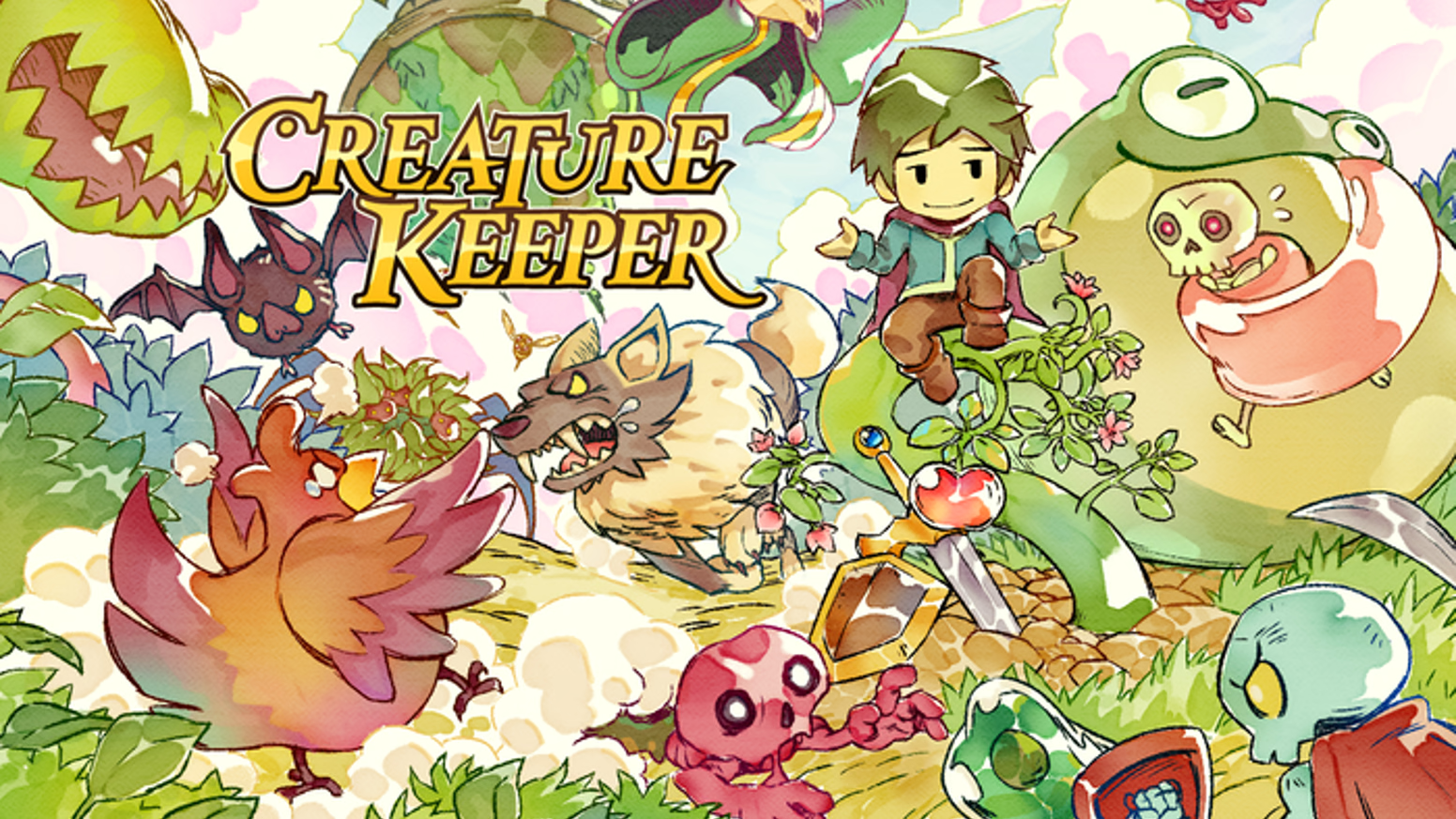
Alright, let’s forget I typed that and move on to the gameplay. It all revolves around the titular creatures. Cute little buggers, that range from giant toads, to big Venus fly traps, to giant, fluffy owls. Or zombies, I guess. Anyway, shove enough berries down their throats and they’ll join you. You can then summon them to help you in battle. Fights play out in a Zelda-esque way, where you madly swing at enemies, with the added bonus of your creatures getting a few good hits in.

Creature Keeper

Falling Apart

Problem is, Creature Keeper struggles to make the most of this potential. The gimmick of setting creatures on your enemies requires a few things, but the biggest is sensible AI. Creature Keeper‘s is a bit… dense. When creatures aren’t just getting stuck, they’re wandering off or only attacking once in a blue moon, even when commanded to. When things go right, clearing a room does feel satisfying. But roughly 75 percent of the time, I did the heavy lifting while I waited for them to get the message. Though it’s balanced out by the other issue: Creature Keeper is way too easy.

The basic boomerang weapon can stun all enemies, and your fists punch as fast as you can tap. So there wasn’t much reason to use anything else. It’s the first in a rather big list of strange issues with Creature Keeper. Creatures level up through battle, for example, and can unlock perks. These are buried in menus and come with an intense drawback in addition to a positive. So I just didn’t use them. It’s also pretty buggy. In addition to graphical glitches, I had to repeat the final level three times. At one point, people start repeating their very first lines of dialogue to me. Thought I’d gone back in time for a second.

Another, somewhat bigger, issue is that Creature Keeper‘s world feels a touch bare. There are a few sidequests throughout, but the vast majority of the world is just elongated dungeons full of the already threadbare combat. What characters we do have are quite interesting, like a old keeper whose mind’s been addled by a strange fruit, but Creature Keeper needed a little bit more reason to poke around in the corners, beyond more weapons to clutter up the bottom of my bag. It also has a big world, but no real world map outside of fast travel, which I’m pretty sure is some form of sin.

Creature Keeper

Creature Keeper – Promising, But Loosely Held Together

Still, there are points where Creature Keeper hits on good ideas. The bestiary, for instance, is cleverly done. You gain bestiary points for capturing and training creatures, which can improve your stats and make it easier to fight them in the future. All the creatures have a little lore snippet too, which is a big plus in my book. It also had promise in its garden mechanic, where you plant seeds to give your creatures bonuses. Somewhat undercut by the lack of difficulty, but a nice idea. Coupled with the light-hearted dialogue and quite lovely pixel art and animation, it makes Creature Keeper hard to dislike.

My final feeling towards Creature Keeper is that it had a good idea at its core – throwing creatures at each other is rarely a bad idea in video games – but the end result feels held together with string. Even excluding the general bugginess, the wildly unbalanced and somewhat repetitive combat that makes up most of the game feels quite frustrating. Throwing a giant, fluffy owl at enemies should be a wonderful experience. Creature Keeper tries its best to hold things together, but I can’t shake the feeling that it’s all fallen apart by the end.

(Creature Keeper‘s Steam Page)

Review: The Precinct

The Precinct is a nod to 90s/80s cop movies. Moreover, it has an early GTA edge that is brilliantly nostalgic. The blend of gritty drama and sandbox action is wonderfully captivating. Furthermore, a pleasant, albeit easy-to-climb skill tree ensures that you improve at a comfortable rate.

This sandbox police simulation was developed by Fallen Tree Games and published by Kwalee. It is an isometric single-player game with a free-flowing camera. Additionally, you can pound the streets, fly helicopters, and tackle criminals from an array of official vehicles. If this isn’t enough, you can relieve the public of their ride as you chase thugs, gangsters, and other low life scum.

The Precinct is gritty, grim, and brilliantly addictive. 

The 80s were an amazing decade. The music is fantastic, the clothes are eye-catching, and the world is evolving. However, where there are opportunities, there are criminals wishing to take advantage. This is exactly what happens in The Precinct! A rookie cop loses his heroic dad in a mysterious crime. His father was a much-loved police officer, and you must fill his shoes and walk his beat.

You control officer Nick Cordell Jr. This rookie cop is fresh out of the academy, but this matters not. He has his dad’s street smarts and a desire to do good. The local criminals of Averno have their work cut out for them. Armed with a sidearm and a desire for the truth, this rookie cop will arrest anyone who breaks the law.

Get your cop fill. 

Exploring a dark and crime-filled world is fascinating. The Precinct gets the balance just right. Its day/night cycle and dynamic weather add drama and intrigue to every shift. What’s more, there are plenty of tasks to enjoy during every shift. Whether you are ticketing cars, stopping vandals, preventing robberies, or punishing littering idiots, your day is never quiet.

You are free to take on any callout that comes your way. Moreover, you can call for backup if things get out of hand. Riot vans, roadblocks, helicopter units, ground cops, and more come to your assistance. This support isn’t free, though. You must execute a perfect chase to earn credits to call in reinforcements. 

This approach was great as it prevents you from jumping to incorrect decisions. Maybe you want to chase a car until it makes a mistake. Alternatively, you may be allowed to use lethal force and shoot their tyres or kill them as they escape. Either way, you must make the tough calls. 

The Precinct looks great. 

The sprawling city expands as you increase your police rank. This opens up different areas filled with new crimes. Additionally, it adds fun side quests such as racing, jumps, and other events to your shift. As the world expands, it makes chasing criminals much harder. They can cross bridges, enter new areas, and increase the risk of failure. 

The isometric viewpoint was a great choice. Exploring the winding streets could have been a nightmare, but the free-flowing camera makes it a joy to explore. Furthermore, there were no frame rate issues, and I encountered minimal bugs and issues. The gritty colour palette enhances the seedy atmosphere, and I love the character models and each vehicle. 

The audio is dramatic and exciting. Each car engine is loud, and the police siren screams as you give chase. There are some nice ambient sounds, and I loved the thunder and lightning. The result is an energetic game with a tough but fun edge.

The controls are questionable. 

The Precinct was surprisingly easy to play. Though the controls are occasionally questionable, the UI is excellent. Selecting new weapons, requesting backup, or a fresh car is a cinch. However, driving the car at speed can be tough, and the shooting mechanics take some getting used to. Once you nail each element, you’ll adore tackling each criminal and becoming a renowned police officer. 

The core story revolves around gang activity and finding evidence. Once you plough through this, you are left with an enjoyable sandbox mode. Though this may not appeal to everyone, I liked pounding the streets and trying new tactics. Moreover, the roster of vehicles and arsenal of guns keeps things fresh. 

The Precinct is a great indie game. 

I’ve been waiting for this since EGX a few years ago. It has evolved nicely, and the overall concept is fantastic. I’d love to see the developer add some online action, but I don’t think this will happen. As such, I’ll have to enjoy my solo patrols and taking down every scumbag on my own. The Precinct is a great indie game, and I recommend buying it here! Can you avenge your father and find the truth? Bust the gangs, pound the streets, and uphold the law.

Review: Moonshadow V2 keyboard

I’ve reviewed many great keyboards. DROP, Epomaker, SteelSeries, Mechlands, and more have crossed my desk. Thankfully, I can now add KiiBOOM to that list. The Moonshadow V2 keyboard is a special peripheral that looks and feels great. Moreover, it is versatile as the switches are hot-swappable, and it has tri-mode connectivity.

This user-friendly design eliminates the need for soldering. Furthermore, you can use this keyboard on the move if you so wish. I’d advise against this, however, as it weighs around 1.6 kg. Now, this isn’t massively heavy, but there are lighter alternatives that may be better suited to commuters. If you love to play wirelessly, you’ll enjoy responsive polling rates. These drop when using Bluetooth, so I’d stick to the USB dongle for the best performance. 

What’s in the box of the Moonshadow V2 keyboard?

  • The packaging is alluring and strong. The contents are well protected, and it can be recycled. 
  • The Moonshadow V2 keyboard comes in 3 colourways. I picked the silver option, but pink and monochromatic liveries are available.
  • Remove the keycaps with the pulling tool. 
  • Charge the device with the braided USB-C to USB-A cable. 
  • Learn the basics with the user manual. 

Technical aspects. 

The Moonshadow V2 keyboard is perfect for gamers and office workers. Though I don’t believe it is ideal for commuting, it can be used with your phone, tablet, or any compatible Bluetooth device. The 1000 Hz polling rate is fantastic. If you opt for a Bluetooth connection, this drops to 125 Hz. This is still impressive, but is best suited for office tasks. Accordingly, wired and USB connectivity are advised. 

This keyboard comes with KiiBOOM’s Flick Switch. This linear switch is comfortable to use and complements the cherry profile keycaps. The actuation distance is superb, and I enjoyed typing and gaming with this semi-compact device. The NKRO feature is particularly impressive. During the heat of battle, I appreciated the lack of ghosting. This delivers a match-winning edge and is ideal for racing and FPS titles.

I tend to play wired as I can forget about battery life and charging. However, if you hate wires, you’ll enjoy 4000 mAh battery life. This was good as the keyboard lasted for hours before running out of juice. If you do run low, you can turn off the RGB or take advantage of the quick charging facilities.

Usability. 

Unlike other keyboards, this one focuses on a user-friendly approach. The hot-swappable switches are suitable for any 3 or 5-pin options. This is ideal if you have a favourite style and wish to create the perfect keyboard. The same applies to the cherry profile keycaps. These can be swapped with any compatible alternatives.

I rarely customise my inputs. I’m happy with a standard set-up and don’t require macros for the games I play. However, if you love MMOs or certain survival/FPS games, you’ll be keen to use VIA or QMK to map your inputs. Luckily, this device is compatible and allows you to change practically every aspect with ease.

Build quality. 

The 6063 aluminium case is wonderfully substantial. The silver anodised colourway is great to look at. Additionally, the south-facing RGB delivers a range of vibrant and soft colour hues. The mixture of grey and baby blue keycaps looks amazing, and the 5-sided dye-sub PBT finish ensures longevity and a reduction in shiny wear and tear.

This 75% layout has 81 keys and is the perfect starting point if you are moving to a smaller keyboard. The Moonshadow V2 keyboard has every essential key without requiring macros or FN input.

The gasket structure and sound-improving materials create a beautiful soundscape and lush typing experience. You enjoy that rich clack of a mechanical input during every stroke. Yet, it is not overbearing. Furthermore, the gasket-mounted structure has a nice spongy feeling that reduces fatigue as you type.

Is the Moonshadow V2 keyboard worth it?

I love affordable keyboards, but if you wish to up the ante and look at a premium device, this should pique your interest. Every aspect is fantastic, and I adored the usability and build quality. Moreover, the RGB and VIA programmable features will appeal to a large array of gamers. Accordingly, this is an amazing device and I recommend buying it here!

(More information on KiiBOOM can be found here!)

The Moonshadow V2 keyboard has been awarded the Movies Games and Tech Gold Award.

(Full disclosure! A sample was provided for an unbiased and free review!)