Review: ReSetna

0

​ReSetna is a metroidvania game that, upon initial play, may not immediately distinguish itself within the genre. Its early stages present a setting that feels somewhat uninspired, lacking the unique flair that sets certain titles apart. However, as the journey progresses, the game reveals layers of depth and enjoyment, particularly in its movement mechanics. The fluidity of character control transforms backtracking—a common and sometimes tedious element in metroidvania games—into an engaging and pleasurable experience.​

Combat, does it stand out?

Combat in ReSetna, while functional, doesn’t particularly stand out. Throughout the game, players unlock three weapons that can be switched between freely. Despite a commendable variety of enemies, I found myself predominantly relying on the third weapon once it became available. This choice was influenced by its effectiveness and versatility compared to the other options. The game’s bosses present a mixed bag; some encounters are genuinely enjoyable, featuring unique mechanics that require thoughtful strategies, while others fall into predictability, repeating the same attack patterns and reducing the challenge to a monotonous rhythm.​

An additional combat feature is the companion robot capable of hacking enemies, essentially serving as the game’s spell system. Regrettably, I often overlooked this mechanic, finding it non-essential to my overall strategy. On the other hand, the upgrade system stands out with its expandable grid where players slot in newly acquired upgrades in a Tetris-like fashion. This design encourages thoughtful consideration of which upgrades to prioritize, balancing spatial constraints and potential synergies by aligning similarly coloured links.​

A world you’d want to learn about

As the game world opens up, it becomes increasingly captivating. The story told through logs and collectibles found across the world, is fascinating. The player can learn more about the inhabitants and uncover mysteries surrounding not only the player, But also those around you. All this while traversing diverse environments, from sterile concrete corridors to hazardous sewers and vibrant electronic areas. With great visual and exploratory richness to the experience. Each locale offers distinct challenges and aesthetics, contributing to a more immersive journey.​

However, the latter stages introduce elements that detract from the overall enjoyment. A particularly frustrating platforming section demands either exceptional reaction speed or a trial-and-error approach, leading to potential player fatigue. Compounding this is a chase sequence that, due to a bug, resulted in the boss spawning ahead of me, undermining the intended tension and excitement of the pursuit.​

Where it went wrong for me

The endgame’s difficulty curve also presents issues. Rather than offering challenges that require increased skill or strategic adaptation, the game resorts to overwhelming players with sheer adversity. The initial boss fight in this segment, for example, inundates a confined space with relentless attacks, shifting the focus from tactical engagement to a test of endurance and resource management. This approach, coupled with persistent bugs—such as getting stuck on enemies after executing a jump dash at certain angles—diminishes the satisfaction of overcoming these obstacles.​

Despite these setbacks, it’s worth acknowledging the developers’ commitment to addressing community feedback and implementing bug fixes. While some technical issues persist, the proactive approach to improving the game reflects a dedication to enhancing the player experience.​

Should you play it?

ReSetna offers a journey that evolves from initial mediocrity to moments of genuine enjoyment, particularly through its fluid movement and inventive upgrade system. However, frustrating late-game design choices, and technical shortcomings prevent it from achieving greatness within the metroidvania genre. For players willing to navigate these challenges, ReSetna provides glimpses of brilliance amidst its flaws.

Review: Edifier NeoDots

Here is our review of the Edifier NeoDots.

Features

  • Premium sound with Hi-Res Audio Wireless certification.
  • Hybrid driver units (BA and 10mm dynamic drivers), combined with digital signal processing and active crossover, deliver superior sound quality.
  • Advanced noise cancelling technology extends the noise cancellation depth to -48dB.
  • Battery life lasts up to 56 hours with the charging case, and fast charging is available—15 minutes of charging provides 5 hours of playback.
  • AI algorithm and beamforming microphones pick up voices clearly and accurately for hands-free calls.
  • Supports multipoint connection, allowing instant switching between music, videos, and calls on two different devices simultaneously.
  • 80ms low-latency audio in gaming mode.
  • Customized EQ and more controls are available via the EDIFIER ConneX app.

Specifications

What’s in the box?

The box contains the earbuds, case, spare ear tips, charging cable and instructions.

A Closer Look

Final Thoughts

The earbuds are comfortable to wear, even for extended periods of time and when not in use they can easily slip into your pocket.

Using the earbuds to make and receive phone calls is easy too – the quality of the mic is excellent – there are 6 microphones, in noisy environments, the AI algorithm will automatically match the noise reduction level based on the noise level, accurately separate environmental noise and human voice, intelligently denoise environmental noise to preserve a clear and clean human voice, significantly improving speech quality. Even in noisy situations, the call effect is always clear and transparent.

It supports LDAC high-definition decoding for Hi-Res Wireless audio, with a transfer rate of 990 kbps, delivering three times the music detail compared to standard Bluetooth codecs.

Block out the world with advanced noise cancelling technology that reduces noise by up to -48dB, ensuring an immersive and uninterrupted listening experience.

The earbuds can be paired with two separate devices at the same time, so you can be listening to something on one device and take a call on another, all seamlessly!

The battery life is excellent, lasting around 56 hours when used with the charging case, whilst a 15-minutes fast charge will give you 5 hours of playback time if you are in a rush. You can even charge the charging case using wireless charging.

The earbuds are IP55-rated dust and splash proof, allowing you to enjoy music without worrying about the sweat in exercise.

You can also use the Edifier ConneX App to customise control settings, explore rich and practical functions and discover more music possibilities – definitely take a look at it as it can really personalise the experience for you.

The Edifier NeoDots are available now priced around £119.99 and are available in either Black or White.

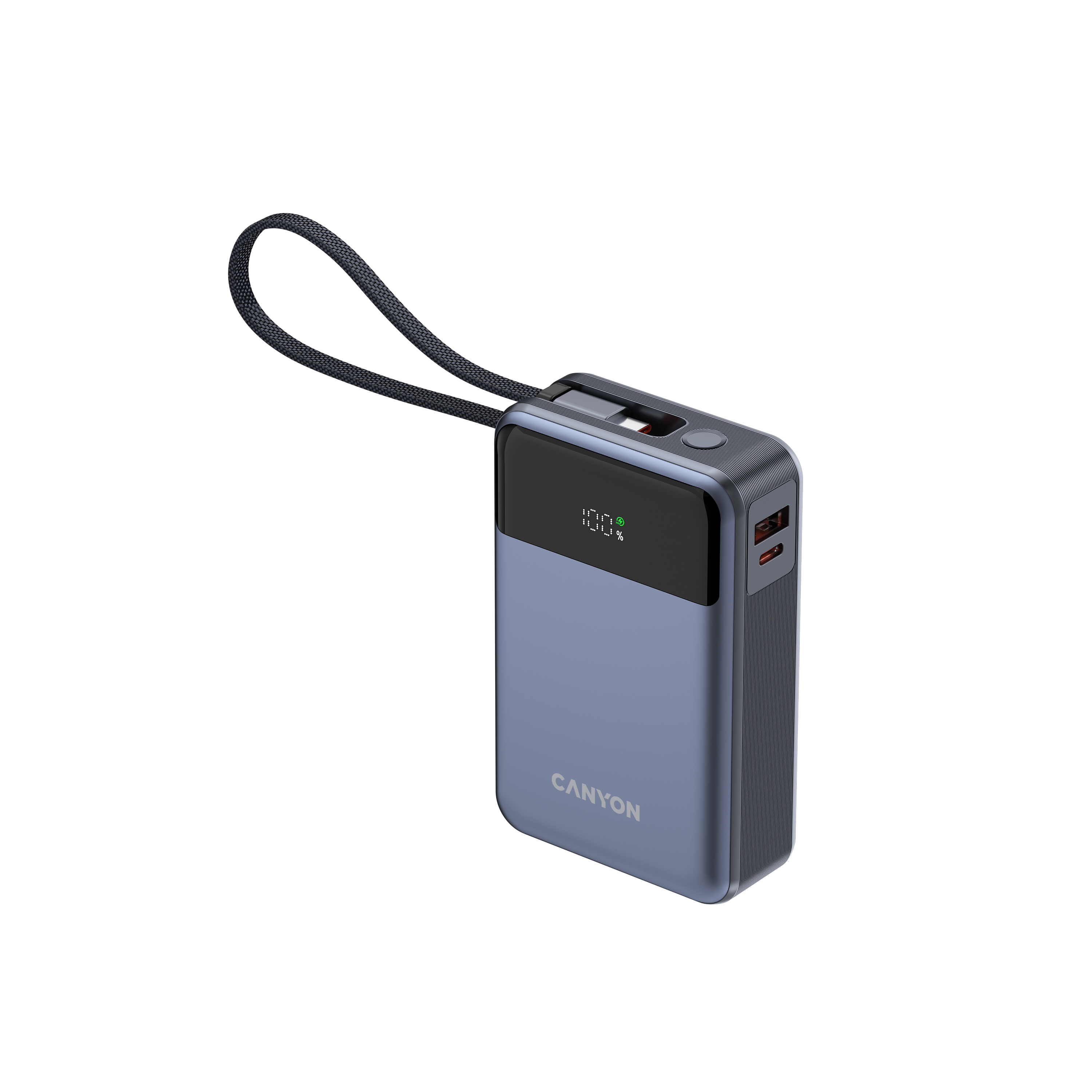
Canyon Launches Power Bank Onpower 600

0

This device will power up all your devices on the go, letting you enjoy uninterrupted productivity (or relaxation, it’s up to you) whenever you need it.

With a massive 20,000mAh capacity, the OnPower 600 will keep your devices charged for days.
It doesn’t really matter what your goals are: digital nomads, frequent travellers, or simply those who can’t afford downtime equally enjoy the benefits of the On Power 600, staying connected at all times.

The power bank’s built-in 65W cable delivers lightning-fast charging, which cuts down your charging time significantly.

For you, this means less time waiting and more time doing what you love. The sleek, compact design also makes this device the perfect travel companion. Slip it into your bag or pocket and take it anywhere you go.

Its durable, fireproof construction will keep your mind at peace, while the clear power display will make sure you stay informed.

Imagine powering through a long flight, a camping trip, or a busy workday without a single thought about a low battery.

The OnPower 600 makes this a reality. We like to call it a statement of independence. So, no more missed calls, interrupted video conferences, or drained devices.

With the OnPower 600, you’re always in control. It’s the ultimate power solution for the modern lifestyle.

. PD 65W Fast charge
. Built-in Type C cable

. Power Display
. 20,000mAh capacity

. Power Output
. 1 (USB Type-A)
. Power In/Out
. 1 (USB Type C)
. Very compact and Airline-Friendly Power For Your Travels

https://www.ryman.co.uk/canyon-power-bank-onpower-600-built-in-cable-20000-mah-pd65w-dark-grey-1

Review: Inayah – Life after Gods

Developed by ExoGenesis Studios and published by Headup, Inayah—Life after Gods is a 2D Metroidvania with beautifully crafted animation.

A game could have a million errors, but if it can get just one thing really right, it has the chance of being regarded as a great game. My feelings for Inayah—Life after Gods—are exactly that. 

This is one cliche-filled cookie-cutter game, but I still want to go back and play it again. I want to explore more and know more. It’s all down to one thing: The upgrade tree. 

Controversially Good

Close your eyes and imagine a Metroidvania with a white female protagonist. Unless you’re picturing a dancing monkey with dysentery, you may have already mapped out the entire game of Inayah.

It is just that simple. You jump, you strike, and you collect stuff. Nothing to add, nothing to change. 

Let’s move to the real star of the show.

The upgrade tree(s) of Inayah caught my attention early on. 

Here’s how they work: 

You kill enemies, and that gets you points. With those points, you buy upgrades. That’s it!

What’s so special?

The size!

There are a lot, and I mean a lot, of upgrades available. These go from slight attack upgrades to completely game-changing moves and powers. Combined with a total of 3 very different weapons, there is an insane amount of upgrades at your disposal. 

Above all that, getting money in this Inayah is very fast and easy; ergo, getting the upgrades is not a waiting affair. You will be making an upgrade at least once every three minutes. 

This is a type of gameplay I never knew could be enjoyable. But after my hours with Inayah: Life after Gods, I can safely say that it is a very unique and fun way to play a game.

Such a shame the plot could not hold up its side of the duties.

Cliché Sensei Revenge Plot

The story is as basic as it gets: an orphan girl, Inayah, whose father was killed when she was young, is raised by an old man—think of the archetypical “sensei” figure. Early in the game, this mentor is killed by a supernatural evil being, setting Inayah off on a quest for revenge. 

There’s nothing about this plot that feels fresh or exciting; it’s a well-worn path that many games, movies and stories have walked before. The narrative is functional, but it lacks the depth and innovation that could have made it stand out.

Inayah is A Fun Experience

Inayah – Life after Gods is a game that lives and dies by its mechanics. While the story is undeniably cliché and offers little in terms of originality, the gameplay delivers a surprisingly addictive experience. 

The sheer volume of upgrades available to the player creates a compelling loop of progression and rewards, making every moment of combat feel purposeful and satisfying. The world may feel familiar, and the plot may lack depth, but the fast-paced, constantly evolving nature of the upgrade system keeps you coming back for more.

Inayah – Life after Gods proves that sometimes, all it takes is one strong gameplay element to elevate a game above its flaws. 

If you’re someone who enjoys a Metroidvania with plenty of room for exploration and experimentation, then this game will likely be a satisfying ride, even if it doesn’t break any storytelling conventions. 

For all its predictability in terms of plot, Inayah – Life after Gods is still a fun, engaging title that proves gameplay can often make up for what the story lacks. Whether you’re in it for the upgrades or the challenge, there’s something undeniably addictive about this game that will keep you hooked long after the credits roll.

Review: Luck be a Landlord

0

Gamblers unite! Luck be a Landlord is a quirky little game where you must play slot machines to pay your rent. With a catchy soundtrack and nice art there’s plenty of enjoyment to be had, especially if you’re a fan of hit games like Balatro. Luck be a Landlord may not hit the same quality and depth of a Balatro, but it is fun in its own right.

Get Lucky or Get Evicted

it’s a simple premise in Luck be a Landlord. You’re a tenant, they’re a landlord, and they assume you enjoy having a roof over your head and would do anything to keep it that way. What is the logical solution to said problem? Easy, to gamble and hope you don’t go broke of course! Obviously not ideal or recommended in real life, but in Luck be a Landlord, it’s status quo.

A quirky concept sure, but in an age of hit games such as Balatro becoming an indie darling overnight, there’s a serious market for these gambler sim-like games.

Luck, Gambling, Gameplay

The Gameplay in Luck be a Landlord is very simple. Your landlord emails you letting you know your rent is due in 5 days with a cost of 25 gold coins. He then informs you there is a slot machine in your apartment that you can use to pay your rent. Oh that sly devil.

The slot machine is where the gameplay happens. Five columns, four spots each column. As you start out you have one symbol in each column giving you one gold coin per spin. After each spin you will have a choice of three different items to add. Whether it be a symbol or a perk which is auto-equipped outside of the slot machine, giving various buffs.


It’s a simple concept but you’ll have to keep adding to your slot machine and racking up those coins if you prefer not getting evicted. I do appreciate that there is some complexity here. There’s enough strategy with the way symbols interact with each other to give you hours of play time.

For instance, if you have a kitten symbol and a milk bottle symbol and those two line up adjacent to each other, the milk will be destroyed and you’ll be given 20 coins. But with the milk being destroyed you’ll have to hope you can find another. Otherwise the kitten will usually just give a few coins per spin. Little things like that.

Lucky Conclusion

Luck be a Landlord is exactly what it is trying to be. It knows the style of game it’s mimicking and it does a good job at that. No, it probably won’t find its way onto your game of the year list, but it’s not trying to.

Luck be a Landlord is trying to be a fun game you can sit back and enjoy. There’s complexities to make it deeper, there’s a groovy soundtrack, and there’s cute sprite art.

I didn’t experience many problems during my time with the game although I believe the menus are a real problem. Felt like most of the time it wasn’t responsive when navigating which symbol I wanted to choose after every round. It was a consistent issue that possibly only affects console which is where I played the game.

Nevertheless, whenever I’m bored and looking to pass the time, I’ll probably turn on Luck be a Landlord and kick back. In an age where every game is trying to get thousand of hours out of you, I find myself appreciating experiences like this even more.

Review: Illusion of L’Phalcia

Another day and another KEMCO RPG to review. This isn’t a complaint, as I love the genre, but the one-shoe-fits-all approach from the dev and publisher makes it difficult to decipher between titles. However, here we are as I take a look at Illusion of L’Phalcia. This old-school experience is much tougher than my previously reviewed RPGs. There is a sense of strategy and tactics and a balls to the wall mindset will lead you up shit creak without a paddle. Accordingly, be cautious and mindful if you wish to be successful.

This retro RPG was developed by EXE-CREATE and published by KEMCO. It is a single-player title where a talking cat and a bunch of would-be heroes band together to complete an epic quest. Much of the action is familiar, and lovers of the genre will feel right at home. However, unlike Sephirothic Stories or Frane: Dragons’ Odyssey, this will kick your ass repeatedly. Consequently, if you want an easier time, I suggest trying either of those titles first.

Illusion of L’Phalcia tells a grand tale.

Despite the weirdness of a talking cat, Illusion of L’Phalcia tells a grand tale that is captivating, absurd, and great to observe. There is nothing better than a legendary treasure and a journey thwart with danger. This is exactly what happens in this RPG. The Sword of Amal will grant any wish. As such, Ryser and his companion Cougar (the talking leopard) must team up with random individuals if they wish to complete their adventure. En route, the band of heroes must slay endless monsters and explore dangerous dungeons.

The story is well-trodden, and the genre tropes will feel comfortable for veteran gamers. Yet, this doesn’t mean it lacks originality. Magic, fighting, runes, and a host of strange creatures keep you hooked as you complete every side quest. Moreover, the fun but occasionally useless NPCs add a layer of distinct old-school energy.

Mastering runes.

Though Illusion of L’Phalcia has many dated quirks, I loved the rune system. You can equip any rune to any character as long as it fits the rune area. Lower-level characters have a smaller space, and higher-level characters have more room. Subsequently, the higher your level, the more power you have. This was a key mechanic as your character progression focuses on the runes you use and the effect this has on your character role. 

Do you push for all-out melee or go for a magical build? Either way, you must make your mind up early as this gives the best chance of building a successful party. Alongside the runes, you’ll enjoy classic turn-based combat. The random encounters come in thick and fast, and you’ll need to maximise the potential of your team if you are to complete your quest.

Illusion of L’Phalcia blends 2 viewpoints.

Visually, Illusion of L’Phalcia has a nice dated appeal. The sharp colours and pixelated ways are distinctly old-school. Each village and dungeon has a rudimentary design that feels limited and small. However, they are deceptively big, and exploration was a joy. This isometric viewpoint changes when you enter any combat arena. The 3D battles and wonderful cutscenes were pleasant to look at. Though the colours are a little “in your face”, I loved the feeling of nostalgia.

The audio is as loud and aggressive as other games from the developer. The simple soundtrack is borderline obnoxious but great to listen to. Moreover, the sound effects are tough to escape, and this makes this a particularly noisy RPG. Where it excels, however, is the blend of Japanese voice-over work and written dialogue. I loved the authentic feel as it added energy to each interaction.

Enjoy the overworld in Illusion of L'Phalcia.

Sluggish controls.

A basic control system isn’t a bad thing per se. Unfortunately, Illusion of L’Phalcia has a few issues where navigation can be challenging. The hero hits invisible walls, and this makes moving through tight spaces tough. However, the well-explained controls and the simple-to-understand combat overcomes these issues.

I’m not sure that I’ll return to play this once I’ve finished it. I’m around 85% of the way through, and I’m enjoying getting to the conclusion. I could approach the core story with a different mix of heroes if I wanted. This was great as it enhances replay value and changes your tactics and strategies. However, I’m not that keen on it, and I probably won’t get enough out of a second playthrough.

Illusion of L’Phalcia is a good RPG.

Despite not wanting to play it again, Illusion of L’Phalcia is a good RPG. I liked creating my style of heroes and the challenging gameplay. Furthermore, the blend of 3D and isometric viewpoints was amazing. Though this is old-school in its approach, it has enough modern elements to keep everyone happy. I like it and I recommend buying it here! Can you complete your quest and find the sword? Pick your style, choose your strategy, and bring that sword home.

Let’s look at: Neon Abyss 2

0

Developed by Veewo Games and published by Team17 Digital Ltd., “Neon Abyss” is a frantic roguelike action-platformer where players run and gun their way into the Abyss as part of Hades’ ‘Grim Squad.’ The game features unlimited item synergies and a unique dungeon evolution system, ensuring each run diversifies the experience and every choice alters the ruleset. It has received very positive reviews from users.

Only a playtest and already promising

Neon Abyss 2 takes everything that made the original game fun and cranks it up a notch. It’s more of the same, but better in almost every way. From visuals to mechanics, the game has seen a significant upgrade while still retaining its core identity as a chaotic, fast-paced roguelike shooter.

I have spent over 15 hours with the single player playtest that was available at the time of writing (27.03.2025). I have played a fair bit of the first game and jumped into the playtest expecting only a few stages and some weapons with repeating enemies. But I was very pleasantly surprised to fight through 5 stages with 5 unique bosses and a lot of enemy variety. Of course this is as mentioned only a playtest and with the game not having a release date yet anything is subject to change. But so far I am very excited.

What we have so far

One of the most noticeable improvements is the graphics. While the game still keeps its pixelated art style, the visuals have become much smoother and more detailed. Character animations, weapon effects, and enemy designs all feel more refined, giving the game a fresh, polished look. The environments have also been improved, with each stage featuring distinct themes that make them feel more unique. In the original game, going from stage to stage didn’t offer much for variety in scenery, but now, every area has a strong visual identity, making progression more exciting.

The gameplay has also seen some major refinements. The gunplay remains just as frantic and satisfying, but now with additional weapon types that add more variety. While the first game focused mostly on ranged weapons, Neon Abyss 2 introduces melee and magic weapons, completely changing how you approach combat. Whether you prefer slicing through enemies with a sword, blasting them with a high-tech rifle, or using magical abilities, the game offers a lot more choice in playstyle.

Another major improvement is the weapon upgrade system. In the original, players would often find weapons they didn’t want to use and just leave them behind. Now, every weapon has a purpose, as you can consume unwanted ones to upgrade your currently equipped weapon. This new system encourages exploration and experimentation, allowing players to power up their favorite guns instead of constantly swapping them out.

What to expect

Item management has also been improved. One of the most prominent aspects of the roguelikes is picking up an item without knowing what it does, sometimes leading to negative effects. In Neon Abyss 2, items now display their effects before you pick them up, giving players more control over their builds. Additionally, the game so far is doing away with items that hinder your character, making every pickup feel rewarding rather than a gamble. Now I know the appeal of learning the items and mastering the synergies run by run. But as someone that has limited time and so many games coming out all the time, I appreciate the change.

Overall, Neon Abyss 2 refines and expands upon its predecessor in all the right ways. With smoother gameplay, more diverse weapons, better visuals, and smarter item mechanics, it delivers an even more satisfying roguelike experience. If you enjoyed the first game, this sequel is absolutely worth diving into. I am looking forward to playing more of the game when its out.

Review: Ai Limit

AI Limit is an action RPG that wears its inspirations on its sleeve, borrowing heavily from the likes of Stellar Blade and Dark Souls. However, while it strives to deliver a challenging combat experience set in a grim, post-apocalyptic world, it ultimately falls short in both narrative and environmental execution.

Story and Worldbuilding: Familiar, But Weaker

If you’ve played Stellar Blade, you’ve already experienced AI Limit’s story—except, Stellar Blade does it better. The setup is painfully familiar: a protagonist thrown into an apocalyptic world with no memory or understanding of what came before, leaving the player to uncover the story alongside them. However, AI Limit fails to make this premise compelling. The main plot is a predictable, uninspired journey through a bleak world with little intrigue. There are some interesting story beats, but they come too infrequently to make much of an impact.

That said, the side characters and their associated quests do a much better job of holding the player’s attention. Unlike the lacklustre main narrative, these side quests feel meaningful, providing glimpses of humanity amidst the mechanical wasteland. I found myself more invested in these personal stories than anything the main plot had to offer. Those side characters are the fun unknown. The players gets tasked to lead a character to of pilgrims gatherings and it is the players choice. Is this a good idea? we know what will happen, but is this the good choice? Unfortunately we are then taken back into a plotline where our character knows nothing, has no personality and needs everything explained like a child.

World Design: Bleak, But Not in a Good Way

Apocalyptic settings can be captivating when done right—Nier: Automata or even Darksiders prove that the end of the world can be beautiful. AI Limit, unfortunately, does not reach those heights. The world is meant to be mechanical, war-torn, and oppressive, but rather than evoking awe or curiosity, it just comes off as unremarkable and uninspired. While writing this review it reminded me of how many games share the same setting and similar plot, and do it 100x better in the overall aesthetic.

The opening hours of the game are particularly egregious in this regard. You move from narrow sewers to narrow corridors, then to narrow scaffolding. It’s a repetitive and suffocating level design that does little to encourage exploration. While later areas do shake things up somewhat, I never felt compelled to stop and take in the world around me because, frankly, there was nothing worth looking at. I explored not out of curiosity but out of necessity—to find items and upgrades, not to marvel at the world.

Combat: A Saving Grace, But Not a Revelation

If AI Limit has one redeeming quality, it’s the combat. While it doesn’t revolutionize the genre, it does enough to keep things engaging and fun for a while.

The weapon variety is a highlight. Every weapon you find comes with a unique heavy charge and special ability, which makes trying out new gear exciting. This variety encourages experimentation, and I appreciated the sense of discovery that came with picking up something new and seeing how it changed my approach to fights. The player can carry two main weapons at a time and switching them mid combat will continue the combo.

As expected from a Soulslike, combat is centered around rolling, sprinting, and timing light and heavy attacks. The parry system is particularly notable—you can parry with any weapon, and nearly every attack in the game can be parried if you’re skilled (or brave) enough. This makes for some satisfying duels, though the mechanics themselves don’t bring anything new to the table. Quick note as well that enemies can be staggered but I failed to find out how exactly it works. Sometimes I could stun lock and enemy with dual blades without allowing them to attack, and then the exact same enemy down the corridor did not care one bit about my attacks. Yes heavier weapons stagger more often , but it was never consistent to the point where you could reliably account for it during a fight.

The game also offers a spell system, which I admittedly didn’t explore much due to my focus on an attack speed/ damage build. From the spells I did use, they seemed fairly unique and added an extra layer of tactical depth for those willing to experiment.

Final Thoughts

AI Limit is, at best, an okay Soulslike experience. The combat provides some enjoyable moments, especially when experimenting with different weapons, but the game is ultimately held back by its uninspired world and weak main story. If you’re a die-hard fan of the genre and are willing to overlook its shortcomings, you might find something to enjoy here. But for most players, AI Limit fails to stand out in a sea of better, and now cheaper alternatives.

Review: Lepro 01 AI Floor Lamp

The Lepro 01 AI Floor Lamp is a wonderful tool for tech-savvy people. This glorious piece of furniture adds colour and warmth to any room. Additionally, it is a real head-turner. If you want an icebreaker or a user-friendly item, this should be on your radar.

This easy-to-construct floor lamp is well-built, and the LED lighting can be adjusted for a soft glow or an overwhelming impact. Alternatively, you can program it to respond to your voice or the beat of a song. As such, this lamp will make you smile as you chat with your friends or listen to your favourite track.

What’s in the box of the Lepro 01 AI Floor Lamp?

  • The packaging is large and colourful. Moreover, around 65% can be recycled. This was disappointing, but the product is protected while in transit.
  • The Lepro 01 AI Floor Lamp has a smooth white livery. The elongated lamp has a translucent case and one tactile button. 
  • A handy starter guide talks you through the basics.

Technical aspects.

In theory, the Lepro 01 AI Floor Lamp is a straightforward device. After all, it is a lamp, and its job is to light a room. Thankfully, this one does that to an extremely high standard. Alongside this, it has some amazing programming options to impress your kids or your friends.

This 2.4 GHz Wi-Fi lamp has no remote. Consequently, you need a mobile phone that is capable of Bluetooth and Wi-Fi connectivity. If you do not have this, you will not be able to take advantage of every feature. Moreover, it is compatible with Alexa and Google Assistant. This allows the user to instruct basic voice commands. I found this aspect to be extremely responsive, and I was impressed whenever I used my Amazon speaker or my mobile phone.

This smart approach allows users to integrate the lamp with other Lepro lighting products. This creates a futuristic and user-friendly house where lights can be adjusted to your emotions, tasks, or the music you are listening to.

Build quality.

I was impressed with the weight and durability of the Lepro 01 AI Floor Lamp. The stand comprises 3 screwable pieces and a sturdy base. Each is made from metal and finished with a solid white livery. This clean and classic approach ensures that though it has a futuristic edge, it will not look out of place in a cottage or Victorian house.

The cabling is hidden within the stand tubing, and this prevents damage from occurring. On top of this, the one tactile button is small but easy to locate. If you don’t have your phone or Alexa device at hand, you may switch on the lamp or reset it with this individual input.

The lamp has 364 LEDs and can be dimmed using the free-to-download app. When turned to its maximum setting, it will comfortably light up a 25 m2 room. Alternatively, a low light is the perfect option if you want a night and reading light for your children.

Usability.

Where the Lepro 01 AI Floor Lamp excels is its usability. The handy app allows you to program every aspect of your lighting needs. First, you can match a product to any room you wish. This is great as you never get confused and adjust the wrong lamp. Second, you can program it to respond to your music or your emotions. Telling Alexa you are sad may seem weird, but the lighting will reflect your mood and create a sombre light show.

Finally, you can customise your settings to your heart’s content. Whether you wish to create a new pattern or adjust the movement of the light show, it is up to you. Some trial and error is essential, but once you get to grips with the fundamentals, you will master every Lepro product in no time.

Is the Lepro 01 AI Floor Lamp worth it?

A fully customisable AI lamp may not be on your radar. However, I urge you to upgrade your current arrangement and step into the future. This incredible brand has some funky and interesting products, and I hope to feature them all. The Lepro 01 AI Floor Lamp is truly fantastic. The dimmable and customisable lighting is perfect for every room. Additionally, the user-friendly app makes this a cinch to customise. Finally, the build quality is phenomenal. Accordingly, this is an amazing product, and I recommend buying it here!

(More information on Lepro can be found here!)

The Lepro 01 AI Floor Lamp has been awarded the Movies Games and Tech Gold Award.

(Full disclosure! A sample was provided for an unbiased and free review!)

News: Backbone One: Xbox Edition

Backbone is renowned for mobile gaming and its console collaborations. Consequently, streaming gamers have long enjoyed this sturdy, comfortable, and well-designed controller. Accordingly, I was excited when word of the latest edition hit my desk. 

The Backbone One: Xbox Edition is a modern controller with a retro aesthetic. Moreover, it has the authentic Xbox button and a glorious green finish. Everything about this controller screams premium device. The buttons look comfortable, and the USB-C-only connection is perfect for modern mobile devices. 

​The Backbone One: Xbox Edition.

Inspired by Xbox’s legacy, innovation and core identity, the Backbone One: Xbox Edition isn’t just another mobile controller – it’s an extension of Xbox itself. Gamers can tap into their favourite games with a press of the Xbox button. 

The new edition allows you to explore your favourite games with the precision, comfort, and reliability that Backbone is known to deliver. The device is complete with transparent Xbox green, a black PCB and the iconic Xbox button. 

Xbox and Backbone brought this product to life with a shared vision and commitment to innovation and accessibility as they continue to create new ways for players to experience Xbox games beyond the console.

(Available online only at launch from Backbone and Best Buy Drops for £109.99.)

Review: Spilled!

Spilled! is a short but relaxing endeavour. If you love to save the world and clean up toxic messes, this will be the game for you. The slow-paced gameplay and lack of danger won’t impress everyone. However, I enjoyed the change of pace and the comfortable world.

Lente developed and published this nautical environmental adventure. Moreover, it is a single-player game that uses an isometric viewpoint. This was a great choice as it helps you to find every last bit of plastic and oil. Additionally, navigating some of the tight areas can be challenging, and the camera alleviates some of the pain.

Spilled! allows the action to do the talking.

The game doesn’t focus on a central plot. Instead, the linear action allows you to do as you wish. There are fires to extinguish and snow to form. What’s more, some animals need your help. As you sail across each of the 8 areas, you will find stranded animals in the oil. Your task is to suck up that mess and rescue that beast.

Alongside this, you must take plastic waste to the recycling centre. Now, this may seem like a big ask, but you get paid for every item you collect. This money can be invested in your ship to help you hold more oil, speed up your rig, or increase the catchment size of your hoover. 

Simple gameplay.

Whatever improvements you make will not alter Spilled’s! core gameplay loop. Each stage has a set amount of oil and plastic to collect. Furthermore, there are a few side quests where you must push an item to a certain area. None of these tasks will test you, and that improves the relaxed experience.

Spilled! has a pleasant pixelated look.

Spilled! may be a simple game, but visually, it has some nice tricks up its sleeve. This pixelated game has a pleasant colour palette, and the ocean changes from a murky brown to a crisp blue once you’ve completed your cleanup. This was great to look at, and I liked the clear visual markers. 

The calm soundtrack enhances the relaxed and laid-back nature of the game. The gentle piano music adds a sense of magic as you move through each toxic arena. Moreover, the simple sound effects do not overpower the pleasant music, and this was a great design choice.

Simple controls.

I played Spilled! with a gamepad, and this made it really easy to master. Additionally, every new element was well explained, and the visual clues ensured that you never struggled. Though the boat steering was a little strange at first, you quickly get used to its quirky ways.

1 hour of gameplay wasn’t enough! I wanted Spilled! to keep going, but it didn’t. This was unfortunate, but I loved every minute that I played. I’m hoping that the solo developer adds more content to enhance replay value and longevity.

Spilled! is a great indie game.

Despite its short playtime, I think that Spilled! is a great indie title. It sets out its stall very early and doesn’t change its course. The simple gameplay and relaxed aesthetic will not please everyone, but I adored its approach. Accordingly, I think this should be in your library, and I recommend buying it here! Can you clean every drop of oil? Help the animals, suck up the oil, and get rid of the recycling.

Review: SONOKUNI

SONOKUNI makes me feel very old. Its blurb proudly displays the word ‘biopunk’. I thought I knew all of the words that preceded ‘punk’. Back in my day, it used to be Cyber or Steam. Maybe Frost if we wanted to push the boat out. Turns out that Biopunk is based around the idea of fiddling with biology. What happens when we mess with our DNA, rather than just jamming technology into our brains. I’m all about that. Add in a dose of Japanese myth and we’re in for a good time.

Though SONOKUNI‘s blend of elements does become quite a brain-melting experience. It’s a kaleidoscope of colours, all blending together. A sensory overload, even before it starts rapping at you in Japanese. Another thing that made me feel old. This chaos is bolted onto an equally frantic combat system, which is quite good fun. SONOKUNI is quite the experience, though its love of chaos does drag it down sometimes.

Sonokuni

Pruning The Invaders

SONOKUNI‘s core theme is all about assimilation. The titular Sonokuni is the name for a tribe of humans. They’re an ancient people, steeped in tradition, but some among them have been looking outwards. What they’re looking at is the people of Wanokuni, a race of… things. All we can see are mini trees, with their bodies swathed in bandages like a giant egg. Anyway, they want Sonokuni to join them. Only, to join Wanokuni you need to become like them. As in, physically. They’re all identical. The rub, then, is that the Sonokuni may survive but lose everything that makes them, them. There are debates on identity, tradition, and the soul.

It’s good stuff. This assimilation is opposed by Takeru, a Sonokuni assassin, who decides to try and genocide the entire Wanokuni race. The combat, then. It’s simple, in theory. Takeru can take only one hit, but can attack all around her, and can shield and deflect projectiles. If that’s not enough, she can also slowdown time. Fights are segmented into small arenas, with the understanding that you’ve gotta murder everything to escape. It’s good fun, and rewards strategic thinking. Crucially, you respawn very quickly after death so you can keep throwing yourself into it as many times as it takes.

Sonokuni

Dice To The Beat

SONOKUNI‘s combat is at its best in small pockets. When you can formulate a quick strategy on the fly. Deflect, shield, strike, win. It’s fun. Cracks only start to appear when it goes on for longer. For one, it seems strangely inconsistent as to how long a swing goes on for. Sometimes I can deflect a whole room, other times only a couple of shots. The boss fights are the biggest offense. They feel brought in from another game, one with movement abilities. One of them is a giant, swirling laser, which fires projectiles. The one-hit-kill element begins to grate here, when you’re forced to dance to the boss’ tune. Even the final boss is just a constant spawn of enemies, with sparse checkpoints.

Still, the absolutely chaotic visuals are a treat for the eyeballs. It’s like looking at a wall that’s been used by a succession of graffiti artists. Everything’s bright, colourful and all smashed together. It does make it a little hard to tell which enemy is which at times, though. That, and figuring out where to go. Soundtrack-wise, I’m a little divided. I suspect it’s down to personal taste, but it wasn’t the kind of driving, intense music that the combat demanded to me. The songs did worm themselves into my head, but it was only after I stopped playing SONOKUNI that they stuck with me.

Sonokuni

Sonokuni – Chaotic To A Fault

If you’re with SONOKUNI for the plot, then you’ll be happy. I was quite impressed. Takeru has conversations with both Sonokuni and Wanokuni citizens, and even wavers on her viewpoints. Granted, she has two ‘Gods’ in her brain who are pushing and pulling her, but she felt distinctly human. Wanokuni made reasonable points, and she made good points about the preservation of the soul. The ending felt a touch disappointing, but I enjoyed the ride. If you’re not here for the story, then there’s a speed run mode that stitches together all the combat for you.

You can probably write off some of this review as basic personal taste. If you’re a fan of Japanese hip hop then you’ll likely rate it higher. Personally, I’m more fond of the music in games like Hotline Miami or Deadbolt. Of the gripes raised, only the boss fights are big enough to really cause problems. They disrupt the pace, and caused stress instead of manic enjoyment. Still, if you can get past them then you’ll find a game that’s dripping in biological chaos, which is wrapped about a very human core.

(SONOKUNI’s Steam Page)

Review: Naga 60 Soundbar

0

The Naga 60 Soundbar from Majority Audio is a compact but powerful piece of kit. Furthermore, it has a pleasant black livery and a simple display screen. Accordingly, it hides in plain sight and improves every entertainment unit.

This stylish device packs an almighty punch. Therefore, every film and TV series will be brought to life. Moreover, the audio is balanced, and the bass is particularly punchy. Audiophiles will adore the well-rounded package, and lovers of film and TV will cherish the next-level experience.

What’s in the box of the Naga 60 Soundbar?

  • The packaging has a pleasant earthy tinge. Moreover, it is environmentally friendly and extremely robust. 
  • The Naga 60 Soundbar is surprisingly compact. However, it has a pleasant weight that is substantial and oozes quality. 
  • Wall mount the device with the brackets. 
  • Adjust the settings with the remote control.
  • RCA and HDMI cables are provided. 
  • Power the soundbar with the supplied cable. 
  • Learn the fundamentals with the user manual.

Technical aspects. 

This impressive soundbar delivers high-end audio at an affordable price. Additionally, it is wonderfully versatile. You may use Bluetooth, RCA, or HDMI ARC to connect the device. Alternatively, you may use USB, optical, or AUX as your connection of choice. This versatility was amazing as I could run it with or without cables. Moreover, the seamless HDMI arc integration is perfect for high-tech users.

This soundbar delivers 120W of power via 2.1 channels, a built-in subwoofer, and Bluetooth 5.0 technology. Furthermore, it delivers 3D surround sound for a captivating and unforgettable audio experience. If this isn’t enough, the touch controls are intuitive, and the handy remote is simple to master.

Audio quality. 

No matter how much tech you have, it is the audio quality that matters. Thankfully, the 120W of power, along with the 2.24 speaker drivers and end cap tweeters, create a delightful soundscape. Whether you are listening to your favourite tune or enjoying an epic movie soundtrack, the Naga 60 Soundbar will not let you down.

I could easily identify the range of tones, and it never felt out of balance. The bass is strong without being obnoxious, and you can hear the low, mid, and high tones with ease. Therefore, each song sounded perfect, and each TV and film scene was crystal clear.

Build quality. 

The Naga 60 Soundbar is extremely well-built. Like other Majority Audio products, this is built to last. The sturdy case feels great to hold, and the accessories are premium. Therefore, I didn’t worry about mounting this on the wall or leaving it on a desktop. The solid outer case will take some knocks, and it was relatively child-friendly. 

The compact design may surprise you, but I liked how it looked. Each layer is black, and this gives it a professional and sleek appearance. Additionally, the handy display screen is incorporated into the main body. Therefore, it doesn’t look out of place or like an afterthought.

Usability. 

I’m reasonably comfortable with challenging tech. However, I prefer a straightforward product that doesn’t blow my mind. Luckily, the Naga 60 Soundbar is a cinch to use. The handy touch controls are responsive, and the remote control is simple to navigate. Furthermore, switching between modes is child’s play. 

Setting the soundbar up and using the wall mounts takes a few moments and some technical know-how. Yet, once you tackle these obstacles, you’ll have a speaker that looks great, sounds great, and is a joy to use. 

Is the Naga 60 Soundbar worth it?

A premium soundbar with high-end tech normally costs an arm and a leg. What’s more, when you are looking to spend under £70, you expect to make some compromises. Thankfully, the Naga 60 Soundbar offers plenty of quality tech at an affordable price. What’s more, the audio is great and using the device is a piece of cake. Consequently, I love it and I recommend buying it here

(More information on Majority Audio can be found here!) 

The Naga 60 Soundbar has been awarded the Movies Games and Tech Gold Award.

(Full disclosure! A sample was provided for an unbiased and free review!)

Review: Driving is Hard

Developed and produced by Elegant Horse Studios, Driving is Hard is a physics-based, rage-inducing platformer similar to ‘Getting Over It’ but with driving.

Inspiration is a strong word. Callipygous is also a strong word! However, we are not here to talk about firm buttcheeks. We are talking about a hard driving game named Driving is hard. 

From design and narration, I have never seen a game copy another so obviously yet still come out as genuine and hilarious. 

Let’s talk about it

Driving is Genuinely Hard

From the very beginning, driving is hard gives you an idea of what we are getting into. The mere difficulty options are Easy or Hard. The only main difference between them: one has checkpoints and the other does not. 

Just like ‘Getting Over It,’ the goal of Driving is Hard is to reach the top of a weirdly constructed, seemingly man-made mountain. All the while trying to master a very clunky and downright annoying gameplay system. Albeit that’s by design, it is still a pain. 

Even though I keep mentioning ‘Getting Over It,’ I must say that not all things are the same. One minor yet decisive difference, you’ll agree, is the mode of transport. In ‘Getting Over It,’ you are a man in a cauldron with a sledgehammer. In Driving is Hard, you are a man in a bathtub with wheels.

You must be wondering, how does that play?

Well, annoying and at points, frustrating. However, this is by design and is worth giving it a chance.

Collectables are the New Black!

Here’s all that you get at the start: You are in a plain old bathtub, with plain wheels and what looks like a bored man inside. Whether you play on easy or hard, you are gonna travel upwards. Eventually, at some points, you will come across these checkpoints for rest. You can still fall off or fail here, but you may take the time to rest regardless.

In these rest areas, you will find a small garage-like structure. Standing above it, you get the ability to update your vehicle. The game doesn’t tell you this, but to my knowledge, these updates are pretty much useless. They are mostly for cosmetics. 

As you progress through the game, you can find many collectible objects in various places, from hidden in boxes, to placed behind a large parkour course. These items help you unlock more items for cosmetics in the shops, like tires, parachutes, clothing for your guy, tub shape, size and location of the exhaust, etc.. All of this is useless nonsense that would leave you wanting more. Some might argue it’s pointless, but I found it fun.

Another for the Masochists

Driving is Hard is a true test of patience and skill, wrapped in a chaotic, physics-based package. If you’re a fan of games that embrace frustration as a core mechanic and enjoy feeling like you’re stuck in an endless loop of failure, then this game might just be your new favorite challenge. 

While its humor and bizarre mechanics make it stand out from the crowd, it’s also a game that doesn’t apologize for its difficulty.

The updates and collectibles add to the charm, no matter how pointless they may seem. 

Ultimately, Driving is Hard is a game that will test your limits and perhaps make you question why you keep trying. But for those who enjoy that kind of masochistic fun, the rewards, both in terms of gameplay and absurdity, are worth the struggle. So, buckle up (or don’t, it’s hard either way) and give it a go, but be prepared for the ride of your life.