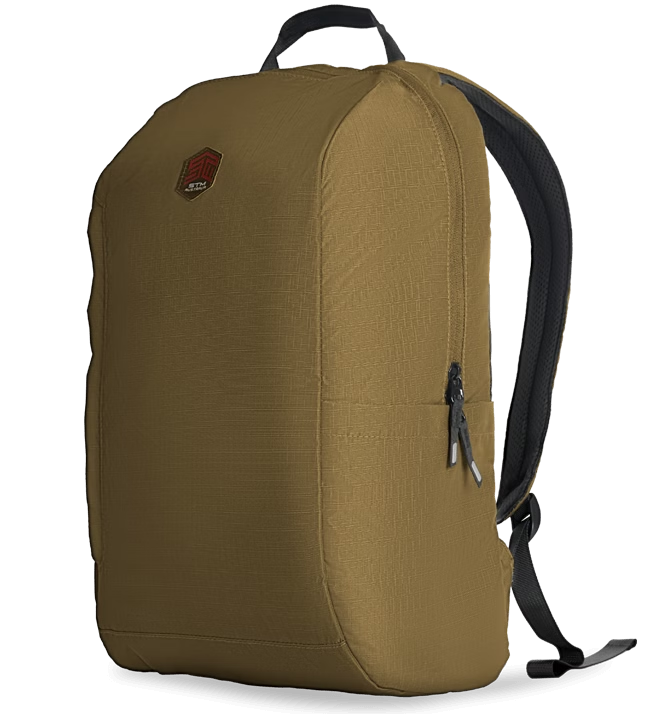
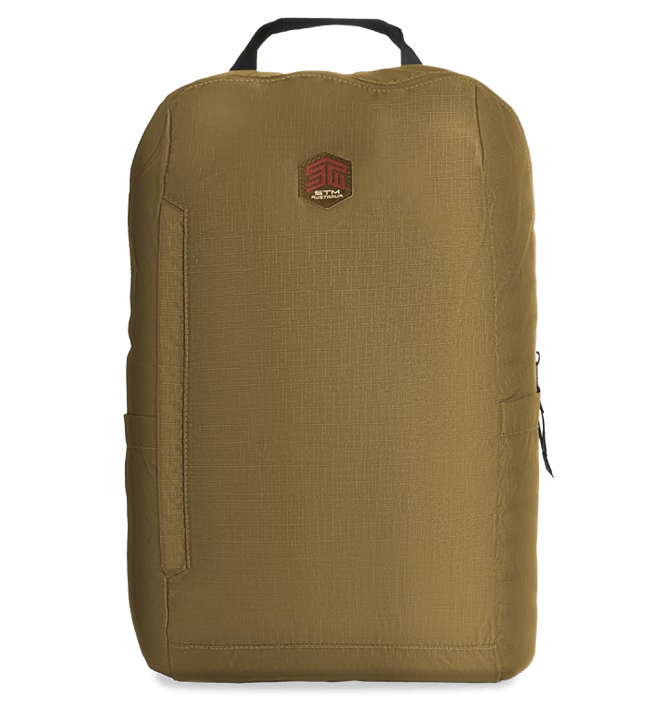
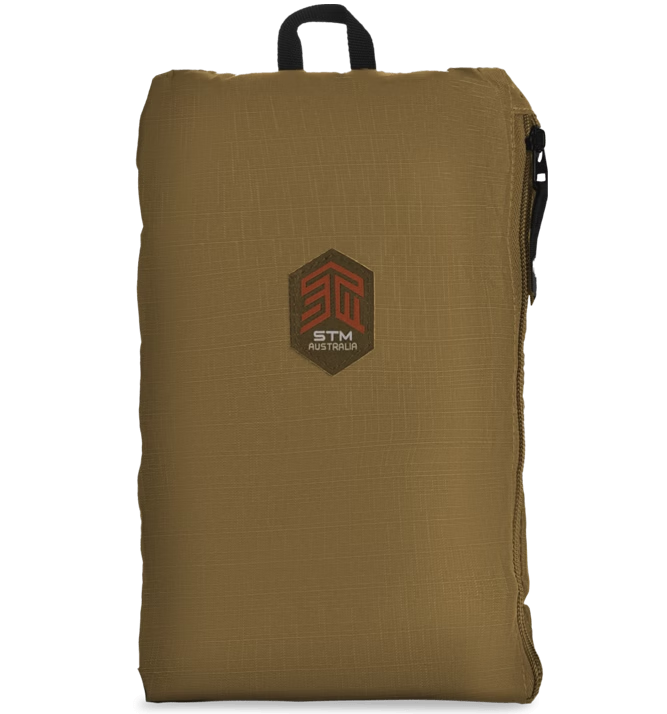
Packs into front zipper pocket for compact stowage
Inflatable TPU bladder sleeve provides laptop protection, bag structure, and back cushioning
Highly rugged 210D nylon material resists wear for long product lifespan
Lightweight fabric for comfortable carry and quick compression
Comfortable contoured shoulder straps
Easy grab zipper pulls for quick access to pockets and compartments
Durable zippers stand up to repeated opening and closing
Fits up to 16” laptops
Specifications
main material(s): 100% nylon
outer dimensions: 18.9 x 12.4 x 6.3 in / 48 x 31.5 x 16 cm
outer dimensions packed: 9.5 x 6.0 x 4.0 in / 24.1 x 15.2 x 10.2 cm
weight: 1.1 lbs / 0.5 kg
capacity: 15 L / 915.4 in
device compatibility: fits up to 16″
BagPack is a backpack with a uniquely ingenious inflatable protective laptop airbag, that all stuffs neatly into its own front pocket for compact stowage.
Unlike anything you’ve seen before, the refreshingly innovative BagPack is designed for reliable, minimal, lightweight carry but also compact out-of-the-way storage. Perfect for the traveler or commuter looking to carry their gear securely without the bulk of a traditional backpack.
Made of ruggedly durable yet feather-light 210D nylon, the BagPack is designed to securely carry a full load of cargo while staying light on your shoulders.
The STM BagPack is available now in Black or Coffee and is priced around £51.41.
Finding an affordable but tech-packed headset is easier said than done. You normally have to compromise and this makes most gamers sad. Luckily, Turtle Beach has your back. The Stealth 500 camo headset for Xbox comes in at under £80. Moreover, it has plenty of game-improving tech for lovers of all genres. Additionally, you can connect it to your phone via Bluetooth, so you can game and listen to your favourite tunes on the move.
All the tech in the world is great, but if the headset is uncomfortable, then you are not going to use it. This beautifully weighted and wonderfully padded headset can be worn for hours. Furthermore, if you wear specs or gaming glasses, you will not feel that uncomfortable pinch. On top of this, the free-to-download Swarm app allows you to alter your settings in a simple and user-friendly manner.
What’s in the box of the Stealth 500 camo headset?
The simple packaging has striking imagery and a professional appearance. Moreover, despite a few pieces of plastic, most of it can be recycled.
The Stealth 500 camo headset is great to look at. The buttons, dials, and ports are well-positioned, and the floating headband support reduces pressure.
A USB-C to USB-C cable is provided to charge the headset.
A USB-A dongle is provided.
Learn the basics with the user manual.
Technical aspects.
The Stealth 500 camo headset is described as the best-in-class for many of its key features. This is a bold claim, but I can see why Turtle Beach are shouting about their mid-price point product. The 40-hour battery life is mind-blowingly good! We all love a marathon gaming session, but I think most gamers will be very comfortable with a 1 1/2-day battery life. Additionally, the choice of Bluetooth 5.2 or a wireless dongle for connectivity was a great choice.
I used both and never struggled with latency or interference. Though I feel that the 2.4 GHz dongle was the better option, I never struggled whenever I connected this to my phone or Steam Deck. Whichever option you plump for, there is a QuickSwitch button for seamless switching. This was fantastic as no one likes to mess around with settings. Furthermore, if you are in a rush, you can simply grab your gear, leave the house, and get connected with ease.
Usability.
I’m lazy and I don’t like complicated are time-consuming products. Thankfully, the Stealth 500 camo headset is unbelievably easy to use. If you want a plug-and-play option, this budget-friendly device is great. However, you can download the Swarm II app and play with your sound settings. Alternatively, you can pick from any of the 4 Turtle Beach premade modes and focus on your gaming.
This user-friendly design will appeal to technophobes, lazy gamers, and parents who simply want their kids to have a great time. What’s more, the ability to play with settings taps into a higher group of gamers who desire some input into their audio experience. Consequently, Turtle Beach has got the balance just right.
Build quality.
The statement “budget-friendly” brings up images of poor quality or something a little inferior. Luckily, this isn’t the case with the Stealth 500 camo headset. The plush earcups use memory foam for a superior and comfortable experience. Additionally, I never struggled with overheating and the close fit prevented unwanted ambient sounds from disturbing me.
The floating headband creates a snug fit without placing too much pressure on your skull. This is the ideal solution for epic gaming sessions. the band stretches and flexes to match your head. Subsequently, you should have a near-perfect fit.
I love a flip-to-mute microphone. They are convenient and simple to use. This hides nicely in the headset body and can be moved with ease. The hinged movement is reassuringly strong and it will take some roughhousing as a consequence. The same can be said for the tough plastic shell. Though I wouldn’t suggest twisting and pulling it, it can take some knocks without breaking. Finally, the camo livery is great to look at if you can see it. The grey and white combination will appeal to many gamers and look perfect in any gaming arena.
Is the Stealth 500 camo headset worth it?
I’ve been a big fan of Turtle Beach for years. As such, it would take a lot for the products to disappoint me. Luckily, this new colourway tickled my fancy. Not only does it look great, but it is packed with incredible tech. Moreover, the Stealth 500 camo headset is comfortable to wear and at under £80, it is well-placed for many gamers’ budgets. Accordingly, I think they are great and I recommend buying them here!
(More information on Turtle Beach can be found here!)
(Full disclosure! A sample was provided for an unbiased and free review!)
Betting is one of the most engaging ways you can stay entertained in this modern century. However, the wagering niche has evolved, accommodating more games.
Initially, we were restricted to the classics, including poker and slots. However, with time, online gaming has come to accommodate more unorthodox games like the fast-rising virtual betting. In this article, we will get to know why this niche is growing at such a rapid rate. We will also get to see exactly what this will mean for the future of online gaming. Let’s jump straight into it.
What is Virtual Gambling
See how you could bet that Manchester United is likely to clobber Liverpool in an FA Cup fixture? Well, virtual betting revolves around wagering on games completely tailored by computer algorithms.
The outcomes of these titles are purely random, ensuring the game is fair for everyone. So yes, say goodbye to real-world athletes because you will be interacting with cutting-edge graphics and algorithms in virtual betting. So the real question is, why is virtual sports becoming more popular? Let’s see why.
Easy Learning Curve
In most casino titles, you’ll often hear terms like strategy and plan. Well, when playing virtual games, the only thing you need to be concerned with is managing your bankroll. Most of these games are very straightforward and demand really little of you.
For instance, when you place a sports bet on a game like virtual horse racing, you don’t need to check the previous performance of the steed or rider. You don’t need to have been following on whether they have an injury or not since the entire thing is simulated.
All that matters is how much appetite you have to take on. Depending on your bankroll size, you can customize it to ensure you play longer and have more fun while at it.
Wide Range of Games
Virtual gambling gives you numerous gaming choices to play. Apart from the conventional casino games, you can indulge in titles like horse racing and even virtual soccer.
Having multiple choices to choose from largely eliminates boredom and gives you space to try out what you like. Most popular wagering sites like Betway will offer you these virtual games to add to your betting favorites.
Fair Play
One great beauty about virtual games is that it is nearly impossible to tamper with the outcome. As technology advances, so has cybersecurity. Hacking these titles to manipulate the outcome is slowly becoming a thing of the past.
This means that you can play without fear of game manipulation. Furthermore, if you want more ease of mind, it would be best to choose a site with good security like Betway.
Conclusion
Online gambling has evolved beyond its traditional form. From gambling on real game outcomes involving athletes, teams, and coaches, to betting on a computer-generated game where the outcome is purely random. Some of the reasons it is becoming more popular include incorporating several games and ensuring fair play.
Grief can make us do weird and wonderful things. However, it is how we deal with our emotions and the aftermath of loss that defines our personality. Afterlove EP takes us on this dark and often uncomfortable journey. This visual novel experience isn’t the most pleasant I’ve encountered. The sense of self-loathing and twisted mindset made me grit my teeth. Yet, the snippets of light and wonderful relationships kept me digging through the dirt.
This visual novel was developed by Pikselnesia and published by Fellow Traveller. Moreover, it has some rhythm-based elements that break up the sense of melancholy. However, at its core, it has many traditional visual novel elements. Consequently, you will build relationships, encounter good and bad endings, and carve a path amongst the most trying of moments.
Afterlove EP tells a tale of loss and destruction.
You play the role of Rama, a young musician who is struggling to move on after his girlfriend Cinta passes. His band needs him, but the young hero is wallowing in self-pity and remorse. Furthermore, he is driven to distraction by the voice of Cinta and her judgemental ways.
The story is set in the vibrant city of Jakarta. This should have created a vivid and electric setting for a music-inspired game. Yet, the sombre nature of the plot drags you across hot coals. Additionally, the protagonist is a bit of a buzz kill as his moping ways and reliance on the words of his dead girlfriend create a sense of melancholy.
Moving on never felt so good.
Where Afterlove EP excels is the realisation that moving on has never felt so good. Luckily, the hero has a great set of friends. Moreover, they are well-loved in the city and people are willing to forgive. Accordingly, new friendships and relationships open up throughout the relatively short story.
The exceptional characters and interesting dialogue help to bat away the sense of misery. Unfortunately, Rama and Cinta are divisive leads. I found Cinta’s continuous backbiting and jealousy to be a real downer. Yet, if you can overlook her sniping and jealous ways, you’ll enjoy the healing process and the friendships that blossom.
If you can put aside your disdain for the protagonists, you’ll enjoy a fulfilling story. The character development and the setting are particularly good. Furthermore, the rhythm-based moments break up proceedings nicely. What’s more, I adored the blend of characters and how each personality shapes Rama’s present and future.
Afterlove EP is a picture of pastels.
I’m a fan of Anime and Manga visual novels. Afterlove EP is a little understated with its setting and character portraits. Unlike its peers, it has a softer approach. This matches the sombre elements but isn’t as striking as other games in the genre. The portraits lack the OTT emotions. Instead, the writing creates each emotive layer. This was a shame as I enjoy the razmataz of other visual novels.
The audio is relatively repetitive but pleasant to listen to. The calm music matches the atmosphere and every character has some voiceover work. The exception is Cinta who haunts you at every turn with her cutting dialogue. This was overwhelming and uncomfortable to experience. Yet, it delivers a sense of oppression that matches Rama’s downtrodden mindset.
Simple controls.
If you want a simple game to play, then a visual novel has to be on your radar. You can fast-forward any unwanted dialogue and sit back and enjoy a drink as the story unfolds. Thankfully, when accuracy is key during the action moments, Afterlove EP doesn’t let you down. The well-labelled inputs are easy to follow and the controls are responsive and accurate.
Most visual novels have exceptional replay value and longevity. Together We Live is a VN I’ve recently covered and it was sadly lacking in both. However, Afterlove EP doesn’t disappoint. There are plenty of different endings and fans of the game will be able to return for more.
Afterlove EP is touching, uncomfortable, but oddly enjoyable.
Death, mourning, and loss rarely go hand-in-hand with entertainment. Yet, Afterlove EP has delivered that with its sombre but touching story. The blend of characters and the charming gameplay kept me interested throughout. Additionally, I loved the new friendships that formed and the interesting subplots. Though the protagonists weren’t my cup of tea, I liked how things unfolded. Accordingly, it is a good visual novel and I recommend buying it here! Losing someone doesn’t mean the end. Learn to grieve, lean on your friends, and evolve personally.
The way that families manage their finances is changing. Many new technologies are constantly emerging that parents can use to track their spending safely, efficiently, and properly.
Technology is making it easier for families to manage their money and have a healthy financial future, from mobile banking apps to digital audits and automated budgeting tools.
As technology continues to change, families need to understand how these pieces of technology can improve their household finances, use them to create financial security for the future, and educate their children about how they can use them, too. Let’s examine this in more detail below.
The Rise of Digital Banking
Gone are the days of visiting a bank in person to transfer money, deposit checks, or pay in cash. Digital banking has changed how families now handle their day-to-day finances. Mobile banking allows parents to check their bank accounts, transfer funds, and pay bills with just a few taps on their smartphones.
Many banks also offer budgeting tools within their accounts, enabling families to track their spending habits and set financial and saving goals. Digital-only banks, or Neobanks, have also gained popularity. These banks operate entirely online and often have lower fees compared to traditional banks that you see on the high street. With features like instant transfers, high-interest savings, and no overdraft fees, they offer a convenient and low-cost way to view their banking experience.
Additionally, these banks integrate much better with financial planning apps, meaning families can now view and analyze their finances in one place.
Automated Budgeting Tools
Budgeting is one of the biggest challenges families often face when it comes to finances; however, technology is making it much easier. Apps like Mint or YNAB (You Need a Budget) and PocketGuard have changed how personal finance is controlled by helping families get a clear picture of what they are spending and how they are spending it.
These apps automatically categorize expenses, track transactions in real time, and generate reports that give families the insights they need to understand exactly where they spend their money.
Expense Tracking and Analysis
With Belton Analytics budgeting apps helping families to find the areas where they might be overspending frequently by visually breaking down expenses into categories such as entertainment, grocery, utilities, and parents, and are able to make better decisions about their finances and how they can make it better.
These tools allow users to set monthly spending limits, receive alerts if they spend over what they shouldn’t be, and adjust their habits accordingly over time. Families should be able to take a smarter financial approach to make sure that their money is being used properly.
Automated Savings Plans
Many budgeting apps also allow their users to set up automatic saving plans, which is something that is highly recommended for families. There are even apps such as Plum that can track a family’s spending habits and automatically transfer small amounts into a savings account based on what they have spent and what disposable income they have.
This is something that is a “set and forget” approach as it removes the stress of manually having to save money, and it also ensures that families are consistently putting money aside for emergencies, vacations, or big purchases. Some apps take saving strategies further by offering the Roundup feature, where when you make an everyday purchase, they round it down to the nearest round number, and the spare change is transferred into a savings account.
Other applications allow families to create different savings buckets for specific goals and split any savings between them. This might be for renovation, education, or holiday funds, but it makes it easier for you to prioritize which financial objectives and pots are going to get filled up first.
Budgeting for Kids and Teens
In addition to helping parents, many budgeting platforms now offer features that are for children and teenagers. It’s a way to teach them how to handle their digital allowances. These platforms teach them how to manage their money, track their spending, and even set up their own personal savings goals.
By introducing budgeting early in families, they can help their children to develop strong financial habits that are going to benefit them even when they go into adulthood. When they see the parent budgeting, it also helps them learn how to do it. If you are saving for something like a holiday for the family, think about talking to the older children about how you are cutting back and saving for it.
Digital Payment Systems and Contactless Transactions
With the rise of contactless payments and digital wallets, cash transactions are becoming much less common. Apps like Google Pay, Venmo, and Apple Pay are allowing families to make quick and secure transactions without having to swipe a physical card or use cash. This is extremely useful for parents who need to send money to their kids for school lunches, extracurricular activities, or for an allowance.
Prepaid debit cards like GoHenry and Greenlight help teach them about financial responsibility. These cards allow parents to set up spending limits on the transactions they are making and even reward kids for completing chores or other activities. By introducing children to digital payments at an early age, families are able to help them develop responsible money habits in a world that is fast becoming cashless. Some cards even include financial literacy features such as educational quizzes and savings goals so that you can reinforce money management skills to your children and teach them how to save for the future.
Subscription Management Tools
There are many different subscription services, from streaming platforms to meal kits to online learning programs or even gym memberships. It’s very easy to lose track of all of these recurring charges, which can lead to overspending on unnecessary expenses. Subscription management apps like Trim and Truebill help families track their subscriptions and cancel services that they are no longer using.
These apps can also help negotiate bills on behalf of the user, which could help lower costs for internet, cable, and insurance. By taking advantage of these types of tools, families should be able to avoid paying for services that they are no longer using and keep their monthly expenses under control.
Investing for the Future
Technology is also changing the way that families make investments. Robo-advisors like Wealthfront and Acorns use algorithms to create customized investment portfolios based on individual families’ financial goals and risk tolerance. These platforms make investing accessible to parents who might not have the time or the knowledge to create a portfolio on their own.
For parents who want to invest in their children’s education, a 529 savings plan on apps like CollegeBacker can help families contribute to college funds with automatic savings and family gifting options. Some platforms even offer employer matching programs, which can help families to maximize their educational savings.
Blockchain and Financial Transparency
One of the most innovative financial technologies that has arisen is blockchain. While it is often linked with cryptocurrencies, blockchain technology is also being used to improve transparency, economic security, and efficiency for families. This could give them more control over their financial transactions and better confidence in the security of their money. Blockchain technology provides a decentralized ledger where transactions are recorded permanently and can never be altered.
This level of transparency can be great for families who want to keep track of their expenses, manage shared accounts, and ensure their financial data is fully secure. Tools like a multichain block explorerallow users to view and verify transactions in real time. By using blockchain-based financial tools, families should be able to minimize the risk of fraud and keep track of their spending with complete accuracy. Blockchain technology is still in its development stages, but it has the potential to reshape how families handle their finances in the future.
The Future of Family Finances
As technology continues to change the way that families manage their money, staying informed about new financial tools and trends is important for families. Digital banking and automated budgeting are just a couple of the ways that are going to change household finances for the better. By embracing these advancements, families should be able to gain a better level of control over their financial future. They should be able to save more efficiently while also protecting their money from fraud, setting themselves up for a solid financial future.
Developed by The End of the Sun Team and produced by Jakub Machowski and The End of the Sun Team, The End of the Sun is a first-person, story-driven mystery adventure set in a Slavic fantasy world.
A few days ago, I asked myself, “It has been a while since I played any game that could be considered a walking simulator.” I wondered what one would feel like after such walking sim celibacy. Then I started playing The End of the Sun. Frustrated, enraged, annoyed…. These are some words that mean someone is not happy. Let’s talk!
Pointless Puzzles
I get that hearing the words, walking simulator, gives the impression of doing nothing but walking and looking at pretty surroundings for a few hours, but trust me, there is more to the formula.
Whether that be horror, comedy or, as we will discuss here, Puzzles, if you don’t put in the proper amount of effort in this crumble, no one will want a bite.
Contrary to the bottom-licking reviews on the Steam page, The End of the Sun does not have any good puzzles.
Majority of The End of the Sun consists of watching cutscenes. They end in some tragedy or error due to a missing object. The “puzzle” is simply going out to find this missing object and placing it in the required location. The first few times, it does not hurt, but after the 5th or 6th time, it just gets lazy and annoying.
If you want to make a movie, just make a movie; no need to attach a half-assed game to it.
Speaking of which:
A Cliché. Plot
The story being told is not exactly Shakespeare; it’s more cliché.-spear….
Uhm… while trying not to spoil, I can say that the game in itself is filled to the brim with cliches and scenes that feel plucked from other media.
Imagine a story about a devoted cult gathering at an Island for some secret ritual, and you might already know 90% of this game’s plot.
A woman gets impregnated with some otherworldly being. CHECK!
A godly figure is angry and is causing bad things to happen. CHECK!
A thing I won’t say cause it will spoil the plot, CHECK!
However, I will say that the Final 10%, felt original. It managed to entertain me a little.
You play from a first-person perspective on a seemingly desolate island, scattered with eerie remnants of a cult’s presence. With the ability to see into the past, Return of the Obra Dinn style, you piece together the mystery of the Island. The concept, though riddled with flaws, does manage to give The End of the Sun a unique charm and atmosphere. The moments when the past reveals itself through ghostly visions provide a glimmer of intrigue, offering just enough to pull you in.
Sadly, the shortcomings of the rest pull you back out.
The End of my Rope
You will spend all your time trekking through a large open world, fetching meaningless objects just to shove them into yet another predetermined spot. Gets old faster than you can say “cliché.”
The few moments where the game shows any spark of originality are buried under a predictable story and lacklustre execution.
It’s a walking simulator with no soul, a puzzle game with no challenge.
If you want to spend hours wandering an empty island trying to piece together a story that honestly should have been a movie or a short film, then sure, The End of the Sun might scratch that itch. But for me, this is a hard pass.
The Blade101 keyboard from Mechlands is affordable, stylish, and a pleasure to use. This full-form keyboard is perfect for gamers who need a numpad and more real estate. However, this larger format may not be ideal for compact workstations. Accordingly, if you sit in that camp, I recommend looking at the Blade75 keyboard.
This premium aluminium keyboard looks and feels great. Furthermore, both colourways are a pleasure to look at. I picked the cool pastel option. Yet, if you want something more sci-fi and aggressive, there is a dark and alluring alternative.
If you want a device that packs in plenty of tech without breaking the bank, this should be on your radar. It has a massive battery, tri-mode connectivity, customisable south-facing RGB, and hot-swappable switches. On top of this, the gasket mounts and layers of acoustic materials make this a pleasure to type with and to listen to.
What’s in the box of the Blade101 keyboard?
The packaging is great to look at. The distinctive logo and sci-fi imagery capture your imagination.
The Blade101 keyboard has a pleasant weight and it feels substantial. The cherry keycaps are familiar and the Verdant Switches are responsive with that pleasant clacky sound.
Charge the device with the USB-C cable.
Pull the keycaps with the pulling tool.
Spare switches are provided.
Learn the basics with the user manual.
Technical aspects.
I didn’t expect such an affordable keyboard to be loaded with tech. Luckily, the Blade101 keyboard has loads of top-end features to impress the toughest critics. The 1000 Hz polling rate is achieved with a wired connection or via the included USB dongle. If you fancy using Bluetooth, you drop around 85% of the polling rate. As such, I recommend sticking to option 1 or 2 if you intend to game.
I usually stick to a wired approach. I don’t mind the slight mess and I don’t have to worry about compromise. However, if you insist that wireless is best, you can enjoy a whopping 8000 mAh battery life. This will keep the most serious of gamers in the game for much longer. Moreover, if you need to charge the built-in batteries, this can be done quickly while you continue gaming.
During testing, I experienced no connectivity issues or latency problems. Additionally, connecting the keyboard to different devices was a cinch. This keyboard has 3 unique Bluetooth profiles and switching between them is as easy as pressing a pair of buttons. Consequently, no one will struggle to set this peripheral up.
Build quality.
Mechanical keyboards are all the rage. The responsive nature of the inputs and that glorious clacky sound are gaming staples. Thankfully, the Blade101 keyboard ticks both of these boxes. On top of this, I was impressed by the quality aluminium case and the attractive pastel colour palette. The south-facing RGB creates a gentle hue against the soft blue livery. Yet, if you pick the black version, the RGB will pop and you’ll have a real head-turner on your desk.
The ability to change switches with ease is a must for many gamers. Luckily, this keyboard allows you to hot-swap the included switches with your favourite without technical knowledge or the need to solder. This was amazing as you can create the keyboard of your dreams with any spare parts you have lying around.
The Cherry profile keycaps are comfortable to use and I was impressed by the actuation distance of the Verdant switches. Furthermore, the gasket mounts and multilayered acoustic material make this a pleasure to work and play with. Finally, the well-positioned connectivity switch is robust. Located at the rear of the keyboard, it is easy to switch between modes. Additionally, you can check your battery life and other key features thanks to the FN macros and the impressive RGB lighting.
Is the Blade101 keyboard worth it?
Top-end gaming peripherals make a massive difference. However, the bank-breaking feeling isn’t pleasant. Luckily, the Blade101 keyboard breaks this trend. Not only does it look great, but it packs an almighty punch at an affordable price. I adore the 2 colourways and the vibrant RGB. Moreover, it is a user-friendly option that is easy to customise. Therefore, if you are inexperienced or you want to up your game, I recommend buying it here!
(More information on Mechlands can be found here!)
(Full disclosure! A sample was provided for an unbiased and free review!)
MainFrames made me feel a little bad. In the real world, I’m a QA Test Manager. It’s my job to break software as much as possible. So MainFrames coming along and giving all the little programs faces and personalities brought on some strange level of guilt. Am I the software equivalent of a supervillain? Perhaps doing QA is the equivalent to walking into someone’s house and putting my foot through TV or tearing down the wallpaper, and then telling everyone that the place sucks. Maybe I’m overthinking it.
Actually, the idea of breaking and destroying things is quite at odds with how MainFrames made me feel. I found it incredibly refreshing. I’ve been in a bit of a slump, video games wise. Nothing has really gripped me in a while (meaning no disrespect to those I’ve reviewed). MainFrames blasted me back to the days of Adobe Flash platformers, with its cute art style and buttery smooth platforming. It’s a pinpoint platformer with an intriguing central gimmick.
Desktop Dangers
MainFrames‘ main gimmick is that everything takes place within a computer, which is connected in turn to a network. Our hero is a li’l floppy disk, called Floppy. If you don’t know what a floppy disk is, then please keep that to yourself. I already feel old. Anyway, Floppy’s little house gets destroyed and he’s cast out into the system. Turns out he is one of a collection of software daemons. These are programs that run processes that are hidden from the user. Unfortunately, the system housing these processes is in the middle of falling apart.
Floppy needs to explore his way through all of the computers connected on the network. This involves a good deal of jumping, as MainFrames is a classic platformer at its heart. First, and most importantly, the movement feels wonderfully precise. Landing precision jumps is quite easy, and there’s a double jump (of sorts) to help dial things in. The end result is that when I died – which was a lot – I always felt like it was my fault. There weren’t any cheap shots. Every death gave me information on how to avoid it in the future.
Added to this is a wealth of mechanics that change things up. Being set inside a PC isn’t just an aesthetic choice. The platforms are all little windows, for instance, and each set of levels plays with that. An early level gives us a mouse pointer, for instance, so we can move around platforms at will. Another lets us BSOD individual windows to give us more platforming space. Each area introduces a mechanic and then puts it through its paces. As a result, MainFrames never gets stale.
Daemon Saving
Despite juggling all these different gameplay modifiers, MainFrames skates along quite a sensible difficulty curve. It hits the sweet spot of being difficult, but never to the point of being too frustrating. Usually it’s just a case of becoming comfortable with the new mechanics. It’s not a particularly long game, mind, but the difficulty was such that it felt like a good challenge. The only real spike was in the middle, with an odd section where you face a running gauntlet of platforming challenges. One way of making sure we’re awake, I guess.
Outside of that, MainFrames has some nice little collectibles in the form of other software daemons. Collecting them requires an optional challenge, which is usually something more complex than the standard levels. It’s good fun, and contributes to the overall idea: that we’re rescuing programs from deletion. There isn’t too much plot here, but I liked the snippets that indicate that the network is falling apart thanks to some big-brained project management moves. On a more surface level, MainFrames also has a lovely, cute art style that manages to somehow inject personality into Floppy. Tall order for an outdated storage medium.
In fact, I’ve only got two itty-bitty criticisms. Firstly, while the abundance of collectible daemons is great, there doesn’t seem to be a way to go back to ones in previous levels. Even if we could, the world is a tangle of interconnected levels and there’s no overall map that I can see. Backtracking would be a bit of a pain in the neck. Secondly, some levels are a bit easy to cheese. I put that down to Floppy’s ability to mantle, which removes the need for too much precision. It also means we can occasionally hop on top of the level and run along it, avoiding all the hazards.
MainFrames – Wonderfully Refreshing
All-in-all, MainFrames feels like a meeting of old and new schools. The platforming feels deliberately retro, albeit improved by all the PC-style shenanigans. The wonderful pixel-art feels pretty old-school too. But the cleverly put together levels, underlying plot notes and general chaotic style to it make it feel fresh and new. There’s a sense of chaotic personality to it. At points, you stumble across a daemon operating a big coffee machine, for instance.
Another puzzle has you turn down the volume slider for an out of control program. It’s little personalities blended with generic programs, and I love that. I would’ve given it high marks for the platforming alone, but MainFrames manages to make its dying electronic world feel alive. Charm drips from every corner. If you’re in the mood to relive the platformers of old, but want something brimming with personality, then you have to give MainFrames a whirl.
As someone who has only briefly engaged with the Yakuza series in the past, never fully completing any of the titles, I approached Like a Dragon: Pirate Yakuza in Hawaii with a mix of curiosity and scepticism. However, as a fan of pirate-themed adventures, this instalment resonated with me in unexpected ways, leading me to rate it a solid 8 out of 10.
The game transports players to a vibrant Hawaiian setting, a refreshing departure from the series’ traditional urban landscapes. This tropical backdrop is not merely a visual change but serves as a dynamic environment that influences the narrative and gameplay. Players assume the role of Majima, a beloved character who, after losing his memory, becomes a pirate captain. This storyline blends the gritty underworld elements of the Yakuza series with the adventurous spirit of piracy, creating a unique narrative experience.
The combat
Gameplay Mechanics
Pirate Yakuza in Hawaii retains the series’ signature beat ’em up combat system, with Majima employing two distinct fighting styles:
Mad Dog: A speed-focused style showcasing Majima’s agility and unorthodox combat techniques to focuse on single enemies or one to one combat.
Sea Dog: Introduces dual cutlasses and pistols, aligning with the pirate theme and giving more AoE damage as well as better crowd control.
A notable addition is the ability to jump and perform mid-air combos, enhancing the fluidity and dynamism of battles. Beyond land-based combat, players can assemble a pirate crew and upgrade their ship, the Goromaru. Naval engagements are conducted in real-time, allowing players to board enemy vessels, confront rival crews, and claim victory. The ship and crew are also highly customisable, not only visually but give plenty of bonuses depending on the weapon used and crew asembled.
Side activities are exactly what you would expect
The game excels in offering a plethora of side activities, a hallmark of the series. Players can participate in Dragon Kart races or food deliveries among many other side activites. Additionally, the Pirates’ Coliseum stands out as a remarkable minigame, allowing players to engage in naval and physical duels against themed pirate crews which I won’t spoil. This side activity was by far my favourite and responsible for more than half the hours I spent on anything else in the game.
Visuals and performance
Visually, the game captures the essence of the Hawaiian islands with meticulous detail. The lush landscapes, dynamic weather systems, and vibrant locales contribute to an immersive experience. On the technical front, the game performed smoothly on the base PS5 , offering high frame rates along decent graphics. The details and art direction are certainly impressive, but I must say that like a dragon games are not the most graphically advanced.
Nothing is perfect
While the game offers a rich tapestry of activities and a compelling narrative, it is not without its shortcomings. Some players may find the naval combat to be repetitive, but since fans of pirate themes are not exactly spoiled for choice in games (me included), I really did enjoy every bit of it. Another critique I do have is the game starts off very slow. Which is a shame because players that are new to the series may not be willing to give it the time it deserves to captivate them.
Conclusion
Like a Dragon: Pirate Yakuza in Hawaii successfully marries the core elements of the Yakuza series with a captivating pirate theme. For newcomers and seasoned fans alike, it offers a compelling adventure that is both familiar and refreshingly new. As someone who had not fully embraced the series before, this instalment provided an accessible and enjoyable entry point, solidifying its place as a standout title in my gaming experience. Its blend of engaging combat, diverse side activities, and a vibrant setting make it a noteworthy addition to the franchise.
Here is our review of the PowerA MarioKart Wired Earbuds.
The PowerA Wired Earbuds for Nintendo Switch are officially licensed and sport original designs featuring your favourite video game characters.
Features
Dynamic Speakers – 8 mm drivers to deliver the audio of your favourite games
Ergonomic – In-ear design with 3 swappable tips so you can find the perfect fit
Wired Connection – No batteries or recharging needed. 3.5 mm right angle jack for a lower profile design.
Inline Mic – Chat with your squad and mute the mic the via a switch
Cable Organizer – Adjustable slider to keep the wire tangle free when using the earbuds or storing them
Storage – Includes a drawstring bag to protect your earbuds when not in use
Officially licensed for Nintendo Switch
2-Year Limited Warranty
A Closer Look
Final Thoughts
The PowerA MarioKart Wired Earbuds are small and lightweight and are easy to carry around in a bag or a pocket. They come in a cool MarioKart carry bag too!
The box also contains additional earbud tips so you can swap out the tips if they are not the right size.
The sound quality is very good and the quality of the inbuilt mic is good too. You can easily mute the mic from a switch on the cable.
The PowerA MarioKart Wired Earbuds are available now priced around £19.99 and are a must for any Super Mario fan with a Nintendo Switch.