Review: GENSOU Skydrift

There are many series of games which don’t really have a huge market over here in the U.K. Often Japanese based titles are massive on one side of the world but barely make a splash in Europe in general. You probably haven’t heard of the “Touhou” universe and the many different genres of games that are shared within that environment but GENSOU Skydrift is part of that heritage which dates back to the nineties.

GENSOU Skydrift story concerns itself with the mystical land of Gensokyo somewhere in Japan, humans and yokai (supernatural Japanese myths) live together in a weird harmony. One day, some girls notice that their spirit energy is weak. Yokai specialist Reimu Hakurei and her friend Marisa Kirisame spot something running off on a racetrack and that’s how everything kicks off. Now that’s the story of GENSOU Skydrift, the actual game is a n arcade kart racer where you as a duo of witches fly on top of each other like on a surfboard!

GENSOU Skydrift has a fair bit in common with Double Dash, you can swap between the characters mid race to utilise their special attributes. The idea behind picking your team is to try to make sure they are best matched so for example someone who is very fast teamed up with someone who has different attributes would be ideal. So picking two speed demons lacking drifting abilities will mean you may be able to fly down straight tracks but you’ll struggle going round corners. There are a few different modes in GENSOU Skydrift. Campaign is a standard set of races where you must finish near the top to progress the somewhat confusing and not so interesting story. Versus mode is where you can play against the computer, a mate or someone online (couldn’t find anyone in my game). There is also a Free Run mode which is your standard time trial. GENSOU Skydrift expects you to know a fair bit about the Touhou universe, if you don’t then most of plot will mean nothing to you.

As mentioned earlier GENSOU Skydrift has you in control of two characters out of the 20 that you can choose from. Not only do they have different skills but as they witches they also possess spells which can be used mid race. Like any classic old school arcade racing game there are different power ups a la Mario Kart. Obviously you need to be careful when you are first because you will often find yourself with a target on your back. There is a reasonably variety of power ups available which you’ll get plenty of opportunity to deploy. The controls in GENSOU Skydrift are quite responsive, they feel like you’re in control, however the tracks you take seem to give you the opposite experience. There is a huge amount of starting and stopping if you’re not hitting the race line perfectly. You don’t generally bounce off the scenery in GENSOU Skydrift, you just seem to hit an invisible wall that stops you in your tracks. It’s hugely annoying at times as it punishes racers who are drifting either very wide or keeping close to the corner.

Graphically GENSOU Skydrift has a very nostalgic feel to it, it’s very similar to one of those high octane racing titles you would find in an arcade in both feel and design, it reminded me of Wipeout for some reason. There are elements of GENSOU Skydrift which wouldn’t feel out of place if this was an early PS3 title. The menu is very simple whilst the tracks themselves are not particularly outstanding but do the job, they are mostly bold and bright in that usual Japanese anime look. The character artwork when the plot is popping along excellent but the character models in the racing element are fairly sketchy. Musically GENSOU Skydrift is where it does very well. The different soundtracks on each course get you in the mood for some witchy racing. GENSOU Skydrift. With so much text on screen GENSOU Skydrift is let down a little by the lack of voice acting.

GENSOU Skydrift feels out of place in it’s less than polished look. The racing is actually fun and feels like your racing but it’s let down by unforgiving courses and some early PS3 era graphics. If you somehow happen to know the Touhou universe then you may get a few hours out GENSOU Skydrift but it’s unlikely that would be the case. The lack of voice acting detracts from the plot whilst the complete lack of online players have a negative effect on the GENSOU Skydrift experience. If you fancy playing something that is similar to Double Dash then GENSOU Skydrift will give you the odd throwback, but as a whole it’s hard to recommend GENSOU Skydrift even to the most avid fan.

Review: void tRrLM(); //Void Terrarium

INTRO – A. . . Unique Game, For Sure…

void tRrLM(); //Void Terrarium is a game by Nippon Ichi Software (The folks behind the much-loved Disgaea games as well as a few other games). Before I begin this, I want to apologize for how long it’s taken to write this review. I’ve been busy as of late with theatre, college, etc.

With that said, is this game good, mixed, or bad? Either way, let’s get this party started!

STORY – A Lone Girl Meets a Robot AI

The story of Void Terrarium goes as follows.

In a world contaminated with toxic fungi, civilization has collapsed, and a discarded maintenance robot finds a lone human girl named Toriko among the discarded junk in a scrapyard. To ensure her survival, the robot and a decommissioned AI known as factoryAI must create a refuge for her within a terrarium.

That’s about it for the story. For the sake of keeping things as fresh and surprising as possible, unlike other reviews I’ve posted, I won’t be spoiling much of anything beyond that.

From what I have experienced thus far, however, I’m rather impressed with the interactions between Toriko and the Robot.

These two characters’ dynamic helps make this game a delight

GAMEPLAY – A Roguelike With a Tamagotchi Twist

Void Terrarium is a Top-down roduelike dungeon crawler RPG with elements of Tamogotchi-like caring moments sprinkled and ingrained into the gameplay. I enjoyed the movement-to-movement combat and story like in most other roguelikes (Glares at Pokémon Mystery Dungeon: Gates to infinity in disgust) But I did not care much for the Tamogotochi-like elements in this game. If it were optional, like a mini-game or add-on dlc mode, I’d understand. However, it’s mandatory for story progression, ad I’m just not a fan of it.

FINAL THOUGHTS – A Mixed Experience

This game is quite the mixed bag, personally. I like the dungeon-crawling. I like the ability to choose which stats go up upon level up, and I like the music, soundtrack, story, and characters. What I strongly don’t like is the Tamagotchi-like pet elements that goes towards protecting Toriko from the spores.

I wish I had more positives to say, but I sadly don’t. I recommend you approach with caution.

Review: Donut County

If I was to ask you to picture a generic vision of a cat burglar, what image would you have in your mind? Black woolly hat, dark mask over the eyes, a black and white stripy jumper and dark leggings? This is how I would picture it! I find it both amusing and strange that one wild creature in particular matches this in both looks and personality, and that’s the bin dipping, thieving animal known as the raccoon. This sneaky character takes a pivotal role in the amusing indie game Donut County. An odd and whacky title that will leave you confused, smiling and giddy with delight.

Developed by Ben Esposito and published by Annapurna Interactive, this unusual game looks similar to The Untitled Goose Game. This single-player experience has you reliving the moments when BK runs amuck. He digs up holes in the ground, dragging the people and their belongings to a new subterranean existence.

Donut County is weird as hell.

Whenever I switch on a game and sit for the first 10 minutes not knowing what is going on, I know I’ve either hit gold, or it’s absolutely terrible. Fortunately for me, the latter happens rarely. Donut County soon turned into an amazing gaming experience that I think everyone should try. Essentially, it’s a game all about holes! You go from stage to stage, starting each one as a small hole. As you swallow more items, your circumference increases and the objects you inhale become sizable. The aim for each level is to clear it of each object, starting from the smallest to the largest. This is it. Nothing fancy and certainly not challenging.

You may think “that sounds terrible, where is the fun in that!” Well, let me elaborate. Each stage has a back story, it explains the reason the hole is there in the first place, and as the game evolves, the stories get more extreme. Alongside this, the levels of wanton destruction soon become unimaginable. You smash up people’s yards, houses and businesses for the sheer hell of it. Its destructive shenanigans, and I loved it. 

Don’t wake the sleeping crocodile.

A raccoon, his best friend and a trash king.

The imaginary town of Donut County is populated by some odd characters. None more so than BK the raccoon who runs the local doughnut store, and his best friend Mira. BK has become obsessed with an app that allows him to earn points to win prizes. All he must do is deliver doughnuts to the people of Donut County. He needs to get enough points to go from level 9 to 10 and then he can afford his Quadcopter Drone. Unbeknownst to BK his actions are slowly destroying the town in which he lives, he is so unaware that he brags to Mira about his achievements on his app and shows off his new drone when it arrives. Mira snaps with rage and destroys BK’s new toy and sucks him into the new underworld city he has created.

This is where the core of the game takes place. Both Mira and BK argue with the residents of Donut County. Both are desperate to prove they are right, but who will the people side with? The story takes a twist when BK visits his boss TK (Trash King) to ask him to return the people to the surface. Will this be enough to undo his mistakes, or will this odd plot go from strange to weird in a blink of an eye?

Though the stories themselves don’t alter how the game plays out, it gives each level depth, and loosely drives the plot to its conclusion with the Trash King. It sells itself as a puzzle focussed story-driven adventure, and I’d say this is a very loose description for what is effectively a game of mindless destruction. It’s incredibly fun, but it won’t challenge you at any point.

Even a raccoon likes to check its social media on the toilet.

It’s not just about swallowing rubbish.

There is a little more substance to this than just swallowing rubbish. During the latter stages, BK’s hole gains the ability to catapult items. With his new found skill, he can dislodge items and activate switches. This drives you away from simply hoovering up everything in sight, making you look for alternative methods of finishing a stage. It’s still obvious what you have to do, but this extra layer appears at the right time to freshen up the gameplay, and keep you interested for the remaining levels.

As you absorb objects and send them on their way to the trash pile, your Trashopedia is noting down everything that has been swallowed. As you flick between each document, you will chuckle at the silly statements attached to each one. This notebook only serves to emphasise the childish nature of this title and will tickle the most immature gamers out there.

Donut County, is super vibrant.

Like The Untitled Goose GameDonut County has used a simple art style matched up with a bright and vibrant colour palette. Each world has enough detail to make each object recognisable, but sticks to its cartoon roots nicely. There is a striking difference between the underworld and over-world, and Ben Esposito has done a great job in changing both colour and tone to show the damned situation of the townsfolk. Though like most of the game, it’s presented in a jovial tongue-in-cheek- fashion. This ensures that the lighthearted nature is present at all times.

The audio continues on with the lighthearted theme and takes the weirdness to a new level. A mixture of folk, electronic and upbeat music is heard alongside over the top sound effects. Every stage has its own audio that matches its unique look. Some rely only on sound effects to show its character, and others have the music blaring out accompanied by the destructive holes.  The audio does wonders to support the oddness of the story and is one of the key elements of the game.

Where the madness all began.

How difficult can it be to control a hole?

As most of the game involves you being a hole in the ground, it’s unsurprisingly easy to control. The movement is smooth, easy to control, and the only complex moment comes when the catapult is added. Even with this additional mechanic, there are no issues and it’s a joy to play.

If you love destroying things, then you’ll find that Donut County has some replay value. Yet, I fear most gamers will have little to no reason to want to return. Once the game is finished, there is no NG+ mode to make you want to play, and the achievement list is earned through natural progression, mostly. You can complete this in one sitting and you will need to set around 3 hours aside if you want to have the 100% status.

Is the havoc worth it?

Is it worth ruining people’s homes for some dirty Trash King raccoon? Probably not, but it sure is enjoyable. The core concept of the game is childish, as is most of the dialogue, yet it will attract gamers from all genres. Free to play on Gamepass and only £10.74 to buy outright. This is a title that I recommend, and you can buy it hereDonut County is an excellent, albeit short game that will make you chuckle. Its mindless and destructive ways will not test you, but it’s enjoyable to lose yourself in for a few hours. Who will you side with, Mira or BK? Jump into this colourful world and help deliver some doughnuts to the people of Donut County!

Review: Doctor Who: The Lonely Assassins

Don’t blink. Don’t turn your back. Don’t look away.

Doctor Who is, to quote the Doctor’s 9th iteration, fantastic. It’s one of the best shows on TV, and the Doctor is the quintessential role-model, always ready with a strong message on what it means to be lead a good life. ‘Never be cruel or cowardly.’ ‘Always try to be nice but never fail to be kind.’ ‘What’s the point in being grown up if you can’t be childish sometimes?’ But alongside spewing out wisdom like some kind of Pyrovile infested Versuvious, Doctor Who is genuinely educational. There’s a generation of kids out there who know about Madame de Pompadour, the partition of India, the life of Agatha Christie and so much more, all because Doctor Who stepped up and taught them about the events their school would never cover, in a way that doesn’t even feel like learning.

Unfortunately, however, the ‘goodness’ of Doctor Who drops off rapidly as soon as we exit the realm of television and move to another medium. There’s never been a Doctor Who game that you could honestly say is as good as an average episode of the show. As much as I enjoyed Doctor Who: The Edge of Time in VR and I’m looking forward to its upcoming non-VR sequel, it was only good in the category of ‘Doctor Who game’ and less so in the much broader category of ‘game’. This is where Doctor Who: The Lonely Assassins comes in (you know, the subject of this review). It’s the first Doctor Who game that I’ve seen that thinks about what makes Doctor Who brilliant and does that, rather than trying to gamify the franchise and lose its soul. I’d describe it more as an interactive experience than a game, and it turns out that that’s what the genre needed.

Have you always dreamed of being in an episode of Doctor Who? Specifically, have you always dreamed of being in the Doctor Who episode ‘Blink’ – the early Steven Moffat episode that introduced Weeping Angles to the show and which is commonly thought of as the scariest Doctor Who episode of all time? If you answered yes, you dream wrong. But don’t worry, Doctor Who: The Lonely Assassins has you covered. The game is situated as a pretty direct sequel to that very episode of Doctor Who where, if you need your memory jogging, Sally Sparrow and Lawrence Nightingale stop a group of Weeping Angels from stealing the TARDIS by trapping them in the basement of Wester Drumlins, a creepy old Scooby-Doo house.

Several years after that adventure, Lawrence has gone missing and thanks to some intervention from your friendly neighbourhood Time Lord (Time Lady?), his operating system androgynous mobile phone has ended up in your possession. It’s up to you to work your way through the files, photos and messages on the phone and solve the mystery of what happened to Lawrence, with the help of your local UNIT member, potential Zygon and Doctor fangirl, Petronella Osgood. You’ll explore what happened after the episode and in the intervening years, through Lawrence’s interactions with other characters from Blink, and the rest of the Doctor Who universe, all to find out what sinister forces have come for Lawrence, now Wester Drumlins has a new occupant.

If that all sounds a bit daunting, don’t worry. You have the Doctor’s implied belief in your abilities and much more tangible help from Osgood, with whom you’ll spend most of the game in contact. She’ll talk you through the story, hacking into the phone to tell you what’s happening in the investigation in the outside world and to guide you to the information you need to find on the phone. This will involve a lot of puzzle-solving. You’ll be pulling together information from various sources to impersonate Lawrence to one of his contacts, fill in online forms to request missing persons information and interface with Osgood’s other technology at Wester Drumlins. Throughout all of this, you could almost believe that the phone is fighting back, after all, we all know what happens to that which holds the image of an angel.

The game is not a long one. It’s about 2 hours in total which is a fine amount of time to get you invested in the story and for it all to draw into a satisfying conclusion. It’s a lot like sitting through a two-part Doctor Who adventure but one that you’re involved in – which again feeds back to my point of the game feeling more like an interactive adventure. I think that’s perfect for a Doctor Who game as you want the game to feel like an episode of the show, not for it to somehow be twisted into a cover shooter or management sim.

The only slight frustration I had is the game being quite slow to Weeping Angel. The random member of the public that you’re playing as obviously has no idea what a Weeping Angel is or what happened in Wester Drumlins during the events of Blink, and neither does Osgood. That means that there’s a lot of mystery surrounding the events that unfolded there despite you, as a player, knowing exactly what happened from watching the show. It feels a lot like the worst bits of a Phoenix Wright game, where you’ve worked out what happened but the game won’t let you tell it yet. It would’ve been nice if the second Wester Drumlins was mentioned, Osgood gave a quick rundown of what happened there so your character is up to date with the knowledge the player has, and there isn’t a lull at the start of the game where you’re working out what you already know.

Doctor Who: The Lonely Assassins plays as an interactive Doctor Who adventure, with a returning cast of well-loved Doctor Who characters and actors. It gives you some interesting and realistic puzzles to solve, a dangerous mystery to unravel and Easter eggs galore. It’s everything a Doctor Who fan could want from a novel, self-contained Weeping Angel based adventure. All that remains is to ask is, with adventure on the horizon, will you pick up the Doctor’s call?

Review: Tinker Racers

Some genres have games that stand head and shoulders above their rivals, and one of these is Micro Machines. Table top racing games have been around for years, and many developers have tried to compete with the addictive gameplay and fun action that can be found when playing this arcade racer. I’m always dubious when a new contender enters the playing field, so when I was offered Tinker Racers I was sceptical.

Developed by Rumbora Game Developer and published by QUByte Interactive, this fast-paced racing game tests; your reactions, reflexes and driving skills, and your ability to survive. To make it stand out from others in the genre, Tinker Racers has strayed away from the standard formula, mostly. It doesn’t rely on a Grand Prix to crown its champion. Aggression, destruction and a picture perfect memory will help you be the victor.

No one likes the washing up.

Tinker Racers is survival of the fastest.

You will race indefinitely, against a random number of opponents in a variety of machines. Events take place in; an office, kitchen and bedroom floor, where your everyday objects form the hazards and obstacles that you must avoid. Each contender has a health bar that starts at 100%. As you collide with items, fall from surfaces, and fail to make jumps it slowly depletes. If the gauge reaches 0 its race over. If you fall too far behind and out of the screen, then a point is awarded to your opponents, and the race begins again.

The winner is the first team to score 5 points, or the first person to destroy an opponent’s vehicle. This is the main concept of the game, and there is nothing complicated about it. Jump in your vehicle, start your race, and try to survive. It would be a simple affair if it wasn’t for the everyday objects trying to smash your car to pieces. Beach balls bounce in your path, ball bearings cave your bonnet in, and glue, jam and other sticky substances slow you down. It’s a challenge trying to get around the course in one piece, especially as the opposing team bash into you, and send you flying into the abyss at regular intervals.

A short, but addictive game.

Tinker Racers isn’t the most in-depth game I’ve taken on. There are no custom options, the vehicles are all the same, except for the visuals, and there is no rivalry between drivers. Yet this mattered not! You move from level to level (18 all told), crashing into each other and hoping to survive for long enough to become a champion. The small tracks increase in size and complexity as you progress. The opponents become more aggressive and staying out of trouble becomes a hazardous task.

You quickly go from winning with ease, to losing race after race. And though it was frustrating, each defeat drove you to keep playing. Once you have finished swearing, and you have completed the main game, you are then treated to a few different modes to keep you entertained. Each uses the established tracks and venues, and will challenge you to; beat the developers best times, win a traditional race, and try a freestyle game that is just for fun. Points are awarded for every competition you take on, these have little bearing on how it plays out, but a leaderboard highlights how you compare to other players.

Will someone please just clean up their toys.

A simple art style and table top perspective.

Fans of Micro Machines will love the style that Rumbora Game Developer has incorporated. It’s a colourful yet simple game that is pleasant on the eyes. Each of the locations show an oversized version of each object that you expect to find. Pencils appear to be metres long, oscillating fans look like wind turbines and will deviate you off course. The beach balls fall from the sky like meteorites from space. It’s a wonderfully elaborate scene that will make you smile the crazier it gets. It didn’t surprise me that this ran really well. There were no performance issues, even when the action got hectic, and many vehicles were present.

The childish nature of this title continued with the loud and obnoxious audio. I really enjoyed its beat riddled tunes. The up tempo music was the perfect accompaniment to the destruction that was taking place on the screen. From the moment the game loads in, the scene is set; you know you are in for a hectic time. Sadly, there is a distinct lack of variety in the music selection, and as a result, it gets tedious, especially when you are trying, and failing, to win races or attempting to beat the developers lap times.

Now, that’s using your loaf!

Accelerate and brake. Nothing more and nothing less.

You can’t ask for an easier game to play. All that is required is the ability to accelerate, brake and steer. If you can master these three elements and you have luck on your side, then you will be a winner. This doesn’t mean that the vehicles always do what you want. No, they handle like unruly beasts, swerving and sliding across the track as if driven by a drunkard. This accompanied with the constant barging can infuriate. You can go from leader to loser in a split second. Fortunately, you get used to the madness and take it all in your stride. The random inconsistencies are all part of the fun, and you learn to live with them.

I have to admit that my scepticism was misplaced. Once I got into the swing of things, I couldn’t put this down. I completed the survival element in one sitting and went onto the single races and time trials. This is one addictive game that keeps you coming back for more. Tinker Racers has added multiplayer gaming to further increase its replay value. Join as one team for the survival races and take down the opposition, or race against each other in the traditional events. There is plenty to do in this small indie title.

Does Tinker Racers compare to Micro Machines?

It can be a useful exercise comparing games, but it also can be an unfair task. Tinker Racers has tried to take a piece of the table top racing scene and make it its own. Its unique idea makes it stand out, and I think it works well in creating an addictive and fast-paced arcade racer. It doesn’t have the depth that Micro Machines has, but it does enough to have a place in your gaming library. I recommend you buy your copy here! Jump in your car, avoid the obstacles and survive for as long as possible. 

Review: Relicta

The world of Sci-Fi is appreciated by millions of people. This imaginative look at what the future holds allows creators to unleash their wildest dreams. Though it’s an amazing theme that is thoroughly enjoyable, it still has a stigmatism attached to it. The common misconception is that it’s only enjoyed by trekkies and geeks. Relicta aims to change people’s mind with its touching story and mind bending mechanics.

Developed by Mighty Polygon and published by Ravenscourt, this futuristic physics puzzle game will test your logical thinking from beginning to end. It’s a single-player first-person adventure that allows you to see through the eyes of a leading scientist as she attempts to understand alien technology and the impact it would have on humanity.

Relicta is more than a scientific experiment.

Whenever I play a Sci-Fi game, I’m always worried that it will take off on a tangent. That I will soon get lost in a world of make believe and absurd ideas. Luckily, for me at least, Relicta blends its futuristic elements with tried and tested story telling elements. This generates a palatable tale that flows nicely and has many twists that piques your interest throughout.

You are Doctor Angelica Patel, the lead scientist at the Chandra moon base. This is the home for the mystery alien AI tech known as Relicta. This top secret project is being studied for its benefits to mankind. As usual, the intelligent people that run these programs forget that these unknown technologies could have a downside. The scientists blindly work on, desperate for positive results, ignoring the obvious side effects that are manifesting right before their eyes. This is the plot behind this in a concise and spoiler-free nutshell.

A winter wonderland awaits you.

It isn’t all about the aliens! There are many emotional subplots that are delicately intertwined as well. Such as; Kira, Angelica’s daughter who is coming to work with her at the moon base. Then there is Dr Laia Alami, the “possible” love interest and distraction for Dr Patel. These two characters add depth to the story, and they help to invoke a sense of despair and urgency.

Relicta is a tale of two key mechanics.

For all its futuristic mumbo-jumbo and bizarre storyline, it all boils down to 2 key components; magnetism and gravity. These are controlled with a pair of alien gauntlets. They can alter gravitational fields, and change the magnetic properties of metallic objects. The action takes place across a diverse landscape. Many districts make up the map. Each has a distinct biome containing a test area. It is these test areas where you must experiment with the alien technology.

This extraterrestrial power is the key mechanic in solving the many similar puzzles you encounter. You must move from point A to B using cubes and pressure plates to open locked doors. Floating paths must be created to bridge chasms. And towering heights conquered by riding the cubes like an elevator.

Like with your magnets at home, opposites attract and matching poles repel one another. A colour system of red and blue denote this. It’s a simple idea that allows you to manipulate the location of your cubes. This is the crux of the challenge that lies ahead of you, and once you understand the basic principle, you’ll love this physics bending world you will explore.

Can you master the alien technology?

It’s great fun, but repetition and glitches undermine it.

Shoving boxes around stages to solve problems doesn’t get old. It’s an enjoyable experience watching your plan unfold before your eyes. Yet, the limitation of just two elements restricts the complexities of the gameplay. Each challenge follows a similar pattern, and you no longer search for a solution, but you identify the starting point and the puzzle unravels from there. Like a Rubik’s cube, once you understand the fundamental moves, success is all but guaranteed.

This, however, wasn’t the greatest drawback as many other elements still made it enjoyable. Relicta follows a strictly linear path that strangles any wish to explore its beautiful worlds. This restrictive approach was necessary for the genre, but a little more freedom would have been appreciated. Many gamers will find this focus frustrating, and will yearn to explore the world around them. The other issue is it’s laced with bugs and glitches. These allow you to skip whole levels if you wish. Now, it’s obvious for me to say that cheating is your choice, but it shouldn’t be an option. The issues should have been identified in testing. I don’t expect to find these problems in modern gaming.

The bugs weren’t enough to put me off, nor will they be reflected in my score as they don’t break the game. It’s simply a disappointment that Mighty Polygon released this with these problems.

The future looks beautiful.

Even with all the glimmering metal, shimmering force fields and cold tones, Relicta is beautiful to look at. From the detail that is found on board the ship, to the variety of biomes you explore, each will capture your attention. The change in backdrop counteracts the repetitive nature of the puzzles. This ensures you don’t get bored as the story unfolds.

Even ice can’t stop you.

The cold and sterile approach is continued with the chilling audio. The minimalist soundtrack enables the sound effects to take centre stage. The terraformed biomes have their own weather fronts. The whistle of the wind is ever present and is met with robotic sounds of your gloves and the moving cubes. The spoken dialogue is well delivered, but is sometimes void of direction and emotion. It’s guilty of conveying the wrong message, and will leave you confused about the established relationships. Overall, the audio is a success, but its shortcomings hold back the story, and will affect what gamers think of the finished product.

It’s easy to learn, but tricky to master.

When the game’s focus is bending the laws of physics, it’s no surprise that it’ll take some getting used to. Fortunately, a well designed tutorial helps to familiarise you with the controls, and the test areas where you will spend your time. Here you learn how to; alter magnetism, gravity, and everything required to progress. It is an easy game to learn, but I still struggled to master the finer points. I’d repeatedly make errors and have to start sections again. You may not suffer these issues, but I know I won’t be alone in my struggle.

Part of the charm that Relicta possesses is its requirement to find collectables that uncover parts of the story. As you progress through the game, you will find more of these quirky items hidden around the base. Collecting them will become an obsession, and completionists will have to find them all to get the 100% status. A moderate achievement list can be found if that’s your thing. If you wish to complete this you will have to put aside 20 hours. At £15.99 this proves great value for money, and a good bit of brain training.

Relicta is a fun title with a few shortcomings.

Mighty Polygon has done a great job at creating a futuristic world that is enjoyable to look at. Playing with gravity and magnetic fields never becomes boring, and the puzzles will challenge you to start with. A great story flows from the off, but its poor delivery in places affects the emotion of the scene, and the relationship you have with the characters. Even though it has some shortcomings, I thoroughly enjoyed my time with it. I recommend you try it, and a copy can be purchased here! Will you be able to use the top secret alien technology to complete each puzzle you face? Take on every training area and immerse yourself in this strange Sci-Fi tale.

Evercade teases new hardware

0

Evercade have teased some new hardware – something called VS!

Watch this space for more information and future announcements of new Evercade Hardware.

Join The Evercade Community
Facebook | Twitter | Instagram | YouTube | Discord | Reddit

Review: Chicken Police – Paint it Red!

No matter who you are, the urge to solve problems, and uncover mysteries lies within us all. Secretly, we all love the idea of being the hotshot detective who solves the impossible crimes. Now you is your chance to step up and be counted. Chicken Police – Paint it Red! allows you to fulfil that investigative instinct from the comfort of your own home.

Developed by The Wild Gentleman and published by HandyGames, this detective adventure title will transport you to the slow and mobster ruled world of the 30s. This film noir inspired story is far from your standard crime tale. Yes, you have the stereotypical character models; The washed up gritty detective, the mobster boss, the trustworthy but foolish partner, and the femme fatale. Yet, you quickly discover the twist, as each person is part animal and part human.

I will not lie, it’s bloody odd looking at a rooster with an ageing mans body, or an impala who is in incredible shape. It plays with your mind and is reminiscent of the cartoon image of Jessica Rabbit in Who Framed Roger Rabbit. People shouldn’t find her attractive, but it doesn’t stop them. Once you get over the shock of the random creature/human creations, you admire the artistic approach, and the striking style that has been implemented. The use of the noir theme works perfectly with the character models, and the seedy and dark nature of the plot takes shape from the first scene.

Ah, you sneaky rat.

Chicken Police – Paint it Red! follows traditional mechanics.

For all its weird and wonderful ways, Chicken Police – Paint it Red! plays it safe throughout. The game is all about observing each area you are in, gathering clues, and questioning the surrounding people. This is nothing new, and can be found in any point and click game or detective title. What makes this standout, however, is the need to match the investigatory questions with the character’s personality. Your line of questioning must match each person’s traits; shy, confident, scared and so on. A meter records a level of success, and too many wrong questions impact the relationship you have with the witness, and the information given. You are awarded a grading between 1 and 5 stars based on your success. Only the best and most observant detectives will obtain the maximum level with no mistakes.

You control Santino “Sonny” Featherland, he is a gritty alcoholic close to retiring cop. He lost his marriage to the job and is currently on paid leave because of an incident. His partner Martin “Marty” MacChicken is not talking to him because of an accident involving the pair and Marty’s shotgun, yet their relationship draws them together for another case. Natasha Catzenko the girlfriend of mob boss Ibn Wessler needs your help, she has a dark past that has caught up with her, and cannot seek help from official channels. Then there’s Ibn Wessler, the mobster boss who seems to have turned over a new leaf, but appearances can be deceiving. The story takes place in the dark and colourless city of Clawville. The people have lost all hope, and crime has taken over, the police are second-rate citizens, and no-one trusts them.

It’s a bad time to be a cop, so it’s a good job that your badge has been taken away. You must use all you have learned to get to the bottom of this latest case, while staying friendly with the city’s biggest mobster. It’s a tricky balancing act, but if anyone can do it, Sonny can do it.

A simple premise to follow.

What’s the point of being a detective if you will not look at the finer details? This is the key principle of Chicken Police – Paint it Red! You must explore every portion of each scene you encounter, observing each interactive object, hoping to find clues. If your investigatory partner alters, the information you obtain from any area will change. This forces you to revisit areas you have already explored, causing possible frustrations. It was a little annoying when key information could have been missed simply because I overlooked an area I had already investigated.

Too much talking makes you a little hoarse!

With finer details being essential, it was also annoying when you discovered that you accidentally skipped clues. There is no way to repeat a conversation, and unlike other games in the genre that store all the poignant information in a journal, The Wild Gentleman didn’t think this would be important. Though it didn’t stop me from playing, it felt that I was guessing the right response to a line of questioning because I hastily pressed the skip button.

Though wrong answers will not stop you from progressing, it almost undermines the main concept of this game. It’s all about fact finding and questioning relevant suspects and witnesses, but these ideas are weakened when you may simply guess your way to the answers.

Chicken Police – Paint it Red! is spectacular to look at.

There is no denying it, Chicken Police – Paint it Red! is absolutely amazing to look at. The grainy black and white imagery is reminiscent of a 30s film, with attention paid to both the background and the character models. Using lighting and smoke effects helped to create a seedy atmosphere that goes hand in hand with this underworld environment.

The merging of animals and humans was unusual, but the highlighting of key animal characteristics was both intelligent and amusing. The gameplay itself is broken down over two perspectives, the city map, and the investigatory screen. These are clear, easy to navigate and allow you to know exactly what you are doing. I experienced some issues with the clarity of clues and some missing textures. This was overcome using the “Extras” menu from the main screen. Sadly, each time I had to do this, it broke the immersive cinematic feel of the game play.

Talking of immersion, the audio is the gateway to this 30s crime ridden realm. A brilliant jazz filled soundtrack sets the scene perfectly, with some amazing sound effects helping to create a sense of realism. The expertly acted dialogue brought every character to life, even if there was an issue with the text failing to keep up with the spoken word. The delivery of the lines and the witty approach have to be commended. The developers did a wonderful job of presenting a game that would easily transport us back 90 years.

Here kitty kitty kitty.

It wants you to focus on the crime, not the controls!

Whenever I look at this genre, I always worry that it will be tricky to play on a console. Most are best suited to mouse and keyboard, but I was pleasantly surprised. A well laid out setup allows you to interact and move around each fixed scene with ease. The D-pad selects the submenus, ensuring you don’t get confused. Though it’s good, it’s not perfect. The use of a radial menu for interactions was a great idea, but if you hover over a selection for too long, it automatically chooses it. That’s annoying, but not game breaking. As previously mentioned you can accidentally skip through poignant moments and miss clues, this is unforgivable in a detective game and makes the story feel disjointed.

Sadly, this genre isn’t renowned for its replay value, and Chicken Police – Paint it Red! follows suit, mostly. No matter how you progress in each interview, the plot continues, regardless. But each conversation is rated between 1 and 5 stars, so players who wish to score the highest points will have something to aim for if they decide to return. A challenging achievement list requires perfection if you wish to get the 100% status. This certainly adds replay value, but I can’t see it adding any elements of enjoyment.

You’ll have a clucking good time with Chicken Police – Paint it Red!

There are so many great and mediocre detective titles on the market that sometimes it’s hard to choose which to play. With its fantastic style, excellent music choices, brilliant acting and comedy laced dialogue, you can’t go wrong with this. I recommend you give it a go, and a copy can be purchased here! Will you help Sonny uncover all the dark secrets from Natasha’s past? Will you find yourself attracted to each of the half animal/half human characters you encounter? These are but some of the questions you’ll face when you enter the dark and gritty city of Clawville. Remember crime sits still for no-one, especially not a rooster/man with a suspicious mind!

Review: Hellbreachers

There is nothing worse than your kingdom being attacked by unruly creatures. They steal all your gold, worry your people, and ruin your day. The only way to repel these hellish beasts is to call upon your friends. They are 3 heroes who can send these loathsome beasts packing. Hellbreachers captures all this emotion, drama and more in its story.

Developed by OMEGACORE and Ratalaika Games and published by Eastasiasoft Limited. This single-player adventure title is a platformer at heart, but contains elements of action and adventure and some RPG-lite moments. An old-school game at its core, it has taken a modern aesthetic to make it accessible to a younger audience while retaining its retro charm.

Do you fancy taking on a purple Demon?

Hellbreachers has some depth.

Hellbreachers oozes character from its classic storyline, hero selection and variety of landscapes. You will be expected to slay 10 hardcore bosses while travelling through each of their worlds. En route you must collect the stolen loot, open chests and decimate any monsters you find.

Each of the 10 worlds is a short-lived experience, especially if you ignore your foes and loot and run to the exit. If, however, you wish to play the game as intended, you will receive a score based on how much gold you have collected. It kindly advises you if you missed any, so you can return to improve your tally if you so wish.

There is no complexity in how it plays, and the difficulty is pretty low as well. It’s simply a 2D side-scrolling platform title which uses established mechanics. Jumping and double jumping must be used to leap chasms and make it to the end goal.

With 2 difficulty settings to choose between, you’d think that perhaps the developers were being kind, enabling you to learn the fundamentals before increasing the challenge. I tried both, and both played in a similar fashion. It was odd, but I shrugged it off and continued collecting treasure and killing monsters.

Fight fire with…. well, a sword!

The gameplay is so, so. But the RPG-lite element brings it to life.

The 3 heroes comprise: a knight, mage and assassin. Each has strengths and weaknesses, and none is better than the other. You will choose the one that best suits your play style and then you may alter them further. 10 speciality modifiers are available per hero. These allow you to improve; ranged attacks, melee, speed, jumping and so forth. Choosing the right option for you will change a hero from being good to a superhuman fighting machine.

These minor changes help to pep up what is otherwise a very safe affair. It looks very nice, has cheery music, some interesting level designs and challenging bosses. But it never feels like it takes off. That is until you adjust the character’s style to match your approach. Each time you do this, it alters how the game plays and helps to keep the action fresh.

Hellbreachers went mad with the colour.

When I look back at early console gaming, I’m always amazed by the use of bright and bold colours. Hellbreachers takes a leaf out of this book as it uses every colour under the sun. With 10 unique landscapes to create, the developers did a wonderful job of treating us to some interesting level designs. Vibrant tones and a cartoon style ensure that each looks interesting and different. It won’t amaze you with how it appears, but it lives up to its promise of a modern take on an old-school genre.

I never understand why developers think it’s a good idea to play music on a loop. Using the same song repeatedly until you get sick of hearing it. Sadly, this is exactly what happens in every world you visit. Each has its own song, but you are forced to hear it until you defeat the stage boss. It’s a shame as it taints what is otherwise a well thought out presentation that modernises a classic genre. To break up this monotony you are treated to some wonderful early era sound effects. These will bring back fond memories for older gamers, and younger players will appreciate them for how they sound in this setting.

One in the eye!

Classic mechanics are easy to handle.

Whenever a game relies on much-loved mechanics, you know that it’ll be easy to play. Yet, to ensure you know what you are doing, a tutorial is given to explain the basics. You won’t struggle with picking this up, you’ll be held back by the slightly clunky nature of the controls. Odd hit boxes mean you miss monsters stood beside you. It’s a little weird, but you get used to it pretty quickly.

Boasting about having 50 levels to try and many character mods leaves a game open for ridicule. But Hellbreachers is right to be cocky about their content. The mods add plenty of depth, and each of the worlds appears unique. If you love platform games, then this will have enough about it to draw you back in. If achievements are your thing, then this will be up your street as the 100% status is earned in under an hour.

Is Hellbreachers the modern platformer that everyone wants?

Hellbreachers won’t be the first title on everyone’s list, but it should make it to your library. On the surface, it feels repetitive and lacking content. Yet when you look deeper, you’ll find elements that add meat to the bone and this was a pleasant surprise. Because of its straightforward approach, it’s a game you can enjoy casually, and I recommend you buy it here! Banish your foes, collect the loot and travel to hell and back.

Review: Rip Them Off

If you go back around 15 years and walk down your local high street, you will see an array of random stores. None of them are necessary, yet they all seem packed with people willing to spend money. These consumers move from one shop to another, throwing money down the drain for items they don’t need. As long as they keep spending, the shopkeepers don’t care, and this is the main premise of Rip Them Off.

Developed and published by Lozange Lab, this ruthless business game has you controlling the profit margins of different high streets, aiming to make as much money as possible. You will need to focus on the flow of people, the locations of the shops, but not the goods you sell. These mindless consumers care not about what they buy, they want to spend their money, and you are there to help them achieve this goal.

So many people.

Rip Them Off is ruthless and heartless.

You begin the game at the bottom of the corporate ladder, you can’t get any lower and the only way is up from here. The members of the board are watching every move you make, and the more money you make them, the higher you’ll climb. You must be ruthless in your endeavours, step on whoever is in your way, and rip off as many people as you can. The board does not care, they simply want you to Rip Them Off.

The game follows an extremely simple premise. The basic map is placed before you, it highlights the pedestrian routes, the position of the shops, and which path will access each store. You are told your cash target, and the number of days you have to earn it. Each of these days has a set amount of people that will spend money, so you mustn’t miss an opportunity.

Each shop has a cost to set up. The cheaper the outlay, the fewer people it can deal with initially and the smaller amount of money it’ll generate. Each can be upgraded to handle more people and to make a larger profit, but this requires an additional outlay of funds. There is also another hurdle to overcome, and that is each consumer will not visit the same type of shop twice! You must plan where to place your outlets to make the most out of each person. Once you have chosen your store, it cannot be changed, so more haste less speed.

Planning is a must when money is involved.

Allowing profit to walk away is madness.

Each time a customer misses an opportunity to pay, that is profit you have lost, and that quickly adds up. On many of the complex levels, victory is achieved by fine margins. Allowing your money to walk out the door is unacceptable and you must plan accordingly.

The strategic challenge soon ramps up to become a hectic and fast-paced nightmare. Mostly you are a voyeur to the madness that unfolds before you. You must sit back and see if your plan works out, or if you must restart the stage and try a different approach. It’s a simple strategy title that quickly becomes addictive.

A simple game needs no bells and whistles.

Rip Them Off uses a 2D fixed-screen image that relies heavily on bold shapes and colours. The imagery is basic in design, but is easy to understand what is required of you, and how you can succeed. A clean cut UI keeps the screen clutter free. This helps when many people are walking the roads to the shops like ants to an anthill. The design won’t wow you, but its simplicity will allow you to focus on the many puzzles you face.

The audio has done well to match the tone set by both the graphics and gameplay. An unobtrusive lobby style music creates an odd sense of calm among the hustle and bustle of the shopping action. Fortunately Lozange Lab didn’t lean towards a high-tempo soundtrack, as I believe this would have created a stressful and uncomfortable atmosphere.

If only they were all this easy.

Simple gameplay = basic controls.

When you first start this up, you’ll have no idea of what to do. Unfortunately, the tutorial does little to remove this confusion. Your best bet is to experiment for a while and suddenly it’ll click. Once you have this Eureka moment, you’ll wonder how you ever struggled as it’s easy to play. Helped by the simple UI, you’ll spend your time focussing on the high street rather than how to control it.

As a single-player game, it’ll always be limited to how much replay value it offers. A local or online multiplayer aspect would have been interesting. Especially if the mode allowed you to be cutthroat and ruthless to your opponent. This would have been harsh, but it would have epitomised the corporate theme.

What Lozange Lab incorporated instead was a leaderboard that allows you to compare your efforts to other players. This adds a layer of competition, and highlights how ruthless you are. There is also a “Map of the Moment” which proposes a revamped map every 10 days with its own leaderboard, this will increase difficulty and will ensure your interest remains piqued. Multiple objectives during each stage and a challenging achievement list will also keep you coming back for more. At around £8, it proves to be good value for money.

Do you really want to Rip Them Off?

No one likes to be ripped off, and most of us don’t want to be seen as a con man. Yet in the world of business anything goes, just as long as you are making it one more step up the ladder. Rip Them Off is confusing to begin with, but it quickly falls into place and then you’ll be addicted. The challenge is infuriating, fun, and I recommend buying it here! Start at the bottom and work your way up. Step over everyone, after all, the plan is to never look back.

Review: Spitlings

0

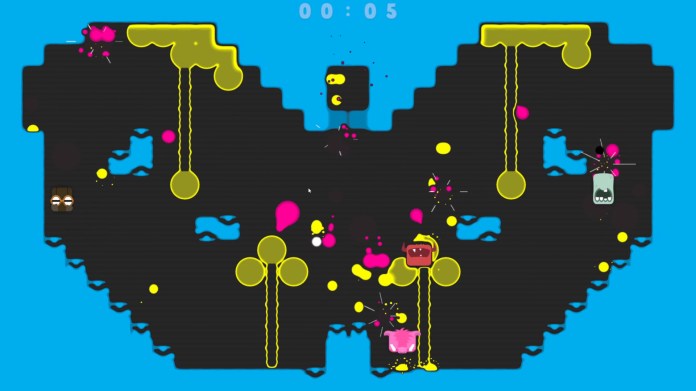
Terrifying or cute – it’s hard to decide which is a more apt description of the square-shaped protagonists of Spitlings. Regardless, in this chaotic action arcade game, you’ll be meeting a whole cast of said creatures, helping to reclaim their home from the goo-pocalypse that has ravaged it. From disgusting, fang-bearing monsters, to a literal helicopter, you can spit and slide your way across over 100 single-player levels. With the addition of local and online multiplayer, as well as a soon-to-arrive level editor, there’s plenty of opportunity to get to know each and every one of the Spitlings. Indeed, the game certainly boasts a plethora of content, but does quality match quantity here? Well let’s break down just how much fun, or how much rage, you’ll be having in this world of spitting-squares.

In contrast to previous reviews, I think it’s best to tackle the visual and audio design of Spitlings first. Almost the entirety of the game, from its UI to level design, is plastered in bold, vibrant block colours. Remarkably similar to that found in the Splatoon series, Spitlings adopts a softer visual design, with menus and HUD indicators all adopting rounded fonts and bright colour schemes. I was a big fan of this design choice, and especially due to its consistency throughout the game, there is a real sense of cohesion across every menu/level. But for me, the real standout of Spitlings is its soundtrack. It. Is. BUMPING. Honestly, I’m sure I spent every level either shimmying my shoulders or bopping my head to the music. With subtle variations to this track through the different stages, it never becomes stale, whilst simultaneously giving each level a distinct feel. Seriously, my hat goes off to those in the sound department over at Massive Miniteam. All in all, Spitlings does a fantastic job at creating a charming, vibrant and exciting aesthetic, and I dare anyone to try to claim they didn’t dance even a little bit to the soundtrack whilst playing.

Nevertheless, we know all too well that great graphics don’t make great games. But is this the case with Spitlings? Unfortunately, I would have to say it is. By no means is the gameplay loop terrible, but in all honestly, it can become very mundane, despite its best efforts to create ‘chaos’. Each level plays out the same – spit and destroy all the bouncing goo, meanwhile avoiding touching them. You can spit downwards to propel yourself through the air, or upwards to take out goo mid-air. One collision however means instant death, and you’ll have to restart over. Considering that each level is confined to a small box, having a tonne of deadly goo flying around certainly gives the impression of a chaos. The problem is, a vast majority of your deaths will come from a stray bit of goo, and so playing it safe often becomes the most reliable means of progression. This means sitting is a corner, waiting for the goo to pass into you line of sight, then spitting them out of existence one-by-one. The levels rarely require any form of strategy or skill, instead just divulging into a series of button-mashing. They do require slightly more thought later into the game, but even then, I found myself more often than not taking the safe route to avoid further frustration. As a result, aside from the odd exception, Spitlings would benefit greatly from some more unique level design. Whether the custom level editor will provide that remains to be seen, but as of right now, I have to say I was largely disappointed with the level design in Spitlings.

These problems extend into the actual gameplay mechanics as well. I found that controlling my Spitling was far more difficult than it needed to be, even with custom controls set up. This mainly stems from the fact that for a fast-paced arcade game, there are too many buttons to press. Having recently reviewed Capcom Arcade Stadium, one thing that stood out was the fact that almost every game could be played with only one or two buttons. There were some exceptions to this rule, for example in Street Fighter 2, but even then the flow between each button press feels natural and appropriate. In Spitlings however, I found myself pressing the wrong button at the wrong time FAR too often. Having to restart a level because I accidently jumped into goo becomes very tiring after the 10th time. As well as this, more a source of boredom than frustration, the ability to recharge your spit-ammo infinitely feels like a bizarre design choice. OK, having the time and space to do is a rarity, as you are often ducking and diving between bits of goo, but even having the option in the first place means there is no incentive to be careful with your shots, and ultimately facilitates the button-mashing mentioned earlier. I honestly believe either limiting or even removing this ability altogether would notably increase the challenge of each level, promoting a more strategic approach, ultimately giving the player a greater sense of reward for overcoming the challenge presented. Look, both of these issues aren’t game-breaking. The gameplay loop of Spitlings is still enjoyable, despite these flaws. However, it feels like the developers missed an essential trick when designing an arcade-style game – creating complexity from simplicity.

Unfortunately I was unable to try out the multiplayer modes in Spitlings, however on paper they do sound a lot of fun to play with friends. Having up to 4 players spitting away at bouncing goo certainly projects a greater sense of chaos than that experienced playing solo. Nevertheless, I did manage to progress enough in the story to appreciate the unique and beautifully-drawn comic book panels between stages. Only being apart of the 13% who made it to the second cutscene though (around 1/3 into the story) suggests that there is not many who have shared this experience. You are able to read this comics in a separate menu after unlocking them, and they are honestly one of the best parts of the game. They are bizarre, funny and weird all at the same time, meanwhile being drawn to perfection. Again, much like in the rest of the game, those behind Spitlings’ visual design have done a fantastic job. The story itself is nothing special, but saving your Spitling friends is a rewarding endeavour, and seeing them jump around the main menu, overjoyed with the feeling of freedom, is a nice touch.

Overall, Spitlings feels like a game created primarily by game designers rather than developers. The visual and audio design are stellar, but ultimately the core gameplay is unnecessarily complex, meanwhile creating far too many instances of boredom. If this sounds like a weird paradox, that’s because it is. Arcade games are often rooted in very simple controls, meanwhile employing the combination of various enemy types/environmental obstacles to present the player with complex and challenging levels. Spitlings on the other hand does the opposite. It is by no means a terrible game, and there is still plenty of fun to be had, but all in all, Spitlings falters at the most crucial part – having an enjoyable gameplay loop.

Review: Can’t Drive This

Would you trust your friend to stop you from falling to your death? Can they build a road quicker than you can drive? If the answer to these questions is yes, then you have the perfect partner to take part in Can’t Drive This

Developed and published by Pixel Maniacs, this single-player and multiplayer building/driving game will have you screaming at, and laughing with your friends, or rage quitting. With both local and online play, the scope to get the most out of this comedy laced game is pretty high.

So what’s it all about?

Have you seen the film Speed? Where Sandra Bullock is on a bus and it can’t drop below 50mph. If the bus slows down, the bomb that has been planted onboard detonates! That’s kinda what happens in Can’t Drive This, except there is no Sandra Bullock, the speed element isn’t as rigid and it’s a monster truck, not a bus (ok, so it’s nothing like Speed). Here I am reviewing yet another monster truck game, at least it’s not a racing title this time, like Monster Truck Championship and Monster Jam Steel Titans 2.

Everyone loves capture the egg.

Anyway, I digress. Can’t Drive This asks you to play; solo, co-op or with up to 3 other players. The latter mode is a party game of Capture the Egg (flag). Co-op allows two modes: Game of Drones and Vardage. Solo events are called Lone Ranger. Each of the options is delightfully simple and oddly addictive.

Capture the Egg.

A local game mode where two teams must race around, building a route and stealing the egg from their opponent’s base. It’s fast-paced, aggressive, and is guaranteed to create arguments. Teamwork is a must, as is clear communication. This wasn’t just about the egg, no this was about the tactical approach it takes to get the prized asset.

Game of Drones.

A small arena has two holo’s to collect. Placed in random locations, you must work with your partner to build a route, locate their position and collect them as quickly as possible. Success ensures you progress to the next level, failure will tally up your score and you will have to try again. Sounds easy, right? It is until you realise a drone is randomly dropping EMP’s on your newly laid path. If you get hit, you need to be revived. If this doesn’t happen, it’s game over.

Vardage and Lone Ranger.

These are the same, except one is co-op and the other solo. A timed event where you will set your route, grab your holo and race to the next platform. Collecting the holo gives you more time, and the further you get, the higher the score.

The burning ring of fire.

A simple concept, but deceptively difficult.

Can’t Drive This has such a simple concept that a child could attempt it. The only issue if they did, is they are guaranteed to fail. Pixel Maniacs have developed this, so no game is the same. You do not know what building blocks will be allocated, and these have a massive impact on how easy your course is to navigate. You will be given simple curves and straight tracks to lay, but then a curveball is chucked into the mix. A ramp, high speed boost section, water trap, foggy area, ring of fire and so on. Your run can be ended with a bit of bad luck, or you can somehow land an epic jump and miss out on large sections of the map.

It was brilliantly infuriating and stupidly addictive. You die for the nth time and chuck your controller down, just to scream, “I want one more try!” You die again, bite your lip with rage and hit restart. Its simplicity makes it work so well, yet I wish it had more content and more game modes.

Basic 3D models and a bird’s-eye perspective.

The combination of two perspectives may confuse and annoy some gamers, but I liked how easily the action flitted from bird’s-eye to third-person. The basic imagery and cool colours made this very easy to look at. The simplicity is in line with the indie theme and is more than adequate for a game of this quality. The cinematic used in the tutorial was reminiscent of a 40s movie, with large in your face icons, and a grainy finish. I liked the whacky presentation, and it went hand in hand with the loud and funny acting.

The comedy flows through every inch of the voice-over work and all the tutorial videos. It’s always a bit of a gamble when you try to add humour, but I think the developers got the balance about right. The childish theme carries on with upbeat music and loud sound effects. The truck has a nice engine roar, and explosions had a good depth. Overall it’s at a standard which I expect, and there were no unpleasant surprises.

Leaping to a fiery death is never good.

The gameplay is tough, but playing it isn’t.

The straightforward and clear message from the tutorial makes this very easy to pick up. The driving action is smooth and responsive, as is the building mode. Rotating each piece is completed with the bumper buttons, and the only stress comes from the ticking of the clock. Gamers of all skill sets will enjoy this, though real progress will only be made by those that are both lucky and skilful.

I enjoyed my time with this, but worry about its longevity. When a game relies heavily on a multiplayer option, you need a good bunch of friends who want to play it regularly to keep things going. If the developers looked to add more solo modes, custom options for track pieces, or different vehicles, I think this would help the lone player want to return. A tough achievement list requires every mode to be played thoroughly, so if you wish to gain the 100% status, you’re going to have to keep playing for some time.

I liked it, but it lacks depth.

Can’t Drive This is a fun little title that can be enjoyed casually. It’s easy to pick up, but tough to progress. The multiplayer modes are good just as long as you have friends who wish to keep playing. With a lack of solo modes and not as many custom options as I’d like, this somewhat lacks depth. Even with these drawbacks, I recommend it and you can buy it here! An enjoyable solo and multiplayer game where a calm head and great communication help you to the highest score possible. 

Review: The Outer Worlds – Murder on Eridanos DLC

It feels like a very long time since The Outer Worlds became one of my top games of 2019 and I was very eager to get more to experience with the two planned DLC drops that would add to the story but playing through “Peril on Gorgon” in 2020 left me very disappointed with an experience that was very much the opposite of how I felt completing the main storyline in DLC that felt like an extended side quest than a full expansion as I had hoped. Now here we are in 2021 and the final chapter of The Outer Worlds is being told with the last Story DLC ‘Murder on Eridanos’ and whilst the trailer had full on 1940’s Noir vibes to it, I still had my concerns and sadly, those concerns were right.

My main issue with this DLC and ‘Peril on Gorgon’ is that due to the nature of how the main game ends, the only way to play the new DLC is to return to a save game before the big finale to the story which means reverting to a lower character level with perhaps different weapons and skills to what you had when you completed the game. There is also the time between playing this new DLC and the last one and honestly forgetting a lot about how my character plays both in abilities and builds so was a little jarring picking the game back up again.

For this DLC it is recommended you have a level 30 character, which if you have completed the main story and the last DLC you should be and being able to just continue from the point you left ‘Peril on Gorgon’ is a lot better than rewinding your experience to before you completed the game. That requirement gave me hope that this DLC would have some challenging combat which was lacking in the previous DLC and the chance to pick up some new weapons is also good but only if you have yet to finish the main game or play to replay the ending after finishing this DLC.

This DLC unlocks the final planet on the map, Eridanos and you, the player, are called upon to become an “Inspector” and given the task of investigating the murder of the most well-known celebrity in the Eridanos colony, Halcyon Helen. With little to go on and arriving at Eridanos with everyone being a possible suspect, you must find clues, pull on threads and see if you can find out who and why she was murdered. The trailer was fantastic and I would have loved to have played this entire story in a black and white style detective style but like much of this DLC, I was to be sadly let down.

Eridanos is perhaps the most visually delicious location of all the worlds in the game so far, a true paradise consisting of floating islands connected by light bridges. It really is a beautiful environment to be in which is handy because this ten hour or so story chapter will have you walking/running or fast travelling back and forth a lot around Eridanos and I am not kidding, there is a lot of walking to various mission way points which after an hour can get very tedious indeed. Enemies are mostly what you would have encountered before so none of them will actually prove any threat to you or your companions throughout, perhaps why the recommending Character level is so high at 30 just to make sure any combat is simply brushed away so you can focus back on the murder mystery.

A Murder Mystery is exactly what this DLC is and no sooner as you arrive on Eridanos then you begin meeting characters who all have a stake in the success of the Colony which has been deeply impacted by the death of Halcyon Helen. Ploughing through the many dialogue trees you will have with characters; more suspects and locations will then be revealed giving you more people to talk to and investigate. So much of this DLC is just this, talking to people and reading dialogue responses and reading messages and emails on computer terminals in order to piece together what happened and who might be responsible. Talking to a character will lead you to investigate their alibi or relationship with Helen and I actually did enjoy the writing and voice acting performances for the varied characters you meet during this DLC.

The problem for me is the pacing of this ten-hour adventure and even if you give allowance for the fact that this is just a murder mystery adventure, it just needed something more than simply talk to this person, be told to do something/go somewhere/bring this to me to keep the excitement alive. Even as you progress on a quest you will end up being asked to do a short side quest for someone else on Eridanos that never feels like it was worth doing or connected to what you need to do in order to solve the crime. Just being at level 30 or higher makes the combat rather dull and boring if you have built your character up at that point which is disappointing considering this is the last DLC for The Outer Worlds, it just fails too really…. “Go big”.

The story is fun but there is so much emptiness around doing the main storyline besides doing a lot of talking and a lot of reading. Like Peril on Gorgon, this is more DLC that would probably work better if you the player, are actually playing this before knowing the ending to the main game because other than levelling up a few levels, my own character never really benefitted from this little side excursion. I never found armour or weapons higher or better than what I had when I started the DLC and that was why the first DLC fell flat. If I was to start a new game and character than this would be great to do say midway in the original campaign playthrough, but having to rewind to use an earlier version of my character that really benefits in no additional way from playing the DLC nor do the ending(s) to the main story change as a result of having both or one of the DLC stories to complete just left it a flat experience and it certainly at no time feels like the send off content The Outer Worlds deserves.

Which is ultimately why neither DLC really reached the same fun and enjoyment of the main game. Murder on Eridanos feels like a side quest than an expansion with the character level requirement quite frankly far too high to make anything here a challenge for the player, it is really just something else to do. Even the fact that the detective work revolves around using a special device called the Discrepancy Amplifier but this only serves to do all the investigative work for you. When you are near a clue it will warn you then bringing up the Discrepancy Amplifier will make it scan, analyse and then tell you what this clue means which makes it less of a murder mystery for you to solve than a murder mystery tour until the point you feel like you want to accuse someone of the murder.

For me, this is a very disappointing farewell to one of the best RPG’s in recent years and neither DLC managed to reach the same level of fun as the main game and because of how the ending to the main story is so complete, having to go back to a point before you finished the game to for the DLC’s is a little bland. This just never feels like the Final DLC the game or fans hoped for or the original playing experience needed.

Superstar Acts Join Guild Esports’ First Online Gaming Festival

0

Guild Esports, the global esports organisation co-owned by David Beckham, is proud to announce an elite line-up to join its first Super Stream Sunday – taking place on the 28th March, 5-10PM GMT on Twitch & YouTube. Super Stream Sunday is Guild’s first online gaming festival – where headline names will compete alongside its roster of professional gamers and content creators.

Topping the lineup is Tom Grennan & Conor Maynard. Tom is fresh off the back of a first number one album, two singles in the UK top-40, and a string of sellout shows announced across the UK. Conor is a world-renowned performer, most recently seeing rapid success on YouTube and being granted a Diamond play button for 10 million subscribers. 

The big question is – can they handle the heat of competitive gaming?

Self-confessed FIFA fanatic Tom will not only be testing his skills alongside the best in the business in Guild’s professional athlete Niklas Raseck, but he’ll also be competing with prince of grime Yizzy. Yizzy continued his rapid rise to fame last year with his aptly titled track ‘Grime’ with the critically acclaimed JME, and also made a track for Guild to mark the launch of its first lifestyle apparel line.

Meanwhile Conor will be battling it out for Rocket League bragging rights alongside leading streamers and entertainers Randolph & Nathan Dawe. Rapper Randolph is known for his passion for all things gaming, while Nathan most recently collaborated with Little Mix on the smash hit ‘No Time For Tears’.

They’re joined by the multi-talented Talia Mar, who will take part in the variety gaming segment of the show. An established singer, YouTuber & content creator, and rising streamer, few have seen the range of successes that Talia has. Alongside her will be rapper and cultural icon Big Zuu, who has recently taken his talents outside of the studio and into the kitchen with his first book launch and the hugely popular TV program ‘Big Zuu’s Big Eats’.

Hosting the variety session will be Guild’s very own Gee Nelly, leading streamer and content creator and founder of the Nelly Nation. Gee is best known for her variety gaming streams and interaction with her loyal followers. Also taking part in the session will be a host of other creators, including Harrie, SnowMixy & Niki Nihachu. Niki’s success in the scene has seen her gather nearly 1.5 million followers on Twitch. 

Meeting them there will be leading entertainer and streamer Harry Pinero. Harry will have to keep up with Guild’s recently crowned #1 EU Fortnite Team as he tests his shooting aim in the Fortnite section.

The stream will be broken into hour long segments, each with a different host and guests.

Yizzy commented, “No one is doing things like Guild at the moment. They recognise how culture crosses over and comes together – from gaming, to music, to entertainment. I’m looking forward to testing my gaming skills against some of the best players in esports, and linking up with other talented performers”.

With something for everyone, Super Stream Sunday is an event you won’t want to miss! Come and drop in from 5pm GMT on March 28th at twitch.tv/guildesports

#WeAreGuild