Review: Phantom81 Lite keyboard

The Phantom81 Lite keyboard from KiiBOOM is truly stunning! Though the cute look may not appeal to everyone, it has 4 unique colourways. I selected the green finish with the Rainy Froggy Days keycaps. This wholesome design is eye-catching and a conversation starter.

This 75% form factor peripheral is ideal for smaller workstations. Additionally, it has FN macroing for full functionality. Moreover, it is a tri-mode device for enhanced versatility. Accordingly, it is perfect for gamers, office workers, or anyone who commutes. 

What’s in the box of the Phantom81 Lite keyboard?

  • The packaging is attractive but understated. It can be recycled, and the contents are well packaged. 
  • The Phantom81 Lite keyboard has 79 keys. Furthermore, the build quality is impressive, and I adore the clean and colourful finish.
  • A USB-C cable charges or connects the keyboard. 
  • The USB dongle is used for a wireless connection. 
  • Spare keycaps, switches, and a keycap puller are provided. 
  • Learn the basics with the user manual. 

Technical aspects. 

This keyboard utilises Bluetooth 5.0, 2.4 GHz wireless, and wired connectivity. The result is a versatile device that has a stable and reliable connection. Polling rates of 1000 Hz and 125 Hz can be enjoyed through either the wired or wireless approach. Alternatively, the lower figure can be achieved when using the Bluetooth functionality. Subsequently, this should be reserved for offline gaming or work-related tasks.

The single 4000 mAh battery offers impressive one-charge power output. You can observe the power loss with the handy RGB lights. If you run out of charge, you can continue playing wired or take advantage of the quick charge facility. This is great if you love to pump up the RGB lighting, but you have a woeful memory. 

Usability. 

Customising inputs and your lighting is a must for many gamers. Thankfully, you can adjust every setting with ease. The QMK and VIA compatibility lets you create the keyboard of your dreams. Consequently, you can design profiles for different genres to get the best out of your peripheral.

Additionally, you can hot-swap the switches if you prefer to do so. The KiiBOOM Mochi Switch is a joy to use. It is responsive, comfortable, and has a fine actuation distance. As such, it complements the style and is perfect for gamers and office workers.

Flitting between Bluetooth settings was a walk in the park. The Phantom81 Lite keyboard can seamlessly switch between 5 compatible devices. Furthermore, it will connect to Mac or Windows-based devices. Changing the Bluetooth profile was a cinch, and connection times were practically nonexistent.

Build quality. 

I was absolutely blown away by the build quality. Every element of this keyboard looks and feels great. The rounded casing was a pleasure to hold. Moreover, the MOA keycaps were a joy to type with (Cherry profile keys are available as well).

This keyboard stands out from its peers! The ABS moulding and UV finishing protect the livery from fading and becoming scratched. Moreover, it makes the colours richer and more vibrant for an eye-catching finish. Each of the keycaps has a stunning level of detail. These durable keys resist staining and damage and will last the test of time.

Finally, the Phantom81 Lite keyboard has a beautiful audio profile. A combination of different damping materials generates a lush and pleasant clicking sound. Moreover, the gasket-mounted structure combines rigidity and flexibility for the ultimate user experience.

Is the Phantom81 Lite keyboard worth it?

I’ve tested some amazing keyboards, and the Phantom81 Lite keyboard is up there with the best. Though it isn’t as technologically advanced as some of its peers, it delivers on every key aspect. Furthermore, it is customisable, comfortable, and truly beautiful. Accordingly, it is amazing and I recommend buying it here!

(More information on KiiBOOM can be found here!)

The Phantom81 Lite keyboard has been awarded the Movies Games and Tech Gold Award.

(Full disclosure! A sample was provided for an unbiased and free review!)

Review: Giant Machines 2017

0

Giant Machines 2017 is a heavy machinery simulator developed by Code Horizon. The game puts you in control of some of the world’s largest machinery in order to complete different tasks given to you by your unseen, slightly humorous, mispronouncing, southern-drawl boss. The gaming industry is no stranger to these realistic simulation games and Giant Machines fits the mold in that it does some things right and some things…which could be improved on? Ok, some of the game elements are just plain bad. I’ll divide this review into three sections: The Good, the Not So Good, and Just Plain Bad because, unfortunately, Giant Machines misses the mark in a lot of ways.

The Good:


What Giant Machines does well, that some of the larger simulator games slightly miss on, is the realistic accuracy of the machines. With the word “machine” in the name this is to be expected I grant you, but given how generic the rest of the world is in-game it is a nice surprise. That being said, while this is a “good” feature of the game there may be a reason so many simulators simplify heavy machinery: quality of life. But we’ll save the downsides for the next two sections. Giant Machines details the machinery you work on and operate down to the fuses and hydraulic lines. Another good feature is that while the number of different machines may leave something to be desired, the variety most players want is there: bucket-excavators, behemoth dump trucks, dozers, cranes, and even the crawler-transporter for a space shuttle.


The Not-So-Good:

There are a variety of elements that may bring Giant Machines down a notch in many players’ eyes. That’s not to say everything listed in this section is unforgivable, just from my personal experience playing the game there are a variety of annoyances. For starters, the movement is very clunky. Whether you are walking or driving there seems to be a good bit of drift along with some lag in certain areas. While this is not a deal breaker there are some pretty technical challenges you have to navigate through where precision is crucial. Another point against the game, for me, is the audio. When you are walking all you hear are your own clunky steps (until you have to put the hazmat suit on and be treated to a forbidden CPAP machine noise coming through your TV speakers) and when you are driving all you hear is the current radio station. I have not found a way to disable the radio, other than the audio settings themselves, so while crawling along with a space shuttle that is threatening to fall every…single…second you have the options of listening to Ave Maria, elevator music from the Fifth Element, or “Dr. Gore 2000” on “Angry Radio.” Again, some players may find that music helps them concentrate however this was not the case for me. That being said, it did spice up those super long runs you occasionaly have to make with a machine whose speed tops out at a blistering 4 km/hr.

Just Plain Bad:

The bad points of this game do seem to outweigh its strengths, unfortunately. There is no real tutorial. Most challenges seem to be pretty common sense, however the game does rely on the player to be a bit familiar with machinery in general. There are numerous ways to “fail”: fall off from too high a point and die (I did say it was a realistic simulator), damage the machine, run out of time on certain missions, and/or damage the cargo. You do start back at your checkpoint though so no real damage other than frustration. The machines themselves are, as the title states, giant. A lot of the gameplay is just you traversing the many staircases of these huge machines (hopefully the right staircase) and finding components to interact with such as battery compartments, fuses, etc. They begin to feel akin to 8-bit dungeons in a sense and most of the time, not in a good way. The story is pretty linear: mining ore, transporting ore, clearing snow, loading radioactive materials, and finally launching a space shuttle? Yeah never mind about the plot, the point is you are completing tasks in a linear “sense” with a final goal in mind. However, with the linear comes the monotonous: between each “stage” you are going to be transporting the material, fueling up the truck, and outrunning tornadoes. Yep. Tornadoes. It’s a bit weird at first, but when it happens again it just feels, well, lazy. Also, the quality of life is boiled down to just giving you life. This game would have been greatly improved with some of the simplifications common in many modern simulator games. Just the Farming Simulator element of switching between vehicles/operator positions with a button would have went a long way. However, if many quality-of-life changes were implemented, the already very quick main story would be approximately 50% shorter. Yeah, there’s a lot of “fluff.”

In conclusion, I have to give Giant Machines 2017 a solid five. The concept is great, the machine execution is great, and the music…is terrible (sorry, couldn’t resist another dig at that blasted radio). The game has the bones of a good game, but it falls quite short in polishing and quality-of-life. It really seems like the storyline was halfway through, the mechanics/physics were 75% there, the machine animation was completely finished, and they decided to go ahead and publish. Would I play it again? Probably not. Would I give an updated version or possible sequel a chance? Yes.

Review: Misc. A Tiny Tale

Misc. A Tiny Tale is a bright light in a murky gaming world. It is heartwarming, wholesome, and a joy to play. Each chapter is compact and fun to explore. Moreover, the story is silly with a familiar twist. As such, this is the perfect title for gamers of all ages and abilities.

Tinyware Games developed and published this 3D adventure title. It is a single-player affair that has platforming and mischief at its core. Additionally, there is a sense of environmental dynamics as the hero scrubs and cleans every world. 

Misc. A Tiny Tale will make you smile. 

I love a cheeky story. Thankfully, Misc. A Tiny Tale keeps you hooked with its bite-sized instalments and amusing tidbits. The plot revolves around 2 wild robots. Buddy and Bagboy are determined to spread joy wherever they roam. This infectious pair will stop at nothing to help everyone and everything they encounter. However, there is a dark twist as a naughty robot tries to ruin the fun.

The story is silly but great. Furthermore, it flows at a wonderful pace. The central elements are nicely juxtaposed by each side quest. Consequently, you are pulled in every direction as you attempt to help every robotic citizen. 

Simple ideas. 

Each chapter asks you to find up to 10 golden cogs. 8 are required to open the broken gateway and exit the chapter. En route, you’ll find discarded nuts. These are essential as they are the currency of the robotic world. Additionally, every piece of rubbish can be recycled to earn more money. 

Though the ideas are simple, they are nicely presented and work well with the puzzle elements. Alongside this, there are some parkour challenges to add depth to the story. Though they can be ignored, you really shouldn’t. The platforming elements are tight, and overcoming every obstacle was enjoyable. 

Misc. A Tiny Tale looks lovely. 

The developer has done a great job with the graphics. The rich colour palette adds to the wholesome edge. Furthermore, the robots are unique, and their animation and odd facial expressions will make you smile. Though the stages are relatively small, the level design is interesting. The 3D elements work well, and you’ll search every nook and cranny to find collectables. 

The audio is upbeat but not overbearing. Each joyful track is punctuated by silly sound effects. The result is a game that captures your imagination without being annoying. 

Decent controls. 

I admit that I prefer a gamepad. However, Misc. A Tiny Tale works well with a mouse and keyboard. The basic inputs are easy to follow, and the tutorial explains every core element. Moreover, the platforming moments are tight, and a handy shadow allows you to judge each wild jump. 

Replay value and longevity are questionable. If you are not a completionist, you will not return for more. Yet, if you love searching for every collectable, you’ll be kept busy for hours. Finding every cog isn’t an easy task. Subsequently, there were some head-scratching moments.

Misc. A Tiny Tale is a great indie game. 

If you adore a relaxed, amusing, and joyful platforming game, then Misc. A Tiny Tale is the title for you. It is colourful, fun, and easy to play. Furthermore, the story is great, and you’ll love the charming characters. Accordingly, I adore it and I recommend buying it here! Can you spread joy to every robot? Find the cogs, clean up the mess, and watch for that crazy robot.

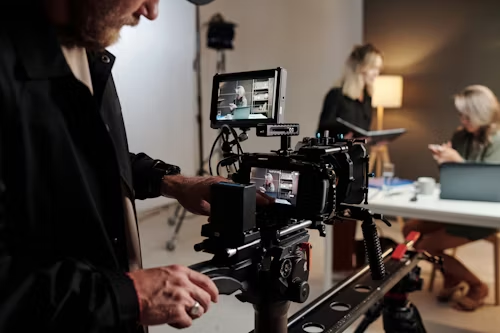
What are the costs of creating a ‘short film’ movie?

0

Filmmaking is costly, and this is the case even for short films. The overall cost of making a film is contingent on many different elements. Generally, depending on the film, it can cost anywhere from $500 to $50,000, and up. Let’s take a look at the breakdown of the costs associated with making a short film.

Pre-production costs

At the outset, this is where all the preparation for the movie is key. Typically, this is around 10% of the overall budget of a short film. It needs to include looking for locations, getting insurance for the film and any workers, and finally in finding the talent for the film be they the actors, writers, or even director.

Getting into production

This is often around 30% of the overall budget and is the initial main section — i.e., it’s when the movie is actually filmed. For this part, you need to factor in the cost of all the equipment, compensation and pay for the crew, and costs for being on location and filming.

After the camera has rolled

Post-production is typically also around 30% of the budget, and a ton of work gets done at this juncture as well. It’s where the crafting of the movie actually takes place. Here you need to ensure that the movie is edited properly, sound mixing is done efficiently and effectively, with color sorted, digital effects added and so on.

Getting it out there

Finally, there is the distribution and marketing phase. Often, this is overlooked, but marketing can be one of the most costly parts of making a film, even a short one. Usually you’re looking at 20% of the budget being spent on marketing, getting the film out there and noticed. This can include the costs of getting the film into festivals, general publicity, and even the creation of short trailers.

Once all this has been laid out, you need to add a contingency fund of 10% to the budget for when things go over. All of this should be carefully planned and noted, which is where the best reporting software can be useful for keeping track of expenses and general finances.

Further considerations

There are some numbers that can be outlined here too. Generally, if we factor in inflation, short films cost around $700 to $1500 per minute of screen time. So, if the film is ten minutes long, then you should be thinking of a budget running from $7000 to $15,000. Depending on the quality, cameras are around $350 per day, and lenses can be as much as $150. It’s essential to have good sound unless going for a silent film. With sound, typically, you’re looking at $200 per day of filming as well. Editing is very costly, with editors commanding prices from $500 to $1500 a day depending on their expertise and experience. Similarly, upper-end sound design can set you back $1000 a day.

All of these costs will differ depending on the location of the film, how available equipment is, and the requirements of the project itself. As such, careful research is needed to get specific quotes that actually meet your project’s needs. An accurate budget is crucial if you want proper funding and to get your movie project off the ground.

If the budget is potentially getting out of hand, then you can also consider cost-cutting strategies to help you save. For instance, instead of purchasing, rent the equipment. Renting means that you get insurance, protection and even guidance when it comes to the tools you’re using. However, if you plan on making regular short films, then some items are good to have permanently in your arsenal, saving you some costs for a future project.

While it may be tempting to have a large crew, careful crew selection can mean both efficiency and budgeting. Generally, a solid team of 5-7 professionals can accomplish the same thing as a larger, less-polished team. Make sure your team includes a director, cinematographer, production designer, and sound recordist as a starting point. The best team members will be able to operate and contribute across many different film sectors.

Where to get funding

Armed with your budget, the next step is to find the money. Depending on your network, a good place to start can be a crowdfunding platform such as Kickstarter, which is great for getting artistic projects and short movies off the ground. Being prepared is essential though, and a strong support base is needed in advance of the actual shooting. Grant opportunities and product placement can also be beneficial.

Review: Tony Hawk’s Pro Skater 3 + 4

Five years after the successful launch of 1+2, Tony Hawk is back again with the return of Pro Skater 3+4. Is this remake a faithful retelling or should this legendary franchise have been left in the past?

Blast From The Past

If we cast our minds back to 2020, Vicarious Visions had just released Tony Hawk’s Pro Skater 1+2 to enormous success, with a faithful and fun remake of the beloved games. To my dismay, after this success, Activision decided to merge Vicarious Visions into Blizzard and cancel development of THPS 3+4. I feared this would be the end of a gaming franchise I grew up playing on the PS1 but thankfully Activision reversed course and tasked Iron Galaxy with restarting development. What an inspired decision that turned out to be! THPS 3+4 absolutely rules!

Remarkably, despite the cancellation and the change in developers, THPS 3+4 maintains the look and feel of THPS 1+2 along with the same streamlined design and structure. Like the previous collection, both games included in this game act as two separate campaigns in terms of the levels and maps but the overall user xp experience and stats are shared over the two games. If you have played THPS 1+2, you will feel right at home. All the levels from these classic games have been rebuilt from the ground up and animations have been modernised, but at its core, they are still the games I grew up with, for the most part. You have a two minute timer on each level to complete specific goals to the maps whilst gaining all the skate letters and high scores, an absolute blast as always. Foundry remains the seminal map you remember and the best introduction to a Tony Hawk game ever. Airport and Canada remain some of my all time favourite levels in THPS3 to rip high scores and clear the gaps.

There are some changes to THPS 4 that I feel you’ll either love or hate. The original THPS4 had open-ended levels where you interact with NPC’s to gain missions and challenges. This has been replaced with the two minute timer from THPS 1,2 +3. For me, this is a welcome change as I love the challenge of the two minute timers to master each level but for purists of the original, this may frustrate and anger you. There are also three new maps added to THPS4: Movie Studio, Waterpark and Pinball. These new additions are solid maps but don’t feel as memorable as the originals. Perhaps I’m a victim of nostalgia here; they don’t capture the same feel but Waterpark is easily the best of the three. Overall, the content available at launch for THPS 3+4 is absolutely fantastic with online modes and create a park added, as in the previous game.

At Least In Heaven I Can Skate

Similar to the campaign modes, THPS 3+4 follows the same gameplay design and concept as THPS 1+2, because why change something if it works so well?! This is still the golden recipe of Tony Hawk games, attempting to piece together a scintillating combo of tricks and jumps across different environments. Perfecting a Hard Rail Grind, performing a sick 540 Christ Air or just a simple Ollie feels so satisfying that it’s magical at times. I could skate around these maps all day long just performing combos and having fun; it’s downright therapeutic. The C-O-M-B-0 challenges and goals have been added to more maps, which is great to make them even more challenging. As with all THPS games, it’s a case of a game that is very easy to play but hard to master.

The roster of skaters returns from the previous game with some additions. There are 31 professional skateboarders who form the bulk of this roster which is the largest in series history. There are also some fictional characters added in such as Officer Dick (Voiced by Jack Black), and even the Doom Slayer appears this time! And yes, Bam Margera returns as a special skater after intervention from Mr Hawk himself. As is common in the series, each skater has unique stats and combos, making replay ability options virtually limitless if you want to master every single skater. The challenges and tours for each character also act as further difficulty spikes for players who are seeking the ultimate skating experience.

There are some new quality of life changes from the previous games that are very welcome and much needed. The Create-a-Park editor has been updated, allowing players to create their own goals for their levels. This gives user levels more purpose, whether it’s adding letters to collect around the map, completing combo goals or doing some smashable challenges. The editor updates don’t stop there either as you can also add death pits which force you to spawn back at a specific point, some boost jumps and pads and even aggressive NPCs. Iron Galaxy have excelled in polishing and honing the work Vicarious Visions had made, whilst innovating and adding superb updates and QOL, making this a brilliantly polished package.

Left It Back In Naughties

In terms of its visual presentation and animation design, skating has never looked or felt this good. Ever. Each map across both THPS 3+4 look absolutely phenomenal as they have been remade from the ground up. Cruise Ship particularly with the vibrant colours of the hull, blended with the gorgeous visuals of the sea behind you, is mesmerizing. Every map you remember from the original games still has the same geometry as it did before but now, they shine with jaw-dropping visual fidelity and lighting. Everything just looks and feels so much more full of colour and life. Of course, they have removed some of the more problematic aspects of map design; the Neversoft girls on the Cruise Ship and the gun shots heard in LA are no more. Along with the visuals is great character model design for each of the pro skaters, making every pro look almost lifelike. Animations are top tier, which is needed for a fast paced game like this and Iron Galaxy have delivered, with lifelike animations showing each pro or character performing wonderful stunts and tricks. It’s a real visual treat.

In terms of its sound design, THPS 3+4 delivers with superb design as you hear the skateboard scrape, clip and land on different surfaces, to great satisfaction. All the classic sounds are present, such as picking up tapes or letters, which makes this a real trip down nostalgia lane. Now, let’s get to the most controversial part of this remake – the music. Whilst there are some returning tracks from the original games, the vast majority of songs have been left in the past. There are only six returning tracks for THPS3 and amazingly only four for THPS4. This is a travesty of the highest order for someone like myself who adored the original tracks. Not having Alien Ant Farm’s “Wish” or ACDC’s “TNT” just hurts my soul. Activision and Iron Galaxy have done a commendable job crafting a updated modernised version for this remake with over 59 songs making up the soundtrack across the two games. Sadly, it doesn’t have the same nostalgic effect as the rest of the game does. A damn shame, but have a look for your self: https://open.spotify.com/playlist/37i9dQZF1DWU4xkATYcbh7?si=7rWgcnqtTfaR5vAMGEnLVw

Verdict

Tony Hawk’s Pro Skater 3+4 is another triumphant return to a franchise dear to my heart. Superb campaigns remade in glorious visuals and a streamlined user experience help make this collection the definitive pro skater package. Whilst the changes made to THPS4 may upset some purists, this is still, for the most part, the games I grew up with fantastic modernised controls and gorgeous visual and animation design. Of course, the glaring omissions in the soundtrack soured my experience to some extent, but thankfully, not terminally. In an era of remakes or remasters, you can place this one squarely in the remake category. A fully remade game from the ground up. Tony Hawk Pro Skater games give you a little slice of nostalgia and they’re just downright fun!

Review: The Drifter

If I had a penny for every point’n’click game this year that revolved around people going backwards in time and the consequences thereof, I’d have two pennies. While Old Skies was a moody look at the regrets of our past lives, The Drifter is more like sinking into a freezing cold bath, in the knowledge that things are going to get worse before they get better. It’s a horror game, is me point. One that thoroughly enjoys smacking about its central protagonist.

Not that it doesn’t touch on deep themes. Much like Old Skies (and I promise this is the last time I compare the two), regret is a major theme. After all, I suspect the whole concept of time travel was born from the desire to fix or erase past mistakes, or plaster over old heartbreak. It’s fertile ground for a horror game. The Drifter sprinkles it with an excellent protagonist and serviceable, occasionally exciting, gameplay.

The Drifter

Boxcar Mishaps

If you just glance at the pretty, animated pixel art and point’n’click trappings of The Drifter, you might think you’re in for an experience like the old Sierra adventure games. Well, until you look at the above screenshot anyway. The Drifter opens with our protagonist, Mick Carter, waking up on a boxcar, having returned home for his mum’s funeral. Already, a gloomy start. Then, when he wakes up another drifter to try and escape the car, a bunch of goons in tactical gear shoot his companion dead. He stumbles his way into the sewers, but a chain of events ensue that result in him getting chucked into the reservoir and left for dead.

Then something strange happens. He drowns, but at the moment of death, he’s brought back to life with a jolt – right at the moment he’s dropped into the water. That’s the time travel bit. From there, Mick is framed for the death of another drifter and goes on the run, while trying figure out what’s given him this power, and why it’s turning his brain to scrambled egg. The Drifter has a great story, full of a sense of creeping dread in the first half, where Mick begins to question what’s real and what isn’t.

It does risk getting a bit up itself in the latter half, though. There’s rather a sudden shift of tone, where we go from being locked up by a serial killer to bumbling around a futuristic lab. The ending does bring things back, though, and it works because it’s anchored to Mick. It’s a testament to both the writing, and the excellent voice acting on display. Mick isn’t just a passive observer. He has his own past demons, which he ran from, and his own beliefs. He also isn’t shy at telling people to piss off if needs be. Critically, while he can be funny, he doesn’t just spew glib remarks. He feels like a real person, in a distinctly unreal situation.

The Drifter

Rewind’n’Click

Mick’s also fantastic at cobbling together complex solutions from random assorted junk, making him the perfect protagonist for a point’n’click. The Drifter follows the basic setup for such a thing. You have a problem you need to solve. Say, you need a map of a graveyard. So you pick up every piece of junk around to try and solve it. Like lobbing a brick through a window so the alarm goes off and you can steal a glance at the code, then unlocking the door with an umbrella. You know, normal things that people do every day.

To be fair though, The Drifter is more grounded than most. It deliberately gets away from the ‘moon logic’ of others in the genre. This is a double edged sword though. There are no rubber chickens with pullies, which is good. You can intuit most solutions from what’s scattered around. The flip side is that a lot of standard puzzles feel like busywork. At one point, we boot up a PC to find the hard-drive has been taken. We then visit a stranded car, which has the requisite HDD in its glovebox. The story can handwave it away, but it’s awfully convenient.

A few too many puzzles don’t require brainpower, just mooching from place to place. But, in key sections, The Drifter does something I thought impossible. It makes point’n’click games exciting. There are moments when you’re solving puzzles against the threat of sudden death. Like the reservoir bit, where you have limited time to figure things out as Mick frantically narrates his own impending doom. The time rewinds do take the sting out, but the panicked music and Mick’s frantic monologues go a long way. The solutions are never amazingly complex, but the sense of immediate urgency jams my brain up. I start trying silly things. It’s a great trick.

The Drifter

The Drifter – Wonderfully Loopy Writing

I keep coming back to the writing. It’s easy for a game about time travel to get a bit self-absorbed. The Drifter gets close. The back-half of the game descends into chats about the science of time travel, and paints away the horror in the first half as hallucinations. It’s saved by two things. Firstly, a great ending that brings all that horror back in. Secondly, the characters are all well written. Mick’s ex-wife, Sarah, for instance, is great. Furious at Mick for leaving, but human enough to know that now is not the time to twist the knife.

The Drifter‘s plot only works because the individual pieces are high quality and all fit together well. The voice acting is stellar, the writing handles the loopy subject matter well ,and the gameplay manages to be nice and exciting. Even the pixel art is fantastic. Though if you’ve read my reviews before, you know that’s my weak spot. Realistically, the only issue with The Drifter is that paring down the point’n’click madness exposes the holes in the genre. A minute issue. If you can ignore that, you’re left with an interesting and exciting adventure game, that enjoys dropping ice cubes down the back of your neck.

(The Drifter‘s Steam Page)

Review: Yaoling: Mythical Journey

Yaoling: Mythical Journey is a charming fantasy RPG developed by RAYKA STUDIO, coming back for a second game release since Prime of Flames released in 2022. The game centers on catching creatures known as Yaolings, sending them into battle, and building your team from one starter Yaoling to a whole team with unique roles, stats, and abilities. The game and its signature Yaolings share a lot in common: both are cute with a lot of depth in certain areas, but can feel like something crucial is missing.

A Beautiful Land of the Ancients

The first thing that I noticed when playing through the game was the overall presentation. The art style is soothing and is an immediate hook for anybody that sees gameplay of this game. The colors all pop, and walking into a new area and seeing all the environments gradually change in front of you is a true delight. It helps that the score of this game really leans in on relaxing music throughout the world. It makes the rest of the game feel incredibly cozy, like this world is all lived in and all the Yaolings you’ll come across can be lifelong friends with a little bit of help. The design of the world lends itself to all sorts of secrets. I was impressed at the overall size of the map when I first opened it, and that’s when I knew that this world would have a multitude of hidden spots, with their own rewards. It helps that not too long into the game, you get access to Spirit Vision, which allows you to see any collectibles or chests you could be missing. The Land of the Ancients is all sorts of vibrant, with multiple towns, NPCs, and side quests the NPCs can provide.

Yaoling Fever!

Yaoling are how you fight in this game. You pick a starter Yaoling and are then quickly off to fight wild Yaolings, capture Yaolings, and fight trainers who use their own team. Combat in this game is an auto-battle, which means most options you have in regards to combat comes in preparation. What makes a well balanced team? What abilities work best for each Yaoling? In the auto-battle, you can also use charms to switch the tide of battle. Charms can do all sorts of things, from dealing elemental damage, healing your Yaolings, and many other unique effects that can change up the battle. While this sounds all great in theory, I personally couldn’t get attached to the battle system. Fights always felt too easy, and when I’d lose, I would win on my second try just because I slightly tweaked my Yaolings and used more charms. The level design of the fighting arenas also don’t help, as most of the time they feel rather bland and don’t encourage any type of real strategy. There’s depth in certain aspects of the combat, mainly in diverse party builds, but the core of the gameplay feels like there’s something missing. Just one or two more things and I could see myself sinking many more hours into the most optimal team build that pulls off crazy damage ratios, but instead I’m left with a gameplay system that is fairly fun at first, but over time becomes fairly boring, simply because it’s too easy and too predictable.

An Epic Journey that Falls a Little Flat

Yaoling: Mythical Journey is a game that divided me. There’s so many positives that made me really hopeful that I would love this game. It’s a game that I could see many people loving due to its world, character designs, and art style. I love those aspects of the game as well, but the general gameplay loop left me a bit on the bored side. There’s potential to be had in the system RAYKA STUDIO made, since I love creating character builds in RPGs and experimenting with all different ways to damage enemies effectively. I just wished that the game challenged me into making those builds. There’s also a general lack of polish within the UI and the text that simply could use some cleaning up. I’d want a game so tied to a mythical world to have good fonts to immerse me even more, but I’m left with a generic font and typos sprinkled into the dialogue. Overall, Yaoling: Mythical Journey is a decent game, I just wish it pushed itself even more.

Review: Architect Life: A House Design Simulator

Have you ever watched a home makeover show and thought, “I could do better than that”? Well, Architect Life: A House Design Simulator hands you the blueprint, the paintbrush, and the furniture catalog to prove it. Whether you’re rearranging cozy apartments or designing sprawling modern homes, this simulator provides a surprisingly enjoyable blend of creativity and calm.

A Creative Playground for Design Enthusiasts

From the moment you boot up Architect Life, you’re handed the keys to your first design job and let loose in a fully editable 3D space. The core loop is simple but satisfying: accept a job from a client, analyze their needs, and transform a blank shell into a stylish, livable space. You can design everything from scratch walls, floors, furniture layouts, lighting, and even outdoor landscaping.The game truly shines in how much creative freedom it gives you. Want to build a minimalist bachelor pad with industrial steel accents? Go for it. Prefer cozy farmhouse charm with pastel color palettes and woodgrain textures? You can do that too. The available inventory isn’t limitless, but it’s extensive enough to keep things fresh for dozens of hours.Controls & Usability is One of Architect Life’s biggest strengths is its accessible control system. Drag-and-drop mechanics, snapping tools, and clean menus make it easy to place, rotate, and align objects. The interface is friendly to beginners but has just enough depth to satisfy more experienced builders.The camera system can occasionally feel finicky especially when working in tight corners or small rooms but overall, the experience is intuitive and fluid. Within a few minutes of playing, you’ll be drawing up floorplans and designing color schemes like a pro.

Career Progression with Chill Vibes

While you can play in sandbox mode with unlimited resources, the career mode adds structure and motivation. As you complete jobs, you earn in-game currency and unlock new décor items, styles, and tools. Client requests range from budget studio makeovers to luxurious home remodels, and while they sometimes lack variety, the sheer creative potential of each space makes up for it.The atmosphere is peaceful with no timers, no strict performance grading. It’s a relaxing experience with lo-fi music and soft ambient sounds that encourage you to take your time and enjoy the process.

Room for Renovation

Despite its strengths, Architect Life isn’t without flaws. The graphics are serviceable, but textures and models can feel outdated, especially when zoomed in. Some furniture items clip into walls or floors, and certain object placements don’t respect the physical rules of architecture.Realism is also not the game’s main focus. You won’t be dealing with plumbing, HVAC systems, or load-bearing walls. While this keeps gameplay smooth and accessible, players looking for a deeper architectural simulation might find the experience too simplified.Additionally, job objectives can feel repetitive over time. You might be painting “Room 1” and placing a bed in “Room 2” just a few too many times. A bit more personality in the clients or their stories would go a long way in keeping the experience dynamic.

Review: Lepro TB2 AI Table Lamp

The Lepro TB2 AI Table Lamp is the perfect option for music lovers. Alternatively, they have a planet-shaped lamp for fans of sci-fi or space. This funky lamp can be used as a plug-and-play option, or you can play with every colour and flow setting. The result is a customised lamp that is as bright as your personality.

This special device can be connected to your home smart network. Furthermore, you may download the free Lepro app and control and customise every Lepro product you own. Whether it is this table lamp, their floor lamp, light bulbs, light strips, or external lights, this company has you covered. 

What’s in the box of the Lepro TB2 AI Table lamp?

  • The packaging is lightweight and strong. Moreover, it can be recycled. 
  • The Lepro TB2 AI Table lamp comes in a few parts. Subsequently, some minor DIY skills are required. 
  • Learn the basics with the user manual. 

Technical aspects. 

I was thoroughly impressed by the intelligent settings and easy-to-use software. Moreover, connecting it to my Alexa or Google Assistant for hands-free controls was great fun. I have multiple unique items from Lepro. Consequently, I don’t want every item switched on at once. Thankfully, the handy app allows you to zone your products and authorise different people to control each one.

On top of this, you are free to customise every aspect of the light display. Creating your profile is a cinch, and playing with unique patterns was fun. If you make an error, you can simply undo your work or delete it altogether. Additionally, you can tell the device your mood. It will automatically generate the relevant lighting to match your emotions. 

If this wasn’t enough, LightBeats Music Sync adds drama to any film, song, or game. Accordingly, this reactive sound technology brings your lighting to life. Clap, sing, cough, or shout, and the lights will react. It is fun, interesting, and a great way to add depth to any entertainment experience.

Build quality.

This powerful lamp is cute as hell! The musical note is vibrant, eye-catching, and unique. Accordingly, if you have a music-loving individual in your household, it’ll take pride of place. The full lighting tubes are made of strong, clear material. The result is a hard-wearing lamp that’ll resist some rough and tumble.

The base is large without being obnoxious. Furthermore, it has a nice centre of balance. The cable is rubberised and durable and doesn’t interfere with any of the core components. Finally, the Lepro TB2 AI Table Lamp is unbelievably vibrant. Adjusting the brightness and colours is easy with your voice-activated controls or the handy app.

Is the Lepro TB2 AI Table Lamp worth it?

I’m a huge fan of unusual lighting. Any headturning device will always get my vote. Furthermore, if it is packed with impressive tech, all the better. Thankfully, the Lepro TB2 AI Table Lamp ticks these boxes. The easy-to-customise patterns and music sync were impressive. Moreover, the app is a joy to use. Accordingly, it is an amazing product, and I recommend buying it here!

(More information on Lepro can be found here!)

The Lepro TB2 AI Table Lamp has been awarded the Movies Games and Tech Gold Award.

(Full disclosure! A sample was provided for an unbiased and free review!)

Review: Luma Island

0

I’m going to be transparent, I don’t really care for Stardew Valley, or its clones. I appreciate what it has done for the video game space though. I’m happy for the many fans who found that game, and will keep playing it long after it’s completed. The amount of clones that come out each year continue to bewilder me, but I’m happy that more people are getting into the game development space. It’s not simply a farming life simulator anymore, the genre has exploded to incorporate lots of other elements from RPG to horror (okay, I’m saying horror, but I don’t actually know if one exists). All that to say, Luma Island falls into that expanding category. But what I played on Luma Island slightly changed my mood. 

First off, no pixels. I’m big when it comes to visual presentation. Pixel art is hard for me to enjoy. Luckily, Luma Island presents itself in a Nintendo 64 retro polygon style with a lower-than-above-head isometric angle. The characters feel inspired from the MySims Wii era, as do the cartoonish and whimsical landscapes. Their most recent update includes a pirate theme, packed with new aesthetics for the characters and the land. The update brings more to the rest of the game including its minigames, housing management, and farm.

Luma Island is equal parts exploratory as it is domestic management. I was thoroughly impressed at the amount of gameplay variety there was. What really impressed me was the small change in equipment that I usually see in other games. Your tools don’t break. I couldn’t remember the last time a game just let me have one pickaxe from beginning to end. Indefinite collecting is my jam. Luma Island lets me upgrade these tools to better stats as well. Better stats plus unbreakable tools equals a happy gamer.

The game’s story is pretty similar and safe to the genre. Players arrive on a mysterious island, occupied with people, a mysterious energy source used without question, and unexplored ancient ruins. As players delve deeper, they’ll find more mystery, and a prophecy that will hopefully hook players to keep playing until the end. What I found was that there’s a choice that requires another playthrough. I won’t spoil anything for players heavily invested. I can tell you my experience was enjoyable.

The last thing I think is worth mentioning are the professions. Very early in the game players will have to choose one to work with and master throughout the game. These will unlock special recipes through mentors that will give you better items to sell and make Gold. This is the best way to earn money, but each class comes with a difficulty rating. I chose the hardest profession first, Archaeologist, but I was also playing on a chill difficulty, so I didn’t have a problem advancing through the game. It took longer, but just vibing with how chill the game is, I was enjoying the grind. There are certainly other games out there with unforgiving grind mechanics (stares at RuneScape).

I certainly do have some gripes. Getting a new profession gets progressively expensive. I suppose the developers didn’t want players maxing out too quickly. Luma Island still suffers from the genre’s padded gameplay for lack of depth. By this point though, it’s a staple, so it feels moot. But finally, there’s no sprinting. Getting around after a while felt like a slog. I get the decision, but having to travel so much became a chore. The Luma pets are cute, but I didn’t invest in them too much. They’re not a bad thing, I simply didn’t care.

Overall, my impression came away more positive. The decision to play safe and make a solid farm/explore sim was a good choice. I will happily recommend Luma Island.

Review: Jade75 keyboard

The Jade75 keyboard from KiiBOOM will divide opinion. On one hand, the RGB is vibrant and incredibly eye-catching. However, on the other hand, the clear case may not be for everyone. Accordingly, outlandish gamers, streamers, and people who want something unusual will flock to this keyboard.

It is a tri-mode device, and this increases usability and versatility. It has a strong battery and can be topped up in no time. Additionally, it has hot-swappable switches, QMK/VIA customisation, and an intuitive system for a plug-and-play approach. Consequently, it is the ideal tool for veteran and newbie gamers and office workers.

What’s in the box of the Jade75 keyboard?

  • The packaging is robust and attractive. It has a professional edge and is unbelievably desirable. 
  • The Jade75 keyboard is a 75% form factor item with 80 keys. There is a simple switch to the rear and macro functionality.
  • The USB cable has a C and A connector. As such, you won’t be left in the lurch. 
  • Spare keys, an Allen key, a screwdriver, switches, and a key cap puller are provided.
  • Learn the fundamentals with the user guide. 

Technical aspects. 

The Jade75 keyboard has up to 1000 Hz polling rate. When connected via USB or a wireless dongle, you’ll enjoy the maximum results. However, if you use the Bluetooth 5.0 functionality, it drops to 250 Hz. Subsequently, I recommend using this option for scrolling the Web or composing emails.

A 3750 mAh battery delivers impressive game time. With the RGB glowing, I enjoyed around 18-19 hours from one charge. Alternatively, when wired, I could forget the juice and enjoy my gaming session. If you are running wirelessly, you can check your remaining power with the LED guide. 

N-key rollover improves gaming and typing. This device registers every input independently to maximise strafing, dodging, and running. This will improve your movement and reactions and push you up every online leaderboard.

Usability. 

I’m more of a plug-and-play guy. However, I do like messing with customisation. Accordingly, I was happy to see the QMK/VIA functionality. The software lets you customise this keyboard to your heart’s content. New macros, RGB lighting, and other settings can be adjusted with ease. 

Built-in macro functionality is key! Thankfully, the Jade75 keyboard has a space-saving size with the functionality of a full-size keyboard. As such, this is the perfect option for smaller workspaces or people who commute for work.

Several Bluetooth profiles allow you to seamlessly switch between compatible devices. This was impressive, as you can move your work PC and gaming setup with ease.

If a classic mechanical clacky sound is your desire, the Jade75 keyboard doesn’t let you down. Multiple layers of audio-damping components generate a rich typing soundscape. Furthermore, it isn’t obnoxious and will not distract anyone within earshot. 

Build quality. 

The Jade75 keyboard is one of the most unusual keyboards I’ve handled. The case has a clear marble effect that is strange but alluring. Moreover, the translucent material emphasises each south-facing RGB key. The result is a stunning light display that will turn heads. 

Durability and gaming peripherals must go hand-in-hand. Fortunately, the Jade75 keyboard is constructed from CNC and UV resin moulding. This hard-wearing material is scratch and colour fade resistant. Additionally, it can take some knocks with no ill effects.

The provided crystal switches are amazing to use. They have a comfortable actuation distance, and they are incredibly responsive. However, if you don’t like them, you can hot-swap them for another 5-pin alternative. 

Is the Jade75 keyboard worth it?

Though the Jade75 keyboard is unusual, I love its stunning design. The RGB is out of this world, and the case is simply divine. On top of this, it is easy to use and I cherish the customisation. Accordingly, it is a phenomenal gaming peripheral, and I recommend buying it here!

(More information on KiiBOOM can be found here!)

The Jade75 Keyboard from KiiBOOM has been awarded the Movies Games and Tech Gold Award.

(Full disclosure! A sample was provided for an unbiased and free review.)

Review: Stunt Flyer

Stunt Flyer has arrived to the PlayStation 5. Developed by Torus Games, Stunt Flyer was originally released on the Nintendo Wii back in 2011. Ultimate Games have now brought the game to next-gen consoles with better graphics and improved controls. Is this flying adventure worth it in 2025? Lets dive in!

A Simple Flying Adventure

There isn’t much to Stunt Flyer in terms of gameplay. It’s a simple aviation game with more of a focus on an arcade type of gameplay. You can crash your plane or even UFO spaceship as many times as you want and you respawn again in the skies. A very casual type of aviation game and just wholesome overall. The target audience is definitely children but adults can have fun too. Just sit down and have a good time for a few hours in this casual flying adventure. No stress, just a relaxing time with a chill soundtrack and world to explore. There is also a split screen option where you can play with a friend and this is always a bonus. Two friends can have some fun here exploring the skies and playing missions.

The flying mechanics are great and easy to use and control. You can do barrel rolls and nose dive all the way down to the ground for more speed before pulling up. Very easy and not much else to it. You can also fly just above the water and skim it. There are challenges to be completed when you fly like this so its important to be experimental when flying if you wish to gain more XP to level up. Players also have access to a camera which they can us to capture pictures of any sights they loved.

Stunt Flyer Captured On PS5

Mission Types and Islands

You play as a simple pilot exploring the skies of three different islands as you progress through the game. Your pilot can be changed anytime from Jimmy Jetstream to a Pirate Queen and even an alien. They don’t do or say much, just there as avatars to fly your plane. The islands are big and offer a lot of exploration as you fly around. Gloster Island is the first island to explore and it is a beautiful opening level to explore. You can see towns and a ferris wheel from above and even follow trains as they circle around the entire map. It is green and colourful, and is truly satisfying to look at. Captains Cove is another island with a big volcano in the middle and the final island is Nimbus which is a floating island with some waterfalls.

The visuals are great and colourful and make exploring the maps more engaging. Lots of hidden areas can be found if you fly around. Exploration is highly recommended.  Each island is unique in design and have their own dangers to encounter. The audio design is also strong with each plane having its own original sound and a soundtrack that is simple and chill. However, there times the music would randomly cut off before coming back moments later.

On each island, there are missions, 40 in the whole game, and these range from time trials to races. There are also random hoops scattered around the islands. One hundred hoops can be found around the islands and flying through them grants you more XP to unlock more planes and customisation options. Birthday presents are also hidden as well and can be found for more XP also.

Repetitive Missions

While time trials and races aren’t anything new to these types of games, there are also missions where you are required to follow a train around and record it. The recordings need to be clear and done in fast time for a TV show. These missions test your flying skills as they can become more difficult as you need to be close to a moving train as it comes in and out of tunnels. The best pilots need to have a steady hand as they follow them in. Another mission type is where players need to fire water ballons from their cannons to water various plants around the island. Besides that, the cannons can’t be used for anything else it seems outside of those missions.

 Unfortunately, the missions can become very repetitive as the same types are present across all the islands and you will find yourself playing them over and over again. Only difference is the change of scenery. This can make the game boring at times but its exploration can make it easier. You can take breaks from just doing the missions and just enjoy flying around.

Customisation

There are multiple planes to unlock as you progress through the game and complete missions and challenges. Each plane has a unique design and different speed stats. Some are faster than others and can be vital for different missions especially races and time trials. You can also unlock different colours and patterns for the planes. From zebra to gold patterns, there is plenty of customisation here for players to experiment with.

Verdict

Overall, Stunt Flyer is a fine, casual aviation game. Flying is very good and easy to control from the start. The islands are big and have plenty to explore. There are plenty of missions to play but they can get a bit repetitive as the game goes on. Definitely more for children than adults with the graphics and art style. Split screen is available so you can have fun with a friend. The occasional audio bug where the music just stops is annoying but doesn’t take too much away from the game. If you are a fan of flying games, this is one to check out even if it is simple.

Review: Return to Ash

Return to Ash is a game that mistakes verbosity for depth, and drags its players through a mire of awkward dialogue, aesthetic half-measures, and a story that can’t decide whether to be profound or just plain pretentious.

Developed and published by Serenity Forge, Return to Ash is a low-effort Twine-based Ren’Py visual Novel based on the afterlife.

At its core, Return to Ash wants to be a melancholic meditation on death, identity, and purpose. But what it delivers is a bloated, self-indulgent monologue machine wrapped in faux-deep narrative fragments and art direction that feels just a few years too late to be stylish.

A Death March of Dialogue

The most defining and damning feature of Return to Ash is its approach to dialogue.

Every. Single. Line is wrapped in a redundant cocoon of internal monologue. Before your character speaks, they think about what they’re going to say. Then they say it. Then they analyse what they just said.

It’s a constant cycle of hesitation, reflection, and pseudo-intellectual rambling that turns even the simplest interactions into emotional marathons. Occasionally, you’re given dialogue options, but most of the time, the game just decides for you, and still insists on making you sit through the character’s three-layered thought process.

Instead of helping you connect to the character, this structure smothers the narrative in noise. It feels like being trapped in a teenager’s diary entry for ten hours.

Visually Flat

Return to Ash attempts to present itself as a moody, surrealist purgatory, featuring stark hospital lighting and minimalist backdrops. At a distance, some of the environments are visually striking. But up close, the animation style collapses into flat, lifeless, and outdated 2D cutouts.

There’s an effort to create visual contrast between the sterile purgatory and the quirky characters who inhabit it, but it all ends up looking like a mismatched collage. Rather than being eerie or poetic, it feels awkwardly assembled.

The Story that Wasn’t

You play as a recently deceased, terminally ill patient thrust into a limbo-like realm run by Death—a petulant teenage shut-in who bullies other souls and spends their time designing unwinnable video games.

The world is populated by other lost souls, all performing meaningless tasks in hopes of redemption, revival, or release. There’s no immediate goal, just vague suggestions that you, too, must convince Death to let you go.

It could have been a clever take on the afterlife. A sort of existential bureaucracy meets surreal comedy. But instead, the writing sinks it.

The tone veers between melodrama and cringey “edgy” humour, and the story’s pacing is drowned by its over-written dialogue. Characters feel like stereotypes in search of substance. Especially the one major NPC, a workaholic man constantly belittled by Death, who seems to exist solely to deliver exposition or serve as emotional bait.

Deathly Hollow Experience

Return to Ash isn’t broken in a technical sense. But it is broken in execution.

Its systems, both narrative and visual, are constantly undermined by the game’s obsession with its voice. Instead of trusting the player to find meaning in its world, it spells everything out three times. And even then, nothing meaningful is said.

There are interesting ideas beneath all the clutter. The purgatory setting, the premise of negotiating with Death, and the existential tone. It all could have worked. But Return to Ash doesn’t know when to stop talking long enough to let any of it breathe.

It’s a game that mistakes introspection for depth, and in doing so, loses itself entirely.

PS: Re-using the tutorial code of Ren’py and editing the colour palette does not make you a game developer.

Review: Lepro B1 AI light bulb

You may wonder how I’m going to review a light bulb. After all, if it lights up, it’s done its job. Thankfully, this isn’t where the review ends, as the Lepro B1 AI light bulb has a few clever tricks up its sleeve. Available in packs of 1, 3, or 4, these bulbs can revolutionise your house. Moreover, they are simple to use and look great.

The B22 fitting is perfect for the modern home. Alternatively, Lepro sell other fittings to suit every lamp holder. This versatility was great and will make fans of the brand extremely happy. Alongside this, the bulbs are made to last. Accordingly, you needn’t worry about them burning out within the first month.

Technical aspects of the Lepro B1 AI light bulb

This energy-saving device can be controlled with a dimmer switch. Furthermore, you may control the brightness with the free-to-download Lepro App. This gives you full control of every light in your house. The Lepro B1 AI light bulb delivers 806lm brightness and saves up to 85% energy usage. This is incredible when you consider the global cost-of-living crisis.

The bulb can be programmed with an array of unique colours or patterns. The handy editing tool lets you adjust the lighting elements from scratch. The result is a personalised room that is as colourful and bright as the occupant.

Usability. 

I’ve used many Lepro products, and they are simple to set up. Consequently, I didn’t expect this to be any different. Connecting the bulb to your app is a cinch, and I was up and running in under 2 minutes. Once the product is connected, you give it a name, adjust the settings, and away you go.

If you have an Alexa or Google Assistant device, you may bark orders to energise or power off your bulbs. Moreover, the handy app allows you to adjust every setting with ease. Finally, you can turn every room into a blinding disco. LightsBeat Music Sync listens to every sound and reacts accordingly. Alternatively, tell the app your mood, and the light will change colour.

Build quality. 

Each bulb is light and has a silky texture. The lighting quality is good, and I experienced no flickering or dead zones. The B22 fitting is strong, and there is no concern about connecting this to your light pendant. Additionally, the packaging is robust, and any spare bulbs will be stored safely when not in use. 

Is the Lepro B1 AI light bulb worth it?

If you wish to digitalise your household, then the Lepro B1 AI light bulb is the way to go. No longer will you worry about a dark and uninviting room. Instead, you may create an inviting ambience before you return home. Moreover, you can change the mood at the touch of a button. As such, these affordable bulbs are great, and I recommend buying them here!

(More information on Lepro can be found here!)

The Lepro B1 AI light bulb has been awarded the Movies Games and Tech Gold Award

(Full disclosure! A sample was provided for an unbiased and free review!)