The VIAIM NoteKit takes the sting out of note-taking. Meetings, Zoom calls, and other recording tasks are stressful enough at the best of times. Accordingly, when you are asked to take minutes and accurate notes, this can push you over the edge. Thankfully, this compact recording device is a game-changer.
Omnidirectional microphones, automatic translation for 15 languages, to-do lists, automatic summaries, and instant voice-to-note transcribing make this the perfect tool for busy office workers. Alternatively, maybe you don’t wish to spend hours writing down your thoughts. Simply plug in the VIAIM NoteKit and let it take the heavy lifting.
What’s in the box of the VIAIM NoteKit?
The packaging is sleek, robust, and discreet. Moreover, it can be recycled.
The VIAIM NoteKit is unbelievably lightweight. Additionally, it is small enough to fit in your pocket or laptop bag.
Learn the basics with the user manual.
Technical aspects.
When the VIAIM NoteKit hit my desk, I expected a brutal learning curve. Thankfully, my assumption was completely wrong. This plug-and-play tool was remarkably easy to use. The free-to-download software lets you master every element in seconds. Moreover, the rudimentary design allows you to flit between 3 recording modes with ease.
Auto translation of up to 15 languages makes this a versatile device for many businesses. Whether you are chairing a face-to-face meeting, a Zoom call or anything in between, this device will not let you down. The omnidirectional microphones have a superb 5 metre range. As such, it’ll pick up every word with ease.
Usability.
I was blown away by its reliability, versatility, and straightforward approach. Install the app, connect the device via USB-C or A, and hit the record button. You’ll watch the app get to work immediately. It highlights every second of dialogue and delivers a word-for-word transcript.
Moreover, it’ll cope with loud meetings and highlight each key player in the room. This ensures that no detail is missed. On top of this, the software highlights key moments from each encounter. Whether it is a summary or a to-do list, you’ll be able to share the highlights with ease. This makes the VIAIM NoteKit the perfect tool for busy office spaces and international teams via streaming platforms.
Build quality.
Bulky goods can be essential. However, no one likes unsightly tech and unnecessary weight. Luckily, this slim and sleek device has a modern finish. A chrome design delivers a professional edge. Moreover, the ability to swap between USB connections reduces the risk of embarrassment.
The hardened case is a combination of plastic and metal elements. This increases durability and portability. The outcome is a device that can fit in your pocket without weighing you down. Selecting the correct USB connection was a breeze, and I love the easy-to-use design.
Is the VIAIM NoteKit worth it?
Without a doubt, this notetaking device is spectacular. TheVIAIM NoteKitis magical and a game-changer for office workers. Whether it is the simple app, straightforward design, instant note-taking, excellent microphone pickup, or language translation, this device has it all. Accordingly, when time is money, and you want accurate notes without the stress, you need this tool in your life.
I’ve always been a big fan of word games, I find them really enjoyable, challenging, and immersive which is why they appeal to me. I especially enjoy Scrabble and Wordscapes, whilst I rarely play them nowadays I would still get a lot of enjoyment from them now, so when I first loaded up Birdigo which had similar elements to both I knew this game would be right up my street which it definitely was, it was fun and addicting, but the one thing that ruined it for me was the difficulty.
And boy was it challenging and grueling…
The ever increasing difficulty was its biggest issue.
Now I’m not one to shy away from games which are challenging, as a matter of fact I enjoy them a lot, I like having to plan ahead and think carefully on my next move, it makes completing a game feel so much more satisfying being rewarded for your perseverance and planned out strategies. With that said it can be frustrating when it feels like no matter what new ideas you come up with or what different approaches you take, beating the game feels next to impossible, which is exactly how I felt after playing Birdigo for hours.
I failed at my first few attempts which I expected, so I didn’t think much of it at first, I was learning how the game worked so I knew that eventually I would get the hang of it and beat the first route which I did, but little did I know that was the furthest I would reach…
There are six different routes to beat, with each one having different amounts of stops (levels essentially). Each level has a specific distance requirement, so in order to progress to the next stop you had to reach the required amount. What I noticed quickly was that the requirement between one level and the next was very high, to the point where beating the stop seemed extremely difficult, which shouldn’t be the case if the previous level was somewhat beatable, so why did the requirement increase so much?
To make it challenging, of course. Which is absolutely understandable since a game which is too easy sometimes doesn’t feel worth playing, but the same goes for a game which is too challenging especially when it doesn’t have a difficulty setting. So as you can imagine I was slightly disappointed upon learning this, I really wanted to clear all the routes but it was just too hard. The first route as previously said I beat, it only had 14 stops and the last one required 1200 points, which mind you is still incredibly difficult, but because of the feathers and songs I got (I’ll explain more about those later) it was much easier.
Now the second route which had 27 stops is where the requirements became ridiculous, the furthest I got was around halfway and that was because I needed 3000 points to reach level 15. I only needed 1200 points for the last level on the first route and 3000 points midway through the second route? Yeah, that seems like a pretty unrealistic and extremely big jump in score, and for those wondering your score doesn’t carry over from the first route, so you have to start from zero each time. To make matters worse, if you fail a stop you have to start all the way from the beginning of the route. So as you can imagine, this game isn’t very forgiving.
There’s also another mode called daily migration which is just a new route every single day, it’s essentially an endless mode, but don’t be mistaken it’s still as hard as the main mode, albeit slightly more doable. That’s because there are only around 14-16 stops each day but the score requirements still increase dramatically which still makes it quite challenging. You only have two feathers to help you from stop two to seven, which at first seems fine but you need 400 points to pass the seventh stop and if the choices of feathers you got were bad then you may as well give up. As I said earlier, I’ll talk more about them and songs later, since they’re the key to helping you progress.
Despite the challenge, it was still fun and addictive.
Ignoring the mildly frustrating difficulty of Birdigo for one moment, I still thought it was an addictive and enjoyable game. Each time I failed a stop/route I would instantly want to go back to and beat it, it was one of those games that despite failing multiple times you couldn’t help but want to jump straight back in to get a new personal best or completely clear the level. It wasn’t just the addictive aspect that kept me playing though, I really liked the art style, and the whole concept of beating stops to help birds migrate across different countries. It was a really calm game.
The word calm isn’t often associated with many video games nowadays, and that’s purely because most of them are competitive, tense, and require lots of concentration, so playing a game which has no expectations is always enjoyable for me, which is why I really enjoy word and puzzle games, they’re very relaxing, immersive, fun, and addictive which is exactly what Birdigo was.
The power-ups were very luck dependent and determined whether or not you would complete a route.
I’ve mentioned feathers and notes a couple of times before since they’re extremely important, essentially they’re the power-ups you receive to help you gain more points and progress. Unfortunately though they are very luck based, some playthroughs you’ll get some of the best and most effective feathers and notes, but other times you’ll get the worst ones possible, which rarely benefit you. It does kind of suck that completing a route entirely depends on the feathers and notes you get to choose from, that paired with the extremely demanding score requirements each stop makes it very challenging and does ruin the gameplay.
Now to give you some more insight into feathers and notes, you can have a maximum of five feathers and two notes each route, both of which are and do different things. Feathers don’t have a one-time use, they last throughout the whole route and either increase your power or flaps which is how the points system works (flaps X power). Some are much better than others and have a bigger impact on your score, allowing you to build around specific lengths of words. During my playthrough I always went with the one which increased your power if you played three letter words, along with the one which also increased your power if the number of letters in your words were odd, those two paired together made for some really high scoring words, making it easier to progress.
Of course I also had other feathers on top of that which helped a lot and made meeting the score requirement much easier. There were a couple of ones which were high-risk high-reward, but being able to meet their conditions increased your score massively. I always chose the one when available, which added 30+ flaps if the word played ended in an “ING” simply because if I managed to get those specific letters I would be able to get a score of around 1000, which put me in a great position to progress. Of course I didn’t always get those specific letters because again, luck played a part in letters I would receive from discards.
Sticking on the topic of discards, you started with four each route and it allowed you to replace all of the letters in your hand with new ones. You could increase the amount of discards you had to five, but that depended on if you found that specific feather in the shop or after completing a specific stop which gives you the choice between three feathers as a reward. Of course it was a risk in itself, there were many times when I used a discard only to get 1 vowel and worse letters than I already had, which put me in a much worse position.
It’s also worth mentioning that you start with only being able to play four words each stop, that however just like discards can be increased to five if you manage to get said feather. Being able to get those two in a playthrough along with other strong feathers massively increases the chances of success, you do have to get lucky enough to be able to get them, though.
Notes have a one time use each route, you attain them as a reward for completing a stop or by buying them at a shop using seeds, which you can gain depending on the amount of words you had left available to play after completing a stop. Like feathers, there are some which are much better than others and luck of course plays a part in it, the one which allows you to reset words available to play is extremely beneficial and is probably the best one, having that note helps you with stops that have an extremely demanding score requirement. But you could also be unfortunate enough to get the note which turns some letters into speckled ones, which is one of the weaker ones.
For context there are four different types of letters, normal, speckled, gold, and platinum. Each one gives you different points when played and also meets requirements of specific feathers. You can buy upgraded letters from the shop and get them as a reward after specific stops. I felt like I’ve said this word so many times but yes luck does play a part in if you get gold and platinum letters in your starting hand or after discards.
Citizen Sleeper 2: Starward Vector is the sequel you didn’t know you wanted to play. It is deep, intense, and a bit dramatic. Moreover, it does a great job of building on the foundations of its predecessor. There is a hint of luck, strategy, and visual novel madness. Additionally, there are contracts to complete and a captivating story to enjoy.
This sci-fi RPG experience was developed by Jump Over the Age and published by Fellow Traveller. It is a single-player game that can be enjoyed on Game Pass. Moreover, if you love to stream your games, you can enjoy it on the move. Consequently, what’s not to love?
Citizen Sleeper 2: Starward Vector, a classic Sci-Fi plot.
This story-rich experience is full of twists and turns. I will not ruin the plot for you, but I loved every moment from the off. Interesting characters, strange endeavours, and layers of luck and drama keep you coming back for more.
The protagonist is an emulation of a human mind in an empty vessel. The sleeper is on the run and many powerful forces. However, you will not let this control you. With great allies and a ship at your command, you will carve a future for yourself and the crew who support you.
Dice-driven action.
Like its predecessor, dice-driven action forms the backbone of this game. A standard die delivers a negative, neutral, and positive outcome to every task you undertake. Moreover, there are valuable resources to manage as you go about your daily tasks. Each roll of the dice delivers a risk vs reward experience that can adjust every playthrough. What’s more, the attributes of your sleeper alter every encounter.
Picking between 1 of 3 classes alters your bonuses and penalties. This has a massive impact on your approach and who to select for different contracts. Combining teammates offers tactical and strategic elements that pad out each playthrough. Additionally, weighing up bonuses and potential weaknesses can be a bit of a minefield. Consequently, you are kept on your toes throughout.
What’s new?
Though Citizen Sleeper 2: Starward Vector incorporates many of the original mechanics, there are 2 new ideas to master. These additional elements will thrill veteran gamers and test newcomers to the franchise. You have full access to your ship. This is the key component for navigating the stars. The “Belt Map” lets you travel to new locations while exhausting your fuel supply. This is a tricky balancing act and something that can’t be taken for granted.
The second element is the aforementioned contracts. Here, you blend your team to overcome each situation. Pressure, mistakes, and luck are some of the ingredients you’ll encounter. This dramatic blend of moments alongside the RNG dice creates a suspenseful situation that can make or break your game.
If you remember the first instalment, you’ll appreciate the stunning graphics. Individual character portraits shift throughout each run. Moreover, every 3D location is wonderfully interesting. The world is a wash of vibrancy and sci-fi madness. There is a sense of darkness and despair as you navigate each tricky situation.
The audio is somewhat subdued. This could seem lacklustre, but I enjoyed the simple and effective approach. The game benefits from a compelling atmosphere as a consequence. Moments of silence are juxtaposed with energy. Subsequently, you flit from lulls and highs with delicate brilliance.
Well devised controls.
On paper, Citizen Sleeper 2: Starward Vector should have been tough to play. There are plenty of pitfalls and lots to learn. However, in reality, the control system is well devised and relatively simple to master. Furthermore, the developer has created a reasonably easy-to-follow learning curve. Consequently, if you’ve never played the original, you should master things in no time.
As RNG is the name of the game, and the roll of the die can ruin every plan, replay value and longevity are at the fore. Moreover, the fantastic story, blend of characters, and interesting side quests help to keep you hooked from the start.
Citizen Sleeper 2: Starward Vector should be on your radar.
I’ve played some great indie games, and Citizen Sleeper 2: Starward Vector is up there with the best. It is interesting, thrilling, and well-balanced. Moreover, the plot is great, and the core mechanics are wonderful. Accordingly, it is fantastic and I recommend buying it here! Can you run and build a future? Choose your Sleeper, build a crew, and hope that luck is on your side.
Ready to build your own kingdom, one domino at a time? In the vast world of board games, where rules can be as complex as a long fantasy novel, there’s something special about a game that gets right to the point. Kingdomino, created by Bruno Cathala and brought to the digital world by Meeple Corp, is exactly that kind of game. It’s a game of building and strategy that is surprisingly simple to learn, yet challenging enough to keep you coming back for more. This review focuses on the digital version, which I’ve spent countless hours playing on my tablet. Before I played this version, I had never even heard of the board game, but the way the app brought the experience to life made me a huge fan and sparked a curiosity to try the real, physical version someday.
How to Build a Kingdom
In a nutshell, Kingdomino is about building a kingdom out of dominoes. The game is played by two to four players, each trying to create the most impressive kingdom possible. The goal is to build a 5×5 or 7×7 grid of connected land tiles, or dominoes, and score the most points. Each domino has two different kinds of terrain on it, like green fields, blue lakes, or yellow wheat fields. Some tiles have a little image of a crown or a few crowns on them, and those are super important for scoring.
Every round, players pick a new domino from the available tiles. This choice can set up a player’s entire game for success or failure, creating a key strategic challenge. So, do you choose the best tile right now, even if it has a higher number, and risk going last in the next turn? Or do you pick a lower-numbered tile to secure a better spot for your next choice, even if the tile isn’t as good? It’s a simple decision that adds a great deal of strategy.
Once you have your domino, you have to add it to your kingdom. The rule is that at least one of its two terrain types must touch a matching terrain type on a tile you’ve already placed. When you place a domino, you can rotate it however you like to make it fit just right. The game ends when everyone has placed all their dominoes, and then it’s time to score. Players get points by multiplying the number of connected tiles of the same terrain type by the number of crowns in that area. For example, if you have five connected yellow wheat field tiles and two of them have crowns, you get ten points (5 x 2). This makes you think about not just building big areas, but also about making sure those areas have crowns. It’s a simple system that’s easy to understand but offers a lot of different ways to play and win.
From Novice to Fan: My Experience
I can honestly say that Kingdomino has become one of my favorite digital board games. My favorite part is how quickly a game can be played. Occasionally, finding time for a long board game or someone to play with can be tough. Thankfully, with the Kingdomino digital edition, a game takes only a few minutes. I can play one on my lunch break, waiting at a doctors office, or when I’m bored and need something to keep my mind occupied, which makes this game perfect for my life.
The game gives me this amazing feeling of satisfaction. There’s nothing better than looking at my kingdom at the end of the game and seeing a big, perfectly connected area with lots of crowns. It’s a great feeling of accomplishment. The game also makes me feel smart. When I have to decide between a great tile with a high number and a so-so tile with a low number, I feel like I’m making a brilliant strategic decision. Even when my plan falls apart, I’m not frustrated because the game is so short and so much fun that I can just start another one right away.
I also love the digital app’s design. The tiles look great, the animations are smooth, and the way the game keeps track of your score automatically is fantastic. It’s so helpful to see how each move affects my points without having to pull out a calculator. The sound effects are also very satisfying, especially the little clicks when you place a tile. For a simple game, it feels incredibly well-made and polished. It’s a game that’s easy to get addicted to, and I can happily lose an entire afternoon just playing “one more game.”
The Digital App: A Flawless Experience with a Catch
For someone like me, who had never played the physical board game, the digital version feels flawless. The app is incredibly convenient—you don’t have to set up or clean up anything, and the computer handles all the work, from shuffling the tiles to keeping score. This saves a ton of time, making it possible to play many games in a short period. The online multiplayer also means you can play against other people without needing to be in the same room, and the app even offers challenges and different game modes, so there’s always something new to try.
Additionally, the app includes a host of in-game achievements that reward you for both wins and losses. These achievements often unlock new rewards, such as custom meeples or unique in-game items, adding another layer of fun to the game. It’s also nice to see additional features like adjustable difficulty levels for the computer opponents, allowing you to tailor the experience to your preference. You also have the option to purchase additional cosmetic features, as they are locked till you buy them, but this is not required to enjoy the entire game.
However, for real board game lovers, the biggest thing the digital game lacks is the tactile feel of the physical pieces. You don’t get to hold the thick, sturdy dominoes or physically place them on your kingdom board. You miss the fun of picking a tile from the line with your own hands and feeling the weight of the crown pieces. In the digital version, the computer handles all the math, which is great, but it also takes away the feeling of figuring out the perfect score on your own. It’s not the same as looking across the table at your friends’ kingdoms and seeing what they are building. The lack of that in-person, social interaction is something the digital version simply can’t replicate. While I enjoy the digital game, it’s not the complete, social experience you get with a physical copy.
Final Thoughts
In the end, Kingdomino is an incredible game. The digital app is a fantastic way to experience it, offering a fast, polished, and addictive version of a truly brilliant board game. It’s a great game that shows you don’t need long and complicated rules to have a great time. While it may lack the special, hands-on feel of the physical version, the digital app is a perfect tool for a quick game on the go and a great way to discover the joy of a board game you may never have heard of. Whether you’re a board game expert or a total beginner, if you’re looking for a fun, hard to master, strategic game that’s easy to learn and hard to put down, Kingdomino is a kingdom you’ll definitely want to build.
Hell Clock begins with the message: “This is a work of fiction based on real events of the Canudos massacre (1896–1897)”. I won’t go into the details of the massacre, but from what I’ve read it was a tragic event that occurred in Brazil. The game’s overall tone fits perfectly with the dark, gloominess of the actual history and makes plenty of references. If you are interested, please take a few minutes to do some research before coming back to this review. I just wanted to point this out and applaud the developers at Rogue Snail for shedding some light on the history this game is based on.
History aside, Hell Clock is a lot of fun. This is the type of game I can lose myself in and spend hours playing. The game is a combination of roguelike and ARPG—like a mixture of Hades with Diablo elements. Developed by Rogue Snail and published by Mad Mushroom, Hell Clock released on July 22nd, 2025. The game offers different skills and potential builds to try out through 3 Acts with 21 floors in each. The developers recently released an end-game that offers deeper builds and a more challenging experience. So, lets run out of time as we discuss Hell Clock!
The Story: Descending into Hell
We startle awake as our main protagonist, Pajeú. Pajeú is a warrior whose mentor, The Counselor, had his soul stolen and dragged down to Hell. Your main mission is to save him. to do so, Pajeú must descend into Hell multiple times and fight off the evil spirits and oppressors that lurk down in the depths, all while racing the clock that will drag him back to the surface. During your journey, you will come across a cast of many characters, such as the mysterious old woman and João Abade, one of the guerrilla leaders during the War of Canudos. They will wait for you at Quixeramobim, which serves as the homebase between each run.
As mentioned before, the game is heavily inspired by the Canudos massacre. Many elements within the game pull from this real historical event. However, you can still appreciate the story without knowing the actual history. It’s a dark, gloomy, vengeful story that kept my attention and made me want to attempt more and more runs to see what happens next.
The Gameplay Part 1: Roguelike with a Timer
Because Hell Clock combines a roguelike and an ARPG, I felt the need to split the gameplay discussion into two parts. That said, I still want to cover a lot in both parts, so I’ll keep my thoughts concise.
Starting off, I found the controls to be very easy to learn and get comfortable using. Key binds can be edited of course, but the default controls are nothing overly complicated. You have the option to change how your movement is done, something I haven’t seen in other roguelike games. You are able to move with either WASD or with the left-mouse button, like how it is in Diablo. Of the two, WASD movement feels a lot smoother, at least with the default key binds. I’m sure if you map your key binds to be similar to a Diablo style, it might not feel as clunky. You are also able to use a controller instead for the non keyboard & mouse warriors out there.
Through the three acts of the game, you will traverse through 21 floors each. The floor layouts are not super long and are pretty straight forward with few branching paths. The layouts also do not seem to change much from run to run, but I’m a little forgiving of this because they are short. Floors are themed as well, such as a dungeon aesthetic to the fiery pits of Hell. New areas will introduce new enemies to gun down, from shambling corpses to giant burrowing worms. Every few floors, you will run into what I suppose is a “mini-boss” and every seventh floor will be a boss battle for that area. While fighting the monsters of Hell, you gather various items. Trinkets provide small bonuses to your Pajeú’s stats. Gold is used at shrines to buy blessings.
Blessings provide larger stat bonuses and can progressively get better as you buy them—buying the first tier of a stat will unlock the next tier being purchasable at the next shrine. As you kill enemies, you will also gain experience and upon leveling up, you select a blessing for your skills. Soul stones serve as the permanent currency used between runs to make yourself stronger. You might come across relics that have unique passives (and also stay between runs), chests that contain loot and various other things. This feels like a standard roguelike set up that I think works well and I have no complaints.
What Hell Clock does differently though is introduce a timer aspect. You have a limited time in order to get through all 21 floors, with the timer pausing during boss fights. If your time runs out, your run will end and you respawn back at Quixeramobim. You can purchase upgrades that will either add more time (you start off with seven minutes) or introduce red portals that will let you skip a floor or two. Eventually, I’m sure you can purchase enough upgrades to easily complete the run within the time limit. However, you can also turn on relaxed mode which pauses the timer completely at any point in the options.
Personally, and I know I might get some judgment from this, I turned the timer off. My easily-distracted brain wanted to go down all the small branching paths. I wanted to make sure all loot was collected and no enemies were left standing. Like I said, I’m sure the timer wouldn’t become an issue after a few upgrades, but I had a lot more fun not having to worry about it at all. However, despite pausing it, the clock stayed paused in the upper left corner on the HUD and I wish it removed it instead. I also noticed that I kept getting a pop up on every floor telling me to come back stronger. Neither of these disrupt my gameplay much, but the constant reminders slightly annoy me. Once is more than enough.
Beyond the time aspect, the game offers a decent bit of customization when it comes to difficulty. When starting a new save, you can select either regular (which should be easy) or veteran (which should be regular) as the difficulty. You can select softcore, the standard roguelike, or hardcore, where a death equals a deleted character. Once you have selected these two things, they are set for the whole save and can no be changed. The game features six save slots in total however, allowing you to try different things and see what works best for you.
The Gameplay Part 2: Builds as Deep as Hell
Pajeú can execute a total of five different skills during a run. You can change these between runs and unlock more skills as you progress through the different acts. Most skills cost mana to cast. They can be altered by the unique passives from relics. Skills can also be upgraded, but you will need to unlock the ability to do this first. Which skills you have equipped will obviously form the basis for your build.
Relics are probably the next most important aspect, especially the unique relics that grant unique passives to your skills. You carry a limited number of relics in your inventory during runs, but you can upgrade that space. You can upgrade relics by spending soul stones. Depending on the relic tier, they will come with a number of affixes, up to three. These affixes work like the stat bonuses you get from blessings, and they upgrade as you upgrade your relics. However, affixes are random and require a little bit of RNG in order to pull something good. Personally, I’d prefer more relics with set passives and no RNG from pulling affixes, but that’s just me.
Blessings you receive during runs are probably the next stones for your build. The game breaks blessings down into foundation and proficiency. The foundation blessings are those that you purchase from shrines with gold—the standard stat increases such as to overall damage or crit chance. You gain proficiency blessings by leveling up, and they affect your skill stats instead of Pajeú’s base stats. Each blessing will have a different tier (common, magic, rare, epic) and each skill can only have a certain number of blessings based on tier. For example, four common blessings, three magic, two rare and one epic. Blessings will improve the further into Hell you go. Players should hold off on selecting the better tiers until later in the run.
Finally, the Great Bell will be the last little bit you need to perfect your build. The Great Bell is the skill tree where you purchase general stats and upgrades. These can be increasing health or mana, increasing reliquary size to hold relics and those time upgrade options mentioned earlier. The end-game introduces other constellations that allow for deeper builds.
When it comes to builds, I tend to go for the DoT types, with a preference for poison or bleed. I love being able to stack up the DoT and do high single target damage or watch it spread in a miasma and cull the masses. Hell Clock does have bleed and plague, but neither felt all that effective. The bosses in the game are complete meat bags with a ton of health. My bleed build never felt like it was doing enough DoT to the bosses, resulting in minutes of dodging their abilities as they slowly bled out. I’ll also be completely honest, I dropped lots of bells on enemies to inflict plague, but I’m not entirely sure what it actually does. If you know, please tell me in the comments because it certainly doesn’t seem to be a DoT.
In the end, I found a high damage/crit build worked best with slight defensive abilities in gaining conviction (a shield to prevent damage to your health). Perhaps I didn’t go deep enough with my DoT builds and would be interested to see where they can go the longer I play the game.
There’s also a freshly new end-game called Ascension to try out when you beat the campaign. However, at the time of writing, I have not unlocked this yet so I don’t have much to say. From what I’ve read, it offers a stronger challenge and deeper builds, such as with the constellations. The developers at Rogue Snail state that it will “challenge your build and take your character to the limit.” Definitely seems worth checking out, but I tend to beat the campaign and move on when it comes to roguelikes.
The Aesthetics: Dark, Gloomy & Cartoony
The art style of Hell Clock is a huge chef’s kiss for me. With the historical backdrop of the Canudos massacre, the visuals match perfectly with what I would expect. You are, after all, descending into hell. Things are going to be a little grim and a little gross down there.
Gunning down a horde of corpses feels satisfying. It’s enough blood and violence to make you feel like a badass, but not too much to make you sick. The game isn’t necessarily gory but it can be grotesque. There are also small cutscenes that will play at times, giving context of the character. They are very short and don’t take you away from the game for long, but are really effective at showing us who these people are and why we might not want them around.
As for the sounds, there are some hits and misses. I think all the gameplay sounds are done well—the sound of shooting bullets or dashing or the monsters themselves. Portuguese is the default audio language and as a fan of languages, this is a very nice touch! You can change it to English but the voice acting is…probably not the best, please just stick with Portuguese. Also, the background music is just okay. After a while, it felt super repetitive, the same string of notes over and over again. Eventually I turned it off and put on my own music, but you can buy the soundtrack as a DLC so maybe I’m just being judgmental.
The Conclusions: Game Might be Dark, but the Future is Bright
The developers at Rogue Snail are hard at work and taking feedback from players to improve Hell Clock. With a content roadmap for the upcoming months, I see a bright future for Hell Clock and can imagine only good things to come.
As it stands now, the game is just my cup of tea. The visuals are great with a decent story to back them up. The different builds are fun to explore and try out. The game has the perfect amount of grind that keeps my attention but doesn’t make me rip my hair out. It is not without it’s flaws, but none of its shortcomings detract from my overall experience. To put it simply, I’m just having a ton of fun playing and I feel as if my review does not do the game the justice deserves. If you are a roguelike or ARPG fan, I happily encourage you to give Hell Clock a try!
After getting stomped on by the final boss in Act 1, I sighed and took a short break in Quixeramobim. I strategized my build, tried something new, upgraded my Great Bell skill tree, failed again and repeat. Despite my deaths, I never got frustrated nor annoyed. I only wanted to get back to descending into hell and start my next run.
Edifier International, the award-winning audio electronics designer, announces the launch of its latest innovation the G2000 Pro. Experience a new level of audiovisual immersion with the budget friendly Edifier G2000 Pro cutting-edge sound system, designed for both style and performance. Housed in a sleek transparent cabinet with customizable RGB ambient lighting, it seamlessly blends aesthetics with powerful 7.1 surround sound. Whether you’re gaming, watching movies, or listening to music, its versatile connectivity options and finely tuned sound modes ensure an optimized experience for every moment.
Compact Design, Perfect for Your Tabletop Setup
With a base width roughly the size of an adult’s palm, this sleek, space-saving design fits seamlessly into any space. The three-sided panoramic light-transparent adds a premium, atmospheric glow, creating your dream tabletop setup.
7.1 Surround Sound
Enjoy a grand soundstage and powerful, immersive audio with 7.1 surround sound powered by the DSP chip and HECATE Gaming Center software, that brings your games, music, and movies to life.
High-Quality Sound Unit
Equipped with a 3-inch full-range internal magnetic driver, this system delivers rich audio with 32W output power for crisp highs and deep mids.
TempoFlow™ Lighting Technology, Where Light and Sound Sync Perfectly
The all-new TempoFlow™ dynamic lighting effect technology synchronizes light with sound. The rear lighting design ensures that it enhances the gaming atmosphere without overwhelming your nighttime visual experience—subtle yet impactful, creating an immersive and premium esports vibe.
7 Dynamic Lighting Effects, Illuminate Your Desk with Color
Featuring 7 built-in dynamic lighting modes, customizable via the HECATE Gaming Center software. Break free from dull surroundings and enjoy a vibrant, sound-responsive atmosphere like never before.
Versatile Connection Options
Stay connected your way with Bluetooth 5.4, USB-A & USB-C audio streaming and AUX input—perfectly adaptable to your diverse device needs.
Tailored Sound Modes
Switch effortlessly between Music, Game, and Movie modes, each finely tuned to enhance your listening experience based on various different content.
Edifier specializes in the design and manufacture of premium audio solutions that showcase technological innovation and design excellence. Founded in 1996 and headquartered in Beijing, China, Edifier delivers outstanding sound experience through a wide range of audio systems for personal entertainment and professional use. Renowned for its award-winning design philosophy, expertise and innovation in acoustic technology, and superior manufacturing standards, Edifier is one of today’s leading innovators of audio electronics.
More information about Edifier is available online at www.edifier.com
There’s a certain charm to a game that makes you use the best visual power you have, your imagination. That’s what Azmar Quest is all about. It’s a text-based RPG that feels like a classic, old-school game. For me, who’s used to modern RPGs with all the big cinematic moments and huge soundtracks, jumping into the world of Azmar was like a trip back in time. It gets rid of all the flashy stuff and focuses on what really matters: a great story, choices that count, and the power of words.
The Personal Touch: Character Creation and Immersion
One of the first things that struck me about Azmar Quest was its remarkably deep character creation process. It’s not just a quick name and gender selection; it’s an opportunity to truly define who you are in this world. The game presents you with a choice of four core classes, such as the warrior, cleric, warlock, or archer. Each with their own unique starting attributes and strategy. The customization goes even deeper, allowing you to meticulously distribute your stat points across a variety of characteristics and customize your build with 24 unique skills per class, plus 4 armor slots and 4 potion slots to create your own unique playstyle.
This level of personalization right from the start gives you a strong sense of ownership over your character. Every choice feels significant, as it directly impacts how you interact with the world and how you approach challenges. While the game’s core mechanics remain the same, your character’s unique build can lead to completely different strategies in combat and different outcomes in dialogue. It’s a feeling you don’t always get in modern games, where classes are often pre-set with little room for true customization. The game’s focus on this personal touch is a huge positive, as it makes you feel like you are not just playing a character, but that you are becoming them, which is perfect for an RPG.
A World Built on Words: The Story and Gameplay
The main concept of a text-based RPG is its narrative, and Azmar Quest is fantastic. The game’s story unfolds through simple and yet descriptive text, which paints a vivid picture of the world and its inhabitants. Each location is described enough to make it easy to visualize. The narrative choices are where the game truly shines. When you are faced with a decision, there are no flashing icons or on-screen prompts; you simply read the options and decide the path your character will take. All done with a few simple taps on the screen if played on a mobile device. These choices often have a direct and noticeable impact on the story, leading to different quests, different allies, and even multiple endings. You’ll face over 100 unique enemies throughout your journey.
Additionally, the narrative portion of the game is handled with an impressive conciseness that sets it apart from many other text-based titles. The story is straightforward, allowing players who prioritize action to move swiftly through the plot without being bogged down by lengthy paragraphs. This streamlined approach makes the game particularly enjoyable for those who, like me, are eager to jump into the combat. While this focus on speed is a positive, it occasionally comes at a cost, as some narrative branches feel too brief, leading to a quick resolution that doesn’t quite feel earned. The combat system itself, a classic turn-based affair, is functional and evokes a sense of nostalgia. You select an action, such as an attack, a spell, or an item, and the outcome is displayed on the screen with minimal graphical detail, showing a change in stats as a result of each turn.
The Visuals and Audio: A Case for the Minimalist Approach
As a text-based RPG, Azmar Quest doesn’t have complex graphics in the traditional sense. For some, that might be a deal breaker. You won’t find breathtaking landscapes to explore or dynamic character models to admire. The “visuals” are just simple illustrations with little variation, relying primarily on text descriptions. However, the soundtrack is where this game truly soars! The music is incredibly exciting and does a fantastic job of making up for the lack of visuals during each battle and as you travel through the kingdom and story.
To be honest, I did initially miss the epic scores and stunning visuals I’m used to with a RPG, turn-based game. However, the more I played, the more I came to appreciate this minimalist approach. The lack of visual and audio distractions forces you to engage with the world on a deeper level. Your imagination fills in the gaps, creating a version of Azmar that is uniquely your own. The simplicity allows the game to run flawlessly on any device with an internet connection. It’s a game you can play anywhere, on a tablet or an old laptop, without worrying about performance. It’s a testament to the idea that a great game doesn’t need to be a technical marvel to be a captivating experience. The game is what you make of it.
More Than Just a Story: Online Play and Other Features
While the single-player story is a 20-hour adventure that can be played offline, the game offers much more. You can fight in 1v1 and 2v2 PvP battles, or team up for Co-op Dungeons with other players online. The developer, who works on this as a one-person indie project, constantly adds new content, including daily quests, 2v2 Arena battles, and 3v3 party-based fights. It’s a game that keeps on giving, and it’s a huge positive that it’s completely free-to-play on mobile, with no content locked behind paywalls. It also features a commendable accessibility feature, as it’s designed to be playable for blind users through screen readers like Talkback and VoiceOver.
A Final Thought on this Adventuring Gem
Azmar Quest isn’t a game for everyone, and it doesn’t try to be. It’s a game for the patient, for the avid reader, and for anyone who cherishes classic text-based RPGs. While it has its flaws—such as the combat that can feel repetitive and a style that might not appeal to fans of modern games—its strengths easily outweigh its weaknesses. The deep character customization, the genuinely impactful story choices, and the unique, imaginative experience it provides make it a truly special game. It’s a proof to the power of pure storytelling in gaming.
Ultimately, this game is a refreshing reminder that the most immersive worlds don’t need to be built with complex visuals. Sometimes, all you need are a few well-chosen words and simple illustrations to create a world that lives on in your mind long after you’ve closed the game. If you’re looking for a journey driven purely by your own decisions and imagination, Azmar Quest is an adventure worth embarking on.
The TB1 AI Table Lamp from Lepro is as clever as it is vibrant. This stunning desk lamp allows users to show off their personality. Moreover, it is impressively versatile and easy to use. Accordingly, technophobes will have no problem creating a vivid and attractive light display.
This amazing device synchronises your home smart network to great effect. Additionally, it reacts to your voice or favourite song for an immersive experience. If that isn’t enough, it’ll react to your mood thanks to the voice-activated commands. In short, it is a fun and clever piece of kit that will not disappoint.
What’s in the box of the TB1 AI Table Lamp?
The packaging is large but great to look at. The interesting colours and imagery are eye-catching. What’s more, it is robust and recyclable.
The TB1 AI Table Lamp comes in several bits. Thankfully, it is easy to construct and made from durable material.
A lengthy power cable is provided.
Learn the fundamentals with the user manual.
Technical aspects.
Though the TB1 AI Table Lamp is simple to use, you shouldn’t underestimate its technical prowess. This spectacular table lamp utilises some impressive market-leading tech to integrate it within your smart home network. Voice-activated commands can be issued using Google Assistant, Alexa, or the free-to-download software. I preferred the latter option as I have several Lepro products. However, if you have either of the other choices, you’ll love how simple this is to set up.
This lamp can be used as a plug-and-play device. Alternatively, users can adjust every element to their liking. The result is a personalised tool that brings light and energy to every room. My favourite trick was the mood setting and reactive sounds. Feeling a little glum? Tell the app you are sad, and the light will create a sombre atmosphere. However, if you are in the mood for romance or a party, expect something a little more spicy!
Usability.
I continue to be blown away by Lepro’s products. No matter which way I control them, they are a walk in the park to use. Changing the colour, pattern, and style is a cinch. Furthermore, setting the lamp up takes no more than 5 minutes.
On top of this, you can synchronise this device with other Lepro products. The result is a vibrant light display that doesn’t let you down. Whether it is the TB2 AI Table Lamp, the smart bulbs, the LED light strip, or external lighting, you’ll have a setup that is the talk of your neighbourhood.
Build quality.
A 2-year warranty gives you peace of mind. However, the combination of PVC and aluminium delivers impressive results. The lightweight design is easy to shift from location to location. Moreover, it is durable if you are somewhat heavy-handed.
The circular surround complements the sci-fi planetary core. Though it isn’t aimed towards geeks or science fans, I believe this will appeal to that audience. The musical note design of the TB2 lamp is more delicate and may appeal to a different audience.
Both the interior and external elements of the TB1 AI Table Lamp light up. Additionally, you can customise the finish and adjust the brightness, pattern, and reactivity to create the perfect ambience.
Is the TB1 AI Table Lamp worth it?
No matter the Lepro product, I’m never disappointed. The TB1 AI Table Lamp is a great addition to any house. Whether it is a standalone device or part of your smart home network, you will love it. The customisable lights, easy-to-use app, and simple setup will impress. Accordingly, it is great and I recommend buying it here!
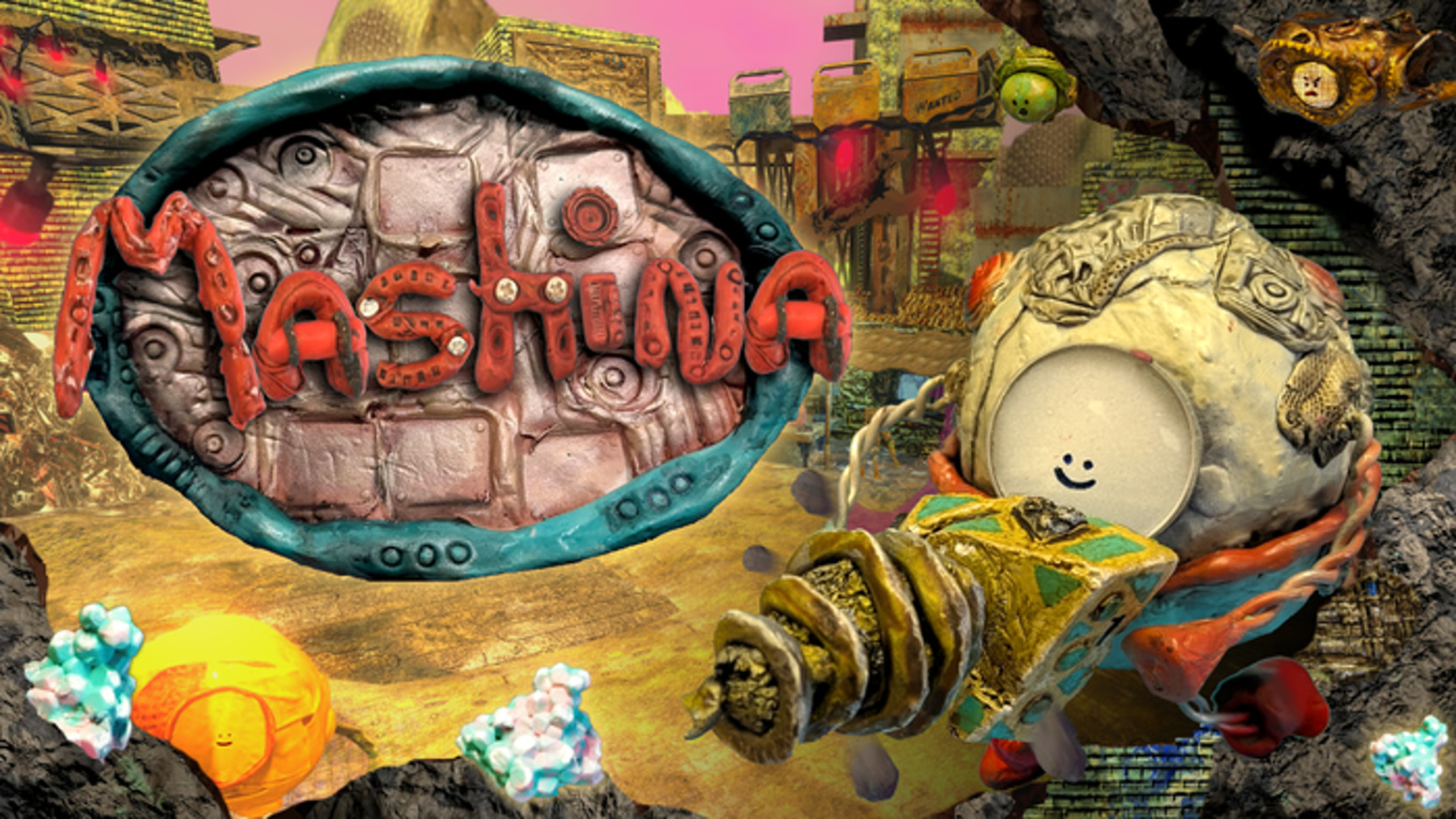
Machina‘s unique art style sparked off a trip down the dusty streets of memory lane. Though I struggled to really place the feeling. On the one hand, it put me in mind of old school cartoons I watched as a kid. Things like The Clangers or the Morph segments from Art Attack. On the other, the deliberate scrappiness and off the wall humour makes me think of old flash cartoons. It’s charming stuff.
Machina coasts through on that charm. If the ‘making of’ video proves anything, it’s that a lot of love went into the development. The aim was relentless positivity. It pulls that off, for sure. A smile was never far from my lips. Though, while scrappiness works well for the art style, the question is: does it work well for the gameplay? Machina‘s dedication to relaxation is admirable, but it might be a little too relaxed.
Diggy Diggy Hole
At first glance, Machina looks like it might be quite depressing. We’re very clearly digging through a post-apocalyptic world, after all. There’s dangerous, green slime everywhere. You don’t use traffic cones as house decorations unless something has gone very wrong with the world. But once you start digging into, no pun intended, you find it’s a lot more positive than that. Machina, an egg-like robot, lives with her robot friends on an island in the middle of a bunch of green goo. They’re happy there, and they all like each other. It’s very ‘children’s cartoon’ and is honestly quite refreshing.
Once you’ve slipped into Machina‘s shoes, you’ll find your world split into two halves: the overworld and the underworld. The overworld is done in an over-the-shoulder 3D perspective, and is based around chatting with the residents and picking up side quests. The other characters are pleasant enough. A radio-esque character wants you to find radio stations for her, so she can sing. A big metal fella is obsessed with drills. It’s pleasant, but somewhat limited in what you can do. Outside of brief chats, all you can do is plonk down decorations. It’s lacking a bit in staying power.
The underground has more longevity to it. This is where all the digging happens. Machina‘s core loop is about digging through the earth to find minerals, which you then grind up to spend on better drills and special technology, like ziplines. The minerals come in different shapes and you have a limited inventory to slot them into, turning digging into a series of little puzzles. It’s quite relaxing – there are no enemies or challenges beyond the inventory. So you can peacefully dig until your inventory is full, without worrying about losing it.
Just Chillin’
There’s a build system in place too. As you dig, you’ll uncover big deposits of minerals, which you need to plonk a miner on top of. This will just spit out singular minerals. They need to be deposited in the right machine before you can spend them, so you can build a system of conveyor belts to move them to where they need to go. It’s quite basic, but it does the trick. As you progress and improve your drill, you’ll scout more of the biome and eventually move on to other islands in the overworld, which require stronger drills but reward you with rarer materials.
On the surface, it’s a pleasant loop. The ‘making of’ video makes a point of mentioning that if a game mechanic was at all stressful for the player, it wasn’t included. This seems to have gone a bit too far, though, as a lot of Machina feels, for lack of a better word, robotic. For one, rock where minerals are hiding looks identical to the surrounding rock. You have to use a limited-use radar to find them. So there’s no real feeling of discovery, you just sort of dig everywhere like a hyperactive earthworm. The only ‘challenge’ of Machina is meeting the mineral quota for the next drill level, so the late game becomes a slog of digging everywhere looking for materials.
There are moments of levity. When you find a new character, there’s a charming stop-motion cutscene introducing them. It’s cute. Unfortunately, I can’t help but feel the delightful graphics are setting a bar that the gameplay can’t meet. All the side quests are either basic fetch quests, or just an elongated tutorial for a new build item. While new minerals are introduced, they are essentially just new currency and aren’t dug up in interesting ways. So ‘stress free’ risks turning into ‘monotonous’ as we just dig in random directions until our mineral number is high enough.
Machina – A Bit Too Relaxed
There’s some mechanical clunkiness here too. Machina had a tendency to freeze up after an hour or two. Sometimes because I had alt-tabbed, other times because it just felt like it. There’s some slight control clunkiness too. Machina uses a jetpack while underground, which is great when you want to get somewhere distant, but if you just want to adjust yourself, it can be quite awkward. Machina is also rather short for this sort of genre, clocking in at less than seven hours for the main story.
I think there was scope to add a bit more flavour to the underground. Some intriguing caverns to explore, or more robust side quests to find. That said, Machina might have been restricted by its own selling point: the graphics. Making new models for every new character and object in the world means that adding more things is going to stretch out the budget and timeline. Still, I do very much love the stop-motion aesthetic. It does a lot to help Machina stand out, even if the gameplay is a little threadbare.
I haven’t looked at a FlexiSpot for a while. However, I admire their high-quality products and their innovative ways. Whenever they have a sale, I’m impressed by the savings and the great items on offer. The FlexiSpot Anniversary and Labor Day sale is a beauty. There are plenty of amazing goods and cracking savings to be had.
Some of the FlexiSpot Anniversary and Labor Day sale items.
The FlexiSpot C7 Morpher is a high‑end, ergonomically designed office chair that moulds seamlessly to your posture. Furthermore, it features adjustable air‑cushion lumbar support, a 10° front‑tilting and up to 160° reclinable backrest with slide‑back motion, 3‑axis headrest, 5D armrests and built‑in footrest—all wrapped in breathable aerial mesh. Consequently, it is perfect for long workdays, offering tailored comfort, dynamic support, and premium adjustability in one sleek package.
The FlexiSpot E7 Plus is a heavy‑duty, motorised standing desk featuring a rock‑solid four‑leg steel frame that supports up to 540 lb (440 lb while moving), ensuring exceptional stability even at its maximum height of 51.6″.
More furniture to brighten your home or office.
The FlexiSpot E2 is a robust yet affordable electric standing desk that lifts with ease at the touch of a button, offering a stable height range from roughly 28″ to 47.6″ . It supports up to 187 lb, thanks to its sturdy, large-footed frame and solid single-piece desktop, minimising wobble. The intuitive control panel includes four programmable height presets, while built-in safety features like overload and overheat protection ensure dependable, long‑lasting performance.
The FlexiSpot Sheer is a premium, stylish ergonomic office chair featuring a breathable mesh backrest and adaptive support designed to contour to your posture. It boasts dynamic lumbar support that moves with your body, plus adjustable 2D headrest and 4D armrests for tailored comfort. With noiseless casters, a sleek profile, and thoughtful design, it combines aesthetics and ergonomic function for more comfortable, productive working.
Plenty more to see.
The 4 highlighted products are but the tip of the iceberg. FlexiSpot offers some incredible and innovative products for home workers and gamers. Accordingly, check out their website for some amazing items.
It is that time of year when parents celebrate, and young adults and children moan. This Back to School guide highlights some of the best tech for your young people as they return to school or university. We have tried many of these products, and we love them. Accordingly, I am happy to recommend anything in this article.
The Back to School guide.
Wacom.
The Wacom MovinkPad is a sleek, ultra-portable pen display designed for creative professionals on the go. Featuring a high-quality OLED screen with stunning colour accuracy, it delivers a natural drawing experience with Wacom’s renowned EMR pen technology. Lightweight and durable, the MovinkPad connects easily to laptops or mobile devices, making it perfect for artists, designers, and illustrators who need a powerful, compact tool for digital creativity anywhere.
SteelSeries.
The Apex Pro TKL White (Gen 3) is a premium tenkeyless gaming keyboard that combines sleek design with cutting-edge performance. Featuring SteelSeries’ adjustable OmniPoint 3.0 switches, it offers lightning-fast response times and custom actuation for every key. Its durable aluminium frame, vibrant RGB lighting, and compact layout make it ideal for competitive gamers who demand precision, speed, and style—all in a streamlined, high-performance package.
The SteelSeries Arctis GameBuds are compact, wireless earbuds designed for gamers who value portability without sacrificing performance. With low-latency wireless connectivity, they deliver responsive, high-quality audio for mobile, console, and PC gaming. Featuring a comfortable in-ear fit, dual microphones for clear voice chat, and a pocket-sized charging case, the Arctis GameBuds are perfect for on-the-go gaming, offering immersive sound and reliable communication wherever you play.
The Rival 3 Wireless Gen 2is a lightweight, reliable gaming mouse designed for performance and versatility. Featuring dual wireless connectivity via 2.4GHz and Bluetooth, it offers ultra-low latency and seamless switching between devices. With a high-precision sensor, durable switches, and up to 400 hours of battery life, it’s built for both competitive gaming and everyday use—delivering comfort, accuracy, and freedom without the hassle of cables.
Boulies.
Engineered for a tailored seating experience, the Boulies OP300features a Multi Tilt Mechanism. Moreover, the backrest can be easily adjusted to lean forward or backwards (recline 90°-109°). Furthermore, Boulies engineers the backrest to perfectly align with the spine’s natural curve to help reduce strain.
INIU.
The Pocket Rocket P50 offers 45W full-speed output that supports PD, QC and Samsung Super Fast Charging 2.0 (PPS). Consequently, you have the ability to charge multiple devices simultaneously. This power level can take a smartphone from low battery to around 73% in just 25 minutes and deliver roughly 42% charge to a MacBook Air in the same time. Accordingly, this makes the P50 a practical emergency laptop solution as well as a daily phone charger.
VQ.
The Halo is a revolutionary wireless speaker with TWS (True Wireless Stereo). Furthermore, it pairs two devices together, with a transmission distance of 10 meters for stereo sound quality. It boasts 22 watts of immersive 360-degree stereo sound in every single full-range speaker, and when paired together, delivers 44 watts of incredible sound with a frequency response of 20Hz – 20KHz. It is Bluetooth 5.3 compatible and connects to any Bluetooth device simply and easily at the touch of a button.
A short but sweet guide!
School and university are just around the corner. Accordingly, your youngsters will need some new tech to get them going. Each of these brands offers a wide range of suitable products, and I recommend taking a look and improving your gear for the new school year!
Flame Keeper by developer Kautki Cave is the latest roguelite entry that has arrived to the PlayStation 5. The action game follows Ignis, a special lump of coal who must fight his way through different levels of enemies to liberate the world of Orbis and bring light to a world shrouded in darkness. Is Flame Keeper a worthy addition to the roguelite genre? Does it shine brightly like its main character? Lets take a look and find out!
Light Vs Darkness
The story of Flame Keeper is simple. Ignis must free the world of Orbis from creatures called Pixies. He must restore the Eternal Flame and bring light to this world. On his quest, he encounters many different enemies like spiders, worms and fly-like creatures that try to stop him in his tracks. The story isn’t anything too deep and can be forgettable the more you progress. One of the strongest aspects of the game are the cutscenes. The animation and art style is fantastic and is a treat to watch. Even the opening intro scene when you boot up the game is beautifully shot. These cutscenes help the story in a way even if it isn’t that strong. It is a shame the story isn’t too memorable because this art style is amazing. But the gameplay is where Flame Keeper shines.
Die And Go Again
Like other roguelite action games, Ignis must fight his way through many difficult enemies to level up and become stronger and he progresses through the three different waves per level. Ignis can level up by using his health to light up campfires in every level. Each level has three waves. The first two are normal levels, where players must explore the area, kill enemies and find lamps to bring back to the campfire in order to light it up. Each lamp that is lit up, Ignis can access different perks and abilities to make his journey easier. Some of the these perks range from increased damage to faster movements. Players can also find weapons for Ignis like rock hands that do more damage. These are especially handy when you progress through the levels against higher level enemies.
The third wave is a survival wave where you must defend a cauldron of flames against waves of enemies that are coming to destroy it. All the abilities and weapons you pick up come in handy here as you have to survive five minutes against them and it becomes very intense. Ignis can use his health to build towers that have village residents on top of them to throw spears at enemies. You can also unlock other traps to help take out enemies. Flame Keeper is a difficult game but this adds to the fun of the game. It also means you need to be wary of what powers you want to upgrade, because if you die, back to wave one and you go again.
Now of course this three wave design can become repetitive the more you progress in the game as the levels, despite looking different in design from swamps to temple like areas, are basically the same. The gameplay does keep it all appealing and fresh. The combat is simple. Punch enemies or dash into them to kill them. Players can also unlock special abilities like missiles or a magic hammer that can damage a horde of enemies of you can time the attack perfectly. The hammer will smash down in the small area, wiping anything in the area out. Best weapon to use, especially against the hordes of enemies when defending the cauldron.
There is a hub world in Flame Keeper. Ignis can upgrade abilities at Vulpius Village. You can come here to upgrade buildings that also level up your abilities. This also includes upgrading your attack power and stamina so it is your best interest to visit and upgrade buildings as much as you can.
Flame Keeper: Captured on PS5
Boss Fights
There are multiple boss fights in the game. These boss fights are challenging like the spider boss fight that spits acid around the platform you are standing on. It can knock you off so there is a lot of things to consider when tackling these boss fights. The most important thing is you picked the best abilities that suit your playstyle as everything you unlocked in the previous levels can be used here. There’s not much else to the boss fights. They have cool designs and are challenging. It is satisfying to take them down knowing you earned it with the challenges you overcame. The beauty of a roguelite game.
Verdict
Flame Keeper is a fun little game to play. It is a welcome addition to the roguelite genre. The combat is simple but fun and the abilities you can unlock are satisfying to use against enemies. The boss fights are challenging and a fun time. The tower defense type wave where you defend the cauldron for five minutes is also a welcome addition and can help keep things somewhat fresh after completing the other normal waves. Some of the levels can get repetitive over time as it does follow the same formula and waves. The story is also forgettable but the art style can keep player’s attention. The game is only about 5-6 hours long, depending on how many times you may die in the game but it is a reasonable length for this type of game. Flame Keeper is a good time for any interested in roguelite games.
The struggle to be good continues with everyone’s favorite Bad Guys, as they encounter a new challenge from a gang of Bad Girls, in DreamWorks Animation’s newest action-comedy, THE BAD GUYS 2,coming home exclusively on digital platforms to buy or rent August 25, 2025 from Universal Pictures Home Entertainment. Based on the New York Times bestselling children’s graphic novel by Aaron Blabey, the latest animated adventure takes the Bad Guys to new exciting locations around the world and even further, to outer space! Unveil THE BAD GUYS 2 master plan with over one hour of captivating bonus content showcasing the exclusive animated short “Little Lies and Alibis” as well as never-before-seen features including deleted scenes, hilarious recording booth moments, how to draw character sketch tutorials with filmmakers, and more when you purchase from participating digital retailers nationwide.
The Bad Guys are back, and this time, they’ve got company. In the new action-packed chapter from DreamWorks Animation’s acclaimed comedy smash about a crackerjack crew of animal outlaws, our now-reformed Bad Guys are trying (very, very hard) to be good, but instead find themselves hijacked into a high-stakes, globe-trotting heist, masterminded by a new team of criminals they never saw coming: The Bad Girls.
How to enter to win
We have 3 digital codes for Bad Guys 2 to give away.
Okay maybe this wasn’t the game for me, I don’t have much experience of rougelikes beyond slightly enjoying, but never completing 2021’s Returnal. The concept of losing everything after dying once and having to battle my way back through repetitive procedurally rooms of the same enemies from square one may appeal to the masochists among you, and the gaming population is certainly full of those, but personally leaves me feeling like Sisyphus watching the boulder roll back down the mountain.
Now I’ve heard nothing but great things about other games in this genre such as Binding of Isaac and 2020’s GOTY winner Hades, both of which are on my (embarrassingly) large play list and maybe one day I’ll go back and finish Returnal, but from what I’ve seen of them, these games have style, narratives and themes going for them. So what does Curse Rounds offer?
My eyes betray me.
I’ll start with the good, actually no, to be fair, the VERY good; I really dig this game’s aesthetic. Composed of monochrome, pixelated doodles, great care has definitely been put into how the game looks. Its sprites, admittedly basic, come alive thanks to fantastic animation work and every one of its, admittedly impressive, list of enemies all behave uniquely. The same can be said of its sound design, a simple retro throw back of pixelated tunes and crunchy sound effects, a tribute to those vintage PC games of yore. What little there is of a story is told through very nice comic book panels; rough and sketchy. Oh and if the black and white contrast is too harsh for you, there is an option in the settings to switch to a much less striking greyscale palette, an excellent consideration.
But then there are moments where it just becomes almost too much. In more intense rooms where enemies become comically frequent, it becomes a cacophony of visual noise, your tiny player character getting lost in the chaos of it all. Some of the game’s curse cards (I’ll get to that in a second) cause visual drawbacks such as screen shakes and pixelated rain to constantly fall from the sky, further muddying the playfield. It’s a fun difficulty curve, I’ll give them that, and your tolerance may vary, but there were points where it gave me genuine motion sickness. I don’t recommend playing this game on a gigantic modern TV either, not only because of the input lag (is this a bad time to talk about how terrible modern telly’s are for gaming?) but simply because your eyes won’t be able to track the chaos of what’s going on. This is a monitor game, requiring you to sit forward at a desk in front of a smaller screen (or handheld) and do what I believe the kids nowadays refer to as locking in.
I never curse, I swear.
Now we get on to the namesake of Curse Rounds: the curses. Between rooms you are given the option of two cards, each condemning you to carry a debuff that will follow through your entire run; by the end you will have gained a whole stack of contrasting effects. As aftermentioned some of these are visual and others mechanical, the floor now being slippery ice or causing enemies to rise up as unkillable ghosts. To balance it out, after clearing a room you are given a small permanent buff to your weapon damage or movement speed, and after a boss you are given a very welcome power card that will provide a positive effect. It’s all random and leads to a lot of unique combinations, with the store page going as far as to declare “No two runs are the same!”. Huh.
Mechanically, it plays fine. Just fine. The player character feels responsive enough and you are given a nice dash with very generous i-frames. Enemies are incredibly varied and I’m sure time can be sunk into learning their behaviours and attack patterns. The base weapon, apparently a flashlight, shoots slow moving pellets that just kinda graze the enemies with no real oomf. I don’t feel like I’m giving that much damage, there’s not enough visual or aural feedback here for it to feel satisfying for me. Likewise the power ups (one of the three selling points on the store page) bounce between being actually useful and kinda lame, leading me to just avoid them and stick to the base pea shooter. Sure, there are some cool boss battles, but they vary from very brief to just cluttering the screen with noise, and I just felt a level of detachment to it all.
Speaking of detachment, the story doesn’t seem to have anything to do with the gameplay. A child playing video games in the dead of night hears knocking coming from his attic; grabbing a flashlight to investigate, the trapdoor bursts open and a swarm of tentacles grabs the boy, dragging him inside. Then he gets turned into a little white ghost (I think?) and has to defeat swarms of ghosts/monsters/whatever in the same empty black room. Look I get this is appealing to a crowd that likes simple no nonsense stories, but what does it have to do with the gameplay loop? I’m not asking for Baldur’s Gate here, but I want some kind of incentive that leads to a payoff. A run will only take you about 25 ish mins and then you are treated to a dozen comic panels that don’t conclude anything. Fantastic. I’m biased of course, I studied film/theatre/TV writing and the written word is my comfort zone; I do like a narrative to keep me going.
“I said, maybe” – Noel Gallagher
Curse Rounds is a somewhat difficult, repetitive time killer with more in common with the coin gobbling arcade cabinets of yesteryear. It’s very cheap (£3/$4) but on modern store fronts that constantly host much deeper games for a similar price point, it feels like an iPhone game in comparison. There’s a good foundation here, very nice visuals and solid game feel and I can see the retro loving crowd getting more out of it, particularly those on Switch and PC (it played okay on controller, but I feel the aiming mechanics were designed with keyboard and mouse in mind). Maybe I’m too young, maybe I’m too impatient, maybe I’m too much of a wannabe film bro and maybe my astigmatism didn’t agree with how many objects were on screen (I should get my prescription checked). But perhaps the biggest maybe, is that one day I’ll find a rougelike that makes me want to roll the boulder back up the hill.