Review: Aaero 2 Black Razor Edition

In the era of imitation instead of originality and innovation, Aaero 2: Black Razor Edition launches to much intrigue. Is this rhythm based shooter a hit? Or should it have been left on the cutting floor?

Fight Or Die For The Beat

Over the years, I have found a real addiction to rhythm based games and how they invoke this obsessive completionism within me. In particular, I fell in love with the Invector games which, in my opinion, are some of the best rhythm games ever made. The combination of having a ship to control whilst also having to correctly hit buttons to the musical beat is a simple concept, yet so wonderfully addictive. So you can imagine my excitement when developers Mad Fellows and publishers Wired Productions announced Aaero 2 was coming to PS5 as the Black Razor Edition. I never managed to play the original Aaero, a sleeper hit for those who played, but I’m beyond grateful I have managed to play the second game; Aaero 2 absolutely rules!

Originally released on PC and Xbox Series in 2024, this Black Razor Edition adds the Arcade Paradise and Lania Kea music packs to create the true definitive version of the game. Right off the bat, it’s important to understand your expectations with this game when it comes to narrative; Aaero 2 is extremely bare on narrative, but dripping with atmosphere. You control a ship that is chartering alien planets whilst engaging in combat with alien vessels and technology – it’s literally that simple. The developers have chosen to display story through visuals, showcasing each level and planet as different from the other through the alien architecture littered throughout the levels.

Boss encounters serve as the finale to some of these mysterious worlds, which escalates tension and the stakes for the player as they shoot and navigate through these worlds. Each track that accompanies the 20 original levels feels uniquely showcased through enemy design and visuals. If you are looking for a rich story, this game is not for you. Gameplay is the clear focus and my god is it fun!

When The Rhythm, Rhythm Starts To Play

What Aaero 2 sets out to do as a rhythm based shooter, it succeeds and then some. It really feels like the developers are inviting you to physically become the music through your spaceship in each level. Every level is designed and built in association with a track which is represented by glowing lines or beams of light; these beams trace the melodies and vocals throughout the level, whilst being surrounded within a circular zone. You have to navigate these environments using the left stick to guide the ship along these beams, thus playing the music. The more precise you are with your navigation of the beams, the higher your score will be. A simple yet utterly satisfying concept.

What sets this game apart from other rhythm games is how it blends the combat seamlessly in with traversal. While you are navigating the environment, enemies will begin to swarm onto the screen at certain parts of the level; this is where the right stick comes into play as you aim your missiles then squeezing the trigger to fire at them. It feels like an intricate and tense dance between ship and enemies, which is truly mesmerizing at times. You have to time everything in this game and, whilst at first it will feel daunting and overwhelming, when the gameplay clicks, it’s beyond addictive – I couldn’t wait to try another level and beat my high score.

When the gameplay clicks, so begins the vast amount of replay ability on offer in Aaero 2. There are four distinct difficulty pre-sets which are unlocked as you gain more and more stars from each level, culminating with the master difficulty, which truly tests your prowess in shooting and movement. There are also red orbs serving as collectibles for the player to find throughout each level. Everything in this game invokes replay ability, whether it’s daily or weekly challenges, xp levelling system or the addition of multiplayer compared to the first title.

Multiplayer really elevates the game to new heights and drastically alters gameplay. The game sports co-op and PvP modes that are available both locally and online. Co-op splits the beams and enemies and organises them by colour, which forces the two players to communicate and cooperate their way around the obstacles whilst trying to build a high score. PvP adds the competitive aspect as you battle another player with the environment split to avoid conflict; it’s a battle of skill, not a direct faceoff where one mistake could be fatal. This is a fantastic addition to an already superb gameplay loop.

A Fist Pumping, Headbanging Delight

When it comes to the visuals of Aaero 2, the game delivers for the most part, with some slightly uneven moments. Every level is full of vast amounts of colour and superb lighting; each level is unique from the next with detailed open environments to underground haunting facilities. The boss designs look daunting and huge in scale, as they tower over the small ship the player operates. Whilst most levels look great, some background areas can look blurry and blocky at times, taking you out of the moment but these are minor issues. Menus and the UI are as basic as they get, but this does not take away from the wonder of this game. The way in which colour is used and deployed in this game will stay with me for a long time.

Along with great visuals is a superb audio design that perfectly complements the gameplay; missile strikes, explosions and cannon fire are woven so beautifully into the game alongside the music. It also helps with the difficulty and timing, as the sound is so crisp it can help you master the deft timing you need on the higher levels. Finally, the soundtrack – my god, the soundtrack! These songs are the core of the game and they propel this game from good to great. It features a wonderful mix of artists, ranging from Monstercat alumni such as MUZZ and Bossfight, alongside new tracks from Black Razor Records and Lania Kea. These tracks range from synth pop to arcade beats; if you have played Beat Saber, this is right up your alley. The tracks make the game explode with life, making this a truly mesmerizing experience.

Verdict

If you are looking for the definitive way to play Aaero 2, look no further than the Black Razor Edition; a superb pulsating soundtrack and addictive gameplay makes this the best rhythm shooter in years. Coupled with great multiplayer modes, great audio design and solid graphics, you have the recipe for one hell of a game. More games like this should be made and more developers should take more chances. Innovation over imitation!

Review: Shroomtopia

Shroomtopia is a game that I really wanted to enjoy. However, developer GXN Games has made some fatal mistakes, and this makes it unbelievably frustrating to play. Unless you are an expert in puzzle games or you are extremely lucky, you will spend many hours scratching your head and wondering what to do.

QUByte Interactive has published this single-player isometric experience. It is designed as a cosy and calm puzzle title. Yet, the lack of guidance and hints leaves you enraged and quitting early. This was a shame, as many of the elements were fantastic. Furthermore, I love the aesthetic and the varied stage design.

Shroomtopia focuses on the nectar of life. 

Life is always in the balance, and too much or too little of anything can be terrible. Shroomtopia takes this to the next level with its vision of the nectar of life. Magical mushrooms are withering and failing. However, if the nectar of life can touch the special fungi, everything will be alright.

This is the core idea of this methodical title. Effectively, users must create a path for the nectar to flow. If it falls off the side and you run out of liquid, you must start again. Additionally, you’ll need to bring micro mushrooms to life as the basic mechanics evolve. 

Use the colour wheel. 

Manipulating the world is a key concept. Yet, this can only get you so far. As the game progresses, you’ll face obstacles and the chance to mix colours. Now, this sounds easy, but creating the correct pathways and matching the right colours isn’t easy.

Sadly, the developer has decided not to include a hint system. This was a huge mistake, as you can’t progress to the next world without completing the puzzles. Accordingly, if you get stuck and you can’t work out a solution, you are screwed. This was a massive shortcoming and something that needs to be addressed. 

Shroomtopia looks lovely. 

Despite the gameplay issues, Shroomtopia looks lovely. The world has a pleasant cartoon edge that is pleasant to the eye. Moreover, the colours are vibrant, varied, and great to look at. Each level is interesting, and the game thrives because of its variety. 

The soundtrack is calm and easy on the ears. This wasn’t surprising as the developer envisioned a cosy experience. Thankfully, the soft audio supports the theme and doesn’t distract from the action. 

Simple controls. 

Mastering Shroomtopia was easy. You can undo moves, reset the puzzle, and the grid system was easy to follow. Consequently, the control system is well considered. 

Longevity is a real problem. If you get stuck, you are likely to uninstall it. This is a shame, as the game has many positives. Unfortunately, though, I can see many people giving up very quickly. 

Shroomtopia could have been great. 

This has so much potential! Visually, it is nice, and I love the cosy atmosphere. However, getting stuck on a handful of puzzles for hours is not my idea of fun. Accordingly, unless you are a genre whizz, I don’t recommend buying it. More information can be found here, though! Can you make the nectar flow? Dig the pathway, touch the mini mushrooms, and watch everything blossom.

Review: Perfect Tides: Station To Station

Perfect Tides: Station To Station struck a deep chord with me. See, the game revolves around a protagonist going off to do a Creative Writing degree. The exact degree that I have. In 2011, when I was just eighteen, I went to a university in a completely different county. I knew no one that was going, and I was suffering badly with anxiety at the time. It remains one of the strangest, most chaotic experiences in my life. Suddenly, everything was uprooted and I was left to make sense of what it had become.

In the end, it was quite a positive experience. There were quite a few mistakes, a lot of hangovers and a massive helping of anxiety. But I met a lot of good people, wrote a ton of stuff (of varying quality) and felt, for the first time, that maybe I wasn’t such a waste of space. Those were the feelings that bubbled to the surface when I was playing Perfect Tides: Station To Station. It’s a wonderfully written story about crashing into adulthood, and trying to figure out meaning in things that ultimately feel meaningless.

Perfect Tides: Station To Station

Writer, Write Thyself

Let me take a step back before going all ‘English Degree’ on you. Perfect Tides: Station To Station is the follow up to Perfect Tides, which I’ve not played, but it followed the turbulent teenage years of islander Mara Whitefish. In Station To Station, she’s off the island and in to university, where she’s studying writing. The story goes to great length to show all the ups and downs of university life, and what it does to a young mind. It’s a game that lives and dies on its writing, being essentially a hyper-evolved visual novel. Fortunately, the writing is excellent.

Now to dredge up the bit of my degree that I sucked at: literary analysis. To my mind, Perfect Tides: Station To Station is neatly split between Mara’s desire to find herself and to find others. In the ‘herself’ category is her writing. Like all good writers, she’s crippled by imposter syndrome. Part of the gameplay involves rewriting her magnum opus short story, and you pick and choose which books to read and which real-world experiences influence it. As Mara gets buffeted by life, the story ebbs and flows, and the whole time she’s left wondering whether it’s all worth it. It’s great stuff, that totally didn’t hit uncomfortably home.

Writing forms a core component of her life, both as an outlet for negativity and the grounds for positivity, which could be kicked out from underneath her at any time. But the other half is the search for others. Mara, in my run at least, grappled with the concept of love. She drifted in and out relationships, wounding and be wounded in turn. This, more than anything, hammered home the concept of moving into adulthood to me. Emotions, desires and sexual frustration all fighting against each other, and never having the words to describe any of it. Which can be a touch frustrating, if you happen to be a writer.

Perfect Tides: Station To Station

(Lack Of) Sex In The City

Alright, I think we’ve established that I like the writing. Time to talk about Perfect Tides: Station To Station‘s gameplay. It’s a light-touch point’n’click, mainly involving chatting to people, making choices and occasional inventory puzzles. What elevates it is the ‘Topics’ mechanic, where Mara gets more confident about various topics, like music or anarchism, by exploring the city. This then feeds into her writing projects. Knowledge can increase by reading books or talking to people, encouraging you to explore. It’s a nice mechanic, especially as time is limited. Writing papers might take up half a day, so you’ve got to pick between your work life and your social life. Imagine that.

I will say that Station To Station feels like it’s missing something of a through line. We stumble, deliberately, from set piece to set piece but at times there’s little in the way of player direction, and it’s easy to get lost in the shuffle. I feel like the university course aspect could’ve helped cement things. Still, this is a game of choices and there’s a metric ton of them. A stressful (in a good way) amount. Your run might well be vastly different from mine. Station To Station even spices the gameplay up with minigames, like emulating old-school dress-up games to get yourself ready. Or, in the best case, orchestrating a singalong to Bohemian Rhapsody.

The gameplay serves the writing well. No matter what choices you make, Mara feels like Mara. Just putting up and breaking down different walls. The art helps as well. There’s a lovely old-school adventure game look to it. Far away shots get broken down into crunchy pixel art, while up close shots are beautifully animated. Mara is incredibly expressive, which highlights her goofy personality well, while also knowing how to keep things serious. My only complaint is that when we’re exploring the city, the whole animation felt rather choppy to the point it felt close to bringing on my motion sickness.

Perfect Tides: Station To Station

Perfect Tides: Station To Station – A Dissection Of Young Adulthood

There is one thing I should say about Perfect Tides: Station To Station: you need patience to play it. You’re peering inside someone’s head, to the point that you have a direct line to their inner voice. As such, if you don’t like that person, you might bounce off it. Mara is hard to like at times, especially as you watch her stumble into yet another terrible choice. It’s also quite a pretentious game at times. Forgivably so, for the most part. Nothing is more pretentious than a young adult discovering classic literature. But it also delivers dry lectures on the books you read, which can get a bit grating at times.

Still though, it’s difficult to shake the feeling that this is exactly the point. The writing is pretentious because Mara is pretentious. But if you can stop your lip curling, you’ll find that there’s a heartfelt undercurrent. Mara’s story isn’t going to set the world on fire, but it’s a great representation of what it’s like to try and find your place in the world. Anxiety and doubt sharing a room with hope and wonder. Trying to better yourself, but not knowing how. It’s a story about someone fixating on the question of why the curtains are blue, because they don’t want to acknowledge that the rest of the room is on fire.

(Perfect Tides: Station To Station‘s Steam Page)

Review: Asfalia: Panic at the Mansion

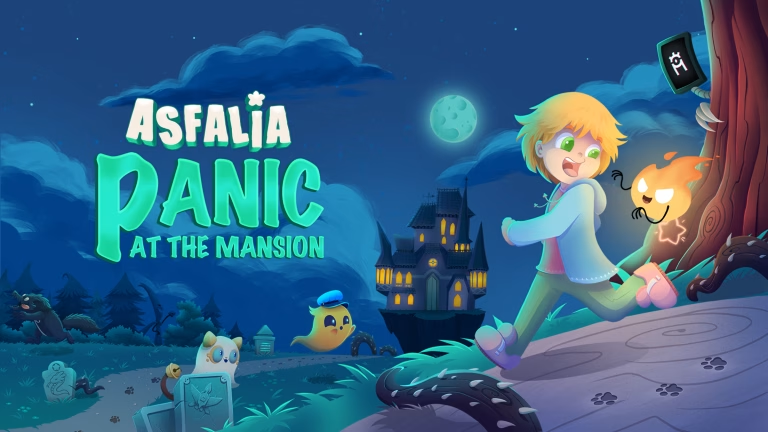
There’s a certain kind of magic that only a handful of games manage to capture, the feeling of being wrapped in a warm blanket while exploring a world full of imagination, kindness, and quiet wonder. Asfalia: Panic at the Mansion is exactly that kind of experience. It doesn’t try to overwhelm you with mechanics, difficulty, or spectacle. Instead, it invites you into a hand‑painted storybook world where charm, humour, and heart take centre stage.

This is a game that understands something important: sometimes, the best adventures don’t need explosions, they just need soul.

Charming and relaxed in every aspect

You play as Charlie, a child exploring the magical land of Asfalia, a world shaped by emotions, imagination, and feelings. When a storm frightens Charlie’s puppies and sends them scattering across the mansion and its surrounding realms, the journey becomes a gentle quest to find them, one that feels less like a heroic mission and more like an emotional journey through fear, courage, and comfort.

Rather than relying on traditional conflict, Asfalia focuses on emotional stakes: calming fears, helping strange characters with simple problems, and restoring a sense of peace to a world that feels shaken by something dark and unknown.

There’s a softness to the narrative that feels rare in games. It’s not trying to be epic or try to overburden you with tasks to ensure longevity. Usually games this cosy come under the ‘Life simulation’ tag such as Animal Crossing and Palia. Here Asfalia just wants players to experience the calm narrative and call it a day when it’s done.

From backgrounds to NPC’s , it’s cosy

Visually, the game is a delight. The art style feels like a mix between a children’s picture book and a whimsical animated film. Every area is painted with care, full of personality and warmth, and the character designs are wonderfully odd in the best possible way. Playing Asfalia is like watching a cartoon as a kid on a rainy autumn Sunday morning.

Gameplay is very accessible. The puzzles are light, intuitive, and designed to add to the story. You won’t find complex logic chains or frustration here and that’s by all means not a flaw. It may come off as only a children’s game but Asfalia is more than that. If Lo-Fi study playlists consisted of games Asfalia would be on it, perfect for relaxed sessions.

The sound design and music reinforce the game’s cosy tone. The soundtrack never demands attention, it gently supports the mood, creating a calm emotional space that makes the game feel safe and comforting. It’s the kind of audio design that’s subtle enough and works so well that players wont notice it often but will smile when they do.

My Conclusion

Asfalia: Panic at the Mansion feels like a soft story that invites players in for relaxed play sessions whether it’s a long train ride or a cosy evening in. There are plenty of massive games with 100’s hours off action and countless side quests. How about a game about fear, comfort, imagination, and kindness, told through a beautifully crafted world full of heart and creativity.

Asfalia: Panic at the Mansion is available now on Windows PC and Nintendo Switch

Review: Lost Eidolons: Veil of the Witch

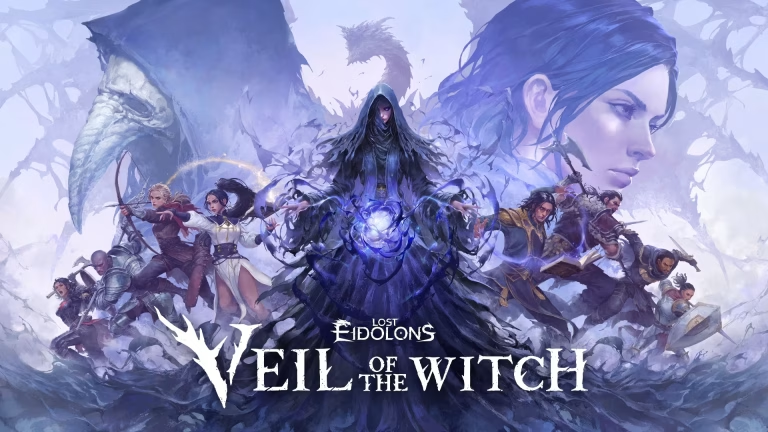
There’s a very specific itch that tactical RPG fans have, the kind that only gets scratched when positioning matters, mistakes are punished, and victories feel earned rather than handed out. Lost Eidolons: Veil of the Witch didn’t just scratch that itch for me, it dug in and refused to let go. As someone who loves the XCOM combat, especially in recent titles like WarTales. I went into this game curious, maybe a little sceptical, about how well that formula would translate into a roguelite structure. I came out thoroughly satisfied.

Tactical rouglite, how does it fair?

At its core, Veil of the Witch understands what makes grid-based tactical combat compelling. Movement is deliberate. Line of sight matters. Terrain matters. Flanking isn’t optional, it’s survival. Every encounter feels like a small puzzle where the solution isn’t always obvious until you’ve already committed to a risky move. That tension, that moment of hovering your cursor over a tile and asking “can I survive this?” is pure XCOM energy, and the game absolutely nails it.

What surprised me most was how naturally that combat fits into a roguelite loop. Altough you will not lose characters if they die during a run, mistakes are still devestating. Poor position in the first battles means that most resources and rewards will be used to recover your party and hindering battles to come.Although since runs are temporary and players to dont lose anything ‘external’, the game encourages experimentation. You’re not hoarding items “just in case.” You’re adapting on the fly reshaping your squad, your builds, and your strategy based on what the game throws at you. That adaptability is deeply satisfying when paired with combat systems that reward smart positioning and synergy over raw stats.

Losing runs doesnt mean starting from scratch

Each character brings something meaningful to the battlefield. Tanks aren’t just damage sponges they’re zone controllers. Ranged units feel vulnerable but powerful when properly protected. Support characters genuinely matter, especially in longer fights where resource economy and survivability start to spiral out of control. This is where the XCOM inspiration shines brightest: winning isn’t about wiping the enemy quickly, it’s about controlling the flow of combat as well as mitigating damages.

The roguelite progression also deserves credit for respecting the player’s time. Failure doesn’t feel like a reset button, it feels like feedback. You learn what went wrong, unlock new options, and head back in with a slightly stronger foundation and a much sharper plan. That constant forward momentum kept me engaged far longer than I expected. Even losing runs felt productive, which is exactly what a good roguelite should accomplish.

What’s surrounds the gameplay?

Narratively, the game keeps things restrained but intriguing. The mysterious Witch, the cursed island, and the fragmented memories all serve as atmospheric glue rather than intricate exposition. I appreciated that the story never pulled focus away from the gameplay. It’s simply there to motivate the player, which feels like the right choice for a game so mechanically driven.

Visually and tonally, Veil of the Witch leans into a sombre, grounded fantasy aesthetic. It’s not flashy, but it doesn’t need to be. The clean readability of the battlefield takes priority, which is crucial in a tactics game where one misread tile or miss-click can potentially cost a good run. The games simplicity also deserves a mention. Heading into runs and navigating them is as simple as a couple clicks which makes it a fantastic game for handheld devices too.

My Conclusion

If I had to summarize my experience in one sentence, it would be this: Lost Eidolons: Veil of the Witch feels like a game made by people who understand why XCOM works, and wanted more of it. That combination won’t be for everyone, but for players that enjoy games such as XCOM or WarTales but without restarting the game because ‘you can do it better’. Those who enjoy calculated risks, tight tactical decision-making, and learning through failure, it’s an incredibly satisfying experience.

Lost Eidolons:Veil of the Witch is available now on Playstation 4/5 , XBOX’s, PC and Nintendo Switch

Review: MatataStudio VinciBot and Creator kit

0

“Disclosure: I received these two products for free from Matatalab
for an unbiased evaluation and review.”

If you’re looking for the ultimate high-tech teammate, the MatataStudio VinciBot and its Creator Kit are a perfect match. Think of the VinciBot as the “brain” and the Creator Kit as the “body.” Together, they let you build and program almost anything you can imagine.

Here is a simple look at how they work, what you get, and why they are so much fun to use.

1. The VinciBot: A Tiny Robot with Big Brains

The VinciBot is a smart, sturdy robot on wheels. Right out of the box, it’s ready to go. It has a big LED “face” that can wink, smile, or show pictures you design.

How to start: To turn it on, just press and hold the power button for 2 seconds. You’ll see its face light up! To turn it off, do the same thing. It’s that easy.

What’s Inside The Box

A Challenge Map: A big paper mat to practice driving and drawing.

The Robot: It has sensors that act like “eyes” to follow lines or avoid hitting your shoes.

A Remote Control: You can drive it around like an RC car without even using a computer.

A Washable Marker: You can click this into the robot, and it will draw perfect shapes as it drives.

2. The Creator Kit: Building Your Inventions

While the VinciBot is great on its own, the Creator Kit makes it way more powerful. This kit is for anyone who loves building with blocks.

What’s Inside The Box

A Big Instruction Book: It shows you how to build 20 different projects, like a moving crane or a soccer-playing bot.

400+ Building Bricks: Lots of pieces to build arms, legs, or towers.

An Extra Motor: This is a separate motor that you plug into the back of the VinciBot. It allows your robot to do more than just drive—it can now lift things or spin gears!

3. How They Work Together

The best part about these two is how they “talk” to each other.

  • LEGO Power: Both the robot and the kit work with LEGO bricks. If you have LEGOs at home, you can snap them right onto the VinciBot to give it a custom look.
  • Coding Levels: You can start by snapping “blocks” of code together on a tablet (like Scratch). When you get older and want a bigger challenge, you can switch to Python, which is the same language professional programmers use to build apps and games.
  • Smart Challenges: You can build a “security gate” with the bricks and the extra motor. Then, program the VinciBot’s “eye” (the laser sensor) to see when someone walks by so the gate opens automatically!

4. The Good and the Not-So-Good

Every toy has parts that are awesome and parts that can be a little tricky. Here is the honest truth:

The Best Parts

  • It’s Super Precise: When you tell the robot to turn 90 degrees, it does it exactly. This makes its drawings look amazing.
  • It Has Personality: The LED face makes the robot feel like a character or a pet.
  • It Grows With You: Since it uses both easy block coding and hard text coding, you won’t get bored of it as you get older.
  • It’s Strong: It’s built well, so it won’t break the first time it bumps into a wall.

The Tricky Parts

  • No Carpets, Please: The VinciBot is built for hard floors or tables. If you try to run it on a thick rug, it might get stuck or not draw correctly.
  • Updating Can Be Tough: Sometimes you have to plug the robot into a computer to “update” it. This part can be a little confusing, so you might need to ask an adult for five minutes of help to get it set up.

Final Verdict: Is it worth it?

If you love building with LEGOs and want to learn how to control your own machines, this duo is incredible. You can start by just driving it around with the remote, but before you know it, you’ll be building a robotic arm that follows your voice commands. It is a great way to turn your bedroom into a mini-science lab!

To explore these products or the wider MatataStudio collection,
please visit the links below:

MatataStudio VinciBot Coding Robot

VinciBot STEM Robotics

Creator Kit for VinciBot Robotic

Review: House Fighters: Total Mess

House Fighters: Total Mess is a whimsical nod to your childhood. Think of Toy Story and the mysterious lives of each inanimate object, and you get the idea behind this game. Dogfights, bombing missions, an array of planes, and a hero complex that must be adhered to can be enjoyed as you tackle this arcade experience.

This arcade dogfighting game was developed and published by Revulo Games. It is a single-player title that has plenty of classical mechanics. Inverted controls, a simple UI, and 13 straightforward narrative-driven missions stand between you and glory. The toy-sized vehicles and boxy structures have a delightfully fun edge. Furthermore, the gameplay is easy to understand as you nail your foes and bomb each target.

House Fighters: Total Mess demands a level of old-school grit.

You play the role of Lieutenant Green, a confident and highly talented pilot. You are relatively inexperienced, but this doesn’t stop you from wanting to assist every toy that needs your help. With courage on your side, you will complete every goal and earn your reputation as the best pilot to exist.

The gameplay is relatively simple, but the story comprises a handful of interesting tasks. Assisting your friends, rescuing toys from threats in the toy room, and collecting objects. Behind all of the mystery and trouble is an evil villain called Baron Von Spielzeug. This madman must be stopped at all costs.

Fun aerial combat.

I haven’t played an arcade flying game for ages. In fact, the last flying game I tested was from the Ace Combat franchise. As such, I was relatively rusty. Thankfully, the fun aerial combat, simple goals, and easy-to-follow mechanics make it the perfect experience. Moreover, it is ideal if you want a casual title away from triple-A games.

The narrative-driven missions can pull you away from exploring the vast playroom. However, it was fun to go off course and search for collectables. Although this isn’t essential, it adds some much-needed depth and time to an otherwise relatively shallow and short arcade game.

House Fighters: Total Mess looks nice, but it isn’t perfect.

I applaud the colourful world and the interesting perspective. Moreover, the 60 FPS smooth performance was welcome. Yet, House Fighters: Total Mess isn’t without its issues. There were occasional glitches, and the camera wasn’t always able to keep up with the fighting. This caused some issues, but not enough for me to switch it off. Sadly, it just undermines the polish and leaves a little bit of a bitter taste.

The audio is as hectic as you’d expect. House Fighters: Total Mess is a cacophony of bullets, bombs, and OTT engine sounds. I started playing it with headphones, but I found the soundscape to be overwhelming. As such, it was more pleasant to use my speakers to get a more levelled but immersive effect.

Flying as flying should be.

The use of inverted controls may not be welcomed by some. However, purists will agree that you have to use inverted controls. This system was easy to pick up. Moreover, the use of guns, bombs, and other key elements was simple to master. As such, this can be enjoyed by gamers of all skills and ages.

Replay value isn’t at the fore. There are a handful of planes with unique strengths and weaknesses to add some tactical nuance. However, once you smash through the levels, there are few reasons to return. If you enjoy finding collectables, you can eke out a few more hours. Yet, this isn’t likely to keep you playing for very long.

House Fighters: Total Mess is short but sweet.

House Fighters: Total Mess is a fun and colourful combat experience. I love the visuals, the enjoyable setting, and the silly missions. Additionally, the dogfighting is smooth, and the use of toys to enhance the story was genius. Despite the minor shortcomings, this is a short but sweet game, and I recommend buying it here! Can you become an aerial legend? Pick your plane, master the controls, and take down everything in your path.

Film and Movie Anagrams

0

Film and movie anagrams are word puzzles created by rearranging the letters of well-known movie titles to form new phrases. The film and movie anagrams puzzles challenge pattern recognition and memory by disguising familiar titles through letter substitution and reordering. Solvers rely on anagram-solving techniques that focus on identifying common words, spotting repeated letters, and isolating recognizable name structures. Familiarity with popular cinema genres improves success since many titles follow predictable naming patterns. Film anagrams work well as mental exercises because they combine language skills with pop culture knowledge. The puzzles frequently appear in trivia games, classroom activities, and recreational brain challenges. The format suits group play since participants compare guesses and reasoning steps. Clear solutions strengthen confidence once the original title becomes visible. Collections of movie anagramsare a learning tools that sharpen vocabulary and logical thinking. Puzzle sets labeled as film anagrams and answers provide structured practice with increasing difficulty. Educators and quiz creators use the formats to design engaging anagram quiz questions that test attention to detail. Complete sets arranged as an anagram quiz with answers support self-checking and progressive learning.

The Film and Movie Anagrams are listed below.

  • The Meg: A simple anagram formed by rearranging the letters of the movie title into a short action phrase while keeping all original letters intact.
  • Jaws: A basic letter rearrangement that demonstrates how short movie titles do form minimal phrases using the same characters.
  • Alien: An anagram that converts the movie title into a common phrase by reorganizing the letters without adding or removing any characters.
  • The Godfather: A longer anagram that reshapes the original title into a meaningful sentence while preserving all letters from the source.
  • Titanic: A well-known anagram where the letters of the movie title form a single descriptive word with a different meaning.

1. The Meg

The Meg is the movie title revealed by unscrambling the letters E, G, E, H, M, and T. Rearrangement of the characters forms the name of a popular science fiction action film featuring a giant shark. Identification of the letters G and M suggests the core name of the creature. Separation of the letters T, H, and E provides the definite article required for the full title. The combination of the parts results in a coherent two-word phrase. Letter puzzles improve cognitive function by forcing the brain to recognize hidden patterns. Movie enthusiasts utilize the exercises to test their knowledge of cinema history. Pattern recognition becomes easier with regular practice of scrambled word games. High-frequency letters (E and T) appear in many common film titles. The Meg stands as the correct cinematic answer.

2. Jaws

Jaws represents the correct solution for the scrambled letters A, J, S, and W. Identification of the four characters leads to the name of a classic thriller film about a predatory shark. Searching for a short word starting with a consonant helps narrow the possibilities. Placement of the rare letter J at the beginning provides a strong starting point for the solver. Vowels (A) occupy the middle position in four-letter nouns. The final consonants W and S complete the recognizable title. Short anagrams offer a fast mental workout for puzzle fans. Cinema history contains many iconic four-letter titles that are perfect examples. Focusing on unique characters (J or Z) simplifies the decryption process. Jaws remains the final answer for the specific set.

3. Alien

Alien is the movie title formed by the letters A, E, I, L, and N. Rearrangement of the five characters reveals the name of a legendary science fiction horror masterpiece. Grouping the vowels together highlights a high density of vowels within the set. Placement of the letter A at the start of the word creates a common English noun structure. Integration of the consonants L and N provides the necessary phonetic framework. The sequence follows a logical pattern found in many extraterrestrial-themed films. Five-letter puzzles provide a moderate challenge for individuals looking to improve their vocabulary. Recognition of science fiction terminology assists in solving the cinematic riddles. Regular engagement with word games builds mental agility and speed, and Alien is the definitive answer for the scramble.

4. The Godfather

The Godfather is the title extracted from the letters A, D, E, E, F, G, H, H, O, R, T, and T. Transformation of the twelve characters results in the name of a famous crime drama film. Breaking the large letter set into smaller components makes the puzzle-solving process more efficient. The selection of the letters T, H, and E forms the necessary definite article. Arrangement of the remaining characters G, O, D, F, A, T, H, E, and R creates the word father. Merging the two distinct words completes the legendary film title. Long anagrams test the patience and pattern recognition skills of puzzle enthusiasts. Systematic sorting of letters alphabetically aids in visualizing potential results. Cinema titles involving family or crime themes frequently appear in complex puzzles, as The Godfather is the final solution.

5. Titanic

Titanic is the name produced by unscrambling the letters A, C, I, I, N, T, and T. The seven characters form the title of a famous romance and disaster movie based on history. Observation of the repeated letters I and T narrows the potential structures for the word. Placement of the letter T at the beginning and in the middle creates a strong rhythmic foundation. Use of the letter C at the end of the word signals a noun or adjective form. Insertion of the remaining letters N and A completes the seven-letter title. Seven-letter anagrams offer a significant mental challenge for experienced players. Historical events provide a wealth of material for creators of word puzzles. Familiarity with major film releases speeds up the identification of correct answers, as Titanic acts as the accurate solution.

What makes a Movie Anagram Solver Useful for Puzzle Fans?

A movie anagram solver is useful for puzzle fans because it provides immediate solutions for complex letter puzzles (The Meg or Jaws). Solvers save significant amounts of time by instantly testing all possible letter combinations. Traditional methods require tedious manual trial and error. Algorithms process thousands of permutations per second. Players rely on digital tools as learning aids rather than replacements for practice. Constant use of assistance tools helps identify common patterns in film titles. Memorization of letter frequencies improves puzzle performance. Reference materials assist players stuck on difficult levels. High-speed processing ensures players maintain game momentum. Digital databases contain extensive lists of cinematic titles. Efficiency is the primary benefit of a movie anagrams solver.

How does a Movie Title Scramble Solver Work?

A movie title scramble solver works by analyzing input letters for films such as Titanic or Alien and matching them against known movie titles. The software breaks down the user input into a specific character count. Internal databases contain thousands of entries categorized by title length. Comparison algorithms scan every letter to ensure an exact match. Entering exact letters improves the accuracy of the results. Users must include all characters provided in the puzzle. Omission of a single vowel changes the potential outcome. Advanced systems recognize multiword titles and punctuation marks. Automated processing eliminates the need for manual guessing. Speed remains a top priority for digital decryption systems. Accuracy depends on the quality of the underlying film database. Comprehensive libraries offer the best chance of finding obscure cinema names.

Can UnscrambleX Solve Film and Movie Anagrams?

Yes, UnscrambleX can solve film and movie anagrams (Alien and Jaws). The tool identifies valid movie titles from scrambled letters using a massive word bank. Users filter results using word length or known letters to narrow down possibilities. Filtering parameters reduces the time spent searching for the correct film. Highly accurate results appear within milliseconds of the search query. Film enthusiasts find the interface easy to navigate for daily puzzles. Pattern recognition software matches character strings to cinematic releases. Precise letter input yields the most relevant title suggestions. Puzzle difficulty decreases when utilizing the features of UnscrambleX.

Are Movie Anagrams Helpful for Improving Vocabulary?

Yes, movie anagrams are helpful for improving vocabulary. Movie Anagrams (The Godfather or Titanic) are helpful for improving vocabulary, as puzzle solving strengthens spelling, recall, and word association skills through repeated exposure. Solving anagrams regularly reinforces vocabulary and cognitive flexibility. Brain exercise through letter rearrangement improves neural connections. Players learn new words and phrases by decrypting unfamiliar titles. Mental agility increases as the mind processes various letter combinations. Constant practice leads to better recognition of linguistic patterns. Language skills grow as learners encounter diverse cinematic terminology. Puzzle solving acts as a fun educational tool for all ages. Memory retention benefits from the active recall required for completion.

Review: DeadCore Redux

There’s a very specific kind of game that doesn’t care if you’re comfortable. It doesn’t ease you in, it doesn’t hold your hand, and it absolutely will let you fall for minutes at a time because you mistimed a jump by half a second. DeadCore Redux is proudly one of those games, and that’s exactly why it works.

This is a modernised return of DeadCore, a cult-favourite first-person platformer that I heard about alot yet never gave it a go until now. Redux doesn’t reinvent the experience so much as simply makes it better, sharpening graphics, music and and giving it the slight performance boost you’d want when split second reactions matter.

Hidden gem back on the radar

DeadCore Redux drops you into the void with almost no context. In front of you looms the Tower — impossibly tall, abstract, and faintly hostile. Your goal is simple: climb. How you do that is where the game shines.

Movement is the star here. You’re jumping, dashing, shooting mid air, changing gravity and chaining momentum in a way that feels closer to a speedrunner’s dream than a traditional FPS. The game’s physics reward confidence and experimentation; hesitation is punished with gravity or lasers. Usually both.

Death is part of the rhythm. You learn routes by failing them. You internalise timing by missing it. You will get better. I wouldn’t say DeadCore is that punishing, yes it is difficult but checkpoints never feel too far away, they’re also not too generous but just perfect. Getting good at timing your dashes and hitting switches mid air already feels great but then you turn the corner and see a checkpoint right there? Perfection.

One simple tool for so many complex mechanics

Your primary tool is the SwitchGun, a weapon that, well, triggers switches in the environment. From turning platforms, switching off barriers, switching gravity. It’s deceptively simple, but the way levels are designed around it creates the need for players to have a symbiotic relationship between speed and control. Do you stop to toggle safely, or shoot mid-air and hope your timing is perfect?

DeadCore’s level design leans hard into this question. Many areas feel less like “platforming challenges” and more like movement puzzles, where the correct solution is often to be faster, not safer. The best runs feel like improvisational jazz: messy at first, then suddenly flawless.

One of DeadCore’s biggest strengths is how openly it embraces speedrunning, without demanding it. Rankings, timers, badges, hidden routes, and secret collectables all encourage mastery, but never shut players off from progress. If getting through the game with any means necessary is the goal, go for it. But if you want to shave milliseconds off every section and chase perfect flow, the game fully supports you. This duality is rare. Many games have speedrunning communities and devs that support said communities but DeadCore was made for it.

My Conclusion

DeadCore Redux doesn’t chase trends. It doesn’t bloat itself with systems or dilute its identity. Instead, it doubles down on what it does best: pure, demanding first-person platforming with a razor-sharp focus on movement. And all that in a very affordable package.

It’s a game about learning how to navigate it, and then how to navigate it faster. When everything finally clicks, when you clear a section flawlessly, it feels incredible. Highly recommended for players who love challenge, flow, and the quiet thrill of doing something difficult well.

Review: Service with a Shotgun

Service With a Shotgun is one of those rare indie games that feels like a fever dream, equal parts clever, absurd, charming, and occasionally rough around the edges. Developed by solo creator Nolyn Vansyckle and released on Steam in November 2025, this hybrid experience refuses to fit neatly into any one genre. It’s part visual novel, part wave-based shooter, and wholly committed to satirising the mundanity of retail work … even as the world literally collapses around you.

A wild concept that works, in a way

At first glance, Service With a Shotgun might sound like a novelty: you’re a retail clerk in an apocalypse, taking orders and chatting with customers during quiet moments, and blasting zombies with a shotgun mid conversation. This mash-up of genres, dialogue-heavy storytelling meets frantic shooting and survival, that rewards players that pay attention. Surprisingly it works really well and the first stage sets the grounds for a fantastic experience, but it won’t let you get used to it.

The charm of the game really lies in keeping a conversation with an NPC , that will ask you questions and react differently whether you were listening or not, and defending the gas station in between. As I mentioned, the first hour or so really sets the theme and nails it. The defence upgrades, managing ammo and money reserves, paying attention to the conversations and regular customers is all very exciting! But then Service with a shotgun switches it up.

I am as confused as the game is

Gameplay in Service With a Shotgun is deceptively simple, and stays simple across its five story chapters. You start by serving customers and learning the basics of the games loop, chat, defend, spend money, repeat. Ultimately that is the loop but every chapter is a new setting with a new problem at hand. Dragging characters through sewers, across the deserts and into bunkers. The characters however are the only thing that stays persistent which means your upgrades and cash don’t really matter at all.

That said, the game IS fun if simple and the story IS engaging even if the choices are limited. I wish whatever the game wanted to be in the first place continued. The solo developer was clearly trying out ideas which puts them on my radar for hopefully their next title.

Visually, Service With a Shotgun strikes a pleasing balance between pixel art and chaos.

My Conclusion

Service With a Shotgun isn’t flawless. MY biggest complaint is that I wish chapters were longer to make the games mechanics feel important. Still, the strengths, clever genre fusion, offbeat humour, bold creative vision really shine through. It’s a reminder that indie games can be weird, emotionally resonant, and genuinely entertaining without needing massive budgets or complex systems.

For players craving something different, a game that combines light storytelling, frantic shooting, and a darkly witty take on retail and survival then Service With a Shotgun is well worth your time. At its best, it’s a brilliantly bizarre love letter to indie game ambitions; at its worst, it’s still a fun little experiment that’s more satisfying than many high-budget titles could hope to be.

Review: Fiz and the Rainbow Planet

Sometimes you boot up a game knowing it’s not going to change your life, and that’s kind of the point. Fiz and the Rainbow Planet is exactly that sort of experience: a modest, earnest indie platformer that wears its heart on its sleeve and invites you along for a cozy, colorful journey.

Nostalgic, Vibrant and Charming

From the moment the game starts, Fiz and the Rainbow Planet makes its intentions clear. The pixel art is vibrant without being overwhelming, leaning heavily into bright colours and soft fantasy vibes. Dragons, floating platforms, glowing orbs, it’s straight out of the Gameboy Advance era and I mean that as a compliment.

You play as Fiz, a young dragon living on the cheerful Planet Longa. After a prophetic nightmare where the world loses its colour and life, Fiz is tasked with preventing that future from becoming reality. It’s a simple setup, but one that fits the game’s tone perfectly.

Simple yet effective

The design philosophy here is simplicity. Fiz and the Rainbow Planet is built around a very small control set, just a few buttons, and it sticks to that idea throughout. You move, jump, and switch between different dragon characters, each with their own abilities.

This character-switching is where most of the game’s puzzles and progression come from. You’re rarely asked to do anything mechanically complex; instead, the challenge comes from understanding who to use and when. It’s approachable, readable, and refreshingly low-stress.

One neat twist is the game’s use of perspective. Certain areas, called Dimensional Sanctuaries play with depth. Now it isn’t anything crazy by today’s standards. But it was a throwback to when games really experimented with inventive ways to stand out. I heard my inner child say Woah! the first time I turned the corner in this 2D platformer.

Platforming as simple as the narrative

This is not a precision platformer. Players are not bombarded with punishing jumps or fast-paced combat. Fiz is much more interested in exploration and atmosphere than raw mechanical skill.

Levels encourage you to wander, poke around, and enjoy the scenery. There’s a gentle rhythm to the game that makes it easy to relax into, almost meditative at times. That said, the pacing can occasionally feel uneven, especially if you’re eager to move on to the next area. Leaning into the relaxed vibes is the soundtrack. It’s pleasant, sometimes whimsical, and occasionally forgettable, but never grating. Sound design overall is serviceable, though clearly constrained by the game’s small budget.

Narratively, Fiz doesn’t try to be profound. The story is straightforward, delivered through brief interactions and environmental hints. It’s about protecting the world, believing in yourself, and stepping into responsibility, classic themes, handled with sincerity rather than irony.

My Conclusion

Fiz and the Rainbow Planet is a game that knows exactly what it is, and just as importantly, what it isn’t. It’s not flashy, it’s not huge, and it’s not trying to reinvent the genre. Instead, it offers a short, colourful adventure that prioritises accessibility, charm, and heart.

This isn’t Celeste but if you enjoy Gameboy era platformers I can recommend you give this a try.

Review: Dark Deity 2

Dark Deity 2 is a direct sequel to the popular Dark Deity. However, this instalment is set 25 years into the future and has a heavy focus on mana-based combat, AOE spells, and a serious lack of permadeath. These changes may upset fans of the original, but I think the game thrives, and longevity, replay value, and quality of life are vastly improved.

This turn-based experience was developed by Sword & Axe LLC and published by idie.io. It is a single-player game that has heavy Fire Emblem vibes. The turn-based madness pushes you into a strategic corner as you must work with several heroes and overcome many main and sub goals during every outing. 

Dark Deity 2 is a story of greed and new lands.

A quarter of a century has passed, and the Eternal Order have rebuilt Verroa. Sadly, their new defences are about to be put to the test! The neighbouring Holy Asverellian Empire need and wants new land. Accordingly, they have Verroa in their sights. Thankfully, the Eternal Order and 20 heroes stand in their way.

The story is brilliantly told, and the full-voice acting, interesting branching stories, factional strife, and political nuances were fascinating to witness. I adored the relationships between each character and how your choices have a significant impact on how everything unfolds.

Turn-based action.

If you do not like turn-based games, you might want to turn back now. Dark Deity 2 utilises this core mechanic throughout, and I adored it as a consequence. Each battle, problem, or traversal element was a joy to experience. Moving a band of your 20 heroes across strange environments as they tackle an array of tasks was fascinating. Moreover, you must decide whether to bum-rush a level or try to complete every goal. Word of warning, biting off more than you can chew can be deadly.

Character customisation is a heavy element of Dark Deity 2. Each of the 20 heroes can adjust their classes to suit your tactical approach. The 20 heroes have around 45 branching classes to select from. Moreover, you can adjust the settings from the start to increase the difficulty and the random nature of the game. This was great as you ensured that no playthrough is ever the same.

Too much, too soon!

I admit that I often found things overwhelming. This caused me to have to slow down and tackle each chapter in bite-sized chunks. Thankfully, this didn’t impact the game, and if you prefer something more casual, Dark Deity 2 adapts to your style. However, if you are a genre expert, you can push yourself all the way and push through without negative consequences.

I adore the focus on mana, teamwork, and the lack of permadeath. The latter was particularly important. However, there are still penalties if you die in combat. Ailments follow you throughout the chapter, and this causes major headaches. Subsequently, you must adjust your approach to ensure your team stays alive.

Dark Deity 2 has an old-school edge.

Dark Deity 2 is nicely polished, and no one can accuse it of visual issues. Yet, it does have a nice old-school design that will appeal to lovers of retro games and pixelated art. Each chapter pushes a new design to keep you interested. Furthermore, the character models, assets, and other key elements are interesting while focusing on a clean but dated approach.

The audio has that triumphant and upbeat edge that retro RPGs were famous for. The blend of haunting tracks and high-energy songs was great. Additionally, the acting was impressive as it added depth to the already captivating story.

Excellent controls.

Dark Deity 2 has plenty of depth and loads of custom options. Therefore, it could have been horrible to play. Thankfully, the impressive UI and simple control layout help you to navigate any potential pitfalls. Additionally, the opening moments were easy to follow, and I like the step-by-step tutorial.

The customisation and branching classes ensure that no playthrough is ever the same. Moreover, the use of a randomiser helps to keep things fresh. This helps to increase longevity and replay value.

Dark Deity 2 is a fantastic sequel.

I enjoyed the first instalment, and Dark Deity 2 is probably better. The lack of permadeath and the focus on magic were real winners. Additionally, the story was fantastic, and the setting worked on many levels. Accordingly, I think it’s great, and I recommend buying it here! Can you prevent the destruction of Verroa? Arm your heroes, plan your attack, and take down your greedy neighbours.

Review: TicNote AI Voice Recorder

Here we review the TicNote AI Voice Recorder.

Unlike conventional transcription tools, TicNote offers a comprehensive, end-to-end creative workflow, rather than just simple documentation. Its integrated AI assistant, Shadow Agent, supports the entire creative pipeline, from project ideation and recording to transcription, mind maps, and ready-to-publish content (such as the auto-created podcast). This enables users to move smoothly from ideas to well-structured narratives, podcasts, and reports, thus improving both productivity and creative output. 

Through its scenario-based design, TicNote fits organically into various professional and educational environments.  

  • Professors and students can record lectures and produce summaries or research reports to share and disseminate structured insights.
  • Teams and professionals can turn discussions into shareable meeting summaries, internal updates, or communication briefs.
  • Bloggers and creators can record interviews or brainstorming sessions and instantly produce outlines, editorial drafts, and even complete podcasts. 

TicNote combines dependable recording hardware with advanced AI-driven workflows to provide a balanced mix of accuracy and intelligence. The device pairs a three-mic air-conduction array for room capture with a Vibration Conduction Sensor (VCS) for two-sided phone-call recording—no speakerphone required on supported devices/apps. Users can embed visual notes, such as whiteboards or slides, directly into transcripts, adding richer context for review and analysis. 

Shadow Agent, the AI designed to assist in content organisation and creative development, identifies “Aha Moments” (angles, titles, quotable lines) from audio to spark creative ideas and extract key insights. It structures information into mind maps, generates research summaries, and produces podcast-ready audio directly from transcriptions. Users can further explore and refine their ideas through project-based Q&A, file uploads, and knowledge organisation, making every conversation part of an ongoing creative process. It also supports Voiceprint Search, enabling users to locate conversations by speaker or keyword. 

TicNote aims to support the rise of voice-led creation and the increasing need for tools that promote human-centric storytelling. By integrating high-quality recording with AI-powered organisation and content generation, TicNote enables creators, educators, and professionals to share their voices through various formats, including podcasts, digital publications, and internal communications. This represents a move toward scenario-based content production, offering users a quicker and more intuitive way to ship content, broaden audience reach, streamline production, and increase the value of spoken communication. 

Final Thoughts

TicNote AI Voice Recorder feels like one of those tools you don’t realise you needed until it quietly fixes a bunch of small, daily annoyances.

At its core, TicNote is a voice recorder—but calling it just that undersells what it does. The standout feature is how seamlessly it turns spoken audio into clean, usable notes. Record a meeting, lecture, or random idea dump, and TicNote doesn’t just transcribe—it organises. Key points are pulled out, filler is minimised, and the result actually reads like something you’d want to revisit later.

The AI transcription is impressively accurate, even with fast speech or multiple speakers. It handles accents and conversational tone better than most voice-to-text tools, and it doesn’t get tripped up by technical terms as easily as expected. There’s also a noticeable effort to preserve context, which makes summaries feel thoughtful instead of robotic.

Where TicNote really shines is convenience. The interface is simple, clean, and clearly designed for real-world use: one tap to record, minimal setup, and fast processing. It’s equally useful for students capturing lectures, professionals recording meetings, or creatives talking through ideas on the go. The ability to search through past recordings and notes makes it feel more like a personal knowledge archive than a pile of audio files.

That said, it’s not perfect. Advanced customisation options for summaries and formatting are somewhat limited, and power users may want more control over how notes are structured. Still, for most people, the default output will be more than good enough.

Overall, TicNote AI Voice Recorder delivers on its promise: it makes spoken thoughts easier to capture, understand, and reuse. It’s practical, well-designed, and genuinely helpful—exactly what an AI-powered productivity tool should be.

The TicNote AI Voice Recorder is available now priced around £149 for the Basic version and £199 for the 1-year Pro Plan.

https://ticnote.ai/en-gb/products/ticnote-ai-voice-recorder?variant=47070932467850You can learn more from the TicNote website.

A Closer Look at GameBaby for iPhone 17

Here we take a closer look at GameBaby for iPhone 17.

Last year, iOS officially opened up the category of game simulators for listing on the App Store. iPhone users can now play retro games anytime, anywhere through apps like Delta. However, the tactile feedback from touching the screen is never as direct as that from pressing physical buttons. That’s where GameBaby comes in.

Based on the Delta simulator, GameBaby functions as a normal phone case. When it’s time to play, you simply flip it over and transform your iPhone into a handheld game console.

GameBaby plays GBA, GBC and NES games. It’s not only about the look. Feel the crisp, tactile feedback that makes gaming real.

GameBaby gives you access to over 7,000 games. Dive into your favourite childhood memories.

GameBaby is available now for iPhone 17, iPhone 17 Pro and iPhone 17 Pro Max for around $39.99.

You can learn more from the GameBaby website here.