Review: Please, Touch The Artwork 2

Please, Touch The Artwork 2 is the artistic blessing we needed this year.

I’m very pleased to make this review and I hope you really get this game to exercise your brain in a less than an hour playtime.

I truly wish you experience the artistic magnificence of this game after reviewing if purchasing it or not!


Please, Touch The Artwork 2 is a brilliant masterpiece

Source?

Me! What? I’m impressed.

This is one of the best games I’ve played in a while. And I’m not only exaggerating but praising this type of games.

In my point of view, a masterpiece is compound on these factors:

  • Beautiful sound/music/visual design.
  • Straight forward story and gameplay.
  • Intuitive.
  • Nurturing.
  • Artistic.
  • Story-rich.
  • A game that causes ”addiction”.

Not that much, huh?

Well, remember I said factors to make the game a masterpiece.

And is obvious by now. Please, Touch The Artwork 2 is an accomplished project and tics all the boxes for me.

Oh! And if you are as obsessed with art and museums as me.

You will probably think this game is perfect and if you don’t know the first game yet.

Then, you will buy that one as well.

Vive La Social - Painting from, Please, Touch The Artwork 2 Steam.
Please, Touch The Artwork 2 – Steam

2. Supports Upskill Yourself – Is Good For Your Brain

I mean, we know games support our development at some point because requires certain kinds of skills and attention.

But Please, Touch The Artwork 2 reaallyy supports your skillset in a level I would absolutely recommend taking advantage of while playing a fun game!

How Does That Happen In The Game?

While you are embarked in massively relaxing, interesting and visually fantastic missions through paintings.

Having Attention To Detail And Testing Your Abilities Are A Requirement:

Puzzle games are highly beneficial for our brains and there is a mission where you have to find the differences between two visually even paintings.

Aside from being a game with a focus on object finding tasks!

Is very similar to Waldo at times. I loved it!

Please, Touch The Artwork 2 - Steam
Please, Touch The Artwork 2 – Steam

Built For Patient People Or For Who Wants To Become One:

With it’s conveniently relaxing music that helps you navigate the missions in a realistic but at your pace style.

Paying enough attention to the same frames to find an specific object that didn’t appear to be there in the first place, and repairing broken canvases in one click process.

Supports your ability to control impulses and make more thought processed decisions.

Benefiting our capabilities while having an amazing and creative time!

Canva being repaired in game. Photo property LDPLAYER.
Please, Touch The Artwork 2 – LDPLAYER

Is An Interesting Game That Leads To Overcomplicate Ourselves:

What I mean by overcomplicating ourselves through Please, Touch The Artwork 2 game.

Is the interest it’s built throughout the story that increases our attention levels and makes us guess deeper than we should to re-check the same paintings all over again overthinking where the objects should be.

As if it was even more difficult to find while the story advances.

And indeed, it gets ”harder” while you keep playing it. But is absolutely probable that the elements weren’t that impossible to find in the first place.

That is why they offer hints as a game feature to help out a bit while playing.

Find objects in Please, Touch The Artwork 2 Review
Please, Touch The Artwork 2 – Steam

But there was a little problem I found with the hints.

They were difficult to use or not that intuitive. So, I obtained the option of not using them at all.

And I’m aware some other players had the same issue with this.

You can find some of those discussions by clicking here if you want to know further about it.


3. Please, Touch The Artwork 2 Made Me Experience A Wide Range Of Emotions

This well-polished visual design was so surrealistic, mysterious, terrifying, quirky, educating, simple, impressionist, brilliant…

I could keep adding adjectives but I suppose you already get the point!

Navigates you through a story-rich experience but in such a simple way. That there’s no space for boredom or impatience.

Very straight-forward and to the point.

It’s absolutely made for players from 12 to +99 years to give it an age range.

And maybe because of the painting experience journey or I’m not so sure why. As soon as I opened the game, it reminded me of a kid’s book I read when I was in junior high school that’s called:

”Descubriendo el mágico mundo de Renoir”.

Descubriendo El Mundo Mágico De Renoir - apagea.com
apagea.com

Apologies, it’s in Spanish but it simply was a gratifying memory of a famous painter’s journey that was absolutely educating at the same time.

And there’s where this kid’s book and Please, Touch The Artwork 2 meet in the timeline for me.

Do you ever get the feeling or desire to go through a painting and experience it all yourself?

Well, this is your chance!

Steam screenshot paintor
Please, Touch The Artwork 2 – Steam

4. Please, Touch The Artwork 2 Has A Brilliant Ending – Conclusion

Please, Touch The Artwork 2 has a really nice ending.

Just exactly as I was expecting and hoping.

Is an obsessive game that makes me want more!

There’s nothing more to be said. Just that go try it yourself.

Baron James Ensor's Skull painting.
Please, Touch The Artwork 2 – Steam

Want to read more of these reviews?

Please check the most recent reviews by clicking this link, this one, and this one out!

Review: Phantom Fury

Phantom Fury is a wonderful homage to everything that makes the FPS adventure genre what it is. Moreover, it adds a sci-fi twist and some modern elements to keep younger gamers interested. This hearty blend of ideas creates a unique experience that will get your juices flowing. As you run for cover or slide past projectiles, your heartbeat will race. Additionally, the sound of bombs exploding and the desire to complete every task will keep you on your toes. Accordingly, this fast-paced and often tough game will divide its audience.

This old-school FPS was developed by Slipgate Ironworks and published by 3D Realms. Moreover, it has a classic straightforward plot that leans towards the gruff and quiet protagonists of the past. As such, it does a great job of getting those nostalgia-infused juices flowing. An array of weapons and an interesting upgrade system buffs the simple gameplay. Alongside this, there are plenty of goons to mow down and boss battles that will kick your ass. Therefore, this isn’t a game for the faint of heart.

Phantom Fury tells a story of a doomed world!

Doomed worlds are a familiar playground for computer games. However, Phantom Fury takes it one step further. The protagonist, Shelly “Bombshell” Harrison, has been in an induced coma since her last fight with Jadus Heskel. Having lost her arm, she thought she had done enough to save humanity. Yet, she soon discovers that her efforts are in vain. A dangerous artefact has been stolen, and it is your responsibility to track it down. With a new robotic arm at her side, this hero will stop at nothing to kill every goon and complete every task.

The retro storyline may not appeal to you, but the pace at which it unfolds is timely and enjoyable. Additionally, the writing is to the point, fun, and dramatic. Effectively, the hero takes no shit, and she doesn’t care who knows it. Instead, she has a laser focus on the task at hand as she moves from point A to B. Unfortunately, if you pose a threat, this badass heroine will mow you down. Whether she uses a bomb, pistol, shotgun, or her deadly bionic arm is anyone’s guess. What is guaranteed, however, is the death and destruction of those who cross her path.

Brilliant gameplay.

The developers have created a suspenseful title that rolls along nicely. The drip-fed weapons, interesting minor puzzles, and evolving stage design will fascinate you. Alongside this, there are plenty of interactive objects that will distract you en route. Though many of the additional layers were there for show, I liked being distracted by the arcade machines and the snippets of information on each computer. The ability to piece together layers of lore was fascinating. Additionally, some puzzles require clues and switches to be activated before you can proceed.

The mixture of ground combat and vehicular madness was impressive. Jumping in a helicopter to annihilate each robotic foe never got old. The claustrophobic canyons host a challenging game of cat and mouse. Moreover, it wasn’t easy to dodge the never-ending rain of projectiles. This tough portion of the game was unsurprisingly rewarding. Yet, it was the parkour ground combat that got under my skin. I loved the ability to slide, jump, and sprint at my enemies. Using the bionic fist to pulverise their face into a bloody pulp was amazing. Alongside this, it filled me with giddy delight to load up my shotgun and blow the arms off of every mutant I saw.

So many weapons.

As the action rolls on, you’ll struggle to take down the ever-increasing waves of enemy soldiers. Whether it was humans, mutants, or androids, they kept on coming. Luckily, though, there are around 20 weapons at your disposal and an array of upgrades to pick from. These brutal tools can be swapped and improved as you like. This was a good move as it allows you to customise your approach. Furthermore, if you die, and you will, you can test different weapons and ammo to overcome each stubborn element.

Where Phantom Fury excels is in its boss battles. These brutal endeavours will test the best gamers to their limits. Not only do you have to consider their strengths and their weaknesses, but you have to contemplate the best way to stay alive. Each arena has the opportunity to manipulate the encounter in your favour. However, finding this chink in their armour is easier said than done. Consequently, you will get your arse handed to you repeatedly!

Phantom Fury looks wonderfully dated.

If you want a highly polished and realistic FPS, then you will need to look elsewhere. Phantom Fury’s niche is an outlandish retro world that has a pixelated edge. Additionally, it is gory, brutal, and oh-so-oppressive. This mixture of uncomfortable themes works perfectly with the daunting plot. Moreover, the tight spaces and bizarre range of environments are respectfully dated and reminiscent of some of the greatest FPS titles to exist. Consequently, this does an amazing job of delivering an original experience that has familiar undertones.

The audio is just as eccentric. The upbeat soundtrack lays the roots for a high-energy experience. Though I don’t like to describe the female protagonist as gruff, her to-the-point dialogue is abrupt, cutting, and great to listen to. On top of this, the crunching sound effects, and the scream of your foes will make you smile. There was nothing better than hearing a bomb explode or high-powered rounds from a mini-gun. Effectively, Phantom Fury chucks noise after noise at you, and you’ll simply sit back and allow it to happen.

You’ll return for more!

You can tackle this with an Xbox controller if you are not used to a mouse and keyboard. However, Phantom Fury is much better with a mouse and keyboard. I found the intuitive inputs and responsive controls to be comfortable and easy to master. My only complaint was the high mouse sensitivity. Yet, once this was adjusted to my liking, I was shooting off heads for fun.

Completing this title is not an easy task! Furthermore, though it is distinctly linear, you are free to explore every nook and cranny. This sense of openness was great as I discovered some fantastic interactive items. Moreover, I could enjoy every environment without the pressure of moving to the next stage. Alongside this, there is an array of difficulty settings to put you through your paces. As such, this has both replay value and longevity.

Phantom Fury is a fantastic blast from the past.

I love it when a developer gets things right. Yes, there are minor issues with Phantom Fury, but it is mostly a raving success. I adored the visuals and the incredible audio. What’s more, the range of enemies and the challenging gameplay will keep you on your toes. However, a few bugs were annoying, and I’m hoping that these problems are ironed out. Despite this small indiscretion, this title is great, and I recommend buying it here! Can you save humanity? Grab some weapons, master your bionic arm, and make every goon pay.

Review: Turbo Kid

0

It’s hard to name games that are creative, fun, cute, yet gory and smooth to play. I know these are all words that praise todays game, but it’s all true! Hi my name is phant0m and these are my thoughts on… Turbo Kid.

Visuals

This game looks absolutely perfect! The artstyle mixes between colorful and beautiful or dark and sad. Its combination makes the game’s story moments make more sense and enhances the experience tenfold. Also the character design is great! I personally love how much the main character sticks out compared to everyone else. Although it doesn’t really fit in the rest of the world. It definitely just looks nice for what it is, other characters spark details. Enemies look fine and let you know what they’re gonna try as soon as you see them.

Gameplay

The gameplay is the highest point of the game. It not only feels nice to play through this metroidvania it feels awesome to absolutely shred my enemies into pieces of unrecognizable gore! I personally don’t play 2d games often because I usually find them more limiting than other games but this one never made me feel that way. Being able to earn several objects which change the gameplay often makes it feel fresh but also like you have a choice. *Spoiler alert of one of the weapons* but I personally loved being able to switch to a machete and taking down enemies up close instead of at range. The choice is yours during combat. And traversal also feels great. You can reach on ledges to jump onto others or even use some objects which I don’t want to spoil. So once you do get there; just know it changes the game!

Story

This is where my experience turns to a more negative tone. I personally had more fun exploring the world or destroying enemies that I kept forgetting what the story was either about, or got bored (which was probably my fault). I just personally found it too easy to get out of the way of the plotline which is great for many players into freedom, it just really got me more lost, especially since this is a continuation to a 2015 movie also called Turbo Boy, which I didn’t watch and left me confused with how the plot of this game started. Luckily for me I never felt the story was too important and if it did my experience would’ve been ruined much more than the tiny amount it did now.

Characters

The characters didn’t really peak my interest either. although their designs looked cool, their dialogue just didn’t interest me enough to pay attention to their wants and needs. But the way you can interact with them with the 4 given emotes is fun. These emotes don’t add a level of depth to these characters but they provide at least 4 more options to every convo; even if they are short or long.

Music

The game’s music is one of the stronger highlights of Turbo Kid. Not only does its multiple tracks sound nice they absolutely crush it. The soundtrack is super fun and exciting. The main theme especially just made me want to start playing multiple hours! Fantastic job!

Performance

The performance of running this game was incredible, while playing on my pc I didn’t lose any frames, didn’t have screen tearing issues and lacked any real flaws, if any during my runtime. As far as I’m concerned this may have been one of the cleanest gaming experiences I’ve had in a long time!

Verdict

Anyways if you’re wondering I do recommend this game! It’s super fun, relaxing, at times stressful but at the end of the day super entertaining and rewarding. I give it a 9/10. The only real issue was that the game was so good that the story couldn’t keep me compelled enough to pay attention. But it barely caused any problems to my overall enjoyment! Those were my thoughts on Turbo Kid! Thx For Reading! Keep doing great things! You’re good at them. Bye 🙂

Side Notes

Played this game with a Rx 6750 XT Powercolor GPU, and an intel i5 13400f. Game had amazing controller support, saving animations are so fun and have so much personality.

Review: UGREEN Nexode RG Robot GaN Fast Charger

Here is our review of the UGREEN Nexode RG Robot GaN Fast Charger.

To enhance the charger’s warmth and appeal, Nexode RG industrial designer CanYu Yang focused on crafting an artful and fun-size design, incorporating interactive emojis, detachable boots, and skin-friendly materials. Additionally, he includes his passion for music by designing an adorable robot adorned with headphones.

What’s in the box?

A Closer Look

Final Thoughts

The UGREEN Nexode RG Robot GaN Fast Charger is small, light-weight and very cute! He can easily slip in your pocket or your bag to carry around ready to be used.

When it’s time to use him, just pull him apart and plug him into a power source, then connect up to three cables ready to be used for charging.

There are three ports on the RG, a 65W, a 30W and a 22.5W port – the first two are USB-C and the last is USB-A. To get the maximum speed from one the ports, only plug in one devices to charge at a time.

A mini-smart screen displays the charging status in real-time with various cute expressions! RG emojis tell you when devices are charging or fully charged. There are three expressions, No device connected, fast charging or trickle charging / fully charged.

You can recharge the MacBook Air M2 to 51% in 30 minutes – now that’s fast!

The UGREEN Nexode RG Robot GaN Fast Charger is available now priced around £44.99 and comes in either Purple or Black (the one reviewed here).

You can learn more from the UGREEN website.

Review: Ready, Steady, Ship

Ready, Steady, Ship is a game that will drive you bonkers! The testing action and constant ticking of the clock will get under your skin. Moreover, the bite-sized stages and progressively challenging gameplay ensure that you rarely get bored. However, this is a game that is best enjoyed cooperatively. Consequently, if you are a solo gamer, you may wish to invite a friend via Steam Remote Play.

This hectic production simulation title was developed by Martynas Cibulis and published by Untold Tales. If you love Moving Out, Tools Up, or Overcooked, then you will cherish this maddening game. Additionally, its testing mechanics will drive a wedge between you and your friends. Consequently, expect there to be arguments, laughter, and swearing. Yet, if this doesn’t put you off, you’ll adore every ball-breaking but amusing moment.

Ready, Steady, Ship allows you to put Amazon to shame!

Distribution centres and factories are not fun-filled locations. Health and safety rule the roost and a jovial atmosphere is frowned upon. Luckily, Ready, Steady, Ship throws this nonsense idea in the bin as you undertake an array of whacky tests across many tough levels. Moreover, there are vehicles to control, switches to flick, boxes to throw, and conveyor belts to repair, recycle, and organise. 

The gameplay unfolds without an overarching plot. Furthermore, there isn’t any amusing dialogue or zany characters. This was disappointing as it is one of the memorable elements of Moving Out and Overcooked. However, this slight shortcoming is quickly forgotten as the cruel action unfolds. As the stages roll on, the gameplay requires you to spin many plates at once. Subsequently, having a second pair of hands makes all the difference. Yet, if you are tackling this alone, you can cope, it is just that little bit harder. 

A simple idea. 

Just like its counterparts, Ready, Steady, Ship is unbelievably simple. Each level comprises 3 subsections. During each layer, you must move and deliver coloured boxes to their cages. This sounds easy, but there is a twist. A conveyor belt stands between you and success. Furthermore, there are obstacles to overcome and an array of switches to power. Moreover, there is a timer to beat. Accordingly, you have to think fast and move even faster. 

If this wasn’t bad enough, the heat ramps up as new and more challenging elements are introduced. Death quickly becomes a hazard and deadly liquids, drops, and moving machinery must all be considered. Alongside this, your equipment will break and platforms swing and sway for good measure. Finally, the developer has added a mountain of unique coloured packages and some fragile goods that need to be looked after. This hearty mix of danger, speed, and methodical thinking ensures that this is a moreish and challenging experience. 

Ready, Steady, Ship looks great. 

The isometric viewpoint was the perfect choice. However, you don’t get to see every aspect of the stage and this adds another uncomfortable layer. Thankfully, the camera moves and centres on each protagonist. Subsequently, it is simple to navigate each level. The varied character models and the interesting backdrops are both attractive and deadly in equal measure. What’s more, the colour palette is vibrant, and I noticed no flaws, glitches, or bugs. 

The audio has a jovial edge that juxtaposes the unfolding madness. The music is upbeat and fun. However, its light-hearted edge lulls you into a false sense of security. Alongside this, there is a nice blend of sound effects and I enjoyed the realistic machinery noises and the sci-fi robotic sounds. 

Excellent controls. 

Ready, Steady, Ship has been designed for both console and PC. Accordingly, the developer has focused their attention on gamepad inputs. This may annoy lovers of a mouse and keyboard, but I adored its pick-up-and-play nature. Additionally, though it hasn’t been verified for Steam Deck, I found that it played perfectly.

There are countless levels to unlock, plenty of stars to earn, and a timer to beat. On top of this, there are characters to unlock, and you can play this alone or with one other via Steam Remote Play. This was a great choice as it enhanced replay value, longevity, and desirability. 

Ready, Steady, Ship is a wonderful title. 

This is one tough cookie to crack. Yet, it is this challenging nature that makes it so rewarding. Additionally, the varied gameplay and drip-fed mechanics keep you on your toes. Undoubtedly, this is a better experience with a friend, but I also enjoyed it solo. Consequently, this is a wonderful title and I recommend buying it here! Running a factory is never easy. As such, plan ahead, grab a friend and get to work.

Review: Between Horizons

0

What makes a great mystery? A small cast of characters, all with secrets and personal agendas? A series of tantalising clues? A brave but vulnerable investigator? A locked room—or perhaps a hermetically sealed starship, hurtling through space, where tensions increase over time and threaten to boil over?

Between Horizons makes great use of its setting—a generation ship, flying through space to form a colony on another planet—to weave a tale about individual choice and collective responsibility. It asks whether leaders, such as the captain of a spaceship, should be given total control—including over as yet unborn children—or whether ordinary people should take matters into their own hands. Tying this all together are some very focused gameplay systems which eschew distractions to hone in exclusively on investigation and deduction. It’s a heady brew that engaged my brain and emotions in equal measure.

You play as Stella, daughter of the security chief aboard the starship Zephyr. Things on Earth are falling apart, so humanity decides to send several starships into the void to settle colonies on habitable planets. The catch is that these are generation ships, meaning that the original crew will eventually die, passing on their responsibilities to their children and grandchildren. 

Like all good sci fi, Between Horizons conjures a world ripe with moral and philosophical dilemmas, and then wastes no time exploring them. Should the first generation crew retain control, even as they grow old? Should the passengers have a say in how the mission is conducted, or only the crew? Is it a good idea that children born on the ship inherit their parents’ profession? 

Stella is part of the second generation, destined (or doomed, depending on how you look at it) to live her whole life on board the Zephyr, taking on her father’s role as security chief when he dies, never having seen Earth, and with no realistic hope of being alive when the ship reaches its ultimate destination. Without giving too much away, the story burrows into the challenges and contradictions of live aboard a generation ship, and Stella finds herself at the centre of events as they unfold, slowly at first, and then with explosive consequences.

The gameplay is tightly focused, with no loose ends. There’s no combat, no platforming, no side activities. You’ll speak to crew members, walk through the ship gathering clues, which will be memorialised in your PDA. You’ll be assigned cases to investigate, which you can theoretically ‘solve’ immediately by simply offering an answer to the central question of the case and calling it a day. That would be like starting out a game of Cluedo by guessing that it was Professor Plum, in the Billiard Room, with the Candlestick. You might luck out and hit upon the correct answer, but probably not. So instead you follow the clues and gradually narrow things down until you’re sure (or fairly sure) you know the answer. 

The main way you do this involves selecting pieces of evidence and showing them to specific characters. Much of the challenge comes from figuring out who might know something about a particular clue. These cases felt like real mysteries rather than video-gamey puzzles, because they require real deduction and logical thinking to solve. The more I played, the more I realised that the real game was taking place inside my head. Sure, the PDA helped me sift through the evidence, but it was always a leap of deduction in my own mind that helped me to crack the case. Between Horizons reminded me how often video games present players with an apparent mystery, only to effectively solve it on their behalf after a bit of gameplay or a few scripted dialogue options. That’s not the case here. You’ll have to rely on your little grey brain cells to get you through—and that feels great. 

At its heart, Between Horizons is about delivering those moments when you use your noggin to smartly piece together information and clues, feeling jolly clever when you get it right. Between bouts of head scratching deduction, the game tells a story that is tense and surprisingly deep given it’s short run time. There are occasional dialogue choices that Stella can make—including some very impactful ones, near the end of the game—but don’t be fooled into thinking this is an RPG. There are different endings, and the narrative will continue even if you offer the wrong answer to a particular case, but this is not a game where you make your own story. The overall contours of the plot remain the same no matter what you do, which was fine by me, since it allows the story to be carefully crafted and well-paced. 

I do have one or two small complaints. Due to the tightly scripted nature of the cases, it’s not possible to ask characters certain straightforward questions—or really any questions at all. You can only show them a piece of evidence and see if they react, and if it’s not the specific evidence the game thinks you should be showing them at that moment, they’ll spit out a generic line about not understanding what you’re asking, which sometimes broke my immersion. You’ll also find yourself traipsing backwards and forwards across the ship, bouncing between clues and conversations, or simply searching for your next lead. This is fine for a while but eventually gets tedious. 

The art style is 2.5D, meaning the characters and many objects are pixelated, while the ship itself has several layers that you can move between, giving an impression of depth. It’s a nice style that suits the game. The Zephyr is depicted with a consistent orange and black colour palette throughout, which looks cool, but does mean that some rooms and corridors start to blend together. The soundtrack is consistently excellent, even though only a few ambient tracks play on loop as you poke around the ship. I felt like I’d wandered into a jazz club in the middle of the movie Blade Runner, which is exactly how I want to feel in a game like this. 

By the end of my seven hour playthrough, the story reached a climax that was both surprising and satisfying. I was thrilled to see story beats that were introduced early on paying off in the final act. Like any good thriller, all the main characters have something to hide and flaws that run deep, but they are not cartoon villains. Even the characters stirring up trouble are doing so for reasons that are entirely understandable, maybe even noble. Without giving too much away, by the end of the story you’ll be questioning who is really right—the established authorities, or the troublesome upstarts—and will be invited to act on your conclusions. 

I’ve rarely been so impressed with the story and writing in a game, or felt so satisfied with the way I’d been challenged to think my way through it. The end screen informed me that I’d solved 8/10 cases correctly and apprehended some, though not all, of the conspirators. That felt about right. I’d made some logical deductions, played some hunches, and come up with a messy solution that felt close to the truth. Somehow, it wouldn’t have felt right if I’d achieved a completely ‘correct’ outcome, which shows just how much I got sucked into this game’s complex, noirish world. 

At a time when so many games are full of bloated content and tacked-on mechanics, Between Horizons is an all-killer-no-filler tale that I heartily recommend to anyone who likes science fiction, mysteries, or simply a great story well told.

Review: Inspector Schmidt – A Bavarian Tale

“Inspector Schmidt – A Bavarian Tale” is a detective RPG developed by Active Fungus Studios. I was allowed to play this game and I found my experience to be conflicting, to say the least. I’ll begin with the positives. 

The game’s atmosphere is very peaceful and immersive. I enjoyed traversing the landscape and taking in all its sights and sounds. Some of the gameplay mechanics are visually interesting and satisfying to use. I found that the way the game has you finding clues to help you progress in your objective was particularly satisfying. Also, the gameplay loop on paper is interesting. Having your progression rely on the bonds and conversations you have with different characters adds to the immersion of the game and makes the world feel more lived in. The game does a good job of fleshing out random NPC as full-on characters with their own personalities and hobbies. However, my praises end there, as the rest of my experience with this game was pretty negative for the most part. 

First off, the game is plagued with visual glitches and inconsistencies. Typically something like this wouldn’t bother me, but they were all so prevalent and consistent that it was distracting. For example, textures would frequently flicker. Some NPC’s animations were extremely glitchy and broke immersion. I also experienced control issues. There was a heavy amount of input lag on multiple commands I attempted during my playthrough. I was always able to do what I wanted to do, but it would occasionally take two or three button presses before the game responded. 

Outside of the various technical issues I experienced, there were moments where the general design of the world hindered my enjoyment of the game. This was most notable at night time. The game requires you to use lanterns to see clearly at night. On paper, this mechanic works just fine. However, even with your lantern equipped, it is still way too dark to be able to see clearly. During these segments, I was unsure of where I needed to go to reach my destination and fulfill my objective. The game also lacks any sort of tutorial for its basic mechanics and controls. This was frustrating at times, most notably whenever my stats were upgraded or during mini-games. The game was telling me that I was improving but I didn’t have a clear understanding as to how or what exactly I was improving in. 

There are a lot of aspects of this game that I just found to be not very well conveyed to the player. For example, the UI. There were multiple occasions when looking through the game’s menus and looking at the game’s HUD where I was unsure as to what certain things were meant to represent. I also found the camera placement to feel awkward. It almost felt like a large portion of the screen was cut off from my field of view. The gameplay was unfortunately underwhelming. While I like the concept of this game’s gameplay loop, the execution of it falls short and ends up being somewhat dull and awkward. Most of the time your progression is tied to the conversations you have with various NPC’s. But the dialogue is very stilted and unnatural, which makes character interactions not as enjoyable as they should be. The subtitles also don’t match up with the spoken dialogue, which was occasionally confusing and made some objectives unclear. 

The game occasionally has you engage in stealth and combat segments. Both of which feel bland and uninteresting; especially in the case of combat. Simplistic stealth can be excused if the core mechanics of combat are engaging, however, I felt that was not the case here. You have one attack button and a dodge button, that’s about it. The impact of your hits feels very light and your attacks come out pretty slow, making for a combat system that overall just isn’t fun to engage with. Perhaps there are upgrades unlocked further down the road that make combat more engaging that I wasn’t able to get to, but as it stands, the basics of combat are pretty lackluster. 

Overall, I wanted to like this game. I could see the potential and the vision for what the developers were going for. There are plenty of great ideas in this game. However, poor execution of those ideas and confusing design elements hold this game back for me. I hope the developers can learn from this criticism to improve their craft in their future titles.

Review: Harold Halibut

0
It’s been 10 years since the announcement of Harold Halibut. Is it out of this world or does it come crashing back down to earth?

Space, The Final Frontier

Developed and published by Slo Bros, Harold Halibut is a handmade narrative adventure game that has finally been released. The story is a complicated and far too realistically scary concept. It’s been 250 years since the Fedora, an ark-like spaceship which fled the Earth that was on the brink of cold war and environmental disaster, in search of a habitable planet to preserve the human race. Upon landing on the supposed ideal planet for colonization, it is discovered that the air is poisonous, resulting in the ship plunging into the green waters of the alien planet. You play as the titular character Harold, a young lab assistant (and general handyman for the ship) to the ship’s head scientist Dr Jeanne Mareaux. Harold and Mareaux are tirelessly searching for a way for the ship to regain power and escape the waters of the planet, even though most of the inhabitants of the Fedora have accepted this ship as their way of life.

The story is deliberately slow paced at the beginning and one that I adored. I loved how the game takes time to get going allowing you to explore the ship and meet its cast of characters, it really made me feel like I had a chance to know all these wonderful characters before the real stakes of the story got going. The overall themes of the game begin right at the start, when you are forced to make Harold do menial tasks he often thinks aloud and to other characters his feelings and thoughts on his own existence and self worth; a masterful stroke in storytelling from the get go. The way in which Harold articulates his struggles in daily life really hit home for me and I could sympathise with Harold almost immediately, an incredible job by Slo Bros to have a such layered way of storytelling. Without giving away major spoilers for the rest of the game, Harold is taken on an incredible journey of discovery both in the literal sense of being on an alien world and a personal sense in his journey of self discovery. This slow burning build will certainly not be for everyone but much like Wes Anderson films (The games clear inspiration both graphically and narratively) it will find its core audience.

Both a positive and negative to the story are the characters themselves. Harold has the chance across the course of the roughly 12 hour story to interact with many different citizens aboard the Fedora. Whether it’s uncovering the mystery of the Secretary brothers, or completing tasks for the colourful Captain Zoya, the game has such a wide and varied range of characters, each coming with their own background and tasks. It’s up to you, the player, in narrative games like this, to take the initiative and get to know this cast, which is beautifully and deftly voiced by a superb British cast which is led by an outstanding performance by Andrew Nolan as Harold. At times, this is where the cast can be a slight negative for the player as you can be so caught up in the individual stories it can take away from the overall plot. But for me, I found the story absolutely riveting and something that has to be seen to behold. Of course a game like this relies on its visuals and boy does this deliver!

Painstaking Precision

The visuals in Harold Halibut are truly something spectacular. One of the main reasons this game has been in development for over 10 years is the process the studio took graphically. Each and every single item in the game has been hand drawn and then filmed and animated in a stop-motion process, which creates a simply astounding looking game. Characters are made in clay in real life and then 3D scanned and actors’ faces mo-capped into the game to create this stop-motion look. I mean what I say by calling Harold Halibut one of the greatest graphical feats in the video game space. EVER. The game oozes style; characters look incredible and individually unique. You really could mistake these characters from being in Wes Anderson’s ‘Fantastic Mr Fox’ or ‘Isle of Dogs’ they look that good. Emotions on the faces are shown so brilliantly, allowing the player to clearly grasp the way they are feeling and thinking in each and every conversation you have. The stop-motion style looks so good on screen and has been animated to perfection. It fits the narrative adventure game that Harold Halibut is to an absolute tee. I am absolutely blown away by Slo Bros and their dedication to this process. I sincerely hope they continue to create games in this style and format. There is a moment relatively early on in the game I don’t want to spoil, in which Harold makes a discovery which is just artistically nuanced and beautiful; you simply have to see it to believe it – a remarkable achievement.

Locations in the game are varied and unique for the player to make them memorable, which is useful when given side tasks by characters. The beautiful shots of the green ocean you are submerged in is something to behold and I often stopped on my way to an objective to look out of the windows of the Fedora. I could rave about this game’s style and art all day long. The little touches in the game are also beautiful, my favourite being the notebook you can access when looking at your daily tasks. It has hand drawn images from Harold’s conversations and adventures throughout the story which is a brilliant way of reminding the player of the story’s events.

Simple, Yet Satisfying

I would liken Harold Halibut to ‘Everybody’s Gone To The Rapture’ and ‘Firewatch’ in terms of its gameplay. This game has basic and simple mechanics in the sense that the game at times can boil down to being a walking simulator. Sprinkle in some puzzles and mini games (great retro games can be found in the arcade) and you have the main gameplay loop. They are fine and serviceable mechanics for this type of game, but they’re not what makes it special. The real gameplay loop is the exploration and discovery process for Harold. Touring each unique area allows the player to get lost in the mystery of the ship and its inhabitants. Exploring each environment for small story details is what makes this game so special to me; it’s the little things that count, whether it’s using the water tube travel system to go to different areas connecting to a central hub, or watching in-game television that has a fully animated whacky show. You can really tell the developers have poured their hearts and souls into this game and made me want to continue exploring and discovering. If I was to truly nit-pick the game, the lack of an in-game map system could be troublesome for players, but it’s such a small minor detail it does not affect the overall game.

Similarly, the soundtrack for the game is incredible. At times, the game deliberately employs scenes of pure silence which really helps build tension and mystery for the player. In addition, emotional and crucial story moments have been created with such a beautiful orchestral score that reminds me of classic space movies from the 80’s and 90’s and yet is unique and fresh. Sound design is also a high point, with beautiful touches for the menial tasks in the game, like traversing the water system or clearing the filtration system. Harold’s bulky shoes clanking on a set of stairs or the sliding doors slowly opening with a bust of air are simple things to the average person, but it’s small touches like this that make me adore this game.

Verdict

Quite simply for me, Harold Halibut is an astonishing achievement in story telling and game design. It has visuals that need to be seen to be believed and a story focusing on the human mind and psyche as well as the unknown. This game has it all for an interactive drama. Wonderfully voiced by a diverse cast, deftly scored by a hauntingly beautiful soundtrack and crafted with such love and care, Harold Halibut truly is a feat in modern gaming, and one that will stay with for me for a long time. I know this type of game isn’t for everyone, but for me, this is perfection.

Review: United Penguin Kingdom

Simulators and city-builders have yet to fall out of style: game developer Turquoise Revival Games have created United Penguin Kingdom to appeal to the itch for the creation and responsibility over little beings subject to your control.

This game was released March 9th, 2024 on Steam.

Kingdom come . . . eventually

Essentially, players are tasked with caring for, protecting, and developing a settlement full of newly migrated penguins. Players begin with a barren ice mass and must establish essential structures and housing in order for the penguins to work and live peacefully.

There is no particular storyline, but the game opens with: Unlike humans, penguins never fight with each other, and live in great unity and solidarity, and always say hello to each other. They cheer up with the help of entertainment venues, increase education in schools and libraries, and never forget spirituality.

This is somewhat of a strange opening, and not necessarily true to the reality penguins, but it is . . . something.

The purpose of the “prologue” is to encourage players to unlock all kinds of buildings for penguins to both have fun and to grown and learn. The schools and libraries allow penguins to become more educated, which in turn fosters more productive scientific growth. Entertainment can also attract more penguins from faraway settlements to come live at your village!

The overarching goal for players is to become king, which is why players are donned with all the hard work of delegating roles and protecting the land. Your penguin settlement slowly progresses from a tiny village towards a full kingdom . . . eventually. I say “eventually” because this mechanic is tedious and cumbersome. Unlocking blueprints can take a ridiculous amount of hours, and raising your kingdom’s “reputation” is quite confusing.

A questionable reputation

A major mechanic of United Penguin Kingdom is fostering your settlement’s reputation. Reputation seemingly goes up the more developed your village becomes; the more populated it is; and the higher amounts of happiness and health the penguins have. Largely, however, the requirements for both building and maintaining reputation is . . . murky. Objectives that could help increase this, like making decorations and buying more islands, rarely occur.

Unlocking all the blueprints takes a long time, and may require exploring unknown islands. Exploration and integrating new islands into your kingdom may also damage players’ reputation. Maintaining the status of a “kingdom” is very hard, so it makes it to where if you are trying to play for fun and relaxation, this can never be fully realized.

There are plenty more penguins in the sea

Overall, while there is a brief, semi-tutorial, it is not very direct nor clear. There are a plethora of clunky controls, and the mechanics are irritating towards the beginning of the game.

United Penguin Kingdom features attack waves of killer whales and seals, who are out to steal the penguins’ food supplies and destroy architecture. At the start of the game, it is incredibly difficult to fend them off. Players can create ice spear towers and other protective measures, but these buildings begin to crowd your village. Nearly every structure requires a type of energy producer, like turbines, which also congests the landscape. Also, the game does not let players place houses or anything right next to one another, leading to copious amounts of unnecessary gaps.

Frankly, United Penguin Kingdom might be enjoyable for several hours as you watch your penguins grow and age. Each penguin has their own delegated job to benefit the community–some build, some fend off seals, and some research and accrue science points. The penguins are cute and all, but a huge critique is that I wish there were more individuality to these little fellows. They all have their own names and varying stats, but that is about it. The enjoyment of this game dwindles as more hours pass, and it becomes tedious and boring. There is not much else thrown at players aside from annual missions and badges to complete, but never any exciting new event or shake-up.

Final thoughts

At its core, United Penguin Kingdom serves as a straightforward city-builder. It is merely what one would expect: there is no overarching story, but it is equipped with humor and some goals to keep in mind. You are free to develop your settlement and explore the lands, and are tasked with making sure the penguins are well-fed and protected.

However, this title is not remarkable compared to other strategy city-builders out there. United Penguin Kingdom is rather monotonous and gauche. To bluntly put it, there is minimal differences between this game and Turquoise Revival Games’ other title, Oxygen, although one could tell that there was a degree of effort put into United Penguin Kingdom.

If you are looking for a way to spend time messing around and looking at penguins, then maybe you will enjoy this title. Otherwise, it is safe to say to browse elsewhere.

Review: Empty Shell

0

Rogue-like or Rogue-Lite

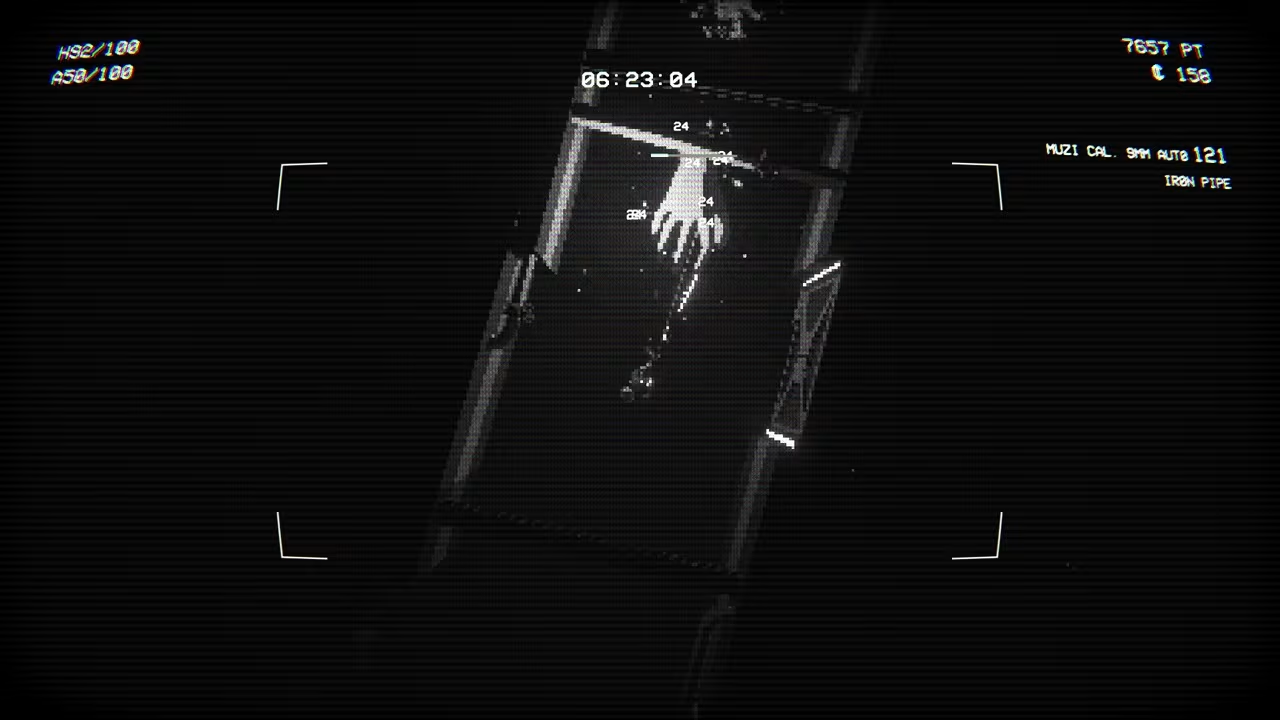
Empty Shell is a stylish rogue-lite horror game. Randomly generated maps that change each time you start a run are used in Empty Shell. Empty Shell is developed by CC Arts and it seems to be one of their first projects. Published by a Polish company, Hyperstrange, the game released on Nintendo Switch on 12th March 2024. The version reviewed here is the Switch version.

A rogue-lite is similar to a rogue-like, a rogue-like being a game where you explore, fight, and die. The player then repeats the run and no weapons, or key items that the player may have collected are saved for future runs. In other words, in rogue-like games, the player is often fighting enemies in dungeons, exploring, finding new paths to make progress, but then, when the player dies, they have to return to the start of the game with nothing that they’ve collected being saved. In a rogue-lite, you keep any key items that you found on previous runs.

In Empty Shell I noticed that some of the electronic devices that you find (that help to describe the game world) are kept on your next run. So, over time, you build up a library of lore documents. Each time you play the game, a character is given to the player and there is detailed biography information of the character that you are playing as. For example, I could be a 22-year-old named John Smith. The background to the game is that there is a group of people being held against their will and one at a time, they are sent into a facility in order to complete certain objectives. For the group, they hold fear of the facility as no one who goes there ever returns.

Horror

There is a clear Squid Game influence in the way that the characters are being held against their will, and sent to complete dangerous tasks. This is similar to the Netflix show, Squid Game. The game is definitely a horror title. There is little or no music as you explore the facility, but there are sound effects and generally an eerie sound design. I feel that the sound design isn’t perfect as the absence of a thematic soundtrack means that Empty Shell isn’t exactly a game that you can sit and chill to. However, it is appealing in other ways. The survivalist elements of being left in a facility swarming with monsters with only a shotgun, some shells, and a shovel does give you an adrenalin rush, and the gameplay is addictive and suitable for a playthrough every so often.

The combat with your melee weapon (which could be a shovel, or iron bar) is satisfying. You can almost feel the edge of the shovel crushing an enemy giant spider’s thorax. However, because the graphics are in black and white, and you see the action from a top down perspective, you can often hardly see what kind of creature you are fighting. There are spiders, zombies and other creepy monstrosities crawling towards the player at most times. It is wise to save ammunition for when you really need it and use the melee weapons on most enemies.

Gameplay

The game controls like a twin stick shooter. You hold the R button to engage you’re rifle or shotgun and then use the second analog stick to aim. It actually controls similarly to Diablo and other Diablo-like action RPGs. A game that I would say Empty Shell is very similar to, is Undead Storm and Undead Storm: Nightmare on DS and 3DS respectively. However, Empty Shell is many times more polished, has serious lore woven around it, and generally doesn’t feel like a budget game (unlike Undead Storm). Ironically, Empty Shell probably will fill the same gameplay niche as Undead Storm for most people who play it.

However, the genre of rogue-likes is prone to eliciting frustration in its players and Empty Shell is no exception. There is little feeling of progression when the player dies repeatedly and is sent back to the start of the game multiple times. Rogue-Likes aren’t my favourite genre of videogame so I’m sure that if you do like rogue-likes, you’ll enjoy Empty Shell because even though it’s not within my favourite genre, I enjoy playing it in bursts.

Conclusion

Overall, Empty Shell is an enjoyable Rogue-lite with a unique look and great horror elements. Reminiscent of past horror games, and with satisfying combat, Empty Shell is great to play in short bursts. While the gameplay loop may put some people off, if you are a horror fan, you could do a lot worse than Empty Shell. Furthermore, there is a wealth of lore hidden around the facility, and if you let the story ensnare you, you could get addicted to the experience of running through the facility narrowly escaping death at every turn.

Review: Pocket MP3 player

The Pocket MP3 player from Majority is an affordable and user-friendly device. Moreover, it has a beefy battery and it is lightweight. Accordingly, it is ideal for walkers, runners, and those who hate cumbersome tech. If you adore UK-designed goods, then this gadget will get your juices flowing. This compact music device was designed in the UK and the quality and expertise shows.

Alongside this, it has a whopping 16GB internal storage and is compatible with up to a 128GB external micro SD memory card. Accordingly, you’ll enjoy hours of non-stop music. If you then consider the vibrant HD screen, the built-in organiser, and the handy sports clip, this music player ticks many boxes.

What’s in the box of the Pocket MP3 player?

  • The packaging is compact and eye-catching. What’s more, it is recyclable and informative. 
  • The Pocket MP3 player is tiny! This miniature device looks great and is easy to handle. Moreover, the tactile buttons ensure that it is simple to use.
  • Charge the battery with the small USB cable. 
  • Wired headphones create a hassle-free connection. 
  • Learn the fundamentals with the user manual. 

Technical aspects.

The 300 mAh battery delivers an impressive 34 hours of music. Furthermore, 30 minutes of charge gives you 5 hours of playtime. As such, you rarely run out of juice. However, the battery life is reduced if you utilise the Bluetooth functionality. I was happy with the lower power capacity as the convenience of wireless audio outweighs the wired alternative. Yet, if you are happy with wired earphones, the supplied pair are more than suitable. The Bluetooth 5.0 connection is strong, stable, and has a low power usage. Consequently, it is ideal if you wish to workout or walk for long periods.

Alongside this, it is straightforward to add music to the Pocket MP3 player. Simply plug the device into your PC or laptop and transfer the files. Alternatively, load them onto your memory card and away you go. Either way, you are up and running in no time and I loved its no-frills approach. This MP3 player supports an array of file modes and this versatility was appreciated. Whether you have WAV, MP3, OGG, or APE, it matters not.

Usability. 

Where the Pocket MP3 player excels is its usability. The vibrant HD screen and clean UI were great to look at. Additionally, navigating each section was a cinch thanks to the tactile buttons. Once your music is loaded onto the device, you can organise it into playlists or simply allow it to select a tune for you. This rudimentary design makes this an ideal tool for technophobes. Subsequently, you can ask a tech-savvy friend to get your music sorted while you enjoy the benefits. 

If this wasn’t enough, there is a calendar, stopwatch, and voice recorder. These minor elements may not be to everyone’s taste, but they are handy. Moreover, they are simple to use and easy to look at. 

Build quality. 

This tiny device only weighs 33g. This lightweight design makes the Pocket MP3 player one of the lightest audio devices I’ve handled. Moreover, it is so small that it is barely noticeable when you wear it on your top or place it in your pocket. The monochromatic casing is made from hardened plastic and this ensures a robust finish. On top of this, the buttons are responsive, and the lock switch is easy to operate. Furthermore, the 3.5mm audio jack is sturdy. The provided headphones won’t blow you away, but they are suitable, refined, and pleasant enough.

The HD screen is a joy to navigate, and it is neither too bright nor dull. I had no issues using this in blazing sunshine nor was it problematic during low light. As such, this is the ideal tool if you like to work out at random times. The USB-C port is well-positioned, and I experienced no problems when connecting the cable. Finally, the sports clip is robust, and it offers enough pressure that the device never moves. 

Is the Pocket MP3 player worth it?

Available for under £30, the Pocket MP3 player impressed me. It has a great battery life, quick charging, stable Bluetooth, and it is easy to use. Moreover, it is robust and perfect for walkers and sports people. Consequently, if you wish to be free from your phone, but still have the option to listen to some tunes, then this is the product for you. Accordingly, I love it and I recommend buying it here!

(More information on Majority can be found here!)

(Full Disclosure! Majority provided a sample for this review!)

A Closer Look at The Man from Sector Six

With Fathers Day not too far away, we take a look at The Man from Sector Six from The Mystery Agency.

Enter a world of intrigue, solve the puzzles, and secure the future – “The Man From Sector Six” escape room games needs your detective skills.

The Man From Sector Six is the fourth in the award-winning series created by Henry Lewis, the Olivier winning writer and star of internationally acclaimed ‘The Play That Goes Wrong’ and host of ITV’s ‘Riddiculous’ quiz show.

When you open the box, you’ll discover a newspaper cutting and a locked, official-looking document portfolio that was left behind by a mysterious agent who suddenly appeared and then disappeared again. You’ll also learn that the agent left behind a dire warning about a monumental peril facing humanity, setting the stage for an urgent and totally immersive challenge.

Multiple brainteasers and locks, featuring a variety of puzzle types, will put your team of detectives’ problem-solving skills to the test. You will also need to uncover and hack into a hidden website to discover more clues about this secretive agency.

The inclusion of real-world objects such as a brass rotating cipher wheel and a complex data chip that serve as clues, ensures a truly authentic and engaging home escape room experience like no other. This meticulous attention to authentic design for all elements keeps players fully absorbed in the mystery all the way through.

Nothing gets damaged during play, making it fully resettable so you can share with others afterwards. Reset instructions are provided online.

The Man From Sector Six escape room is recommended for 1-6 players from 12 years to adult, encouraging entertaining teamwork or providing a thrilling solo adventure. If you do get stuck, help is available for each puzzle. The help is graded from very little ‘hints’nudges’ through to giving you the full answer.

If you are a fan of escape rooms or puzzles, then The Man from Sector Six is just what you are looking for. It’s very cleverly designed and is so much fun and you can reset and replay it over and over again!

The Man from Sector Six from The Mystery Agency is available now priced around £50.

You can learn more from The Mystery Agency Website.

Review: DUEX Plus Portable Laptop Monitor

Here is our review of the DUEX Plus Portable Laptop Monitor from MobilePixels.

DUEX Plus offers a slightly larger display screen at 13.3” and is ideal for professionals and those who wish to multi-task with ease. Whether you’re presenting, gaming, teaching, or multitasking, DUEX Plus is a clean, simple to use, plug-and-play solution. 

Specifications

13.3″ FHD or 1080P Display

11.7”L x 6.5”W viewing area and a 16:9 aspect ratio

 • Auto-Rotation Display

Featured with G-sensor for auto-rotation

 • Lightweight & Portable

Made with durable PC-ABS plastic and robust aluminum alloy

 • Multi-Device Compatibility

Any laptops, Nintendo Switch and Samsung DeX supported devices

 • Hybrid-Signal Input

Quick connectivity with any laptop with a USB-C or USB-A port

What’s in the Box?

The box contains the monitor, cable and instruction manual.

A Closer Look

Final Thoughts

If you have ever thought how useful it might be to have a second monitor but didn’t have the room, the DUEX PLUS Portable Laptop Monitor is definitely for you.

Setting up the monitor was very quick and easy – place the magnetic plates toward the monitor side and remove the stickers, center the screen against the back of the laptop, open the laptop and slide the monitor out and swivel the screen to the correct viewing angle, then connect the cable – that’s it! The laptop works with either a USB-C or a USB-A connection.

You can then setup the screens however you want them either in Windows or on a Mac, it even works with a Nintendo Switch!

The quality of the screen is excellent and it is very lightweight (only 1.3 lbs) making it very portable (which after all is the whole point of getting it). There is a 270 degree viewing angle so you should be able to find that perfect position for wherever you are. You can use the monitor in either portrait or landscape mode and even adjust the brightness too.

The whole process is simple and I found myself wondering how I ever managed to get by without that second screen. If you have ever thought that a second screen would be useful but didn’t have the room or wanted or needed it to be portable, then take a look at the DUEX PLUS Portable Laptop Monitor – you won’t be disappointed.

The DUEX PLUS Portable Laptop Monitor is available now priced at £259.

You can learn more from the MobilePixels website.

Disclaimer: The DUEX PLUS Portable Laptop Monitor was sent to us for the purposes of an honest review. All opinions are the opinions of our reviewer.

Review: Skaramazuzu

A soothing story driven fetch quest.

Skaramazuzu is a rather interesting project. The premise is rather basic , you wake up with no recollection of who or where you are. The art style even though quite simple is very clear, from the character you can interact with to all the objects in the over all world that can be used or picked up. Following in the footsteps of its art direction , the gameplay is also very simple. The games mechanics only require you to walk and talk to various character who are in possession of some item that you will need, and since they never have the need for said item themselves you are free to grab it off them. For a price. The entire game is you finding out more about the situation you found yourself in by chatting away to certain creatures in this ‘limbo’, and then fetching something for them so that they may give you an item that you were tasked to fetch for someone else.

Other than these characters and creatures you will also find yourself interacting with items, keyholes and rotating mechanisms in order to find 4 orbs spread around the games world in order to finally learn exactly what and who you are.

I will not mention anything about the story as the game is rather short, I have completed it within 3 hours or so. it is definitely a nice experience if this is the sort of game you are into. To me the walking back and forth and talking with the same no voice acted characters to see if there’s something I missed was tedious, but definitely rewarding when my brain finally clicked and I solved the puzzle / riddle. The game is sitting at $10.59 which in my opinion isn’t worth it for a 3 hour experience with no replay-ability factor but that may be due to me not being a fan of such games. With that in mind I still commend the game for what it is. A story focused puzzle experience, and this it does pretty well.